YAMA AHA A RD350LC 80 0s
IR RN-BRU special
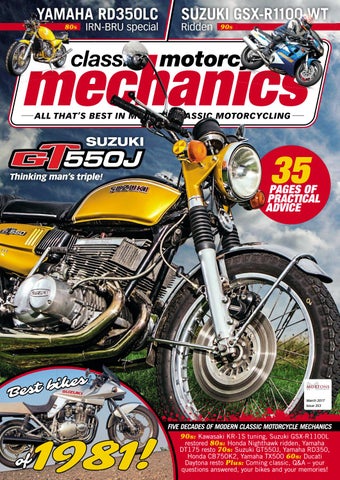
Thinking man’s s triple!
SUZUKI GSX-R1100 G 100 WT Ridden
90s
35
PAGES OF PRACTICAL ADVICE
March 2017 Issue 353
FIV VE DECADES OF MODERN CLASSIC MOTORCYCLE MECHANICS 90s: Kawasaki KR-1S tuning, Suzuki GSX-R1100L restored 80s: Honda Nighthawk ridden, Yamaha DT175 resto 70s: Suzuki GT550J, Yamaha RD350, Honda CB750K2, Yamaha TX500 60s: Ducati Daytona resto Plus: Coming classic, Q&A – your questions answered, your bikes and your memories!
62
❙ WORKSHOP NEWS
64
❙ Q&A
66
❙ YAMAHA DT175 MX
New parts, kit tested.
Mark Haycock, Scoop and you with tips!
Ralph Ferrand sorts the suspension out this month.
70
❙ YAMAHA RD350
74
❙ DUCATI DAYTONA
78
❙ KAWASAKI KR-1/S
Scoop MoTs his two-stroke twin.
Pip Higham restores a Duke. Stan Stephens on tuning this two-stroke race-rep.
89
❙ SUZUKI GSX-R1100 L
94
❙ YAMAHA TX500
98
The Suzuki apprentices finally finish the beast! Steve Cooper’s buyer’s guide on this quirky twin.
❙ YAMAHA FZS1000 FAZER Bertie makes a case for this being a ‘coming classic’.
106 ❙ YAMAHA TX500
Mark Haycock on some issues with his!
108 ❙ DUCATI 996
Jim Lindsay polishes his Bologna bullet!
Contents 06
ARCHIVE
30
08
1984 HONDA NIGHTHAWK
36
SUBSCRIBE!
12
NEWS
38
1998 SUZUKI GSX-R1100 WT
47
YAMAHA RD350LC SPECIAL
18 20 22 26
King Carl Fogarty in all his pomp.
Bertie Simmonds gets off quietly surprised! All of what’s occurring in the modern classic world.
CALENDAR
Be a mad March hare!
FEEDBACK
Your letters and emails about CMM.
SHOW US YOURS
52
4-HOUR ENDURANCE
60
Now with added nostalgia! Check out ‘The Way We Were!’ The latest on this must-see event.
SUZUKI GT550J
Steve Cooper rides the thinking man’s two-stroke.
Subscribe and save cash!
Bertie rides a big bruiser: but does he like it?
Brian Thomson’s beautiful IRN-BRU LC.
BEST BIKES OF 1981
John Nutting goes back to the time of Bucks Fizz and fine bikes.
RETRO REBOOT
It’s back! What would a modern Z1300 look like?
114 NEXT MONTH
Yamaha RD350 N2, Kawasaki Z650 and a GL1500 Gold Wing and much more!
112 ❙ HONDA CB750 K2
Mark puts his carbs back together.
www.classicmechanics.com / 5
1984
st torcycle ju o m a g in t a . underestim k Bertie Simmonds f o p a r t e th as yle – just o fall into It’s easy t you don’t like its st OTOS: GARY ‘D’ CHAPMAN NDS PH because E SIMMO DS: BERTI WOR
I
’m clearly not going to enjoy riding the Honda Nighthawk, right? It comes from an era that style couldn’t recall and is a class of bike that I don’t really care for. Now, the 1980s saw some very fine motorcycles produced; we could rattle off the likes of the Suzuki GSX-R range, a stable full of Kawasaki GPzs (and GPXs), ZXRs, Yamaha RDs, FZs and a host of Hondas, but bikes of – well, bikes of this style just weren’t really my thing back in the day. It just seemed that they were neither fish nor fowl: I’m talking about motorcycles like Kawasaki’s Eliminator family, where fantastic engines would be saddled with a style and a chassis that just didn’t compute with me back then or now. In fact, take the ZL900 Eliminator: the motor was the sublime GPz900R’s but the styling… well, it just doesn’t work, does it? I’m not some race-replica above everything fan, as I love a good quirky cruiser – preferably one with a characterful motor, like a Yamaha VMAX, but the Eliminator? No thanks. I can’t help but be reminded of the Kawasaki as I approach the Nighthawk. The first thing I’m noticing about the CB650SC is the natural patina it proudly displays. Nowt wrong with that: the patina includes some rust spots on the odd bolt and fastener, paint flaking off some of the engine finning and lacquer peeling off the forks. But let’s remember this is a 33-year-old motorcycle and other parts still look good: most noticeably the paintwork, decals and exhausts. It’s a Honda, then. Of course, we never really got the Nighthawk in the UK and this bike itself is an import from Pennsylvania in the USA, but the styling is very reminiscent of the Eliminator. It’s the similar sort of ‘lean-back’ styling and custom-esque 16in rear wheel and 19in front. The teardrop tank slopes back towards the seat and the slash-cut exhausts hint at performance that (surely) isn’t even there.
8 / classic motorcycle mechanics
www.classicmechanics.com / 9
NOSTALGIA
Europe’s best classic endurance teams are ready to head to Donington Park for the 4-Hour. WORDS: BERTIE SIMMONDS PHOTOS: CLASSIC BIKE TRACKDAYS
T
he CMM-backed Endurance Legends event will play host to the first round of the European Classic Series. Classic Bike Trackdays will put on the Endurance Legends event at Donington Park over the weekend of May 6-7 and it promises to be an unmissable weekend of classic race action. CBT’s Darin Frow said: “We're very pleased to confirm that Endurance Legends will also host the first round of the 2017 European Classic Series. As the debut ECS event in the UK, this means that visitors to the Endurance Legends event will see the best European endurance teams compete on British Tarmac for the very first time. It also means the 4-Hour endurance grid is already provisionally full, subject to any cancellations of course! “We are confident that International Classic Grand Prix race and Lansdowne classes will also have full grids, and each of the track sessions are over half full already as well. It’s all amazing news and to say that we are over the moon about it would be an understatement.”
26 / classic motorcycle mechanics
CLASSIC RIDE WORDS: STEVE COOPER PHOTOS: GRAHAM ‘D’ CHAPMAN
Shadow
BOXER Scoop finds out if Suzuki’s GT550J is still living in the shadow of Kawasaki’s 500cc two-stroke triples.
A “
lways the bridesmaid, never the bride”; if you’re into 1970s classics then that phrase may strike a chord with you when run alongside Suzuki’s GT550. For reasons that are as biased as they are inaccurate, the middleweight triple has perpetually lived in the shadow of the Kawasaki H1 both then and now. Back in the day, in the UK at least, some insurance companies ran a capacity break from 351-499ccs which meant, against all logic and common sense, that a GT550 was perceived as more of a risk than a Kawasaki 500 Mach III. Four decades on and the Hamamatsu machine is still perceived as the poor relation, somehow a lesser entity, less charismatic and, ultimately, is perceived as being worth less: all of which is a huge shame and totally unjustified. The two manufacturers were always aiming at different target markets and whatever anyone else might say then or now a direct comparison is about as valid as comparing apples with oranges; different flavours, different uses, different riders. Suzuki’s logic at the time of the bike’s inception was a lot more sensible than it might at first seem. Having delivered a raft of hugely successful singles and twins; triples were the next logical step. However, Kawasaki had got there first in 1968 with its ‘take-your-brain-out, heart-into-your-mouth, bum-clenching’, 500 triple Mach III. Where was the mileage in making an analogue of something already so iconic? Suzuki’s GT750 triple had been launched in 1971 as a genuine Grand Tourer, a two-stroke alternative to Honda’s CB750/4. Even if the contemporary test riders wanted more speed out of the Kettle, most riders were more than happy with its easy-going performance and wide spread of power. So if the top-end of the market was happy with the 750 why not spread the joy around and roll out similarly good natured smaller capacity machines aimed at riders that didn’t necessarily want all-out performance? Quite why the 550 engine was chosen (it’s actually 543 cubic centimetres) is anybody’s guess but it was probably to differentiate the bike from the Kawasaki. Suzuki also needed to distance its new
30 / classic motorcycle mechanics
www.classicmechanics.com / 31
Suzuki’s 1995-on GSX-R1100 was the best ever – and the last of the line. Bertie Simmonds finds out whether, 22 years on, the beast still lurks within. WORDS: BERTIE SIMMONDS PHOTOS: MORTONS ARCHIVE
M
y first ever speed-test hoon as a fledgling motorcycle hack came on a water-cooled 1100 and – as a big bloke – I realised I had fallen in love. The test was all about big Suzukis and Suzukipowered machines, so we had a budget RF900, some daft Bimota SB6 thing which never worked or did as well as the standard 1100 down the strip, and a couple of specials. Being given the keys to the 1100WP for the ride home and a couple of days was fantastic, better even than the adrenalin rush of doing 170mph(ish) down Bruntingthorpe’s long runway. The few days we spent together were a blur of blistering road-rides, my first ever stoppie (the WP was one of the first bikes fitted with the six-pot Tokicos) and a scary front end slide (those Tokicos again, mixed with oily Tarmac at a set of traffic lights). That bike got so far under my skin that a couple of years later in 1996 I managed to bag a WS model for a few weeks and it was more of the same: a big sportsbike for a big bloke. Little wonder I ended up buying one some years later. Fast forward to 2012 and I bought the very GSX-R1100WT you see in these pictures. My first impressions of the old 1100 were positive. Look at her – she’s a beauty, even with mid-1990s shell suit blue graphics. With so few miles on the clocks (8000) and even the original factory plastic covers on the replacement OE silencers before my first ride, this bike is a minter. Throwing a leg over her was a different matter: I couldn’t remember the pegs being quite so cramped and was it really such a stretch across the long, wide tank to those bars? At least the motor was as I remembered it. The WT was the last of the 1100 breed to be sold in the UK and they were unrestricted. Press reports of the day quoted bhp as anything between 125 and bordering on 140 at the back wheel: so not bad at all, even in today’s world of 200bhp. Interestingly, as a comparison, 2012’s GSX-R1000 L2 was making 86lb-ft of torque compared to the 80 of
38 / classic motorcycle mechanics
www.classicmechanics.com / 39
This is a bike many years in the inspiration and in the making: welcome to Brian Thomson’s labour of love: the IRN-BRU Yamaha RD350LC Powervalve! WORDS: BERTIE SIMMONDS PHOTOS: GARY ‘D’ CHAPMAN, BRIAN THOMSON
T
his story starts almost 25 years ago, with a legendary motorcycle built by Nick Daniels. In the hallowed pages of September 1993’s Performance Bikes (perhaps the 1990s’ finest motorcycle magazine) Nick’s 7Up-painted Yamaha RD350LC became an iconic example of the two-stroke special and it hit a switch in Brian Thomson’s head. It’s taken a further 23 years to come to fruition, but Brian has finally finished his homage to that most special of specials. Ladies and gentlemen, check out the IRN-BRU Yamaha RD350LC Powervalve…
Brian and the IRN-BRU LC.
Now, let’s start with the theme of this RD350LC. Coming from Dollar, in Scotland, there really was only going to be one choice of colour scheme. Right, Bri? “Well, yes I’m Scottish so my thought was to use IRN-BRU as I love the stuff too. I wanted to make a homage to the 7Up bike of Nick’s so figured that was a good way to go – although I did also think of using Vimto for a while!” Introduced way back in 1901, IRN-BRU, known as ‘Scotland’s other national drink’ is an institution and also just happens to come in a very colourful can. Perfect for a paint job, but first a suitable donor bike needed to be found.
www.classicmechanics.com / 47
READER’S SPECIAL
Colour scheme not quite 100% IRN-BRU...
“For me the 7Up RD350LC special just flicked a switch in my head and I really wanted to make my own homage to it.”
Brian says: “Nick’s 7Up bike was the most stunning LC I’d ever seen. We all have bikes that affect us and this was one that affected me. This bike really floated my boat. I’d been thinking about it for 20 years or more, but then I joined the two-stroke forum in 2010 or 2011 and thought ‘let’s do it’. I finally saw a bike for sale: an LC with a YPVS motor (which was what I wanted). I looked at it and bought it for £870 but as a ‘non-runner’. Those two words would haunt me and become a pain in the backside. One thing I’ve learned with a two-stroke – especially one that’s sat for 16 years – is get it running first.” Brian is 54 and his family always had bikes, even if he wasn’t that bothered with them at first. He says: “I’d go on the back of bikes but wasn’t bothered until my cousin bought one when he was 14! That fired up the old jealousy so I wanted one! “I’ve basically had bikes continually since then: dad got me a cheap 50cc Step-Thru and since then I’ve had the likes of a GSX250, RD400, Kawasaki GPz1100B1, Z1000J, a Katana 1000 – that was beautiful! I had a bad crash on that. When I remember my old bikes I was always changing the paint to what I wanted. I was always making the bikes individual to me.” It’s fair to say here and now that Brian isn’t the biggest fettler/builder in the world. In his own words he says: “This bike was always going to be a reality of what a special really does cost for someone who doesn’t have the ability to do it all by themselves and I’m comfortable with that. In many areas I didn’t have a ‘Scooby Doo’, but I learned as I went. “I also knew what I wanted: something in-period that looked right. This is why I went with right-wayup forks and modern wheels rather than spoked.” The decision on the chassis was one which was made with the help of Nigel Kimber from NK
48 / classic motorcycle mechanics
Racing. Bri explains: “We were chatting and I was asking what works and he mentioned the CBR400RR front and rear-end but that he’d never done the front before so it was the first one he did. From there it was a long process getting the bike to how it should look.” A long process and an expensive one, right Brian? “It was a case of ‘no expense spared’ when I could afford it! I had £600 of OE Yamaha parts from Webbs of Lincoln alone. I stripped it all down and got the engine sorted first to be fair: that was three or four years before the rest of the bike as I thought that was the most important thing, then the frame and swingarm.” The motor proved to be the hardest thing to get right, despite Brian hiring the biggest names in the business to help. He explains: “Barry Moore did the engine and the wiring for it. Barry’s philosophy is funny, he said ‘I will do it no problem, but if I give you list of parts then you get them, no quibbles!’ So, if Barry wants 20 particular parts from Yamaha, then you do it his way. The guy is so meticulous and his work was faultless and Barry got this non-runner running, but then we had to get it running right, which meant time on a rolling road.” Enter stage left Mick Abbey and Two Stroke Forum member Dave Whattam – known to many as ‘Mutt’s Nutts’ on the various forums! Brian explains: “These two got the bike sorted. Both are gods on two-strokes and worked their magic. They worked on the bike for 10 hours straight one day to get the thing sorted.” Eventually after many hours on a rolling-road dyno the YPVS motor showed 59bhp, which Brian was well chuffed with: “It’s all completely standard to be honest, apart from the beautiful Blue Haze/Barry Dawson expansion chambers. I really just wanted a reliable bike and from that 59bhp I can always tune it if I want to, but to be honest I didn’t want to keep taking the motor to bits if it was over-tuned and
MIRA FILES
Superbikes got faster and heavier at the start of the 1980s, so new sophisticated ways of getting performance emerged. John Nutting recalls the bikes that appeared during 1981. WORDS: JOHN NUTTING PHOTOS: JOHN NUTTING, MORTONS ARCHIVE
I
t was the year when we got a glimpse of what the future of motorcycles might look like. And didn’t we need it. Amid economic gloom, the world at the beginning of the 1980s was just as uncertain as it is now. Throughout 1981 there was raging inflation and unemployment and riots in Brixton and Toxteth, a new US president in the form of Ronald Reagan and a Labour Party tearing itself to pieces as its leaders left to form the Social Democratic Party. So desperate were we to escape from all this that New Romanticism was growing with the top selling album of the year in the UK coming from Adam and the Ants – Stand and Deliver and Soft Cell topping the singles charts with Tainted Love. It took the wedding of Prince Charles and Lady Diana Spencer at Westminster Abbey in the summer and Ian Botham’s stunning batting to beat the Aussies single-handedly at the Headingley cricket test to show the British that there were some things to celebrate. At least I had seen the future of bikes and that provided some encouragement in the gloom. The previous autumn at the Cologne Show in Germany Honda had unveiled the prototype of its turbocharged CX500, a machine completely at odds with what we’d expected. Performance motorcycles were getting bigger and more unwieldy with 1000cc or more machines offering blistering if hairy acceleration and speed. Could turbocharging provide the answer with smaller but more potent engines powering less bulky motorcycles? Also shown at Cologne was a mock-up of Suzuki’s Katana 1100, styled by Hans Muth at Target design to look like some spooky Star Wars projectile. Could this escapism also be the way ahead? We would find out later in 1981. British bikers were lucky that year because the International Motorcycle Show had been organised to be held at the National Exhibition Centre in Birmingham over the Easter holiday. The previous autumn’s Earls Court event had been a damp squib, and with manufacturers holding the unveiling of their full
52 / classic motorcycle mechanics
The CBX morphed into the Pro-Link for 1981...
www.classicmechanics.com / 53
WORDS AND PHOTOS: RALPH FERRAND.
www.haynes.co.uk
Project Yamaha DT175 MX Part 6
Boing boing!
Yup, it’s time for Ralph to sort the suspenders on his mud-plugging Yamaha.
T
his month I’ll be turning my attention to the DT’s suspension. The shock is like no other I have previously encountered, being pretty much twice the length of a traditional shock, disappearing up inside the top frame rail with its top mount being just behind the headstock. It has nitrogen gas and oil separated in a mono-tube construction by a floating piston, thereby preventing ‘airation’ (mixing of oil and gas). Luckily for me, despite the serious abuse this poor bike had suffered over the last 35 years, the shock seemed to be in perfect working order, which is just as well since, according to the manual, it is not serviceable and I have very grave doubts about the availability of a replacement. Mechanically it may have been in good shape, but pretty it was not, so I removed the spring using my suspension press and masked up the main body in preparation for a bit of rattle canning. First up was the pre-load adjuster ring. This was originally zinc plated, but it was not removable, so paint was the only practical solution. I usually apply paint outdoors, but as this was only a small job, I sprayed it in front of the extractor fan. Once the primer was 66 / classic motorcycle mechanics
The piston rod and main damping body masked up and the adjuster ring primed.
Wheel silver from a rattle can gave a reasonable finish for the adjuster ring.
dry it was followed up with some wheel silver. After that coat was hard, I masked over the preload adjuster and removed the masking from the shock body and ‘keyed up’ the original coating with some wet and dry paper. I didn’t get too anal about the paint as it was never going to be seen by anyone save my good, though critical, self. The original label will be irreplaceable, and call me
sad, but while it’s in far from perfect condition, I rather like it as a historic feature. So I masked it up. Before any paint was administered, the surfaces were thoroughly cleaned with panel wipe (preparatory cleaner) on clean paper wipes. Once free from any grease or other allied detritus that might lessen the grip of the paint, I primed it and then finished it with PJ1 Fast Black. As soon as the paint had