Z
CAFÉ
CLASSIC BIKE GUIDE || CONTENTS
060 006
RIDING LIFE
010
SUBSCRIBE!
012 018 024 030 034 038 040
Report on a giant jumble, with some great old bikes
Save money, get the magazine early. Thrills undiluted. Excitement possible
NORTON COMMANDO MK3 Electric ladyland
DUCATI PANTAH Belts and braces, possibly
TRIUMPH TR5 When 500cc was all you needed
042 044
MARK WILLIAMS Learning different lessons
PAUL MILES Two-strokes make sense
048 060 070 080 090 102
RIDER GEAR Keeping warm in winter
RIDER ART Calendars and seasonal offerings
LETTERS Debate, wisdom, intelligence
PAUL D’ORLÉANS Centenarians on the road
112 129
080 130
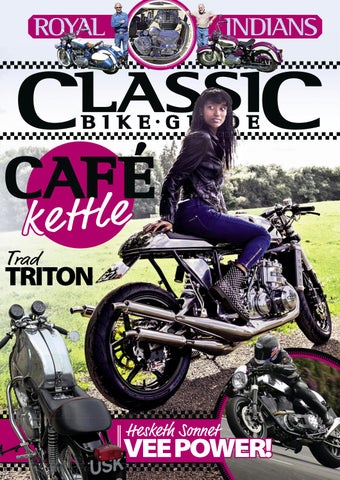
HESKETH SONNET British, brash and brutish too
TRAD TRITON That fabled combination
MASH TT40 A most singular café racer
RE CHIEFS Two little Indian twins
LAVERDA 750 TWINS Far more than you thought you knew
CAFÉ KETTLE Suzuki’s bigger stroker, stripped right back
READER ADS Lots and lots to look at
A SUNDAY FETTLE A-WAITING By Tim Gladdis
FRANK WESTWORTH Unhinged by a bracket
CLASSIC BIKE GUIDE || NOVEMBER 2016 3
RIDINGLIFE || NORTON COMMANDO
Above: A genuine Norton classic, and a more than simply capable high miles touring machine, the Mk3 is arguably the best of the Norton twins 1: Opinions vary on the effectiveness of the single disc and its caliper. Lots of fine upgrades are available, happily 2: Mk3 versions of the Commando saw the gearshift shifted to the left of the machine, swapping places with the rear brake pedal. The kickstart is easy to use … which is just as well 3: Although the infamous starter motor lives in the space originally occupied by a magneto, it drives through the primary side of the engine. This is an original Prestolite motor 4: Riders asked for a fuel tank which would allow a decent range. This one can easily run for 250 miles, Commandos being frugal enough if run in the torque bands. Bars match the rests, making for a good riding position
Self starter
Gentlemen, start your engines! In your own time. Any day now… PHOTOS BY CHRIS DICKINSON
AS WE NEVER tire of telling you, the Norton Commando was awarded the UK’s ‘Machine of the Year’ accolade five times on the trot, from 1968 to 1972. Which was great news for the beleaguered British bike industry, but it posed a pretty problem. Just what do you do for an encore, when your next generation sportsbike is resolutely welded to the drawing board? After the ghastly debacle of the highly-tuned self-destructing Combat engine, it was obvious to the engineers at Norton Villiers that if they wanted their venerable air-cooled pushrod twin to supply more torque at rider-rewarding rev levels then there could be no substitute for cubes. So for 1973 the Commando 750 engine was enlarged again (it started life as a 500 Dominator, remember), bored out by 4mm on each cylinder to give 828cc. While outright power was little more than was produced by the original 750 – and considerably less than the Combat engine could achieve – the
12 NOVEMBER 2016 || CLASSIC BIKE GUIDE
850 engine was set up to deliver the goods at grininducing revs. The 850 Commando hit peak torque at around 3000rpm, 2000rpm lower down the range than the 750. This big fat gain at the bottom end was of course compensated for by a corresponding drop off in performance at higher revs, so there really is no point in thrashing an 850 Commando much past its peak power point of 6250rpm. In classic use you’ll rarely need to explore those giddy heights anyhow: there’s just too much fun to be had rolling on in third gear at around three grand. Crack open the throttle on a clean-running 850 Commando and the sudden lunge forward is akin to being given a 50,000 Volt wake-up call courtesy of Mr Taser… Increasing the Commando’s engine capacity had much the same effect as Viagra does on a chap of a certain age: it definitely perked up performance and put a smile on plenty of faces. It didn’t make the underlying design any younger, however, and Norton’s
RIDINGL LIF FE || TRIUMPH TROPHY
Top honours Triumph took three gold medals and the team trophy in the 1948 ISDT, and launched a legend Above: As was the way back then, even though this is intended for off-road use, it is also entirely functional on the hard stuff, even down to a centrestand 1: The tank-top grid is useful, and was a Triumph trademark for many years, but the consequences of a sudden stop could be worrying 2: Front brake was adequate, better than that on the rough. The fork is Triumph’s own, and is a little spindly 3: Big fat tyre demanded decent clearance below the mudguard, while the tipped seat encouraged closeness between rider and pillion 4: The slender Avon Speedmaster Mk2 tyre on its 19-inch rim provided on-road accuracy. No use at all off that road
WORDS BY FRANK MELLING PHOTOS BY CAROL MELLING
WHEN THIS TR5 was built in 1956, a visitor to Triumph’s Meriden works would have found the highest-paid workers in the Coventry area, with boundless pride in the machines they were making. The TR5 Trophy fed a near insatiable demand from the critical American market for off-road sports bikes. These were dual-sport machines which could be used for serious off-road racing, trail riding or road use. There are two magic keys to the TR5, essential to the machine’s success. It had to be light. It also had to make the correct sort of power for off-road use. To meet both requirements a bronze cylinder head might have been the answer, but this was expensive and heavy. By 1947 Triumph had gained a lot of experience in casting alloy heads and barrels thanks to the RAF generators it had manufactured during the war. After 1945, these parallel exhaust port engines became the basis for the Triumph Grand Prix road-racers. At the same time, Triumph defied the
24 NOVEMBER 2016 || CLASSIC BIKE GUIDE
received wisdom that a big, four-stroke single was required to win in off-road events. Jim Alves began competing on a 350 Triumph twin in 1946 and soon shocked the established off-road stars. There were, however, two problems with the generator-type cylinder head and barrel. Triumph twins always run hot when tuned and, while the highspeed air-flow satisfactorily dissipated the heat from the Triumph GP’s parallel exhaust ports in road racing, the motor ran too hot in competitive off-road use. A splayed head, with the exhaust ports widely separated, was required for the engine to stay cool when used off-road. The second problem was one of marketing. Edward Turner knew that the ex-generator engine looked dull and crude, regardless of how well it went. In 1950 Turner came up with a solution to both issues and this was the Trophy’s iconic fine-pitched alloy head and barrel, which it shares with the roadgoing Tiger 100. Here was an utterly beautiful
RIDINGLIFE || ARTS & CRAFTS
art of the motorcycle The
At this time of year, thoughts turn to calendars, cards and Christmas gifts. CBG’s artists in residence have plenty to offer on all counts…
LOUISE LIMB WELL KNOWN FOR her motorcycle illustration work, Louise has been collecting some of her favourite works to display in her popular calendars for the last seven years. Her 2017 Motorcycle Art calendar features a selection of classic images from her illustration archive – and maybe even the odd surprise new piece – and is guaranteed to brighten even the darkest February day. The calendar retails for £16.50 including UK delivery; the first 100 are signed and numbered by the artist. Also available: Christmas cards, greetings cards and, made especially to order, signed archival quality prints in various sizes. See louiselimb.com
IAN CATER “I’D ALWAYS BEEN fascinated by the style and rugged simplicity of 1950s and 60s British bikes,” says Ian. “A chance visit to the Ace Cafe Brighton burn-up re-ignited my interest. As well as rows of beautifully preserved Triumphs, BSAs, Nortons and café racers, I discovered many people not just still riding these machines, but dressing the same way and listening to the same music they had 50 years before. Much of my work is a celebration of those superb machines and the people who ride them. Men and machines of character.” High quality, giclée art prints cost £40 at A3, £70 for A2. See motorcycleartuk.com
34 NOVEMBER 2016 || CLASSIC BIKE GUIDE
HESKETH SONNET
Two-wheeled Cobra
It’s the very definition of the current café craze. Hesketh’s latest roadripper is here WORDS BY ALAN CATHCART PHOTOS BY KYOICHI NAKAMURA
48 NOVEMBER 2016 || CLASSIC BIKE GUIDE
N
othing succeeds like success, and English entrepreneur Paul Sleeman’s achievement of selling all 24 examples of the limited edition Hesketh 24 V-twin streetfighter costing £35,000 each (including 20% VAT) with which he brought the aristocratic British historic marque back to the marketplace in 2014, has now resulted in the debut of a follow-up model – the more retrothemed Sixties style Hesketh Sonnet café racer. In doing so, it confirms the restoration of a brand to the marketplace whose CV is so improbable that it’s worthy of a Hollywood screenplay – as indeed transpired in the recent Formula 1 movie Rush.
CLASSIC BIKE GUIDE || NOVEMBER 2016 49
FEATHERBED CAFÉ RACER
Trad
TRITON Modern technology offers many different ways to build a cracking café racer, but it’s hard to beat the original combination of a Meriden motor and Featherbed frame… WORDS & PHOTOS BY STUART URQUHART
60 NOVEMBER 2016 || CLASSIC BIKE GUIDE
TRADING
||
MODEL HISTORY
WOODBURY SEASON, WORDS BY NOLAN MILES, ROWENA HO WOODBURY, PAUL S ARCHIVE R, PHOTOS BY NOLAN POTTE MORTON HAERTER, SCOTT G AN LFG WO , IVE JEAN-LOUIS OL
ade of the They inhabit the sh verda twins big triples, but Laeir own have a style all th
90 NOVEMBER 2016 || CLASSIC BIKE GUIDE
‘It’s a Kettle, Jim, but not as we know it…’ WORDS & PICS BY ROBERT DAVIES EXTRA PICTURES FROM ROBIN HORTON
BEING MOSTLY A conversation between CBG’s Robert Davies and Café Racer creators Martyn Wilkins and David Cooper: If Mr Spock’s Leonard Nimoy were still alive he might say, ‘It’s a GT750, Jim – but not as we know it.’ And he would be right, for this type of conversion is way beyond your average bike fettler’s ability, being undertaken by two university engineers, who are at pains to state that they are not professional motorcycle builders. Having said that, between the two of them they
have a considerable amount of skill and knowledge about motorcycles. To indicate the gulf between a standard Kettle and Martyn’s Café Racer, I have included a picture of the Standard K model I owned back in the wild days of 1978. That bike was fabulous, and it was light years ahead of the BSA A10 I had just replaced it with. I just loved to turn the ignition on the Suzuki to see all those pretty coloured lights come on, and then to simply press a button to fire up the engine, and not have to jump furiously up and down to get the motor going.
CLASSIC BIKE GUIDE || NOVEMBER 2016 103