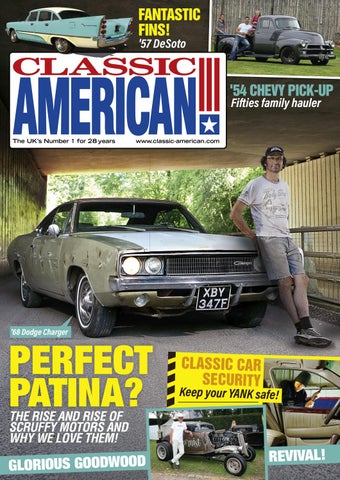
FANTASTIC FINS!
'57 DeSoto
'54 CHEVY PICK-UP Fifties family hauler
'68 Dodge Charger
PERFECT PATINA?
THE RISE AND RISE OF SCRUFFY MOTORS AND WHY WE LOVE THEM!
GLORIOUS GOODWOOD
CLASSIC CAR SECURITY
Keep your YANK safe!
REVIVAL!
59
53 35
41
26
Contents December 2016
Regulars
Features
06 12 14 16 18 20 22 82 84 86 90 94 106 110
26 35 41 47 53 59
News Letters Across the Pond Muscle Car Files Here to Obscurity Subscription Offer CA Shop Reviews Tex Discoveries Events Rear Window Services Directory Private Classifieds
1968 Dodge Charger 1941 Buick 1957 DeSoto Lee Iacocca Isle of Man Museum Tech: Security
Events 64 Can Am Show 67 Goodwood Revival 73 Prescott 78 Beaulieu American & Modified 97 A&M News 100 1954 Chevy Truck
100
67 classic-american.com 5
Huw Evans
The 1970 Dodge Challenger is one of the most popular American classics today, but that wasn’t always the case. Photo: FCA
Across
the
pond
Popularity isn’t everything Evans celebrates the obscure while pointing to the fact that today’s popular classics weren’t always so celebrated…
O
ne of the things I love most about this hobby is that everyone’s got their own favourite cars and trucks. Granted some are more popular than others, ’69 Camaros, vintage Mustangs etc., but if you actually look at this hobby stateside, or just about anywhere else actually, it’s amazing what you’ll find tucked away in people’s garages. Of course, there are those so-called experts that are quick to deride some vehicles, claiming they aren’t worthy of true classic status, but in my view that’s missing the point. Okay, so something like an AMC Pacer or Lincoln Versailles may not be everybody’s cup of tea but both are historically significant cars – the Pacer being a radical take on the Detroit concept of a small car, while the Versailles bridged an important gap in Lincoln’s line-up at a time when buyers were flocking to cars like the 1976-79 Cadillac Seville. The automotive hobby gives all of us a chance to preserve history for future generations, which is why I feel it’s great to have those who cherish and preserve so-called ‘obscure’ or orphan cars. It’s also interesting to note that classics popular today weren’t always so highly regarded. Time has a habit of distorting the past and what was once the ‘hot thing’ fades into relative obscurity or somehow gets usurped by a car or truck that wasn’t popular when new. I may take some flack for this but I look at the 1957 Chevrolet and 1970 Dodge Challenger as classic examples.
Today, both cars represent the absolute zenith in American collectible cars. Good ones can cost an arm and a leg, especially if they’re fitted with options such as fuel injection or the all-conquering 426 Hemi. Yet there was a time when almost nobody wanted them. Back in 1957, that year’s Chevrolet was an update of an already three-year-old design, which during the mid-1950s represented an age. By contrast Ford fielded a brand new design for its standard cars in ’57, which was significantly more swoopy and styled than Chevy’s offerings. During the Sixties and into the Seventies, cars like the ’57 Chevy were largely seen as anachronisms and it wasn’t until the end of the stagflation era that they really started to be appreciated as classics. The ’57 Ford, although outselling its arch rival by two to one that year, hasn’t fared as well as its Chevy counterpart. Many have rotted away and even today, the survivors still tend to be regarded more as cult cars than widely appreciated classics. Moving on to the 1970 Dodge Challenger, when this car was new, it was criticised as being a very late and almost irrelevant entry to the Pony Car marketplace, debuting almost as the segment was in decline. Okay, so it offered a whole host of engine options, special editions, even a homologated Trans Am racer like Chevy’s Camaro Z/28 and Ford’s Mustang Boss 302 (the one year Challenger T/A).
Nevertheless, critics panned the Challenger for its poor quality control, ergonomics and general on-road performance, rating the new ’70½ Camaro much more highly overall. Yet with the passing of time, the Challenger has become the absolute darling of the collector car world stateside, while second-generation Camaros, although relatively popular, aren’t held in as high esteem. I’ve had the opportunity to drive both of these cars and from a purely objective standpoint the Camaro is far superior in terms of engineering, ergonomics and build quality. Yet the Challenger looks absolutely fantastic and although you feel like the interior was put together in five minutes, and the seat is so low on the floor it’s hard to position your legs properly, the feeling of hitting the gas and the grunt of a big-block V8 pulling you along as you bang gears with that Pistol Grip shifter is utterly unforgettable. No wonder these cars are so popular today. The tale of the Challenger and ’57 Chevy indicate that popularity can rise and fall; yet while some vehicles might not be to our particular tastes, it’s great to take solace in the fact that somebody loves them and cherishes them. If they didn’t, the world and our hobby would definitely be a duller place! Huw Evans – news & views from North America
14 classic-american.com
1968 Dodge Charger
26 classic-american.com
Words: Mike Renaut Photography: Jonathan Fleetwood
This 1968 Dodge Charger R/T may look like it just rolled out of a barn, but owner Matt Snowball has spent more than 15 years upgrading the car to make it into a reliable daily driver.
classic-american.com 27
1957 DeSoto Firesweep Words & Photography: Paul Bussey
Colin Addington has loved American cars since the Sixties and set out to buy a Ford Zephyr a few years ago. Somehow he came home with this beauty instead – a 1957 DeSoto Firesweep! Paul Bussey investigates‌
classic-american.com 41
Words: Richard Heseltine Photography: Lyndon McNeil
Richard Heseltine takes a hop, skip and a jump into the Irish Sea to check out the Isle of Man Motor Museum, a must-see destination for any red-blooded classic American car fan! classic-american.com 53
Goodw wood Revival
Goodwood, West Sussex
September 9-11, 2016
I
know we Brits always bang on about the weather but it has a huge effect on outdoor activities. It is so unpredictable and can often make or break an event. At least Lord March doesn’t have to worry about the forecast affecting ticket sales for the Goodwood Revival as it is pretty much a sell-out well in advance. This year we had three seasons in three days. Friday was okay-ish and quite autumnal, as could be expected at this time of year, Saturday was like winter with lashing rain much of the time and Sunday was gloriously sunny with deep blue skies.
Grid girls in 1966 World Cup England strip.
Words & Photography: Steve Havelock
Needless to say, Friday and Sunday were the most enjoyable days although Saturday’s demanding track conditions with rivers streaming across the track and pools of standing water did make for some challenging and interesting, even entertaining, racing. I’m not sure that double World Superbike Champion Troy Corser would agree with me though as he ended up sliding along on his backside when his 1937 BMW motorcycle hit a huge puddle on the exit to the chicane while dicing for the lead with Isle of Man TT legend John McGuinness on his 1953 Manx Norton in part one of the two-part Barry Sheene Memorial Trophy. American triple World Grand Prix Champion Fast Freddie Spencer was also in the fray riding a 1962 Norton Daytona Manx. However, McGuinness, who was making his Goodwood debut, and race partner Glen English won Sunday’s race and clinched the trophy overall. The star-studded, very wet, splishsploshing all Austin A35 race was a hoot. ❯❯
classic-american.com 67
50th International
BEAULIEU AUTOJUMBLE Beaulieu, Hampshire
September 3-4, 2016
Bird’s eye view of Automart from the monorail.
T
his year was the 50th running of the Beaulieu International Autojumble and to mark the occasion, a commemorative booklet has been produced which was on sale at the event. Very interesting reading it makes too. Just 70 stallholders attended that first event in 1967 of which only three were full-time traders, with some 4933 people attending. Now, there are 2000 stands with close to 40,000 people attending. So what is the attraction? Top chef’s Corvair sold for just £2300. The new Lord Montagu sums it up nicely. He says: “The attractions of the Autojumble are about the little things, but lots of them. For the stallholders the morning starts with the pleasures of camp cooking, bacon, sausages, coffee. Then the punters arrive. For them, it’s the sight of oily crankshafts, colourful enamel signs, careworn toy cars, slightly tarnished radiator mascots and spark plugs still in their boxes which get them going, Practical, but pricey 1960 Chevy Suburban. some with such enthusiasm that they run when the barriers come down.” And then, quite appropriately for this showery weekend, he added: “And should it rain, there are always the marquees in which the perfume of wet grass mixes with the smell of old books to create an odour of its own.” One of the main attractions for me are the cars for sale. A large Automart in the central arena and the adjacent Bonhams Auction always provide plenty of interesting cars. Personally, I feel that as the event has grown in popularity, the chances of finding real bargains have diminished. But, like
78 classic-american.com
Restored ’71 Mustang convertible fetched £18,400.
Perfect trailer for “Shuttle-ing” your cars around.
Words & Photography: Steve Havelock
DISCOVERIES Our intrepid salvage yard explorer brings you junkyard jewels from across North America.
Words & Photography: Will Shiers
There are a number of Seventies cars scattered around Collins Auto Salvage, including this wonderful 1978 Ford LTD Landau. According to the licence plate it hasn’t been on the road since 1993, so it’s odd that it still holds air in all four of its tyres. This was the final year for the full-size LTD, which was to be seriously downsized in 1979.
Launched in 1980, the bustle-back (or slant-back) styling of the Seville was supposed to appeal to a younger generation. And it worked too, at least it did for me anyway! I remember getting a Hot Wheels diecast model when I was 10, and I’ve had a soft spot for them ever since. Although GM produced 200,000 of them over a sixyear period, you don’t find many languishing in salvage yards, making this circa 1985 example something of a rarity.
This 1949 Plymouth (complete with original hubcaps) is the oldest resident of Collins that I found, but that’s not to say there aren’t a few older ones lurking in the yard’s wooded perimeter. They’re selling this one as a restoration project, and if you’re interested you need to call 001 770 963 2650.
Battered, abused and blinded in both eyes, a sorry-looking Plymouth patiently awaits rescuing from the yard. But unfortunately 1965 four-door Valiant 200s aren’t particularly desirable or valuable, meaning it’s likely to end its days here.
Words: Simon Lucas
So having taken a look at the new car offerings from GM and the independents for 1947, let’s turn our attention this month to the remaining choices facing those of you planning to replace the occupant of your drives during the coming year. Perhaps you can argue that Chry rysler y Corporation has taken the most honest and straightforw rward approach to the present situation in our auto industry – it has stated that there will be no changes to any of its cars until the all-new post-war models are ready for production; and like GM that is likely to be for the 1949 model year. You’ll have to open the hood and read the serial number to tell a ’47 Plymouth, Dodge, DeSoto or Chrysler from the ’46 car – and it seems the same will apply for the ’48s as well, in due course. Ford has made some detail changes to its products however – but like the GM cars these are so tiny that you’ll need to look very carefully to see them. Given Chry rysler’s stance, you have to wonder if these tiny changes were really worth the cost of making them…
Ford’s mid-price entry carries on as before – only the Sportsman has been dropped from the line-up for ’47. Grille surrounds are plated now rather than painted so you can tell the difference, thanks to the improved availability of nickel and chromium, and like everyone else Ford has put the prices up – $1592 for a two-door sedan to $2207 for the wagon.
The only change here is a practical one – no-one liked the ‘push-button’ door handles of the ’46 cars so now we have a more conventional handle fitted, except for the Continentals. Lincolns stick firmly to the luxury-car end of the field, with prices from $2533 for the Club Coupe to $3142 for the convertible – Continentals will set you back $4662 for a coupe or $4746 for a cabriolet. All Lincolns stick with the big 292 cubic inch V12 engine but it is rumoured to be dropped in years to come. You can tell a ’47 Ford from a ’46 – just! The parking lights have moved from above the grille to the front fenders and become round instead of square. The choices of 6 or V8 power remain, in DeLuxe or Super DeLuxe trim, with the same list of bodies available; prices are up but remain competitive with Chevrolet and Plymouth – the base coupe is $1154, the Super DeLuxe wagon $1972. The wood-panelled Sportsman convertible is still there too at a price of $2282.
94 classic-american.com