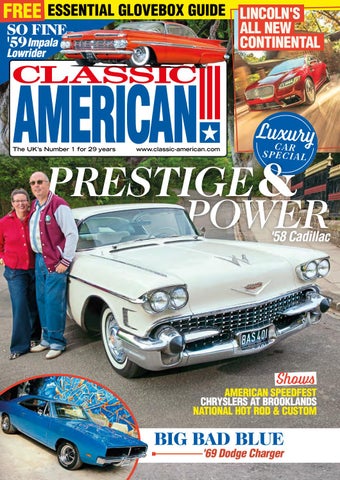
FREE ESSENTIAL GLOVEBOX GUIDE SO FINE '59Impala Lowrider
LINCOLN'S ALL NEW CONTINENTAL
Luxury CAR SPECIAL
PRESTIGE & POWER
'58 Cadillac
AMERICAN SPEEDFEST CHRYSLERS AT BROOKLANDS NATIONAL HOT ROD & CUSTOM
BIG BAD BLUE '69 Dodge Charger
Ben Klemenzson
Viewpoint
DEMOCRATIC LUXURY
What does luxury mean to you? If, like me, you grew up in the Seventies and Eighties, most American cars at the time seemed remarkably luxurious. Even a humble bog-standard Caprice or LTD boasted power windows and seats, air conditioning, eight-track stereos, big comfortable seats and a huge boot. These were real luxury features back then, which were otherwise the realm of prestige marques like Rolls-Royce or Daimler. And perhaps that’s the beauty of ordinary postwar American cars – your everyday Joe could literally walk into a Chevrolet dealership, slap a deposit down and drive off in what was to all intents and purposes a ‘Cadillac for the everyday man’. It really was ‘democratic luxury’. I remember once reading an old car comparison feature from the late Sixties which pitched a brand-new Cadillac against a Chevrolet; the truth was that other than a few inches in length and some badges, there wasn’t a whole heap of difference between the two cars. And, as the writer suggested, if an alien were to
visit from outer space (it was the Sixties remember!) you’d have a hard job explaining the difference between the two cars. We’ve assembled examples of luxury cars from all of the big three, as well as different eras; no doubt you’ll have your favourites so I hope we’ve included them! Making a welcome reappearance is Jonny Smith’s Project Beauty ’Pala, the lowrider project started by Jonny many moons ago, then shelved when weddings, kids and house buying came along. How familiar a story is that? I’d wager there are garages and barns up and down the land filled with half-finished American car projects that have stalled when the realities of life have r. Maybe you ve got one yourself? If you ha taken over. you’ve have, we’d love to hear about it…
Ben Klemenzson, ediitor bklemenzson@mortons.co o.uk
46
60
32
106
23
Contents August 2017
Regulars
Features
06 12 14 16 18 20 44 88 90 101 114 120 122 134
23 32 39 46 53 60 75 81
News Letters Across the Pond Muscle Car Files Here to Obscurity Subscription Offer CA Shop Discoveries Reviews Scale Autos Events Drive Buy Private Classifieds Services Directory
New Continental 1958 Cadillac 1963 Imperial 1969 + 1970 Cadillac 1979 Lincoln MkV 1969 Dodge Charger Classic American People Project Beauty ’Pala
Events 67 American SpeedFest 72 Epsom 93 National Hot Rod & Custom Show 96 Chryslers at Brooklands 105 A&M News 106 1959 Impala
39
67
classic-american.com 5
Classic American
News Footman James Car of the Year Round 2
Sometimes a car will roll into a show and it immediately becomes apparent that it’s definitely Car of the Year material. This was the case during the second round of this year’s competition. This incredible 1977 Chevrolet Caprice is in remarkable condition and has obviously been very, very well looked after over the past four decades. Owner Paul Chamberlain acquired the
Chevrolet from Classic American advertiser Oldcott Motors (www. oldcottmotors.co.uk/tel. 01782 782 081) who seem to specialise in turning up very clean ‘cream puff’ classics like this one. Apparently it’s spent time in the South of France and appears to be wearing its original paint and unmarked original vinyl roof. Even the doors are stiff and the spare tyre unused on this ‘as-new’
Chevy. Forty years ago these cars were ubiquitous all over America and even here in the UK… it’s perhaps that ‘commonness’ that meant nobody thought they were worth saving. And then one day, all of a sudden, they were virtually all gone, making immaculate examples like this one such rarities. The year 1977 was the first of the downsized full-size Chevrolets after the behemoth ’76s and it remained
iin production d ti with ith only l minor i changes until 1990, when it was superseded by what many consider to be the ungainly 1991 models. We look forward to welcoming Paul and his whisper-quiet Caprice on to the Classic American stand at the NEC Classic Motor Show in November and you can read the full report on the Footman James Bristol Classic car Show in next month’s Classic American magazine.
OBITUARY: VIC EDELBROCK JR 1936-2017
Vic Edelbrock Junior dies aged 80… The head of the Edelbrock Corp, Vic Edelbrock junior, has passed away. The Edelbrock name is synonymous with aftermarket performance parts for cars and bikes, although the company actually started in Beverly Hills as a car repair shop. In 1938 Vic Edelbrock senior bought a 1932 Ford roadster with a flathead V8 as a project car and began designing the first Edelbrock intake manifolds for the emerging California hot rod scene. As more Edelbrock equipped cars began winning races, the now Los Angeles-based business quickly grew.
6 classic-american.com
Vic Edelbrock junior was born in 1936 and started working at his father’s parts shop in 1948. When Vic senior died from cancer in 1962 the 26-year-old Vic junior took over the company, growing it from 10 employees in 1962 to more than 700 by 2004. In 1964 the development of the C-4B intake manifold for the small-block Chevrolet V8 marked the beginning of a golden age, with products such as the Tunnel Ram, Tarantula and Streetmaster manifolds. Edelbrock always adapted his wares to the automotive trends of the time. During the Seventies, when environmental restrictions were strangling performance cars, Edelbrock developed induction systems that met pollution requirements, but still improved performance. He even built his own testing dyno to measure carbon emissions and prove his claims. During the Eighties Edelbrock Corp expanded to include carburettors, camshafts and exhausts, further increasing its portfolio with suspension parts for the growing Sport Utility (SUV) market. The company made its aluminium products
in house, then later at a foundry purpose-built in San Jacinto, California that opened in 1988. Today the company has six locations, including its ‘Vic’s Garage’ facility in Torrance, California housing Vic’s extensive hot rod and classic car collection that still includes that original ‘32 roadster. Vic Edelbrock junior was also the president of the Speciality Equipment Market Association (SEMA) for four years from 1971 and on its board of directors between 1967 and 1989. Inducted into both the SEMA and The International Drag Racing hall of fame, Vic was a keen pilot as well as a car and boat racer. He served as president and CEO of the Edelbrock Corp until 2010 when he gave up those positions, but remained chairman of the board. Survived by his wife Nancy and three daughters, Vic Edelbrock junior died on June 9, 2017 aged 80. MR
OLD CADDYS DON’T DIE… Classic American contributor Des Penny has been to the banger races and found out what happens to old Cadillacs when they’re put out to pasture. Pictured is James Dillon’s Cadillac at the Barford Raceway meet recently in County Durham. Also pictured from a while back is Daryl Wall’s Caddy limo, which according to Des “has a Ford Granada block and a steam tank under the windscreen… so there’s plenty of space between the nose of the car and the front of the
engine. Daryl was racing as part of Scotland’s well known ‘mob’ racing team and as you can see the limo gave a good account of itself...” Amen to that Des!
MORE SHOWS, MORE COVERAGE… ONLINE NOW! This time of year is always a bit of a headache here at Class Am towers, as we try and squeeze as much event coverage as we can into the magazine. It seems almost as if all the shows and events we cover occur in a six-week window and sometimes it feels like it’s impossible to cram it all in. If you think some of this year’s coverage looks a bit sparse, fear not, as we’re uploading all the event coverage images that we couldn’t fit in on to the Classic American website. Not only that, there’s also some event coverage on
the website that we weren’t even able to shoehorn into the magazine. Just go to www.classic-american. com, hit the ‘Community’ tab, and select ‘Galleries’ from the pull-down menu. You’ll find a full selection of images from the following events: Wheels Day 2017, NSRA Swapmeet, Ace Cafe Mustang Stampede, Rhythm Riot, Chelsea Cruise, SEMA… Phew, you get the picture. And remember it’s continuously being updated, so make sure you keep checking for updates!
classic-american.com 7
Classic American
News
OBITUARY: TOM TJAARDA 1934-2017
Talented car designer dies aged 82
H
is name might not be immediately recognisable, but you’ll know a lot of his work. Tom Tjaarda designed the Mk1 Ford Fiesta along with numerous American show cars and supercars. Born to Dutch parents in Detroit in 1934 as Stevens Thompson Tjaarda Van Starkenberg, his father Joop (later John) worked for Ford and Lincoln at the Briggs Motor Bodies studio where his sketches became, among other classics, the Lincoln Zephyr. Tom was studying architecture in Michigan in 1958 when, for a final project, instead of a building he designed a sporty station wagon. The wagon caught the eye of Luigi Segre, head of design house Ghia, who offered him a six-month contract in Turin after graduation. Tom was to live in Italy for the rest of his life. During his first stint at Ghia Tjaarda produced two concept cars. The first was the 1959 Ghia Selene I – a forward control people carrier with switchable left- and right-hand drive that mixed Italian curves with an American roofline. It supposedly ended its days in Moscow. The other was the streamlined IXG (Innocenti & Ghia) Dragster of 1960 intended to set speed records in the 1000cc class. The body turned out to be too low to fit the 950cc engine, which reportedly sent Segre into a rage. Commercial projects including the ‘razor edge’ Karmann Ghia and, with input from Virgil Exner Jnr, the Fiat 2300S coupe. In 1961, in addition to a streamlined go-kart, Tjaarda came up with the Corvair Coupe Speciale. His elegant Corvette Rondine I and II show cars (see From Here to Obscurity in the July 2017 issue of Classic American) were based on a 1963 Stingray with the body built in steel. Although General Motors liked the shape they felt it didn’t look like enough like a Corvette. However the design won him the job of designing the Fiat 124 Spider when Fiat asked for a sports car resembling the Rondine. Tjaarda then moved to Pininfarina, penning the stunning Ferrari 330 GT 2+2 and 365 GT California.
1959 Ghia Selene in show setting.
The 1959 Ghia Selene displays its space-age rear to full effect.
1960 IXG Dragster.
Corvair Coupe Speciale.
1968 Checker Centurion.
8 classic-american.com
1982 Chrysler Lebaron concept.
Back at Ghia, in 1968 he came up with the Pantera for De Tamaso, and later the Deauville and Longchamp models. The Pantera was a Ford V8-powered Italian GT sold through Ford’s US dealerships. In a 1984 interview Tjaarda recalled: “The Pantera had gone from prototype to production in eight months and there were teething troubles, the main one was the crash test in California – the front wheels ended up under the driver’s seat. They solved the problem by fitting a double chassis.” Another unusual Tjaarda car was the 1968 Checker Berlina Centurion, a massive Checker limo-based taxicab/limousine – no one seems to completely agree which it was – built by Ghia for the Paris Auto Salon at a reported cost of $50,000. Tjaarda designed the Checker with Giorgetto Giugiaro and the 283cu in V8 Chevypowered car had a rear-hinged back door on the driver’s side while the other doors were front hinged. He was involved in the Ford Torino Talladega, but in 1972 was handed ‘Project Bobcat’, a styling study built on a Fiat 127 platform. Tjaarda refined it into ‘Wolf’, going from drawing board to running prototype in just 56 days. It was launched in 1976 as the Fiesta, Ford’s first minicar and still one of the company’s best-
selling models. Other work included the 1974 Ford Maverick, designs for Fiat and Saab and some 1979 proposals for the Mustang II. In 1982 he came up with concepts for the Chrysler LeBaron and Chrysler Imperial. He’s also the creator of the 1985 Jeep interior. Going independent in 1984, Tjaarda set up Dimensione Design (known also as Tjaarda Design) and gradually moved away from cars into designing products as varied as homes, Silvercraft helicopters, electronic information machines and a chain of Pratesi boutique shops. Yet he didn’t ever completely give up his first love, coming up with the concept for the 2006 Shelby series 2. He took his work home with him too, the one-off Tjaarda Design 700T Mustang was his personal car. It started life as a 2008 Shelby GT500 with the engine uprated for over 650bhp at the wheels and, in addition to suspension upgrades, the car boasted both a Tjaarda designed leather interior and carbon fibre body panels. In his later years Tjaarda’s design experience was often called upon as a classic car judge for concours d’elegance events. He passed away in Turin on June 1, 2017 following a battle with cancer. He was 82 years old. MR
2006 Shelby series 2.
Corvette Rondine.
classic-american.com 9
What a cutie – Nash Metropolitan.
Hmmmm, not sure what Elf & Safety would say about these!
Stockton, Wiltshire
Words and photography: Steve Havelock
T
his well-organised, three-day Vintage Nostalgia Festival is held annually on a large, flat, grassy farmland site pretty much in the middle of nowhere at Stockton, about 12 miles north west of Salisbury. Access for the last quarter of a mile is rather tight and in places, just one vehicle wide, so a little patience and politeness goes a long way. But once inside the gates, a delight awaits as you are wafted back in time to bygone days. There are vintage farm tractor, military vehicle and old motorcycle and bicycle displays. There are scores of stands selling vintage clothes, hats, old radios and record players, period household knick-knacks, books and photographs and a wide choice of places to eat and drink. I must say I really enjoyed a thin and crispy pizza cooked in a wood burning oven in the back of an old Citroen H van. I also enjoyed the ‘proper’ coffee served by The Bean Machine Cafe out of a polished aluminium Airstream caravan which was towed by a 1958 Ford F100 panel delivery truck. As I stood waiting while the coffee machine hissed and gurgled, I read a history card placed in the window. It transpires that this 14ft Airstream started life in 1989 as a massive 34ft-long, six-wheeled special edition. It came to the UK in the early Nineties but then, due to a faulty tow hitch, it became uncoupled and rolled. The current local owners bought the mangled wreck in 2010, cut 20ft out of the middle of it and kitted it out as a mobile cafe – good for them! There was camping on site for those who wished to make a weekend of it. One area was
Friday to Sunday, June 2, 3 and 4
reserved for vintage caravans and campers and the other for modern outfits and tents. Plenty of entertainment was laid on with some 19 acts appearing in two large marquees, plus a kiddies’ entertainment area, a big wheel and even a makeshift putting green. No need to go thirsty either as Ringwood Brewery supplied their range of real ales, ferried along on the back of their immaculate old green Bedford truck. And while you were supping your pint, you could watch Charlie Chaplin teasing the kids with his magic tricks. There was also a ladies’ hairdresser and make-up artist and a gents’ barber. You could even treat yourself to ‘something for the weekend’, a tub of ‘extra stiff Cock Grease’, which of course is hair pomade. A large area was devoted to classic cars which included loads of lovely American cars, hot rods and trucks. Ever-enthusiastic members of the Can-Am Club were out in force, but then this is their patch. I spied a great-looking trio of late Forties Chevrolets in the form of a sedan, a rare Ute, complete with lift jack and spare wheels, and a gorgeous panel delivery van. A delightful fully restored flathead V8-powered baby blue Ford Model B pick-up on whitewalls looked the business, as did a battered, twin-rear-wheeled International flatbed and a back-to-bare-metal GMC pick-up. There were also a pair of Nash Metropolitans. These quirky, often maligned little cars have of late become quite trendy and desirable. Let’s face it, if you want to be different, there’s nothing else quite like them. This was a very enjoyable show made all the better by blue skies and sunshine. ★
International flatbed truck.
Black beauty Cadillac.
Chrysler Airstream.
Hoorah for real coffee!
10 classic-american.com
Back to the bare metal: GMC pick-up.
Classic American
Last month’s GTO.
Realistic motors Dear Classic American, I love Classic American magazine and have subscribed in the past on and off. But I get a bit disillusioned with the cars and owners. Take this month’s magazine which features a surgeon with a garage full of hot American classics. That’s great, but most of us can only dream of such a stable. He obviously earns well and this pays for his hobby. It’s easy to fill mags with cars that are owned by people who have the funds to buy/restore and own such motors. But in the real world, people like myself have to save, beg and borrow to get anything mildly interesting on the drive. I own a 1987 Harley Sportster – a failed resto by the importer – and picked up a bargain bike, getting the parts from here and there to finish the job. Now I have a mint one-owner bike, with just nine thou on the clock from new, worth around £3.5k. I have yet to own an American car and hope to do so if I can find something in my price range. Let’s get more cheap restos in your great mag, and how about running a series on sub-£5k rides to own/restore. We have seen so many mags putting great cars in articles, who are owned by people who have high disposable incomes. Let’s get some cheap and cheerful Yanks back on the pages of your cool mag! Steve Reader Via email Thanks for your email and your comments; to be fair we have a pretty wide range of owners in the mag, they’re not all millionaires or wealthy professionals. However, when a car like that turns up, I think most people would agree that it would be a shame not to feature it, regardless of who owns it. Your comments have been reflected in the reader surveys we’ve done in the past and I certainly make a point of ensuring that we include vehicles and owners from all economic backgrounds. Anyway, isn’t it refreshing that he doesn’t drive a Porsche or a Ferrari? And he does drive it too. Watch thiis space for more cheap Yanks!
12 classic-american.com
Email us at: email@classic-american.com or write to: Classic American Magazine, PO Box 99, Horncastle, Lincs LN9 6LZ
STAR
Letter
HIT THE ROAD JON (AND SHANNON!) Dodge truck on the salt flats, Utah.
Dear Classic American, My girlfriend and I had always dreamed of ‘getting our kicks on Route 66, but we didn’t exactly have the budget to match what some companies were offering and a rental car was too expensive for anything better than a Toyota Prius, so instead, we thought we would buy. We started to shop around and after a lot of consideration, we bought a 1976 Dodge Adventurer pick-up (400cu in big block, 727 trans, dually) and set out on our adventure at the beginning of March this year. We picked it up in Texas, where we met the guys that had sold it to us and they prepared it for the road trip we had planned. We got to meet the original owner of the truck and it turned out we were just the second owners in all its life. The other interesting fact was that the truck had been parked up since the year 2000, barely moving between then and us picking it up... ambitious, we know! We then headed west through to Nevada, stopping at the usual landmarks along the way and sticking to as much of the old Route 66 as possible. The truck had developed a few ‘quirks’ by then, although nothing to hinder us (thankfully). We then headed north to Utah and took the truck to Bonneville – such a fantastic sight to see. We then headed east and southeast, taking a route through Dodge City. Kansas turned out to be a very welcoming state, with a lovely family inviting us to stay at their ranch; this gave us a great insight as to what American life really is all about. We continued the last leg of our journey on through the south-east, where our final few stops were at Georgia and South Carolina – this was where we had chosen to ship the truck back home to England (Golden Chariots shipping). The thing that enabled us to complete this once-in-a-lifetime journey was – in more ways than one – the truck. Not only did it carry us 5500 miles across 15 different states, but it was also our home for three-and-a-half weeks. We bought a truck-bed tent that we camped in the Gettin’ kicks on...
Truck bed tent...
... made the holiday affordable!
entire time and, believe it or not, that was our favourite part of the trip, as well as it saving us hundreds of dollars, which we wouldn’t have been able to afford otherwise. The thing that we want to share with everyone is that it is possible – we read books and text from several different websites before we bought the truck, that told us it was ‘virtually impossible’ and ‘more hassle than it’s worth’. But at the ages of just 24 and 22, we did it. And we did it in style. We understand if our story is of no use to you, we won’t be offended if you choose not to use it but keep up the good work, we enjoy reading the magazine. Kind regards, Jon and Shannon Now that is the roadtrip of a lifetime and how cool they were able to do it on a budget and use a classic American in the process too!
They are still out there, as this ’77 Cadillac confirms.
Huw Evans
Across
the
pond
Diamonds in the rough Evans looks for traditional American motoring amid a sea of milquetoast appliances on Great Lakes roads.
I
t’s funny, but since I moved here 16 years ago, the North American roadscape has changed almost beyond recognition. Even a decade ago, it wasn’t uncommon to find roads and driveways littered with full-size body-on-frame cars – like a Cadillac DeVille, Mercury Grand Marquis, Buick Roadmaster or Chevrolet Caprice – in daily use. Today, they’ve been replaced with overtly sculpted and decidedly nondescript crossover utilities and cars, along with a plethora of neoclassic and latemodel full-size pick-ups. So what happened, where did all these cars go? Okay, so there have been scrappage programmes and collisions, but I think a lot of them basically succumbed to the elements. The thing about the Great Lakes is that it truly is a climate of extremes. The summers can get very humid, with frequent thundershowers and temperatures that can reach well into the mid-30s Celsius. By contrast, the winters can get very cold and snowy. The lowest daytime temperatures I can recall were minus 30 degrees Celsius and the local road commissions spare no time, nor expense, in laying down tons of sand and rock salt. So, you have a high degree of humidity in the summer time, and roads laced with rock salt, sand and slush in the winter. Perfect for corrosion. Many traditional American cars weren’t that well protected in terms of rust proofing from the factory. Paint was often sporadically applied around the areas that arguably needed it the most – rocker panels, fender openings, splashguards, floor pans and trunk floors. Consequently, when driven in this
14 classic-american.com
lovely climate of ours for a few years without any kind of aftermarket rustproofing treatment, the rot quickly became terminal. Granted, vehicle quality has improved over the years, but this part of the world is notoriously hard on cars if you drive them year round. Most of the boxy and even jellybean full-size American cars you used to see in daily use around here have simply disappeared. I remember that when I first moved over here, one of the first jobs I got was with a rental car company. We had all kinds of things, from small subcompacts to full-size cars, vans and pick-ups. I remember the Impalas and Monte Carlos we had often featured a velour bench seat and a column shift. Today, these are features you can’t find in anything outside a full-size pick-up or SUV. Also, it seems, the more distractions you can pack inside, like Bluetooth, Heads Up Displays, voice activated commands, smartphone connectivity features and a myriad of warning buzzers, the better. Maybe I’m getting older and grumpier; but I long for simplicity—a big bench and the choice of a steering column gear selector, not a pointless console for a gear lever that barely moves and bucket seats with all the ergonomics and comfort of an ironing board. Okay, so it might seem things are becoming a bit depressing for a traditional American car enthusiast in these parts, but there is a plus side. Firstly, that this region is the heart of auto manufacturing. There are assembly plants, headquarters, suppliers, racetracks, dealers and
service centres galore. Additionally, either yourself, or your neighbour or somebody you know works in an automotive-related profession. Also, if you happen to live in a rural area, many cars often get dumped on local properties instead of being sent to the crusher. Furthermore, in the summer time, the car industry manifests itself in car culture, with literally thousands of weekly car-related events taking place. The daddy of them all is the Woodward Dream Cruise, which takes place in Metro Detroit on the third Saturday in August and is an event like no other. This car culture also means there’s still a huge number of people prepared to bring some of the old and dumped cars back to life, with countless hardy souls spending the cold months tinkering and building in their garages so they can hit the road come spring. Of course, even if you have something to tinker with in the garage that comes out only on nice days, you might wonder how you can get your old American car fix year round. Buy a big old cruiser like a Grand Marquis or Roadmaster from a Snowbird, dowse it in rustproofing and you can have your cake and eat it. I know of two local cars owned by enthusiasts – a 1978 Oldsmobile Toronado and a 1983 Chrysler New Yorker. These guys wouldn’t be caught dead driving anything late model. Both cars are driven come rain, shine or snow. And thanks to the miracle of rustproofing, the bodies and frame rails on both are still solid as a rock. ★ Huw Evans – news & views from North America
Tony Oksien
Muscle
car files
1962 Dual-Ghia L 6.4 Italian American
We all know Tony is a Mopar man; however, this is one Mopar-related rarity that’s bound to get your attention, whatever marque loyalty you declare!
O
ur hobby at times has a knack of throwing up the most bizarre events and it’s these occurrences that are one of the reasons I am so passionate about American cars. You pitch up at a car show, never quite knowing what to expect, and every now and then – wham! – something takes your breath away. This happened to me at the Brooklands Chrysler meet held over the late May bank holiday. Fuelled with the expectation of seeing a bunch of Mopars and other assorted muscle cars at this show, I never in a million years expected to set eyes on a car of such beauty and elegance as a 1962 Dual-Ghia L 6.4 coupe finished with a red leather interior and painted a deep glossy black. This is the type of car that really gets your juices flowing – incredibly rare, with only 26 examples
Space age-looking dash.
16 classic-american.com
built and one of only six given the front light and grille treatment by the legendary George Barris! The standard headlights on the 1962 Ghia are round, set in a three-piece grille at the farmost part of the front end; on this car Barris redesigned the headlights to be oval, creating a completely new look which gave the car a more space-age appearance. Another neat Barris touch was replacing the steering wheel with a Nardi wood-rimmed item that gives the sumptuous interior a more European feel. This particular example was ordered and destined for the legendary Hollywood actor Gary Cooper; sadly, however, he never took possession of the car as he died before he could take delivery. Cooper personalised it by ordering a sunroof, which is an unusual option and makes it even more special, as it is the only model to have a sunroof – making it a genuine ‘one of one’. Fitted by the American Sunroof company which just happened to be right around the corner from customiser George Barris’s Pacific Avenue, San Francisco workshop, interestingly all ’62 Ghias came equipped with air conditioning. Under the hood lies a 335bhp 383cu in Chrysler V8, with a Carter 4bbl carburettor and a 727 Torqueflite automatic gearbox. The 383 rounds up to about 6.4 litres, hence the model’s L 64 designation, which was capable of 0 to 60mph in 8.5 seconds. Hand built by Carrozzeria Ghia in Turin, Italy, designed by Paul Farago and shipped
Simple rear end treatment.
to the US for sale, the L 6.4 incorporated many touches from Chrysler’s Virgil Exner, notably the scalloped tail-lights that were borrowed from a 1961 Dodge. The car is based on 1960 Chrysler running gear, suspension and chassis. The Ghia L 6.4 went on sale at a mind-blowing $13,500, climbing to $15,000 for the later models, making it only affordable for the super-rich of the time – the cost not only reflected the workmanship and exclusivity but also the shipping to the United States. The car debuted at the 1962 New York Auto show and I believe Frank Sinatra took delivery of the first and Dean Martin the last; other notable celebrities who became owners were Lucille Ball and Peter Lawford. So how has it wound up in dear old England? Well, after a search for an L 6.4 stretching back to 1989 the owner, Mr Graham, finally realised his goal and purchased the car from a California-based family who had owned it for 45 years. Only 17 survivors are known to exist, which is not a bad ratio out of 26 built. These are truly rare automobiles and if this car makes an appearance at a show, be sure to give it your complete and undivided attention! ★
Tony Oksien – CA’s resident muscle car guru
Richard Heseltine
From
here to
obscurity
GM Runabout Think of GM’s Dream Cars and you don’t think of anything so mundane as a three-wheeler with a built-in shopping trolley, do you? Well, think again!
Three wheeled, but a million miles away from Del Boy’s Reliant!
A
merican car buyers have never really taken three-wheelers to heart, which may explain why this intriguing curio is nowadays forgotten. The Runabout was one of three General Motors show cars built for the 1964 World’s Fair which was held in Flushing Meadows, Queens, the other being the GM-X and Firebird IV. It was intended to showcase design innovation, and this sleek trike wasn’t without interesting features. It’s just that none of them subsequently filtered down into the mainstream. Most existed only on paper, or in its designers’ imaginations. While GM wouldn’t get away with such things in today’s more enlightened times, the Runabout was trumpeted as a car for housewives. It was a grocery getter, one that was known internally as ‘The Shopper’. It was conceived as a four-seater car with a front-mounted engine, although what, precisely, powered the Runabout was never divulged. It could, conceivably, have encompassed everything from two- and four-stroke units to a bank of batteries. batteries
What would power it was never made clear.
The car’s unusual three-wheeled layout ensured that it was never going to be conventionally styled, but it wasn’t unattractive. The front end featured a full-width, wraparound headlight/indicator combo. Three louvres were positioned directly below this arrangement, ostensibly for engine cooling. Further louvres were sited just ahead of the windscreen. As with its fellow showstopper, Runabout was part of the ’64 World Fair. the GM-X, the Runabout didn’t feature conventional doors. The windscreen formed part of Inside, there was nothing so boring as a a canopy that lifted up and forward, allowing conventional steering wheel and foot pedals. There passengers entry to the cabin. The only ‘door’, if was a console fore of the driver, incorporated you can call it that, was the rear hatch. Even then, into which were a pair of rotating dials and two the only promo shot that showed occupants in buttons between them. What function they served the car was of a little girl sitting in the back seat. was never divulged, but this wasn’t the really No adults were ever pictured getting in or out, let wild bit. The lower rear section of the outer body incorporated a shopping trolley – yes, really! alone seated seated. Upon arrival at the supermarket, you merely separated it – somehow – and small wheels would then pop out. You then did your shopping, pushed the cart back into the rear of the car and the wheels would simply fold back in. Once home, the trolley could be detached from the Runabout, complete with your shopping, and you pushed it inside your house and put everything away. What happened to the Runabout following its debut remains a mystery, but that wasn’t the end of GM’s dalliance with three-wheelers. In 1969, it built the XP 511 Commuter Car which was intended for short urban journeys. Wilder still were the Frank Winchell-designed Lean Machines. These slender devices featured small motorcycle engines and, as the name suggested, they would tilt into corners. We’re still awaiting the first GM production three-wheeler, mind. Somehow, we don’t expect the arrival of one anytime soon… ★ Richard Heseltine’s weird and wonderful American cars from the past.