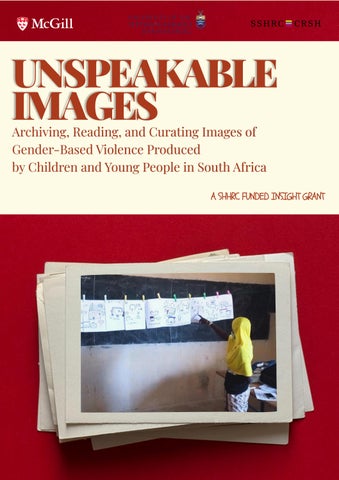
UNSPEAKABLE IMAGES Archiving, Reading, and Curating Images of Gender-Based Violence Produced by Children and Young People in South Africa
A SHHRC FUNDED INSIGHT GRANT
Why Unspeakable Images? THE PROBLEM · THE ARCHIVE · THE URGENCY 01 | A History of Violence in Educational Spaces The 2001 Human Rights Watch report, Scared at School, exposed the prevalence of sexual violence against girls in South African schools. Alongside Opening Our Eyes (NDoE, 2001/2015), these interventions established school-related gender-based violence (SRGBV) as an urgent educational and human rights concern. Subsequent scholarship demonstrates the persistence of gendered violence within educational spaces, shaped by unequal power relations, HIV/AIDS, COVID-19, and feminist, queer, and trans backlashes (Bhana et al., 2021; Zungu et al., 2024; Beckmann, 2024). 02 | More than twenty-Five Years of Visual Testimony The documentary Unwanted Images (Mak & Mitchell, 2000) brought international attention to drawings produced by South African schoolchildren depicting sexual violence, corporal punishment, harassment, homophobia, and abuses of institutional power. These images challenged audiences not simply as representations of violence, but as creative and ethical interventions. Over the following two decades, participatory visual research in South Africa generated drawings, photographs, cellphilms, and digital stories through which children and young people documented their experiences of violence in schools and communities (Mitchell et al., 2007; Moletsane et al., 2009). 03 | From Visual Knowledge to Social Change Participatory images have contributed to academic scholarship, exhibitions, and policy interventions. Research on school sanitation informed discussions of girls' safety and educational environments (Mitchell, 2009), while digital storytelling with girls and young women in KwaZuluNatal contributed to the development of the eMangweni Protocol on Early and Forced Marriage (Haffejee et al., 2022). These examples demonstrate how youth-generated visual knowledge can extend beyond research to influence public understanding, institutional practice, and policy. 04 | Difficult Knowledge and the Ethics of Representation Images produced through participatory research occupy an ambiguous space between art, evidence, and research data. Their circulation raises questions about interpretation, consent, ownership, and the potential aestheticization of violence. Scholarship on difficult knowledge (Lehrer et al., 2011) and Refiguring the Archive (Hamilton et al., 2002) provides a conceptual foundation for understanding images as ethically complex materials whose meanings and responsibilities extend beyond their original production. Although participatory visual research has demonstrated the power of youth-generated images to document violence and inform change, less attention has been given to the ethical afterlives of these images: how they should be preserved, reinterpreted, exhibited, withheld, or revisited decades after their creation Unspeakable Images addresses this gap by bringing archival studies, visual culture, participatory methodologies, and an ethics of care into conversation.
2
THEORETICAL FRAMEWORK Unspeakable Images: Refiguring the Archive The theoretical framework of Unspeakable Images brings together two interconnected areas of scholarship: Picturing Atrocity and Difficult Knowledge, Gender Violence, and Curatorial Ethics. Together, these approaches explore how images of violence are interpreted, preserved, exhibited, and experienced, while foregrounding the ethical responsibilities associated with working with difficult visual knowledge. 1. Picturing Atrocity: Images, Affect, and Haunting Scholarship on images of violence examines how visual representations shape public memory, emotional responses, and ethical encounters with suffering (Sontag, 2004; Batchen et al., 2012). Theories of spectatorship and affect highlight how images move audiences, while concepts of haunting and the afterlives of images reveal how unresolved histories continue to circulate through visual materials (Gordon, 1997; Hartman, 2019; Sharpe, 2016). However, much of this scholarship focuses on professional photography and images circulating in the public domain, with children appearing primarily as subjects rather than creators of visual knowledge.
2. Difficult Knowledge: Archiving, Curation, and Ethics The concept of difficult knowledge offers a framework for understanding images that challenge dominant narratives, unsettle viewers, and demand ethical engagement with violence and its consequences (Lehrer et al., 2011). Research on participatory archives, trauma, and curatorial practice raises critical questions about consent, representation, ownership, and the responsibilities of those preserving and exhibiting sensitive materials (Caswell, 2014; Taylor, 2014). Feminist curatorial approaches further explore how exhibitions can create spaces for reflection, dialogue, and potential repair (Fabijanska, 2024; Gobodo-Madikizela, 2020). 3. Four Cross-Cutting Concepts Affect and Spectatorship: How do images evoke emotional responses, and what ethical responsibilities emerge from viewing representations of violence? Haunting and Afterlives: How do images carry traces of unresolved histories, and how do their meanings change across time and audiences? Participatory Archiving: Who decides which images are preserved, interpreted, made accessible, or withheld, and whose knowledge shapes these decisions? Curatorial Care and Repair: How can researchers, archivists, and curators engage with difficult images while attending to emotional labour, safeguarding, and possibilities for healing?
3
4. The Critical Research Gap While visual studies have extensively examined representations of atrocity and participatory research has foregrounded marginalized voices, limited attention has been given to the aesthetic, semiotic, archival, and curatorial afterlives of images of violence produced by children and young people themselves. The emotional labour experienced by researchers, archivists, and curators working with these materials also remains insufficiently explored.
Overview of Unspeakable Images Unspeakable Images (2026-2030) examines how to preserve, read, curate, and care for imags of school-related gender-based violence (SRGBC) produced by children and young people in South Africa, and how this visual knowledge can inform research, policy, and public engagement without reproducing harm.
Read (Interpret)
Develop participatory approaches to preserving and organizing images.
Explore reflexive, semiotic, and ethical frameworks for interpreting difficult images.
Care (Safeguard)
Curate (Engage) Test exhibition and workshop approaches for meaningful engagement
Re
se
arc
h↔
P olic
Develop safeguarding and care-in-action practices for all who produce, preserve, interpret, and encounter the images.
ag y ↔ P u blic E n g
e
n me
-based Gender
Archive (Preserve)
Viole n c e (S R GB V )
h-generated Vis Yout ual
e
d ate rel olho Sc
Kn ow led g
Ethics of Care
t
4
5
Research Questions & Objectives WHAT ARE WE SEEKING TO UNDERSTAND? Our guiding question: How can images of school-related gender-based violence produced by children and young people be ethically archived, interpreted, and curated to support reflection, knowledge production, dialogue, and possibilities for healing and repair?
Four Research Objectives
01 ARCHIVE
03 CURATE
Develop participatory approaches to preserving and organizing youth-generated visual knowledge.
Test exhibition and workshop approaches that enable meaningful engagement with images across communities and institutions.
02 READ
04 CARE
Explore reflexive, semiotic, and ethical frameworks for interpreting difficult images as complex, situated texts.
Develop safeguarding and care-in-action practices for those producing, preserving, interpreting, and encountering difficult knowledge.
Questions that Guide our Work 1. How can we read images without separating them from the contexts in which they were created? 2. Who should decide whether difficult images are preserved, exhibited, or withheld? 3. How can young people contribute to interpreting and curating existing visual collections? 4. What responsibilities do researchers, archivists, curators, and audiences have when engaging with representations of violence?
6
Four Studies, One Connected Research Process HOW UNSPEAKABLE IMAGES WORKS The project brings together four interconnected studies. Each approaches the same collection of images from a different perspective, while visual ethics and safeguarding inform the research throughout. Refiguring the Archive What does it mean to create an ethical archive of images produced by children and young people? This study explores how approximately 1,000 previously digitized images can be organized, contextualized, and preserved through participatory archival practices. Working with youth coresearchers, the team will examine questions of consent, ownership, classification, accessibility, and the responsibilities associated with maintaining sensitive visual collections.
Care-in-Action Who cares for those who work with difficult images? This study investigates the emotional and ethical labour involved in preserving, interpreting, and exhibiting representations of violence. It examines how trauma-informed approaches, peer support, debriefing, and slow archiving can become integral to responsible research practice.
Closely Read Images What can we learn by paying sustained attention to a single image? This study brings together researchers and experts to produce close readings of images of SRGBV. Using semiotic, multimodal, reflexive, and autoethnographic approaches, it examines how images communicate difficult knowledge, how meanings change across audiences and time, and how certain images continue to haunt those who encounter them..
Curatorial Interventions
Explores how difficult images produced by children and young people can be ethically curated, exhibited, and circulated. Examines questions of visibility, consent, ownership, and the politics of looking. Considers how images might travel back to their communities of origin through participatory exhibitions and collective engagement. Investigates the possibilities and limits of curatorial practices grounded in care, accountability, and community agency.
7
Reference List Batchen, G., Gidley, M., Miller, N. K., & Prosser, J. (Eds.). (2014). Picturing atrocity: Photography in crisis. Reaktion Books. Beckmann, J. (2024). PiE editorial March 2024. Perspectives in Education, 42(1), 1–3. https://doi.org/10.38140/pie.v42i1.8166 Bhana, D., & Singh, S. (2021). Gender, sexuality and violence in South African educational spaces. Springer. https://doi.org/10.1007/978-3-030-69988-8 Caswell, M. (2014a). Defining human rights archives: Introduction to the special double issue on archives and human rights. Archival Science, 14(3), 207–213. https://doi.org/10.1007/s10502014-9226-0 Fabijanska, M. (2024). To censor or to teach: Educational reflections on a foundational exhibition. In E. C. Caldwell, C. Colburn, & C. Gonzalez (Eds.), Gender violence, art, and the viewer: An intervention. 138-149. Pennsylvania State University Press. Gobodo-Madikizela, P. (2020). Trauma testimonies as public narrative and reparative action: Engaging the archive of the Truth and Reconciliation Commission through the arts. In K. Wale, P. Gobodo Madikizela, & J. Prager (Eds.), Post-conflict hauntings: Transforming collective memories of historical trauma. Palgrave Macmillan Gordon, A. (1997). Ghostly matters: Haunting and the sociological imagination. University of Minnesota Press. Hamilton, C., Harris, V., Taylor, J., Pickover, M., Reid, G., & Saleh, R. (Eds.). (2002). Refiguring the archive. Springer. https://doi.org/10.1007/978-94-010-0570-8 Haffejee, S., Treffry-Goatley, A., Wiebesiek, L., & Mkhize, N. (2022). Negotiating girl-led advocacy: Addressing early and forced marriage in South Africa. Girlhood Studies, 13(2), 18– 34. Hartman, S. (2019). Wayward lives, beautiful experiments: Intimate histories of social upheaval. W. W. Norton & Company. Lehrer, E., Milton, C., & Patterson, M. (2011). Curating difficult knowledge: Violent pasts in public places. Palgrave Macmillan. Mak, M. (Director), & Mitchell, C. (Producer). (2000). Unwanted images: Gender-based violence in the new South Africa [Short documentary]. Mitchell, C. (2009). Geographies of danger: School toilets in sub-Saharan Africa. In O. Gershenson & B. Penner (Eds.), Ladies and gents: Public toilets and gender (pp. 62–74). Temple University Press. Mitchell, C., De Lange, N., Stuart, J., Moletsane, R., & Buthelezi, T. (2007). Children’s provocative images of stigma, vulnerability, and violence in the age of AIDS: Revisualizations of childhood. In N. De Lange, C. Mitchell, & J. Stuart (Eds.), Putting people in the picture: Visual methodologies for social change (pp. 59–71). Sense. Moletsane, R., & Mitchell, C. (2018). Researching sexual violence with girls in rural South Africa: Some methodological challenges in using participatory visual methodologies. In Harvey D. Shapiro (Ed.), The handbook on violence in education: Forms, factors, and preventions. (443-448). Hoboken, NJ: Wiley Blackwell Publishing. Sharpe, C. (2016). In the wake: On blackness and being. Duke University Press. Sontag, S. (2004). Regarding the pain of others. Picador. Zungu, N. P., Petersen, Z., Parker, W., Dukhi, N., Sewpaul, R., Abdelatif, N., Naidoo, I., Moolman, B., Isaacs, D., Makusha, T., Mabaso, M., Reddy, T., Zuma, K., & The SANSHEF Team. (2024). The first South African national gender-based violence study: A baseline survey on victimisation and perpetration. Human Sciences Research Council.
8