IHDW
Summer - Spring 2026 Newsletter
From the Director This issue of the IHDW newsletter addresses a key feature of McGill University’s new research strategy on “amplifying youth voices, transforming systems,” focusing in particular on the ways in which participatory arts-based methodologies are so central to this work. As the strategy notes, “…In education, social work, and counselling psychology, researchers are collaborating with families, schools, and communities to co-create inclusive models of learning and support … We will mobilize this knowledge to develop models for youth leadership, advocacy, and civic engagement; advance trauma-informed and equity-driven practices; and inform policies that promote lifelong well-being and social inclusion.” How the images produced by children and young people in the form of photographs, drawings, cellphilms or participatory videos become part of the amplifying process is critical, particularly in the context of the question of how the images become part of public knowledge. One important part of this focuses on the ‘afterlife’ of participatory visual and arts-based work with children and young people. What happens to the images and how do we deepen an understanding of mental health and well-being through archival practices?
Institute for Human Development and Well-being In keeping with an IHDW tradition, this newsletter features news from the 14th annual McGill International Cellphilm Festival which took place in June, 2026. Taking a “Futures…Now” theme, the festival included many submissions from children and young people, again highlighting the importance of finding ways to amplify their voices. Many thanks to Arts intern Jenna MacKenzie for her dedication in putting together this issue of the IHDW newsletter and the PCL team for their contributions to this newsletter.
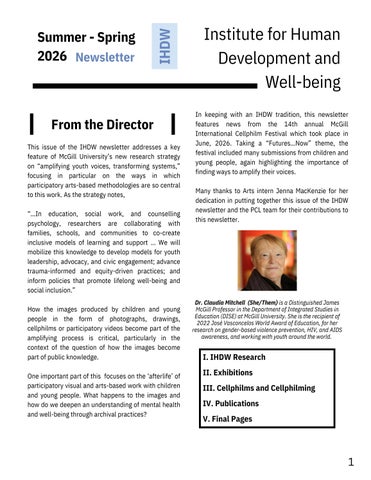
Dr. Claudia Mitchell (She/Them) is a Distinguished James McGill Professor in the Department of Integrated Studies in Education (DISE) at McGill University. She is the recipient of 2022 José Vasconcelos World Award of Education, for her research on gender-based violence prevention, HIV, and AIDS awareness, and working with youth around the world.
I. IHDW Research II. Exhibitions III. Cellphilms and Cellphilming IV. Publications V. Final Pages
1
I. IHDW Research GAME IN ACTION GAME JAM: Promoting Creativity, Agency, and Well-Being Through Game Design Video games are often the subject of public concern. Parents, educators, and the media frequently worry that young people spend too much time gaming, viewing it as a passive activity that may distract from school, social relationships, or other developmental opportunities. While excessive gaming can present challenges for some youth, these stereotypes often overlook the creativity, collaboration, and learning that can emerge through gaming cultures. For many young people, video games are far more than entertainment. What begins as a hobby can spark interests in design, programming, storytelling, digital art, leadership, and teamwork. In some cases, these interests can lead to future educational and career opportunities in fields such as game development, computer science, animation, and digital media.
Just as importantly, gaming can provide meaningful opportunities for friendship, social connection, and self-expression. Time spent with video games does not have to be passive; it can also be a powerful catalyst for creativity, learning, and community building. Recognizing this potential, the GAME IN ACTION (GiA) project, funded by the Fonds de recherche du Québec – Société et culture (FRQSC; NPA: Ferrari), examines how video game engagement influences the wellbeing and mental health of young people. The project includes three studies. Studies 1 and 2 investigate the effects of video game play and game watching on youth well-being and mental health, while Study 3 focuses on developing and testing an intervention designed to harness the positive potential of gaming through a Game Jam.
View 2: Participants engaging in a Game Jam at Vanier College.
Research on game-based learning increasingly demonstrates that video games can support problemsolving, critical thinking, persistence, communication, and digital literacy when embedded within meaningful learning contexts.
View 1: Participants engaging in a Game Jam at Vanier College.
Building on this evidence, the GiA/Game Jam, the third study of the FRQSC-funded project, transformed gaming from a primarily consumption-based activity into a creative and collaborative experience where participants became game creators rather than game players.
2
A Game Jam is an intensive event in which participants work together to design, develop, and present original video games within a limited timeframe. The passion that young people bring to gaming can therefore be channelled into productive and creative activities that foster personal growth, learning, and community engagement. On January 10–11, 2026, in partnership with the Dingo Game Jam at Vanier College, the GiA research team implemented and evaluated a Game Jam involving 149 attendees. A total of 92 participants completed the pre-event survey, while 68 participants completed the post-Game Jam assessment, representing a 74% follow-up rate. Participants had a mean age of 19.2 years (SD = 2.4). Approximately one-third of participants were female (34%), while 29% identified as women and 3% identified as non-binary, Two-Spirit, or another gender identity. In addition, 7% of participants reported living with a disability. This diversity reflects the inclusive nature of the Game Jam and demonstrates the potential of game-creation activities to engage youth from a variety of backgrounds. The study assessed outcomes related to creativity, collaboration, competence, selfperception, and the overall Game Jam experience using measures grounded in Self-Determination Theory.
View 3: Participants engaging in a Game Jam at Vanier College.
Findings revealed encouraging changes following participation. Youth reported greater creative collaboration and teamwork, highlighting the value of working collectively to solve problems and build games: “It showed me that I still have creativity, even if school kind of killed that part a little bit.” “Honestly, besides the food, I think the - my favorite part was like, how much people were there. Like there were over like 10 people sitting on tables. All of us are like chugging coffee and just like walked in on getting something to work or like seeing people scream “Oh my God, it's finally working.” Or like other people screaming ‘Oh my God, why is it not rendering?’ ” Participants also demonstrated reduced selfdiscrepancy, suggesting stronger alignment between how they viewed themselves and who they wanted to become: “I felt really proud when we put all the files together, like branched them and then saw how the entire put the game together looks like and we were like really excited on how like it came out significantly better than we had anticipated because we were like, ‘Wait, we made that, that's crazy!’ ” This finding points to an increased sense of personal agency, as youth felt more capable of shaping their goals, expressing their ideas, and influencing their own pathways forward. Overall, the findings point to positive effects on collaboration skills, selfperception, and psychosocial well-being. The GiA/Game Jam demonstrates that time spent around video games does not need to be passive. When young people are given opportunities to create, design, and collaborate, gaming can become a powerful platform for learning, creativity, friendship, and personal development. The GiA/Game Jam offers a promising model for supporting youth well-being while embracing the positive possibilities of gaming culture and engagement with technology.
3
By Manuela Ferrari
Dr. Manuela Ferrari (She/Her) is an Associate Professor in the Department of Psychiatry at McGill University and a leading researcher in implementation science, digital mental health, and serious games for mental health. Her research focuses on developing, adapting, implementing, and evaluating youth-led, co-designed digital innovations that improve access to high-quality, evidence-informed mental health care. Dr. Ferrari is the Principal Investigator of the Game in Action research programme, an innovative initiative examining how youth in Quebec engage with video games and how gaming influences their mental health and well-being. Through this programme, she collaborates with youth, gamers, game developers, clinicians, researchers, and community partners to generate evidence that informs the responsible integration of commercial and therapeutic video games into mental health promotion, prevention, and care. By integrating local knowledge, lived experience, and cultural values, Dr. Ferrari advances culturally responsive, equityoriented approaches that strengthen mental health research and services and foster meaningful interdisciplinary and cross-sector collaborations to improve outcomes for diverse youth.
UNSPEAKABLE IMAGES: Archiving, Reading, and Curating Images of GenderBased Violence Produced by Children and Young People Unspeakable Images is a SSHRC Insight Grant (2026-2030) led by Claudia Mitchell (McGill University) with Myriam Denov (McGill University), Gracen Brilmyer (McGill University), Catherine Vanner (University of Windsor), Monica Patterson (Carleton University), Lisa Starr (University of Lethbridge) Twisha Singh (McGill University), Kyveli Lignou-Tsamantani Kyveli (York St John University), Relebohile Moletsane (University of the Witwatersrand), Naydene de Lange (Nelson Mandela University), and Sadiyya Haferjee (University of Johannesburg).
How can the drawings, photos and cellphilms produced by children and young people on adversity in their lives serve as ‘lasting legacies’? Unspeakable Images, a new project on amplifying the voices of children and young people at McGill University and involving Canadian, South African and UK researchers, operates as a ‘refiguring the archive’ project in contemporary South Africa. The project engages critically with a collection of close to 1000 visual images of school-related genderbased violence (SRGBV) produced over several decades by children and youth engaged in community-based research through participatory visual methodologies. The SSHRC-funded project positions youth-generated images as key sources of knowledge about SRGBV, but also as prompts for community dialogue and action in relation to SRGBV and structural violence. Through collaborations with scholars across archival work, curation, museum studies, education, social work, NGOs and young people, the project seeks to develop critical frameworks to engage with images that depict or document SRGBV, offering new methodologies and ethical approaches.
Drawing by participant in Unspeakable Images project. Permission to use drawing by the artist, Devon Peterli.
4
The project has four core aims: (1) to build an archive of images on GBV produced by children and young people between the years 1994 to 2025; (2) to develop reflexive and ethical frameworks for reading and interpreting these images; (3) to test curatorial approaches to exhibiting these images across different sectors and audiences in South Africa; and (4) to deepen an understanding of care-inaction/safeguarding approaches to working with these images of difficult knowledge. Unspeakable Images overlapping studies:
is organized around four
1. Refiguring the Archive focuses on archival practices for preserving and coding the “difficult knowledge” of children’s drawings, photos, cellphilms, and digital stories of SRGBV. 2. Closely Read Images is organized around interpretive frameworks based on reflexive, autoethnographic, and semiotic approaches to working with multimodal images that include captions and intertextual markers. This study builds on the idea of the ‘afterlife’ of images, drawing on the concept of “haunting” to analyze the residual effects of visual trauma and resistance. 3. Curatorial Interventions examines exhibition practices and strategies for ethically displaying GBV images and engaging communities and stakeholders, especially teachers and those in education and health. 4. Care-in-Action addresses the emotional labour of archiving and curating difficult knowledge, embedding trauma-informed practices including debriefings, peer support, and “slow archiving.” Carein-action raises the question of who cares for the archivists and curators of difficult knowledge, as well as members of a research team including research assistants.
Myriam Denov is a Tier 1 Canada Research Chair in Youth, Gender and Armed Conflict at McGill University. “While children actively resist war and live with the daily consequences, war‐affected children and youth are typically de‐historicized, universalized, and overwritten as powerless victims. In this context, gathering the unique perspectives of war‐affected children and youth becomes vital. Yet doing so can be fraught with “ethical minefields.” How do researchers and practitioners effectively and sensitively explore and examine young people’s wartime and post‐war realities? Researchers and practitioners have noted that words and narrative alone are often unable to adequately capture the complexities and horrors of war, particularly for children. As such, they have increasingly advocated for, and drawn attention to, the benefits of using arts‐ based research (ABR). ABR enables research participants, particularly children, to convey experiences of war in contexts of reduced stress, providing a means for communicating with the nonverbal mind and safely accessing traumatic memory. ABR can be used in developmentally and culturally appropriate manners, promoting expression beyond words, offering a democratic way of involving children as producers of knowledge. The use of art has also been found to facilitate children’s ability to communicate their realities, in a less threatening and pressurized context. Arts‐based activities can allow participants to create distance from discussions of trauma and create safety with a self‐directed locus of control. Yet, researchers must not assume that all participants will be comfortable with the method or that it is appropriate in all settings. Comfort and safety must be continually assured, particularly for individuals and groups who may have experienced trauma and adversity.”
Through collaborations with scholars across several areas, the Unspeakable Images seeks to develop critical frameworks to engage with images that depict or document GBV.
5
Innovative in scope across several areas, but particularly in relation to the development of the archive itself as a ‘first’ in relation to the thematic focus, this project makes a critical intervention in visual and feminist research on SRGBV by turning sustained attention to images created by children and young people. It reorients the field toward inclusive and participatory modes of archiving, interpretation, and exhibition. By centering youth voices, this research enhances our understanding of how SRGBV is experienced, imagined, and resisted. The project responds to urgent national and global calls by offering new methodologies and ethical frameworks for recognizing and engaging with SRGBV knowledge produced by youth.
By Twisha Singh and Claudia Mitchell
II. Exhibitions Finding places to exhibit artwork at McGill University can be challenging, but so worthwhile. This section includes accounts of exhibitions at Gallery Transforming involving two community-based exhibitions of girl-led projects and an exhibition of the work of Indigenous artist, Thomas Wilson. Artist Hannah Ledwell’s exhibition displayed at the Osler Library of the History of Medicine at McGill University is also featured. Exhibitions highlight important themes including disability, gender, literacy, spirituality and community.
Re-Imagining the South: Girls and Women with Disabilities Advocating for Change Engage Transnational Exhibition and Discussion
Dr. Twisha Singh (She/Her) is a Research Associate attached to the TRANSFORM project. Twisha teaches in the IGSF and at Concordia. Her research spans South Asian History, Theatre and Performance Studies, and Gender and Sexuality Studies, with a focus on feminist and post-colonial literary theories. Dr. Claudia Mitchell (She/Them). Refer to page 1 for more information about author.
On March 11, 2026, Re-imagining from the South: Girls and Women with Disabilities Advocating for Change invited us to rethink what agency and leadership look like for girls and women with disabilities across the Global South. Rather than framing disability through deficit or limitation, this immersive exhibition as part of Gallery Transforming, foregrounds creativity, resistance, and advocacy. Through powerful zines and drawings, participants articulate their lived realities, political insights, and visions for more just and inclusive futures.
6
Re-Imagining the South: Girls and Women with Disabilities Advocating for Change exhibition poster.
Author Curatorial Statement This collection of visual arts, handicrafts, and zines represents the collective work of 54 girls and young women with disabilities in three project sites, including West Bengal, India, Empangeni, South Africa, and A Luoi, Vietnam. Visual art provides a powerful medium for conveying the collective voices of young women and girls with disabilities across these communities.
Re-Imagining the South: Girls and Women with Disabilities Advocating for Change, Zine, South Africa.
The collection also includes a section called Disabled Girls Manifestos, to highlight key messages sent to the world by young women and girls with disabilities across these spaces. Critically, this collection builds connections among disabled women and girls across local and transnational contexts, offering a collective representation from voices from the global South, while recognizing unique stories from these communities.
The exhibition presents different aspects of their artwork, including a collection of collages that represent the individual stories of girls and young women with disabilities in these communities, a set of zines/community magazines on Bringing About Change, a set of drawings on Imagining Disability, and other art pieces that characterize distinct cultural and material aspects of women and girls with disabilities in each community. Importantly, while the stories may be similar to one another, they each reflect unique stories of young women and girls with disabilities in Southern spaces and the ways in which they each connect to one another collectively.
Re-Imagining the South: Girls and Women with Disabilities Advocating for Change, Disabled Girl Manifesto, India.
7
We invite the viewers to engage in each of these art pieces and respond to their messages through a process of learning and unlearning what disability, gender, leadership, and activism may bring about in the struggles for justice of young women and girls with disabilities transnationally.
Gallery Exhibition Highlights Not even a severe weather warning in Montreal could stop an exhibition and panel on March 11, 2026. Although the event meant to be primarily in-person and was shifted to a hybrid format, the dialogue remained powerful, with about 20 participants in attendance.
Dr. Claudia Mitchell (right), Linh Dang (middle) and Xuan Thuy Nguyen (left) during panel discussion.
The accompanying exhibition featured a collection of drawings, cellphilms, collages, and zines. These works represent 54 young girls and women from Vietnam, South Africa, and India. Each piece envisions an alternative future while exploring how these creators connect across diverse cultural and social contexts.
View of online audience members attending the Re-Imagining the South: Girls and Women with Disabilities Advocating for Change exhibition.
Presented by Linh Dang (MA, Brock University), Xuan Thuy Nguyen (Carleton University), and Claudia Mitchell (McGill University), the exhibition draws on participatory, arts-based methodologies that resonate strongly with TRANSFORM’s own commitment to youth-led and community-grounded research. The work challenges dominant narratives by positioning girls and women with disabilities as knowledge producers, cultural workers, and leaders shaping change within their communities.
Re-Imagining the South: Girls and Women with Disabilities Advocating for Change, Collage, Vietnam.
This gathering was more than an exhibition — it is a space for dialogue, cross-community engagement, and collective reflection. It invites us to consider how creative methods can open new pathways for advocacy, how intersectional feminist work must centre disability justice, and how solidarity across contexts can strengthen movements for gender equality. The panel discussion and digital gallery exhibition are available for viewing online.
8
Participant engaging with panelist during panelist discussion.
By Tianna Klopfer
Girls Authoring Decolonial Futures Exhibition: Re-imagining Literacies, Gender and Activism from the Global South Poster.
Tianna Kloepfer (She/Her) has been working as a Research Assistant in the PCL for just over a year. She’s also a year into her PhD, investigating “What Do You Think a Teacher Looks Like? Using Participatory Visual Methods to Evaluate Students’ Gender-Based Perceptions of Teachers”.
Girls Authoring Decolonial Futures Exhibition: ReImagining Literacies, Gender and Activism from the Global South An exhibition in partnership with Monica Shank Lauwo
On June 10th, 2026, the Participatory Cultures Lab (PCL) hosted the hybrid exhibition, Girls Authoring Decolonial Futures: Re-imagining Literacies, Gender, and Activism from the Global South. The interactive exhibition invited participants to listen closely to 10-12-year-old Tanzanian girls, through their multilingual books, drawings, and photovoice creations. This event took place in-person in the PCL at McGill University and a large group joined online through Zoom from all over the world.
Monica Shank Lauwo (next to screen) giving opening presentation for the Girls Authoring Decolonial Futures Exhibition: Re-Imagining Literacies, Gender and Activism from the Global South.
9
Author Curatorial Statement Girls of the Global South are incisive agents of social change. This exhibition, Girls Authoring Decolonial Futures, is about listening closely to girls as they collaboratively interrogate their lives and communities, and author alternative futures. Emerging from the broader Stories of Lives and Literacies project, this exhibition features drawings, photovoice, and multilingual books created by 10-12year-old girls at Hadithi Zetu girls' storytelling clubs at one school in rural Kilimanjaro and one school in urban Dar es Salaam, and 10-14-year-old girls and boys at a community library in peri-urban Monduli. Over the course of 18 months (and counting!), these author-artists have interrogated themes such as: who is a girl?; our dreams; languages of our lives; strengths, challenges, and solutions in our communities; and the community of our dreams. Through their insightful authorship, artistry, and collaborative inquiry, they push our understandings of gender issues, community struggles, and the power of young people to author transformation, and invite us to consider the kinds of communities that we too will author with our magic pencils.
Gallery Exhibition Highlights Girls’ drawings, photovoice, and multilingual books reflected prompts including “Gender in our community: challenges and solutions,” “Our Dream,” “Languages of our lives,” and “Who is a girl?” Descriptions of drawings and photos were available in English and Swahili. During the Girls Authoring Decolonial Futures Exhibition, participants at the PCL were able to walk around, engaging with drawings and stories authored by the girls by talking with the other guests in attendance, as well as through adding sticky notes with their comments on the girls’ art pieces for the girl creators to see.
Karibuni tujifunze kutoka kwa wasichana.
Audience members seen viewing photo books from the Girls Authoring Decolonial Futures exhibition.
10
From her experience working with the community, Monica shared how handwritten stories were significant for literacy engagement, the girls’ writing skills, and their understanding of what it means to be a girl. Now, the girls are focusing on solutions to community challenges, working towards preparing for their futures rather than just identifying problems. You can view the virtual exhibition and watch the recording of the panel session online!
Audience member comments seen on Girls Authoring Decolonial Futures drawings following the prompt ‘Who is a girl?’
For the participants that joined online, they were able to read the collection of digital stories, including the drawings and photos featured in the exhibition. There was a large turnout for the event with over 25 participants in attendance either online or in-person.
Audience members seen viewing drawings and photo books from the exhibition.
Following the walk-around the gallery, conversation and some sushi snacking and refreshments, a panel discussion, led by Mayasa Salum, featuring Monica Shank Lauwo (McGill University), Fatuma Mnubi (Aga Khan University, Tanzania), and Claudia Mitchell (McGill University), took place. They discussed the importance of youth-led policy dialogue and the need for collective action to effect systemic change. The discussion included reflections on the importance of ongoing support for girls’ work on social transformation.
By Tianna Klopfer and Jenna Mackenzie
Tianna Kloepfer (She/Her). Refer to page 6 for more information about author.
11
Jenna Mackenzie (she/her) is final year McGill University psychology and sociology student that is passionate about youth development and well-being. Her research interests relate to culture, disability, immigration and intersectionality in youth and family populations. She is currently an Arts intern at the Participatory Cultures Lab (PCL).
LKVỊ́LỊ́ŃAKVỊA: Transformation Through Art and Story An exhibition by Thomas Wilson On May 16th, 2026, the Participatory Cultures Lab hosted LKVỊ́LỊ́ŃAKVỊ́A, a captivating exhibition by Thomas Wilson. A Bella Bella artist and educator from the Humchitt family, Wilson uses his practice to explore the profound transformations that occur within both the natural and supernatural worlds.
Author Curatorial Statement To be human is to transform. The name of this exhibition, which is in Haitzaqyla, is LKVỊ́LỊ́ŃAKVỊ́A. Northwest Coast art often represents transformations that occur in the natural and supernatural worlds. Stories emerge through these transformations. As you walk through this exhibition, each design will be accompanied with their respective story. Transformation is one of the most important threads informing the artwork that I do. The design on the poster depicts a spiritual transformation, a story of coming home. The setting is Yáláxi, Goose Island, which is the ancestral home of the Humchitt family that I descend from. A large, ocean-going canoe lands at the sandy beach of north Yáláñi. Our chief at the bow of the canoe transforms into an eagle. The eagle is our ancestor, and as the eagle soars over our homelands, so does my spirit. The deep connection that I have to my culture and the artform allows my spirit to soar and be proud of where I come from. My designs are inspired by the people who I love, the stories and lineages passed down by ancestors, and the beautiful places that we come from. Through my art, I breathe life and spirit into the stories that I witness, live through or that are told to me. I am a Northwest Coast artist and a teacher. To be human is to transform, and this is also my story.
Gallery Exhibition Highlights
LKVỊ́LỊ́ŃAKVỊ́A exhibition poster.
Dr. Claudia Mitchell (right) introducing artist Thomas Wilson (left) before his address to the audience.
12
Over the course of the evening, Wilson spoke twice to the gathered crowd. Rather than delivering rigid lectures, he fostered an intimate atmosphere, effortlessly connecting with each member of the audience. He spoke passionately about the vital importance of mutual support, community resilience, and his enduring connection to his ancestors— elements beautifully mirrored in his use of the sacred raven and blackfish (killer whale) crests.
Audience members seen experiencing the “Cha-Cha Raven” and “Octopus” in the LKVỊ́LỊ́ŃAKVỊ́A exhibition.
With approximately 45 attendees, the exhibition was a resounding success. Family, old friends, and new faces came together in a vibrant circle of mutual respect, transforming the gallery space into a true celebration of culture, art, and living history.
Featured exhibition pieces in the LKVỊ́LỊ́ŃAKVỊ́A exhibition.
Every design on display exuded the immense love, care, and intentionality Wilson pours into his craft. Rather than leaving the visual art to stand alone, each piece was paired with a meticulously crafted description. These captions served as narrative generously leading viewers through the deeply personal stories and ancestral lineages behind the imagery. Among the featured works, the Chacha Raven perfectly captured the artist’s whimsical nature while maintaining a deep, grounded connection to the land. Nearby, a striking octopus piece offered a poignant look back at his creative evolution, marking one of the very first works he ever created.
By Emilia Vera Romero
Emilia Vera Romero (She/Her) is a Chilean PhD student at McGill University and a Research Assistant at the Participatory Cultures Lab. Her current research, Resistance in Practice by Queer Chilean Educators: Love, Care, and Dialogue, explores the intersection of sexual identity and pedagogical strategy within Chilean public education. Grounded in critical pedagogy and social justice frameworks, Emilia’s work centres practices of radical care, dialogue, and resistance, examining how queer educators navigate and transform educational spaces. Her research interests include feminist and queer pedagogies, visual inquiry, and education as a site of social transformation.
13
Where We Go to Heal: Women's Health in History
The exhibition is the newest chapter in Ledwell's ongoing project Ressourcement / Where We Go to Heal, which raises awareness about the realities of living with invisible illnesses and disabilities.
An exhibition by Hannaleah Ledwell From April 4th to July 30th, 2026, the Osler Library of the History of Medicine at McGill University exhibited Where We Go to Heal: Women's Health in History, a stunning exhibition by Hannaleah Ledwell. An artist based in Tiohtià:ke/Montreal, Ledwell uses her practice to explore the ofteninvisible experiences associated with chronic illness, as well as the intimate relationship between body, emotion and memory to reveal how disease, healing and care can be translated visually and sensorially. What is a disease before it is diagnosed? Before it is even discovered? These are the questions at the heart of artist Hannaleah Ledwell's latest exhibition, Where We Go to Heal: Women's Health in History, developed through the Michele Larose-Osler art residency.
View 2: Exhibition Where We Go to Heal: Women's Health in History, Osler Library of the History of Medicine, April 4th - July 30th 2026
For this exhibition, Ledwell turned her research toward medical history, tracing how conditions now known as endometriosis, fibroids, PCOS, and multiple sclerosis have been understood — and misunderstood — across time.
View 1: Exhibition Where We Go to Heal: Women's Health in History, Osler Library of the History of Medicine, April 4th - July 30th 2026
Through oil paintings inspired by personal testimonies, the broader project depicts the spaces — real, imagined, or held in memory — where people with chronic conditions go to recenter and find strength. It places particular emphasis on women and genderqueer people, populations who face compounded barriers to care and remain significantly underrepresented in medical research.
14
For this exhibition, Ledwell turned her research toward medical history, tracing how conditions now known as endometriosis, fibroids, PCOS, and multiple sclerosis have been understood — and misunderstood — across time. Through oil paintings inspired by personal testimonies, the broader project depicts the spaces — real, imagined, or held in memory — where people with chronic conditions go to recenter and find strength. It places particular emphasis on women and genderqueer people, populations who face compounded barriers to care and remain significantly underrepresented in medical research. The result is a journey through centuries of dismissal, culminating in a sharp and unsettling question: how many of the women depicted in these paintings would simply have been told they were hysterical?
Alongside each painting, the subject's own testimonial anchors the work in the present, setting lived experience against the historical record that would have erased it. Each of them has had to fight to be heard, to be diagnosed, to have her pain believed. Central to Ledwell's process is the act of translation. She does not paint from photographs or visual references. Instead, she works entirely from participants' descriptions, listening closely to how each person characterizes their place of healing, then rendering her own interpretation of those sensations and memories onto canvas. The paintings become a kind of visual interpretation of lived experience, filtered through empathy and imagination.
View 3: Exhibition Where We Go to Heal: Women's Health in History, Osler Library of the History of Medicine, April 4th - July 30th 2026
Artist portrait, Fais-moi l'art: Ressourcement / Where We Go to Heal, 2025, Photo by Sean Mundy Photography
15
The project's research and exhibition were shaped by the incredible collection at the Osler Library of the History of Medicine, as well as their dedicated team. Drawing on this rich historical archive, Ledwell was able to trace how women's health conditions have been understood, named, and treated across different eras of medicine. This collaboration between art and medicine is not a first for Ledwell, who has spent the last year working with an interdisciplinary team — recent McGill University medical student graduate Dr. Imen Benadda, as well as Dr. Annie Leung (MUHC gynecologic oncology), Dr. Julia Burnier (RI-MUHC oncology researcher and William Dawson Scholar at McGill University), and Dr. Cara MacInnis (professor of Psychology at Acadia University) and independent art curator Michelle Tripodi — in an effort to explore how art can help foster trust and empathy in doctorpatient relationships. That work continues this fall with a two-month exhibition at the Centre culturel Georges-Vanier in Little Burgundy. The exhibition will feature the work of five artists, including Hannaleah, living with chronic conditions and will include round-table discussions between the artists, medical professionals, and medical trainees. These sessions will be open to the public upon registration; visit the artist's website for more information.
Hannaleah Ledwell (She/Her) is an emerging artist and a patient partner born and based in Tiohtià:ke/Montreal. Her work seeks to make visible the often-invisible experiences associated with chronic illness, exploring the intimate relationship between body, emotion and memory to reveal how disease, healing and care can be translated visually and sensorially. Her experience of living with type 1 diabetes, Graves disease and a history of ovarian cancer guides her research, turning vulnerability into a creative and relational force, and inviting viewers to reflect on their own experiences and connections to others—through vivid and gestural paintings.
III. Cellphilms and Cellphilming
The 14th International Cellphilm Festival Report
Website: https://www.hannaleahledwell.com/ Instagram: hannaleah_ledwell
By Hannaleah Ledwell
14th McGill International Cellphilm Festival Poster.
16
How do we think about the futures in relation to the now? What can you imagine for the future? What’s your message to future generations? Following these prompts, cellphilm creators of all ages and from around the world shared their personal interpretations, addressing the theme of this year’s 14th McGill International Cellphilm Festival, “Futures... Now!”
The project aimed to reimagine education possibilities, evaluating responses over four key groups: quality of life, social change, care of the environment, and development of technology. Dr. Harden-Wolfson highlighted several areas in sustainability, social justice, wellbeing and health, and advances in technology as major desires and concerns for the future, challenging the audience to consider the plurality of futures rather than just one.
The cellphilms submitted by participants reflected on a number of important topics, ranging from social isolation and the importance of community, land and labour exploitation, as well as our understanding of time, place and colonial history. Through their dynamic visual storytelling, cellphilm creators conveyed the omnipresent role of human connection and relationships, as well as the need to address the past when going into the future.
Dr. Emma Harden-Wolfson delivering keynote speech during the 14th International Cellphilm Festival.
Frame from Individual category winner “Leave the Canoes and Go Back.”
The 14th McGill International Cellphilm Festival took place on Thursday, June 18th 2026, with attendees joining online through Zoom from around the world. After the welcoming speech made by Ingara Maidou and Jenna Mackenzie, PCL Arts Interns and moderators of this year’s festival, the festival kicked off with a speech made by the keynote speaker, Dr. Emma Harden-Wolfson. During her keynote presentation, titled “Imagining The Futures,” Dr. Harden-Wolfson spoke to her research on education policy, specifically focusing on their work on The Futures of Education project led by UNESCO.
The keynote speech was followed by opening remarks by Dr. Claudia Mitchell, Director of the Participatory Cultures Lab. Dr. Mitchell began by speaking on the importance of this year’s theme, taking place during a time rife with war, genocide, gender based violence, and major human right setbacks across the world. Given these challenges, she remarks how it is crucial to challenge injustice and reflect on the generative changes needed to move forward, inviting participants to reflect on how cellphilms submissions respond to the festival prompts and how their personal desires shape the future we want to see. Cellphilm submissions from this year were reviewed by three judges. Sasha Utkina, a McGill Graduate and past PCL Intern, Dr. Candace Amarante, an artistresearcher and Columbia PhD political science Graduate and Dr. Brett Pardy, an instructor in Media and Communication Studies at the University of Fraser Valley. Sasha introduced the Children’s category, Dr. Amarante presented the Youth Category, Dr. Pardy presented the Individual category.
17
Participants of the 14th McGill International Cellphilm Festival on Zoom. Third row (from bottom-up): Sasha Utkina (third), Brett Pardy (sixth). Fourth row: Claudia Mitchell (third), Jenna Mackenzie (fourth), Candace Amarante (fifth). Fifth row: Ingara Maidou (right).
This year’s festival received submissions from 15 countries spanning across 5 continents. The 37 cellphilm submissions by individuals and groups of diverse ages and cultural contexts provided a multitude of perspectives on important issues related to the Futures Now. The majority of submissions were to the Children’s category and about half of the submissions came from Canada. With the cellphilms created by over 90 participants, the festival presented the opportunity for people of all contexts, backgrounds and ages to come together and connect over their reflections on the future.
World map highlighting the geographic distribution of submissions received. Red location markers indicate the countries from which participants contributed, showing engagement across multiple continents, 14th International Cellphilm Festival Report.
The 14th ICF in Summary: The Awards and Festival Highlights Children’s Category Winner: La nature naturel de 2026 ! by Constance Lean, Léonie Gillet, and Lya Frechette of Canada Honourable Mention 1: L'album de vie, un espoir pour les enfants confiés by Sophie An, Tiago, Alexis, Eric, and Emmanuel of France Honourable Mention 2: Qu’est-ce que c’est ce monde ? by Marie Caldairou, Leonica Bellazzi, Evi Shapiro, and Mia Rochon of Canada
Graphical summary of participant demographics for the 14th McGill International Cellphilm Festival, showing the proportion of submissions by country and the number of submissions across four categories (Children, Youth, Individual, Group), 14th International Cellphilm Festival Report.
Frame from Youth honourable mention “EcoEcho.”
18
Youth Category Winner: The cost beneath the price by Rachel Olien of Canada Honourable Mention 1: Let’s talk by Shuraim Alamin, Khalid Abdulaziz, Mubarak Adamu, and Nuru Abdulaziz of Nigeria Honourable Mention 2: EcoEcho by Yunyi Guo of Canada
Frame from Group category winner “A future on hold.”
Group Category Winner: A Future On Hold by Martina Silva, Antonia Soto, and Sebastian Troncoso of Chile Honourable Mention 1: No Time for Silence by Jacob Daniel, Chikondi Jowabe, Brian Chidule, Desire Makumba, Stella Mlolongo, Mervis Kadzuwa, Hacson Howard, and Zaithwa Chidule of Uganda
Frame from Youth category winner “The cost beneath the price.”
Individual Category
Honourable Mention 2: Change is Necessary by Ummi Murtala, Asiya Iliyasu, Nafisa Muazu, Nazira Dahiru, Aisha Mustapha, and Murja Ahmed of Nigeria
Winner: Leave the Canoes and Go Back by Adonai Kirabo of Uganda Honourable Mention 1: Beneath the Surface of Sankofa Square by Salma Gharaibeh of Jordan Honourable Mention 2: Notes from the sidewalk by Timea Nagy of Hungary and Canada Frame from Group category honourable mention “No Time for Silence.”
Frame from Individual category honourable mention “Notes from the sidewalk.”
Attendee participation in the festival was made accesible participants, with creators across all categories sharing valuable insights about their work in real time during the festival, or for those who could not attend the festival, through video acceptance speeches sent in beforehand to be shown during the festival.
19
Particularly insightful was the first Individual honourable mention creator, Salma, who shared the message behind “Beneath the Surface of Sankofa Square.” She explained how her cellphilm allowed her to pour her creativity somewhere generative and address pressing issues, rather than getting trapped in the common cycle of pessimism and hopelessness. Salma expressed how her cellphilm further helped her connect to the issue of indigenous struggle and reflect on her own place in the system, reminding the audience that knowledge is power.
Frame from Individual honourable mention “Beneath the Surface of Sankofa Square.”
In a powerful acceptance video, the ‘A Future on Hold’ team, the Group category winner, revealed the inspiration behind their cellphilm. They discussed reflecting on how they feel social isolation and individualism is constant in personal and societal life and that they themselves experienced a shift from optimism to pessimism regarding the future as they became adults and began to notice the deep-rooted issues of the world. Overall, they found the cellphilming reflection and creative process challenging yet incredibly rewarding.
Sani Muhammad Abdullahi, who assisted with the creation of the Youth first Honourable mention, spoke on behalf of the ‘Let’s talk’ team and shared the realworld application of their cellphilm. Sani described how the cellphilms were made in a rural community in Northern Nigeria, where a dialogue group promoted the use of youth community intervention to improve sexual and reproductive health among adolescents. He also shared that the cellphilm was screened for local community leaders, parents, service providers, and youth, raising awareness in the community. The winner of the Children’s category, “La nature naturel de 2026,” caught attention with its clever reporter-style format and satirical tone, delivering a powerful and cautionary message about the necessity of protecting the environment for future generations to see. Furthermore, second Children’s honourable mention “Qu’est-ce que c’est ce monde ?” also stood out for their insights on how people today are overconsumed with their cellphones and their electronic devices, and they should instead aim for more connection with people and nature.
Frames from Children’s category winner “La nature naturel de 2026 !”
By Jenna Mackenzie and Ingara Maidou
Frame from Group honourable mention “Let’s talk.”
20
Jenna Mackenzie (she/her). Refer to page 12 for more information about the author.
Ingara Maidou (she/her) is a 3rd year McGill University student, writer, and editor pursuing a Joint Honours degree in Political Science and Gender, Sexuality, Feminist, and Social Justice Studies (GSFS). She is interested in feminist praxis and post-colonial theory, with a focus on the African content. She is currently an Arts intern at the Participatory Cultures Lab (PCL).
Reflecting on a PCL Cellphilming Workshop On May 6th, 2026, I took part in a cellphilmming workshop at the Participatory Cultures Lab (PCL) organized by Emilia Vera Romero, a PhD student at the PCL and incoming PhD candidate in the Department of Integrated Studies in Education at McGill University. The interactive, adult workshop consisted of six participants: two undergraduates, three graduate students, and one professor.
Emilia Vera Romero presenting a cellphilm workshop presentation at the Participatory Cultures Lab (PCL).
Throughout the workshop, Emilia explained what cellphilming is, different types of cellphilming strategies available, and the different applications of cellphilming. Not only can cellphilms serve as a form of creative expression or story-telling, but that they were also a tool for participatory research. Emilia also put emphasis on the “No Face” approach, which I learned was a useful strategy to protect the personal privacy of actors while maintaining their agency and conveying their message in an impactful way. We reviewed additional important topics to keep in mind while cellphilming including storyboarding, filming techniques, ethical considerations, and accessible storytelling during the presentation. What struck me about cellphilming was how accessible it is to everyone. While professional filmmaking can be inaccessible, many people today in the age of technology have access to a smartphone or technological device around the world, providing both children and youth, and adults with a vehicle for cellphilming. Following the presentation, participants split into smaller groups, with me being grouped with my fellow PCL Arts intern, Ingara Maidou, as well as Prudence Caldairou-Bessette, professor of psychoeducation and psychology department at L'Université du Québec à Montréal.
21
To begin, we brainstormed ideas based on the 14th McGill International Cellphilm Festival theme Futures Now, coming up with a number of relevant social justice issues we considered important for the future including a need for gender affirming and HIV care, disability rights, research into women’s health, truth and reconciliation, and accessible mental health care. After going back and forth collaborating as a group trying to decide on which social justice issue to focus on for our cellphilm, we then came to realize that we could incorporate all of them in a creative way. We decided that they could fall under the broader umbrella of posterity concerns related to corporate greed, in the context of situations in which corporations prioritize short‑term financial gains over social justice issues, the well‑being of society, and the health of future economies.
As we were under a time limit of about one hour to completely film and edit our cellphilm, we decided to shoot the majority of the cellphilm using the one-shot method, only taking a couple of close-up shots to edit into cellphilm using the iMovie editing app afterwards.
Frame from the cellphilm “Care 4 The People” created at the PCL workshop.
At the end of the session, all the participants gathered to watch each other’s cellphilms. Though my group talked about a couple social justice issues broadly, another group in the workshop group drew on a 2019 paper by Florence Ashley about how gatekeeping in hormone replacement therapy for transgender patients is dehumanizing in creating their cellphilm, “Imagining Euphoria.” This group was similarly drawn to the no-face approach and used hands as the focus of their cellphilm as well. They demonstrated how cellphilming can be used as a tool to disseminate information from academic papers in an accessible and understandable manner for the wider audience.
Ingara Maidou (left) and Prudence Caldairou-Bessette (right) engaging in the cellphilming process at the PCL workshop.
When filming, we decided to have hands as the key subject of our cellphilm, in line with the no face approach. We represented individuals or groups with our hands, having the sticky notes demonstrating the social justice issues these ‘groups’ care about. Our other ideas included having all of these social justice interests ‘unite’ together against posterity, to have the ‘Corporate Greed Cafe’ represent posterity, and having the hands forming fists to knock and ’stand together,’ symbolizing social justice.
Frame from the cellphilm “Imagining Euphoria” created at the PCL workshop.
22
As a group, we were quite satisfied with our cellphilm results and had an enjoyable experience during the cellphilm making process. This just goes to show that not only is cellphilming accessible, but that they can also be fast, easy and fun. The workshop not only introduced me to a new participatory research strategy and creative method, but also allowed us to promote social justice messages that matter.
By Jenna Mackenzie
Jenna Mackenzie (she/her). Refer to page 12 for more information about the author.
Reflecting on the PCL Cellphilming Workshops with Youth Espace Jeunesse and Service d'Accueil CME StLouis (SACME) Workshops
The first cellphilm workshop was about two hours long and took place at Espace Jeunesse, an afterschool program located in downtown Montreal. As the participants were middle school students who were already familiar with cellphilming, the workshop was quite relaxed. The activity was primarily focused on this year’s international cellphilm festival theme, Futures Now, and examined how cellphilm could be used as a creative tool to express students’ desires, opinions, and grievances related to the future. The children involved in the workshop all took different approaches in addressing the theme, with groups focusing on environmental issues, bullying, and inequity. What I found particularly interesting about this activity was how satirical the cellphilms participants created were. Rather than imagining a future where our current social issues were resolved, each cellphilm took a more pessimistic, yet witty, approach to examining the future. Each cellphilm warned of a world where we failed to correct our attitudes regarding the environment or the way we treat others, which forced viewers to deeply reflect on how sustainable our current behaviours are. I found the participants’ approach to the theme of Futures Now not only clever but also incredibly persuasive in presenting their desires.
In mid-May, with the help of Emilia Vera Romero, a PhD student at McGill University and research assistant at the PCL, as well as Prudence CaldairouBessette, a professor of psychoeducation and psychology at UQAM, I facilitated two targeted children's cellphilm workshops. Espace Jeunesse workshop, May 13th, 2026
Participants engaging in cellphilming process at the Espace Jeunesse Workshop, May 13th 2026
23
About 6 students participated in the workshop at Espace Jeunesse on May 13th, 2026, with three cellphilm submissions, including the children’s category winner, “La nature naturel de 2026 !” by Constance Lean, Léonie Gillet, and Lya Frechette, coming from this group. The other cellphilms created during this workshop, “Pensez aux autres” and “Faites mieux les enfants,” can be found in the children’s archive section of the McGill International Cellphilm Festival website.
Featured child cellphilms created during the SACME workshop available for viewing on the McGill International Cellphilm Festival website. https://internationalcellphilmfestival.com.
The remaining time was used to assist the children in storyboarding, filming, and editing their cellphilms.
Frame from cellphilm submission “Pensez aux autres” created at Espace Jeunesse.
The approaches children took to creating the cellphilm varied quite a bit. Nonetheless, one topic that reappeared multiple times was the issue of access to education, with children making dramatized cell films where one of their friends or peers could not attend school. The fact that this topic reappeared more than once in this workshop was a tad bit surprising to me, considering that schooling in Canada is free and mandatory. However, the fact that this international issue was still of interest to the children suggested that they had some understanding of global inequity.
Service d'Accueil CME St-Louis (SACME), May 15th, 2026 The second children’s cellphilm workshop took place two days later and was facilitated by me, Emi, Prudence, and Myriam Faucher, an art therapy student and research assistant at L’Université du Québec en Abitibi-Témiscamingue. This workshop took place at the Service d'Accueil CME St-Louis (SACME), an after-school supervision program for younger children. This workshop was much bigger as it included approximately 20 children between the ages of four and seven years old. Due to the larger participant size and younger age demographic, this workshop was more straightforward, presenting the basic tenets of cellphilming and the ICF theme for this year.
Frame from the Children’s honourable mention “Qu’est-ce que c’est ce monde ?“
Overall, children in this workshop worked collaboratively to create a total of 8 cellphilms that would go on to be submitted to the International Cellphilm Festival, including “Qu’est ce que c’est ce monde?” which received honourable mention 2 in the Children’s category.
24
These cellphilms can be found on the children’s archive of the McGill International Cellphilm Festival website.
By Ingara Maidou
Ingara Maidou (she/her). Refer to page 20 for more information about the author.
IV. Publications New In 2026!
The Use of Drawings in Social Change Research: Centering Participant Insights
The Use of Drawings in Social Change Research is a practice-oriented guide to draw-and-write and drawand-talk methods in qualitative research. It offers a clear, structured account of how drawing, paired with participant explanation, can be used to generate and interpret visual–narrative data in research concerned with social change. Grounded in applied work, the book demonstrates how these methods operate across diverse social, cultural, and institutional settings. The book provides step-by-step guidance on designing prompts, supporting participants, and analysing drawings alongside written or spoken accounts. It addresses ethical questions of consent, power, language, and dissemination, equipping readers to work responsibly with visual material.
25
Contributions from scholars working internationally show how drawing practices can surface nuanced accounts of lived experience across age groups, disciplines, and research aims. The final section extends the methodology into emerging areas, including creative and embodied approaches, comics-based research, and AIsupported practices. Contributors: Maria Adams, Narayanan Annalakshmi, Talitha Brown, Nesa Bandarchian Rashti, Angelo Bernard, Daniel McCarthy, Diane Levine, Miranda D’Amico, Myriam Denov, Fatmata Daramy, Warren Linds, John Goodwin, Bori Godley, Jon Garland, Vicki Harman, Johnnie Hay, Jennifer Thompson, Kattie Lussier, Evonne Miller, Claudia Mitchell, Macalane Junel Malindi, Rebekah Russell‑Bennett, Kate Letheren, Lisa Starr, Grace Skahan, Erin Power, Osarenkhoe Ogbeide, Morenike Oyenubi, Deepak Kumar S, Vijayan Gayathry, Chellamuthu Kishor, Shu‑Hau Kang, and Linda Theron. Table of Contents Seasons of Learning: Education in an Era of Reconciliation / Linda Theron, Claudia Mitchell and Diane Levine Introduction — Linda Theron, Diane Levine, Claudia Mitchel Part 1: The Theory Explained Chapter 1: How to generate draw-and-write/talk data — Linda Theron, Diane Levine, and Claudia Mitchell Chapter 2: Making meaning with draw-andwrite/talk data — Diane Levine, Claudia Mitchell, and Linda Theron Chapter 3: Image, ethics and audience — Nesa Bandarchian Rashti, Miranda D’Amico, Myriam Denov, Bori Godley, Warren Linds, and Claudia Mitchell
Part 2: The Theory Illustrated 1. Chapter 4: The art and craft of facilitating drawing in research with adolescents in Mali — Kattie Lussier 2. Chapter 5: Drawings as visual indicators of resilience in street-involved children and youth (SICY) in South Africa — Macalane Junel Malindi and Johnnie Hay 3. Chapter 6: Multisystemic factors associated with resilience to COVID-19 challenges among emerging adults in India — Narayanan Annalakshmi, Deepak kumar S, Vijayan Gayathry and Chellamuthu Kishor 4. Chapter 7: Drawing, talking and writing in the context of feminist art practice — Maria Adams, Vicki Harman, Erin Power, Talitha Brown, Jon Garland and Daniel McCarthy 5. Chapter 8: Drawing the future: Co-designing health services communication through visual thinking — Evonne Miller, Kate Letheren and Rebekah Russell-Bennett 6. Chapter 9: Drawing to deepen understandings of gender concepts: Teachers’ picture gender transformation in Sierra Leone — Lisa Starr, Jennifer Thompson, Grace Skahan and Claudia Mitchell Part 3: The Theory Extended 7. Chapter 10: Artificial intelligence and the interpretation of draw-and-write data: Creative possibilities and epistemological limits — John Goodwin, Diane Levine, Morenike Oyenubi and Dov Stekel 8. Chapter 11: Comics as a catalyst: Innovative approaches to data engagement in research with Racially and Ethnically Marginalised (REM) communities — Fatmata Daramy and Osarenkhoe Ogbeide 9. Chapter 12: Leaving a mark: Conceptualising embodiment in art-making with refugee children and young people — Miranda D’Amico, Nesa Bandarchian Rashti, Shu-Hau Kang, Myriam Denov, Warren Linds and Claudia Mitchell Release Date: June 30, 2026
26
Seasons of Learning: Education in an Era of Reconciliation
Each part begins with a reflection on Indigenous understandings of seasonality and ends with discussion prompts to support classroom and community dialogue. Contributors offer concrete teaching examples, from land- and arts-based learning to youth-led initiatives. They also share personal reflections on teaching Indigenous knowledges within Western educational systems. Seasons of Learning underscores that reconciliation has no single path, only many ways of walking together. It invites readers into a reflexive process of decolonization to shape our shared future. Teachers and educators seeking to engage with the findings of the Truth and Reconciliation Commission of Canada will find inspiration and a trove of insights in this work.
What does it mean to teach in an era of reconciliation? Seasons of Learning is an innovative exploration of ways to engage pedagogically with calls to action from the Truth and Reconciliation Commission of Canada. Organized around the metaphor and rhythm of the seasonal cycle, this interdisciplinary volume highlights the importance of change: learning from the past, imagining different futures, and recognizing that learning is always unfinished.
Contributors: Angelo Bernard, Sherry Bie, Vicki Bouvier, Mindy R. Carter, Alyssia Christmas, Amanda Walbert, Jennifer Altenberg, Ranjan Datta, Margot A. Hurlbert, William “Bill” Marion, Deanna MacNeil, Jennifer MacDonald, Aubrey Jean Hanson, Michele Sorensen, Sara Schroeter, Shu‑Hau Kang, Dionne Denny, Kalo Nicholas, Farrah Stevens, Linda Liebenberg, Elaine (Ying‑Syuan) Huang, Teresa Strong‑Wilson, Peter Graham, Rena Upitis, Amarou Yoder, Kit Dobson, Teena Starlight, Linda Handiak, Vicki Harman, Erin Power, Talitha Brown, Jon Garland, Daniel McCarthy, Angelina Weenie, Claudia Mitchell, The Young Indigenous Women’s Utopia (YIWU) Girls Group, Zachary Mandamin, Sarah Flicker, Alyssia Christmas, Grace Skahan, and Jennifer Thompson. Seasons of Learning: Education in an Era of Reconciliation / Ying-Syuan (Elaine) Huang, Mindy R. Carter, Teresa Strong-Wilson, Claudia Mitchell, Ranjan Datta, Angelina Weenie, Teena Starlight, Michele D. Sorensen
27
Table of Contents Winter: An Introduction — The Editorial Team Early Spring Preambling Through Early Spring – Awakenings — Ying-Syuan (Elaine) Huang and Teresa Strong-Wilson 1. The Matter of Reconciliation — Peter Graham and Rena Upitis 2. This Land Is (Not) My Land: Teachers’ Unsettling Engagements with Indigenous Counterstories — Teresa Strong-Wilson and Amarou Yoder 3. Teaching Indigenous Literatures and the Event of the Unexpected: In Search of April Raintree and Teaching for Decolonization — Deanna MacNeil and Kit Dobson Editors’ Notes from the Field – Early Spring — YingSyuan (Elaine) Huang and Teresa Strong-Wilson Spring Preambling Through Spring – Planting the Seeds of/for Land-Based Learning and Environmental Justice — Ranjan Datta and Teena Starlight 3. Novel Connections: Implementing the TRC’s Calls to Action Through the Arts — Linda Handiak and Amanda Walbert 4. Land-Based Knowledge Through an Indigenous Lens (Nísk’á-Hī Ádãdàgúnāshōn) — Teena Starlight 5. Redefining Environmental Education from Indigenous Energy Philosophies: A Learning Reflection from Indigenous Elders and Knowledge-Keepers’ Guidelines — Ranjan Datta, Margot A. Hurlbert, and William “Bill” Marion 6. Learning to Be Good Relatives Through the Spiritual Exchange Pedagogy — Vicki Bouvier and Jennifer MacDonald 7. Editors’ Notes from the Field – Spring — Ranjan Datta and Teena Starlight
Summer Preambling Through Summer – The Art and Science of Tending: Arts-Based Approaches for Pedagogical Change — Mindy R. Carter and Michele Sorensen 8. Food for Thought: Collaborative Devising on Treaty 4 Territory — Sara Schroeter 9. Unsettling Play — Sherry Bie Editors’ Notes from the Field Summer — Mindy R. Carter and Michele Sorensen Fall Preambling Through Fall – The Harvest: Abundance of Hope — Angelina Weenie and Claudia Mitchell 10. Generating Meaningful Land-Based Learning for Preservice Teachers — Jennifer MacDonald and Aubrey Jean Hanson 11. “Creator Save the Matriarch”: Muraling Young Indigenous Women’s Utopias — The Young Indigenous Women’s Utopia (YIWU) Girls Group, Jennifer Altenberg, Zachary Mandamin, and Sarah Flicker 12. Growing Connections: Use of a Garden to Learn and Heal in the Context and Legacy of Systemic and Institutionalized Racism — Linda Liebenberg, Alyssia Christmas, Farrah Stevens, Kalo Nicholas, Dionne Denny, and Angelo Bernard Editors’ Notes from the Field – Fall — Angelina Weenie and Claudia Mitchell Freeze-Up: Our Concluding Conversation — The Editorial Team Release Date: September 2, 2026
28
V. Final Pages Reflecting on the ‘ReImagining Images’ Workshop
Textiles are often seen as objects to wear, use, or display. But what happens when we approach them as something we can read? This guiding question shaped two workshops held on June 4 and June 16, 2026, in which participants from diverse backgrounds examined textile language and considered how images, textures, colors, and materials can carry stories, memories, emotions, and political meaning.
The ‘Youth United Will Never Be Defeated’ photovoice exhibition was launched in the Faculty of Education, McGill University in 2025, but in this article we learn how the images keep circulating in unique ways.
Political photo-embroidery work by UNAM youth in Mexico.
The workshops that we describe here were inspired by the political embroidery work of a group of youth in Mexico City studying at National Autonomous University of Mexico (UNAM). When these political embroiderers saw the photovoice exhibition “Youth United Will Never Be Defeated” they decided to use their embroidery skills to add further meaning to the image. Instead of using embroidery to ‘annotate’ the images in the workshops, we decided to work with pens and markers, but hanging on to the idea political embroidery.
Dr. Vivek Venkatesh, Dean of the Faculty of Education, McGill University, officially opens the ‘Youth United Will Never Be Defeated’ exhibition.
The first workshop took place at Concordia University, as part of the Visual Pedagogies class with students in a Master of Education program. The second workshop was held at the Participatory Cultures Lab (PCL) at McGill University. Although each setting shaped the conversation differently, both encounters invited participants to work with textile-making ideas and reflect on how patterns, colours, materials, and visual forms can tell stories that go beyond words.
29
To begin, we invited participants to move beyond words by reinterpreting images and exploring their creative and critical potential. This purpose was reflected most clearly in the materials selected for the workshop, especially Youth United Will Never Be Defeated, a travelling exhibition of 30–35 photographs and captions selected from work created by more than 200 youth from Tanzania, Mali, South Africa, Sierra Leone, Nigeria, Mexico, and Indigenous communities in Canada. Developed around the prompt “gender in my community,” the exhibition presented youth perspectives on gender, struggle, resilience, community, and collective action.
Some photographs from the exhibition were also presented by Professor Graciela Martínez-Zalce at National Autonomous University of Mexico (UNAM), where her students experimented with photoembroidery. By stitching directly onto the images, they created new ways of interpreting the photographs and questioning how young people’s concerns are seen and understood.
Professor Graciela Martínez-Zalce (far right) and students creating photo embroidery.
Inspired by this approach, our workshops used the photovoice and photo-embroidered images as starting points for young adult and adult participants to engage with the issues represented by children and youth. Participants reflected on the contexts behind the images and creatively reimagined their meanings through artistic intervention.
Intervened Images. Sierra Leone, Early Marriage, Political Textiles Workshop at the PCL.
Samuel (far left of screen) and Valentina (next to screen) introducing Political Textiles at Participatory Research at the Participatory Cultures Lab (PCL).
30
During the first workshop at Concordia University, we worked with 15 students of a visual pedagogies class, taught by professor of education, Dr. Carolina Cambre. We worked with around 15 adult students already experienced in analyzing visual narratives, but less familiar with textiles. The session built on this strength, inviting the students to analyze and use the exhibition photographs through both a teaching and a critical reflection lens.
Intervened Images. South Africa, Between a Rock and a Hard Place, Political Textiles Workshop at the PCL.
Intervened Images. Sierra Leone, Masculinity, Political Textiles Workshop at the PCL.
What stood out to us about this group was the care and intentionality they brought to their work. They considered how the images could support open conversations about gender, power, and community. They paid close attention to the visual changes they introduced and how these connected with their spoken and written reflections.
31
Introducing the context of textiles as text during the Political Textiles Workshop at the PCL, June 16, 2026
Beginning of the Political Textiles Workshop at Concordia University.
The second workshop session, held at McGill University and hosted by the Participatory Cultures Lab (PCL), had a different feel and direction from the beginning, leaning more toward a community gathering. This group of 11 people included researchers and participants with previous experience working with textiles, which deepened the conversations. Working with this group, they highlighted the social critique behind the images, the urgent needs and themes emerging from them, and the broader global impact of the gendered struggles represented in the exhibition. As for the development of the sessions, in both spaces, we framed and introduced political textiles as a participatory approach within qualitative research. No embroidery experience was needed. Instead, participants worked directly on copies of the exhibition photographs, each person receiving a photo situated in a specific context and responding directly to it.
With mixed materials on the table—mostly markers— they added lines, color, and texture right into the images, building what became a second interpretive layer, a new narrative, a kind of “photovoice” that emerged through making. Conversation began quickly. Some participants planned their interventions carefully, choosing symbols to speak back to the social conditions visible in the photos. Others worked more intuitively, letting ideas surface while the group talked. For us, as professionals in formation, it was especially meaningful to continue fostering creative learning spaces that challenge the assumption that legitimate knowledge must always be formal, academic, verbal, or immediately measurable. We experienced firsthand that bodily knowledge exists with spontaneous interactions, in the debates that emerge when analyzing visual narratives, and in the very uncertainty of not knowing exactlyhow the final pieces would unfold by the end.
Discussion of the intervened images, Sierra Leone, Drug abuse, Political Textiles Workshop at the PCL.
32
Discussion of the intervened images, Sierra Leone, Drug Abuse, Political Textiles Workshop at Concordia University.
Although the themes connected with ongoing research on material culture, gender, and visual methods, the sessions remained grounded in something deeply human: the collective and participatory nature of textile practice. Each participant made an individual contribution, and the final piece took shape through the connections among their gestures, ideas, and stories. In the end, this workshop highlights the transformative potential of arts-based and visual methodologies not only in research but also in participatory educational spaces. By approaching textiles as creative and analytical tools, the session invited community members, educators, and youth activists to explore these practices and contribute to critical reflection and gender transformative dialogue from their own stances.
Rosa Valentina Costilla Prieto (She/Her) is an English Philology student from Bogotá, Colombia, building experience in EFL teaching and research. Her work explores how language and the arts can foster meaningful connections across cultures and communities. Some of her particular interests include arts-based approaches, authentic learning experiences, and feminist perspectives in education. She is currently a MITACS research intern at the Participatory Cultures Lab (PCL).
Samuel Felipe Montenegro Roa (He/Him) is a Colombian designer with a graphic sensibility rooted in typography and a passion for animation and video games. He connects architectural structure with visual narrative, creating experiences that tell stories and generate impact through both aesthetic and functional design. Right now, he is a MITACS research intern at the Participatory Cultures Lab (PCL).
Moving forward, educational resources on this matter can be developed and adapted for classroom contexts so that more young people have access to spaces and conversations where social issues are explored and collectively reimagined.
By Rosa Valentina Costilla Prieto and Samuel Felipe Montenegro Roa
33
Connect with the Institute for Human Development and Wellbeing Ste 930 , 2001 McGill College Montreal, QC H3A 1G1
mailto: ihdw.education@mcgill.ca
Website: www.mcgill.ca/ihdw
https://www.facebook.com/ihd w.mcgill/
This edition of the IHDW newsletter was prepared by Jenna Mackenzie
For further information contact Claudia Mitchell at: claudia.mitchell@mcgill.ca
34