Moredun
News Sheet Vol. 8 | No. 10 | May 2026

Moredun
News Sheet Vol. 8 | No. 10 | May 2026
Using animal medicines responsibly to reduce antimicrobial resistance






Thomson Moredun Research Institute
Emma Patterson Taylor SAOS
Kate Rowell QMS
Eleanor Watson Moredun Research Institute
Nuno Silva Moredun Research Institute



Antibiotics specifically target BACTERIA and CANNOT kill fungi or viruses.
Responsible use of antibiotics means using them only when needed and following a veterinarian’s advice on the correct type, dose, and duration.
Many people think that they or their animals become resistant to antimicrobials, but this is not the case. It is the pathogen (bacterium, virus, fungus or parasite) itself that develop resistance.
Antibiotic resistance occurs naturally, but it can develop and spread more rapidly when bacteria are exposed to antibiotics.
When resistance develops, antibiotics may no longer be effective, making infections harder or sometimes impossible to treat.




Antimicrobials are medicines or compounds that kill or inhibit microbes like bacteria, fungi or viruses. Most people will be aware of antibiotics (which target bacteria), but other commonly used antimicrobials are antifungals (which target fungi) and antivirals (which target viruses). For the purposes of this newssheet we will refer mainly to antibiotics for treatment of bacterial infections.
Antibiotics are used to treat bacterial infections such as mastitis, lameness (for example footrot or CODD), and some respiratory diseases. However, not all respiratory infections are caused by bacteria, so antibiotics will not always be effective. This is why an accurate diagnosis and clear treatment advice from your vet are essential to ensure medicines are used appropriately.
It is important to note that antibiotics CANNOT kill fungi or viruses.
While most antibiotics are used specifically to target bacteria, some can also have activity against protozoa, giving them additional antiparasitic effects. Antibiotics vary in how they work, some are very targeted and act against specific types of bacteria, while others are “broad-spectrum” and affect a wider range of bacteria, including beneficial or “good” bacteria.
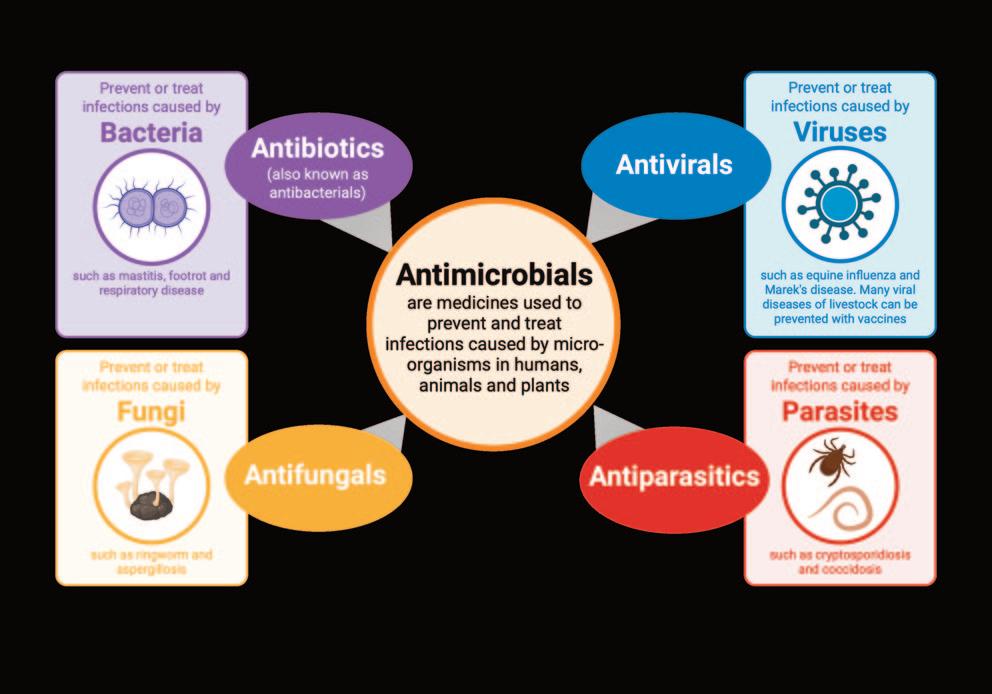
An antimicrobial drug works against only one type of organism
Antimicrobial Resistance: When the micro-organisms change or mutate over time and get to a point whre they no longer respond to medicines previously used to treat them
Figure 1:
Antimicrobials can be divided into different types. Antibiotics treat diseases caused by bacteria, antivirals treat diseases caused by viruses, antiparasitics treat infections caused by parasites and antifungals treat diseases caused by fungi.
Antibiotics are commonly used on farms to treat infections, sometimes they are used to control disease by treating a group of animals following diagnosis of an infection in one or two animals. Antibiotics are also used as a preventative i.e. after transporting young calves they may be given an antibiotic injection to reduce the risk of Bovine Respiratory Disease (BRD), but it is important to note that responsible use of antibiotics means using them only when needed and following a veterinarian’s advice on the correct type, dose, and duration.
RUMA (Responsible Use of Medicines in Agriculture) have published guidance on the use of prophylactic (preventative) antibiotics in farm animals, you can access this on their website: www.ruma.org.uk/the-preventive-use-of-antibiotics-in-farmanimals-prophylaxis along with a range of other guides on responsible use of medicines.
Many people think that they or their animals become resistant to antimicrobials, but this is not the case. It is the pathogen itself, whether a bacterium, virus, fungus or parasite, that develops resistance.
Bacteria can reproduce very quickly, allowing them to adapt rapidly to challenges such as antibiotic treatment. Antimicrobial resistance occurs naturally, but it can develop and spread more quickly when bacteria are repeatedly exposed to antibiotics.
Antibiotic resistance is not a new phenomenon. The first cases of penicillin-resistant bacteria were reported in 1942, just 14 years after its discovery. Methicillin-resistant Staphylococcus aureus (MRSA) was identified in the early 1960s, followed swiftly by resistance to other types of antibiotics.
To help control antimicrobial resistance (AMR), a One Health approach is essential, recognising the links between human and animal health, and the role of the environment in the development and spread of resistance.
Lots of bacteria in an environment (e.g. skin, gut) and some are drug resistant
Antibiotics kill the bacteria causing the illness as well as the good bacteria that are protecting the body from infection
The drug resistant bacteria are now able to grow and take over
Some bacteria give their drug resistance to other bacteria
Figure 2: How antibiotic resistance develops
Bacteria can evolve in several ways, including changes to their DNA or by acquiring new genetic material. These changes can allow them to survive antibiotic treatment, for example by breaking down the drug or pumping it out of their cells. Resistance is more likely to develop when bacteria are exposed to antibiotic levels that do not kill them completely, allowing some to survive and adapt. Over time, these bacteria can become able to withstand even higher doses of antibiotic.
Resistant bacteria can spread between animals, people and environments, particularly where hygiene or infection control measures are insufficient.
When resistance develops, antibiotics may no longer be effective, making infections harder or sometimes impossible to treat. Misuse of antibiotics contributes to this problem. For example, using antibiotics to treat viral infections such as the common cold or flu is ineffective and increases the risk of resistance developing.
The increase and spread of drug-resistant pathogens directly threatens our ability to treat common infections that were easily controlled in the past meaning that they could become fatal again in a post-antibiotic world. In some cases, where resistance has developed to the first-line of defense, alternatives are required to be used which may be more expensive, less effective and require longer treatment durations. Dealing with AMR infections requires more work – additional laboratory testing to identify a suitable antibiotic treatment, more appointments and the potential need for isolation procedures.
Without antibiotics routine surgical procedures, common infections and management of other medical issues would become more dangerous.
It is estimated that by 2050 human deaths, as a result of antibiotic-resistant infections, will reach 10 million annually and the economic losses will reach $100 trillion USD1.
Drug resistant infections in livestock can have a negative impact on animal welfare as well as reducing productivity and threatening food security. In a world without effective antibiotics an outbreak of treatment-resistant infection may necessitate large-scale culling which would have a hugely negative impact on the wellbeing of the animals themselves and the farmers caring for them as well as significant economic implications.
It is also possible for drug-resistant bacteria to spread between humans, animals and plants risking human health as well.
The Scottish AMU Pilot, which began in July 2023, builds on the approach taken by Welsh Lamb and Beef Producers (WLBP) in Wales. Delivered in partnership with SAOS, Farmvet Systems, and ScotEID, and funded by the Scottish Government, the pilot is Scotland’s response to the challenge of AMR and the need for AMU recording. Using Scotland’s AMU Calculator, antibiotic sales data is captured and standardised to produce easy-to-understand reports expressed in milligrams of antibiotic per kilogram of animal (mg/kg). These reports provide a starting point for a conversation between a vet and their farming client, enabling a more targeted and proactive approach to antimicrobial use on farm.
Antimicrobial resistance poses a growing global threat, with over 1.27 million deaths in 2019 linked to drug-resistant bacteria. Overuse or misuse of antibiotics in farming can contribute to resistance, impacting both human and animal health. The AMU Pilot addresses this challenge, aiming to protect public health, safeguard antibiotic effectiveness, support animal welfare and productivity, reduce environmental impact, and contribute to global food security.
The Pilot is currently working to support fifteen vet practices to produce AMU reports for their farming clients, helping to lead the way in tracking the use of antibiotics in livestock.
Over the next year we will be recruiting a further six vet practices. If you would like to be one of them, please get in touch: emma@saos.coop
“Antimicrobials are a hugely important tool for farmers across Scotland and it’s vital that our ability to use them when necessary is protected. Antimicrobial resistance and the potential for restriction of use are both major concerns to the sector and so the accurate recording of usage is very important to give clear evidence on which decisions can be made.
Most farmers have an Animal Health and Welfare plan which is developed in conjunction with their local vet and addresses the specific disease risks on their farm and the methods used to prevent or control them. The collation of which antimicrobials have been used is often a key part of this to highlight areas of concern, and the recording of this by the vet practice rather than the farmer makes accurate measurements and subsequent discussions much more straightforward.
A Scottish AMU pilot will help at a national level to prove how hard Scottish farmers and vets are working to lower volumes of antimicrobials being used on livestock farms and will allow us to benchmark amongst ourselves and against other countries. It is also very reassuring that such data would be owned by the producers themselves and not by either governments or private companies.”
Recording antimicrobial use is a key part of responsible livestock management.
Accurate records allow vets and farmers to monitor how, when and why medicines are used, helping to identify patterns, review treatment decisions and highlight opportunities to reduce or refine use. This supports more targeted, effective treatments when they are needed, while avoiding unnecessary or repeated use. Good records also underpin herd or flock health planning, support compliance with assurance schemes and regulations, and provide evidence of responsible use. Ultimately, this contributes to slowing the development of antimicrobial resistance and safeguarding the effectiveness of these medicines for the future.
The ambition is to move Scotland’s action around AMU beyond the current pilot stage and into full scale national rollout. Wales have demonstrated that this approach is viable and if funding can be secured it could be achieved. National rollout would encompass every vet practice in Scotland and all their farming clients. This would allow a national picture of antimicrobial use to be seen and understood and the country’s suspected low rates of usage to be evidenced.
If you would like to support this approach and the ramping up of an AMU programme, then please raise its importance at relevant forums you participate in. Whether it’s within your vet practice, at your local NFUS meeting, at a Scottish Government stand or the next time you go to a Moredun event please share your support for the work we are trying to do and our ambition for a national programme.
Reducing reliance on antimicrobials in livestock production is a key priority, and a range of alternatives already exists. At Moredun we are working on a variety of projects to support this.
• Development of new diagnostics to improve AMR stewardship
• Development of vaccines to reduce the need for antibiotics
• Alternative treatments - identification of novel antimicrobials
• Research on risks from slurry / manure / biosolids to provide advice on farm management practices
• AMR spread – investigating the role of wildlife
• Investigating the use of wild animal sentinel species such as seals to monitor environmental AMR
• Novel methods to rapidly detect AMR in pathogens
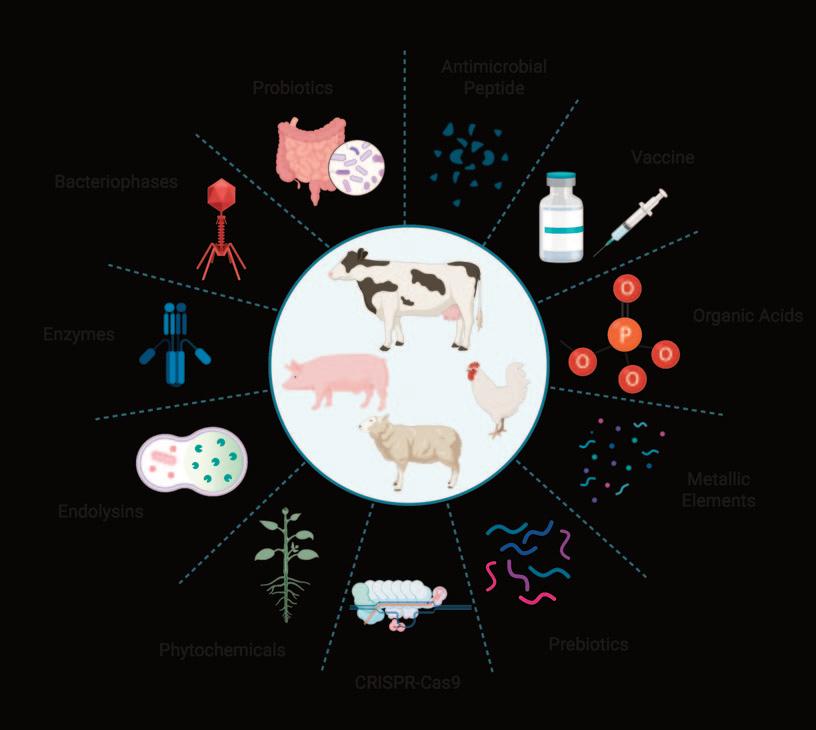
4: Alternatives to antibiotics
Antimicrobials will always be required on some level for the treatment and prevention of infectious diseases in animals and humans.
Medicines used to treat some infections are becoming less effective, leading to poorer outcomes for our livestock. For commercial farms this can mean a reduction in profitability and a threat to your livelihood.
Ensuring that antimicrobials are used responsibly to protect them for future use is everyone’s duty.
Plan ahead with your vet and know what the disease risks for your flock/herd are.
Ensure that animals are maintained in optimal condition so that they are fit and healthy, consider the age of the animals as well as the breed. Does this change any of the risks?
Your health plan should be dynamic and reviewed regularly.
Preventing diseases proactively rather than responding to a disease outbreak is always the preferred option. Reviewing your health plan as well as the husbandry of your stock can help reduce the risk of disease.
Good husbandry, robust biosecurity and strategic vaccination programmes reduce the risk of infection entering and spreading within a herd or flock, protecting both animal health and productivity. By minimising disease pressure in this way, the need for antimicrobial use is reduced, which in turn lowers the risk of antimicrobial resistance developing and spreading. This not only preserves the effectiveness of vital medicines for future use but also supports more resilient, efficient and responsible livestock systems.
Moredun have produced a biosecurity for key livestock diseases news sheet (Volume 7, No. 19) which provides information on diagnostics, quarantine conditions, available vaccines and official accreditation schemes for common diseases.
www.ruma.org.uk/responsible-use-of-antimicrobials-in-veterinary-practicethe-7-point-plan/
www.rcvsknowledge.org/subject/antimicrobial-stewardship-ams/ www.scotlandshealthyanimals.scot/ www.saos.coop/what-we-do/data/amu-(antimicrobial-use)-pilot
www.who.int/europe/news-room/fact-sheets/item/antimicrobial-resistance
1. J. O’Neill, Antimicrobial Resistance: Tackling a Crisis for the Health and Wealth of Nations, (2014).


Produced by The Moredun Foundation Pentlands Science Park, Bush Loan, Penicuik, EH26 0PZ, Scotland
Phone: +44 (0)131 445 5111
E-mail: info@moredun.org.uk
Website: www.moredun.org.uk