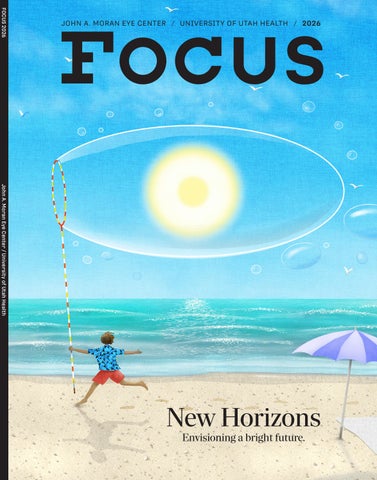
FOCUS 2026
JOHN A. MORAN EYE CENTER / UNIVERSITY OF UTAH HEALTH / 2026
John A. Moran Eye Center / University of Utah Health
New Horizons Envisioning a bright future.
Contents
•••
Features
8
2026
34
Leadership
12 Research 22 Patient Care 28 Outreach 34 Education 40 Donors Departments 2
Chair Message
4
News & Notes
44 Donor List 50 Ophthalmologists & Optometrists 58 Research Faculty 62 Emeritus-Adjunct Research Faculty 63 Volunteer Ophthalmologists 64 Moran Profile
CO-EDITORS
Anna Cekola Communications Editor Elizabeth Neff Director, PR, Communications, Marketing EXTERNAL RELATIONS TEAM/ CONTRIBUTORS
Karah Haney Digital Marketing Manager Tawnja S. Martin Development Officer Brett Prettyman Corporations and Foundations Development Editor
Heidi G. Reid Director of Development Lynn Ward Executive Director, External Relations CONSULTANTS
Stacy Kish Writer Catherine Reese Newton Copy Editor GRAPHIC DESIGN
B&G Design Studios www.bgdesignstudios.com
PHOTOGRAPHY
Laura Kinser, Major Portrait Photography Michael Schoenfeld, Major Portrait Photography Matthew Hepworth; Kinser Studios; Scott Peterson ILLUSTRATIONS
Dave Cutler Illustration Studio Cover and Section Openers, On the Concept of New Horizons PRINTING
Sun Print Solutions West Valley City, Utah
Research work highlighted in this publication was supported by an unrestricted research grant from Research to Prevent Blindness, New York, New York, to the Department of Ophthalmology & Visual Sciences, University of Utah. ©️2026 John A. Moran Eye Center. All rights reserved. The Moran Eye Center does not assume responsibility for any representation therein, nor the quality or deliverability of the product itself. Reproductions of articles or photographs, in whole or in part, contained herein are prohibited without the publisher’s express written consent, unless otherwise stated.
Official Publication of the John A. Moran Eye Center, University of Utah Health, Salt Lake City, Utah 84132
FOCU S 2026
1
•••
MESSAGE FROM THE CHAIR
New Horizons Lead to Sustainable Eye Health for All I am deeply honored to serve as the new chair of the University of Utah Department of Ophthalmology & Visual Sciences and CEO of the John A. Moran Eye Center during a period of extraordinary change for eye care. As I step into this role at an institution I respect, surrounded by colleagues I admire, I reflect with gratitude on the legacy of Dr. Randall J Olson. His inspirational leadership transformed a one-person ophthalmology division into a Top 10 national eye center over his remarkable 46-year career. Most importantly, he left the Moran Eye Center uniquely positioned to shape the future of vision research and care. The stakes have never been higher. With visual impairment worldwide projected to reach 1.8 billion people by 2050, we face a global challenge that requires us to develop new ways to fight the rising rates of vision loss. Advances in artificial intelligence (AI) and digital health are powerful tools, but I believe they must be combined with systems that prioritize public health and universal care to improve eye care delivery and accessibility. At the Moran Eye Center, we are rising to meet this moment. We are working to integrate technology and AI into our clinical infrastructure to enhance disease diagnosis, improve surgical outcomes, and tailor treatment strategies for each patient. These new tools also enable us to expand eye care access in low-resource and rural areas in Utah and around the globe. In the pages ahead, you will read about what we are doing to enhance: • early disease detection and diagnosis, • personalized treatment plans, • remote screening and teleophthalmology, • continuous monitoring and home-based care, • drug development and clinical trials, • accessibility and affordability, and • education and training. With support from our talented faculty, staff, and generous donors, we dedicate ourselves to new horizons that lead to sustainable eye health for all.
2 J OHN A . M ORA N EY E C EN T ER
With support from our talented faculty, staff, and generous donors, we dedicate ourselves to new horizons that lead to sustainable eye health for all.
2026
Moran Advisory Council
TONI BLOOMBERG La Jolla, California WILLIAM “BILL” CHILD Salt Lake City, Utah THOMAS “TIM” DEE III Salt Lake City, Utah CHRISTENA HUNTSMAN DURHAM Salt Lake City, Utah SPENCER F. ECCLES Salt Lake City, Utah CHRISTINE A. FAIRCLOUGH Salt Lake City, Utah
Join us as we work to restore sight, push the boundaries of discovery, train the next generation of ophthalmologists, and meet real-world needs with lasting impact. Together, we will expand access to care, accelerate research that changes the course of a disease, and reimagine what it means to deliver hope and healing on a global scale. Sincerely,
WAYNE A. IMBRESCIA John A. Moran Eye Center CLAUDIA S. LUTTRELL Salt Lake City, Utah KELLIE MORAN Bedford, New York MARISA MORAN Stamford, Connecticut RANDALL J OLSON, MD John A. Moran Eye Center
Jeff Pettey, MD, MBA Professor and Chair, Department of Ophthalmology & Visual Sciences CEO, John A. Moran Eye Center CEO, University of Utah Vision Institute Dr. Ezekiel R. and Edna Wattis Dumke Endowed Chair
JEFF PETTEY, MD, MBA John A. Moran Eye Center LYNN WARD John A. Moran Eye Center NORM A. ZABRISKIE, MD John A. Moran Eye Center
FOCUS 2026
3
News & Notes
•••
The cornea-on-a-chip consists of cultured living corneal cells on top of flexible silicon-based membranes. These membranes were hydraulically inflated with precise control, matching the cornea’s curvature at various stages of disease progression.
RESEARCH
Cornea-on-a-Chip Study Engineers and Moran Eye Center vision scientists are using cornea-on-a-chip biomedical technology to better understand and identify new therapies for keratoconus and similar conditions involving the cornea of the eye. A study published in Nature Communications detailed new findings related to the abnormal thinning and bulging of the cornea found in some eye diseases, impacting 1 in 250 people worldwide. The researchers determined that corneal reshaping is not only a result of disease but
4 JOHN A . M ORA N EY E C EN T ER
also the factor driving disease progression. “This discovery fundamentally reframes how we understand these eye diseases and how we could treat them,” explained study lead author and University of Utah engineering professor Jungkyu “Jay” Kim, PhD. Ophthalmologists treat keratoconus and other conditions with special contact lenses, implants to shape the cornea, or corneal transplants in severe cases. The study, conducted using a cornea-on-achip device developed by Kim, opens the
door to new therapies that could target how cells in the eye sense and respond to pressure. “The study provides new insight into how the tiny internal structures that give corneal cells their shape and strength, the cytoskeleton, are organized and how they differ in sensing pressure across the layers of the cornea,” explained Moran’s David Krizaj, PhD, a study author and collaborator. “If we can block pressure signaling early, we might prevent disease progression altogether.”
NEWS & NOTES
RECOGNITION
HONORS & AWARDS
The Eye as Art Two Moran Eye Center imagers won awards in the Ophthalmic Photographers’ Society (OPS) annual competition. Richard Ordonez earned first place for his “Starry Eye” image, below, in the “The Eye as Art” category, while Wara Camacho Orgaz, CRA, earned an honorable mention in the same category for an image featuring a dense capsular plaque.
For his image, Ordonez used a slit lamp camera to capture an iris and then utilized artificial intelligence and Adobe Photoshop for artistic effects. The international competition was held in conjunction with the OPS and American Academy of Ophthalmology annual meetings.
• Jeff Pettey, MD, MBA, CEO of the John A. Moran
Eye Center and Chair of the Department of Ophthalmology & Visual Sciences, received the Copic Humanitarian Award in recognition of his longtime work increasing access to eye care worldwide. Pettey donated the award’s accompanying $10,000 to Moran’s Global Outreach Division. • Iqbal Ike K. Ahmed, MD, FRCSC, director
of the Alan S. Crandall Center for Glaucoma Innovation, was ranked among the Top 50 most influential ophthalmologists worldwide by The Ophthalmologist magazine. Ahmed appeared in the glaucoma section of its annual Power List. • Lilliana Werner, MD, PhD, Nick Mamalis, MD,
and Jeff Pettey, MD, MBA, received multiple awards for their video, “Handheld Fragmentation Device: Paradigm Shift in Lens Extraction.” Among the organizations honoring the video were the American Academy of Ophthalmology, the European Society of Cataract and Refractive Surgeons, and the Brazilian Association of Cataract and Refractive Surgery. • Suva Roy, PhD, received a Ben B. and Iris M.
Margolis Scholar Award at the University of Utah. The award, bestowed on outstanding new junior faculty members, includes $91,300 to support Roy’s research on advancing understanding of the functions of retinal cells and circuits in normal vision and in diseases such as glaucoma. EDUCATION
Supporting Student Scientists Incoming residents Cameron Reinisch, MD, and Amanda Wade, MD, are the recipients of 2026 Achievement Rewards for College Scientists (ARCS) Foundation of Utah scholarships. ARCS awards $15,000 to honorees to support research during residency, hoping they will choose careers that continue their scientific investigations. Moran matches the award for the following two years of residency. Kathie and Mark Miller sponsor the awards in honor of Moran CEO Jeff Pettey, MD, MBA, and former CEO Randall J Olson, MD.
• Fiona McDonnell, PhD, received a national
Shaffer Research Grant from the Glaucoma Research Foundation. McDonnell will use the $55,000 award to further her glaucoma research to improve treatments for lowering intraocular pressure by understanding the mechanisms that cause it. • Robert C. Kersten, MD, FACS, received the
American Society of Oculofacial Plastic and Reconstructive Surgery Foundation’s inaugural Rick Anderson Award for Surgical Innovation, recognizing outstanding contributions to the art and science of oculofacial surgery.
FOCUS 2026
5
NEWS & NOTES
OUTREACH
Save the Date The countdown is on for the Night for Sight gala benefiting the Moran Eye Center’s donor-funded Global Outreach Division, working to end curable blindness in Utah and around the world. Mark your calendars for Saturday, May 16, at the Grand America Hotel in Salt Lake City. The gala includes a reception, dinner, auction, and stories. Moran physicians, nurses, and medical personnel have volunteered their time locally and
in more than 25 countries, providing cataract and other surgeries and vision screenings while training local ophthalmologists and healthcare workers to increase access to care.
Join Us For more information on Night for Sight tickets, sponsorships, or auction donations, call 801-585-9700, email heidi.reid@hsc. utah.edu, or visit nightforsight.org.
SNAPSHOT: GLOBAL OUTREACH DIVISION FISCAL YEAR 2025
44
2,194
850
448
CLINICS
EYE EXAMS
PAIRS OF EYEGLASSES
EYE SURGERIES
6 J OHN A . M ORA N EY E C EN T ER
NEWS & NOTES
HONORS & AWARDS
RESEARCH
Vision Scientists Share Work Moran Eye Center scientists held a reception to host colleagues from around the world at the 2025 Association for Research in Vision and Ophthalmology (ARVO) annual meeting held in Salt Lake City. More than 30 faculty members presented research at the annual meeting. The ARVO Foundation honored Moran
Vice-Chair for Clinical and Basic Science Research Paul S. Bernstein, MD, PhD, for his efforts to bring vitreoretinal services to the developing world and for his dedicated service to the organization. A retina specialist, Bernstein works with Moran’s Global Outreach Division to train retina specialists in low-resource countries, most recently in Ethiopia.
• Griffin Jardine, MD, was recognized for
his pediatric eye care through Moran’s clinic at Primary Children’s Hospital with a Living Our Values Everyday — or L.O.V.E. Award. The Intermountain Health award asks patients to nominate caregivers who have made a difference in their lives and provided an exceptional care experience. • Rachel G. Simpson, MD, vice-chair of
education, was honored by the Association of University Professors of Ophthalmology with a “Shark Tank” Award for Moran’s Surgical Mentorship and Resident Wellness programs. The award honors educational innovation. • Craig J. Chaya, MD, medical director of
Moran’s Global Outreach Division, received the American Glaucoma Society’s Humanitarian Award for his efforts to preserve vision and improve the quality of life for those in need. • Iqbal Ike K. Ahmed, MD, FRCSC, director
of the Alan S. Crandall Center for Glaucoma Innovation, received the American Glaucoma Society’s Innovator Award. • Barbara Wirostko, MD, FARVO, received
PATIENT CARE
AMD Clinical Trial Advances A new gene therapy for age-related macular degeneration (AMD) developed by Moran’s Sharon Eccles Steele Center for Translational Medicine has successfully completed a Phase One clinical trial demonstrating safety. The therapy, designed for patients with the most common form of AMD directed by genetic mutations on Chro-
mosome 1, is now in a Phase Two trial to evaluate the therapy’s efficacy. It is hoped that a single injection can be given to people at high risk for AMD, the leading cause of blindness for adults 60 and older, or in the early stages of the disease to stop it from progressing or even to prevent it.
a Glaucoma Research Foundation Visionary Award. The award was presented at the foundation’s Glaucoma 360 Gala, part of a three-day series of events including a meeting dedicated to innovations in glaucoma therapies.
Subscribe Now
Scan to sign up for our monthly newsletter for all the latest news in eye care, vision research, and much more.
FOCU S 2026
7
Focus / P R O F I L E
8 J OHN A . M ORA N EY E C EN T ER
A
New
Chapter Jeff Pettey, MD, MBA, turns a page in his dynamic career at the Moran Eye Center to lead one of the country’s top-ranked institutions.
FOCU S 2026
9
Focus / P R O F I L E
J
eff Pettey, MD, MBA, has long been part of the Moran Eye Center family. During college, he worked at the center’s Utah Lions Eye Bank. After medical school, he chose ophthalmology as his specialty, trained at Moran, and joined the faculty. Pettey quickly emerged as a leader who was willing to take on progressively more responsibility, and his creative approaches to education and global outreach elevated Moran’s reputation on the national stage. Now Pettey has stepped into a dream job: succeeding Randall J Olson, MD, as chair of the Department of Ophthalmology and Visual Sciences at the University of Utah and CEO of the Moran Eye Center and University of Utah Vision Institute. “I am humbled to continue our culture of innovation in research, education, outreach, and care,” said Pettey, a physician, educator, and researcher specializing in comprehensive ophthalmology and anterior segment conditions. “I have a deep investment in Moran—who we are, how we got to where we are today, and our future as we remain committed to our vision of hope, understanding, and treatment for all.” Following a nationwide search, a University of Utah School of Medicine committee selected Pettey to replace Olson, who retired in August. Olson had served as founding chair for a remarkable 46 years, leaving Moran with big shoes to fill. But Pettey is ready for the challenge after serving in key roles that gave him an exceptional understanding of the center that Olson dedicated himself to building. “Dr. Pettey is a thoughtful, mission-driven leader whose commitment to patient care, education, and global health reflects the very best of Moran’s values,” said Kristina Callis Duffin, MD, MS, interim dean of the Spencer Fox Eccles School of Medicine. “He brings deep institutional knowledge, a collaborative spirit, and a bold vision for the future. I am confident he will lead the department with the same excellence and innovation that has long defined the Moran Eye Center.” PASSION PROJECTS A Utah native, Pettey earned his undergraduate degree from the University of Utah and his medical degree from The Ohio State University. Returning to Moran for his residency,
10 J OHN A . M ORA N EY E C EN T ER
he developed a strong commitment to cataract surgery research, education, and expanding access to the highest-quality care. In 2012, Pettey and fellow resident Brian Stagg, MD, started a charity surgery day that became Moran’s renowned Operation Sight program. The donor-funded initiative, now a national model, provides sight-restoring cataract surgery to uninsured or underinsured Utahns. With Moran’s Global Outreach Division, Pettey has led capacity-building programs across the globe to train local physicians and improve the quality and safety of sight-restoring surgeries. Locally, he continues his work to improve access to care throughout the Mountain West. Pettey established an ophthalmology training collaboration at the University of Dodoma and the Bugando Medical Center in Tanzania. Viewing global eye health work as a collaborative effort across institutions, he co-founded an international Global Ophthalmology Summit and the Academic Global Ophthalmology Consortium to advance the field. Both the summit and consortium are operated in partnership with the American
My goal is to empower amazing people to achieve their best. Each of us has something unique to offer, and it’s the amalgam of these talents that has the potential to change the world for the better. — Jeff Pettey, MD, MBA
•••
Jeff Pettey, MD, MBA, examines a patient at the Moran Eye Center.
Get To Know Jeff Pettey, MD, MBA Academy of Ophthalmology (AAO) and academic ophthalmology departments across the U.S. During residency, Pettey began researching phacoemulsification (phaco), the modern form of cataract surgery that uses an ultrasonic handpiece to break up the eye’s cloudy lens for removal. His Olson Pettey Lab now evaluates phaco technologies for safety and efficiency to improve the most performed surgery worldwide. Cultivating his passion for education, Pettey chose fellowship training in complex anterior segment surgery, global ophthalmology, and ophthalmic education at Moran. In 2014, he took the helm as Moran’s residency program director, and four years later became vice chair for education, overseeing the entire education program. Pettey focused on innovative ideas in ophthalmology training. He championed highly tailored residency training at Moran, empowering residents to explore unique training opportunities to advance their careers. This included expanding international training opportunities, protected personal wellness time, and subspecialty electives. Before his selection as chair, Pettey additionally served as Moran’s vice-chair of clinical affairs. MAKING A MARK Pettey has prioritized innovation in leadership roles with ophthalmology’s major associations. He chairs the Association of University Professors of Ophthalmology (AUPO) committee overseeing the process for residency matching nationwide. He also led an AUPO effort to create an advanced cataract surgery curriculum for residents and to incorporate ophthalmology training into a resident’s intern year. With AAO, he chairs the Sustainability Committee to reduce the future carbon footprint of clinical care and has served on a wide variety of education, global health, and mentorship committees. His work has earned honors, including the AAO Artemis Award and the Copic Humanitarian Award for his outreach efforts and dedication to expanding access to care. Pettey views the future as one that will eclipse the past. He is committed to finding new ways for Moran to deliver eye care for all with an enthusiasm his predecessor would be proud of. But he noted he will not do it alone. “Our faculty are our greatest strength moving forward, as they set the standard for new discoveries and provide the highest quality care to each patient we serve,” said Pettey. “Underpinning all our success are our donor partners, who are the lifeblood, enabling us to pursue ambitious goals and meaningful modernization. Together, we can look to a bright future knowing that collectively we can make transformative progress to set new standards, serve wider communities, and provide life-changing eye care.”
To introduce you to Dr. Jeff Pettey, our new chair of the Department of Ophthalmology & Visual Sciences and CEO of the John A. Moran Eye Center, here are a few things about him that you won’t find on his résumé.
FAMILY?
My wife, Gretchen, and I celebrated our 25th anniversary this year. We have two daughters and two sons, who each bring joy and just the right amount of spice to our lives.
places where I feel most connected to family and nature. PETS?
Bailey! She’s the single greatest dog that’s ever lived. FAVORITE FOODS?
WHO HAS INFLUENCED YOU THE MOST?
My parents, Jax and Kathy Pettey. My mother has nothing but love for all people and embodies emotional intelligence, which has taught me empathy and grace. My father possessed a brilliant mind and a kindness and humanity that made everyone feel like they were the most important person in the room, and by extension, the world. FAVORITE VACATION SPOT?
Capitol Reef National Park and Fish Lake, also in Utah, were the vacation soundtracks of my childhood and remain the
My favorite foods have depth and complex flavors, and discovering the world’s best chocolate chip cookie remains an ongoing quest. HOBBIES?
I love exploring Utah deserts, learning the culinary arts, and restoring vintage cast iron. HOW DO YOU START YOUR DAY?
A 6 a.m. run or workout followed by New York Times word games. FAVORITE MOTTO?
“Be curious, not judgmental.” — Ted Lasso
FOCUS 2026
11
p.14 p.16 p.20
Focus
RETINAL Q&A AI INITIATIVES LENS TECHNOLOGY
RESEARCH
FOCUS 2026
13
RESEARCH
RETINAL Q&A
What’s Next in Eye Care? Just Ask Dr. Bernstein. Moran Eye Center Vice-Chair for Clinical and Basic Science Research Paul S. Bernstein, MD, PhD, is a renowned retinal specialist and a prolific researcher whose work is shaping the future of eye care. We asked him three important questions related to some of his recent research. SHOULD RETINAL SPECIALISTS DO GENETIC TESTING FOR PATIENTS WORRIED ABOUT THEIR RISK FOR AGE-RELATED MACULAR DEGENERATION (AMD)? This is a question on the minds of many physicians whose patients have family members with the disease, which is the largest cause of vision loss for people age 60 and over. Current guidelines don’t recommend testing, but they date back 12 years. Genetic testing to determine risk for AMD is now affordable and reliable. We studied 80 subjects to examine whether genetic testing was worthwhile for someone who may or may not develop AMD decades down the road. Would they change their behaviors to lower risk: lose weight, improve their diet, or quit smoking? Would testing cause stress or anxiety, maybe even depression? We couldn’t prove people would make a major dietary change. We believe we’d need a much larger study to do that, and many of our participants already had healthy lifestyles. But we learned a lot on the psychological side. Subjects were interested and engaged in testing; they found the information very valuable, and we induced zero anxiety or depression. CAN WE IMPROVE EYE HEALTH FOR PREGNANT MOTHERS AND BABIES BY BUILDING BETTER PRENATAL VITAMINS? I study the role of carotenoids such as lutein and zeaxanthin in eye health and why and how the eye goes out of its way to concentrate them early
14 J OHN A . M ORA N EY E C EN T ER
in life, as vision is developing. We get carotenoids from dietary sources—dark green leafy vegetables and orange and yellow fruits and vegetables. My lab has shown that carotenoids improve eye health for AMD patients, so I decided to investigate whether they could be beneficial as a supplement for pregnant mothers and their soon-to-be-born babies. Just when we began recruiting for the clinical trial, COVID hit. We were still able to do the trial with 47 women, most of them hospital and university employees. We showed that the supplements were safe and raised carotenoid levels for the mother and the child. We also observed that the fovea—that’s the part of the eye responsible for detailed central vision—of these babies was more mature at birth. We are seeking funding to conduct a second study, this time focusing on high-risk pregnancies in Utah and Ghana. ARE WE CLOSE TO A TREATMENT FOR A RARE EYE DISEASE KNOWN AS MACULAR TELANGIECTASIA TYPE 2 (MACTEL)? This was an orphan disease until new imaging technologies made it easier to identify, and the MacTel Project launched an international research collaboration to study it. At Moran, we have the largest cohort of MacTel patients (more than 150) at a U.S. academic center. One of our Utah multigenerational MacTel families led to the discovery of the first gene for MacTel, which helped us understand, in part, what’s causing this disease that leads to a slow
RESEARCH
loss of central vision in middle-aged individuals. In terms of treatments, we were involved in preliminary studies of therapeutic doses of serine, an amino acid deficient in MacTel patients, and we will be part of an upcoming larger clinical trial. The most exciting thing has been this year’s FDA approval of the first MacTel treatment: ENCELTO. This is a capsule, placed in the eye, that is packed with bioengineered cells that secrete a protein supporting retinal cells. I was involved in a clinical trial that showed it slows disease progression by about 30 percent, and I recently performed the first commercial ENCELTO implantation in the Mountain West in one of our MacTel patients. It’s fantastic to see a project for a disease we knew very little about get all the way to a new therapy I can offer my patients. I’m thankful for Moran’s culture of innovation, which supports long-term research like this.
Learn More
Scan or visit moraneye.link/mactel-treatment to read more about Dr. Bernstein’s first patient in the Mountain West to receive a new treatment for MacTel.
FOCUS 2026
15
RESEARCH
AI INITIATIVES
Powering Hope: The Rise of AI in Ophthalmology Adam Dubis, PhD, is driving advances for artificial intelligence in eye care and vision research. Moran Eye Center researcher Adam Dubis, PhD, works at the intersection of big data, artificial intelligence (AI) algorithms, and hope. The breakthrough tools and platform technologies he developed are helping ophthalmologists determine treatment plans and creating new opportunities for vision scientists to explore pressing questions. His most recent project aims to improve care and speed drug development for people and their families who are facing blinding inherited eye diseases. “We have an incredible opportunity to use AI tools and ethically sourced data to improve how healthcare is accessed and delivered on a global scale,” said Dubis, a data expert who has traveled the world advising international bodies on health technology regulation. “At the end of the day, I’m creating tools that give patients hope for the future.” AI FOR AMD Age-related macular degeneration (AMD) is the leading cause of blindness for people 60 and older, impacting central vision that’s important for seeing grandchildren clearly and enjoying hobbies in your golden years. There is no cure for it, but ophthalmologists do have treatment options for the neovascular or “wet” form of the disease in which abnormal
16 J OHN A . M ORA N EY E C EN T ER
blood vessels growing in the eye can leak and rupture. Retinal specialists can inject medication to prevent vessel growth and use retinal imaging to evaluate a patient’s progress. The problem: Not all patients respond to the same treatment regimen equally, so care must be personalized. If injection appointments are scheduled too far apart, or if patients feel they are coming in too frequently and miss some appointments or even drop out of treatment, they could lose vision. Dubis made headlines in 2025 when the company he co-founded launched the Treatment Planning Support (deepeye® TPS) algorithm, which uses tens of thousands of 3D scans of the retina combined with medical records to analyze disease progression and correlate them to treatment regimens. The tool, now available in Europe, was the first of its kind approved for use in the Western world. Its algorithm helps physicians make two decisions, acting like a second expert reader of the scans: • Does the patient need to receive a treatment today or not? • How many treatments will the patient need over the next 12 months? The AI also displays the basis for the recommendation. “The idea is that it will allow patients to keep
•••
Adam Dubis, PhD
RESEARCH
FOCUS 2026
17
RESEARCH
their vision as long as possible and ensure they are only spending time going to a clinic when they need to,” said Dubis. “For physicians, it optimizes clinic flow, provides reassurance for the treatment course, and possibly helps in patient education or justifying changes to prescribed therapies.” Discussions about evaluating the AI at the Moran Eye Center as part of a U.S. clinical trial are ongoing. A WIDER DOOR FOR RESEARCH Dubis is among the first to say AI is only as good as its vetted data sources and a person’s ability to easily access it. This idea is at the center of the new Moran Phenotyping, Imaging, and Advanced Technologies (PHIAT) AI database, which contains close to 2 million health records. PHIAT allows researchers to easily ask myriad questions related to ophthalmology. For example, a clinician scientist might try to predict which patients with diabetes are most at risk for getting diabetic eye disease, or to create an algorithm that helps doctors identify when one drug isn’t working and it’s time to try another. Dubis emphasizes that ethically sourced data powers his AI. In PHIAT, individual health records are de-identified, and the confidentiality of the data is strictly protected within data computing facilities using industry-leading security measures. PHIAT is unique among academic medical centers. “While other universities have limited databases open to research, their data is preconfigured, whereas PHIAT is not,” said Dubis. “This allows for a much broader range of inquiries and investigations. We are opening the door wider for research in diseases that can be time-consuming and expensive to study.” PRIORITIZING PATIENT GOALS Bob Pettipaw, 62, was just 15 years old when he learned he would slowly go blind from choroideremia, a rare, inherited eye disease impacting men in his family. His grandfather on his mother’s side was blind, as was his uncle. Choroideremia advances slowly, starting with peripheral vision loss that moves inward later in life, so at first, Pettipaw did his best to ignore his diagnosis. He got married, started a family, built a successful plumbing career, and started his own business.
18 J OHN A . M ORA N EY E C EN T ER
•••
Bob Pettipaw, right, speaks with Adam Dubis, PhD, about research at the Moran Eye Center.
There is so much out there in the world of research that maybe in my lifetime I’ll be able to get some vision back. But even if not, at least I will have done the work as best I can to try to ensure my daughter’s children or other people’s children don’t go blind. —Bob Pettipaw, patient and research advocate But as the disease advanced and he made the first of many visits to the Moran Eye Center, he realized he had to modify his approach to managing the disease. “I made changes in how I lived my life and pursued my career,” said Pettipaw, now an advocate active with the Choroideremia Research Foundation. “There is a point when you just say, ‘So what? I’m not afraid, I’m looking forward.’ What helps me the most is when I can help others, especially people who are just starting their journey and may need some help from us old guys who have been through it.” Pettipaw participated in an East Coast clinical trial for a new drug that didn’t make it to the market. While he said he experienced improvements in his vision and day-to-day functioning, the trial gauged success primarily through improvements in a single measure: visual acuity. Taken using an eye chart, visual acuity looks for improvement in a small region of central vision. “Choroideremia is a condition that you will retain good central vision well into your 70s,”
RESEARCH
explained Pettipaw. “We’ve got 20/20 in our center, it’s our peripheral, our contrast, our light sensitivity that are impacted. So, what I am looking for in terms of a successful outcome is more functional-based, like mobility tests and things of that nature.” These types of outcomes, known as patient-reported outcomes (PROs), focus on tasks most relevant to patients. Before and following treatment, is a patient able to navigate a room in dim light or drive at dusk better? Can they participate in sports, or recognize faces across a room more easily? The use of PROs in blinding eye diseases has been fragmented at best. That’s where Dubis comes in. He’s working with patients like Pettipaw, caregivers, clinicians, and researchers to create a unified set of PROs for multiple conditions and an accompanying comprehensive, multicenter clinical database. He envisions Moran as ground zero to use this information to create a new center
for inherited eye disease research. “Visual acuity measures central vision in a very small part of the eye, yet we see across a much larger field of vision,” explained Dubis. “Quantifying how vision occurs, how it changes during disease, and how it works post-treatment across the entire visual space is essential. PROs better capture post-treatment changes, and without them, drug companies must start from scratch for each trial. That slows development and adds cost.” Pettipaw’s daughter, Anna, 25, is hopeful about research to find new treatments and a cure. She thinks about having children one day, but it’s a complicated question, knowing she could pass choroideremia on to a son. On some days, her answer is yes; on others it is a no. “Research is my future, my family’s future, my kids’ future,” she said. “It is ever developing, always a positive light when things aren’t so positive, when they are dark.”
•••
Bob Pettipaw, a Moran patient losing his vision to choroideremia, often relies on public transportation.
FOCUS 2026
19
RESEARCH
LENS TECHNOLOGY
IOLs From Space A unique research project offers an out-of-this-world look at intraocular lenses. Cataract surgery on Mars? A research collaboration between the Moran Eye Center’s Intermountain Ocular Research Center (IORC) and surgeon Morgan Micheletti, MD, with Texas-based Berkeley Eye Center, aims to answer key questions that could make it possible one day. In a first-of-its-kind project, Micheletti partnered with a NASA and Space Center Houston materials testing program to send 135 types of artificial intraocular lenses (IOLs) to the International Space Station (ISS). The lenses spent six months mounted outside the ISS in special capsules, directly exposed to real space conditions like high UV radiation, extreme temperature fluctuations, and elevated atomic oxygen levels.
20 JOHN A . M ORA N EY E C EN T ER
If humans one day begin growing old in space, they will almost certainly need cataract surgery. A cataract—caused mainly by aging—is a gradual thickening and hardening of the naturally transparent lens in the eye, which makes it increasingly difficult to see. Surgeons remove the cloudy lens and replace it with an IOL to restore clear vision. “One of my goals is to perform the first surgery in space,” said Micheletti, who has performed over 10,000 cataract and other surgeries as part of his practice with Berkeley Eye Center in Houston, where he also serves as a partner and director of research and fellowship training. “Cataract surgery is the most common operation on Earth. As space exploration advances, we believe it will
•••
Morgan Micheletti, MD, left, and Lilliana Werner, MD, PhD, display some of the IOLs from space at the Moran Eye Center.
RESEARCH
one day become routine off Earth as well.” However, there are significant questions to answer first. How will different types of IOLs, made of a variety of surgical biomaterials, hold up in space? What are the safest and most efficient ways to transport and store sterile medical implants beyond Earth? Enter Lilliana Werner, MD, PhD, co-director of the IORC, a nonprofit laboratory that researches IOL design, materials, and complications for companies and physicians worldwide. “I’ve gotten lenses from everywhere in the world to analyze, and I thought I had seen it all,” said Werner. “But I’ve never gotten lenses from space—it’s super cool!” Micheletti is equally excited to work with Werner on the next step of his Joint Assessment of Intraocular Lens Exposure in Space (JAMES) project, which has received funding support from several leading makers of IOLs. “She’s not only a world-renowned expert in IOL materials,” said Micheletti, “but also brings decades of experience in understanding how these lenses
perform in every imaginable condition, making her the perfect person to tackle this unique project.” EARLY OBSERVATIONS Cobblestones, bubble wrap, burn scars. These are a few of the damages to the once-clear and smooth-surfaced lenses from space that Werner noted from analysis in her lab and the Nanofab Electron Microscopy and Surface Analysis Lab at the University of Utah. “These are damages I’ve never seen before,” said Werner. “This damage does not happen on Earth.” Not all the lenses showed signs of damage, probably a result of their exact position on the ISS and how they were stored, Werner said. She and Micheletti will be working to publish the results of the JAMES project as they continue their exploration into this new world of cataract surgery. “The whole purpose of this is to determine how these materials act in space,” Micheletti said. “In my lifetime, someone will have cataract surgery off of this planet, and we need to figure out how to send lenses there.”
•••
At top, are two single-piece hydrophobic acrylic IOLs subjected to large temperature and vacuum fluctuations in space, as well as conditions with high ultraviolet radiation and atomic oxygen exposure. They both show large cracks in the optic and areas that appear to be opacified. Under high magnification, at bottom, the yellowed opacified areas also exhibit many small cracks.
FOCUS 2026
21
p.24 p.27
Focus
PERSONALIZED MEDICINE GLAUCOMA CARE
PAT I E N T C A R E
FOCUS 2026
23
PAT I E N T C A R E
PERSONALIZED MEDICINE
Advanced Glaucoma Care Comes Home A handheld device that allows patients to track their eye pressure at home is transforming care and research. Glaucoma is a chronic, incurable, insidious blinding eye disease. People often lose vision before receiving a diagnosis since its main symptom—increased intraocular pressure (IOP)—usually does not cause any pain or discomfort. Once a diagnosis is made, fluctuations in IOP reveal whether the disease is progressing or a treatment is working. Like early coal miners who once relied on canaries to warn of toxic gases, ophthalmologists have long relied on pressure checks at clinic appointments to monitor IOP. The problem: These checks provide only a brief snapshot of a patient’s condition every few months. “Our research has shown IOP can spike early in the morning or late at night—times that patients are not typically seen,” said Barbara Wirostko, MD, FARVO, a glaucoma researcher at the Moran Eye Center’s Alan S. Crandall Center for Glaucoma Innovation. “There is a need to monitor eye pressure more continuously, similar to monitoring blood sugar or blood pressure.” Enter the iCare HOME2—a compact, handheld device that allows patients to easily measure their eye pressure at home without the need for numbing eyedrops. “This technology is like a better canary in the coal mine,” said Wirostko. “It helps us detect dangerous pressure changes we might not be seeing in the office before they cause permanent damage. It’s also a valuable new tool for research, helping us to learn more about the underlying pathophysiology of glaucoma as well as comorbidities and associations.”
RIDING THE TREATMENT ROLLERCOASTER Like many patients, John Sharkey was surprised by his glaucoma diagnosis. He sought the help of Wirostko several years into his glaucoma treatment journey.
24 JOHN A . M ORA N EY E C EN T ER
By the time he retired from his law practice 25 years ago, Sharkey had already cycled through different glaucoma therapies, beginning with eye drops before progressing to laser eye surgery. Wirostko introduced him to the iCare HOME2. “I liked having the feedback—not just an absolute pressure number—but how it changes,” said Sharkey. “My results showed quite a bit of variability during the day even with treatment.” The handheld device, known as a tonometer, has built-in sensors that help the patient make subtle adjustments to match the contours of their face and align the device with their eye. As with many routine tests during an eye exam, the patient looks at a light in the device while it captures pressure readings. “It wasn’t hard,” said Sharkey. “It was how I found out one of my surgeries had failed. I was able to get back on medication and schedule the next surgery rather than waiting for more progression to occur.” iCare HOME2 takes six measurements in rapid succession, eliminating the lowest and highest numbers and logging an average of the remaining readings. The data, which is displayed graphically and in a table, also includes metadata, such as the date and time when the measurement was taken. The data is downloaded wirelessly to a secure cloud server that the patient and doctor can access. Like Sharkey, Justin Wilson was surprised by his glaucoma diagnosis. “Your biggest fear is the fear of the unknown,” he said. “Now I can be proactive, not reactive, in my care. Daily monitoring allows me to be immediately aware of any IOP issues and not have to wait for biannual office visits—a true game changer.” Wilson also began his therapy with eye drops, but after each new treatment failed to lower his
PAT I E N T C A R E
•••
Michael Jensen, MD, a former Moran glaucoma research fellow, holds an iCare HOME2 device that glaucoma patients can use at home to measure eye pressure.
Understanding Glaucoma Glaucoma is a group of eye diseases that damages the optic nerve, the part of the eye that carries information defining what you see to the brain. The brain then turns the information into images. Although there are probably several factors that
NORMAL EYE
contribute to glaucoma, the best understood is eye pressure. Increased pressure damages the optic nerve over time. Without treatment, optic nerve damage can lead to vision loss and, ultimately, blindness.
GLAUCOMA
High pressure damages optic nerve. DRAINAGE CANAL BLOCKED Too much fluid stays in the eye. This increases pressure.
FOCUS 2026
25
PAT I E N T C A R E
eye pressure, he turned to more invasive therapies. Wilson also sought treatment from Wirostko and found that the Moran Eye Center treated him as an individual, not another number walking through the door. “Eyes are not a cookie-cutter or one-size-fitsall business,” Wilson said. “At the Moran Eye Center, they look at you as an individual, and they treat your individual problem.”
NEW STUDY USING ICAREHOME2 AND GENETIC TESTING Genetics influence how likely you are to develop a host of diseases, and glaucoma is no exception. Doctors can use a measure called a polygenic risk score (PRS), which measures the combined effects of several genes, to assess a person’s risk for developing glaucoma. Wirostko and her Crandall Center colleagues are launching a study with glaucoma patients who have used or are currently using the iCare HOME2 to monitor their IOP daily. The study aims to determine if higher PRS scores are associated with elevated IOP and greater and more frequent IOP fluctuations. The answers could help patients, their family members, and doctors make better treatment decisions to manage IOP. “If we find a correlation, this could be a game-changer for glaucoma patients and even their loved ones,” said Wirostko. “We want to have the best information possible to customize care to each patient and control both high IOP and IOP fluctuations before our patients lose vision. So often we treat after there is already vision loss.” Participating patients will complete a saliva test to determine their PRS, which will then be compared to their IOP records. Australian researchers conducted a similar study, published in 2020, involving 239 participants with open-angle glaucoma who used the iCare HOME. The study found that those in the highest PRS quintile were 5.4-fold more likely to show early morning IOP spikes (4-6 a.m. on average) than those in the lowest quintile. “Much of this groundbreaking work is already happening around the world,” said Wirostko. “Here at the Moran Eye Center, we can help lead the U.S. in this field to learn more about patterns and associations of IOP with a PRS score.”
26 JOHN A . M ORA N EY E C EN T ER
There is a need to monitor eye pressure more continuously, similar to monitoring blood sugar or blood pressure. —Barbara Wirostko, MD, FARVO
STUDY INFORMATION
Support the Research Donors are needed to help fund saliva testing for the PRS study. Why? The out-of-pocket test cost is $350, which is a barrier for some patients to participate. Data collected from this initial study will be used to secure grants to fund additional research. Faculty leading the study include: • Ike Ahmed, MD, FRCSC • Craig J. Chaya, MD • Ian F. Pitha, MD, PhD • Barbara Wirostko, MD, FARVO
More Information
Scan to learn more or make a donation.
PAT I E N T C A R E
GLAUCOMA CARE
Hope for Complex Cases Watch Now
Scan to watch Gentry’s story or visit moraneye.link /AhmedPatientStory.
When the stakes are high, patients count on Moran Eye Center experts. Gentry Howard is a dancer, a strong student, and a typical teen. Yet the 13-yearold Missourian has lost vision in one eye and is fighting to save it in the other. Her ophthalmologist knew what he had to do when glaucoma, cataracts, and structural abnormalities were compromising Gentry’s good eye. “Moran was the first—and only—place I considered to refer her to,” said Michael C. Stiles, MD, of Stiles Eyecare Excellence in Overland Park, Kansas. “You could ask anybody who they would go to if they had something really, really difficult to treat. In the ophthalmology community, they say ‘Ike’, and everybody knows who they are talking about.” Iqbal Ike K. Ahmed, MD, FRCSC, a world-renowned glaucoma specialist and director of Moran’s Alan S. Crandall Center for Glaucoma Innovation, welcomed Gentry and her mother, Becky, to Utah. “Saving her sight was my highest priority,” Ahmed said. Scan the code at left for the full story.
•••
Ike Ahmed, MD, FRCSC, top, examines teenager Gentry Howard, above, at risk of losing her sight.
FOCUS 2026
27
p.30 p.32
Focus
NAVAJO NATION TANZANIA
OUTREACH
FOCUS 2026
29
OUTREACH
NAVAJO NATION
A Drive to Provide Care Moran Eye Center outreach teams travel several times a year to schools and health clinics to provide eye care on the Utah strip of the Navajo Nation, one of the most isolated and underserved areas in the Lower 48. Every now and then, they go even further with a house call. That was the case this past fall when a team led by Theresa Long, MD, loaded equipment into a car and drove miles down a red dirt road at the base of Navajo Mountain to reach the home of 95-year-old Polly Stevens, a mother of eight who has lived on the remote homestead her entire life. Stevens’ home nurse, Evonne Butler, had re-
1
30 JOHN A . M ORA N EY E C EN T ER
cently noticed a rapidly growing abnormality in the eye of her homebound patient. When Butler heard about Moran’s planned outreach clinics in the Navajo Mountain area, she reached out for help. The Global Outreach Division team didn’t hesitate to set up a house call. In the patient’s living room, Long provided an in-depth eye exam and offered the family various options depending on the ultimate diagnosis. “I haven’t done a house call since medical school; they’re rare today,” said Long. “Bringing care and hope directly to Polly and her family was truly meaningful.”
•••
1. Theresa Long, MD,
examines 95-year-old Polly Stevens during a house call on the Navajo Nation. 2. Natalie Oberer, OD, performs an eye exam at the September 2025 Navajo Mountain clinic. 3. Craig J. Chaya, MD, examines a patient at the Navajo Mountain clinic. 4-6. During the September trip, the outreach team provided screenings and eyeglasses to dozens of students at Montezuma Creek Elementary.
OUTREACH
3
2
5
4
6
SNAPSHOT: NAVAJO NATION OUTREACH FISCAL YEAR 2025
731
COMPREHENSIVE EYE EXAMS FOR ADULTS AND CHILDREN
487
ADULT AND PEDIATRIC GLASSES
20 EYE SURGERIES
FOCUS 2026
31
OUTREACH
TANZANIA CARE AND TRAINING
Expanded Services Meet Dramatic Need A hyena pack descended upon a remote Tanzanian village in the middle of the night. Among the victims in the terrifying attack: a 10-year-old girl, asleep in her bed. She survived the trauma but was left scarred and unable to see out of one eye. When her family learned that doctors from the Moran Eye Center’s Global Outreach Division would be holding a clinic at Benjamin Mkapa Hospital in Dodoma, they didn’t hesitate to make an eight-hour journey for the chance to help their child regain her vision. There, they were met by Moran Eye Center oculoplastic surgeon and Tanzania outreach team member H. Joon Kim, MD. “When I first met her, she was so shy, she didn’t say a word, and she didn’t smile,” Kim said of her patient. “On surgery day, I could see her beautiful personality, and she was so happy. She was undoubtedly excited about having her injuries repaired. She was playing hide and seek with me, and I actually got her to smile.” In the first of several surgeries that will be needed, Kim successfully restored some vision in the girl’s damaged eye by repairing her eyelid, allowing her to open her eye again. The surgery and nine others marked the first time the Global Outreach Division has provided oculoplastic care and the first oculoplastic surgeries performed in Dodoma, the capital city of Tanzania. “We are happy to begin providing oculoplastic care and training in an area where there is so much need for it,” said Global Outreach Division Medical Director Craig J. Chaya, MD. “Some children or adults need this type of care for a congenital condition, like a drooping eyelid that impacts vision. Others suffer injuries to the eye related to everyday life and survival in their communities.” Funded solely by generous donors, the Global Outreach Division works to expand access to eye care in low-resource countries, such as Tanzania, where there is statistically less than one ophthalmologist for every million people. The division provides training for local doctors and nurses, as
32 JOHN A . M ORA N EY E C EN T ER
well as critically needed eye care for those who would otherwise go without it. During this two-week trip to Tanzania last spring, the outreach team conducted 393 vision screenings and performed 150 sight-restoring surgeries, while also training local doctors. Kim also performed surgery on two babies born with ptosis, or drooping eyelids. Kim said she looks forward to returning to Tanzania in 2026 to provide outreach care that should fully reconstruct the girl’s eye socket and further restore her vision. She’s also heard there will be another young hyena attack victim in need of care.
1
2
•••
1. H. Joon Kim, MD,
performs an eye exam in Tanzania. 2. Kim performs oculoplastic surgery in Tanzania. 3. The young patient attacked by a hyena before her first eye surgery. Kim said she looks forward to continuing to provide outreach care that should fully reconstruct the girl’s eye socket and restore her vision.
OUTREACH
3
SNAPSHOT: INTERNATIONAL OUTREACH FISCAL YEAR 2025
850+
COMPREHENSIVE EYE EXAMS FOR ADULTS AND CHILDREN
305 EYE SURGERIES
50+
DOCTORS, NURSES, TECHS TRAINED
FOCUS 2026
33
p.36 p.38 p.39
Focus
PHYSICIAN TRAINING FELLOWS RESIDENTS
E D U C AT I O N
FOCUS 2026
35
E D U C AT I O N
PHYSICIAN TRAINING
Surgery 3.0 Moran Eye Center faculty trained residents and practicing ophthalmologists through expanded hands-on experiences in 2025. Moran’s top-ranked resident education program is known for providing exceptional surgical experiences. A curriculum revamp created regular, hands-on wet labs, including a new annual cataract symposium. Now in its second year, the event featured Moran adjunct professor and complex cataract expert Nicole Fram, MD, and Barry Seibel, MD, an expert in cataract phacoemulsification, which uses a vibrating ultrasound handpiece to break up the cloudy lens of the eye.
1
36 JOHN A . M ORA N EY E C EN T ER
Alan S. Crandall Center for Glaucoma Innovation Director Ike Ahmed, MD, FRCSC, directed a glaucoma masterclass for practicing specialists. The event provided mentor-based didactic and hands-on training in interventional glaucoma treatments such as micro-invasive glaucoma surgery (MIGS), along with wet labs and workshops. Attendees reported a 63 percent increase in their MIGS procedures following the class, one of several to be offered at Moran.
•••
1. Ike Ahmed, MD, left,
leads a session at the glaucoma masterclass. 2. Resident Amen Nigussie, MD, trains at the cataract symposium.
E D U C AT I O N
2
FOCUS 2026
37
E D U C AT I O N
F E L LO W S H I P P R O G R A M 2 02 5 -2 6
Meghan Brown, MD
James Garcia, MD
Jodi Hwang, MD
Ashley Polski, MD
Ryan Frisbie, MD
Anthony Mai, MD
Cornea
Cornea
Glaucoma
Glaucoma
Global Ophthalmology
Global Ophthalmology
Sannah Vasaya, DO
Leo Hall, MD
Etti Katzburg, MD
Sean Collon, MD
Joseph Luvisi, MD
Paul Micevych, MD
Neuro-Ophthalmology
Plastics
Medical Retina
Retina
Retina
Retina
R E S E A R C H F E L LO W S 2 02 5 -2 6
Devayu Parikh, MD Uveitis
Lieu Nguyen Lowrie, MD
Charissa Tan, MD
Max Liu, MD
Zoha Mian, MD
Glaucoma Research
Glaucoma Research
Ocular Pathology
Ocular Pathology
PROVIDING AN EXCEPTIONAL EDUCATION Moran offers one of the nation’s top educational programs, providing excellent didactic training and extensive surgical experience. In 2025, Doximity, a networking platform for physicians, ranked Moran’s residency program No. 6 nationwide and No. 1 in the West.
38 J OHN A . M ORA N EY E C EN T ER
Scan for More Information
Curriculum Details
Education Focus 2025
E D U C AT I O N
SNAPSHOT: EDUCATION PROGRAM FISCAL YEAR 2025
R E S I D E N CY P R O G R A M 2 02 5 -2 6
THIRD YEAR
664
RESIDENT APPLICATIONS FOR 4 SPOTS IN 2024 Ayesha Patil, MD, MPH
George Sanchez, MD
Sam Wilkinson, MD
Erica Woertz, MD, PhD
SECOND YEAR
IN A TYPICAL THREE-YEAR PERIOD, ONE MORAN RESIDENT, ON AVERAGE, PERFORMS
700
Nadim Azar, MD
Amen Nigussie, MD
Chase Paulson, MD
Madison Perchik, MD
SURGERIES AND PROCEDURES. MORE THAN
300
FIRST YEAR
ARE CATARACT SURGERIES;
Ivan Cardenas, MD
Shima Dehghani, MD
Jenna Jensen, MD
Lena Juratli, MD
86
IS THE NATIONAL REQUIREMENT. I N T E R N S 2 02 5 -2 6
Meva Beganovic, MD
Gabriela Lee Aguirre, MD
350+
Cameron Reinisch, MD
Amanda Wade, MD
MORAN-TRAINED OPHTHALMOLOGISTS PRACTICING IN 45 U.S. STATES, THE DISTRICT OF COLUMBIA, PUERTO RICO, AND 2 COUNTRIES
FOCUS 2026
39
p.42 p.44
Focus
GIVING BACK LISTINGS
DONORS
FOCUS 2026
41
DONORS
GIVING BACK
Honoring a Legacy of Vision and Compassion Elizabeth Hope Armstrong Johnson’s generous donations transform lives through the gift of sight. Elizabeth Hope Armstrong Johnson was a visionary in every sense of the word. She believed in a better world and made significant contributions to Moran’s Global Outreach Division to bring hope and sight to thousands. Captivated by photos she saw of doctors curing needlessly blind cataract patients in Nepal, Johnson made her first gift to establish the David Kelby Johnson Hope Fund in 2013. The fund honored her beloved grandson, David, who tragically lost his life at age 8 after being struck by a drunk driver in downtown Salt Lake City. Through her grief, Johnson found purpose—advocating against drunk driving and providing unwavering support for Moran’s outreach work. The fund provides free eye exams, eyeglasses, and sight-restoring surgeries to underserved communities along the Wasatch Front, on the Navajo Nation, and worldwide. “I’ve always stood up for what I believe in,” Johnson often said. “And I really believe in Moran.” Her belief translated into action—and impact, including the eventual formation of the David Kelby Johnson Memorial Foundation. Today, the foundation’s board continues Johnson’s legacy by making annual grants that focus on local outreach efforts on the Navajo Nation and in the Salt Lake Valley. Upon her death in 2014, Johnson’s trust laid the groundwork for the establishment of the David Kelby Johnson Memorial Endowment, which ensures ongoing support for Moran’s Global Outreach Division. The gift is an enduring testament to her values and vision. “Elizabeth’s incredibly generous gifts were transformative,” said Lynn Ward, executive director of Moran’s External Relations. “They enabled us to expand and grow sustainable eye care solutions around the globe. Today, income from her
42 J OHN A . M ORA N EY E C EN T ER
endowment continues to help us work toward the goal of eye care for all.” Johnson’s personal gifts, along with those from the foundation and endowment, ensure that David’s memory lives on through restored sight and renewed hope. Thanks to her generosity, the Moran Eye Center continues to reach those in greatest need, offering not just medical care, but dignity, opportunity, and light.
Elizabeth’s incredibly generous gifts were transformative. They enabled us to expand and grow sustainable eye care solutions around the globe. Today, income from her endowment continues to help us work toward the goal of eye care for all. —Lynn Ward, executive director of External Relations
More Information
Scan or visit moraneye.link/outreach to learn more about Moran’s donor-funded Global Outreach Division.
DONORS
•••
The legacy of transformative gifts from Elizabeth Hope Armstrong Johnson, at right, to Moran’s Global Outreach Division continues today. A David Kelby Johnson Hope Fund banner, above, hangs at a fall 2025 outreach clinic at Montezuma Creek Elementary on the Navajo Nation, where dozens of students, including the boy at the top, received free eye care and glasses.
FOCUS 2026
43
DONORS
The following individuals and organizations contributed to the Moran Eye Center between July 1, 2024, and June 30, 2025.
Gifts of $1,000,000 and above Anonymous Dick and Timmy Burton Foundation John A. Moran Charitable Trust Perceive Biotherapeutics Sylvia Prahl-Broadbeck*
Carl Marshall and Mildred Almen Reeves Foundation Alvin Richer Helene H. Richer The Sorenson Legacy Foundation Alice G. Telford*
Gift of $25,000 and above
James M. Steele and Linda Wolcott-Steele R. Anthony Sweet Naoma J. Tate Hank and Sally Tauber Dean T. Terry Haru Toimoto* James W. and Jeanne J. Welch Terry L. and Tammy Do Wright
Gifts of $500,000 and above
Gifts of $250,000 and above
Anonymous American Society of Cataract and Refractive Surgery Foundation Willard L. Eccles Charitable Foundation Thomas H. and Carolyn L. Fey Family Foundation Grandeur Peak Global Advisors
The Lawrence T. and Janet T. Dee Foundation
Gifts of $10,000 and above
Gifts of $100,000 and above
Anonymous Daniel M. and Suzanne B. Allred ARCS Foundation, Utah Chapter William and Sara Barrett The Jeffrey and Helen Cardon Foundation Barbara Chrisman Thomas D. and Candace C. Dee Christine A. and Fred W. Fairclough John E.* and Christena O. Gates Val and Elizabeth Green George, Brack, and Sam Hale Brothers for Hunger & Blindness Stephen and Lynda Jacobsen Foundation John W. and Helen B. Jarman Family Foundation Robert Kersten, MD The Robert B. Lence Family Andrea S. Dumke-Manship and Michael A. Manship John M. Martin Karl and Joan M. Mosch Dave and Donna Newberry Andy Nielsen The Olch Family Trust Amy S. Paul and Rex E. Falkenrath Joyce T. Rice*
David W. Bernolfo William H. and Patricia W. Child Gabe L. Newell Olson-Huntsman Vision Foundation
The ALSAM Foundation Joan and Tim Fenton Family Foundation Linda L. Francis Thomas and Susan Hodgson David Kelby Johnson Memorial Foundation Ruth and Randall J Olson, MD Sharon Steele-McGee
Gifts of $50,000 and above Alcon Foundation Rajiv and Ritu Batra H. A. and Edna Benning Endowment Fund Ann P. Bernstein and Paul S. Bernstein, MD, PhD Val A. Browning Foundation Val A. and Edith D. Green Foundation James M. and Alison R. Luckman Mark and Kathie Miller Kellie Moran Marisa Moran James E. Nelson Trust Thomas C. Praggastis and Michelle Dumke Praggastis
44 JOHN A . M ORA N EY E C EN T ER
Gifts of $5,000 and above Fred and Linda Babcock Gainor L. Bennett Joseph E. Bernolfo Toni F. Bloomberg Rodney H. & Carolyn Hansen Brady Foundation Paula Brown Burningham Foundation John Chipman Julie T. Crandall Dorian and Christine De Maio Charles Dunn Errol P. EerNisse and Sonja Chesley EerNisse Henry W. and Leslie M. Eskuche Foundation Joan B. Firmage John H. and Carol W. Firmage Bradley R. Fundingsland William W. and Dianne Hansen James Gordon and Kirstin J. Howard Todd Lincoln Jackson Judy Levine Kay W. Lipman Susan R. Madsen William and Suzelle McCullough Charles H. McLeskey, MD, and Nanci S. McLeskey, DNP Moschetti Family Donald E. Nickelson Randy and Sandra E. Okland Edward H. Skinner Jonathan P. and Elizabeth M. Slager Susan O. Taylor Margie and Theron R. Tempest Janice and James Tweeten, MD
DONORS
Albert T. Vitale, MD, and Patricia A. Vitale, MD James R. and Linda R. Wilson Lisa and Bill Wirthlin Jean A. and Harry C. Wong, MD
Gifts of $1,000 and above Anonymous Eugene W. Banks David W. Becker Jr., MD, JD William F. and Victoria F. Bennion Scott and Elaine Bergeson Linda Bliss Michael and Patricia Brill Irene G. Casper and Ruth A. Morey Ben Chortkoff, MD, and Susan Chortkoff, MD Howard S. and Betty B. Clark Cohenour Family Trust Robert W. and Carol N. Culver Jim and Susan C. Deacon Kathleen B. Digre, MD, and Michael W. Varner, MD Jane Durcan, MD, and John Hoffman, MD Eleanor G. Egli Joan R. Eindender William and Fern England Foundation Jack M. and Marianne Ferraro Elaine T. and Frank W. Fox, PhD Sheila S. Gardner Ernest and Judith Getto Sivaraman Guruswamy and Vasantha Sivaraman R. Craig and Gloria H. Hansen Julia A. Hardy Carolyn S. and Robert O. Hoffman, MD Robert David Howe Theodore M. and Charlotte G. Jacobsen Jim S. and Jeanne M. Jardine Katie and Griffin Jardine, MD Donald C. Johnson Rick and Beth Kent Ranch* and Josie Kimball Roxanne and Elliott Kulakowski, PhD Kate Lahey and Michael J. Lahey, MD Mel and Wendy S. Lavitt The Lavon Kutkas Trust Andrea and James Lieberman Amy Lin, MD Paul and Ruth Lyon Family Foundation Dr. Nick and Mercy Mamalis Carol and Peter Max
Philip and Susan L. McLaughlin Marvin A. and Renee B.* Melville Vicki Bettilyon Merchant Terry Morgan Jack D. Morris and Glenda M. Rose George and Pauline Mulligan Wendy and Louis “Skip” Nichamin, MD Ruth L. Novak* Josephine C. and Merrill C.* Oaks, MD Suzanne E. Oelman Ranae* and Harold E. Olafsson, MD Harry and Karen Page Nancy A. and Randy A. Parker Bonnie D. Parkin* Dinesh and Kalpana Patel Foundation Gretchen and Jeff Pettey, MD, MBA Marlene Patricia and Randy D. Poole David P.* and Suzanne J. Razor Red Butte Lions Club Warren Reese Gail B. and Bill Reisinger Edward N. Robinson Gary W. Rodgers and Chris Filtz Bill J. and Susie Rusho Derek Sakata, MD, and Cindy Sumarauw, DDS Stephen and Marji Bailey Sofro Kent P. and Dana L. Strazza Stephen D. and Sonnie S. Swindle Lary J. and Judy W. Talbot Daniel M. Thomas W. James and Elizabeth Tozer Stephen and Ingrid Tyler Douglas Unger Cynthia A. and Gary W. Wallace, MD Marva M. Warnock Larry Allen Wheeler, PhD Carlene and Jay Williams Lonnie Wollin Louise M. and Norm A. Zabriskie, MD
Gifts of $100 and above Anonymous Hans G. Ahrens Stan G. and Joyce Aiazzi Suzanne Aiono Anne Davis Alexander Craig Allen John C. and Sheryl L. Allen Colleen J. Allred Deanna Allred
David L. and Maun Alston Carol A. and James A. Anderson, PhD Kristin Wann Anderson and Richard Anderson, MD Barry J. and Cathy F. Angstman Amir and Lisa B. Arbisser, MD Frank and Robyn F. Archer Nadene G. Archibald Ken Ashley Pamela J. Atkinson F. Joseph and Marie T. Backer Brenda B. Barlow William H. Barry, MD, and Susan Chesteen, PhD F. Robert and Jan L. Bayle James C. and Larue Beardall John and Terry B. Becker Cynthia Beckstrand Helen Begelman Neal Belnap John E. Bendixen Kelly and Michael Tingey Bennett Frank Bergman John L. Bezzant and Christina E. Blomquist-Bezzant Dee and John A. Bianucci Sheila M. Bilbrey Bonnie B. Blanchard Arlyn R. and Norma Bodily Beth Alene Bodily Sheri A. Bodily Janene P. Bonnemort Donald Boothe Gary and Rebecca W. Boren Peter and Billie Borgerding Vaughn F. and Rae Bowcutt Gary and Herlinda B. Bowen Eula and Larry E. Braby James K. and Linda M. Brady Christopher Bremer Richard T. and Sharon Bretzing Robert E. Briggs and Patricia L. Milazzo Donald and Lynn Bright Arthur and Patricia Brimhall Steven M. and Joan M. Brinton Tim W. and Marlise P. Brough Susan J. Brown Ted B. and Beverly Brown Jennifer Condie Browning and Michael K. Browning Catherine P. Bryan
FOCUS 2026
45
DONORS
Xinya Bu and Dasen Luo Carol M. Bullock David C. Burke H. David and Barbara M. Burton William and Carol Callahan Robin C. Campbell and Marion R. Riley Robert A. and Judith Carleson Janet A. Carlisle Randall C. Carlisle Blaine L. Carlton and Marilyn BushmanCarlton John K. and Shirley A. Carmack Keith Carson Pook Rungrudee Carson, PhD Kathleen Chatelain Gino Chewning Qing Chong Kurt P. and Deborah Christiansen James R. and Barbara S. Clark Curt K. and Jeri Clayton R. Donald and Dorene Cluff John Cofer Ric L. Collier Arthur and Barbara Colton Marian A. Connelly-Jones and Gary Jones Dani M. and Richard Copp Jr. Keith R. Cordon Sandra Lee Corp Steven and Bernadette M. Coughenour Frank H. and Susan L. Countner Frederick and Elizabeth F. Crook Paul B. and Tonita M. Crookston Kathleen D. Crow James W. and Peggy P. Cunningham Karen Curtin, PhD, and William B. Wegesser Karen M. Dahl Allison A. and Michael E. Daun, MD Matthew V. Davies and Debra Russell Carolyn Davis Maureen Kirkeby Delevan Inci Irak Dersu, MD Carolyn Bartlett Deru Yves Desgouttes Lois M. Dutson Peter M. and Bonnie H. Edwards Maureen C. Ellis Steven C. Elsnab Carolyn Espil Dennis D. and Carma B. Ewing Daniel S. and Carri Fergusson Theresa Ferraro
46 JOHN A . M ORA N EY E C EN T ER
Carole E. Fishburn Leslie and Jon R. Fishburn, MD Barry Flitton Robert D. Folker Marlene C. Fortie Quintin and Dorothy L. Foster Cecelia H. Foxley, PhD Steven Franks Marti P. and Giles A. Fronce Chang Fu Teresa L. Fuller, MSN B. J. and Brian Fullmer Don Gale, PhD D. Jay Gamble Gregory and Jannis Gardner K. Gary and Linda S. Garff Grant Gebhard, MD Carol Genduso Joann Genduso William A. and Claudia M. Gislason Christine Gordon Jose and Maria Granados Ninel Z. Gregori Bernard I. Grosser, MD, and Karen J. McArthur Roger David and Rhonda Groves J. Roger and Kimberly T. Guard Neil Ha Duane L. and Margaret L. Haas Gary Hammer Gareld D. and Betty Jo Hanson Brad D. Hardy and Jolie A. Coleman Larry R. Hardy Joan R. Harrow Robert Hartleben Douglas Hattery Susan D. Heath and William R. Tanner Trevor Hebditch Jack Hegardt Masonry Larry S. and Ann Marie Heinhold Thomas F. and Nancie Hennig William and Susan Henning Nicole L. Herman Jonathan S. and Susan M. Hermance Jared and Jerusha Hess Linda Hibbert Deon T. Hilger John and Patricia Hinman Max R. and Joy Holcomb Ann E. Hollowell Michael and Shoko Horrell
Carey and Karen Horton Evert R. and Mary E. House Richard Houston Stephen J. Hull and Carol Clawson Samuel T. and Sandra A. Hunter Helene Imber Albert Imesch Harry F. and Marjorie Immerman Kathleen A. Isaac Gary Jacobson Stanley Clyde Jardine and Lana J. Jardine Roy and Eileen G. Jenkins Monica A. Jenks Xuan Jia Benton W. and Kim Johnson Linda Johnson Mark Wood Johnson Merlyn W. and Bonnie T. Johnson Susan Johnson Jim Jones Robert G. Jones W. Stanley Jones and M. Gay Taylor-Jones Wayne Joseph Marian L. and John Kane Beth A. Karwande, MD, and Shreekanth V. Karwande, MD Oleg Kats Brad, Tracey, Sam, Jonah, and Zev Katz Kurt and Joette M. Katzer Paul and Geraldine* Kilpatrick Cornelia Kincanon Craig and Lupita Kirkeby Shawn Kirkeby Jean Klein Jindrich Kopecek, PhD, and Pavla Kopeckova, PhD Barbara Brittain Korous Panangipalli R. Krishna, MD, and Fermina Rivera-Krishna Bob and Marilyn Kukachka Frank B. and Denise A. Ladenburg Roger O. and Sue Ladle Loris Largo-Rhodes Jean M. Larsen Judi Laughter Dean and Ann Leavitt Lisa Lee Peilan Leng and Defu Zhu Ling-Ling Lillian Leu and Jimmy Chen, PhD Leverage Fitness Solutions Martha Lewis Jennings
DONORS
Neva P. Lewis Richard W. and Alana A. Lewis Binxing Li, PhD Herb Lichtenstein and Barbara E. Highlander Lichtenstein Katherine P. Liddle The Otto K. Liebergesell Revocable Trust Lindsey and Jon Little Samuel D. and Carol Loftin Valerie K. Logsdon, MD, and Alan Pokorny, MD Elizabeth Ann Love Allen C. Luther Patrick D. and Susan Keller Lynch Kent W. and Joyce Mabey Myroslava Maksymtsiv, MD, PhD Thomas N. and Maria C. Maloney Joseph and Mary Manatos Peter Mandros Glenna Marshall Collette Marthia Stephen Martin Tawnja Stout Martin Kurt Matzen Willard Z. Maughan, MD, and Rona Lee W. Maughan, PhD William Mauthe Gregory L. and Nancy C. Mayer Therese M. Mayes Karen L. McCormick Lori L. and Brian McCoy Marcie and Wade McEntire Paul P. and Judy H. McGarrell Mark S. McKay and Chris Beck-McKay Kim G. and Patricia A. McReynolds Juan E. and Esther R. Medina Tim and Jean Mehrens Earleen Michels Ann Marguerite and Kenneth G. Miller Floyd and Terrie Miller Betsy J. Minden Grant L. Mitchell Risa Moffitt Gretchen and Stephen Moisen Casey E., Daysha, and Elle Moore Edward B. Moreton Mary and Tony W. Morgan, MD Paula F. and Michael V. Morris Donald W. Moseman Christopher J. and Kathleen D. Muck Phillip R. and Kathy S. Muir Gary and Lisa Mulcock
Derek and Gina A. Murdock Nick and Maggi Murdock Laura Angelina Nava Ron and Anna M. Naylor Charles and Barbara Neal Stanley and Linda Neilson Sylvia C. Newton Tu Thi Nguyen Jeanette Nice Roland C. Nickerson Dianne Nickman Deanna Nielsen Brent T. Nilsen Vincent and Elizabeth Novack Angelita T. Obcemea Joan J. Odd Michael and Susan Benner Odekirk Barbara J. and Stephen H. Olchek Shauna and Ted Olsen Stephen L. and Barbara F. Olsen Bill O. Orchow and Mary Janet Martineau Dianne Orcutt Lisa M. Ord, PhD Virginia W. Ord Robert F. and Joy Dahlberg Orton William and Elissa Oshinsky Erma J. Oten Joan B. Palmer Anne J. and Dennis L. Parker, PhD Sally M. Patrick and Christopher G. Latour Sarah E. Patrick Myron and Robin L. Patterson PEO Sisterhood Chapter R Lynn and Gary G. Peterson, PhD Nedra A. Peterson Scott C. Peterson Lyddia and Robert D. Pierce Adrienne Pilmanis Howard and Sharon Poch Donald R. and Joyce M. Polster Randy D. and Marlene Patricia Poole Brent Price John and Marcia P. Price Family Foundation Kandace O. and Keith A. Prisbrey, PhD Virginia Nell Rainey Diana L. Ramirez Richard F. and Elaine B. Randolph V. Raman and Elizabeth D. Rao Craig and Delia Reece Daniel and Lynette E. Reichert Jeffery A. and Heidi G. Reid
David and Rosemary Rentschler Jo Richardson Corinne and Stephen Ricks Lynn G. and Jan Robbins Gail Robinson Janie L. Rogers Tonya Rogers Glenn Ross Francis X. and Georgina Rossbach Ira B. Rubinfeld and Willamarie A. Huelskamp Alene M. Russon John M. and Melanie A. Sacco Connie Saccomanno Patricia L. Sandberg David H. and Martha C. Sargent William and Patti A. Sargent Susan B. Schulman Maria Schweska Marianne Buffy and Mark R. Schwieger Angela R. Scott Duane and Christine Craig Seppi Sharon S. Sevy Donald C. and Linda M. Shearer Richard L. Shields David K. and Patricia L. Sias Vicki A. Slotte Richard and Jenny M. Smartt Brad Smith Rosanne Smith Marilyn M. Smolka Kerry and Karen E. Spiroff Melanie Spoor Suzanne S. Stensaas Ruth C. and Michael Stevens, MD Rebecca Stewart Lonette Stoddard Gerald B. and Barbara F. Stringfellow George R. Sutton and Suzan Pixton Thomas C. and Marsha Swegle Arthur J. Swindle Hui and Kwok Tai William W. and Elizabeth F. Tanner Gretchen and Michael P. Teske, MD Else B. Theobald Sally B.L. Thompson, MD Ning Tian, PhD, and Ping Wang Michael and Debra Tosca Terry and Karen B. Tucker Barry A. and Gail M. Tuohig Christopher A. Turner Philip and Melissa Urofsky
FOCUS 2026
47
DONORS
L. Craig and Margaret B. Vernon Theresa Vonier Verdon R. and Laurene S. Walker Richard Wallace Chip and Linda C. Ward Matthew J. and Lynn W. Ward Peter C. and Susan W. Weaver Charles H. Weber, MD, and Lana S. Weber, MD Joe Ann Weber Richard Weber Ken Wegner Elaine B. Weis Phillip Weisen Bart L. and Marlene Wheelwright David C. and Gloria H. Whipp Miranda Wilcox Elizabeth B. Wilder Joleen S. Willey Andre and Brenda L. Williams Betty Jean Williams Janet C. and H. James Williams, MD Michael Williams Stephen P. and Nancy Z. Williams Thomas A. and A. Kaye Winegar Hope H. Worner Phillip A. and Judy V. Yeates Michael S. and Olga N. Zhdanov
Planned Gifts Those who have planned gifts in place to the Moran Eye Center as of June 30, 2025. Anonymous Neal R. Anderson David R. and Karen S. Bachman Bonnie Barry Joseph E. Bernolfo Elmen D. and Monika P. Bloedel Toni F. Bloomberg Irene G. Casper and Ruth A. Morey Donald A. Cathcart Jr. Richard and Susan Coe Julie T. Crandall Everett P. and Mary Kay Davis Thomas D. and Candace C. Dee Carol M. Fay Daniel G. Forman, DVM Elaine T. and Frank W. Fox, PhD Bernard I Grosser, MD, and Karen J. McArthur Cliff Hammer
48 JOHN A . M ORA N EY E C EN T ER
Joseph L. Hatch, MD Jerry S. and Claudia F. Howells Curtis C.* and Lynne P. Kennedy Ranch* and Josie Kimball Tim and Wendy A. Lacy Charles H. McLeskey, MD, and Nanci S. McLeskey, DPN Ruth and Randall J Olson, MD Ken and Holly Reynolds Edward H. Skinner Daniel Soulia Linda Stauss, PhD Sharon Steele-McGee Susan O. Taylor Mary E. Thompson Haru Toimoto*
In Honor Of Those in whose honor gifts were made to the Moran Eye Center between July 1, 2024-June 30, 2025. Marcus Altman, MD Annie William Barlow, MD Paul S. Bernstein, MD, PhD Doreen Bromfield Craig J. Chaya, MD Susan Chortkoff, MD Caroline M. Craven, MD Kathleen B. Digre, MD Monika Fleckenstein, MD Spencer Fuller, MD, MPH Gregory S. Hageman, PhD Dixie Hardy Katherine S. Hu, MD Eileen Hwang, MD, PhD Rachael S. Jacoby, MD Griffin Jardine, MD The John A. Moran Eye Center Dave Johnson H. Joon Kim, MD Bradley J. Katz, MD, PhD Sue Keel Cornelia Kincanon Michael Kincanon Mitchell Klein Marissa LaRochelle, MD Amy Lin, MD Nick Mamalis, MD
Lori L. McCoy David Meyer, OD, FAAO Anthony Middleton Mark D. Mifflin, MD Cole Milliken, MD Majid Morshirfar, MD My cornea implants My sight Austin S. Nakatsuka, MD Randall J Olson, MD Dix H. Pettey, OD, MS Jeff Pettey, MD, MBA Charlie Pieper Ian F. Pitha, MD, PhD Michelle Dumke Praggastis Thomas C. Praggastis Emily Raming Nishika M. Reddy, MD Heidi G. Reid Katie Robinson Brian T. Rose, MD Steffen Schmitz-Valkenberg, MD Meagan Seay, DO Akbar Shakoor, MD Donald Shearer Rachel G. Simpson, MD Marilou R. Sorensen Brian C. Stagg, MD Banu E. Symington, MD Michael P. Teske, MD Transplant recipient Albert T. Vitale, MD Lynn W. Ward Judith E. A. Warner, MD Abby Whiting Barbara M. Wirostko, MD, FARVO Norm A. Zabriskie, MD Brian E. Zaugg, MD
In Memory Of Those in whose memory gifts were made to the Moran Eye Center between July 1, 2024June 30, 2025. William Deloy Archibald Thomas Arquette Dr. Ken Begelman John I. Bloomberg Colleen H. Bowman Rourke H. Bowman
DONORS
Lauren Elyse Bradley Sharron Brim Lyman R. Buhler Alan S. Crandall, MD Gary Duggleby Carol B. Dumke Edmund W. Dumke James R. Dunn Elwin J. Dutson Ruth Haglund Craig Evelyn L. Herman George Herman Tom H. Kishimoto Yoshie Kondo Kishimoto James P. McCormick Renee B. Melville William R. Moreton Michael Charles Murray James E. Nelson Steven J. Nichols John A. Nicolaysen Douglas D. Palmer Darcy Peterson Jax H. Pettey Maureen Pixton Herb Pollock David P. Razor Stephen L. Richey Carma Russell Ken Russell Karen Rynearson Donald R. Snow Ron V. Stevens Randall S. Taylor Alice G. Telford Richard D. Tomlin Helen Torgerson Mehrens William A. Worner
YOUR LEGACY BEGINS WITH
You can make a significant impact and establish your enduring legacy with a planned gift to the John A. Moran Eye Center at the University of Utah. Some simple ways to do this are: • including a gift to the Moran Eye Center in your will or trust • naming the Moran Eye Center as a beneficiary of a retirement plan • donating a life insurance policy you no longer need
The Moran Eye Center is grateful for contributions that support our mission and goals. We have made every effort to ensure that this Fiscal Year 2025 Donor Report is as accurate as possible. Should you find an error or wish to change your listing, please contact us at 801-585-9700. *Deceased
Learn More Please contact Heidi Reid at 801-585-9700 or at heidi.reid@hsc.utah.edu.
FOCUS 2026
49
Faculty
OPHTHALMOLOGISTS
Iqbal Ike K. Ahmed, MD, FRCSC Professor; Director, Alan S. Crandall Center for Glaucoma Innovation; Jack R. and Hazel M. Robertson Presidential Endowed Chair SPECIALTIES
Glaucoma Complex Cataract Surgery Lens Implant Complications
Craig J. Chaya, MD Associate Professor John E. and Marva M. Warnock Presidential Endowed Chair; Division Chief/Senior Medical Director, Global Outreach Division; Director, Glaucoma Fellowship; Co-Director, Global Ophthalmology Fellowship SPECIALTIES
Cataract/IOL Surgery Medical & Surgical Glaucoma Anterior Segment Surgery
William Barlow, MD Professor; Associate Vice Chair, Clinical SPECIALTIES
Comprehensive Ophthalmology Cataract Surgery Refractive Surgery
Paul S. Bernstein, MD, PhD Professor; Val A. and Edith D. Green Presidential Endowed Chair SPECIALTIES
Vitreoretinal Diseases and Surgery Retinal Biochemistry-Nutrition Inherited Retinal Diseases Macular Degeneration
50 J OHN A . M ORA N EY E C EN T ER
Susan Chortkoff, MD Adjunct Associate Professor; Associate Editor of morancore. utah.edu SPECIALTY
Glaucoma
Christopher D. Conrady, MD, PhD Associate Professor SPECIALTIES
Retinal Diseases and Surgery Uveitis and Ocular Immunology
OPHTHALMOLOGISTS
2026
Alison Crum, MD
Roya Garakani, DO
Associate Professor
Assistant Professor; Chief of Ophthalmology Services VA Salt Lake City; Associate Residency Program Director
SPECIALTY
Neuro-Ophthalmology
SPECIALTIES
Glaucoma Cataract Surgery Anterior Segment Surgery
David C. Dries, MD
Eric Hansen, MD
Associate Professor
Adjunct Assistant Professor
SPECIALTIES
SPECIALTY
Pediatric Ophthalmology Adult Strabismus Complicated Adult and Pediatric Strabismus Craniofacial Disorders
Ocular Oncology
John B. Fassio, MD
Katherine S. Hu, MD
Adjunct Associate Professor
Assistant Professor
SPECIALTIES
SPECIALTIES
Comprehensive Ophthalmology Glaucoma Geriatric Ophthalmology
Corneal Transplantation Cataract Surgery Vision Correction Surgery (LASIK, PRK, Phakic IOLs)
Monika Fleckenstein, MD
Eileen Hwang, MD, PhD
Professor
Assistant Professor
SPECIALTIES
SPECIALTIES
Treatment and Management of AMD Degenerative Retinal Diseases
Adult and Pediatric Retina Diseases and Surgery
FOCUS 2026
51
OPHTHALMOLOGISTS
2026
Griffin Jardine, MD
Marissa Larochelle, MD
Associate Professor; Director of Medical Student Education for the Department of Ophthalmology; Editor of morancore.utah.edu
Associate Professor SPECIALTIES
Uveitis and Ocular Immunology Comprehensive Ophthalmology Cataract Surgery
SPECIALTIES
Pediatric Ophthalmology Adult Strabismus
Bradley J. Katz, MD, PhD
Amy Lin, MD
Professor
Professor; Associate Vice Chair, Clinical; Vice Chair of Faculty Affairs; Medical Director of Utah Lions Eye Bank
SPECIALTIES
Cataract Services Neuro-Ophthalmology Comprehensive Ophthalmology
Robert C. Kersten, MD, FACS, FASOPRS
Corneal Transplantation Cataract Surgery Vision Correction Surgery (LASIK, PRK, ICL) Ocular Surface Disease
Theresa Long, MD
Professor; Division Chief of Oculoplastics
Assistant Professor; Director of Ophthalmology Consult Services
SPECIALTIES
SPECIALTIES
Oculoplastics and Facial Plastic Surgery Pediatric and Adult Eyelid, Eye Socket, Tear Duct Abnormalities
Cataract Surgery Comprehensive Ophthalmology Ophthalmic Hospitalist Services
H. Joon Kim, MD
Nick Mamalis, MD
Associate Professor
Professor; Director, Ophthalmic Pathology Laboratory; Calvin S. and JeNeal N. Hatch Presidential Endowed Chair
SPECIALTIES
Oculoplastic and Facial Plastic Surgery Pediatric and Adult Eyelid, Eye Socket, Tear Duct Abnormalities
52 JOHN A . M ORA N EY E C EN T ER
SPECIALTIES
SPECIALTIES
Comprehensive Ophthalmology Ophthalmic Pathology
OPHTHALMOLOGISTS
2026
Douglas Marx, MD
Ian F. Pitha, MD, PhD
Adjunct Associate Professor
Associate Professor
SPECIALTIES
SPECIALTIES
Oculoplastic and Facial Plastic Surgery
Glaucoma Comprehensive Medical and Surgical Ophthalmology
Mark D. Mifflin, MD
Nishika M. Reddy, MD
Professor; Director, Cornea and Refractive Division; Associate Medical Director, Utah Lions Eye Bank; Director, Cornea Fellowship Program
Associate Professor SPECIALTIES
Comprehensive Ophthalmology Ocular Surface Disease Medical Cornea
SPECIALTIES
Corneal Transplantation Cataract Surgery Vision Correction Surgery (LASIK, PRK, Phakic IOLs)
Austin S. Nakatsuka, MD
Brian T. Rose, MD
Assistant Professor
Adjunct Associate Professor
SPECIALTIES
SPECIALTY
Anterior Segment and Complex Cataract Surgery Medical and Surgical Glaucoma Cornea and Refractive Surgery Comprehensive Ophthalmology
Comprehensive Ophthalmology
Jeff Pettey, MD, MBA
Steffen SchmitzValckenberg, MD
Professor; Chair, Department of Ophthalmology and Visual Sciences; CEO, John A. Moran Eye Center; CEO, University of Utah Vision Institute; Dr. Ezekiel R. and Edna Wattis Dumke Endowed Chair
Professor; Jon M. Huntsman Presidential Chair at the University of Utah SPECIALTIES
Macular and Vitreoretinal Diseases and Surgery
SPECIALTIES
Anterior Segment and Complex Cataract Surgery Comprehensive Ophthalmology
FOCUS 2026
53
OPHTHALMOLOGISTS
2026
Meagan Seay, DO
Brian C. Stagg, MD
Associate Professor; Chair of Visual Electrophysiology; School of Medicine Course Director
Associate Professor
SPECIALTIES
Neuro-Ophthalmology Visual Electrophysiology
SPECIALTIES
Glaucoma Comprehensive Ophthalmology Cataract Services Geriatric Ophthalmology
Akbar Shakoor, MD
Jean Tabin, MD
Associate Professor; Director of the Uveitis and Vitreoretinal Fellowship Programs
Adjunct Associate Professor SPECIALTY
Comprehensive Ophthalmology
SPECIALTIES
Retinal Diseases and Surgery Uveitis and Ocular Immunology
Joseph Simonett, MD
Sravanthi Vegunta, MD
Assistant Professor SPECIALTIES
Assistant Professor; Associate Residency Program Director
Retinal Diseases and Surgery
SPECIALTIES
Neuro-Ophthalmology Pediatric Ophthalmology Adult and Pediatric Strabismus
Rachel G. Simpson, MD
Albert T. Vitale, MD
Associate Professor; Vice Chair of Education; Residency Program Director
Professor; Director of the Uveitis Division
SPECIALTIES
Uveitis and Ocular Immunology
Glaucoma Cataract Surgery Anterior Segment Surgery
54 JOHN A . M ORA N EY E C EN T ER
SPECIALTIES
OPHTHALMOLOGISTS
2026
Judith E. A. Warner, MD
Brian E. Zaugg, MD
Professor; Chief of NeuroOphthalmology
Associate Professor
SPECIALTY
Corneal Transplantation Cataract Surgery Vision Correction Surgery (LASIK, PRK, Phakic IOLs)
Neuro-Ophthalmology
SPECIALTIES
Barbara M. Wirostko, MD, FARVO Adjunct Professor; Adjunct Professor Biomedical Engineering SPECIALTY
Glaucoma Therapeutics
OPTOMETRISTS Marielle Young, MD Professor; Chief, Division of Pediatric Ophthalmology
Katherine Anderson, OD
SPECIALTIES
Contact Lenses Ocular Disease Management Geriatric Optometry Low Vision Myopia Control
Pediatric Ophthalmology Adult Strabismus
SPECIAL INTERESTS
Norm A. Zabriskie, MD
Deepika Bagga, OD
Professor; Senior Vice Chair, Clinical; Glaucoma Division Chief; Glaucoma Fellowship Director
SPECIAL INTERESTS
Contact Lenses Ocular Disease Management
SPECIALTIES
Glaucoma Services
FOCUS 2026
55
OPTOMETRISTS
2026
Shandi M. Beckwith, OD
Timothy L. Gibbons, OD
SPECIAL INTERESTS
Director of the Optometry Division
Myopia Management Contact Lenses
SPECIAL INTERESTS
Contact Lenses Pediatrics Glaucoma
56 J OHN A . M ORA N EY E C EN T ER
Robert H. Corry, OD
Gabriel A. Hulewsky, OD
SPECIAL INTERESTS
SPECIAL INTERESTS
Ocular Pathology Contact Lenses Dry Eye Management Pediatrics
Contact Lenses Dry Eye Management
Ryan Coyle, OD
Mark A. McKay, OD
SPECIAL INTERESTS
SPECIAL INTERESTS
Contact Lenses Diagnosis and Treatment of Ocular Diseases
Contact Lenses Anterior Segment Eye Disease Pediatrics
Brandon J. Dahl, OD, FAAO
David Meyer, OD, FAAO
SPECIAL INTERESTS
Director, Contact Lens Services
Primary Eye Care Contact Lenses Ocular Disease Management Pediatrics
SPECIAL INTERESTS
Fitting Lenses for Keratoconus Pediatric Specialty Contact Lenses Cosmetic Contact Lenses for Eye Trauma Irregular or High Astigmatism Post-Surgical Corneas
O T H E R S P E C I A LT I E S
2026
Edward R. Nicholls, OD
Patrick G. Bakke, MD
SPECIAL INTERESTS
Medical Director of Anesthesia Services at Moran
Contacts Ocular Pathology Myopia Control Pediatrics Special Needs
Natalie Oberer, OD SPECIAL INTERESTS
Contact Lenses Geriatrics Low Vision
SPECIALTY
General Anesthesiology
Robert M. Christiansen, MD, FACS Patient Support Program Specialist SPECIALTY
Vision Rehabilitation
Dix H. Pettey, OD, MS
Daniel O. Clegg Jr., PharmD
SPECIAL INTERESTS
Moran Pharmacy Supervisor
Fitting Contact Lenses for Keratoconus Pediatrics Post-Surgical Severe or Irregular Astigmatism
SPECIALTY
Ophthalmic Pharmaceutical Sterile Compounding
Roger P. Harrie, MD Director, Ophthalmic Ultrasound Department SPECIALTIES
Ophthalmic Ultrasound Comprehensive Ophthalmology
FOCUS 2026
57
R E S E A R C H F A C U LT Y
2026
Iqbal Ike K. Ahmed, MD, FRCSC
Andrew M. Clark, PhD
Professor; Director, Alan S. Crandall Center for Glaucoma Innovation; Jack R. and Hazel M. Robertson Presidential Endowed Chair
SPECIALTIES
Research Assistant Professor Visual Cerebral Cortex Structure and Function
SPECIALTIES
Glaucoma, Complex Cataract, and Lens Implant Surgical Therapeutics; Novel Device and Surgical Technique Development
Alessandra Angelucci, MD, PhD
Christopher D. Conrady, MD, PhD
Professor; Mary H. Boesche Endowed Chair of Ophthalmology and Visual Sciences
Associate Professor SPECIALTY
Inflammatory Eye Diseases
SPECIALTIES
Visual Cerebral Cortex Structure and Function; Development of Novel Technologies
Afua Oteng Asare, OD, PhD
Zachary Davis, PhD
Assistant Professor
Assistant Professor
SPECIALTIES
SPECIALTIES
Pediatric Vision Health; Health Services and Systems Research; Access to Care; Digital Health Interventions; Cost Effectiveness Analysis; Implementation Science
Cortical Mechanisms of Visual Perception
Paul S. Bernstein, MD, PhD
Adam Dubis, PhD
Professor and Vice-Chair for Clinical and Basic Science Research; Val A. and Edith D. Green Presidential Endowed Chair
Professor
SPECIALTIES
Nutritional Biochemistry; Macular and Inherited Retinal Degeneration; Fluorescence Lifetime Imaging Ophthalmoscopy
58 JOHN A . M ORA N EY E C EN T ER
SPECIALTIES
Ophthalmic Imaging and Therapeutic Development; Using Data Science and Population Health Methods of Large Dataset Acquisition, Curation, and Modelling to Explain Biological Processes
R E S E A R C H F A C U LT Y
2026
Monika Fleckenstein, MD
Bradley J. Katz, MD, PhD
Professor
Professor
SPECIALTIES
SPECIALTIES
AMD, Degenerative Retinal Diseases; High-Resolution Imaging; Identification of Prognostic Biomarkers for Disease Progression; Validation of Clinical Endpoints for Interventional Trials
Photophobia (abnormal light sensitivity); Migraine and its Effects on Visual Quality of Life; Optic Nerve Drusen
Caroline M. Garrett, DVM, DACLAM
David Krizaj, PhD
Research Assistant Professor SPECIALTIES
Professor; Deputy Director of Research; Ralph and Mary Tuck Presidential Endowed Chair
Laboratory Animal Medicine; Nonhuman Primate Behavior, Reproduction, Anesthesia, and Surgery; Translational Animal Modeling in Ophthalmology and Neuroscience
SPECIALTIES
Gregory S. Hageman, PhD
Binxing Li, PhD
Distinguished Professor; John A. Moran Presidential Endowed Chair; Executive Director, Sharon Eccles Steele Center for Translational Medicine
Research Associate Professor
SPECIALTIES
Genetics and Assessment of Pathways Involved in AMD and Glaucoma Etiology; AMD Target Identification and Therapeutic Development
Glaucoma and Intraocular Pressure Regulation; Calcium Signaling in Retinal Neurons, Glia, and Cornea; Pressure-Induced Neurodegeneration; Nonvisual Phototransduction
SPECIALTIES
Biochemistry and Biophysics of Macular Carotenoids; Models of Retinal Disease; Raman Imaging of Nutrients in the Retina
Eileen Hwang, MD, PhD
Nick Mamalis, MD
Assistant Professor
Professor; Co-Director, Intermountain Ocular Research Center; Calvin S. and JeNeal N. Hatch Presidential Endowed Chair
SPECIALTIES
Vitreous; Collagen; Extracellular Matrix; Aging; Protein Aggregation
SPECIALTIES
Ocular Pathology; Comprehensive Ophthalmology; Intraocular Lens Research; Postoperative Inflammation
FOCUS 2026
59
R E S E A R C H F A C U LT Y
2026
Fiona McDonnell, PhD
Ian F. Pitha, MD, PhD
Assistant Professor
Associate Professor
SPECIALTIES
SPECIALTIES
Glaucoma; Conventional Outflow Physiology; Extracellular Vesicles; Extracellular Matrix; Biomedical Engineering Microfluidics; Eye Perfusions; Glaucoma Devices
Glaucoma Medical Therapeutics, Drug Delivery, Device Design; Scleral Remodeling
Neda Nategh, PhD
Suva Roy, PhD
Research Associate Professor; Associate Professor, Electrical and Computer Engineering
Assistant Professor
SPECIALTIES
Computational Neuroscience; Neural Mechanisms of Visuospatial Perception
Behrad Noudoost, MD, PhD Associate Professor SPECIALTIES
Cognitive Neuroscience; Prefrontal Modulation of the Visual Cortex
SPECIALTIES
Retinal and Central Visual Processing; Mechanisms of Light Adaptation; Retinal Computations; Retinal Diseases; Comparative Biology of Vision
Steffen SchmitzValckenberg, MD Professor; Jon M. Huntsman Presidential Chair; Director, Utah Retinal Reading Center (uread.org) SPECIALTIES
AMD; Retinal Imaging; StructuralFunctional Correlation
Jeff Pettey, MD, MBA
Brian C. Stagg, MD
Professor; Chair, Department of Ophthalmology and Visual Sciences; CEO, John A. Moran Eye Center; CEO, University of Utah Vision Institute; Dr. Ezekiel R. and Edna Wattis Dumke Endowed Chair
Associate Professor
SPECIALTIES
Phacoemulsification Platform Efficacy and Efficiency; Ophthalmology Training Methods and Outcomes
60 JOHN A . M ORA N EY E C EN T ER
SPECIALTIES
Clinical Decision Support in Glaucoma; Personalized Medicine; Health Informatics; Population Health
N
R E S E A R C H F A C U LT Y
2026
Liliana Werner, MD, PhD
Moussa A. Zouache, PhD
Professor; Co-Director, Intermountain Ocular Research Center; H.A. and Edna Benning Presidential Endowed Chair
Assistant Professor
SPECIALTIES
Ocular Biodevices Research; Different Intraocular Lens Designs; Materials and Surface Modifications; Interactions between Ocular Implants and Ocular Tissues
SPECIALTIES
AMD; Genetics of Eye Disease; Computational Biology; Engineering Ophthalmology; Drug Development
Jun Yang, PhD Professor SPECIALTIES
Pathogenetic Mechanisms of Retinal Degeneration; Cell Biology of Photoreceptors
Guoxin Ying, PhD Research Assistant Professor SPECIALTIES
Retinal Degeneration Diseases; Neuroscience; Gene Therapy
Weiquan “Wendy” Zhu, PhD Associate Professor SPECIALTIES
Angiogenesis and Vascular Instability and the Nexus with Inflammation, Infection, and Immune-Related Diseases of the Eye and Central Nervous System
FOCUS 2026
61
E M E R I T U S C L I N I C A L A N D R E S E A R C H F A C U LT Y
Wolfgang B. Baehr, PhD
ADJUNCT RESEARCH TEAM
SPECIALTIES
Retinal Cell and Molecular Biology
INTERNAL |UNIVERSITY OF UTAH
Donnell J. Creel, PhD
Neuro-Ophthalmology
Brittany Coats, PhD Karen Curtin, PhD, MStat Jungkyu Kim, PhD Kristen Kwan, PhD Jon Rainier, PhD Jason Shepherd, PhD Monica Vetter, PhD
Jeanne M. Frederick, PhD
EXTERNAL
SPECIALTY
Electrophysiology
Kathleen B. Digre, MD SPECIALTY
SPECIALTIES
Retinal Cell and Molecular Biology
Helga E. T. Kolb, PhD SPECIALTY
Retinal Anatomy
Robert E. Marc, PhD SPECIALTIES
Retinal Neurotransmission and Networks; Retinal Degenerations; Metabolomics
Richard A. Normann, PhD SPECIALTIES
Artificial Vision/Neural Prosthetics
Randall J Olson, MD SPECIALTIES
Cataract and External Eye Diseases
Michael P. Teske, MD SPECIALTY
Retinal Diseases
Ning Tian, PhD SPECIALTIES
Retinal Neurobiology; Synaptic Plasticity
62 J OHN A . M ORA N EY E C EN T ER
Catherine Bowes Rickman, PhD Paul Bressloff, PhD Victor Chong, MD Margaret DeAngelis, PhD Ticiana De Francesco Figueiredo, MD, PhD Eugene de Juan, MD Eduardo Fernandez, MD, PhD Anne E. Fung, MD Werner Gellermann, PhD Mary Elizabeth Hartnett, MD Wen Fan Hu, MD, PhD Bryan W. Jones, PhD Van Charles Lansingh, MD Ariana Levin, MD Anat Loewenstein, MD Philip Luthert, MBBS, FRCP, FRCPath, FRCOphth Jordi Monés, MD, PhD Rebecca Pfeiffer, PhD Debra Schaumberg, ScD, OD, MPH Matthew B. Schlenker, MD Jacqueline Shaia, PhD Arsham Sheybani, MD William Daniel Stamer, PhD Omer Trivizki, MD Frans Vinberg, PhD Larry Wheeler, PhD Barry Willardson, PhD Lloyd Williams, MD, PhD
ADJUNCT VOLUNTEER OPHTHALMOLOGISTS
2026
Adjunct volunteer faculty collaborate on research projects, participate in clinical studies, attend teaching opportunities, and assist on our outreach medical missions. Jason Ahee, MD
Jayson David Edwards, MD
Todd Jackson, MD
Hreem Patel, MD
Scott O. Sykes, MD
St. George, Utah
St. George, Utah
Henderson, Nevada
Stickley, Illinois
Ogden, Utah
Arwa Alsamarae, MD
David Faber, MD
Zachary Joos, MD
Rachel Patel, MD
Geoff Tabin, MD
Santa Rosa, California
Salt Lake City, Utah
Renton, Washington
Sacramento, California
Palo Alto, California
Lisa Arbisser, MD
Sophia Fang, MD
Khizer Khaderi, MD
David B. Petersen, MD
Timothy Truong, MD
Sarasota, Florida
Tigard, Oregon
Sacramento, California
Salt Lake City, Utah
Oakland, California
Penny A. Asbell, MD
William J. Fishkind, MD
Victoria Knudsen, MD
Marcos Reyes, MD
James Tweeten, MD
Memphis, Tennessee
Tucson, Arizona
Murray, Utah
St. George, Utah
Boise, Idaho
Sila Bal, MD
Nicole R. Fram, MD
Elliott Kulakowski, PhD
Trent Richards, MD
Albert Ungricht, MD
Honolulu, Hawaii
Los Angeles, California
Park City, Utah
Layton, Utah
Salt Lake City, Utah
Nicholas Behunin, MD
Spencer Fuller, MD, MPH
Robert C. Kwun, MD
Christopher Ricks, MD
Jeremy Valentine, MD
St. George, Utah
Reno, Nevada
Murray, Utah
Provo, Utah
Bangor, Maine
John Berdahl, MD
Roger C. Furlong, MD
David P. Lewis, MD
Sanduk Ruit, MD
Aaron N. Waite, MD
Sioux Falls, South Dakota
Butte, Montana
Brigham City, Utah
Kathmandu, Nepal
Lehi, Utah
Ronnie Bhola, MBBS
Rebekah Gensure, MD, PhD
Susan MacDonald, MD
Derek J. Sakata, MD
Gary Wallace, MD
Concord, Massachusetts
Salt Lake City, Utah
Idaho Falls, Idaho
Jay J. Meyer, MD
Lydia Sauer, MD
Matthew S. Ward, MD
Auckland, New Zealand
Royal Oak, Michigan
Provo, Utah
Cole Milliken, MD
Joshua Schliesser, MD
Charles H. Weber, MD
Charleston, South Carolina
St. George, Utah
Oregon City, Oregon
Majid Moshirfar, MD
Loren S. Seery, MD
Eric Weinlander, MD
Kennewick, Washington
Madison, Wisconsin
Barry S. Seibel, MD
Robert C. Welch, MD
Los Angeles, California
Twin Falls, Idaho
St. Augustine, Trinidad
Kristin O. Bretz, MD Salt Lake City, Utah
Eric Brinton, MD Salt Lake City, Utah
Gregory Brinton, MD Murray, Utah
Michael Burrow, MD Salt Lake City, Utah
Paul Chamberlain, MD, MPH Boise, Idaho
Joseph Chen, MD Ventura, California
Robert J. Cionni, MD Salt Lake City, Utah
Richard P. Corey, MD Provo, Utah
David A. Crandall, MD
Salt Lake City, Utah
Mitchell J. Goff, MD Salt Lake City, Utah
Robert Goodrich, MD Winston-Salem, North Carolina
Shawn Gulati, MD Chicago, Illinois
Reeta Gurung, MD
Michael Murri, MD Murray, Utah
Avni Shah, MD
John Welling, MD
Valliammai Muthappan, MD Murrysville, Pennsylvania
Santa Rose, California
Medford, Oregon
William Myers, MD
Julie Skaggs, MD Tuba City, Arizona
Brice J. Williams, MD, PhD
Kathmandu, Nepal
Anna Gushchin, MD Hines, Illinois
Arezu Haghighi, MD Ventura, California
Tara Hahn, MD Houston, Texas
Bradley Hansen, MD Idaho Falls, Idaho
West Bloomfield, Michigan
Matheson A. Harris, MD
Sonya Dhar, MD
Robert O. Hoffman, MD
Salt Lake City, Utah
New York, New York
Salt Lake City, Utah
Jane Durcan, MD
James G. Howard, MD
Spokane, Washington
Draper, Utah
Chicago, Illinois
Anastasia Neufeld, MD Vancouver, British Columbia, Canada
Louis “Skip” Nichamin, MD
D. Snow Slade, MD St. George, Utah
Robert E. Smith, MD West Valley City, Utah
Aishwarya Sriram, MD
Park City, Utah
Cambridge, Massachusetts
Tom Oberg, MD
R. Doyle Stulting, MD, PhD
Salt Lake City, Utah
Leah Owen, MD, PhD Cincinnati, Ohio
Atlanta, Georgia
Ogden, Utah
Darcy Wolsey, MD, MPH Salt Lake City, Utah
Gilbert C. Wong, MD West Jordan, Utah
DonRaphael Wynn, MD Boise, Idaho
Zachary J. Zavodni, MD Salt Lake City, Utah
Russell Swan, MD Bozeman, Montana
Murray, Utah
FOCUS 2026
63
MORAN EYE CENTER PROFILE
J U LY 1 , 2 0 2 4 — J U N E 3 0 , 2 0 2 5
Nationally Recognized. Locally Trusted.
SURGERIES PERFORMED:
10,786 PATIENT VISITS:
The John A. Moran Eye Center at the University of Utah is the largest ophthalmology clinical care and research facility in the Mountain West, with more than 60 faculty members, 10 satellite clinics, and over 20 research laboratories and centers. Physicians provide comprehensive care in all ophthalmic subspecialties, making Moran a major referral center for complex cases.
U.S. News & World Report 2025-2026 Best Hospitals for Ophthalmology
No.
9
NATIONWIDE
$9.8 Million RESEARCH GRANTS
64 JOHN A . M ORA N EY E C EN T ER
No.
6
No.
1
NATIONWIDE FOR RESIDENCY EDUCATION IN THE WEST
90
188,582 BY SPECIALTY
40,921 — Optometry 23,826 —Comprehensive/Cataract 22,574 — Retina 22,410 — Glaucoma 22,007 — Other 19,644 — Cornea/Refractive 18,959 — Pediatric 5,873 — Neuro-Ophthalmology 5,604 — Oculoplastics 5,102 — Uveitis 1,662 — Low Vision
CLINICAL TRIALS/STUDIES
175+ PUBLICATIONS
In Memoriam We dedicate this issue in memory of John A. Moran Eye Center pediatric ophthalmologist Matthew C. Weed, MD, whose expertise and compassion brought hope to countless families.
1982-2025
JOHN A. MORAN EYE CENTER 65 MARIO CAPECCHI DRIVE SALT LAKE CITY, UT 84132
NON-PROFIT ORGANIZATION U.S. POSTAGE PAID PERMIT NO. 1529 SALT LAKE CITY, UT