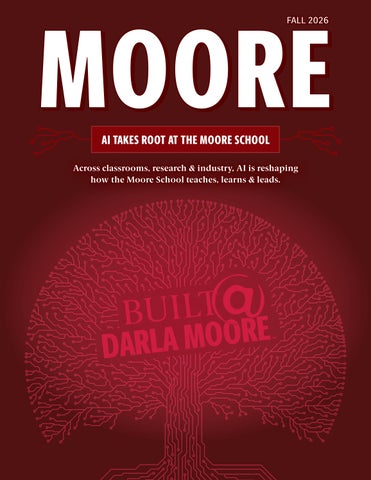
MOORE FALL 2026
AI TAKES ROOT AT THE MOORE SCHOOL
Across classrooms, research & industry, AI is reshaping how the Moore School teaches, learns & leads.
CONTENTS 3 AI is no longer optional 6 40th Annual Leadership Award winners 7 Lasting impact – Major Brock 9 Investing in the future – Drew Stevens 10 Advancing sustainable growth 11 Leading with purpose 12 A full-circle journey – Matthew Cabe 14 Faculty & staff awards 15 Student accomplishments, class notes, and alumni events
FALL 2026 Greg Niehaus — Interim Dean Bo Hart — Senior Director of Alumni Engagement Laney Grubbs — Interim Director of Marketing and Communications Editor: Laney Grubbs Contributing writers: Amanda Green, Amelia Douglas Photographers: Jeff Blake, Katie Cannon, Michelle Rashid Designer: Karen Scurry Office of Alumni Engagement Darla Moore School of Business University of South Carolina 1014 Greene Street Columbia, SC 29208 sc.edu/moore/alumni The University of South Carolina does not discriminate in educational or employment opportunities on the basis of race, sex, gender, age, color, religion, national origin, disability, sexual orientation, genetics, veteran status, pregnancy, childbirth or related medical conditions.
DEAR ALUMNI, STUDENTS, COLLEAGUES AND FRIENDS, This fall, the University of South Carolina will begin a global search for the next Dean of the Darla Moore School of Business. As that process begins, I am privileged to serve as your Interim Dean. In this role, I find it comforting to know that even as we transition leadership, the momentum of our school does not stop. This year, our undergraduate International Business degree was recognized by U.S. News & World Report as the No. 1 program in the U.S. for the 27th consecutive year, while our other undergraduate and graduate programs continued to build on their national and international reputations as well. Ten of our academic programs are currently listed among the top 50 by academic ranking agencies, with six programs ranked in the top 15. This edition of Moore Magazine highlights the many ways our students, faculty, staff, and partners are advancing the mission of the Darla Moore School of Business and building on the momentum that defines our community. Our feature story explores how the school is preparing students to thrive in an AI-driven future while showcasing how our faculty are
2 DARLA MOORE SCHOOL OF BUSINESS | 2026
partnering with industries to better understand how AI is transforming business. In this edition, you will also learn how our school is making an impact in leadership, sustainability, and healthcare. We are proud to recognize the recipients of the 2026 Alumni Leadership Awards and introduce the new Darla Moore School of Business Leadership Awards Hall of Fame, celebrating individuals whose leadership and contributions continue to strengthen our community. We are excited about a new academic year, and the future of the school. Thank you for all you do for the Darla Moore School of Business. Best,
Greg Niehaus | Interim Dean, Darla Moore School of Business
AI IS NO LONGER OPTIONAL
The Moore School is making artificial intelligence a foundational skill—blending technical fluency with critical thinking, ethics, and real-world application.
Artificial intelligence is no longer a futuristic concept. It is rapidly becoming one of the defining forces shaping how organizations operate, compete, and innovate. From automating workflows to enhancing decision-making and customer engagement, AI is transforming industries at every level of business. At the University of South Carolina’s Darla Moore School of Business, AI is not viewed as a temporary trend or a narrow specialization reserved for technical fields. Instead, it has become deeply integrated across the school’s curriculum, research initiatives, and entrepreneurial ecosystem, positioning students to lead in an economy increasingly driven by data, automation, and emerging technologies. Across disciplines such as strategy, marketing, finance, operations, and management, students and faculty are exploring how artificial intelligence is reshaping business decision-making and leadership. At the Moore School, the emphasis is on enhancement rather than replacement. AI is viewed not as a substitute for human capability, but as a tool that can amplify creativity, improve efficiency, strengthen analysis, and support stronger business outcomes when used responsibly. This philosophy has led the Moore School to prioritize AI literacy as a foundational business skill. Just as students once needed to understand spreadsheets, data analysis, and digital
communication to succeed in the workplace, they are now expected to understand how AI tools function, where they create value, and where human judgment remains essential. Faculty members are helping students move beyond simply experimenting with AI platforms and toward understanding how to strategically and ethically integrate these technologies into organizations. The Moore School’s instructional framework is built around three core pillars: foundations first, practical application, and responsible use. This structure ensures that students gain not only technical proficiency, but also the critical thinking skills necessary to evaluate AI responsibly, protect sensitive data, and recognize the limitations of automated systems.
NELSON PINOCHET Principal, watsonx.governance, IBM | ’96 MIBS
“At the Moore School, and across USC, AI is a recognized strategic priority. From the Dean to faculty members, I found a genuine and consistent enthusiasm for technology, paired with a clear-eyed understanding of its implications. The commitment to staying current, and ideally ahead of the curve, is evident at every level.”
UNIVERSITY OF SOUTH CAROLINA | 3
Students are encouraged to think carefully about accuracy, bias, ethics, and accountability while learning how AI can support business strategy and innovation. The journey begins early for many students. Undergraduate students can pursue the university-wide AI Literacy Certificate, which includes Moore School courses such as Mastering Artificial Intelligence for Business and Practical AI in Business. These courses expose students to real-world AI applications while emphasizing ethical implementation and organizational transformation. Rather than teaching students to rely blindly on AI-generated outputs, faculty challenge them to analyze information critically, refine prompts strategically, and understand how AI can support better decision-making across industries. Even introductory courses have evolved to reflect the growing importance of AI in modern business environments. In Computer Information Systems, students use AI to support complex data analysis, automate repetitive workflows, and improve efficiency in tools such as Excel. In Professional Communication courses, students learn how to ethically integrate generative AI into research and business writing while maintaining strong communication fundamentals and analytical thinking. The goal is not to eliminate traditional skills, but to teach students how to combine those skills with emerging technologies in ways that strengthen their work. For students seeking more advanced expertise, the Moore School also offers a Graduate Certificate in AI for Business featuring specialized coursework in machine learning for marketing, predictive analytics, and AI applications in finance and operations. These programs reflect a broader institutional effort to ensure graduates understand not only how AI works, but how it can create measurable business value. The Moore School’s commitment to applied AI education also extends beyond the classroom through events that connect students directly with industry leaders and emerging conversations shaping the future of business. During the school’s recent AI in Action Summit, executives, university partners, faculty, and students gathered to explore how artificial intelligence is transforming industries across South Carolina and beyond. The event convened leaders from business, healthcare, technology, and infrastructure to discuss how AI is reshaping organizational strategy, workforce development, and operational decision-making. Panel discussions focused on topics ranging from risk and liability to health care operations and energy resilience, highlighting both the opportunities and challenges organizations face as AI becomes increasingly integrated into daily operations. The summit reinforced the interdisciplinary nature of artificial
4 DARLA MOORE SCHOOL OF BUSINESS | 2026
intelligence, showing students how AI is influencing sectors as varied as healthcare, finance, legal compliance, and energy systems. By bringing together leaders across industries, the event reflected the Moore School’s broader mission to prepare students not only to understand emerging technology, but to lead thoughtfully and strategically as AI continues reshaping the modern economy. Beyond the classroom, Moore School students are already applying these lessons through entrepreneurship and innovation. Many are building companies that use AI to solve real-world problems, demonstrating how classroom concepts can translate directly into practical business applications. Daniel Ellis, a Professional MBA candidate and co-founder of Lap1Labs, sees artificial intelligence as far more than a technological trend. His company, Seddle, is a no-code platform that enables organizations to deploy customizable AI agents capable of transforming audience conversations into actionable insights. Rather than treating AI as an additional feature layered onto an existing product, Ellis explains that AI serves as the foundation of the business itself.
OZGUR INCE Director of AI Initiatives; Clinical Associate Professor of Finance, Darla Moore School of Business “AI is rapidly transforming how we work, but it doesn’t replace the need for strong fundamentals or human judgment. At the Moore School, we see AI not as a separate skill, but as a force multiplier. We’re focused on preparing students who combine deep business knowledge, strong interpersonal skills, and real-world AI experience. That is the combination that will set them apart.”
“The PMBA program has been incredibly valuable in shaping how we think about AI from a business perspective, not just a technical one. Building a product is science. Building a strategy is an art,” says Ellis. Through his experience in the Moore School’s Professional MBA program, Ellis has learned how to combine technical capability with strategic thinking. The school’s emphasis on balancing innovation with business fundamentals has helped shape how he approaches entrepreneurship in a rapidly evolving technological landscape. Other students are using AI to address challenges much closer to home. Thomas Lentine (’24 MHR) founded UpAhead to
help students navigate the overwhelming nature of academic scheduling and workload management. The platform uses AI to transform lengthy course syllabi into structured semester timelines, helping students stay organized and manage assignments more effectively. What began as a solution designed to help classmates has expanded into a platform serving students across hundreds of universities. By simplifying academic planning and reducing stress, UpAhead demonstrates how AI can create meaningful improvements in everyday life when designed around practical user needs. Lentine’s work reflects a larger trend among Moore School students who are leveraging AI not simply for innovation’s sake, but to solve problems people encounter daily. The entrepreneurial energy surrounding AI at the Moore School also extends beyond campus into local communities and small businesses. Connor MacIntyre and Connor Wellmon, founders of Wellmon Systems, are applying AI to help contractors and service-based businesses modernize their digital operations. Their company builds AI-powered websites and customer management systems designed to improve lead generation, customer communication, and operational efficiency for businesses that often lack sophisticated digital infrastructure. Their interest in artificial intelligence began when they realized it was not simply a future trend, but “a practical tool that could solve real business problems right now.” Through their work with local businesses, they noticed a recurring pattern that many companies were losing potential customers because of outdated websites, inconsistent follow-up systems, and slow response times. AI presented an opportunity to improve those weaknesses while helping businesses operate more efficiently and remain competitive in increasingly digital markets. They also use AI internally to streamline repeatable production tasks, allowing their team to work more efficiently while delivering stronger results for clients. Their work demonstrates a broader principle emphasized throughout the Moore School that AI creates the greatest value when embedded into systems that solve practical, measurable problems. “Innovation matters most when it improves execution,” they say. “When a business has a stronger website, better follow-up, and AI tools helping support communication, it has a much better chance of winning the job.”
GRACE COSBY
ANDREW NYE CEO, Qatalyst Health | ’24 B.S. “AI can play a major role in business education by making learning more individual and personalized. Research has shown that one-on-one tutoring can improve student outcomes more than anything else, but historically that level of support was expensive and limited. AI changes that by giving students access to support at any time, whether they’re trying to understand a difficult concept or go deeper on a topic of interest.”
MacIntyre and Wellmon also believe AI is fundamentally reshaping how students prepare for careers in business. They note that today’s students can learn, test ideas, and build at a faster pace than any previous generation, but that this increased access to technology also raises the importance of strong judgment and problem-solving skills. In their view, the students who will stand out are those who can think critically, communicate clearly, and effectively connect AI tools to real business outcomes. The Moore School’s broader approach to AI education reinforces this mindset. Rather than encouraging students to rely entirely on automation, faculty and student leaders emphasize the importance of combining technological fluency with strategic thinking, ethics, creativity, and interpersonal skills. This philosophy is shaping a new generation of business leaders who view AI not as a replacement for human capability, but as a multiplier of it. Whether they are launching AI-native startups, streamlining student life, modernizing local businesses, or developing new operational systems, Moore School students are applying the same principle in different ways. As artificial intelligence continues to reshape industries across the world, the Darla Moore School of Business is preparing students not only to adapt to those changes, but to help lead them. By combining technical education with practical application, ethical reasoning, and entrepreneurial thinking, the Moore School is creating an environment where students can experiment, innovate, and build responsibly.
USC Student Director for AI Strategy
“My biggest takeaway from the conference was that AI is everywhere and is quickly becoming embedded into all aspects of society. This technology has the potential to provide both staggering increases in productivity and to create disruptions across all industries. Now is the time to prepare for the large-scale implementation of AI in our world through creating policy and safeguards for its use.”
40 TH ANNUAL
LEADERSHIP AWARD WINNERS Distinguished Alumni Award
Distinguished Young Alumni Award
Distinguished Service Award
Distinguished Corporate Partner
MATTHEW B. MYERS, ’92 MIBS
ZACHARY GREENBERGER, ’12 B.S.
ROSE BUYCK NEWTON, ’94 MBA
TRUIST FINANCIAL CORPORATION
Matthew B. Myers is a professor at SMU’s Cox School and Senior Fellow at the Bridwell Institute for Economic Freedom. He served as its ninth dean from 2017–2025, raising $315 million and leading the Miller Business Quadrangle development. Previously, he was dean of Miami University’s Farmer School of Business and taught at the University of Tennessee. He is a graduate of the Darla Moore School of Business and is a former U.S. Army Airborne medic.
Zachary Greenberger is CEO of Nexar, an artificial-intelligence company using driving data to improve vehicle safety and autonomous systems. Previously, he held leadership roles at Tesla and Lyft, serving as chief business officer and leading major partnerships. Greenberger earned a bachelor’s degree from the University of South Carolina and an MBA from Johns Hopkins Carey Business School and holds 15 patents.
Rose Buyck Newton is Chairman of the Board and Executive Officer of the Bank of Clarendon in Manning, South Carolina, leading its strategy and governance. With more than two decades of banking experience, she has held leadership roles in financial services and community organizations. Newton is Chair of the University of South Carolina Board of Trustees and chairs the Governance Committee.
Truist Financial Corporation is a purpose-driven financial services company headquartered in Charlotte, North Carolina. It serves fast-growing U.S. markets through consumer and wholesale businesses, offering banking, investment banking, capital markets, wealth management, payments, and specialized lending. A top-10 U.S. commercial bank, Truist reported $544 billion in assets as of September 30, 2025.
LEADERSHIP HALL OF FAME For more than 40 years, the Darla Moore School of Business has honored
leaders whose innovation, vision, entrepreneurship, and service reflect its
highest ideals. The Leadership Hall of Fame builds on tradition, permanently recognizing past award recipients whose impact extends beyond professional success. It preserves legacy, inspires students, strengthens alumni pride, and encourages future leaders to act boldly with purpose.
6 DARLA MOORE SCHOOL OF BUSINESS | 2026
READ MORE ABOUT THE WINNERS →
LASTING IMPACT
ALUMNI SPOTLIGHT
MBA alumnus applies business & healthcare lessons to student support Major Brock (’15 B.S., ’24 MBA), CEO of Brock Recovery Group, is working to reshape how universities think about student success. Through the Brock Family Student Success & Wellbeing Fund, he is focused on a simple but often overlooked idea that achievement and wellbeing should move together, not compete. Returning to USC for his MBA was an opportunity to refine. “It allowed me to reengage with business education from a much more practical and applied perspective,” he says. At that point, he was already operating across real estate and sober living, which meant classroom concepts were never abstract. They were immediate, tied directly to decisions happening in real time. That sense of application showed up across his coursework. One of the most defining experiences was the Global Classroom International Business 750 class, which took students to London and Paris. The experience expanded his understanding of how business operates across regulatory, economic,
and cultural systems. But for Brock, the impact was also personal. He grew up living abroad in London and Belgium while his father worked internationally. “That global lens was especially meaningful to me personally,” he says. “Today, that international exposure has come full circle as we work to partner with the University of East London to develop the Brock Centre for Addiction Research & Care.” Other courses reinforced how directly business principles translate into leadership decisions. In Risk Management (FINA 746), taught by Interim Dean Greg Niehaus, Brock saw his work in commercial real estate, sober living operations, behavioral health startups, and nonprofit initiatives reflected in academic frameworks. “The course reinforced the importance of diversification, measured exposure, and disciplined decision-making,” he says. “Those principles extend beyond finance. They apply to how you allocate time, attention, and leadership energy.”
Learning from an Inspiring Leader Major Brock, second from left, visited the Moore School this spring to speak with a special-topics class: Learning from Inspiring Leaders. Pictured with him are Patrick Harrison (’26 B.S.), Annabel Voskuil, and Lillian Hupke (’26 B.S.).
Strategic Management (MBAD 702) with DJ Schepker added another layer. The course blended theory with case-based application in a way that emphasized adaptability over rigidity. “That blend of framework and flexibility shaped how I think about adaptability in leadership,” he says. “In an environment as dynamic as healthcare and recovery, the ability to pivot while staying anchored in core principles is essential.” That perspective now informs how he leads both business and philanthropy. Brock serves as CEO of Brock Recovery Group (BRG), which operates at the intersection of real estate, healthcare, and behavioral health innovation. The organization includes both a for-profit venture arm and a nonprofit foundation focused on addiction recovery, research, and access to care. Across all of it, the central theme is the same, systems thinking applied to one of the most complex public health challenges in the country. “Addressing addiction requires disciplined capital allocation, operational excellence, and long-term thinking,” he says. “The same principles reinforced during my MBA apply directly to building sustainable recovery infrastructure.” That connection between education and impact is also what drives his philanthropy. The University of South Carolina played a defining role at two key stages of his life. He earned his undergraduate degree in 2015 and returned for his MBA in 2024. “At both points, the University challenged me to grow intellectually and personally,” he says. The Brock Family Student Success & Wellbeing Fund reflects what he and his family see as a gap in higher education, the idea that academic success is often prioritized without equal attention to student wellbeing. “Academic rigor is essential, but so is wellbeing,” Brock says. “Students cannot perform at
8 DARLA MOORE SCHOOL OF BUSINESS | 2026
their highest level if their mental health, resilience, and support systems are not intact.” For him, giving back is not symbolic. It is structural. It is about building systems that support students in the same way strong organizations support their people. “Supporting the University and the Moore School is about giving back to an institution that shaped how I think and lead,” he says. “It is also about investing in the next generation of leaders who will operate at the intersection of profitability and purpose.” What he hopes the fund ultimately changes is the culture, not just the systems in place. “Business school environments are competitive and demanding,” he says. “That pressure can produce excellence, but it can also produce burnout.” His goal is for the fund to help create resources and support systems that allow students to sustain both performance and balance. At its core, he sees that as a leadership issue, not just a student issue. “The most effective leaders are those who understand resilience, discipline, and personal responsibility,” he says. “Those qualities matter just as much as technical competence.” That belief also shapes how he views institutional support. Brock is direct about it, universities do not remain strong on their own. They remain strong because alumni choose to invest back into them. For him, supporting the Moore School is less about nostalgia and more about responsibility. “The Moore School is uniquely positioned to develop leaders who understand global markets, strategic management, and responsible decision-making,” he says. “Giving back is an opportunity to multiply that impact.” And ultimately, that is the point of his work across business and philanthropy alike, building systems that last longer than any one decision, leader, or cycle. “The return on investment,” he says, “is measured in the caliber of people the school sends into the world.”
INVESTING IN THE FUTURE
How long-term vision and strategic giving can support generations
Drew Stevens (’10 B.S.) has built a career in wealth management, but his approach to money extends far beyond client portfolios or market strategy. It is rooted in a deeper belief that financial success is most meaningful when it is intentionally directed toward lasting impact. A graduate of the Darla Moore School of Business, Stevens is a Private Wealth Advisor at G3 Wealth Advisors, where he guides clients through complex financial planning decisions. Yet, his approach to wealth is grounded in a personal philosophy that has guided him for years. Stevens’ relationship with the Moore School has evolved into sustained engagement and leadership. He has served as Chair of the Young Alumni Board, sits on the BPF Board of Advisors, endowed a scholarship in 2022, and supports the Faber Center for Entrepreneurship. For him, these roles are not symbolic—they reflect an ongoing investment in students and the future of business education. “I’m connected to the Moore School, our students, the faculty and the long-term vision of continued success here,” Stevens says. “I believe in and totally love the product (our next generation) that we’re shaping, improving, and building.” That belief has directly shaped how he approaches his personal financial planning. Rather than treating philanthropy as an afterthought, Stevens builds it into his financial structure from the start. “I have a separate line item beyond lifestyle expense ‘needs’ and debt service, to include charitable contributions,” he explains. “Which I view as investments in people and our community.” One of the most significant expressions of this philosophy is his decision to name the Moore School as the sole beneficiary of his 401(k). The choice reflects both emotional commitment and financial strategy.
“If my plan of giving outlasts my plan to work, why would my desire to give stop at death?” - Drew Stevens
ALUMNI SPOTLIGHT “The reason I’ve listed the Moore School as the sole beneficiary of my 401(k) is because they’ll get that seven figures entirely tax free,” Stevens says. “Whereas my family would have to pay ordinary income on the entire sum. The Moore School is going to serve students and communities around the world forever, so my intentions to aid these initiatives can only be met with indefinite and infinite support.” Stevens intentionally structures his estate plan across accounts and insurance to maximize efficiency and reduce taxes, ensuring wealth reaches its intended impact. “It’s very intentional and indicative of my belief that our support to this school makes a difference.” At the core of his philosophy is long-term alignment rather than one-time giving. He encourages others to start with engagement before making financial commitments. “My suggestion isn’t to just give, it’s to get involved,” Stevens says. “Then one can begin a conversation and build a plan based on their priorities.” For Stevens, estate planning is not about ending a story—it is about extending it. As he puts it, “If my plan of giving outlasts my plan to work, why would my desire to give stop at death?” It is a mindset that transforms financial planning into legacy-building, creating a future gift that will support the Moore School and its students for generations to come.
ADVANCING SUSTAINABLE GROWTH
Through Partnership and Impact The Darla Moore School of Business’s Center for Sustainable Growth is continuing to build momentum as it brings together industry leaders, students, and faculty to address real-world sustainability challenges across South Carolina. During the fall 2025 semester, the Center received two major gifts from Google and Coca-Cola Consolidated. These investments reflect growing confidence in the Center’s work and are helping expand its efforts in research, student engagement, and industry collaboration. Under the leadership of Executive Director Kealy Carter (’07 IMBA, ’14 PhD), and Associate Director Adam Steinbach, the Center has quickly established itself as an important part of the Moore School’s approach to sustainability. Their work focuses on connecting students and faculty with companies and policymakers to create solutions that are both practical and forward-looking.
MBA Sustainability Bootcamp Participants, sponsored by Coca-Cola Consolidated
supports events, speaker sessions, company visits, and industry tours throughout the year. These experiences give students a closer look at sustainability careers and allow them to build connections with professionals in the field. One of the highlights this year was the first MBA Sustainability Bootcamp, sponsored by Coca-Cola Consolidated. The bootcamp focused on circularity and gave students the opportunity to work through a real-world case while developing practical problem-solving skills. Students also participated in the ClimateCAP Summit and attended conferences focused on sustainability and business, helping them stay informed on current trends while expanding their professional networks. The Center is also supporting new courses within both the MBA sustainability certificate and the undergraduate sustainability concentration. These additions help ensure that students graduate with the skills and knowledge needed to meet the challenges that businesses face.
The Center serves as a bridge between academia Kealy Carter and industry, bringing together faculty, students, elected officials and corporate partners. As a firstIn addition to these experiences, undergraduate of-its-kind program in South Carolina, it operates at students have played an important role in supporting the Centhe intersection of business, policy and sustainability. Through ter’s work. This year, three students contributed to faculty-led these partnerships, students work on applied projects and research and applied projects. Two Honors College students sustainability challenges with real companies, gaining handsreceived research grants to support sustainability-focused on experience while helping organizations address current work, and another student earned a Bloomberg Philanthropies environmental and operational issues. Youth Climate Action grant through the City of Columbia. Their Over the past year, the Center has also hosted two energy-focontributions have helped strengthen the Center’s research cused roundtables that brought together leaders from indusefforts while giving students valuable hands-on experience. try, utilities, government, and academia. These conversations As the Center for Sustainable Growth continues to grow, its created space for open discussion about the state’s energy focus remains on creating opportunities for collaboration future while also helping shape the Center’s research priorities and preparing students to lead in a changing business enviand student learning opportunities. ronment. With strong support from corporate partners and Student engagement remains a central part of the Center’s increasing engagement across campus, the Center is helping mission. Through its partnership with IMPACT, the Moore shape a more sustainable future for South Carolina. School’s student-led sustainability organization, the Center
10 DARLA MOORE SCHOOL OF BUSINESS | 2026
LEADING WITH PURPOSE
Building Future Leaders
The University of South Carolina’s Moore Leadership Summit brought together executives, nonprofit leaders, alumni, and students for a day centered on one defining question: What does it truly mean to lead with purpose? This year’s theme, “Leading with Purpose,” encouraged attendees to think critically about how purpose shapes leadership, workplace culture, and organizational success. Throughout the summit, speakers emphasized that while industries evolve through artificial intelligence, automation, and digital transformation, people still seek meaning, connection, and shared values in their work. Discussions highlighted how purpose-driven leadership can strengthen employee engagement, improve culture, and help leaders navigate change. Hosted by award-winning journalist Hannah Hall (’12 MBA), the event challenged traditional ideas of leadership by focusing not only on business performance, but also on values, meaning, and human connection. “The Moore Leadership Summit, with its focus on Leading with Purpose, helped to remind me that truly successful businesses are built on more than just revenues,” Hall says. “Organizations that thrive have cultures, values, and visions that go beyond balance sheets to build their people and communities around them.” Interactive table discussions and panel conversations encouraged attendees to reflect on questions such as, “What makes purpose feel real versus just a buzzword?” and “What is your biggest concern about AI in leadership?” The summit featured a distinguished lineup of leaders from business, technology, cybersecurity, nonprofit leadership, and
LEADERSHIP SUMMIT entrepreneurship. Featured keynote speaker Boyd Blanchard (’12 B.S.), President and CEO of Blanchard Machinery Company, delivered a keynote emphasizing the importance of mission, culture, and responsibility at every level of an organization. Blanchard, who previously spoke in the Moore School’s Inspiring Leaders class in spring 2025, reinforced the importance of embedding organizational purpose into daily leadership practice. Additional speakers included Michael D’Ambrose, retired CHRO at Boeing; Josh Dorminy of Coca-Cola Consolidated; Zach Greenberger (’12 B.S.) of Nexar; Kathryn Kissam (’88 B.S.) of Carolina Youth Coalition; entrepreneur and author José Salibi Neto (’82 B.S.) (’86 MIBS); Wendy Thomas (’98 IMBA), former CEO of Secureworks; and Natalie Wright (’03 B.S.) of The Real Estate House International Inc. Speakers discussed how emerging technologies, including artificial intelligence, are reshaping leadership and decision-making. The event reflected the Darla Moore School of Business’ commitment to translating leadership theory into practice and its “Built at Darla Moore” approach. Through opportunities such as the Leadership Concentration and programs like Inspiring Leaders, students engage directly with executives and nonprofit leaders while building skills in communication, organizational leadership, and management strategy. While many conversations focused on AI and the future of business, speakers emphasized that leadership ultimately remains deeply human. “While we talked a lot about AI and its effect on how we do business, the Leading with Purpose theme brought us back to EI — emotional intelligence, and the ability to shape a generation of thought leaders who do what computers cannot,” Hall reflected. Supported by sponsors including Boeing and Coca-Cola Consolidated, the 2026 Moore Leadership Summit reinforced a lasting message: effective leadership is not defined solely by profit or position, but by the ability to inspire others, strengthen communities, and lead with purpose.
ALUMNI SPOTLIGHT
A FULL-CIRCLE JOURNEY
Matthew Cabe’s Path from Engineering to the C-Suite
Matthew Cabe’s (’17 MBA) 20-year journey at Michelin North America began as a mechanical engineer and led him to the role of president and CEO. Along the way, he has combined technical expertise, global experience, and a focus on people to build a leadership style driven by innovation and continuous growth. “I began my career with Michelin more than 20 years ago as an engineer,” Cabe says. “That foundation shaped how I make decisions today, with a focus on putting people at the center of innovation to deliver meaningful and scalable solutions.” When Cabe became president and CEO of Michelin North America, he made visiting manufacturing sites across the United States and Canada one of his first priorities. The experience marked a meaningful turning point, connecting his early career experiences with his current leadership responsibilities. “It was a full-circle moment,” he explains. “I found myself standing in the same facilities where I once installed equipment, now watching our teams drive innovation in ways we could previously only imagine. This has been both humbling and incredibly inspiring.” Seeing employees firsthand shaped Cabe’s belief that leadership begins with empowering people. About ten years into his career, he transitioned from engineering into marketing while completing a Professional Master of Business Administration, applying classroom lessons directly to real-world challenges. “At Michelin, we build careers, not just jobs, and that mindset fuels a culture of continuous learning,” he says. “That timing gave me an immediate runway to put what I learned into practice. Strategic planning, international business, and decision-making became tools I could apply right away.” Pursuing graduate school required careful planning as Cabe navigated a cross-country move, a career transition, and raising two young children. A part-time MBA program allowed him to grow professionally while maintaining stability at home.
12 DARLA MOORE SCHOOL OF BUSINESS | 2026
“Choosing a part-time program enabled me to continue investing in my education while balancing career growth and personal life,” he says. “There is never an ideal time to pause and invest in yourself, but continuous learning and growth are essential today. The world changes quickly, and it is important to be proactive in shaping your educational pathway.” The MBA program strengthened Cabe’s business expertise and complemented his technical background, shaping how he approaches marketing and navigates global business. “International business was one of my favorite classes, and it’s critical in a global company like Michelin where decisions often have worldwide impact,” Cabe says. “The strategy frameworks I learned help me evaluate opportunities and make decisions with a long-term perspective. This degree has been a springboard, and I pull on these learnings daily.” Beyond academic knowledge, the relationships formed during the program left a lasting impression. Cabe credits those
1. Cabe visits Michelin’s production floor, where conversations with employees help shape the company’s approach to innovation and leadership. 2.
Cabe signs Lexington, S.C. plant’s legacy tire alongside Michelin team members.
3. Cabe joins his family at the Edouard Michelin Memorial 5K, reflecting his belief in balance, community and a people-first culture.
connections with helping shape both his professional path and leadership approach. “Building meaningful connections is a core value for me,” he says. “The relationships that I built during my PMBA helped me move forward. Even now, nearly ten years later, I’ve stayed in touch with many of those connections.” Michelin’s global presence also provided opportunities for Cabe to live and work abroad, including time spent in France and Hungary. Moving from Greenville to Budapest expanded his worldview and reinforced the importance of cultural understanding in leadership. “At Michelin, our purpose is to give everyone a better way forward, and that is a uniting thread across every location where I have had the privilege to work and visit,” he says. “Moving around the world taught me how vital it is to stay open and meet people where they are.” Experiencing different cultures professionally strengthened his ability to listen, collaborate, and approach challenges from new perspectives. “Culture is living and dynamic,” Cabe says. “Experiencing different cultures professionally is something I truly cherish. It has made me a better listener, a stronger teammate, and it helps me think beyond what is familiar.” During Cabe’s tenure, the automotive industry has rapidly evolved, with new technologies and changing vehicle designs reshaping innovation and value delivery. “You can see the shift on the road every day,” he says. “Changing vehicle dynamics with multiple powertrain options, increased weight, and larger sizes bring energy to our Michelin teams.” Rather than viewing these changes as obstacles, Cabe sees them as opportunities to push innovation further. “When we set out to deliver a product, we do this without compromising and push beyond what you might think is possible,” he explains. “Michelin is more than a tire company. We are an innovation engine, pioneering in the field of engineered materials for more than 130 years.”
1
2
Today, the company continues transforming how products are developed and manufactured by integrating advanced technologies such as digital simulation, industrial 3D printing, and artificial intelligence. “The pace of change is incredible,” Cabe says. “Unlocking value at every turn is what you can continue to expect from our teams.” Reflecting on his first year as CEO, Cabe describes it as fastpaced yet familiar, requiring constant learning while reinforcing Michelin’s collaborative culture. “My first year has felt both fast and slow,” he says. “Fast because I’ve spent the year learning and absorbing as much as I can while moving at an unmatched pace of business. Slow because it feels familiar. I feel at home in this role.” For Cabe, the most rewarding aspect of leadership has been witnessing employees succeed and collaborate in new ways. “We rely on each other, and my role is to create an environment where teams can bring their best selves to the table,” he says. “Michelin employees do extraordinary things, and watching our people thrive has been the most rewarding part of this journey.” Reflecting on his career and education, Cabe emphasizes that success is shaped not just by achievements but by the relationships and shared growth along the way. “More than the classroom experience, it’s the people you meet along the way who truly make a difference,” he says. “The same holds true in professional life. It’s about the people around you — the ones who support you, challenge you, and grow with you.” Looking ahead, Cabe aims to sustain Michelin’s collaborative, innovative culture while guiding the company through a rapidly changing global market, drawing on lessons from his journey from engineer to CEO. “The time you invest in those connections and the impact you have on others are what matter most,” Cabe says. “This is your legacy.”
3
MOORE FACULTY & STAFF AWARDS STATS ACHIEVEMENTS
Sanjay Ahire | Michael J. Mungo Distinguished Professor of Management Science and co-director of the Operations and Supply Chain Center Fifth among all-time most-published authors in INFORMS Journal on Applied Analytics Paul Bliese | Jeff B. Bates Professor of Management and department chair 2025 Academy of Management Distinguished Career Award Blair Flicker | Assistant Professor of Management Science Named Poets&Quants’ 2025 list of the best undergraduate business school professors Sean Handley | Distinguished Moore Fellow and Professor of Management Science 2025 Academy of Management Distinguished Career Award
919
Ayse Ozturk | Marketing professor 2026 Michael J. Mungo Undergraduate Teaching Award
Students studied abroad in 2024-2025
Robert Ployhart | Bank of America Professor of Business Administration and Carolina Distinguished Professor; program director, Master of Human Resources Inducted into the National Academy of Human Resources
NO. 12 | NO. 18
Patrick Wright | Associate Dean for Corporate Relations, Thomas C. Vandiver Bicentennial Chair and Professor of Management Top 20 most productive human resources management academics
William Blanks, IT | Bo Hart, Alumni | Carla Watson, Management Science Susie H. VanHuss Staff Awards
NO. 1
Master of Human Resources Program (Degree Choices)
Consecutive years as Top 3 International MBA (U.S. News & World Report)
Dan Ostergaard | Clinical Professor of International Business Best of Carolina Award
Georgia Doran, Office of Career Management Dean's Award
Consecutive years as No. 1 undergraduate international degree program (U.S. News & World Report)
37
Ozgur Ince | Clinical Professor of Finance Appointed Darla Moore School of Business director of AI initiatives
Staff Shout Outs!
27
Research.com National and World Ranking in management and business research
Congratulations To our very own Xavery Hopkins who was honored with USC's 2026 Martin Luther King Social Justice Award. “It means a lot because MLK is an everlasting figure in our world. His impact motivates me to do more things to improve where I live and the people I have touched.”
Moore Faculty Authors AI Book Clinical Professor Wolfgang Messner published "In Business with AI: What Leaders Must Understand Before Deploying Artificial Intelligence at Scale" (Routledge), a new book that helps leaders, professionals, educators, and students understand the managerial foundations of AI. Scan the QR code to purchase the book on Amazon.
14 DARLA MOORE SCHOOL OF BUSINESS | 2026
CONGRATS, STUDENTS! 1
ACHIEVEMENTS
1. The Darla Moore School of Business 2025 MHR Case Team celebrates their first-place finish at the Penn State HR Case Competition at PepsiCo headquarters, besting 11 leading universities with an innovative AI workforce strategy. Pictured: Neal Hammond (’25 MHR), Erin Mazza (’25 MHR), Danaezha Wade (’25 MHR), and Tian Wu (’25 MHR), who were advised by faculty members Mazen Aziz and Rob Spooner. 2. The Darla Moore School of Business 2026 MBA Case Team
2
celebrates their historic second-place finish at the John Molson MBA International Case Competition in Montreal. Pictured: Competitors Jacob Blalock (’27 IMBA), Ashlan Cheever (’27 IMBA), Walker McDonald (’27 IMBA), and Jason Williamson (’27 IMBA), alongside team coach Kyle Jansen. 3. Moore School students participated in the 2025 National Black MBA Case Competition, hosted by NBMBAA® in Houston, TX. This rigorous event challenges student consulting teams to dissect complex business cases. Pictured: Elicia Villaurel (‘26 IMBA), Alex Outen (’24 B.S.) (’27 IMBA
3
Candidate), Jayla Bryant (’26 MBA), Zion Grant (’24 B.S.) (’26 MBA), Douglas Hanslip, Director of Career Services and Employer Relations for MBA.
Alumni Events
NOVEMBER 6 | Homecoming: Shuck and Shag
CLASS NOTES
NOVEMBER 18 | Learn Moore: Greenville NOVEMBER 18 | Engage Moore: NYC
Our alumni class notes are online! We want to celebrate and acknowledge your major life events, promotions, and other accomplishments, so please submit your class notes to alumni@moore.sc.edu. Check out the class notes webpage at: bit.ly/mooreclassnotes
← SEE FULL ALUMNI EVENT CALENDAR
AND INTERNATIONAL EVENTS
UNIVERSITY OF SOUTH CAROLINA | 15
1014 Greene St. Columbia, SC 29208
SAVE the DATE! $
50
YOUNG ALUMNI (40 OR YOUNGER)
$
60
ALUMNI, STAFF, FACULTY RETIREES
$
70
NON-ALUMNI
TICKETS AVAILABLE NOW!
November 6, 2026 16 DARLA MOORE SCHOOL OF BUSINESS | 2026
Scan the QR code or contact us at 803-777-4645 for more information.