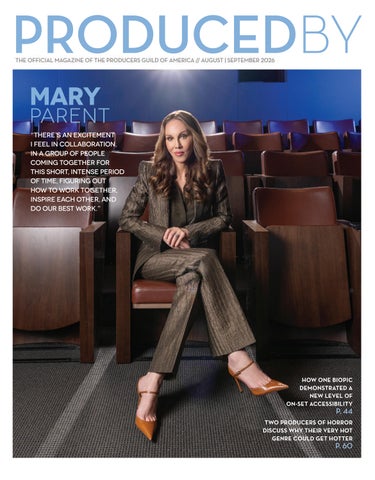
PRODUCEDBY THE OFFICIAL MAGAZINE OF THE PRODUCERS GUILD OF AMERICA // AUGUST | SEPTEMBER 2026
MARY
PARENT “There’s an excitement I feel in collaboration, in a group of people coming together for this short, intense period of time, figuring out how to work together, inspire each other, and do our best work.”
HOW ONE BIOPIC DEMONSTRATED A NEW LEVEL OF ON-SET ACCESSIBILITY
P. 44
TWO PRODUCERS OF HORROR DISCUSS WHY THEIR VERY HOT GENRE COULD GET HOTTER
P. 60
16
EMMY AWAR OUTSTANDING
LEAD ACTOR
Oscar Isaac
®
THE MOST NOMINATED
“HANDS DOWN, THE BEST
SUPPORTING ACTOR
Charles Melton
DIRECTING
Lee Sung Jin
WRITING
Lee Sung Jin
CINEMATOGRAPHY
FROM EMMY® WINNER
PICTURE EDITING (EP: 201)
PICTURE EDITING (EP: 203)
SOUND
D NOMINATIONS N LIMITED SERIES LEAD ACTRESS
LIMITED SERIES IS
TV SHOW OF THE YEAR.”
Carey Mulligan
SUPPORTING ACTRESS Youn Yuh-jung
DIRECTING
Jake Schreier
CASTING
LEE SUNG JIN
MIXING
SOUND EDITING
CONTEMPORARY COSTUMES
STUNT COORDINATION FYC.NETFLIX.COM
7NOMINATIONS EMMY AWARD ®
INCLUDING
OUTSTANDING DRAMA SERIES LEAD ACTRESS
LEAD ACTOR
KERI RUFUS RUSSELL SEWELL
WINNER
ACTOR AWARD
OUTSTANDING FEMALE ACTOR IN A DRAMA SERIES
KERI RUSSELL PRODUCERS GUILD AWARD NOMINEE
OUTSTANDING PRODUCER OF EPISODIC TELEVISION, DRAMA
FYC.NETFLIX.COM
SUPPORTING ACTRESS
ALLISON JANNEY
GUEST ACTOR
WRITING
BRADLEY PETER ACKERMAN WHITFORD DEBORA CAHN
“TV PROGRAM OF THE YEAR.
‘The Diplomat’ ASCENDS TO THE HIGHEST OFFICE IN TELEVISION in its third term. Politics are personal in DEBORA CAHN’s stylish and sophisticated series, with KERI RUSSELL AND AN ALL-STAR ENSEMBLE personifying the tension between affairs of the state and affairs of the heart as the two collide in a world on the brink.”
4
CRITICS CHOICE AWARD NOMINATIONS
2
GOLDEN GLOBE AWARD NOMINATIONS
INCLUDING
BEST DRAMA SERIES ®
INCLUDING
BEST DRAMA SERIES
Go Inside the House to learn how The Diplomat was crafted.
PRODUCEDBY AUGUST | SEPTEMBER 2026
30
MARY PARENT “As a producer, you have to be egoless. It’s about how you can best serve the movie, and that looks different every time.”
FEATURES 30 TO LEAD IS TO SERVE Mary Parent produces successful blockbusters and wins the esteem of her peers by subsuming ego and inspiring her creatives to do their best work.
48 PRODUCED BY CONFERENCE 2026 Sessions at the 16th annual Produced By Conference took on the challenges and opportunities facing producers today.
44 ACCESS FOR ALL
54 A CRAFTY’S ANTIWASTE MISSION
The new biopic Being Heumann demonstrates how high standards for authentic casting, accessibility, and collaboration with Deaf and disabled artists benefit everyone on the set.
Terri Freedman’s revolutionary on-set practices not only reduce food and foodware waste; they save money for productions and redistribute unused leftovers to worthy recipients.
10 producersguild.org | PRODUCED BY
60 PRODUCING HORROR Roxanne Avent Taylor and Zainab Azizi go one on one to discuss their very hot genre—why it’s hot, why it may get hotter, and why it should better embrace women and up-and-coming filmmakers.
2
EMMY® AWARD NOMINATIONS INCLUDING
Outstanding Comedy Series
“One of the BEST SHOWS OF THE YEAR.”
FYC.NETFLIX.COM
73
NUISANCE BEAR DEPICTS THE PLIGHT OF POLAR BEARS IN A CHANGING WORLD.
DEPARTMENTS 15 THANK YOU TO OUR PRESIDENTS
68 ON THE MARK
A message of gratitude for Donald De Line and Stephanie Allain as they complete their term as presidents of the Guild.
How producers of three forthcoming features—Forgotten Island, The Boy in the Iron Box and Nuisance Bear—did the work that earned them the Producers Mark.
16 A DAY IN THE LIFE Mary-Jane Mitchell juggles intensive investigative work and transatlantic calls to produce insightful films and documentaries— but never misses an Arsenal soccer match.
23 NEW MEMBERS Produced By trains the spotlight on some of the guild’s newest members, and offers a glimpse at what makes them tick.
12 producersguild.org | PRODUCED BY
78 MEMENTO More than a keepsake, crew hats for Raiders of the Lost Ark were were worn far and wide— and preserved in a Lucasfilm time capsule.
5
EMMY AWARD NOMINATIONS ®
INCLUDING
OUTSTANDING VARIET Y SPECIAL (PRE-RECORDED)
“ONE OF THE MOST IMPORTANT
MOMENTS IN POP CULTURE HISTORY.” THE GLOBE AND MAIL
© 2025 TAS Rights Management LLC
BOARD OF DIRECTORS OFFICERS PRESIDENTS Stephanie Allain Donald De Line VICE PRESIDENT, PRODUCING Charles Roven VICE PRESIDENT, PRODUCING TEAM Steve Cainas VICE PRESIDENT, EASTERN REGION Tonya Lewis Lee TREASURER Yolanda T. Cochran SECRETARIES Mike Jackson Kristie Macosko Krieger DIRECTORS Bianca Ahmadi Fred Berger Parker Chehak Melanie Cunningham Mary Alice Drumm Linda Evans Samie Kim Falvey
Mike Farah Jennifer Fox Beth Fraikorn DeVon Franklin Donna Gigliotti Jinko Gotoh Bob Greenblatt
Rachel Klein Larry Mark Lori McCreary Tommy Oliver Marc Platt Joanna Popper Lynn Kestin Sessler
ASSOCIATE NATIONAL EXECUTIVE DIRECTOR Michelle Byrd CEO Susan Sprung EDITOR Lisa Y. Garibay PRODUCERSGUILD.ORG Vol. XXII No. 4 Produced By is published by the Producers Guild of America. 11150 Olympic Blvd., Suite 980 Los Angeles, CA 90064 310-358-9020 Tel. 310-358-9520 Fax
14 producersguild.org | PRODUCED BY
VP, BRANDED PUBLISHING Emily S. Baker
COPY EDITOR Bob Howells
CREATIVE DIRECTOR Ajay Peckham
PHOTOGRAPHER Michael Neveux
ADVERTISING Ken Rose 818-312-6880 | KenRose@mac.com
MANAGING PARTNERS Charles C. Koones Todd Klawin
THANK YOU TO OUR P RESIDENTS
SHARING THE GUILD’S GRATITUDE
N
o one could have predicted what we all would face when Donald De Line and Stephanie Allain became PGA’s presidents in 2022. Today, as they prepare to turn over the helm to the Guild’s next leaders, our industry is at a true inflection point—but because of their extraordinary work, PGA is stronger and better prepared to shape our future than ever before. Donald and Stephanie’s bold leadership ensured PGA stood up as essential partners in the coalition that led the expansion of California’s Film and Television Tax Credit, helped drive more than 30 companies into our healthcare initiative, and launched the Producing Is a Job campaign to uplift producers and our profession. And we all saw Donald and Stephanie’s compassion in full effect when they led PGA’s efforts in the aftermath of last year’s wildfires. Under their leadership, the Guild contributed to the sustainability and safety of all productions by building our comprehensive Sustainability Tool Kit and expanding PGA’s Set Etiquette Training. And through a yearlong effort involving more than 100 producers, they led the most sweeping update to the Guild’s Code of Credits in 25 years.
Right now, as we all assess what AI and potential consolidation mean for the future, we do so with our voices heard loudly within the corridors of power, thanks to Donald and Stephanie’s willingness to support PGA and its members in stepping up and speaking out. The truest testament to their stewardship of our Guild comes from our members. Despite tough times, the PGA under Donald and Stephanie’s term grew its membership. PGA members counted on Donald and Stephanie for so much, and they always came through. They came through for me, too—to help navigate the tough decisions, to support our staff or to just be there as wise counsel. Donald and Stephanie, from me and the Guild as a whole— thank you. You leave big shoes for your successors to fill! With deep gratitude and admiration,
Susan Sprung CEO
August | September 2026
15
A DAY IN THE LIFE
HANDLED WITH CARE Producer-researcher Mary-Jane Mitchell relies on discipline and routine to stay well grounded for the filmmakers who depend on her to provide genuine connection to the people and places their movies are based upon. INTRO by Lisa Y. Garibay
16 producersguild.org | PRODUCED BY
Mitchell with Kevin McKay, the real-life bus driver whose story is depicted in The Lost Bus.
PHOTOS COURTESY OF MARY-JANE MITCHELL (LEFT) AND APPLE (OPPOSITE)
M
ary-Jane Mitchell is a British American producer, researcher and filmmaker based in New York City who specializes in researchled storytelling for scripted and documentary. She cocreated and produced the six-part documentary series I, Sniper with John Smithson’s Arrow Pictures, and Mister Untouchable with Alex Gibney and Marc Levin. Mitchell also developed American Animals and The Imposter with director Bart Layton and was the field correspondent on Eugene Jarecki’s Sundance Grand Jury Prizewinning Why We Fight. Most recently, Mitchell produced the Netflix feature documentary The Carman Family Deaths for Rachel Grady and Heidi Ewing’s Loki Films. She is currently working with director Ali Abbasi on the development of his next feature following the Oscar-nominated hit The Apprentice. Over the years, Mitchell has become an industry specialist for directors and studios concerned with authenticity and the adaptation of true stories for both scripted and unscripted projects. Her work often focuses on accessing complex and emotionally charged environments in order to help filmmakers tell real-life stories with accuracy, soulfulness and integrity. One example: Mitchell
A DAY IN THE LIFE
served as research consultant on director Paul Greengrass’s acclaimed 2025 feature The Lost Bus, which was based on real events that transpired during the deadliest fire in California history in November 2018. Mitchell has worked extensively with federal, state and local agencies and stakeholders, and often directly engages complex subjects, including crime victims and perpetrators. Here, she describes what a typical day of doing her careful, conscientious work looks like.
In the Beginning My alarm goes off at 6 a.m. and I put the kettle on. I am from across the pond, so my day always begins with a cup of Yorkshire tea. Before I check my emails or messages, I spend 20 minutes meditating. Whether I am at home in New York City or traveling, it’s a ritual I rarely miss. For more than 25 years, I have told stories about loss: the loss of life, liberty, home and community. Whether I am producing documentaries or acting as the research consultant on movies like The Lost Bus, my work depends on people trusting me with the most painful moments of their lives. My responsibility isn’t simply to help tell their story well, but to carry it with care. Starting the day quietly helps me approach that responsibility with the calm and focus it deserves. One habit I adopted about a decade ago was to have the discipline to keep my phone on “do not disturb” until the morning rush at home was over, and I had dropped my children at school. Whatever was waiting for me online could not be solved until after I’d “produced” another breakfast and got myself
A cup of Yorkshire tea, meditation, a cameo role in The Lost Bus—all in a day in Mitchell’s life.
August | September 2026
17
A DAY IN THE LIFE
and kids out the door, which it meant I was fully present with them before the intensity of the workday began. My children are teenagers now, and grimace at the thought of me accompanying them to the school gates. But a couple of mornings each week, I ride the subway with them anyway, my phone on silent, and somewhere between home and downtown, I tease out the headlines of what is happening in their world.
Settling Into the Workday If I am not traveling, I am at my desk in my home office by 8 a.m. Much of my work is solitary and often resembles gumshoe investigative journalism more than on-set producing. As I often work with directors and studios based in London and Europe, my schedule is dictated less by the clock than by time zones. Mornings usually begin with a flurry of calls. It’s lunchtime in the U.K. by the time my day begins, and everyone is already in full swing. I have to play catch-up fast. If I am working as a research consultant on a movie, conversations are usually with the director, discussing areas of the script that need to be clarified—e.g., “In the real world, how would this actually happen?”—and any new avenues of research the story demands. Once I get my marching orders, the middle of the day onward is when I can really get stuck into the meat of my work. London has logged off, and California isn’t calling me yet. The phone stops ringing, and the inbox slows down. This is when I disappear into the research: writing, reading, following leads and tackling whatever new question the director has thrown my way. These quiet, uninterrupted hours are precious. Notifications are silenced. My phone is devoid of enticing apps, and I don’t have social media. I’ve learned my best work comes from sustained attention, so I guard mine carefully. The work I do sits in a niche, but
18 producersguild.org | PRODUCED BY
growing, corner of the film industry. As more filmmakers tell stories inspired by real events or create fictional worlds grounded in reality, the role of the dedicated researcher has evolved far beyond fact-checking. While the crew may be filming hundreds of miles away, I’m often working in the real community where the story unfolded, helping to answer the creative questions that inevitably arise when real events are brought to the screen. How I approach this work was shaped long before I ever stepped onto a film set. I studied criminology at the London School of Economics and later at the University of Cambridge. I learned to resist simple narratives of heroes and villains. Instead, I was taught to ask deeper questions: What social, psychological and institutional forces shaped an outcome? Which systems failed and what else was happening in that person’s life? Those questions have guided every project I’ve worked on. Whether I’m producing a documentary or researching a feature film, I’m interested in more than the facts. My job is to understand not only what happened, but what it felt like to experience it.
Mitchell (center) on the red carpet for The Lost Bus with real Paradise, California, locals Ruby Bishop and Mary Ludwig.
That philosophy shaped my work on The Lost Bus. I spent considerable time in Northern California, making repeated trips to the impacted community while production was happening two states away. I sat in people’s living rooms, met them at work, drove the streets they had evacuated, shared coffee, lunch and dinner, attended family gatherings and most importantly, earned their trust. I was fortunate to stay with the project from preproduction through release. My time on the ground allowed me to prepare extensive research dossiers. I formed great working relationships with local consultants and experts. I sourced archival material, assisted with streetcasting real firefighters for background, accompanied the real people to set, even played a reporter for a small cameo in the movie, and worked with Apple TV’s marketing team on developing a thoughtful release strategy. The most meaningful part of the job came at the end, working alongside Paul Greengrass and Jamie Lee Curtis to ensure that the real people remained part of the rollout process. They saw the film privately before its release, had the opportunity to ask questions, and most importantly, felt heard. At
®
M E MM AT Y A TH WAR EW D WIN RH NER YS
®
CL EMMY AI AWA RE RD DA WINNE NE R S
9
★ ★
”
.
★ R N. ★ IE IO “ ★ P-T VIS TO LE TE
FYC.NETFLIX.COM
EMMY AWARD NOMINATIONS OUTSTANDING LIMITED SERIES ®
3 EMMY AWARD NOMINATIONS ®
OUTSTANDING MOVIE
LEAD ACTRESS SALLY FIELD CONTEMPORARY COSTUMES
“A stunning, emotionally resonant film.” SCREENRANT
“A beautiful tale about loss, connection and the power of family. Sally Field remains a force of nature.” AWARDSWATCH
FYC.NETFLIX.COM
BASED ON THE BELOVED NOVEL
A DAY IN THE LIFE
the premiere, in Toronto, they were not only honored by the actors that played them but received a standing ovation from the crowd of 1,800 for their selfless acts of bravery.
tragedy. Football reminds me that belonging is also built through shared hope and joy. For 90 minutes, individual lives give way to something collective. Families, friends and
strangers sing together, celebrate together and despair together. We all need places where we belong and where joy and disappointment are shared rather than carried alone.
An Afternoon Boost My days are often long, particularly when I’m working across multiple time zones. By the time New York is winding down, California is just finishing its workday, so there’s often one last round of calls waiting for me. Around 7 p.m., though, everything stops for family dinner. We gather around the kitchen table and catch up on everyone’s day. We laugh and we bicker, but either way we reconnect before I head back into my office for another hour or two. That dinner hour is my reset. By the time I sit back at my desk, I’ve stepped away from work just long enough to return to it with a final burst of energy. There’s usually one more conversation worth having before I shut down for the night.
And That’s a Wrap When people ask how I switch off, the answer is simple: Arsenal Football Club. I grew up in North London and have supported Arsenal since I was a girl. When I moved to New York, I brought that love of football (soccer) with me. My husband is American and knew nothing about the game when we met, but somewhere along the way, he became every bit as invested as the rest of us. Our two boys are fanatical, and watching Arsenal together has become one of the rituals that anchors our family life. Wherever work takes me, I try to find a way to watch the matches. If I miss one because of filming or travel, the last thing I do before bed is watch the Arsenal highlights. Much of my work explores what binds families and communities together in moments of extraordinary
Mitchell and family are ardent followers of England’s Arsenal Football Club.
August | September 2026
21
5 EMMY AWARD NOMINATIONS ®
INCLUDING
OUTSTANDING UNSTRUCTURED REALITY PROGRAM
“Illuminates the universal experience of seeking connection.”
FYC.NETFLIX.COM
MEMBER SPOTLIGHT
NEW MEMBERS Produced By trains the spotlight on some of the Guild’s newest members, and offers a glimpse at what makes them tick.
Rachel O’Connor Rachel O’Connor is the president at Pascal Pictures, a production company based at Amazon Studios. O’Connor is a producer on Spider-Man: Brand New Day, as well as a producer on Project Hail Mary. Additionally, she was a producer on Luca Guadagnino’s Challengers, an executive producer on Spider-Man: No Way Home and Spider-Man: Far From Home, and a coproducer on Spider-Man: Homecoming. Previously, O’Connor was a Sony executive for over 15 years and currently sits on the board of the Vidiots Foundation.
Why did you decide to become a producer, and what about the job brings you the most joy and fulfillment? My decision to become a producer was really an evolution in my thinking. During my last years working as a studio executive, I had been thinking about producing. The idea of being inside the filmmaking process was definitely something I was interested in. But I didn’t actually make the decision to become a producer until I found out my boss and longtime mentor, Amy Pascal, was going to become a producer, and I asked her if I could take the leap with her. Luckily for me, she said yes! Many things about producing bring me joy and fulfillment. I love discovering answers to hard problems. I love when you’re breaking story and you’re hitting your head against the wall for hours and then you have a breakthrough—and also all the laughs you have along the way. I love the way a movie starts to exist in many more dimensions once you start prepping it, and you get to see the script come to life through the minds of the HODs. I also love those moments on set when the director and actors make a scene happen in a way that blows way past the limits of my own imagination. And I am always inspired when I come to set in the morning and join hundreds of people from all walks of life as we work together to make the thing happen. It just reminds me of what humans can do when we come together.
August | September 2026
23
MEMBER SPOTLIGHT Luis Cadena Luis Cadena is a bilingual post supervisor for scripted television with eight years of experience in both dramas and comedies. Although he received a degree in broadcasting and cinematic arts, he began his career in postproduction only after a 12-year detour exploring opportunities in communications, technology and design. Cadena’s credits include A.P. BIO Season 2, the Emmy-nominated Mrs. America, Snowfall Seasons 4 and 5, What We Do in the Shadows Season 5 and Adults Seasons 1 and 2. When he isn’t designing spreadsheets to track all aspects of production, Cadena likes to maximize his downtime by traveling the world.
What are the most important lessons you learned from your time as a postproduction coordinator that have helped you succeed as a postproduction supervisor? Prepare to be the nexus of information for the entire production because you’ll be asked about it all! Pick up the phone—so much is lost when we only communicate via Slack and email. Talking it through not only shows initiative, but also facilitates finding a resolution. Finally, be curious. Strive to be extremely proficient at understanding processes and technologies on a fundamental level. Know how to use the tools of the trade your peers live in, not just the ones you directly interact with. This is the fun part of a career; there’s always something more to learn.
Jane Robertson An accomplished film and television producer, Jane Robertson has built a career spanning acclaimed feature films and premium episodic drama. Most recently, she was executive producer on The Runner, directed by Kevin Macdonald, for Amazon MGM Studios, due for release in September. She spent four years producing the award-winning Slow Horses, twice nominated for the Emmy Award for Outstanding Drama Series. Robertson’s feature credits include Mary Queen of Scots, The Danish Girl, Bridget Jones’s Baby, Legend, Belle and Black Sea, also directed by Kevin Macdonald.
What skills have best served you as a producer of both feature films and TV series? Have your experiences in one format helped boost your skills in the other, and vice versa? The skills that have served me best across both feature films and television are organization, adaptability, problem-solving and the ability to build strong relationships. Producing features taught me how to manage large-scale productions, balance creative ambition with practical realities and maintain focus on the bigger picture. Television, particularly on long-running series, sharpened my ability to oversee multiple storylines, multiple directors and evolving production demands, while sustaining consistency over extended periods. Each format strengthens the other: Film encourages decisive, strategic thinking, while television develops resilience, collaboration and longterm planning. Together, they have made me a more versatile and effective producer.
24 producersguild.org | PRODUCED BY
89 EMMY NOMINATIONS ®
OUTSTANDING DRAMA SERIES
OUTSTANDING COMEDY SERIES
OUTSTANDING COMEDY SERIES
OUTSTANDING COMEDY SERIES
OUTSTANDING DRAMA SERIES
OUTSTANDING DRAMA SERIES
MEMBER SPOTLIGHT Katie Pruitt Katie Pruitt is a Los Angeles-based producer and veteran assistant director with nearly two decades of experience across film and television. She recently coproduced the Emmy-winning Apple TV series Severance, as well as the feature Basic, directed by Chelsea Devantez, which premiered at SXSW 2026. A sought-after AD, her credits include Once Upon a Time… in Hollywood, Captain America: The Winter Soldier, Westworld and Fallout. Now producing through her company Always/Never, Pruitt champions director-led features that pair bold visual storytelling with emotional depth. Upcoming projects include Rose, directed by Jessica Lee Gagné, and Gratitude, directed by Yulia Trofimova.
Why did you decide to become a producer, and what about the job brings you the most joy and fulfillment? I became a producer because I’m a storyteller at heart, and producing lets me touch every part of the process—from the first spark of a story all the way to the screen. I took a winding path there, building a career as an assistant director first. Everything I learned over nearly two decades on set is woven into how I work now. What fills me with joy is believing in a story before anyone else does, carrying it through all the doubts and difficulties. It’s the challenges that shape us, and each project comes with its own unique puzzles. Ultimately, putting the pieces together and collaborating with a filmmaker to bring the vision to life is why I continue to jump out of bed at the crack of dawn, coffee in hand, ready to make a little magic.
Diego Luna Diego Luna is a Mexican actor, director and producer. He executive produced and starred in Disney+’s Andor (2022), which earned 22 Emmy nominations and two nominations for the PGA Norman Felton Best Episodic Drama Award. In 2018, Luna cofounded the production company La Corriente del Golfo. Under that banner, he produced and starred in Hulu’s La Máquina (2024), earning a Golden Globe nomination for Best Supporting Actor, and produced Pan y Circo (2020), winning two Daytime Emmy Awards. His latest film, Ashes, which he cowrote, produced and directed, premiered in May at the 79th Cannes Film Festival. His previous directorial credits include J.C. Chávez (2007), Abel (2010) and Mr. Pig (2016).
Why did you decide to become a producer on top of your success as an actor, director and writer? What aspects of producing give you the most joy and fulfillment? I started producing early on in my career. I was 22 years old when it was clear to me that I had to be the one generating my own work. First, it was theater and soon after, film. Instead of waiting for a call, producing and financing my own projects were the ways I could dedicate myself to stories that mattered to me and represented the challenges I was hoping to take as an actor. Later came my interest in directing, and producing seemed like the natural move to me in the search for freedom. Producing also became a good way to witness the process of other directors I could learn from, and also a wonderful opportunity to help other voices experience the freedom I think every director with a clear point of view deserves.
26 producersguild.org | PRODUCED BY
EMMY AWARD NOMINEE ®
Outstanding Short Form Comedy Series
“HILARIOUS.”
“RAUNCHY and UNHINGED.”
For your consideration. Sorry.
FYC.NETFLIX.COM
MEMBER SPOTLIGHT
Vara Reese
Jasmine Garcia
Vara Reese is a New York City-based producer who joins the PGA with over 20 years of production experience. She specializes in unscripted YouTube editorial development for iconic publishing brands across the world, including Architectural Digest, Vogue, Entertainment Weekly, People and Wired.
Jasmine Garcia produces scripted and unscripted television, commercials and independent film. With experience spanning development through postproduction, she specializes in helping filmmakers build compelling worlds, from crafting pitch decks that attract executives and investors to shaping the final creative elements that bring a project to life. Garcia’s recent producing credits include The Rider: Burning Chrome, her first feature—a cyberpunk action film currently beginning its festival run; Everything Is Brand, an official selection of Dances With Films Los Angeles; and Netflix’s Selling Sunset, currently beginning its 10th season and approaching its 100th episode.
What skills have best served you as a producer of digital short-form content? What skills would you advise someone to hone if they want to become a producer in this format? My greatest asset is having worn several hats over the years, giving me a holistic view of the workflow. Starting as a PA, I worked as a director, writer, DP, cam op, gaffer, still photographer, editor and graphic designer. I’ve worked in audio and GFX, and I even did stunts. In short-form digital media, agility is everything. Understanding the technical mechanics of design and physical production allows me to budget accurately, communicate clearly with crew, and problemsolve on the fly. I advise aspiring digital producers to understand postproduction first, since knowing how a story is assembled dictates how efficiently and creatively you capture it on set.
28 producersguild.org | PRODUCED BY
What was the most valuable piece of advice you received when you began working in producing roles, and how has that advice helped you grow as a producer? A piece of advice that has stuck with me, especially as an indie film producer, is pretty simple: Take care of your crew. Get people paid on time. Go the extra mile to have their favorite snack on set. Make sure they feel valued. That mindset has helped me build teams that genuinely want to work together again and again, creating what I call “collaborationships”—not just collaborators I work with, but people I’ve built friendships and community with. Producing isn’t just about making movies; it’s about bringing people together to create things none of us could make on our own.
MEMBER SPOTLIGHT
Leigh London Redman
Matthew Moss
Leigh London Redman is president of Berlanti Productions, where she oversees all development and current programming. She currently serves as executive producer on the upcoming Netflix series Scooby Doo: Origins, the HBO Max pilot How to Survive Without Me, and Stillwater, which has a series order at Amazon. In her time at Berlanti, she has also worked on All American, Brilliant Minds, You, Found and The Flight Attendant. Redman previously served as executive vice president of drama development at Warner Bros. Television.
Matthew Moss is a U.K.-based production supervisor specializing in large-scale feature films and high-end television productions, with extensive experience delivering complex international shoots across Europe, Asia, North Africa and the United Kingdom. He is recognized for overseeing large-scale crew operations, international logistics, budgets and multiunit productions with precision, efficiency and strong leadership. Over the past decade, Moss has progressed through the production department to production supervisor, working with leading studios including Netflix, Paramount Pictures, Universal Pictures, Apple TV, Amazon and Miramax. His recent credits include Mercenary, Gladiator II, Poor Things, Primate and The Last House.
What was the most valuable piece of advice you received when you began working as a producer, and how has that advice helped you grow as a producer? Someone told me that every project is like pushing a boulder up a hill, so you better really love the things that you are involved in. One of the reasons I was so excited to join Greg, Sarah (Schechter) and the whole Berlanti team is because their shows have always been some of my absolute favorites. Getting to roll up my sleeves and push the boulder up the hill with them has been a dream come true.
What skills and experience have best served you as a production supervisor for the high-profile projects you’ve worked on? The skills that have best served me are financial management, leadership and strategic planning. Working closely with UPMs and line producers, I help to oversee production budgets, monitor departmental costs and help ensure projects remain financially accountable while meeting creative and operational objectives. Equally important is my experience leading physical production teams across the U.K., Europe, North Africa and Asia, often coordinating crews operating in different countries, cultures and regulatory environments. Success on large-scale productions depends on clear communication, adaptability and building strong relationships, enabling teams to deliver ambitious projects efficiently, safely and at the highest standard. I consider myself very fortunate to work in this field.
August | September 2026
29
30 producersguild.org | PRODUCED BY
Mary Parent understands that her considerable success begins and ends with artists and creators—making everyone feel seen, supported and inspired to do their best work. Written by Lisa Y. Garibay photographed by michael neveux
August | September 2026
31
TO LEAD IS TO SERVE
M
ary Parent knows how to stay in her lane. Fortunately for audiences worldwide—and the thousands of creatives and execs in the industry who have had the joy of working with her— that lane is very, very wide. Parent grew up loving movies of all shapes and sizes across a range of genres. That broad palette has served her big, bold career well. So has her knack for spotting projects that possess a magnetic combo of blockbuster potential and enough spin to differentiate them from rote adaptations of existing IP. Alongside boisterous, sequel-spinning adventures like Dune, Godzilla, Enola Holmes and Pacific Rim are memorable one-offs that stand on their own—Set It Off and 8 Mile, for example—coupling Parent’s producing prowess with the enviable vision and execution of the best directors in the world. These visionaries include Alejandro G. Iñárritu, with whom Parent has produced the Oscar-winning feature The Revenant and the forthcoming satirical dark comedy Digger, starring Tom Cruise. “She has never lost the excitement, curiosity, or youthful energy that comes with discovering something new, yet she also has the wisdom that only comes from years of experience, knowing where the obstacles are and how to avoid them,” says Iñárritu. “That combination of creativity and knowledge, youth and experience, fresh excitement and seasoned wisdom, is something that is incredibly rare to find.” Then there’s Denis Villeneuve, with whom Parent has walked alongside for almost a decade of producing the Dune trilogy. “Mary is wise, straightforward, insightful and thoughtful. She spontaneously inspires trust,” says Villeneuve. Everyone knows there is no secret formula to success in this business, no
32 producersguild.org | PRODUCED BY
MARY UNDERSTANDS THAT PRODUCING FILMS IS ABOUT HELPING EVERYONE TO DO THEIR JOBS BETTER AND CREATING A TEAM. IT’S ABOUT ROLLING UP YOUR SLEEVES AND GOING TO EVERY SINGLE DEPARTMENT AND HAVING AN OPEN LINE WITH EVERYONE. IT’S NOT SITTING IN A SEPARATE OFFICE—IN AN IVORY TOWER— COMMANDING. IT’S ABOUT CREATING IN EVERY MOMENT.” —Tom Cruise
single rule to follow that will guarantee a path to the career heights that Parent has summited. But when you ask those who have worked with her what they believe her secret is, the answer is easy. “She loves what she does. She loves movies. Not only seeing them but making them,” says Cruise, who produced Digger with Parent. “Her life is cinema,” Villeneuve adds. It’s that simple.
YOU HAVE TO SERVE THE MOVIE Defining what she does is also simple for Parent: Producing is a passion, not a job. “It’s something that I get a tremendous amount of joy and satisfaction from, and it keeps me on my toes,” she says. “There’s an excitement I feel in that community and collaboration, in a group of people who often don’t know each other who are coming together for this short, intense period of time, figuring out how to work together, inspire each other, and do our best work.” “Mary understands that producing films is about helping everyone to do their jobs better and creating a team,” Cruise says. “It’s about rolling up your sleeves and going to every single department and having an open line with everyone. It’s not sitting in a separate office—in an ivory tower— commanding. It’s about creating in every moment. When we’re creating a film, there’s the blank page, and you have to see into the future, years into the future. Of preproduction, postproduction, the release, the theatrical run, the digital run. Every aspect. That’s what she understands, and understands well.” Whether it’s a gargantuan monster movie, a period drama, a sci-fi spectacle, or a VR experience, Parent’s approach is the same. She just pretends it’s her first film. From that beginner’s mind, she asks herself, What does this
2 EMMY NOMINATIONS ®
INCLUDING
OUTSTANDING VARIETY SPECIAL (PRE-RECORDED)
FYC.NETFLIX.COM
TO LEAD IS TO SERVE
Mary Parent and fellow producer Tanya Lapointe on the set of Dune: Part Three.
project need me to be? “As a producer, you have to be egoless. It’s about how you can best serve the movie, and that looks different every time,” she says. A million questions then follow, a checklist of personal and professional accountability as critical as any budget or schedule: What are the challenges of this particular film? What are the holes that I’m going to plug? How can I take
34 producersguild.org | PRODUCED BY
work off everybody else’s plate so they can focus on what they need to do? What are the jobs, no matter how small or unexciting, that I can do? “Because at the end of the day, if your presence isn’t making things better, what’s your value?” Parent asks. Cruise was aware of Parent’s reputation as a lover of cinema and a dedicated worker before he’d ever met her. He got to experience these qualities firsthand when the two
TO LEAD IS TO SERVE
signed up for Digger. “To be a great executive, to be a great leader, one has to understand every department, every job within the organization. The better that working knowledge, the better they’re able to set goals and predict the outcome,” Cruise says. “The fact is, to lead is to serve. These skills and abilities are hardearned. And that is Mary Parent.” Being of service involves going from micro to macro on the daily. “It’s problem-solving on a very high level.” Parent says. “A lot of the problems can be tiny, but tiny problems can grow into big problems. Half the day I’m solving problems, and the other half I’m figuring out how to anticipate and make sure problems don’t happen. Whether that’s creatively managing people or nuts and bolts, you’re constantly shifting gears.” Managing the nuts and bolts usually comes down to managing people, which isn’t about restraint but rather ensuring creative freedom. “Mary is someone I admire tremendously, not only for everything she’s accomplished, but for the way she shows up for the people around her,” says Zendaya, with whom Parent has worked for almost a decade on all three installments of Dune. In order to do this, Parent believes in maintaining a high EQ, or emotional intelligence quotient. “Artists have to constantly be in a vulnerable state. It’s very important that they feel they’re in an environment of trust and safety where they can try and experiment. You’ve got to be looking around and asking, Are they feeling comfortable? Are they feeling safe? And paying attention to the energy that you’re bringing,” she says. “Even if internally you’re like, ‘Oh my gosh, oh my gosh, oh my gosh, we have this thing going on over here,’ it’s knowing how to keep that to yourself and bring a calm energy where you’re supporting everybody to do their best work,” she adds. “You want them focused on what only they can do.”
Iñárritu experienced this first-hand when he met Parent in December 2014. He was in the thick of filming The Revenant in the Canadian Rockies outside Calgary, Alberta. The production was facing stormy weather, both literally and figuratively, caught in a maelstrom of technical, logistical and budgetary challenges. “We needed someone with experience, but also youth, energy and the ability to look at these situations from a freer perspective. We needed someone who could help us find a better process for confronting each of these challenges, and that person was Mary Parent,” Iñárritu says. True to form, Parent applied an objective, clear and well-informed approach to solving seemingly insurmountable obstacles, becoming an indispensable player in keeping the production moving forward. And she did so, Iñárritu emphasizes, “with a wonderful sense of humor.” This fun and fruitful relationship has continued for 12 years, helping the lauded Mexican filmmaker grow not only as a director, but as a producer himself. “Mary’s experience, after nearly 30 years in the industry and having held so many different roles, has given her a remarkably complete, holistic understanding of filmmaking. Many people only see one angle because that’s all they’ve experienced, but Mary has the ability to see the entire picture, 360 degrees. That is how she has helped me the most,” says Iñárritu. “She has taught me to always pay attention not only to the narrative and the director’s perspective, but also to grow as a producer and understand a film’s needs from every possible angle.” Parent says she loves all her cinematic children equally, but some make her sit up a little more proudly. When asked to name the films she could die tomorrow feeling completely fulfilled by having accomplished, it’s a tie. Digger is one. (Don’t worry—the second will be revealed later.)
But before we get there, there’s a bit to be said about how Parent got here.
EVERY RUNG TO THE TOP Parent’s rise to chairman of worldwide production at Legendary Entertainment was the result of building a strong foundation over three-plus decades of leaving her ego outside the door, putting her nose to the grindstone, and soaking up every aspect of production, including the critical bookends of development and distribution. The titan, who in 2022 received the PGA’s David O. Selznick Achievement Award and was named Variety’s Billion Dollar Producer, started her industry journey as a talent agency assistant in 1992. After graduating from USC with a degree in business, Parent had launched a successful women’s fashion company. But her heart and soul had always been in film. So, with characteristic daring and gumption, she made the leap into an arena where she had no connections or experience. She didn’t try to cut the line or bypass any trials by fire. She was thrilled to be starting there, anywhere, in the industry she longed to be a part of. “I started at the very bottom. I didn’t skip any rungs. I had pretty much every job you can have coming up,” Parent says. She proved herself so adept and indispensable that she was hired as a creative exec at New Line in 1994, working under then-president and COO Mike De Luca. Parent treasures much about her time under De Luca’s wing, not the least of which was his championing of women at a time when too few were in positions of power, especially when it came to being able to green-light the grand cinematic events that Parent loved. “Early in my career, there were not many female producers making big movies. Some were well ahead of me as executives, and if it weren’t for them, I wouldn’t have been able to have the jobs and the opportunities I had,” Parent says. Years later, when Parent was scoring studio deals, women still
August | September 2026
35
TO LEAD IS TO SERVE
made up an appallingly small number of producers who were getting their own. De Luca’s generosity as a boss was as much about practicality as it was about the value of equity. “Unlike a lot of bosses, he was all about, ‘How much more can you do? That frees me up to do more.’ It was about giving people opportunity and giving people credit for their work,” Parent recalls. The nature of New Line proved a transformational training ground for Parent. “Nothing was handed to you. We didn’t have a lot of money, and we had to get real resourceful, real quick. You had to advocate for every movie. You had to do a P&L. You were on set. You actually learned how to make things.” One of those things was Set It Off, a turnaround project that Parent found and passionately advocated for. The film was a critical and box office hit and continues to be revered as a landmark depiction of Black culture, driven by four strong female leads. While she was at New Line, Jerry Bruckheimer offered Parent a job at his company—a job that she ended up turning down because she was appreciating all there was to learn at New Line. But Bruckheimer saw so much potential in her that he kept lending a hand in other ways, mostly quietly in the background with no agenda. In this regard, Parent refers to him as a fairy godfather. “Over the years, people would call to offer me an opportunity, and they would say, ‘It’s because Jerry Bruckheimer has observed this about you.’ He’s so inspiring, both because of the pivotal films of his that I grew up loving, and how he is still working at this level at this point in his career, with this much success, approaching everything as if it’s his first film. He was helpful to me in ways that I don’t know if he realizes. I’m very, very grateful for that,” Parent says. After rising to vice president at New Line, Parent felt empowered to leave the nest. In 1997, she made the move to work under Marc Platt and Stacey Snider at Universal Pictures, where Parent’s work ethic and reverence for every part of the moviemaking puzzle—and the people doing those jobs—helped her ascend to vice chairman of worldwide production. She credits Kathleen Kennedy as one of the torchbearers who helped make it possible. “The opportunity to work with a female producer who was working with filmmakers who formed the cinematic experience for me was huge,” Parent recalls. “She was very
ARTISTS HAVE TO CONSTANTLY BE IN A VULNERABLE STATE. IT’S VERY IMPORTANT THAT THEY FEEL THEY’RE IN AN ENVIRONMENT OF TRUST AND SAFETY WHERE THEY CAN TRY AND EXPERIMENT. YOU’VE GOT TO BE LOOKING AROUND AND ASKING, ARE THEY FEELING COMFORTABLE? ARE THEY FEELING SAFE?” —Mary Parent generous with me, sharing her stories about coming up in the industry.” At Universal, Parent threw her passion behind another project that others weren’t so sure of: the semiautobiographical, Eminem-driven drama 8 Mile. The film was a huge hit with audiences and critics alike, and grabbed the Best Original Song Oscar at the 2003 Academy Awards. In 2005, Parent partnered with Scott Stuber to launch production shingle Stuber/Parent. Under its deal with Universal, the pair’s output spanned romance, comedy, and action-adventure with The Break-Up; You, Me and Dupree; The Kingdom; Role Models; and Welcome Home Roscoe Jenkins. Ever keen to try new things and learn more, Parent moved to MGM, where she served as chairman and co-CEO before inking a first-look deal at Paramount in 2011 for her new production company, Disruption Entertainment. There, Parent’s commitment to the art she loved so much paid off in 2016, when she received her first Best Picture
August | September 2026
37
TO LEAD IS TO SERVE
Academy Award nomination as well as a BAFTA and a Golden Globe for The Revenant. Also in 2016, Parent was named vice chairman of worldwide production at Legendary Entertainment. Under her Disruption banner, she had already helped launch Legendary’s Monsterverse with Godzilla and Guillermo del Toro’s Pacific Rim, as well as Darren Aronofsky’s Noah and The SpongeBob Movie: Sponge Out of Water. From the moment she arrived at Legendary, Parent produced a scope and range of films with undeniable cultural impact that have transported millions the way she was transported by the films she loved growing up. Films like A Minecraft Movie, Godzilla x Kong: The New Empire, Enola Holmes and Pokémon Detective Pikachu have played to packed audiences of all ages around the world. “Mary has a rare ability to recognize ambitious creative visions and the strategic thinking required to bring them to life,” says CEO of Legendary Entertainment Josh Grode. “In doing so, she has helped build enduring franchises that entertained millions of moviegoers and inspired generations of filmmakers. She embodies the thought that great filmmaking and commercial success can go hand in hand.” Most recently, Parent completed Enola Holmes 3, Kitao Sakurai’s Street Fighter, and the latest Monsterverse installment, Godzilla x Kong: Supernova. She also just wrapped the much-anticipated Dune: Part Three, the final piece in Villeneuve’s adaptation of the epic sci-fi novels by Frank Herbert. It marks the completion of a trilogy so massive in scope and expectation that there was arguably no producer more experienced, imaginative, resourceful, tireless and talented than Parent to tackle it. Not only has she brought it to fruition, but she’s done so to universal acclaim, scoring two additional Best Picture Oscar nominations for Dune Parts One and Two. After being on a journey with Dune for almost 14 years, it’s no surprise that
38 producersguild.org | PRODUCED BY
the trilogy shares the top spot with Digger as Parent’s favorite cinematic child. The journey began when Parent sold Dune to Alex Garcia, EVP of creative affairs at Legendary, after winning him over while they were working on Godzilla in 2012. “What attracted me to Dune,” says Parent, “was that, even though this book was written 50-plus years ago, it was incredibly prescient on every level, from power to religion to resources to the environment. At the same time, I knew enough to know that if one of three filmmakers was not going to do this movie, do not attempt.” Villeneuve was one of those three. What does the celebrated director recall about the first time he met Parent to discuss Dune? “It was the fastest and most efficient meeting ever,” Villeneuve recalls. “We both wanted to make this adaptation together. But I never imagined for a second that by shaking her hand, I was embarking on a 10-year journey. “She had a deep knowledge and understanding of the source material and was as intrigued and fascinated by the human aspects of the story and Paul Atreides’ emotional journey as she was by the politics and the world-building,” Villeneuve adds. “I understood quickly that she would be the perfect ally to bring this complex and intricate family story to the screen.”
Parent calls one project in particular, which she doesn’t name, the worst implosion she’s ever experienced, “shrapnel and all.” “This was deeply, deeply important to me. It was an excellent reminder of how important it is to be relentless, to regroup, and to understand why it went down. In the end, the movie gods were doing me a favor,” she says. This speaks to another key tenet of being a producer for Parent: belief. After all, she says, “Everything starts off as a caterpillar before it’s a butterfly.” There’s a delicate balance involved in that as well. It’s up to the producer to believe in a project when no one else seems to get it, but not so blindly that they shut out valid criticism or input, and end up believing themselves off a cliff. “You have to know how to hear that feedback and be like, ‘Is that valid? Do we pivot?’ At the same time, you’ve got to be willing to lay it on the line and fight for things, and then you’ve got to be more right than wrong,” Parent says. In the end, Parent is deeply proud of how relentless she and the filmmaker in question were, even though the tough circumstances proved too much in the end. But she’s human, and it hurt. “I’m pretty resilient, but I sure felt that one.”
PUTTING PEOPLE FIRST HIGHS AND LOWS It would be easy for anyone assessing Parent’s track record and all the testimonials about her tenacity to conclude that she has rarely, if ever, experienced failure. But of course she has. Some projects fell to the wayside. Some she stepped away from during the development process after keenly discerning that she wasn’t the right fit. Then there are those that she wanted to bring to fruition with all her heart and soul, that she felt in her bones were timely, but that she just couldn’t make, despite best efforts, the best network, and yes, that undisputable track record.
Parent is the first one to emphasize that this resilience, invaluable as it has been to so many, is the result of having worked with the right people— those with the qualities that help her maintain a high EQ so she can be at her best for others. “I only want to have people around who know how to manage fear and stress, and frankly, who are very comfortable in the uncomfortable,” she explains. “What I look for is real partnership and a similar kind of egoless approach. “I also want people who have a different skill set than I do,” she adds.
EMMY AWARD NOMINEE ®
OUTSTANDING MOVIE
WARMING T R A E H D N A G IN IN ERTA “A WILDLY ENT Y.” D E M O C IC T N A M RO
FYC.NETFLIX.COM
PHOTO BY GARETH CATTERMOLE/GETTY IMAGES FOR WARNER BROS. PICTURES
TO LEAD IS TO SERVE
Mary Parent attends the world premiere of A Minecraft Movie at Cineworld Leicester Square in London, England.
“I’m going to defer to their expertise and to the director, who also knows what their own strengths and limitations are, because ultimately, they’re the ones driving the car. We’re all jammed into the car, too, but we’re here to help serve a vision.” No one can argue the fact that the industry is one heck of a rocky road— when there’s even a road at all—and fear is fueling so much of how things are currently getting done or not getting done. “You can’t take anything for granted,” Parent says. “You have to be sure that the people you need to say yes are there and aren’t going to pivot out
from underneath you at the last minute.” Every day, Parent gives it her all to be fully present for those colleagues whom she has said yes to. Putting people first has paid off time and time again. “When I’m working with Mary, she knows she can depend on me, and I know I can depend on her,” Cruise says. “You know it’s going to get done, and it’s going to get done in the best possible manner for everyone.” Says Zendaya, “Mary is one of the rare people who combines incredible creative instincts with genuine kindness. Working on Dune, I was always struck by how deeply she cared about both the film
and the people making it. She has a way of making everyone feel seen, supported and inspired to do their best work.” This innate kindness made possible one of Parent’s most ambitious works, one that was very much outside the feature fare she had become most known for. In 2017, Parent produced Iñárritu’s conceptual virtual reality installation CARNE y ARENA (Virtually present, Physically invisible), a powerful immersive experience that has visitors walk in the footsteps of immigrants and refugees based on true accounts of how they risked their lives to cross the U.S.-
August | September 2026
41
TO LEAD IS TO SERVE
Mexico border to freedom. “She is a deeply human and sensitive person, someone with an extraordinary capacity for empathy. She understands the suffering of others and never hesitates to do everything she can to support a worthy cause that helps ease someone else’s pain. That was the origin of CARNE y ARENA,” Iñárritu explains. When he approached Parent with his idea for a VR experiment, it was the first time either of them had thought about doing anything like it. They had a vast amount of screen experience between them, but nothing equal to this experiment, and no way to gauge where it could lead them. In the end, none of that mattered. What did matter was Iñárritu’s desire to generate empathy for the reality of the suffering experienced by millions of people driven by unimaginable hardship to walk for hundreds of miles in the harshest of conditions. Parent not only grasped what Iñárritu was going for, but she also signed up to shoulder the risk by financing and producing it with him, along with Miuccia Prada of Fondazione Prada and cinematographer Emmanuel Lubezki. “It took us more than two years to figure out how to make it happen, but Mary is someone with empathy and courage. She isn’t afraid to face new challenges, and that’s what makes her so remarkable,” says Iñárritu. The project ended up being so astonishing that it was awarded a Special Achievement Oscar in 2017 from the Academy of Motion Picture Arts and Sciences. To those who’ve had the benefit of working with her, accolades like this are well-deserved recognition not just for what she does, but why she does it, “She’s a good person. She likes people. She’s honest. She’s someone who works to make things better,” says Cruise. “And over these decades, she just gets better and better and better.”
42 producersguild.org | PRODUCED BY
STEPPING INTO THE UNKNOWN With the future appearing more uncertain than ever, there’s nothing of greater value than personal connections, whether it’s the communal experience of seeing a film in a theater or the bond between collaborators forged in the trenches of a seemingly impossible production. These human touches are what give Parent hope in an industry struggling to regain its footing. “There’s a lot more competing for your time and attention—social media, gaming, streaming. I think Hollywood as a whole didn’t put forward its best work for a while. We did get factorylike, and the bar has gotten higher. I think that’s a good thing, in a way,” Parent says. “Now more than ever, people have to be doing their best work. People want something that feels fresh and different and makes them feel something. We’re at a time in the business where there’s no net
and no floor. But there’s also no ceiling, whether it’s the number that a film opens at or what it ultimately does.” She points to the unanticipated success of Obsession as an additional beacon of hope. “I’m massively impressed by making a film for $750,000. One of the things I worry about is the obstacles for people getting into this business. At the same time, there’s more opportunity, and having those muscles, knowing how to make quality storytelling at a price, is a superpower,” Parent says. “Those are muscles that are going to really bode well for producers coming into the business now.” She encourages the industry not to lose sight of tried-and-true aspects of producing during this time of upheaval. Number one: We are nothing without the artists and creators. Period. End of story. And who are the producers who will come out the other end of this storm not merely having survived but thriving?
MARY’S EXPERIENCE, AFTER NEARLY 30 YEARS IN THE INDUSTRY AND HAVING HELD SO MANY DIFFERENT ROLES, HAS GIVEN HER A REMARKABLY COMPLETE, HOLISTIC UNDERSTANDING OF FILMMAKING. MARY HAS THE ABILITY TO SEE THE ENTIRE PICTURE, 360 DEGREES. SHE HAS TAUGHT ME TO ALWAYS PAY ATTENTION NOT ONLY TO THE NARRATIVE AND THE DIRECTOR’S PERSPECTIVE, BUT ALSO TO GROW AS A PRODUCER AND UNDERSTAND A FILM’S NEEDS FROM EVERY POSSIBLE ANGLE.” —Alejandro G. Iñárritu
TO LEAD IS TO SERVE
“Producers who can do more with less, who understand that it begins and ends with the artists and the creators themselves, and who are willing to really commit and are doing this for the right reasons. It’s so tough right now. The people who are coming in want to be here for the right reasons. Those are the people we need to keep this incredible art going.” When it comes to the looming question of AI, Parent addresses that, too, with hope. “A lot of young people
are very concerned about AI, and understandably so. But part of what makes film so great is its authenticity,” she says. “Human beings aren’t perfect, and frames aren’t always perfect. Sometimes when you look at AI, it’s so perfect that it has a lack of authenticity, and a soullessness that can stand out. The human touch cannot be replicated. “Where I find hope is in the belief that storytelling isn’t going away. I don’t believe that our need and our desire to be entertained and to be
moved is going away.” Whatever happens, Parent is poised to continue shining as a beacon for the profession of producing, spending each day not only tackling the pesky minutiae and the daunting mountains, but doing it with the relentless joy and gumption that comes when you love something so unconditionally. Besides, there are still some bucket-list items to cross off. For example: “I haven’t made a $750,000 film. That sounds incredible!”
Mary Parent and Alejandro G. Iñárritu on location for CARNE y ARENA in 2016.
August | September 2026
43
A c c e ss FOR ALL
By prioritizing authentic casting, accessibility, and collaboration with Deaf and disabled artists, films like Being Heumann are setting a new standard for on-set upgrades that benefit everyone on the set. Written by Paula Bernstein
44 producersguild.org | PRODUCED BY
I
n 1946, nonactor Harold Russell, a World War II veteran who lost both hands during his military service, was cast in one of the lead roles in William Wyler’s The Best Years of Our Lives. No on-set accommodations were made for Russell’s disability during production. Despite those barriers, Russell won the Academy Award for Best Supporting Actor for his portrayal of Homer Parrish, a veteran with the same disability, as well as an honorary Oscar “for bringing hope and courage to his fellow veterans through his appearance.” Russell’s experience reflected a broader reality. For much of Hollywood’s history, disabled performers and filmmakers were expected to adapt to inaccessible workplaces rather than have those workplaces adapt to them. That’s assuming they were hired at all, rather than having their roles given to nondisabled people Hollywood’s relationship with disability evolved unevenly. Early films such as Freaks offered rare visibility while often emphasizing spectacle. Later, acclaimed films including My Left Foot, Rain Man, Temple Grandin, and The Theory of Everything brought disabled characters into the cultural mainstream, sparking conversations about disability while also raising persistent questions about authenticity and representation. Children of a Lesser God made Marlee Matlin the first Deaf actor to win an Academy Award. Yet most of the era’s most celebrated portrayals of disability featured nondisabled actors, frequently earning them Oscars. In recent years, filmmakers have increasingly embraced collaboration with disabled artists both on and off screen. Being Heumann, the upcoming Apple Original film inspired by Judith Heumann’s 2020 memoir of the same name, builds on that momentum while pushing it further. Rather than focusing solely on authentic casting, the production approached accessibility as an essential part of the filmmaking process itself. From preproduction through post, the goal was to create a set where disabled cast and crew members had the accommodations, communication tools, and support they needed to do their best work. “Not only did this production change my opinion of what can be done, but it also changed my opinion of what should be done,” says the film’s costume designer, Danny Glicker. Daniel Durant, who has been deaf since birth and has been acting professionally since 2012, was impressed by the production’s commitment to accessibility for all. “While it was a massive learning experience for everyone involved, the production team listened to our needs and worked everything out,” Durant says, through an ASL interpreter hired by the production. “I’ve never had an experience like that before, and I’m very grateful to have
been part of a production that increased on-set accessibility awareness for everyone.”
TOTAL REPRESENTATION It’s rare for a biographical film to be shaped by the very person it portrays, but in the case of Being Heumann, the disability activist’s vision molded the production from the start. Heumann’s 2019 Ford Foundation report, Road Map for Inclusion: Changing the Face of Disability in Media, provided a blueprint for authentic disability representation both on screen and behind the camera. “Disabled people are a part of every other group in society, and we are the one group that anyone can join at any age,” wrote Heumann, who contracted polio as a toddler and used a wheelchair most of her life. “The time has come to seriously and comprehensively take steps that will move us from the margins to the main stage.” True to the spirit of Heumann, who died in 2023 while the film was in preproduction, the production hired predominantly disabled leads, hundreds of disabled background actors, and a number of disabled crew members. Not every crew member with a disability chose to selfidentify, and many disabilities are non-visible. However, crew members on set who publicly identified as disabled represent a range of lived experiences, including physical disabilities, limb differences, dwarfism, neurodivergence, Tourette’s syndrome and deafness. “We did a worldwide search to find disabled actors who most of the time don’t have the opportunity to star in a major motion picture,” says veteran producer David Permut, known for both big-budget Hollywood hits such as Face/Off and smaller Sundance favorites such as 2025’s Twinless. It’s a rare film where most of the leads are disabled, and belowthe-line positions went to disabled crew members “whenever possible,” says Permut. Being Heumann stars Ruth Madeley, an actress who was born with spina bifida and uses a wheelchair, as Heumann, alongside Mark Ruffalo and Dylan O’Brien, with whom Permut recently worked on Twinless. The cast also includes CODA’s Durant, wheelchair athlete/model Madeline Delp and Deaf actor Russell Howard.
THE REVOLUTIONARY ACTIVIST Set in 1977, Being Heumann follows Heumann, already an accomplished civil rights activist, as she leads a 26-day sit-in along with more than 100 people with disabilities in a federal building in San Francisco. The demonstration became a turning point in the disability rights movement, helping secure enforcement of Section 504 of the Rehabilitation Act
August | September 2026
45
ACCESS FOR ALL
and expanding accessibility nationwide, and a precursor to the Americans with Disabilities Act. Even though she is widely considered the “mother of the disability rights movement,” Heumann never became a household name. Permut first learned of her while watching the Sundance Awardwinning documentary Crip Camp: A Disability Revolution, about a sleepaway camp for people with disabilities, in which Heumann plays a key role. “I never knew who Judy was, and after seeing Crip Camp, I wanted to know more,” Permut recalls. “So I read Being Heumann, and literally the next day I was on the phone with the people who represent Judy.” Despite learning that other filmmakers were already interested in buying Judy’s life rights and developing her memoir, Permut arranged a Zoom meeting with Heumann. It turned out that she was a fan of his work too, especially his films about overlooked activists and unlikely heroes, including Hacksaw Ridge, about World War II medic Desmond Doss, and Prayers for Bobby, about LGBTQ rights activist Mary Griffith. “It was my passion for telling these kinds of stories that made Judy trust me to tell hers,” says Permut. The following day, he recalls, her team called to say, “Congratulations—you’re the producer!”
A SHARED VISION Permut had been tracking director Siân Heder since her first feature, Tallulah, premiered at Sundance in 2015, and was looking forward to her next film, CODA, which was still in production. Believing Heder would be the best person to direct Being Heumann, Permut introduced her to Heumann, and the three of them “connected around a shared vision for the film,” according to Permut. The creative team developed a pitch deck and began taking Being Heumann out to buyers. After a few rejections, they paused their search and continued developing the script while waiting
46 producersguild.org | PRODUCED BY
The producers on Being Heumann had a spirit of learning and opennXess because a movie with this big a disabled ensemble cast has never been made before at this scale. We witnessed a true spirit of trial and error to get it just right. to see if CODA, a family drama with a predominantly Deaf cast, got into film festivals, which would strengthen their sales pitch for Being Heumann. CODA ended up being selected for the opening night at Sundance 2021, where it became the first film in the festival’s history to win all three top prizes in the U.S. Dramatic competition. Following an intense bidding war, Apple acquired CODA, paying a recordbreaking $25 million. Suddenly, Being Heumann was in quite a different negotiating position. “Every streamer, every studio, everybody who lost a bid on CODA, really wanted Siân’s next picture,” says Permut. With a number of offers on the table, the team decided to go with Apple because of the company’s enthusiasm for the project and its relationship with Heder, who had by then signed a multipicture deal with the studio. CODA went on to win three Academy Awards, making it the first film with
a predominantly Deaf cast in leading roles to win Best Picture; Troy Kotsur became the first Deaf male actor to win Best Supporting Actor; and Heder earned her first Academy Award for Best Adapted Screenplay. Heder brought the same inclusive approach to Being Heumann that she had on CODA, prioritizing lived experience, authentic casting, accessibility, and meaningful collaboration with Deaf and disabled artists. In order to authentically adapt Heumann’s memoir, Heder cowrote the screenplay with Rebecca Taussig, author of Sitting Pretty: The View from My Ordinary Resilient Disabled Body. “She read my memoir and sought out my perspective as a storyteller with the lived experience of moving through the world in a wheelchair since childhood,” says Taussig, who considers Heumann a personal inspiration. Ashley Eakin, a disabled writerdirector and a founding member of
ACCESS FOR ALL
the DGA’s Disability Committee, met Heder in 2024 at the committee’s first event highlighting the contributions of members with disabilities. “I let her know I was totally open to helping recommend disabled crew members for Being Heumann, because I know the community pretty well,” says Eakin, whose film Forgive Us Our Trespasses, based on a screenplay she wrote with her husband and writing partner, Shawn Lovering, was developed as part of Netflix’s Emerging Filmmaker Initiative. The production eventually hired the pair as field producers to shoot behind-the-scenes documentary footage of Being Heumann.
SPIRIT OF OPENNESS “Ashley and I have been a part of enough productions where things are rigid, and there’s an attitude like, ‘This is just how we do things in the business,’” says Lovering. “The producers on Being Heumann had a spirit of learning and openness because a movie with this big a disabled ensemble cast had never been made before at this scale. We witnessed a true spirit of trial and error to get it just right.” Shooting in Toronto became a key decision that made the film feasible, thanks to strong tax incentives, experienced crews, and access to large studio spaces. “That made it possible to build detailed recreations of San Francisco on soundstages, which was especially important because many of the real locations now have full accessibility and would have required extensive digital modification if we had shot on site,” says Permut. The Toronto base also helped support the production’s large-scale logistical demands, from assembling hundreds of disabled performers to coordinating the accommodations required to ensure a fully accessible set. Diana Pokorny, the film’s line producer, says that fostering genuine disability inclusion meant ensuring that everyone involved
in the production understood what was needed to create a barrier-free set. “As much as the team researched and consulted disability experts, the process involved continual learning and adaptation. It’s a bespoke process,” Pokorny explains. “You can’t apply accessibility guidelines from a corporate 9-to-5 setting to what happens on a movie set, which often involves changing locations, shifting schedules and occasionally very long hours.” Realizing that accessibility isn’t a one-size-fits-all situation, the producers completed intake forms with disabled cast and crew before production so they could understand and anticipate needs. Pokorny’s advice for other producers? “Don’t assume you know what someone’s needs are. Wait until you find out who that particular cast or crew member is, and then listen to what they need you to do so they can do their best job,” she says. When the production learned that many wheelchair users need regular breaks from sitting, for example, it created an off-set area where performers could lie down and rest or get a massage. Another actor was provided with a “hang bar” to stretch between takes. Some on-set adjustments had to be made. The production originally tried using a manual hand-crank lift to provide access to individual trailers while they were on stages, for example, but after realizing it was too slow, they built individual ramps to each trailer that needed one.
A TEAM EFFORT The film established a new standard for collaboration by prioritizing the comfort and well-being of everyone on set, allowing them to fully focus on their work. Accessibility coordinators managed a team exclusively dedicated to supporting the production’s disabled cast and crew. It included medics, transfer assistants for wheelchair users, a massage therapist, ASL interpreters, and a dedicated PA for individuals with
specific needs. The production built fully accessible trailers, a rarity in the business. The hair and makeup trailer was fitted with a hydraulic lift to make it wheelchair accessible. “Overall, we worked to educate the crew about what sort of language to use when speaking about disability, and there were also department meetings that focused on specific requirements,” says Pokorny. Signs were clearly posted on set stating that there were Deaf people at work, and the electrical department had to be extra careful about covering cables. On other sets, Glicker has worked in costume shops so cramped that they couldn’t fit a costume rack through the door, let alone fit a wheelchair. Not so on Being Heumann. “There needed to be a foundation of accessibility as infrastructure for the entire costume department, which was an incredible undertaking and something that I wish all productions had,” says Glicker, who was nominated for an Academy Award for his work on Gus Van Sant’s Milk. “It made our entire job make more sense. It was more ergonomically functional in all ways.” For Deaf actor Daniel Durant, the changes have been tangible. “We really brought our best foot forward, because this is based on a true story,” Durant says. “I’m extremely proud of how we did that.” Permut hopes Being Heumann will set a new standard for disability representation both on screen and behind the scenes. “Any film that gets made is a miracle. This one, more exceptionally so,” says Permut. “What we achieved with this film will pave the way for others to be very conscientious and open-minded about inclusivity, knowing that this can be achieved, this can be done.” Most of all, Permut is pleased that the production has lived up to the values set by Heumann herself: “I think we all know that we made something that is as special as Judy was.”
August | September 2026
47
Challenges Opportunities The 16th Produced By Conference took on the main issues facing producers today in a stimulating series of thoughtprovoking sessions. Written by Eve Weston
A fireside chat with James Wan, Jason Blum and Stephanie Allain kicked off the conference.
rom shifting finance models to the emergence of new AI technologies, there’s no question producers today are encountering unique challenges and opportunities—which is why the 16th Produced By Conference was notably timely. Featuring sessions with top producers and entertainment executives—and held sustainably on the Universal Studios lot in May—the conference provided an opportunity for insightful and thought-provoking dialogue.
48 producersguild.org | PRODUCED BY
A FIRESIDE CHAT WITH JASON BLUM AND JAMES WAN “The reason these movies are connecting with young people the way they are is that these people are thinking about directing in a different way,” said Jason Blum, CEO and founder of Blumhouse-Atomic Monster, regarding the recent success of Obsession and Backrooms. “They are so homed in and focused on making stuff for their audience.” He spoke along with James Wan, filmmaker and founder of Blumhouse-Atomic Monster, and PGA President Stephanie Allain. They noted that this generation sees testing as an opportunity rather than an imposition and is using the in-depth feedback that platforms like YouTube offer.
THE NEW MUST-SEE: PRODUCING THE FUTURE OF TV – SPONSORED BY YOUTUBE Creator-producers Michelle Khare and Brittany Broski discussed storytelling approaches for modern audiences, including eventized viewing and using unconventional interview formats to build trust and loyalty through authenticity and direct engagement. The two creators emphasized a tactic referred to repeatedly throughout the day: Build global audiences that feel personally invested in the content. Said Khare, “I consider myself a producer first, and producers are the quarterback of the team. You have to understand everything.”
Michelle Khare and Brittany Broski
A FIRESIDE CHAT WITH TOM QUINN CEO and founder of NEON Tom Quinn noted that “there are many places in the world where you can find extraordinary work” and expressed his company’s belief that “artistic merit and cultural relevance should and must exist in equal measure” as he discussed the future of producing with NBC’s senior Hollywood reporter, Rebecca Keegan.
Tom Quinn and Rebecca Keegan
THE STATE OF PRODUCING “Content used to be king. Now, community is king,” said Joy Gorman Wettels (founder of Joy Coalition and executive producer of Netflix’s Little House on the Prairie) in conversation with Charles Roven (founder of Atlas Entertainment and producer of Oppenheimer), Mike Farah (executive producer, Between Two Ferns with Zach Galifianakis), and Variety co-editor in chief Cynthia Littleton. They examined the current state of producing, how the role is changing, and strategies that are helping producers move projects forward, including independent financing models, the creation of mini studios and engaging audiences. Cynthia Littleton, Charles Roven, Joy Gorman Wettels and Mike Farah
Jed Weintrob, Joanna Popper, Jennifer Howell, Nik Kleverov and Julina Tatlock
AI AND PRODUCING: ADAPTING TO NEW TECHNOLOGY Joanna Popper (CEO, Laurel Beach) led a conversation with Jed Weintrob (CEO and cofounder, 30 Ninjas), Jennifer Howell (CCO, Deep Voodoo and supervising producer, South Park), Julina Tatlock (cofounder and chief creative officer, 30 Ninjas) and Nik Kleverov (CCO at Native Foreign) about how producers are adapting to the latest technology and driving innovation in their workflows and business models through the practical integration of AI. As Kleverov said, “There’s no magic button. You need creatives more than ever, and creative storytellers will win.”
August | September 2026
49
Will Schildknecht and Lori McCreary
CHALLENGES AND OPPORTUNITIES
A FIRESIDE CHAT WITH MICHAEL DE LUCA
Sara Murphy, Michael De Luca and Susan Sprung
Cochair and CEO of Warner Bros. Motion Picture Group Michael De Luca sat down with Academy Award-winning producer Sara Murphy for a lively discussion centering on how the common definition of IP needs to be changed. “I actually think IP is talent,” said De Luca. “I don’t think Batman is IP. I think the artists and writers over the decades who did that comic book are the IP.”
ARTIFICIAL INTELLIGENCE: THE TERMS & CONDITIONS AI tools are becoming increasingly integrated into development, production, post, marketing and distribution. Lori McCreary (Revelations Entertainment CEO) and Will Schildknecht (partner, Latham & Watkins) explored how this integration is happening, along with key questions that producers should be asking as they engage AI vendors and workflows.
This photo and below: Two producers giving their all to The Art and Craft of Pitching panel Tommy Oliver, Joe Lewis and Jana Winograde
THE FUTURE OF PRODUCING – NEW MODELS, SPONSORED BY WRAPBOOK
THE ART AND CRAFT OF PITCHING In this engaging live pitch session featuring three PGA members and moderated by Joe Farrell (executive producer, American Vandal and producer, Weird: The Al Yankovic Story), Bob Greenblatt (founder, The Green Room), Chris Slager (president of film at Fifth Season and executive producer, Friendship), Donna Gigliotti (producer, Hidden Figures and Silver Linings Playbook), and Vivian Cannon (executive vice president of drama development at Universal Television) offered feedback on pitches and outlined the nuances of pitching film versus television.
50 producersguild.org | PRODUCED BY
We’re in “a period of transformation, a period of evolution,” said Tommy Oliver (producer, Fancy Dance), in a lively conversation with Jana Winograde (CEO, aTwist) and Joe Lewis (CEO of Amplify Pictures and executive producer, 100 Foot Wave), led by Lucas Shaw, media and entertainment managing editor of Bloomberg News. They noted how producers are creating companies designed for a new era and adapting to a shifting landscape. “Producing is about figuring it out, whatever it may be,” said Oliver, “and it’s about being proud of what comes out the other side.”
CHALLENGES AND OPPORTUNITIES
The Terms and Conditions of AI A
cknowledging that producers are being asked to navigate the fast-evolving integration of AI, Lori McCreary (CEO, Revelations Entertainment and cofounder, FoodFight USA) and Will Schildknecht (partner, Latham & Watkins) prepared and shared a presentation that explored the key questions producers should be asking as they engage AI vendors and workflows, including what rights are implicated when AI is used in a commercial production; where liability sits in cases of infringement, misuse or unauthorized replication; and how producers should evaluate vendor terms to protect their IP, their talent and their projects. McCreary and Schildknecht also examined recent developments in regulation and industry practice, giving attendees a grounded, up-to-date view of the current AI landscape and the producer’s role in navigating it. Finally, they shared a list of Top 10 Questions Producers Should Ask When Utilizing AI, updated from the list they first shared during their panel at the 2025 Produced By Conference: 1. What exactly are we using AI for? Is it worth the legal, creative and reputational risk? 2. Do we own the outputs? 3. What rights does the vendor claim in our content and will they use it for their training? 4. How are we demonstrating substantial human contribution to the overall project? 5. Can we distinguish between human and AI elements in a copyright application? 6. Is there an indemnity for outputs and should we use it, given the ownership catch-22? 7. Where are performers or estates, and how will we get consent for digital likenesses? 8. What are our rights and obligations for digital likenesses for content and ads? 9. Would the public feel misled by our use of AI or a digital likeness? 10. What are our remedies if creators, AI providers or licensors violate their obligations?
August | September 2026
51
CHALLENGES AND OPPORTUNITIES
GOING GREEN The PGA continued to highlight its focus on sustainability by partnering with Universal Studios to host the event on a 100% renewable energy-powered lot. The Guild also offered conference attendees the chance to win a custom Universal GreenerLight bag—created with upcycled marketing backdrops from across the 2025 Universal film slate—by participating in a quiz to test their sustainability knowledge based on facts presented on screens throughout the venue.
ASK ME ANYTHING ROUNDTABLES Seasoned producers led Ask Me Anything Lunchtime Roundtables for conference attendees. Hosts included Hawk Koch, executive producer, Wayne’s World, and producer, Keeping the Faith; Ellen Goldsmith-Vein, founder and CEO, The Gotham Group and producer, Springsteen: Deliver Me From Nowhere, Juror #2; David Friendly, producer, Little Miss Sunshine and executive producer, Queen of the South; Jay Roewe, SVP of Production, Global Incentives and Production Planning, HBO/Warner Bros. Discovery; Ash Sarohia, producer, The Gallerist, The Freshening; Alex Garcia, EVP of Creative Affairs at Legendary Entertainment and producer, Kong: Skull Island, Godzilla vs. Kong; Sev Ohanian, founder, Proximity Media and producer, Sinners, Searching; Carol Mendelsohn, showrunner and executive producer, CSI: Crime Scene Investigation and executive producer, The Faithful: Women of the Bible; Erica Lee, president and partner, Thunder Road and producer, Sicaro and John Wick franchises; Poppy Hanks, EVP of Development and Production, MACRO Film Studios and producer, Freaky Tales, Blue Bayou.
52 producersguild.org | PRODUCED BY
CHALLENGES AND OPPORTUNITIES
RECEPTION After official conference programming wrapped, guests mingled and enjoyed great food during a networking reception cohosted by Universal Production Services.
August | September 2026
53
Serving Up Sustainability One crafty pro has quietly and effectively made it her mission to combat food waste on sets of all shapes and sizes. The far-reaching impact of such efforts may surprise you. Written by Lisa Y. Garibay
August | September 2026
55
SERVING UP SUSTAINABILITY
T
erri Freedman’s approach to sustainability is powered by a seemingly simple tactic: asking questions. As a member of IATSE Local 80—which represents Motion Picture Grips, Crafts Service, Marine, First Aid Employees, and Warehouse Workers—and the owner of Eat Healthy Crafty, Freedman has spent years turning that habit into a quiet revolution on set—one that touches everything from soda cans to composting bins to the hundreds of meals that would otherwise end up in a dumpster. For producers looking to tighten budgets, boost their Environmental, Social, and Governance (ESG) story, and do right by their crew and community, her playbook offers a surprisingly low-cost blueprint with a primary directive: “Communication is always the key.”
A PROBLEM IN PLAIN SIGHT Set catering has a reputation for abundance, often for good reason. “Catering on a lot of these jobs is really high quality,” Freedman notes. But that abundance has a shadow side: mountains of untouched food, tossed at wrap because no one thought to ask what else could be done with it. “There’s a lack of education around food waste,” Freedman says. “Caterers, producers and venues don’t know these things, whether it’s the waste services that are supposed to be provided, the local and state restrictions about foodware, or the rules around food reallocation and donation.” The stakes go beyond good optics. Food waste sent to landfill breaks down and produces methane, a major driver of climate change. The timing makes it sting more. The industry is still grappling with a prolonged work slowdown at a time of painful increases in the cost of living. Food insecurity isn’t confined to people without housing. Plenty of working people—including crew members between jobs—are skipping meals to feed their kids or having to choose between
56 producersguild.org | PRODUCED BY
groceries and rent. During the 2023–25 strikes, Freedman helped run a pantry out of her union hall, and today several hair and makeup artists from Local 706 still operate a biweekly grocery distribution for IATSE members and Teamsters who need support. For many crew members without steady work, that food is a lifeline. “The legwork it takes to do the right thing is minimal,” Freedman says. “The benefits far outweigh the effort.” It’s easy to spot the problem when you stop and look, but solutions are also easy to undertake when your perspective shifts just a tiny bit and you realize that nothing has to be wasted.
THE POWER OF GIVING Freedman’s method for rehoming food is equal parts logistics and relationship building. On a nonunion feature she joined in May, she set up trash, recycling, and a labeled countertop food scrap bucket wherever she worked. If the location had a green organics bin— required by California law at commercial facilities, but not always actually in place—she used it. If not, she took the scraps home to her own bin. That gap between what the law requires and what’s actually on site is one reason Freedman wants location scouts to change how they ask the question. Instead of “Do you have a green bin?” she suggests scouts ask, “Where is your green bin?” Leftover prepared food is trickier than recyclables, largely because of a knowledge gap. On more than one smaller production, Freedman asked what happens to unused catering and got the same answer: It’s thrown away. No one on set knew about California’s Good Samaritan Food Donation Act, which protects from liability people and companies who donate food in good faith. Once she explained this, Freedman began collecting food between lunch and wrap, storing it in the location’s fridge and taking it with her on her way out to distribute since these smaller
productions couldn’t afford a third-party pickup service. When a larger catering company was hesitant about donating leftovers, Freedman had production email the caterer directly with a liability release, which cleared the way. Food handler certification removes another layer of hesitation for both donors and recipients. In California, it costs $11.99 for a two-hour course through ServSafe. “That certification can help both the donor and recipient feel more comfortable because the food handler knows the best practices for handling food,” Freedman explains. The methods of redistribution depend on what time you wrap, where you are and what kind of food you’re holding. LA Community Fridges work well for boxed meals or unopened items. Neighborhood Buy Nothing groups are useful for putting out a call for takers. Freedman advises always posting or sending photos of what you have to donate; recipients need to see the quantity and type (salads versus a meat dish versus snacks) and judge whether they have the fridge space or facilities to accept it.
PERFECT TIMING One recipient let Freedman drop off food at 6:30 a.m. after overnight shoots, then distributed it to her neighbors. But late-night wrap donations require their own playbook, since most nonprofits and shelters aren’t operating at 11 p.m. Freedman has found two reliable, always-open options: hospital emergency rooms and fire stations. She’s dropped off bags of barely touched coffee and second-meal leftovers at her local ER at 3 a.m. and found security eager to accept them. “A lot of workers there are not rich doctors,” she says. Fire stations, staffed 24/7, will also take catering trays for firefighters. One of her most memorable donation stories happened by accident. After a job left eight untouched catering trays of sandwiches from a midday snack, Freedman pulled them from the fridge at wrap with no plan for where they’d
SERVING UP SUSTAINABILITY
PHOTO BY MELISSA THOMPSON
Terri Freedman demonstrating methods for on-set recycling and waste management at a 2026 Earth Day event.
go when she left for home at 10:30 p.m. that Friday. But when she realized she was driving through downtown LA near Skid Row, Freedman made a U-turn, found a man with a table on a street corner, and offered him the trays. He immediately accepted the donation and ensured her a line would form around the block within minutes. “That was actually one of the easiest experiences I had donating food because no receiving fridge or advance coordination was necessary, and it was definitely going to people who needed nutritious food immediately,” Freedman says. Freedman has learned to manage her own limits, too. She plans donation routes that fit her schedule so they don’t turn into hours of extra driving, especially before an early call time. She communicates with potential recipients as soon as a meal wraps, with a quick text or post asking who wants what. She tries to spread the word that “best by” dates, which the USDA has clarified are indicators of quality, not safety, are not a reason to discard something. Freedman regularly finds chips or snack bars past their printed date sitting around from previous productions. Rather than tossing them, she posts them in Buy Nothing groups with full transparency about the date so recipients can decide for themselves whether they
want to pick them up. For producers wondering what to physically stock for these kinds of efforts, Freedman’s list is simple: gallon airlock bags, aluminum foil, gloves and a Sharpie for labeling and dating each container. Recalling the donation efforts she made during one job, Freedman says, “Yes, it’s going the extra mile, but it was important to me, and it served a ton of people. That four-week job fed up to a hundred people per week in addition to the cast and crew.”
PLANNING MAKES PERFECT The best version of all this happens in preproduction, not in a parking lot at 11 p.m. Freedman recommends producers ask early on whether their catering company has a donation plan. If they don’t, the production can consider partnering with a vendor like Every Day Action, which was founded by two DGA first ADs, so the team understands how sets actually run. “It’s run by film people for film people to address a big issue,” says Freedman, who began introducing the company to producers on commercial jobs in 2021. Having a dedicated donation fridge, allotting space in a main fridge or even just keeping a designated cooler packed with ice isn’t a heavy lift. When Freedman brings these ideas to producers, the reaction is usually en-
thusiasm rather than resistance. “It’s an effort that didn’t occur to them because they have so many other things on their checklist,” she says. “They’re especially excited that I’m not asking for any extra money, time or manpower.” Freedman also flags a donation spot that tends to be overlooked: the location or facility itself. If it has a staff break room, she’ll ask an employee or the facility rep whether the staff would want the leftovers. “I have never been turned down,” she says. For example, laborers at the Burbank Equestrian Center benefited from leftover catering after Freedman coordinated with a neighbor—a retired IATSE Local 700 postproduction worker—who brought the food to the center. Donation planning doesn’t need to be contained to catering and crafty. The art department can generate its own surplus of perishables and nonperishables, particularly when a food stylist is involved. Looping them into the plan early, asking them to report on the quantities and types of food they’ll have, closes another gap.
THE SIZE IS RIGHT Donation solves what to do with surplus food. But Freedman’s other core message to producers is about preventing unnecessary surplus in the first place without swinging so far the other
August | September 2026
57
SERVING UP SUSTAINABILITY
way that crew go hungry. Some productions over-order to project an impression of abundance on set. Freedman’s pushback isn’t to eliminate that generosity, but to calibrate it. “We can still do morning and afternoon passes, but can we scale it back?” Her advice is to actually watch what people consume and order to that, rather than guessing or assuming more is better. It’s also necessary to prevent lack. Lower-budget productions trying to trim costs sometimes come up short because headcounts weren’t communicated accurately, or because no one accounted for extra people showing up that day, such as entourages or parents accompanying minors. Such a shortage triggers a panicked overcorrection, with the next order going well beyond what’s actually needed. The fix is the same: constant communication. “Ask what we can do to continually not have so much waste instead of simply throwing money at a line item and saying, ‘Just spend it,’” Freedman advises. Water coolers where cast and crew can refill reusable bottles are becoming standard on more sets, and Freedman sees an opening to pair that kind of setup with food donation and recycling planning from the start. When a shoot goes well, she hears about it directly: “The client really loved that you had canned water, so we want that again,” producers have told her. This feedback opens the door for Freedman to follow up with, “That’s great! How about we take one more step?” Not every request is well thought through, though. For Freedman, the fix is usually a more specific question asked much earlier in production planning. On one budget-conscious production, Freedman was asked to coordinate an afternoon food pass for 150 people. But the passes were only able to be stationed at crafty or served to the client. Not everyone came over and helped themselves, and only half of what was ordered was necessary—a needless hit to the production budget.
58 producersguild.org | PRODUCED BY
“The whole point of the pass is to go to where the crew is because they can’t leave their posts,” Freedman says. “If this is really just for the client, tell me to order only for the client, which is usually three people instead of trays for dozens of people that will be wasted.” So here’s another question for producers to ask: What is the food request actually for? Is it functional, or is it there to create an atmosphere because VIPs will be present? “Just be more transparent, even if it’s just a quick phone call,” Freedman says. “You don’t have to put it in writing.”
BEYOND FOOD Freedman’s sustainability work extends well past what happens to leftovers. On a game show this spring, she introduced composting at both crafty and catering after confirming the venue had an organics dumpster available for production’s use. She brought in two 23-gallon green bins—on loan from her Local and originally donated by the sustainable production warehouse EcoSet—along with clear trash liners, since haulers need to visually confirm a bag actually contains food scraps and not ordinary trash. The bins collected roughly 50 pounds of food waste per day from a headcount of 175, diverting all of that waste from landfills. “And 50 is bigger than zero,” she says. Each one of these small steps helps normalize sustainable practices as part of standard production culture. These habits carry over to people’s lives off the set, particularly in states like California with strong sustainability infrastructure already in place. Even with clear signage printed and laminated by production, some habits proved sticky. People consistently missed the compost and recycling bins. Freedman had set up a separate collection box for unused cutlery and condiment packets, intending to donate them alongside the food. But people kept tossing used utensils into it instead, not paying attention to the signs.
That utensil mix-up ties into a foodware issue Freedman often flags: California law prohibits the bundling of utensils, since prepackaged sets force people to take plastic they don’t need, plus Burbank and Glendale have separately banned polystyrene, which is what most bundled utensils are made from. Freedman has relayed this information to catering companies on several productions, and more than one switched from standard black bundled utensil packs to individual single utensils literally the next day. The Fortune 500 client on that game show had also mandated no single-use water bottles anywhere on set. Over eight shoot days, Freedman handed out just one case of canned water total, to grips working in lifts during strike. For the crafts service table itself, Freedman avoided individually wrapped condiments across the board, offering sugar and stevia in jars, a squeeze bottle for Splenda, and only full-size creamers rather than single-serve cups. Napkins were sugarcane, paper towels were bamboo, utensils and coffee stirrers were unwrapped bamboo, and food boats were largely uncoated kraft paper. She also collected soft plastic from beverage cases and dropped it at Pavilions and Ralphs locations with in-store collection bins. Freedman is similarly deliberate about lower-carbon substitutions that don’t ask anything of the crew. She regularly offers nondairy creamers at the coffee station, noting that most people are really just looking for taste and sweetness. “They don’t necessarily care where the ‘dairy’ comes from,” she says. She’s applied the same “don’t waste what’s there” thinking beyond food entirely. On a small production without dumpster service, she noticed the crew was generating at least one full garbage bag of soda cans a day. To help production problem-solve at no cost and manage recycling, she started asking location staff a simple question: “Is anyone interested in taking these home at
SERVING UP SUSTAINABILITY
the end of the day?” to cash in the cans themselves. They were.
AN INDUSTRY COMING TOGETHER Freedman’s individual efforts are increasingly part of something bigger: a growing network of sustainability advocates across IATSE locals. The majority of IATSE West Coast locals now have a green committee. That momentum has been visible in a string of recent events. In May, the interlocal green committees hosted “Share Fare,” a large-scale opportunity for attendees to swap items they would otherwise discard. The event included a dedicated crafty section, drawing enough interest that a follow-up has already been approved for November. In April, Freedman represented Local 80’s Green Committee at Burbank’s Earth Day event, alongside Locals 800, 600 and 892, with Local 871 joining for the first time. There, she offered a compact version of the waste-sorting education she’s taught in crafts service skills training over the past two years, focused specifically on to-go coffee disposables—a session that drew strong public engagement. In February, Freedman partnered with Local 871 to host a Recycling Masterclass & Sustainable Production Resources training aimed at union production management, covering
fundamentals and pointing attendees toward sustainable vendor solutions, including the PGA’s sustainability tool kit (producersguild.org/sustainability). Attendees came from Locals 44, 800, 871 and 111—including that local’s vice national chair, who is now considering starting a Green Committee of their own—plus the DGA and PGA. Freedman also brought in three vendors to table at the event: Reel Waste & Recycling, Everyday Action and EcoSet. The session ran well past its scheduled two hours as attendees stayed to keep asking questions. That same month, Local 728 held its quarterly clean-energy Techquity Demo event, drawing about 50 attendees including vendors. There, Freedman provided low-waste crafty service and coffee and tea for the gathering. She also spoke with a sustainability coordinator at a major studio who voiced a common frustration: the on-set perception that sustainability coordinators are essentially glorified trash managers. The coordinator was encouraged to hear that Crafts Service members are now receiving formal waste-sorting training, positioning them to take on that role more reliably and credibly going forward. Last November, the Art Directors Guild’s Green Committee hosted an EcoSet facility tour that Freedman used
Freedman at an Interlocal “Share Fare” waste swap event.
to bring in Local 111’s vice national chair and Local 871’s director of education, both of whom loved what they saw. Freedman’s advocacy has also reached city government. She was appointed to the Sustainable Burbank Commission by the Burbank city council and now serves as the official liaison between that commission and IATSE’s Interlocal Green Committees—a role designed to funnel information about film industry sustainability efforts directly to the city, and to strengthen the relationship between film workers and the city more broadly.
THE CASE FOR PRODUCERS For producers still weighing whether any of this is worth the coordination, Freedman offers a hook: publicity and reporting value. Productions with ESG reporting obligations can track food donations in pounds or meals served, alongside the fuel-consumption metrics that typically dominate a production’s carbon accounting. Freedman sees that fuel-first focus as a blind spot. “Sustainability is a holistic process,” she argues. It’s about maximizing broad impact, and food reallocation isn’t just an environmental measure; it’s a social one. “It’s a good publicity story for your production,” she adds. “The donation process can cost you little to nothing. You’ve already paid for the extra food, so why let it go to waste?” If there’s a single principle underlying everything Freedman does, it’s a refusal to let the scale of the problem prevent her from acting on the aspects of it she can actually reach. “Do something over nothing,” she says. “Don’t let perfection be the enemy of the good.” She started down this path after observing that no one else was stepping up to the plate. Her advice to producers, department heads and crew alike isn’t to overhaul operations overnight. It’s to start small. “Do the one thing that resonates with you and feels within your capacity,” Freedman says. “Even if you can only do that one thing, at least it got done.”
August | September 2026
59
ONE ON ONE
Producing
Horror
Roxanne Avent Taylor and Zainab Azizi discuss their favored genre— why it’s hot, its huge creative potential, and why it should BETTER embrace more women and up-and-coming filmmakers. Interview by Lisa Y. Garibay
W
ith horror topping the box office and at the top of the collective industry’s mind, no doubt many producers who never considered the genre are giving it serious consideration. To help producers get a better grasp on what this could look like for them, Produced By brought together two powerhouses who have been successfully producing in this space for years. Roxanne Avent Taylor is the co-CEO of Hidden Empire Film Group, an entertainment company spanning film production, distribution, marketing and social impact initiatives. Under her leadership, Hidden Empire has financed, packaged, and distributed original films that have generated more than $300 million in revenue, with multiple projects debuting in the top five at the box office through innovative grassroots marketing and distribution strategies. Avent Taylor’s producing credits span a range of horror features including Fatale, which reached No. 1 on Netflix; The Intruder; Black and Blue; Fear; Traffik; Meet the Blacks; and The House Next Door: Meet the Blacks 2. Her upcoming projects include Blacula, Freedom Ride, Free Agents and documentary projects centered on Floyd Mayweather and Pee-Wee Kirkland. Avent Taylor cofounded Hidden Empire with her husband, filmmaker Deon Taylor, building the company into a force for culturally relevant
60 producersguild.org | PRODUCED BY
storytelling and independent filmmaking. Beyond entertainment, her work has driven social impact initiatives. Traffik raised awareness around human trafficking, and Be Woke. Vote nabbed a Webby Award for its civic engagement campaign. Producer Zainab Azizi, a first-generation Afghan American, shares Avent Taylor’s passion for telling original stories and elevating women and underrepresented voices, both in front of and behind the camera. Her producing credits include Umma, a supernatural horror film starring Sandra Oh for Sony Pictures; 65, a sci-fi thriller starring Adam Driver for Columbia Pictures; and the action-comedy spectacle Boy Kills World. Azizi also produced the Netflix thriller Don’t Move, which became the No. 1 film in 83 countries on the platform, and Locked, a psychological thriller starring Anthony Hopkins and Bill Skarsgård, which is available on Hulu. Her most recent release is Send Help for 20th Century Studios, starring Rachel McAdams and Dylan O’Brien, directed by Sam Raimi. Up next for Azizi are Crawl 2 for Paramount and Sam Raimi’s next directorial feature, Magic, for Lionsgate Studios. Here, these mavens of horror discuss what the genre means to them, the methodology behind putting these types of projects together, and the myriad opportunities that open up when one puts aside their fears to pursue originality.
Umma (top) and Fatale represent the work of Azizi and Avent Taylor, respectively. August | September 2026 61
ONE ON ONE: PRODUCING HORROR
FROM THOSE IN OTHER GENRES? DO YOU TURN INTO A DIFFERENT TYPE OF PRODUCER WHEN IT’S A HORROR PROJECT IN CONTRAST TO OTHER GENRES?
THE WHAT OF HORROR
WHAT DOES “HORROR” MEAN TO YOU? HOW DO YOU DEFINE THE GENRE AND THE TYPES OF STORIES THAT FIT WITHIN IT?
ZAINAB AZIZI: My love for
horror started when I was 6 years old. A relative gave away a box of B-horror films on videotape, and the first one I ever watched was Peter Jackson’s Dead Alive. I completely fell in love with it, because it was horror, comedy and romance. I kept exploring more of these VHS tapes and one of them was, funnily enough, Sam Raimi’s Evil Dead. He is now my producing partner. One thing I’ve always loved about the genre is that when you watch an amazing horror film, you have to get all your friends to go watch it. It’s such a communal experience to be in a dark theater or be in a dark room with everybody sharing this emotion, the dread, the comfort. What makes it stand apart from a comedy or romance, for example, is that it’s a fun community experience.
ROXANNE AVENT TAYLOR: For sure.
That’s why I’m so excited about theaters being back on 100%. Going to the movies is an event. It’s an experience. I love sharing that with friends and family. My first experience with horror was Children of the Corn. I was terrified! I could never get past the first 10 minutes as a young girl. I watched it again when I was older, and it’s not even scary. (Laughs.) But there are so many levels to horror, whether it’s the psychological thrillers, the slasher horror of it all, the Sevens of it all—just so many different types of horror. The one thing that stands out for me about horror is the fear. The best horror exposes the deep truths, whether it’s trauma, guilt, injustice, or
62 producersguild.org | PRODUCED BY
“IT’S SUCH A COMMUNAL EXPERIENCE TO BE IN A DARK THEATER OR BE IN A DARK ROOM WITH EVERYBODY SHARING THIS EMOTION, THE DREAD, THE COMFORT.” —ZAINAB AZIZI the consequences. Depending on who we are and what we’ve gone through, sometimes the monster is just a reflection of humanity. I think that great horror stays with you because it says something beyond the scares. As the consumer, you’re locked into what that is.
THE HOW OF HORROR DO YOU APPROACH PRODUCING HORROR PROJECTS WITH A DIFFERENT MINDSET OR METHODOLOGY
AZIZI: The unique thing about horror is that there’s no set formula. No instructions for what’s scary, what’s not scary. So as a producer, the most important thing for me is originality, and number two, the director’s vision. Those two ingredients are what I look for when it comes to attaching myself as a producer. Making sure it’s original, and making sure the studio or the financier and I are all on the same page with the director, because the creative vision is so important, as it is when producing every genre. It’s a collaboration, right? In terms or production, sound design is instrumental in horror. When I’m in the theater, some people close their eyes and some people close their ears because the sounds alone are terrifying. AVENT TAYLOR: 100%. You have to
have that sound design and the right pacing for it. The anticipation and the buildup with the sound is everything. Horror is definitely a trend now. All the movies coming out are horror movies. But I think it requires incredible discipline in the script, with the pacing, with the sound, with the production design and the effects. How real are your kills? I really make sure that it’s super authentic to what it is that we’re trying to tell in the story. Horror transcends cultures and countries. Everybody knows what’s going to happen when you pick up an axe. Sometimes comedy doesn’t transfer, or action doesn’t transfer if it’s, like, a football movie. But horror transfers in all ways. The horror audience is sophisticated. They reward you for the originality of your story. The success of Backrooms and other recent horror films
ONE ON ONE: PRODUCING HORROR
is mind-blowing proof of that. I love creating that monster and seeing it come to life. I love the originality of creating your own IP and a new, fresh story.
IT’S ALWAYS INTERESTING TO SEE HOW PRODUCTION COMPANIES SHIFT THEIR BUSINESS MODELS IN RESPONSE TO TRENDS. BUT YOU CAN’T BE CHASING EVERYTHING IN THAT ARENA, BECAUSE THAT’S NOT A GOOD USE OF ANYBODY’S TIME OR ENERGY, RIGHT?
AVENT TAYLOR: Yes. We’re always
reinventing ourselves as producers and trying to follow the marketplace. But you love what you love, and you’re passionate about what you’re passionate about, so sometimes it’s hard to take that leap of faith to go in a different direction that’s not comfortable for you. But I’m very proud of these new creator-led ways of storytelling, that we’re being more open-minded with where these stories are coming from. I think that’s a testament to how Hollywood is evolving. Our responsibility as producers isn’t simply getting movies made. It’s building these stories, these characters, and the worlds they live in. Horror has produced some of film’s most valuable franchises that are being rebooted every day, which is incredible. I’m excited to help shape what the next generation looks like, and I hope that I get to be a part of it.
WHAT ARE THE NUTS AND BOLTS OF DEVELOPING, PACKAGING, FINANCING AND DISTRIBUTING FEATURES AND SERIES IN THE HORROR REALM? WHAT CONSIDERATIONS—BUDGET, SETTING, STORY—FACTOR INTO A DECISION ABOUT WHETHER YOU’RE GOING TO PRODUCE A HORROR PROJECT?
AVENT TAYLOR: Before I even get into anything, I always try to answer the
question “Who is my audience?” The audience comes for the concept, the scares, and the execution of all of that. Then your concept, your strong hook, your clear mythology and franchise potential are always important. I think we all would love to have some sort of merchandising component, which can be a whole other revenue stream. With the packaging, I think it’s the same with every movie: the director, the writers, the cast, the visual effects artist. The sales strategy is pretty much the same for every movie, too. With the financing, I’ve always lived in the independent space, so pretty much all of our projects have been under $5 million. We’ve never had the luxury of having big budgets. We’ve had to raise all of our own financing. Traditionally, we’ll go get that, then we shoot it, and then we go find a distribution partner. Sometimes that involves tax incentives or rebates. I look at it like, OK, if I make the movie for $5 million, I go out on 900 to 1,500 screens, we put $10 million in P&A, then my number’s $15 million. I try to ensure that I have a really great strategy so that I can clear that with the box office for the most part by creating amazing hype for all the different windows to drive that price point. So far, we’ve been really successful about getting everybody paid back—our equity financers, the P&A—then putting money in people’s pockets, because traditionally, everybody’s working for scale. They believe in the project and then they participate in the back-end success. It’s really important for me to make sure that I can do that full 360 with my partners and my team, so we can go back and do it again.
AZIZI: We’ve done both studio and
independent. The studio films have budgets that are $15 million and up. I’ve done a sci-fi horror thriller that was over $60 million, but then, I’ve also made an independent film for $5 million. For me, it’s more about the concept, the story
and the characters. I go from that to asking who the right filmmaker will be, then work from there. Budgetwise, I’m not married to making something independent or studio. I love the smaller indie budgets, because I think there is a little bit more creative freedom, even though we have financial restrictions. Sometimes, the higher the budget with the studio, the more restrictions creatively. It also depends on who the audience is and whether it’s a first-time filmmaker. A lot of studios are afraid to invest in a first-time filmmaker. If that’s the case, then I’ll make the film independently.
ROXANNE, YOU MENTIONED THE UNIVERSALITY OF HORROR AND HOW IT TRANSLATES ACROSS AUDIENCES, LANGUAGE BARRIERS AND GEOGRAPHY. HAS THAT FACT OPENED UP ANY NEW PATHS OF FINANCING OR DISTRIBUTION?
AVENT TAYLOR: For me, it’s the
international component, with both investors and distribution. A lot of investors follow trends. Although I’ve always done horror, the trend now is who has the next best horror franchise or the next best original idea of what horror looks like. On the international side, you can look at Black horror, Latino horror, Asian horror, African horror—it opens up more original stories and content in different markets and cultures. It’s really hard to raise money, and like I said, investors follow these trends. Because our price points are low, we’re able to present an undeniable package, and that’s what excites them. It’s showing them how they’re going to get their money back, so that package has to be really strong. A lot of investors are not really creative. They’re finance people, and for them it’s really more about the economics than the actual story. On the distribution side, it has to hit all those boxes for them to be able to
August | September 2026
65
ONE ON ONE: PRODUCING HORROR
market the film and get talent on any couch to talk about it.
office value. With horror, it’s really just about the story, and you don’t have to be so worried about getting the best cast that is quote-unquote “of value” for the distributors. You can run your own race, and you can do it at a price point that’s reasonable for success. With horror, you get to be more creative and give people chances who don’t usually have opportunities in front of and behind the camera. I’m an advocate for giving people opportunities who normally wouldn’t have them, and I think horror lends itself to that.
THE WHO AND WHY OF HORROR
IN YOUR EXPERIENCE, HAS HORROR OPENED THE DOOR TO TYPES OF STORIES AND VOICES THAT DON’T GET THE SCREEN TIME THEY DESERVE IN OTHER GENRES?
AZIZI: Definitely. The first horror film
I produced was called Umma, starring Sandra Oh. It explored themes of cultural identity, mental health, abuse in families and what it means to be first-generation Korean, but I wanted it to be relatable for anyone who was firstgeneration anything. It would have been very, very difficult to pitch a drama that was just that alone, especially with an all-Asian cast. But because it was a horror film, and there’s such an appetite for horror films, I thought it would be easier making it versus a straight drama. That’s the beauty of horror films. We uncover other human themes, whether it’s grief or isolation or the unknown. Horror is a great driving force to carry on all of these different themes.
AVENT TAYLOR: It’s a philosophy of
creating myths rooted in social, cultural and emotional themes. You can tap into different worlds. For example, the theme of our forthcoming film is based on how we demoralize each other in the Black community, and the stereotypes of bashing each other. Due to generational trauma and community guilt, we as Black people tear each other down. The film homes in on the stereotypes of the Black man wearing the ski mask and the gold teeth and the (Nike) Air Force 1s, which represent in the hood that you’re a straight killer. Playing on these mythologies gives it a really interesting perspective.
66 producersguild.org | PRODUCED BY
“WITH HORROR, YOU GET TO BE AZIZI: The horror boom with Obsession and Backrooms is really exciting. It has MORE CREATIVE more people talking about original ideas. AND GIVE PEOPLE There are a few things I wish this boom would do. Most importantly, I want it CHANCES to support more female filmmakers. I wish people would take more chances WHO DON’T on female directors, whether they’ve been in the business for a while, or are USUALLY HAVE up and coming. I want financiers to OPPORTUNITIES invest more in them. I know everyone’s excited about finding the next YouTube IN FRONT OF or TikTok star, but I wish we could focus AND BEHIND THE on having more female directors. AVENT TAYLOR: I agree with that. CAMERA. I’M AN The female producer’s perspective on ADVOCATE FOR leadership, financing, strategy and the creative is equally important. I think GIVING PEOPLE the storytellers behind all this horror should reflect the diversity of the OPPORTUNITIES audiences experiencing it. We’re in a WHO NORMALLY male-dominant business, so it’s hard to around that, but if we can empower WOULDN’T HAVE get more women and lift them up with this boom, that would be amazing. THEM.” — ROXANNE AVENT TAYLOR You can also break talent in horror. With other types of films, studios and distributors want you to have some sort of leading man or leading lady with box
The next generation of horror franchises is coming from original creators who haven’t historically had opportunities to define the genre. Audiences are looking for that new monster and new perspective. That’s why I think the boom is happening, because it’s the space that we’re investing in. Will
ONE ON ONE: PRODUCING HORROR
it also pass? Probably. But I’m excited for anyone who’s able to get a movie made, whatever the boom or the trend is. If you can ride the wave, great! Hopefully we continue to see the drive in horror, and it allows other voices and filmmakers to be seen and heard, which has been proven with these last few horror movies by YouTube creators. It’s been the usual suspects in the film business getting the opportunities to make movies, but I think horror allows anyone to tell these stories. It’s allowing storytellers to come in with no experience, and it’s proving that they can also win.
AZIZI: I agree that it's also about having more female producers. My favorite on-set experiences have been when I’ve had other women surrounding me. On my last three films, I’ve promoted three female producers. We need more of that. All these horror movies are centered around a woman, but typically—and I don’t know if this is the same for you, Roxanne—when I’m in a development or a production meeting, I’m the only woman in that Zoom box. I hope that changes.
AVENT TAYLOR: Absolutely. I hope
so too. I love your energy behind that, Zainab. I’m trying to figure out how I can create some sort of mentorship, platform, or studio around this like Participant did with social impact. How come we haven’t created a studio or a system for female-led content, women in front of the camera, and women behind the camera? It would be so amazing to create a woman-led studio that focuses on uplifting the woman’s voice and gives women an opportunity to tell their stories. Women drive the box office. We’re the ones buying the tickets, we’re the ones pulling our husbands along, we’re the ones bringing our girlfriends, and we’re the ones taking our kids. How do we band together and do this?
AZIZI: And all the horror films that we
watch, most of them are about women.
AVENT TAYLOR: Exactly. You’ve got
the panicked girl running around in the wet T-shirt, the pretty girl in danger. We are the focal point of the film aside from the killer.
AZIZI: Or the killer is a woman, which
was the case in my last film, Send Help.
HAVE YOU ENCOUNTERED FINANCIERS OR OTHER DECISION-MAKERS WHO BELIEVE THAT WOMEN CAN’T PRODUCE GOOD HORROR? HAVE YOU HAD TO FIGHT AS A WOMAN PRODUCING THESE TYPES OF PROJECTS, ESPECIALLY WHILE ALSO WANTING TO PUT FORTH FEMALE VOICES?
AVENT TAYLOR: I think that applies
across all genres. It’s tough, but you’ve just got to be bold, even when you don’t want to. We’ve got to be as confident as we can when we walk in the room, and know that our value, our input, our track record and the work that we’ve done is superior. You also have to not be afraid to share your opinions, share your truths and stand up to whoever may challenge you. Because it is a male-dominated business, we can feel a little intimidated sometimes. But our value is just as important as everyone else’s in the room. We just need to support each other to make sure that we’re heard and seen.
AZIZI: That’s right. Lead with
PHOTO BY JESSE GRANT/GETTY IMAGES
confidence, lead with power, lead with collaboration and lead with kindness.
Dylan O'Brien, Zainab Azizi, Rachel McAdams and Sam Raimi attend the Send Help premiere.
Roxanne Avent Taylor and her husband, Deon Taylor, are co-CEOS of Hidden Empire Film Group.
August | September 2026
67
ON THE M A R K
ON THE MARK producers OF THREE FILMS pull back the curtain on the work they did to earn the Producers Mark.
I
nnovation and dedication are requisites for any producer applying for the Producers Mark. But to earn the Mark, those producers must also demonstrate that they performed, in a decision-making capacity, a major portion of the producing functions on a motion picture. Because each project offers its own unique set of circumstances, the challenges and triumphs vary wildly across budget, talent, location, distribution and more. But the denominator common to each producer
Forgotten Island celebrates friendship, Filipino culture and a fantastical adventure for its protagonists, Raissa and Jo.
68 producersguild.org | PRODUCED BY
who receives the Mark is the quality of their contribution to each phase of production—development, preproduction, production and postproduction. Here, the producers of three forthcoming features share details about their Mark-certifying work.
Forgotten Island Mark Swift, p.g.a.
While celebrating their last night together before embarking on separate
life paths, Jo and Raissa stumble upon a mysterious portal that transports them to the fantastical island of Nakali, packed with magical and mythological creatures they grew up hearing about in stories shared by their Filipino families. Joined by well-meaning but hapless weredog Raww and a small but mighty pack of pals, Jo and Raissa must face The Dreaded Manananggal, the most feared creature on the island. When they discover that the memories of
ON THE M A R K
their entire friendship are the price for returning home, Jo and Raissa will race to find a way to leave the island before they forget each other forever. Produced by Mark Swift, this DreamWorks animated feature was cowritten and codirected by Joel Crawford and Januel Mercado. The three have been a team for about 10 years.
THE FILM IS BEING DESCRIBED PUBLICLY AS ONE OF THE FIRST MAJOR STUDIO ANIMATED FEATURES CENTERED ON FILIPINO CULTURE. WHEN YOU FIRST BECAME INVOLVED IN FORGOTTEN ISLAND , WHAT WAS YOUR VISION FOR BALANCING A UNIVERSALLY ACCESSIBLE STORY WITH A NARRATIVE ROOTED IN FILIPINO CULTURE AND MYTHOLOGY? Our two directors have deep connections to the Philippines. Januel’s
parents are in the Philippines, and Joel is married to a Filipina, so his kids have Filipino heritage. The origin of the story came from them trying to do a love letter to the Philippines. Any film you make has to exist on its own narrative, no matter what the setting is. Is it an engaging story? Can anyone, if they’re from any part of the world, find a way into this movie? Forgotten Island is an ode to friendship and what makes friendships last. What is it that binds certain people together, while other friendships drift away as you get older and you move on? Having that core universal story of friendship that everyone can relate to was super important. The specificity of the Philippines as a setting is a strength. Giving it this unique setting adds to the enjoyment of the film. But underpinning it all, there has to be a great story; otherwise, no one’s going to go see it. It can’t just be a love letter to the Philippines with nothing beneath it. Animated
movies cost a lot of money, so they have to make a lot of money. That’s the business, so we’ve got to make something that is universal. We all work in an art, but this is a very expensive art. I want to continue to have DreamWorks make animated movies. That only happens if our movies are popular, and people go, and people want to see more of them. So it’s a responsibility that I have, and everyone who works on the film has. Joel, Januel and I came to the project with open hands. We’d ask, “Who’s got an idea that’s better than ours? Who’s got some information that we don’t know?” DreamWorks had 400 people working on this movie. Everyone who works at DreamWorks, in my opinion, went into animation because they love movies and they love the art. So we try and engage that whole community of filmmakers as much as we can. They brought ideas and feedback and gags and jokes, and the best ones made their way to the script. We’re very blessed to have that community and we always say, the more the merrier!
PHOTOS COURTESY OF XXXXXXXXXXXX
HOW DID YOU CONTRIBUTE TO DECISIONS RELATED TO THE FILM’S SETTING, THEMES OR PORTRAYAL OF FILIPINO IDENTITY?
Off the island: Writer-director Januel Mercado, Liza Soberano (the voice of Raissa), writer-director Joel Crawford and producer Mark Swift.
One of the things that I really championed on this film was to actually go to the Philippines. I have no connections to the Philippines, and I felt, for our directors and our art team, it was really important to be there, experience it, get a sense of it. When you’re adding a line to a budget that says “research trip to the Philippines,” that line is questioned. But we learned so much from that trip, not just about how the Philippines looks, which was obviously really important for our art team. But also, what is the culture? What is the connection with the people? In the movie, we have a big
August | September 2026
69
ON THE M A R K
family party that takes place in the Philippines, where the culture is very family oriented. When Januel’s family found out a scene like this was going to be in the movie, they closed down the street where they live and threw one of those parties, which involved lots of food, karaoke singing and games. There were probably 100 people at this party, all “family” by a loose definition. It was amazing to be so welcomed and to experience what that connection means in the Philippines. Another very important thing involved the look of the film, which has a stylistic component that involves 2D animation. In brainstorming that with the directors, we decided to hire a Filipino company called Snipple Animation. They primarily do TV, but they have incredibly talented artists and did amazing work when given the opportunity. They came to the table with lots of ideas, and they were so excited to be working on this film because the Philippines hasn’t had a huge amount of attention from Hollywood movies. This big DreamWorks movie is meaningful to everyone who has Filipino connections.
How we represented the Philippines was really important to us. There are Filipino populations all over the world, so we were able to tap into quite a number of Filipino artists who had a massive impact on the film, both within the art department and the story department. Now that we’ve shared it with people from the Philippines or who have a Filipino background, they say it’s so authentic. That’s all due to the love and the knowledge of those artists and what they brought to the process.
CAN YOU DESCRIBE A SIGNIFICANT PRODUCTION CHALLENGE THAT YOU ENCOUNTERED AND HOW YOU ADDRESSED IT? For this film, the biggest challenge was the schedule. DreamWorks wanted the movie to come out this year. That meant we had about two and a half years from the time we engaged storyboard artists to when we were to deliver the movie. Typically, a DreamWorks movie takes three or maybe three and a half years. We took on the challenge because we really wanted to make this movie. But
it was definitely taxing. It was a bigger leap than I thought. The last few movies I’ve done have all been sequels or have been from known IP, like Captain Underpants, so we knew what it was going to look like. With Forgotten Island, because it was all original artwork, we had less time to develop the look of the film, less time to build the characters and less time to test the characters than we typically would. The animation process is different from live action in that you make the whole movie, then keep refining it. We do that every three months or so with a screening that follows. Throughout the process, you might get six, seven or eight screenings, and after each one, you’re tweaking the script, trying to answer questions that came up from the previous screening. We did that part of the process really well. It moved in the way that it should move and there were no real surprises. That really saved our bacon. If one of those screenings didn’t go exactly to plan, with it being an original film, I think we would have had to make some real compromises to the movie.
PHOTOS COURTESY OF UNIVERSAL PICTURES
On the mysterious island of Nakali.
70 producersguild.org | PRODUCED BY
ON THE M A R K
PHOTOS COURTESY OF NETFLIX (THIS PAGE), GABRIELA OSIO VANDEN (OPPOSITE)
J. Miles Dale (right) and Guillermo del Toro are longtime collaborators, shown here on the set of Frankenstein.
THE BOY IN THE IRON BOX J. Miles Dale, p.g.a.
Flying dark, a plane carrying a team of mercenaries crash-lands on a remote snowy summit. They come across a mazelike stone fortress, but it’s no refuge from the wolves and the freezing wind. It’s more like a trap. What they discover can stop
72 producersguild.org | PRODUCED BY
the heart—or worse. As terror takes a new shape, the real battle for survival begins. The film was produced by J. Miles Dale in partnership with longtime collaborator Guillermo del Toro.
WHAT STRENGTHS DO YOU AND GUILLERMO INDIVIDUALLY BRING TO A PROJECT LIKE THE BOY IN
THE IRON BOX ? In general, Guillermo leans to the creative, and I am more active on the operational side, but we both know enough about each other’s worlds to be able to have a meaningful exchange on almost any topic or issue, which makes for a very healthy mix when it comes to approaches to problem-solving.
ON THE M A R K
ONE OF THE MOST DISTINCTIVE ASPECTS OF THE FILM IS ITS VISUAL WORLD. HOW DID YOU CONTRIBUTE AS PRODUCERS TO SHAPING THE CHARACTER AND CREATURE DESIGNS? The titular “Boy” creature was our principal design challenge, and that creative work was overseen by our director, David Prior. Our primary contribution was to put David together with our longtime creature designer, the great Mike Hill, who oversaw the sculpting, paint work and application on our actor, Jaeden Martell. The results are pretty spooky!
THE PRODUCERS MARK SEEKS TO IDENTIFY CONTRIBUTIONS ACROSS DEVELOPMENT, PREPRODUCTION, PRODUCTION AND POSTPRODUCTION. LOOKING BACK, WHICH PRODUCTION
NUISANCE BEAR
PHASE OF THE BOY IN THE IRON BOX DEMANDED THE MOST HANDS-ON PRODUCING EFFORT FROM YOU? Well, Guillermo and Chuck Hogan wrote the book that the film is based on, so that was some early heavy lifting! As for our contributions, the goal is to always support the director’s vision as best as we can, so at every stage we did our best to embrace that approach.
HAVE YOU AND GUILLERMO YOU DEVELOPED A SHORTHAND FOR PROBLEM-SOLVING AFTER WORKING TOGETHER FOR ALMOST TWO DECADES? Yes, we’ve developed a great shorthand over the years, and I have a good idea of what Guillermo’s expectations are when we’re producing and he’s not directing. The methodology doesn’t change much; it’s applying those same high standards to the director’s creative process, which may be very different from Guillermo’s.
Michael Code, p.g.a., Will N. Miller, p.g.a., Teddy Leifer, p.g.a., Gabriela Osio Vanden, p.g.a., Jack Weisman, p.g.a.
YOU’RE A MEMBER OF THE PGA’S SUSTAINABILITY TASK FORCE. WERE THERE ANY SUSTAINABLE PRODUCTION PRACTICES THAT YOU’RE PARTICULARLY PROUD OF HAVING UTILIZED DURING THE MAKING OF THE BOY IN THE IRON BOX ? We have gone almost exclusively to electric vehicles in our rental fleet and to electric generators in an effort to eliminate our use of diesel fuel. We also utilized a vendor who separated our garbage so that recycling and compostable materials were dealt with efficiently. We used environmentally friendly water bottles, of course, in an effort to reduce our use of plastics. We’re in it for the long haul with sustainability and are doing our best to refine those practices and to empower every crew member to do the same.
This award-winning documentary follows a polar bear that is forced to navigate a human world of tourists, wildlife officers and hunters as its ancient migration collides with modern life. When a sacred predator is branded a nuisance, it becomes unclear who truly belongs in this shared landscape.
August | September 2026
73
ON THE M A R K
THE FILM TAKES PLACE WITHIN A COMMUNITY WHOSE HISTORY AND IDENTITY ARE CLOSELY CONNECTED TO INDIGENOUS PEOPLES AND THE ARCTIC ENVIRONMENT. HOW DID YOU APPROACH ENGAGEMENT WITH LOCAL AND INDIGENOUS STAKEHOLDERS DURING DEVELOPMENT AND PRODUCTION? WERE THERE MOMENTS WHEN FEEDBACK FROM COMMUNITY MEMBERS OR LOCAL PARTNERS INFLUENCED THE CREATIVE DIRECTION OF THE PROJECT? IF SO, HOW DID YOU NAVIGATE THOSE CONVERSATIONS AS PRODUCERS? Michael Code and Jack Weisman: The communities represented in Nuisance Bear are not simply backdrops to the story. They are places where the questions at the center of the film are lived every day: polar bear migration, human-bear conflict, tourism, waste management, conservation policy, hunting, public safety and the pressures of a changing North. Both Churchill, Manitoba, and Arviat, Nunavut, have painful colonial histories, including a long pattern of extractive and reductive filmmaking by nonnative filmmakers. From the outset, our aim was to build a process rooted in meaningful informed consent, transparency and input. We spent 10 years making this film. We needed that much time. Creative freedom, patience, and space were crucial to developing trust organically rather than transactionally. During preproduction, we held open community meetings in both English and Inuktitut. We explained the project in detail, screened our short film Nuisance Bear as an artistic reference and invited feedback. Through this process, we met many of our key collaborators, including executive producers Joe Karetak and
74 producersguild.org | PRODUCED BY
Eric Anoee, as well as narrator Mike Gibbons, whose powerful personal story ultimately became the emotional backbone of the film. As producers, we had to remain open to the film revealing itself through the relationships we built. Our goal was always to let local voices and images speak for themselves. By moving at the speed required to build trust, we received unprecedented access that had been denied to other productions for many years. We experienced genuine acceptance and excitement, but we never took that buy-in for granted. Trust building was a constant process throughout our production. Continuing in that spirit, we have partnered with Isuma Distribution International, Canada’s first Inuit independent production and distribution company, who have acquired the impact distribution rights for Nuisance Bear. With Isuma, we will return the film to the communities where it was made as part of a Northern Community Screening Tour. This tour is first and foremost an act of return: a way to say thank you, and to ensure the communities closest to the film can experience and discuss it before it reaches broader public audiences.
NATURE DOCUMENTARIES FREQUENTLY REQUIRE PRODUCERS TO MAKE DIFFICULT DECISIONS REGARDING TIME, RESOURCES AND PATIENCE IN THE FIELD. CAN YOU DESCRIBE A MOMENT WHEN A SIGNIFICANT PRODUCING DECISION MATERIALLY AFFECTED THE OUTCOME OF THE FILM? HOW DID ENVIRONMENTAL FACTORS SUCH AS WEATHER, SEASONAL CONDITIONS AND ANIMAL BEHAVIOR AFFECT PRODUCTION SCHEDULES AND BUDGETS?
Gabriela Osio Vanden and Jack Weisman: One of the most important producing decisions we made was to maximize our time in the field. A typical production might budget 15 to 30 field days to film a polar bear sequence. Because our 88-minute film is constructed around the journey of a single polar bear, we spent more than 260 days filming on land and sea in order to maximize our chances of capturing the extraordinary events that occur in the film. When Jack and I began, we had no experience as wildlife filmmakers. We were starting from zero, so we brought in collaborators with deep regional and technical knowledge, including Sayisi Dene producer and cinematographer Michael Code, whose family lives in the regions around Churchill and Arviat. Alongside Michael, Inuit executive producers Joe Karetak and Eric Anoee, and Churchill-based coproducers Cathie Edgar and Ian Kerr, we developed creative and logistical solutions that allowed us to live and work in the North for as long as possible. The scope of the film was extremely ambitious. We shot on 27 cameras, all in 4K resolution or higher, and built a dedicated DIT and equipment room inside the modest bungalow we rented in Churchill for the 16 months of core production. The keystone of our system was the Shotover M1 sixaxis camera stabilizer, mounted to a 4x4 vehicle, boat and occasionally a helicopter. It was equipped with a RED Helium 8K cinema camera and a Canon 50–1000mm lens. This immense, weather-protected camera system weighed more than 100 pounds, and much of our logistical planning revolved around training, transportation, assembly, mounting and keeping it in the field for as many days as possible. With the generous support of coexecutive producer Jeff Turner and River Road Films, the system allowed us to maintain safe distances from the
ON THE M A R K
Coproducers Jack Weisman and Gabriela Osio Vanden in the film’s Churchill, Manitoba, home base. Below: Location shooting required a specialized camera rig and stabilizer.
bears. We never needed to exit the vehicle to film or even change batteries. That was a major producing choice. It required more resources and planning upfront, but it gave us safety, patience and cinematic reach. It allowed us to stay with the bears long enough to capture behavior that would have been impossible on a shorter or more conventional schedule.
PHOTOS COURTESY OF SAMUEL HOLLING (TOP), JACK WEISMAN (BOTTOM)
WHAT WERE THE MOST SIGNIFICANT LOGISTICAL CHALLENGES ASSOCIATED WITH FILMING IN A REMOTE NORTHERN LOCATION, AND HOW WERE THOSE CHALLENGES OVERCOME? Jack Weisman and Gabriela Osio Vanden: There were many significant obstacles to this project, and those obstacles created both risk and opportunity. Gabby and I believe documentary filmmaking requires a leap of faith—a willingness to begin without knowing the ending. What we did know from the start was that we would face enormous challenges and might fail spectacularly. We also knew that if we could overcome those challenges, the creative rewards would be immense. The Arctic is an environment that demands creativity to survive. Everywhere we looked, we found inspiration from humans and animals defying the odds. Through this process, we learned that obstacles are not something to fear. They can become part of the work itself. From the outside, working in the North can seem almost impossible. We filmed in fly-in locations with extreme costs of living, where freight, food, housing, fuel and equipment transport were major budget considerations. We dealt with travel delays, mechanical failures and multiday blizzards. We safely tracked bears at night, which often felt like finding a needle in a haystack. We also navigated delicate
August | September 2026
75
ON THE M A R K
social and cultural dynamics, including taboos, and the responsibilities of outsiders telling stories in Indigenous and northern communities. We overcame these challenges by building a production model around patience, redundancy, and local knowledge. We extended the production window, created a longterm base in Churchill, built a local network of collaborators, and relied on community partners whose judgment was often more important than any production plan. We designed our camera systems, safety protocols, and travel logistics around the reality that the North would set the terms. There were many moments of doubt. In those moments, we would look for a sign. Often, narrator Mike Gibbons or executive producer Joe Karetak would respond by saying, “We must keep going, no matter how difficult it gets.” Despite everything we faced, there was a deep unifying belief that what we were making was special and that the story wanted to be told.
WHAT ASPECT OF PRODUCING NUISANCE BEAR REQUIRED
76 producersguild.org | PRODUCED BY
THE GREATEST AMOUNT OF LEADERSHIP, JUDGMENT OR DECISION-MAKING FROM YOU PERSONALLY? Will N. Miller and Teddy Leifer: Our responsibility as producers was to know when to lead and when to listen. The highest priority was always safety: for the crew, for community members and for the bears. We knew there would be extra scrutiny on our team because Nuisance Bear offers an unflinching portrait of human-bear conflict rather than a postcard image of polar bears. That meant following wildlife protocols precisely and making conservative decisions, even when the creative stakes were high. It also meant that decision-making could not be fixed or follow traditional film-team hierarchies. We were working in Inuit and Dene contexts where leadership can be fluid, situational and rooted in lived experience. That shaped how we produced the film. In one moment, the right leader might be Michael Code because of his intuitive knowledge of the land, equipment and safety. In another, it might be Joe Karetak or Eric Anoee
because the decision required cultural knowledge, language or community trust. In moments of emotional or practical difficulty, we often looked to Mike Gibbons and Joe Karetak, whose judgment carried great weight. Editorially, there were many possible ways to shape the film in postproduction. One of the greatest producing challenges was finding the right balance between the micro and macro storylines: the dramatic visual possibilities of the bears’ journey and the smaller, more personal narratives unfolding around them. The goal was to arrive at a film that was narratively satisfying while remaining authentic to the people, bears and place at its center. That process required a major team effort, with producers, partners and stakeholders offering regular feedback to us and our editor, Andres Landau, to ensure that multiple points of view were heard and reflected. The leadership required of us was to hold the larger vision without imposing ourselves on every decision. Producing Nuisance Bear meant building a structure where the right person could lead at the right moment.
PHOTO COURTESY OF SAMUEL HOLLING
Polar bears are a familiar sight in Churchill, Manitoba.
WE TAKE CARE OF OUR OWN.
MPTF provides a safety net of social and charitable services including temporary financial assistance, counseling to navigate difficult times and referrals to community resources.
mptf100.com
MEMENTO
Cool Heads Written by Frank Marshall
P
roduction crew hats became a tradition in the late 1970s as a postproduction thankyou gift. Since we would be filming on the open sea, in the deserts of North Africa and the jungles of Hawaii, I thought it would fun to create a Raiders hat that we could give the crew before we started production—something practical that the crew would actually wear. I worked with The Thinking Cap Co. to design a beige trucker-style hat with a breathable mesh back to keep the head cool. I based the embroidered logo on the front on the bold typography from the classic 1930s adventure movie serials that inspired the movie. We gave the hats to cast and crew members, and they were very popular. In 1981, at the annual July 4 Lucasfilm picnic, George buried a time capsule in the cornerstone of the Main House at Skywalker Ranch. The capsule was packed with a wide variety of artifacts representing the early days of Lucasfilm’s cultural and merchandising legacy. Before George closed the capsule, I tossed in a new Raiders hat, which he predicted would be worn next by “some archaeologist 2,000 years from now!”
78 producersguild.org | PRODUCED BY
SET ETIQUETTE TRAINING
Free harassment prevention training + legal consultation for independent productions.
For more information producersguild.org/set