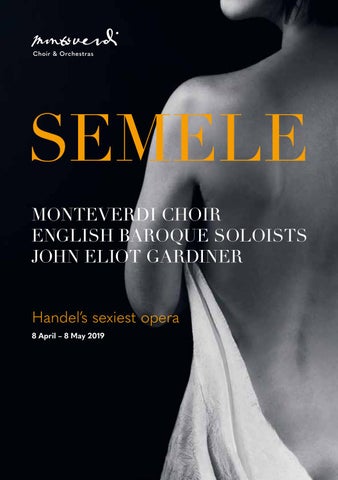
Handel’s sexiest opera 8 April – 8 May 2019
HANDEL SEMELE 2019 A European tour Paris Philharmonie Monday 8 April Barcelona Palau de la Música Wednesday 24 April London Alexandra Palace Theatre Thursday 2 May Milan Teatro alla Scala Monday 6 May Rome Sala Santa Cecilia Wednesday 8 May
INTRODUCTION JOHN ELIOT GARDINER It is ironic - and surely not coincidental - that the first great full-length opera in the English language was composed in 1743 by Handel, an emigré German approaching the height of his powers, but in self-imposed retirement from the toxic London opera scene.
S
emele was his defiant counter-blast to those who for years had sought to control him - the rival aristocratic theatre-owners and company directors. Not surprisingly, Handel preferred to promote and organise his own annual concert season at Covent Garden free from interference, and with his own hand-picked soloists, orchestra and chorus. Semele caught his audience off balance: it was not a conventional Italian opera properly ‘staged’ (though it clearly was in Handel’s imagination and despite the presence of elaborate stage directions); nor was it a pious oratorio based on the Old Testament tailored to the Lenten season. Far from it. Instead he chose a ‘profane’ story based on Ovid, in which gods and mortals operate on the same level, behaving badly and passionately but in ways that everyone - except the disgruntled audience of the time or, later, the sanctimonious Victorians - can relate to. Handel was breaking fresh ground with Semele: it was a new form of music drama, drawing the best features of Italian opera and creating a synthesis of the English masque and ‘semi-opera’ traditions (which he had first attempted in the delicious Acis and Galatea 25 years earlier). Semele’s musical score is a glorious blend of irresistible solo arias - some virtuosic showstoppers, others lyrical, sensual and evocative, ensembles, duets, accompanied recitatives and (unlike his operas) imposing choruses. Still more than when I first performed it and recorded it almost forty years ago, I feel Semele’s time has finally come.
“No oratorio, but a bawdy Opera” Charles Jennens, librettist of Messiah
The Monteverdi Choir & Orchestras presents
SEMELE A dramatic oratorio in three acts Music by George Frideric Handel Libretto by William Congreve Monteverdi Choir English Baroque Soloists John Eliot Gardiner conductor / director Thomas Guthrie director Rick Fisher lighting designer Patricia Hofstede costume designer CAST Louise Alder Semele Hugo Hymas Jupiter Lucile Richardot Juno / Ino Carlo Vistoli Athamas Gianluca Buratto Cadmus / Somnus Emily Owen Iris Angela Hicks Cupid Peter Davoren Apollo Alison Ponsford-Hill / Angharad Rowlands Endless Pleasure Daniel D’Souza / Robert Davies / Christopher Webb High Priest The score and parts for these performances have been supplied by Faber Music Ltd, London on behalf of Bärenreiter-Verlag, Kassel. Performances will last approximately 3 hours and 20 minutes, including a 20 minute interval after Act II.
Jupiter and Semele – attributed to Jacopo Tintoretto, c.1545
SYNOPSIS Act I
Act II
Act III
Cadmus, King of Thebes, and his family have travelled to the Temple of Juno in Bœotia to solemnise the marriage of his daughter Semele to Prince Athamas. The Priests and Augurs proclaim that the omens for the marriage seem propitious, but Semele has been inventing one excuse after another to delay the wedding because she is secretly in love with Jupiter. Semele pleads to Jupiter for help, and his thunder interrupts the ceremony and extinguishes the sacrificial flames on the altar of his wife Juno. The Priests advise everyone to flee from the temple, but the despairing Athamas and Semele’s sister Ino remain behind.
Juno, angered at her husband’s adultery, has ordered her messenger Iris to discover where Jupiter and Semele are. Iris reports that Jupiter has built his new mortal lover an elaborate new palace on Mount Cithaeron, and warns that it is guarded by fierce dragons that never sleep. The enraged Juno swears vengeance, and hastens to visit Somnus, the God of Sleep, in order to enlist his aid.
The cavernous dwelling of Somnus, god of sleep, is rudely disturbed by the arrival of Juno and Iris. Somnus lethargically refuses to help Juno, but he is enlivened when Juno promises him the reward of his favourite nymph Pasithea. Juno orders Somnus to give Jupiter an erotic dream that will make him desperate to enjoy Semele’s favours at any price. Juno takes Somnus’ magical lead rod in order to beguile the dragons and Ino to sleep. Juno assumes the form of Ino, pretends to believe that Semele has been made immortal, and gives her a magical mirror that deceives the foolish girl into thinking herself even more beautiful than usual. Juno advises that if Semele wishes to become truly immortal then she must refuse Jupiter’s sexual favours until he promises to grant any wish she desires, and that she must request that he come to her in his true undisguised form (‘like himself, the Mighty Thunderer’). Semele eagerly accepts this advice. Juno departs when she senses the approach of Jupiter.
Ino reveals to the astonished Athamas that she loves him. Cadmus interrupts with the shocking news that Semele, surrounded by azure flames, has been abducted by a giant eagle, ‘on purple wings descending’, that left behind a scent of ‘celestial odour and ambrosial dew’. The Priests and Augurs identify that this eagle was Jupiter, and it is announced ‘Endless pleasure, endless love, Semele enjoys above.’
Semele, attended by Loves and Zephyrs, yearns for Jupiter. He arrives, in human form, reassures her of his fidelity, and reminds her that she is only mortal and needs time to rest between their bouts of love-making. Semele professes devotion to him, but reveals her discontent that she has not been made immortal. Jupiter, recognizing that Semele has dangerous ambition, transforms the palace to Arcadia, charms her with its pastoral delights, and magically summons her sister Ino to keep her company. The enraptured Ino describes the heavenly music she has heard on the way to Mount Cithaeron whilst carried by two winged Zephyrs. The sisters, and a chorus of nymphs and swains, sing of the joys of music.
Inflamed by desire for Semele, Jupiter is astonished when she acts coldly towards him. He rashly swears an irrevocable vow to grant her whatever she desires, and she demands that he visit her in his natural guise. He reacts with horror, knowing that his lightning bolts will certainly kill her, but she refuses to listen to reason, assuming that Jupiter does not wish to grant her immortality. Left alone, Jupiter tries to find a way to save Semele’s life, but dejectedly realizes that ‘she must a victim fall’. Juno gloats in triumph at her victory. Semele sees Jupiter descend as a fiery cloud of lightning and thunder, laments her folly, and dies consumed in flames. Ino, safely returned to Bœotia, announces the tragic news that Semele has perished. However, some good has come of it: Jupiter has ordained that Ino and Athamas must be wed, and Apollo prophesies that Bacchus, god of wine and unborn child of Semele and Jupiter, will arise from Semele’s ashes to bring a delight ‘more mighty than love’ to the earth. David Vickers, co-editor of The Cambridge Handel Encyclopedia
After Jupiter’s Amour with Europa, the Daughter of Agenor, King of Phænicia, he again incenses Juno by a new Affair in the same Family; viz. with Semele, Niece to Europa, and Daughter to Cadmus King of Thebes. Semele is on the Point of Marriage with Athamas; which Marriage is about to be solemniz’d in the Temple of Juno, Goddess of Marriages, when Jupiter by ill Omens interrupts the Ceremony; and afterwards transports Semele to a private Abode prepar’d for her. Juno, after many Contrivances, at length assumes the Shape and Voice of Ino, Sister to Semele; by the help of which Disguise, and artful Insinuations, she prevails with her to make a Request to Jupiter, which being granted must end in her utter Ruin.
HANDEL AND THE STORY OF SEMELE by David Vickers Handel ceased composing and performing Italian operas in London after 1741 and resolved to confine his main musical output to unstaged English theatre works. During summer 1743 the Earl of Middlesex attempted to entice the fifty-eight-year-old composer to return from his self-imposed operatic retirement with an offer of £1,000 to write two new operas. Handel initially accepted, but then changed his mind – even stubbornly refusing the personal entreaties of the Prince of Wales – and instead organized his own Lenten series of twelve subscription concerts at Covent Garden. At around the same time as rejecting the repeated offers from Lord Middlesex’s opera company, Handel composed the overtly operatic concert entertainment Semele, set to an old English opera libretto by the playwright William Congreve
(1670–1729) – an extraordinary decision that must have aggravated the Italian opera lobbyists amongst the nobility. He commenced writing the music on 3 June 1743, finished Act I on 13 June, Act II on 20 June, and finished the filled-out score of the entire work on 4 July; it took only a month and one day to complete. Congreve had been Sir John Vanburgh’s partner in the planning, building and artistic direction of Queen’s Theatre in the Haymarket (renamed the King’s Theatre after the succession of George I). This was the theatre for which Handel composed most of his Italian operas, but when it was first built in 1704 it had been hoped that the venue would nurture the development of all-sung English opera. With that aim in mind, Congreve based his Semele, An Opera on a fable in Ovid’s Metamorphoses, and summarized its action:
The libretto was first set to music by John Eccles (c.1668–1735), the leading London theatre music composer after the death of Henry Purcell. This fantastic extravaganza was probably intended to celebrate the opening of the new Queen’s Theatre, which was designed to have good acoustics and enable elaborate scenic transformations. In the event, Eccles did not finish the music in time. By the time it was ready to be rehearsed in January 1707, the disillusioned Congreve had quit the Queen’s Theatre project, the actresssinger Anne Bracegirdle (for whom the title-role was designed) was about to retire, and only spoken plays were permitted at the theatre after the Lord Chamberlain granted the rival Drury Lane theatre a temporary monopoly on opera. The Drury Lane manager Christopher Rich agreed with Eccles to produce Semele, but the abject failure of Addison’s Rosamund in March 1707 discouraged Rich from risking another all-sung English opera, and so Semele was permanently abandoned. Fed up by the shenanigans of theatre politics, Eccles left London and spent most of his time fishing. Congreve was also deeply disappointed by the failure of Semele to get to the stage, but his libretto was printed in The Second Volume of the Works of Mr. William Congreve (1710), for
which the author added a Latin epigram from Seneca’s Epistles, complaining about the fickleness of public taste: ‘We forsake nature and commit ourselves to the public, a bad guide in anything, and in this, as in everything, most inconsistent’. The old-fashioned text was too short to meet the expectations of Handel’s audience, so it required some adaptation, and particularly the addition of more choruses and da capo arias.
Jupiter and Semele Gustave Moreau (1826-1898)
Act II scene 2 prior to the stage direction ‘Semele awakes and rises’.
The anonymous adaptation of the libretto for Handel drew extra texts judiciously from Congreve’s other poems: Semele’s ‘My racking thoughts’ was taken from the elegy To Sleep; Ino’s recitative ‘O’er many states’ from Congreve’s translation of the Homeric Hymn to Venus; most of the chorus ‘Oh terror and astonishment’ from Of Pleasing: an epistle to Sir Richard Temple; Ino’s ‘But hark! the heavenly sphere turns round’ from the ode On Mrs Arabella Hunt, singing. Three new texts were not taken from Congreve’s works: Jupiter’s ‘Where’er you walk’ was adapted from Alexander Pope’s pastoral Summer, and it seems that Athamas’s ‘Despair no more shall wound me’ and the final chorus ‘Happy, happy shall we be’ were newly written. The music proves that Handel’s instincts as a dramatist were razor-sharp, and he undoubtedly relished the libretto’s ingredients of supernatural events, affectionate humour, extrovert wit, erotic tenderness, unfulfilled longing, murderous jealousy, coquettish vanity, tragic vulnerability, euphoria and loss. He took great care over the composition of his music, which illustrates the emotional or psychological condition of characters using the orchestral scoring of strings and continuo in a panoply of different ways; oboes and bassoons are used very sparingly, and brass only feature in two choruses. Some music was rejected when Handel revised the score prior to the first performance; John Eliot Gardiner has reinstated Cupid’s languid ‘Come, Zephyrs, come’, which was intended to be sung in
There are more accompanied recitatives than in any of Handel’s other theatre works: Iris’s fantastic report of the dragons that guard Semele’s palace, and the twinkling of their ‘thousand fiery eyes which never know repose’, is wittily illustrated; Juno’s explosive vengefulness is immediately apparent in her ‘No more – I’ll hear no more’; the drowsy slow music depicting Somnus’s sleepy cave, featuring memorable use of bassoons, is rudely disturbed by flurrying strings that herald Juno’s agitated arrival and summons ‘Somnus awake!’ – and yet the God of Sleep proves impossible to rouse from his slumbers (‘Leave me, loathsome light’) until the mention of the lovely nymph Pasithea rouses him from his lethargy. Jupiter’s ‘Ah! whither is she gone’ shows his eventual resignation that he cannot save the mortal woman he loves (the recurring section ‘’Tis past, ’tis past recall, She must a victim fall!’ reveals a hitherto unsuspected sincerity and poignant depth in the philandering God). Semele’s demise in ‘Ah me! too late I now repent’ is a tragic doom for the flirtatious, vain and ambitious mortal whose folly hits its peak when she becomes entranced by her own loveliness when gazing into an enchanted mirror (‘Myself I shall adore’). The first performance of Semele was at the Theatre-Royal in Covent Garden on 10 February 1744. On that day, the London Daily Post advertised that for one shilling the public could acquire the wordbook of ‘The Story of Semele; Alter’d from the Semele by Mr. Congreve’, and the newspaper also announced that it would be performed ‘after the manner of an oratorio’. Handel was careful not to publicly call it a concert opera or a secular English music drama because such entertainments were forbidden during Lent, but he was sensible that he could not describe it as an actual oratorio. His cast included the trilingual Elisabeth Duparc (‘La Francescina’) as Semele, Esther Young as both Ino and Juno, John Beard as Jupiter
(and Apollo), Henry Reinhold as Cadmus (and Somnus), Daniel Sullivan as Athamas, and Christina Maria Avolio as Iris. On 11 February Handel’s staunch supporter Mary Delaney wrote to her sister that Semele ‘is a delightful piece of music’, and nine days later wrote that ‘the more I hear it the better I like it’, but also reported that ‘Semele has a strong party against it, viz. the fine ladies, petit maîtres, and ignoramus’s. All the opera people are enraged at Handel’. Even some of his supporters disapproved of the work. Delany’s husband, a Doctor of Divinity, did not think it proper for him to attend a profane entertainment during Lent. Charles Jennens, the librettist of Saul
and Messiah, took such exception to the immorality of Semele that he boycotted its only revival in December 1744, and many years later complained that it was ‘a bawdy Opera’. From a certain point of view, the objectors had a fair point – the sexual innuendos about Semele’s romping with Jupiter described in ‘Endless pleasure’ remain as blatant today as they must have been in the eighteenth century (in John Eliot Gardiner’s performance it is sung by a voyeuristic augur, as in Congreve’s original libretto). Nevertheless, the compassionate humour, sexiness and emotional insights into its motley personalities are exactly why ‘The Story of Semele’ is adored by modern audiences. © David Vickers 2019
Autograph score of Handel Semele: extract from ‘Where’re you walk’, f.69r, 1743. Held in the British Library.
JOHN ELIOT GARDINER CONDUCTOR / DIRECTOR Sir John Eliot Gardiner is revered as one of the world’s most innovative and dynamic musicians, constantly in the vanguard of enlightened interpretation and standing as a leader in contemporary musical life. His work, as founder and artistic director of the Monteverdi Choir (MVC), English Baroque Soloists (EBS) and Orchestre Révolutionnaire et Romantique (ORR), has marked him out as a key figure both in the early music revival and as a pioneer of historically informed performances. As a regular guest of the world’s leading symphony orchestras, such as the London Symphony Orchestra, Symphonieorchester des Bayerischen Rundfunks, Royal Concertgebouw Orchestra and Gewandhausorchester Leipzig, Gardiner conducts repertoire from the 17th to the 20th century. He was awarded the Concertgebouw Prize in January 2016. The extent of Gardiner’s repertoire is illustrated in the extensive catalogue of award-winning recordings with his own ensembles and leading orchestras including the Vienna Philharmonic on major labels (including Decca, Philips, Erato and 30 recordings for Deutsche Grammophon), as wide-ranging as Mozart, Schumann, Berlioz, Elgar and Kurt Weill, in addition to works by Renaissance and Baroque composers. Since 2005 the Monteverdi ensembles have recorded on their independent label, Soli Deo Gloria, established to release the live recordings made during Gardiner’s
Bach Cantata Pilgrimage in 2000, for which he received Gramophone’s 2011 Special Achievement Award and a Diapason d’or de l’année in 2012. His many recording accolades include two GRAMMY awards and he has received more Gramophone Awards than any other living artist. Gardiner has also conducted opera productions; at the Royal Opera House, Covent Garden, at the Vienna State Opera and at Teatro alla Scala, Milan. From 1983 to 1988 he was artistic director of Opéra de Lyon, where he founded its new orchestra. Following the success in 2008 of Verdi Simon Boccanegra at the Royal Opera House, Gardiner returned there in 2012 to conduct Verdi Rigoletto, and in 2013 Mozart Le nozze di Figaro, to coincide with the 40th anniversary since his ROH debut. In autumn 2015, he returned to ROH to conduct Gluck Orphée et Eurydice, with the MVC and EBS, co-directed by Hofesh Shechter and John Fulljames.
An authority on the music of J. S. Bach, Gardiner’s book, Music in the Castle of Heaven: A Portrait of Johann Sebastian Bach, was published in October 2013 by Allen Lane, leading to the Prix des Muses award (Singer-Polignac). Among numerous awards in recognition of his work, Sir John Eliot Gardiner holds several honorary doctorates. He was awarded a knighthood for his services to music in the 1998 Queen’s Birthday Honours List. In 2017 Gardiner and the Monteverdi ensembles celebrated the 450th anniversary of Monteverdi’s birth with staged performances of his three surviving operas across Europe and in the USA, a project that was awarded an RPS Music Award in the Opera and Music Theatre category. Recent recordings include two Bach releases with SDG, Magnificat in E Flat and St Matthew Passion along with LSO recording of Mendelssohn Symphony No 2 (Lobgesang).
THOMAS GUTHRIE
RICK FISHER
PATRICIA HOFSTEDE
DIRECTOR
LIGHTING DESIGNER
COSTUME DESIGNER
Thomas Guthrie is an innovative and award-winning British director and musician working in theatre and music to tell stories in vivid, new and direct ways.
Born in Philadelphia, Rick is winner of two Olivier Awards for best Lighting Design and two Tony Awards for An Inspector Calls and Billy Elliot (Broadway). He has previously worked with John Eliot Gardiner on productions of the Monteverdi 450 Trilogy, Leonora, The Magic Flute, and A Midsummer Night’s Dream. His theatre credits include: Edmond de Bergerac (Birmingham Rep and tour), Consent (West End), La Traviata (Royal Opera Muscat), Rent (UK tour), An Inspector Calls (USA tour), Sunny Afternoon, Judas Kiss (New York, Toronto, London), The Audience (West End, Broadway).
Patricia Hofstede is an interdisciplinary designer and painter based in Amsterdam. Fuelled by a love for colour, (natural) textiles and symbolism, she creates clothing and stage costumes with a classic yet modern twist emphasizing simplicity, elegance and spirituality.
A former Jette Parker Young Artist Stage Director at the Royal Opera House in London, his revival of David McVicar’s Die Zauberflöte there won What’s On Stage Best Revival 2018. His own productions of Le Nozze di Figaro and Die Zauberflöte at Longborough Festival Opera led to an invitation to direct Wagner Der Fliegende Holländer there in 2018 (subsequently called ‘one of the best productions at this venue I have seen’, Rupert Christiansen, Telegraph). Future projects include a revival of Nozze di Figaro at ROH, a new production of Jonathan Dove’s Monster in the Maze at Grange Festival and a new staging of Aida at the Liceu in Barcelona. With a reputation for stylish, unfussy, energetic, physical, theatrical and sometimes controversial work, the clarity of the storytelling, the commitment of the performers and a pre-eminence of musical values are at the heart of his productions. Guthrie is the artistic director of Music and Theatre for All, a charity that works to connect performers and public in new and transformative ways through music, theatre and opera.
After years of fashion-industry experience, Patricia opened her studio, ‘Atelier Paradis’ nestled in Amsterdam, which is part boutique part laboratory. This hybrid home-base serves as a backdrop for her design work and her paintings and has enabled Patricia to open her door to interdisciplinary collaborations in the fields of the arts, music, and theatre.
LOUISE ALDER
HUGO HYMAS
LUCILE RICHARDOT
SOPRANO
TENOR
MEZZO-SOPRANO
Louise Alder studied at the Royal College of Music International Opera School where she was the inaugural Kiri Te Kanawa Scholar.
British tenor, Hugo Hymas, grew up in Cambridge singing with Great St Mary’s Church Choir and Clare College Choir. He then studied Music Durham University and is now based in London.
Lucile Richardot graduated in 2008 from the Maîtrise de Notre-Dame de Paris, and then in 2011 from Conservatoire à rayonnement régional de Paris in Early Music, having studied under Margreet Hoenig, Noëlle Barker, Paul Esswood, Howard Crook and Jill Feldman. In 2012, she founded her own ensemble, named Tictactus, with two lutenist friends.
She is a member of Oper Frankfurt’s Ensemble where her roles in the 2018/19 season include Romilda Serse, Pamina Die Zauberflöte, Gretel Hänsel und Gretel and Monica in a new production of Menotti The Medium. She also makes débuts at the Teatro Réal, Madrid in the title role of La Calisto and at the Bayerische Staatsoper, Munich as Gretel. On the concert platform she sang the title role in Theodora at the BBC Proms with Arcangelo and Jonathan Cohen; Messiah with the Deutsches Symphonie-Orchester Berlin in performances staged by Frederick Wake-Walker; Carmina Burana with the LPO and Jérémie Rhorer; Brahms Ein Deutsches Requiem with the RLPO and Vasily Petrenko; Jessie in Turnage The Silver Tassie with the BBC Symphony Orchestra and Ryan Wigglesworth; Mozart Arias in Salzburg with the COE and Robin Ticciati and The Plaintiff in Trial by Jury with the OAE and John Wilson. Her recital appearances include London’s Wigmore Hall with William Vann, the Bath Mozartfest with Joseph Middleton, the Stefaniensaal in Graz with Gary Matthewman and the Alte Oper in Frankfurt with Leif Ove Andsnes.
Hugo has performed on the concert platform as a soloist in several of Europe’s great concert halls: Philharmonie (Paris), Concertgebouw, KKL Luzern, Philharmonie (Berlin), Royal Albert Hall and Wigmore Hall. In 2016 he performed the tenor arias in a critically acclaimed European tour of Matthäus-Passion with English Baroque Soloists (Sir John Eliot Gardiner), and later that year on a tour of Bach Magnificat. He has also collaborated recently on Messe H-Moll with Münchener Motettenchor - Benedikt Haag, Weihnachtsoratorium, Matthäus-Passion and Messiah with Dunedin Consort (John Butt), Die Schöpfung with Les Arts Florissants (William Christie), and Johannes-Passion with Taverner Consort (Andrew Parrott). On the opera stage Hugo has played the lead roles in the works of Monteverdi, Purcell and Handel.
She specialises in early music and contemporary repertoire both on stage and in concerts, performing with Les Solistes XXI (conductor Rachid Safir), Ensemble Correspondances (Sébastien Daucé), Pygmalion (Raphaël Pichon) and Le Poème Harmonique (Vincent Dumestre). In 2012, Lucile sang Monteverdi’s complete books of Madrigals with Les Arts Florissants in performances conducted by Paul Agnew, who later invited her to perform with the Liverpool Philharmonic Orchestra. Recent engagements include a world-wide tour of Monteverdi’s three surviving operas with the Monteverdi Choir & Orchestras and John Eliot Gardiner, Lisea in Vivaldi Arsilda with Collegium 1704 (Vaclav Luks), and her début at the Aix-en-Provence Festival as the Sorceress and Spirit in Purcell Dido and Aeneas. Alongside these projects, Lucile also recorded her first solo album with Ensemble Correspondances, Perpetual Night, a collection of 17th century English consort songs.
CARLO VISTOLI
GIANLUCA BURATTO
EMILY OWEN
COUNTERTENOR
BASS
SOPRANO
Carlo Vistoli began his vocal training in 2005, with William Matteuzzi and Sonia Prina. Previous operatic roles include: Licida in Mysliveèek L’Olimpiade (Bologna Teatro Comunale), the title role in Handel Tamerlano (Poitiers and Warsaw), Purcell King Arthur (Rome and Bologna), Piritoo in Elena by Cavalli with Garcia Alarcon, in Rennes and Nantes, Tolomeo in Handel Giulio Cesare in Shanghai with Opera Fuoco. In 2015 he sang the premiere of L’Amore che move il sole by Adriano Guarnieri at Ravenna Festival. He was Febo in Caldara Dafne, with Teatro La Fenice, Ottone in Handel Agrippina at Brisbane Baroque Festival; in 2016-17 sang Handel Dixit Dominus with Accademia di Santa Cecilia, Handel Messiah and Monteverdi Orfeo with Les Arts Florissants, Cavalli Erismena at the Festival d’Aix en Provence.
One of the major talents to come out of Italy recently, bass Gianluca Buratto made his debut at the Teatro Verdi in Trieste, in the world premiere of Solbiati Il Carro e I Canti. His past engagements include Mercadante Virginia and La Bohème at the Wexford Opera Festival, La Betulia Liberata by Jommelli and by Mozart at the Salzburg Festival under Riccardo Muti, Le Nozze di Figaro with Christophe Rousset in Barcelona, La Bohème under Riccardo Chailly and I Due Foscari in Valencia, I Puritani (Giorgio) at the Maggio Musicale Fiorentino, and Die Zauberflöte in Liège under Paolo Arrivabeni. Gianluca recently performed in his first solo recital at the Wigmore Hall in London and in Faccio Amleto and Turandot at the Bregenzer Festspiele. Gianluca took part in the 2017 Monteverdi Trilogy Project with John Eliot Gardiner, the Monteverdi Choir and English Baroque soloists as Seneca, Antinoo and Plutone, on a worldwide tour celebrating the composer’s 450th anniversary.
Emily Owen graduated with first class honours in Music from Durham University and then completed with distinction an Extended Artist Masters in Historical Performance at the Guildhall School of Music and Drama coached by Marie Vassiliou in 2017. She is now coached by Tim Evans-Jones.
In 2017 he took part in Monteverdi 450, a world-wide tour with the Monteverdi Choir, English Baroque Soloists and Sir John Eliot Gardiner. In 2018 he sang Artabano in Hasse Artaserse in Sidney, Ruggiero in Vivaldi Orlando Furioso in Venice and at the Salzburg Festspiele Ottone in Incoronazione di Poppea under William Christie. Recents engagements include La Finta pazza by Sacrati, in Dijon and Geneva and Orfeo in Gluck Orfeo e Euridice at the Rome Opera, production by Robert Carsen.
His discography includes Puccini La Bohème with Riccardo Chailly (Unitel); Handel Giulio Cesare (Naïve); Rossi Oratorio della Settimana Santa (MV Cremona); Lieder by Carl Philipp Emanuel Bach (Winter and Winter); Cavalli Missa pro defunctis (Tactus); Bassani La tromba della Divina misericordia (Concerto), Rota Mysterium (Decca).
She is an accomplished consort singer and soloist performing with Dame Emma Kirkby’s Dowland Works, including a recent solo debut at Wigmore Hall. She also performs with Britten Sinfonia Voices and Apollo5. In 2016/17 she participated in the Handel & Hendrix in London Talent scheme including masterclasses with Carolyn Sampson and Laurence Cummings. She is a soprano in the choir of St Bride’s, Fleet Street. She is a founder member of Ceruleo, a Baroque ensemble which is currently touring an Arts Council England-funded show about the life of Henry Purcell which will appear at Brighton Early Music Festival, York Early Music Christmas Festival and Ryedale Festival in 2019. She performs for Live Music Now, taking baroque music into alternative social settings and as a passionate educator, she leads workshops with Apollo5 and the VCM Foundation in their outreach work across Europe and is a choral practitioner for the Voices Foundation. She teaches singing at Harrow School.
MONTEVERDI CHOIR Founded by Sir John Eliot Gardiner as part of the breakaway period-instrument movement of the 1960s, the Monteverdi Choir has always focused on bringing a new perspective to its repertoire.
W
ith a combination of consummate choral technique and historicallyinformed performance practice, its real difference as an ensemble lies in its ability to communicate music to their audiences worldwide. The Choir goes beyond the music, seeking to make the visual impact of its performance enhance the experience, even exploiting the venues themselves in the search for immediacy and drama. This approach has led the Monteverdi Choir to be consistently acclaimed over the past 50 years as one of the best choirs in the world. Amongst a number of trailblazing tours was the Bach Cantata Pilgrimage in 2000, during which the Choir performed all 198 of J. S. Bach’s sacred cantatas in more than 60 churches throughout Europe and America. The entire project recorded by the company’s record label Soli Deo Gloria was hailed as ‘one of the most ambitious musical projects of all time’ by Gramophone magazine. The Monteverdi Choir has over 150 recordings to its name and has won numerous prizes. The Choir is also committed to training future generations of singers through the Monteverdi Apprentices Programme. Many Apprentices go on to become full members of the Choir, and former Choir members have also gone on to enjoy successful solo careers. The Choir has participated in several staged opera productions, including Der Freischütz (2010), Carmen (2009) at the Opéra
Comique in Paris, and Les Troyens at the Théâtre du Châtelet. In 2015, the Choir performed Gluck Orphée et Eurydice at the Royal Opera House, Covent Garden, working in collaboration with the Hofesh Shechter dance company. In addition, the Choir has taken part in a variety of projects across different repertoires – from an extensive tour of Bach St Matthew Passion (performed from memory) with the English Baroque Soloists to Berlioz Roméo et Juliette at the BBC Proms and Festival Berlioz with the Orchestre Révolutionnaire et Romantique in 2016. Under the direction of Sir John Eliot Gardiner, they have also collaborated with both the London Symphony Orchestra on Mendelssohn Ein Sommernachtstraum and the Tonhalle Orchestra on Janáček Glagolitic Mass. Recent achievements include the acclaimed Monteverdi 450 trilogy tour, which saw them perform all three of Monteverdi’s surviving operas across Europe and in the US in 2017. This project received an RPS Music Award in the Opera & Music Theatre category. 2018 saw the Choir perform a mixed programme of J. S. Bach’s sacred cantatas with the English Baroque Soloists across Europe, and critically-acclaimed performances of Verdi Requiem alongside the Orchestre Révolutionnaire et Romantique - including a landmark concert at Westminster Cathedral in aid of Cancer Research UK.
SOPRANOS Penelope Appleyard Emily Armour Sam Cobb* Rebecca Hardwick Angela Hicks† Eloise Irving Laura Jarrell* Charlotte La Thrope* Victoria Meteyard* Eleanor Meynell Emily Owen† Alison Ponsford-Hill† Rebecca Ramsey Angharad Rowlands†
ALTOS Francesca Biliotti Heather Cairncross Rosie Clifford Sarah Denbee Hamish McLaren Simon Ponsford Margarita Slepakova* Matthew Venner Richard Wilberforce TENORS Ben Alden Mark Bonney John Bowen Peter Davoren† Jonathan Hanley* Edmund Hastings Graham Neal Benedict Quirke Gareth Treseder
BASSES James Birchall Robert Davies† Daniel D’Souza† Sam Evans Michael Lafferty* Alistair Ollerenshaw James Quilligan* David Stuart Lawrence Wallington Christopher Webb† †
Step-out soloists
* 2018/19 Monteverdi Apprentices
ENGLISH BAROQUE SOLOISTS The English Baroque Soloists have long been established as one of the world’s leading period instrument orchestras. Throughout their repertoire, ranging from Monteverdi to Mozart and Haydn, they are equally at home in chamber, symphonic and operatic performances and the distinctive sound of their warm and incisive playing is instantly recognisable.
T
he ensemble has performed at many of the world’s most prestigious venues, including Teatro alla Scala, Milan, the Concertgebouw in Amsterdam and the Sydney Opera House. During the course of the 1990s they performed Mozart’s seven mature operas and recorded all of his piano concertos and mature symphonies. The English Baroque Soloists are regularly involved in joint projects with the Monteverdi Choir, with whom they famously took part in the iconic Bach Cantata Pilgrimage in 2000, performing all of Bach’s
sacred cantatas throughout Europe. They also toured Gluck Orphée et Eurydice to Hamburg and Versailles, following a staged production at the Royal Opera House, Covent Garden, in collaboration with the Hofesh Shechter dance company. In 2016, they were involved in several tours, including performances of Bach Magnificat in E flat, Lutheran Mass in F major, and Cantata ‘Süßer Trost’ with the Monteverdi Choir in venues around Europe, and Bach St Matthew Passion as well as a mixed programme of Mozart Symphonies 39-41, Requiem and Great Mass in C Minor. 2017 saw the EBS take part in the Monteverdi 450 trilogy tour in which performed all three of Monteverdi’s surviving operas across Europe and in the USA, a project that was awarded an RPS Music Award in the Opera and Music Theatre category. In 2018, they performed in Salzburg’s annual Mozartwoche, before embarking on a reprise of their landmark Bach Cantata Pilgrimage to some of Europe’s most iconic concert halls and churches. In January 2019, the EBS made their inaugural visit to South America, performing four concerts of Bach’s instrumental masterpieces at the Cartagena International Music Festival, Colombia.
FIRST VIOLINS Kati Debretzeni Iona Davies Jane Gordon Rebecca Livermore Susan CarpenterJacobs Dominika Fehér Sarah Moffatt Davina Clarke SECOND VIOLINS Anne Schumann Oliver Webber Roy Mowatt Beatrice Scaldini Håkan Wikström Hildburg Williams Kinga Ujszaszi
VIOLAS Fanny Paccoud Monika Grimm Lisa Cochrane Aliye Cornish CELLOS Marco Frezzato* Catherine Rimer Ruth Alford Kinga Gáborjáni DOUBLE BASSES Valerie Botwright* Markus Van Horn
OBOES Rachel Chaplin Mark Baigent BASSOONS Veit Scholz* Katrin Lazar HORNS Anneke Scott Joseph Walters Gavin Edwards TRUMPETS Neil Brough Robert Vanryne Michael Harrison
TIMPANI Robert Kendell THEORBO Evangelina Mascardi* HARP Gwyneth Wentink* KEYBOARDS James Johnstone* Oliver-John Ruthven* Paolo Zanzu* * denotes continuo
MONTEVERDI APPRENTICES PROGRAMME The Monteverdi Apprentices Programme enables outstanding young musicians to spend an entire year training and performing with our three internationallyrenowned ensembles, under the direction of Sir John Eliot Gardiner. This worldclass artist development scheme continues to have a deep impact upon the development of all the young musicians who have participated in it: extending their musical horizons and broadening their career aspirations. Not only does it remain a pioneering initiative, but it also serves as a testament to MCO’s continued commitment to nurturing the next generation of musical talent. The Apprentices Programme was set up in 2007 - the first of its kind in the UK - its aim being to nurture exceptional musical talent and an aptitude for ensemble performing. We felt there was a pressing need to create a safe environment and opportunity for gifted young singers and instrumentalists to dip their toes in the waters of professional music-making while still exploring their own musical potential - just plunging into the professional world straight out of college can be a daunting prospect at the best of times.
The Apprentices Programme follows the age-old apprenticeship principle of learning a craft on the job from older hands. At the start of the year each Apprentice is assigned a mentor - an experienced musician within the Monteverdi Choir, EBS or ORR - on hand to give encouragement and one-toone advice on the multiple challenges that arise from ensemble singing and playing at the highest professional level. Furthermore, over the course of their Apprentice year these young musicians are integrated with
the Monteverdi ensembles, rehearsing and performing in concerts at home and on tour overseas with the Monteverdi ensembles. Our aim is to round out their musical education and to help equip them for future challenges by giving them the opportunity to work alongside some of the best and most experienced musicians in the business. It should come as no surprise, therefore, that our current Apprentices are joining us in the chorus for selected performances of Semele. By the end of the year, a Monteverdi Apprentice should be able to gauge his or her individual worth as a singer or instrumentalist with greater objectivity. They will have been given a taste of the life of a professional musician and be in a better position to weigh up if this is genuinely the path that they wish to pursue either as a soloist, an ensemble musician, or both. And if he or she has shown that they can meet the requisite musical,
technical and stylistic standards that define the Monteverdi Choir, EBS or ORR, they may be offered a place whenever there is a vacancy. The Programme now has over 60 alumni with roughly 70% of Apprentices graduating as fully-fledged members of the Monteverdi ensembles and performing with them regularly in their many projects. John Eliot Gardiner
The Apprentices Programme will continue with the appointment of a new group of instrumentalists to work with us on our 2020 projects, with Beethoven a major focus in the composer’s 250th anniversary year. Applications open at the end of April 2019, and we welcome enquiries from across UK and Europe. Please visit the MCO website for more information: www.monteverdi.co.uk
SUPPORT THE MONTEVERDI ENSEMBLES The Monteverdi Choir & Orchestras is committed to producing work of the highest calibre and to sharing our distinctive performance practice with audiences around the world. Our supporters are a group of dedicated and discerning music lovers who take pride in the knowledge that their donations help us to achieve our artistic vision.
As a registered charity without public subsidy, we rely on the generosity of our supporters to help us to produce top-quality performances, nurture young talent, and plan towards a sustainable future. Please consider joining the Monteverdi family and, by doing so, ensure that we continue to produce music of the very highest quality to the widest possible audience for years to come.
MAKE A DONATION Donate directly to the Monteverdi Choir & Orchestras and play your part in the creation of outstanding performances, inspirational education projects and developing the musicians of the future. BECOME A SUPPORTER By joining the membership scheme of the Monteverdi Choir & Orchestras, not only are you helping to guarantee a sustainable future for our ensembles, but you are making a direct contribution to the breadth, depth and quality of our artistic output, not just in the UK, but all over the world. JOIN AS A CORPORATE PARTNER The Monteverdi Choir & Orchestras is a mark of excellence. We can tailor partnership packages to meet your business needs, including client and employee entertainment and international marketing opportunities. LEAVE A LEGACY By choosing to leave a legacy gift to the Monteverdi Choir & Orchestras, you will play a crucial role in securing the future of our three ensembles for decades to come.
JOIN OUR AMERICAN FRIENDS Our American donors have always played a valuable role in supporting the work of the Monteverdi ensembles worldwide. Become an American Friend by making a one-off donation or by joining the membership scheme. GIFT A MEMBERSHIP If you have a friend or loved one who enjoys the work of the Monteverdi ensembles, then please consider gifting them with a year’s membership.
For more information, to make a donation, or to request a confidential conversation with our General Director, please contact us on +44 (0)20 7719 0120 or email us at development@monteverdi.org.uk Additional information can be found on our website: www.monteverdi.co.uk
MONTEVERDI SUPPORTERS ROYAL PATRON HRH The Prince of Wales PRESIDENT Ian Hay Davison CBE BENEFACTORS Michael L. Cioffi – Monteverdi Tuscany, Castiglioncello del Trinoro, Italy Sebastiano Cossia Castiglioni Mrs Carol Grigor & Mr Murray Grigor Judith McCartin Scheide Sir David Walker CORPORATE PARTNERS Greensill Capital Morgan Stanley TRUSTS & FOUNDATIONS Dunard Fund The Vernon Ellis Foundation
MEMBERSHIP SCHEME BACH MEMBERS Michael Beverley David & Sandra Brierwood Julia Chappell The Earl and Countess of Chichester Andrey Kidel William Lock And those who wish to remain anonymous BEETHOVEN MEMBERS Lord Burns Peter & Stephanie Chapman Gordon Gullan Antony C. Shoults Christopher Stewart Stephen & Victoria Swift And those who wish to remain anonymous
BRAHMS MEMBERS Roger & Rosemary Chadder Jake Donovan & Gracia Lafuente Michael Estorick Mr John & Mrs Felicity Fairbairn Mr Duncan Matthews QC Lady Nixon Alessandro Orsaria Professor Richard Portes CBE FBA Nicola Ramsden Christian & Myrto Rochat And those who wish to remain anonymous BERLIOZ MEMBERS Brian André & Peter Folstar Geoffrey Barnett Mary Bernard Donald D. Campbell Peter J. Chapman Miss Vanessa Claypole Dr Carol Cobb Anthony de Grey Steve Edge Joseph & Linda Fernandez Flora Fraser Donald J. Gorman János & Dietlinde Hidasi George & Jenny Hill Richard Jacques Gareth & Charlotte Keene Lydia Lau & Family Yi-Peng Li Laura Lindsay Mollie Norwich Mary Pinnell Dr Paul A. Sackin Steven & Olivia Schaefer Christopher J. H. Thornhill Andrew Tusa Andrew Wales David Ward Victor & Tina Vadaneaux And those who wish to remain anonymous
AMERICAN FRIENDS OF THE MONTEVERDI CHOIR & ORCHESTRAS, INC.
CURRENT SUPPORTERS OF THE MONTEVERDI APPRENTICES PROGRAMME
CONDUCTOR’S CIRCLE - GOLD Michael L. Cioffi – Monteverdi Tuscany, Castiglioncello del Trinoro, Italy The Negaunee Foundation The New York Community Trust – The Scheide Fund
Geoffrey Barnett Mr Roger Chadder Heather Davies Morny & Ian Hay Davison CBE Mr John & Mrs Felicity Fairbairn Paul Nettelmann Mr Keith Salway Mrs Helen Skinner
CONDUCTOR’S CIRCLE - SILVER Laurie & Bill Benenson CONDUCTOR’S CIRCLE - BRONZE Jeffrey Calman Christopher Stewart PATRONS Mr. Frank Brown Gwen DeLuca Dr. Janice Dutcher Kathryn Earley John A Gentile, Jr Neil Graham Francesca Hayslett Mr. John Kelly Seth Levi Ferne Mele Matthias Ohr & Shannon Coulter Dr. Laura Youens And those who wish to remain anonymous
The The The The The The
D’Oyly Carte Charitable Trust Garrick Charitable Trust Golsoncott Foundation Idlewild Trust Kirby Laing Foundation Thistle Trust
And those who wish to remain anonymous
IN MEMORIAM Sir Ralph Kohn Kevin Lavery John Julius Norwich Ruth Ziegler With many thanks to those other individuals who give regular donations in support of our work.
MCO TEAM
MCO BOARD
Rosa Solinas General Director
Michael Beverley, DL (Chair) David Brierwood (Deputy Chair) David Best Lady Deben Mandy DeFilippo Virginia Fraser Sir John Eliot Gardiner Sir Stephen Gomersall Andrey Kidel Joanne Merry Nicola Ramsden John Smyth
Martin Wheeler Finance & Administration Manager Matthew Broom Artistic Planning Manager Emily Parker Tours & Choir Manager Tom Hansell Projects & Partnerships Coordinator Conor O’Dwyer Marketing & Communications Assistant Bart Thiede Fundraising Executive Assistant James Halliday Artistic Advisor & Librarian Dinis Sousa Assistant Conductor Philip Turbett Orchestra Manager Matthew Muller Stage Manager Robin Jennings Keyboard Technician Georgiana Butler Wardrobe Supervisor Kevin Kilmister Deputy Wardrobe Supervisor Robin Senoner Assistant Lighting Designer Big Man Consultancy Ltd Instrument Transport
THE MONTEVERDI CHOIR AND ORCHESTRAS LIMITED Level 12, 20 Bank Street, Canary Wharf, London E14 4AD, UK +44 (0)20 7719 0120 www.monteverdi.co.uk Find us on social media Registered charity 272279 Company registered in England & Wales 01277513
Brochure designed and printed by ARC UK www.e-arc.co.uk
‘Luxury hideaway in an idyllic Tuscan setting, inspired by Monteverdi.’ Sir John Eliot Gardiner
International direct dial number: +1.513.579.1666 U.S. Toll Free: 866.644.0787 +039.0578.268.146 MonteverdiTuscany.com