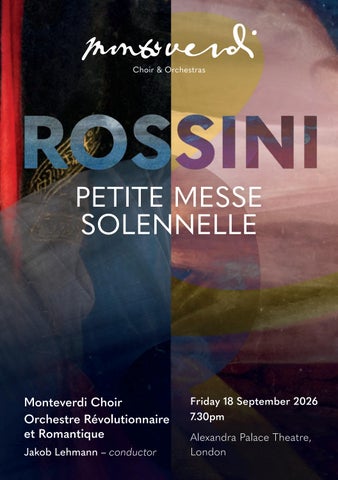
PETITE MESSE SOLENNELLE
Monteverdi Choir Orchestre Révolutionnaire et Romantique Jakob Lehmann – conductor
Friday 18 September 2026 7.30pm Alexandra Palace Theatre, London
SIGN UP FOR OUR NEWSLETTER What’s On | News | Reviews | Media Scan the QR code or visit: www.monteverdi.co.uk/pages/newsletter
ROSSINI PETITE MESSE SOLENNELLE Scan to listen on Spotify
This evening’s performance is being audio recorded for a future album release.
Monteverdi Choir & Orchestras presents
ROSSINI PETITE MESSE SOLENNELLE Kyrie Gloria Credo Prélude religieux Ritournelle Sanctus O salutaris Hostia Agnus Dei
Monteverdi Choir Orchestre Révolutionnaire et Romantique Jakob Lehmann – conductor Robyn Allegra Parton – soprano Natalie Lewis – mezzo-soprano Petr Nekoranec – tenor Bogdan Talos – bass With generous support from Garfield Weston Foundation and William Lock All information in this programme was correct at the time of going to print.
WELCOME from the MCO Team
Welcome to the magnificent Alexandra Palace Theatre, and to the first concert of the Monteverdi Choir & Orchestras’ 2026/27 season. There could hardly be a more appropriate London venue in which to continue our groundbreaking exploration of Rossini on period instruments. The Petite messe solennelle – in the orchestral version you will hear tonight – was premiered at the Salle Ventadour theatre in Paris, home to the Théâtre-Italien, in 1869; just six years later Alexandra Palace Theatre in London first opened its doors. The English Baroque Soloists were one of the first orchestras to play here after the restored Victorian theatre reopened in 2018, performing Handel’s Semele with the Monteverdi Choir. Now it is the turn of the Orchestre Révolutionnaire et Romantique, and the music of Rossini. The composer joked about the ambiguity of the Petite messe solennelle in his inscription at the end of the score: “Good Lord, is this sacred music or opera to a religious text?” The Monteverdi Choir’s versatility, from 17th-century sacred music to 19th-century opera, makes it the ideal vehicle for this choral showpiece, while the Orchestre Révolutionnaire et Romantique will draw on its deep experience of French Romantic repertoire to recreate the sound world of Rossini’s Paris. Following his performance of the Stabat Mater and scenes from Ermione last year, we are delighted to welcome back Rossini specialist Jakob Lehmann, and a cast of exceptional soloists, including former Monteverdi Apprentice Robyn Allegra Parton. Together, these musicians and this stunning heritage location will illuminate as never before a work poised between devotion and drama, liturgy and theatre.
FROM THE CONDUCTOR Jakob Lehmann I am very happy to present Rossini’s Petite messe solennelle in a historically informed way. Beyond the period instruments themselves, which open up a new world of sounds, colours, and shapes, how this music is played is of equal, if not greater, importance. Any truly historically informed interpretation must not only follow the ‘Urtext’—here the critical edition published by the Fondazione Rossini—but also read between its lines, drawing on research into performance practice: treatises, manuscript annotations, and other contemporary sources, as well as early recordings that often provide a link to much older traditions. Our rhetoric-driven, drama-oriented approach therefore introduces nuances beyond what is prescribed in the score, but which in Rossini’s time would have been expected: from the agogic freedom of a melody against its accompaniment to broader tempo flexibility, such as holding back in lyrical or emotive moments, and moving forward in dramatic or lively passages. Following 19th-century models, we use more double basses than cellos or violas, but unlike in our programme last year, we employ four-string basses— still a novelty in Italian and French orchestras when Rossini orchestrated the Mass, but specifically requested by him here. Our singers approach this music without shying away from its oftencriticised ‘operatic’ character. Rather than contradicting the religious content, this theatricality is intrinsic to Rossini’s musical language: his writing makes no emotional distinction between opera house and church; what matters solely is honesty of expression. Nor is there evidence of a different singing style or technique for operatic and sacred music in his time. Particularly inspiring in this context are the early 20th-century recordings of the Sistine Chapel Choir, and of its ‘last castrato’, Alessandro Moreschi. In one respect, our historically informed approach meets modern technology: Rossini’s orchestration includes a substantial organ part. Finding a suitable historical instrument for Alexandra Palace Theatre would have been impossible, so we use Hauptwerk software to create an ‘idealised’ solution: bringing the sound of a late-19th-century French church organ into this space for the first time!
PROGRAMME NOTES By Andrew Benjamin Walton Dr Frampton
Gioachino Rossini’s Petite messe solennelle, his final major work before his death in 1868, is famously neither solemn nor petite. The pedantic response to this would be to say that it’s a missa solemnis because it’s sung, not spoken; and that it’s small because the voices were originally accompanied not by full orchestra, as we hear tonight, but instead by the unusual combination of two pianos and harmonium. But for a work that clocks in at more or less the same length as Beethoven’s epic Missa Solemnis, it’s hard not to feel that such an explanation rather misses the point; not least when one of Rossini’s own epigraphs for the piece also plays on the scale of the work: Dear God, here it is finished, this poor little Mass. Is this sacred music which I have written or music of the devil? I was born for opera buffa, as you well know. A little science, a little heart, that’s all. Be blessed, then, and grant me Paradise. So even if the title is not strictly a joke, Rossini could still joke about the title. And his words reveal more about both composer and work than might at first appear. Behind the self-deprecating wit stands the complicated image of the aging Italian composer as he entered his eighth decade, after fifty years as a musical celebrity. It had been in 1813 that his opera Tancredi had catapulted him to success across Italy; with the
works that followed he would become famous throughout Europe, and soon enough could lay claim to being the first global operatic phenomenon, performed from Rio de Janeiro to Calcutta. Meanwhile, his string of operatic hits continued until 1829, the year his monumental grand opera Guillaume Tell appeared at the Paris Opéra. And then, nothing: Rossini’s turn away from operatic composition led to one of the longest retirements in musical history. As a result, he failed to fulfil either of the cherished archetypes of romantic musical biography: neither dying tragically young, like Schubert, nor apparently showing any interest in developing a profound and esoteric ‘late style’, like Beethoven. Instead, he moved from Paris to Italy in the 1830s in search of peace and seclusion, and then back to the French capital in 1855, where he saw out his days as a semidetached host at the exclusive weekly salon run by his second wife, Olympe, and otherwise living a quietly eccentric existence split between his apartment along the road near the Italian opera house and his country residence (its flowerbeds planted in the shapes of musical instruments) on the outskirts of Paris in Passy. Meanwhile, for the salon, and for his own amusement, in these last years he turned to writing piano pieces, chamber music and songs, which he collectively termed his
expectations after so many years, he packaged it instead as a trifle: ‘the last sin of my old age’, as he wrote on the manuscript score.
Photograph of Gioachino Rossini taken in 1865 by Étienne Carjat (1828-1906). (Harvard Art Museum)
‘Péchés de vieillesse’ (‘Sins of Old Age’), whose titles (such as ‘Castor oil waltz’, or ‘Whew! The Peas!’) and oblique relationships to contemporary musical styles seem to foreshadow the early 20th-century world of Erik Satie. Rossini’s embrace of his status as a sort of living relic in these final years can be seen clearly enough in his description of himself in relation to the Mass as ‘born for opera buffa’: a reference to the continued fame of works such as Il barbiere di Siviglia, even as his more serious operas mostly dropped from the repertory. But this biographical background can perhaps also shed light on the hint of defensiveness lurking behind the humour in his epigraph. The Petite messe is, after all, the great testament of Rossini’s late style, his swan song; but keen not to raise
The Messe didn’t come from nowhere: as early as 1820, near the height of his operatic fame, Rossini had written a ‘Messa di Gloria’ for Naples (setting only the ‘Kyrie’ and ‘Gloria’ of the Mass text) for soloists, chorus and orchestra. Then soon after his well-publicised retirement, in 1831, he produced half of a Stabat Mater for the Archdeacon of Madrid, eventually completing it a decade later. By the early 1860s, though, rumours of a new large-scale work by the great composer were sufficiently noteworthy to circulate around Europe and across the Atlantic, where one New York journal reported in August 1863 that ‘Rossini has positively finished a grand mass with choruses’. Tellingly, though, they went on to say that at that point the composer had ‘declined to permit the execution of the work’. Strictly speaking, Rossini’s initial unwillingness to allow a full public performance of the Mass would remain intact until after his death in November 1868. The premiere of the work in its original chamber scoring, at 10pm on 14 March 1864, was a private, invitationonly affair, held at the newly-built residence in central Paris of Rossini’s good friends the Count and Countess Pillet-Will. Admittedly, the privacy of this event was relative: everything about it was on the grandest Second Empire scale. Pillet-Will was a prominent banker, and his new abode was literally palatial, easily large enough to fit an audience of around 250 members of the Parisian social and artistic aristocracy, along
with a quartet of top-notch operatic soloists, keyboard players, conductor and a small chorus recruited from the Paris Conservatoire. What’s more, alongside all the ambassadors, politicians, business titans and superstar musicians present, the audience also included enough music critics, at both dress rehearsal and concert, to ensure that the event received full coverage in the press, allowing everyone to read about the success of the performance and the glories of the new work; just not to hear it. A more or less identical performance, with the same soloists and much the same guest list, took place around a year later, in April 1865, with critics again fulsome in their praise. But there was a clear sense from many that these were seen as rehearsals for a real event still to come: an event reconceived in terms of audience, orchestration and venue. Unsuccessful attempts by Rossini in 1866 to overturn the papal ban on women singing in church (given his deep aversion to boy trebles and altos) mentioned an orchestrated version of the Mass destined for a ‘large basilica’. Meanwhile, a performance with orchestra scheduled for the Birmingham Festival in 1867 – location for the premiere of Mendelssohn’s Elijah twenty years before – came to nothing. As a result, the public history of the full, orchestrated version of the Mass (no longer at this point ‘petite’ by any definition) begins posthumously, and in a decidedly secular, operatic mode. In his memoirs, the great transatlantic impresario Maurice Strakosch recalls that when he went to pay his respects
to Rossini’s widow after the composer’s death, she told Strakosch that Rossini had explicitly wanted him to take on the full performance of the Mass. So once the mourning period was over, Strakosch visited her again, only to be informed that he could indeed have the exclusive rights to perform the work, but at the cost of 100,000 francs (several hundred thousand pounds in today’s money). He hesitated initially at such an enormous sum, but then paid up, and instantly brought Marietta Alboni – the preeminent operatic contralto of the time – out of premature retirement with an offer of another 100,000 francs for three months’ work. And so Strakosch set about organising the logistics for what might be best described as a messe solennelle roadshow, to unfold over the following months. It worked: the premiere took place on 24 February 1869 at the Théâtre Italien in Paris, location of so many of Rossini’s earlier operatic triumphs (and also of the Stabat Mater premiere in 1842) before a packed audience, earning Strakosch 26,000 francs in one go. Then, just like a successful opera, the piece was repeated multiple times there over the following month, before touring to Belgium, and then the following autumn to the Netherlands and the French provinces. At the same time, Strakosch negotiated the rights for similar tours in other countries, most notably Italy, and ultimately earned himself a clear profit of 50,000 francs. In England, the work was first performed in May 1869, at St James’s Hall (off Regent Street), and then at Covent Garden in June. Later in the summer it appeared at music festivals in Norwich
and Worcester, and by early 1870 had made it all the way along colonial networks to Sydney, Australia. Whether it was ever performed at tonight’s venue of the Alexandra Palace Theatre, opened in 1875, remains unclear; in general, though, as the fevered enthusiasm whipped up by the initial performances died away, the work quickly fell out of favour – like Verdi’s Requiem, premiered just afterwards in 1874 – perhaps because of its hybrid status as an operatic mass, or else a sort of sacred opera. Only in the later 20th-century would it be rediscovered, thanks to the recording industry, and updated critical editions. The recent preference for the chamber version, however, both in concert and on record, makes tonight’s performance particularly timely and exciting in recreating the extraordinary sound worlds that Rossini envisaged for the full orchestral version of his final major work. These can be heard in multiple ways: through the Mass’s notably wide dynamic range and colouristic palette, for example, or in its stylistic juxtapositions and kaleidoscopic modulations (see, for example, the meltingly lovely ‘Crucifixus’ for soprano solo that forms the second movement of the ‘Credo’). But in a more historical sense, the work can also be heard as a summation of Rossini’s long life, looking back to his role as the greatest operatic composer in the first half of the 19th Century, while showing the close attention he continued to pay to musical developments during his years of operatic silence. So, alongside explicit homages to some of Rossini’s musical heroes – Bach, Mozart, and even Palestrina – we hear glancing
echoes of Wagner and Liszt, not to mention foretastes of Fauré and César Franck. All are transformed into an unmistakably individual language that is by turns classically poised and richly chromatic, religiously restrained and unashamedly operatic. Or, to continue the pairing of opposites, at once solemn and joyous, large scale and intimate, as contradictory and beguiling as the composer himself, in other words, and a suitably entrancing – and enigmatic – passport to paradise. Benjamin Walton is Professor of Music History at the University of Cambridge and a Fellow of Jesus College. He has written and edited several books, including Rossini in Restoration Paris (2007), The Invention of Rossini and Beethoven (2013) and Nineteenth-Century Opera and the Scientific Imagination (2019). From 2013 to 2018 he served as editor of the Cambridge Opera Journal, and is co-editor of the forthcoming volume The Cambridge History of Italian Opera Since 1800. His current research focuses on the spread of Italian opera beyond Europe during the first half of the nineteenth century.
MCO’S 2026 ARTWORK Our 2026 artwork mirrors MCO’s mission: to bring fresh perspectives, immediacy and drama to historically informed musical performances. Applying the same principles to our visual identity, Matt Abel Smith’s designs for each concert draw on an artwork that is related, both historically and in subject matter to the repertoire, highlighting the close relationship between visual art and music.
Crucifixion by Andrea Mantegna (1431–1506)
Taking closely cropped segments of the original artworks, each design borrows colour and texture from artists working centuries ago. For Rossini’s Petite messe solennelle, the colours are taken from an altarpiece by the Italian Renaissance painter Andrea Mantegna. Painted in 1456-59 for the Basilica di San Zeno in Verona, our design focuses on a panel from the predella depicting the crucifixion in vivid hues: characters in the scene wear clothes of bright golds, pinks and blues, in stark contrast to the black robes of Mary, who has fainted at the shock and solemnity of Jesus’ plight.
Mantegna’s Crucifixion was looted by Napoleon in 1797 and placed on display in the Louvre, where it remains to this day. Rossini was a regular visitor to Paris, twice calling it home between 1824-1835 and again from 1855 (during which he composed the Petite messe solennelle). Although speculative, it’s tempting to imagine Rossini viewing Mantegna’s painting in the Louvre: we know he visited at least once, as depicted in another painting of Charles X distributing awards to artists of the 1824 Salon. There, Rossini stands in a room filled floor to ceiling with artworks, alongside the likes of fellowcomposer Cherubini and a who’s who of contemporary French artists.
TEXTS & TRANSLATIONS i. Kyrie Kyrie eleison. Christe eleison. Kyrie eleison.
Lord, have mercy upon us. Christ, have mercy upon us. Lord, have mercy upon us.
ii. Gloria Gloria in excelsis Deo. Et in terra pax hominibus bonae voluntatis. Laudamus te. Benedicimus te. Adoramus te. Glorificamus te.
Glory to God in the highest, And on earth peace to men of good will. We praise Thee. We bless Thee. We worship Thee. We glorify Thee.
Gratias agimus tibi propter magnam gloriam tuam.
We give Thee thanks for Thy great glory.
Domine Deus, Rex coelestis, Deus Pater omnipotens. Domine Fili unigenite Jesu Christe altissime, Domine Deus, Agnus Dei, Filius Patris.
O Lord God, heavenly King, God the Father Almighty. O Lord Jesus Christ, the only-begotten Son, O Lord God, Lamb of God, Son of the Father.
Qui tollis peccata mundi, miserere nobis. Qui tollis peccata mundi, suscipe deprecationem nostram. Qui sedes ad dexteram Patris, miserere nobis.
Thou that takest away the sins of the world, have mercy upon us. Thou that takest away the sins of the world, receive our prayer. Thou that sittest at the right hand of the Father, have mercy upon us.
Quoniam tu solus Sanctus. Tu solus Dominus. Tu solus altissimus, Iesu Christe. Cum Sancto Spiritu, in gloria Dei Patris. Amen.
For Thou only art holy. Thou only art the Lord. Thou only art most high, Jesus Christ. With the Holy Spirit, in the glory of God the Father. Amen.
iii. Credo Credo in unum Deum, Patrem omnipotentem, factorem coeli et terrae, visibilium omnium et invisibilium. Et in unum Dominum Jesum Christum, Filium Dei unigenitum, et ex Patre natum ante omnia secula. Deum de Deo, Lumen de lumine, Deum verum de Deo vero, genitum non factum consubstantialem Patri, per quem omnia facta sunt. Qui propter nos homines et propter nostram salutem, descendit de coelis, et incarnatus est de Spiritu Sancto ex Maria Virgine, Et homo factus est.
I believe in one God, the Father Almighty, maker of heaven and earth, and of all things visible and invisible. And in one Lord Jesus Christ, the only-begotten Son of God, born of the Father before all worlds. God of God, Light of light, Very God of true God. Begotten, not made, being of one substance with the Father, by whom all things were made. Who for us men, and for our salvation came down from heaven, by the Holy Spirit of the Virgin Mary, And was made man.
Crucifixus etiam pro nobis sub Pontio Pilato, passus et sepultus est.
And was crucified also for us under Pontius Pilate, he suffered and was buried.
Et resurrexit tertia die, secundum Scripturas. Et ascendit in caelum: sedet ad dexteram Patris. Et iterum venturus est cum gloria, judicare vivos et mortuos: cujus regni non erit finis. Et in Spiritum Sanctum Dominum et vivificantem: qui ex Patre Filioque procedit. Qui cum Patre et Filio simul adoratur, et conglorificatur: qui locutus est per prophetas. Et unam sanctam catholicam et apostolicam ecclesiam. Confiteor unum baptisma in remissionem peccatorum. Et expecto resurrectionem mortuorum, Et vitam venturi saeculi. Amen.
And the third day he rose again according to the Scriptures. And ascended into heaven: and sitteth on the right hand of the Father. And He shall come again with glory, to judge both the quick and the dead: Whose kingdom shall have no end. And in the Holy Spirit, Lord and giver of life: who proceedeth from the Father and Son, who, with the Father and the Son is worshipped and glorified: who spoke by the prophets. And in one, holy, catholic and apostolic church. I acknowledge one baptism for the remission of sins. And I look for the resurrection of the dead. And the life of the world to come. Amen.
iv. Prélude religieux v. Ritournelle vi. Sanctus Sanctus, sanctus, sanctus Dominus Deus Sabaoth. Pleni sunt caeli et terra gloria tua. Hosanna in excelsis. Benedictus qui venit in nomine Domini. Hosanna in excelsis.
Holy, Holy, Holy Lord God Sabaoth. Heaven and earth are full of thy glory. Hosannah in the highest. Blessed is he who cometh in the name of the Lord. Hosanna in the highest.
vii. O salutaris Hostia O salutaris Hostia, Quae caeli pandis ostium, Bella premunt hostilia, Da robur, fer auxilium. Amen
O saving victim, Who opens the gates of heaven, Our foes afflict us with war, Give us strength, bring us help. Amen.
viii. Agnus Dei Agnus Dei, qui tollis peccata mundi, miserere nobis. Agnus Dei, qui tollis peccata mundi, dona nobis pacem.
O Lamb of God, that takest away The sins of the world, have mercy on us. O Lamb of God, that takest away The sins of the world, grant us peace.
NURTURE THE NEXT GENERATION
Support the next cohort of Monteverdi Apprentices, and provide a step change for emerging professional musicians, turbocharging their creative development. To learn more and support, please contact Will Handysides, Head of Development: will@monteverdi.org.uk Scan the QR code or visit monteverdi.co.uk/education/apprentices-programme
MONTEVERDI CHOIR For over 60 years, the Monteverdi Choir has been recognised as one of the greatest and most influential choirs in the world. Heras-Casado. A longstanding project exploring concert stagings of Handel oratorios will continue with Christophe Rousset conducting Theodora on a tour of South America and Europe in November 2026. In 2025 the choir opened the Edinburgh International The recipient of numerous awards, the Festival with a staged performance of Monteverdi Choir was named ‘Best Choir’ John Tavener’s The Veil of the Temple, at the 2024 Oper! Awards, with the jury conducted by Sofi Jeannin. noting that: ‘At festivals, on concert tours With over 150 recordings to its name, and in their numerous recordings, this is the choir continues to build its an ensemble whose quality will always international recording legacy. In June leave the listener speechless.’ 2026, the Monteverdi Choir & Orchestras The music of J.S. Bach is central to the announced a new long-term partnership choir’s repertoire, and in 2026 the choir with the French record label harmonia has toured the St John Passion with mundi, launching with three recordings Peter Whelan, and Mass in B minor with that showcase the ensemble’s ongoing Laurence Equilbey. Masaaki Suzuki made artistic collaborations with leading his debut in 2025 with Bach’s cantatas for conductors. In September 2025, the the year 1725, and will return to conduct choir released an album of Charpentier: a major US tour of the St Matthew Baroque Christmas on its own record Passion in February 2027 culminating label, Soli Deo Gloria. The album was in a performance at Carnegie Hall. recently selected as the benchmark recording of Charpentier’s Messe de The choir is renowned for its concert Minuit pour Noël by France Musique. stagings of operas. In 2026 these have included Purcell’s Dido & Aeneas Founded in 1964 by Sir John Eliot conducted by Jonathan Sells in a staging Gardiner, the choir performed at the beneath Cutty Sark in Greenwich, and Coronation of HM The King in 2023, Weber’s Oberon at the BBC Proms with the Telegraph proclaiming: ‘if the conducted by Sir Mark Elder. In 2027 Monteverdi Choir isn’t singing when they will perform Beethoven’s Fidelio in I get to the gates of Heaven, I want a European tour conducted by Pablo my money back.’ Through a combination of consummate technique and historically informed performance practice, the choir constantly strives to bring fresh perspectives, immediacy and drama to its performances.
MONTEVERDI CHOIR 18 September 2026 Chorus Master: Sam Evans
Soprano
Alto
Tenor
Bass
Rachel Allen
Francesca Biliotti
John Bowen
Henry Brearley*
Milly Atkinson
Luthien Brackett
Marcus Burton*
Robert Davies
Lydia Baldwin*
Rosemary Clifford
Joseph Doody
Peter Edge
Alice Beverley*
Christie Cook
Jonathan Hanley
Sam Evans
Christine Buras
Sarah Denbee
Thomas Herford
Dominic Felts*
Katherine Gregory
Lara Harvey
Samuel Jenkins
William Gaunt
Lucy Knight
Toluwani Idowu*
James Robinson
Johnny Herford
Charlotte La Thrope Lorna Price
Gareth Treseder
Jack Lawrence-Jones
Helena Moore
Rachael Simone*
Will Wright
Timothy Murphy
Emily Owen
Margarita Slepakova
Christopher Webb
Cressida Sharp Claire Ward
* 2026/27 Apprentices
ORCHESTRE RÉVOLUTIONNAIRE ET ROMANTIQUE The Orchestre Révolutionnaire et Romantique (ORR) specialises in the music of the 19th and early-20th centuries. It has won plaudits for its stylistic fidelity and intensity of expression in works by major early Romantic composers, from Berlioz to Beethoven, as well as later works by composers ranging from Verdi to Debussy. The ORR performs with some of the world’s leading conductors specialising in historically informed performance. In August 2026 Sir Mark Elder made his debut with the Orchestra, performing Weber’s rarely heard opera Oberon in its 200th anniversary as part of the BBC Proms. This followed the 2025 debut of Pablo Heras-Casado, who conducted performances of Schubert’s Fifth Symphony and Mozart’s Requiem in London and Italy; he will return in 2027 for a European tour of the ORR’s first ever performances of Beethoven’s Fidelio in the composer’s anniversary year, before turning to the work of Schubert in 2028 on the concert platform and on record as part of MCO’s partnership with harmonia mundi. The ORR’s ground-breaking exploration of Rossini on period instruments – starting in October 2025 with the Stabat Mater and scenes from Ermione – is the latest in the orchestra’s series of ambitious composer explorations. Other landmark projects have included recording the complete symphonies of Schumann and Brahms. In the summer of 2023, the Orchestra
performed Berlioz’s Les Troyens on a critically acclaimed European tour, conducted by Dinis Sousa, having given the first complete staged performances in Paris in 2003. In 2019 they marked the 150th anniversary of the composer’s death with the first contemporary performances of his opera Benvenuto Cellini on period instruments. The ORR has performed operas by composers including Weber (Oberon and Le Freyschütz), Bizet (Carmen), Chabrier (L’Étoile), Verdi (Falstaff) and Debussy (Pelléas et Mélisande) in new productions in France, Italy and London. In May 2024 the ORR, conducted by Dinis Sousa, performed Beethoven’s complete symphonies at St Martin-inthe-Fields in London and a selection of his symphonies at the Philharmonie de Paris. The ORR’s recordings of Beethoven’s symphonies have been described as a ‘tour de force…played at white heat’, ‘glorious’ and ‘magnificent’ by Gramophone magazine.
ORCHESTRE RÉVOLUTIONNAIRE ET ROMANTIQUE 18 September 2026
Violin I Peter Hanson May Kunstovny Miranda Playfair Bradley Creswick Clare Hoffman Catherine van de Geest Marcus BarchamStevens Kyra Humphreys Judith Templeman Davina Clarke Naomi Burrell Rachel Rowntree
Viola Oliver Wilson Lisa Cochrane Catherine Musker Joe Ichinose George White Samantha Hutchins
Violin II Lucy Jeal Jayne Spencer Beatrice Philips Iona Davies Bérénice Lavigne Beatrice Scaldini Will Harvey Lucy Waterhouse Will McGahon Archie Freeman
Double Bass Peter Ferretti Cecelia Bruggemeyer Elizabeth Bradley Carina Cosgrave Jean Ané Rosie Moon Kate Brooke
Cello Catherine Rimer Ruth Alford Lucile Perrin Penny Driver Daisy Vatalaro Eglantine Latil
Flute Elizabeth Walker Rosie Bowker
Trumpet David Blackadder Phillip Bainbridge
Piccolo Eva Caballero
Cornet Robert Vanryne Matthew Wells
Oboe Rachel Chaplin Mark Baigent Clarinet Timothy Lines Fiona Mitchell
Trombone Matthew Lewis Miguel Tantos Sevillano Josh Cirtina
Bassoon Catriona McDermid Philip Turbett Sally Jackson
Ophicleide Marc Girardot
Horn Ursula Paludan Monberg Joseph Walters Christopher Price Martin Lawrence
Harp Alison Martin Stephanie Beck
Timpani Adrian Bending
Organ William Whitehead
JAKOB LEHMANN Conductor
Jakob Lehmann is quickly establishing himself as a highly sought-after conductor, energetically merging historically informed performance styles and fundamental stylistic research with emotionally sincere and engaging performances on period as well as modern instruments, both in the symphonic and operatic world. Following his debut at the 2026 BBC Proms conducting Berlioz’ La damnation de Faust with Les Siècles, highlights in his 2026/27 season include debuts with SWR Symphonieorchester, WDR Sinfonieorchester, Münchner Rundfunkorchester, Orchestre Philharmonique de Strasbourg, Wuppertaler Sinfonieorchester, Musikkollegium Winterthur, and Tafelmusik Baroque Orchestra as well as opera productions at Volksoper Wien and Oper Wuppertal. Amongst his recurring collaborations are his long-term exploration of Rossini’s music on period instruments together with the Monteverdi Choir and Orchestras and concerts with Les Siècles, Orchestra of the 18th Century, and La Banda storica Bern, as well as teaching engagements at the Juilliard School New York and Mozarteum Salzburg. Recent highlights have included collaborations with Scottish Chamber Orchestra, Bruckner Orchester Linz, Orchestre Philharmonique de Marseille, Wiener Symphoniker, Symfonieorkest Vlaanderen, Beethoven Orchester
Bonn, as well as opera productions at Théâtre des Champs-Elysées, Opéra de Rennes, Angers-Nantes Opéra, and North Carolina Opera. Being held in high regard amongst period instrument orchestras for his expertise in the historically informed performance styles of Classical and Romantic repertoire, he regularly works with high-profile groups such as Les Siècles, Monteverdi Choir and Orchestras, and Anima Eterna Brugge and recently has been named Artistic Partner of the Orchestra of the 18th Century. As a specialist for the music of Rossini, Donizetti, Bellini, and the entire Belcanto period, he has contributed greatly to the exploration and research into the historically informed performance practice of this style. From 2019 till 2025 he served as Associate Artistic Director of New York based opera company Teatro Nuovo, and is presently serving as the company’s Artistic Advisor. Jakob’s discography encompasses a wide range of repertoire on various labels, including his 2024 recording of Rossini’s L’italiana in Algeri with Eroica Berlin on Pan Classics, which was praised for its “astonishing approach“, and “relentless enthusiasm“. Forthcoming titles include Rossini’s Stabat Mater and Petite messe solennelle (with Monteverdi Choir & Orchestras), and operatic excerpts by Wagner, all on harmonia mundi.
© Caroline Doutre
© Zack Rioux
© Victoria Cadisch
ROBYN ALLEGRA PARTON soprano
NATALIE LEWIS
British soprano Robyn Allegra Parton studied at the University of Oxford and Royal College of Music. Her repertory includes Gilda Rigoletto (Royal Ballet and Opera, English National Opera, Theater Münster), Violetta La traviata (Theater Münster, Theater für Niedersachsen), the title role in Lucia di Lammermoor (IF Opera), Adina L’Elisir d’Amore, Micaëla Carmen, Musetta La bohème and Tytania A Midsummer Night’s Dream (Theater Münster) and Helmwige Die Walküre (Teatro di San Carlo, Naples). As a concert artist Robyn has performed with ensembles including the Leipzig Gewandhaus, Gustav Mahler Chamber Orchestra, London Philharmonic, Royal Philharmonic, Orchestra of the Age of Enlightenment, English Baroque Soloists, Scottish Chamber Orchestra, Luxembourg Philharmonic and the Royal Oman Symphony Orchestra. Robyn’s debut solo album of late Romantic Viennese songs: Burnished Gold, recorded with pianist Simon Lepper for Orchid Classics, debuted in the Top 10 of the UK Official Specialist Classical Chart in June 2023.
American mezzo-soprano Natalie Lewis is quickly emerging as one of the brightest young talents on the global operatic scene. Now in her second season as a member of the Bayerische Staatsoper Ensemble, she has appeared there in such roles as Erda in Das Rheingold under General Music Director Vladimir Jurowski, Emilia in Otello, Mary in Der fliegende Holländer, and as La Voce in a new production of Der Mond by Carl Orff. During the 26-27 season, Ms. Lewis will appear with Zubin Mehta and Orchestra del Maggio Musicale Fiorentino and with Domingo Hindoyan and Royal Liverpool Philharmonic Orchestra in performances of Mahler’s 2nd Symphony, with Edward Gardner and the London Philharmonic Orchestra as The Angel in Elgar’s The Dream of Gerontius, with Kerri-Lynn Wilson and the Ukrainian Freedom Orchestra in performances of the Verdi Requiem, with Oksana Lyniv as Birgitte in concert performances of Korngold’s Die tote Stadt with the Radio Filharmonische Orkest at the Amsterdam Concertgebouw, and with Nicholas Collon and the Aurora Orchestra as a part of BBC Proms singing Mahler’s Lieder eines fahrenden Gesellen. On the operatic stage, Ms. Lewis will make her debut at the Salzburger Osterfestspiele as Waltraute in the new Ring Cycle. She will also appear on her home stage as Maffio Orsini in Lucrezia Borgia, Pasqualita in a newly staged production of Doctor Atomic, and Suzuki in Madame Butterfly.
mezzo-soprano
© Andreas_Endermann
© Lukas Kimlicka
PETR NEKORANEC
BOGDAN TALOS
Tenor Petr Nekoranec is one of the most outstanding talents of the young Czech singing generation. His recent international engagements include Faust in Berlioz’s La Damnation de Faust at Théâtre des Champs-Élysées in Paris while in the 2025/26 season, he appeared at Nantes Opera House and Theater an der Wien, and will make concert performances with major European orchestras. In 2024/25, he debuted at the Polish National Opera, State Opera Berlin, and Queensland Opera, Brisbane, and appeared at Teatro Real Madrid, Lille, Lyon, and with Los Angeles Philharmonic. Since 2021/22, he has been a soloist at the National Theatre Prague, performing many roles including Rodolfo, Almaviva, Tamino, Ferrando, Roméo, Don Ottavio, and Nemorino. He has collaborated with leading orchestras and conductors, including Jiří Bělohlávek, James Levine, Oxana Lyniv, and Marco Armiliato. Nekoranec was the first Czech selected for the Lindemann Program at the Metropolitan Opera (2016), was also a member of the Bavarian State Opera studio where he won the Bavarian Art Prize in 2016, and received the Classic Prague Awards Talent of the Year (2018). He is a laureate of major European competitions, including the absolute winner of the Francesco Viñas International Competition (2017). He studied at Pardubice Conservatory with Jarmila Chaloupková, and collaborates with tenor Antonio Carangelo. His discography includes French Arias (2019) and Janáček’s The Diary of One Who Disappeared (2025).
Bogdan Talos has established himself as one of the leading basses of his generation since his Metropolitan Opera debut in 2025, admired for his refined voice, musical intelligence, and commanding stage presence. In the 2025/26 season, he opens the season at Dutch National Opera Amsterdam as Lorenzo in a new production of Bellini’s I Capuleti e i Montecchi. He also appears at the Komische Oper Berlin as Gremin in Tchaikovsky’s Eugene Onegin (directed by Barrie Kosky) and at Deutsche Oper am Rhein as Le Roi Soliman in Gounod’s La Reine de Saba and Ferrando in Verdi’s Il trovatore. Born in Romania, Talos studied at the Gheorghe Dima Music Academy in Cluj-Napoca and won numerous international awards early in his career. Following his debut as Don Pasquale in 2010, he appeared at major houses throughout Europe and became a member of the Komische Oper Berlin Opera Studio. Recent highlights include debuts at the Metropolitan Opera and San Francisco Opera as Colline in La bohème, Leporello at the Opéra de Paris, Bluebeard in Bartók’s Bluebeard’s Castle in Düsseldorf, and Figaro in Le nozze di Figaro at Hamburg State Opera. His concert repertoire includes major works such as Verdi’s, Mozart’s and Brahms’s Requiems and Beethoven’s 9th Symphony.
tenor
bass
MONTEVERDI APPRENTICES PROGRAMME The Monteverdi Apprentices Programme was established in 2007 as the first of its kind in the UK. It remains a pre-eminent training scheme for young musicians, seeking to bridge the gap between higher education and the professional music world. The programme now has over 100 alumni, and several former Apprentices still perform regularly with MCO. By crafting a supportive learning environment for talented young artists, providing rewarding performance opportunities, and offering coaching and tuition from experts in a range of fields, the scheme is designed to nurture the next generation of musical talent. MCO aims to address some of the myriad challenges faced by emerging classical musicians by embedding Apprentices within our ensembles, equipping them with the skills, training and experience required to kick-start a sustained freelance career. Monteverdi Apprentices are given the opportunity to perform with our world-class ensembles, integrating into the Monteverdi Choir and Orchestras for concerts in the UK and across Europe. This allows them to gain unrivalled firsthand experience of the working practices of an internationally renowned organisation in a safe and supportive environment. Apprentices also take part in a range of workshops and masterclasses with a focus on historically informed
performance practice, led by prominent artists and experts from across the classical music industry such as Sophie Daneman, Elizabeth Kenny, Matteo Dalle Fratte, Alessandro Fisher, Jean-Paul Fouchécourt, and MCO Choir Director Jonathan Sells. We are extremely proud to have internationally acclaimed soloists Dame Sarah Connolly and Mark Padmore as Ambassadors for the Monteverdi Apprentices Programme. Both Sarah and Mark have a long association with MCO, and both share our deep commitment to nurturing the next generation of vocal talent. Each brings a wealth of experience, a passion for ensemble singing, and a profound understanding of vocal artistry, stylistic versatility and the demands of a modern singing career. MONTEVERDI APPRENTICES 2026/27 The 2026/27 Apprentices are performing with the Monteverdi Choir for the first time in tonight’s concert. This marks the start of their time taking part in
The 2026/27 Apprentices rehearsing during their residency at Ripon College Cuddesdon
several upcoming MCO projects, including Handel’s Theodora with Christophe Rousset; Gabrieli, Schütz and Monteverdi with Francesco Corti; and Bach’s St Matthew Passion with Masaaki Suzuki. The new cohort began working together earlier this month during a weekend at Ripon College Cuddesdon in Oxfordshire, where they worked on a wide range of repertoire from Italian madrigals and German part-songs to Bach recitative and English song. They were joined by Apprentice Ambassadors Dame Sarah Connolly and Mark Padmore, MCO Choir Director Jonathan Sells, Italian coach Alessandro Fisher, and mentors from the Monteverdi Choir. Last week, the Apprentices took part
in a masterclass on Italian song, led by tonight’s conductor Jakob Lehmann, and language coach Alessandro Fisher. Several other masterclasses and workshops will take place over the coming months, led by the Apprentice Ambassadors and other artists including lutenist Elizabeth Kenny and stage director Thomas Guthrie. More information about each of the seven Apprentices in the current cohort can be found in the ‘Education’ section of our website (monteverdi.co.uk). The Monteverdi Apprentices Programme is generously supported by Garrick Charitable Trust, Golsoncott Foundation and Rainbow Dickinson Trust
SUPPORT THE MONTEVERDI ENSEMBLES MAKE THE EXTRAORDINARY HAPPEN
© Jude Lacey
The Monteverdi family extends well beyond our trio of acclaimed ensembles. From our international audiences, our dedicated Members and supporters, to the Board of Trustees and the MCO team: everybody makes a vital contribution towards our mission of shedding new light on the great works of classical music and sharing astonishing musicianship with the world. We rely on the generosity of individuals, trusts and foundations, and corporate partners to make the extraordinary happen. There are many ways to support us and become more closely involved in our world. We hope in these pages you will find the perfect way to join our family.
To learn more, please contact Head of Development Will Handysides will@monteverdi.org.uk 07984 570 627
MEMBERSHIPS Members get exclusive access to a personalised booking service for all our concerts, invitations to special events, and they are the first to hear our news through regular newsletters. We have four levels of membership, renewable each year, with additional benefits included for higher level members: Platinum Gold Silver Bronze
from £5,000 from £3,000 from £1,000 from £250
To join now, and for more information, visit the website, or you can get in touch: monteverdi.co.uk/support-us development@monteverdi.org.uk PHILANTHROPIC SUPPORT We warmly invite you to become more closely involved with the work and people of the Monteverdi Choir and Orchestras. The vital contributions of our philanthropic supporters, including our Benefactors, allow us to share astonishing musicianship globally, and ensure our legacy endures. In gratitude, we are delighted to offer those who support us as major donors a very close relationship with MCO and the incredible people who make up our ensembles and perform with us. From period instrumentalists to sublime vocalists, from our Apprentices to our roster of leading conductors – there are countless captivating stories to be told and remarkable journeys to witness. Philanthropists can enjoy a bespoke, one-
to-one involvement with MCO, tailored to their interests and schedule, as well as receiving invitations to our special events. CORPORATE PARTNERSHIPS The Monteverdi Choir and Orchestras has a global reputation for producing the extraordinary. We foster a collaborative culture of rigorous musical examination and unbridled virtuosity, resulting in spine-tingling, electrifying sell-out performances. Our award-winning recordings are upheld as the definitive versions of hundreds of musical masterpieces. We want to create unique partnerships with brands, that deliver on your objectives with a strong ROI, with engaging content, virtuosic concert experiences and opportunities to sponsor pioneering projects. LEAVE A LEGACY By choosing to leave a Legacy Gift to the Monteverdi Choir & Orchestras, you will play a crucial role in ensuring that the performers and listeners of the future will continue to be enthralled by the power of our music-making. AMERICAN FRIENDS Our American Friends play a valuable part in supporting and championing the work of the Monteverdi ensembles both in the US and beyond. The American Friends of the Monteverdi Choir & Orchestras, Inc is a registered 501(c)(3) organisation and donations to it are tax-deductible for US taxpayers to the extent allowed by law. EIN:31-1651106.
MONTEVERDI SUPPORTERS PATRON
HM The King
MEMBERS PLATINUM
Julia & Martin Albrecht
Lord & Lady Burns
Peter & Stephanie Chapman
PRESIDENT
Ian Currie
Dame Carol Grigor DBE
Sir Vernon Ellis The Isola/Little Family
PRINCIPAL FUNDER
SILVER
Martin Fraenkel Tony Hales CBE Lady Nixon
Dunard Fund
Jonathon Gill & Christian Grobel Lady Susan Hussey
Stefan Paetke
BENEFACTORS
William Lock
Carlos & Francesca Pinto
Sebastian & Flora Lyon
Professor Richard Portes CBE FBA
Michael & Fiona Beverley David & Sandra Brierwood
Francis Norton
Mollie Norwich
Sabine & Norbert Reis
Christian & Myrto Rochat
Helen & John Skinner
Sir David Walker & Lady Harding
GOLD
Ina De & James Spicer
David & Claudia Harding Foundation
Sarah & Mike Cuthbert
Caz Weller Knight
Nicholas Eldred
Garfield Weston Foundation
Sir Stephen Gomersall
BRONZE
Gordon Gullan
Geoffrey Barnett
Stephen & Victoria Swift
Donald D. Campbell
Bankim Thanki KC
Vanessa Claypole
Isabella de Sabata
Lady Virginia Fraser Nigel Gibson Jenny Hill Mark & Sophie Lewisohn Robert Moreland Mary Pinnell Daan Posthuma Anne Reyersbach
The Monteverdi Choir & Orchestras gratefully acknowledges the generous support of the following individuals, organisations and Trusts & Foundations
CORPORATE PARTNERS
LEGACIES
Morgan Stanley
The Estate of Prof. Andrew Dunlop Roberts
TRUSTS & FOUNDATIONS
The Estate of Donald Gorman
Dunard Fund
The Estate of Howard Hodgkin
Mrs F B Laurence’s Charitable Trust
The Estate of Kevin Lavery
David & Claudia Harding Foundation Garfield Weston Foundation Garrick Charitable Trust Golsoncott Foundation Maria Björnson Memorial Fund
AMERICAN FRIENDS The Negaunee Foundation William Dudley Dunard Fund USA
Rainbow Dickinson Trust
Neil Graham
IN MEMORIAM
Seth Levi
Roger Chadder
Jai Shekhawat
Peter J. Chapman
Rory Walck
David Kay
Ian Hay Davison CBE Sir Henry Keswick Judith McCartin Scheide Nicholas Snowman OBE Geoffrey Taunton
With grateful thanks to all those who wish to remain anonymous
MCO TEAM
MCO BOARD OF DIRECTORS
Dr Rosa Solinas General Director
James Halliday Artistic Advisor & Librarian
Christian Rochat (Chairman) Nicholas Eldred Sir Stephen Gomersall Diana Houghton Barra Little Francis Norton Caz Weller Knight
Matthew Knight Artistic Planning Manager
MCO CHAIRS CIRCLE
Martin Wheeler Finance & Administration Manager
Janet Marsden Artistic Operations Manager Katie Care Concerts & Tours Manager Will Handysides Head of Development
Michael Beverley David Brierwood Lord Burns Sir David Walker SIGN UP FOR OUR NEWSLETTER What’s On | News | Reviews | Media
Charlotte Walker Development & Events Coordinator
Sophie Southall Marketing & Communications Assistant Philip Turbett Orchestra Fixer Michael Pattison Stage Manager Premier Comms PR & media relations
Scan the QR code or visit: monteverdi.co.uk/pages/newsletter
LISTEN TO MCO Recordings | Videos | Performances | Podcasts
Scan the Spotify link to listen to the Monteverdi Choir, or buy our recordings at: shop.monteverdi.co.uk
MONTEVERDI CHOIR & ORCHESTRAS Level 12, 20 Bank Street, Canary Wharf, London E14 4AD, UK info@monteverdi.org.uk monteverdi.co.uk Registered in England & Wales Company No. 01277513 Charity No. 272279
Follow us on social media
Design: Linda Lundin, Park Studio
Orlando Jones Projects Coordinator
THEODORA
Monteverdi Choir English Baroque Soloists Christophe Rousset – conductor Thursday 19 November 2026, 7pm St Martin-in-the-Fields, London
monteverdi.co.uk/handel-theodora
MONTEVERDI, SCHÜTZ & GABRIELI Monteverdi Choir English Baroque Soloists Francesco Corti – conductor Thursday 17 December 2026, 7.30pm St Martin-in-the-Fields, London
monteverdi.co.uk/venetian-christmas
PASS ON YOUR PASSION
To learn more please contact Will Handysides, Head of Development: will@monteverdi.org.uk Scan the QR code or visit monteverdi.co.uk/support-us/leave-a-legacy
© Paul Marc Mitchell
Remember MCO in your will and help us continue to breathe new life into the great works of classical music