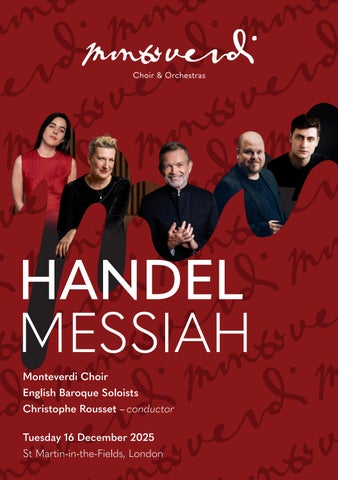
HANDEL MESSIAH Monteverdi Choir English Baroque Soloists Christophe Rousset – conductor Tuesday 16 December 2025 St Martin-in-the-Fields, London
SIGN UP FOR OUR NEWSLETTER What’s On | News | Reviews | Media Scan the QR code or visit: www.monteverdi.co.uk/pages/newsletter
HANDEL MESSIAH Wednesday 10 December 2025 Église Saint-Roch, Paris Sunday 14 December 2025 Sala Sinopoli, Santa Cecilia, Rome* Monday 15 December 2025 Teatro alla Scala, Milan Tuesday 16 December 2025** St Martin-in-the-Fields, London * Recorded for broadcast by RAI Radio 3 on 25 December at 20:30 ** Recorded for broadcast by BBC Radio 3 on 22 December at 19:30
Monteverdi Choir & Orchestras presents
HANDEL MESSIAH
Monteverdi Choir English Baroque Soloists Christophe Rousset – conductor Ana Vieira Leite – soprano Dame Sarah Connolly – mezzo-soprano Andrew Staples – tenor William Thomas – bass
All information in this programme was correct at the time of going to print.
HANDEL MESSIAH 1752 Covent Garden version PART I interval
PART II PART III
HANDEL MESSIAH Scan to listen on Spotify
WELCOME from the MCO Team
The Monteverdi Choir and English Baroque Soloists have been performing historically-informed Handel for almost 50 years, and are widely recognised as ‘unbeatable in the performance of this repertoire’ (Scherzo). However, the ensembles have not performed Handel’s best-known oratorio, Messiah, in almost three decades. Tonight, they perform the version heard at Covent Garden in 1752, with a stellar lineup of today’s leading singers matching the solo voices employed then. Following his triumphant debut in December 2024, celebrated French baroque specialist Christophe Rousset returns to bring his dramatic flair to a European tour of Handel’s festive masterpiece. From its inception, Monteverdi Choir & Orchestras have been leaders in the field of period performance – blending scholarship with compelling performance, and upending entrenched ideas and expectations. This year we have launched a series of new artistic strands led by specialist conductors to bring fresh perspectives to our repertoire and expand our musical range: Marc Minkowski with ‘thrilling’ Mozart; Masaaki Suzuki with a ‘dream date’ of Bach cantatas; Pablo Heras-Casado with Schubert of ‘blazing precision’; and Jakob Lehmann with ‘magnificent’ Rossini. Tonight’s return to Handelian roots marks the start of a new strand with Christophe Rousset – developing our long-standing exploration of Handel oratorio in staged-concert versions. After last year’s ‘joyous and immaculate festive programme’, Messiah seemed the perfect foundation for this journey of discovery, which will continue in Autumn 2026 with Theodora. Thank you for joining us at our London concerts in 2025. We wish you a merry and musical Christmas and we look forward to seeing you at our concerts in the New Year, both here at St Martin’s and around the world.
PROGRAMME NOTES Ruth SmithFrampton Dr Andrew
Familiar as Messiah is now, for its first audiences it was startlingly original. An oratorio about salvation through Jesus Christ was unprecedented in Britain, but its originator, Handel’s friend and librettist Charles Jennens, knew that it was an established type of composition on the Continent. He also knew that Handel had contributed two stellar works to that tradition, La Resurrezione (1708), in Italian, for the Catholic audience of Rome, and the Brockes Passion (c. 1716), in German, for the Lutheran audience of Hamburg. To Jennens, a devout high Anglican Protestant and a devotee of Handel’s music, it must have seemed obvious that Handel should fulfil his calling as the world’s greatest musician by vindicating Christian belief for a British Protestant audience. To Jennens the vindication of Christian belief was urgently needed. Like many committed English Christians of his time, he was concerned by the incoming tide of Enlightenment thought, powered by scientific discovery and scholarly rationalism and spawning existential fear. Faith was waning, but Protestantism was still the keystone of British identity. Full participation in public life required membership of the Church of England; the Hanoverian regime had been put in place to ensure its continuance; during British coronations the Bible was (and is) ceremonially given to the monarch as a principal guide to conduct; for most
citizens Sunday church was the major social event of their week; and most Britons, indeed most Europeans, believed that at death there would be judgment and an afterlife – in heaven or in hell. Hence, Messiah is a reminder of Christian doctrine for an audience that knew it but was in danger of doubting it. The ground plan of the text is the Protestant creed, expressing faith in redemption through Christ. It progresses through his revelation, incarnation, nativity, passion, resurrection, and ascension to our personal resurrection and individual salvation. For Handel’s audience the composition, novel though it was, had reassuringly familiar resonances, in that almost all the biblical texts in the first two parts were – and are – readings for the major festivals of the Christian year: Advent, Christmas, Good Friday, Easter day, Ascension; and most of Part 3 is taken from the all too familiar burial service. Handel’s audience would have known these texts from their childhoods. At the same time, Jennens provides the three traditional chief ‘evidences’ of Christianity: prophecies fulfilled, Christ’s miracles, and the giving and propagation of the gospel. Churchmen tried to defeat sceptics on their rationalist ground; however, Messiah transcends the flood of argument and ‘demonstration’ pouring
Portrait of Jennens by Thomas Hudson (1701-1779)
from the presses by asserting that God’s grace is a mystery: ’Behold, I tell you a mystery’. Salvation comes through faith and is freely available to all who believe. Messiah emphasises the benevolence of God and the community of believers,
rather than (as in Bach’s Passions) the suffering of Christ and the responsibility of the individual. Not only does Christ take away the sins of the whole world (so states the opening of Part 2), he has gifts even for his enemies, he brings
peace to the heathen, and ‘in Christ shall all be made alive’. For the time in which it was written, and for any time, Messiah’s version of Christianity is immensely inclusive and generous. Messiah assuages fear. Each part begins with reassurance; the first two parts with promise, the last with assurance: ‘I know’ (not just ‘I believe’) ‘that my redeemer liveth’. The overriding message of Messiah is comfort – its first word. This is surely one of the reasons why it has reached ‘unto the ends of the world’, and why views of flashmob ‘Hallelujah’ choruses on YouTube surpass 70 million.
The end of the Oratorio, signed by Handel
Handel was the most European of composers; trained in counterpoint in Germany and in the European lingua franca of opera in Italy. In Hanover and England his earliest patrons were admirers of French style (especially Lully’s), and one of his first English works was a Purcellian court ode, followed by a Te deum and Jubilate that melded the dazzle of his church music for Italy with the direct declamation of the English anthem. He kept up with musical developments throughout his working life. A French visitor in the late 1740s found scores of all Lully’s, Rameau’s and Campra’s operas on Handel’s bookshelves, and in his oratorio Jephtha, Handel borrowed
both from Masses by the German Habermann and from a wedding serenata by the Italian Galuppi.
arresting, the images enabled Handel to convey complex ideas, almost like a preacher using a homely analogy.
English oratorio, invented by Handel, combined the characteristics of Italian opera (recitative and aria) and English anthem (block and contrapuntal movement) and like his operas was usually prefaced by an overture in the form established by Lully. That is all true of Messiah, but what makes Handel’s music for Messiah universally appealing is less its melding of European baroque forms than his mastery of musical expressiveness.
The verbal text can seem opaque; it supplies no narrative, dialogue or even (bar the annunciation the shepherds) an indication of who is speaking or being addressed. Yet Messiah is loved the world over largely because Handel evokes myriad emotions and states of being – joy, pain, grief, majesty, force, tenderness, hostility, aspiration, excitement, fear, awe, confidence, limitlessness, transcendence – that are universally recognisable. Moreover, the score has a richness of lyricism and vocal texture unequalled in his oratorios. There is almost no plain (secco) recitative – a mere 41 bars – but 143 bars of accompanied recitative, and a greater number and proportion of choruses than in any of his other oratorios.
A complex, meditative, doctrinal text might seem unsuited to a gestural dramatic composer, but Messiah is a powerfully affecting work for millions of listeners, regardless of their beliefs, in part because its text perfectly served Handel’s compositional style. His method of proceeding by contrasts of mood is given scope in such transitions as the shift in perspective from Christ’s universal rule at the end of Part 2 to his care for the individual believer at the start of Part 3, or the contrast of darkness and light in Part 1, where the duplication of the dark–light image allowed Handel to show the variety of his invention. Handel could bring his dramatizing ability to the occasional miniature scenes, such as the angelic annunciation to the shepherds, or the mocking of Christ. The concrete imagery of the Old Testament gave him cues for vivid evocation: not only the unifying pastoral image, but a straight highway in the desert, sheep running away in different directions, a potter’s vessel being smashed, a refiner’s flickering fire. Suggestive and
In his operas and oratorios, Handel invites us to reflect by repeating phrases of texts with differing emphases. That is a particularly effective intensification in oratorio, where there is no staging to impose an interpretation. Messiah abounds in such detail: consider ‘He hid not His face / He hid not His face from shame and spitting’ (in ‘He was despised’), or ‘we shall be changed / we shall be changed / we shall be changed’ (in ‘The trumpet shall sound’), or ‘he shall stand / he shall stand / he shall stand’ (in ’I know that my redeemer liveth’). Much of the greatest art contains conscious reflections on art, and in Messiah that occurs most tellingly in
what for many is the nub of the work, the chorus ‘Since by man came death’. Here Handel brilliantly gives musical form to the mystery of redemption, contrasting the old dispensation of sin and death with the eternal life promised by Christ. The belief system of the old dispensation is represented in old-style church music, expressive of grief: the chorus unaccompanied, slow-moving, with long-held notes, in the minor and with dissonant chromatic harmony, suggesting souls in limbo. These elements then have their antithesis in Handel’s evocation of the vitality of the new dispensation granted to us here and now, hence in the style of his and his audience’s own time: we hear the joy of redemption in the fully accompanied, bounding, consonant, major-key allegro. (Note too Handel’s repetition of the crucial generous message: In Christ shall all, shall all be made alive.) For listeners who are at all attuned to European Baroque music, Messiah continually arrests the attention with a fundamental gambit: expectation raised and sometimes satisfied, sometimes denied, sometimes surpassed: the unexpected, when heard, seeming inevitable. A masterly stroke of such astonishment happens at the very beginning, when the overture lacks its expected third movement, stern E minor softens to E major, and before the end of a string introduction, the tenor breaks in with a single word: Comfort. Handel will have been familiar with the treatise Opposite: Portrait of Handel with a Messiah score, Painted by Thomas Hudson (1701-1779), commissioned by Jennens
on key associations by his Hamburg colleague Johann Mattheson, who wrote of E minor that ‘it usually is very pensive, profound, grieved, and sad, indeed, so much so that one even hopes at the same time for consolation’, and of E major that ‘under certain circumstances it is so piercing, severing, and penetrating that it may be compared to nothing short of a total separation of the body from the soul’. So it is no coincidence that the next full return of E major is for the contemplation of life after death, ‘I know that my redeemer liveth’. In a pleasant anticipation of the international reach of Messiah, this aria was first sung, in Ireland, by Signora Avolio (Mrs Maclaine), a German by birth, trained in Italy, and working in Britain – like Handel.
TEXT G.F. HANDEL (1685-1759): MESSIAH Text compiled by Charles Jennens (1700-1773)
PART I 1. Symphony 2. Accompagnato (Tenor) Comfort ye, comfort ye my people, saith your God. Speak ye comfortably to Jerusalem, and cry unto her, that her warfare is accomplish’d, that her iniquity is pardon’d. The voice of him that crieth in the wilderness: Prepare ye the way of the Lord, make straight in the desert a highway for our God. (Isaiah 40: 1-3)
3. Air (Tenor) Ev’ry valley shall be exalted, and ev’ry mountain and hill made low, the crooked straight, and the rough places plain. (Isaiah 40: 4)
4. Chorus And the glory of the Lord shall be revealed. And all flesh shall see it together, for the mouth of the Lord hath spoken it. (Isaiah 40: 5)
5. Accompagnato (Bass) Thus saith the Lord, the Lord of hosts: Yet once, a little while, and I will shake the heavens and the earth, the sea and the dry land. And I will shake all nations; and the desire of all nations shall come. The Lord, whom ye seek, shall suddenly come to His temple; ev’n the messenger of the Covenant, whom ye delight in; behold, He shall come, saith the Lord of Hosts. (Haggai 2: 6-7, Malachi 3: 1)
6. Air (Alto) But who may abide the day of His coming, and who shall stand when He appeareth? For He is like a refiner’s fire. (Malachi 3: 2)
7. Chorus And He shall purify the sons of Levi, that they may offer unto the Lord an offering in righteousness. (Malachi 3:3)
Recitative (Alto) Behold, a virgin shall conceive and bear a son, and shall call His name Emmanuel, “God with us”. (Isaiah 7: 14; Matthew 1: 23)
8. Air (Alto)and Chorus O thou that tellest good tidings to Zion, get thee up into the high mountain; O thou that tellest good tidings to Jerusalem, lift up thy voice with strength, lift it up, be not afraid; Say unto the cities of Judah: Behold your god! Arise, shine; for thy light is come, and the glory of the Lord is risen upon thee. (Isaiah 40: 9, 60: 1)
9. Accompagnato (Bass) For behold, darkness shall cover the earth, and gross darkness the people: but the Lord shall arise upon thee, and His glory shall be seen upon thee. And the Gentiles shall come to thy light, and kings to the brightness of thy rising. (Isaiah 60: 2-3)
10. Air (Bass) The people that walked in darkness have seen a great light. And they that dwell in
the land of the shadow of death, upon them hath the light shined. (Isaiah 9: 2)
11. Chorus For unto us a Child is born, unto us a Son is given: and the government shall be upon His shoulder: and His Name shall be called Wonderful, Counsellor, the mighty God, the Everlasting Father, the Prince of Peace! (Isaiah 9: 6)
12. Pifa (‘Pastoral symphony’) Recitative (Soprano) There were shepherds abiding in the field, keeping watch over their flocks by night. (Luke 2: 8)
13. Accompagnato (Soprano) And lo, the angel of the Lord came upon them, and the glory of the Lord shone round about them, and they were sore afraid. (Luke 2: 9)
Recitative (Soprano) And the angel said unto them, Fear not: for behold, I bring you good tidings of great joy, which shall be to all people. For unto you is born this day in the city of David a Saviour, which is Christ the Lord. (Luke 2: 10-11)
14. Accompagnato (Soprano) And suddenly there was with the angel, a multitude of the heav’nly host, praising God, and saying:
Recitative (Soprano) Then shall the eyes of the blind be open’d, and the ears of the deaf unstopped; Then shall the lame man leap as an hart, and the tongue of the dumb shall sing. (Isaiah 35: 5-6)
17. Air (Soprano) He shall feed His flock like a shepherd: and He shall gather the lambs with His arm, and carry them in His bosom, and gently lead those that are with young. Come unto Him, all ye that labour, come unto Him that are heavy laden, and He will give you rest. Take his yoke upon you, and learn of Him, for He is meek and lowly of heart, and ye shall find rest unto your souls. (Isaiah 40: 11, Matthew 11: 28-29)
18. Chorus His yoke is easy, His burthen is light. (Matthew 11: 30)
Interval PART II 19. Chorus Behold the Lamb of God, that taketh away the sin of the world. (John 1: 29)
(Luke 2: 13)
20. Air (Alto) He was despised and rejected of men, a man of sorrows, and acquainted with grief.
15. Chorus Glory to God in the highest, and peace on earth, good will towards men.
He gave His back to the smiters, and His cheeks to them that plucked off His hair, He hid not His face from shame and spitting.
(Luke 2: 14)
(Isaiah 53: 3, 50: 6)
16. Air (Soprano) Rejoice greatly, O daughter of Zion, shout, O daughter of Jerusalem, behold, thy King cometh unto thee. He is the righteous Saviour, and He shall speak peace unto the heathen.
21. Chorus Surely, He hath borne our griefs, and carried our sorrows; He was wounded for our transgressions, He was bruised for our iniquities; the chastisement of our peace was upon Him.
(Zecharaiah 9: 9-10)
(Isaiah 53: 4-5)
22. Chorus And with His stripes we are healed. (Isaiah 53: 5)
23. Chorus All we like sheep have gone astray, we have turned ev’ry one to his own way; and the Lord hath laid on Him the i niquity of us all. (Isaiah 53: 6)
24. Accompagnato (Tenor) All they that see Him, laugh Him to scorn; they shoot out their lips, and shake their heads, saying:
Lift up your heads, O ye gates, and be ye lift up, ye everlasting doors, and the King of Glory shall come in! Who is this King of Glory? The Lord of Hosts, He is the King of Glory. (Psalm 24: 7-10)
Recitative (Tenor) Unto which of the angels said He at any time: Thou art My Son, this day have I begotten Thee? (Hebrews 1: 5)
31. Chorus Let all the angels of God worship Him.
(Psalm 22: 7)
(Hebrews 1: 6)
25. Chorus He trusted in God that He would deliver Him, let Him deliver Him, if He delight in Him.
32. Air (Alto) Thou art gone up on high, Thou hast led captivity captive, and received gifts for men, yea, even from Thine enemies, that the Lord God might dwell among them.
(Psalm 22: 8)
26. Accompagnato (Tenor) Thy rebuke hath broken His heart; He is full of heaviness; He looked for some to have pity on Him, but there was no man, neither found He any to comfort him.
(Psalm 68: 18)
33. Chorus The Lord gave the word: great was the company of the preachers.
(Psalm 69: 20)
(Psalm 68: 11)
27. Arioso (Tenor) Behold, and see if there be any sorrow like unto His sorrow!
34. Air (Soprano) How beautiful are the feet of them that preach the gospel of peace, and bring glad tidings of good things.
(Lamentations 1: 12)
28. Accompagnato (Tenor) He was cut off out of the land of the living; for the transgressions of Thy people was He stricken.
(Isaiah 52: 7; Romans 10: 15)
(Isaiah 53: 8)
(Romans 10: 18; Psalm 19: 4)
29. Air (Tenor) But Thou didst not leave His soul in hell; nor didst Thou suffer Thy Holy One to see corruption.
36. Air (Bass) Why do the nations so furiously rage together: why do the people imagine a vain thing? The kings of the earth rise up, and the rulers take counsel together: against the Lord and His anointed.
(Psalm 16: 10)
30. Chorus Lift up your heads, O ye gates, and be ye lift up, ye everlasting doors, and the King of Glory shall come in! Who is this King of Glory? The Lord strong and mighty, The Lord mighty in battle.
35. Chorus Their sound is gone out into all lands, and their words unto the ends of the world.
(Psalm 2: 1-2)
37. Chorus Let us break their bonds asunder, and cast away their yokes from us. (Psalm 2: 3)
Recitative (Tenor) He that dwelleth in Heaven shall laugh them to scorn, the Lord shall have them in derision. (Psalm 2: 4)
38. Air (Tenor) Thou shalt break them with a rod of iron; thou shalt dash them in pieces like a potter’s vessel. (Psalm 2: 9)
39. Chorus Hallelujah! For the Lord God Omnipotent reigneth. The Kingdom of this world is become the kingdom of our Lord, and of His Christ; and He shall reign for ever and ever. King of Kings, and Lord of Lords. (Revelation 19:6, 11: 15, 19: 16)
Short pause PART III 40. Air (Soprano) I know that my Redeemer liveth, and that He shall stand at the latter day upon the earth. And tho’ worms destroy this body, yet in my flesh shall I see God. (Job 19: 25-26)
For now is Christ risen from the dead, the first fruits of them that sleep. (I Corinthians 15: 20)
41. Chorus Since by man came death, by man came also the resurrection of the dead. For as in Adam all die, even so in Christ shall all be made alive. (I Corinthians 15: 21-22)
42. Accompagnato (Bass) Behold, I tell you a mystery; we shall not all sleep, but we shall all be chang’d, in a moment, in the twinkling of an eye, at the last trumpet. (I Corinthians 15: 51-52)
43. Air (Bass) The trumpet shall sound, and the dead shall be raised incorruptible, and we shall be changed. For this corruptible must put on incorruption, and this mortal must put on immortality. (I Corinthians 15: 52-53)
Recitative (Alto) Then shall be brought to pass the saying that is written: “Death is swallowed up in victory.” (I Corinthians 15: 54)
44. Duet (Alto, tenor) O death, where is thy sting? O grave, where is thy victory? The sting of death is sin, and the strength of sin is the law. (I Corinthians 15: 55-56)
45. Chorus But thanks be to God, who giveth us the victory through our Lord Jesus Christ. (I Corinthians 15: 57)
46. Air (Soprano) If God be for us, who can be against us? Who shall lay anything to the charge of God’s elect? It is God that justifieth, who is he that condemneth? It is Christ that died, yea rather, that is risen again, who is at the right hand of God, who makes intercession for us. (Romans 8: 31, 33-34)
47. Chorus Worthy is the Lamb that was slain, and hath redeemed us to God by His blood, to receive power, and riches, and wisdom, and strength, and honour, and glory, and blessing. Blessing and honour, glory and power, be unto Him that sitteth upon the throne, and unto the Lamb, for ever and ever. Amen. (Revelation 5: 12-14)
MONTEVERDI CHOIR ‘ They are truly one of the finest choirs of their time.’ Bachtrack For over 60 years the Monteverdi Choir has been recognised as one of the greatest and most influential choirs in the world. Through a combination of consummate technique and historically-informed performance practice, the Choir constantly strives to bring fresh perspectives, immediacy and drama to its performances. The recipient of many awards, the Monteverdi Choir was named ‘Best Choir’ at the 2024 Oper! Awards, with the jury noting that: ‘At festivals, on concert tours and in their numerous recordings, this is an ensemble whose quality will always leave the listener speechless.’ Fresh from celebrating its 60th anniversary in 2024, the Choir’s 2025 programme expanded the range of its repertoire and conductor collaborations. This included two concerts at the Edinburgh International Festival: John Tavener’s monumental The Veil of The Temple on the opening night, conducted by Sofi Jeannin, and a programme of Purcell, Bach and Handel, conducted by Jonathan Sells (Choir Director), and streamed on DG Stage+. Other highlights of 2025 included Bach 1725 cantatas with Masaaki Suzuki, Mozart Requiem with Pablo Heras-Casado, Rossini’s Stabat Mater with Jakob Lehmann. On Good Friday 2025, the MCO’s own record label, Soli Deo Gloria,
released its first new recording since before the global pandemic – an album of Bruckner and Gesualdo motets recorded live in concert in October 2024, conducted by Jonathan Sells. This was followed in September 2025 by an album of Charpentier Christmas music conducted by Christophe Rousset, and recorded during a critically-acclaimed European tour in December 2024. In 2026 the Choir will embark on a European tour of Bach’s St John Passion, conducted by Peter Whelan, and collaborate with Laurence Equilbey’s Accentus choir for a tour of Bach’s Mass in B minor. Jonathan Sells will return to conduct an immersive production of Purcell’s Dido & Aeneas in the dry dock of Cutty Sark in Greenwich and on tour at the Bergen International Festival, directed by Andrew Staples. In the autumn Christophe Rousset will conduct Handel’s Theodora on a tour to South America, concluding with concerts in London and in the first season at the
MONTEVERDI CHOIR 16 December 2025 Choir Director: Jonathan Sells
new Sohmen Concert Hall in the Schwarzman Centre, Oxford. Founded in 1964 by Sir John Eliot Gardiner, the Monteverdi Choir has released over 150 recordings and won numerous prizes. In 2023, the Choir and English Baroque were honoured to perform at the Coronation of HM The King, with The Telegraph proclaiming ‘if the Monteverdi Choir isn’t singing when I get to the gates of Heaven, I want my money back.’
Soprano Rachel Allen Rachel Ambrose Evans Milly Atkinson† Jennifer Clark Lucy Knight Gwendolen Martin Theano Papadaki Rebecca Ramsey Cressida Sharp Áine Smith† Clementine Thompson Alto Francesca Biliotti Luthien Brackett Lowri Bufton† Annie Gill Francis Gush Rebekah Nießer-Jones Elizabeth Nurse†
† 2025/26 Apprentices
Tenor John Bowen Phil Durrant Thomas Herford Tom Kelly Sam Madden† James Micklethwaite Benedict Munden Bass Felix Kemp Will Harmer† Jonathan Howard Jack Lawrence-Jones Alistair Ollerenshaw Henry Saywell Jonty Ward
ENGLISH BAROQUE SOLOISTS ‘ Intricate and detailed throughout…it was brilliant.’ Die Presse For over 40 years, the English Baroque Soloists (EBS) has been one of the most innovative period-instrument ensembles, consistently challenging the preconceptions of audiences around the world. Equally at home in chamber, symphonic and operatic repertoire, its distinctively warm and incisive playing is instantly recognisable in music ranging from Monteverdi to Mozart. The orchestra has performed at many of the world’s most prestigious venues, including Milan’s Teatro alla Scala, the Concertgebouw in Amsterdam and the Sydney Opera House. Highlights of the orchestra’s 2025 season have included Mozart double piano concerto and symphonies with Marc Minkowksi and the Labèque sisters, Bach 1725 cantatas with Masaaki Suzuki, and ‘Sing to the Lord a new song’, a programme of Bach, Purcell and Handel touring to Aldeburgh, the Edinburgh International Festival and the recently-renovated North Wing at St Bartholomew’s Hospital in London. The year culminates with the orchestra’s first performances of Handel’s Messiah in almost three decades, touring to Paris, Rome, Milan and London, conducted by Christophe Rousset. In September 2025 MCO’s own record label, Soli Deo Gloria, released its first recording of the EBS since the pandemic – an album of Charpentier Christmas music. This was recorded in December 2024 during a European
tour conducted by Christophe Rousset, with performances described as ‘joyous and immaculate’ (The Guardian), ‘a refined festive celebration’ (The Times) and ‘an enchanting musical journey, showcasing their exceptional artistry and energy’ (Operawire). The orchestra’s 2026 season opens in March with Bach’s St John Passion conducted by Peter Whelan in Barcelona, Budapest and London. In May, Jonathan Sells returns to conduct an immersive production of Purcell’s Dido & Aeneas in the dry dock of Cutty Sark in Greenwich and on tour at the Bergen International Festival, and in June a programme exploring Haydn in London will be conducted by Peter Whelan with cello soloist Christophe Coin. In the autumn Christophe Rousset will conduct Handel’s Theodora on a tour to South America, concluding with concerts in
ENGLISH BAROQUE SOLOISTS 16 December 2025
London and in the first season at the new Sohmen Concert Hall in the Schwarzman Centre, Oxford. Founded in 1978 by Sir John Eliot Gardiner, the EBS famously took part in the iconic Bach Cantata Pilgrimage in 2000 alongside the Monteverdi Choir, performing all of Bach’s sacred cantatas throughout Europe (recorded for Soli Deo Gloria). They have participated in major opera productions alongside the Monteverdi Choir in works by Handel, Purcell and Monteverdi, and made the earliest recording of Mozart’s complete piano concertos on period instruments, as well as his greatest operas for Deutsche Grammophon.
Violin I Jane Gordon Iona Davies Gabi Jones Jayne Spencer Beatrice Scaldini
Organ/Harpsichord Paolo Zanzu
Violin II May Kunstovny Oliver Webber Naomi Burrell Sarah Bealby-Wright Will Harvey
Bassoon Philip Turbett
Viola Oliver Wilson Lisa Cochrane Oscar Holch
Timpani Robert Kendell
Cello Marco Frezzato Ruth Alford Gavin Kibble Pedro da Silva Double Bass Rosie Moon Kate Brooke
Oboe Mark Baigent Cait Walker
Trumpet Paul Sharp Michael Harrison
CHRISTOPHE ROUSSET Conductor
Founder of the ensemble Les Talens Lyriques and an internationally acclaimed harpsichordist, Christophe Rousset is a conductor and musician with a deep passion for opera and the rediscovery of Europe’s musical heritage. Trained in harpsichord at the Schola Cantorum in Paris with Huguette Dreyfus, then at the Royal Conservatory in The Hague with Bob van Asperen, he won First Prize at the Bruges International Harpsichord Competition aged 22. In 1991, he founded Les Talens Lyriques, with which he explores Baroque, Classical, and early Romantic repertoires – often focusing on rare and neglected works – and has performed for over 30 years on the world’s leading stages. In the 2025/26 season, at the helm of Les Talens Lyriques, he will conduct Traetta’s Ifigenia in Tauride, Handel’s Orlando, Lully’s Cadmus & Hermione, Mozart’s Ascanio in Alba and La Clemenza di Tito, as well as Gassmann’s L’Opera Seria. A sought-after harpsichordist and chamber musician, he records on period instruments and has produced landmark complete editions of the harpsichord works of Louis and François Couperin, Rameau, and Scarlatti, as well as the complete keyboard works of J.S. Bach. A dedicated pedagogue, he leads masterclasses and academies at the CNSMD in Paris, the Ambronay Academy, the Royaumont Foundation, the Opera
Studio in Ghent, the Accademia Chigiana in Siena, the Piccola Accademia in Montisi, and the Britten-Pears Orchestra. As a guest conductor, he has collaborated with the Gran Teatre del Liceu in Barcelona, La Scala in Milan, the Teatro di San Carlo in Naples, the Opéra Royal de Wallonie, the Royal Opera House in London, the Spanish National Orchestra, the Hong Kong Philharmonic Orchestra, the Orchestra of the Age of Enlightenment, and, more recently, the Monteverdi Choir & Orchestras, with whom he has begun a regular partnership. As a scholar and author, he has published critical editions and monographs on Rameau (2007) and François Couperin (2016, Actes Sud). His book of interviews, L’impression que l’instrument chante (2017), offers further insight into his reflections on interpretation. Among his recent recordings are J.S. Bach’s Complete Toccatas (Aparté, 2024), Portraits de François Couperin (MarchVivo, 2025), Salieri’s Cublai Can (Aparté, 2025), and Charpentier: Baroque Christmas with the Monteverdi Choir & Orchestra (Soli Deo Gloria, 2025). A Chevalier of the Légion d’Honneur, Commander of the Ordre des Arts et des Lettres, and Officer of the Ordre National du Mérite, he was awarded the prestigious Händel Prize by the Händel-Haus Foundation and the City of Halle in 2024.
© Nathanael Mergui
soprano
Portuguese soprano Ana Vieira Leite is a laureate of the 10th edition of Le Jardin des Voix, Les Arts Florissants’ academy for young baroque singers. Under the direction of William Christie, she made her debut at the Paris Opera as Créuse in Charpentier’s Médée, a role she later reprised at Teatro Real Madrid, and appeared at the Opéra Comique in Rameau’s Les Fêtes d’Hébé in a staging by Robert Carsen. With Les Arts Florissants, Ana has performed roles such as Belinda in Purcell’s Dido and Aeneas, Dalinda in Handel’s Ariodante, Eurydice in Gluck’s Orphée et Eurydice, and the title role in Handel’s Partenope on an extensive international tour. She regularly collaborates with leading period ensembles including Le Concert de la Loge, Le Concert de l’Hostel Dieu, Concerto 1700, and Divino Sospiro. Her first solo recording, Amorosi Accenti with Concerto 1700, devoted to Domenico Scarlatti’s chamber cantatas, received enthusiastic international acclaim. Highlights of the 2025/26 season include Agrippina, Orphée et Eurydice, Rinaldo, and Ercole amante. Ana is a graduate of the Haute École de Musique de Genève and winner of several international awards.
©️ Andrew Crowley
© Jean-Baptiste Millot
ANA VIEIRA LEITE
DAME SARAH CONNOLLY mezzo-soprano
Sarah Connolly was made a DBE in the 2017 Birthday Honours. In 2020 she was made an Honorary Member of the Royal Philharmonic Society in recognition of her outstanding services to music. In 2023 she was awarded The King’s Medal for Music. She has sung at the Aldeburgh, Edinburgh, Lucerne and Salzburg festivals and the BBC Proms where, in 2009, she was a soloist at the Last Night. Opera engagements have taken her around the world from the Metropolitan Opera to the Royal Opera House, the Paris Opera, La Scala Milan, the Vienna and Munich State Operas and the Bayreuth, Glyndebourne and Aix-en-Provence Festivals. Highlights in her 2025/26 season include Jocasta (Oedipus Rex) for The Norwegian Opera & Ballet and Mrs Patrick De Rocher (Dead Man Walking) for the English National Opera. On the concert platform she sings The Dream of Gerontius with the Tampere Philharmonic Orchestra/Matthew Halls and Mahler’s Symphony No. 2 with the Naples Philharmonic Orchestra/ Alexander Shelley and the Aalborg Symfoniorkester/Joshua Weilerstein. Dame Sarah is a Vocal Professor and Fellow at her alma mater the Royal College of Music, a Trustee of the Countess of Munster Musical Trust, and Ambassador for the Monteverdi Choir and Orchestras’ Apprentices Programme.
© Thomas Gimson
© Andrew Staples
ANDREW STAPLES
WILLIAM THOMAS
Andrew Staples is a renowned tenor and director whose career spans leading opera houses, major orchestras, and innovative film projects. Equally at home on stage and behind the camera, he brings a collaborative spirit and narrative depth to all his work, and bridges classical tradition with contemporary vision. Staples has performed with many of the world’s foremost conductors – including Sir Simon Rattle, Daniel Harding, Klaus Mäkelä, and Gustavo Dudamel – and with ensembles such as the Berlin Philharmonic, Vienna Philharmonic, Orchestre de Paris, Los Angeles Philharmonic, and Mahler Chamber Orchestra. He has appeared at the Royal Opera House Covent Garden, the Metropolitan Opera, Staatsoper Berlin, and the Salzburg Festival. Highlights of the 2025/26 season include Boulanger’s Faust et Hélène with the London Philharmonic Orchestra and Wiener Symphoniker, Beethoven’s Missa Solemnis with Orchestre de Paris, Schumann’s Das Paradies und die Peri with Wiener Symphoniker, and Britten’s War Requiem with both the Cleveland Orchestra and the Berlin Philharmonic. Staples’ career as a film and stage director has led to collaborations with ensembles such as Voces8 and Arcangelo. His Nocturne film with Alice Sara Ott won Audiovisual Music Production of the Year (2025) at the Opus Klassik Awards. In 2025/26, he directs Emily, a new work by Kevin Puts for Joyce DiDonato and Time for Three.
A graduate of the Opera Course at the Guildhall School of Music and Drama and recipient of a number of major awards, British bass William Thomas is fast making a name for himself as one of today’s most promising young singers. His recent operatic appearances have included roles for the Wiener Staatsoper; the Opéra national de Paris; La Scala, Milan; the Royal Ballet and Opera; the Bayerische Staatsoper and the Glyndebourne and Seiji Ozawa Matsumoto Festivals. In concert he has appeared at the BBC Proms and the Salzburg and Edinburgh Festivals. Operatic roles in his 2025/26 season include Hebrew in Samson et Dalila for the Royal Ballet and Opera; Mr Flint in Billy Budd for the Glyndebourne Festival; and Ormonte in Partenope for the English National Opera. His many concert engagements include Roméo et Juliette with the Symphonieorchester des Bayerischen Rundfunks/Robin Ticciati; L’enfance du Christ with the Orquestra de la Comunitat Valenciana/Sir Mark Elder; The Dream of Gerontius with the London Symphony Orchestra/Sir Antonio Pappano; and the Johannes-Passion with Il Pomo d’Oro/Maxim Emelyanychev.
tenor
bass
MONTEVERDI APPRENTICES PROGRAMME The Monteverdi Apprentices Programme is a training scheme for young musicians that seeks to bridge the gap between higher education and a professional, freelance music career. By crafting a supportive learning environment for talented young artists, providing rewarding performance opportunities alongside our ensembles, and exposing them to coaching from experts in a range of fields, the Monteverdi Choir and Orchestras aim to nurture the next generation of musical talent. The Apprentices take part in workshops and masterclasses with a focus on historically-informed performance practices. Previously, these have been led by industry-leading singers and vocal coaches including Jean-Paul Fouchécourt, Sophie Daneman, Matteo Dalle Fratte and Richard Stokes. Each Apprentice is also matched to an experienced member of the Monteverdi Choir who acts as a mentor, offering them tailored artistic and practical support, providing invaluable holistic advice, guiding them through the practicalities of preparing for projects, and helping them to adjust and integrate into the wider ensemble whilst still encouraging their personal development. Monteverdi Apprentices are also given the opportunity to perform with our world-class ensembles, joining the Monteverdi Choir and Orchestras for concerts both in the UK and overseas. Our aim is to round out their musical education, to help prepare them for
future challenges, and to allow them to gain unrivalled experience of the working practices of an internationally renowned ensemble in a safe and supportive environment. By the end of each programme, we expect to have equipped these young musicians with the skills to be able to work as professionals with the Monteverdi Choir and Orchestras and other similar organisations worldwide. Now in its 18th year, the programme has over 90 alumni, and many prior Apprentices still perform regularly with the Monteverdi ensembles. We are delighted that internationally acclaimed soloists Dame Sarah Connolly and Mark Padmore have become Ambassadors for the Monteverdi Apprentices Programme. Both Sarah and Mark have a long association with the Monteverdi Choir, and both share our deep commitment to nurturing the next generation of vocal talent. Each brings a wealth of experience, a passion for ensemble singing and a profound
The Apprentices rehearsing with Mark Padmore
understanding of vocal artistry, stylistic versatility and the demands of a modern singing career. As inspirational role models and experienced mentors, they will offer invaluable guidance to the Apprentices, drawing on their wideranging professional insight. MONTEVERDI APPRENTICES 2025/26 The 2025/26 programme is in full swing, with Apprentices joining in recent MCO performances of Mozart’s Requiem at St Martin-in-the-Fields with Pablo Heras-Casado, and Rossini at Cadogan Hall with Jakob Lehmann (who also led a workshop on Italian song with language coach Pepi Ferrari). Earlier this month, they were joined by Dame Sarah Connolly for a masterclass on Handel. They have also taken part in a workshop
led by Richard Stokes, Professor of Lieder at the Royal Academy of Music. The Apprentices started work together under the direction of Choir Director Jonathan Sells during a 3-day residency at Grittleton House, Wiltshire at the beginning of September. They were joined by some of the programme’s mentors, as well as Mark Padmore, who led a workshop on Bach. The programme is due to feature more coaching, workshops and masterclasses over the coming months, and will culminate in a final recital featuring repertoire they have worked on over the course of the year. More information about each of the nine singers taking part in the current programme can be found in the ‘Education’ section of our website (monteverdi.co.uk).
SUPPORT THE MONTEVERDI ENSEMBLES As a registered charity with no public subsidy, the Monteverdi Choir and Orchestras rely on the generosity of our supporters to continue planning our ambitious, historically-informed artistic programme. This support allows us to deliver projects without compromising on artistic quality or integrity, to share our concerts with music lovers around the world through top-quality film and audio content, and helps us to nurture and develop the next generation of musical talent.
© Paul Marc Mitchell
Monteverdi Choir & Orchestras’ (MCO) mission is to bring fresh perspectives, immediacy and drama to historically informed musical performances around the world. MCO is made up of three internationally-renowned ensembles that lead the field of period performance: the Monteverdi Choir, English Baroque Soloists and Orchestre Révolutionnaire et Romantique. Performing regularly in London concert venues, as well as touring worldwide, MCO is in its 61st year of delivering outstanding performances and recordings to global critical acclaim.
WAYS YOU CAN SUPPORT US
JOIN OUR MEMBERSHIP SCHEME Our membership scheme starts from £250 per year. Members enjoy a range of benefits including a personalised priority booking service for all our concerts, monthly newsletters, and invitations to post-concert receptions. At higher levels, additional benefits include invitations to exclusive open rehearsals and backstage access after our performances. BECOME A BENEFACTOR By supporting our charity at this highest level, you will contribute substantially towards our landmark projects, allow us to perform regularly in our London home at St Martin-inthe-Fields, and share our music globally via our filmed concerts. BECOME A CORPORATE SPONSOR We can offer creative and collaborative sponsorship packages that enable you to align your business with our work. There are opportunities to sponsor individual performances, or an entire season of concerts at our London home, St Martin-in-the-Fields.
Opposite: The Monteverdi Choir and Orchestre Révolutionnaire et Romantique conducted by Pablo Heras-Casado
LEAVE A LEGACY By choosing to leave a Legacy Gift to the Monteverdi Choir & Orchestras, you will play a crucial role in ensuring that the performers and listeners of the future will continue to be enthralled by the power of our music-making. JOIN OUR AMERICAN FRIENDS Our American Friends play a valuable part in supporting and championing the work of the Monteverdi ensembles both in the US and beyond. The American Friends of the Monteverdi Choir & Orchestras, Inc is a registered 501(c)(3) organisation and donations to it are tax-deductible for US taxpayers to the extent allowed by law. EIN:31-1651106. CONTACT US
If you wish to find out more about supporting MCO please get in touch. On our website, you will find the facility to make a donation (which we warmly welcome at any level), purchase one of our memberships, or treat a friend via a Gift Membership. If you would like to discuss becoming a Benefactor, or how your organisation could partner with us, please contact us to arrange a conversation with our General Director. development@monteverdi.org.uk www.monteverdi.co.uk/support-us
MONTEVERDI SUPPORTERS The Monteverdi Choir & Orchestras gratefully acknowledges the generous support of the following individuals, organisations and Trusts & Foundations: PATRON
HM The King PRESIDENT Carol Grigor CBE PRINCIPAL FUNDER Dunard Fund BENEFACTORS Michael Beverley David & Sandra Brierwood Christian & Myrto Rochat Sir David & Lady Walker
MEMBERSHIP SCHEME PLATINUM David Best Lord & Lady Burns Morny Davison Lord & Lady Deben Sir Vernon Ellis Andrey Kidel William Lock Sebastian & Flora Lyon Francis Norton Yoshi Onodera Helen & John Skinner Clare Woodman CBE GOLD Lady Virginia Fraser Sir Stephen Gomersall Gordon Gullan Stephen & Victoria Swift SILVER Julia & Martin Albrecht Rosemary Chadder Peter & Stephanie Chapman Sarah & Mike Cuthbert Tony Hales CBE Yi-Peng Li Lady Nixon Mollie Norwich Stefan Paetke
With grateful thanks to all those who wish to remain anonymous and other individuals who continue to support our work with their generous donations.
Nicholas & Christylle Phillips Professor Richard Portes CBE FBA Professor John Smyth BRONZE Tania Bader Geoffrey Barnett Donald D. Campbell Vanessa Claypole Dr Carol Cobb Steve Edge Jonathan Edwards Lady Egremont Nigel Gibson Jenny Hill Mark & Sophie Lewisohn Robert Moreland Mary Pinnell Daan Posthuma Meghan Purvis Anne Reyersbach Thomas Richter Dr Paul A. Sackin Steven & Olivia Schaefer Christopher J. H. Thornhill Jenny & John Wiggins
CORPORATE PARTNERS Morgan Stanley TRUSTS & FOUNDATIONS Dunard Fund Garfield Weston Foundation The David and Claudia Harding Foundation Mrs F B Laurence’s Charitable Trust The Rainbow Dickinson Trust The Thistle Trust IN MEMORIAM Roger Chadder Peter J. Chapman Ian Hay Davison CBE Sir Henry Keswick Judith McCartin Scheide Nicholas Snowman OBE Geoffrey Taunton LEGACIES The Estate of Donald Gorman The Estate of Howard Hodgkin The Estate of Kevin Lavery AMERICAN FRIENDS The Negaunee Foundation William Dudley Neil Graham David Kay Seth Levi Jai Shekhawat Rory Walck
IN MEMORY OF TOM COCHRANE (1 April 1964 – 21 November 2025)
We are deeply saddened by the sudden passing of our beloved keyboard and tuning specialist Tom Cochrane. Tom and his family have been a part of the MCO family since the organisation was founded. He was the son of harpsichordists Jill Severs and Maurice Cochrane and after studying cello at Trinity College of Music, followed in his father’s steps as a keyboard and tuning specialist. Tom was a familiar face to many musicians and those who got to know him found a warm, happy, generous, very funny and truly empathetic soul. Music was at the centre of his life, but he was also an expert mariner. Having spent his childhood sailing, at the age of 18 he began working as an art director for film and TV. In between film jobs he would work as a delivery skipper, traveling on board vessels all over the world.
Father, brother, uncle and son, Tom leaves behind his children, Rosa and Emily, his partner Anna and their young son Benjamin, Benjamin’s big brother Thomas, his mother Jill and three sisters, Tanya, Laura and Lisa, who plays the viola in the English Baroque Soloists. Before Tom died, he was rebuilding his houseboat where his family live on the Thames. It was a huge job that he undertook with his usual energy and skill. Unfortunately, Tom never got the chance to finish the project and its current state makes it very hard to live in. For anyone wishing to donate to the completion of the project in support of Tom’s family, please visit: https://gofund.me/24156755e
He will be missed immeasurably.
MCO TEAM
MCO BOARD OF DIRECTORS
Dr Rosa Solinas General Director
James Halliday Artistic Advisor & Librarian
Christian Rochat (Chairman) Nicholas Eldred Sir Stephen Gomersall Diana Houghton Barra Little Francis Norton Caz Weller Knight
Matthew Knight Artistic Planning Manager
MCO CHAIRS CIRCLE
Janet Marsden Head of Concerts & Tours Katie Care Concerts & Tours Manager Orlando Jones Administrator Charlotte Walker Development Assistant Sophie Southall Marketing & Communications Assistant David Kay Philanthropy Manager Philip Turbett Orchestra Fixer Matthew Muller Stage Manager PR & media relations Premier Comms Instrument Transport Big Man Consultancy Organ Tuner Simon Brown
Michael Beverley David Brierwood Lord Burns Sir David Walker
SIGN UP FOR OUR NEWSLETTER What’s On | News | Reviews | Media
Scan the QR code or visit: monteverdi.co.uk/pages/newsletter
LISTEN TO MCO Recordings | Videos | Performances | Podcasts
Scan the Spotify link to listen to the Monteverdi Choir, or buy our recordings at: shop.monteverdi.co.uk
MONTEVERDI CHOIR & ORCHESTRAS Level 12, 20 Bank Street, Canary Wharf, London E14 4AD, UK info@monteverdi.org.uk
Harpsichord Tuner Cesar Hernandez Martinez
Registered in England & Wales Company No. 01277513 Charity No. 272279
With thanks to Lord and Lady Burns for the generous donation for the MCO organ
Follow us on social media
monteverdi.co.uk
Design: Linda Lundin, Park Studio
Martin Wheeler Finance & Administration Manager
ST JOHN PASSION Monteverdi Choir English Baroque Soloists Peter Whelan – conductor
Tuesday 10 March 2026 St Martin-in-the-Fields,London
DIDO & AENEAS
Monteverdi Choir English Baroque Soloists Jonathan Sells – conductor Andrew Staples – director
Tuesday 21 May 2026 Cutty Sark, Greenwich