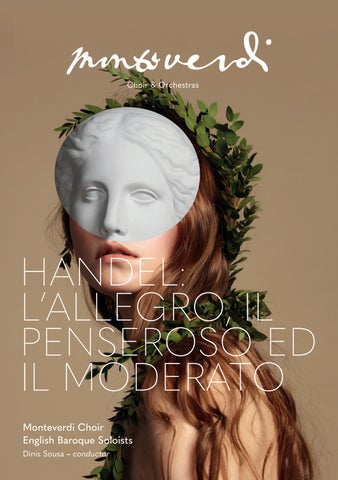
Choir & Orchestras
HANDEL: L’ALLEGRO, IL PENSEROSO ED IL MODERATO Monteverdi Choir English Baroque Soloists Dinis Sousa – conductor
HANDEL: L’ALLEGRO, IL PENSEROSO ED IL MODERATO
Saturday 21 October 2023, 7.30pm Harris Theater, Chicago Thursday 26 October 2023, 8pm Carnegie Hall, New York City Tuesday 31 October 2023, 7.30pm St Martin-in-the-Fields, London
WELCOME
Following our North American tour, we are delighted to return to our London home for a performance of l’Allegro, il Penseroso ed il Moderato, one of Handel’s greatest, but rarely performed, works in English. Handel’s setting of Milton’s poetry explores different ways of experiencing life: either in a joyful, carefree way; or in a pensive, more melancholy way. His music gives us a rollercoaster ride through these different emotions, providing perfect opportunities for the singers of the Monteverdi Choir to shine collectively and as soloists, as well as showcasing the members of the English Baroque Soloists. The piece culminates in what seems to be nothing less than a manifesto for the Englightenment, as the twin characters of ‘l’Allegro’ and ‘il Penseroso’ unite in duet: ‘rising reason puts to flight the fumes that did the mind involve’. And what better surroundings to celebrate the dawn of the Age of Reason than the architect James Gibbs’s church of Saint Martin-in-the-Fields, built just a few years before this music was written? We hope you enjoy the concert!
© Paul Marc Mitchell
Monteverdi Choir & Orchestras presents
HANDEL: L’ALLEGRO, IL PENSEROSO ED IL MODERATO Monteverdi Choir English Baroque Soloists Dinis Sousa — conductor Samantha Clarke — soprano Hilary Cronin — soprano Alison Ponsford-Hill — soprano Bethany Horak-Hallett — mezzo-soprano Jonathan Hanley — tenor Nick Pritchard — tenor Alex Ashworth — bass-baritone Frederick Long — bass-baritone Leo Duarte — assistant conductor
All information in this programme was correct at the time of going to print.
HANDEL AS LANDSCAPE PAINTER Richard Wigmore The years between 1738 and 1741 were a watershed for Handel. With his operatic finances in a parlous state (though his aristocratic backers always staved off bankruptcy), he now wavered between Italian opera and works in English: the oratorios Saul and Israel in Egypt, followed in the notoriously cold winter of 1740 by the ode l’Allegro, il Penseroso ed il Moderato. The initial idea for the ode came from Handel’s friend James Harris, a Salisbury-based author and aesthetician. Harris suggested to their mutual friend Charles Jennens (librettist of Saul and Messiah) that a work based on John Milton’s two complementary poems from the early 1630s, l’Allegro (‘The cheerful man’) and il Penseroso James Harris of Salisbury, by Arthur Pond
(‘The pensive man’), would be right up Handel’s street. The composer agreed. Harris duly drafted a libretto interleaving Milton’s paired poems, which Jennens polished into its final form. Evidently intent on creating a full evening’s entertainment, Handel then suggested a third part based on Milton’s At a solemn musick (‘Blest pair of sirens’). Jennens deemed this an unsuitable subject. Instead, at Handel’s behest, he provided a poem of his own, il Moderato, which with characteristic eighteenthcentury reasonableness seeks to reconcile Milton’s two extreme humours. Enclosing himself in one of his familiar ‘composing bubbles’, Handel immediately set to work. He completed the ode in Portrait of Charles Jennens, by Thomas Hudson
Lincoln’s Inn Fields Theatre
just seventeen days between 19 January and 4 February 1740, and directed the premiere at Lincoln’s Inn Fields Theatre on 27 February. Amid the sub-zero temperatures a London newspaper assured Handel’s potential public that ‘Particular Care has been taken to have the House secured against the Cold, constant Fires being order’d to be kept in the House ‘till the Time of Performance’. Whatever the audience’s comfort level, the ode seems to have gone down well, and ran for four further performances. In those days there was no question of nipping out to the bar in the intervals. Instead the audience stayed put while Handel’s band performed one of his recent Concerti Grossi Op. 6, another of which had already served as overture (Harris and Jennens had failed to persuade him to compose a new overture). The composer then introduced a ‘new concerto on the Organ’ in the second interval. Handel’s audiences expected, and got, their money’s worth.
Any Handel revival almost always entailed additions, cuts and transpositions, usually to accommodate different singers. He composed several new items for performances of l’Allegro, il Penseroso ed il Moderato in Lincoln’s Inn Fields in 1741, then returned more or less to the original 1740 version when he performed it to acclaim in the new Musick-Hall in Dublin’s Fishamble Street in December 1741 (he would unfurl Messiah there the following April). There was a more radical revision in 1743, when Handel reworked some of il Penseroso’s arias for the famous contralto Susanna Cibber, and ditched il Moderato in favour of his 1739 Song for Saint Cecilia. Tonight’s performance broadly follows the expanded 1741 version of Parts One and Two (although it includes some of the revised contralto sections), but makes cuts in il Moderato. Milton’s wonderfully vivid imagery inspired Handel to a series of poetic vignettes that explore the contrasting
temperaments of the extrovert and the shadow-seeking introvert while evoking an Arcadian idyll, man and nature in perfect harmony (one early reviewer compared it to the landscapes of Poussin and Claude). As in Shakespeare’s As you like it, Arcadia is transplanted to the English countryside in what is the most quintessentially English of all Handel’s works. The ode also hymns the delights of urban life – ‘city mirth’, as James Harris dubbed it – and the pleasures of theatre and music. The movements for l’Allegro in Part One have a spontaneous exuberance which Handel never surpassed, while several of the Penseroso solos, not least the final ‘May at last my weary age’, attain a contemplative ecstasy found elsewhere only in Theodora. The whole work is suffused with an almost pantheistic sense of wonder and delight, prompting the great Handel scholar Winton Dean to suggest that l’Allegro is more truly religious in tone than the extrovert Messiah. Portrait of Élisabeth Duparc, by John Faber Junior
James Harris was not backward in offering suggestions for scoring and voice type. Handel adopted many of these, including the casting of a boy soprano for l’Allegro and a female soprano (Elisabeth Duparc, known as ‘La Francesina’) for il Penseroso. The composer also took note of Harris’s observation that ‘each part begins with an execration of its contrary’. Throughout, the two humours interact as if in a philosophical dialogue. In the opening pair of recitatives Mirth and Melancholy in turn deplore the other’s music, contrasting minor and major, low and high. Melancholy, ever longing for nightfall, is derided with lugubrious bassoons, cellos and basses, Mirth in a frivolously skipping theme accompanied by violins and violas (no basses). Mirth then launches into the blithe soprano aria with oboes and strings, ‘Come, come thou goddess, fair and free’, one of several numbers in the score with an unmissable Purcellian flavour. Melancholy responds with the musing ‘Come rather goddess, sage and holy’, where a luxuriant chain of sequences paints the key word ‘solitary’. In the next two numbers Mirth’s song is taken up by the chorus. Both are among the ode’s obvious hits: the tenor’s infectious ‘laughing song’, ‘Haste thee, nymph’ (which later reduced audiences including King George III and Queen Caroline to hysterics), and the graceful minuet aria ‘Come and trip it’. Handel again conjures the spirit of Purcell in Melancholy’s ‘Come, pensive nun’, beginning as recitative, then flowering into a gravely beautiful aria and chorus over a freely varied ground bass. The next two arias both evoke birdsong: the morning lark, courtesy of frolicking violins, in ‘Mirth admit me’, the nightingale in Melancholy’s ‘Sweet bird’, which unfolds as a rhapsodic, almost improvisatory
© Bruno Moussier
Ideal Landscape, by Nicolas Poussin
dialogue between soprano and flute. In one of the ode’s rare da capo arias the central ‘B’ section dips from major to minor with a magical depiction of the rising moon. One of James Harris’s suggestions was that ‘Mirth admit me’ should be sung by ‘a Base voice with French Horns’. Handel more or less obliged in a lusty aria in which the ‘base voice’ imitates the (solo) horn’s traditional hunting calls. Throughout the ode Handel’s descriptions of the rural world are both precise and charmingly naïve. The evening curfew tolls hypnotically in violas and pizzicato basses in Melancholy’s ‘Oft on a plat of rising ground’, while ‘Far from all resort of mirth’ depicts the chirping cricket and (with a tolling dotted figure) the ‘bellman’s drowsy charm’.
The numbers for l’Allegro that close Part One can take on a surprisingly pensive cast: in the gently lilting ‘Let me wander not unseen’ (a siciliano-style aria here was Harris’s idea), and in the solo and chorus ‘Or let the merry bells ring round’. This begins with a tinkling carillon evoking English change-ringing. The chorus break into a jig. Then the fun suddenly stops as major turns to dusky minor for an exquisite – and, again, very Purcellian – portrayal of the villagers ‘by whistling winds soon lull’d to sleep’. Whereas l’Allegro opens and closes Part One, Part Two is framed by il Penseroso – an indication, perhaps, of Handel’s own sympathies. Melancholy hymns the glories of ancient Greek theatre in ‘Sometimes let gorgeous tragedy’, with its majestically falling phrases to illustrate ‘sweeping by’
(Handel added this aria in 1741). In ‘But o, sad virgin’ Melancholy evokes the spirit of the poet Musaeus and his master Orpheus, whose notes ‘warbled to the string’: cue for a trilling duet between soprano and cello-as-lyre (in 1743 Handel transposed the cello part up an octave for violin). Mirth counters with the bustling bass solo and chorus ‘Populous cities please me then’, festooned with trumpets and timpani. Masculine swagger contrasts with the airy, ‘feminine’ music of the central section (‘With store of ladies, whose bright eyes’). After Mirth invokes the god of marriage in reams of buoyant coloratura, Melancholy seeks shade and solitude in ‘Hide me from day’s garish eye’, a nocturne of haunting stillness that hovers between the keys of F minor and A flat major. Where Melancholy is temperamentally drawn to Greek tragedy, Mirth, predictably, prefers comedy. (Ben) ‘Jonson’s learned sock’ prompts a strutting ‘Pomposo’ tune (a touch of parody here?), while ‘sweetest Shakespeare, Fancy’s child’ inspires graceful chains of coloratura. Just as at the close of Part One, the idioms of l’Allegro and il Penseroso seem to fuse in the delicately scored ‘As ever against eating cares’, where voluptuous suspensions paint the line ‘of linked sweetness long drawn out’. L’Allegro reverts to type in the bravura soprano aria ‘Orpheus’ self may have his head’ (another 1741 addition), and the rollicking trumpet aria with chorus ‘These delights if thou can give’. But the closing numbers of Part Two belong to il Penseroso, walking in ‘the studious cloister pale’. In 1740 Handel himself displayed his organ prowess in pauses for improvisation (‘Organo ad libitum’) in the hymnlike chorus ‘There let the pealing organ blow’, and in a more extended improvisation on the fugue
subject of the final chorus, ‘These pleasures, Melancholy, give’. (Handel the inveterate self-borrower lifted the fugue theme from a vocal trio he had written in Italy over thirty years earlier.) Before the reflective final chorus, Melancholy sings of the ‘peaceful hermitage’ and the visionary wisdom of old age in ‘May at last my weary age’ (added in 1741). This quietly hypnotic aria is first cousin to ‘Come, come, but keep thy wonted state’ in Part One, and a touching final homage to the ground-bass arias of Henry Purcell. In il Moderato Charles Jennens’s sub-Miltonian verse, dealing in abstractions rather than the concrete images which always fired Handel’s imagination, comes as something of an anticlimax (coffee house wags dubbed it ‘Moderatissimo’). The music, though, beginning with the bass’s recitative and minuet aria ‘Come with native lustre shine’ (the two short arias that follow are cut in this evening’s performance), is still delightful Handel. The ode’s final, resolving, climax comes in the duet for l’Allegro (tenor) and il Penseroso (soprano), ‘As steals the morn’, whose text Jennens adapted from a speech of Prospero’s in Act Five of The Tempest. The painter in Handel seized on the image of the first two lines; and their upshot is perhaps the most beautiful of all his sunrise evocations, with the rapturous vocal lines complemented by duetting oboe and bassoon against gently palpitating strings. After this, the anthem-like closing chorus, incorporating fragments of two German chorales, is distinctly sober, even sombre, in tone. Like the first two parts, il Moderato ends in a shadowed minor key: a final reminder, perhaps, of where the balance of Handel’s sympathies lay in this colourful, gloriously inventive work.
Statue of George Frideric Handel, by Louis François Roubiliac,1738. © Victoria and Albert Museum, London
LIBRETTO Libretto based on poems by John Milton rearranged by Charles Jennens
PART 1
Air
Accompagnato
Il Penseroso (alto) Come rather, goddess sage and holy; Hail, divinest Melancholy, Whose saintly visage is too bright To hit the sense of human sight; Thee bright-hair’d Vesta long of yore, To solitary Saturn bore.
L’Allegro (tenor) Hence loathed Melancholy Of Cerberus, and blackest midnight born, In Stygian cave forlorn ‘Mongst horrid shapes, and shrieks, and sights unholy, Find out some uncouth cell, Where brooding darkness spreads his jealous wings, And the night-raven sings; There under ebon shades, and low brow’d rocks, As ragged as thy locks, In dark Cimmerian desert ever dwell. Accompagnato Il Penseroso (alto) Hence vain deluding joys, Dwell in some idle brain, And fancies fond with gaudy shapes possess, As thick and numberless As the gay motes that people the sunbeams, Or likest hovering dreams The fickle pensioners of Morpheus’ train. Air L’Allegro (soprano) Come, thou goddess fair and free, In Heav’n yclep’d Euphrosyne; And by men heart-easing Mirth, Whom lovely Venus, at a birth, With two sister-graces more, To ivy-crowned Bacchus bore.
Air and Chorus L’Allegro (tenor) Haste thee, nymph, and bring with thee Jest and youthful jollity, Quips and cranks, and wanton wiles, Nods, and becks, and wreathed smiles Such as hang on Hebe’s cheek, And love to live in dimple sleek, Sport, that wrinkled care derides, And laughter, holding both his sides. Chorus Haste thee, nymph, and bring with thee Jest, and youthful jollity; Sport, that wrinkled care derides, And laughter, holding both his sides. Air and Chorus L’Allegro (tenor) Come, and trip it as you go, On the light fantastic toe. Chorus Come, and trip it as you go, On the light fantastic toe. Accompagnato Il Penseroso (soprano) Come, pensive nun, devout and pure,
Sober, steadfast, and demure; All in a robe of darkest grain, Flowing with majestic train. Arioso Il Penseroso (soprano) Come, but keep thy wonted state, With even step, and musing gait, And looks commercing with the skies, Thy rapt soul sitting in thine eyes. Accompagnato and Chorus Il Penseroso (soprano) There held in holy passion still, Forget thyself to marble, till With a sad leaden downward cast Thou fix them on the earth as fast. And join with thee calm Peace, and Quiet, Spare Fast, that oft with gods doth diet, And hears the muses in a ring Round about Jove’s altar sing. Chorus Join with thee calm Peace, and Quiet, Spare Fast, that oft with gods doth diet. Recitative L’Allegro (tenor) Hence, loathed Melancholy, In dark Cimmerian desert ever dwell. But haste thee, Mirth, and bring with thee The mountain nymph, sweet Liberty.
And at my window bid good morrow. Mirth, admit me of thy crew! Accompagnato Il Penseroso (soprano) First, and chief, on golden wing, The cherub Contemplation bring; And the mute Silence hist along, ‘Less Philomel will deign a song, In her sweetest, saddest plight, Smoothing the rugged brow of night. Air Il Penseroso (soprano) Sweet bird, that shun’st the noise of folly, Most musical, most melancholy! Thee, chantress, oft the woods among, I woo to hear thy even-song. Or, missing thee, I walk unseen, On the dry smooth-shaven green, To behold the wand’ring moon Riding near her highest noon. Sweet bird. . . da capo Recitative L’Allegro (bass) If I give thee honour due, Mirth, admit me of thy crew! Air
L’Allegro (soprano) And if I give thee honour due, Mirth, admit me of thy crew!
L’Allegro (bass) Mirth, admit me of thy crew! To listen how the hounds and horn Cheerly rouse the slumb’ring morn, From the side of some hoar hill, Through the high wood echoing shrill.
Air
Air
L’Allegro (soprano) Mirth, admit me of thy crew, To live with her, and live with thee, In unreproved pleasures free; To hear the lark begin his flight, And singing startle the dull night; Then to come in spite of sorrow,
Il Penseroso (soprano) Oft on a plat of rising ground, I hear the far-off curfew sound, Over some wide-water’d shore, Swinging slow, with sullen roar; Or if the air will not permit, Some still removed place will fit,
Where glowing embers through the room Teach light to counterfeit a gloom. Air Il Penseroso (soprano) Far from all resort of mirth, Save the cricket on the hearth, Or the bellman’s drowsy charm, To bless the doors from nightly harm. Recitative L’Allegro (soprano) If I give thee honour due, Mirth, admit me of thy crew! Air L’Allegro (tenor) Let me wander, not unseen By hedge-row elms, on hillocks green. There the ploughman, near at hand, Whistles over the furrow’d land, And the milkmaid singeth blithe, And the mower whets his scythe, And every shepherd tells his tale Under the hawthorn in the dale. Air L’Allegro (soprano) Straight mine eye hath caught new pleasures, While the landscape round it measures Russet lawns, and fallows grey, Where the nibbling flocks do stray. Accompagnato L’Allegro (soprano) Mountains, on whose barren breast The lab’ring clouds do often rest: Meadows trim with daisies pied, Shallow brooks, and rivers wide Tow’rs and battlements it sees, Bosom’d high in tufted trees.
Air and Chorus L’Allegro (soprano) Or let the merry bells ring round, And the jocund rebecks sound To many a youth, and many a maid, Dancing in the checquer’d shade. Chorus And young and old come forth to play On a sunshine holiday, Till the livelong daylight fail. Thus past the day, to bed they creep, By whisp’ring winds soon lull’d asleep. INTERVAL PART II Accompagnato Il Penseroso (alto) Hence, vain deluding joys, The brood of Folly without father bred; How little you bestead, Or fill the fixed mind with all your toys. Oh, let my lamp, at midnight hour, Be seen in some high lonely tow’r, Where I may oft out-watch the Bear With thrice-great Hermes, or unsphere The spirit of Plato to unfold What worIds, or what vast regions hold Th’immortal mind that hath forsook Her mansion in this fleshly nook. Air Il Penseroso (soprano) Sometimes let gorgeous Tragedy In sceptred pall come sweeping by, Presenting Thebes, or Pelops’ line, Or the tale of Troy divine; Or what (though rare) of later age Ennobled hath the buskin’d stage. Air Il Penseroso (soprano) But oh, sad virgin, that thy pow’r
Might raise Musaeus from his bow’r, Or bid the soul of Orpheus sing Such notes as, warbled to the string, Drew iron tears down Pluto’s cheeks And made hell grant what love did seek. Recitative Il Penseroso (soprano) Thus night oft see me in thy pale career, Till unwelcome morn appear. Solo & Chorus L’Allegro (bass) Populous cities please me then, And the busy hum of men. Chorus Populous cities please us then, And the busy hum of men, Where throngs of knights and barons bold, In weeds of peace high triumphs hold; With store of ladies, whose bright eyes Rain influence, and judge the prize Of wit, or arms, while both contend To win her grace, whom all commend. Populous cities. . . da capo Air L’Allegro (tenor) There let Hymen oft appear In saffron robe, with taper clear, And pomp, and feast, and revelry, With mask, and antique pageantry; Such sights as youthful poets dream On summer eves by haunted stream. Accompagnato Il Penseroso (soprano) Me, when the sun begins to fling His flaring beams, me goddess bring To arched walks of twilight groves, And shadows brown that Sylvan loves; There in close covert by some brook, Where no profaner eye may look.
Air Il Penseroso (soprano) Hide me from day’s garish eye, While the bee with honied thigh, Which at her flow’ry worth doth sing, And the waters murmuring, With such consort as they keep Entice the dewy-feather’d sleep; And let some strange mysterious dream Wave at his wings in airy stream Of lively portraiture display’d, Softly on my eyelids laid. Then as I wake, sweet music breathe, Above, about, or underneath, Sent by some spirit to mortals good, Or th’unseen genius of the wood. Air L’Allegro (tenor) I’ll to the well-trod stage anon, If Jonson’s learned sock be on, Or sweetest Shakespeare, Fancy’s child, Warble his native wood-notes wild. Air L’Allegro (soprano) And ever against eating cares, Lap me in soft Lydian airs Married to immortal verse, Such as the meeting soul may pierce In notes, with many a winding bout Of linked sweetness long drawn out; With wanton heed, and giddy cunning, The melting voice through mazes running, Untwisting all the chains that tie The hidden soul of harmony. Air L’Allegro (soprano) Orpheus’ self may heave his head From golden slumbers on a bed Of heap’d Elysian flow’rs, and hear Such strains as would have won the ear Of Pluto, to have quite set free His half-regain’d Eurydice.
Air and Chorus L’Allegro (tenor) These delights if thou canst give, Mirth, with thee I mean to live. Chorus These delights if thou canst give, Mirth, with thee we mean to live. Recitative Il Penseroso (soprano) But let my due feet never fail To walk the studious cloister’s pale, And love the high-embowed roof, With antic pillars’ massy proof, And storied windows richly dight, Casting a dim religious light. Solo & Chorus Chorus There let the pealing organ blow To the full voic’d quire below, In service high and anthems clear! Il Penseroso (soprano) And let their sweetness, through mine ear, Dissolve me into ecstasies, And bring all Heav’n before mine eyes! Air Il Penseroso (soprano) May at last my weary age Find out the peaceful hermitage, The hairy gown and mossy cell, Where I may sit and rightly spell Of ev’ry star that Heav’n doth show, And ev’ry herb that sips the dew; Till old experience do attain To something like prophetic strain. Solo and Chorus Il Penseroso (soprano) These pleasures, Melancholy, give, And I with thee will choose to live.
Chorus These pleasures, Melancholy, give, And we with thee will choose to live. PART III Accompagnato Il Moderato (bass) Hence, boast not, ye profane, Of vainly-fancied, little-tasted pleasure, Pursued beyond all measure, And by its own excess transform’d to pain. Air Il Moderato (bass) Come, with native lustre shine, Moderation, grace divine, Whom the wise God of nature gave, Mad mortals from themselves to save. Keep, as of old, the middle way, Nor deeply sad, nor idly gay, But still the same in look and gait, Easy, cheerful and sedate. Accompagnato and Chorus Il Moderato (bass) Sweet temp’rance in thy right hand bear, With her let rosy health appear, And in thy left contentment true, Whom headlong passion never knew; Frugality by bounty’s side, Fast friends, though oft as foes belied; Chaste love, by reason led secure, With joy sincere, and pleasure pure; Happy life from Heav’n descending, Crowds of smiling years attending: All this company serene, Join, to fill thy beauteous train. Chorus All this company serene, Join, to fill thy beauteous train.
Duet Il Moderato (soprano and tenor) As steals the morn upon the night, And melts the shades away: So truth does fancy’s charm dissolve, And rising reason puts to flight The fumes that did the mind involve, Restoring intellectual day. Chorus
© Paul Marc Mitchell
Thy pleasures, Moderation, give, In them alone we truly live.
MONTEVERDI CHOIR The Monteverdi Choir, founded in 1964, will celebrate its 60th anniversary in 2024. Over the course of its lifespan it has established itself as one of greatest choirs in the world. Through a combination of consummate technique, historically informed performance practice and a strong appreciation for visual impact, the Choir constantly strives to bring fresh perspectives, immediacy and drama to its performances. The Monteverdi Choir and English Baroque Soloists, conducted by Dinis Sousa, performed Bach’s Mass in B minor, as well as Handel’s pastoral ode l’Allegro, il Penseroso ed il Moderato, on their American tour in October 2023 following their European tour of Bach’s monumental work in April. In the summer the Monteverdi Choir, Orchestre Révolutionnaire et Romantique and outstanding soloists, conducted by Dinis Sousa, performed Berlioz’s opera Les Troyens on a critically acclaimed European tour. In May the Monteverdi Choir and English Baroque Soloists were honoured to perform at the Coronation of Their Majesties King Charles III and Queen Camilla. The Daily Telegraph noted, “If the Monteverdi Choir isn’t singing when I get to the gates of Heaven, I want my money back.” In 2022 the Monteverdi Choir performed on several successful tours including works by Mendelsohn and Brahms in partnership with the Berlin Philharmonic, a programme of music by Bach, Schütz
and Schein at prestigious festivals across Europe, and Beethoven’s late masterpiece: Missa solemnis at the BBC Proms, Berliner Festspiele and Wratislavia Cantans. The year culminated in a tour of J.S. Bach’s Christmas Oratoiro at Teatro alla Scala, Milan, Chapelle Royale, Château de Versailles, and at our London home, St Martin-inthe-Fields, which was livestreamed on Deutsche Grammophon’s new online platform STAGE+. In 2021 the Choir performed its first livestreamed concert, Bach’s St John Passion with the English Baroque Soloists, filmed in Oxford’s historic Sheldonian Theatre and streamed on Deutsche Grammophon’s online platform DG Stage. The ensemble returned to live performing in the summer with a programme of Handel and Bach at the BBC Proms and Berliner Festspiele, and ended the year with a tour of Berlioz’s sacred oratorio L’enfance du Christ. The Monteverdi Choir accompanied the Orchestre Révolutionnaire et Romantique in performances of Beethoven’s Ninth Symphony in Barcelona, New York and Chicago in 2020, forming part of a wider project celebrating the 250th anniversary of the composer. The Monteverdi Choir has taken part in a variety of projects across different repertoires, ranging from tours of Bach’s Mass in B minor and St Matthew Passion (performed from memory) with the
HANDEL: L’ALLEGRO, IL PENSEROSO ED IL MODERATO MONTEVERDI CHOIR PERSONNEL LIST
© Paul Marc Mitchell
St Martin-in-the-Fields 31 October 2023
English Baroque Soloists (EBS) to Berlioz’s Les Troyens, L’enfance du Christ, La damnation de Faust and Verdi’s Requiem with the Orchestre Révolutionnaire et Romantique (ORR). It has also performed in several staged opera productions, including Orphée et Eurydice at the Royal Opera House (2015), Der Freischütz (2010), Carmen (2009) at the Opéra Comique in Paris, and Les Troyens at the Théâtre du Châtelet (2003). Amongst its many trailblazing tours was the Bach Cantata Pilgrimage in 2000, during which the Choir performed all 198 of Johann Sebastian Bach’s sacred cantatas in over 60 churches throughout Europe and North America. The entire project was recorded and released by the Monteverdi Choir & Orchestra’s record label, Soli Deo Gloria, with Gramophone hailing the venture as “one of the most ambitious musical projects of all time”. In 2017 the Choir took part in the RPS awardwinning Monteverdi 450 project, which saw them perform all three of Monteverdi’s surviving operas with the English Baroque Soloists across Europe and the United States. The Monteverdi Choir has released over 150 recordings and won numerous prizes.
Soprano Samantha Clarke^ Emily Armour Sam Cobb Hilary Cronin** Laura Jarrell Lucy Knight Charlotte La Thrope Emily Owen Alison Ponsford-Hill** Daisy Walford Amy Wood Theano Papadaki* Billie Robson* Claire Ward* Alto Bethany Horak-Hallett^ Francesca Biliotti Luthien Brackett Sarah Denbee** Annie Gill Rebekah Jones Iris Korfker Hamish McLaren Simon Ponsford Matthias Dähling* Lorna Price* Avalon Summerfield*
Tenor Nick Pritchard^ Ben Alden Christopher Bowen Jonathan Hanley** Thomas Herford Graham Neal Edward Ross Gareth Treseder Jack Harberd* Joseph Taylor* Bass Frederick Long^ Alex Ashworth** Jack Comerford Peter Edge Tom Herring Michael Lafferty Alistair Ollerenshaw George Vines* Henry Saywell*
The Monteverdi Choir is under the patronage of HM King Charles III. ^Guest Soloist *Monteverdi Choir Apprentice **Monteverdi Choir Soloist
ENGLISH BAROQUE SOLOISTS The English Baroque Soloists (EBS), founded in 1978, seeks to challenge preconceptions of 200 years of music ranging from Monteverdi to Mozart and Haydn. Equally at home in chamber, symphonic and operatic performances, their distinctively warm and incisive playing is instantly recognisable. One of the world’s leading period instrument orchestras, the ensemble has performed at many of the world’s most prestigious venues including Milan’s Teatro alla Scala, the Concertgebouw in Amsterdam and the Sydney Opera House. The EBS and the Monteverdi Choir, conducted by Dinis Sousa, performed Bach’s Mass in B minor, as well as Handel’s pastoral ode l’Allegro, il Penseroso ed il Moderato, on their American tour in October 2023 following their European tour of Bach’s monumental work in April. In May the EBS and the Monteverdi Choir were honoured to perform at the Coronation of Their Majesties King Charles III and Queen Camilla. In January 2023 the EBS were joined by Isabelle Faust and Antoine Tamestit for performances of orchestral works by Haydn and Mozart throughout Europe. In 2022 the ensemble completed a number of successful tours including symphonies by Mozart and Haydn across Europe and the United States, and works by Bach, Schütz and Schein,
in collaboration with the Monteverdi Choir, at prestigious festivals across Europe. The year culminated in a tour of J.S. Bach’s Christmas Oratorio, with the Monteverdi Choir, at Teatro alla Scala, Milan, Chapelle Royale, Château de Versailles, and at our London home, St Martin-in-the-Fields, which was livestreamed on Deutsche Grammophon’s new online platform STAGE+. In 2021 the EBS performed its first livestreamed concert, Bach’s St John Passion with the Monteverdi Choir, filmed in Oxford’s historic Sheldonian Theatre and streamed on Deutsche Grammophon’s online platform DG Stage. It also gave critically acclaimed performances of Handel and Bach at two of Europe’s most prestigious music festivals; the BBC Proms and the Berliner Festspiele. The ensemble famously took part in the iconic Bach Cantata Pilgrimage in 2000 alongside the Monteverdi Choir, performing all of Bach’s sacred cantatas throughout Europe. In 2019 the EBS made its inaugural visit to South America for the Cartagena International Music Festival, and subsequently undertook a tour of Handel’s dramatic oratorio Semele with the Monteverdi Choir, visiting a series of iconic venues including Barcelona’s Palau de la Música and Milan’s Teatro alla Scala. The ensemble then gave
HANDEL: L’ALLEGRO, IL PENSEROSO ED IL MODERATO ENGLISH BAROQUE SOLOISTS PERSONNEL LIST St Martin-in-the-Fields 31 October 2023
its debut performances in Russia alongside the Monteverdi Choir with a programme of works by Monteverdi, Carissimi, Scarlatti and Purcell, before returning to South America for further inaugural concerts in Brazil, Uruguay, Argentina and Chile.
Violin I Kati Debretzeni Jane Gordon Madeleine Easton Beatrice Scaldini Dominika Fehér Sophie Simpson
Flute Rachel Beckett
In 2017 the EBS took part in the Royal Philharmonic Society’s awardwinning Monteverdi 450 project, with the Monteverdi Choir, in which they performed all three of Monteverdi’s surviving operas across Europe and in the USA.
Violin II Oliver Webber Davina Clarke Henrietta Wayne Håkan Wikström Jean Paterson Chloe Prendergast
Bassoon Philip Turbett* Theresa Koenig
The EBS has also participated in major opera productions alongside the Choir in works by Handel, Purcell and Monteverdi, and recorded Mozart’s greatest operas for Deutsche Grammophon in the 1990s.
Viola Fanny Paccoud Monika Grimm Annette Isserlis Lisa Cochrane
The English Baroque Soloists is under the patronage of HM King Charles III.
Cello Kinga Gáborjáni* Catherine Rimer Ruth Alford
Oboes Michael Niesemann Mark Baigent Leo Duarte
Horn Anneke Scott Trumpets Neil Brough Robert Vanryne Michael Harrison Timpani Robert Kendell Organ Oliver John Ruthven*
Double Bass Harpsichord Valerie Botwright* Benedict Williams* Cecelia Bruggemeyer
*continuo
DINIS SOUSA
Dinis Sousa will lead the Monteverdi Choir and English Baroque Soloists’ autumn programme in 2023, featuring Bach’s Mass in B minor, and Handel’s l’Allegro, il Penseroso ed il Moderato, including their American tour and London concert at St Martin-in-the-Fields. In August/September 2023 Dinis Sousa stepped in to conduct the Monteverdi Choir and the Orchestre Révolutionnaire et Romantique on their critically acclaimed European tour of Berlioz’s Les Troyens, including a BBC Proms performance which was broadcast live on BBC Radio 3. Their performance at the BBC Proms received five-star reviews from the Financial Times, The Times, The Observer, Daily Telegraph, Evening Standard, The Arts Desk and Bachtrack. The Guardian noted, “Sousa was electrifying in moments of grandeur, high drama and emotional intensity” and, as Bachtrack remarked, “There were heroes at every turn, none more than Dinis Sousa.” Dinis Sousa is Associate Conductor of the three Monteverdi ensembles, the first-ever in the history of the Monteverdi Choir & Orchestras. The UK-based Portuguese conductor has worked closely with the Monteverdi ensembles and with other esteemed orchestras including the London Symphony Orchestra, Berliner Philharmoniker and Tonhalle Orchester Zurich. In January 2019 Sousa conducted the English Baroque Soloists in four concerts at the Cartagena International
Music Festival, and at the 2016 BBC Proms he co-conducted the Monteverdi Choir’s critically acclaimed performance of Berlioz’s Roméo et Juliette which was televised on BBC4. During the 2023/24 season Dinis Sousa will make his debut with the Swedish Radio Symphony Orchestra and the BBC National Orchestra of Wales, as well as returning to Edmonton Symphony and the Riga Sinfonietta. Recent engagements have included the BBC Philharmonic, Gulbenkian and Ulster Orchestras. His operatic experience includes Rossini’s Il barbiere di Siviglia (Nevill Holt Opera) and Debussy’s Pelléas et Mélisande (Orquestra XXI). Sousa is Principal Conductor of the Royal Northern Sinfonia, a position he has held since April 2021. During his tenure the orchestra have performed at the BBC Proms twice, with soloists Kristian Bezuidenhout and Nicholas Daniel. During the 2023/24 season, they will present a complete cycle of Robert Schumann’s symphonies at The Glasshouse in addition to his choral masterpiece Das Paradies und die Peri. Other highlights include a world premiere by Cassandra Miller, collaborations with soloists Christian Tetzlaff, Steven Isserlis and Elizabeth Leonskaja and several performances around the UK including Birmingham and Cardiff. Dinis Sousa is Founder and Artistic Director of Orquestra XXI, an award-
© Sim Canetty-Clarke
winning orchestra bringing together some of the best young Portuguese musicians from around Europe to perform at the most prestigious venues in Portugal. Recent highlights include opening the Gulbenkian Foundation season and a critically acclaimed tour of Mahler’s Symphony No 5 to celebrate the orchestra’s 10th anniversary. In recognition of his work with Orquestra XXI, Sousa was awarded the title of Knight of the Order of Prince Henry in Portugal.
© Helena Cooke
© Benjamin Ealovega
SAMANTHA CLARKE
HILARY CRONIN
Australian/British soprano Samantha Clarke is a graduate of the Guildhall School of Music and Drama and a Tait Memorial Trust Scholar. In the 2023/24 season Samantha makes debuts with Opera Australia as Violetta La traviata, Pinchgut Opera in the title role of Theodora, with Garsington Opera as Contessa Le nozze di Figaro and with the Seiji Ozawa Music Academy as Fiordiligi Così fan tutte. In concert, she tours the USA and Canada in a Bach and Handel programme with the Monteverdi Choir and Orchestra, she sings Woglinde in concert performances of Das Rheingold with the Sydney Symphony Orchestra/Simone Young, performs a programme of Baroque arias with the Melbourne Symphony Orchestra/Erin Helyard and appears at London’s Wigmore Hall with The Mozartists/Ian Page. Recent highlights have included La traviata for the West Australian Opera; Fiordiligi for Opera Queensland and the Grange Festival; Tytania A Midsummer Night’s Dream for the Grange Festival; Musetta La bohème for Opera North; the title role in the Buxton Festival’s award-winning pasticcio Georgiana; Marzelline in concert performances of Fidelio with the Sydney Symphony Orchestra/ Simone Young and the title role in The Golden Cockerel for the Adelaide Festival. Her awards have included the 2019 Guildhall Gold Medal, 2nd Prize and the Audience Prize in the 2019 Grange Festival International Singing Competition, and the 2017 RNCM Gold Medal.
Soprano Hilary Cronin was selected by BBC Music Magazine as a Rising Star of 2022 and won First Prize and the Audience Prize at the 2021 London Handel International Singing Competition. She trained at Trinity Laban Conservatoire and Royal Holloway University of London. Her current engagements include J. S. Bach Mass in B minor and Handel l’Allegro, il Penseroso ed il Moderato with the Monteverdi Choir Acis and Galatea and Amadigi with The English Concert, Arianna in Creta with La Nuova Musica, the St John Passion with BBC Philharmonic, J. S. Bach Cantatas with London Handel Orchestra, Barber Knoxville: Summer of 1915 with The Royal Orchestral Society, Messiah with Britten Sinfonia, the Hallé, The Really Big Chorus and The Sixteen, Silete venti with The King’s Consort, Haydn Nelson Mass with The Sixteen and Mozart Exsultate Jubilate and Pergolesi Stabat Mater with Israel Camerata. She will also sing Fauré Requiem at the Newbury Festival, appear in Command Performance: Music for an Empress with the Academy of Ancient Music, and sing J. S. Bach Christmas Oratorio and St John Passion as well as Handel Messiah with Polyphony. Previous highlights include Agrippina with English Touring Opera, as well as making her debuts at the Halle Handel Festival and at Teatro La Fenice, where she sang Fauré’s Requiem. Her recordings include Second Lady Dido and Aeneas with La Nuova Musica.
soprano
soprano
© Emma Jane
© Andrew Thompson
ALISON PONSFORD-HILL
BETHANY HORAK-HALLETT
Soprano Alison Ponsford-Hill is a soloist, ensemble singer, conductor, and dedicated teacher. She has performed for nearly twenty years with esteemed ensembles such as the Monteverdi Choir, The Tallis Scholars, and Polyphony, to audiences worldwide in renowned concert halls. In recent years Alison has also enjoyed chorus mastering for the Monteverdi Choir and London Voices, as well as running her own ensembles. Alison’s musical journey started as a girl-chorister at Salisbury Cathedral before studying at Trinity College, Cambridge and King’s College, London. She is a respected teacher and currently teaches at Eton College and University College, Oxford. Alison has also worked with the National Youth Choirs of Great Britain and the RSCM Millennium Youth Choir, and has made a notable contribution through her work with the charity Songbound, running choirs for disadvantaged children in India.
British mezzo-soprano Bethany Horak-Hallett read Music at Leeds University, gaining a Masters in Music Performance, and completed her training at Trinity Laban Conservatoire. Bethany is a Rising Star of the Enlightenment and a Samling Artist. She was a finalist in the 2020 Cesti Competition at the Innsbruck Festival of Early Music and won Second Prize in the 2021 International Handel Singing Competition. Bethany’s opera engagements have included Così fan Tutte for Garsington Opera, Rusalka for Glyndebourne Festival Opera and the Deutsches Symphonie-Orchester / Robin Ticciati as well as Katya Kabanova at Glyndebourne. On the concert platform Bethany has appeared with the Orchestra of the Age of Enlightenment singing Bach Cantatas and in Handel Aci, Galatea e Polifemo directed by Steven Devine; the St John Passion with Mark Padmore and Haydn Nelson Mass with John Butt. She joined the Royal Northern Sinfonia / Dinis Sousa as soloist for Bach Cantata 199 and made her BBC Proms début with the Monteverdi Choir / Sir John Eliot Gardiner singing Handel Dixit Dominus (broadcast on BBC TV and Radio). She has given recitals at the London Handel Festival and for Garsington Opera. Bethany’s films and recordings include John Eccles Semele with the Academy of Ancient Music / Julian Perkins. Her recent and future engagements include Bach Mass in B Minor and Handel l’Allegro, il Penseroso ed il Moderato with the Monteverdi Choir / Dinis Sousa and Lady Psyche Princess Ida with the OAE and John Wilson.
soprano
mezzo soprano
© Nick James
© Joel Rodriguez
JONATHAN HANLEY
NICK PRITCHARD
Jonathan Hanley is a British tenor working as both a soloist and ensemble singer, with a particular interest in Baroque vocal music. A history graduate from the University of York, Jonathan has since been a member of Genesis Sixteen and a Monteverdi Choir Apprentice. Forthcoming performances include the tenor solos in Bach Mass in B minor and Handel l’Allegro, il Penseroso ed il Moderato with the Monteverdi Choir on their North American tour, and performances of Bach Christmas Oratorio in York and Oxford, alongside a busy international schedule with vocal ensemble Stile Antico. Jonathan has performed as a soloist in the UK and Europe, appearing with the Monteverdi Choir and English Baroque Soloists, Academy of Ancient Music, Royal Northern Sinfonia, Nevill Holt Opera, Yorkshire Baroque Soloists, and the Instruments of Time and Truth. He has recently performed J.S. Bach Mass in B Minor, St John Passion, Christmas Oratorio, St Matthew Passion, Handel Acis and Galatea, Mendelssohn Die Erste Walpurgisnacht, Monteverdi 1610 Vespers, and Britten St Nicolas. He also enjoys performing English song and lieder. Jonathan works regularly with some of the finest vocal ensembles in the world, most notably Gramophone-award winners Stile Antico and the Monteverdi Choir, for whom he is regularly a step-out soloist. He has recorded with Stile Antico, the Monteverdi Choir, SANSARA, and The Sixteen.
Nick Pritchard was an inaugural member of the Orchestra of the Age of Enlightenment’s (OAE) ’Rising Stars’ scheme and is a Samling artist. Described as a ‘Masterly Evangelist’ by The Guardian he has sung the role in Bach’s St John and Matthew Passions around the world. His recording of the St John Passion on Deutsche Grammophon was recently nominated for a Grammy Award. The 23/24 season highlights include a North American tour of Handel’s l’Allegro, il Penseroso ed il Moderato and Bach’s Mass in B minor with the Monteverdi Choir, performances with the Early Opera Company, Les Talens Lyrique Lully’s Atys at l’Opera Royal de Versailles and at the Vienna Konzerthaus, Evangelist with Irish Baroque under Peter Whelan, Residentie Orkest under Richard Egarr and Stavanger Symfoniorkester under Masato Suzuki, George Benjamin’s Written on Skin (John/ Angel 3) with the Finnish Radio Symphony conducted by the composer, Messiah with the Academy of Ancient Music and the Flemish Radio Choir and Britten St Nicolas at the Aldeburgh Festival. On the concert platform Nick Pritchard has performed with Ensemble Pygmalion, Concerto Köln, Les Talens Lyriques, Les Violons du Roy, L’Orchestre du Chambre de Paris, Orchestra of the Age of Enlightenment, English Concert, Early Opera Company, Philharmonia Orchestra, The Royal Philharmonic Orchestra, BBC National Orchestra of Wales, Gabrieli Consort, the Monteverdi Choir and Orchestras, and the Early Opera Company.
tenor
tenor
© Joey Thompson
ALEX ASHWORTH
FREDERICK LONG
Bass-baritone Alex Ashworth studied at the Royal Academy of Music and has sung with opera houses including Glyndebourne Festival Opera, Welsh National Opera and Scottish Opera. Abroad he has performed for the Opéra Comique in Paris, Opéra de Lille and the Icelandic Opera. Alex sings regularly on the concert platform and has worked as a soloist for conductors including Sir John Eliot Gardiner, Sir Colin Davis and Paul McCreesh. Recent appearances include the UK première, with the Classical Opera Company, of Telemann’s Orfeo as Pluto, Vaughan Williams’ Dona Nobis Pacem with the Hallé Orchestra, Messiah with the CBSO and City of Birmingham Choir in Symphony Hall, Birmingham, a tour of Australia with the Australian Chamber Orchestra in Bach’s Christmas Oratorio and performances of Brahms’ Requiem in China. Alex’s recordings include Œdipus Rex, Stravinsky, with the London Symphony Orchestra, Monteverdi Vespers with the Orchestra of the Age of Enlightenment, Bach’s Mass in B minor for Sir John Eliot Gardiner and the English Baroque Soloists and Handel’s Giulio Cesare for Glyndebourne Festival Opera (DVD). Recent engagements include Œdipus Rex with the Berlin Philharmonic, St Matthew Passion on tour across Europe and Vaughan Williams’ Dona Nobis Pacem for the Three Choirs Festival. He recently performed in the inaugural Alamo Baroque Festival in Texas and toured throughout Europe giving over twenty performances of Bach’s cantatas with Sir John Eliot Gardiner.
Bass-baritone Frederick Long has forged a richly diverse career, garnering acclaim in repertoire from Bach to Bernstein. Noted for the musicality of his performances, alongside vivid stagecraft, he is establishing himself as one of Britain’s most exciting and versatile young singers. Frederick received a first-class degree in music from the University of Bristol, a DipRAM from the Royal Academy of Music (where he was recently made an associate) and furthered his training at the National Opera Studio. Recent highlights include Messiah with the Irish Baroque Orchestra at Wigmore Hall and Bach’s Christmas Oratorio in his debuts at La Scala and the Palace of Versailles under John Eliot Gardiner. Since making his debut at Glyndebourne he has gone on to work at all the major opera houses in the UK including ENO, WNO, Opera Holland Park, Opera North and the Royal Opera House. Recent performances for English Touring Opera in Dido and Aeneas, Bach’s St Matthew Passion and Cosi fan tutte received widespread critical praise. Equally at home in contemporary repertoire, he performed in The Yellow Sofa for Glyndebourne on Tour, Don Giovanni for Silent Opera (a digital reimagining of the original), and in Tansy Davies’ Between Worlds for ENO. With Royal Academy Opera he created the role of Willi Graf in the world premiere of Peter Maxwell Davies’ Kommilitonen! Frederick is in demand on the concert platform at home and abroad. Highlights include Messiah with the Academy of Ancient Music and Haydn’s Creation with the London Mozart Players. He has also performed with some of the UK’s leading solo-voice ensembles including I Fagiolini and Solomon’s Knot.
bass-baritone
bass-baritone
SUPPORT THE MONTEVERDI ENSEMBLES As a registered charity without public subsidy, the Monteverdi Choir & Orchestras rely on the generosity of our supporters to continue planning our ambitious, historically inspired artistic programme, and regularly perform world-class concerts at our new central London home, St Martin-in-the-Fields. This support also allows us to share our concerts with music lovers around the world through top-quality film and audio content and helps us nurture and develop the next generation of musical talent.
© Slawek Przerwa
The three Monteverdi ensembles – the Monteverdi Choir, English Baroque Soloists and Orchestre Révolutionnaire et Romantique – are a leading force on the international music scene. World-class instrumentalists and singers of many different nationalities come together to perform in groundbreaking projects that span eight centuries of musical masterpieces.
Here are the ways in which you can support us: JOIN OUR MEMBERSHIP SCHEME Our membership schemes start from £250 per year. Members enjoy a range of benefits including a personalised priority booking service for all our concerts, monthly newsletters, and invitations to post-concert receptions. At higher levels, additional benefits include invitations to exclusive open rehearsals, backstage access after our performances, and an Annual Conductor’s Dinner. JOIN AS A BENEFACTOR By supporting our charity at this highest level, you will contribute substantially towards our landmark projects, allow us to perform regularly in our new London home at St Martinin-the-Fields, and share our music globally via our filmed concerts. CORPORATE SPONSORSHIP OPPORTUNITIES We can offer creative and collaborative sponsorship packages that enable you to align your business with our work. There are opportunities to sponsor individual performances, or an entire season of concerts at our new London home, St Martin-in-the-Fields.
LEAVE A LEGACY By choosing to leave a Legacy Gift to the Monteverdi Choir & Orchestras, you will play a crucial role in ensuring that the performers and listeners of the future will continue to be enthralled by the power of our music-making. JOIN OUR AMERICAN FRIENDS Our American Friends play a valuable part in supporting and championing the work of the Monteverdi ensembles both in the US and beyond. The American Friends of the Monteverdi Choir & Orchestras, Inc is a registered 501(c)(3) and donations to the AFMCO are tax deductible for US taxpayers. CONTACT US On our website, you will find the facility to make a donation (which we warmly welcome at any level), purchase one of our memberships for yourself, or treat a friend via a Gift Membership. If you would like to discuss how you could support us by becoming a Benefactor, or how your organisation could partner with us, please contact us to arrange a discussion with our General Director, Rosa Solinas. development@monteverdi.org.uk +44 (0)20 7719 0120 Monday to Friday 9:30am to 5.30pm www.monteverdi.co.uk/support-us
MONTEVERDI APPRENTICES PROGRAMME The Monteverdi Apprentices Programme is a training scheme for young musicians that seeks to bridge the gap between university or conservatoire education and the world of the professional musician. Participants in this long-established artist development programme take part in projects ranging from workshops and masterclasses to paid performances with the Monteverdi ensembles. With the help of guidance from a team of dedicated mentors and guest workshops leaders, we hope to nurture and showcase the development of all our Apprentices by providing challenging and rewarding performance opportunities and exposing them to world-class coaching from experts in a range of fields. The Apprentices Programme was set up in 2007 – the first of its kind in the UK – its aim being to nurture exceptional musical talent and an aptitude for ensemble performing. We felt there was a pressing need to create a safe environment and opportunity for gifted young singers and instrumentalists to dip their toes in the waters of professional music-making while still exploring their own musical potential – simply plunging into the professional world straight out of college can be a daunting prospect at the best of times. The Apprentices Programme follows the age-old apprenticeship principle of learning a craft on the job from older hands. At the start of the year, each Apprentice is assigned a mentor – an experienced musician within the Monteverdi Choir, EBS or ORR – on
hand to give encouragement and one-toone advice on the multiple challenges that arise from ensemble singing and playing at the highest professional level. Furthermore, over the course of their Apprentice year, these young musicians are integrated with the Monteverdi ensembles, rehearsing and performing in concerts at home and on tour overseas. Our aim is to round out their musical education and to help equip them for future challenges by giving them the opportunity to work alongside some of the best and most experienced musicians in the business. By the end of the year, a Monteverdi Apprentice should be able to gauge their individual worth as a singer or instrumentalist with greater objectivity. They will have been given a taste of the life of a professional musician and be in a better position to weigh up if this is genuinely the path that they wish to pursue either as a soloist, an ensemble musician, or both. And if they have shown that they can meet the requisite musical, technical and stylistic standards that define the Monteverdi Choir, EBS or ORR, they may be offered a place whenever there is a vacancy. The Programme now has over 90 alumni, and many Apprentices still perform regularly with the Monteverdi ensembles. MONTEVERDI APPRENTICES PROGRAMME 2023–24 This evening’s concert proudly features a full complement of 2023-24 Apprentices, with the ten-strong cohort swelling the ranks of the Monteverdi
Choir. Billie Robson, Theano Papadaki, Claire Ward, Lorna Price, Avalon Summerfield, Matthias Daehling, Joseph Taylor, Jack Harberd, Henry Saywell and George Vines are now over halfway through their year-long programme: six months have passed since their previous performance of Bach’s Mass in B minor, at St Martin-in-the-Fields, which have been as exciting as they have been varied. At the beginning of August renowned tenor Jean-Paul Fouchécourt led two masterclass sessions of Baroque chansons for the young singers. This was followed by a day of rigorous French language training with MCO language coach, Nicole Tibbels. Combined, these workshops stood the Apprentices in fine stead for MCO’s landmark European tour of Berlioz’s Les Troyens which conquered Festival Berlioz, Salzburg, Versailles and Berlin before culminating at the BBC Proms in September.
Most recently, in mid-October, the soprano Sophie Daneman and conductor Dinis Sousa guided the Apprentices through an array of Purcell solo and ensemble repertoire during two days of insightful coaching sessions. These proved to be the perfect platform from which to dive into Handel’s l’Allegro, il Penseroso ed il Moderato which will be performed this evening.
MONTEVERDI SUPPORTERS The Monteverdi Choir & Orchestras gratefully acknowledges the generous support of the following individuals, organisations and Trusts & Foundations: PATRON HM King Charles III PRESIDENT Carol Grigor PRINCIPAL FUNDER Dunard Fund BENEFACTORS Michael Beverley Michael L. Cioffi – Monteverdi Tuscany Christian & Myrto Rochat Judith McCartin Scheide Sir David Walker
MEMBERSHIP SCHEME PLATINUM David Best David & Sandra Brierwood Morny Davison Lord & Lady Deben Lady Virginia Fraser Andrey Kidel William Lock Sebastian & Flora Lyon Francis Norton Yoshi Onodera Helen Skinner Clare Woodman CBE GOLD Lord Burns Gordon Gullan Stephen & Victoria Swift SILVER Julia & Martin Albrecht Geoffrey Barnett Donald & Corrine Brydon Rosemary Chadder Peter & Stephanie Chapman The Earl & Countess of Chichester Sarah Cuthbert Jake Donavan & Gracia Lafuente Sir Stephen Gomersall Iain & Alicia Hasnip Sir Henry Keswick Yi-Peng Li
Lady Nixon Mollie Norwich Nicholas & Christylle Phillips Professor Richard Portes CBE FBA Anthony C. Shoults Professor John Smyth Captain Brian Woodford CBE RN BRONZE Tania Bader Mary Bernard Donald D. Campbell John Canady Peter J. Chapman Vanessa Claypole Dr Carol Cobb Nigel Gibson Anthony de Grey Peter Dunkerley Steve Edge Jonathan Edwards Lady Egremont Alison & Mark Hesketh János & Dietlinde Hidasi Jenny Hill Richard Jacques Gareth & Charlotte Keene Robert Moreland Mary Pinnell Daan Posthuma Meghan Purvis Anne Reyersbach Thomas Richter Dr Paul A. Sackin Steven & Olivia Schaefer Christopher J. H. Thornhill Andrew Tusa Andrew Wales
CORPORATE PARTNERS Morgan Stanley TRUSTS & FOUNDATIONS Dunard Fund The Prince of Wales’s Charitable Foundation Garfield Weston Foundation The Kirby Laing Foundation Mrs F B Laurence’s Charitable Trust IN MEMORIAM Roger Chadder Donald Gorman Ian Hay Davison CBE Nicholas Snowman OBE Christopher Stewart LEGACIES The Estate of Howard Hodgkin The Estate of Kevin Lavery We are grateful for the donations made in memory of our supporters
AMERICAN FRIENDS The Negaunee Foundation The New York Community Trust – The Scheide Fund Michael L. Cioffi Judith McCartin Scheide Neil Graham Seth Levi Rory Walck With grateful thanks to those who wish to remain anonymous and to the other individuals who give regular donations in support of our work.
MCO TEAM
MCO BOARD OF DIRECTORS
Dr Rosa Solinas General Director
Sir David Walker (Chairman) David Best Lady Deben Virginia Fraser Sir Stephen Gomersall Andrey Kidel Francis Norton Christian Rochat
Martin Wheeler Finance & Administration Manager Matthew Broom Planning & Casting Manager James Halliday Artistic Advisor & Librarian Andrew Softley Artistic Projects & Choir Manager
MONTEVERDI CHOIR & ORCHESTRAS
Margot Moseley Tours & Concerts Manager
Level 12, 20 Bank Street, Canary Wharf, London E14 4AD, UK +44 (0)20 7719 0120 info@monteverdi.org.uk
David Kay Philanthropy Manager – North American Friends Freya Firth-Robson Fundraising Executive Assistant Emily Denton Administrator Philip Turbett Orchestra Fixer Matthew Muller Stage Manager
Registered in England & Wales Company No. 01277513 Charity No. 272279
SIGN UP FOR OUR NEWSLETTER What’s On | News | Reviews | Media Scan the QR code or visit: www.monteverdi.co.uk/ pages/newsletter
LISTEN TO MCO Recordings | Videos | Performances | Podcasts Scan the QR code or visit: shop.monteverdi.co.uk/shop
Nicky Thomas Media PR and media relations Bonzo’s Consultancy Ltd Instrument Transport Robin Jennings Keyboard Technician (keyboards provided by Jennings Organs)
FOLLOW US ON SOCIAL MEDIA
Design: Linda Lundin, Park Studio
Sharon Kelly Communications Manager
Portrait of George Frideric Handel, by John Theodore Heins -
Inside back cover
Choir & Orchestras
www.monteverdi.co.uk
Morgan Stanley is proud to support
Monteverdi Choir and Orchestras
© 2023 Morgan Stanley