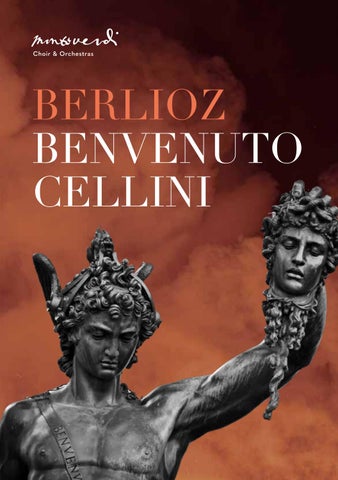
BERLIOZ BENVENUTO CELLINI
BENVENUTO CELLINI 2019 A European tour La Côte-Saint-André Cour du Château Louis XI, Festival Berlioz Thursday 29 August Berlin Philharmonie, Berliner Festspiele Saturday 31 August London The Royal Albert Hall, BBC Proms Monday 2 September Versailles Opéra Royal, Château de Versailles Spectacles Sunday 8 September
INTRODUCTION JOHN ELIOT GARDINER Berlioz's first opera, Benvenuto Cellini, tells the story of a maverick Florentine sculptor-goldsmith whose lust for life gets him into terrible scrapes.
H
e kills a man, elopes with the delectable Teresa and to avoid the chop and win pardon, agrees to cast a statue of Perseus which has been commissioned by the Pope. But Cellini runs out of time and metal sufficient to feed the furnace. In his desperation he orders his workers to throw all his most precious objects into the fire. In the background the Roman populace are in riotous carnival mood. Cellini’s personal fate is in the balance right up until the closing bars. A colossal explosion blows the lid off the crucible. Will the casting of Perseus be a triumph or a total wreck? The first performance at the Paris Opéra in 1838 was a resounding flop. The singers and the orchestra grumbled at the technical difficulty of the music, hardly inspired by the conductor Habeneck’s indifference and ill humour. The Parisian audience were completely befuddled and hissed most of the music. Yet at this distance in time it is difficult to think of an opera that matches Cellini for the sustained exuberance of its orchestral writing coupled with the acrobatic virtuosity demanded of the chorus. Franz Liszt, who championed the revival of the opera in Weimar in 1852, said as much when he wrote, “for the first time in opera the crowd speaks with its great roaring voice". He recognised that Cellini comprises one long string of enchanting musical surprises. It's Berlioz at his most original, witty and vivacious. He himself said, “the score is polished and burnished like a new sword.” There are parallels between Cellini's and Berlioz's own lives. Both men were aware and proud of their outstanding natural gifts, both had powerful enemies and both were undaunted in their fight to overcome the many obstacles they encountered on the path to success. Fourteen years after the Paris première Berlioz wrote: "I was dragged to execution at the Opéra; but on re-reading my poor score with strict impartiality, I cannot help recognising in it a variety of ideas, an impetuous verve, and a brilliancy of musical colouring which I shall probably never again achieve, and which deserved a better fate". Any revival is confronted by the need to choose between three basic versions of the opera, each complicated by revisions and corrections entered into the source material. Our version is an unapologetic attempt to get the best of all worlds. In 2003, the Monteverdi Choir and Orchestre Révolutionnaire et Romantique won over Parisian audiences with Berlioz's Les Troyens. Now, 150 years after his death, it's our turn to do the same with Cellini.
© Sim Canetty -Clarke
© Sim Canetty-Clarke
The Monteverdi Choir & Orchestras presents
BENVENUTO CELLINI Opera semi-seria in two acts and four tableaux Music by Hector Berlioz Libretto by Léon de Wailly and Henri Auguste Barbier Monteverdi Choir Orchestre Révolutionnaire et Romantique John Eliot Gardiner conductor / director Dinis Sousa assistant conductor Noa Naamat movement director Rick Fisher lighting designer Sarah Denise Cordery costume designer Nicole Tibbels language coach CAST Michael Spyres Benvenuto Cellini Sophia Burgos Teresa Maurizio Muraro Giacomo Balducci Tareq Nazmi Pope Clement VII Lionel Lhote Fieramosca Adèle Charvet Ascanio Krystian Adam Francesco Ashley Riches Bernardino Duncan Meadows Perseus Alex Ashworth Pompeo Peter Davoren Le Cabaretier (Innkeeper) These performances of Benvenuto Cellini use the edition of the opera by Hugh Macdonald, published by Bärenreiter as part of Hector Berlioz, New Edition of the Complete Works. Performances will last approximately 3 hours and 10 minutes, including a 20 minute interval after Act I.
SYNOPSIS ACT I Pope Clement VII wants to be known as a generous art benefactor and collector. The prelate has commissioned Benvenuto Cellini, a hot blooded but brilliant Florentine sculptor and goldsmith, to create a statue of Perseus killing the Medusa. The Pope’s treasurer, Balducci, mistrusts Cellini, preferring a local (and mediocre) sculptor, Fieramosca, to whom he has promised his beautiful daughter, Teresa, who in turn is in love with Cellini. It is carnival time. Teresa watches the masked revellers from her window and hopes to catch a glimpse of her lover, Cellini. Though Balducci is suspicious, he hurries off to see the Pope. He feels threatened by the rebellious “bandit of genius” Cellini and intends to persuade the Pope to support the safe and submissive Fieramosca instead of him. Teresa is a dutiful daughter and is concerned to discover Cellini in the house. Between fear and hope, the two sing of their love for each other and their disdain for Fieramosca, little realizing that the latter has also stolen into the house and is eavesdropping on them. Cellini reveals his plan to elope with Teresa to Florence: Balducci is to attend the theatre and while he watches the play, Cellini and his apprentice Ascanio, disguised as monks, will abduct Teresa. The spying Fieramosca overhears and vows to thwart them. When Balducci returns unexpectedly Cellini escapes but Fieramosca is discovered hiding in the house. Balducci refuses to hear any excuses and calls the neighbours and servants to punish the intruder. At the inn, Cellini’s friends and fellow metalworkers drink to the glory of their “divine art” until the Innkeeper comes to
settle the tab. Just in time, Ascanio arrives with Cellini’s commission for the bronze statue of Perseus which must be cast the next day. Thanks to Balducci the funding is much smaller than expected. Infuriated, Cellini instructs the actors to mock Balducci in the commedia he will soon be attending. Fieramosca vows to reveal to Balducci Cellini’s plan to elope with Teresa, but his friend Pompeo advises him to steal the plan instead. They will disguise themselves as monks and abduct the girl. Balducci and his daughter arrive at the Carnival, where the play will be presented. The players exhort the Roman spectators to watch their commedia, which, at Cellini’s instigation, pokes fun at the Papal treasurer. Balducci watches angrily, and finally attacks the players who are mocking him. In the hubbub both sets of false monks fall upon Teresa, then upon each other. Cellini stabs Pompeo and is arrested. Just when all appears lost, a cannon is fired from the Castel Sant’Angelo, signalling curfew and the end of Mardi Gras. All candles and lights are extinguished, and in the darkness and confusion Cellini escapes and Fieramosca is mistakenly arrested and accused of murder. ACT II Early the next morning Teresa and Ascanio look for Cellini in his atelier, hoping in vain to find him hiding there. Hearing the chant of monks in procession, they pray for Cellini’s safe return. Cellini enters and recounts his tormented night and miraculous escape. Teresa and Cellini vow never to be parted and to flee together to Florence. Ascanio tries in vain to remind Cellini of his duty to cast the statue of Perseus. “To hell with the statue!” says the sculptor. The lovers sing of the
happiness that awaits them, but their flight is prevented by Balducci, who bursts in with Fieramosca, ordering him to take his “wife” home. At this point the Pope unexpectedly appears. His mind is on the statue, and finding out it is not ready yet, furiously decides to let somebody else cast it. Cellini is outraged: he would rather die than let another finish his work. He grabs a hammer and threatens to destroy the model of the statue if the Pope does not grant his wishes. The Pope, who cares more about his statue than anything, gives in and grants Cellini an unconditional pardon, as well as Teresa’s hand and time to cast Perseus. But on one condition: the statue must be completed by the evening of that day, or else Cellini will be hanged. Cellini has set up an immense foundry. The tension is at its peak. To fight his fears, Ascanio laughs and sings. But there is not much time for daydreaming. Cellini rallies his workmen to prepare bronze for the casting. Accompanied by swordsmen, Fieramosca enters, demanding satisfaction from Cellini and provoking him to a duel outside. Cellini leaves; he feels the eyes of Rome upon him and wishes he could live the simple life of a shepherd, free from the worries and pressure that an artist has to go through to please his benefactors. Meanwhile, Fieramosca plans to take advantage of the sculptor’s absence to bribe the workers against their master. The moment is favourable because the workers, dissatisfied with their low wages, just went on strike. But Teresa turns the plan to Cellini’s advantage and the workers turn on Fieramosca, thinking that he killed their master. To their surprise, Cellini returns and orders the workmen to dress Fieramosca in an apron and put him to work. Fieramosca happily submits to this punishment. The Pope and Balducci come to watch the casting; both are sceptical about the success. The workmen exclaim in desperation that this is not enough metal
to complete the job. In a moment of inspiration, Cellini orders his apprentices to throw all his previous metal works into the furnace in order to save the casting. The overloaded crucible explodes. For a moment, it seems all is lost. Then the bronze begins to flow. The casting is successful. Balducci suddenly changes his mind and willingly hands Teresa to Cellini, and the Pope pardons Cellini. Art has triumphed and everyone sings its praise. Synopsis reprinted by kind permission of the Metropolitan Opera, New York, revised by the Monteverdi Choir & Orchestras. Statue of Benvenuto Cellini in the Uffizi Colonnade, Florence
Poster for the 1838 premiere of Benvenuto Cellini at the Paris Opéra
BENVENUTO CELLINI, OPÉRA SEMI-SÉRIEUX by Hugh Macdonald In 1830, at the age of 27, Berlioz won the Prix de Rome and spent over a year in Italy as a laureate of the Institut with the purpose of composing in suitably classical surroundings. Many of his later works carried echoes of his Italian sojourn – Harold en Italie (obviously), Roméo et Juliette in Verona, Béatrice et Bénédict in Sicily – but none so vividly as Benvenuto Cellini, set in Rome. But he did not plan it while he was there, even though he saw and admired Cellini’s masterpiece, the Perseus, in the Piazza della Signoria in Florence, where it still stands. After his return to Paris he searched around for opera subjects. In 1834, just as he was finishing Harold en Italie, Alfred de Vigny suggested an opera based on Cellini’s autobiography, the famous Vita. Since de Vigny was unable to supply a libretto himself at that time, Berlioz sought the help of the dramatist Léon de Wailly and
the poet Auguste Barbier, who devised an opéra-comique, loosely using events from Cellini’s book. We know very little about this original plan for the opera, but it would have contained spoken dialogue and scenes of comedy and intrigue. The libretto was refused by the OpéraComique, so the authors set their sights on the more prestigious Opéra instead. Although far from conforming to the current norm, which exploited the current taste for grandeur and spectacle, their subject allowed plenty of scope for the incident and colour that the large Opéra stage demanded, and it was probably in enlarging the plan that they introduced the carnival scene which contributes such a spectacular episode to the finale of Act I. When Berlioz witnessed the carnival in Rome in 1832 he was disgusted by the squalor and debauchery in the streets, so
in his opera he presented a much more animated and joyous scene. The opera’s historical setting (sixteenth-century Rome) provided an excellent opportunity for colourful costumes and décor. There was now no dialogue, which had to be presented as recitative, not speech, but the colloquial language and the un-heroic tone of the verse was retained. The Italians had devised a genre to cover a kind of opera that was amusing and sentimental, and they called it opera semi-seria, as a modern offspring of the long tradition of opera seria reaching back to the seventeenth century. Rossini’s Cenerentola and Donizetti’s Linda di Chamounix were thus regarded as semiserious, and so was Don Giovanni, which was originally labelled dramma giocoso, a jocose drama. Benvenuto Cellini too was now admirably categorised as an opéra semi-sérieux, since it offers sentiment and passion and keeps tragedy at arm’s length. Several elements of the opera are found in Cellini’s Vita, including the casting of the statue of Perseus by throwing countless artefacts into the furnace. But Teresa, Fieramosca and all the amorous intrigue are newly invented, so too is the carnival scene and the action at Cassandro’s theatre, which is based on a story by E.T.A. Hoffmann, Signor Formica. Berlioz’s opinion of the librettists’ efforts was honest: “Their work did not, if we are to believe our mutual friends, contain the elements required to make a well-made play. But I liked it, and to this day I cannot see that it is inferior to any number of librettos we see staged every day.” The Opéra accepted the reworked libretto and it was staged there in September 1838. It was a notorious failure. Its comedy, intended for a smaller theatre, was one reason; another was the complexity of the orchestral writing and the rhythmic intricacy of almost every scene. Rhythmic energy is the hallmark of this score, as well as Berlioz’s virtuosity in orchestration. Furthermore, as disappointed dilettanti observed, the vocal style was different
from anything anyone had ever heard or sung before. Berlioz was rewarded for his originality with a barrage of sour reviews in which his “system” was rancorously decried by a cadre of ignorant critics, almost none of whom had any musical training or expertise. “Never will I forget,” he later wrote, “the tortures I had to suffer during those three months of rehearsal and the indifference, even disgust, which most of the singers displayed, being convinced it would be a failure. The bad attitude of Habeneck, the conductor, the rumours whispered around the opera-house, the stupid reactions of all ‘Malvenuto Cellini’. Caricature by Benjamin Roubaud (1 November 1838)
Original costume designs for the premiere of Benvenuto Cellini by Paul Lormier. Left to right: Benvenuto Cellini, Teresa, Fieramosca, Balducci. Source: gallica.bnf.fr / National Library of France
those illiterates to certain expressions in the libretto which were so different in tone from the feeble, flat doggerel of the Scribe school: it all added up to a general feeling of hostility which I could do nothing to get rid of. I just had to pretend not to notice.” Fortunately Liszt, who was in Italy and had not seen the work, put his faith in it. He wrote an absentee review, comparing Berlioz to Cellini himself as an artist defiantly struggling to create a masterpiece against philistine resistance. Fourteen years later, in 1852, he revived it in Weimar as part of his programme for fostering a vital new repertoire. He suggested a number of modifications and cuts which Berlioz approved of and which were included in a version heard at Covent Garden in 1853. Despite the presence of Berlioz on the podium and Queen Victoria in the audience the opera was resoundingly booed by an audience that liked only Italian opera. Berlioz withdrew it immediately and left London in a state of bitter disappointment. Some further performances in Weimar in 1856 were the last in his lifetime. Like many operas subjected to the eager tinkerings of their composers and others (Fidelio, Boris Godunov, Carmen, for example), Benvenuto Cellini has come down to us in a number of versions. Until the 1950s the opera was always revived in the shorter Weimar version, the only version that was published during Berlioz’s lifetime. In 1966 a new version was staged at Covent Garden, using parts of the opera that had not been played since 1838.
The original material is preserved in Paris at the Bibliothèque-Musée de l’Opéra, and this has allowed the reconstruction of many pages of lost music. A number of revivals in the last fifty years have been based on the original Paris version, and the full text, with all the alternative versions, was published for the first time in the New Berlioz Edition in 1996. It is now customary to restore the Pope, censored in 1838, and some productions have introduced spoken dialogue in place of recitative. Tonight’s version, devised by John Eliot Gardiner, leans toward the original 1838 version, while absorbing a number of revisions introduced in 1853. Whatever version is played, the opera is a special kind of opéra-comique, enlivened by the spectacle and variety of grand opera, so that a serious message can be conveyed on the stage of comedy. Berlioz never loses sight of the higher message that art (particularly music) is serious, not to be tampered with by cretins and idiots like Balducci, a message that has lost none of its urgency today. Like Berlioz himself, whose profound faith in the importance and seriousness of great music and literature was often presented in the drollest terms and in whom tragedy and humour were indissolubly entwined, Benvenuto Cellini illustrates the masterly blend of high and low, serious and trivial, philosophical and funny: semi-serious indeed. Hugh MacDonald, General Editor of the New Berlioz Edition © 2019
JOHN ELIOT GARDINER CONDUCTOR / DIRECTOR Sir John Eliot Gardiner is revered as one of the world’s most innovative and dynamic musicians, constantly in the vanguard of enlightened interpretation and standing as a leader in contemporary musical life. His work, as founder and artistic director of the Monteverdi Choir, English Baroque Soloists (EBS) and Orchestre Révolutionnaire et Romantique (ORR), has marked him out as a key figure both in the early music revival and as a pioneer of historically informed performances. As a regular guest of the world’s leading symphony orchestras, Gardiner conducts repertoire from the 17th to the 20th centuries. Gardiner has also conducted opera productions; at the Royal Opera House, Covent Garden, at the Vienna State Opera and at Teatro alla Scala, Milan. From 1983 to 1988 he was artistic director of Opéra de Lyon, where he founded its new orchestra. The extent of Gardiner’s repertoire is illustrated in the extensive catalogue of award-winning recordings with his own ensembles and other leading orchestras. His many recording accolades include two GRAMMY awards and he has received more Gramophone Awards than any other living artist. In 2017, Gardiner and the Monteverdi ensembles celebrated the 450th anniversary of Monteverdi’s birth with staged performances of his three surviving operas across Europe and in the USA, a project that was recognised by the RPS
Music Award in the Opera and Music Theatre category. 2018 saw Gardiner along with the Monteverdi Choir and EBS - embark on a reprise of the landmark Bach Cantata Pilgrimage, before giving a number of critically acclaimed performances of Verdi’s Requiem with the Monteverdi Choir and ORR. Gardiner went on to demonstrate a renewed commitment to Berlioz’s music with an extensive tour of his major symphonic works (including Harold in Italy, Lélio and Symphonie Fantastique) across Europe and the United States. In the Spring of 2019, Gardiner conducted and directed the Monteverdi ensembles in a new production of Handel’s Semele, which toured to the Philharmonie de Paris, Barcelona’s Palau de la Música and Milan’s Teatro alla Scala. An authority on the music of J. S. Bach, Gardiner’s book, Music in the Castle of Heaven: A Portrait of Johann Sebastian Bach, was published in October 2013 by Allen Lane, leading to the Prix des Muses award (Singer-Polignac). Among numerous awards in recognition of his work, Sir John Eliot Gardiner holds several honorary doctorates. He was awarded a knighthood for his services to music in the 1998 Queen’s Birthday Honours List. © Chris Christodoulou
© Johan Persson
NOA NAAMAT MOVEMENT DIRECTOR Stage director Noa Naamat was born in Israel and has worked on over 40 productions across Israel, Germany, Italy, Austria, the United States, the United Kingdom and Ireland. Her directorial credits include Henze’s Phaedra (Royal Opera House); Don Pasquale, L’elisir d’amore and Don Giovanni (Arezzo Opera Festival); La voix humaine (Studiotheater Weimar); Il matrimonio segreto (Baldwin Wallace Conservatory of Music Ohio); Salieri’s Prima la musica e poi le parole (Royal Conservatoire of Scotland). In 2017, Naamat became the first Israeli director to join the prestigious Young Artist programme at the Royal Opera House, where she made her debut directing the Young Artists Summer Performance on the main stage. Naamat has worked at various companies including Wiener Staatsoper, Scottish Opera, The Israeli Opera, Deutsches Nationaltheater und Staatskapelle Weimar, Lismore Opera Festival, Royal Opera House and Teatro dell’Opera di Roma. She studied at the Royal Central School of Speech and Drama and the Accademia Europea di Firenze, and holds a MA in Directing from the Royal Conservatoire of Scotland. She was awarded the Bayreuth Bursary by The Wagner Society and was the recipient of the Accademia Europea dell’Opera Stage Director Fellowship. She also held a stage directing residency at Shakespeare’s Globe.
provided by the artist
provided by the artist
RICK FISHER
SARAH DENISE CORDERY
LIGHTING DESIGNER
COSTUME DESIGNER
Born in Philadelphia, Rick is winner of two Olivier Awards for best Lighting Design and two Tony Awards for An Inspector Calls and Billy Elliot (Broadway). He has previously worked with John Eliot Gardiner on productions of the Monteverdi 450 trilogy, Leonora, The Magic Flute, and A Midsummer Night’s Dream. His theatre credits include: Edmond de Bergerac (Birmingham Rep and tour), Consent (West End), La traviata (Royal Opera Muscat), Rent (UK tour), An Inspector Calls (USA tour), Sunny Afternoon, Judas Kiss (New York, Toronto, London), The Audience (West End, Broadway).
After years of beavering away in fashion design offices, working her way from Junior Designer to Senior Product Developer, weaving through brands and continents, Sarah took the leap to self-employment earlier this year, opening the creative online portal, Sarah Denise Studio. Sarah helps others see their productions, products and brands thrive through awardwinning design and industry experience, and has allowed Sarah’s pastime passion of costume design, learnt through a lifetime of dance, to come into its own.
Rick worked with the Monteverdi Choir & Orchestras earlier in 2019 on their Handel Semele production.
Having taken ballet class since the age of two, Sarah now performs regularly as a Burlesque and Trapeze Artist, and has always enjoyed using the corsetry and performance wear skills learnt through internationally renowned Contour Fashion Degree Course to communicate character and emotion within the theatrical world.
© Marco Borrelli
MICHAEL SPYRES TENOR Michael Spyres is one of the most sought after tenors of his generation. Born in Missouri, he began his studies in the USA and continued them at the Vienna Conservatory. He first sprang to international attention in 2008 as Otello at Rossini in Wildbad and as an ensemble member of Deutsche Oper Berlin, where he made his debut as Tamino. Engagements in 2019/20 include his debut at the Metropolitan Opera (La damnation de Faust) and the Theater an der Wien (La vestale), performances at the Bavarian State Opera (Les Contes d’Hoffmann, Guillaume Tell), the Vienna State Opera (Lucia di Lammermoor) and the Paris Opera (Il pirata). He recently performed in La Cenerentola at the Vienna State Opera, La clemenza di Tito at Paris Opéra, Mitridate at Covent Garden, Orlando Paladino in Zurich, Les Contes d’Hoffmann at the Bavarian State Opera, La favorite at Liceu Barcelona, La damnation de Faust at the BBC Proms, Carmen and Fidelio in Paris and Schubert’s Messe Es-Dur at the Salzburg Festival. Other career highlights include appearances at La Scala, La Monnaie, Dutch National Opera, Semperoper Dresden, Lyric Opera Chicago, Carnegie Hall, Gewandhaus, Bunka Kaikan Hall, Aix-en-Provence and Pesaro.
© Studio Volpe
© Kate Lemmon Photography
SOPHIA BURGOS
MAURIZIO MURARO
SOPRANO
BASS
Puerto Rican-American soprano Sophia Burgos is fast emerging internationally as a young talent of outstanding intelligence, musicality and stage presence.
Italian bass Maurizio Muraro made his debut in Spoleto with a critically acclaimed performance as Dulcamara in Donzinetti’s L’elisir d’amore and has since worked worldwide with conductors such as Claudio Abbado, Daniel Barenboim, Ivor Bolton, Sir Colin Davis, Sir Mark Elder, Philippe Jordan, Alessandro de Marchi, Zubin Mehta, Riccardo Muti, Daniel Oren, Seiji Ozawa, Sir Antonio Pappano, Giuseppe Sinopoli, Christian Thielemann and Marcello Viotti.
Most recent engagements include Crumb‘s Ancient Voices of Children with the SWR Symphony Orchestra and Theodor Currentzis, Fox/The Cunning Little Vixen with the London Symphony Orchestra and Sir Simon Rattle, Maria/West Side Story with John Eliot Gardiner at the Edinburgh International Festival, Ann Truelove/ The Rake’s Progress with the London Philharmonic Orchestra and Vladimir Jurowski, a CD recording and concerts with the Basel Symphony Orchestra and Ivor Bolton, Quatre chants pour franchir le seul by Gérard Grisey at the Elbphilharmonie Hamburg, Britten‘s Les illuminations at the Bregenzer Festspiele, Bernstein‘s Songfest with the BBC Symphony Orchestra and the MDR Symphony Orchestra, Claude Vivier‘s Lonely Child with the Mahler Chamber Orchestra and Teodor Currentzis and Belinda/Dido and Aeneas at the Festival d’Aix-en-Provence. Highlights in 2019/20 include her role debut as Despina/Così fan tutte at De Nationale Oper Amsterdam as well as Zerlina/Don Giovanni and Susanna/Le nozze di Figaro at La Monnaie in Brussels, amongst others.
Muraro opened his 2018/19 season with a guest performance of Manon Lescaut in Japan with the Opera di Roma, before returning to the Metropolitan Opera (Il trittico, Adriana Lecouvreur, La Fille du regiment) and to London's Royal Opera House (Le nozze di Figaro). He also performed Bartolo/Il barbiere di Siviglia in Hamburg and Dresden. Next season Muraro returns to the Semperoper Dresden for a new production of Il viaggio a Reims, debuting the role of Don Profondo, and Il barbiere di Siviglia. He also sings Don Magnifico in a revival of La Cenerentola the Hamburg State Opera, a role in which he also returns to the Metropolitan Opera. Under the direction of Sir András Schiff he sings Bartolo/Le nozze di Figaro with the Salzburg Mozarteum Orchestra at the Felsenreitschule and at the Valencia Opera House he again performs Balducci/Benvenuto Cellini.
© Marco Borggreve
TAREQ NAZMI BASS Bass Tareq Nazmi trained at the Bavarian State Opera’s Opera Studio, after which he joined the Opera´s ensemble, singing various roles including Masetto, Speaker, Truffaldino, Publio and Osman in Les Indes galantes. Last season he made his role debut as Filippo (Don Carlo) at Theater St. Gallen, sang Banco (Macbeth) in Antwerp, starred in a major European concert tour of Verdi Requiem with Teodor Currentzis, and in Beethoven´s Missa Solemnis in Munich with Kirill Petrenko and in recitals in Cologne, Regensburg and Ingolstadt. Highlights of previous seasons include Bottom in A Midsummer Night´s Dream in a Damiano Michieletto production at Theater an der Wien, Speaker in The Magic Flute at the Salzburg Festival and Verdi Requiem at the Tonhalle Zurich under the baton of Sir John Eliot Gardiner. In the 2019/20 season Tareq will make his debut as Colline at the Metropolitan Opera and can be heard in a staged production of Verdi Requiem at Hamburg State Opera as well as in a new staging of Fidelio by Mateja Koležnik at the Baden-Baden Festspielhaus with Kirill Petrenko and the Berlin Philharmonic. On the concert stage he will sing Beethoven’s Ninth Symphony on tour in the US and Europe under Sir John Eliot Gardiner and perform alongside Christian Gerhaher in Schumann´s Scenes from Goethe´s Faust at the Concertgebouw in Amsterdam.
© Alice Pacaud
© Jacques Leinne
LIONEL LHOTE
ADÈLE CHARVET
BARITONE
MEZZO-SOPRANO
Lionel Lhote, since his international breakthrough, has appeared in many of the leading opera houses in Europe, including Opéra National de Paris, Liceu de Barcelona, La Monnaie Bruxelles, Oper Frankfurt, Teatro Massimo Palermo, Glyndebourne Festival.
Young French mezzo-soprano Adèle Charvet studied at the Paris National Conservatory with professor Elène Golgevit.
He studied at Conservatoire Royal in Mons, then he graduated from Conservatoire Royal de Musique de Bruxelles, where he won the First Prize of concert singing and gained the Superior Diploma of Lyric Art. Since October 2015 he has been teaching at the Royal Conservatorium of Brussels. Successful roles in his repertoire include Figaro in Il barbiere di Siviglia (company debut at Liceu de Barcelona), Dandini in La Cenerentola (La Monnaie Bruxelles and Oper Stuttgart), Leporello in Don Giovanni, Don Alfonso in Così fan tutte, Schaunard (company debut at Opéra de Paris) and Marcello in La bohème, the title role of Falstaff, Fra Melitone in La forza del destino (Opéra Royal de Wallonie Liege), Mercutio in Roméo et Juliette (Opéra de Monte-Carlo and La Monnaie Bruxelles) and many others. Among his latest performances: Massenet’s Cendrillon at Glyndebourne Festival; Faust (Valentin) and Aida (Amonasro) at Opéra Royal de Wallonie Liège; Don Pasquale (Malatesta) at La Monnaie de Bruxelles.
Passionate about the Song and Lieder repertoire, she formed a duo with pianist Florian Caroubi in 2015 with whom she obtained the Mélodie Prize at the Nadia and Lili Boulanger International Lied and Song Competition in Paris. In 2016, they won among others the Grand Duo prize of the International Vocal Competition in ’s-Hertogenbosch in the Netherlands. In 2017, Adèle Charvet was awarded the Yves Paternot prize in Verbier for the most outstanding musician of the Academy. She made her debut at the Dutch National Opera, singing in Borodin’s Prince Igor and sang afterwards Mercedes in Carmen at the Royal Opera House of Covent Garden, Rosina in Il barbiere di Siviglia in Bordeaux and Javotte in Manon in Bordeaux and at the Opéra Comique. Among her future projects, she will be singing Rigoletto and Carmen at the Paris National Opera, Roméo et Juliette in Bordeaux and Parsifal (Blumenmädchen) in Toulouse. She will also perform in a series of concerts with the Ensemble Pygmalion under the direction of Raphaël Pichon.
© Piotr Kucia
KRYSTIAN ADAM TENOR Much in demand for his interpretation of 17th and 18th century repertoire, Adam regularly works with conductors including Gardiner, Antonini, Spinosi, Currentzis, Montanari, Spering, Ehrhardt, Alessandrini, Luks, Biondi, and Bonizzoni. Recent engagements included: Mozart’s Great Mass in C Minor in France with Pichon and with the Düsseldorfer Symphoniker; Le nozze di Figaro and Adriana Lecouvreur at the Royal Opera House in London; Idomeneo in Venice under Jeffrey Tate; Bach’s Magnificat in Berlin; La fanciulla del West (Joe) at La Scala in Milan; Le nozze di Figaro in Amsterdam; Handel’s Messiah with Spinosi on tour in Europe; L’Orfeo (title role) and Il ritorno d’Ulisse in patria (Telemaco) with Gardiner on tour in Europe and US for the Monteverdi 450; Don Giovanni in Milan and Tel Aviv; Rossini’s Mosè in Egitto in Naples; L’incoronazione di Poppea in Barcelona, Bilbao; San Giovanni Battista in Salzburg; Idomeneo in Madrid, Robert Carsen directing; Messiah in Pistoia, Prague and Dresden with Collegium 1704; Monteverdi's L'Orfeo in Leverkusen and Dusseldorf with L'Arte del Mondo; San Giovanni Battista at the Salzburg Festival; King Roger and Paukenmesse at the Wratislavia Cantans and La Resurrezione with La Risonanza in Milan and on tour.
© Kenneth Dolin photography
© Debbie Scanlon
ASHLEY RICHES
DUNCAN MEADOWS
BASS-BARITONE
ACTOR & STREET PERFORMER
Ashley Riches studied at the University of Cambridge and the Guildhall School of Music and Drama before joining the Jette Parker Young Artist Programme at the Royal Opera House. He was a BBC New Generation Artist. He has appeared with the Royal Opera, English National Opera, Opera National de Lorraine, Berlin Philharmonic, Gabrieli Consort and Philharmonia Orchestra with conductors including Salonen, Ticciatti, Gardiner, Rattle, Curnyn and Norrington.
Duncan Meadows is a British actor and street performer, noted for his performances as the Executioner in the Royal Opera House production of Salome.
Recent engagements include Dido and Aeneas with the Academy of Ancient Music, Lélio with the Monteverdi Choir and Orchestras, The Silver Tassie with the BBC Symphony Orchestra, Le nozze di Figaro in Tokyo, Bernstein’s Wonderful Town with the London Symphony Orchestra, concerts with MDR Rundfunk, Royal Scottish National Orchestra, English Concert and his debut at Glyndebourne Festival Opera. This season Ashley joins Les Talens Lyrique for Giulio Cesare and Agrippina, the Gabrieli Consort for King Arthur, the Freiburg Baroque Orchestra for Messiah and debuts with the Concertgebouw Orchestra for St. Matthew Passion and Les Violins du Roy for La Senna festeggiante. Opera engagements include a new WakeWalker production at the Potsdamer Winteroper as Simon Peter in Schubert’s/ Vivier’s Lazarus - Lonely Child and Escamillo Carmen for English National Opera.
While performing in Covent Garden as his self-designed ‘Centurion’ character in 2007, he was spotted by Sir David McVicar, who was soon to direct Salome at the nearby Royal Opera House. McVicar thought he would be a natural fit for the role of the Executioner, which required periods of stillness, combined with the ability to engage an audience. Although Meadows had previously performed in many commercial campaigns and television roles, he had yet to work as a mainstream actor. This changed in 2009, when former Grange Hill and EastEnders star Todd Carty was looking to cast ‘Elton’ in his 2010 directorial debut feature film, The Perfect Burger. He has since been sought out by Hollywood sci-fi writer and director Neil Gaiman, famous for his work on Stardust and Beowulf, who chose Meadows to play a key role in his short film, Statuesque, commissioned by British broadcaster Sky Movies. In 2010, he made his theatrical debut in Bonded by Blood, and guest starred in the BBC fantasy adventure series Merlin. In 2012, he acted alongside British actor Bob Hoskins in the feature Outside Bet.
MONTEVERDI CHOIR Founded by Sir John Eliot Gardiner in the 1960s, the widely acclaimed Monteverdi Choir has always focused on bringing a new perspective to its repertoire.
W
ith a combination of consummate choral technique and historicallyinformed performance practice, the Choir goes beyond the music, seeking to make the visual impact of its performance enhance the experience, often exploiting the venues themselves in the search for immediacy and drama. Amongst a number of trailblazing tours was the Bach Cantata Pilgrimage in 2000, during which the Choir performed all 198 of J.S. Bach’s sacred cantatas in more than 60 churches throughout Europe and America. The entire project was recorded by the company’s record label Soli Deo Gloria and hailed as ‘one of the most ambitious musical projects of all time’ by Gramophone magazine. The Monteverdi Choir has over 150 recordings to its name and has won numerous prizes. The Choir has participated in several staged opera productions, including Der Freischütz (2010), Carmen (2009) at the Opéra Comique in Paris, and Les Troyens at the Théâtre du Châtelet. In 2015, the Choir performed Gluck’s Orphée et Eurydice at the Royal Opera House, Covent Garden, working in collaboration with the Hofesh Shechter dance company. In addition, the Choir has taken part in a variety of projects across different repertoires, from an extensive tour of Bach St Matthew Passion (performed from memory) with the English Baroque
Soloists to Berlioz Roméo et Juliette at the BBC Proms and Festival Berlioz with the Orchestre Révolutionnaire et Romantique in 2016. Under the direction of Sir John Eliot Gardiner, they have also collaborated with both the London Symphony Orchestra on Mendelssohn’s Ein Sommernachtsraum and the Tonhalle Orchestra on Janáček’s Glagolitic Mass. In Spring 2019, the Choir, alongside Gardiner and the EBS, showcased a new production of Handel’s Semele, which toured to some of Europe’s most celebrated concert halls including the Philharmonie de Paris, Barcelona’s Palau de la Música and Milan’s Teatro alla Scala. In Autumn, the Choir will make a series of debut performances in Russia and South America with a programme of sacred music featuring works by Monteverdi, Carissimi, Purcell and Scarlatti. Recent achievements include the awardwinning Monteverdi 450 Trilogy tour, in which the Choir performed all three of Monteverdi’s surviving operas across Europe and in the United States. In a reprise of its now iconic Bach Cantata Pilgrimage, 2018 saw the Choir perform several mixed programmes of the composer’s sacred cantatas with the EBS across Europe, before giving a number of critically acclaimed performances of Verdi’s Requiem alongside the ORR - including a landmark concert at Westminster Cathedral in aid of Cancer Research UK.
SOPRANOS Emily Armour Elenor Bowers-Jolley Zoe Brookshaw Christine Buras Amy Carson Sam Cobb* Hilary Cronin Rebecca Hardwick Angela Hicks Eloise Irving Laura Jarrell* Emily Kirby-Ashmore Charlotte La Thrope* Gwendolen Martin Victoria Meteyard* Chloe Morgan Emma Nash Alison Ponsford-Hill Elinor Rolfe-Johnson Angharad Rowlands
ALTOS Francesca Biliotti Luthien Brackett Margaret Bridge Rosie Clifford Christie Cook Jess Dandy Sarah Denbee Clara Kanter Rozanna Madylus Melanie Sanders Margarita Slepakova* TENORS Mark Bonney John Bowen Andrew Busher Peter Davoren† Jonathan Hanley* Edmund Hastings Thomas Herford Nicholas Keay Thomas Kelly Angus McPhee* Graham Neal Benedict Quirke Cameron Rolls Edward Ross Gareth Treseder Kieran White
BASSES Alex Ashworth† James Birchall Geoffroy Buffière Robert Davies Daniel D’Souza Sam Evans Ben Kazez Michael Lafferty* Alistair Ollerenshaw James Quilligan* Jon Stainsby David Stuart Humphrey Thompson Lawrence Wallington Christopher Webb Step-out soloist
†
* 2018/19 Monteverdi Apprentice
ORCHESTRE RÉVOLUTIONNAIRE ET ROMANTIQUE Founded in 1989 by Sir John Eliot Gardiner, the Orchestre Révolutionnaire et Romantique (ORR) aims to bring the stylistic fidelity and intensity of expression of the renowned English Baroque Soloists to the music of the 19th and early 20th centuries. In the upcoming 2019/20 season, the ORR will celebrate its 30th anniversary year.
T
he ORR has also been acclaimed for its interpretations of all the major early Romantic composers, starting with Hector Berlioz. They performed and recorded his Symphonie fantastique in the hall of the old Paris Conservatoire, where the very first performance took place in 1830. In 1993, together with the Monteverdi Choir, the orchestra gave the first modern performances of the newly rediscovered Messe solennelle. They later joined forces to perform L’Enfance du Christ at the Proms as well as the first complete staged performances in Paris of Berlioz’s masterpiece Les Troyens, given at the Théâtre du Châtelet. Other critically acclaimed initiatives have included a project entitled ‘Schumann Revealed’ given at the Barbican, including recordings of the complete Schumann symphonies and Das Paradies und die Peri. The ORR has performed operas by Weber (Oberon and Le Freyschütz), Bizet (Carmen), Chabrier (L’Etoile), Verdi (Falstaff) and Debussy (Pelléas et Mélisande) in new productions in France, Italy and London. Since 2015, the ORR has again focused on Berlioz, performing his Symphonie fantastique at the BBC Proms, followed by performances of Lélio and Symphonie fantastique at the Edinburgh International Festival and Festival Berlioz.
In 2016, the ORR returned to the Proms with Berlioz’s Roméo et Juliette (as part of Shakespeare 400), before touring a programme of Beethoven, Schubert and Brahms with acclaimed concert pianist Kristian Bezuidenhout. In 2017, the Orchestra once again returned to the music of Berlioz via performances of his monumental La damnation de Faust. 2018 saw a continued commitment to the music of Berlioz, with an extensive tour of his major symphonic works (including Harold in Italy, Lélio and Symphonie fantastique). As well as Berlioz, the ORR also gave several performances of Verdi’s monumental Requiem with the Monteverdi Choir in a critically acclaimed European tour. The 2019/20 season marks 30 years since the founding of the ORR, as well as the 250th anniversary of the birth of Ludwig van Beethoven. In celebration of these twin milestones, the orchestra will embark on another momentous project, performing a cycle of all nine of the composer’s symphonies in residencies across Europe and the United States. The celebrations continue in September as the orchestra unites with the Monteverdi Choir to perform Beethoven’s Missa Solemnis at some of Europe’s most prestigious music festivals.
FIRST VIOLINS Peter Hanson Madeleine Easton Miranda Playfair Martin Gwilym Jones Emil Chakalov Catherine van de Geest Beatrice Philips Paula Muldoon Cibrán Sierra Vázquez Clare Hoffman Fiona Stevens Davina Clarke SECOND VIOLINS Lucy Jeal Jayne Spencer Anne Schumann Julia Hanson Gabrielle Maas Håkan Wikström Judith Templeman Nancy Elan Bérénice Lavigne Jenna Sherry VIOLAS Judith Busbridge Oliver Wilson Lisa Cochrane Catherine Musker Mark Braithwaite Monika Grimm Joe Ichinose Felicity Matthews
CELLOS Robin Michael Catherine Rimer Ruth Alford Olaf Reimers Lucile Perrin Aoife Nic Athlaoich Jonathan Byers
BASS CLARINET James Maltby BASSOONS Veit Scholz Thomas Quinquenel Antoine Pecqueur Philip Turbett
BASSES Valerie Botwright Markus van Horn Elizabeth Bradley Jean Ané Raivis Misjuns
HORN Anneke Scott Mark de Merlier Jeroen Billiet Martin Lawrence
HARPS Gwyneth Wentink Anne Denholm Elizabeth Bass Rachel Wick FLUTES Marten Root Lina Léon PICCOLO Lina Léon OBOES / COR ANGLAIS Michael Niesemann Rachel Chaplin CLARINETS Timothy Lines James Maltby
CORNETS Neil Brough Robert Vanryne TRUMPETS Michael Harrison Paul Sharp Simon Munday Matthew Wells TROMBONES Adam Woolf Miguel Tantos Sevillano James Buckle OPHICLEIDE Marc Girardot TIMPANI Robert Kendell Bobby Ball Stephan Gawlick
PERCUSSION Nigel Bates Tim Palmer Stephen Gibson GUITARS Daniel Thomas Tom Ellis
Monteverdi Apprentices Showcase Recital at Messums Wiltshire Š Stephanie Rennie
MONTEVERDI APPRENTICES PROGRAMME The Monteverdi Apprentices Programme enables outstanding young musicians to spend an entire year training and performing with our three internationallyrenowned ensembles, under the direction of Sir John Eliot Gardiner. This worldclass artist development scheme continues to have a deep impact upon the development of all the young musicians who have participated in it: extending their musical horizons and broadening their career aspirations. Not only does it remain a pioneering initiative, but it also serves as a testament to MCO’s continued commitment to nurturing the next generation of musical talent. The Apprentice Programme was set up in 2007 - the first of its kind in the UK - its aim being to nurture exceptional musical talent and an aptitude for ensemble performing. We felt there was a pressing need to create a safe environment and opportunity for gifted young singers and instrumentalists to dip their toes in the waters of professional music-making while still exploring their own musical potential - just plunging into the professional world straight out of college can be a daunting prospect at the best of times.
The Apprentice Programme follows the age-old apprenticeship principle of learning a craft on the job from older hands. At the start of the year each Apprentice is assigned a mentor - an experienced musician within the Monteverdi Choir, EBS or ORR - on hand to give encouragement and one-toone advice on the multiple challenges that arise from ensemble singing and playing at the highest professional level. Furthermore, over the course of their Apprentice year these young musicians are integrated with
2018/19 Monteverdi Apprentices with their mentors and John Eliot Gardiner
the Monteverdi ensembles, rehearsing and performing in concerts at home and on tour overseas. Our aim is to round out their musical education and to help equip them for future challenges by giving them the opportunity to work alongside some of the best and most experienced musicians in the business. It should come as no surprise, therefore, that our current Apprentices are joining us in the chorus for selected performances of Benvenuto Cellini. By the end of the year, a Monteverdi Apprentice should be able to gauge his or her individual worth as a singer or instrumentalist with greater objectivity. They will have been given a taste of the life of a professional musician and be in a better position to weigh up if this is genuinely the path that they wish to pursue either as a soloist, an ensemble musician, or both. And if he or she has shown that they can meet the requisite musical, technical and stylistic standards that define the Monteverdi
Choir, EBS or ORR, they may be offered a place whenever there is a vacancy. The Programme now has over 60 alumni with roughly 70% of Apprentices graduating as fully-fledged members of the Monteverdi ensembles and performing with them regularly in their many projects. John Eliot Gardiner
On Thursday 19 September, our current cohort of Apprentices will perform a showcase recital in the Chapel of King’s College London. An essential conclusion to the Apprentices’ time embedded amongst the Monteverdi ensembles, this recital gives Apprentices the opportunity to demonstrate their abilities as a free-standing vocal consort and consolidates the musical, technical and stylistic developments that have defined their Apprentice year. To purchase tickets or for more information, please visit the MCO website: www.monteverdi.co.uk
SUPPORT THE MONTEVERDI ENSEMBLES The Monteverdi Choir & Orchestras is committed to producing work of the highest calibre and to sharing out distinctive performance practice with audiences around the world. Our supporters are a group of dedicated and discerning music lovers who take pride in the knowledge that their donations help us to achieve our artistic vision. As a registered charity without public subsidy, we rely on the generosity of our supporters to help us to produce top-quality performances, nurture young talent, and plan towards a sustainable future. Please consider joining the Monteverdi family and, by doing so, ensure that we continue to produce music of the very highest quality to the widest possible audience for years to come. Here are the ways in which you can get involved:
Š Nick Rutter
Š Sim Canetty-Clarke
MAKE A DONATION Donate directly to the Monteverdi Choir & Orchestras and play your part in the creation of outstanding performances, inspirational education projects and developing the musicians of the future. BECOME A SUPPORTER By joining the membership scheme of the Monteverdi Choir & Orchestras, not only are you helping to guarantee a sustainable future for our ensembles, but you are making a direct contribution to the breadth, depth and quality of our artistic output, not just in the UK, but all over the world. JOIN AS A CORPORATE PARTNER The Monteverdi Choir & Orchestras is a mark of excellence. We can tailor partnership packages to meet your business needs, including client and employee entertainment and international marketing opportunities. LEAVE A LEGACY By choosing to leave a legacy gift to the Monteverdi Choir & Orchestras, you will play a crucial role in securing the future of our three ensembles for decades to come.
JOIN OUR AMERICAN FRIENDS Our American donors have always played a valuable role in supporting the work of the Monteverdi ensembles worldwide. Become an American Friend by making a one-off donation or by joining the membership scheme. GIFT A MEMBERSHIP If you have a friend or loved one who enjoys the work of the Monteverdi ensembles, then please consider gifting them with a year’s membership.
For more information, to make a donation, or to request a confidential conversation with our General Director, please contact us on +44 (0)20 7719 0120 or email us at development@monteverdi.org.uk Additional information can be found on our website: www.monteverdi.co.uk
MONTEVERDI SUPPORTERS ROYAL PATRON HRH The Prince of Wales PRESIDENT Ian Hay Davison CBE BENEFACTORS Michael L. Cioffi – Monteverdi Tuscany, Castiglioncello del Trinoro, Italy Sebastiano Cossia Castiglioni Mrs Carol Grigor & Mr Murray Grigor Judith McCartin Scheide Sir David Walker CORPORATE PARTNERS Greensill Capital Morgan Stanley
BRAHMS MEMBERS Roger & Rosemary Chadder Jake Donovan & Gracia Lafuente Mr John & Mrs Felicity Fairbairn Mr Duncan Matthews QC Joanne Merry Lady Nixon Alessandro Orsaria Professor Richard Portes CBE FBA Nicola Ramsden Christian & Myrto Rochat And those who wish to remain anonymous
BEETHOVEN MEMBERS Lord Burns Peter & Stephanie Chapman Gordon Gullan Antony C. Shoults Christopher Stewart Stephen & Victoria Swift
BERLIOZ MEMBERS Brian André & Peter Folstar Geoffrey Barnett Mary Bernard Peter J. Chapman Miss Vanessa Claypole Dr Carol Cobb Anthony de Grey Steve Edge Joseph & Linda Fernandez Flora Fraser János & Dietlinde Hidasi George & Jenny Hill Richard Jacques Gareth & Charlotte Keene Yi-Peng Li Laura Lindsay Mollie Norwich Nicholas & Christylle Phillips Mary Pinnell Dr Paul A. Sackin Steven & Olivia Schaefer Christopher J. H. Thornhill Andrew Tusa Andrew Wales David Ward Victor & Tina Vadaneaux
And those who wish to remain anonymous
And those who wish to remain anonymous
TRUSTS & FOUNDATIONS Dunard Fund New Berlioz Edition Trust The Vernon Ellis Foundation
MEMBERSHIP SCHEME BACH MEMBERS Michael Beverley David & Sandra Brierwood Julia Chappell The Earl and Countess of Chichester Andrey Kidel William Lock And those who wish to remain anonymous
AMERICAN FRIENDS OF THE MONTEVERDI CHOIR & ORCHESTRAS, INC. CONDUCTOR’S CIRCLE - GOLD Michael L. Cioffi – Monteverdi Tuscany, Castiglioncello del Trinoro, Italy The Negaunee Foundation The New York Community Trust – The Scheide Fund
IN MEMORIAM Sir Ralph Kohn Kevin Lavery John Julius Norwich E. L. Youens Dr Laura Youens Ruth Ziegler
LEGACIES
CONDUCTOR’S CIRCLE - SILVER Laurie & Bill Benenson
The Estate of Howard Hodgkin The Estate of Kevin Lavery
CONDUCTOR’S CIRCLE - BRONZE Jeffrey Calman Christopher Stewart
We are grateful for the donations made in memory of our supporters.
PATRONS Mr. Frank Brown Gwen DeLuca Dr. Janice Dutcher Kathryn Earley John A Gentile, Jr Neil Graham Francesca Hayslett Mr John Kelly Seth Levi Ferne Mele Matthias Ohr & Shannon Coulter
With many thanks to those other individuals who give regular donations in support of our work.
And those who wish to remain anonymous
CURRENT SUPPORTERS OF THE MONTEVERDI APPRENTICES PROGRAMME Geoffrey Barnett Mr Roger Chadder Heather Davies Morny & Ian Hay Davison CBE Mr John & Mrs Felicity Fairbairn Paul Nettelmann Mr Keith Salway Mrs Helen Skinner The The The The The The
D’Oyly Carte Charitable Trust Garrick Charitable Trust Golsoncott Foundation Idlewild Trust Kirby Laing Foundation Thistle Trust
And those who wish to remain anonymous
© Sim Canetty-Clarke
© Sim Canetty-Clarke
MCO TEAM
MCO BOARD
Rosa Solinas General Director
Michael Beverley, DL (Chair) David Brierwood (Deputy Chair) David Best Lady Deben Mandy DeFilippo Virginia Fraser Sir John Eliot Gardiner Sir Stephen Gomersall Andrey Kidel Joanne Merry Nicola Ramsden John Smyth
Martin Wheeler Finance & Administration Manager Matthew Broom Artistic Planning Manager Emily Parker Tours & Choir Manager Tom Hansell Projects & Partnerships Coordinator William Vignoles Marketing & Communications Coordinator Conor O’Dwyer Marketing & Communications Assistant Holly Randhawa Tours & Concerts Trainee James Halliday Artistic Advisor & Librarian Dinis Sousa Assistant Conductor Philip Turbett Orchestra Manager Matthew Muller Production Manager Noel Mann Stage Manager Sam Evans Assistant Chorus Master Nathalie Steinberg Vocal Coach William Green Répétiteur Kevin Kilmister Costume Supervisor Big Man Consultancy Ltd Instrument Transport
Brochure designed and printed by ARC UK www.e-arc.co.uk
THE MONTEVERDI CHOIR AND ORCHESTRAS LIMITED Level 12, 20 Bank Street, Canary Wharf, London E14 4AD, UK +44 (0)20 7719 0120 www.monteverdi.co.uk Find us on social media Registered charity 272279 Company registered in England & Wales 01277513
‘Luxury hideaway in an idyllic Tuscan setting, inspired by Monteverdi.’ Sir John Eliot Gardiner
International direct dial number: +1.513.579.1666 U.S. Toll Free: 866.644.0787 +039.0578.268.146 MonteverdiTuscany.com