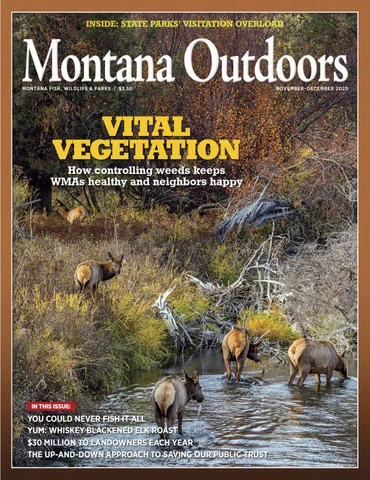
INSIDE: STATE PARKS’ VISITATION OVERLOAD
VITAL VEGETATION
How controlling weeds keeps WMAs healthy and neighbors happy
IN THIS ISSUE:
YOU COULD NEVER FISH IT ALL YUM: WHISKEY BLACKENED ELK ROAST $30 MILLION TO LANDOWNERS EACH YEAR THE UP-AND-DOWN APPROACH TO SAVING OUR PUBLIC TRUST
MONTANA OUTDOORS VOLUME 51, NUMBER 6 STATE OF MONTANA Steve Bullock, Governor MONTANA FISH, WILDLIFE & PARKS Martha Williams, Director FIRST PLACE MAGAZINE: 2005, 2006, 2008, 2011, 2017, 2018 Association for Conservation Information
MONTANA OUTDOORS STAFF Tom Dickson, Editor Luke Duran, Art Director Angie Howell, Circulation Manager
MONTANA FISH AND WILDLIFE COMMISSION Shane Colton, Chair Tim Aldrich Logan Brower Pat Byorth Richard Stuker MONTANA STATE PARKS AND RECREATION BOARD Angie Grove, Chair Erica Lighthiser Mary Moe Betty Stone Scott Brown
Montana Outdoors (ISSN 0027-0016) is published bimonthly by Montana Fish, Wildlife & Parks in partnership with our subscribers. Subscription rates are $12 for one year, $20 for two years, and $27 for three years. (Please add $3 per year for Canadian subscriptions. All other foreign subscriptions, airmail only, are $48 for one year.) Individual copies and back issues cost $4.50 each (includes postage). Although Montana Outdoors is copyrighted, permission to reprint articles is available by writing our office or phoning us at (406) 495-3257. All correspondence should be addressed to: Montana Outdoors, Montana Fish, Wildlife & Parks, 930 West Custer Avenue, P.O. Box 200701, Helena, MT 59620-0701. Website: fwp.mt.gov/mtoutdoors. Email: montanaoutdoors@mt.gov. ©2020, Montana Fish, Wildlife & Parks. All rights reserved. For address changes or subscription information call 800-678-6668. In Canada call 1+ 406-495-3257 Postmaster: Send address changes to Montana Outdoors, Montana Fish, Wildlife & Parks, P.O. Box 200701, Helena, MT 59620-0701. Preferred periodicals postage paid at Helena, MT 59601, and additional mailing offices.
CONTENTS
NOVEMBER–DECEMBER 2020 FEATURES
12 Overwhelmed Visitation increases induced by Covid-19 are pushing Montana’s state parks—already struggling with insufficient staff, limited infrastructure, and growing shoulder season attendance—to their breaking point. By Todd Wilkinson
18 Paying It Back (and Forward) Each year FWP distributes nearly $30 million to Montana landowners in Block Management Program payments, conservation easements, and other wildlife habitat and hunter access programs. By Andrew McKean
22 Awesome Opportunities From walleye and catfish to whitefish and cutthroat, Montana offers up a dizzying diversity of angling action. By Tom Dickson
32 Good Maintenance Makes
Good Neighbors FWP puts a
22
high priority on controlling weeds, building fences, and managing timber on wildlife management areas across Montana. By Paul Queneau
38 A Guiding Light Recent recommendations from the Governor’s Grizzly Bear Advisory Council are helping wildlife managers better understand exactly how Montanans want bears and people to coexist. By Jessianne Castle
DEPARTMENTS
WELCOME SIGN A pheasant hunter returns from a hunt on an eastern Montana Block Management Area. See page 18 to learn how FWP programs like Block Management pay landowners for access and habitat conservation. Photo by Jess McGlothlin. FRONT COVER Cow elk feed along a hidden creek surrounded by healthy vegetation. See page 32 to read how FWP weed control and other maintenance is improving habitat and landowner relations at wildlife management areas across Montana. Photo by Steven Akre.
2 LETTERS 3 TASTING MONTANA Whiskey Blackened Elk Roast 4 OUR POINT OF VIEW Standing Up—and Sitting Down— for the Public Trust
6 10 43 44 45
SNAPSHOTS OUTDOORS REPORT MONTANA OUTDOORS INDEX SKETCHBOOK Respect OUTDOORS PORTRAIT Snow Bunting MONTANA OUTDOORS | 1
LETTERS Lead bullets, dead eagles I just read the story about lead in meat and gut piles and need to tell of something I am guilty of. When predator hunting for coyotes, we always use lead bullets meant to fragment completely so as to not make an exit hole in the pelt. I have always dumped the carcasses for the birds, which I love, not knowing I could be harming them. Thanks for letting me know. I will never do it again.
should demand that they be protected before it is too late. Also, that was a great article on lead and its harmful effects. As a wildlife rehabber for 50 years, I definitely know the effects on raptors, especially eagles. Thank you so much for writing and publishing it. Judy Hoy Stevensville
Dan Hershman Arlee
After reading your article on lead bullets versus solid copper bullets, I have one concern. I wish Mike McTee would have tested the modern premium bonded lead bullets along with the Remington Core-Lokt, which is of the old cup-and-core design that is over 100 years old. It would be interesting to see if and how much lead the newer bullets shed under Mike’s test conditions. Granted, the old bullets are still used, mainly because they are cheaper, but the premium bonded bullets are very popular with a lot of hunters. I have used all three designs, from many manufacturers, and have had excellent results and accuracy from all of them. Doug Crachy Elliston
Mike McTee, conservation scientist for the MPG Ranch in the Bitterroot Valley, replies: Mr. Crachy is correct that bonded bullets are designed to hold together better than lead cup-and-core bullets. Yet they still fragment and the core often separates from the jacket. A 2017 study published in the Wildlife Society Bulletin looked at weight retention of three bullet categories used by more than 5,000 moose hunters in Norway, Sweden, and Finland. The article noted that copper bullets retained more weight
(85–100%) than lead core (74–82%) or bonded lead bullets (75–90%). Lead bullets in general retained less weight when they struck bone (~71%) compared to soft tissue (~77%). Bonded bullets retained more weight on soft tissue than lead core bullets, but, surprisingly, their jackets separated from the core nearly as often as occurred with lead core bullets (11% and 16% respectively).
years after seeing a video on how the lead bullets shatter. But I am also glad that the piece emphasized how lead was impacting other wildlife, like eagles. Also, the CWD piece is a good cautionary piece. One thing you might include in a future article is how predators like wolves and cougars may detect the disease in animals before we humans can detect it. They might be useful in helping to control the disease.
George Wuerthner I read with interest the lead poiLivingston soning article. I am considering switching to no-lead bullets myself after reading several such Who will help the insects? articles. The picture of the poor Great article on the insect apocagolden eagle was touching. I just lypse (“Outdoors Report,” Julyhope that the same concern will August). Article IX of the Monbe shown for all the countless tana State Constitution states, raptors killed every year by “The Legislature shall provide those inefficient wind towers adequate remedies for the prothat mar the landscape all over tection of the environmental life the beautiful state of Montana. support system from degradaI’ll bet the numbers of poisoned tion and provide adequate remedies to prevent unreasonbirds pales in comparison. Phil Allegretti able depletion and degradation Naples, ID of natural resources.” The MonEditor replies: We are now working tana Legislature should be takon an article on wind turbines and ing all necessary steps to protect the state’s native bees, earthwinged wildlife for 2021. worms, spiders, and other inverI commend you for publishing tebrates, which are essential to the CWD article (“To Eat Or Not our environmental life support To Eat,” September-October) system. Sadly, no state agency, and the one on lead. I’ve been including FWP, protects these using copper bullets for at least 15 species in Montana. People
2 | NOVEMBER–DECEMBER 2020 | FWP.MT.GOV/MTOUTDOORS
Crayfish are the ticket In your article “Catfish Crazy” (May-June) a fisherman talks about using shrimp for bait and says that it’s “almost as good” as using crayfish meat. Well, why not use crayfish meat? It’s also considered the top bait for largemouth bass, walleye, big trout, and trophy smallmouth bass (especially in the lower Flathead River below Kerr Dam). To capture crawfish, all you need is a valid fishing license and a regulation trap, no larger than 24 by 12 by 12 inches. In Montana, there is no season and no limit, though commercial fishing for crawfish is not allowed. The best bait for catching crayfish (also spelled “crawfish”) is liver. In my experience, the best places to catch them in western Montana are Noxon Reservoir and Lake Mary Ronan. Ed Ritterhousen Polson
Not a dinosaur Your article on Makoshika State Park (“Dino Destination,” September-October) contained a descriptive error. The mosasaur was a marine reptile, but not a dinosaur. For most folks the distinction is not a big deal. A lot of people think that pterodactyls were dinosaurs, too; they were not. The Jurassic Park movies blurred a lot of details. Aleen Kienholz Gallatin Gateway
TASTING MONTANA
Whiskey Blackened Elk Roast By Ben Long I Preparation time: 1 hour I Cooking time: 6 hours I Resting time: 10 minutes
Note: For this recipe, you’ll need a heavy roasting pan with a lid. INGREDIENTS 3–5 lb. elk roast 5 cloves garlic, peeled and cut into slivers 1 large yellow onion, cut lengthwise into slivers (optional) 1 c. vinegar (any type) 5 T. vegetable oil 2 c. strong brewed coffee 2 c. water ½ c. whiskey* Salt and pepper *Don’t worry about the alcohol. It evaporates, but the whiskey flavor continues to enhance the meat.
DIRECTIONS With a knife, cut two dozen or so slits halfway into the meat. Insert slivers of garlic (and onion, if you like).
SHUTTERSTOCK
T
hanksgiving is my favorite holiday because I believe gratitude, which this day celebrates, is something to be cultivated, like a tree in an orchard. Some years when the frost is deadly, when the rains are sparse, and when the soil seems depleted, it pays to foster a bit of gratitude. To remember the blessings that come despite all our bad luck and poor choices. To give thanks for our good fortune. The holiday season reminds me of all the rare things we have to be grateful for here in Montana. It comes at an opportune time: the tail end of general big game season, for which I am grateful. I am grateful also to live in a place and time when we have the freedom to roam the wilds and enjoy abundant fish, wildlife, and their habitats. And I am grateful to have friends to share it all with, friends who happen to be better elk hunters than I am, and who are generous enough to share when my luck runs out. Food, friendship, and time outdoors are all meant to be savored. To rush any of it is to miss the point. Food—especially when gathered by your own hand from the natural world—is more than fuel for the body. It’s nourishment for the soul and is well worth taking your time to savor and enjoy. By far, my favorite “slow food” recipe is this Whiskey Blackened Elk Roast, which I learned to prepare from my dear friend, retired Whitefish schoolteacher Mary Sloan. Her late husband Gary was one of those old-timers who filled an elk tag nearly every year for decades. Just the thought of how this elk roast turns out— the feast of aroma, flavor, and texture—makes me grateful that Gary and Mary have been a part of my life. And of course, grateful for the elk, both in the freezer and roaming the wild. —Ben Long is a writer in Kalispell.
Put the roast in a glass or ceramic bowl. Pour vinegar over the top and into the slits, turning for full coverage. Cover and refrigerate for 24 hours. The next day, discard the vinegar solution and pat the meat dry with paper towels. Over medium-high heat, heat the oil in a heavy roasting pan. Add the roast and brown until nearly burned on all sides. Reduce heat and pour coffee over the roast, being careful of hot oil spatters. Add water and whiskey, cover, and simmer for about 6 hours atop the stove. (Alternatively, roast the meat, after browning and adding the liquids, in an oven preheated to 285 degrees.) Twenty minutes before serving, season with salt and pepper. Remove the roast and let it rest 10 minutes before carving and serving. Meanwhile, heat the pan until the remaining liquid begins to bubble. Use a wooden spoon to scrape up any brown bits. Serve this as a sauce atop the roast or over potatoes, or thicken it into a gravy with flour or cornstarch, whisking briskly to blend, then heat until bubbling. n
MONTANA OUTDOORS | 3
OUR POINT OF VIEW
Standing up—and sitting down— for the public trust
O
ver the past year I’ve used this column to explain the public trust concept, the notion that certain natural resources are so important to everyone that they must remain in public hands. This American ideal also maintains that government is responsible, through agencies like Montana Fish, Wildlife & Parks, for stewardship of public lands, waters, and wildlife for everyone’s fair and equitable enjoyment today and far into the future. People who care about the public trust—both inside and outside our agency—often ask, “What can we do to protect it?” My answer: We need to stand up for the public trust—and, even more importantly, know when to sit down. Standing up means opposing those in Montana and nationwide who want to privatize public lands, pollute water, relax protections for endangered and migratory wildlife, and reduce public access. In the past, it meant fighting for Montana’s Stream Access Law and against efforts to build a dam on the Yellowstone River that would have turned Paradise Valley into a massive reservoir. These and others were worthy battles. But too often fighting is ineffective. Conservation advocacy framed as battle produces winners and losers. And when those on an opposing side lose, they often don’t give up. They regroup, bide their time, and fight to take back what they lost. Which creates new losers. Back and forth it goes, decade after decade, with no lasting progress for land, water, or wildlife. Too many members of Montana’s conservation community favor this strategy. Unfortunately, their inflexibility damages the vital relationships we need to cultivate with landowners and other Montanans. It creates an “us versus them” dynamic that closes the door to compromise and the steady progress that comes from building trusting, mutually respectful relationships. What I’ve found over the past nearly four years as FWP director, during my time as legal counsel for the department, and as a professor of natural resources law, is that a far more successful—and sustainable—strategy is to simply sit down. By that I mean having the courage and patience to sit down with others who have a stake in a wildlife, fisheries, lands, water, or access issue. I mean respectfully and intentionally listening and hearing—the ultimate sign of respect—and putting in the time to build trust. I mean checking egos at the door. Remember: Public trust resources belong and matter to everyone. Yes, constant disagreements over management—whether the issue is grizzlies, walleye, trout, or elk—can be exhausting and frustrating. But they are certainly not surprising. The debates and tension come from people caring so strongly about Montana’s public trust resources. (It would be far worse if no one cared, which
4 | NOVEMBER–DECEMBER 2020 | FWP.MT.GOV/MTOUTDOORS
increasingly is the case in many other states.) It’s our job at FWP to channel those passions in a direction that benefits everyone. The hard work of listening I know sitting in meetings, finding common core values, and working to reach agreement sounds dull and difficult. It’s far easier and more exciting to raise the flag and wade into the fray, right? To vilify and defeat the other tribe. To claim victory! Yet again and again I’ve seen that the most lasting conservation accomplishments come from bringing together those with a stake in an issue: stockgrowers, wilderness advocates, hunters, anglers, outfitters, business owners, civic leaders, and others. Once in the same room, everyone works to understand each other’s perspec-
STANDING UP FOR WHAT’S RIGHT Sometimes protest is called for, like in 2017 when hunters and others crowded the Montana state capitol to demand that public lands remain in public hands.
tives. It’s not easy. It requires curiosity, a desire to understand why others believe what they do. But it’s essential. Reaching mutual understanding and respect is the only way to get at what we all have in common and begin to chart a path forward. Coalitions of earnest, open-minded, solution-seeking Montanans are why the Blackfoot Valley is home to more grizzly bears than subdevelopments. They are why there’s an additional 275,000 acres of wilderness and conservation lands on the Rocky Mountain Front, and why so many eastern Montana ranchers are willing to change the way they graze cattle in ways that sustain native grassland wildlife. I believe that the biggest challenge for all of us wishing to protect
LEFT TO RIGHT: THOM BRIDGE/HELENA IR; THOMAS LEE
SITTING DOWN TO LISTEN But in many cases, more can be gained— and sustained—by sitting down with others who have different values, listening to each other, and finding common ground.
the public trust is the paradox of doing two often-contradictory things: fight when necessary, but also meet with those on the other side of an issue and understand their point of view. We don’t all have to agree, but we do need to acknowledge that they, like us, have fears and concerns. We need to show humility and recognize each other’s inherent dignity. Then we can collectively use the shared understanding and trust as a foundation on which to build progress. How do we know when to hold firm and when to work cooperatively? When to stand up and when to sit down? I believe the times when Montana’s conservation community should stand firm are whenever we face a net loss in the integrity of, access to, or capacity to manage public trust resources. By integrity, I mean immediate threats to land, water, and wildlife, and their sustainability. By access, I mean actions that reduce the public’s ability to use these resources. By capacity to manage, I mean anything that weakens FWP and other agencies entrusted with the stewardship of public trust resources. And by net loss, I mean that sometimes we need to be willing to give something up to get more back. That might mean exchanging some public land for property even more valuable to wildlife and public access. Or providing a landowner with a bull tag in exchange for allowing public cow elk hunting to hundreds of hunters. I don’t mean we ever cave in or give up the farm. We must remain true to the principles of personal and professional integrity and stay dedicated to preserving the public trust concept. But sometimes we need to allow for some wiggle room. Like a ponderosa pine In addition to knowing when to speak up and when to listen, those of us who care about safeguarding the public trust also must be more flexible. Our world is increasingly complex, volatile, and uncertain.
What we did yesterday may not work today. We need to adapt. Wildlife managers are familiar with the concept. They adapt management of waterfowl, mule deer, elk, and other species to changes in climate, hunter harvest, habitat, and populations. We need to apply this approach to managing contentious issues and changing demographics. That means gathering more and better information—about people as well as fish and wildlife—and then adjusting management strategies accordingly. An example is finding ways to welcome—and gain conservation support and funding from—Montana’s growing number of kayakers, innertubers, mountain bikers, and hikers. Staying flexible while remaining true to our values and principles requires FWP and Montana’s conservation community to be like a ponderosa pine. We must remain rooted in our core beliefs, our allegiance to the public trust, and the foundation built by listening to and respecting others. Yet we must also be flexible enough to absorb even the strongest winds. Because if we don’t, we will be uprooted and blown over. Previous generations gave us a great gift of the rivers, prairies, forests, wildlife, parks, and fish that we enjoy today. It’s our responsibility to take what they bequeathed and continue Montana’s long and proud heritage of stewardship excellence. But we live in a new era, one that demands new thinking while building on our best traditions. Effective stewardship in Montana today requires us to be both rooted and flexible, to oppose actions that degrade the public trust while working with those on the other side of the fence to create lasting solutions. This is how conservation and stewardship will succeed. This is how we honor and protect the public trust. —Martha Williams, Director, Montana Fish, Wildlife & Parks MONTANA OUTDOORS | 5
SNAPSHOT
6 | NOVEMBER–DECEMBER 2020 | FWP.MT.GOV/MTOUTDOORS
Mike Anich, a professional wildlife and landscape photographer who lives in the Bitterroot Valley near Darby, was hiking on one of his regular winter routes near Lake Como when he spotted this whitetail buck and doe up ahead. “I squeezed off a couple of shots, and then they were gone, and that was it,” he says. “I don’t have much else to say about the photo, other than I like it.” n MONTANA OUTDOORS | 7
SNAPSHOT
Every winter, flocks of Bohemian waxwings descend on towns across Montana to feed on mountain ash berries. Lee Nelson, a retired FWP fisheries biologist and amateur photographer, shot these waxwings as they were devouring berries from the ash in his yard last February. “There were hundreds of them in the flock,” he says. “They were moving so fast that I put my camera on its fastest shutter speed and started firing away, hoping I could get at least some of the birds in focus.” Of the roughly 1,000 photos Nelson took that afternoon, only a handful turned out. “With this particular shot, I was lucky,” he says. “I like how the birds look like a squadron of fighter jets, and how that one at the top seems to look right at you.” n
8 | NOVEMBER–DECEMBER 2020 | FWP.MT.GOV/MTOUTDOORS
MONTANA OUTDOORS | 9
OUTDOORS REPORT FISH HABITAT
Old bridge timbers help fish
4
Minimum inches of ice needed to walk safely across frozen water.
Migratory bird protections retained “It is not only a sin to kill a mockingbird, it is also a crime. That has been the letter of the law for the past century,” U.S. District Court judge Valerie Caproni wrote in her August 2020 ruling that a recent Department of the Interior legal opinion weakened the Migratory Bird Treaty Act [MBTA]. In her ruling, Judge Caproni found that the revised policy does not align with the intent and language of the 100-yearold law. Instead, she wrote, it “runs counter to the purpose of the MBTA to protect migratory bird populations” and is “contrary to the plain meaning of the MBTA.” The decision results from a series of lawsuits brought in 2018 by the National Audubon Society, several other conservation groups, and eight states.
By using the free salvage timbers, donated by MDT and FWP, landowners can afford to build stream crossings that allow fish to easily move underneath. Landowners only need to provide abutments and decking for the bridge. The timber bridges not only help with fish passage, they also improve a stream’s ecological function, sustain invertebrates and other aquatic life, and often last decades longer than culverts. McGree says that over the past 20 years, salvaged bridge stringers have been used on
High flows going through a small culvert create a fire hose effect. The water velocity is too much for fish. 160 to 200 private land stream crossings in western and central Montana near Missoula, Wisdom, Dillon, Butte, Helena, Great Falls, and Livingston. “For instance, one crossing that was recently installed on a tributary of the Big Hole is now allowing Arctic grayling to move to and from the river,” she says. n
A small culvert on Brewster Creek, a major tributary of Rock Creek southeast of Missoula, blocked upstream fish movement. Trout Unlimited, using salvage bridge stringers from the Montana Department of Transportation and funding from FWP, helped the landowner replace the culvert with a bridge that opens up six miles of prime spawning and rearing habitat. 10 | NOVEMBER–DECEMBER 2020 | FWP.MT.GOV/MTOUTDOORS
CLOCKWISE FROM TOP LEFT: CARTOON BY MIKE MORAN; LEWISTOWN PUBLIC LIBRARY; SHUTTERSTOCK; MONTANA FWP; MONTANA FWP; SHUTTERSTOCK
F
or two decades, FWP and the Montana Department of Transportation (MDT) have teamed up to transform bridge stringers, or timbers, into fish habitat improvements. “It’s such a great way to reuse materials to benefit fish and streams, and most people haven’t heard about it,” says Michelle McGree, who runs FWP’s Future Fisheries Habitat Improvement Program. Stringers are wooden beams that were installed over piers and abutments to create highway bridges in the mid–20th century. Each year, MDT crews replace aging bridges across Montana, resulting in surplus stringers. Private landowners can use these stringers to help build bridges over streams on their own property, instead of relying on metal culverts. Culverts are inexpensive and easy to install, but fish often struggle to move upstream through them, especially if the structures are too small in diameter. “High flows going through a small culvert create a fire hose effect,” McGree explains. “The water velocity is too much for fish.” Small culverts also can’t handle floodwaters, which then erode the bank next to or downstream of the structures. “Sometimes a culvert gets washed out and then the stream widens,” McGree says. Widening makes a coldwater stream shallower, causing it to warm more quickly in the summer sun.
OUTDOORS REPORT
What the Camp Freezout stagecoach stop might have looked like in the 1880s.
WILDLIFE MANAGEMENT AREAS
How Freezout lost its “e”
R
egular readers of Montana Outdoors and other FWP publications who see “Freezout Lake” may think they’ve caught a typo. Not so. Freezout, with no “e” after the “z,” is the original name. Even though it looks weird and implies that FWP staff don’t know how to spell, the agency is sticking with tradition. “It’s a never-ending battle, but we try to correct people whenever we can, even the same people more than once,” says Brent Lonner, an FWP wildlife biologist whose work area includes Freezout Lake Wildlife Management Area (WMA). Freezout Lake, at the center of the WMA, is a 12,000-acre basin 35 miles northwest of Great Falls. The alkali lake was naturally fed with snow and rain runoff but historically went completely dry during drought years.
Now the lake is also fed by irrigation runoff from surrounding barley and other crop fields. In the mid-20th century, a system of dikes and ditches was built to regulate water levels in ways that benefit waterfowl and shorebirds and eliminate highway and railroad flooding. The earliest record of the lake’s name and unique spelling originated during the late 1800s when a few soldiers stationed at nearby Fort Shaw (established in 1867) were caught in a blinding blizzard while traveling in the area. It has been called Freezout Flats, later changed to Freezout Lake, ever since. In 1885, a stagecoach stop was established in the area and apparently was named Camp Freezout or Freezout Way Station. Some travelers spending cold nights at the desolate station would play a variation of
The USGS map above shows FWP’s “Freezout” spelling for the state game management area (actually, wildlife management area) and the USGS spelling of “Freezeout” for the lake.
poker they called Freezout while tending the stove. Among early visitors to Camp Freezout were Western artist Charles M. Russell and Brother Van, an early missionary in the area. In his letters, Van recalled seeing herds of bison watering at the lake. Don Childress, head of the FWP Wildlife Division from 1990 to 2006, says the department has stuck with the original spelling since it first acquired the area and made it into a WMA in the 1950s. “The U.S. Geological Survey (USGS) also used that spelling for years on its maps. But at one point someone there must have decided it was a misspelling and added the ‘e’ to the name on the official USGS map.” Lonner says FWP has no plans to add the missing vowel. “We like using the historical spelling. It provides a unique link to bygone times in Montana history,” he says. n
169-year-old Confederate bird name changed The American Ornithological Society (AOS) recently announced it is renaming the McCown’s longspur. The small prairie bird native to eastern Montana and elsewhere in the northern Great Plains was originally named after Confederate general John Porter McCown, a defender of slavery and anti-Indian aggression. The bird was named for McCown in 1851 after the amateur birder sent a specimen, the first recorded for science, to an ornithologist friend. It will now be known as the thick-billed longspur. Since 2018, many ornithologists have been trying to sever the bird’s name from McCown, who, in addition to fighting to preserve white supremacy, went to war against the native Seminole people. “All races and ethnicities should be able to conduct future research on any bird without feeling excluded, uncomfortable, or shame when they hear or say the name of the bird,” reads a 2019 petition from the AOS classification committee. “This longspur is named after a man who fought for years to maintain the right to keep slaves, and also fought against multiple Native tribes.” n MONTANA OUTDOORS | 11
Visitation increases induced by Covid-19 are pushing Montana’s state parks—already struggling with insufficient staff, limited infrastructure, and growing shoulder season attendance—to their breaking point. BY TODD WILKINSON
Todd Wilkinson is a journalist in Bozeman and the author of Grizzlies of Pilgrim Creek: An Intimate Portrait of 399, the Most Famous Bear of Greater Yellowstone. 12 | NOVEMBER–DECEMBER 2020 | FWP.MT.GOV/MTOUTDOORS
TOMMY MARTINO
M
arina Yoshioka knew it would be a challenging day when she looked out the window of her office at Cooney State Park, 35 miles southwest of Billings. It was May 1, 2020, and the park manager was preparing for the season’s first weekend of overnight camping. “I could see a line of vehicles with impatient people waiting to get in,” Yoshioka says. “I would describe what followed as a morning of unpleasant chaos.” As she left her office, the 30-something state parks manager was confronted by a man furious that all the park’s campsites were already occupied. “He pushed his fingers into my face and screamed obscenities that I will not repeat,” Yoshioka says. Other visitors also were rude and insistent. Some honked, demanding to enter the park before the gates opened. In the weeks that followed, behavior at Cooney pushed Yoshioka and her staff nearly to the breaking point. Daily and weekly attendance broke record after record, as people from nearby Billings and elsewhere fled Covid-19 confinement for the scenic reservoirside park, nestled in the foothills of the Beartooth Mountains. Rowdy visitors tore down cedar fencing and used the wood to make campfires. Hooligans driving off-road tore up a sagebrush meadow. Drunk and sober visitors unwilling to wait in line relieved themselves outside vault latrines. “We dealt with human waste issues every day,” Yoshioka says, wincing at the memory. The state parks deluge happened elsewhere across the state too. Staff at the already overcrowded Wayfarers State Park on Flathead Lake reported daily visitation “unlike anything they’d ever seen before,” says Dave Landstrom, Montana Fish, Wildlife & Parks’ northwestern region parks manager. Along Whitefish Lake, the single volunteer who staffs the popular Les Mason State Park worked from noon until well past dinnertime seven days a week, week after week, trying to manage unprecedented crowds. “Many of our people were
IN THE THICK OF IT Masked up as a Covid-19 precaution, Placid Lake State Park manager Ryan Sokoloski surveys the crowded beach during a midsummer weekend day. Like many state park staff, Sokoloski was caught unprepared for the visitation crush as pandemic-weary Montanans and tourists turned to nearby parks for outdoor recreation relief.
MONTANA OUTDOORS | 13
working 16-hour days,” says Beth Shumate, head of the FWP Parks Division. “They had no relief. Some volunteers said they couldn’t take it anymore and left.” Many visitors ignored “parking full” signs, illegally leaving their vehicles in barrow pits or along county roads. At Fish Creek State Park near Alberton, campers parked wherever they desired. They crushed vegetation with their tires, cut down trees for wood, and defecated along roadsides. Park manager Colin Maas closed one popular trail at Sluice Boxes State Park that was severely eroding, “but people walked right past the closure sign and used it anyway.” In many state parks, tempers flared. At Lewis & Clark Caverns, employees had to turn away visitors after limiting cave tour group size to comply with new health guidelines. “One person told me we ruined their vacation,” says Julia Smit, a park ranger. OBSTRUCTION Cooney State Park manager Marina Yoshioka pleads with a driver at Cooney State Park near Billings to abide by parking regulations during a weekend rush. Covid-19-related stress and months of indoors isolation this past summer seemed to bring out the worst in some visitors.
Sluice Boxes, Cooney, Madison Buffalo Jump, Missouri Headwaters, Milltown, Ackley Lake, and Makoshika. “If it was within a half-hour drive from town, people went there in droves,” says Shumate. Adding to the frustration for staff were new sanitation requirements to comply with state Covid-19 guidelines. Each day park employees and volunteers wearing plastic suits and masks spent hours disinfecting countertops, handrails, restrooms, and pit latrines in addition to their regular maintenance and customer service duties. There was something else, too. Perhaps
Many of our staff were working 16-hour days. They had no relief. Some volunteers said they couldn’t take it anymore and left.” some even saw slightly fewer visitors due to the sharp decline in school groups, field trips, and interpretive program presentations. But nearly 80 percent of Montana’s 55 state parks, especially those near cities, saw increased visitation over last year, including Flathead Lake, Salmon Lake, Placid Lake,
due to Covid-19-related stress, many visitors acted belligerently, leaving employees feeling threatened and vulnerable. “During weekends, some parks with just one or two staff were dealing with hundreds and in some cases a thousand or more people, many of them angry and unwilling to follow
14 | NOVEMBER–DECEMBER 2020 | FWP.MT.GOV/MTOUTDOORS
rules,” Shumate says. Despite the problems, Shumate is quick to note that the vast majority of visitors behaved themselves. “And it was great to see more people enjoying their state parks,” she adds. “It’s just that we didn’t have the capacity to absorb the increase.” DECADES OF SHORTAGES Montana’s state parks, each a source of pride and commerce for local communities, were already struggling from decades of insufficient staff and funding. In Great Escapes: Montana’s State Parks, published in 1988, former FWP Parks Division administrator Don Hyyppa lamented that “the number of state parks and the amount of use they receive by Montanans and their guests have outpaced our ability to properly manage them.” A 2019 Montana Outdoors article (“Behind the Curtain”) documented how park visitation had risen by more than 50 percent since 2008 while funding barely increased and staffing remained flat. At the time, just 98 employees covered the entire state and managed 2.5 million annual visits. In that article, Montana State Parks and Recreation Board chair Angie Grove pointed out that, lacking sufficient paid staff, far too
CLOCKWISE FROM UPPER LEFT: JOHN WARNER; TOMMY MARTINO; TOMMY MARTINO
THE OUTDOORS ESCAPE What accounts for the visitation onslaught? FWP officials point to huge numbers of homebound Montanans who heeded advice to social distance in the great outdoors. With national parks and federal campgrounds shuttered early in the season, state parks absorbed the full brunt, only to see pressure intensify as summer wore on. What’s more, summertime youth sports events were canceled, driving even more families to nearby parks for convenient, lowcost outdoor recreation. “Last year [2019] broke all records for state parks attendance, and January through June of this year was 25 percent higher than that,” Shumate says. Not all parks reported increases, and
LINED UP Top: At Milltown State Park near Missoula, a parking area recently upgraded to accommodate 200 vehicles was hit with up to 500 on weekend days as innertubers arrived to float the Clark Fork River. Left: FWP’s Brett Zarling scrubs the floors in a bathroom at Placid Lake State Park.
growth of spring and fall “shoulder season” visitation. “It used to be that Memorial Day and Labor Day were the start and end of people going to state parks,” Shumate says. “Now they are coming in March and April and in September and October. We don’t have staff to accommodate that.”
many parks relied on volunteers who couldn’t be asked to handle medical emergencies, deal with campground conflicts, or write resource-management plans. “We can’t continue to expect volunteers to make
up for those shortages,” she said. Each year, the hours that volunteers contribute equal that of 20 full-time staff. Adding to the burden facing state parks managers over the past decade has been the
STILL WORKING AT MIDNIGHT On an early Saturday morning in August, I meet a fatigued Ryan Sokoloski at Placid Lake State Park 30 miles northeast of Missoula. Standing on a rickety dock in need of repair, we watch several kids fish for bass. A long line of SUVs pulling boat trailers is backed up waiting to unload at the ramp. By noon, the campground is full, with some sites packed with a dozen or more people where only eight are allowed. At the park’s perimeter, vehicles that can’t find space MONTANA OUTDOORS | 15
inside illegally leave their vehicle on the A SYSTEM IN TROUBLE shoulder of a county road. Meanwhile, Chris Smith, retired FWP chief of staff who visitors crowd around the park’s official serves on the board of the Montana State “office”—an entrance station barely bigger Parks Foundation, believes that park employthan a phone booth—which serves as a ees’ selfless commitment, while admirable, fee-collection post, home base for the park may actually add to the problem. Dedicated ranger and groundskeeper, staging area managers and volunteers continue to find for the two campground volunteers, and ways to consistently deliver services “but campground reservation center. Two peo- without the funding and staffing they so desple can barely fit inside. perately need,” he says. Now, with employees Sokoloski points to a particularly vexing burned out and the toll of deferred mainteproblem this summer: an increase in people nance like failing sewage and electrical syscamping on nearby national forest and other tems raising safety and health issues, a recreation lands who drive to the park to use reckoning has arrived. “Montana’s state park the bathrooms and dump their garbage. system has never faced a challenge like the Like other state parks staff, Sokoloski isn’t one it’s seeing right now,” Smith says. comfortable complaining about this year’s What does that system require? As has crush of visitors and his lack of staff to man- been the case for years, state parks’ greatest age the increase. “Complaining isn’t in our necessity is sufficient resources to serve the DNA,” he says. “We want our guests to have hundreds of thousands of people who visit a great time. We’re about solving problems.” each year to have fun and learn about MonLacking bodies to help meet the growing tana’s storied past and diverse cultures. need, however, requires Sokoloski to ask “We’ll definitely have to continue reexamineven more of himself. As of this afternoon, ing staffing needs to address the visitation the park manager tells me, he hasn’t had a issue, which isn’t going away,” Grove says. completely work-free day off in 90 days. Another vital need: additional funding “Many nights I’m out here after dark, when to fix ailing water systems, sewers, electrical most of our guests are finally asleep, check- lines, RV dumping stations, docks, roads, and ing the water system or lighting. It’s the only other infrastructure. “Infrastructure is such a time I have available,” Sokoloski says. challenge, because there’s so much of it that
people don’t see. But it’s necessary and it’s expensive,” Grove says. She notes that updating an old, leaking sewer system at a single park can cost $1 million. There’s hope the appeals will be heard. Shumate points out that state lawmakers in 2019 were receptive to requests for infrastructure maintenance funding. “We were grateful to secure $2 million last session and are making a similar request for 2021,” she says. Based on trends, Grove and Shumate say they don’t think 2020 is a one-off year. Park attendance, especially during the off-
Game wardens and fishing access site crews catch their breath State parks staff aren’t the only FWP employees reeling from the recent outdoor recreation boom. Dave Loewen, chief of the agency’s Enforcement Division, says that because state parks staff aren’t authorized to handle illegal parking, vandalism, disorderly conduct, and other criminal behavior, they have had to call on game wardens to help. “We beefed up high-profile patrols so that people at the parks and fishing access sites could see our wardens out there, which helps keep violations down,” Loewen says. “All that came on top of our regular enforcement duties, so it definitely was a challenge keeping up.” Dustin Ramoie, who manages FWP’s Fishing Access Site (FAS) Program, says his field crews report spring and summer usage up 30 to 50 percent from previous years. “Demand for these sites has been through the roof,” he says of the 339 water recreation sites across the state. On the front lines were FAS crews cleaning pit latrines, picking up trash, and maintaining properties. “We have such a dedicated staff, and fortunately not one has gotten Covid-19, even though they are in those latrines every single day, hour after hour,” says Ramoie. Though visitation at some state parks and fishing access sites slowed down after kids headed back to school in September, Loewen predicts another NO VACANCY Vehicles fill every space at the Wolf Creek upsurge once hunting season begins. “And I don’t Bridge Fishing Access Site on the Missouri River. “I don’t see any letup next year, either” he adds. “We’ve expect any letup next year, either,” says Dave Loewen, recruited all these new visitors to our sites, and I FWP Enforcement Division chief. expect many will be back.” n 16 | NOVEMBER–DECEMBER 2020 | FWP.MT.GOV/MTOUTDOORS
CONSTANT CRUSH Far left: Park ranger Ben Dickinson checks day-use fee packets at Milltown State Park. Left: A few hours later, Dickinson takes a break from cleaning bathrooms at Frenchtown Pond State Park. Below: Marina Yoshioka ends a long day in her office at Cooney State Park. “Nobody should have to put up with what we faced this year,” she says.
She remains committed to public service and enjoys seeing people find joy and restoration in the natural world. But this past season has taken its toll. “I love Montana and I love our parks, but nobody should have to put up with the abuse and challenges we faced this year,” Yoshioka
says. “The most valuable assets of our parks, besides the special settings, are the people who commit themselves to doing a great job, often under very troubling circumstances. But we need help. And if we don’t get it, good employees will leave and the parks will be even worse off.”
CLOCKWISE FROM UPPER LEFT: TOMMY MARTINO; TOMMY MARTINO; JOHN WARNER; MONTANA FWP
seasons, has been growing for years. Now that thousands of additional people have seen the wonders of Montana’s state parks for the first time, many will no doubt return. That’s something Yoshioka doesn’t want to think about right now. Back at Cooney, the park manager is weighing her options.
MONTANA OUTDOORS | 17
PAYING IT BACK (AND FORWARD)
Each year FWP distributes nearly $30 million to Montana landowners in Block Management Program payments, conservation easements, and other wildlife habitat and hunter access programs. BY ANDREW MCKEAN
T
he way Joe and Betsy Purcell see it, hunters saved their Bitterroot Valley ranch. Just days after the Purcells accepted a 2017 Montana Neighbor Award from Governor Steve Bullock, a forest fire roared down from Lolo Pass. The U.S. Forest Service, trying to save homes farther down the valley, set a backfire on the Purcell Ranch. After the embers were quenched and the smoke had cleared, the couple began the hard work of restoring their property. “Just as we were figuring out where to start, here shows up a group of hunters, asking how they can help,” Joe Purcell says. “Within 24 hours of that first group, hunters from all over the state and country started showing up here. Without those hunters, and without Block Management that brought them to us, we would never be upright and going now, three years after the fire.” The Purcell Ranch has been enrolled in the Montana Fish, Wildlife & Parks’ Block Management Program for the past dozen years. Hunting is managed a little more intimately on their ranch than in other places— Andrew McKean is the hunting editor for Outdoor Life. He lives with his family on a ranch near Glasgow.
limited to three hunters per day, and the farmers, and other property owners across Purcells greet each one, often with baked the state. The money is a combination of goods—but the idea is the same as in Scobey funds generated by hunting licenses, a or Dillon or anywhere else you’ll find Block federal tax on guns and ammo, and federal Management enrollees. Landowners receive and private organization grants that flow a payment from FWP to compensate for through FWP to landowners to provide pubtheir time and the wear and tear on their lic access, enhance habitats, and conserve properties that comes from daily visits by natural landscapes. hunters. The more hunter days a landowner The department administers so many provides, the more funding they’re eligible to accounts and distributes so many payments receive, up to an annual cap of $15,000. through various programs that it takes a Block Management is funded mostly by sharp-eyed auditor to keep track of it all. nonresident big-game license revenue and “We have multiple documents with many the base hunting license fee required as part pages, detailing all the programs, the various of most Montana hunting licenses. Other sources of funds, and then how those funds funds come from special tags like the popu- are paid,” says FWP’s Hunting Access Bular Super Tag raffle. In 2019, more than reau chief, Jason Kool, who has a graduate 1,200 landowners enrolled 7.1 million acres degree in natural resources. “But for this job, of private and isolated public land in Block a degree in accounting would probably be Management. During the three-year period just as useful.” ending that year, FWP paid Block ManageKool has more programs to track all the ment cooperators an average per year of time. As an example, the 2019 Montana more than $5.5 million in direct cash pay- Legislature created the Public Access Land ments, plus another nearly $2 million per Agreements Program and directed FWP to year in services. find and pay landowners who provide access Block Management is only the most visi- to otherwise inaccessible public land. That’s ble and popular landowner program that in addition to the Unlocking Public Lands, FWP administers. During the past three Access Public Lands, Managed Access Sites, years, the department has distributed FWP Livestock Loss Reimbursement, Renearly $30 million annually to ranchers, gional Access Projects, and Game Damage
18 | NOVEMBER–DECEMBER 2020 | FWP.MT.GOV/MTOUTDOORS
MORE THAN MONEY Betsy and Joe Purcell at their Bitterroot Valley ranch. “It’s never been about the money,” says Joe about the couple’s participation in Block Management. “We’re in it because it’s a way we could give back to people and give them a chance to have a positive outdoor experience.”
TOMMY MARTINO
Programs. Most landowners who participate in these programs receive payments from the state via FWP.
Just as we were figuring out where to start, here shows up a group of hunters, asking how they can help.”
KEEPING RANCHES INTACT The eyes of someone without an accounting degree might glaze over looking at all these balance sheets. But each program plays a vital role in Montana’s tradition of public hunting chase parcels overlooking the river, she also and ensures that landowners are recognized saw the easement as a way to prevent the and compensated for the public hunting visual degradation that she, her husband access and wildlife habitat they provide. Jim, and their neighbors feared. “For people One such landowner is Cindy Kittredge, who have lived most or all of their lives on a who placed an FWP conservation easement ranch, there’s a visual and psychic loss of on her family’s 2,200-acre ranch outside familiar landscapes as new houses are built Cascade in 2007. She wanted to protect the and viewscapes change,” Kittredge says. property from the creeping exurban sprawl “We wanted to conserve the viewscape as of Great Falls, 20 miles downstream on the much as we wanted to be stewards of the Missouri River, and maintain her family’s land and water habitat and keep our ranch farming and ranching heritage. With real operational.” estate agents and others calling or knocking Funds to purchase the Kittredges’ Bird on the door every few weeks offering to pur- Creek Ranch conservation easement came
from FWP’s Habitat Montana and Migratory Bird Wetland Programs. Several conservation groups including Ducks Unlimited and Pheasants Forever pitched in, too. “FWP was critical in providing the funding we needed to operate a working ranch, and to protect things like vistas, while also giving us the financial flexibility to create a trust fund for our land,” Kittredge says. “Without FWP, we might have been forced to sell to housing developers.” A glance at a department spreadsheet (see page 21) shows that during 2017, 2018, and 2019, FWP and other funders paid landowners a total of about $20 million per year for conservation easements alone. More than $16 million of that came from competitive grants through the USDA’s Forest Legacy and Agricultural Conservation Easement Programs, and from nongovernmental sources. “For every hunting license dollar we spend from Habitat Montana, MONTANA OUTDOORS | 19
YEAR-END BONUSES In an FWP conservation easement, the landowner restricts certain development on the property—such as subdividing parcels, plowing native grasslands, or leasing land for hunting—in exchange for a one-time payment of roughly 40 percent of the property’s value. That cash, which can be substantial given Montana’s skyrocketing property values, helps ranchers stay on their land and can even reduce and pay inheritance taxes. While the money is essential for landowners selling a conservation easement, cash compensation is rarely the main incentive for those entered in Block Management. “We’d probably be doing this even without
payments,” says Purcell. “But every little bit helps. Those Block Management checks go to buy more fenceposts and fence wire. But it’s never been about the money. I raised my son by hunting on land in the Block Management Program, but across the [Bitterroot] valley, I see more ‘No Hunting’ signs going up all the time. We’re in Block Management because it’s a way we could give back to people and give them a chance to have a positive outdoor experience.” At the other end of the state, Lee Cornwell has been a Block Management participant since the program’s inception. His family-owned ranch near Glasgow receives a little over $10,000 each year in compensation for providing hunting access to about 15,000 acres of private property. “Our ranch has so much federal and state land in it, even if you wanted to be a jerk and keep people off, you probably couldn’t,” says Cornwell, who serves on FWP’s Private Land/Public Wildlife Council. “We’re in Block Manage-
Without FWP, we might have been forced to sell to housing developers.”
KEEPING THE FAMILY FARM Cindy and Jim Kittredge say real estate agents and even passersby regularly offer to buy parcels of their ranch that provide views of the nearby Missouri River.
20 | NOVEMBER–DECEMBER 2020 | FWP.MT.GOV/MTOUTDOORS
Yes, FWP pays property taxes Contrary to popular belief, FWP pays property taxes on almost all of its holdings. In addition to payments to landowners, each year FWP pays Montana counties a total of roughly $875,000 in property taxes, mostly for wildlife management areas but also for fishing access sites, state parks, and administrative office sites owned by the agency.
ment because it’s what we’d be doing anyway. We’ve been here for 100-some years. A lot of the families that hunt our place have been hunting here about that long.” Cornwell uses the ranch’s Block Management check to pad the year-end bonuses his ranch hands receive. “I hate to say it, but by participating in Block Management, we sometimes have to put up with a bunch of nonsense from hunters,” Cornwell says. “Actually, it’s our employees who put up with the nonsense, so it makes sense to give them a little something extra for putting up with me, but also with those hunters.” Because payments are calculated annually for each of the roughly 1,300 landowners who participate in Block Management, the economic benefit varies according to the size and type of operation. For landowners who have smaller agricultural operations but provide thousands of hunter days, the maximum $15,000 Block Management payment can be an important part of their operation. It diversifies their income stream, helping them through years when commodity prices don’t cover all the bills. Conversely, for a huge ranch with limited hunting opportunities, Block Management payments don’t make an operational difference. But other services that FWP and its employees provide to the program’s participants can be extremely helpful. That’s the case with Stimson Lumber Company. Stimson, with some 130,000 acres of private timberland in northwestern Montana, has enrolled nearly all of that property under various arrangements with FWP. Some of the land has an underlying
LEFT TO RIGHT: JOHN WARNER; SEAN R. HEAVEY
we’ve been able to leverage another nearly four dollars in additional funding—all for conservation easements that protect critical wildlife habitat and provide public hunting,” says Ken McDonald, head of the FWP Wildlife Division.
HOLIDAY HELP The Cornwell Ranch near Glasgow receives roughly $10,000 from FWP each year to provide hunting access on 15,000 acres. The money is not significant for such a large livestock operation, but it helps with year-end bonuses for workers on the 128-yearold ranch, says family member Lee Cornwell.
We’ve been here for 100-some years. A lot of families that hunt our place have been hunting here about that long.” FWP conservation easement, some is enrolled in Block Management, and some is managed under a Recreation Management Agreement with the department. “Our lands are working forests that provide wood products, jobs, clean water, wildlife habitat, and a place where people can recreate and find enjoyment,” says Barry Dexter, the company’s director of
inland resources. “The conservation easement allows the company’s owners to receive a financial benefit for keeping their forest working and providing habitat and public access rather than seeking other forms of monetization, such as selling parcels for development.” Another benefit for Stimson is FWP’s enforcement authority for fish, game, and trespass violations. “We
appreciate the ability to contact FWP with access issues, and they are responsive in helping us curb the problems,” Dexter says. Then there are those unquantifiable rewards that come from FWP programs. “Block Management has been among the best things in the world for us,” Purcell says. “After our fire, we didn’t ask them, but hunters came. They came from all over to save a ranching family whose land and livelihood was devastated. So, you can imagine what Block Management means to us. We literally cannot imagine our operation without it.”
Average total annual landowner payments* *made through FWP Wildlife Division programs in 2017, 2018, and 2019 (cash and in-kind).
Payment Type T Conservation Easements n C Conservation Easements n T Upland Game Bird Enhancement Program n C Upland Game Bird Enhancement Program n T Working Grasslands Initiative n C Working Grasslands Initiative n T Migratory Bird Wetland Program n T Wildlife Habitat Improvement Program n T Block Management n C Block Management n COMBINED
Hunting License Dollars $25,490 $4,564,518 $53,077 $274,278 $6,102 $27,392 $50,555 NA $1,906,697 $4,166,597 $11,074,706
Outside Dollars NA $16,017,948 $ 32,881 $ 131,133 $81,279 $ 567,498 $35,731 $93,266 NA $1,404,532
Outside Sources FL; ACEP; DV; HCP; NFWF; Other ABC; FSA; PF VPA-HIP P-R P-R; VPA-HIP; NFWF NAWCA P-R P-R
$18,364,268
ANNUAL TOTAL: $29,438,974 C Cash Payment: Directed to landowners in the form of a lease payment, conservation easement n payment, or Block Management payment. T n
Tangible Items or Services: Payments for materials and contracted services or costs realized by FWP for its services in support of hunter access management. Materials and contracted services include things like gates, fence supplies, herbicide, shelterbelt materials, and services for installing or applying such items.
FL: Forest Legacy
PF: Pheasants Forever chapters
ACEP: Agricultural Conservation Easement Program DV: Donated Value HCP: Habitat Conservation Program NFWF: National Fish & Wildlife Foundation ABC: American Bird Conservancy FSA: Farm Service Agency
VPA-HIP: Voluntary Public Access Habitat Improvement Program P-R: Pittman-Robertson Act funds NAWCA: North American Wetlands Conservation Act DU: Ducks Unlimited
MONTANA OUTDOORS | 21
FROM WALLEYE AND CATFISH TO WHITEFISH AND CUTTHROAT, MONTANA OFFERS UP A DIZZYING DIVERSITY OF ANGLING ACTION. BY TOM DICKSON
PHOTO: ARNIE GIDLOW; SMALL INSET PHOTOS: SHUTTERSTOCK
N
ot long ago I was listening to Eileen Ryce talk about the crazy amount of fishing that took place in Montana this past summer. Ryce, fisheries chief for Montana Fish, Wildlife & Parks, told me that angling license sales boomed as families who had been stuck indoors flocked to lakes, rivers, and streams to connect with nature. “Fishing is the top dog of outdoor recreation in Montana, and it’s been even more so in 2020,” said Ryce, adding that angling generates nearly $1 billion in spending statewide each year. Ryce told me a big reason for all that angling and associated commerce is the wide assortment of fish species and fishing opportunities across the state. “I’d argue we have more diversity of freshwater fishing than any state in the Lower 48,” she said. “And by that I mean species diversity and angling access.” Could that be true? At first I dismissed Ryce’s claim as fisheries chief pride. I mean, what fish or wildlife agency doesn’t claim its state has the nation’s best angling or hunting? Then I got to thinking about the 21-inch brown I’d caught on the Missouri River near Craig the previous week. The half-dozen three-pound rainbows I’d landed one afternoon at Canyon Ferry Reservoir a few weeks
TOO MANY TO COUNT An angler casts to westslope cutthroat trout in a mountain stream deep in the Bob Marshall Wilderness. Backcountry fishing is just one of countless angling opportunities that Montana provides statewide.
AWESOME OPPOR 22 | NOVEMBER–DECEMBER 2020 | FWP.MT.GOV/MTOUTDOORS
RTUNITIES MONTANA OUTDOORS | 23
before that. The 50 or so eating-size yellow perch an FWP colleague and I had pulled through the ice on Holter Reservoir one winter afternoon. The catfish derby in Glasgow each June. The smallmouth and largemouth bass anglers who flock to Noxon Reservoir. The photo of a 31-inch walleye and what appeared to be a 25-pound northern pike that my barber recently showed me from her latest trips to Fort Peck Reservoir. It all seemed so, well, diverse. Wondering if maybe Montana’s angling diversity and access were in fact all Ryce made them out to be, I went fishing for some answers.
cutthroat, rainbow, brown, and brook trout angling in roughly 28,000 miles of other streams and rivers. It’s home to more than 1,000 mountain lakes that offer intrepid anglers high-altitude fishing for stocked native and non-native trout, including, in a few waters, rare golden trout. Coldwater anglers can also fish reservoirs like Holter, Hauser, Hebgen, Canyon Ferry, DIVERSE, AND THEN SOME Ennis, and Georgetown for 18- to 24-inch To grasp all of what Montana offers anglers, rainbows, and chase after beefy trout weighing I pored over FWP’s 487-page fisheries man- up to 10 pounds on fertile prairie lakes east of agement program guide and delved into the the Rocky Mountain Front. trove of fisheries and fishing information Also on tap for salmonid seekers: dry-fly on FWP’s comprehensive FishMT website angling for Arctic grayling in the upper Ruby application. I quickly realized that, even after and Big Hole Rivers; trolling for deepwater fishing here for two decades, I knew only a lake trout on a handful of lakes and reservoirs fraction of what Montana provides in terms including McGregor and Fort Peck; and of diversity and access. angling for lake whitefish on Flathead Let’s start with the coldwater species. Like and Whitefish Lakes, kokanee (landlocked all trout anglers, I was already familiar with sockeye salmon) in more than two dozen the famous blue-ribbon rivers like the Big waters such as Lake Koocanusa and HorseHole, Madison, Blackfoot, Bighorn, Yellow- shoe Reservoir, and native westslope and stone, and upper Missouri featured in books Yellowstone cutthroat on more than 1,000 and magazines. But Montana also provides miles of rivers and streams. Montana even offers limited opportuniTom Dickson is the editor of Montana Outdoors. ties to catch federally threatened bull trout,
DIZZYING DIVERSITY You name the game fish, Montana’s got it. In coldwater, there’s Arctic graying, Chinook salmon, kokanee, lake whitefish, Yellowstone and westslope cutthroat trout, as well as rainbow, brown, brook, bull, and even some golden trout. In warmwater, anglers can catch walleye, sauger, smallmouth and largemouth bass, channel catfish, perch, crappies, sunfish, tiger muskies, burbot, paddlefish, and shovelnose sturgeon. Anglers also use a diversity of methods, including ice fishing, spearing, fly-fishing, spinner fishing, bait fishing, trotlining, and trolling, and we pursue fish while wading, from shore, from a boat, on ice, and also, for many of us, in our dreams.
LEFT TO RIGHT FROM TOP: SHUTTERSTOCK; SHUTTERSTOCK; SHUTTERSTOCK; SHUTTERSTOCK; SHUTTERSTOCK; JEREMIE HOLLMAN; ALLEN HAY; LON E. LAUBER; JEREMIE HOLLMAN; STEPH & SAM ZIERKE; STEPH & SAM ZIERKE; JEREMIE HOLLMAN; GARYKRAMER.NET; STEVEN AKRE; SHUTTERSTOCK; LISA DENSMORE BALLARD; GARYKRAMER.NET; NATHAN COOPER; PATRICK CLAYTON/ENGBRETSON UNDERWATER PHOTOGRAPHY; NATHAN COOPER; SHUTTERSTOCK; ERIC ENGBRETSON; JEREMIE HOLLMAN; ELIZABETH MOORE; ROBERT S. MICHELSON; NATHAN COOPER; ALINA GARVER; JEREMIE HOLLMAN; ALLEN HAY; JEREMIE HOLLMAN; ALINA GARVER; LON E. LAUBER; JEREMIE HOLLMAN; ROBERT S. MICHELSON; STEVEN AKRE; CADE DURAN; SHUTTERSTOCK
24 | NOVEMBER–DECEMBER 2020 | FWP.MT.GOV/MTOUTDOORS
MONTANA OUTDOORS | 25
26 | NOVEMBER–DECEMBER 2020 | FWP.MT.GOV/MTOUTDOORS
which can top 20 pounds, on the South Fork of the Flathead River, Hungry Horse Reservoir, Lake Koocanusa, and Swan Lake. Another native gem, found in the state’s far northwest, is the Columbia River redband trout, a pint-sized relative of the majestic steelhead that thousands of years ago may have made its way to that region from the Pacific Ocean. Believe it or not—and I didn’t until I saw photos and stocking records—you can also tie into a landlocked Chinook (king) salmon in the Treasure State at Fort Peck Reservoir, where anglers troll deep in late summer for fish weighing up to 25 pounds. JUST WARMING UP Montana provides even more angling opportunities statewide for warmwater species. Foremost is walleye fishing, which accounts for nearly 10 percent of the state’s combined cold- and warmwater angling each year on waters ranging from sealike Fort Peck to modest 178-acre Beaver Creek Reservoir south of Havre. Other states may contain more walleye waters (Minnesota, where I grew up fishing, is home to more than 1,700), but few boast fish sizes and catch rates like Montana. Ken Schmidt of Glasgow moved here 15 years ago from North Dakota, where he’d grown up fishing Devil’s Lake and Lake Sakakawea, two of the nation’s top walleye waters. His jaw dropped when he started chasing marble-eyes on Fort Peck. “The very first time I fished it, my wife caught a 33-incher and I caught a 32-incher,” he says. A 28-inch walleye in Minnesota makes the local newspapers, and people speak in hushed, reverent tones of the angler who caught it. This past summer, I saw photos of six different 30-plusEVERY TEMPERATURE Left: Trout fishing, especially with flies, is what put Montana on the international angling map. But the state is also home to top-notch warmwater fishing, including for walleye, sauger, paddlefish, shovelnose sturgeon, and, shown at far right, smallmouth bass and yellow perch.
HOOKING KIDS To introduce children to Montana’s amazingly varied fisheries, FWP works with civic groups to stock dozens of community fishing ponds, many set aside for kids only. FWP also provides fishing instruction to thousands of Montana children each year in partnership with grade schools, community clubs, and groups like Trout Unlimited and Walleyes Unlimited.
inch walleye caught by workmates or friends fishing Montana reservoirs. One FWP colleague hooked and landed a 31-incher from shore at Canyon Ferry on the Fourth of July while his kids splashed in the shallows nearby. Montana’s walleye catch rates are equally remarkable. Nationwide, the average is 0.15 fish per hour, about one fish per seven hours of fishing. Rates topping 0.3 are considered excellent. Anglers on Lake Erie, considered the world’s best walleye fishery, average 0.2 fish per hour. But catch rates on Montana’s top walleye waters—Fort Peck, Canyon Ferry, Nelson, Holter, and Tiber—often equal or even surpass that. The smaller and more slender sauger, a close cousin to the walleye, can post even better catch rates in the Milk, Powder, lower Bighorn, lower Missouri, and lower Yellowstone Rivers. Few people think of blizzard-prone Montana as a channel catfish hotspot, yet fishing for these whiskered bottom-dwellers can be fantastic on the Milk, lower Yellowstone, lower Missouri, and lower Bighorn Rivers, to name a few waters. In 2019, an angler caught a state record channel cat topping 35 pounds in Castle Rock Lake near Colstrip. As for smallmouth bass, Matthew Lothspeich, general manager of Riverside Marine in Miles City, says the fishing for bronzebacks in the lower Yellowstone is so good it’s even boosting boat sales. “People want to get out on the river and fish. We’ll tie into 20 to 30
smallies in a single pocket, and bass topping three pounds are not uncommon,” he says. Dozens of lakes and reservoirs east and west of the Divide also produce smallmouth, and similar opportunities are on offer for largemouth bass. Anglers can target tiger muskies (muskellunge x northern pike hybrids) at Horseshoe Lake and, east of the Divide, a half-dozen
LEFT TO RIGHT FROM TOP: SHUTTERSTOCK; SHUTTERSTOCK; PHIL FARNES; SHUTTERSTOCK; SHUTTERSTOCK; JEREMIE HOLLMAN; JUSTIN CRIPPEN; JEREMIE HOLLMAN; ERIC PETERSEN; JEREMIE HOLLMAN; SHUTTERSTOCK; JEREMIE HOLLMAN; JEREMIE HOLLMAN; PATRICK CLAYTON/ENGBRETSON UNDERWATER PHOTOGRAPHY
MONTANA OUTDOORS | 27
kin to saltwater cod that is hooked mainly through the ice on Canyon Ferry, Clark Canyon, and Fort Peck Reservoirs.
lakes and reservoirs. They can fish for pike in dozens of waters statewide, including Tiber and Pishkun Reservoirs to the east and the lower Bitterroot River and Upper Thompson Lake to the west. Those more interested in supper than sport can catch yellow perch on lakes and reservoirs statewide. Crappies and sunfish are available on hundreds of ponds stocked by FWP and open to the public. If that isn’t enough, Montana offers opportunities to catch fascinating, out-of-the-ordinary game fish species like shovelnose sturgeon, a prehistoric denizen found in the lower Missouri and lower Yellowstone Rivers; paddlefish, another ancient species, caught by snagging in the same waters; and burbot (ling), a freshwater
THEY GET IT FWP fisheries employees from across Montana are shown here fishing by themselves or with family members. “Just like everyone, we get frustrated when fish aren’t biting,” says Eileen Ryce, FWP fisheries chief. And just like everyone, she adds, her staff love to share the joy of fishing with their kids. “That’s what we discuss first thing on Monday morning: Where did your family go over the weekend?”
VARIED AND ACCESSIBLE Granted, much of that remarkable fishing dams also create opportunity is spread out—sometimes way reservoirs that trap out. It takes four hours to reach Canyon nutrients and proFerry’s walleye nirvana from Kalispell, and duce varied fish habitat six to drive from Miles City to the storied for game fish and nonBeaverhead River. But given Montana’s mas- game prey species. sive size and relatively sparse population, all Then there’s our unparalleled public or even most of Montana’s game fish species access. Montana’s nationally recognized can’t be right next door to everyone. “We pro- 1985 Stream Access Law secures public use vide a wide range of fishing opportunities of water and streambeds regardless of ownacross the state, but it’s not possible to ership. Because the law protects access only produce everything in every community, like via bridges and public lands, FWP buys, some anglers ask,” Ryce says. from willing landowners, small parcels One reason for Montana’s mind- where anglers can launch boats or wade to boggling angling abundance is its widely reach public waters. Today the department’s varied geography. The Treasure State is Fishing Access Site Program has 339 sites home to both snow-packed mountains that across the state. Two-thirds have boat keep trout streams and rivers chilled well ramps, many strategically spaced along the into summer, and fertile prairie rivers where most popular rivers to reduce crowding. warmwater species thrive under the hot “We also advocate protecting the Stream summer sun. Several laws passed in the Access Law and we explain to anglers how 1960s and ’70s, including the Montana public access in Montana works so they Stream Protection Act and the Water Use respect private property rights,” Ryce says. Act, help protect streams and rivers from FWP also manages fishing and other de-watering, highway construction, and water recreation on the popular Blackfoot, other damaging development. Big Hole, Madison, West Fork Beaverhead, Montana also contains a dozen hydro- and Bitterroot Rivers to reduce crowding power dams that create “tailwater” trout and ease tensions among various fishing and fisheries, where water temperature and food floating constituencies. abundance remain relatively constant yearTo bring angling recreation closer to famround, producing steady rainbow and brown ilies, the department manages 64 statewide trout growth. By impounding rivers, the community fishing ponds, working with
ALL PHOTOS PROVIDED BY FWP FISHERIES STAFF
MONTANA OUTDOORS | 29
towns, cities, counties, and community groups to stock and maintain these small angling waters, many set aside for kids only. FWP also provides fishing instruction to thousands of Montana children each year in partnership with grade schools, community clubs, and groups like Trout Unlimited and Walleyes Unlimited. FWP’s extensive hatchery system helps feed the state’s insatiable demand for game fish. It’s true that Montana stopped stocking rivers in the early 1970s, switching to wild trout management. But 5 million trout produced by the department’s eight coldwater hatcheries are stocked each year in nearly 500 ponds, reservoirs, and mountain lakes that lack natural spawning habitat. What’s more, each year FWP’s three warmwater hatcheries produce 33 million walleye, sauger, northern pike, crappies, tiger muskies, channel catfish, largemouth bass, and smallmouth bass, which are planted in more than 120 lakes, ponds, and reservoirs. FANATICAL FISHERIES TEAM “One reason we’re so passionate about fisheries management—whether it’s on the Madison, Fort Peck, Canyon Ferry, or wherever—is because all of us in the Fisheries Division came into this work out of our love of fish and fishing,” Ryce tells me. “It’s our entire life. During the day we work to preserve and protect fish, and then after work we go and try to catch those fish.” Their own fishing fanaticism, Ryce says, ensures her employees never lose sight of regular anglers’ concerns. “Just like everyone, we get frustrated when fish aren’t biting,” she says. “We get it.” And just like everyone, FWP staff want to share the joy of fishing with their kids. “That’s what we discuss first thing on Monday morning: Where did your family go over the weekend?” Ryce says. Helping fellow anglers is one reason FWP developed FishMT, a feature on the department’s website documenting decades of FWP fish stocking, research, and other management work. It’s why fisheries biologists make presentations to dozens of angling and conservation groups statewide each year. It’s why FWP partnered with Montana State University to create the free Fishes of Montana ID cell phone app. And it’s why FWP established its playful “Fisheries Friday” postings on Face-
book and Instagram to share angling and fisheries management information. Better fishing is also a major driver behind FWP’s extensive habitat, aquatic invasive species control, and native fish conservation programs. “When we maintain tributary flows, keep zebra mussels out of reservoirs, and restore native Yellowstone cutthroat, that’s not just good for the environment, it’s also good for Montana’s fishing and fishing economy,” Ryce says. So, does Montana really have the nation’s most diverse freshwater fishing opportunities? I concluded there’s really no way to measure that claim. But without a doubt, Montana offers some of the best and most varied coldwater and warmwater angling in the country. It’s so good, in fact, it’s turned at least one overseas visitor into a fishing fanatic. Ryce tells me the story of how her mother, who lives in Scotland, first learned to fish during her regular visits to Montana to visit her daughter, son-in-law, and granddaughter. “We live on Canyon Ferry Reservoir, and one day a few years ago, my mum walked down to the water’s edge and caught a 28-inch walleye. I mean, right from shore. She’d never been interested in fishing, but now she fishes all the time back in Scotland—and of course whenever she visits us here in Montana.” HOOKED The fisheries chief’s mother and daughter with a big walleye the Scotswoman caught from shore.e.
30 | NOVEMBER–DECEMBER 2020 | FWP.MT.GOV/MTOUTDOORS
To find additional fishing information on waters mentioned here, check out FWP’s FishMT app. Located on the FWP website at fwp.mt.gov.fish/, the app provides easy access to stocking records, access sites, maps, research data, regulations, and more for all streams, rivers, lakes, and reservoirs.
LEFT TO RIGHT FROM TOP: JEREMIE HOLLMAN; CRAIG & LIZ LARCOM; THOM BRIDGE; TOMMY MARTINO; PAUL QUENEAU; EILEEN RYCE; ALLEN MORRIS JONES; JEREMIE HOLLMAN; CHRIS MCGOWAN; JESSE VARNADO
BETTER ANGLING FOR ALL FWP fisheries management aims to protect and restore fish habitat and conserve native species like pallid sturgeon and bull trout. But equally important is how the work produces better fishing and greater angling opportunities. FWP manages 339 fishing access sites and annually produces 5 million trout and 33 million warmwater species like walleye, northern pike, and channel catfish for stocking in hundreds of ponds, reservoirs, and mountain lakes statewide. Stream habitat improvements through the Future Fisheries Program improve trout numbers. Programs that protect and restore native species like sauger and westslope cutthroat trout don’t just preserve Montana’s natural heritage, they also enhance fishing for those species. FWP fisheries crews in action, clockwise from top left: tracking trout fitted with radio transmitters on the Flathead River; feeding young rainbow trout at Big Spring Hatchery near Lewistown; incubating genetically pure westslope cutthroat fry at the Sekokini Springs Hatchery near West Glacier; looking for invasive species at Holter Reservoir; using a backpack electroshocker to monitor trout populations near Missoula; measuring rainbow trout during night fish monitoring on the Missouri River near Craig; using seining nets on Fresno Reservoir to monitor growth of youngof-the-year walleye and other species; kokanee salmon fingerlings at the Flathead Lake Salmon Hatchery in Somers; monitoring willows planted along a tributary of the East Gallatin using funds from FWP’s Future Fisheries Habitat Improvement Program in partnership with Trout Unlimited.
MONTANA OUTDOORS | 31
KEEPING GRASS GREAT Most of Montana’s 68 wildlife management areas were purchased to provide winter habitat for elk and other species. To prevent invasive weeds from crowding out native plants like rough fescue, FWP maintenance crews regularly spray herbicides. Weed control also benefits neighboring landowners. 32 | NOVEMBER–DECEMBER 2020 | FWP.MT.GOV/MTOUTDOORS
WMA MAINTENANCE
Good Maintenance Makes Good Neighbors FWP puts a high priority on controlling weeds, building fences, and managing timber on wildlife management areas across Montana. By Paul Queneau
LEFT: TIM CHRISTIE; RIGHT: PAUL QUENEAU
B
rady Shortman maneuvers his pickup invasive weeds. As is often the case, they were Noxious weeds are non-native plants that up a rutted forest road as we make mostly clustered along access roads. An initial crowd out native vegetation and generally our way to a spotted knapweed infes- survey when FWP purchased the property aren’t eaten by wildlife or livestock. tation in the high country of the Spotted Dog found that roughly 6 percent (2,000 acres) Depending on the species, invasive weeds Wildlife Management Area (WMA). was infested with knapweed, houndstongue, can also increase wildfire risk and erosion This 37,616-acre WMA between Avon and other noxious weeds. and even change soil chemistry. and Deer Lodge is a waffle-iron of They are detested by ridges and valleys covered in wildlife managers, ranchers, grassy savanna, bitterbrush, aspen, and farmers alike. and conifers climbing toward At Spotted Dog, wildlife the Continental Divide. In 2010 managers believed they could Montana Fish, Wildlife & Parks greatly reduce the harmful acquired the property, which convegetation. Though the work tains the largest contiguous publicly would likely take years, it owned native grassland in western would allow native species like Montana, to protect and improve rough fescue to recover. habitat for the 183 species of Shortman is the maintewildlife that depend on it, includnance supervisor for several ing critical winter range for more major WMAs in western than 2,000 elk. Montana. As he rounds a But like many places in western dusty hairpin, we spot Adam Montana where, decades ago, Sieges, a member of Shortoverly aggressive logging and cattle man’s crew, FWP’s lead weed PREPARING FOR BATTLE FWP maintenance worker Shawn Smith grazing disturbed the soil, the propwarrior, and the agency liaimixes an herbicide in a four-wheeler sprayer at Spotted Dog Wildlife Management Area, parts of which are covered in spotted knapweed. erty came with extensive patches of son on the Montana Weed
MONTANA OUTDOORS | 33
Control Association board. Sieges’s truck is loaded with a tank of herbicide hooked to a gasoline-powered pump and 100 feet of hose coiled on a vertical wheel for easy deployment. As I snap photos, Sieges sprays a roadside patch of knapweed until all of it is tinted blue. The dye helps him see if he missed a spot. Down the road we inspect another patch of invasives sprayed several days earlier. The heads of knapweed, bull thistle, and mullein have curled over, indicating successful treatment. “We wait for just the right conditions Paul Queneau of Missoula is the conservation editor of Bugle, the magazine of the Rocky Mountain Elk Foundation, and a longtime contributor to Montana Outdoors.
to nail these things,” Shortman says. “We can’t do it if it’s just rained—or if it’s about to rain—because the herbicide won’t take, so we watch the weather like hawks. And when we get our window, it’s awfully satisfying to see the results. We’ve got some areas of invasives that we’ve treated two or three years in a row and seen them shrink by 75 percent.” That’s good not only for a WMA’s wildlife but also for its neighbors, who don’t want invasives spreading to their property. “The key to weed management is early detection and control to prevent spread into noninfested areas on a WMA or next door,” Shortman says. “That’s especially true for new invaders like yellow toadflax and leafy spurge. When hunters report seeing those, we get the GPS coordi-
34 | NOVEMBER–DECEMBER 2020 | FWP.MT.GOV/MTOUTDOORS
nates and jump on it immediately so they don’t get established like knapweed has.” WHIP IT GOOD FWP has been buying tracts of critical elk and other wildlife habitat from willing sellers since the 1940s. Today, Montana’s statewide system of 68 wildlife management areas (totaling 452,000 acres) secure some of the best game and nongame habitat and public access for hunting, wildlife watching, fishing, and other outdoor recreation. From the beginning, WMAs were created in large part to help neighboring landowners. Most were purchased to provide winter habitat for Montana’s growing number of elk while keeping the hungry animals off adjacent ranches. To further maintain
ALL PHOTOS: PAUL QUENEAU EXCEPT SUN RIVER WMA FENCE PHOTO BY CRAIG & LIZ LARCOM
GIVING WEEDS THE BLUES Regional WMA maintenance supervisor Brady Shortman (above left) and maintenance foreman Adam “Weed Warrior” Sieges spray knapweed beneath conifers. Left: Blue dye added to the herbicide lets applicators see where they missed. “You need to get it all,” says Shortman. “Otherwise you have another year’s worth of seeds in the ground and you’re back where you started.” Right: Dead thistles show the results of a previous herbicide application.
WMA MAINTENANCE
healthy relationships between the department and property owners next door, in 1999 the Montana Legislature and FWP created a “good neighbor” policy. These legal guidelines stipulate that the agency will maintain fences and signs around all boundaries, ensure access roads are maintained, and manage weeds and litter so they don’t spread to nearby properties. In similar fashion, the 2017 Legislature created the Montana Wildlife Habitat Improvement Program (WHIP). The program sets aside federal Pittman-Robertson (P-R) funds for large-scale wildlife habitat restoration by controlling noxious weeds across adjoining public and private properties. The legislation makes up to $2 million in P-R funds available each year and requires $1 in nonfederal matching funds for every $3 of federal funding. A WHIP advisory council reviews applications for grants from the program, which FWP administers. One major WHIP grant, for nearly $800,000, went to manage weeds across a 200-square-mile landscape of the Fish Creek drainage roughly 50 miles northwest of Missoula. The area includes private property, federal lands, and 41,000 acres that FWP purchased in 2010 from Plum Creek Timber Company and designated as a WMA,
a state park, and a fishing access site. The FWP property contains habitat for moose, elk, mule deer, and beavers, as well as bull trout and westslope cutthroat trout on the area’s namesake creek. Unfortunately, with an extensive road network built to accommodate past logging, the land was also heavily infested with knapweed, St. John’s wort, and other noxious weeds. Over the past two years, FWP and other land managers have used the WHIP grant to attack infestations by spraying herbicides and siccing predatory weevils on knapweed. “I just spent the last two days releasing bugs,” says Liz Bradley, FWP wildlife biologist in Missoula. “This weed control project has been a lot of work and has required a ton of planning, but already we can see we’re really making a difference.” GOOD FENCES Another way FWP acts neighborly is by maintaining perimeter fences on WMAs. For more than three decades, Mark Schlepp has led the WMA maintenance work along the Rocky Mountain Front and elsewhere in FWP’s Region 4. Now headquartered at Freezout Lake WMA, Schlepp grew up farming and ranching near Windham, and spent time as a kid hunting in and around the
nearby Judith River WMA. For half a century, he’s seen firsthand that good fences indeed make good neighbors. Each winter, elk by the hundreds or sometimes thousands move down from the Front’s high country in search of grass exposed on the windswept foothills of the Judith River, Sun River, Beartooth, Ear Mountain, and other major WMAs. Elk don’t recognize property boundaries and sometimes wander onto neighboring ranches, trampling fences along the way. Schlepp spends each spring and early summer making sure WMA boundary fences are upright and functioning, and that gates and temporary “lay down” fence segments are maintained and reconfigured so elk herds can move without causing damage. “During my tenure here, we’ve probably replaced or rebuilt 90 percent of our perimeter fences in Region 4,” he says of FWP’s central region. A three-person crew continually works on 300 to 400 miles of fence in a routine not unlike painting San Francisco’s Golden Gate Bridge; by the time they finish, they have to start all over again. Schlepp say that even though perimeter fences benefit adjacent landowners, FWP pays for most construction and maintenance. Some fences cost hundreds of thousands of dollars to rebuild or replace. “We don’t go to
SETTING BOUNDARIES FWP maintains fences around all or part of its WMAs to prevent cattle from adjacent properties from entering, and to indicate boundaries so hunters don’t inadvertently trespass on neighboring land. Fences generally aren’t needed where WMAs abut national forests.
MONTANA OUTDOORS | 35
COWS ARE SOMETIMES WELCOME On some WMAs, FWP partners with neighboring ranchers to allow rotational cattle grazing. When done correctly, grazing can remove old, dead vegetation and reinvigorate plant growth, benefiting cows as well as elk and other wildlife.
our neighbors and ask to split the cost. We take care of it. And that’s huge when it comes to maintaining goodwill,” he says. Montanans’ state taxes aren’t tapped, either. Almost all of the money used to maintain WMAs comes out of the Habitat Montana Fund, mostly drawn from nonresident big game license sales. In other words, the money that deer and elk generate goes back to supporting some of their best habitats. Launched in 1987, the Habitat Montana Fund allocates its dollars so that 80 percent is available for buying conservation easements or WMAs from willing landowners to protect habitat and provide public access. The other 20 percent is set aside for maintenance, with half paying for immediate needs and the rest invested in a trust. As that trust has grown over the years, it provides increasingly larger interest payments to ensure a predictable revenue stream for WMA upkeep. “We’re proud to have developed a funding source that will be there forever to help maintain these properties,” Ken McDonald, head of the FWP Wildlife Division, says. Another WMA maintenance challenge is keeping interior roads accessible not only for hunters and FWP crews but for other
recreationists and agencies that use the Some of the harvest projects are even routes. At Spotted Dog, Shortman says “cash positive,” meaning they generate more crews recently finished grading a road up to money through the sale of wood products Rocky Ridge. The high-elevation section is than what it costs to do the logging. owned by the Montana Department of NatBut the priority for WMA timber harvest is ural Resources and leased to FWP, except wildlife, and it often involves cutting down for a small parcel containing towers leased smaller Douglas fir, lodgepole pine, and other to communications companies. “Their conifers expanding across grasslands and crews need decent roads so they can main- shrublands so important for deer, moose, and tain those towers,” Shortman says. other species. Shortman is also working with the U.S. Parke supervises the Elk Basin RestoraForest Service to find funding to improve an tion Project on the Blackfoot-Clearwater existing route that would allow firefighters WMA south of Seeley Lake. The wildlife easier access along the east side of the WMA management area winters up to 1,000 elk so any possible fire wouldn’t spread next that visit from the nearby Bob Marshall door. “Again, it’s work we’re doing to be as Wilderness. It offers superb forage, espegood a neighbor as possible,” he says. cially within scattered aspen stands and expansive rolling grasslands. Both the LOGGING FOR WILDLIFE (AND aspen and grasslands are being overrun in LOCAL EMPLOYMENT) places by conifers, which crews have begun Sometimes WMA maintenance pays divi- cutting. Parke says the value of the logs will dends beyond strengthening neighborly rela- help offset the costs of habitat improvement tions. In 2015, FWP hired Jason Parke as the and fuels reduction, such as removing small department’s first and only forester. He’s trees with no commercial value from grassoverseeing more than 30 forest management lands and aspen stands and piling and burnprojects on WMAs and other department ing slash to remove fuel hazards. properties, including several prescribed One “good neighbor” component of timber harvests that improve wildlife habitat. WMA timber management is that it can
36 | NOVEMBER–DECEMBER 2020 | FWP.MT.GOV/MTOUTDOORS
WMA MAINTENANCE
CLOCKWISE FROM TOP LEFT: PAUL QUENEAU; MONTANA FWP; PAUL QUENEAU
reduce the risk of wildfire on a WMA that might spread to nearby properties. Another comes from providing work for Montana timber companies. On one BlackfootClearwater project, crews from Bull Creek Forestry thinned understory beneath centuries-old ponderosa pine and Douglas fir, and removed one million board feet of saleable timber. The project provided
approximately 2,800 days of work for local loggers, truck drivers, and mill workers. In addition to timber harvest, fence management, road improvements, and weed control, FWP also does work purely to benefit wildlife on WMAs. Crews conduct prescribed burns to reinvigorate grasslands, plant shelterbelts for winter cover, control water levels on ponds to improve
aquatic habitat for waterfowl and shorebirds, and cost-share with nearby farmers to plant food plots. But the good-neighbor work is equally important to wildlife. “If we don’t maintain good relations with the people living next to WMAs, it’s tough to convince legislators that investing in additional wildlife property is a smart thing for us to do,” McDonald says.
BOUNTIFUL BENEFITS Managed logging, like here on the Nevada Lake WMA near Helmville, can open up dense forest to sunlight, prevent encroaching conifers from overtaking grasslands, and reduce wildfire risk on the FWP lands and adjoining private parcels.
Neighborly parks and fishing access sites
PURPLE PEST Spraying spotted knapweed at a fishing access site near Billings.
FWP also works to be a good neighbor by managing invasive plants on state parks and fishing access sites. To keep weeds from spreading, FWP crews mow, pull, and dig some plants while using herbicides, biological control (weed-eating insects), and targeted livestock grazing on others. Scott Harvey, statewide asset and facility manager for Montana’s state parks, says he coordinates about 1,700 acres of noxious weed management each year. As on WMAs, spotted knapweed is Enemy No. 1 for state parks. “For example, we’ve been working with the neighboring landowner at Lost Creek State Park who has a major knapweed infestation on his property that threatened the park’s native plant communities,” Harvey says. The landowner purchased and helped release 600 root-boring weevils on his property and the park perimeter. The Deer Lodge–Anaconda County Weed Control Department chipped in to help. “[The weevils] have definitely made a big dent in the knapweed along the property boundary, creating a weed-free buffer,” Harvey says. n
MONTANA OUTDOORS | 37
A Guiding
Recent recommendations from the Governor’s Grizzly Bear Advisory Council are helping wildlife managers better understand exactly how Montanans want bears and people to coexist.
38 | NOVEMBER–DECEMBER 2020 | FWP.MT.GOV/MTOUTDOORS
Light
O
n a Saturday morning in October 2018, Jamie Jonkel was staring at a problem. The large, blocky head and narrow eyes of a grizzly bear looked squarely back at him from inside a culvert trap. Using a piece of road-killed deer, the local game warden had easily captured the hungry bear. Jonkel faced a much more difficult challenge: figuring out where to release it. Hired by Montana Fish, Wildlife & Parks in 1996, the veteran bear management specialist had released dozens of grizzlies. But this one was different. The 250-pound male was caught on the Whitetail Golf Course north of Stevensville, in the Bitterroot Valley, an area with no grizzly bear population. When something began breaking flag sticks and digging holes on the greens, state wildlife officials assumed it was a black bear. FWP set a trap with plans to move the animal to a nearby mountain range. But when the culprit proved to be a 2 1⁄2-year-old grizzly, Jonkel, his FWP supervisors, and officials with the U.S. Fish & Wildlife Service (USFWS) weren’t sure what to do with it. The grizzly is a protected species managed under strict federal laws and protocols. You can’t just put one anywhere. They considered relocating the bear to the Sapphires. But grizzlies haven’t moved into that mountain range on their own, so even proposing to place one there would require a long and contentious public process. Another option was returning the bear to the population where it likely originated, either the Northern Continental Divide Ecosystem (NCDE), which stretches from Glacier National Park south to the Blackfoot River Valley, or the Greater Yellowstone Ecosystem (GYE) around Yellowstone National Park. But which one? A DNA test confirming the bear’s origins would take days.
GOOD BEAR, BAD BEAR, OR JUST A BEAR? Public attitudes toward grizzlies vary widely. Some people revere them as symbols of wilderness. Others see them as adorable family groups. Still others view the large carnivores, like the bear at right captured after killing sheep, as threats to their livelihood. A new citizens advisory council worked for a year to find common ground on which FWP will build a statewide management and conservation plan.
LEFT TO RIGHT: BRUCE BECKER; PERRY BACKUS/RAVALLI REPUBLIC
By Jessianne Castle
MONTANA OUTDOORS | 39
“The time to figure this out is not when you have a bear sitting in a trap,” Jonkel says. “That situation really drove home the point that we’ve got to figure out what to do with grizzlies that are wandering far from the two established populations.” In coordination with the USFWS and the U.S. Forest Service (USFS), FWP decided that the bear most likely came from the NCDE and released it in the Lolo National Forest northeast of Missoula. But wildlife managers knew it was just a matter of time before the next grizzly began causing problems far from home and they’d be forced to quickly decide what to do with it. WILL THEY STAY OR WILL THEY GO? When a grizzly is spotted within or just outside the boundaries of the NCDE or GYE, wildlife managers follow guidelines established by the Interagency Grizzly Bear Committee. Options include leaving it alone if it’s not causing problems, or trapping and releasing it elsewhere within that ecosystem. If the bear repeatedly threatens human safety or habitually preys on livestock, another option is euthanization. But what’s to be done with a grizzly that shows up in the upper Big Hole Valley, or east of Interstate-15 on the prairie, 100 miles or more from core populations? Such questions are part of a larger puzzle the Governor’s Grizzly Bear Advisory Council worked on over the past year. In September 2020, the 18-member citizen panel sent the governor its final report on managing and conserving grizzlies in Montana. The recommendations address issues like human safety, livestock protection, and the intrinsic and ecological value of the region’s largest and most iconic carnivore. FWP is using the recommendations to develop a statewide plan, scheduled for public review and comment in 2022, that will guide grizzly bear recovery, conservation, and management while maintaining the quality of life for people who live, work, and recreate in Montana. “One thing the plan will do is help our biologists, bear specialists, and game wardens give people in the communities where grizzlies appear a better idea of how those bears Jessianne Castle is a writer who lives near the Flathead Valley.
The time to figure this out is not when you have a bear sitting in a trap.”
ON THE FRONT LINES Jamie Jonkel and other FWP bear management specialists who trap problem grizzlies are looking for guidance on where to put the bears. “We’ve got to figure out what to do with grizzlies that are wandering far from the two established populations,” he says.
will be managed,” says Ken McDonald, head of the FWP Wildlife Division. “People want to know: Are you planning to get rid of them? Are you letting them stay? If so, what will you do to safeguard us and our property?” BUST THEN BOOM Scientists estimate that before the 19th century 50,000 to 100,000 grizzly bears lived across western North America, stretching from the Alaskan bush to the mountains of Mexico. To protect themselves and their livestock, Euro-American settlers waged war on the large carnivores. By the mid-1900s, grizzlies in the Lower 48 had been reduced to just 2 percent of their historic range. In 1975, with only 800 to 1,000 grizzlies remaining in all of the contiguous United States, the USFWS listed the species as threatened under the then two-year-old Endangered Species Act. The agency identified six recovery areas, which included some of the wildest ecosystems in the Lower 48: four containing grizzlies, Greater Yellowstone, Northern Continental Divide, Cabinet-Yaak, and Selkirk; and two that had no grizzlies but held ideal habitat, North Cascades and Bitterroot. Following decades of strict conservation protocols, including a hunting ban, as well as extensive research and monitoring by
40 | NOVEMBER–DECEMBER 2020 | FWP.MT.GOV/MTOUTDOORS
state and federal agencies, bears in the NCDE and GYE recovery areas thrived. When grizzlies were listed, the two populations in combination held 700 bears. Today the estimate is 1,000 to 1,200 for the NCDE and 750 to 1,000 for the GYE, according to the Interagency Grizzly Bear Committee. In 2007 the USFWS, responsible for threatened and endangered species oversight, delisted the GYE bears, returning management to Montana, Idaho, and Wyoming. Environmental groups sued the agency, and federal courts overturned the delisting decision. The USFWS delisted the population again in 2017, and again federal judges sided with lawsuit plaintiffs and restored federal oversight and protections. Meanwhile, the NCDE and GYE populations continue to grow and spread. Historically inhabitants of both mountains and prairies, grizzlies are recolonizing areas where they haven’t lived in more than a century—and where people have grown accustomed to living without bears. Grizzlies now show up in towns and on ranches, wheat fields, and even an occasional golf course. “For a long time, people thought of grizzlies as living in wilderness areas or in Glacier or Yellowstone,” McDonald says. “Now they are showing us they can live on farmland and ranchland, too, far from wilderness
areas. Managing those grizzlies is a completely different challenge.” Meanwhile, recovery efforts continue in the Cabinet-Yaak and Selkirk recovery areas, home to about 150 grizzlies. Little progress has been made to recover grizzlies in the Bitterroot Ecosystem, most of which is in Idaho, and Washington State’s North Cascades. While the USFWS oversees recovery efforts, state and tribal wildlife departments are responsible for work on the ground. Bear specialists like Jonkel respond to conflicts between humans and grizzlies. They help people prevent bear conflicts with strategies like protecting beehives and orchards with electric fencing, and they resolve problems if bears get into trouble, sometimes capturing the animals and relocating them elsewhere. State, federal, and tribal biologists study grizzly habitat, diet, movement, and mortality.
should respond to different types of conflicts in different parts of the state, or who should pay for grizzly management. Our biggest challenges are with value-laden decisions that need to be based on knowing what Montanans as a whole want.” That’s where the Governor’s Grizzly Bear Advisory Council comes in. DIVERSE MIX In the words of his executive order, Governor Steve Bullock established the council in 2019 to “develop recommendations for fundamental guidance and direction on key issues and challenges related to the conservation and management of grizzly bears in Montana, particularly those issues on which there is significant social disagreement.” (Italics added.) The 18 council members were selected by the Governor’s Office and FWP from more than 150 applicants. Members were expected
LEFT TO RIGHT: TOMMY MARTINO; DILLON TABISH/ FWP
GROUND RULES At a November 2019 meeting in Bozeman, the 18-member Governor’s Grizzly Bear Advisory Council listens to a facilitator with the University of Montana’s Center for Natural Resources & Environmental Policy before resuming discussions about the large carnivore’s future in Montana.
While the growth of grizzly populations in Montana is one of the state’s greatest wildlife conservation achievements, the expansion puts FWP in a tough position. “Bear biology is relatively easy and straightforward. We know what grizzlies do, and why,” McDonald says. “But there are so many unanswered social questions, like who should decide where grizzlies should or shouldn’t be in Montana, or how the state
to listen to and work with people from diverse backgrounds and could represent only themselves and not interest groups. Hailing from communities where grizzlies now or may soon live, the council comprised livestock producers, naturalists, community leaders, conservationists, and outfitters and other outdoor industry professionals. The first five of the council’s 15 meetings were held at different locations around west-
ern Montana. The rest were held via remote video conference to adhere to state Covid19 protocols. The council heard from biologists, conservation groups, and wildlife officials from Montana, Alaska, and Canada about bear biology, conservation efforts, and how communities elsewhere have successfully learned to coexist with grizzlies. The council also sought public input, receiving more than 16,000 comments from both Montanans and nonresidents, to help develop recommendations that represented a wide range of people concerned about grizzly bears. Bullock set a late summer 2020 deadline for the council’s final report so he could begin using its recommendations as soon as possible. “I’m putting great stock...in what the council’s work is going to do,” he said during a December 2019 meeting in Missoula. “We are facing a Herculean task....You are the leaders in this state in shaping this understanding.” “The council members took their appointment to heart,” says Heather Stokes of the University of Montana’s Center for Natural Resources & Environmental Policy, who facilitated the council’s deliberations with the center’s Shawn Johnson. “They spent a year developing relationships with each other, which was essential for building the respect necessary to share knowledge and understanding.” In her experience facilitating meetings on contentious issues, Stokes says she’s learned that people can reach agreement when they earnestly listen to and respect each other’s viewpoints while feeling they can express their own views without being attacked. “Establishing trust takes time, but you can’t make progress without it,” she says. On September 8, the council submitted its final recommendations for managing and conserving grizzlies in Montana. The 25page public document contains the council’s consensus on public education and outreach, conflict prevention, conflict response, grizzly distribution, and management funding. “We were pleased to see the amount of agreement among such a diverse representation of interests,” McDonald says. The one area on which the entire council could not agree was the role of hunting, a possibility if grizzlies are delisted and MONTANA OUTDOORS | 41
LOPSIDED DISCUSSIONS In January 2020, during FWP’s Grizzly Bear Information and Outreach Summit in Helena, I asked agency director Martha Williams what the council means for the grizzly’s long-term recovery and conservation. “Discussions about grizzlies are too often lopsided,” Williams told me. She looked around the room at the roughly 100 people representing organizations, businesses, agencies, and campaigns vested in the future of grizzly bears. “Usually we either hear from ranchers who are concerned about grizzlies affecting their livelihoods, or we hear from people who just want to see bears, or know they’re there, and have them left alone no matter what. “But there’s been very little discussion among the various factions that have a stake in grizzly bears,” Williams continued. “Until now, there’s been no opportunity for them to sit down with each other, build trust, and start to understand why other people’s values may be different from their own.” Williams said the council represents a breakthrough in bringing diverse opinions together to forge areas of consensus. “Grizzly bears are iconic carnivores highly valued by people and cultures across the state and around the world. And they play an important role in Montana’s ecosystems and economies,” Williams said. “At the same time, they can threaten people and livestock and cause property damage and economic loss that disproportionately affects people living and working in bear country.” How can Montana reconcile those and other issues over something as emotionally charged as grizzly bears? “We’re charting new ground,” Williams said. “The council’s job has been to tell us where to start.” Read the council’s final report, “Recommendations and Input on the Future of Grizzly Bear Management in Montana,” at fwp.mt.gov/gbac.
WHERE TO GO NEXT? The advisory council’s recommendations provide state wildlife managers with consensus on major topics, such as bear relocation, that will help them produce a management and conservation plan that reflects a broad spectrum of public opinion.
Wildlife managers begin using grizzly council recommendations Ken McDonald, head of the FWP Wildlife Division, says his staff is reviewing recommendations from the Governor’s Grizzly Bear Advisory Council’s final report, released September 8, as they start work on Montana’s first comprehensive grizzly bear management and conservation plan. “We’re still digesting the report, but are already finding many of the recommendations very helpful,” he says. One example is the council’s advice for FWP to “continue to allow natural [grizzly] movement to new areas between all four identified recovery zones in Montana.” The zones are the NCDE, GYE, Cabinet-Yaak, and Bitterroot. “This is important because for years the focus on grizzly bear recovery has been on the recovery areas themselves, with very little guidance on what to do about bears moving outside those areas,” McDonald says. “The council has affirmed that, at a minimum, we should explore and develop ways to allow for connectivity between recovery areas by managing habitat and working with private landowners and communities in those places so they can prepare to coexist with grizzlies.” But that green light is not a road map. McDonald notes that many questions related to grizzly management remain unanswered. “For instance, if Montana decides to promote grizzly occupancy in the Bitterroot Mountains, does that mean allowing only natural expansion from other recovery areas, or would we actually relocate bears into remote areas there? And should we have different protocols for bears in different places, like being more lenient with a problem bear in the Flathead, because that animal is contributing to federal recovery goals, than we would for a bear in, say, Stanford?” McDonald adds that FWP’s management plan will aim to answer questions like these so wildlife managers have a better idea what to do about specific bears that raid an orchard, kill a cow, or even dig up a golf course. “The council’s report is the skeleton of grizzly management in Montana. The management plan will put meat on the bones,” he says. FWP’s statewide comprehensive grizzly bear management and conservation plan is scheduled for public review and comment in 2022. n
42 | NOVEMBER–DECEMBER 2020 | FWP.MT.GOV/MTOUTDOORS
KATE AND ADAM RICE
management authority returns to Montana. The final report includes statements both supporting and opposing grizzly hunting. “Not reaching consensus on something as contentious as grizzly hunting is not surprising,” McDonald says. “For me, that highlights the deeply held values of the council members and makes their other agreements that much more admirable.” Stokes adds that even though the council’s tenure ended in September, members continue to work together to find ways to further grizzly conservation. “That wouldn’t be happening without the trust they developed early in the process,” she says.
MONTANA OUTDOORS INDEX JANUARY–FEBRUARY 2020
JULY–AUGUST 2020
39th Annual Photo Issue
My Salmonid Search An angler’s quest to catch Montana’s nine native coldwater species. By Tom Reed. Art by Stan Fellows
MARCH–APRIL 2020
Floating Flowers in the Sky The challenge and importance of counting butterflies. By Shane Sater
The Herd and the Bird How an innovative federal program is conserving sage-grouse by helping ranchers improve their cattle-grazing practices. By John Grassy
In-Between Bears Communities and FWP adapt as grizzlies spread into historic habitats. By Tom Dickson
Welcome Back, Stranger Seeing the American robin again for the first time. By Emma Marris 16 Raptors That Every Montanan Should (Kinda) Know The “good enough” guide to identifying birds of prey. By Tom Dickson
How Hot Is It? Essay. By Bruce Auchly Calming the Waters How FWP game wardens keep boaters safe. By Brett French. Photos by John Warner The Fish and the Turbines Balancing electrical power with the needs of native fish. By Brian Marotz
Searching for the Elusive Fisher In an unprecedented survey, crews in Montana and Idaho set up hundreds of bait stations in targeted mountain habitat to locate these rare predators. By Laura Lundquist
On a Bat Safari Tours at state parks and other sites across Montana introduce participants to a nighttime wildlife spectacle. By Tom Kuglin. Photos by Thom Bridge
Plugging the Leaks A worrisome incident in September 2019 highlights the need for Montana to continue improving watercraft inspections. By Jim Pashby
SEPTEMBER–OCTOBER 2020
Homecoming The trumpeter swan’s long-awaited return to the Flathead and Blackfoot Valleys. By Anthony Pavkovich
Choosing the Unleaded Option Hunters are switching to copper and other less toxic bullets after learning how lead projectiles endanger eagles and other scavenging wildlife. By Tom Dickson
MAY–JUNE 2020
Dino Destination Eastern Montana’s Makoshika State Park shines as one of the nation’s premier places for all things paleo. By Peggy O’Neill. Photos by John Warner
Give a Big Hand for the Big Hole Applauding the consensus-based, collaborative approach to conserving this premier southwestern Montana trout and grayling river.
To Eat Or Not To Eat? Pondering venison consumption in the age of CWD. By Andrew McKean. Illustrations by Luke Duran
By Tom Reed
Catfish Crazy For the past 20 years, Glasgow has stayed up late the first Saturday in June to celebrate the Catfish Classic and the Milk River’s remarkable channel cat fishery. By Andrew McKean. Photos by John Warner Has Catch-and-Release Gone Overboard? The case for harvesting more trout. By Tom Dickson Living Limestone Revisiting the ever-changing geological wonders of Lewis & Clark Caverns, Montana’s first state park. By Julie Lue. Photos by Braden Gunem
Keepers of the Flame Defying stereotypes, Millennials are maintaining the long tradition of wilderness guiding and wrangling. By Ben Long Turkey Day Tradition Each fall, my wife and I try to harvest a bird for Thanksgiving dinner. Here’s how we hunt turkeys during Montana’s late season. By Jack Ballard
NOVEMBER–DECEMBER 2020
Blaming the Birds Are pelicans, cormorants, and other winged piscivores harming game fish populations?
Overwhelmed Visitation increases induced by Covid-19 are pushing Montana’s state parks—already struggling with insufficient staff, limited infrastructure, and growing shoulder season attendance—to their breaking point.
By Jack Ballard
By Todd Wilkinson
BACK ISSUES ONLINE: All stories from 2002–2020 issues are available online at fwp.mt.gov/mtoutdoors/. Most back issues of Montana Outdoors before 2002, along with issues of most predecessor publications (Montana Wild Life, Sporting Montana, and Montana Wildlife) dating to 1928, are available online at https://archive.org/. PAST MAGAZINE ISSUES are $4.50 per copy, which includes shipping. Send your request and payment to: Montana Outdoors, P. O. Box 200701, Helena, MT 59620-0701. Or you can e-mail us at AHowell@mt.gov.
Paying It Back (and Forward) Each year FWP distributes nearly $30 million to Montana landowners in Block Management Program payments, conservation easements, and other wildlife habitat and hunter access programs. By Andrew McKean
Awesome Opportunities From walleye and catfish to whitefish and cutthroat, Montana offers up a dizzying diversity of angling action. By Tom Dickson Good Maintenance Makes Good Neighbors FWP puts a high priority on controlling weeds, building fences, and managing timber on wildlife management areas across Montana. By Paul Queneau A Guiding Light Recent recommendations from the Governor’s Grizzly Bear Advisory Council are helping wildlife managers better understand exactly how Montanans want bears and people to coexist. By Jessianne Castle MONTANA OUTDOORS | 43
SKETCHBOOK
Respect By Tom Dickson
Tom Dickson is the editor of Montana Outdoors.
not only as a traditional holiday dish, but Carp aren’t the only ones. The summer also as a species deserving respect and—for 2020 issue of Montana The Magazine of one boy—even love. Western History contains a related article, How different from the United States, “The Lady and the Monster,” about how where carp are considered “trash fish” and early 20th-century Montanans vilified bull thrown onto the bank to rot. trout while revering Arctic grayling, both That widespread attitude here seems of them native salmonids. State leaders especially odd considering that the common referred to bull trout as “cannibals” and encarp was brought to this country in the 1880s couraged their eradication, with dynamite if as a food fish. The species was so prized that necessary. Grayling, native also to England at first they were distributed only to promi- and considered the ultimate prize of gentlenent citizens for stocking in private ponds. man anglers, were described as “aristoThe U.S. Fish Commission later released carp cratic” and “elegantly formed.” into public rivers and lakes. Able to tolerate Fortunately, attitudes toward bull trout, the nation’s increasingly polluted water, carp, and other denigrated species are which killed native species, carp thrived. changing. Carp fishing tournaments are Yet because fish take on the flavor of the increasingly popular, especially among fly water they swim in, carp quickly fell out of anglers who appreciate the fish’s speed and favor. Even European immigrants began power. The website roughfish.com promotes considering them a “dirty” fish. Adding to fishing for and appreciating dozens of their declining prestige, carp, like suckers usually ignored species. Millions of dollars and catfish, are “bottom feeders,” consum- are being spent to protect and restore bull ing aquatic insects, seeds, and other foods trout across the Northwest. from lake and river bottoms. Also like suckIt’s encouraging to see the caste system for ers, they have a lipped mouth, which many fish finally come undone. And while we may people find repulsively humanlike. not all have carp swimming in our bathtubs For more than a century, carp have been this holiday season, I hope we can take a clearat the base of an aquatic hierarchy that puts eyed look at other long-established hierarchirough fish at the bottom, and, depending on cal systems that favor one group over another. the angler, walleye, trout, or bass at the top. May they soon be dismantled, too.
44 | NOVEMBER-DECEMBER 2020 | FWP.MT.GOV/MTOUTDOORS
ILLUSTRATION BY STAN FELLOWS
B
ack in the 1990s, my longtime friend Rob Buffler and I were regarded as authorities on rough fish—carp, redhorse, drum, bullheads, and the like. Together we had written Fishing for Buffalo, a book introducing anglers to the sport, culinary qualities, and natural history of fish widely ignored or disparaged. It was no A River Runs Through It, but the book garnered some positive reviews, and we still hear from fans who say they consider it the bible of rough fishing technique and lore. One result of our fame (or infamy) was that for years during the holidays I received rough fish–related presents from friends and family. If someone saw an apron covered with shortnose gar images, or a T-shirt emblazoned with big, meaty lips and the words, “I’m a Sucker for Fishing,” they thought of me. The only gift I still have from that era is a children’s book titled The Christmas Carp. I still read it every holiday season. Set in Prague, The Christmas Carp tells the story of Thomas, who is spending the holiday with his grandfather. As in much of Eastern Europe, many residents of Prague eat carp for Christmas dinner. In the Czech Republic, carp are raised in aquaculture ponds, just like channel catfish in the southern United States. Fishmongers with huge tubs brimming with live carp appear on the streets a few days before Christmas. Customers select a good-looking specimen and take it home in a waterproof bag. The carp spends its final days in the bathtub, swimming in clean water that makes it taste better. Then it is killed, cleaned, breaded, fried, and served with potato salad. In the book, Thomas and his grandfather buy a carp. After they bring it home, the boy becomes attached to the fish, which he names “Peppo.” He convinces his grandfather not to kill Peppo so it can be his pet. Finally, the grandfather convinces Thomas to release Peppo into the Moldau River as a gesture of kindness and goodwill. I admire the way the story depicts carp
MONTANA OUTDOORS PORTRAIT
Snow bunting Plectrophenax nivalis By Jim Pashby
I
TOP TO BOTTOM: DONALD M. JONES; DAVID STIMAC
was driving home from central Phillips County, two late-season roosters in the backseat with my springer spaniel, who was fast asleep. Through the fogged-up windshield I saw ahead what looked like a large flock of white sparrows pecking at gravel on the dirt road. As I passed, more than 100 of these oversized “snowflakes” flittered off, creating what looked like a tiny snow squall. Once home, I looked them up in my Sibley’s Guide to Birds. Ever since then, I’ve watched for these hardy little winter survivors on my end-of-the year pheasant hunting travels. IDENTIFICATION The snow bunting shows more white than any other passerine (songbird) in the Lower 48. The breeding male sports a sharp, allwhite head with black shoulder feathers and wingtips and some black on the tail. The breeding female appears similar but with more black and brown streaking in the head, back, and wings. The nonbreeding versions of both sexes take on some rusty tones that help them blend in with bare ground and crop stubble.
SCIENTIFIC NAME Plectro is from the Greek plektron, a clawlike tool for striking a lyre, an ancient stringed instrument. This refers to the bird’s long, straight hind claw. Phenax is Greek for “false” (because the claw isn’t actually a plektron). Nivalis is Latin for “snowy,” which refers to the snow bunting’s color and Arctic home range. “Bunting” is a name given by early ornithologists to several North American species that looked like Old World buntings, though it turns out that they are not closely related. Naturalists of the 19th century commonly referred to snow buntings as “snowflakes.”
The male stays nearby, bringing food to NORTH AMERICAN RANGE This hardy little flier nests in the high Arctic, the female so she can remain on the nest, farther north than any other songbird. In and defending his family against gull-like winter it descends to the “milder” climes of predators known as jaegers. If a snow Canada and the northern United States bunting can survive its first year, it may live from Idaho to Maine, feeding on spent grain for up to nine years—downright ancient for and weed and grass seeds in open fields and a small bird. stubble. It can survive temperatures down to minus 50 degrees Fahrenheit, burrowing CONSERVATION STATUS into the snow to keep warm. By springtime, The International Union for the Conservasnow buntings have returned north to the tion of Nature lists the snow bunting as a Arctic, where their mostly white plumage “species of least concern.” The birds are common and widespread, and numbers appear blends in with the snowy landscape. stable. The species’ breeding range is far from human activity like road construction and REPRODUCTION In spring, the male snow bunting puts on a housing developments that elsewhere have mating display. While fluttering in the air or damaged or eliminated bird habitat. perched on a rock, he sings in a broken twittering warble, hoping SPIRITUAL SIGNIFICANCE to attract a female. According to the Alaska Native Knowledge After mating, the Network website, Inuit people so highly female builds a nest regard snow buntings that they build nest in crevices between boxes and place them among rocks on the rocks and lays up to tundra. The traditional practice stems from nine streaked, pale the belief that snow buntings have spiritual blue eggs. After significance and bring good fortune to those about two weeks, the who build nest boxes. The wooden struceggs hatch, and two tures are regularly cleaned and repaired, weeks later the allowing the birds to reuse them year after young fly for the first year. “According to Inuit elders, before construction wood was commonly available, time. families heaped stones together and fashJim Pashby is a writer ioned special cavities to attract nesting birds,” the website says. in Helena. MONTANA OUTDOORS | 45
THE OUTSIDE IS IN US ALL.
Whether it’s through hunting, fishing, camping, boating, mountain biking, hiking, wildlife watching, or cross-country skiing, Montana is a state where everyone can find their own special way to connect with the natural world. Around here, the outside is in us all. PHOTO BY ERIK PETERSEN
MONTANA OUTDOORS
On-line: fwp.mt.gov/mtoutdoors Subscriptions: 800-678-6668 Montana Outdoors Magazine
$3.50