Postcard from CWD Country One hunter’s message to the rest of Montana—and visiting hunters—on ways to think about hunting, field dressing, and consuming venison in (and from) areas where this troubling disease has finally appeared. By Andrew McKean
GLASGOW, MONTANA BY SEAN R HEAVEY
34 | SEPTEMBER–OCTOBER 2019 | FWP.MT.GOV/MTOUTDOORS
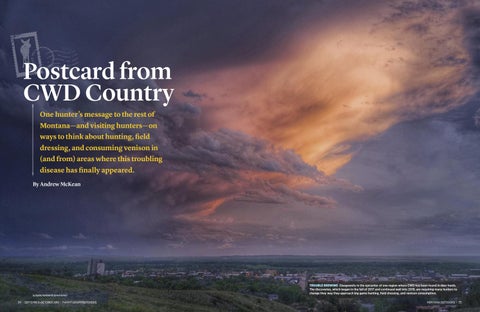
TROUBLE BREWING Glasgowsits in the epicenter of one region where CWD has been found in deer herds. The discoveries, which began in the fall of 2017 and continued well into 2019, are requiring many hunters to change they way they approach big game hunting, field dressing, and venison consumption. MONTANA OUTDOORS | 35
in Montana, nothing is normal, but neither is anything especially dire. And that you’ll be ready to help me and other hunters slow its spread and ensure that CWD remains as rare and unusual as possible. BIOHAZARD BUCK Sue Dalbey is a meat hunter, and she’s one of 21 people who shot a CWD-positive deer last fall in FWP’s Region 6 (northeastern Montana). On the final day of the 2018 season, Sue and her husband, Steve, an FWP regional fisheries manager, drove north from their home in Glasgow to a chunk of Bureau of Land Management property just south of the Canadian border, a place that has produced plenty of mule deer venison for their family over the years. They spotted some deer, and Dalbey made a stalk that culminated in a clean shot on a young mule deer buck. The deer had acted normal, and it looked fine once down except for dried-mustard “sleep” that crusted its eyes. But when the Dalbeys got the buck home and started skinning, they noticed that it carried no fat and that a waxy yellowish membrane covered the muscles. That’s why I’m writing this, a postcard from “He didn’t look very healthy, like he was CWD country, with the hope that together fighting an infection or something,” Dalbey we can learn how to deal with the challenges and slow its spread. If you let it, CWD could be that one extra hassle that keeps you from hunting this year. It could create a worry that maybe deer meat isn’t safe to feed your family. Or it could be so abstract that you ignore all the new rules aimed at preventing its spread and carry on as normal. But it doesn’t have to be any of those things. CWD is pretty simple to understand, and the rules designed to limit its spread can be as easy to follow as other hunting regulations, like adhering to legal shooting hours or tagging your animal before moving it. My hope is that after you read this, you’ll understand that now that CWD has arrived
’m a deer hunter who lives in Glasgow, and I’ve been waiting for chronic wasting disease for years. Not anticipating it. I don’t want it here or anywhere, but its arrival seemed inevitable. The disease has been creeping toward our borders for two decades, moving south through Saskatchewan, north from Wyoming, and west across the Dakotas. Then, last fall, 21 mule deer tested positive for CWD in my county and neighboring Montana counties strung along the Canadian border. It’s also in southcentral Montana, and this past spring and summer, several white-tailed deer near Libby tested positive. The presence of CWD affects how you prepare for a hunt and how you deal with the animal if you’re successful. It can skew your appreciation of wild venison. It complicates meat care and requires you to learn special skills and follow additional rules. It adds a layer of preparation and, if I’m being honest, anxiety about hunting in CWD country. The disease may decrease some big-game populations over time. But in the near term it hovers over hunters like the sword of Damocles, a threat that is worrying because of its invisibility and the remote—though so far unsubstantiated—human health concerns. (Though I refer to “deer” throughout this article, CWD also infects elk and moose. All state CWD-related regulations and all my suggestions for venison management apply to those species as well. Pronghorn, mountain goats, and bighorn sheep are not affected.) If you don’t have CWD where you live and hunt, you should hope it doesn’t come anywhere near you. I don’t want it to spread beyond the pockets where it has already become established on Montana’s Hi-Line, areas south of Billings, and around Libby.
FACING CWD Sue Dalbey of Glasgow with the young mule deer she shot last fall. After learning that the buck tested positive for CWD, she decided not to consume the deer. “That was difficult. We are very conscientious about not wasting meat,” she says.
36 | SEPTEMBER–OCTOBER 2019 | FWP.MT.GOV/MTOUTDOORS
LEFT TO RIGHT: STEVE DALBEY; SHUTTERSTOCK
told me. “We decided we’d have it tested for chronic wasting disease and, once we heard back, we’d decide whether to keep the meat. The weather turned cold, so we weren’t worried about meat spoiling while we waited for the test results.” It’s worth noting that animals infected with CWD can often appear healthy. And that sick-looking deer are not necessarily infected with the disease. Still, experts say an unhealthy-appearing animal is a sign to look for, so Dalbey’s caution was well founded. The results came faster than expected, delivered via a phone call from FWP. The test was positive for CWD. “It was a big bummer,” says Dalbey. “The first thing Steve and I realized was that it was too late to get a replacement deer tag, since hunting season was over. Both of us had been looking forward to a big batch of jerky.” Disposing of the infected deer left a different kind of taste in the Dalbeys’ mouths. Standard disease-containment protocol requires disposing of infected remains in municipal landfills. “The hardest thing about this was treating that deer as a biohazard,” says Dalbey. “We had to dump it like it was trash. We are very conscientious about not wasting meat, and there we were throwing an entire deer in the landfill.” CONSUME WITH CARE There’s a good reason diseased carcasses must go in landfills. The infectious agent of CWD, hardy malformed proteins, endure in the environment for years, potentially infecting other animals. The Dalbeys could have consumed the deer, even after learning it carried CWD. There’s no legal requirement that they abandon the carcass. But they did the right thing by discarding it, says Jennifer Miller. “There is no known transmission of CWD to humans, but the World Health Organization and Centers for Disease Control recommend not consuming meat from an animal known to be infected with CWD,” says Miller, Montana’s point person
My hope is that after you read this, you’ll understand that now that CWD has arrived in Montana, nothing is normal, but neither is anything especially dire. And that you’ll be ready to help me and other hunters slow its spread and ensure that CWD remains as rare and unusual as possible. for the human variants of transmissible spongiform encephalopathies (TSEs), which include CWD and the brain-wasting mad cow disease. A nurse and communicable disease consultant with Montana’s Department of Public Health, Miller tracks these human “prion diseases”—rare, progressive neurodegenerative disorders. Though she says there is no evidence that CWD can jump the species barrier to humans, she recommends
“an abundance of caution to minimize risk as much as possible.” This risk is an important subtext to the recent evidence of CWD in Montana deer herds. Even the remote possibility that infected venison might make somebody sick with an incurable brain-wasting disease affects many hunters’ decisions whether to tag a deer in CWD country. But there are ways to reduce the risk to near zero, says Emily Almberg, a disease ecologist in FWP’s Bozeman wildlife laboratory. “If you’re hunting in a known CWDpositive area, test the meat. In many cases, FWP will pay for the test,” says Almberg, who earned her doctorate in wildlife disease ecology at Pennsylvania State University. “If the test comes back positive, don’t eat the meat, simple as that.” If you’re hunting in an area where CWD hasn’t been detected and you want to test your meat, learn how to extract samples needed for testing—see the sidebar on page 39—and pay for your own test. “It only costs about $18 for the peace of mind of knowing whether your meat is safe to eat,” Almberg says.
CARCASS MANAGEMENT Beyond testing, health experts also recommend avoiding contact with the most diseaseprone portions of a carcass, including brain, spinal tissue, and lymph nodes. Wear gloves while field dressing animals, they advise. One of the most important ways hunters can prevent the spread of CWD elsewhere in Montana is by not transporting a potentially infected animal or its body parts. FWP has established CWD Management Zones around areas of known CWD infection. It’s illegal to transport the whole carcass, whole head, brain, or spinal column outside a management zone unless the animal tests negative for CWD. Because there’s no field test that can immediately determine SAFETY MEASURES Though no evidence exists that CWD can infect if an animal is infected, any deer humans, public health officials recommend using rubber gloves when field dressing elk, deer, and moose; minimizing the handling of brain harvested in a CWD Manageand spinal tissue; and, if hunters are especially concerned, having ment Zone should be considanimals—especially deer in designated CWD Management Zones— ered infected until you find out tested for the disease. otherwise, by submitting it for MONTANA OUTDOORS | 37
testing. Because results take anywhere from 10 days to two weeks, hunters need to prepare to freeze or process the animal until they learn the results. A quick note on that topic, one that I learned repeatedly last season. My family submitted five deer for CWD testing, but due to the time lag between submission and results, we had to stabilize the carcasses for a few weeks. Because we butcher our own meat, I didn’t want to invest the time and freezer paper required to process a deer only to learn that it was CWD positive and have to take the meat to a landfill. So we quartered all five deer, then froze the quarters until we learned that they had tested negative. Then we thawed and processed them as normal. If that sounds simple, it’s not. First, you need freezer space for storing 20- to 60pound quarters, which require more room than you’d expect. Then you need to thaw them at the right rate so the exterior doesn’t dry out or spoil while the interior is still frozen. Then get busy cutting and wrapping. But be aware that thawed meat, once refrozen, doesn’t store as well as meat that has never been thawed. Or, as some hunters are doing, you can butcher your deer while awaiting the test results, freeze the portions, and cross your fingers that the results will be negative. THE TRAVEL DILEMMA Those are options for home butchers who live in CWD Management Zones. But many who hunt in the zones don’t live there, and they need to plan how to transport their deer home. FWP’s rule is pretty straightforward: The whole carcass, whole head, brain, or spinal column of any deer, elk, or moose harvested inside the boundaries of a CWD Management Zone must not leave the zone until a CWD test comes back negative. This transportation restriction makes abundant sense from a disease-containment perspective. After all, the best way to avoid spreading CWD is to avoid moving potentially infected dead deer. But from a practical perspective, this requirement has been one of Formerly the editor-in-chief of Outdoor Life and now a freelance writer, Andrew McKean lives in Glasgow.
“If you’re hunting in a known CWD area, test the meat. In many cases, FWP will pay for the test. If the test comes back positive, don’t eat the meat, simple as that.”
the most misunderstood and hardest to follow by hunters in CWD country. Let’s start with carcass care. FWP recommends quartering or boning out a deer or elk in the field, leaving behind the head and spinal column to ensure that infectious agents aren’t moved to a new area. But most hunters haven’t learned the “gutless method” of field dressing, which leaves the organs intact inside the chest cavity and abdomen but removes the four quarters, backstraps, and tenderloins, all of which can be legally transported out of a CWD Management Zone. A quick Internet search will turn up video tutorials on this method, but beginners can expect the process to be long and messy and best done with a partner and plenty of game bags to contain detached quarters and loose meat. And remember, if you leave the head at the kill site, you’ll want to keep the genitals as evidence of the animal’s sex. You’ll also have to extract the retropharyngeal lymph nodes in the field (see sidebar at right), or bring out the head if you plan to have your animal tested. The good news is that once you master gutless field dressing, you can bone a deer out in 45 to 60 minutes. And because they are no longer attached to the skin or carcass,
38 | SEPTEMBER–OCTOBER 2019 | FWP.MT.GOV/MTOUTDOORS
which is left behind, breaking down the quarters back home takes about half the time as before. If you want to keep the antlers of a special buck, you’ll need to learn how to clean the brains out of the skull, so you don’t transport nervous tissue outside the CWD Management Zone. That requires intense boiling, brushing, and powerwashing, something most hunters far from home aren’t equipped to do. Or find a taxidermist inside the zone where you can leave your trophy. Another option is to remove the antlers from the base with a small hacksaw and have a taxidermist back home mount them on another deer skull. A PROCESSOR’S PERSPECTIVE Then, say you want to have your animal commercially processed. No problem, as long as you take it to a meat processor inside the CWD Management Zone. Doug Wixson is one such butcher. He owns Treasure Trail Processing in Glasgow, and takes in several hundred hunter-killed deer, elk, and antelope each fall. Last year, two deer that he butchered tested positive for CWD. Wixson says the presence of CWD has forced some changes to his business. He encourages his clients to get their animals tested for CWD, but he doesn’t have room to store animals while he waits for test results. So, starting this fall, he’ll process those animals with pending CWD tests results later in the day, so that a potentially positive carcass does not contaminate any other meat. And he’ll offer more single-animal processing services, rather than “batch processing,” the term for grinding the meat of several animals in one bulk sausage or burger mix. BAD BUNCH? Many game processors “batch process”—grind the meat of several animals in one bulk mix for burger or sausage. The practice is especially worrisome in the new era of CWD.
CLOCKWISE FROM LEFT: SHUTTERSTOCK; NATE HOWARD; ERIK PETERSEN
All that extra care will require the game butcher to charge more to process deer from CWD areas. “I understand the problem with batch processing,” says Wixson. “I don’t want to be inadvertently mixing a CWD-positive animal with uninfected meat, because then it all has to be thrown out. But I also want people to know that if they ask for a singleanimal process, they’ll need to pay more. The cost of processing a single animal at a time is going to be twice what I normally charge, at least. How many people are going to pay that? And how many are going to pay me once they learn that their meat has CWD and has to be thrown away?” Granted, Wixson is just one meat processor. Others may be less—or more—worried about what CWD means to their bottom line. But as a business owner in the heart of CWD country who deals with deer carcasses throughout the hunting season, his concerns are worth noting. As for Sue Dalbey, the Glasgow hunter, she’s still in the game, but with some new considerations. “I enjoy hunting mule deer too much to quit,” she says. “Will I maybe watch animals a little longer before I pull the trigger, to make sure they look healthy? You bet. Will I hunt earlier in the season so that, if the animal does test positive, I can get a replacement license from FWP? Yes. Will I opt to hunt somewhere else, maybe outside the CWD Zone? Possibly. “And will I test every deer we shoot around here from now on? Absolutely.”
How to submit a sample for CWD testing FWP’s understanding of where and how much CWD is infecting Montana’s deer herds is gained mainly by testing samples from hunter-harvested deer, elk, and moose. In what are known as “Priority Sampling Areas,” wardens, biologists, and technicians at check stations ask hunters’ permission to remove a special lymph node that will reveal distorted protein concentrations in infected animals. The tests, conducted by technicians at Colorado State University (CSU), cost about $18 apiece, but FWP underwrites the expense for hunters who harvest animals from Priority Sampling Areas around the state. These sampling areas change year to year, as FWP looks for CWD in suspected areas and tries to determine prevalence of the disease where it has already been found. See page 43 for a map showing the priority areas. “We want to encourage as much testing as possible, so it’s in everyone’s interest to lower barriers— in terms of cost and accessibility— as we determine the distribution and prevalence of CWD in the population,” says Emily Almberg, FWP’s wildlife disease ecologist. The special lymph nodes, ready Hunters can also have their deer for delivery for CWD testing tested on their own by submitting a sample of the retropharyngeal lymph node, though they’ll need to pay for the test and postage if the animal was taken outside of the Priority Sampling Areas. The process is clearly explained on the FWP website (fwp.mt.gov): u On the right side of the FWP home page, click on the brown CWD box. u Once on the CWD page, scroll down to “submitting a sample.” There you’ll find instructions, including a video showing how to remove these special lymph nodes, which are small glands in the neck behind the jaw. As you’ll see in the video, the nodes are exposed by cutting across the throat, bending the head back, and finding and removing the lymph glands, generally with a tweezers or needle-nose pliers. “It can take some studying so that you don’t mistake a saliva gland for a lymph node,” says Brent Race, staff scientist at the Rocky Mountain Laboratories in Hamilton, Montana, part of the National Institutes of Health. Once they are removed, hunters should place the lymph nodes in a sealed bag, box the bag with an ice pack, and ship it to CSU using one- or two-day delivery (details are on FWP’s CWD website page). “People should take care that the sample doesn’t leak,” says Race. “And it’s a good idea to keep it cold. But the reality of the CWD prion is that it doesn’t decompose, even if the tissue around it does. So even fairly degraded samples can still be effectively tested.” Each sample submitted by FWP will be given a unique number, which hunters can track on the FWP website. Test results are generally posted within 10 to 14 days. If a sample is positive, indicating CWD infection, the department will contact the hunter. If the sample is negative, the hunter will see the notification on the website and then can consume the meat with all the gusto that healthy FWP CWD information: wild venison deserves. fwp.mt.gov
MONTANA OUTDOORS | 39