V O L U M E 2 7
SEPTEMBER 2016
M O N TA N A
GRASS ROOTS F E E D I N G T H E F U T U R E T H R O U G H F A R M E R S U N I O N E D U C AT I O N A P U B L I C AT O N B Y M O N TA N A F A R M E R S U N I O N
PAGE 4 & 5 Member Profile, Homestead Organics Farm PAGE 6 BNSF to Raise Rates
PAGE 7 Time to Register for Convention! PAGE 8 Convention Highlights 1
V O L U M E 2 7
SEPTEMBER 2016
WELCOME NEW MEMBERS!!!
IN THIS ISSUE SYAC Members Elected Page 3 Member Profile, Homestead Organics Farm Page 4 & 5
Mem b e r Recr uited by Donald & Marla Boyce, Havre Justin & Kaydee Kelley, Malta Kenneth Clark, Broadus T J & Awna Irish, Miles City Gene & Dianna Pena, Vida Kristi & Cedar Jeffers, Miles City Highlander Farms, Miles City Saylor Enterprises Inc., Joran Christian & Glenda Ueland, Terry Alix & Pete Wittmayer, Glendive Joe & Catherine Servais, Richey Craig & Shiela Barthel, Molt Grey Cliffs Ranch Ltd., Centerbrook CT Cody & Brianna Kountz, Bozeman Lynn & Aimee Griffin, Silesia David & Diane Bonet, Roberts Jack Lutgen, Billings Hawks Livestock Inc., Billings Randy & Charlotte DeVries, Roberts Sarah Lavelle, Belgrade William & Linda Hinebauch, Cascade Betty Sauer, East Helena Duane Robinson, Conrad Norman & Judy Kamrud, Choteau Frank Celaya, Hamilton Lola Lee Eby, Victor Carlton Grimm, Billings John & Crystal Walkup Ronan Charles Jacquier, St Ignatius Laura Silgen, Ronan Havila Unrein, St Ignatius Tesla & Ryan Long, Dennis & Tina Loch, Dutton
Cindy Schubert Shane Anderson Tayler Kennedy Tayler Kennedy Ron Watts Ron Watts Ron Watts Ron Watts Ron Watts Ron Watts Jesse Fleming James Mathews Dean Derby Craig Parker Dallas Hagfeldt Jr Dallas Hagfeldt Jr Dallas Hagfeldt Jr Judd Long Judd Long Trenton Leintz Eric Hinebauch Todd Crum Gordon Elings Mathew Luedtke Bryan Jones Bryan Jones Andrew Luedtke Andrew Luedtke Andrew Luedtke Andrew Luedtke Andrew Luedtke MFU Lodge Justin Loch
BNSF to Increase Rates, Terry Whiteside Page 6
It’s Time to Register for Convention! Registration Form Inside! Page 7 Washington Corner, Roger Johnson Page 8 Hot topics of the 2016 Convention Page 9 Message from the President Page 11 Poultry Co-op Facility Opens in Hamilton Page 12 Candidates for Governor Field Questions on Agriculture Page 13-15
Youth Leadership Development Program
Recap of Camp Page 16-17
Tom McKenna, FU Insurance, Lewistown
Message from the Delegation Page 17
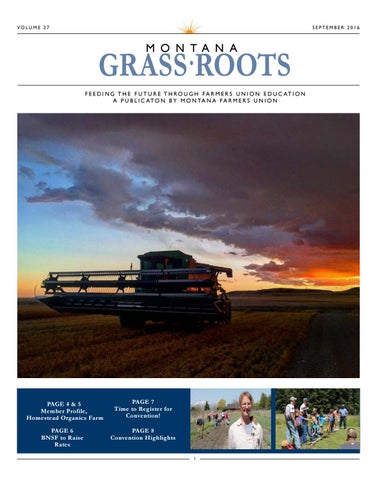
About the cover: Congratulations to Lauren LeSueur for her submission to win the Harvest 2016 cover photo contest! The picture was taken on Tom Ellis Farms in Conrad. The crop is a field of banner peas. In addition to her picture on the cover Lauren will receive a $50 VISA gift card.
MFU SCHOLARSHIP PROGRAM
Second place goes to Jocelyn Juelfs. Her picture is featured on pg. three. Jocelyn will receive a $25 VISA gift card. Thank you for all your submissions!
Diana Adamson, Shelby 2
V O L U M E 2 7
SEPTEMBER 2016
NEXT CLASS OF SENIOR YOUTH ADVISORY COUNCIL ELECTED
In Memoriam Mrs. Lloyd (Audrey) Kaercher Havre William Running Fisher Dodson Thomas Hastings Conrad
MONTANA FARMERS UNION PO BOX 2447 300 RIVER DRIVE NORTH GREAT FALLS MT 59403
B Y K AT H RY N P E T E R S O N A R ROW P E A K C A M P D I R .
PHONE: (406) 452-6406 FAX: (406) 727-8216 mfu@montanafarmersunion.com www.montanafarmersunion.com
Each year during senior camp members are elected by their peers to serve on the Senior Youth Advisory Council known as SYAC. SYAC members serve as the liaison for the Montana Farmers Union youth program to help define issues that impact youth today and use it to establish a theme and design for the upcoming summer camping program. This year’s newly elected SYAC members are Donna Arganbright and Matt Mendenhall!!!
Board of Directors: Alan Merrill, President Rollie Schlepp, Vice President, Conrad Erik Somerfeld, Secretary/Treasurer, Power Bill Courtnage, Geraldine, at-large director Brett Dailey, Jordan Ben Peterson, Judith Gap, at-large director Kelly Rutledge, Big Sandy Sig Rudie, Fairview, at-large director Paul Kanning, Flaxville Jan Tusick, Ronan
State Office Staff: Jan Johnson, Office Mgr., Assistant Secretary/ Treasurer Lyndsay Bruno, Communications Director Chris Christiaens, Legislative & Project Specialist Delisa Protsman, Education Director Justin Loch, Membership Director Dave Snuggs, Facility Director Copyright © Montana Farmers Union, 2016. Montana Grassroots is the official publication of the Farmers Educational and Cooperative Union of America, Montana Division. MFU reserves the right to reject any advertisements. Third Class bulk postage paid at Great Falls MT 59401. Membership: $50.00 per year Montana Grassroots is published 10 times each calendar year with two combined issues. Article submissions are requested by the 15th of month. Advertising space is available. Contact Lyndsay Bruno if interested. Copy Editor: Jan Johnson Editor/Designer: Lyndsay Bruno Staff Contributors: Justin Loch, Chris Christiaens, Kathryn Peterson & Alan Merrill A special thank you to this month’ s guest contributors: Governor Steve Bullock & staff; Greg Gianforte & staff; Mr. Ted Dunlap; Senator Jon Tester; Senator Steve Daines; Clare Ann Harff, Laura Garber; Jan Tusick; Terry Whiteside; Roger Johnson; Lauren LeSueur & Jocelyn Juelfs
HARVEST 2016 Photo Contest 2nd pl;ace winner: Brody (2) is helping check crops for Juelfs Farms east of Dutton, while daddy and papa harvest the wheat!!! Submitted by Jocelyn Juelfs
MFU ANNUAL CONVENTION CALL
to a two-year term, two district board members, from Districts 2 and 6 to three-year terms; one district board member, from DisAll members of local and county trict 5 to a one-year term; and an organizations of Farmers Union at-large director for Districts 5 & Educational and Cooperative 6 to a three-year term. A conducUnion of America, Montana tor and doorkeeper will be electDivision of (Montana Farmers ed to one-year terms; further, to Union) you are hereby notified transact such business and adopt that the 101st Annual State Consuch resolutions as may be devention of the Montana Division sired by the members of Montana of the Farmers Educational and Farmers Union. Cooperative Union of America will be held in Great Falls, MonNominations of board members tana at the Heritage Inn, October and officers shall be made from 21-22, 2016, for the purpose of the floor during the afternoon hearing reports from the state session of October 21. Ballots officers, to elect a vice president will be distributed at the time of
election, during the morning session of October 22 and all ballots must be in the ballot box no later than 10:30 AM on October 22. It will be appreciated if resolutions be sent to state headquarters by October 14. Resolutions for submission after that date should be given directly to the Resolutions Committee at the Convention site during designated times announced at convention. Alan Merrill, President, Montana Farmers Union Erik Somerfeld, Secretary-Treasurer, Montana Farmers Union 3
Members of SYAC meet throughout the year to create, plan and organize the programming for the youth camps from activities, crafts and special projects to discussing and managing funds and supplies for the camp co-op store. Members also assist with the state convention and other youth education activities by giving presentations. From this years’ speeches came some incredible ideas. It was a hard choice for seniors to make! A special thank you to Lauren Arnst and Cory Kelly for your continued involvement and dedication to Montana Farmers Union and the SYAC program. It’s going to be an awesome year with these incredible members leading the way!
V O L U M E 2 7
SEPTEMBER 2016
V O L U M E 2 7
SEPTEMBER 2016
HAMILTON FARMER SHARES PASSION FOR AGRICULTURE & EDUCATION •
MEMBER profile
•
B Y LY N D S AY B R U N O C O M M U N I C AT I O N S D I R E C TO R
In the picturesque Bitterroot Valley sits are Homestead Organics Farm which is owned and operated by Laura Garber and Henry Wuensche. Laura and Henry raise a variety of vegetables and poultry. Homestead Organics Farm is now the new site of the cooperative poultry facility that began processing birds this summer, which is also featured in this edition. Laura and Henry sell the majority of their meat, eggs and vegetables through a CSA(community supported agriculture) program and the Hamilton Farmers’ Market. While purusing a triple major in Liberal Studies, Eduation and German at the University of Montana, Laura developed a love for agriculture. After having her first child she made the decision to choose a lifestyle that would allow her the freedom to be home with her family - farming seemed like a natural fit. Homestead Organics has six green houses. Laura says the easiest vegetable to grow are onions. Tomatoes are the most difficult, but worth the effort and time. “We want everyone to have interaction with plants,” said Laura. “Tomato plants are the perfect gateway plant because they are very easy to cook with.” Laura credits much of their success to the involvement with several cooperatives including the Western Montana Growers Co-op, Triple Divide Organic Seeds, and most recently the Montana Poultry Growers Cooperative. “Cooperatives are the heart of our farm, we see great benefit by being part of a cooperative. The seed cooperative has been a good experience and is starting to be a viable market for mem-bers of the coop,” said Laura. The seeds
The seeds are all harvested by hand. According to Laura the process can take a while depending on the growth pattern of the crops.
ess to good quality food,” said Laura.“We believe in helping under served populations and are proud to be able to give back in this way.”
Also located on the farm is a commercial kitchen which they hope will extend the functionality of the farm and increase the outreach potential for community members to be part of their effort to serve those in need.
EDUCATION ON THE FARM
In an effort to marry her two passions of teaching and farming Laura started the high school internship program Cultivating Connections. Through this program eight BitAs with most farmers and ranchers Laura terroot Valley High students participated in wears several hats. She is an entrepreneur, the 11-week farm based internship this year. farmer, philanthropist and teacher. A large Community members led workshops on leadportion of the vegetables harvested on the ership, finances, and civic involvement. The farm are donated to the local Meals on Wheels students wages are funded through grants. program that serves 700 meals each week in “Our interns learn the value of hard work, Ravalli County. “Everyone should have accagriculture and sustainability. We have switcC O N T I N U E D O N PA G E
4
5
Homestead Organics Farm hosts a Tuesday CSA pickup
Henry talks with community member about the CSA program
Interns with Cultivating Connections and community volunteers work on the farm; photo courtesy of MAPS
Laura says the youth internship program has been a huge success; photo courtesy of MAPS
hed gears in recent years including less selling and more giving with the kids. It just seems like the right thing to do.”
ics Farm’s Facebook page and VIMEO. Visit MAPS on VIMEO to enjoy the series.
MAPS student film crew recently produced a video for the Council on Aging’s Meals on Wheels program, so we are very excited to contribute to Cultivating Connections,” said Harff.
.
Wheels. She says the real catch is to secure the financing to do so.
“The idea isn’t producing someLOOKING TO THE FUTURE thing to sell, but rather to produce knowledgeable teenagers The collaberation between comThis spring, thanks to a grant by and food for elders. There is so munity and youth education got the attention of the MAPS Media “MAPS students will document the Red Ants Pants Foundation, much more than farmer versus Institute in Hamilton so much so the youth farm internship from the farm was able to build a stage farmer that we could be doing that they decided to do a video the first day of seed planting to that Laura plans to use for events with agriculture.” series on the program. MAPS is the final day of harvest. Media that will entertain, engage and a hands-on program that incor- arts will be the bridge that con- teach people of all ages about ag- A big thank you to Laura and Henry porates science, technology, en- nects the art of growing food riculture. Moving forward Laura for opening up their farm and to Clare is always looking at the big pic- Ann Harff with MAPS for partcipatgineering, arts and math. MAPS with the art of sharing stories.” ture of combining Ag education ing in this story! Program Director Clare Ann Harff said she was honored that The Cultivating Connections vid- and philanthropy with the ultiHomestead Organics Farm in- eo series produced by MAPS can mate goal of donating their entire vited MAPS to participate. “A be found on Homestead Orgain- harvest to programs like Meals on
5
V O L U M E 2 7
TRANSPORTATION REPORT: BNSF SET TO INCREASE WHEAT TARIFF RATES
SEPTEMBER 2016
capture higher revenues from northern farm producers on harvested wheat crops in 2016. Interestingly, the BNSF chose not to decrease Idaho, Oregon and Washington wheat rates to Portland in March 2016 and then are not increasing the wheat rate levels in the August, 2016 northern tier increasing choosing to extend the expiration date of current rates to 5/31/2017. Most troubling for Montana farm producers will be the differential expansion once again between shuttles and less-than-shuttles shipment quantities. This differential creep has skyrocketed every year for the past decade (since 2006). In the last decade, the difference between shuttle rates and single car rates, when comparing the large cars at Great Falls, was $368/ car. After the 08/01/16 increases, the difference between Shuttle rates and single car rates (big cars) at Great Falls will have skyrocketed to $1,413/car (116% increase).
B Y T E R RY W H I T E S I D E W H I T E S I D E & A S S O C I AT E S
The BNSF, in spite of lack of wheat movement on the BNSF during 2015 which is due primarily to poor wheat prices, is jacking up the wheat rates throughout its system. Why? As more than one farm producer has stated in the last couple of weeks – because they can! The BNSF followed increases in its southern grain markets in May, 2016 by increasing the northern rates (Minnesota, Montana, North Dakota, South Dakota and Wisconsin) by $92/car (3 cents/bushel) 1-47 cars, 48 cars increased in Montana (+ Beach, ND) up $150/ car (4 cents/bushel), Shuttles up $100/car (3 cents/bushel). These increased rates are set right now to expire 12/31/16 unless changed before that date.
There is a shift occurring in Montana agricultural with the movement to growing an ever-increasing amount of pulse, peas, beans, barley and lentils as rotational crops. These crops do not normally move in shuttle quantities. The ever increasing spread in differentials (differential creep) is forcing an ever increasing burden on the farm producer and Montana production, which must rely on less-than-shuttle transportation methods. The differential creep is thus penalizing Montana farm producers by exacting an increasing burden on them from the railroad. Two brief points about the differential creep:
1.) The increasing differentials between shuttles and non-shuttle movements on BNSF is not justified by differentials in the rail cost of handling – when one considers that rail movements (even smaller quantities) are always concentrated into larger train sets beHistory review: the BNSF reduced these fore leaving Montana and thus have transpornorthern wheat rates to the PNW by $100/ tation costing and characteristics of larger car (about 3 cents/bushel) on May 1, 2016 – trainload shipments and stating that grain (wheat) shipments were running below normal and a rate reduction might 2.) There is an increasing demand for smaller stimulate movement. Most farm producers train load shipments for movement of the knew that this modest reduction would not burgeoning pulse crop production in Monbe enough to stimulate any new movements tana. and that the temporary increase would be followed by an increase in time for the BNSF to
6
V O L U M E 2 7
SEPTEMBER 2016
HOT TOPICS IN AGRICULTURE BY CHRIS CHRISTIAENS L E G I S L AT I V E & S P E C I A L P RO J E C T S
At the time of this writing, harvest is in full swing across Montana; with winter wheat nearly finished. While yields are high or the highest in many years, the low commodity prices have a chilling message for producers with in many cases devastating consequences for many young producers, who have purchased land and equipment when commodity prices were high. Those who currently have little if any reserves are looking for options to stay in business. A saving grace during this period of low prices for this year’s crop is that of low interest rates, a major difference to the 1980’s agriculture disasters. The raising of pulse crops may be a God send for many young producers as they have for the most part, remained the bright spot in commodity prices. When growers of green or yellow peas were getting $10.00 plus and as high as $12.60 per cwt., and wheat averaging less than $4.00 per bushel even with high yields makes for a simple decision as to what crops need to be planted. When you get the time take a look at Pulse Market prices. It is no wonder Montana has become the #1 producer of Pulse crops in the nation. It is not just Montana farmers and ranchers who are struggling to pay their bills and providing for their families. The farm economy downturn started some three years ago and when I last checked with the USDA , net income from farms is forecast to be the lowest this year since 2002 crops. FSA offices have run out of money and have dipped into emergency funds from other parts of the USDA budget. Many agriculture groups feel the answer is with passage of the TPP, however in recent discussions with members of Congress, it does not appear that there will even be a vote during the lame duck session this fall. The reasons being that both of the candidates for president claim to be opposed to this trade agreement and there are not enough members of Congress willing to vote for it prior to the November elections. Montana Farmers Union, along with other Farmers Union delegations, will be in Washington D.C. in September for the fall fly-in to meet with every congressional office. Stay tuned to the answers as we represent your voice when meeting with the Montana Congressional delegation as well as other state members.
REGISTER TODAY FOR THE 101ST ANNUAL MEETING OF MONTANA FARMERS UNION BEST WESTERN HERITAGE INN, GREAT FALLS NAME________________________________________________________________
CHECK IF APPLICABLE:
SPOUSE_______________________________________________________________ MEMBER _____________ VISITOR ______________ YOUTH ((Names & Ages) : __________________
______________________
_______________________
ADDRESS_________________________________________________
CITY_________________________ STATE ___________
ZIP CODE___________
Registration fee includes all meals on programs,, all breaks, the MFU Insurance Reception, and the Members’ Montana Food Banquet & Friday night enteratainment. Pre-Registration by October 17
Cost
x
# Registering = ____________ (Total)
Per Adult
$100
x
__________
_________
Per Youth (15 yrs & under) $50 x ___________ + __________ Total Registration _____________ Registration After October 17
Cost
x
# Registering = ___________ (Total)
Per Adult
$125
x
__________
Per Youth ( 15 yrs & under)
$60
x
___________ + __________
Total Registration_____________
Daily Registration will be $20. Meal Tickets sold separately. Mail this form with payment to the MFU Office, PO Box 2447, Great Falls, MT 59403 or register online. Hotel group rates are available. Please contact the MFU office at 452-6406 for details. Hope to see you there! 7
V O L U M E 2 7
SEPTEMBER 2016
dairy farmers. The letter suggests the USDA use existing authority to aid dairy farmers during the difficult economic downturn that is distressing the industry.
RO G E R J O H N S O N PRESIDENT N AT I O N A L F A R M E R S U N I O N
American family farmers and ranchers are experiencing the worst farm economy in more than a decade. As the trend is forecasted to continue for low commodity prices and high cost of production, NFU is calling on Congress for immediate action to ensure family producers can stay on the land and provide for the country. NFU is also ramping up efforts to provide dairy farmers with immediate assistance through the USDA, as well as convening emergency dairy committee meetings to address issues with the current dairy safety net. NFU and Food and Water Watch are calling on the U.S. committee reviewing the ChemChina acquisition of Syngenta to block the proposed merger. Farmers, Ranchers Need Immediate Assistance to Deal with economy woes The heartland is hurting! American farmers are the best in the world - but their livelihoods are at the mercy of market fluctuations and Mother Nature. As it stands now, the economic reality in rural America is a ticking time bomb. Congress cannot stand by and watch an entire generation of farmers be wiped out as a result of rock bottom commodity prices, rising inputs and an inability to access affordable credit. Farmers across the country are faced with the third consecutive year of lower net farm in
come. Meanwhile, input costs remain high. Last month, NFU established an emergency No other sector of the American economy faces such continuous instability and farmers dairy planning committee to address shortcomings in the current federal dairy program who grow the nation’s food are at risk. and build support for a stronger safety net and Net farm income for 2016 is forecast to be emergency assistance for U.S. dairy producers. $54.8 billion. That’s more than 50% lower than 2013 and $4.2 billion lower than it was Margin Protection Program for Dairy (MPPDairy), the federal dairy price program esin 1996! tablished in the 2014 Farm Bill, has provided Input costs remain high despite a drastic de- very little benefit for dairy producers despite cline in commodity prices. In fact, total farm farmers heavily investing in the program. In production expenditures were 4% higher last 2015, U.S. dairy producers paid $73 million year than in 2011, 2012 and 2013, while many into MPP-Dairy and only received $700,000 commodity prices have fallen 40% or more back from the program. since that same time period. Specifically, NFU is urging USDA to use its The economic crisis has limited access to af- authority under the Commodity Credit Corfordable credit to many producers across the poration Charter Act and Section 32 of the country. USDA’s farm loan program, commer- Agriculture Adjustment Act of 1935 to procial and community banks, and the Farm Cred- vide direct financial support that will protect it System are all witnessing increased stress in all of our nation’s dairy farmers from further their loan portfolios. Total farm debt at com- crisis. mercial banks has continued to rise, credit conditions have deteriorated as repayment The U.S. has lost more than 18,000 dairy rates declined, and delinquency rates have in- farms in the past decade, and the trend is continuing with the current milk price declines. creased alongside reduced farm income. The dairy industry has a great need for immediate action that offers market stabilization NFU is calling on Congress to: ~ immediately begin working on the next and support without further stimulating milk farm bill to provide a stronger safety net to overproduction. protect family farmers and ranchers from very NFU will continue to work with the dairy inlow prices. ~ Provide emergency assistance to producers dustry, Congress and USDA to propose meaningful reforms that will support dairy farms, in need. ~ Provide USDA the necessary resources in an important segment of our nation’s econoorder to get Title I payments to producers im- my. mediately instead of waiting until the end of NFU Opposing the ChemChina-Syngenta the commodity marketing year. ~ Increase funding for FSA guaranteed and Merger direct lending programs. ChemChina, a Chinese government-owned A strong and effective farm safety net is essen- chemical company, proposed to buy Swiss tial to the food security of our nation. Failing seed and pesticide maker Syngenta earlier this to act now is not an option for America’s fam- year, drawing scrutiny from NFU over national security and competition issues for Ameriily farmers and ranchers. can producers. This is just the latest effort in Immediate Support Needed for U.S. Dairy an alarming trend of Chinese governmentowned entities acquiring other agriculture Farmers companies. NFU sent a letter to U.S. Department of Agriculture (USDA) Secretary Tom Vilsack in Au- The Washington Corner can be found in its gust, requesting much needed relief for U.S. entirety at www.nfu.org/corner. 8
V O L U M E 2 7
AG ECONOMICS, USE OF DRONES IN AGRICULTURE, & PULSE CROPS TO BE TOPICS OF INTEREST AT CONVENTION DR. JOE OUTLAW FARMERS UNION INSURANCE LUNCHEON KEYNOTE SPEAKER
Dr. Joe Outlaw is a Professor and Extension Economist in the Department of Agricultural Economics at Texas A&M University. He also serves as the Co-Director of the Agricultural and Food Policy Center (AFPC) at Texas A&M University. In this role, Dr. Outlaw frequently interacts with members of Congress and key agricultural committee staff to provide feedback on the likely consequences of agricultural policy changes. Dr. Outlaw led the team of Texas A&M economists who received awards in excellence for their 2002 farm bill education efforts from the American Agricultural Economics Association, the Southern Agricultural Economics Association, the National Public Policy Education Committee, USDA-FSA, and the Vice Chancellor in the College of Agriculture and
SEPTEMBER 2016
Life Sciences at Texas A&M University. Outlaw is originally from Devine, Texas. He received his B.S (1987), M.S. (1988), and Ph.D. (1992) degrees from Texas A&M University, all in agricultural economics.
“THE UNMANNED FARMER” ROBERT BLAIR ON THE USE OF DRONES IN AGRICULTURE
Since that time, Robert received an Eisenhower Fellowship in 2011, taking him to South America for six weeks studying these technologies. During the fall of 2012 he spent three weeks in Germany on a McCloy Fellowship for agriculture. In Idaho he was recognized as one of the most influential U of I College of Agriculture and Life Science (CALS) alumni, received the 2013 Governor’s Award for Agriculture Technology and Innovation and was honored as a 2015 U of I CALS Distinguished Alumni. Robert’s vision and leadership ability has been recognized by the positions he has held including president of the Idaho Grain Producers Association, chairman of the National Association of Wheat Growers (NAWG) Research & Tech Committee, chairman of the U.S. Wheat/NAWG Joint Biotech Committee, Idaho Farm Bureau Federation county president, an initial member of Idaho’s UAS steering committee, and an initial advisory board member of the Drone World Expo.
Robert Blair is the VP of Agriculture for Measure, Drone as a Service and a fourth generation farmer from north central Idaho managing 1,300 dryland acres of wheat, barley, peas, lentils, chickpeas, alfalfa, and cows. The farm is situated on the edge of the rolling hills of the Palouse and not far from his Alma Mater the University of Idaho where he received his B.S. in Agriculture Business. His journey with precision agriculture started in 2003 using a PDA for simple mapping. That evolved into all different types of equipment, including Unmanned Air Systems (UAS) in 2006. Robert is the first farmer to own and use a UAS. His vision and advocacy of these technologies helped him become the Precision Ag Institute’s 2009 International Farmer of the Year. Robert has been on the leading edge of the precision agriculture utilization in the PNW and U.S.
9
Montana Farmers Union Convention Oct. 21-22 Great Falls R e gis ter Today at w w w.montanafarmer sunion.c om
V O L U M E 2 7
SEPTEMBER 2016
A MESSAGE FROM THE PRESIDENT....
t blink.
SEPTEMBER 2016
do is to not lose your family identity. Don’t allow these times to destroy you or your family. Often deep sacrifices have to be made and wants are tabled while you dig deep in order to say at the end of hard times:“I’m still here and I’m proud to be a farmer/rancher.” My goal in the next year is to organize and sponsor state-wide meetings in conjunction with financial institutions to discuss the current financial situation.
why wheatwhy works wheat works
re is a simple There science is a to simple why we science chosetotowhy make we cat chose to make cat r from 100 percent litter from wheat. 100 When percent the wheat. wheatWhen is ground, the wheat is ground, manufacturing the process manufacturing exposesprocess starch and exposes enzymes starch and enzymes t contribute to that ourcontribute sWheat product. to our sWheat The 100 product. percentThe 100 percent degrad-able wheat biodegrad-able enzymes wheat neutralize enzymes odor while neutralize the odor while the ch helps with starch clumping. helps So, withwith clumping. wheat, So, we with havewheat, we have naged to make managed life better to make for cats, lifepeople, better for andcats, the planet. people, and the planet.
ps fast
V O L U M E 2 7
give yourself the gift of sWheat Perks
Signing up for sWheat Perks means you receive a monthly e-newsletter with exclusive promotions, coupons, and expert advice from our resident veterinarian Dr. Justine Lee. It’s free, full of natural lifestyle articles; cute cats, an inside look at new products, contests and more!
all-natural cat litter
clumps stops odors fast clumps fast
Smell that? Don’tNeither blink. do we.
chemical-free stops odors powerful odor Smell Nothat? ick toNeither make usdo we. control sick.
chemical-free biodegradable biodegradable
To sign up, visit sWheatScoop.com/sign-up today. biodegradable
Now Noyou ick see to make it, now usyou sick.don’t. Now you see it, now you don’t.
©2016 Pet Care Systems. sWheat Scoop is a registered trademark of Pet Care Systems. SS3283. sWheatscoop.com
no chemicals, no chemicals, no clay, no no worries clay, no worries sWheat Scoop’s natural sWheat wheat enzymes Scoop’s neutralize natural wheat odorenzymes on neutralize odor on contact, and its wheat starches contact,clump and itsfirmly wheat forstarches easy scooping. clump firmly for easy scooping. Add that it’s biodegradable, Addchemical-free that it’s biodegradable, and clay-free, chemical-free and and clay-free, and 1 0 of. you’ve got yourself the litter you’ve dreams got yourself are made theof. litter dreams are made
eat©2016 ScoopPet is aCare registered Systems. trademark sWheatof Scoop Pet Care is a registered Systems. SS3283. trademark sWheatscoop.com of Pet Care Systems. SS3283. sWheatscoop.com
One can bury their head in the sand and say that the conditions will rebound better then ever in the near future. I hope so, however in the meantime a new farm bill is on the horizon. I encourage membership to get involved by attending farm bill meetings. This means farmers & ranchers who are not in the habit of going to meetings I urge you to change your way of thinking. Our delegation needs your input and guidance to make informed The year 2016 is a banner year for most crops. decisions when it comes to the farm bill. I The reports I have heard from members range personally feel this will be the most imporfor winter wheat between 50 bu. per acre to tant farm bill to occur in my lifetime. Don’t as high as 100 plus bu. per acre. These figures complain if you don’t give your input. When are on dry land farms. The weight varies from people complain to me on how BAD and 58 lbs to 62 lbs. Protein is the big issue. Re- worthless Washington DC is I ask if they ports across my desk are 6 percent to as high voted in the general election. If they respond as 15 percent with the majority around the with a no, I immediately end my conversa8-10 percent. Spring wheat and barley are not tion. If you are involved in agriculture then yet available at the time of this letter. Com- we need your input on what will help farmers bining a huge yield with low prices for wheat & ranchers stay in business. already makes for a year of uncertainty.
MFU MEMBERS & STAFF TO ATTEND NFU FLY-IN MFU members and staff will join Farmers Union chapters from across the country in Washington D.C. for the 2016 Fall Legislative Fly-In September 11-14. At the Fly-In participants will hear from officials from the U.S. Department of Agriculture on current events, and will recieve a briefing from White House officials and committees on agriculture leadership. The Fly-In is grassroots advocacy at its best! One of the most important focuses of the Fly-In are the meetings on Capitol Hill. Teams of Farmers Union members will stop by the office of every member of Congress. Members will highlight the key priorities for the organization, struggles they are facing and goals for future legislation including the next farm bill. “The Fly-In is an excellent opportunity for members of congress to hear from farmers and ranchers about what’s really important to their operations and the concerns that they have,” said MFU President Alan Merrill. Hot topic policy initiatives for 2016 include the Trans-Pacific Partnership(TTP), Renewable Fuel Standard, Corporate Consolidation in Ag and Adequate Farm Support. Members attending include Levi & Kristen Ostberg, Ben Peterson, Deverie Kelly, and Brian & Barb Mothershead. MFU staff attending include Justin Loch, Membership Director; Chris Christians, Legislative Specialist; Alan Merrill, President and Lyndsay Bruno, Communications Director.
We here at MFU are huge supporters of trying to present ways to help the new generation of farmers/ranchers. Many of the older generation of farmers and ranchers including myself have gone through the rough times of the eighties, the drought years of the nineties and now with the extreme low prices of 2016. I will remain positive with caution that we will be able to find a way even with low commodity prices to survive.
Stay up-to-date on all things Fly-In by following us on Facebook, Twitter and Instagram with the hashtag #NFUFlyIn16.
Montana Farmers Union will be holding farm meetings through the state in the near future. I hope that the 80’s will not be returning. If you need any questions answered or help in trying to find answers during these challenging times there are people who can help guide you, including our office. The times of low commodity prices can take a toll on a family farm. My wife and I have personally been through these high-pressure times. Keep in mind that the most important thing you can
11
V O L U M E 2 7
CO-OP POULTRY FACILITY OPENS IN HAMILTON
by Garber and Henry Wuensche. The couple recognized a growing need for locally grown poultry which prompted them to act. The project was funded by Montana B Y LY N D S AY B R U N O Farmers Union/Farmers Union C O M M U N I C AT I O N S D I R E C T O R Industries, a Growth Through Agriculture Grant and the Lake Montana Farmers Union is County Community Development pleased to announce that a part- program. nership with the Montana Poultry Growers Co-op has resulted “Montana Farmers Union is in a co-op run poultry process- proud to support a project like ing facility near Hamilton, MT this one particularly because it on Homestead Organics Farm. is a co-op model and will benefit Last week the co-op owned facil- countless farmers in the state,” ity received the official license to said President Alan Merrill. operate from the Montana Department of Livestock. Bureau The project was provided techChief Gary Hormel presented nical support from Lake County the license to co-op members Community Development Corand managers Laura Garber of poration’s Cooperative DevelHomestead Organics Farm, Beau opment Program. Jan Tusick, McLean and Chris Greene of program director, assisted the Living River Farms and Jan Tu- cooperative in fundraising, fissick with Lake County Commu- cal management and food safety nity Development. “The facility planning. Tusick said the goal looks good,” said Hormel. “This of the cooperative model is not is going to be a nice operation.” profit driven, but rather a great example of how successful this The facility is the only coopera- type of collaboration can be for tively run poultry facility in the farmers and the agriculture comnation. It is located on Homestead munity. “All the members of the Organics Farm which is owned cooperative can use this facility.
Back row- left to right: Dave Sylvester, MT Department of Livestock; Gary Hamel, MT Department of Livestock; Beau McLean, Living River Farms; Laura Garber, Homestead Organics Farm; Front row: Chris Greene, Living River Farms; Jan Tusick, Lake County Community Development
SEPTEMBER 2016
Members of the co-op can have their birds processed here legally and then go into commerce,” said Tusick. This model doesn’t exist nationally. It is our hope that more states will follow our lead.” Garber, McLean and Greene were instrumental in getting the project off the ground. The project began in 2013 when market research showed a real demand for locally raised chickens. According to McLean the biggest challenge was not having a place to process the birds. McLean and Greene will manage the plant’s operations and are certified by the Halal Food Standards Alliance of America (HFSAA) to do so. To join the co-op a member pays a fee of $100 and must carry liability insurance. There is an additional fee per bird for processing. In order to process their own birds, they too would have to become HFSAA certified and receive additional in-house training. A state inspector must be present during processing which will take place on Wednesdays. The facility operates under one license. McLean said policies and proce-
dures are very important to maintain the license, but also the integrity of facility. “We are extremely proud of the work that has been done here,” said McLean.“We receive inquiries daily from producers looking for such a facility and from restaurants who wish to purchase the birds and support Montana farmers.” Construction of the facility began in December using local contractors, volunteers and the co-op managers who worked tirelessly to finish the project. McLean and Garber expect to maximize the one day a week they can operate by processing upwards of 500 birds a day. “The cooperative would like to thank all cooperative and community members who supported the Kickstarter that got the project going,” said Tusick. “A very special thank you to Laura Garber, Homestead Organics and Beau McLean and Chris Green, Living River Farm. Without the vision and support of these members the facility would not have become a reality.”
Chris Greene & Beau McLean with Living River Farms in Stevensville
12
V O L U M E 2 7
SEPTEMBER 2016
CANDIDATES FOR GOVERNOR ANSWER KEY QUESTIONS ON AGRICULTURE Agriculture is Montana’s #1 industry. Many challenges are ahead for Montana’s farmers and ranchers with low commodity prices and high overhead. One of MFU’s main objectives is to advocate for family farmers. In anticipation of the upcoming election we decided to do an informal Q & A with the three candidates for governor on issues that will affect Montana producers and the agriculture industry.
Montana Governor Steve Bullock 1) Agriculture is the fastest growing area of tourism, therefore it is necessary for states to have laws that promote agritourism while protecting producers from inherent risk liability. How would you address this issue? Montana’s rich agricultural heritage is brimming with opportunity. Though agri-tourism is no exception, we must take great care to ensure that agri-tourism is secondary to agricultural production, and not vice versa. My Main Street Montana Project brought together a diverse group of folks across the agriculture and food industries to identify the new challenges and opportunities facing Montana agriculture. These Montanans made several final recommendations, which include promoting Montana’s agricultural
One of the biggest barriers for Montana's "beginning" farmers is the costs associated with starting a farm or ranch. I know this is a very real and potentially devastating challenge, so through the Montana Department of Agriculture, we are providing financing for young and disadvantaged farmers and ranchers who have difficulty finding commercial financing. Applicants are able to get loans for agriculture improvements, herd increases or operating costs up to $75,000. We also offer financing to young producers to get their start in agriculture 2) Because of the deterioration with loans up to $8,500. of the St. Mary’s canal system, how do you plan to repair the structure to ensure adequate 4) The average age of a farmer/ water for drinking and irriga- rancher in Montana is 59 years old. What can be done to assist tion? rural communities in keeping The St. Mary’s canal is a complex young people on the farm to project involving a whole bunch take over operations when the of parties. It's in our best in- time comes for succession? terest to reach a consensus on a path forward by working togeth- The most responsible solution is er with rural communities across to continue building an economy northern Montana and southern that values Montana agriculture, Alberta, the Blackfeet, Assini- promotes it, ensures that taxes boine and Gros Ventre Tribes, the and regulations aren't overburU.S. Bureau of Reclamation and densome, and makes producers the Canadian government. The St. whole--which will inspire future Mary's canal system is 100 years generations of robust farming and old and only operates at around ranching. But I believe we have a 80% of where it needs to be in role as state leaders to make sure terms of infrastructure. This is that rural communities thrive in unacceptable and only under- agriculture. That's why across the scores the need for these groups state, our Food and Agriculture to work together. We must ad- Development Centers are doing dress concerns related to capac- great work providing advice and ity, allotments, usage and storage, assistance to help folks with busiand to ensure that all stakeholders ness plans. The Growth Through are contributing to the wellbeing Agriculture initiative is strengthand continued operation of the ening and diversifying Montana’s agricultural industry by encouragcanal system. ing the development of new ag3) Do you have a plan to assist, ricultural products and processes either by financing or leasing and helping new and young farmof farms/ranches, to help be- ers break into the industry. We ginning/veteran farmers get also need to continue to encourage research of new varieties and their start in agriculture? alternative crops; the Department products through a centralized "clearinghouse" to allow producers to share resources and to coordinate efforts. The Departments of Agriculture and Commerce are currently working with agricultural partners across the state to assess the appetite for agri-tourism from in-state and out-of-state consumers. They are also actively seeking input from farmers, ranchers, and food companies regarding their needs when it comes to liability protection and agri-tourism.
13
is funding trial and demonstration projects for carrots, green beans, broccoli, cucumber, lettuce, strawberries, apples, goji berries, currants, aronia, and haskaps, all of which have the potential to be profitable crops on small acreage and accessible to new and beginning farmers. We will continue to fund and organize opportunities to expand and improve education for our new producers. As we continue to create a diversified agriculture environment that minimizes risk, we will be able to help younger folks get their start in the industry. Having an estate plan in place can also take the uncertainty out of succession and set our younger producers up for success from the beginning. 5) What do you think is the greatest challenge facing Montana agricultural producers today? How would you tackle the issue? The biggest challenge facing Montana’s producers is price. Low commodity prices hurt Montana producers, especially our younger producers. Additionally, high startup costs, input costs and operating costs can make it difficult to continue operating. That's why I see it as my responsibility to ensure that taxes and regulations are fair and not overburdensome, and that we are always looking for new avenues and markets for Montana commodities. Montana’s weather variability and the impacts of climate change are also considerable challenges to agriculture. Increased crop diversification--as we’ve seen with pulse crops like peas, lentils and chickpeas--has helped many Montana producers weather the storm and manage low commodity prices. Further increasing that diversification into C O N T I N U E D O N PA G E
14
V O L U M E 2 7
Q & A C O N T I N U E D F RO M PG. 13
producing oilseeds like canola, safflower and sunflower, can help producers navigate these changing markets. Promoting varietal research can help with yields and disease and promoting cattle genetics will help our producers increase outputs and manage these high operating costs.
how do you plan to repair the structure to ensure adequate water for drinking and irrigation? Infrastructure is one of the primary functions of government. Unfortunately, the current administration has not gotten the job done in the last 4 years and rural Montana is suffering. I’ve promised to make infrastructure a priority when I’m governor, and fixing the St. Mary’s canal system is one of the state’s top infrastructure needs. It’s going to take new state leadership that will uphold the state’s obligations and work with the irrigators, the Blackfeet Tribe, and the feds to much needed funding to begin fixing the system. It also helps that I have strong relationships with Congressman Zinke and Senator Daines (who I worked with for 12 years). Working in tandem with a great congressional delegation, I’m confident that we can find solutions.
SEPTEMBER 2016
communities and make a living, so it’s easier for a younger person to take over the farm when the time comes. On the education side, we need to continue to have strong Ag education programs in our high schools and colleges that pass on agricultural skills to a new generation. As far as helping young people stay in rural communities, this is why I’ve been a big proponent of telecommuting. It is increasingly possible for a person to work for a national firm and work over the internet, while still living in a rural community and helping out on the family farm.
state economy that allows our ag producers themselves to make a good living and also provides more cylinders on the economic engine for rural communities. Telecommuting is a part of this, but technology also allows many different types of businesses, from manufacturing to high tech to be located just about anywhere.
14
Q & A C O N T I N U E D F RO M PG. 14
arily formed irrigation districts to accomplish this, and support those districts for maintenance purposes. Nothing has changed other than the increased expectation that governments will continue to grow, taking from some and giving to others. This is creeping socialism that can only end badly. 3) Do you have a plan to assist, either by financing or leasing of farms/ranches, to help beginning/veteran farmers get their start in agriculture?
5)What do you think is the greatest challenge facing Montana agricultural producers today? How would you tackle the issue?
The biggest challenge facing ag producers is federal regulation and overreach. Whether it be the Endangered Species Act, Waters of the US, or any number of EPA 3) Do you have a plan to assist, regulations, the federal governGreg Gianforte, Republican candidate either by financing or leasing ment is making life difficult for for governor of farms/ranches, to help be- our farmers and ranchers. What it ginning/veteran farmers get really amounts to is a taking of 1) Agritourism is the fastest their start in agriculture? property rights. What we need growing are of tourism, thereis leadership in Helena that will fore it is necessary for states I believe in the private sector. stand up against federal overto have laws that promote ag- That is where wealth is created. reach. Attorney General Tim Fox ritourism while protecting pro- We need a robust economy in the has sued the feds several times ducers from inherent risk li- state where young people and over excesses such as Waters of ability. How would you address veterans can pursue their dreams, the US and the Clean Power Plan. this issue? build wealth, and not need gov- We need a governor who will join ernment financing programs to him in these efforts and stand up First and foremost, we need a pursue their dreams. for Montana’s interests. court system that is reliable, respects the rule of law, and rules 4) The average age of a farm- The other part of this is that we according to common sense. er/rancher in Montana is 59 have to restore vibrancy to our Many businesses in many differ- years-old. What can be done rural communities. The primary ent industries have to worry about to assist rural communities in reason that I’m running for govfrivolous lawsuits. As governor, keeping young people on the ernor is that our kids are leaving. I’ll pursue common sense litiga- farm to take over operations Rural Montana communities are tion laws that protect Montana when the time comes for suc- losing population, the tax base is businesses, including agritourism cession? eroding, schools are closing. To businesses, from frivolous lawreach stores, schools, and other suits I think it starts with education, services, many have to go further 2) Because of the deterioration while also giving our young peo- from home. To reverse this, we of the St. Mary’s canal system, ple the ability to stay in rural need a robust private sector and
V O L U M E 2 7
Ted Dunlap, Libertarian candidate for governor 1) Agriculture is the fastest growing area of tourism, therefore it is necessary for states to have laws that promote agritourism while protecting producers from inherent risk liability. How would you address this issue? Regarding protections from risk liability, I do not see a governmental role beyond defense of life, liberty and property, which IS its primary function. If a farmer chooses to allow tourists on their land they either accept the inherent liability or insure against it with private insurers. 2) Because of the deterioration of the St. Mary’s canal system, how do you plan to repair the structure to ensure adequate water for drinking and irrigation? Irrigation reservoirs, canal and ditch systems were built by farm ers for their own use. They prim-
I do not have enough money to help other veterans buy or lease farms or ranches. Were I governor, or any other official in a free country, I would have no right to take from others to do so either. People who are concerned with assisting veterans could answer this by creating private, charitable or entrepreneurial groups for that purpose. It is not, however, PROPER government business to take from some and give to others.
4) The average age of a farmer/rancher in Montana is 59 years old. What can be done to assist rural communities in keeping young people on the farm to take over operations when the time comes for succession? Farms, ranches and all other types of enterprises were traditionally passed from one generation to another. That passing on of family equity has been around as long as families have. Some kids stay, learn and work with their parents, some explore other lives. This fundamental human system is as natural as reproduction. Government can either stay out of the way, or get in the way. I, rather obviously, want government to keep their hands off. 5) What do you think is the greatest challenge facing Montana agricultural producers today? How would you tackle the issue? Farmers, ranchers and the rest of us face a society where big government and the baggage it carries are approaching the point where
SEPTEMBER 2016
the parasite overpowers the host. Some states are beyond the point of no return. I do not believe Montana is.
an organization that has meant a lot to us, and to many rural Montanans, in Montana Farmers Union.
When you discover the path you are on to be clearly wrong, change direction, turn around, or back up. This is not time to change brands of car wax, but to engage four-wheel-drive and get the heck out of here.
In the first year of holding 5K On The Farm we ended up with around 150 runners and volunteers, we were blown away. To me it demonstrated that there is a real hunger for events like this. By combining fitness, food, and fun in a unique location we held a successful race that helped build community with friends and neighbors from near and far.
5K ON THE FARM TO RAISE FUNDS FOR WOMEN’S PROGRAMS B Y K AT I E B A N G S
5K On The Farm started as an idea to bring people together and do something active out on the farm. Running and racing has been something I’ve done for many years, but is only just now getting big on the Hi-Line. We also wanted to build community in our rural neighborhood. Lastly, we wanted to give back to
fering its three worst years since the depression and young farmers AGRICULTURE TO BE and ranchers trying to get started FRONT & CENTER AT “It is important to debate in Great are facing incredibly tough times. CONGRESSIONAL Falls with the Farmers Union I am looking forward to discussDEBATE hosting because Montana agricul- ing all these topics and showing ture is not monolithic,” said Zin- the clear differences between my opponent and me.” MFU is pleased to announce it ke. “Ag is still our biggest induswill co-host a congressional de- try; we have grain, sheep, cattle, bate with the Great Falls Tribune pulse crops and more. Each sec- Superintendent Juneau also proat the Great Falls College MSU on tor has its own unique challenges vided comment on the issues she Oct. 5. from 6-7 pm. KFBB plans when it comes to trade, labeling, sees as important when addressto stream the debate live online insurance, taxes and regulations. I ing agriculture. “I’m pleased Conformed my Agriculture Advisory gressman Zinke has agreed to and broadcast at a later date. Committee to help guide me on debate me in Great Falls and adThe debate panel will include a these issues, and I’m happy to dress the issues Montana farmers representative from the Tribune, have the Farmers Union partici- and ranchers face each day,” said MFU and KFBB. Candidates to pate on that board and give me Juneau. “Agriculture is a key comparticipate include Representative guidance on a number of issues ponent of Montana’s economy, Ryan Zinke, State Superintendent including industrial hemp. Under and it is important farmers and of Public Education Denise Ju- this president, agriculture is suf- ranchers know where I stand on neau and Libertarian Party State Chair Mike Fellows.
15
Rural women are already great leaders and strong voices in our communities. We plan to donate the majority of our race proceeds back to Montana Farmers Union again this year, we’d like to look into making donations to local organizations as well. Race day is Saturday, September 17. The 10K race will start at 10:00 a.m. with all other distances to begin at 10:30. Follow us on Facebook and register at runsignup.com. See you there!
things like climate change, energy production, food labeling and trade agreements. I’m in this race to put the needs of our people and land first, grow our economy, and ensure the next generation has the chance to build a bright future.” Libertarian candidate Mike Fellows is a graduate of the University of Montana. Fellows says if folks are looking for smaller government and lower taxes than he is the right candidate for them. “I look forward to discussing the issues of individual liberty,” said Fellows. “This includes economic freedom in the world of agriculture.”
V O L U M E 2 7
SEPTEMBER 2016
V O L U M E 2 7
SEPTEMBER 2016
ARROWPEAK CAMP 2016 A BIG THANK YOU TO ALL THE VOLUNTEERS, BUSINESSES WHO DONATED TIME & RESOURCES, CAMP DEANS & STAFF WHO MADE THIS SUCH AN INCREDIBLE CAMP SEASON! HOPE TO SEE YOU NEXT YEAR!
JUNIOR CAMP II
TEEN CAMP
16
17
V O L U M E 2 7
SENATOR STEVE DAINES
laboration that can benefit Montana. While national security and broader issues in the Middle East were certainly discussed, water and agriculture, two issues Montanans are very familiar with, were areas of focus. Israel – a nation largely built in a desert – has made incredible advances in drip irrigation and desalinization technologies that have helped them save up to 70 percent of the water typically used for farming, and increase crop yields up to 90 percent.
SEPTEMBER 2016
to wind, runoff, evaporation and overspray that is common with the spray watering commonly used by farmers. Many of the lessons learned in the deserts of Israel and the Middle East can be applied to the farms and ranches in Montana, and vice versa.
For generations, farmers and ranchers in Montana have been using the same innovative spirit that I saw in Israel to solve problems that help feed not only our state, but the world. But, unbelievably, there are over 22,000 Montanans Israeli engineers in the 1950s de- who lack access to a steady supveloped drip irrigation as an in- ply of clean water. That’s why I’m novative way to solve one of working to reform our system to On a recent trip to Israel, I met their biggest problems – feeding improve the efficiency of existwith top Israeli business leaders a growing population in a dry ing water supply infrastructures to discuss opportunities to enand arid climate. By delivering and protect water rights. I’ve hance economic cooperation besmall drops of water directly to been a strong proponent of autween our two countries; finding the plant roots the water isn’t lost thorizing the Dry-Redwater and ways to share ideas and forge col.
Musselshell-Judith Rural Water Systems, and am proud that my bill – the Western Water Supply and Planning Enhancement Act – recently passed the Senate Energy and Natural Resources Committee. This bill would authorize both projects and would help supply a steady source of water to irrigate crops, water our livestock and provide clean drinking water to over 22,000 Montanans across eastern Montana. Never in the history of the world have so few people been responsible for feeding so many. And with the growing global population, this responsibility will only increase. I was proud of the opportunity to collaborate and share ideas with agriculture and technology leaders in Israel while I was there and it’s important that we, as a global community, continue to find ways to innovate.
V O L U M E 2 7
SEPTEMBER 2016
MFU TAKES FARM SAFETY EDUCATION ON THE ROAD Membership Director Justin Loch put in some serious windshield time traveling to attend the Sheridan County Fair in Plentywood. “It’s important to reach all corners of the state to educate on farm safety and to be present for our membership,” said Loch. At the fair Justin taught farm safety, supported the 4-H kids and visited with fair attendees. MFU Board Member Paul Kanning who farms near Flaxville assisted at the booth. A big thank you to Paul for volunteering his time!
A BIG THANK YOU TO OUR BUSINESS BOOSTERS!!!
ers in Cuba. Just this month, I authored bipartisan legislation that would allow farmers to use private credit to sell their commodities to Cuba and it would also lift a prohibition on shipping vessels. These are common sense steps that will streamline the process Cuba provides Montana produc- for us to sell our world class grain ers with the opportunity to sell to a new market. I’m happy to our products to over 11 million report that these provisions were new customers who live only 90 included in a larger bill and will miles off our shores. That is near- continue to push it forward. ly half of the size of Taiwan—a nation that spends over $70 mil- As this legislation moves forlion each year buying Montana ward, I will continue to identify more ways we can establish new products. markets and increase opportuniOver the past two decades, Mon- It is not a secret that the demand ties for Montana farmers here at tana farmers have been success- for products in Cuba is strong. home and across the world. fully exporting products to new In fact countries across the world markets across the globe. exported nearly $2 billion worth of agricultural goods to Cuba in Two years ago, I visited a country 2014, but the United States exthat I believe holds incredible po- ported only $300 million of that. tential: Cuba. During my visit to That is why I’ve been working to Cuba I saw firsthand that 60 years establish and increase export opDuring my visit to Cuba I saw fir- portunities for Montana produc-
SENATOR JON TESTER
st hand that 60 years of severed diplomatic policy has failed, and Montana producers are in a position to succeed as the United States works to reestablish an international relationship with Cuba.
18
19
V O L U M E 2 7
SEPTEMBER 2016
OUR AGENTS LIVE AND WORK NEAR YOU.
Havre Cindy Schubert 265.2693 Havre Susie LaSalle 265.3346 Helena Todd Crum 443.4630 Kalispell Randy Bloom 257.1252 Kalispell Charles Monroe 756.7720 Laurel Dallas Hagfeldt, Jr. 628.6649 Laurel Jeff Seborg 628.6649 Lewistown Tom McKenna 538.8736 Lewistown Raleigh Heitzman 538.8736 Libby Colleen Wood 293.6228 Livingston Daryl Hansen 222.7151 Malta Shane Anderson 654.1589 Miles City Tayler Kennedy 874.2560 Miles City Ron Watts 874.1804 Missoula Brad Bowman 721.2540 Missoula Pam Jacobsen 721.0599 Missoula Andre Marcure 543.7184 Plains Sally Miller 826.4633 Plentywood JR Johnson 65.2051 Ronan Andrew Luedtke 676.0173 Ryegate Audrey Stoican 568.2336 Sidney Cathy Hintz 488.8326 Terry Blayne Watts 635.5782 Thompson Falls Sally Miller 827-3221 Whitefish Rial Gunlikson 862.4700 Wolf Point Jesse Fleming 653.2200
Anaconda Stefanie Thompson 563.5991 Belgrade Craig Parker 388.6774 Billings Jim Mathews 656.2323 Billings Steve Plaggemeyer 294.9491 Billings Judd Long 252.9391 Bozeman Dean Derby 556.0893 Bozeman Trent Leintz 551.2163 Bozeman Art Hoffart 586.6230 Bridger Wesley Schwend 662.3930 Chester R. Gordon Elings 759.5065 Choteau Mathew Luedtke 4 66.5146 Circle Barbara Mothershead 485.3303 Conrad R. Gordon Elings 271.7047 Dillon Judy Siring 683.2365 Dutton Matt Luedtke Agency 476.3444 Fairfield Matt Luedtke Agency 467.3444 Fort Benton Robert Nelson 622.5053 Glasgow Del Hansen 228.2284 Great Falls Eric Hinebauch 453.8413 Great Falls Aeric Reilly 570-5853 Great Falls Faith Cardwell 268.0077 Great Falls Scott Walsh 761.2087 Great Falls Jeff Thill 452.7283 Hamilton Bryan Jones 363.6583 Hardin Melissa Wacker 665.1867
www.fumico.net
20