V O L U M E 2 7
M AY / J U N E 2 0 1 6
M O N TA N A
GRASS ROOTS
F E E D I N G T H E F U T U R E T H R O U G H F A R M E R S U N I O N E D U C AT I O N A P U B L I C AT O N B Y M O N TA N A F A R M E R S U N I O N
CONFERENCE OFFERS DIVERSE LINEUP OF SPEAKERS FOR YOUNG PRODUCERS The average age of the farmer is 59 years-old. Given this fact, it’s more important than ever to support the next generation whether they are taking over the family farm or are starting from the ground up. Montana Farmers Union strives to support the next generation through conferences like the Young Producer Conference. This event is held in a different location each year. This year it took place at the Best Western Plus in Havre. The conference offered young producers the opportunity to gain and share knowledge on a variety of topics including financing, how to buy the right equipment, soil health, current farm practices, social media marketing, ag technology and a tour of the MSU Northern Research Center.
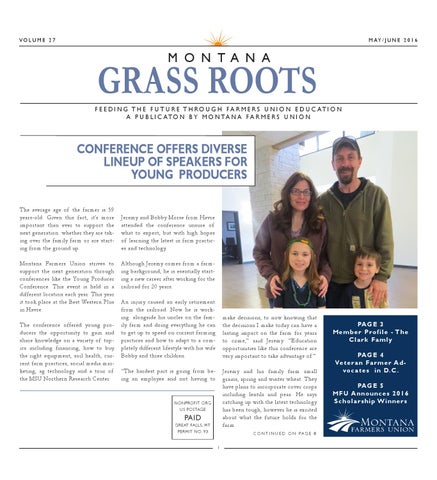
Jeremy and Bobby Morse from Havre attended the conference unsure of what to expect, but with high hopes of learning the latest in farm practices and technology. Although Jeremy comes from a farming background, he is esentially starting a new career after working for the railroad for 20 years. An injury caused an early retirement from the railroad. Now he is working alongside his uncles on the family farm and doing everything he can to get up to speed on current farming practices and how to adapt to a completely different lifestyle with his wife Bobby and three children.
make decisions, to now knowing that the decisions I make today can have a lasting impact on the farm for years to come,” said Jeremy. “Education opportunities like this conference are very important to take advantage of.”
“The hardest part is going from being an employee and not having to
Jeremy and his family farm small grains, spring and winter wheat. They have plans to incorporate cover crops including lentils and peas. He says catching up with the latest technology has been tough, however he is excited about what the future holds for the farm.
NONPROFIT ORG US POSTAGE
PAID GREAT FALLS, MT PERMIT NO. 93
C O N T I N U E D O N PA G E 8 1
PAG E 3 M em b er P rofi l e - Th e C l a r k Fa m ly PAG E 4 Vet er a n Fa r m er A dvoc a t es i n D. C . PAG E 5 M FU A n n ou n c es 2016 Sc h ol a r sh i p Wi n n er s
V O L U M E 2 7
M AY / J U N E 2 0 1 6
CENTENNIAL F A M I LY
IN THIS ISSUE Member Profile - The Clark Family Page 3
Is your family celebrating 100 years of heritage? If so we would love to honor you as a centennial family!
Opportunities for Veteran Farmers Page 4
Simply submit a family biography & pictures to Lyndsay Bruno at: lbruno@montanafarmersunion.com or mail the information to: PO Box 2447, Great Falls, MT 59403
MFU Announces 2016 Scholarship Recipients Page 5
Your family will be recognized at the annual convention in Great Falls at the Heritage Inn, October 21-22.
•
WELCOME
MFU Hires Kathryn Peterson as Arrowpeak Camp Director Page 6 Why Soil Health is Important Page 7
•
Member Re c r u ite d b y Daniel & Cortani Martin, Brusett Ron Watts Uthaug Livestock Co. , Jordan Ron Watts John & Sue Foster, Lewistown Tom McKenna Thomas King, Bozeman Dean Derby Copper City Ranch LLC, Three Forks Craig Parker Carola Mielke, Stevensville Bryan Jones Edeltraud Stockstad, Charlo Andrew Luedtke Larry and Patricia Hayden, Alberton Andre Marcure Joseph Purcell, Lolo Andre Marcure Lawrence & Barbara Clark, Philipsburg Andre Marcure Neal Clark, Philipsburg Andre Marcure Bobby & Jeremy Morse, Havre Young Producers Casey & Heather Jorgenson, Harlem Young Producers Emma Faus Ralston, Havre Young Producers Zane Goldhahn, Havre Young Producers Raynee Pearson, Big Sandy Young Producers Dallas & Amy Egbert, Turner Young Producers Izaac Goldhahn, Shelby Young Producers Kyla McNamara, Shelby Young Producers Skylar Pearson, Big Sandy Young Producers Kasee Clark, Townsend Young Producers Charity Alonso, Great Falls MFU Camp Jennifer & Alex Johnson, Great Falls MFU Office
News from Around the State Page 8 Messages from Montana Delegation Page 9 How Agriculture in Colombia Compares to the U.S. Page 10, 12 Save the Date for the Governor’s Ag & Food Summit Page 13 Montana Wheat & Barley Tour Page 14
Conf. Conf. Conf. Conf. Conf. Conf. Conf. Conf. Conf. Conf
Good News for Agriculture, Transportation Update Page 15 What does the CSKT Water Compact Mean for Montana? Page 16 A Celebration of Mothers Page 18
MONTANA FARMERS UNION PO BOX 2447 300 RIVER DRIVE NORTH GREAT FALLS MT 59403 PHONE: (406) 452-6406 FAX: (406) 727-8216 mfu@montanafarmersunion.com www.montanafarmersunion.com Board of Directors: Alan Merrill, President Rollie Schlepp, Vice President, Conrad Erik Somerfeld, Secretary/Treasurer, Power Bill Courtnage, Geraldine, at-large director Brett Dailey, Jordan Ben Peterson, Judith Gap, at-large director Kelly Rutledge, Big Sandy Sig Rudie, Fairview, at-large director Paul Kanning, Flaxville Jan Tusick, Ronan State Office Staff: Jan Johnson, Office Mgr., Assistant Secretary/Treasurer Lyndsay Bruno, Communications Director Chris Christiaens, Legislative & Project Specialist Delisa Protsman, Education Director Justin Loch, Membership Director Dave Snuggs, Facility Director Copyright © Montana Farmers Union, 2016. Montana Grassroots is the official publication of the Farmers Educational and Cooperative Union of America, Montana Division. MFU reserves the right to reject any advertisements. Third Class bulk postage paid at Great Falls MT 59401. Membership: $50.00 per year
Montana Producers Travel to Costa Rica Page 19 2
V O L U M E 2 7
•
MEMBER profile
M AY / J U N E 2 0 1 6
•
FROM CORPORATE LIFE TO LIFE ON THE FARM B Y LY N D S AY B R U N O C O M M U N I C AT I O N S D I R E C T O R
Tom and Joellyn Clark met in college while attending MSU- Bozeman. Joellyn graduated with a degree in graphic design and Tom a degree in engineering. Joellyn grew up on a farm near Fort Benton and Tom is a native of Belgrade. In pursuit of their dreams they moved to a suburb of Salt Lake City. After ten years and two children later, they longed for the less hectic slower pace of life. They made the decision to move back to the farm and did so shortly after having their youngest daughter. They now work alongside Joellyn’s parents and and brother Ash. “The transition from corporate life and taking that leap of faith was made easier because we were doing it with family,” said Tom. “In a small town you have a sense of community that you don’t really get in the big city. That was a big draw for me, and also being able to spend more time with my family. I was traveling two weeks out of the month and felt I was missing out.” For Joellyn it was also about that connection with family. “For me staying home was an opportunity I wanted to explore. I worked for ten years with my kids in daycare,” said Joellyn. “I grew up in a small town so I knew the kind of opportunities that there are.” Tom says his family was pretty surprised, not that he returned to Montana, but of the path he chose going from construction management to life as a farmer. “I was intrigued by the opportunity to be my own boss,” said Tom. “At the end of the day I am proud to say that there is real purpose to what we
Tom & Joellyn Clark farm near Fort Benton with Joellyn’s brother Ash and parents do. We are helping other people.” The Benjamin Ranch, named after Joellyn’s side of the family, was started by her grandfather years before. On the ranch the family grows spring and winter wheat, canola, mustard, peas, lentils and alfalfa. Tom says his father-in-law Roger has been very progressive with his farm practices. For nearly 15 years Roger has grown a varied rotation of continuous crops with fewer fallow years. Recently he has been testing cover crops. Joellyn tells the story of how farming has changed over the years. She says her grandfather moved to Montana from California and bought a piece of land after serving in World War II. “At that time wheat was selling for $3.50 a bushel”, said Joellyn. There was no income tax and his first tractor cost him $1,200. Today wheat is selling for a little over $4 a bushel and yet tractors cost hundreds of thousands of dollars.” Tom and Joellyn agree that that the price of wheat and high input costs are two of the biggest hurdles facing farmers today. In addition, access to capital and land is also tough to come by. Joellyn says one of their main goals is to farm every acre every year. 3
She sees many advantages of continous crop rotation. With Joellyn’s background in farming she can draw comparisons between what farming was like years ago versus what it is today. One major difference she says is the technology. “When I was a kid we tilled everything. We didn’t have navigation equipment, auto steer or navigation capabilities.” Tom says having the technology is a double edge sword. “On the one hand you can be more efficient with controls on spreaders and sprayers. Because of such high input costs the technology can really help minimize that impact, but there is a reluctancy to upgrade because the equipment is much more complex to fix.” Tom and Joellyn are active members of Montana Farmers Union. Tom is president of the Chouteau County Farmers Union and Joellyn is the Education Director. They served as a Farmers Union Enterprise Couple and traveled to Washington D.C. last year for the annual fly-in to D.C. There they advocated for policies for beginning farmers. C O N T I N U E D O N PA G E 7
V O L U M E 2 7
M AY / J U N E 2 0 1 6
MONTANA FARMER TESTIFIES ON BEHALF OF MILITARY VETERAN FARMERS B Y PA U L K A N N I N G M F U B OA R D M E M B E R / FA R M E R
“It was a fantastic experience and great opportunity to participate in the funding process of our government.” Paul Kanning, courtesy National Farmers Union Recently I had the opportunity to testify at a Senate Ag Appropriations Subcommittee hearing on military veteran opportunities and benefits in agriculture. It was a fantastic experience and a great opportunity to participate in the funding process of our government. The subcommittee oversees and legislates funding for the Food and Drug Administration and most USDA agen-
cies and programs, with the exception of the Forest Service. It is chaired by Senator Moran of Kansas and includes 12 other members, including both of Montana’s U.S. Senators.
Vocation Education, and Ms. Alison Perry from Central Oregon Veterans Ranch. The hearing addressed the benefits and opportunities available to veterans seeking a profession in agriculture. In addition to submitting written testimony, each witness provided oral testimony at the hearing and addressed questions from subcommittee members.
In addition to myself, the other witnesses at the hearing included USDA Deputy Under Secretary Lannon Baccam, Military Veterans Agriculture Liaison, Mr. Gary LaGrange and Mr. John Ulrick of Soldier Agricultural
Each of us highlighted programs and services which aided our transition into agriculture and provided input on new programs requested in the President’s budget for 2017. In addition to veteran programs, I spoke on other benefits available to all beginning farmers, such as the new farmer provisions in conservation programs, the federal crop insurance program and FSA loan programs. C O N T I N U E D O N PA G E 1 5
Paul Kanning with Senator Jon Tester; courtesy Senator Tester’s office
Paul Kanning with Senator Steve Daines; courtesy Senator Daines’ office 4
V O L U M E 2 7
SCHOLARSHIP WINNERS FOR 2016 BY DELISA PROTSMAN EDUCATION DIRECTOR Montana Farmers Union holds the education of its members in high esteem. Therefore, several scholarships have been developed to enhance success in educational endeavors. We offer seven scholarships each year to the tune of $3,000. We are pleased to announce the scholarship winners for 2016.
M AY / J U N E 2 0 1 6
am today as I have attended the camps for the last 10 years. Being a dean and SYAC member over the years has helped me improve my cooperation, leadership and time management skills. These three qualities have helped me manage and properly execute the steps to achieving my dreams.
MFU has helped me reach my goals by making me into the leader I have become, due to going to camps and MFU events over the years. What are your hobbies and interests? I’m just a Montana gal. I love to hunt, fish, be outdoors and spend time with kids and my family.
What are your hobbies and interests?
I have grown to love swing dancing at Farmers Union Camp. Every year at camp, I progressively advance my dance skills and love it all the more.
Lauren Arnst
Montana Farmers Union Scholarship Chouteau County Scholarship John Korsbeck Memorial Scholarship
I am also very interested in photography. This year, I photographed some senior pictures and they turned out great. I have always loved camping in the mountains, too. Lastly, I enjoy gardening. My sister, grandparents and I grow a large garden together every summer and sell the produce at the local farmers market.
Alana Green
Montana Farmers Union Scholarship Chouteau County Scholarship John Korsbeck Memorial Scholarship
Hayley Siroky
Bud Daniels Memorial Scholarship
Hometown: Roy High School: Roy High School College: Montana State University Bozeman Degree: Agricultural Business with a concentration in Farm and Ranch Management and Economics Minor How has Montana Farmers Union helped you to reach your goals? Montana Farmers Union has been an immense help in reaching my educational goals. My family’s longstanding history with MFU has helped to root myself in agriculture and the many related sectors. I have learned various leadership and cooperation skills through MFU and this has helped me to become the hard working individual that I am today. My involvement with MFU has only solidified my educational and career goals. I am incredibly thankful to MFU and their continuing support towards my education. What are your hobbies and interests? Anything having to do with outdoors or agriculture are my favorite things. I enjoy all sports, do-it-yourself projects, art, hiking, biking, riding horses and riding dirt bikes.
Special Announcement?
Hometown: Fort Benton High School: Fort Benton College: Montana State University Degree: Undecided How has Montana Farmers Union helped you to reach your goals?
Do you have a birthday, anniversary, favorite recipe or other community news you would like to share?
Hometown: Fort Benton High School: Fort Benton College: Montana State University Degree: Undecided
Send the information to: lbr uno@montanafar mersunion. com and we will publish it in the next edition of Montana Grassroots!
How has Montana Farmers Union helped you to reach your goals?: MFU has helped me become who I 5
V O L U M E 2 7
M AY / J U N E 2 0 1 6
MFU HIRES KATHRYN PETERSON AS ARROWPEAK CAMP DIRECTOR Montana Farmers Union is proud to announce the hiring of Kathryn Peterson as Camp Director. Kathryn was born and raised in Great Falls. She left after graduating high school to pursue her education and career. After returning she married her husband Jake who is also from Great Falls. The two were married at the Arrowpeak Lodge. Together they have three children. Riley is 8, Liam 7 and Lily is 3.
REGISTER NOW FOR ARROWPEAK SUMMER LEADERSHIP CAMP! Camp registration is $75 for members & $130 for nonmembers. Camp Scholarships are available. To register visit montanafarmersunion.com
Arrowpeak Camp Dates: Senior Camp: June 19-24 Ages 15-19 Junior Camp I: June 26-July 1 Ages 8-11 Teen Camp: July 11-July 15 Ages 12-14 Junior Camp II: July 17-22 Ages 8-11
Kathryn says one of her goals for camp is to encourage the campers to explore, learn and have fun all while developing basic survival and navigational skills; plant, explore mineral and animal identification and learn archery! Campers will also have the opportunity to learn about cooperatives. “I want these kids excited about Montana Farmers Union’s heritage and core values. We want camp to help them develop an understanding and ownership of the land and have the knowledge to cherish and protect it,” said Kathryn.
KEEP TRADITIONS ALIVE: SHARE YOUR CAMP MEMORIES!! B Y K AT H RY N P E T E R S O N / C A M P D I R E C T O R
Kathryn Peterson/ Arrowpeak Camp Director Kathryn encourages those in the community who have a skill they would like to share to consider volunteering a few hours to the program.“I would like these kids to leave with a bigger sense of what it is to be a productive member of society, and to ignite their passion for nature and the outdoors.”
the heritage of camp for future campers, the foundation of Arrowpeak, but to educate others on the history of Arrowpeak and why it was established. As part of our senior camp we will be creating a memory and songbook highlighting former camp leaders to serve as a vision for the future.
In keeping traditions alive within Montana Farmers Union Camp, we are asking past campers to share favorite memories, campfire stories and songs.
We would love to see old photos, lines of songs and favorite activities you enjoyed while attending camp.
As we reach another generation shift it is important to record these for years to come, not only to ensure
Please submit camp memories to Kathryn Peterson at kpeterson@montanafarmersunion.com.
Camps are sponsored by the CHS Foundation, Farmers Union Mutal Insurance Company and Montana Farmers Union.
6
V O L U M E 2 7
M AY / J U N E 2 0 1 6
SOIL HEALTH-WHY IT MATTERS
M E M B E R P RO F I L E : THE CLARKS C O N T I N U E D F RO M P G . 3
BY JUSTIN LOCH M E M B E R S H I P D I R E C TO R
3. Healthy soils protect natural res- ources on and off the farm. 4. Healthy soils can reduce nutrient loading and sediment runoff, increease efficiencies, and sustain wildl- life habitat.
and soil function, and improve water or sustain water quality, air quality, energy efficiency and wildlife habitat. Energy is saved by using less fuel for tillage thus maximizing nutrient cycling.
We all know water is an invaluable resource and it goes hand-in-hand with healthy soil. Healthy soil holds more water by binding it to organic matter, and loses less water to runoff and evaporation. Organic matter builds as tillage declines and plants residue cover the soil. Organic matter holds 18-20 times its weight in water and recycles nutrients for plants to use. In a I want to discuss an issue that has betime where water is limited, it’s imporcome a hot topic lately, soil health. tant to utilize it to the fullest. Having What is soil health? Soil health is the healthy soil can accomplish this. capacity of soil to function as a living system, with ecosystem and land use Organic matter is vital to healthy, boundaries, to sustain plant and aniproductive soil. Most farmers can inmal productivity, maintain or enhance crease their soil organic matter in 3 water and air quality, and promote to 10 years if they are motivated and plant and animal health. adopt good conservation practices. With that being said producers need As producers each year we work to to keep 4 principles in mind: plant a crop hoping for high quality 1. Use plant diversity to increase div- and high yields. On the ranching end ersity in the soil. Cover cropping we hope to have enough grass and is a good way to accomplish this. forage to sustain our cattle herds and 2. Manage soils by disturbing them help fatten our market cattle. Yet, how less. much attention are we paying to the 3. Keep plants growing in the soil soil quality that helps produce crops throughout the year to feed the soil. and forage? Improving soil health is 4. Keep soil covered as much as poss- key to long-term, sustainable agriculible. Plants flourish better in cool- tural production. er soil temps and it helps keep more water and nutrients in the soil. Why does Soil Health matter? It mat ters for numerous reasons. What is the best way to start and carry 1. Healthy soils are high-performing, out a healthy soil plan? A soil health productive soils. management plan can help with this. 2. Healthy soils reduce production The plan outlines a system of practiccosts and improve profits. es needed to enhance crop production
A healthy soil plan helps reduce disease pest problems. Most importantly for producers healthy soil leads to improved plant health. In a time where commodity prices are down producers need to take advantage of any way to help keep production costs low and increase yields to help make their operations financially sustainable. Improving soil health is certainly one way to help. It’s an area that is sometimes lost or given little thought in the overall operation of production agriculture and ranching. So please take the time to think about the soil that’s working to support your livelihood and make some decisions to improve your soil health. You will reap the rewards for years to come. (Some information used in this article is from NRCS and USDA)
Join Montana Farmers Union today and advocate for Montana farmers and ranchers through local and state involvement! Visit montanafarmersunion. com or contact Membership Director Justin Loch for details!
7
The two say their involvement in Farmers Union has opened their eyes as to other types of farming practices throughout the country. “Farmers Union is a very pro-family farm and so we understand and support keeping that lifestyle alive,” said Joellyn. Despite the fact that 97% of the nations farms are family owned and operated it is becoming increasingly difficult to keep it that way. The very cost of operation forces many family farms out of business. “Hard times like these weed out the weak and so farms who can’t afford to operate because of low commodity prices end up selling to large farms”, said Joellyn. Modern farming practices and better technology has made farms more efficient, however as Tom points out the population of rural communities is shrinking. “The local farmer supports the schools and local businesses. We have to do more to advocate for the family farm.” Joellyn says one solution to the decline in family farms is incorporating Ag education in the schools. She says Fort Benton is exploring the possibility of adding a program like Future Farmers of America into the curriculum. “I think my kids could really benefit from that. Even though we have all daughters I don’t think that should prevent them from wanting to be involved in the farm an family business.” A special thanks to Tom and Joellyn for participating in this edition’s Member Profile!
V O L U M E 2 7
M AY / J U N E 2 0 1 6
YO U N G P RO D U C E R C O N F E R E N C E C O N T I N U E D F RO M PA G E 1
“It helps to be in a group environment and hear questions from others you might not have thought to ask yourself,” said Jeremy. The farming lifestyle is completely new to Jeremy’s wife Bobby who is from Helena.“From a business perspective it’s hard to go from having a steady income and health insurance to living with the uncertainty of farming,” said Bobby. “But I am encouraged as to what the future holds for our family. It will certainly be an adventure for us! ”
When asked about the pride that comes with being a farmer, Jeremy says he is just now starting to get a sense of what that means now that he is working on the farm full-time. “It’s definitely made my relationship with my kids better. They are able to be there with me when I work, where else can you say that? I am looking to be the bridge between generations and carry on this tradition of farming to my kids.”
Bobby Morse and daughter look over a sample of a cover crop during the Young Producer Conference at the Northern Ag Research Center.
NEWS FROM AROUND THE STATE Roosevelt County-Wide Farmers Union: Paul Kanning provided updates from the subsequent board meeting including information on the release of both the The Fracking Report & Climte Change Report. Other points discussed were hail and crop insurance, international policy and legislation on GMO labeling. Chouteau County Farmers Union: The group discussed team goals which include incresing membership by 10% and having required meetings to earn education funds. Education Director, Joellyn Clark talked about ways the group could promote camp directly to schools to help connect education programs with schools in the county.
Cottonwood Farmers Union:
V.P. Alicia Bach talked about better educating people on the benefits of membership, and to make meetings more enticing. Scott LeFurgey, Director of Cooperatives, would like to research potential co-ops who would be interested in partnering with members. At the group’s most recent meeting they voted to fund scholarships for Arrowpeak Camp.
The most recent meeting was held at the Knights of Columbus in Havre and called to order by president LeRoy Keller. An update on candidates who have filed for office was given. The group discussed the potential dairy fee increases and the impact that would have on the state. Changes to crop insurance were also discussed. The next local meeting is scheduled for October.
Western Montana Local Farmers Union:
Cascade County Farmers Union & Headquarters Local:
The most recent meeting was held at the 44 Cafe and Bar in conjunction with the Alternative Energy Resource Organization ( AERO) with a presentation on uses of solar energy in business and farms. Presenters Karl Sutton with Fresh Roots Farm and Joe Arnold with Flathead Creamery explained how they incorpated solar energy into their operations and the installation, cost and cost saving benefits of solar.
President Eric Bergman called the meeting to order which was held at state office in Great Falls. It was voted that current officers be retained. The group discussed the possibility of organizating a public debate. Erik Somerfeld provided an update on the policy adopted at the national convention in March in Minneapolis, MN. 8
Teton County-Wide Farmers Union Local: The most recent meeting was held at Les’ Bar in Power. It was reported that Teton Local received education funds from Mountain View Co-op. President Erik Somerfeld moved to utilize a portion of the funds for summer camp scholarships. Six members and six non-members will be given $75 each towards a camp scholarship. The group also discussed the possibility of using further education funds to cover the cost of tours such as the new mint/dill still on the Fairfield Bench and a tour of Montana Speciality Mills.
V O L U M E 2 7
A MESSAGE FROM SENATOR STEVE DAINES
M AY / J U N E 2 0 1 6
foreign trading partner – supporting over 25,000 Montana jobs and totaling over 36.5% of our states exports in 2014. It’s important that we continue to do everything possible to facilitate trade with Canada, not create more obstacles for Montana products to overcome to get to market.
A MESSAGE FROM CONGRESSMAN RYAN ZINKE
I also led the fight in the House for conservation easements because I believe our tax code should incentivize farmers, ranchers, and land owners to support conservation by donating their land for a tax write-off if they so choose. My bill, the Conservation Easement Incentive Act of 2015, was included in the year end package and signed into law.
CBP’s repeated efforts to reduce operating hours would unduly harm rural regional commerce and I’m pleased to say that they withdrew three previous proposals to reduce operating hours following my urging. I’m also working to ensure that Montana’s wheat exporters are on equal footing with Canadian trading partners when sending wheat to Canada.
Throughout eastern Montana, signs of our state’s strong agriculture heritage are at every turn. From wheat and sugar beet fields to grazing cattle and sheep – it’s impossible to miss the impact of our state’s number one industry: agriculture. Agriculture is more than just an economic driver of our state, it’s a way of life for thousands of Montana families who pass on farms and ranches from generation to generation. That’s why I’m committed to working toward commonsense policies that help, not hurt, our farmers, ranchers and producers and help expand opportunities for success. I’m actively working to reverse the misguided decision by the U.S. Customs and Border Protection (CBP) to terminate the northeastern Montana border crossing’s 24-hour operating status. Canada is Montana’s largest
combine or auger. This permanent reform incentivizes Montanans to invest in the future, knowing that the tax credit is permanent, rather than reauthorized last-minute or retroactive basis.
I’ve pressed the U.S. Trade Representative to make the issue a priority and have reached out to Canadian Prime Minister Justin Trudeau to urge him to examine the Canada Grains Act and support efforts to establish reciprocal grading standards of wheat and barley between the U.S. and Canada.
Tax Relief for Montana Ag You sent me to Washington with a long list of Montana priorities. After about a year and a half in, I’m happy to say we’ve accomplished a lot. We rolled back common core, lifted the Cold War-era ban on exporting crude, and restored crop insurance funding. But one of my biggest accomplishments is providing real tax relief for farmers and ranchers.
As a fifth generation Montanan, I know our state’s natural resources are central to our way of life and important to our economy, and I’m committed to helping our farmers, ranchers and small business owners succeed.
Last December, I was the only member of Montana’s Congressional delegation to work across the aisle and vote for a package of tax breaks for agriculture. One of the most important aspects was permanently extending Section 179 tax credits. This tax deduction is critical for ranchers and farmers to invest in new equipment. You know as well as I do that just because the bank says you’re worth Xamount of dollars, doesn’t mean you have cash laying around to buy a new
SAVE THE DATE! Montana Farmers Union Annual Convention October 21-22 in Great Falls at The Heritage Inn. 9
We must set our sights on repealing the Death Tax. Ag families are not the leisure class. They are hardworking Montanans who spent their whole lives – generations – building a better future only to see it threatened. The death tax punishes people who worked hard, played by the rules, and just want to pass that legacy on to their children. The death tax is a tax on the American Dream. The repeal passed the house and now it is time for the Senate to take up my bill. I am proud of these victories, but there’s more work to do. My door is always open and please know Montana farmers and ranchers can always count on me to fight for them in Washington, D.C.
V O L U M E 2 7
M AY / J U N E 2 0 1 6
A LOOK AT THE CHALLENGES FACING AGRICULTURE IN COLOMBIA B Y LY N D S AY B R U N O C O M M U N I C AT I O N S D I R E C T O R
lowship began with study at the University of Montana- Missoula, Cornell University and finally a six week internship with Montana Farmers Union where he is studying right to farm legislation and its effects on rural America.
Nearly 2,700 miles separate the United States from Colombia. There are great differences between the two countries, but as Oscar Diaz Forero has discovered, the two do share some commonalities.
One might expect Oscar’s interest in agriculture to stem from a background in farming, but it was actually his interest in rural development that was the motivator to pursue a career in agriculture.“I really like the rural life,” said Oscar. I enjoy working with small farmers in Colombia.”
Oscar has a bachelor’s degree in Agricultural Engineering from the University of Columbia and a specialization in Economics from a private college in Colombia as well.
Oscar Diaz Forero/ Native of Colombia
In his studies and work in the Colombian government, Oscar has discovered a disconnect between rural and urban Colombia. He lives in the city of Bogota, home to nine million people. He says the urban lifestyle can shelter many people from the realities and issues in rural Colombia. “When I was living in the city I never faced anything difficult,” said Oscar. “I was living a good life having parties with my friends going to restaurants and
A desire to further his education in agriculture and economics led to him applying for the Hubert Humphrey Fellowship Program. He and one fellow Colombian were chosen among 430 applicants to participate in the program, which is managed by the U.S. Department of State. Oscar’s fel-
Coffee crop in Colombia - Colombia is one of the top coffee producers in the world
the cinema. It was a different kind of life, but when I was in the rural areas I noticed that there are real security problems.” Oscar is referring to the civil war between the guerillas, the Colombian Army and rebel fighters. He says the civil war is threatening the livelihood of farmers. They are often left displaced after guerillas take their land to grow coca which is the raw plant material used to make cocaine. “As a goverment we try to improve their conditions and quality of life through social programs and subsidies,” said Oscar. I think the situation is improving. It’s nothing like it was 10 or 20 years ago. A better dialogue between the Colombian government and the guerrillas will eventually lead to some compromise that will be good for the Colombian people.” Unlike Montana, where agriculture is the number one industry, in Colombia
C O N T I N U E D O N PA G E
Plantain Crop in Colombia - Plantains are different from fruit because they contain more starch than sugar, unlike their cousin the banana 10
12
V O L U M E 2 7
M AY / J U N E 2 0 1 6
why wheatwhy works wheat works
re is a simple There science is a to simple why we science chosetotowhy make we cat chose to make cat r from 100 percent litter from wheat. 100 When percent the wheat. wheatWhen is ground, the wheat is ground, manufacturing the process manufacturing exposesprocess starch and exposes enzymes starch and enzymes t contribute to that ourcontribute sWheat product. to our sWheat The 100 product. percentThe 100 percent degrad-able wheat biodegrad-able enzymes wheat neutralize enzymes odor while neutralize the odor while the ch helps with starch clumping. helps So, withwith clumping. wheat, So, we with havewheat, we have naged to make managed life better to make for cats, lifepeople, better for andcats, the planet. people, and the planet.
ps fast
t blink.
give yourself the gift of sWheat Perks
Signing up for sWheat Perks means you receive a monthly e-newsletter with exclusive promotions, coupons, and expert advice from our resident veterinarian Dr. Justine Lee. It’s free, full of natural lifestyle articles; cute cats, an inside look at new products, contests and more!
all-natural cat litter
clumps stops odors fast clumps fast
Smell that? Don’tNeither blink. do we.
chemical-free stops odors powerful odor Smell Nothat? ick toNeither make usdo we. control sick.
chemical-free biodegradable biodegradable
To sign up, visit sWheatScoop.com/sign-up today. biodegradable
Now Noyou ick see to make it, now usyou sick.don’t. Now you see it, now you don’t.
©2016 Pet Care Systems. sWheat Scoop is a registered trademark of Pet Care Systems. SS3283. sWheatscoop.com
11
no chemicals, no chemicals, no clay, no no worries clay, no worries
V O L U M E 2 7
COLOMBIA C O N T I N U E D F RO M P G . 1 0
manufacturing is the leading industry with petroleum being the number one export. Columbia has the third largest GDP in South America. Strong trade agreements with neighbors like Panama, Ecuador and Brazil create a great demand for many agriculture products including rice, fruits, cocoa and vegetables. In addition, Colombia exports many exotic fruits and coffee to the United States. In fact, Colombia is the fourth largest coffee producer in the world. Oscar says size is one of the main differences between farms in Colombia and the United States. The average farm in Colombia is between one and two hectares, which is the equivalent to nearly two and a half acres in the U.S. The average farm or ranch in Montana is 2,147 acres. The challenges for rural development and agriculture in Colombia are multi-faceted. Access to land, credit, transportation and variance in climate threaten the industry. “We have somewhat of a crisis because of the amount of waste,” said Oscar. Farmers will have product to sell, but no way to transport their goods. The government in Colombia is exploring options for transport including the use of waterways and animals in very remote areas.” Another obstacle to production is weather. Oscar says Colombia is seeing the effects of climate change. Some areas are in severe drought, especially in the North-
M AY / J U N E 2 0 1 6
west part of the country where there has been little to no rainfall in months or even years. The government is working to development irrigation systems for those areas to supplement the lack of moisture. He says the opposite is true in other parts of the country. Excessive flooding can wipe out a farmer’s whole operation which in turn drives up prices and puts a burden on the consumer. “We have to be resilient with those types of situations. We do have subsidies and some insurance for farmers.” Oscar says one solution to food insecurity is the adaptation of varying farm practices to include long and short term crops. He Rose crop in Colombia - Colombia is the second-largest cut-flower exporter in the world says the culture in Colombia is very individualistic in that many farmers will only produce enough food for their families. He says the government wants to see a cultural shift where farmers collaborate with each other to produce more food using a cooperative model. Yet despite the cultural differences, the United States shares some similar struggles with Colombia including the aging rural population and the deficit of next generation or beginning farmers. Oscar says even twenty years ago it was still common practice for the family farm to be handed down to the next generation, however now it’s increasingly harder to keep young people on the farm. “Wages in agriculture are typically lower than any other field, so it’s difficult to attract young people. The government is trying to design new policy related to rural development which includes education, access to credit and exte-
Mr. Jimmy Carter signs a copy of his book for Oscar at a workshop in Atlanta nsion services. After completing his fellowship Oscar will return home to Colombia. He says the experience in the U.S. has been very eyeopening. “I love Montana. I think it is a really good place to live. The people 12
here are very friendly. Agriculture is big in this state. The concept of city gardens and community food banks is new to me and I hope to apply some of those ideas when I get home to Colombia.”
V O L U M E 2 7
M AY / J U N E 2 0 1 6
look at the topics, identify challenges that exist, and brainstorm ways to address them. The tracks will be a mixture of panel presentations, small group discussions, and attendees prioritizing next steps. All of the tracks will report on their top recommendations at the summit’s conclusion.
GROW MONTANA HELPS PLAN GOVERNOR’S FOOD & AGRICULTURE SUMMIT B Y : T R AV I S M C A DA M , P RO G R A M S P E C I A L I S T N AT I O N A L C E N T E R F O R A P P R O P R I AT E TECHNOLOGY
Nine years have passed since former Governor Brian Schweitzer convened his Governor’s Food and Ag Summit. At that time, one major topic was how more of the food grown and raised in Montana could be used in the state to benefit our communities. An incredible amount of work has happened on that front since Governor Schweitzer’s event. There is, however, plenty of work that still needs to be done. Montanans caring about these issues will have another chance to come together, share information, and strategize about the next 10 years of local food systems work in the state.
The idea for the summit started at a June 2015 meeting of Grow Montana’s steering committee. Committee members talked about how numerous individuals and organizations had shown interest in convening another food and agriculture summit; however, attempts to pull an event together had petered out. Grow Montana decided to make sure another summit happened in 2016.
The Grow Montana Food Policy Coalition is working with other partners to plan the 2016 Governor’s Food and Agriculture Summit, which will be held October 28-29 in Bozeman.
Since that meeting last June, Grow Montana has partnered with other groups, including the Montana Governor’s Office, Montana Department of Agriculture, and Montana State University, to form the summit’s planning committee. The summit is structured around topical tracks. Attendees will be asked to pick a track and stay with it for a good part of the summit, so they can take an in-depth
RENT A HISTORIC CABIN AT HIGHWOOD CREEK
Creek feature two unique and rustic private cabin sites nestled in towering evergreen trees along Highwood Creek.
B Y DAV E S N U G G S FAC I L I T I E S D I R E C TO R
Imagine sitting in a rocking chair on a covered porch listening to the sounds of the Highwood Creek. Later in the evening enjoy a campfire while listening to a bugling elk in the distance. All of this is now available to you! Montana Farmers Union is proud to announce the grand opening of the Historic Cabins at Highwood Creek. Located in the Highwood Mountains, just 42 miles east of Great Falls and adjacent to the Arrowpeak Lodge, the Historic Cabins at Highwood
For over one-hundred years, the cabins and the surrounding land were for the private use of family and friends. In the spring of 2015 the owner Stephenson Ranch decided that the cabins should be enjoyed by all. Improvements have been made to the cabins while maintaining their rustic charm and historic significance. The Historic Cabins at Highwood Creek are managed by Montana Farmers Union & Arrowpeak Lodge. For information visit our website or contact Facilities Director Dave Snuggs at 406-231-8690. The cabins are available for the enjoyment of the public between June 1st and October 31st.
13
The current tracks are: • Challenges of Food and Agriculture Manufacturing, Processing, and Local Distribution • Farm to Folk: Positive Economic and Health Benefits of Communities Becoming Markets for Local Food • Who Is Your Farmer? Demographic Shifts Creating a New Generation of Farmers • Resilience in Agriculture: Diversifying, Adapting and Planning for a Changing Environment • Montana and Beyond: Marketing Montana Food and Agriculture to the World Fred Kirschenmann, a Distinguished Fellow at the Leopold Center for Sustainable Agriculture, and economist Michael Shuman will provide keynote presentations during the two-day event. Visit https://foodsummit.ncat.org/ for more details.
V O L U M E 2 7
WORKSHOP BY WHEAT & BARLEY COMMITTEE PROVIDES EYE-OPENING EXPERIENCE B Y B E N P E T E R S O N , M F U B OA R D O F D I R E C TO R
This spring I was fortunate to attend a workshop sponsored by the Montana Wheat and Barley Committee in Portland, OR. We toured bakeries, an export terminal, the Federal Grain Inspection Service (FGIS) and the Wheat Marketing Center. We also enjoyed a very informative presentation given by the U.S. Wheat Associates(USW). We began our tour by visiting Dave’s Killer Bread’s production facility. This was the largest production facility we visited, but not necessarily the most efficient. The large mixing vats and ovens, as well as the two massive cooling towers, gave us a good overview of the production process and quality controls. The next day we began at the Wheat Marketing Center. We were given an overview of the purpose of the center and enjoyed a lesson on how bagels, crackers and a varieties of pastas are made. These production lines are for the purpose of creating new products, or determining how different wheat varieties and qualities work with current or future products. This is all for the purpose of marketing
M AY / J U N E 2 0 1 6
our wheat to export markets. That is after all the primary purpose of the Wheat Marketing Center. Our next stop was the Pearl Bakery for a tour and lunch. The Pearl Bakery is a local scale multi-generational bakery in the heart of the Pearl District in Portland. It produces primarily artisan style breads with a specialty of the traditional French bread. They market to restaurants, operate a storefront, and utilize farmers markets. The bakery itself is a very labor intensive, but flexible style. During the tour, the owner spent a great deal of his time talking about his labor difficulties. The products that are created there are of the highest quality. Next on the tour was the TEMCO export facility that is literally across the river from the Wheat Marketing Center. TEMCO is one of three CHS/Cargill joint ventures. The facility can move 40,000 bushels per hour and is the smallest of the three. TEMCO receives 80% of its incoming grain from barges and gets the remainder via truck and train. TEMCO is relatively small for the current infrastructure and the facility has to fill twice to load a Panamax cargo ship. The facility’s greatest asset is the truckload out and its proximity to the Willamette Valley with its large supply of low-protein white wheat that is in demand. If dry land farmers like me could find a close market for white wheat, it might fit our climate quite well.
Tour of Wheat Marketing Center, bagel making demonstration; photo courtesy Wheat & Barley Committee
In my opinion, visiting the Federal Grain Inspection Service (FGIS) was the most informative part of the trip. We learned how to spot flaws in our wheat and the causes of those flaws. Next was a meeting with U.S. Wheat Associates, also known as USW. USW is a voice for wheat producers in the international markets. They have two offices in the country and over a dozen offices overseas. One-third of their operating budget comes from check-off dollars paid by producers. One dollar invested yields forty-five dollars back to the U.S. economy. Among the states, Montana ranks second as the largest exporter of wheat driven by currency values, supply, and wheat quality. The strength of the U.S. dollar puts us at a disadvantage in the world market because it makes our wheat more expensive than exporters with weaker currencies like Canada. However, the current slight gains by foreign currencies will make us more competitive in the short term. The more obvious price driver is the excessive supply of wheat on the world market which has understandable negative impacts on demand. This oversupply of wheat will take time to change and will affect pricing for at least a year. The two factors in the price equation that Montana producers have the most control over is the type C O N T I N U E D O N PA G E
15
TEMCO Export Facility, Portland, OR; photo courtesy Wheat & Barley Committee 14
V O L U M E 2 7
GOOD NEWS FOR PRODUCTION AGRICULTURE B Y T E R RY W H I T E S I D E & A S S O C I AT E S
There are good things happening for production agriculture on the national transportation scene and it is important that farmer producers know about it. U.S. Sen. John Thune (R-S.D.), chairman of the Senate Committee on Commerce, Science, and Transportation, was honored with the first annual Murdo MacKenzie Award for advancing public policies that improve freight rail service and the American economy, including the passage and stewardship of S808, The Surface Transportation Board Reauthorization Act of 2015. The award was presented by the Rail Customer Coalition (RCC) of which the Alliance for Rail Competition (ACC) and National Farmers Union are founding members. The RCC is comprised of associations representing manufacturing, agriculture, and energy freight rail customers. From a national press release by the Senate Commerce Committee, “I am honored to receive this award for my efforts on behalf of Americans who depend on railroads for shipments and deliveries,” said Thune. “While we still have work to do, the reforms we enacted to the Surface Transportation Board help address many frustrations in the oversight of the freight rail industry in States like South Dakota.” Last year, Sen. Thune led the first successful effort to reform the Surface Transportation Board (STB), the federal regulatory body responsible for
M AY / J U N E 2 0 1 6
economic oversight of the nation’s freight rail system, and also helped avert the negative economic effects of a railroad service shutdown by extending the deadline of a federal requirement for the implementation of positive train control technology.
priations Committees. RCC will continue to work the House side, but this is a significant step towards our goal of ensuring the STB is fully funded. We understand some of the funds are designated for much-needed technology upgrades at the Board.
Murdo MacKenzie (1850-1939), the namesake of the award, was the head of Matador Land and Cattle, the founding president of the American Stock Growers Association, and a prominent advocate for railroad customers. His testimony before the Commerce Committee in 1905 was instrumental in the passage of the Hepburn Act of 1906, one of the centerpiece freight rail regulation laws of the 20th century. Sen. Thune’s hometown, Murdo, South Dakota, on the old Milwaukee Road rail route, was named after Mr. MacKenzie.
Thank - you especially to Mike Friedberg from Holland & Knight for their efforts on this issue.
From Michael Meenan, ACC, with permission, “Sen. Thune was appreciative of the award-- he even brought a picture of his ancestors from Murdo, SD on a railcar.”
The best part of serving as a hearing witness is knowing you have support. In my case, Tom Driscoll from National Farmers Union was instrumental in helping me prepare.
Thune also read a quote from Murdo MacKenzie testifying before the Senate Commerce Committee in 1903 demonstrating that this is not a new issue for rail shippers:
It’s great to be part of an organization like ours with great lobbying expertise and sound policy to draw upon.
VETERANS C O N T I N U E D F RO M P G . 4
I also addressed questions regarding rural development grants, rural community vitality and current efforts to recruit veterans into agriculture.
I encourage all of Montana Farmers Union’s members to observe a congressional hearing when visiting the capitol. Citizens can also submit written testimony to committees to address specific concerns at any time. Thank you to Farmers Union for the great support. It was an honor to testify and advocate for veterans, agriculture, and rural Montana.
“What show has he to go into the courts to make the railroads pay for this? He has none; and even if he does succeed it takes him years to get it, and it costs him more than the whole thing is worth.”” Some More Good News About Washington DC efforts on Transportation: The Senate THUD appropriations bill included a $4.6m increase for the STB-- well above even what the RCC has been advocating for in the appro15
TO U R C O N T I N U E D F RO M PG. 14
and quality of the wheat we raise. Wheat quality is determined by more than just protein content. U.S. wheat quality, including Montana’s, has been declining in recent years with the most obvious culprit being our choice of wheat varieties. The way we are compensated for our wheat defines the varieties that we choose to grow. The fact that we get paid strictly on protein and volume and not end use performance is creating a devaluation of our wheat on the world market. We are planting varieties that generate income, which we should be, not varieties that the export market wants. The breeders produce varieties that do not necessarily perform well at the mill because that is not what the buyers are demanding. We as producers need to start pressuring our buyers to change how they value our product as to better reflect what the end users of our wheat are willing to pay for. We will most likely need to change the varieties that we grow. This could cause a short-term decline in price, but the long-term result will be higher export demand for our products and therefore a more stable and profitable market. Quality has been the hallmark of U.S. wheat when competing with world markets. We will never be the cheapest wheat, but we can be the best again. I see the wheat market morphing from a volume and protein based market to more of a variety based market similar to the malt barley market. I strongly encourage any wheat producer that is able to join the Montana Wheat and Barley Committee on one of these tours. This trip was an an incredible opportunity.
V O L U M E 2 7
CSKT WATER COMPACT PROTECTS MONTANA FARMERS & RANCHERS FROM UP HILL BATTLE B Y F A R M E R S & R A N C H E R S F O R M O N TA N A
Our water is our state’s most valuable resource— our industry depends on it. And when the availability of water is uncertain, so too is the future of Montana agriculture, which is why the Montana Farmers Union supports the CSKT Water Compact. The Compact is a negotiated agreement that seeks to define the federally reserved water rights of the Confederated Salish & Kootenai Tribes. These rights have been held in trust for the Tribes by the federal government since the establishment of the Flathead Reservation. Without the Compact, the Tribes would be forced to litigate claims across the state in the Montana Water Court.
M AY / J U N E 2 0 1 6
pletely protected and irrigators will have access to new sources of water from the Hungry Horse Reservoir that would not otherwise be available.
field. Paul’s insights were tremendous, and he did an outstanding job representing Montana Farmers Union in our nation’s Capitol.
The Compact also respects individual property rights. Not only does it ensure that water access can be transferred if the land is sold or passed on to future generations, but it also protects property values by ensuring the certainty of those rights. The Compact passed the Montana State Legislature with bi-partisan support and is supported by all of the major agriculture groups across the state, including the Montana Farm Bureau Federation, Montana Stockgrowers Association, Montana Water Resources Association, Association of Gallatin Agricultural Irrigators, Montana Agricultural Business Association, and Farmers and Ranchers for Montana.
I know Paul, and other producers in Montana, grow the best wheat in the world, and they ought to get paid for it.
C O N T I N U E D O N PA G E 1 7
A MESSAGE FROM SENATOR JON TESTER
In this way, the CSKT Water Compact prevents individual water right holders from spending millions of dollars to protect their water rights. It also assures that Montana’s farmers and ranchers aren’t forced to fight an uphill battle to secure their rights. For instance, the water rights of the Tribes carry an 1855 or a ‘time immemorial’ priority date—making it nearly impossible for existing water users to protect their rights in Court without the Compact. Because the Compact must be evaluated by the Montana Water Court, the Compact doesn’t prevent those who wish to dispute the Tribes claims in court from doing so.
But unfair Canadian trade regulations are keeping hard working folks from receiving the compensation they deserve. Currently, every bushel of American wheat is automatically downgraded to the lowest quality designation after it crosses the Canadian border. Montana’s number one hard amber durum wheat is not feed wheat. Here in the U.S., we grade wheat as it is, we don’t just grade wheat as feed like the Canadians do. This policy should be reciprocated on the other side of the border. That’s why I’m fighting to make sure family farmers get a fair price. I met with the U.S. Trade Representative and contacted President Obama to raise urgency of this problem. I even met face-to-face with Canadian Prime Minister Trudeau and told him to stop shortchanging Montana. Going forward, I’ll keep pushing this issue to ensure Montana farmers are getting a fair shake. Best of luck this planting season. Please don’t hesitate to reach out to my Agriculture Liaison Jesse Anderson at 406.449.5401 if we can help.
The Compact also prevents taxpayers from paying millions of dollars in unnecessary court costs. If the rights of the CSKT are defined through litigation the process will be long and costly. However, defining the Tribal water rights through the Compact will ensure that water users won’t be forced to defend their existing water rights in Court.
In April, it was my honor to welcome Montana Farmers Union member and Flaxville farmer, Paul Kanning, to Washington.
Under the Water Compact, all existing water rights for domestic, commercial, municipal, industrial, stock water or other non-irrigation uses are com-
Paul provided one of my Senate committees with testimony on the resources available for veterans who transition from the battlefield to the wheat 16
V O L U M E 2 7
M AY / J U N E 2 0 1 6
BREAKDOWN OF THE CSKT WATER COMPACT B Y F A R M E R S & R A N C H E R S F O R M O N TA N A
COMPACT
NO COMPACT
Priority Date of tribal water rights that are held in conjunction with MT Fish, Wildlife and Parks (FWP) will be the priority date of the existing FWP right.
Priority Date
100% protection for stock, municipal, domestic, commercial, and other non-irrigation water uses on and off the reservation. The Compact prevents those with existing rights from having to go to Court. The Compact does not prevent those who want to go to Court over their water rights from doing so.
The claims of the federal government with regard to any off reservation water requirements will be settled. No existing or new rights will be given to the federal government.
The Tribe cannot issue a call on ANY non-irrigation rights, and even then may only issue calls on limited irrigation for more than 100 gpm during drought conditions only. The Tribes will not litigate any off-reservation in stream flow.
Localized moratorium on new water rights will be lifted. Compact would make valid all post 1996 domestic wells that don’t currently possess a valid permit. The Compact provides irrigators on the FIIP a delivery entitlement that runs with the land, ensuring no property devaluation related to irrigation water availability.
Litigation
Federal Involvement
Tribal Call
Property Rights
17
Tribal water rights on and off the reservation will have a priority date of 1855 or time immemorial. Those with existing rights would have to prove in the Montana Water Court that their rights predate those of the Tribe.
MT Law requires the tribe to file their water right claims. Litigation will be undertaken in the Water Court that will include basins across Montana. Water users in basins where the tribes have filed a claim must object to the tribal claim if they do not agree with the terms of the claim – including the priority date. Individual water users will be burdened by the cost of litigation. The federal government has a fiduciary obligation to the tribes and will have continued involvement, including USFWS conducting Biological Opinions regarding Endangered Species Act on off reservation in-stream water requirements. In those basins where the tribe files a claim the priority date of tribal rights will be at least 1855 if not earlier. There will be no limitation on what types of rights can be called. The Tribe could issue a call on water rights both East and West of the Continental Divide. These calls would impact water users both on and off the reservation.
Localized moratorium on new permitting and changes of use will continue until the Tribe’s claims are resolved through the adjudication process. Post 1996 wells not necessarily protected. Litigation of Tribal claims will cause water right uncertainty, decreasing property values and the real estate market.
V O L U M E 2 7
M AY / J U N E 2 0 1 6
hear that the calf price futures are down and look at all the cows we bought when the market was high. However, my kids keep me grounded and put into perspective what’s important.”
A CELEBRATION OF MOTHERS Montana Farmers Union would like to celebrate the women who support the state’s number one industry – Farm and Ranch Moms! Read on to learn the story of two moms who juggle work, kids and ranch life!
Barbara says being a mother and a rancher are one in the same and she sees the humor in the little things. “It is a thankless 24/7 job, but at the end of the day I have accomplished some
Barbara Mothershead, mother of two: Dalaney, age 8 and Justin, age 3 Barbara Mothershead Barbara and her husband Brian raise their son and daughter in Circle, Montana. As moms do, Barb wears many hats. She is an insurance agent for Farmers Union Insurance, owns a floral and fabric shop in town and helps Brian on the ranch which is 13 miles from town. Barbara and Brian are the current Farmers Union Enterprise couple and active members in Montana Farmers Union. Barbara has strong family ties to agriculture. After living in and out-ofstate it was a goal of hers to return home and raise her children in a rural community. Barbara and Brian were married in August of 2007. Two children and nearly a decade later she is
thing that is worth writing home about. I look at my kids and I see a beautiful mix of me and Brian. Watching them grow is the most rewarding part of being a mother. To be honestBrian has the “Favorite Parent Award” in the bag. I wouldn’t be able to raise these two without him. Every day I strive to give them some kind of advice or experience that will hopefully mold them into productive adults.”
Sara Paulsen mother of Emma age 9, Hayden age 4 & Westen age 6
as busy as ever shuffling kids from school to sports, helping out on the ranch and running her own business. Barbara says it wasn’t easy when she decided to purchase inventory from the flower and fabric shop.
Sara Paulsen Sara and her husband Theron ranch near Chinook. They married in 2007. Sara is originally from Minnesota, and moved to Montana at nineteen. Sara grew up on a horse farm and still loves to ride. You will often find her saddling up their three year-old mare for a ride.
“My 82 year-old grandma gave me a poster with a picture of a gym and a basketball hoop that read: OPPORTUNITY, You’ll always miss 100% of the shots you don’t take. When I feel like my world is coming down around me and wonder why I got myself into all this I look over at that black and white copy and remember that even if everything doesn’t work I know I took a shot at it. This goes the same for being a ranch wife and mother. I have to remind myself of this every time I
A typical day on the ranch starts early with getting the kids dressed and out the door to school. Then it’s time to tend to the animals with her youngest by her side. Sara is very active in the day-to-day operations of the ranch. As with all farmers and ranchers her job duties vary depending on the season. Once branding is complete Sara says they we will bring the cows out 18
to summer pasture, irrigate and hay. “Soon a typical day for me will be on a tractor. What I like best about ranching is being outdoors and working with the animals.” Sara says her kids love living the ranch life. In the summers they enjoy swimming and fishing on the river next to their house. Her daughter Emma is taking on more responsibility this year, which Sara says Emma enjoys! “I find the most rewarding part about being a mother is teaching them something and seeing them get better and better at it. It’s very awesome to watch them grow and utilize the skills you taught
C O N T I N U E D O N PA G E
19
V O L U M E 2 7
C E L E B R AT I O N O F M O T H E R S C O N T I N U E D
them while becoming more independent.” Sara says learning to juggle ranch life and kids can be challenging, but she has some valuable advice for new or soon-to-be moms. “Don’t take on more than you can handle. If you focus on trying to be perfect then you will be stressed. The time when kids are little goes by fast and it should be cherished. Find the time to play with the kids and get your work done. It’s a balancing act, but it can be done.” One fun fact about Sara, her middle child was born the day after Mother’s Day in 2009. Now, that’s one unique Mother’s Day gift! A big thank you to Barbara and Sara for sharing their story! It’s so important to recognize and celebrate all the hardworking moms out there who are busy raising the next generation of Montanans!
THANK YOU TO OUR VALUED BUSINESS BOOSTERS FOR THEIR CONTINUED SUPPORT!
Urick Log Homes & Construction, Belt
M AY / J U N E 2 0 1 6
MONTANA PRODUCERS TRAVEL TO COSTA RICA TO BUILD POTENTIAL FOR EXPORT OF CATTLE BY LISA SCHMIDT
Three Montana cattle producers recently spent three days in Costa Rica building the potential to export Charolais and Red Angus genetics to innovative beef producers in the Central American country. Charolais producers Howard Rambur and Cole Bravig, plus Red Angus producer Lacey Sutherlin learned that Costa Rican beef producers rely on exports to sell about 75 percent of their beef and that Charolais and Red Angus crossed with Brahma speed growth in calves significantly. “They want Charolais and Red Angus because those breeds can stand the intense sun and the bugs,” said Treston Vermandel, business development specialist for Montana Dept. of Agriculture. “Their F1 crosses do really well, but the next generation faces a lot of heat stress and other challenges,” said Sutherlin.Vermandel who helped organize the producer tour, along with the Kansas Dept. of Agriculture and the U.S. Livestock Genetics Export Inc. is pairing Montana bulls and semen with Costa Rican cows by introducing Montana breeders to the top producers in the mountainous country that spans 19,700 square miles, about one-eighth the size of Montana. The Montanans, along with three Kansas beef producers, participated in a field day at the 800-acre Los Diamantes Experiment Station in Guapales so Costa Rican producers could learn how genetics can improve muscling, body condition and time-to-maturity while the cattle still can withstand Central American heat About 100 Costa Rican cattle producers toured the experiment station during the field day, checking out the crossbred cattle. “The difference in the crossed calves was something to see. The weights, muscling and body condition scores were really improved,” Vermandel said. A crossbred calf also will speed production time, 19
improving Costa Rican producers’ ability to feed their 4.87 million fellow citizens. “Right now, their cattle are not ready for processing until they are 36 months old. The crosses cut that time almost in half, to 20 to 21 months,” Vermandel said. Sutherlin, who traveled as a Red Angus breeder and to teach artificial insemination (AI) techniques as an employee of ABS Global, demonstrated some of the finer details of successful AI to about 30 Costa Rican ranch owners, herdsmen, veterinarians and experiment station employees. Average conception when a Costa Rican veterinarian AIs is about 45 to 50 percent, Sutherlin said.“They know the basics. I talked about anatomy, sire selection, and AI protocols. Then everyone threaded into real (dead) reproductive tracts. The experiment station had 30 cows that we bred, too,” Sutherlin said. “They asked a lot of questions and were attentive. They appreciated the opportunity.” Next on the agenda, eight to 10 Costa Rican beef producers will spend two or three days in Montana on a “reverse mission,” Vermandel said. “It’s good to see different aspects of the cattle industry firsthand,” Sutherlin said. “They do so much with what they have. But seeing their challenges makes you appreciate what we have in the U.S.”
Montana Farmers Union is a grassroots organization. Our strength comes from the local level. Members have the opportunity to shape policy, develop local education programs and effect real change for Montana agriculture. If you are interested in starting a Farmers Union chapter contact our office for details at 452-6406 to get started!
OUR AGENTS LIVE AND WORK NEAR YOU.
Anaconda Stefanie Thompson 563.5991 Belgrade Craig Parker 388.6774 Billings Jim Mathews 656.2323 Billings Steve Plaggemeyer 294.9491 Billings Judd Long 252.9391 Bozeman Dean Derby 556.0893 Bozeman Trent Leintz 551.2163 Bozeman Art Hoffart 586.6230 Bridger Wesley Schwend 662.3930 Chester R. Gordon Elings 759.5065 Choteau Mathew Luedtke 466.5146 Circle Barbara Mothershead 485.3303 Conrad R. Gordon Elings 271.7047 Dillon Judy Siring 683.2365 Dutton Matt Luedtke Agency 476.3444 Fairfield Matt Luedtke Agency 467.3444 Fort Benton Robert Nelson 622.5053 Glasgow Del Hansen 228.2284 Great Falls Eric Hinebauch 453.8413 Great Falls Aeric Reilly 570-5853 Great Falls Faith Cardwell 268.0077 Great Falls Scott Walsh 761.2087 Great Falls Jeff Thill 452.7283 Hamilton Bryan Jones 363.6583 Hardin Melissa Wacker 665.1867
Havre Cindy Schubert 265.2693 Havre Susie LaSalle 265.3346 Helena Todd Crum 443.4630 Kalispell Randy Bloom 257.1252 Kalispell Charles Monroe 756.7720 Laurel Dallas Hagfeldt, Jr. 628.6649 Laurel Jeff Seborg 628.6649 Lewistown Tom McKenna 538.8736 Lewistown Raleigh Heitzman 538.8736 Libby Colleen Wood 293.6228 Livingston Daryl Hansen 222.7151 Malta Shane Anderson 654.1589 Miles City Tayler Kennedy 874.2560 Miles City Ron Watts 874.1804 Missoula Brad Bowman 721.2540 Missoula Pam Jacobsen 721.0599 Missoula Andre Marcure 543.7184 Plains Sally Miller 826.4633 Plentywood JR Johnson 65.2051 Ronan Andrew Luedtke 676.0173 Ryegate Audrey Stoican 568.2336 Sidney Cathy Hintz 488.8326 Terry Blayne Watts 635.5782 Thompson Falls Sally Miller 827-3221 Whitefish Rial Gunlikson 862.4700 Wolf Point Jesse Fleming 653.2200
www.fumico.net