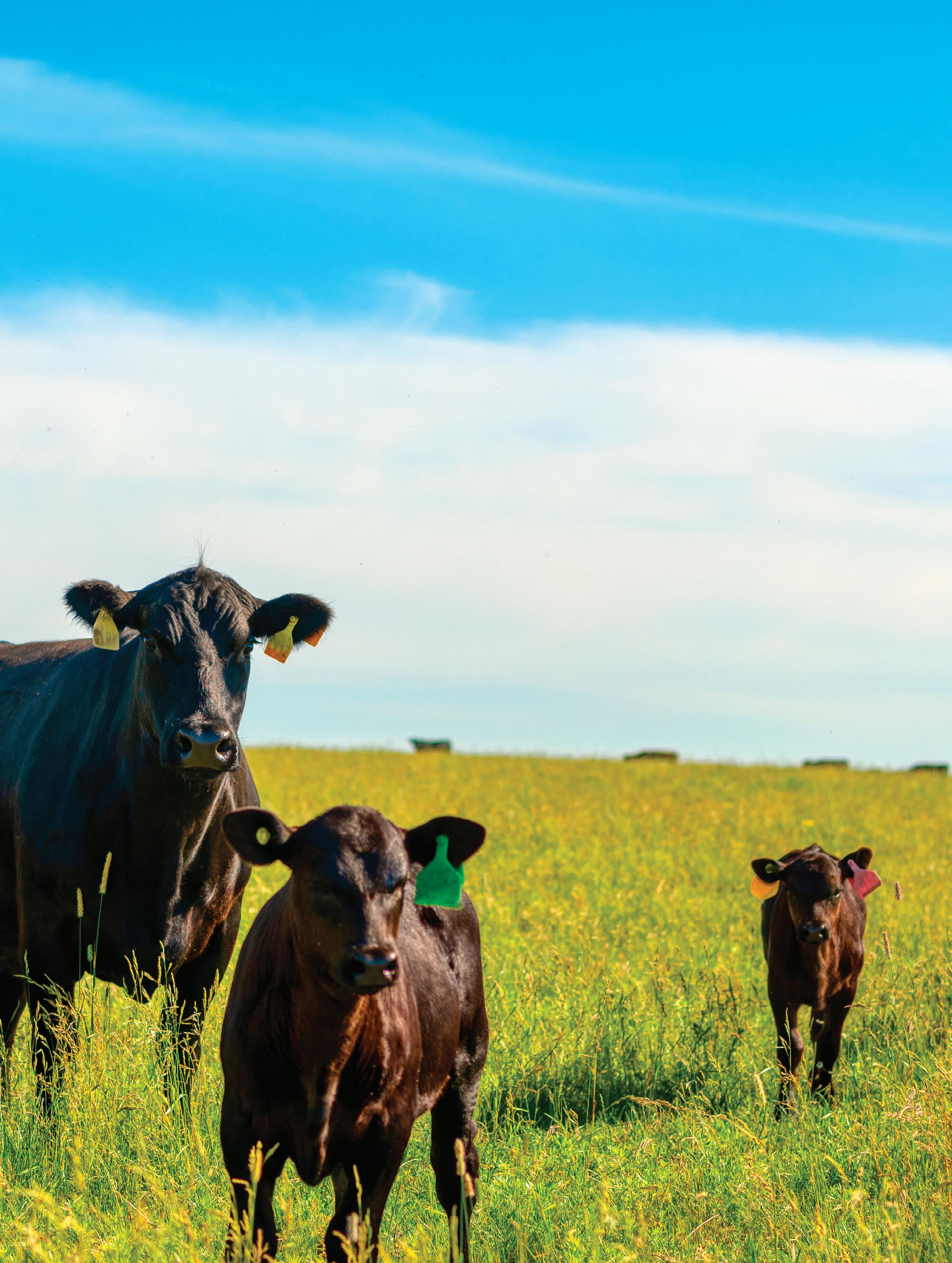



























































































































A certain 7-year-old won’t eat lamb. We thought that saying his sister’s 4-H lamb had been given the best life possible because he was going to take care of others by being butchered so that the buyers could eat him was enough for a child to understand what came next. But we didn’t tell him that Harold would instantly and painlessly be killed before he would be butchered. So the poor guy spent weeks thinking that Harold was drawn and quartered while alive.
No wonder he won’t eat lamb. Luckily, if you don’t like what’s for dinner at our house, make yourself a PB&J. But there’s no easy alternative when you’re talking about policy that impacts operations’ bottom lines and community resiliency.
If mandatory country-of-origin labeling isn’t reinstated, ranchers will continue to sell off their herds at an alarming rate because of volatile and unfair markets. If a Farm Bill isn’t reauthorized, producers will continue to operate with uncertainty under an outdated bill that leaves farmers and ranchers reliant on ad hoc programs instead of relevant programs.
If you don’t have all the details – or worse, inaccurate ones – those issues and more don’t carry urgency. Farmers and ranchers must tell our stories to convincingly convey the whys for policies to be championed and pushed forward by lawmakers and consumers.
If you don’t tell your story someone else will, with their own assumptions and whys. How we tell our stories, how often, matters.
Inside this edition, find a helpful guide to get started, even if you’re an introvert. Gain inspiration for sharing your story from producers who are tackling challenges, diversifying, and using their voices to educate others about what they do and why having food grown and processed in America matters for everyone.
See real-life examples, like Montana Farmers Union partnering with Ag Processing Solutions in Great Falls to produce value-added cold-pressed safflower oil for consumers and in the process creating a stable market for a rotational crop for Montana producers. And how Montana Food Bank Network’s recently opened facility in Missoula is ensuring our neighbors aren’t hungry because they have access to Montana-grown foods.
Also in these pages is information about how you can tap into Montana Farmers Union resources for education to make you a stronger advocate and build community.
Only you can tell your story of why agriculture matters. Use the tips, resources, and inspiration in this edition to start telling yours, and make agriculture stronger each time you do.









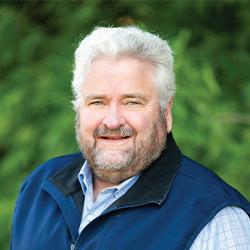
by MFU President Walter Schweitzer
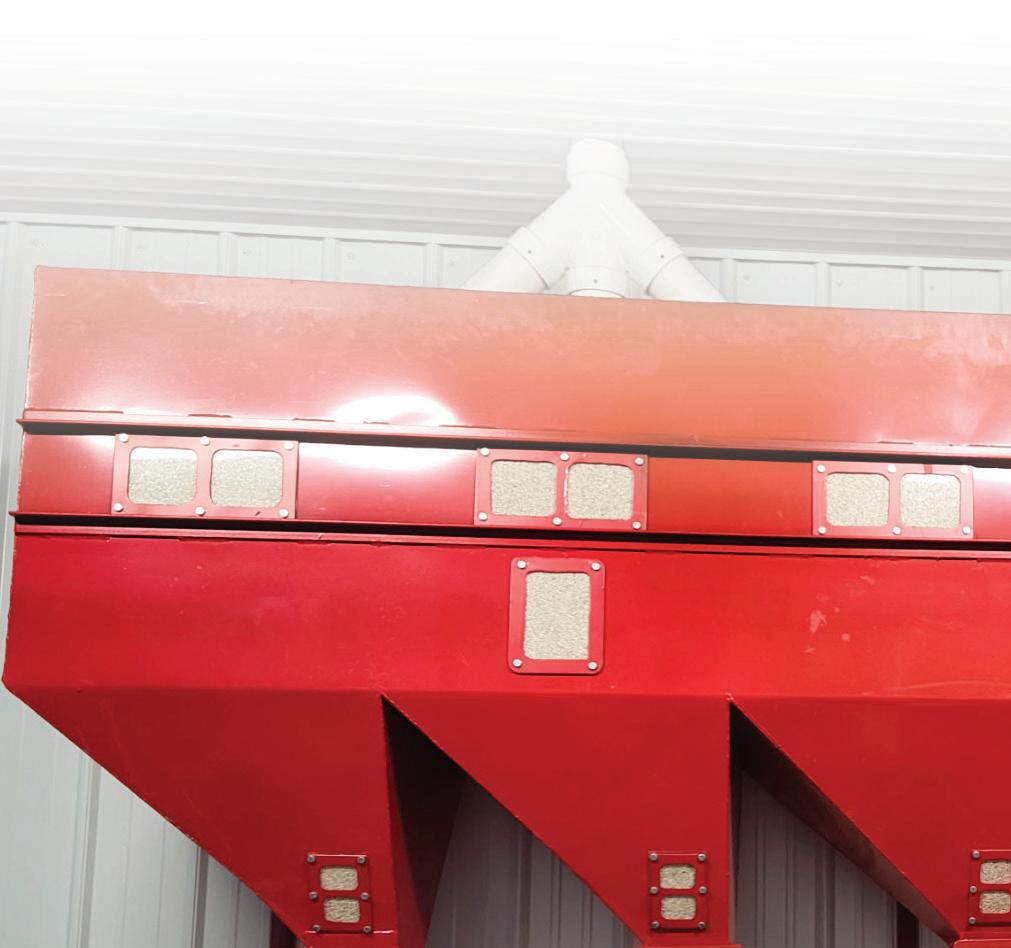
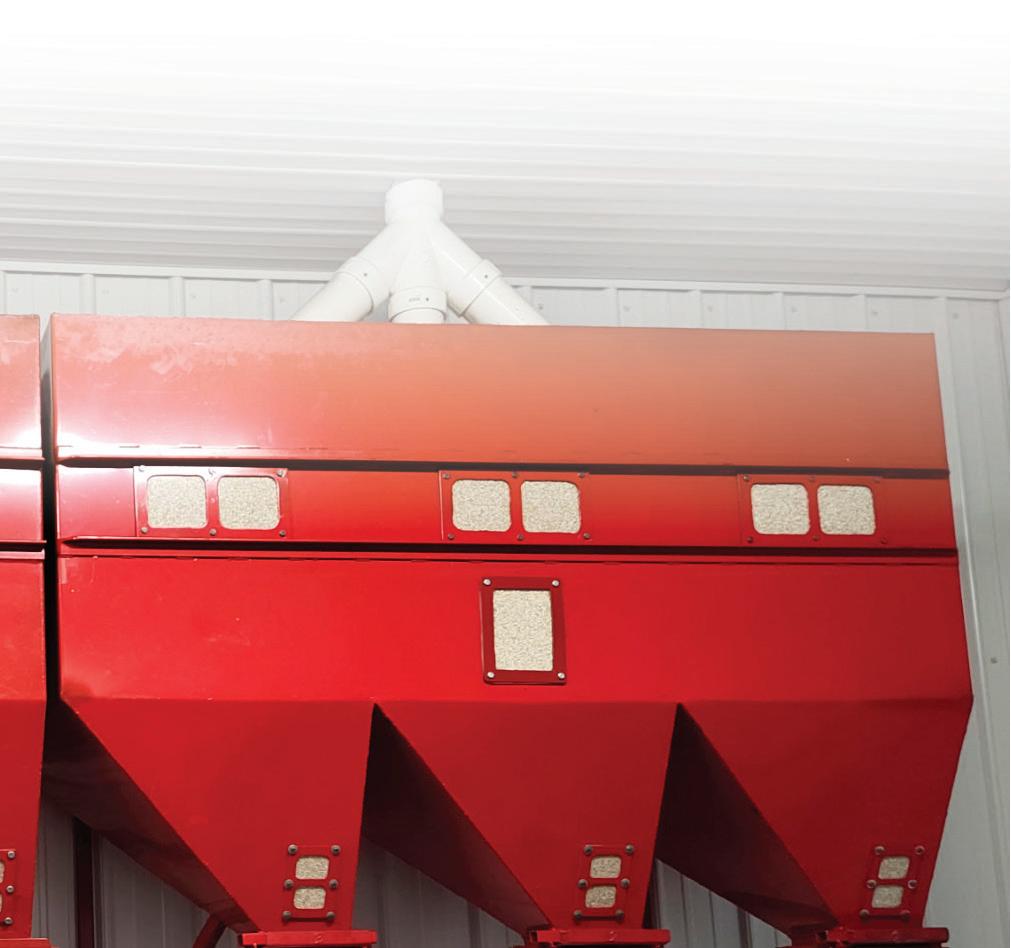
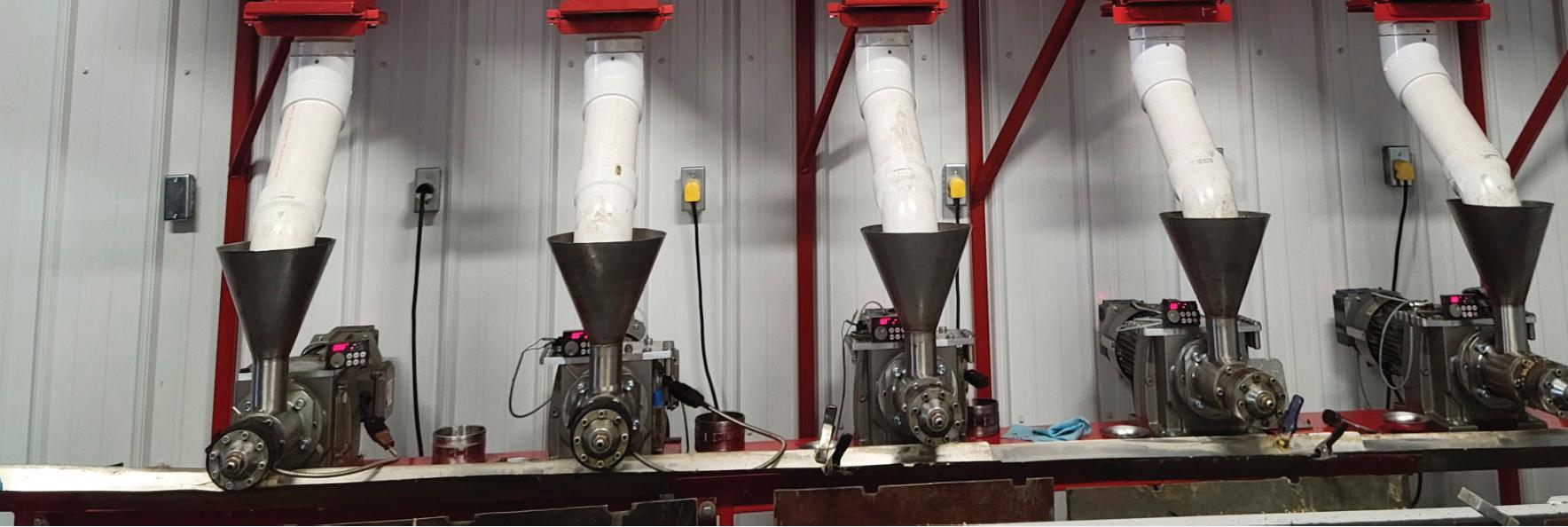
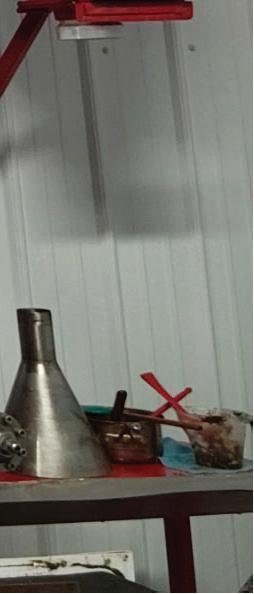
During the Christmas holiday last year Montana Farmers Union purchased the Oil Barn. This business cold pressed Safflower into food-grade cooking oil. MFU partnered with Ag Processing Solutions and began the process of moving the equipment to Great Falls. First steps were to remodel a portion of APS facility that was used for manufacturing. We had to design and build an enclosure inside the building that met food-grade standards and installed most of the equipment needed to press, filter, and bottle the oil. Just outside of this room is the cleaner used to separate the safflower grain from weed seed and chaff.
In addition to the physical construction of the facility, we were also required to file business applications, organic certifications, and food safety permits. This required a back-and-forth process with inspectors and other bureaucrats from state, county, and federal agencies. Montana Safflower now has a commodity brokers license, organic processing certificate, food-grade certification, and a Hazard Analysis Critical Control Point plan.
We processed our first batch of oil on February 9. This started the process of trial and error to develop a workflow that we hope will be the most efficient way to produce a high-quality product for the existing Oil Barn customers and encourage new customers to purchase our Montana Safflower.
We are also experimenting with different varieties of safflower by pressing each variety and sharing that oil with customers to determine which varieties we want to grow this summer. We will contract with MFU members to grow a few different varieties this season to help identify which varieties to focus on in the future. Our plan is to contract about 1,000 acres of safflower for the 2026 season, with the long-range goal of growing the business to 10,000 acres by Year 5 and 30,000 acres by Year 10.
If you are interested in growing safflower this season, please reach out to me.


MONTANA FARMERS UNION
PO BOX 2447
300 RIVER DRIVE NORTH, STE 1
GREAT FALLS, MT 59403
PHONE: (406) 452-6406
1-800-234-4071
FAX: (406) 727-8216
office@montanafarmersunion.com www.montanafarmersunion.com
Board of Directors:
Walter Schweitzer, President
Erik Somerfeld, Vice President, Power
John Ferrat, District 1, Toston
John Wicks, District 2, Ledger
Jeff Bangs, District 1 & 2, At-Large, Inverness
Sarah Degn, District 3, Sidney
April Martin, District 3 & 4, At-Large, Busby
Trent Stoltz, District 5, Pompeys Pillar
Mark Siderius, District 6, Kalispell
Ben Peterson, District 5 & 6, At-Large, Judith Gap
MFU Staff:
Walter Schweitzer, President
Jan Johnson, Office Mgr., Assistant Secretary/Treasurer
Kari Kester, Administrative Assistant
Rachel Prevost, Executive Director
Heather Link, Communications Director
Jodi Koterba, Education Director & Ambassador
Alice Miller, Public Relations Manager
Jessica Plance, Communications Content Specialist & Ambassador
Samantha Ferrat, Membership Ambassador
Carissa McNamara, Membership Ambassador
Mary Jenni, Membership Ambassador
Montana Caise, Membership Ambassador
Grace McDonald, Membership Ambassador
Raynee Gullickson, Membership Ambassador
Bailey Chalfant, Membership Ambassador
Julie Gagnon, Data Coordinator
Amber Fladland, Education Associate
Bella Folino, Government Affairs & Outreach Coordinator
Amanda Borwege, AmeriCorps
Eli Abercrombie, MFU Intern
Copyright © Montana Farmers Union, 2026 MFU
Magazine is the official publication of the Farmers Educational and Cooperative Union of America, Montana Division.
MFU reserves the right to reject any advertisements. Membership: $50.00 per year
Montana Farmers Union Magazine is published quarterly.
Editors: Heather Link & Alice Miller
Layout & Design: Heather Link
Copy Editors: Alice Miller, Jan Johnson & Heather Link


Montana Farmers Union is the oldest and largest family farm organization in the state who represents family farmers and ranchers.
MFU is working for family farms, ranches, & rural communities and supports its members through: strong education programs for both youth and adults, advocating member-driven policies & legislation at the state and federal level, and cooperation through producer-owned co-ops.



By Alice Miller, Public Relations Manager



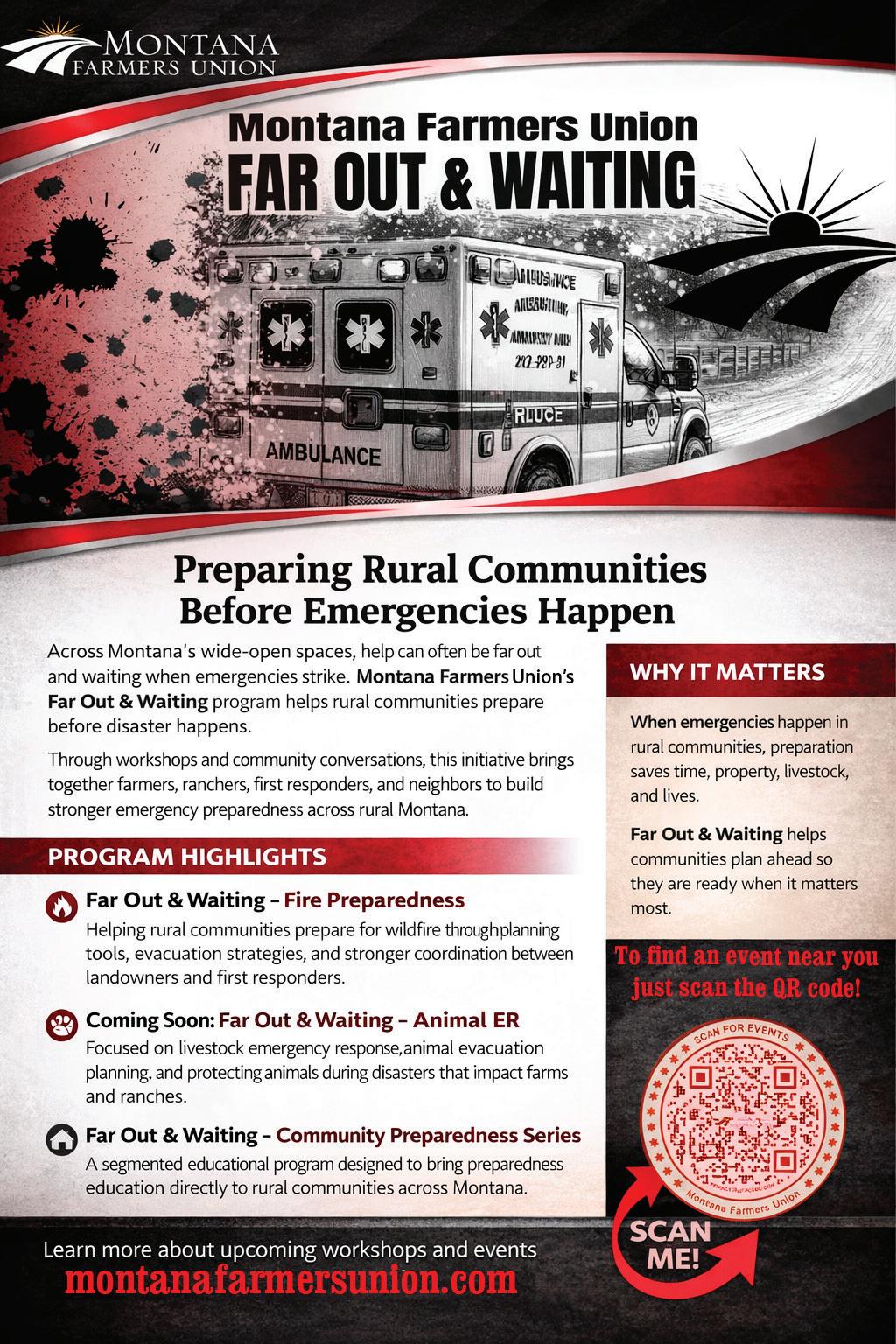
Living in rural areas often means residents must be prepared to handle emergencies on their own, which can sometimes mean handling common medical emergencies and fires for upward of 30 minutes before emergency services can reach them. That time gap can be catastrophic, but a new training from Montana Farmers Union gives residents the skills they need to be proactive instead of feeling helpless in the face of emergencies.
Montana Farmers Union is committed to helping rural residents become better prepared through their Far Out & Waiting workshop series, and the new Fire Prevention and Preparedness workshop series is helping producers better handle fire emergencies ahead of fire season.
“I feel the prevention/preparedness is especially important for rural areas because of the long distances and time it takes for fire personnel to respond to an incident. There is a lot residents can do to protect themselves and their property,” said Ryan Peterson, Fergus County Sheriff and Fire Warden who helped create workshop materials.
Far Out & Waiting: Fire Prevention and Preparedness workshops equip farmers, ranchers, and rural residents with what to do to prevent fires and what to do while waiting for emergency fire services to arrive in remote areas. The core curriculum includes: what to do before a fire starts, evacuation preparation and process, home hardening, and what to expect when calling 9-1-1.
“After doing the training, I want people to have a plan, use the services of the fire risk assessments that the organizations offer, and do what a homeowner can do to prepare their home for a fire disaster and do the things you need to do to help protect your home against a fire,” said Mary Jenni, an MFU Membership Ambassador who is helping organize the workshops. “And you’re given all those skills in the class.”
The fire workshops are an extension of Montana Farmers Union’s popular Far Out & Waiting EMS workshops that teach people what to do during common medical emergencies until EMS can arrive.
Both the workshops are part of MFU’s grassroots education efforts to help rural communities thrive and aim to improve


outcomes in medical and fire emergencies by providing hands-on workshops to build skills in support of emergency services.
Many farmers and ranchers live and work in the remotest places and are at high risk of injuries. According to the CDC, agriculture ranks among the most hazardous industries and is one of the few industries in which family members are also at risk for fatal and non-fatal injuries.
The first fire-focused Far Out & Waiting workshop was held in February in Grass Range, to a positive response from fire departments and homeowners, with local organizations partnering with MFU to create curriculum.
“I hope the residents were able to see a glimpse of what fire suppression and management entails. There are a lot of parts, and some of it can get complicated on a larger incident. I also hope the information helped residents have realistic expectations of what their volunteer fire departments are capable of,” Peterson said.
The collaboration and eagerness of fire services personnel and volunteers to put on the workshop is illustrative of the need for more fire preparedness education in Montana’s rural communities.
“I work directly with local fire chiefs, and we have been discussing the need to educate the public about fire prevention and explain how fire departments operate in Fergus County. This was a great opportunity to share valuable information with citizens so they understand the sacrifice and challenges rural volunteers face,” Peterson said.



“Sometimes it just takes a driving force to make it happen because everyone’s plates are full. I feel like MFU, because of our pillar of education, can be that driving force that says, ‘This is what we do. We provide educational events in communities, and we can easily partner with rural fire departments and the sheriff’s office to offer these trainings,’” Jenni said.
In addition to learning about key preventative and preparedness measures, including who to call in the event of a fire, how to make a fire evacuation plan that accounts for communication channels being unavailable, how to make sure fire fighters can find your home, and how to fire harden homes, attendees also had lots of time to ask questions. Their questions sparked larger conversations about needs, policy issues, and area-specific concerns.
“Workshops improve communication because it is really the only way residents can meet with their volunteer fire departments. Our rural stations are not staffed, which can create a barrier for the public to seek information. There is no office phone to call if someone has a question, and you can’t just stop by the station to ask staff questions,” Peterson said. “This workshop made it possible for citizens to meet face-to-face with fire representatives.”
More fire-focused Far Out & Waiting workshops are already planned around the state, Jenni said.
“We want to do this is in all the communities across the state like we’ve done the Far Out & Waiting ambulance ones. People just need to contact Montana Farmers Union to get it coordinated.”
Find your MFU Ambassador or reach MFU’s state office at www.montanafarmersunion.com or (406) 452-6406.


"Give us a callOur Agents Live and Work where you Live"
Anaconda
Belgrade
Belt
Billings
Bozeman
Bridger
Broadus
Butte
Chester
Choteau
Circle
Coeur d’ Alene
Columbia Falls
Conrad
Culbertson
Cut Bank
Dillon East Helena
Fairfield
Forsyth
Froid
Glasgow
Great Falls
Stefanie Thompson: 563-5991
Lacey Mitchell: 388-6774
Matt Triplett:952-0451
Judd Long: 252-9391
KJ Fauth: 969-2282
Art Hoffart: 586-6230
Dean Derby: 556-0893
Trent Leintz: 551-2163
Wesley Schwend: 662-3930
Jesse Fleming: 436-2115
Mathew Luedtke: 270-5304
Megan Hedges: 759-5150
Matt Luedtke 467-3444
Kaylen Lehner: 485-3303
Flathead Insurance 208-667-7485
Flathead Insurance 208-667-7485
Dirk Elings: 271-7047
Matt Stentoft 487-2629
Ashley Vanek: 873-2249
Sara Nye: 683-1250
Eric Hinebauch: 453-8413
Matt Luedtke: 467-3444
Donna Manuel-590 0866
Watts Agency: 346-1196
Matt Stentoft: 487-2629
Brady Burgess : 228 8282
Eric Hinebauch: 453-8413
Aeric Reilly: 570-5853
Kyle Tschetter: 836-7261
Hamilton
Hardin
Havre
Bryan Jones: 363-6583
Melissa Wacker: 665-1867
Meagan Kinsella:265-2693
Alex Thornton:879-2028

Todd Crum: 443-4630
Alissa McClendon: 397-3146
Ray Lipp: 397-3146
Shawn “Tater” Erickson: 366-1287
Flathead Insurance: 752-8000
Randy Bloom: 257-1252
David Harriman 219-7650
Lorna Olson: 628-6649
Raleigh Heitzman: 538-8736
Colleen Wood: 293-2200
Cole Mauch 222-7151
Shane Anderson: 654-1589
Tayler Kennedy: 874-2560 Watts Agency: 874-1804
Andre Marcure: 543-7184
Ben Barker: 721-2540
Josh Rollins: 830-3073
Pam Jacobsen: 721-0599
Tom Monaghan: 926-2552
Lisa French: 826-4633
Ronan Ryegate
Scobey
Wolf
Andrew Luedtke: 676-0173
Audrey Stoican: 568-2336
Matt Stentoft: 487-2629
Tom Monaghan: 677-7400
KW Insurance: 424-8480
Cathy Hintz: 488-8326
KW Insurance: 937-6950
Watts Agency: 635-5782
Lisa French 827-3221
Rial Gunlikson: 862-4700
David Harriman 219-7650
Jesse Fleming: 653-2200
Production Director Director of PL Production Director of CL Production
Jeff Dow: 799-4096
Chris Strand: 871-2260
Ryan Kuntz: 581-4493























By Avery Rambo, Gildford
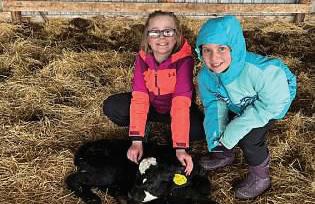
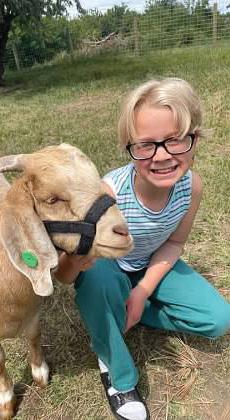



Hello, I am here to talk to you about growing up in an agricultural family. My dad’s family has farmed and ranched north of Gildford for a very long time. My mom says when I was about a week old, I was in my family’s grain truck for my first harvest. Since my birthday is in August, trying to have a party is hard. I really like growing up in an agricultural family as well as the community. Smaller towns, in my opinion, have stronger bonds with each other. My dad once told me that when his cousins were over once they said that he could survive a zombie apocalypse by living on a farm. We take care of ourselves and the rest of the world. I can’t really remember much about growing up on the farm. I knew I missed my family because sometimes they would work from six in the morning to midnight.
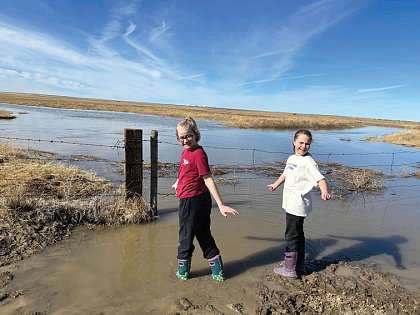
The Farmers Union camp helped me make some new friends and create a lasting friendship. We have met up several times in the past few years. I have stayed in touch with them since then and have some new friends to show for it. My sister and I and some of our friends do 4-H. My sister and I do goat in 4-H, we have been the only goat kids in Hill County 4-H for three years. My mom is the goat and sheep superintendent for Hill County 4-H and is trying to gain interest in goat and sheep. Most people don’t really want to try goat or sheep because people in Montana are used to beef. Goat tastes a lot like beef; lamb is chewier than goat but still good. My family does not own a goat farm, but we have been trying to convince my dad to start one.







Public Relations Manager
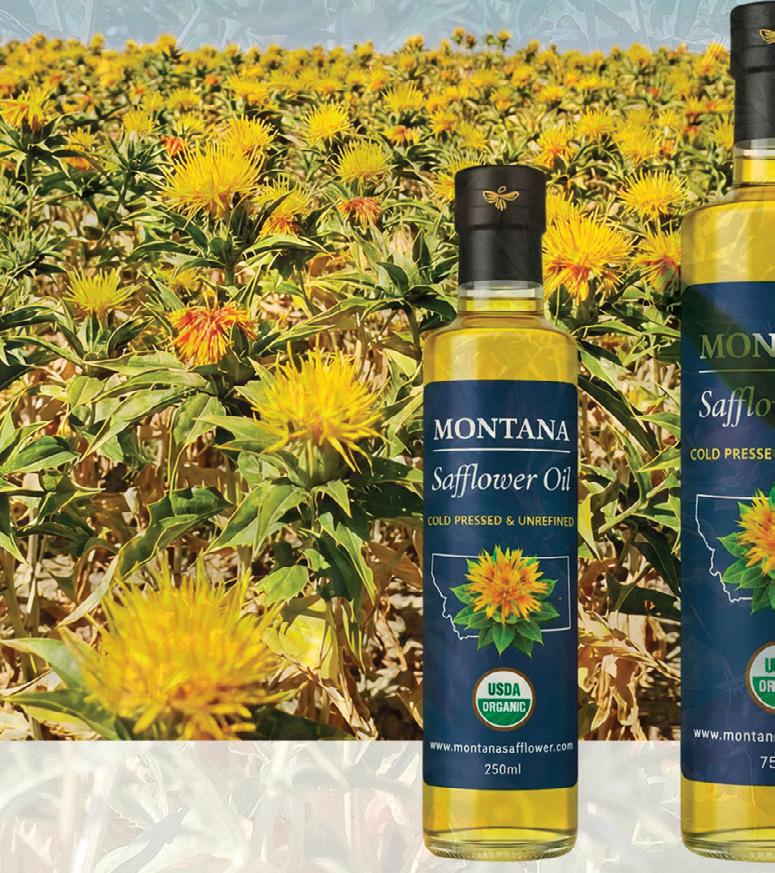
The benefits of safflower oil can now extend beyond consumers to Montana growers with newly formed Montana Safflower, a cold-press oil business that aims to make safflower oil a household staple and safflower itself a profitable rotation crop for
Montana Safflower is the latest business through which Montana Farmers Union has led by example to increase the resiliency of regional food systems, with the grassroots, non-partisan organization becoming the majority owner in partnership with Ag Processing Solutions owned by Andrew and Jennifer Bishop of Brady.

“Montana Farmers Union believes that we should raise our food locally and process it locally to be eaten by our neighbors,” MFU President Walter Schweitzer said. “Montana Safflower is owned by the members of Montana Farmers Union to benefit
People might remember Montana Safflower instead as the Oil Barn in Devon.
When Bishop approached the Oil Barn’s owners about purchasing oil from them, they approached him about selling the press to him. Bishop then approached the MFU board about partnering to create a new market for farmers and expand the reach of
“And here we are,” Bishop said, with press operations beginning in February at Ag Processing Solutions in Great Falls.
Initially, the press will continue to process the 1,000 acres a year that it processed under its previous ownership. As growers and customers increase, Bishop said he sees a clear path to processing 10,000 acres within five years and, ultimately, a total of 30,000 acres of safflower from conventional and organic growers each year to reach a scale of 50 tons of safflower processed each day.






The oil will be sold both for household use and in bulk.




“We are in a niche with safflower, no doubt about it, but you still have to be at scale,” Bishop said, adding the demand for the oil extends to international markets.










Montana Safflower’s screw oil press uses more pressure than heat to maintain the integrity of the final oil’s omega 3s. Home cooks and chefs alike seek out the high-oleic, cold-pressed oil that is rich in monounsaturated fats as a healthy option that is more stable than many other cooking oils under high heat.











Safflower also is a desirable rotation crop for farmers.


“Our next goal is to expand the market for Montana Safflower. We plan to contract acres with MFU members for the 2026 season,” Schweitzer said.







Bishop said he’s hopeful that current commodity markets will help convince farmers to give safflower a try. “I think our selling point is pretty simple right now. It’s not wheat.”
















Safflower’s high drought resistance and long tap root that’s able to mine water and nutrients below the root zone of other Montana crops make it a desirable crop. Montana Safflower provides a stable market close to home, creating profitability for farmers.






“I view this project as a profoundly cool way to give back to our farmers who have been screwed over so consistently by commodity markets,” Bishop said. “I want to grow that to a size that we have a lot of other members growing safflower with us, and we’re growing together.”




Find Montana Safflower on the shelf in your local grocery store and learn more at: https://montanasafflower.com.





To learn more about growing safflower, reach MFU at 406-452-6406 or Schweitzer at 406-799-3782.














By Jodi Koterba, Education Director
Montana Farmers Union provides many educational opportunities for our youth. The spring is filled with school visits and County Agriculture Days. Staff from Montana Farmers Union visit classrooms around the state. They are delivering hands-on agriculture-centered science lessons tied to the grade level standards. It is estimated that MFU will educate over 5,000 students this spring.
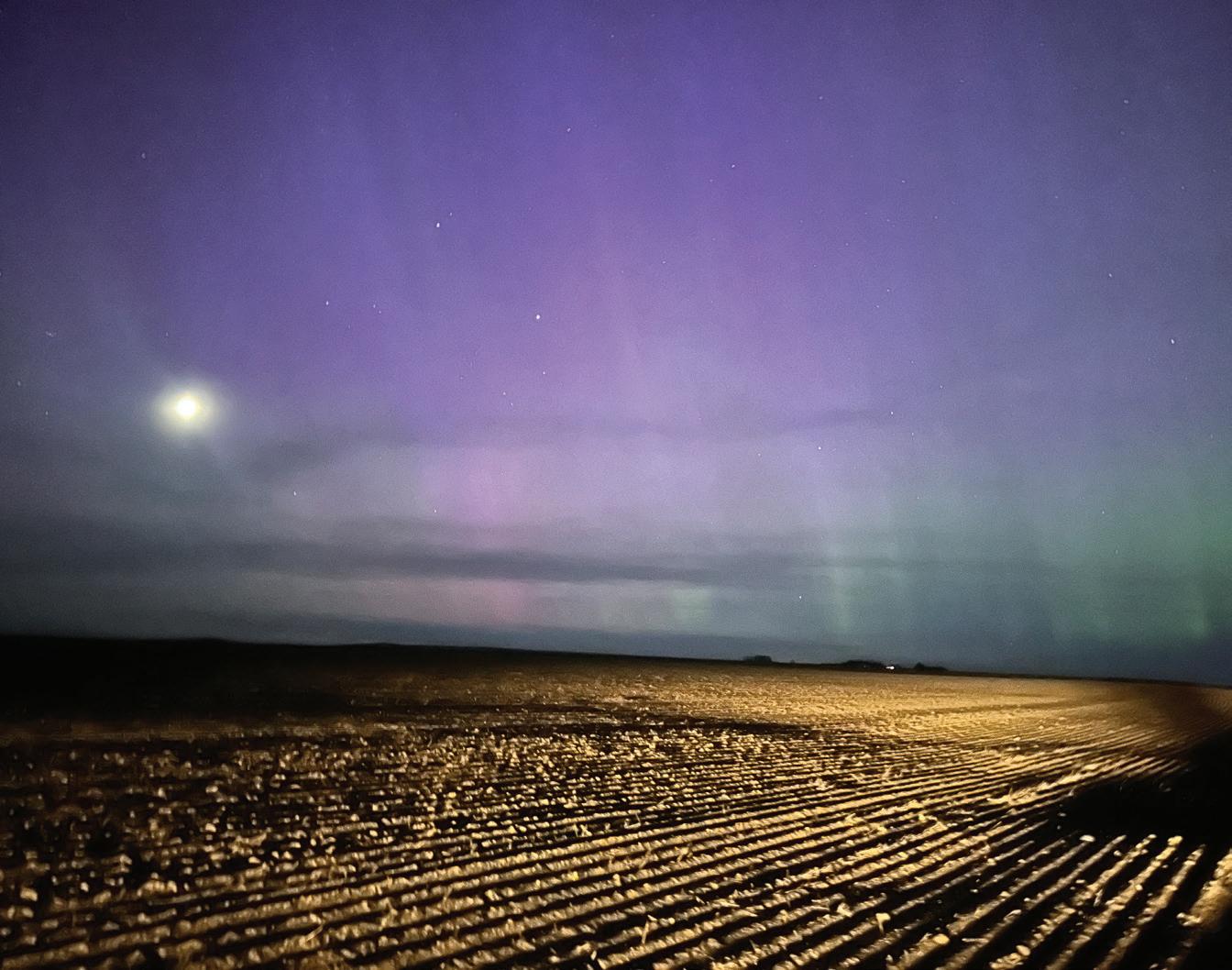
We are hiring staff, planning lessons, and developing the programing for Montana Farmers Union Arrowpeak Camp for the summer of 2026. There will be five weeklong sessions available to youth in 2026. This year’s theme is Neon Nights and Northern Lights. We will be exploring the stars and skies, noxious weeds, outdoor activities and so much more. Registration is open and will remain open until camp capacity is reached for each session. You can register at https://montanafarmersunion.com/mfucamp/.
Who decides the theme and activities for camp? There is an amazing group of young people, the Youth Advisory Committee. These individuals are elected by the campers in attendance at the Senior and Teen level camps. They then meet together monthly for training and planning. The Youth Advisory Council members choose the theme, help design the logo, pick colors, and give suggestions for programs and activities to conduct for the summer. They also have the opportunity to serve as Junior Deans at the Junior and Mini Sessions for camp.
The torchbearer award is the highest award given by Farmers Union to senior youth. It is a great honor and achievement to be a “Torchbearer”. Recipients must be involved in day camps, serve as a Junior Dean at camp, attend camp, attend an MFU state convention, and perform a community service project.
Being a torchbearer is not an end to involvement in Montana Farmers Union, but rather a commencement of his/her participation in adult activities. We encourage each of you to continue your involvement in Montana Farmers Union as adult members of our organization.
Our youth program is driven by supporting members through: enhanced leadership skills, building professional credentials, members mentoring youth, and gaining insight into the state goals. We are using the seven cooperative principles voluntary and open membership, democratic member control, member participation, independence, education, cooperation, and concern for community to design and build the curriculums and activities.
Developing leadership in youth and adults is a goal for Montana Farmers Union. Please watch the publications for upcoming MFU events in your area.




By Jasmine Krotkov, Master Gardener

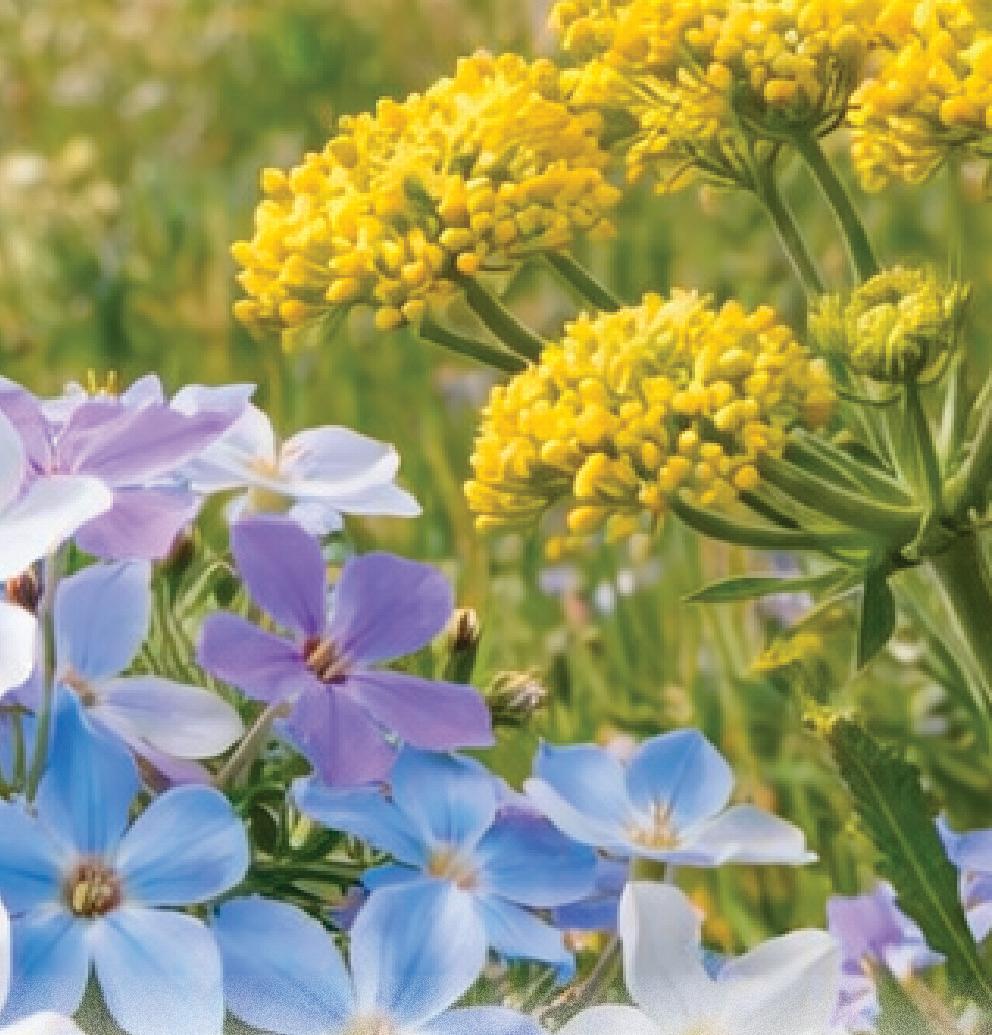

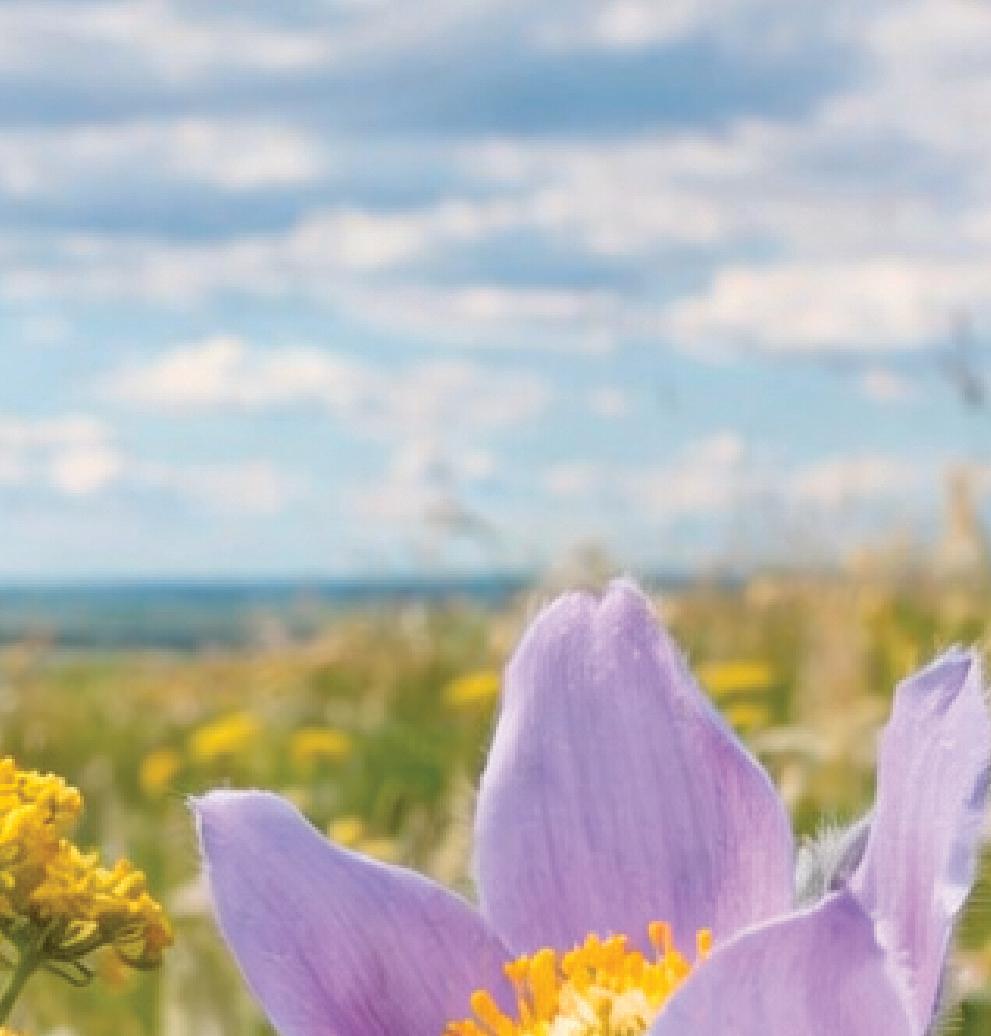
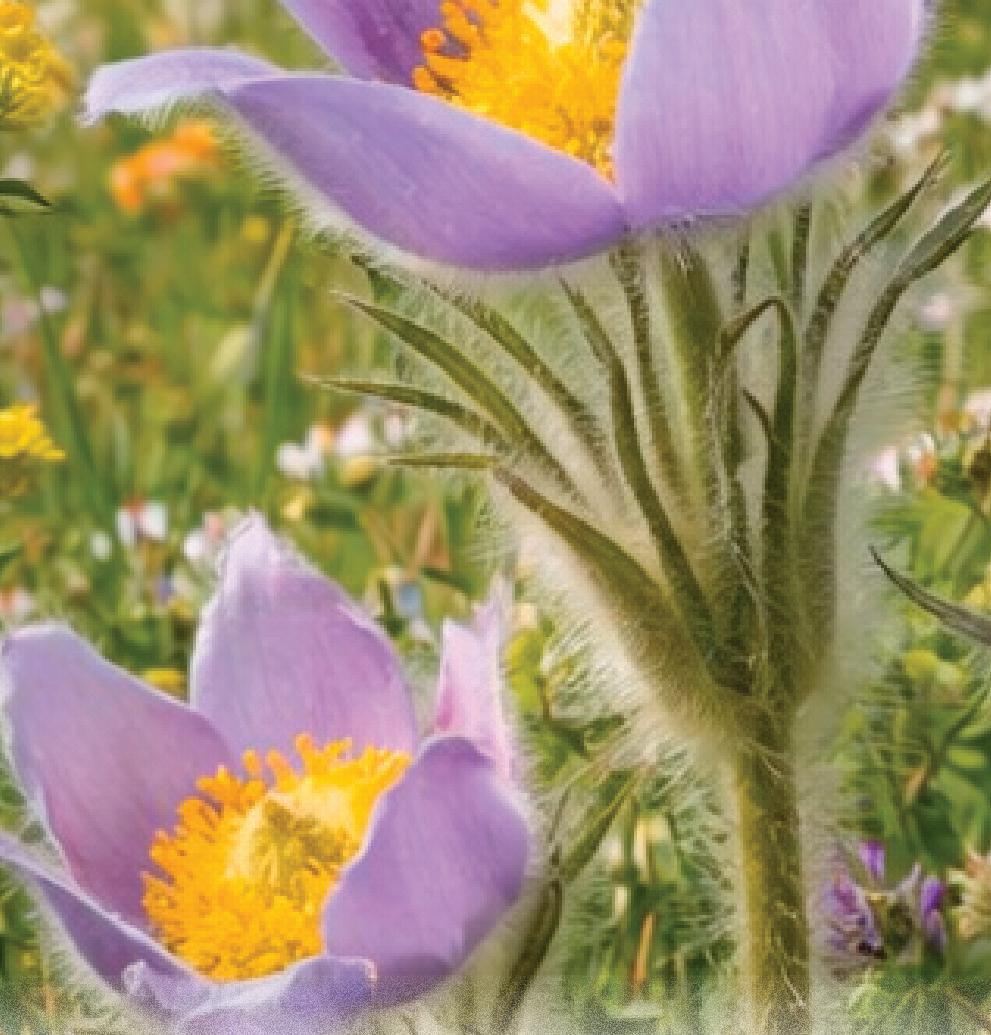
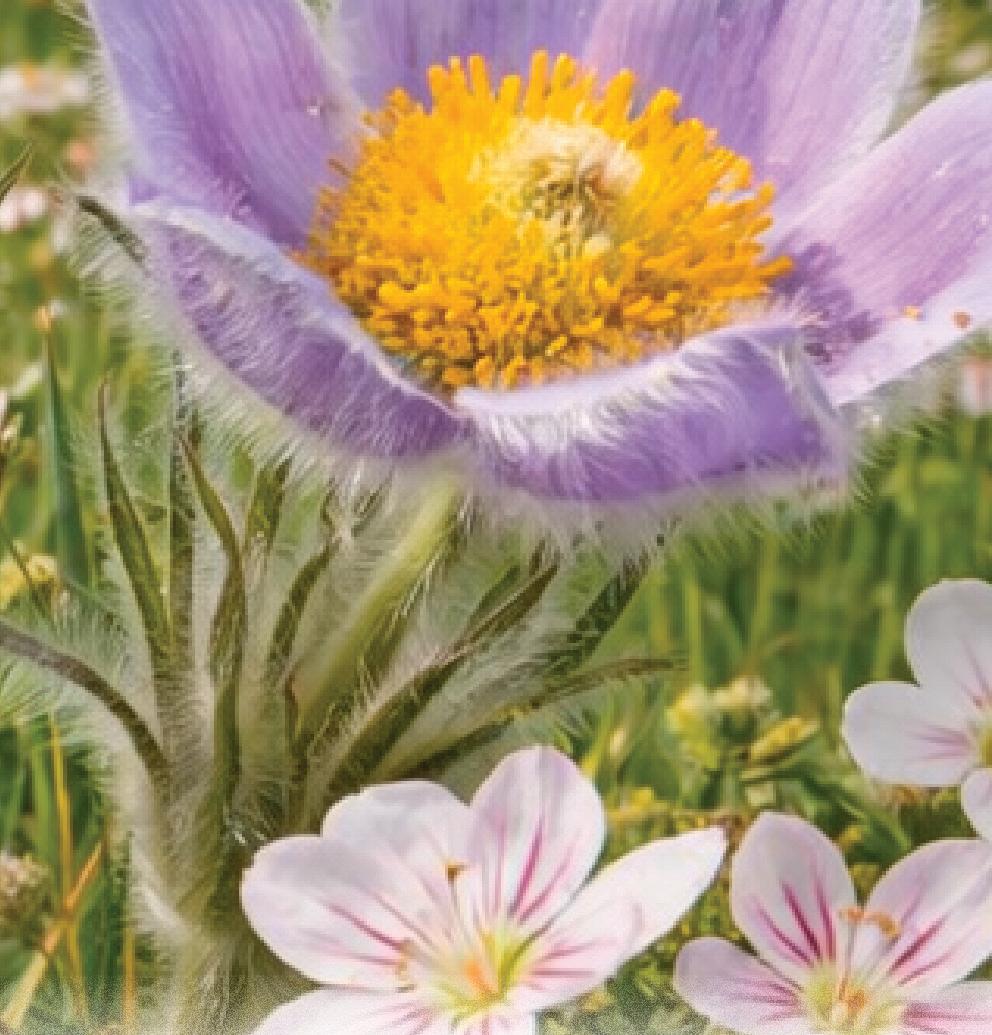
Springtime on the prairie is a festival of color. As the flat and rolling uplands begin to green up, tiny blue and white Phlox flower alongside yellow Biscuit Root (Lomatium), white Springbeauty (Claytonia), purple Pasqueflower (Anemone) and so many more, under our big, blustery, blue spring sky.
Prairie ecosystems stand out, not just for their beauty, but for their resilience. The shortgrass prairies of Eastern Montana are dominated by grasses and wildflowers with little tree cover. In areas of little rainfall, trees and shrubs struggle to survive, while prairie plants and their seeds are well adapted to this environment. In drought, after a wildfire or heavy grazing by a thundering herd of bison, the grasses and flowers can become dormant, and then bounce right back.
It’s their deep, dense, tangled root systems – which are sometimes two or three times the size of the above-ground part of the plant – that make prairies so hardy, by providing a variety of ecosystem services. Researchers are discovering that plants can signal to one another through networks of roots and fungi when pests are invading, when nutrients are low, or another stress is on the way. These mycorrhizal networks allow plants to share resources, and to rapidly change behavior such as root growth, shoot growth, photosynthetic rate, and defense mechanisms.
In comparison, my mom’s backyard garden had annual vegetables planted in long, neat rows, on completely tilled soil. Seemed



like the right thing to do: keep “weeds” from competing for the water and nutrients that humans made available to the vegetables. It can be the right thing to do, but it also has drawbacks. For one, it’s a lot of work! All that tilling, and weeding, and watering, and fertilizing makes gardening harder and more complicated than it needs to be. This is especially true when we take into account how the services we provide plants are naturally provided to each other in their native ecosystems.
Of course, I don’t really want to eat a biscuit root (Lomatium cous), which is native around here, requiring none of my help to survive. I do want to eat a potato, which can’t survive here without me. I’ll have to do some of the work to help that potato grow, but maybe not as much as my mom did, in her backyard garden, with the neat rows and hours and hours of unpaid child labor provided by little ol’ me.
An easy way to let the shortgrass prairie ecosystem do some of your gardening work for you is to plant a native border on the windward side of your veggies. A native plant border can slow runoff, reduce soil loss, lessen the severity of flooding, rebuild the structure of damaged soils, and provide food and shelter for beneficial insects.
The Montana State University Extension service has a free pamphlet called Native Plants for Montana’s Home Gardens (scan QR code) with a plant list which you can take to your local nursery this spring to get started!





















































































Few ingredients are as simple, versatile, and nourishing as the humble egg. Found in kitchens across farms, ranches, and homes everywhere, eggs have long been a staple that bring comfort, creativity, and flavor to the table. Whether gathered fresh from the chicken coop or picked up at the local market, eggs offer endless possibilities for cooks of every skill level.
From fluffy morning scrambles and hearty omelets to delicate baked goods and rich homemade sauces, eggs are one of the most adaptable ingredients in the kitchen. They can be fried, boiled, poached, baked, whipped, or folded into dishes both sweet and savory. A single egg can transform a recipe—adding structure to cakes, richness to custards, and a golden finish to breads and pastries.
Beyond their versatility, eggs are packed with nutrition, offering high-quality protein and essential vitamins that fuel busy days on the farm, at work, or with family. They’re a reminder that sometimes the most wholesome ingredients are also the simplest.
Whether you‘re making a quick breakfast, baking a favorite family recipe, or experimenting with something new, eggs are a timeless ingredient that bring warmth, nourishment, and creativity to every meal.



2 tbsp milk or cream
1 tbsp butter
Salt and pepper
Optional: cheese, chives, or diced ham
Instructions
Crack eggs into a bowl and whisk with milk, salt, and pepper.
Melt butter in a skillet over medium-low heat.
Pour in eggs and gently stir with a spatula.
Continue stirring until eggs are soft and fluffy.
Top with cheese or herbs and serve warm.
• Tip: Cooking slowly makes scrambled eggs creamier.




2 cups diced potatoes
2 eggs
¼ cup diced onion
¼ cup cooked bacon or sausage (or more if you prefer)
1 tbsp butter or oil
Salt and pepper
Instructions
Cook potatoes and onion in a skillet with butter until crispy.
Stir in bacon or sausage.
Make two small wells in the potatoes.
Crack eggs into the wells.
Cover and cook until eggs reach desired doneness.
1–2 eggs
1 tbsp butter or oil
Salt and pepper
Instructions
Heat butter or oil in a skillet over medium heat.
Crack egg into the pan.
Cook until whites are set but yolk remains runny (sunny side up).
For over-easy eggs, gently flip and cook 20–30 seconds more.
Season and serve with toast, hash browns, or breakfast meats.

Prep Time: 10 minutes
6 hard-boiled eggs, peeled
¼ cup mayonnaise
1 tsp mustard
1 tbsp chopped celery
1 tbsp chopped green onion
Salt and pepper to taste
4 slices bread
Lettuce (optional)
Instructions
Chop hard-boiled eggs and place in a bowl.
Add mayonnaise, mustard, celery, and green onion.
Season with salt and pepper.
Mix gently until creamy.
Spread egg salad onto bread slices and top with lettuce.
Close sandwich and serve.
Prep Time: 10 minutes | Cook Time: 40 minutes
3 eggs
2 cups milk
½ cup sugar
1 tsp vanilla extract
¼ tsp salt
Ground nutmeg for topping
Instructions
Preheat oven to 325°F.
Warm milk slightly in a saucepan (do not boil).
In a bowl whisk eggs, sugar, salt, and vanilla.
Slowly whisk warm milk into egg mixture.
Pour into ramekins or a baking dish.
Sprinkle with nutmeg.
Place dish in a larger pan with hot water (water bath).
Bake 35–40 minutes until custard is set.
Chill or serve slightly warm.


Prep Time: 15 minutes | Cook Time: 40 minutes
1 pie crust (store-bought or homemade)
6 eggs
1 cup milk or half-and-half
1 cup shredded cheese (Swiss or cheddar)
½ cup cooked bacon, chopped
1 cup fresh spinach
½ tsp salt
¼ tsp black pepper
Instructions
Preheat oven to 375°F.
Place pie crust into a pie dish.
In a bowl whisk eggs, milk, salt, and pepper.
Sprinkle bacon, spinach, and cheese evenly in crust.
Pour egg mixture over the fillings.
Bake for 35–40 minutes until center is set.
Let cool slightly before slicing.





By Alice Miller, Public Relations Manager



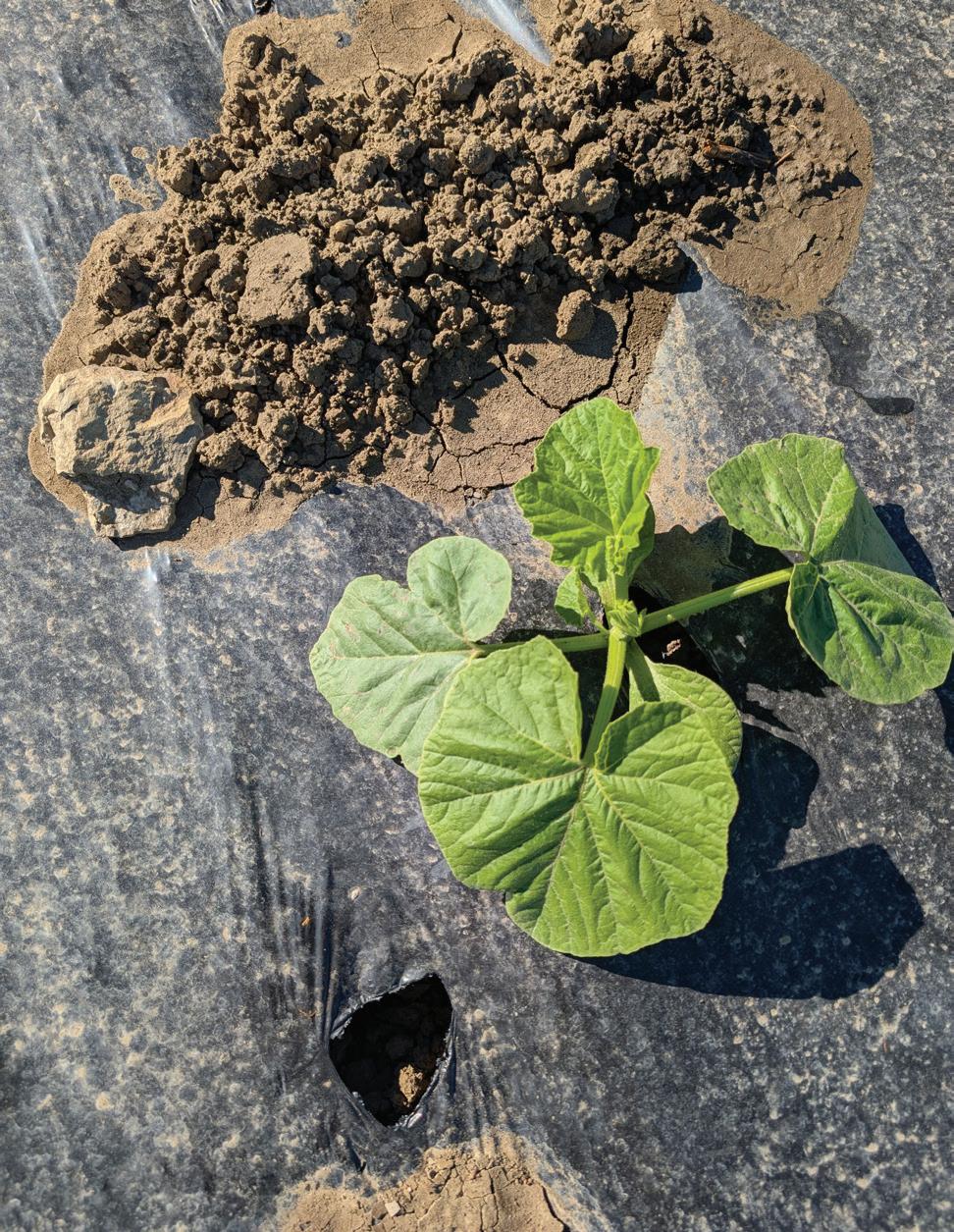
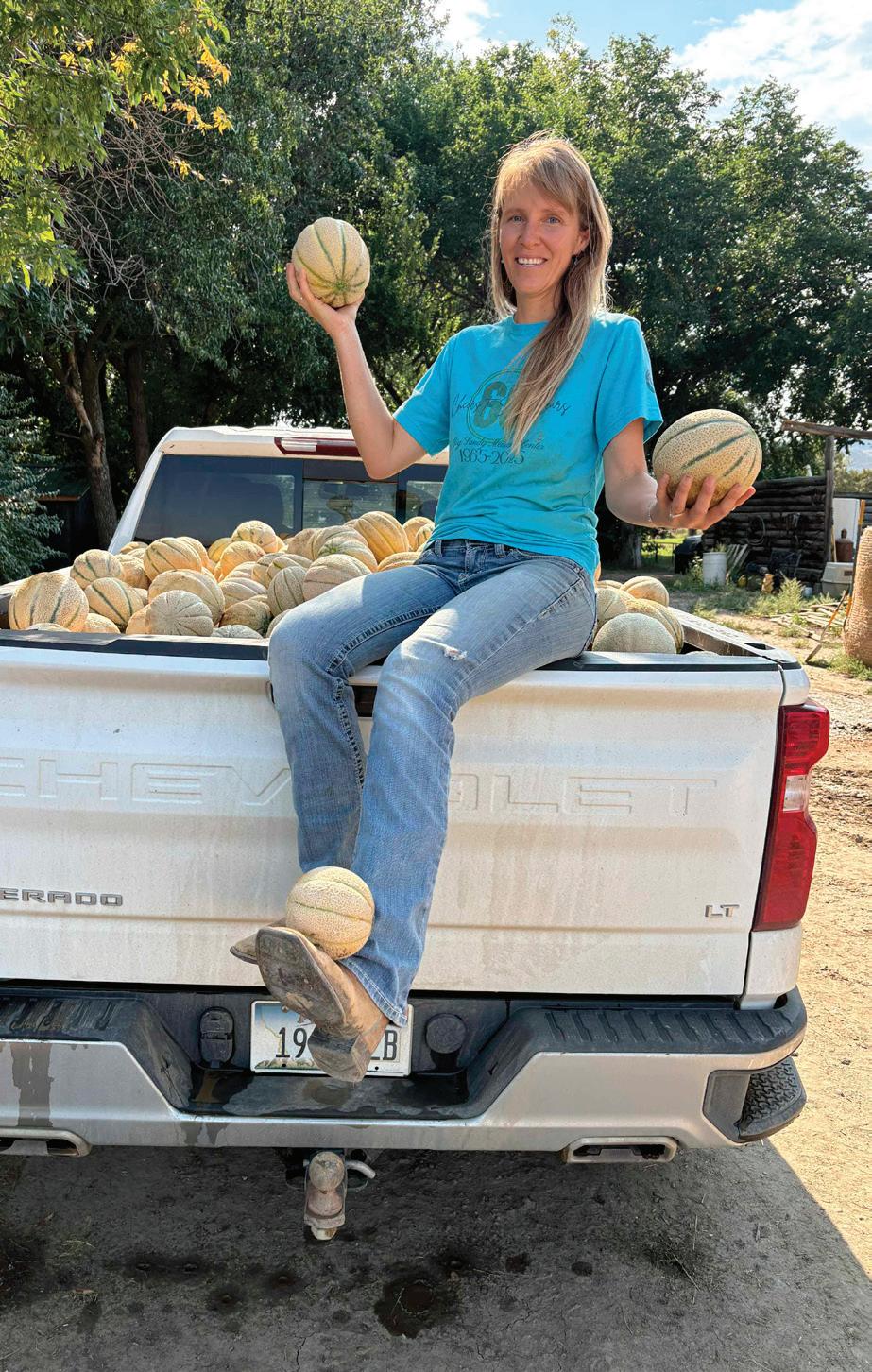
Nestled in the Missouri River bottom, amongst the wheat fields and pastures between Big Sandy and Winifred, are several surprising acres of cantaloupe and pumpkins showcasing the best of the blood, sweat, tears – and love – it takes to grow food.
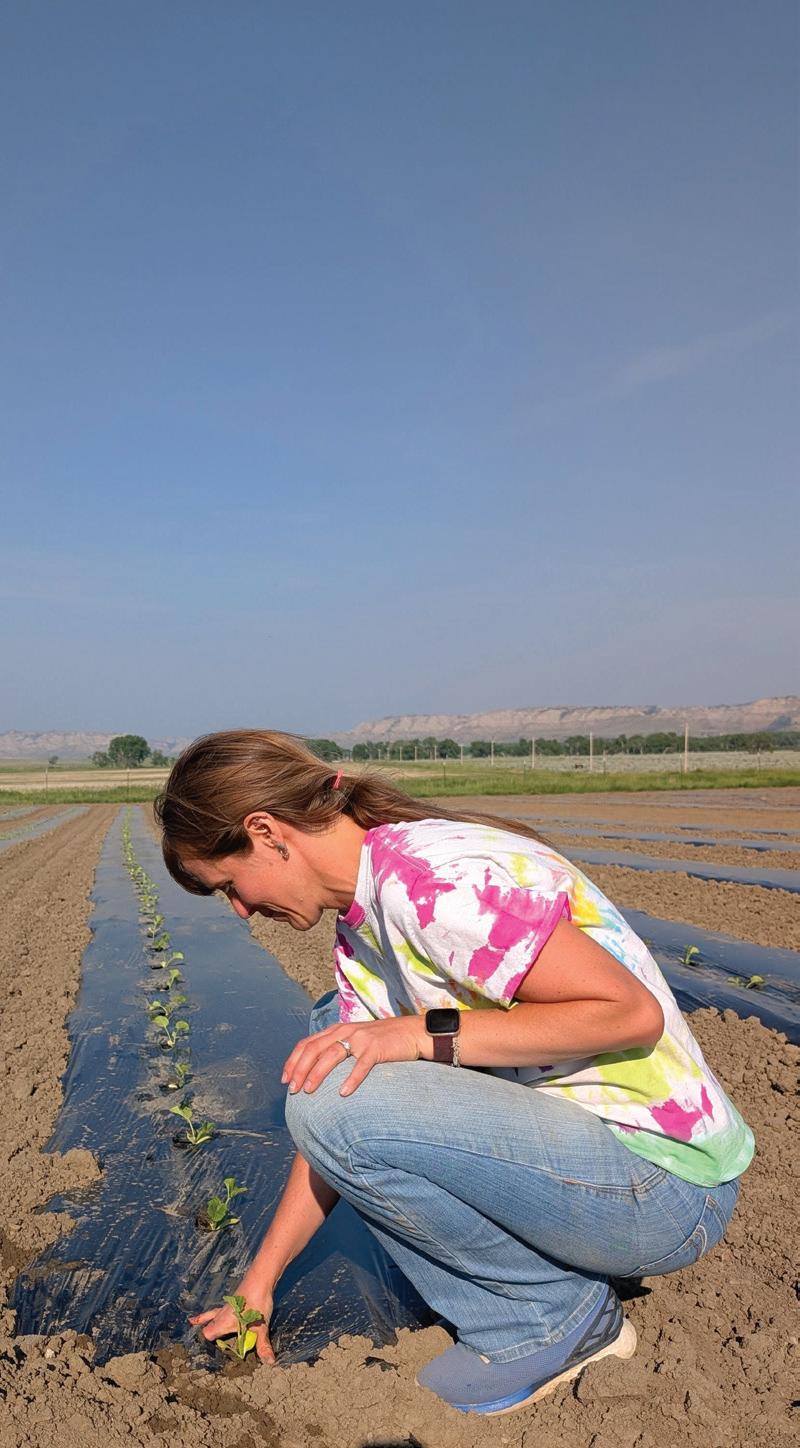
“When we get to have people out, especially for the pumpkin patch, they get to see how farm life really is,” Raynee Gullickson said. “We’re out here on our hands and knees planting these seeds and laying the plastic, and they see that it does take a lot of work and there’s so much value in getting fresh food and fresh produce. When you can just go to the store and grab it, what goes into growing it gets lost.”
The Pearson family has deep roots in agriculture, growing wheat and hay and raising cattle and quarter horses on their generational farm and ranch. Perhaps what they’re most known for, though, is cantaloupe.
“We started growing cantaloupe in 1998 because times were tough even though we were farming and ranching. We didn't have any extra money for day-to-day living, so we decided to try out a new venture. We had had such huge success with our vegetable gardens we thought that a cantaloupe field could be successful. We never realized how loved and appreciated the effort would be by the communities we serve cantaloupe to,” Gullickson said.
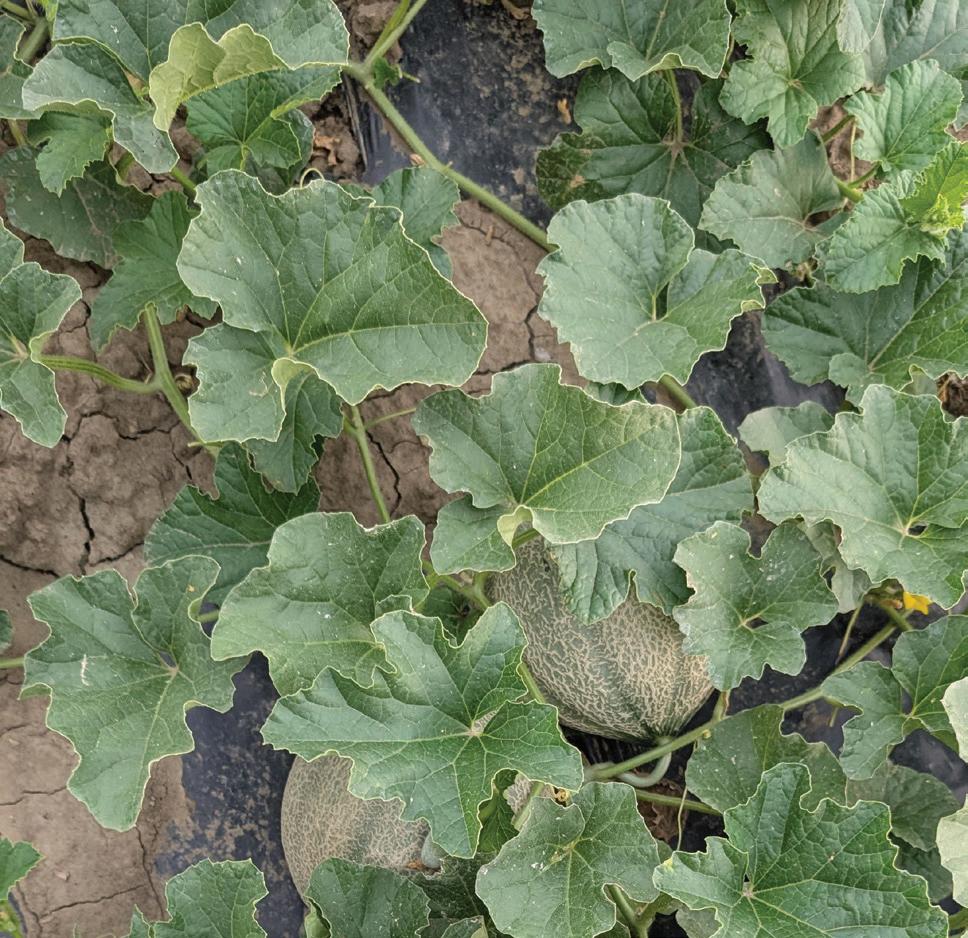
Planting the roughly five-acre patch begins in early June. When the cantaloupes begin to ripen in mid-August, the work begins again with the family harvesting roughly 2,000 pounds every other day – and up to 5,000 pounds on Fridays ahead of farmer’s markets – for about eight weeks until a hard frost hits in October.
Admittedly, Gullickson has a love-hate relationship with cantaloupe and the intense work to produce it.
“I definitely thought I was going to leave the farm and ranch and get a big city job,” she said. “But that comes with other challenges.”
After a stint away, she returned to the ranch in 2012 and continues her work with breeding and training quarter horses and helping with the cantaloupe. The family has added on a pumpkin patch, and in 2017, when her uncle asked her husband Matt and her if they were interested in leasing land from her family’s original homestead claim to grow wheat, they said why not.
“Yeah, I think we’re crazy because we’re farming without all the equipment, but the equipment is so expensive,” Gullickson said.

“We’re just trying to do our best out here.”
She’s learned to be conservative in the face of high inputs and depressed commodity markets. “When we make money from our farm, we are basically spending all of that putting it back into the farm. So we are definitely being conservative and asking for help, which can be hard.”
Her own joy and connection to the land, coupled with a legacy of farming, fuel the effort.
“Our ancestors were passionate about the land, and it passes down through the generations. We’re passionate about the land and seeing it taken care of by the next generation. And I do feel proud to be continuing the family legacy.”
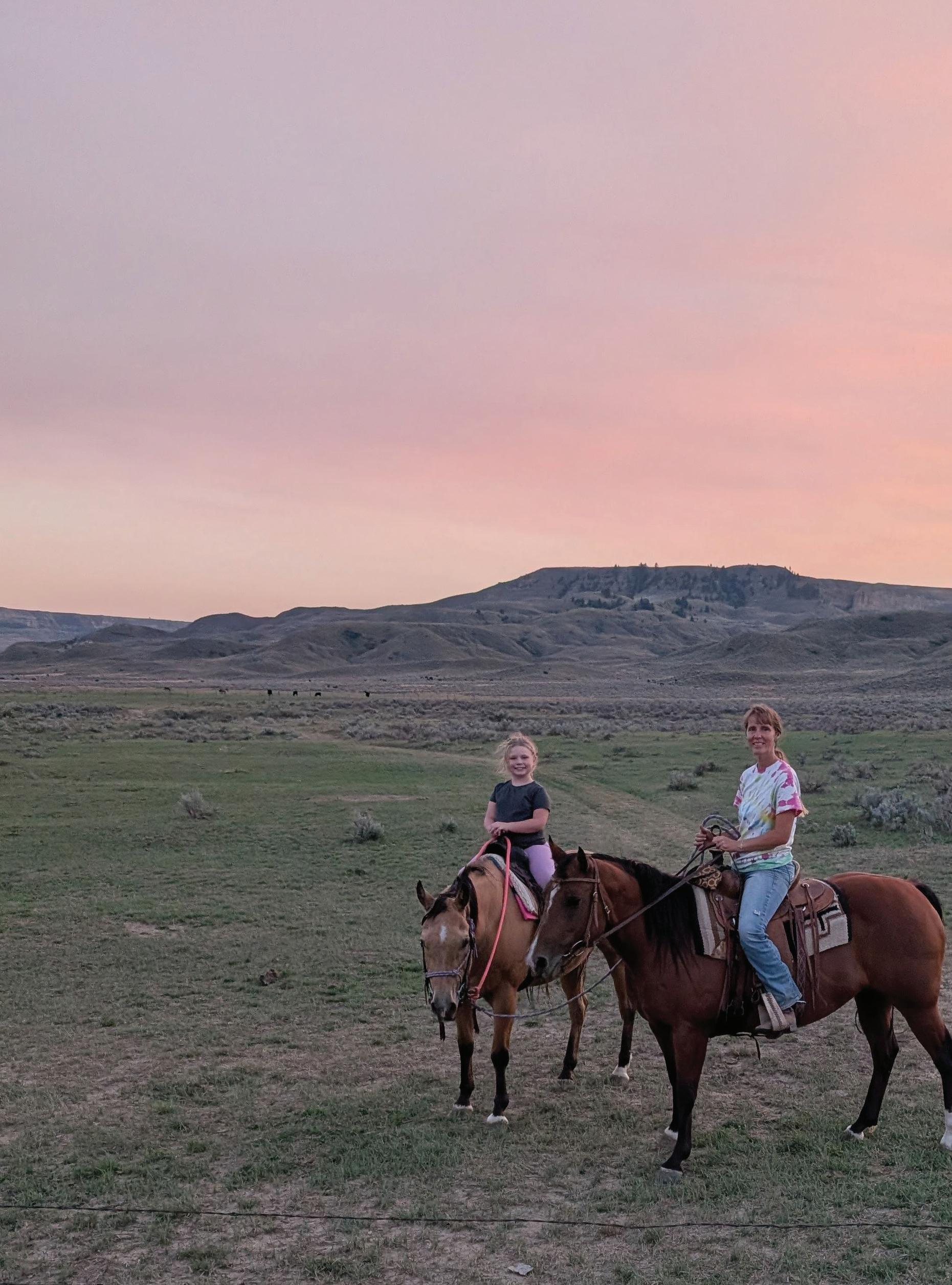
Gullickson’s love of farming and ranching started from horseback at an early age.
“My favorite part of working with the cantaloupe was I would be able to have friends come out to help, and we would be able to go ride horses when we were done.”
Today, her involvement with training and marketing the foals is a business venture, but she still finds the sense of freedom they gave her as a child.
“When I’m working with horses, I feel freer and that I can set my worries aside for a little bit of time. I must live in that present moment and meet the horses where they are at instead of where I’m feeling,” Gullickson said. “I may not be as carefree anymore, but a good race across the hay meadows still brings out that feeling of pure excitement and enjoying the beauty of nature.”
Focusing on the task at hand and being present are skills that Gullickson carries over to her other work on the farm, including the days spent planting and harvesting.
“Our family all gets to hang out together. There is a lot of labor to it, but it’s gradual over time, so we’re able to be out in the field and enjoy it.”
Sprinkled in with the labor are fond memories, like how the cows and other farm animals enjoy eating the melons and pumpkins too.
“The cows will come running across the pasture to get to the tractor load. They’ll take the whole cantaloupe in their mouth and break it, and the juice is just running down their face,” Gullickson said.
The pumpkins must be smashed before feeding them to the cows and goats as a natural dewormer, providing sustenance for the critters and stress relief for the humans.
“We have so much fun just out there smashing pumpkins for the cows,” Gullickson said. “It’s the little things like that that you look back on and realize it was a really good memory.”
Pearson’s Big Sandy Cantaloupes are found regionally at several grocery stores and farmer’s markets, with the quality earning many repeat customers.
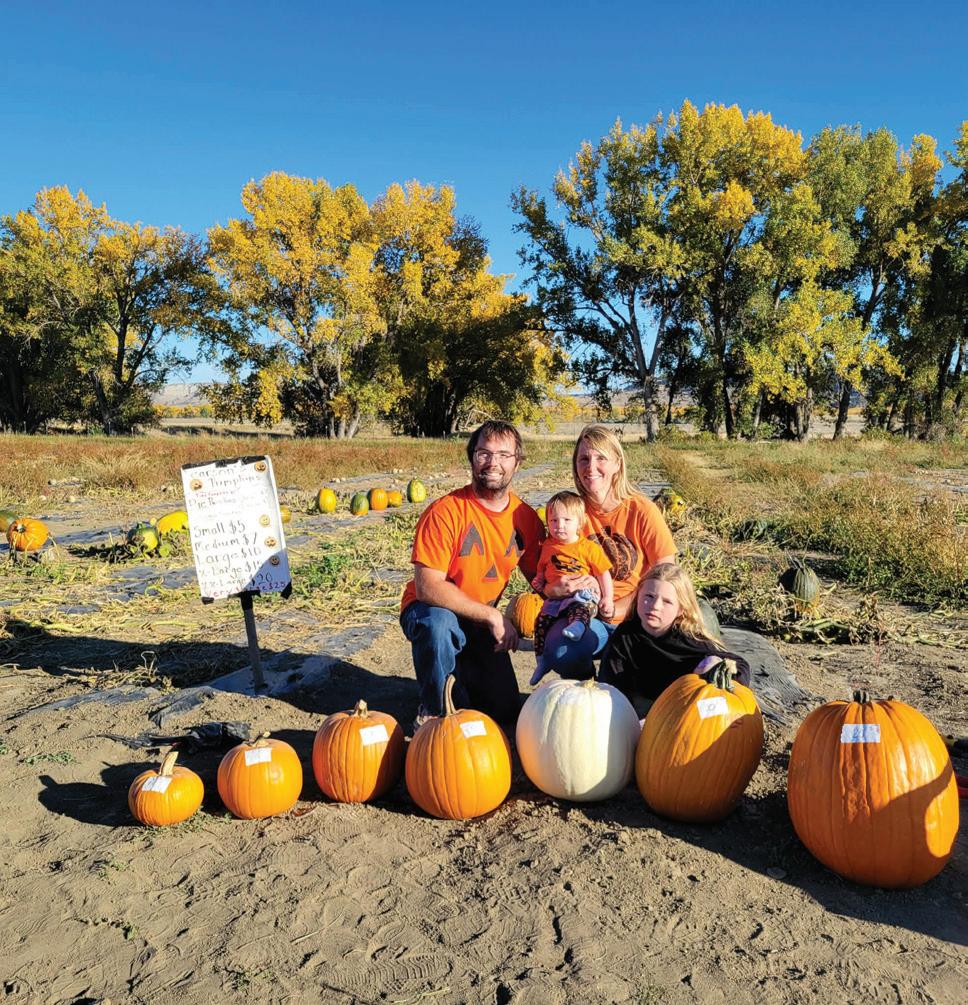

Raynee, her husband, and their two kids with their pumpkin patch.
Continued on next page
Continued from previous page

Raynee plants, harvests, and sells her family‘s canteloupe crop.
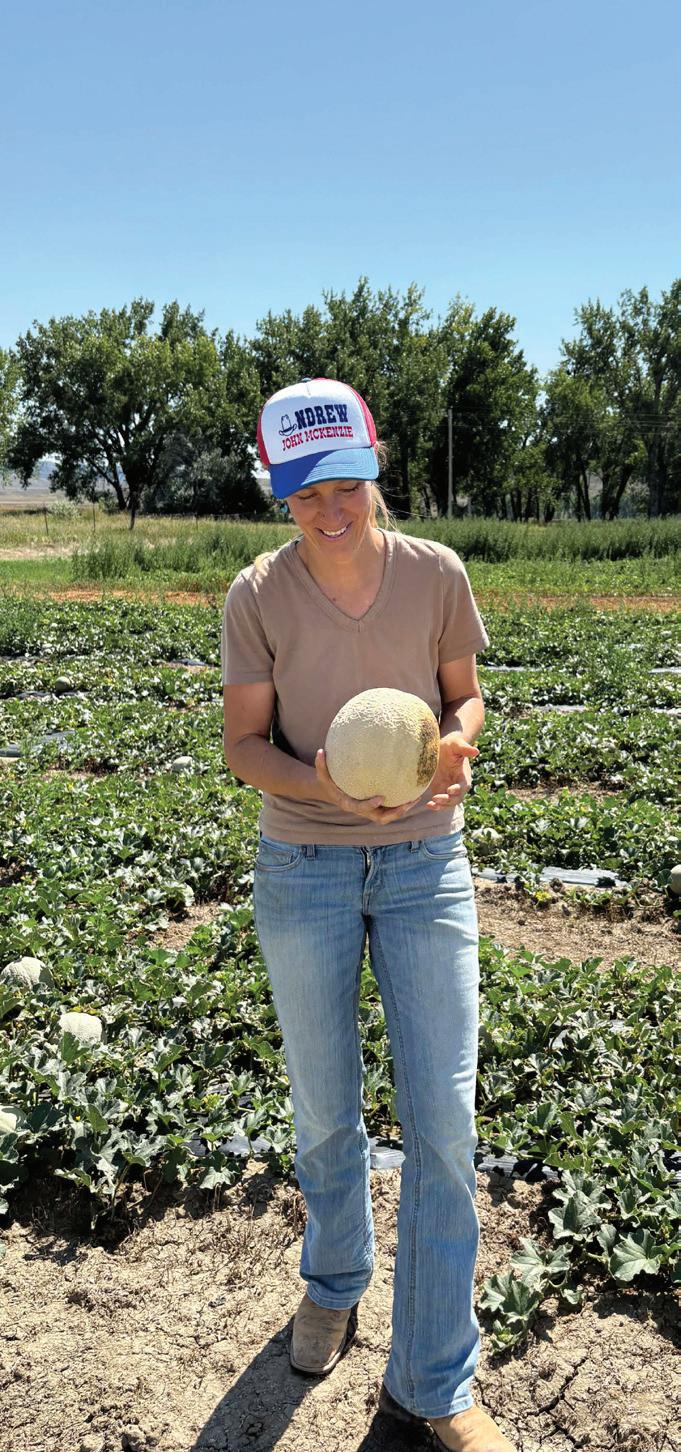
“The melons just have a different taste to them,” Gullickson said.
The secret is simple. “My daughter says it’s because we grow it with love.”

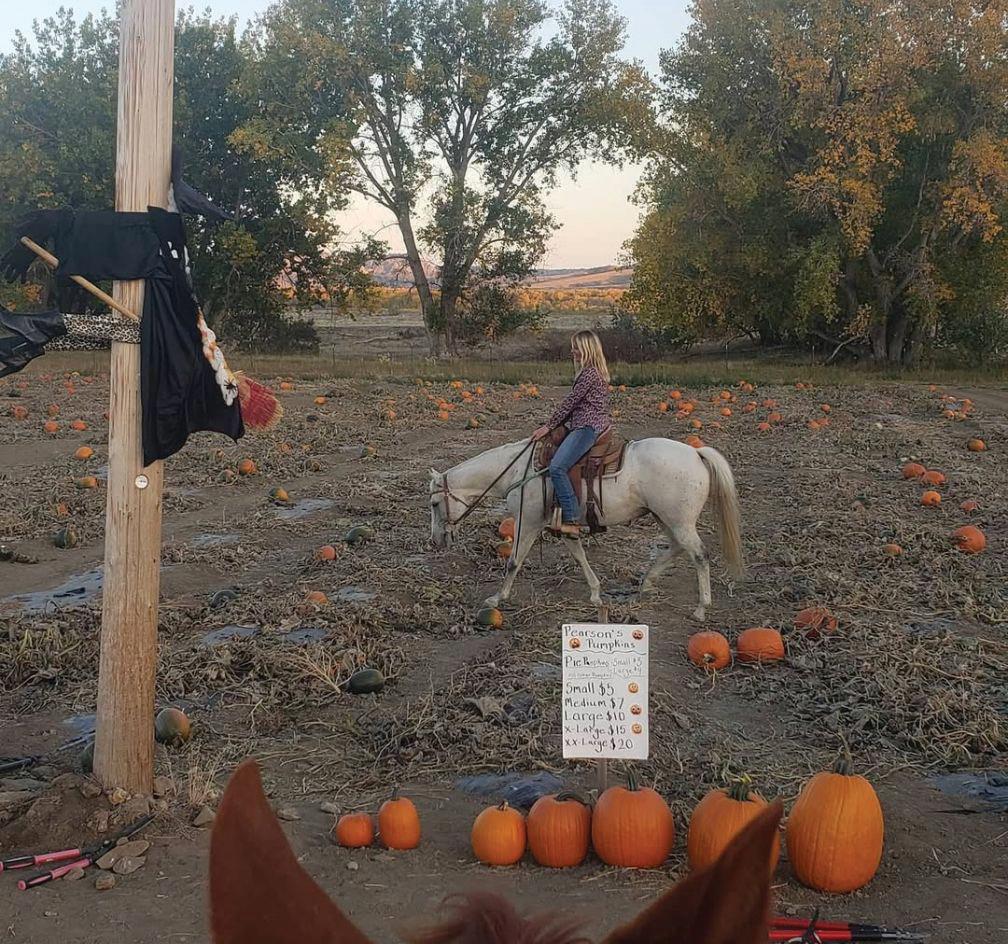
The pumpkin patch, which is planted by hand and spans an acre, also has many return visitors.
"We have a lot of people who come every year for the pumpkin patch, and we get to see their lives in just a little yearly snapshot,” Gullickson said.
The pumpkin patch started in 2012, when Winifred schools approached the Pearsons about having a pumpkin patch for students. The Pearsons embraced the idea, with Gullickson’s dad even constructing a hay maze.
“They were really interested in learning about how the pumpkins that they’re carving at Halloween are grown,” Gullickson said. It was so much fun for area students and for them, that the Pearsons did it again the following year and then created a few online posts to invite community members to grab the extra pumpkins. Since, the patch has become a fall staple for the community and grown to include an even larger hay maze and other activities that connect participants with agriculture.
Attendees trim pumpkins right off the vines in the field. Often, the pumpkins bear signs of deer bites and hail damage. “They get to see how it’s not super easy to grow these things, and they’re really thankful that we keep producing them.”
Gullickson is looking for ways to diversify even more, including using a cabin they built last year for agritourism. Gullickson said she wants to be able to help her children stay just like her parents created space for her. “It’s really fun to have our three generations all being able to work together.”
Her children help with the animals and the patches and experience the joy of sharing agriculture with others, learning that if you take care of something it will flourish and that satisfaction often doesn’t come from instant gratification.
“With my kids, I want to give them a positive outlook about farming and ranching and let them know, if they want to farm and ranch, they can hopefully come back to this lifestyle.”
Find more information about Pearson’s Big Sandy Cantaloupe and Pearson’s Pumpkin Patch on Facebook.

Raynee Gullickson is a Membership Ambassador for Montana Farmers Union in the Hi-Line region.
“My favorite part so far has been all the ways it’s challenged me to grow as a person,” Gullickson said of her new role, adding that she’s realized how important it is to work together toward common goals.
“It just makes me realize that we’re all capable of getting out and using our voice if we’d just take those first steps and start.”
Gullickson will be serving as MFU Membership Ambassador for Glacier, Pondera, Liberty, Toole, Hill, and Chouteau counties in the Golden Triangle. She can be reached at rgullickson@montanafarmersunion.com or 406-390-4656.
Above: The pumpkin patch often doubles as a training ground to teach the horses about new obstacles, crossing the mulch rows and riding past the witch that had an unfortunate incident flying into the power pole.







By Bella Folino, MFU Government Affairs & Outreach Coordinator

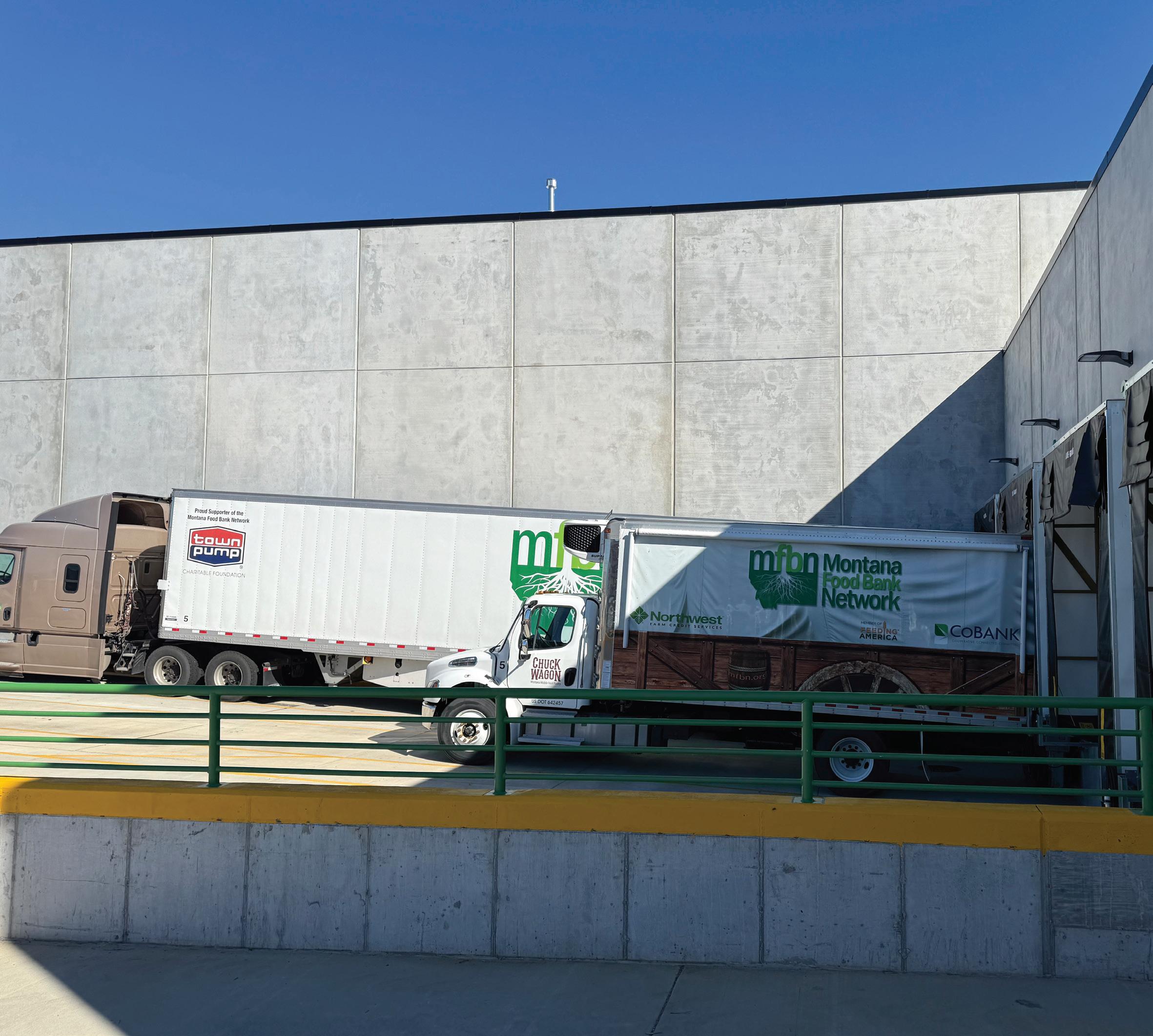
Montana Food Bank Network is Montana’s only statewide food bank, serving 330 Network Partners including community food banks, pantries, schools, senior centers, and shelters. In 2025, MFBN distributed 16.4 million pounds of food, which equates to over 13.6 million meals.
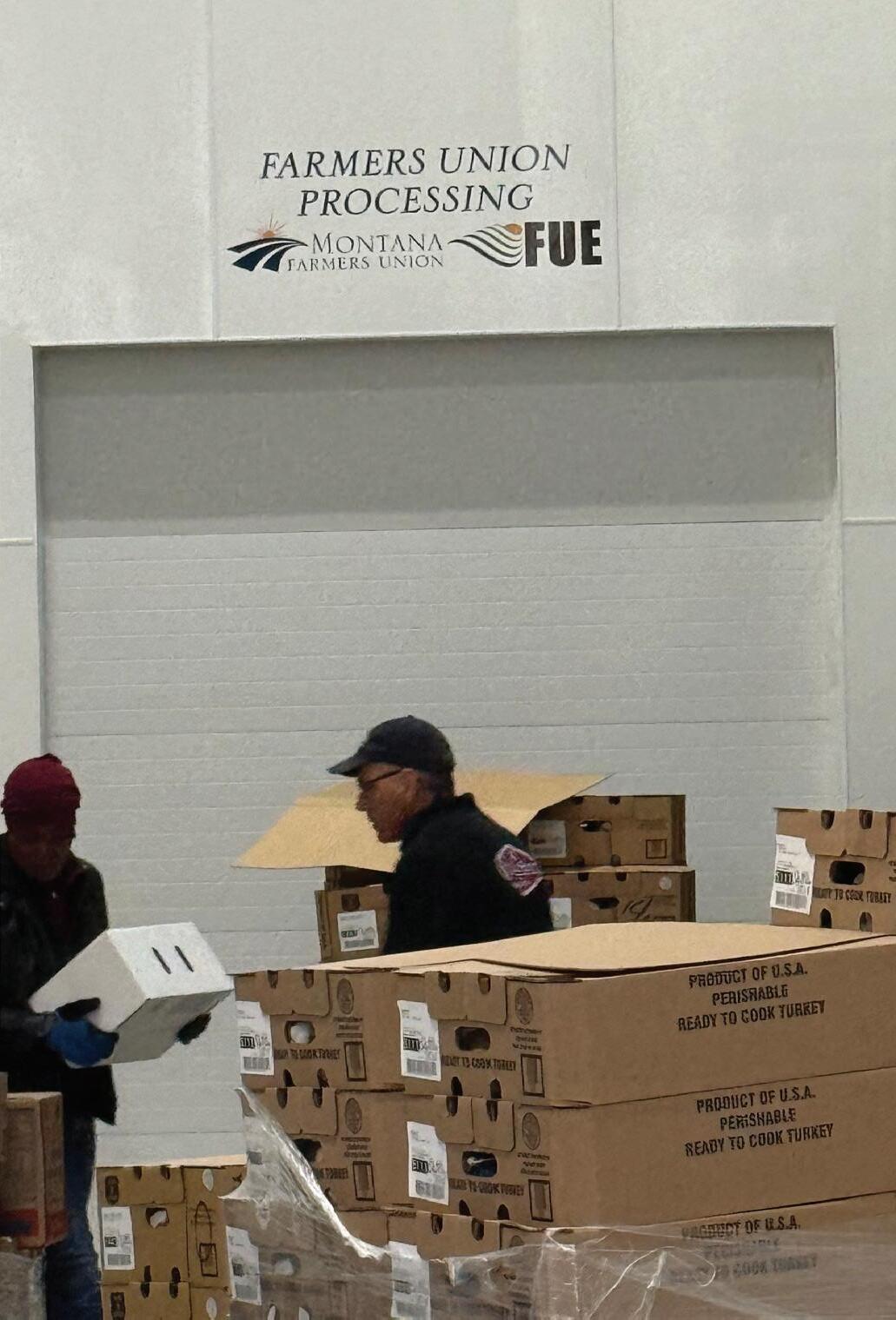
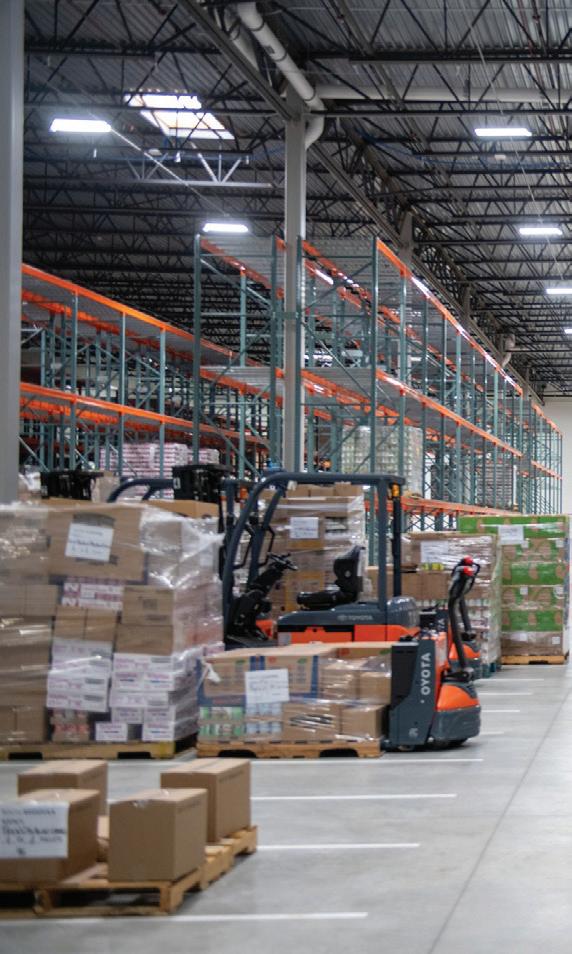
In September 2025, MFBN moved to its newly constructed facility in Missoula, which not only doubled the organization’s food storage capacity, but also increased its volunteer capacity. Additionally, the new facility provides farmers with an easier way to donate their products. To support MFBN’s vision of a hunger-free Montana where everyone has equal access to nutritious food, Montana Farmers Union and Farmers Union Enterprises donated an agriculture processing room to the new facility.
“It is important for local food system resiliency to support our food institutions in giving farmers and ranchers new opportunities to utilitize commodities and help more Montanans access local food,” said Rachel Prevost, Montana Farmers Union’s Executive Director.
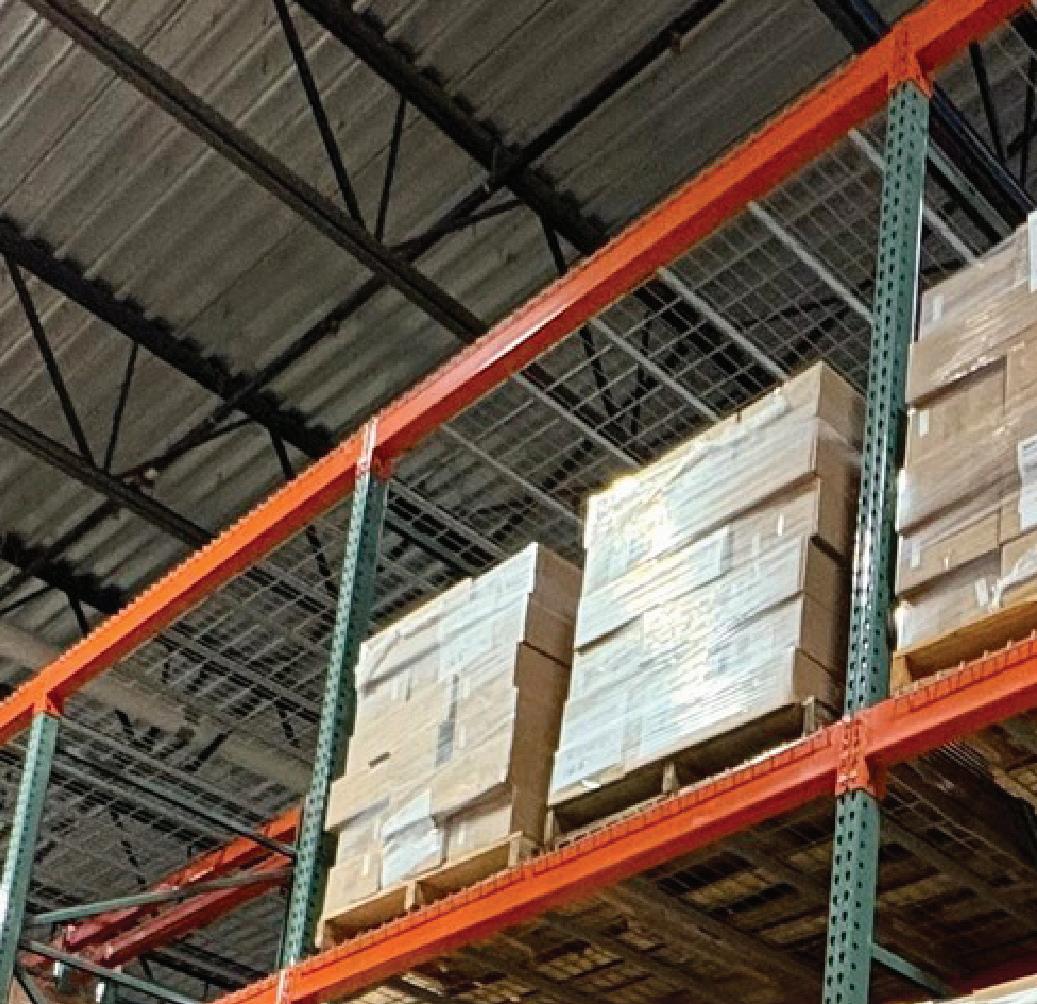
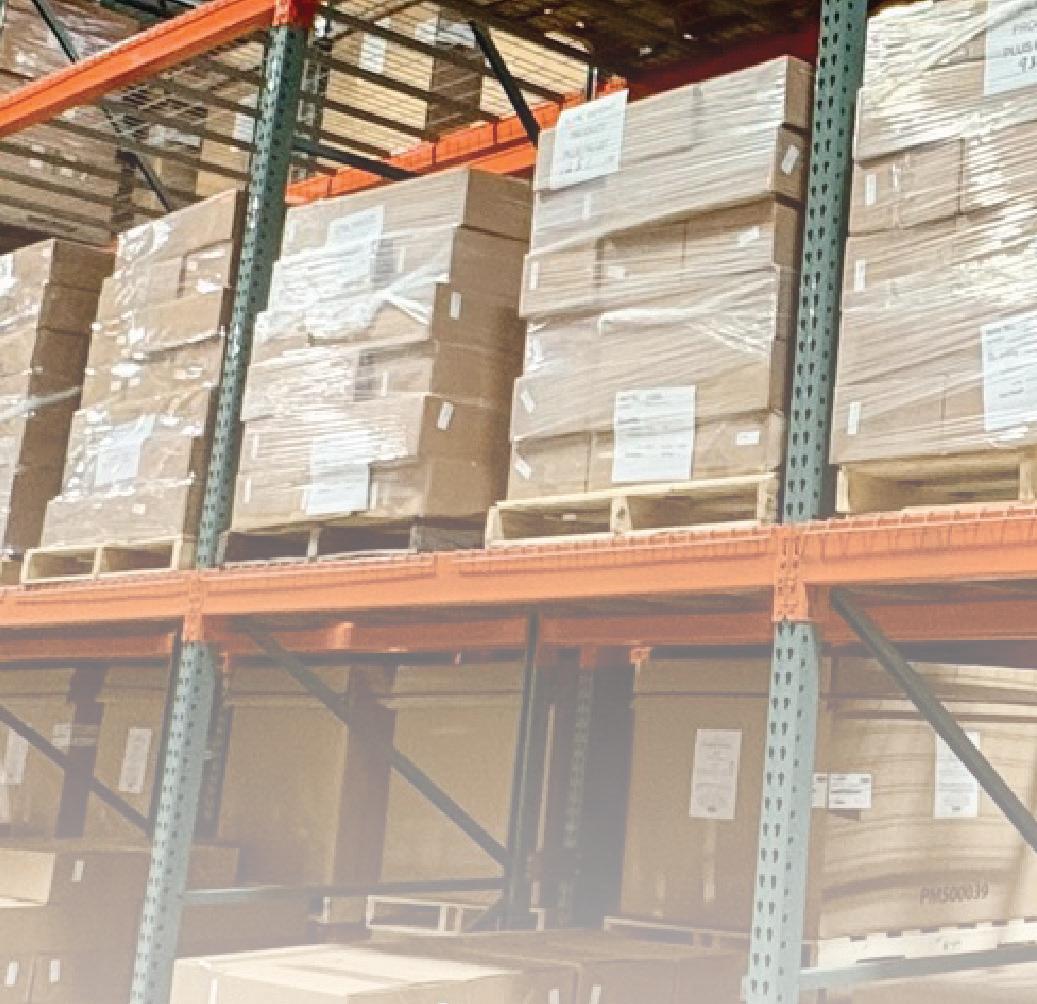
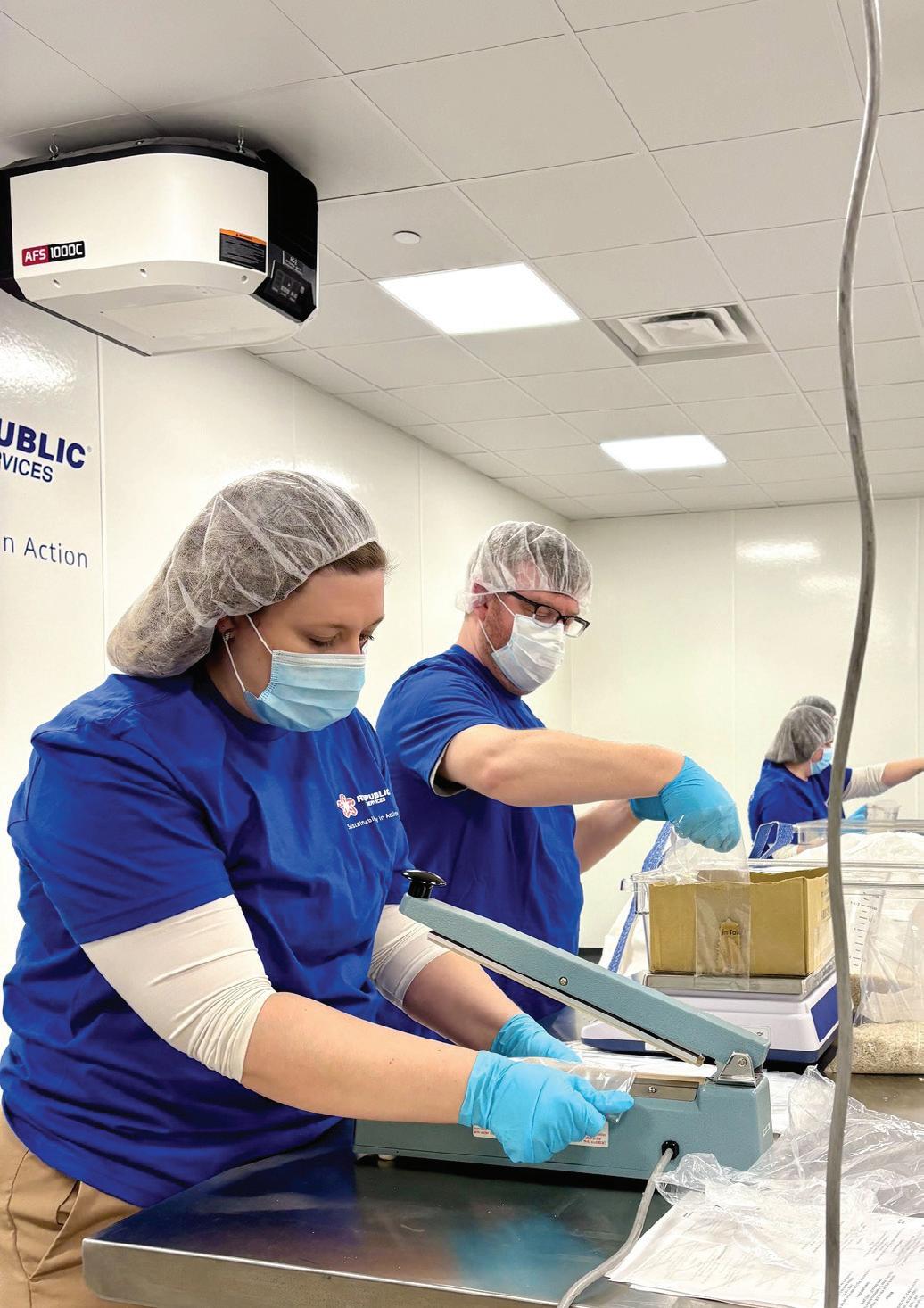
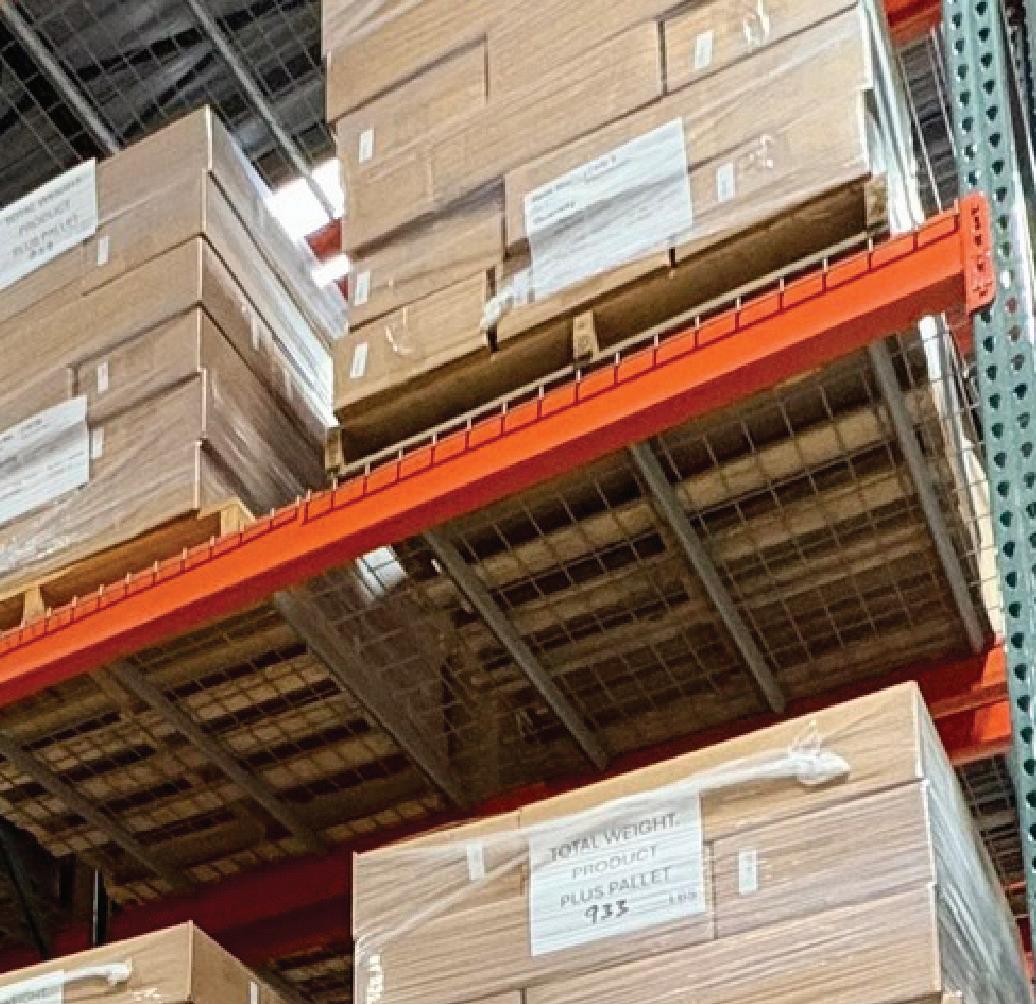
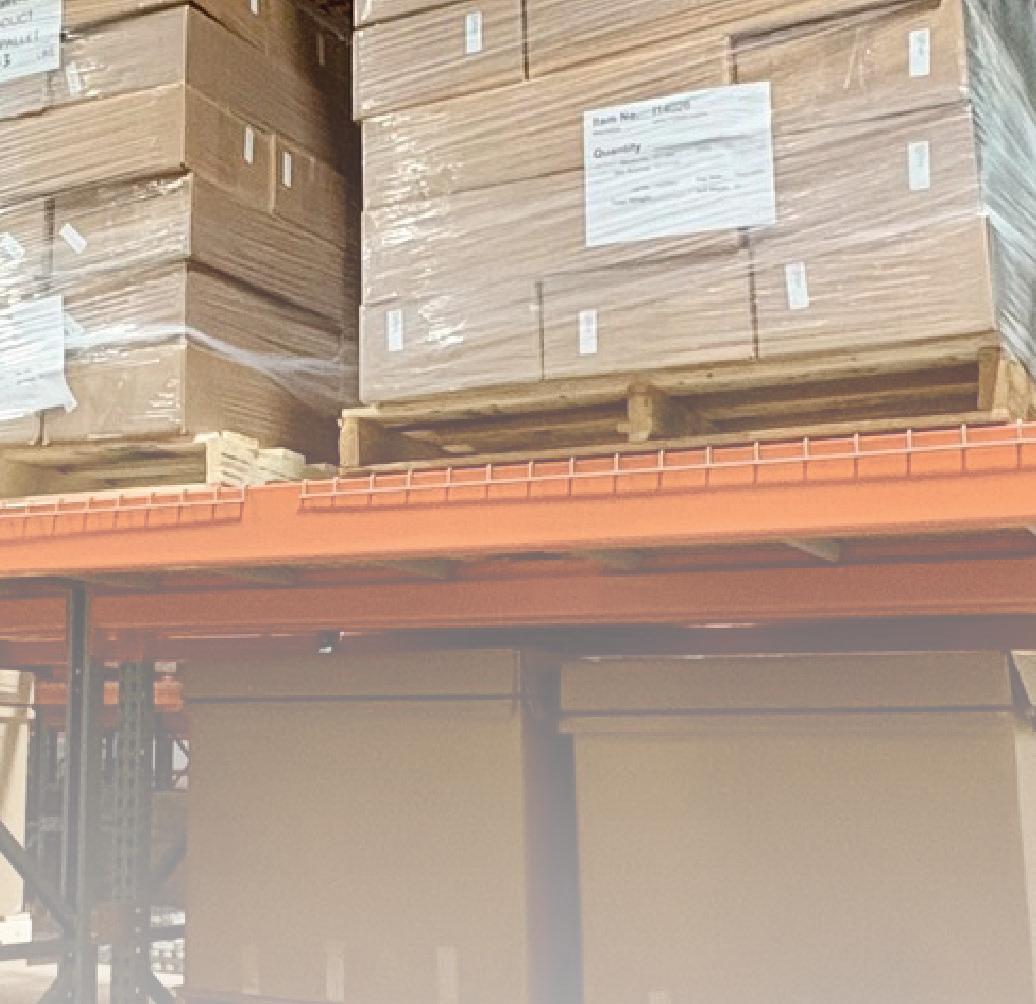
The agriculture processing room is a designated room specialized for the storage of agricultural products in raw form. With the new room, MFBN has been able to accept and store bulk raw agricultural products, which are then repackaged into smaller, family-sized portions and delivered to the organization’s partners across Montana. Some items they have been able to take are nonperishables, such as peas, lentils, rolled and steel cut oats, dried beans, and cereals, as well as produce, such as potatoes and carrots.
“We have the manpower and the labor covered, we have the receiving covered, we have the enhanced repacking capabilities,” said Brent Weisgram,Vice President and Chief Operations Officer of MFBN, “and now we have a designated space to safely store these bulk agricultural commodities.”
MFBN’s food distribution system is critical to rural communities, especially those without nearby grocery stores. Partner organizations can use MFBN’s online system to order food items needed to support their communities. These items are then delivered by MFBN staff, providing an easy, efficient option to acquire grocery items. This saves shopping and driving time for volunteers.
“The majority of small-town food pantries across the state are run by volunteers. They are amazing people who are taking time out of their day to run the pantry, to source and stock their shelves, and to support their neighbors facing challenging times,” said Weisgram. “Our goal is to be a one stop shop where we provide as many of the identified resources they are needing and asking for. This includes purchased food, donated food, school program meal kits, fresh produce, and frozen proteins, including beef, pork, and poultry. In addition, we also work with the State of Montana to administer the USDA TEFAP program, supporting domestic growers and producers across the U.S.”
With a robust transportation network across the state, MFBN welcomes bulk donations from anywhere in Montana to be brought to its main facility in Missoula. Beyond food distribution, MFBN also serves as a hub for food security and hunger-relief programs. The organization supports local food pantries, school food programs, SNAP outreach, and more. It also supports food

Continued from previous page

unique programs, such as Hunters Against Hunger, where hunters can donate wild game animals to participating processors to be processed and distributed to local food pantries free-of-charge.
With its new agriculture processing room, MFBN is looking forward to creating new connections to provide more Montanagrown food to Montanans experiencing hunger.
“One thing that excites us is that this opens up a whole new opportunity to start new relationships that in the past we have not been able to do, such as opening up our opportunities to support local Montana-grown producers that have products in bulk,” said Weisgram.
For more information on MFBN’s efforts, visit mfbn.org. Those who are interested in opportunities to provide bulk raw agricultural products can contact James Dodge, MFBN’s Procurement and Sourcing Specialist at 406-541-4951 to discuss potential opportunities. If you are interested in donating food on a smaller scale, please reach out to your local provider. As a resource, visit mfbn.org/partner-agencies to find hunger relief organizations near you.
Montana Farmers Union is proud to support MFBN in their efforts to end hunger in Montana and ensure more Montanans have access to local, fresh products.













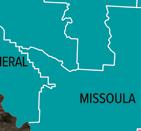
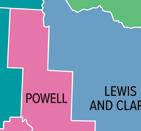
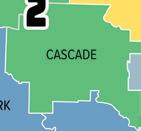
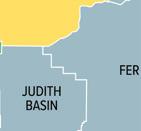
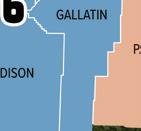
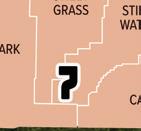
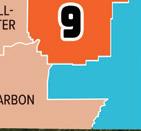
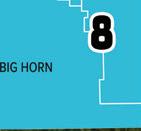










TETON/CASCADE 2
As we launch into the spring, I find myself shaking my head as to what happened to the winter or, for that matter, the summer of 2025. I struggle to find the time, resources, and energy to do all the tasks that need to be completed. I then got a quick reminder of a presentation from the Succession Planning Institute held by Montana Farmers Union last November,What Hat Do You Wear? I can see Rollie Schlepp standing at the front of the room with a pile of hats on his head, CEO, CFO, COO, and CMO representing all the roles he plays on his farm or ranch.That stack of hats feels overwhelming and unmanageable.The family then distributed the hats so that Rollie was no longer the only person with responsibilities, but each role was given to a member of the farm. I try to think how I can apply that to my responsibilities!
We have so many activities going on for Montana Farmers Union this spring. I have a personality that I want to be in charge and DO all the things. However, we have a great team, and I have to become a director and allow others to complete tasks they are good at or are responsible for. Montana Caise has taken on the Regenerative Farming Cohort. Amanda Borwege, the AmeriCorp service person, has taken on many of the school visits. Amber Fladland has been doing the Elementary Ag Pages for quite a while. Our co-camp directors Haley Milton and Bella Folino will be conducting the day-to-day work at camp.
I have been working on coordinating the lessons for the school visits, conducting the Youth Advisory Committee meetings, planning the activities and adventures for camp, overseeing the registration, and hiring for camp staff. I have learned that I have to delegate, trust, and let go of my control. I have to trust the members of the team to do their tasks. Could you use this process of becoming a director or Chief Wisdom Officer and allow the other people in your operation to take on responsibilities? Might this delegation of tasks help you manage the spring with less stress and struggle? We at Montana Farmers Union hope to see you at a Legislative Advocacy Training, A Far Out & Waiting, Ladies Who Ag, or any of the other MFU events taking place this spring.
Ambassador Jodi Koterba - Teton-Cascade
I have first-hand seen the result of pressure that farmers and ranchers are currently under, much of which we all know has led to family operations going out of business. Since becoming the Eastern Region Ambassador for Montana Farmers Union, I have been able to get an even closer look at what unfair markets and practices are doing to producers in Eastern Montana. By advocating through education, cooperation, and legislation, I have learned not only to be a voice for producers, but also to help producers find and use their own voices at the legislative level to preserve family farms and ranches.
Given the significant loss of ranches and farms in the state, now is the time to advocate and fight for what we, as producers, know is affecting our operations as we approach the 2027 Legislative Session. If we don’t, family farms and ranches will continue to erode and fade to the background.
That is why I am excited about MFU’s new Legislative Advocacy Events. In February, producers and rural community members gathered to share what matters most to them. In Jordan, Circle, and Sidney, we met with local legislators to discuss issues impacting rural communities, practiced writing a Letter to the Editor, and heard updates on the work Montana Farmers Union is doing for agriculture across the state. Get in touch with your MFU Ambassador to learn about Legislative Advocacy sessions happening near you so you can take the opportunity to advocate for your operation and for the next generation.
Since the repeal of mandatory country-of-origin labeling, Montana has lost nearly 25% of our family ranches. One of the best ways to fight for fairness and transparency in the beef market is to include federal bills in the Farm Bill:The American Beef Labeling Act in the Senate and the Country-of-Origin Labeling Enforcement Act of 2025 in the House. As a producer, you can send an action letter from mtcool.org to Congressional Delegation, urging Montana representatives and senators to sign onto the appropriate legislation and push to reinstate MCOOL in the Farm Bill.
Let’s stand up and fight for policy that protects our family farms and ranches for generations to come. If you are in Eastern Montana and want to learn more about how you can make your voice heard, please contact me at gmcdonald@ montanafarmersunion.com!
Ambassador Grace McDonald - Eastern Montana
There is something grounding about knowing where your food comes from. In Montana, that often means you know the family who raised the beef, the neighbor who grew the lamb, or the friend who took a chance on a direct-to-consumer business. Sourcing local food is not a trend here — it is a way of life, and it matters more now than ever.
When we choose to buy and eat local, we choose transparency.We can ask questions about how the animal was raised, what inputs were used on the crops, and how the land is being cared for.That kind of relationship builds trust. It also builds accountability. In a time when food labels can feel confusing or vague, buying directly from a local producer or at a farmer’s market brings clarity.You are not guessing.You know.
In Montana, agriculture is not just an industry; it is the backbone of our communities. From grain and pulses to cattle, lamb, and pork raised across our state, Montana producers work hard to feed us.When we purchase their products, those dollars circulate right back into our local economy.They support equipment dealers, veterinarians, feed stores, schools, and main street businesses. One local food purchase has a ripple effect that strengthens rural communities.
Supporting local food also means supporting policies that protect transparency and fairness for producers.That includes advocating for mandatory country-of-origin labeling.We need to put America first and put an MCOOL label on beef and pork. Montana producers raise some of the highest quality beef in the world. Consumers deserve to know if their beef was born, raised, and processed in the United States or imported from another country like Argentina. Clear, honest labeling empowers families to make informed choices and ensures our ranchers are not undercut by products that do not meet the same standards.
Eating local also reconnects us to seasonality and stewardship.We remember that beef does not come from the grocery store, and bread begins in a field of grain.We understand the risk producers take every year with weather, markets, and input costs.
At Montana Farmers Union, we believe food sovereignty starts at home.When we source Montana-sourced food, we invest in our communities, our producers, and the next generation of producers. In Montana, buying locally sourced food is not just about what is on the plate. It is about community, resilience, and standing together for a food system that reflects our values.
Ambassador Mary Jenni - Central Montana
Life moves fast.Too fast most days. Calendars fill up, priorities stack on top of each other, and it can feel like there’s never quite enough time to do everything — let alone add one more meeting, call, or commitment. I totally get it. I am guilty of putting things off until tomorrow and overfilling the calendar.We’re busy keeping operations running, families fed, fences fixed, crops in the ground, and livestock cared for. Sometimes just getting through the day feels like an accomplishment.
And that’s exactly why engaging in Montana Farmers Union matters.
Being part of MFU isn’t about adding another heavy lift to an already full plate. It’s about remembering that none of us are in this alone. It’s a way to connect the work we’re already doing to the bigger picture of Montana agriculture and rural communities. When we engage, even in small ways, we’re investing in something that supports not just our own operation, but the future of rural communities, family agriculture, and the next generations.
It’s easy to think impact only comes from big gestures or from a handful of people carrying the load. But real, lasting change usually happens the opposite way. It happens when a lot of people each do a small part.When someone shows up to a local meeting.When another shares their perspective.When someone volunteers once, mentors a youth, helps plan an event, or simply stays informed.Those small actions add up.They ripple outward in ways we don’t always see right away.
MFU creates space for just that. It brings people together across various farm and ranch practices, multiple generations, and communities to work toward common goals — fair markets, strong rural communities, and a more resilient agricultural industry in Montana. It reminds us that our voices matter individually and collectively.
Time will always feel short. Life will probably keep moving fast. But being involved in Montana Farmers Union is one way to slow down just enough to be intentional about where we put our energy. It’s a way to make sure the work we’re already doing every day on our farms and ranches connects to something bigger — and helps shape the future of Montana agriculture for decades to come.
Small efforts. Shared responsibility. Bigger impact.That’s the value of showing up.
Ambassador Samantha Ferrat - Missouri Headwaters
What a 2026 already! Montana Farmers Union’s grassroots momentum is palpable.
Montana Farmers Union members in the Northwestern region are as busy and engaged as ever. It is incredible to watch engaged members move the needle for their farms, ranches, and local communities, from their kitchen tables, fields, calving sheds, and local meetings.
By the time you read this, we will have attended and returned from the NFU Convention, and Montana will be well represented. For those of you who have yet to attend a Montana Farmers Union state convention, please save the date for October 15-18 in Bozeman. Convention is a great opportunity to bring your farms, ranches, and fields to the table, unify our voices, and lift together to take action.When our voices are collected and centered around the needs of our family farms and ranches, we shape policy that starts in our fields, not in Washington.The truth of what impacts us, or will impact us, is in Montana, and close to home.
Just like we grow our crops and livestock, through investment in the land, soil, and watershed, we grow our grassroots opportunities through investment at our local meetings, conventions, and member events, with thoughtful discussion and debate. Our lived experiences on the farm and ranch are the weight behind our stories.Want to know more about sharing your story? Keep an eye out for our upcoming 2026 Legislative Advocacy Training events, where we will learn to write letters to the editor, meet legislators, county commissioners, and new candidates. These events will be held statewide. Join us!
It just takes one, a simple step forward.
New to the Northwestern region is the Sanders County Local! The new local is a great example of how one “Know your Co-op” event inspired one member, who took engagement to heart and inspired a group of folks to gather, and within just a matter of weeks, they hosted their first “Know your local Food System, Meet your Farmer/Rancher” event with nearly 50 folks in attendance.We all know in the agriculture world that one act doesn’t just transform the farm … it transforms rural communities; it transforms our food systems.
A single conversation and the courage to act brought 48 community members through the door.
A huge thank you to our members, for your commitment to Montana Farmers Union and to your farms, ranches, and rural communities.
See you out there!
Ambassador Carissa McNamara - Flathead
To be a farmer using regenerative practices is to walk between worlds. On one hand, you remain part of a commodity system that demands certain yields, inputs, proteins, and weedless fields (and then proceeds to reward your toil with pennies on the dollar). On the other hand, you’re part of an ecological system that measures success by resiliency and the total amount of life supported on the land.The route to accomplishing both feels like walking a tightrope. Regenerating land while still growing cash crops at a large scale, with or without livestock, adds layers of complexity to the existing challenges of agriculture.Truth is, every farmer I know wants to see life thriving on their land — but many have their hands cuffed to systems that haven’t worked in their favor for a long time.
I grew up on a farm in the Midwest — a typical input-heavy corn and soybean operation.Tillage, pesticides, synthetic fertilizers — you name it, we probably did it.We were in a fight-to-the-death, conquer-or-be-conquered war with nature and the elements every season. I loved working on the farm —being part of the crew at harvest time, the precious solitude, the steady rhythm of endless rounds in the tractor, green shoots stretching toward the sun in neat rows — I found it all immensely satisfying. Meanwhile, I also had mild obsessions with gorillas and orcas, and childhood dreams of being some kind of biologist, so as you can probably imagine, I never cared much for the needless killing side of things. And truthfully, I still don’t.
These days I spend a lot of time learning and wrestling with these concepts of how to continue raising food at the scale necessary for today’s population, while working primarily with nature instead of against it ... agriculture is difficult enough without turning it into a war, if you ask me.
The folks I know who are truly invested in the regenerative agriculture movement are finding ways to make it work, but if anything is clear, it is that there’s no one-size-fits-all solution, and it’s most certainly going to require bucking the current systems that cater to Big Ag and Big Food.
I don’t have the answers, but I’m stubborn and resolved to figure it out as best as I can, and I’m willing to bet those are things you and I have in common. If so, you should consider joining our Regenerative Farming Collaborative to figure out your own answers for what practices can strengthen your operation. Give me a call; I’ll gladly tell you more about it.
Ambassador Montana Caise - South Central
The Houlihan (hoola hand) is a roping technique cowboys have used for generations to catch fast-moving cattle and horses. It gives the roper a greater range of position and longer distances, while allowing them access in the herd. Historically, the cow boss may have been the one to orchestrate this maneuver or maybe he allowed for your choice of mount — out of a bunch of snorty broncs. Either way, throwing a Houlihan required you to be brave, energetic, and quick witted to keep up with your mount.
As we enter the Lunar Year of the Horse, we can carry that same energy forward. 2026 is the Year of the Fire Horse, a cycle that comes around only once every 60 years! As a new ambassador for MFU, I can feel that energy on the horizon — much like your youngest ranch pony on the first crisp morning of fall gathering.There’s electricity in the air and a sense that something is alive, and there’s potential for fast forward movement.
Ranchers and farmers live in that energy every day.We face uncertainty as part of the job description. Our livelihoods depend on our ability to embrace the unknown — with independence, grit, and a willingness to solve whatever problem tears down the gate … even after it’s just been stretched tight again.
Montana Farmers Union is addressing all these gate-jumping, high headed unknowns coming through our operations: Right to Repair, tariffs, mental health, and the policy decisions that will affect our family farms, ranches, and their bottom lines. MFU’s job is to make sure that your voice is heard, no matter your background, operation size, or age.
The Houlihan isn’t a careless throw. It takes timing, feeling, and confidence in your ability. Agriculture is shifting. Markets are changing.Weather patterns are less predictable.Yet we’re still showing up, putting in long hours, caring for the land, and investing in our future generations.We’re confident in our ability to produce for the world.The Year of the Fire Horse is known for intensity, drive, and transformation. My hope for each of you is that 2026 is the year your Houlihan catches. No matter how wolfy or fast your animal is. I’m confident that we can do the hard work together — no matter how long the ride is.
Ambassador Bailey Chalfant - South Eastern
Continued on next page
HI-LINE 3
As spring comes, I know everyone starts thinking about what needs to be done on the farm and/or ranch this year.We prepare our equipment, our buildings, our land, and our animals for the busy days ahead. Do you feel like there is anything you just can’t get on top of for preparations? Anything that just seems too daunting of a task that you are afraid to even start? The anxiety rolls in and the nights are spent tossing and turning, with thoughts of how will I accomplish it all?
Know that if you are feeling this way, you are not alone! We as farmers and ranchers are facing many challenges.We struggle to find hired help, we take on more than most people can even imagine, and we work hours that sometimes seem endless.
My hard-learned advice to you is to create a list, or a calendar, or whatever else you like that can help you organize your tasks, thoughts, and plans. Organize these items from highest priority down to lowest priority. It’s ok if some items overlap or change in order as events unfold.Then start with the most pressing task and break it down into manageable sized bites of labor.
Have you heard the age-old idiom that goes … How do you eat an elephant? One bite at a time.
This idiom has calmed my nerves and anxiety many times of being overwhelmed and helped me to step away from the bigger picture for a moment.Then I can see what task I can accomplish right here, right now that will keep me moving forward on that trajectory to eventually reaching that bigger picture goal.
Sometimes when we are thinking about creating our list of tasks, we might need someone to listen to what we have going on, so we can get our thoughts out loud and make sense of them. If you find yourself struggling with what tasks to prioritize this spring, feel free to reach out to me as your newest MFU Membership Ambassador. I’ll be here to listen and help you organize your thoughts and make a plan of attack to tackle all those spring and summer projects.
Although I can’t help you grow an extra set of arms or make a clone that can take on half the workload, I can help you find your direction and hopefully ease a little of that spring workload anxiety.
Happy Spring to you all and remember that you are some of the strongest, bravest people in the world!
Ambassador Raynee Gullickson - Hi-Line
YELLOWSTONE COUNTY 9
WELCOME, JESSICA - MFU’s newest ambassador in Yellowstone County.
Jessica Plance is a Billings-based communications professional, photojournalist, and storyteller with a passion for rural communities and the people who sustain them. She brings experience in nonprofit communications, photography, and video production, with a background working alongside grassroots organizations and conservation leaders across the West.
Jessica’s work focuses on capturing authentic, place-based stories, highlighting producers, youth leaders, and community members through documentary-style visuals and clear, engaging narratives. She believes strong storytelling strengthens connection, builds trust, and helps organizations share their values in meaningful ways. Being out in the field and meeting new people is what brings her the most joy in her work. She is especially drawn to the small, candid moments that reveal the heart of a community and the pride people carry for their land and livelihoods.
She began her career supporting a conservation corps through multimedia storytelling, which opened the door to nonprofit communications and outdoor-focused content creation. Most recently, her work with the Western Organization of Resource Councils and Homegrown Stories has centered on elevating rural voices and documenting the lived experiences of farmers, ranchers, and community leaders across the region.Through interviews, photography, and video, she has helped tell stories rooted in stewardship, resilience, and agricultural heritage.
Jessica approaches each project with curiosity, organization, and deep respect for the people whose stories she is entrusted to share. Outside of work, she enjoys taking advantage of Montana’s outdoor recreation through skiing, biking, hiking, and camping with her dogs.
With an appreciation for Montana’s agricultural heritage and rural landscapes, Jessica is excited to support Montana Farmers Union by elevating member voices, documenting events, and sharing the stories that shape the state’s farming and ranching communities.
Ambassador Jessica Plance - Yellowstone



By Ali Moxley, contributing writer
It’s easy to look at the statistics and realize that, when the majority of American farmers and ranchers are older than 65, that large amounts of agricultural land will be switching management in the near future. The issue is more than statistics, though.
Farmers love to say that production agriculture is a lifestyle, and often producers’ identities are inextricably tied to their land and operations. The deep ties make it even more difficult to consider, and untangle, what’s next for farms and ranches.

To help family farmers and ranchers address succession planning in a thoughtful and proactive manner, Montana Farmers Union created the Succession Planning Institute, which is currently wrapping up its first-ever cohort. The program began during MFU’s Annual State Convention as an intensive deep dive with experts into succession planning and has included several months of follow up sessions and support as families have worked to create succession plans.
“Succession planning is a process with lots of moving parts. Each family or operation is going to follow a path unique to them,” MFU’s Education Director Jodi Koterba said. “We have started some great conversations among families and operations. The Succession Planning Institute provided some tools to frame conversations. Throughout the process, we have learned the need for some checklists and some lists of potential resources to be used. We have a few groups who have successfully completed their documentation and have a working plan for their succession and several more groups at various stages along the way.”
The institute has been invaluable at facilitating not only constructive conversations but concrete plans for participants and their operations.
“Montana Farmers Union provided a suggested path to follow based on the research of a variety of resources. We have had some families who have embraced the process and kept diligently working to get concrete plans in place. As with any long-term project, there have been other groups who have hit bumps in the road,” Koterba said. “The important part is that operations need to start the process in order to reach a completed plan.”
Because of high demand from membership for succession planning resources and support, MFU is planning institutes in Havre, Kalispell, and Eastern Montana later this year. Watch the MFU publications and social media for more details.
In the meantime, make sure to listen to Reframing Rural’s new season focused on succession stories (read more here).






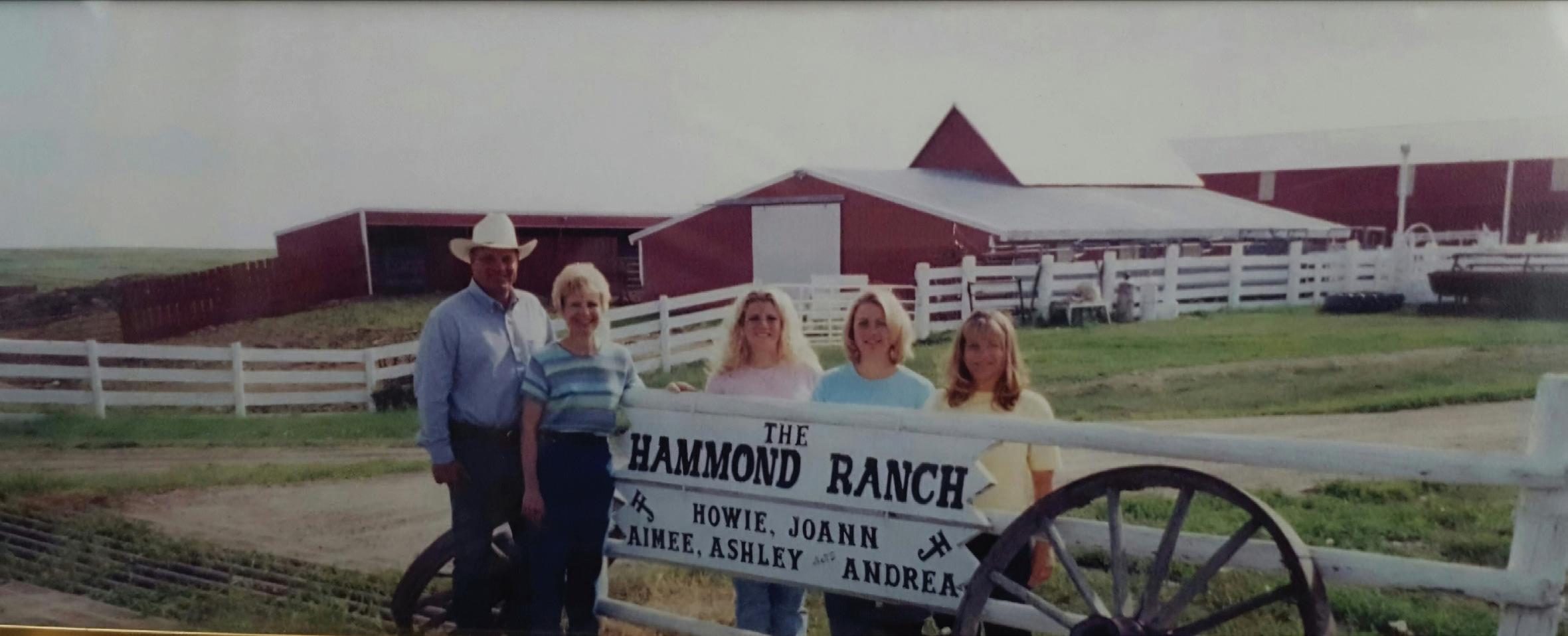
Howie Hammond, his wife Joanne, and their family steward 37,000 aces near the Milk River Valley just outside of Malta. Since the 1970s, Howie has worked hard to build their cow calf operation and small grain farm. The family has navigated challenges ranging from the 1980’s farm crisis to extreme drought to fluctuating cattle prices, persevering through the uncertainty that most farmers face throughout their career. Over the years, the family has also experienced immense personal growth as they invited workers from around the world into their home and made connections throughout the West as they moved their cattle to different leased parcels.
It felt important to the Hammonds that their daughters leave their small rural town for a time to expand their horizons. As their children found their way to other areas of the country, Howie and Joanne began thinking about what future family involvement on the farm might look like as they considered expansion and labor needs. Their daughters were surprised when, during their early twenties, their parents called to talk with them about the possibility of selling off or leasing the farmland. Their parent’s property was already primarily surrounded by out-of-state absentee landowners, and thinking about the land exchanging hands outside the family was vexing. Andrea, one of Howie’s daughters, quickly decided she wanted to come home and experiment with farming full-time. The family came up with a plan for Andrea and her husband to trial farm operations for five years without family pressure to stay or inherit the farm operation.
In 2014, Howie Hammond developed a health condition that left him and his family feeling lost and devastated. While the Hammonds had assumed they would have many years to iron out a succession plan, this life-altering news prompted the family to accelerate their future planning timeline. This was an emotional time for the family as they began processing the imminent loss of their father while trying to handle the logistics of day-to-day ranching operations and the restructuring of the farm. While Howie’s diagnosis was later reassessed, and he is still enjoying time with his family, this scare highlighted the importance of succession planning for the Hammond family.
Howie’s story is just one of many succession stories that Season 4 of the podcast Reframing Rural explores. For those who may be new to the podcast, Reframing Rural is an award-winning documentary podcast that features the distinct experiences of rural life in America. During this season, Megan Torgerson, the founder, writer, and reporter of the podcast, dives into the emotional and logistical processes that farmers navigate as they work to create a plan for their future assets and businesses. Megan brings in important perspective from her own experience of sitting down with her family to discuss potential future opportunities for her parents’ farm. Her family met over Zoom to open up conversations about who was interested in


Continued from previous page
farming the land in the future and how to make the division of assets feel equitable. Her dad shares difficult components of stepping back from the farm such as a degree of identity rediscovery.
Succession conversations are becoming increasingly important for American farmers as it is likely that 370 million acres of farmland in the United States could change hands in the next 20 years. Montana is seeing the number of farms decrease as land is developed and farm consolidation continues. Nearly 40 percent of all producers in the United States are over the age of 65, with many approaching retirement.
This season of Reframing Rural looks at both the formal and informal steps involved in succession planning. It highlights important components such as composing legal documents, evaluating tax law, creating financial projections, and identifying successors. However, it also underscores softer moments of the process such as a daughter learning pasture rotation from her father and concessions that two hardheaded cowboys make when trying to envision a collaborative future.
As the narrator, Megan weaves in beautiful prose and reflections. She asks farmers to be brave and initiate difficult conversations as they grapple with heavy issues such as the future of food production in the United States, how to keep farming heritage alive, and their own mortality. Megan explores the idea that, “At the heart of it, succession is about contending with death.” She recognizes that opening up conversations about succession planning can be emotional and taxing. Aging farmers often do not want to think about the inevitable changes that will occur as an operation is passed down. The incoming generation may feel pressure to keep their parents’ legacy alive.
Throughout the season, succession planning is often personified, being described as “the death of a family member.” In Episode 1, Howie describes that his family has a collective understanding that, “everybody has to have a voice, but the ranch has to speak the loudest.” This allows listeners space to contemplate the concept that farmland is a living, breathing entity, constantly in motion, constantly asking for and receiving care.







By Rachel Prevost, MFU Executive Director & Bella Folino, MFU Government Affairs & Outreach Coordinator
Grassroots advocacy is rewarding, impactful, and critical to the future of rural communities and the farms and ranches that sustain them. It can also feel overwhelming, confusing, and daunting if you’ve never advocated before. The good thing about being a grassroots advocate is that there are many ways you can make your voice heard, right from your farm or ranch! If you find that you aren’t the most vocal or aren’t sure where to start with advocacy, this article will provide the pathways and tips to help you start your journey.
Grassroots advocacy is about meeting you where you are. Maybe making phone calls, sending emails, and talking with your neighbors is what you have time for now. Effective change happens at the local level when we talk to the members of our community. Maybe you feel ready to testify before a legislative committee or speak to our congressional delegation in D.C. Both of these pathways start with being prepared. With some preparation and practice you can make a difference in your community and feel confident doing so. When we step up and lead, we inspire others to get involved too.
Preparing on-the-spot remarks to share your farm or ranch story is a great way to start in grassroots advocacy. Being prepared with an “elevator pitch” — or your 30 second story to share with an elected official — is a great way to start feeling confident in your communication and reach people effectively.
Below we walk you through the three basic components of building your elevator pitch. These are useful at lobby days, with community leaders, and when speaking with other stakeholders that need to be engaged.
The first step to building your elevator pitch is understanding your “why.” Why are you advocating for change? What has motivated you to share your story?




This reason will look different for every person, but it is essential to root your message in your personal inspiration. Sharing what has moved you can motivate others to support your message. While data and information are important, stories are the vehicle through which we can deliver the necessity for change. You share the essence of your “why” through your story.
Next, you need to consider the audience you will be sharing it with. When you share your story, who do you want it to resonate with? Is it different for different groups?
When you are talking with someone who can identify with your story, you can use your discussion to connect those with similar experiences. You can also utilize the base understanding of your situation to spend more time digging into a particular issue and sharing the need for that change.
When talking to people who are removed from your experience, it is helpful to find a connecting point that they can ground themselves with. This is often a central idea, such as the importance of family, financial challenges, or aspiring toward goals. By leaning into the shared experience and providing some context for your specific situation, you can motivate them to care about an issue they may have never experienced.
The key to sharing your story is knowing your audience and giving them a reason to care about your issue. Once they are inspired, the next step is to move them to take action.
The final step of preparing your elevator pitch is to end with a call to action. You want to share your story with the goal of motivating a change. Make sure you know what you want that next step to be.
Your call to action should be concise and clear. You want to make sure people walk away knowing what your purpose in sharing was, and what their responsibility is. The best call to action is a simple next step ask. It is especially motivating if the ask if something actionable that they can do after walking away from your discussion.
You can start today by following these three steps. Even a simple start can have a major impact. The more we advocate and add our voices together, the more power we build toward positive movement and change. It’s important to remember that you are the expert of your own story; no one else can tell it! Your story is important and can make all the difference when our elected officials are making decisions in our state and at the federal level.




By Bella Folino, MFU Government Affairs & Outreach Coordinator
With camp season just around the corner, preparation starts early to get ready for another year at Arrowpeak.
In the off-season, teen campers who are interested in continuing their involvement can participate in the Youth Advisory Council. They apply and are elected by their peers during camp to give their input for the future camp seasons. They participate in leadership development and work with the education team to share their ideas to improve camp. YAC members have been meeting since December to discuss camp themes and activities for this upcoming season.
In 2025, a record number of 240 campers enjoyed activities like soap felting, nature survival lessons, and trying out a low ropes course. Campers interacted with chickens, lambs, and an onsite greenhouse.
Three teens also developed their professional skills in the Junior Dean Program, through which high school-aged campers return as helpers during junior camps and earn volunteer hours. As part of MFU’s commitment to youth education and civic engagement, each dean also received $500 to use toward a community project of their choice. Mason Anderson, Colter Han, and Harper Pieper served as junior deans during 2025’s summer camps.
“This program is beneficial as it teaches junior deans how camps operate and fosters a sense of professionalism as they prepare for their future,” said Jeri Copenhaver, camp co-director for the 2025 camp season. “Additionally, it provides opportunities for professional development, allowing them to reflect on the skills they have learned at camp and how those skills can be applied in their scholarship applications.”
Each of the 2025 junior deans has been involved in the Montana Farmers Union community and grew up attending Arrowpeak.
“My mom went when she was younger, and she always talked it up,” said Han. “She met a lot of people there and always talked about how fun it was. She decided it would be a great experience for me to have too. And she was right. You meet so many new people you never would have gotten the chance to, and it opens up a lot of new doors.”
The junior deans serve as counselors in training. They assist the counselors with activities and a large portion of their job is being another set of helping hands with campers.
“My favorite part was working with the kids,” Pieper said. “I would wake up in the morning and do six girls’ hair back-toback and sit with them to help pick out outfits. I loved those moments.”
The hands-on experience allowed the junior deans to learn valuable skills to take into their future. They were able to strengthen skills such as communication, time management, and collaboration.

“This was my first job, so I learned a lot,” Anderson said. “It helped me be a more patient person. We don’t know what is going on with kids at home, and it teaches you a lot of empathy.”
MFU offers affordable youth summer camps at Arrowpeak as part of the organization’s dedication to education. Registration for the 2026 season is now open on MFU’s website, and gift certificates are available for purchase so people can gift summer fun to their loved ones. Register for an unforgettable summer experience at www.montanafarmersunion.com.



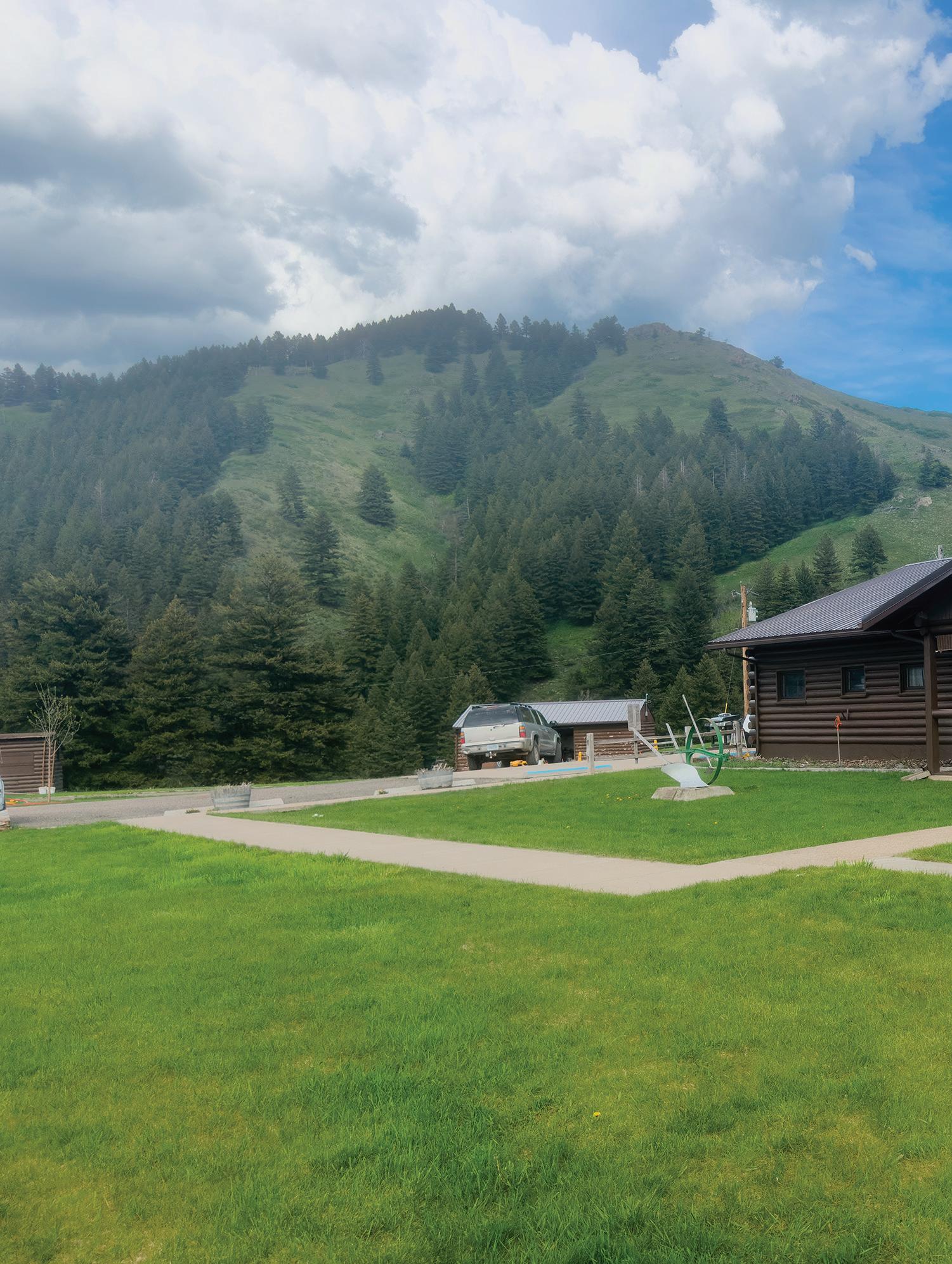
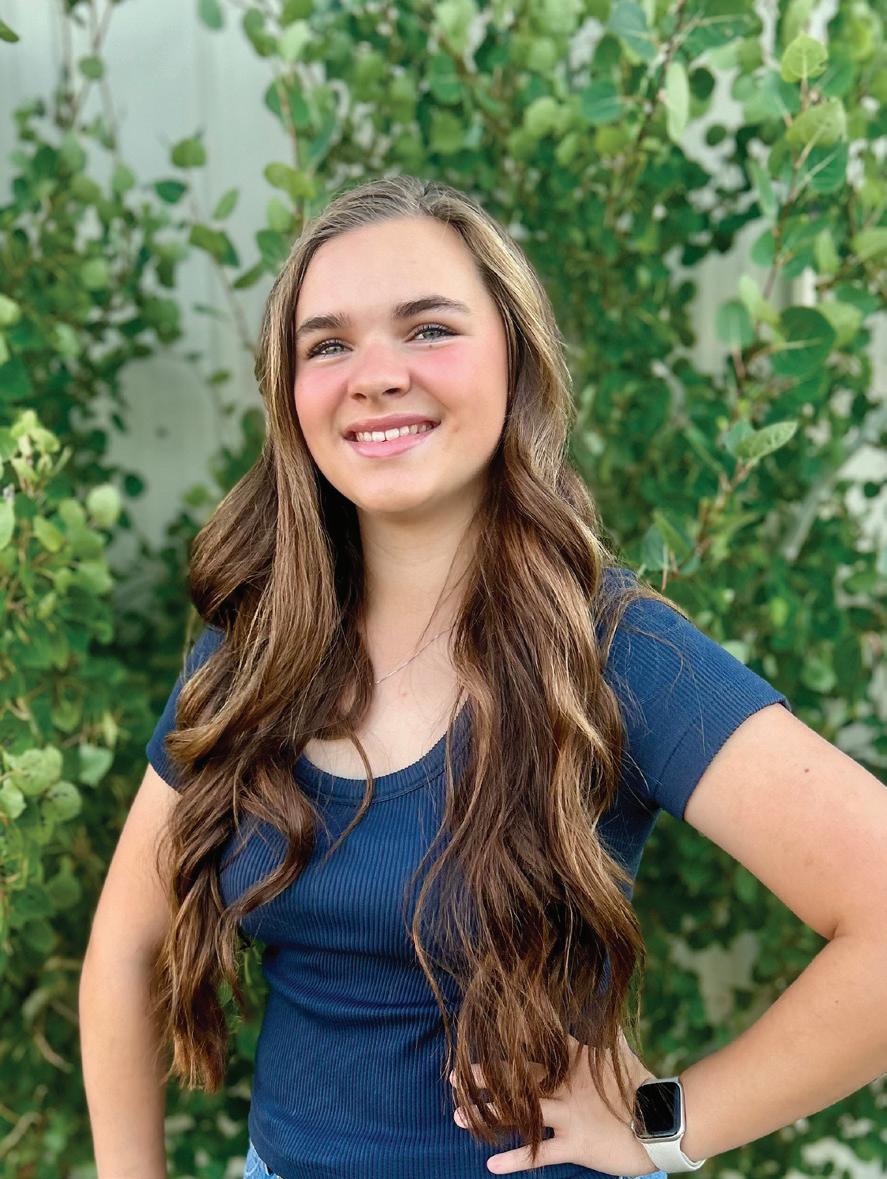
Mason Anderson
Grade- 10th
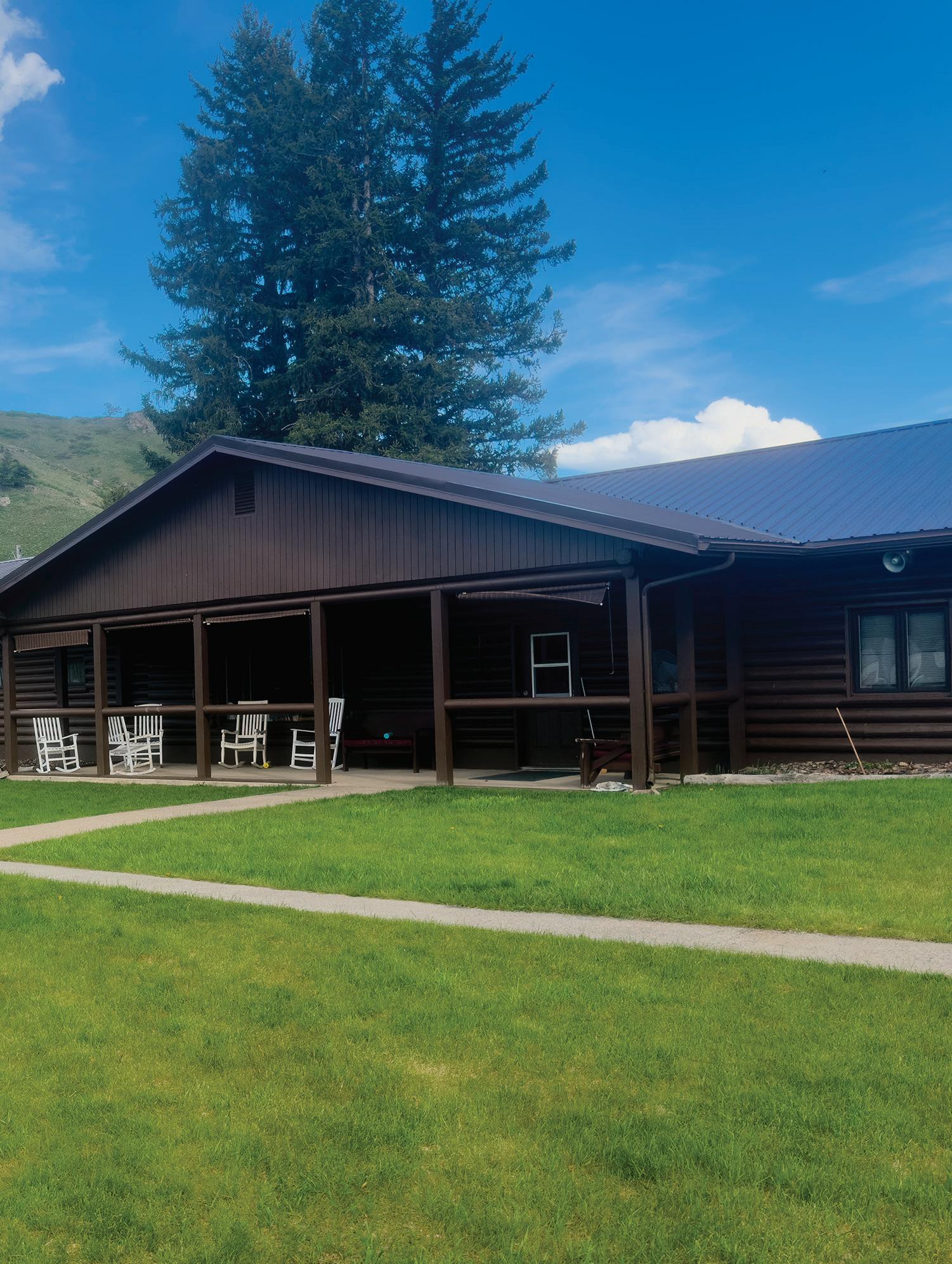
Harper Pieper
Grade- 9th
School- Cascade Public Schools
Favorite camp memory- Dancing
Future plans- Mercy Flight pilot


School- Frenchtown High School
Favorite camp memory- Dancing Future plans- Attend college

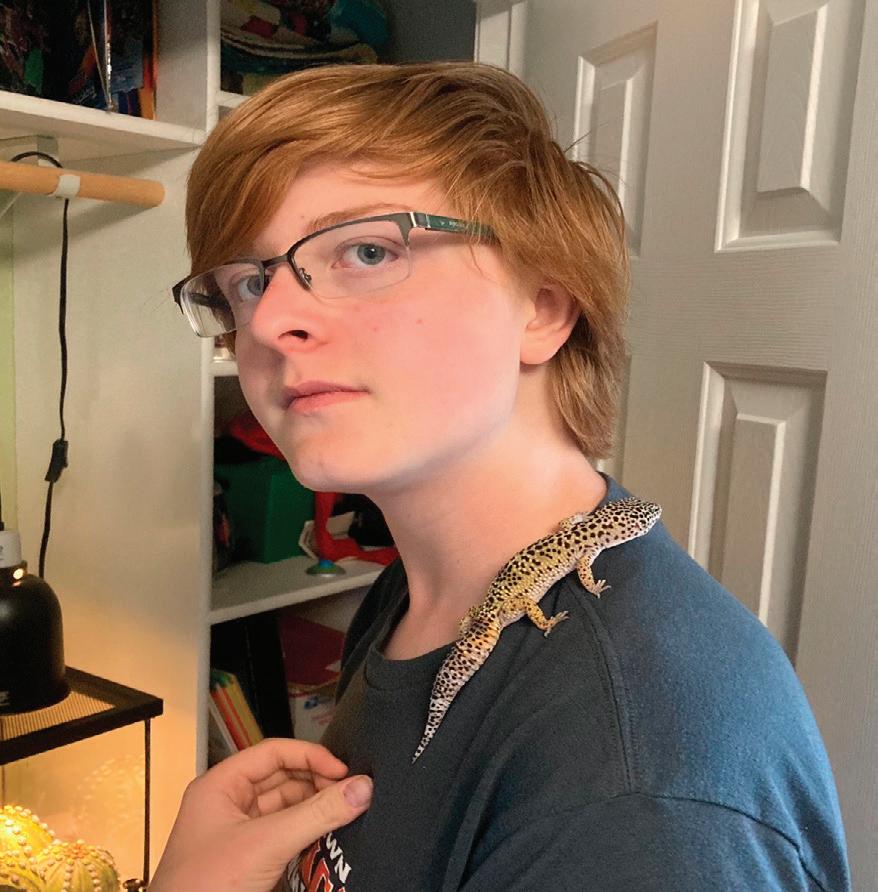
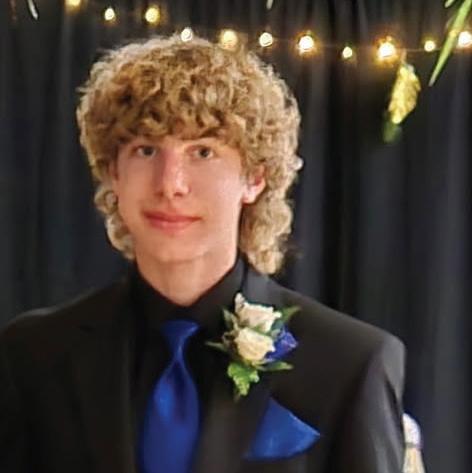


Colter Han
Grade- 10th
School- Big Sandy
Favorite camp memory- Dancing
Future plans- Attend college for agriculture engineering and work at the family farm


Marsha A. Goetting, Ph.D., CFP®, MSU Extension Family Economics Specialist
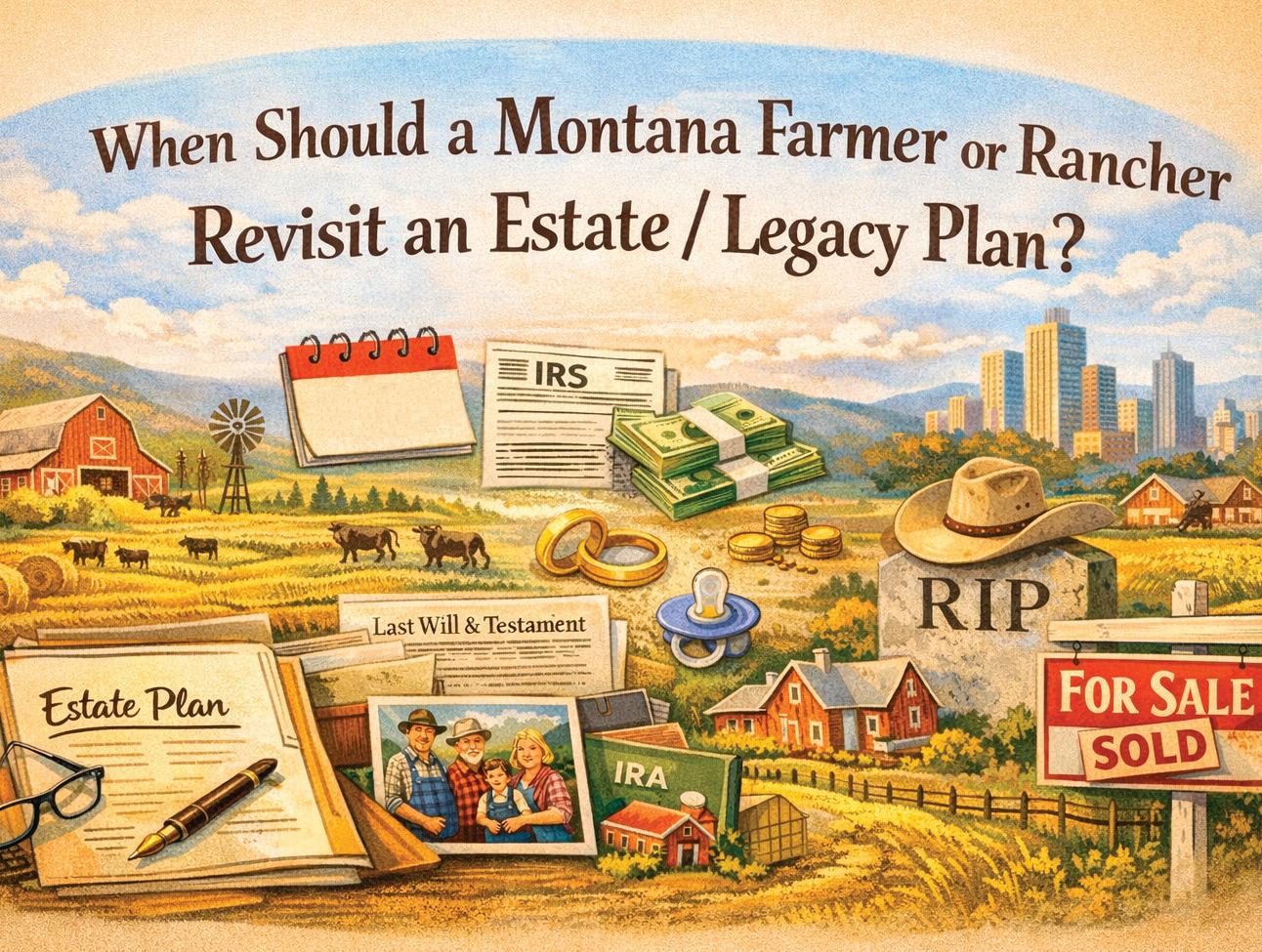
Running a Montana farm or ranch means rolling with whatever the year brings—drought cycles with wildfires, good calf crops, a tough hay season, land coming up for sale next door, or a family member deciding to come back to the place. Those same changes that shape the operation can also throw your estate/legacy plan out of line. A plan that fit with your operation ten or fifteen years ago may not be ideal after a big land purchase, new grandkids, death of a family member or major federal estate/ legacy tax changes.
Here are the clearest signs it’s time to dust off that estate/legacy plan and make sure it still does what you want, especially with the big federal changes brought by the One Big Beautiful Bill Act.
Federal estate/legacy tax laws have changed—and they matter for ag families.
Federal estate/legacy and gift tax rules drive planning for Montana producers simply because land values have climbed. Many family places now carry higher appraised values than folks realize. Back in 2018, Public Law 115 97 doubled the federal estate and gift tax exemption, but that increase was set to drop at the end of 2025. The IRS later confirmed through Treasury Decision 9884 that gifts made under the higher exemption wouldn’t be clawed back after 2025—even if the exemption dropped.
Then came the One Big Beautiful Bill Act (OBBBA) in 2025, which canceled that expiration and permanently set the exemption at $15 million per person starting January 1, 2026, and thereafter indexed for inflation. That means married couples have an exemption of $30 million.
For Montana families with appreciating rangeland or irrigated hay ground, this matters.Your plan may have been written assuming a much lower exemption, which could change the way assets flow to your spouse, kids, or grandkids. If your will or trust uses an old “formula clause” tied to now outdated exemption numbers, have it checked by an attorney or CPA, so it won’t create surprises for your survivors.
IRA Retirement accounts now follow new 10 year rules.
Many ranch and farm families have built up IRAs. Under the SECURE Act, most non-spouse heirs must now empty inherited IRAs within 10 years. Final IRS rules require annual RMDs during those 10 years that started in 2025.
For an heir helping run cows, haying, or keeping the place afloat, those required withdrawals could affect income taxes and cash flow. Make sure your beneficiary designations and any trust set up to receive an IRA still work under the new distribution rules.
You’ve changed how the ranch or farm is structured
Montana operations often use LLCs, S Corps, or partnerships—not just for tax reasons, but to organize ownership between generations. Any changes to leases, partnership interests, crop share arrangements, or the operating entity can affect eligibility for §2032A special use valuation, which lets heirs value farmland at agricultural use instead of development value. The IRS updates the interest rate factors used in this calculation annually. Estimated benchmarks for Montana range from 4.83% to 5.78%.
This valuation can be the difference between heirs keeping the ranch or having to sell acres to pay the federal estate tax. If you shift management to the next generation, be sure the IRS would agree that “material participation” by the older generation operator is happening. The person needs to make decisions, not just sign checks.
You bought or sold land—or watched prices jump.
It’s no secret that Montana land prices have risen sharply in many counties. Buying a neighbor’s pasture, selling a field, entering a conservation easement, or watching land values spike can dramatically shift your estate/legacy picture. It can also make it harder to keep things “fair” between ranching and non ranching heirs. After any land deal—big or small—revisit how your plan divides assets and whether it still makes sense.
Family milestones—marriages, divorces, births, and kids returning to the operation.
Every family change affects the estate/legacy plan. Perhaps a daughter comes home to help run the cows, or a son and daughterin-law decide ranch life isn’t for them after all. Maybe there’s an unexpected divorce that affects how assets pass. These are all reasons for revising your documents to see if they need updated.
And don’t forget portability, which allows a surviving spouse to use a deceased spouse’s unused federal exemption—but only if a timely Form 706 is filed, even when no tax is due. File the return. It’s cheap insurance for your family.
The passing of a family member, whether a spouse, sibling, or child—almost always means the estate/legacy plan needs to be updated. On a working ranch, the loss of someone who managed irrigation, calving, books, or decisions can completely change who should inherit what and who’s capable of running the operation. It can also trigger the deadline for filing Form 706 to preserve portability for a surviving spouse.
After a death, confirm who the decision makers are, whether beneficiaries need updating, and whether leadership of the operation has shifted.
Montana doesn’t have its own estate or inheritance tax—but planning still matters.
Montana hasn’t had a state inheritance tax since 2001 or an estate tax since 2004. This is good news for families wanting to keep land together. But federal estate and gift taxes, family dynamics, and land values still make estate/legacy planning essential.
Keeping an estate/legacy plan updated is like staying ahead of your fences or your water. It’s a whole lot easier to fix things now than after they’ve gotten away from you. A yearly or every other year checking with your attorney and CPA to determine the impact of new federal or state laws on your estate/legacy plan can help make sure the ranch or farm stays in the family and out of court or out of a forced sale to pay taxes.

































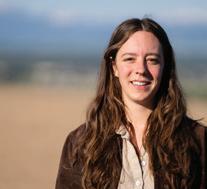
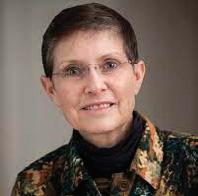
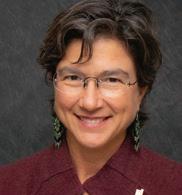
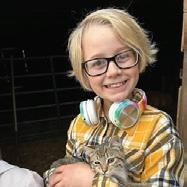

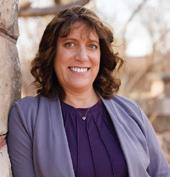

Ali Moxley is a food and agriculture-focused freelance journalist and grant writer based in Bozeman. She centers farmer perspectives, equity issues, and environmental stewardship in her writing. She has a master‘s degree in Sustainable Food Systems from Montana State University.
Dr. Marsha Goetting is a Professor and Extension Family Economics Specialist at Montana State University in Bozeman. During the COVID years, 2020 through 2022, her virtual seminars reached more than 13,450 Montanans and another 7,140 during 2023. She received the Iowa State University Alumni Achievement Award in 2020 and the AARP Community Partner Award in 2021. In 2023 she received the Distinguished Service Ruby Award from Epsilon Sigma Phi, an Extension Honorary. Dr. Goetting is a member of the Montana Alzheimer’s and Related Dementia’s Coalition and has been appointed to the Montana Supreme Court Commission on Continuing Legal Education
Jasmine Krotkov is a Master Gardener with decades of experience designing and installing chinook zone gardens. She grows fruits and vegetables at elevation, where the growing season is short and the deer are hungry. She has taken time out from gardening to work as an advocate publicly for peace and a clean and healthful environment.


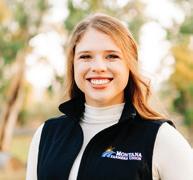
Avery Rambo is growing up in an agricultural family north of Gildford, where farming, ranching, and strong rural community ties have shaped her life from the very beginning.Through Farmers Union Camp and Hill County 4-H—where she raises goats with her sister—Avery has developed lasting friendships and a passion for agriculture and sharing its importance with others.
Bella Folino is the Government Affairs & Outreach Coordinator at MFU. Originally from Pennsylvania, she joined MFU through the AmeriCorps program as an agricultural educator. She studied professional writing and literary analysis with minors in environmental science and psychology for her undergraduate degree. She looks forward to combining her passions for writing and the environment to advocate for next generations.

Jodi Koterba is the Education Director and an Ambassador for Montana Farmers Union, developing curriculum, workshops, articles, and the Lunch & Learn Podcast to educate the public in and about agriculture. Koterba retired after 29 years of teaching high school agriculture and advising FFA chapters. Two agriculture curriculums written by her are currently sold nationwide.
Alice Miller is a Public Relations Manager with Montana Farmers Union and also serves as an MFU Magazine Co-Editor. Originally from the East Coast, she roamed The West as a newspaper reporter before settling down on her husband’s Hi-Line family farm and ranch, where they raise small grains, pulses, oil seeds, and Simmental Cattle.
Heather Link, the Communications Director at Montana Farmers Union, is also a Co-Editor and responsible for the layout and design of MFU Magazine. She holds a bachelor’s degree and over 20 years of marketing and design experience. Growing up, she visited her family’s farm on the Hi-Line, which is 110 years old and still operates today. She is married with two children and resides in Great Falls.

Rachel Prevost is the Executive Director at Montana Farmers Union. Prevost grew up on her family’s farm and ranch in Northeastern Montana and was a 10-year member of 4-H and 5-year member of Montana FFA. Prevost studied Political Science, Communication Studies, and Public Relations for her undergraduate degrees and cares deeply about the vitality of our rural communities and the sustainability of family farms for generations to come.