V O L U M E 2 7
SEPTEMBER 2017
M O N TA N A
GRASS ROOTS F E E D I N G T H E F U T U R E T H R O U G H F A R M E R S U N I O N E D U C AT I O N A P U B L I C AT I O N B Y M O N TA N A F A R M E R S U N I O N
IN THIS EDITION: 2 0 1 7 C onve n t i o n P rev i ew PAG E 2 F a r m e rs U n i o n Donates to C o- o p PAG E 7 To u r o f iH e mp F arm D e liver s Val u a b l e I n fo r mat i on PAG E 1 0
PAID
GREAT FALLS, MT PERMIT NO. 93
NONPROFIT ORG US POSTAGE
IN THIS ISSUE.... PAGE 5 & 6 MFU Sponsors Solar Tour & Ag Technology Seminar
PAGE 7 Sneak Peek of the 2017 Producers Conference
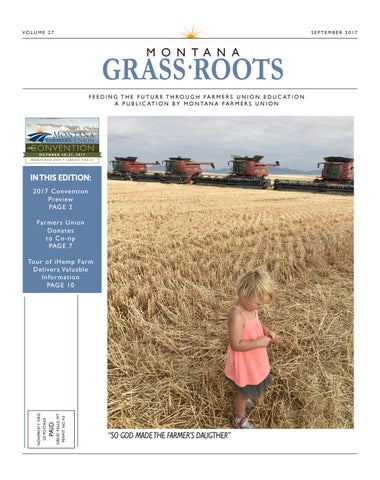
“SO GOD MADE THE FARMER’S DAUGTHER”
PAGE 8 2017 Arrowpeak Camp theme revealed!
V O L U M E 2 7
SEPTEMBER 2017
Join us for the 2017 Annual Montana Farmers Union Convention! This year’s convention will include releveant and timely workshops for producers on soil health, accessiblity to rural healthcare, the Farm Bill and more! Adult registration by October 16 is $100. Adult registration after this date is $125. Youth registration (under the age of 15) is $50 by the October deadline. After this date youth registration is $60. Daily registration is available for $20 and meal tickets can also be purchased. MFU does have a special hotel rate for convention attendees at the Best Western Heritage Inn. Please contact the hotel directly to make reservations. Online Registration opens September 1. Visit montanafarmersunion.com for a complete event agenda and to register!
EVENT SPEAKERS:
Dean Folkvord Wheat Montana
Parker Sebens
Jim Richardson National Geographic
MFU Convention Mixer: Join us for a new member mixer at the Celtic Cowboy Friday night of the convention from 5:15-6:15. Transportation from the Heritage Inn will be provided.
Rebecca Knotts Wildwood Floral
For the price of becoming a member($50) an attendee gets a membership, conference registration and two nights at the Best Western Heritage Inn. Members who recruit a new member(s) who attend the mixer will receive a Yeti Tumbler! Space is limited. Call the MFU office for details! 2
V O L U M E 2 7
SEPTEMBER 2017
IN THIS ISSUE
WELCOME NEW MEMBERS!! Member
Jesse & Stephanie Benson, Malta Sidney Simonsen, Hinsdale Jess Cunningham, Hysham Floyd & Valerie Gabel, Miles City Timothy & Dani Hudson, Fallon Graham MT Ranch Inc., Broadus Harms Livestock, Livingston Margaret Munroe, Miles City Harvey Whipps, Miles City Milo & Karen Stangeland, Brockton J D & Kami Stensland, Wolf Point Barbara Newman, Tacoma WA Mizpah Rangeland LLC, Belgrade Bob & Kelly Meadows, Emigrant Lois Saier, Ennis Joe & Sherida Bullis, Billings Wallila Corp, Laurel Curtis & Michelle Brubaker, Joliet Austin Pitsch, Hardin Ike Shaw, Worden Stimpson Land & Livestock Inc., Lodge Grass L & F Ranch, Whitefish Van Horn Ranch Company, Conrad Mabel Barritt, Fairfield D’Arlene Hilt, Power Norman & Judy Kamrud, Choteau Ian & Yve Bardwell, Choteau Jerry & Carol Patterson, Anaconda Sherrie Smith, Sand Coulee Stephen & Linda Bodick, Kalispell Richard Beem, Missoula Juanita Evans, Libby Belinda Orem, La-Canada, CA Stacey & Marilyn Auch, Hamilton James & Deborah Jones, Three Forks J Todd Loomis, Billings Yvette Klucewich, Thompson Falls Clarence & Ludmilla Koger, St Ignatius Lisa Wheeler, St Ignatius Teresa & Rhett Rigby, Drummond Carl & Sharon Bolick, Corvallis Dirk Elings, Conrad Stephen Thomas, Victor Lois Phillips, Great Falls Lynn Johnson, Great Falls Brent & Lynette Souther, Lakewood CO
Message from the President: Fly-In’s Top Issues Page 4
Recruited by Shane Anderson Del Hansen Ron Watts Ron Watts Ron Watts Ron Watts Ron Watts Ron Watts Ron Watts Jesse Fleming Jesse Fleming Jim Mathews Jim Mathews Daryl Hansen Craig Parker Dallas Hagfeldt Jr. Dallas Hagfeldt Jr. Wes Schwend Melissa Wacker Melissa Wacker Melissa Wacker
Unity Comes Out of Tragedy, Justin Loch Page 5
PO BOX 2447 300 RIVER DRIVE NORTH GREAT FALLS MT 59403 PHONE: (406) 452-6406 1-800-234-4071 FAX: (406) 727-8216 mfu@montanafarmersunion.com www.montanafarmersunion.com Board of Directors:
Time to Register for the 2017 Annual Convention! Page 6 Donation to Co-Op Helps Producers Replace Fencing Lost to Fire Page 7 Soil Health After the Fire/ Clain Jones & Kathrin OlsonRutz of MSU Page 8 Bangs Family Featured in Video Showcasing 2018 Farm Bill Page 9
Dirk Elings Dirk Elings Mathew Luedtke Mathew Luedtke Mathew Luedtke Mathew Luedtke Stefanie Thompson Scott Walsh Rial Gunlikson Sally Miller Colleen Wood Charles Monroe Bryan Jones Art Hoffart Art Hoffart Andrew Luedtke Andrew Luedtke
iHemp Tour Shows Status of Montana Pilot Program Page 10 How Weather Affects Production Chris Christieans Page 11
Alan Merrill, President Rollie Schlepp, Vice President, Conrad Erik Somerfeld, District 2, Power Bill Courtnage, At-Large director, Geraldine Brett Dailey, District 4, Jordan William Downs, District 5, Molt Ben Peterson, At-Large director, Judith Gap Kelly Rutledge, District 1, Big Sandy Sig Rudie, Fairview, At-Large director Paul Kanning, Distric 5, Flaxville Jan Tusick, District 6, Ronan State Office Staff: Jan Johnson, Office Mgr., Assistant Secretary/ Treasurer Lyndsay Bruno, Communications Director Chris Christiaens, Legislative & Project Specialist Justin Loch, Membership Director Dave Snuggs, Facility Director Violet Green, Education Coordinator Maggie Shane, Continuing Education Coordinator Copyright © Montana Farmers Union, 2016. Montana Grassroots is the official publication of the Farmers Educational and Cooperative Union of America, Montana Division. MFU reserves the right to reject any advertisements. Third Class bulk postage paid at Great Falls MT 59401. Membership: $50.00 per year Montana Grassroots is published 10 times each calendar year with two combined issues. Article submissions are requested by the 15th of the month. Advertising space is available. Copy Editor: Jan Johnson Editor/Designer: Lyndsay Bruno
Washington Corner Page 12-13
ABOUT THE COVER: CONGRATULATIONS TO THE 1ST PLACE WINNER OF OUR HARVEST PHOTO CONTEST JENNIFER BIRKELAND OF Message from the Montana FORT BENTON! JENNIFER’S PICTURE IS ON THE COVER. IN ADDITION SHE WILL Delegation RECEIVE A VISA GIFT CARD! Page 14
Andrew Luedtke Andre Marcure Judy Siring MFU MFU MFU MFU
MONTANA FARMERS UNION
What’s New in Education? Page 15
Office Lodge Lodge Lodge
3
SECOND PLACE GOES TO KRISTEN OSTBERG WHO WILL ALSO RECEIVE A GIFT CARD AND WHOSE PHOTO WILL BE FEATURED IN THE OCTOBER EDITION OF MONTANA GRASS ROOTS. CONGRATULATIONS AND THANK YOU FOR SHARING YOUR PHOTOS!
V O L U M E 2 7
SEPTEMBER 2017
MESSAGE FROM THE PRESIDENT
The second issue that will be discussed at the Fly-In is access to healthcare. Medicaid expansion has worked well. We need a strong Medicaid program to ensure the viability of rural hospitals. It is a fact that patients from rural communities enroll in the program at higher rates than their urban counterparts. In addition, we need protections for individuals with pre-existing conditions. Two-thirds of farmers and ranchers have pre-existing conditions. We need to improve the affordability, accessibility and quality of health care. Finally as a delegation we will talk about a transition to a homegrown renewable energy future for the U.S. In order for the United States to realize the full potential of the renewable energy sector we must promote a cleaner and higher blended ethanol and advanced bio-based fuels that includes Ethanol(E30). This switch will clean up our air and benefit farming and rural communities by offering environmental benefits and additional value for farm byproducts.
It is well known that clean burning fuels cut down on greenhouse gas emissions which in turn help the environment. By transitioning The National Farmers Union annual Fly-In is to a higher blend of E30 farmers would have September 11-13 in Washington D.C. Mon- expanded markets for their crops and bio tana has a delegation that will not only visit based products. This is a particular advantage our congressional delegation, but also our during low farm prices that continue to push neighboring states’ representatives. We have the national farm economy down. three issues of which we will lobby for: a strong farm safety net; access to affordable, We will ask for continued support for Renewquality healthcare and a transition to a home- able Fuel Standards and to eliminate barrigrown renewable energy future. ers to higher-blended ethanol and advanced biofuels. I look forward, along with our MFU In, Montana we are suffering through a se- delegation, to present these three top issues vere drought and low commodity prices. In that the National Farmers Union Board of regards to the first point of safety nets, we Directors came up with for this year’s Fly-In. need to protect crop insurance which is an essential management tool for farmers who suffer crop loss or loss of revenue. We need to Running for re-election maintain the Farm Service Agency loan portfolios and make sure there is emergency fund- I would like to officially announce my intent ing for farmers that need the loans. We also to run for the office of president. It has been need a strong mediation program for farmers a pleasure to serve you, the members. I kindly struggling to meet their financial obligation ask for your vote once again. With your blessto their lender. ing I will continue to fight for the best interests of family farms in Montana!
Fly-In
4
Exciting news in education! I am pleased to announce the hiring of Violet Green as Education Coordinator. In this capacity Violet will lead Arrowpeak Camp, the women’s conference and other education efforts. Congratulations Violet!
Youth Leadership Development Program: Kaylen Lehner, FU Insurance Circle Tom McKenna, FU Insurance Lewistown Charles Monroe FU Insurance, Kalispell
Thank you to the following Business Boosters! K’s Supermarket Stanford Marra, Evenson & Bell, PC Great Falls
Montana Farmers Union Sponsors V O L U M E 2 7
SEPTEMBER 2017
IN TIMES OF NEED THE AGRICULTURE COMMUNITY SHINES the fire and begin picking up the pieces.
BY JUSTIN LOCH M E M B E R S H I P D I R E C TO R
The world of Agriculture has its ups and downs for sure. However, there truly is no profession where you will find a group of people that support and help each other out in a time of need, than agriculture. Most of the state of Montana is fully aware of the recent wildfire around Jordan, MT. The fire burned thousands of acres, wiped out miles of fence, displaced cattle, burned homes and barns and took the lives of livestock. During this time of crisis families, neighbors, friends and communities came together to help each other out. Many brought their own vehicles, equipment and other resources to help try and distinguish the fire and limit its destruction. No family’s assets were more important than any others. They all banded together where the most critical help was needed at the time. Many people worked on very little sleep to try and save as much as they could. While some fought the fire others collected food, water, clothing and other resources to help those fighting the fire. As a result of a mass effort and some help from outside resources the Jordan community was able to stabilize
producers. Fences will be rebuilt and grass will regrow. Cattle will come back to the land, but the The call for help was heard near memories and gratitude that Ag and far. Numerous people donat- producers showed during the Jored money to help rebuild fence, dan area fire will last a lifetime. homes, and supply hay. Many After an event like this I am recame to help in the rebuilding ef- minded why I love being involved forts to help get fences back up in agriculture. People help each and round up cattle that had been other much like a family would pushed forced out due to the fire. help their own. A person’s own It’s never easy to move on after issues or struggles are put aside a disaster, but with the work and while they work to help out a felefforts of many the areas affected low producer. by the fire are beginning to rebuild. At the end of the day they just want to do what’s right and help It’s amazing how people in agri- another producer work another culture truly are at a time when day in agriculture. If what happrices are not great, drought, and pened by producers, community, limited hay production in some and the rest of the Ag world in areas producers come together the region banding together durand forget about themselves to ing the Jordan are fire doesn’t help a fellow farmer or rancher make you feel good about the out. Some took equipment which people involved in Ag, nothing is vital to their operation and lit- will. Hats off to all of those who erally ran it non-stop or until it helped others in need. Good luck could go no more to try and keep to those picking up the pieces and the fire at bay. Other producers plowing forward. I hope there are donated the precious commodity brighter days ahead. of hay. Hay came for all over the region to help ranchers in Jor- The resiliency of Montana Agdan and the area out. I even got riculture is truly showcased in a call from a dairy in Wisconsin times of challenge. There are nuwho was a fellow Farmers Union merous instances where the agrimember who wanted to donate culture world comes to the aid of hay and how to get it to Jordan. others in need. This was just another time where producers and On my way home from a recent supporters of agriculture shined. trip to Billings, I passed numerous semi- trucks with hay headed If you or someone you know is to help. The response to need has interested in helping out the probeen incredible and not just with ducers in Jordan please contact hay. Montana Farmers Union the MFU office and we can help along with FUE states North assist you. Dakota, South Dakota, Wisconsin, and Minnesota put together $25,000 to help producers with EQIP: A TOOL TO fencing supplies. The money was IMPLEMENT YOUR sent to the Farmers Union Oil Co. CONSERVATION where producers could get assistance. Numerous others outside PLAN of Farmers Union have joined B Y L O R I V A L A D E Z in this effort as well, with some N AT U R A L R E S O U R C E S C O N S E R V AT I O N S E R V I C E groups even providing labor to S TAT E P U B L I C A F F A I R S S P E C I A L I S T 5
Montana agricultural producers have used financial assistance through the Environmental Quality Incentives Program (EQIP) since 1996 to help them implement practices outlined in conservation plans they developed with the assistance of the USDA Natural Resources Conservation Service. EQIP is a voluntary program that provides technical and financial assistance to implement conservation practices to improve soil, water, plant, animal, air, and related resources on agricultural land and non-industrial private forestland. Applications for EQIP are accepted on a continuous basis, however, NRCS establishes application acceptance or submission deadline dates for evaluation and ranking of eligible applications. Contracts are awarded to producers with the highest rankings until funds are exhausted. How EQIP Works Payments are made on completed practices or activities identified in an EQIP contract that meet NRCS standards. Payment rates are set each fiscal year and are attached to the EQIP contract when it is approved. Payment rates for each conservation practice can be found on the Montana NRCS website at www.mt.nrcs.usda.gov. Payments received by producers through EQIP contracts after February 7, 2014, may not exceed $450,000 for all EQIP contracts entered during the period 2014 to 2018. Application Periods May Differ by State. Those “batching period” dates are posted on the NRCS website at www.mt.nrcs. usda.gov. How to Apply For EQIP Complete EQIP Application at Your Local NRCS Field Office. Step-by-step assistance can be found at http://www.nrcs.usda. gov/getstarted.
V O L U M E 2 7
SEPTEMBER 2017
REGISTER TODAY FOR THE 102ND ANNUAL MEETING OF MONTANA FARMERS UNION BEST WESTERN HERITAGE INN, GREAT FALLS NAME________________________________________________________________
CHECK IF APPLICABLE:
SPOUSE_______________________________________________________________ MEMBER _____________ VISITOR ______________ YOUTH ((Names & Ages) : __________________
______________________
_______________________
ADDRESS_________________________________________________
CITY_________________________ STATE ___________
ZIP CODE___________
Registration fee includes all meals on programs,, all breaks, the MFU Insurance Reception, and the Members’ Montana Food Banquet & Friday night entertainment. Pre-Registration by October 16
Cost
x
# Registering = ____________ (Total)
Per Adult
$100
x
__________
_________
Per Youth (15 yrs & under) $50 x ___________ + __________ Total Registration _____________ Registration After October 16
Cost
x
# Registering = ___________ (Total)
Per Adult
$125
x
__________
Per Youth ( 15 yrs & under)
$60
x
___________ + __________
Total Registration_____________
Daily Registration will be $20. Meal Tickets sold separately. Mail this form with payment to the MFU Office, PO Box 2447, Great Falls, MT 59403 or register online at: montanafarmersunion.com. A special room rate at the Heritage Inn is available for convention attendees. Please contact the hotel to make a reservation. 6
V O L U M E 2 7
SEPTEMBER 2017
Garfield County Rancher and MFU Board of Director Brett Dailey(left) presents a check for $25,000 to Farmers Union Oil Co. Manager Bob Wilson; Photo Courtesy Donna Dailey
FARMERS UNION ENTERPRISE STATES DONATE TO HELP IN WAKE OF FIRES B Y LY N D S AY B R U N O C O M M U N I C AT I O N S D I R E C T O R
To help the farmers and ranchers in Garfield County and surrounding areas Montana Farmers Union along with the four other Farmers Union Enterprise (FUE) states which include Minnesota, Wisconsin, North Dakota and South Dakota made a donation this week to the Farmers Union Oil Co-Op in Jordan, MT. Montana Farmers Union Board of Director, and Jordan rancher Brett Dailey, presented the manager of the co-op Bob Wilson with a check for $25,000. The donation will go to replace fencing lost to the fire. Farmers or ranchers interested in receiving fencing compliments of FUE should contact the co-op directly. Donations are on a first come, first serve basis. “Montana Farmers Union is a great organization to try to help get things back in operation,” said Wilson. ”We certainly appreciate the support.” Wilson said it’s going to be a challenge to get all the fencing up, but said relatives are coming from all over to help get
Garfield County rancher Brett Dailey looks over the destruction left by the Lodgepole Fire; Photo courtesy Donna Dailey
the process started.Montana Farmers Union President Alan Merrill said he is appreciative of the partner states for stepping up. “Farmers Union is a family, we all help each other in times of need,” said Merrill. “We know it will be a process to rebuild for the residents of Garfield County, but are confident in their ability. Montana farmers and ranchers are strong, resilient and with the help of neighbors will come out stronger than before.” Dailey’s ranch is located west of Jordan and was mostly spared by the fire with the exception of a smaller pasture he uses to grazes yearlings. He said the support has been overwhelming. “It’s neighbors helping neighbors here,” said Dailey. “We thought a perfect solution to help the county was to donate to the local co-op as Montana Farmers Union was formed on this principle.” According to Wilson in Garfield County and 7
the surrounding areas cattle, sheep and wheat are the primary sources of income for producers. He also said some farmers are now experimenting with peas and dryland corn. One advantage Wilson said the ranchers have is the ability to keep livestock on their land rather than transporting to a feedlot. He said this is thanks in part to the overwhelming donations of hay from across the region.
V O L U M E 2 7
SEPTEMBER 2017
FIRE EFFECT ON SOIL NUTRIENTS AND SOIL PROPERTIES B Y C L A I N J O N E S , M S U S O I L F E RT I L I T Y E X T E N S I O N S P E C I A L I S T A N D K AT H R I N O L S O N - R U T Z , R E S E A R C H A S S O C I AT E , M S U L A N D R E S O U R C E S A N D E N V I R O N M E N TA L S C I E N C E S
Hundreds of thousands of acres of forest, rangeland and cropland have sadly gone up in smoke this summer in Montana. In addition to the devastating effect on personal property, human health and safety, and direct loss of crops and livestock, fire can affect soil properties and soil nutrients. The impact is highly dependent on the fire intensity/duration and the proportion of plant material that is burned. Timber and shrubs will burn hotter and longer with greater impact than rangeor crop land. Fast moving grass fires do not transfer as much heat to the soil or soil organisms, and have minimal impact on soil nutrients and soil health compared to slow moving, intense fires in moderate to heavy fuels. The fire-soil nutrient relationship is complicated, but in general, fires release a flush of plant available nutrients in the short term, and redistribute nutrients through the soil profile. Soil fertility can increase after low intensity fires since fire converts nutrients bound in litter and plants to more plant available forms. This is especially true for nitrogen. However, even with low intensity fires, a portion of nitrogen, sulfur and carbon are lost to the air Although these losses are not trivial and are similar to removal by harvest and losses to wind erosion, they are small compared to the average pool of nutrients in the top six inches of soil. Nitrogen can additionally be lost through nitrate leaching, as the burned plant matter creates a large pool of nitrate and few active plant roots are left to take up either the nitrate or soil water. This can have a long term impact on the productivity of forest and rangeland ecosystems, but can be minimized or remediated on croplands. The other nutrients such as phosphorus, potassium, magnesium, zinc and manganese are more stable and not lost directly through combustion, but rather through blowing ash, and post-fire soil erosion.
Lodgepole Complex Fire; Jordan; Photo courtesy of Donna Dailey
Cropland fires rarely burn hot enough to affect soil organic matter. The bigger concern is loss of surface plant residue, which is very important to reduce wind erosion, and protect against the physical sealing impact of raindrops. Ash particles also contribute to reduced water infiltration as they plug soil pores. All these factors increase the risk of water runoff and soil erosion.
minerals. The depth and thickness of this layer can vary greatly, and it can affect infiltration for several months to a year or longer. This layer should not form on grassland or stubble fires.
Fire kills bacteria and fungi at the soil surface but these microbes rapidly recolonize from deeper soil layers, except in severe fires where the soil is sterilized several inches deep. MiForest and shrubland fires can burn soil or- crobial activity can actually increase with the ganic matter, causing a larger reduction in the flush of nutrients available after a fire. Howpool of nutrients in the soil and reducing soil ever, new input of plant material is important aeration and water infiltration/retention. The to sustain their populations. Fungi are affectstore of nutrients is not only directly lost, but ed more than bacteria. Drought conditions soil organic matter provides parking spaces to before a fire can foster microbial adaptations hold nutrients in the soil, also known as the and fungal spore formation, both of which soil's cation exchange capacity. Without this help them survive fires. holding capacity, nutrients available in the ash or coming from fertilizers are more likely to Post-fire management includes soil testing to be lost. determine nutrient availability, and establishing ground cover where possible. Test for niIn addition, forest and shrubland fires can cre- trogen, phosphorus, and potassium to calcuate a water repellent layer within the top two late the next crop fertilizer needs. inches of soil that comes from compounds in the burnt litter, coating soil aggregates or C O N T I N U E D N E X T PA G E 8
V O L U M E 2 7
SEPTEMBER 2017
VIDEO ON 2018 FARM BILL HIGHLIGHTS MONTANA AGRICULTURE
Jeff talked about farm payment programs including the Agriculture Risk Coverage (ARC) and the Price Loss Coverage (PLC). He also discussed the importance of conservation programs in helping producers be good stewards of the land. “Tools that we can use is crop insurance, we have to have that baseline of revenue coverage, no one is making money on crop insurance but it helps prevent loss of the entire operation.” Jeff also touched on the important link agriculture has to rural development. “It’s the driving force in this area and the land is our main resource so you need family farmers to utilize those resources to the best of their ability,” said Jeff. “We serve on boards we serve on committees we are involved in things, but have also taken a role in Farmers Union and to help farm policy. We try to be involved and try to keep our business local and patronize local co-ops, chemical stores and fertilizer companies. We try to keep our communities vibrant as much as we can.” The video is expected to be completed this fall. A big thank you to Jeff and Katie Bangs for helping tell the story of Montana agriculture by participating in this video!
A videographer interviews Jeff Bangs on his family’s ranch near Inverness.
The 2014 Farm Bill is set to expire in September of 2018. Farmers Union Enterprise which includes Montana, South Dakota, North Dakota, Minnesota and Wisconsin Farmers Union and other Farmers Union states in coordination with National Farmers Union are partnering to produce a 5-7 minute video to educate producers and consumers on the 2018 Farm Bill. The video is being filmed and produced by videographer Louie Fisher and will tell the story of agriculture through the eyes of producers in each state and their hopes for the next Farm Bill.
traveling across the country this month to interview family farmers and their communities for the film, which will be released this fall. As Congress begins deliberations on the 2018 Farm Bill and attacks to Farm Bill programs mount, Farmers Union will be out front, taking the lead on building support for a Farm Bill that provides an adequate safety net for family farmers and consumers alike."
The featured Montana couple is Jeff and Katie Bangs of Inverness. The Bangs Farm is a third generation farm and ranch with a concentration on wheat and cattle. Jeff and Katie National Farmers Union President Roger are very active in Farmers Union, both repJohnson said it’s important for Farmers Union resenting the organization as delegates at the to led efforts to educate consumers and pro- national convention, being part of the Naducers on the legislation, which impacts us all. tional Farmers Union Fly-In in D.C. and were a Farmers Union Enterprise couple. “While the Farm Bill is important to all Americans, very few people outside of the agricul- Fisher came out to the Bangs’ Farm to film ture and nutrition communities understand its the segment on the Montana couple to highfar-reaching impact,”said Johnson.“Farmers light programs they see as a necessity to help Union is producing a Farm Bill video to bridge their operation succeed. that gap. Our film producer has been
9
FIRE EFFECT ON SOIL CONTINUED
Because drought preceded fire, it’s likely that many fields have nitrate that wasn’t used by crops this summer, so less nitrogen might be needed. When soil sampling burned fields be sure to select representative sites, avoid areas where there may have been a windrow, bale, or other high accumulation of straw or residue. Spreading manure can be very beneficial but this is rarely available or reasonable at large scales. The MSU Soil Fertility Extension website http://landresources.montana.edu/soilfertility/ has several publications and presentations on soil testing and calculating fertilizer rates. Contact Clain Jones at clainj@montana. edu or 406-994-6076 if you have questions.
V O L U M E 2 7
TOUR OF INDUSTRIAL HEMP FARM HIGHLIGHTS EFFORTS OF GROWING PLANT IN THE TREASURE STATE
SEPTEMBER 2017
low and said the industry standard is 85 percent germination. According to Kostuik there are challenges with growing iHemp.
Fowley said there are 20 growers licensed under the current rules, with a total of 545 acres of iHemp planted in Montana.
“The fiber is quite strong which tana Department of Agriculture can tend to bind the combine durto sell the hemp. Through the ing harvest,” said Kostuik. “That In July three staff members from pilot program Montana can only is why the height of the plant is Montana Farmers Union attend- purchase hemp seed from the ap- so important. You can imagine if ed an Industrial Hemp tour held proved sources which are Canada the plant grows 8-10 feet it is that in Big Sandy at the farm of Bob and the European Union. much harder to harvest.” Quinn. Quinn is currently participating in the state’s Industrial HGI focuses on the develop- Ian Fowley with the Montana DeHemp Pilot Program. The growth ment of industrial hemp includ- partment of Agriculture talked of iHemp in Montana is just start- ing research and consultation on about the certification and reguing to take hold through the pilot hemp agronomy. Director of Op- lations of iHemp in the state. In program. Nearly a dozen growers erations Jeff Kostuik led the tour 2001 the state of Montana passed attended the tour to learn more talking about the three varieties legislation authorizing the proabout the potentials of the crop HGI works with that are planted duction of industrial hemp. and how to grow it. on the Quinn Farm. He also discussed the process of planting The crop may be grown in MonThe tour was hosted by the Ca- of iHemp, growth patterns and tana only through the Industrial nadian based company Hemp his personal experience growing Hemp Pilot Program. Fowley said Genetics International (HGI), hemp in Saskatoon. According the federal option came with the Quinn and the Montana Depart- to Kostuik ideally an iHemp crop 2014 Farm Bill which allows the ment of Agriculture. grows around 6 feet tall with 10- Montana Department of Agri12 plants per square foot. He rec- culture to hold a controlled subHGI has a contract with the Mon ommends seeding the crop shal- stance registration.
The 2017 application period for the Montana Industrial Hemp Pilot Program is currently closed.
B Y LY N D S AY B R U N O C O M M U N I C AT I O N S D I R E C T O R
MFU’s Justin Loch and Chris Christiaens learn about the process of growing iHemp during a tour of Bob Quinn’s farm in Big Sandy.
Those interested are encouraged to check with the department for future opportunities by visiting the department’s website at agr. mt.gov/Industrial-Hemp.
“THE FIBER IS QUITE STRONG WHICH CAN BIND THE COMBINE, THAT IS WHY HEIGHT IS SO IMPORTANT.”
HGI Director of Operations Jeff Kostuik talks about his experience farming iHemp in Cananda. 10
V O L U M E 2 7
SEPTEMBER 2017
WEATHER PATTERNS AFFECT PRODUCTION & PRODUCER NEEDS FOR NEXT FARM BILL
BY CHRIS CHRISTIAENS P R O J E C T S A N D L E G I S L AT I V E SPECIALIST
The past couple of months have been down-right brutal in Montana as we are in a severe drought stretching across the broad state of Montana. In early July, farmers and ranchers were searching for grazing acreage in the eastern part of the state as they were cutting grain crops for feed and hauling water for livestock. Hay will be a scarce commodity for much of the state and prices for what is available rise. Top this off with the fires that recently burned some 250,000 acres and leaving some 50,000 head of livestock without any forage. This disaster leaves an area resembling a former black and white movie scene. Some producers are still in the process of finding missing livestock and the total costs in loss are not completed. This fire along with some 17 other fires burning across the State were started in nearly every case by lightning strikes and many are still not controlled. The toll on fire fighting resources are extreme and nearly depleted in the DNRC and may necessitate a special session of the legislature in the near future. In the past FEMA disaster spending was available and amounted to $2.68 million in 2016. Recent
dead and will not come back as a fire with lower heat generally does with good rain fall in the efforts have not been accepted spring. It is also the norm that and our Congressional Delega- forage following a fire should be tion along with the Counties af- allowed to grow for two seasons fected and the State continue before grazing is permitted. to ask for help. As of this writing, help has not been obtained The changing weather patterns from the Federal Government. over the past few years have led While those affected struggle to producers to add diversity in move livestock to pastures, neigh- crops and may be the salvation bors and fellow Montanans have for many producers. As crop helped where able, as this what prices for commodities remain we do without being asked. on the low side some of the new crops may save many farms and Montana Farmers Union policy ranches. In the past carbon sehas included climate change con- questration has been discussed cerns since 2014 and reads “ Con- and perhaps should be included tinue climate change monitoring with some financial incentives and research to provide agricul- for a producer to impact emistural producers with the knowl- sion reduction in this manner. edge and ability to adapt to cli- MFU has held listening sessions mate change, and to reduce their concerning the next farm bill and environmental impact.” It would urges Congress to provide funds appear that some of the changes for research at the College of Agin weather have come to bear as riculture in Bozeman to address the west side of our State received crop and livestock breeding for earlier snows and due to fires in climate resiliency. There has been the mountains over the past few talk that the successful program years the forest canopy no lon- for livestock at Fort Keogh would ger exists, leading to an earlier close when in fact funding should snow melt and top soil moving be increased for the study of reinto storage reservoirs impacts silient husbandry and agronomic the amount of water stored. The programs. Rural development in smoke from the many fires has the USDA budget is slated for impacted most of the State and major cuts and recommendations severely impacts those with lung for cuts in FSA offices. These and breathing problems. programs and staffing have been the lifeline for rural Montana. Different parts of the State have This would include funds for bebeen affected with either crop ginning farmers, water programs, lands on the highline being so dry CDBG funding and the SNAP many crops did not come up or program with a cut of $191 bilthose living east of Great Falls lion over a ten year period. Some being so wet the crops could not 60% of the funds for children be seeded. Both situations qualify and the elderly come from this for disaster payments. Continu- last program and should it be ous cropping and producers prac- stripped from the next farm bill ticing projects building on soil legislation, it will be very difficult health has had a positive impact to get a farm bill passed. on maintaining soil moisture in an extended period of drought. Meanwhile harvesting, haying and Large BLM lands were impacted high temperatures continue as we with the Lodge Pole fires and may reach mid August with little or no have burned so hot that grass and moisture is in sight. other forage root systems may be
11
MFU TO ATTEND NATIONAL FARMERS UNION FLY-IN NFU will host 275 members in Washington, D.C., for the 2017 Fall Legislative Fly-In on September 10-13, 2017. MFU will be sending staff, membership representatives and board members to the Fly-In. During their time in Washington, members will be afforded the opportunity to hear from the U.S. Department of Agriculture, receive briefings from White House officials, U.S. Senate and House of Representatives Committees on Agriculture leadership and meet with their states’ congressional delegation. Representing Montana Farmers Union at the 2017 National Farmers Union Fly-In will be President Alan Merrill, Board of Director Jan Tusick, Board of Director Ben Peterson, Communications Director Lyndsay Bruno, MFU member Tom Clark of Fort Benton and members and Farmers Union Enterprise Couple Scott and Misty LeFurgey of Loma. Follow us on Facebook, Twitter & Instagram for updates from Washington D.C.!
ROGER JOHNSON TO KEYNOTE IN BILLINGS National Farmers Union President Roger Johnson will make a trip this Fall to the Treasure State to be a keynote speaker at the 2017 US Cattle Producers forum in Billings September 15-16 at the Big Horn Resort. The event is hosted by the United States Cattlemen’s Association. To register visit cattlemensmeeting.com or call 406.839.9300.
V O L U M E 2 7
SEPTEMBER 2017
Keep up with all things Fly-In on Facebook, Twitter and Instagram with the hashtag #NFUFlyIn17. For more information about future fly-in activities, please contact your state/regional Farmers Union office.
B Y RO G E R J O H N S O N PRESIDENT N AT I O N A L F A R M E R S U N I O N
During the August congressional recess, elected officials returned to their home districts and states and meet with constituents. To help Farmers Union members advocate on issues important to family farmers, NFU released its 2017 District Work Packet, a helpful resource on legislative issues that Congress may take up this year, including the farm bill, the farm economy, expansion of ethanol use, and health care. Those issues will also be addressed during our Fall Fly-In in September, during which hundreds of members will come to Washington, D.C., to speak with members of Congress. Read more in this month’s Washington Corner for a preview of some of the topics our members will be taking up with their representatives and for the latest news from Washington. 2017 Fall Fly-In NFU will host between 250-300 members in Washington, D.C., from September 10-13 for the 2017 Fall Legislative Fly-In. During their time in Washington, attendees will have the opportunity to hear from U.S. Department of Agriculture officials about current events, new opportunities, and work the department is doing on behalf of farmers. The most important agenda items of the flyin, however, are the meetings on Capitol Hill. Teams of Farmers Union members will stop by the office of every member of Congress to highlight the key priorities for the organization, struggles they are facing, and goals for future legislation and the 2018 Farm Bill.
NFU Advocates for Health Care While Congress spent the past several months deliberating the future of American health care, NFU was on the front lines, advocating for the right to accessible, affordable, and quality health care for all Americans. To this point, the proposed options would have only made matters worse for rural Americans. The House of Representatives’ American Health Care Act (AHCA), the Senate’s Better Care Reconciliation Act (BCRA), and a repeal-only option each would have caused millions of Americans to lose their coverage, prompted hefty premium hikes, and cut billions of dollars from Medicaid. Throughout the process, NFU ensured rural voices were heard. In late June, after the House passed the AHCA, NFU President Roger Johnson testified at a Senate health care hearing, reiterating his concern with the proposed legislation and underscoring the importance of health care to family farmers and ranchers and the communities in which they live. A vote on the BCRA was stalled until late July due to a lack of support. Then, after days of debate and amendments, a decisive vote on a so-called “skinny repeal” bill failed. While efforts to reform our health care system are stalled at the moment, the debate is expected to pick up again when Congress comes back into session in September. NFU will continue to promote a bipartisan solution that improves access to affordable, high quality care for family farmers, ranchers, and rural Americans.
official renegotiation of the North American Trade Agreement (NAFTA). In late July, the Trump Administration released its set of objectives for the renegotiation process. They outlined plans to modernize and strengthen the 23-year-old trade pact by decreasing the U.S. trade deficit, preventing currency manipulation, eliminating non-tariff barriers to U.S. agricultural exports, and strengthening enforcement. For the past 40 years, American trade negotiators have prioritized a “free trade” agenda over fair and balanced trade, leading to a massive trade deficit, corporate consolidation, lost jobs and lowered wages in rural communities across America. NFU is encouraged by the administration’s intent to address the fundamental flaws of free trade agreements, particularly the trade deficit and currency manipulation. However, in many ways the objectives are a missed opportunity for family farmers and ranchers. The omission of both Country-ofOrigin-Labeling (COOL) and controls on corporate consolidation are disappointing. NFU will continue to advocate for these important measures to be included in the renegotiated deal. Monsanto-Bayer Merger Puts Competition, Farmers, and Consumers at Risk In late July, NFU, the American Antitrust Institute (AAI), and Food & Water Watch (FWW) urged the U.S. Department of Justice (DOJ) to reject the impending merger between agricultural input giants Bayer AG and Monsanto Co. In a joint letter, the three groups outlined their concerns with the proposed merger.
For one, the merger would eliminate competition across a number of important markets. NAFTA Renegotiation Begins A combined Monsanto-Bayer would hold be tween 58 percent to 97 percent of the U.S. On August 16, trade representatives from the markets in cotton, soybeans, and canola. United States, Canada, and Mexico began the C O N T I N U E D N E X T PA G E 12
V O L U M E 2 7
This level of market power squeezes out smaller rivals, eliminating competition and respectively the incentive to create innovative products that family farmers and ranchers need. This in turn raises prices and decreases choices for producers and consumers alike. NFU also joined a coalition of 24 farming organizations to further emphasize the issues inherent in the Bayer-Monsanto merger. In another letter to the DOJ, the group focused on the anticompetitive impact of the merger on vegetable seed markets. Monsanto and Bayer are the first and fourth largest vegetable seed producers in the world, respectively. Furthermore, as Bayer and Monsanto were the second and fifth largest agrichemical suppliers in 2015, the merger joins companies that dominate not only vegetable seeds but also the pesticides and herbicides that vegetable farmers use. The proposed merger augments
SEPTEMBER 2017
the potential leverage Bayer-Monsanto could have over farmers who need to buy both seeds and agrichemicals from a diminishing number of firms, making them vulnerable to loyalty agreements and cross-marketing tie-ins.
global food security.
Although agriculture is particularly vulnerable to a changing climate, the industry is also in a unique position to effect change. It not only has the potential to both reduce ongoNFU will continue to use all avenues possible ing emissions as well as reduce the amount of to stem the tide of consolidation in agribusi- greenhouse gasses already present in the atness. mosphere. However, to effectively adapt and mitigate the adverse impacts of climate volatility, as NFU President Roger Johnson noted USDA Must Continue to Proactively Ad- in a letter to Secretary of Agriculture Sonny dress Climate Change Perdue, producers need the ongoing support and assistance of the U.S. Department of AgThe effects of climate change are already be- riculture (USDA). ing felt by family farmers and ranchers. Warming temperatures, erratic precipitation, and The Washington Corner can also be found at extreme weather events interfere with every www.nfu.org/corner. aspect of growing food, fuel, feed, and fiber, consequently undermining the livelihoods of American family farmers and threatening
13
V O L U M E 2 7
A MESSAGE FROM SENATOR STEVE DAINES
F E B R U A RY 2 0 1 7
The historic drought in Montana has been devastating and with the massive spread of wildfires burning across our great state, you can be sure we must continue to do all we can to ensure Montana has the support and flexibilities it needs from the federal government. That's why I was pleased to hear from Federal Emergency Management Agency (FEMA) Administrator Brock Long that at my urging, he would be giving Montana fire management assistance on the Lodgepole Complex fires, fires that have already consumed more than 270,000 acres.
Montana farms and ranches are our shared heritage and hold generations of Montanans’ legacies. Fields standing barren and the struggle to water livestock are real challenges facing these incredible livelihoods and our state depends on their survival.
A MESSAGE FROM SENATOR JON TESTER
I was also pleased to work with Interior Secretary Ryan Zinke to get relief for ranchers hit by these fires. Secretary Zinke's announcement allowing for emergency grazing on the Charles M. Russell National Wildlife Refuge for those ranchers who lost grazing land in the Lodgepole Complex fires is certainly helpful. Yet even more practical flexibility is necessary to help farmers and ranchers get through these tough times.
livestock, hay and supplies. I am committed to doing everything possible to help our farming and ranching neighbors get through these difficult times. As I continue to hear from the producers in our great state, I understand the fear and anxiety caused by such an extreme drought. I am, however, also struck by the courage and determination with which these men and women are facing these conditions. It’s no wonder that our agriculture industry is the leading industry in Montana – these men and women are fighters and it is an honor to represent them and work on their behalf in the U.S. Senate.
Additionally, I am grateful that the Federal Motor Carrier Safety Administration (FMCSA) granted my request to provide emergency relief from certain trucking regulations to make it easier for Montanans to transport
This summer has been a devastating one for Montana farmers and ranchers. From extreme drought to wildfires and low commodity prices, we’ve seen better years. That’s why it’s so important to make sure Congress hears the voices of real farmers and ranchers who understand the risks and rewards of working the land. I take that perspective with me to the Senate to fight for strong USDA disaster assistance programs, a reliable crop insurance program, and making sure the USDA’s agencies are sufficiently staffed and well equipped to help Montana’s ag industry weather tough times. We can’t control mother nature, but we can come in after she strikes to make sure the safety nets are there when you need them the most. Folks back in Washington don’t always get it. They see hurricanes and tornados and willingly send help. But then when wildfires sweep 14
through precious ag land, they slow walk the critical resources that we need. That’s why I will continue to hold government accountable to ensure it delivers for rural America and Montana. I will fight for a strong Farm Bill that serves as a backstop for the folks who work the land. And as a member of the Appropriations Committee, I will continue to work hard on a responsible budget that invests in Montana’s number one industry. The folks who feed the nation deserve no less. If you have been impacted by wildfire or drought or need help navigating any of the assistance programs, please contact my Agriculture Liaison Jesse Anderson at 406.449.5401. We are here to serve you.
V O L U M E 2 7
F E B R U A RY 2 0 1 7
WHAT’S NEW IN EDUCATION? SENIOR YOUTH ADVISORY COUNCIL SELECTED Each year during Senior Camp, board members are elected by their peers to serve on the Senior Youth Advisory Council. SYAC members serve as the liaison for the Montana Farmers Union youth program to help define issues that impact youth today and use it to establish a theme and design for the upcoming summer camping program. Members of SYAC meet throughout the year to create, plan and organize the programing for the youth camps. Meet your 2017 SYAC members!
David Shane
Donna Arganbright
Cory Kelly
Lilly Green
MFU DAY CAMP COMBINES FUN & LEARNING BY MAGGINE SHANE C O N T I N U I N G E D U C AT I O N
Matt Mendenhall
At the end of July, Montana Farmers Union put on a day camp in Fort Benton at the Community Bible Church. With the help of some of our summer camp staff taught a couple different lessons throughout the day including flag etiquette, co-ops, and pollinators. We talked about what the different colors on the flag stood for, what the stars and stripes represented, and we walked through how to properly fold the flag with everyone. Our cooperative lesson focused on teaching the kids to work together as a team and being a cooperative person by doing multiple different co-op games like the human knot, the tarp flip, and tower building with marshmallows, toothpicks, and spaghetti. We also had a lesson on pollinators that taught them what pollination is and why we need pollinators in order to live. At the end of that lesson we made beeswax candles for them to take home. The kids also had fun with a slime making activity and ice cream making. We concluded camp with a few more fun cooperative games before everyone headed home. 15
OUR AGENTS LIVE AND WORK NEAR YOU.
Anaconda Stefanie Thompson 563.5991 Belgrade Craig Parker 388.6774 Bigfork Janice Erickson 692-6020 Billings Jim Mathews 656.2323 Billings Steve Plaggemeyer 294.9491 Billings Judd Long 252.9391 Billings KJ Fauth 969-2282 Bozeman Dean Derby 556.0893 Bozeman Trent Leintz 551.2163 Bozeman Art Hoffart 586.6230 Bridger Wesley Schwend 662.3930 Chester Gary Seubert 759-5150 Choteau Mathew Luedtke 466.5146 Circle Kaylen Lehner 485.3303 Conrad Dirk Elings 271-7047 Dillon Judy Siring 683.2365 Dutton Will Rasmussen 476-3444 Fairfield Matt Luedtke 467.3444 Froid Austin O’ Dea 766-2205 Glasgow Del Hansen 228.2284 Great Falls Eric Hinebauch 453.8413 Great Falls Aeric Reilly 570-5853 Great Falls Scott Walsh 761.2087 Great Falls Jeff Thill 452.7283 Hamilton Bryan Jones 363.6583 Hardin Melissa Wacker 665.1867 Havre Cindy Schubert 265.2693 Helena Todd Crum 443.4630 Kalispell Randy Bloom 257.1252
Kalispell Charles Monroe 756.7720 Laurel Dallas Hagfeldt, Jr. 628.6649 Laurel Jeff Seborg 628.6649 Lewistown Tom McKenna 538.8736 Lewistown Raleigh Heitzman 538.8736 Libby Colleen Wood 293.6228 Livingston Daryl Hansen 222.7151 Malta Shane Anderson 654.1589 Miles City Tayler Kennedy 874.2560 Miles City Watts Agency 874.1804 Missoula Brad Bowman 721.2540 Missoula Pam Jacobsen 721.0599 Missoula Andre Marcure 543.7184 Plains Sally Miller 826.4633 Plentywood JR Johnson 765.2051 Ronan Andrew Luedtke 676.0173 Ryegate Audrey Stoican 568.2336 Shelby KW Insurance 424-8480 Shelby Russ Seubert 434-5211 Sidney Cathy Hintz 488.8326 Sunburst KW Insurance 937-6950 Terry Watts Agency 635.5782 Thompson Sally Miller 827.3221 Falls Whitefish Rial Gunlikson 862.4700 Wolf Point Jesse Fleming 653.2200