VOL 33 | NO 4 | WINTER 2019
MONMOUTH COLLEGE MAGAZINE
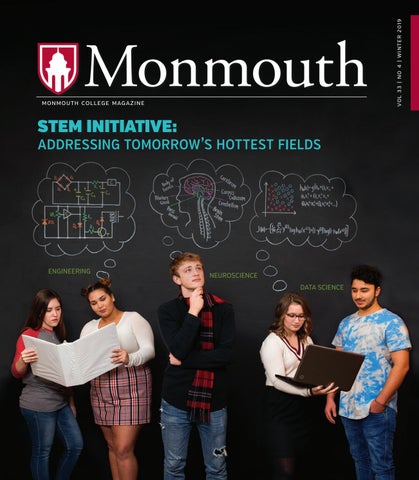
STEM INITIATIVE: addressing tomorrow’s hottest fields
ENGINEERING
NEUROSCIENCE DATA SCIENCE
CELEBRATING A GREATER GRIER HALL Historic residence hall returns to service following extensive yearlong renovation
J
AMES HARPER GRIER HALL was rededicated Dec. 4, following a topto-bottom upgrade lasting nearly a year. New amenities added to the three-story, 25,000-square-foot building include private bathrooms, an elevator, air conditioning and new furniture. Students returned to the renovated 90bed residence hall in January. The project, which also involved the installation of new plumbing, wiring and HVAC, was the first phase of a thorough renovation of the oldest residence halls on the campus’s east side, paid for by funds donated to the College’s capital improvement fund. Colorful modern furniture complements one of the lounge/kitchenettes.
Speaking at the rededication ceremony, student government president Magdalynne Bruckner ’20 noted that, to students, residence halls like Grier are “a second home to us when we leave home. [They are] a place where we share great moments that will last a lifetime.” Built in 1940 and named after the College’s fifth president, Grier Hall was the third residence hall to open on campus. The Georgian-style brick structure was designed by noted New York City architect Arthur O. Angilly.
Bedrooms feature carpeting and dimmable lighting.
Corridors were updated with new doors and a bright color scheme.
Tara Sturgeon ’19 admires one of the new bathrooms, which contain individual private shower and toilet facilities. Trustee emeritus Ralph Whiteman ’52 has fond memories of Grier Hall. As a high school student during World War II, he worked in the supply store for preflight Naval cadets, who were housed in the building.
The St. Louis architectural firm Hastings + Chivetta was responsible for the renovation’s design, which was carried out by Pepper Construction of Chicago. First Lady Lobie Stone, a former interior designer, worked with Christine Capps of Hastings + Chivetta to select all of the finishes and furniture, which have created welcoming and comfortable spaces for students.
Magdalynne Bruckner ’20 speaks on behalf of the student body at the dedication.
College officials and students cut a ceremonial ribbon at the rededication in Grier’s formal lounge, which is paneled in distinctive knotty pine. The historic character of the room was preserved in the renovation.
PRESIDENT Clarence R. Wyatt
VOL. 33 | NO. 4
MONMOUTH COLLEGE MAGAZINE
WINTER 2019
12 GETTING IN STEP WITH ‘STEM’ Three new majors open doors to careers in emerging technological fields.
19 NEW HOME UNVEILED AT HOMECOMING The christening of a new alumni house was one of many special moments celebrated.
26 THE PRINCE OF MONMOUTH ATHLETICS Was Walter McMillan the greatest all-around athlete in Monmouth College history?
34 RED, WHITE AND BLUE GOES ‘DOWN UNDER’ Inspired by patriotism and his father’s legacy, triathlete competes in Australia. EDITOR AND DESIGNER Jeffrey D. Rankin ASSOCIATE EDITOR Barry McNamara PHOTOGRAPHY George Hartmann Kent Kriegshauser CONTACT US Magazine Editor 309-457-2314 jrankin@monmouthcollege.edu
campus news 3 academics 8 newsmakers 11 books 18 sports 28 alumni news 36 the last word 48 Monmouth College Magazine is published quarterly for alumni, students, parents and friends of Monmouth College. All opinions expressed in signed articles are those of the author and do not necessarily reflect those of the editorial staff or the College. We welcome letters about the College or the magazine. Letters will be printed on a space-available basis and may be edited for length, style and clarity. Send letters, queries or submissions to: Monmouth College Magazine, 700 East Broadway, Monmouth IL 61462-1998, or email jrankin@monmouthcollege.edu. Change of Address?
Monmouth College Magazine is printed on Cascades Rolland Enviro 100 paper, made with 100 percent post-consumer fiber.
Write: Development & College Relations, Monmouth College 700 East Broadway, Monmouth, IL 61462-1998 Phone: 888-827-8268 Web: monmouthcollege.edu/update
ON THE COVER (From left): Taylor Ewald ’19, Opal Perez-Williams ’21, Brock Crothers ’20, Emma Hildebrand ’20 and Sahil Sharma ’22. Chalkboard illustrations by Natalie Curtis ’18. For a behind-the-scenes video, visit: monmouthcollege.edu/cover-video.
BOARD OF TRUSTEES Mark Kopinski ’79, Chairman Dr. Ralph Velazquez Jr. ’79, Vice Chairman Douglas R. Carlson ’66 Daniel Cotter ’88 Robert Dahl Rod Davies ’74 Nancy Speer Engquist ’74 Christine Beiermann Farr ’90 Larry Gerdes William J. Goldsborough ’65 Kevin Goodwin ’80 Augustin Hart III ’68 Mahendran Jawaharlal ’86 F. Austin Jones John Kemp ’82 The Rev. Robert C. McConnell ’72 Michael B. McCulley, Esq. ’70 J. Alex McGehee ’81 Gary Melvin Bradley C. Nahrstadt ’89 Gail Simpson Owen ’74 J. Hunter Peacock J. Stanley Pepper ’76 Anthony J. Perzigian ’66 Dennis M. Plummer ’73 Anita Ridge ’88 Susan Romaine The Hon. John J. Scotillo ’72 Dr. Carlos F. Smith ’90 Sherman Smith ’72 Nancy L. Snowden Mark E. Taylor ’78 Dwight Tierney ’69 George E. Trotter III Beth Bowdoin Tyre ’96 Jean Peters Witty ’88 Richard E. Yahnke ’66 Jackie Bell Zachmeyer ’89 ALUMNI BOARD REPRESENTATIVES TO THE BOARD OF TRUSTEES Mary Alexander Corrigan ’82 Craig Dahlquist ’78 Jerri Picha ’75 ALUMNI BOARD EXECUTIVE COMMITTEE Mary Corrigan ’82, President Andrew Kerr ’73, Vice President Michelle Moy ’89, Secretary Hilary Stott ’07, Member at Large EDITORIAL BOARD Duane Bonifer Associate Vice President for Communications and Marketing Trent Gilbert Vice President for Enrollment and Communications John Osterlund Vice President for Development and College Relations Hannah Maher Assoc. Vice President for Development and College Relations Jeffrey D. Rankin College Editor and Historian Barry McNamara Associate Director of College Communications NOTICE OF NONDISCRIMINATION
Monmouth College does not discriminate on the basis of race, religion, color, sex, national origin, ancestry, disability, age, military service, marital status, sexual orientation, pregnancy or other factors as prohibited by law. Monmouth College admits students of any race, religion, color, sex, and national or ethnic origin to all rights, privileges, programs, and activities generally accorded or made available to Monmouth students. Monmouth College, an Equal Opportunity Employer, is committed to diversity and encourages applications from women and minority candidates. Any inquiries regarding Title IX or the College’s Policy Prohibiting Discrimination, Harassment and Retaliation (www.monmouthcollege.edu/nondiscrimination-policy) should be directed to the Title IX Coordinator identified below. The Coordinator will be available to meet with or talk to students, staff and faculty regarding issues relating to Title IX and this policy. Stephanie Kinkaid Title IX Coordinator 309-457-2272 skinkaid@monmouthcollege.edu
PRESIDENT’S MESSAGE
THE SPIRIT OF INNOVATION
STEM initiative reflects our commitment to preparing students for changing world
O
u r t h r e e n e w pro gr a m s in
other programs,
engineering, neuroscience and data science
providing an
are exciting in and of themselves, not least for
even richer
their intellectual rigor, but also for their strong appeal to
experience for
prospective students and to prospective employers.
our students.
These programs are even more encouraging and
The faculty is
important for the spirit of innovation that they represent.
also working
Monmouth has always been a place that seeks to serve its
to describe the
students more effectively, but the energy and action around
outcomes for
that spirit have grown significantly in the last few years.
students in their
The development of the three new programs has been
programs in ways that are more compelling, to prospective
a model of creativity, discipline and teamwork—all
students and prospective employers. The intellectual
three necessary ingredients to any successful effort at
energy and sense of possibility are infectious.
innovation. In the fall of 2017, I encouraged the faculty to
Most encouraging is the fact that, at the heart of all
propose new or significantly modified academic programs
of this, rests the desire to prepare young people more
that strengthened our liberal arts and sciences mission,
effectively for rewarding and contributing lives in a world
that would prepare students for fields with strong career
changing by the second. The faculty is guiding our students
prospects, and that would broaden and deepen the
through evolving fields of inquiry so that our alumni will
College’s appeal to bright and motivated students.
thrive in, and create, emerging fields of endeavor. By
We received several excellent proposals, and then
enhancing the quality of the Monmouth Experience in this
moved them through a thorough and purposeful process
way, we are placing the College on a stronger foundation
of evaluation by the faculty, through rigorous market
for the long run, and empowering our students to be of
testing, and consideration by the Board of Trustees. At
even greater service to society.
each step, we were increasingly encouraged by the promise of these programs, and were able to move ahead with implementation through a special commitment by the Board of Trustees to provide start-up funding.
As always, Lobie and I thank you for all that you do to support this gratifying work. My Best,
This process is also inspiring existing academic programs to look at themselves anew, to consider how they can augment and modify their offerings and how they can link their particular perspectives and methods to those of
2
MONMOUTH COLLEGE MAGAZINE
Dr. Clarence R. Wyatt President
CAMPUS NEWS
PREPARING FOR GLOBAL CITIZENSHIP Interdisciplinary program helps ready students for Peace Corps service
M
onmouth College of f icially launched its Peace Corps Prep program in October, opening “amazing opportunities” for students interested in becoming global citizens who can help shape the world. “This is one of the most exciting developments for the College,” Monmouth President Clarence R. Wyatt said at the announcement event. “The Peace Corps is one of the great legacies of America to the world. We look forward to this being a great hallmark of Monmouth’s contribution to the country and to the world for generations to come.” An interdisciplinary certificate program housed in the College’s educational studies department, with support for professional development in the Wackerle Career and Leadership Center, the program prepares students for leadership, intercultural competence, foreign language and a professional sector of their choice such as education, health or the environment. Those skills give them a competitive edge when applying for Peace Corps service, and can be built upon and marketed throughout their careers. “There is a much more compelling case to be made about how and what skills you as a student can acquire to better prepare yourself for Peace Corps service,” said Manuel Colón, program specialist in the Peace Corps Office of University Programs. The Monmouth Peace Corps Prep program is overseen by two co-coordinators: Wackerle Career and Leadership Director Marnie Dugan and educational studies professor Craig Vivian. It is assisted by anthropology
Participating in the announcement of the Peace Corps Prep program were, from left: Peace Corps Office of University Programs Program Specialist Manuel Colón, Wackerle Career and Leadership Director Marnie Dugan, anthropology professor Megan Hinrichsen, political science professor Jessica Vivian, political science professor Michael Nelson, President Clarence R. Wyatt and educational studies professor Craig Vivian.
professor Megan Hinrichsen and political science professor Michael Nelson, who is a Peace Corps veteran. Vivian and his wife, Jessica Vivian, who teaches political science at Monmouth, are also Peace Corps veterans. Their son Paul is currently serving in the Peace Corps. “The Peace Corps Prep program will allow students like you to make a significant impression on and a meaningful contribution to others,” Vivian said. “Most important are the experiences that you can have, which will help you in the building of yourself, the building of your identity—what I like to call your life project.” Taylor Sutschek ’16 is among more than four dozen Monmouth alumni who have served in the Peace Corps. Sutschek returned in August from two years of teaching English to schoolchildren in the South African province KwaZulu-Natal.
“I’m 100 percent certain that my Peace Corps service shaped me into a better global citizen,” she said. “My time living in South Africa gave me so many amazing opportunities and equipped me with the ability to approach and experience different cultures with humility and respect, to listen, and to understand. Peace Corps changed my life, and I am beyond grateful.” Vivian said that serving in the Peace Corps, which was established by the U.S. government in 1961, will shape a person’s life in numerous ways. “It is in the self-constructing experiences that you will begin to understand the necessity of doing this work in a community … a community of friends, of colleagues and initially strangers,” he said. “A large part of being in the Peace Corps is being able to transform strangers into those friends and colleagues who will become part of your life.” WINTER 2019
3
CAMPUS NEWS
THE CENTER FOR CIVIC AND SOCIAL CHANGE AN INTERDISCIPLINARY APPROACH TO HELPING STUDENTS MAKE A DIFFERENCE
M
onmouth college has created the center for civic and social change
MICHAEL NELSON
to help students prepare for careers focused on making a difference in the world. “This Center will empower our students so that they can lead lives that are directed toward the betterment of societies and individuals’ lives throughout the world,” said political science professor Michael Nelson, who helped lead the faculty-driven initiative. Monmouth President Clarence R. Wyatt said the Center for Civic and Social Change “represents an important moment in the life of Monmouth College.” “The essence of the Monmouth College experience has long been to empower young people through the liberal arts and sciences to be forces for good in their personal, professional and civic lives,” Wyatt said. “The creation of the Center for Civic and Social Change gives even greater focus and energy to that mission, and it will serve as a catalyst for additional efforts. The center also demonstrates the vital role that Monmouth plays in preparing young people to lead and create positive change. I thank and congratulate the faculty members who are leading this exciting new development.” The center brings together five of the College’s dynamic and interdisciplinary minors and programs: Global Public Health Initiative, Global Food Security Initiative, the Peace, Ethics and Social Justice minor, the Rural Schools Collaborative, and the Peace Corps Prep program. “Members of those programs realized that their missions and work complement one another,” Nelson said. “Creating the Center for Civic and Social Change is a great way for us to bring together the faculty and the students already involved with these outstanding programs. That will allow us to act
E
xcellence in alumni programming
4
MONMOUTH COLLEGE MAGAZINE
on the synergies among the programs and build something collectively that will be very effective.” Nelson said that Monmouth faculty have seen an increase in students who “want to make Monmouth’s liberal arts a difference in program helps us think about the world, but they need di what we can do to be better rection about citizens, both here in the how to do it,” United States as well as in adding, “This our interactions with people center will help provide stu around the world. dents with the paths that can help channel those passions.” Monmouth’s curriculum is ideally suited to support the Center for Civic and Social Change. “Our liberal arts approach encourages us to think about not just our academic programs and our professions, but it also encourages us to consider our broader lives and how these things interact,” said Nelson. “Monmouth’s liberal arts program helps us think about what we can do to be better citizens, both here in the United States as well as in our interactions with people around the world.” Employers are eager to hire students who have the kind of interdisciplinary experiences offered through Monmouth’s Center for Civic and Social Change. “We’ve found that employers like to hire students who have been part of programs that are dedicated to making their communities and their world a better place,” said Nelson. “Employers are excited to hire students like that because they have demonstrated a level of capability and responsibility that prepare them to handle a variety of situations and challenges.”
For the third year in a row, Monmouth College’s alumni programming has been recognized with an award from CASE, the Council for Advancement and Support of Education. Monmouth College’s first Alumni Science Symposium, held last April, received honorable mention for best new alumni program in CASE District V, which
‘
’
includes member institutions from Illinois, Indiana, Michigan, Minnesota, Ohio and Wisconsin. All alumni science majors and minors were invited to attend the weekend event, to hear from peers in their profession, meet with friends and professors, and help guide current science students in their post-baccalaureate pursuits.
CAMPUS NEWS
A UNIQUE PRE-COLLEGE EXPERIENCE TWO-WEEK SUMMER PROGRAM INTRODUCES TALENTED HIGH SCHOOL STUDENTS TO MONMOUTH
B
eginning this summer, monmouth college will offer a special academy
to prepare select high school students for their college experience. An intense, residential, pre-college experience, the Scholars Academy at Monmouth College will be the only program of its kind in Illinois and one of few of its kind in the Midwest. Held June 16-28, the two-week program will give academically talented rising high school juniors and seniors the opportunity “to try on the life of a college student,” said Monmouth history professor Michelle Damian, the academy’s director. “This unique academy is ideal for a student who is considering MICHELLE DAMIAN going to college, but who might not know what type of college he or she wants to attend,” said Damian. Attending the Scholars Academy at Monmouth College will give students a sense of the diverse range of subjects offered at a liberal arts college, which could benefit students who don’t yet know what they want to study in college. “The academy lets them try out a number of things without them having to make a full-time commitment to a specific discipline,” said Damian. Students enrolled in the Scholars Academy at Monmouth College will take two discussion-based courses from six subjects: anthropology, biology, chemistry, classics, English and media. Class topics include “Good Eats and Forbidden Flesh: Food’s Role in Shaping Humanity,” “How Life Works,” “Food and Forensics in Chemistry,” “Nature and the Environment in Antiquity,” “Write the Whirlwind: Creative Writers Being Heard” and “From Media Consumer to Media Producer: Audio and Video Production.” Students will have two classroom sessions in the morning, then return to those classes for more “hands-on, practicum-type experiences in the afternoon,” said Damian. “They’ll have the opportunity to engage in stimulating discussions, learn from knowledgeable professors and raise their learning to a whole new level.” In addition to an intellectual immersion in a highly personalized learning environment, academy participants will
have opportunities to sharpen their leadership skills. Students will engage in discussions and activities focused on leadership and hear from leaders within the College and community. They’ll also participate in leadership activities that will help them build problem-solving skills and self-confidence. Academy students will live in a Monmouth residence hall, “experiencing college life in all kinds of different ways,” said Damian. “They’ll move beyond high school as they encounter new challenges, meet new friends and step out of their comfort zones.” Information about the Scholars Academy at Monmouth College is available at scholarsacademy.monmouthcollege. edu. For more information: scholarsacademy@monmouthcollege.edu or 309-457-2345.
Educational Studies Department introduces major for non-teachers In recent years, Monmouth College’s Educational Studies Department has offered only one major—elementary education, designed for students wishing to pursue certification for teaching. In order to serve students interested in education but not necessarily a teaching career, a new educational studies major was recently introduced. According to Brad Rowe, assistant professor of educational studies, the new major is an option for students “who express a more general interest in the liberal arts study of education and society—a study of the social, political, historical and cultural contexts and issues that shape education.” Rowe said possible career paths for the new major include school counseling, non-profit organizations, international teaching, speech pathology and college admissions. It also provides a good foundation for admission to graduate school.
WINTER 2019
5
CAMPUS NEWS
BIOCHEM MAJOR NAMED LINCOLN LAUREATE
S
obhi kazmouz, a senior biochemistry major originally from Syria, has been named Monmouth College’s 2018 Student Laureate of the Lincoln Academy of Illinois, joining an elite group of Illinois college students honored for overall excellence.
Kazmouz is congratulated by President Wyatt.
Selected to work last summer at the Harvard Stem Cell Institute, where he was matched with Dr. Jerome Ritz’s lab at the Dana Farber Cancer Institute, Kazmouz worked on a project to monitor the immune profiles of bone marrow transplant patients with chronic graftversus-host disease. “He is incredible at research and eloquent in his explanations of his research,” said chemistry professor Laura Moore, who has collaborated with Kazmouz on site-directed mutagenesis and protein assays as well as studied the
effect of different interactions on protein structure of the E. coli FNR transcription factor. Kazmouz said he hopes to become a medical doctor, working in immunology or oncology. “I really love the process of scientific discovery and research,” he said. “Even before coming to Monmouth, I was inspired to pursue that path by my parents. My mother is a dentist, and my father is a doctor.” Outside of the classroom, Kazmouz has served in many leadership roles on campus, including co-president of the Pre-Health Society, supplemental instructor for general chemistry and organic chemistry, member of the editorial board for the Midwest Journal of Undergraduate Research, and international student orientation leader. A resident assistant for two years, Kazmouz is a member of two honor societies—Alpha Lambda Delta and Mortar Board—and has volunteered at Monmouth’s OSF Holy Family Hospital.
Farmers Can Wear Kilts
60 YEARS and still going strong
H
arlow blum, emeritus professor of art, retired from teaching in 1999 after a 40-year career, but he may never retire as an artist.
A major retrospective of Blum’s lifetime of work, spanning more than six decades, opened in October at Monmouth’s Buchanan Center for the Arts and ran through early January. Wide-ranging themes in the exhibit included the effects of global warming, the cycles of nature in volcano eruptions and lava flows, the majestic forms of mountains and canyons, and the serene calm of Japanese landscapes and gardens. A distinctive feature of the exhibit was his acrylic collage paintings, which make use of sand, resins, bird gravel, Japanese handmade papers and cedar boards, and rusted metals. His “Fire and Ice” works are constructed using expandable foam.
6
MONMOUTH COLLEGE MAGAZINE
Eight Monmouth students represented the College in the famous Blue Room at the 2018 National Future Farmers of America Convention & Expo in Indianapolis in October. Wearing pins proclaiming “Farmers Can Wear Kilts,” the team showed a video and performed demonstrations to FFA high school attendees. From left are Esther Hubbard, Morgan Abraham, Noah Applegate, Brie Stumbo, Bridgette Davey, Riley Criddle, Declan Crego and Colton Willhardt. They were accompanied by physics professor Chris Fasano.
CAMPUS NEWS
L
A EUREKA MOMENT
et the record show that Sept. 18, 2018, was the day that phage was found at Monmouth College. “We have liftoff,” said biology professor Eric Engstrom, who teaches the College’s
phage-hunting course with department colleague Tim Tibbetts. “Our students found phage the world’s never seen before. Tim and I are walking around the ceiling today.” Phage is a virus that infects bacteria. It’s “a biological entity,” said Engstrom, stopping short of calling it an organism. “They’re fascinating things,” said Engstrom. “They’re everywhere that bacteria are found, but we don’t know how to think about phage. We’re trying to broaden our understanding. Most of its genes, we have no idea what they do. This opens up a lot
of questions, such as are they phage-specific? We just don’t know until we have lots of samples.” Research was conducted in the 1950s on using phage to treat infection, but that information was pushed to the back burner because of the rise of antibiotics. Phage has become relevant again because some diseases, such as tuberculosis, are resisting antibiotics. “We’re becoming interested in this again,” said Engstrom. “We let it rust. Can we clean it up and put it back to use?” Monmouth students aren’t the only ones hunting for phage. The College is part of a five-year, nationwide discovery-based undergraduate research initiative. Other schools participating include community colleges to larger research institutions such as Johns Hopkins University.
Assessing the Midterms Nationally known political analyst Amy Walter weighed in on the results of the 2018 midterms during a Monmouth College Midwest Matters lecture in November. She told the audience that the election was a stark reminder that there are “two Americas,” adding that the country is “more geographically polarized than at any time since 1860, and we know that didn’t turn out very well.”
LUX SUMMER THEOLOGICAL INSTITUTE PREPARES FOR THIRD YEAR
H
igh school students from across the United States will converge on campus this summer to grapple with the challenges of hunger and poverty. The students will participate June 16-30 in the third annual Lux Summer Theological Institute for Youth, funded by Lilly Endowment. “We’ve been through two years now,” said Monmouth Associate Chaplain and Lux Summer Theological Institute for Youth Director Jessica Hawkinson, who helped start the summer program. “We know the institute is a success. What we have here is something special. Experiences like this are few and far between for high school students.” The 2019 Lux Institute will be built around the theme “A Place at the Table: Thinking Theologically About Hunger and Poverty.” Thanks to a Lilly Endowment grant, there is no cost to attend the two-week institute. Families have to pay for stu-
dents to travel to Monmouth, but a free shuttle is provided from Chicago to the College. Hawkinson said the Lux Institute offers students a chance to think deeply about a critical topic that affects every society. “We want them to think holistically about why hunger and poverty exist,” she said. “It’s one of our most essential human rights. We understand the need. Most of the students will have volunteered in a soup kitchen or volunteered on a mission trip. They’ve encountered hunger or poverty. In that regard, it’s an easy topic to take on.” The institute takes that topic to another level. “We immerse them in the subject,” said Hawkinson. “Solutions to poverty and hunger are not something you teach from one discipline or perspective. There are many ways of thinking about those issues, and approaching it from multiple disciplines is something that Monmouth College does well.” Above: Participants in the 2018 Lux Institute bid farewell at the closing exercises.
WINTER 2019
7
ACADEMICS
Eyeing a career in medical research, biochemistry major Laura Sanchez ’19 has spent the last two summers participating in advanced study at major universities.
A passion for research By BARRY McNAMARA
L
aura Sanchez has known she’s wanted to be a researcher since she was a high school student in Bensenville, Ill. Through several experiences at Monmouth College, Sanchez is well on her way to being accepted into medical school and, ultimately, embarking on a career in medical research. “It’s been a lot more than I expected,” said Sanchez ’19, a biochemistry major. “I had no idea about what an REU was my freshman year.” An REU is Research Experiences for Undergraduates, a program that supports student research in an area funded by the National Science Foundation. Sanchez completed an REU in each of the past two summers. Her most recent experience took her to the University of Michigan’s School of Pharmacy, where she worked with cytochrome P450 enzymes, which are proteins that metabolize toxins and/or drugs in the body. “She was given a challenging problem—expressing a variant of a cytochrome P450 enzyme from mammalian cells in a bacterial system—and was successful in isolating protein,” said Monmouth chemistry professor Laura Moore, Sanchez’s academic adviser. Moore said that she and fellow chemistry professor Brad Sturgeon hope that Sanchez might be able to isolate some of the cytochrome P450 enzyme at Monmouth. “How these molecules are metabolized is something that
8
MONMOUTH COLLEGE MAGAZINE
Brad has long been interested in,” said Moore. “He’s just never had the opportunity to work with isolated cytochrome P450.” Sanchez said she was attracted to the project at the University of Michigan “because it’s in a field of study similar to what I want to do in grad school.” “I want to go into medicinal chemistry research, working on trying to develop new drugs,” said Sanchez. “I’m really interested in trying to find alternatives to some of the drugs that are out there, such as opioids. I want to try to develop drugs that are non-addictive.” Sanchez participated in a 2017 summer research program at Southern Illinois University, where she worked on developing inexpensive, printed electrodes that can be used for immunoassays. Sanchez is also part of Moore’s research team that is examining the aggregation properties of protein found in corn. “She is testing the effect of different reducing agents on the aggregation of the protein in hopes that one can be found that will be suitable for use in the food industry,” said Moore. “Laura has learned to do gel electrophoresis and how to think about designing experiments. She has shown that she can independently learn how to analyze data.” Moore said the hard-working senior is a quiet leader and trusted student. “What I think Laura excels at is her independence in her laboratory work and her determination in solving problems that she encounters,” she said. “While she may be quieter than the other students, I notice her making important contributions as the group works through the lab. Because of her excellence in the lab, she was chosen to be a teaching assistant in the organic chemistry lab last year. Her lab skills, excellent communication and work habits suggest to me that she will be successful in any research environment.” Sanchez has yet to decide where to apply to graduate school, but she’s already reached a major milestone. In May, she’ll become the first member of her family to graduate from college. “Not a lot of people in my family have gone to college,” said Sanchez, who also received an American Chemical Society scholarship this year. “I’ve put pressure on myself, because I’ve wanted to set a good example. My parents have also told me about the challenges they had going to school, so it makes me want to persevere that much more, knowing that they had it tougher than me.”
ACADEMICS
Roman coins to modern agriculture New annual lectures examine diverse academic topics
Dean Kim Kidwell of the University of Illinois College of Agriculture (left) visits with lifelong farmers Jeanne Robeson ’60, who endowed the Wiswell-Robeson Lecture, and Professor Ken McMillan.
Baylor University art professor Nathan Elkins (left) poses with Professor Emeritus Thomas and Anne Sienkewicz, in whose honor the annual classics lecture is named.
Two recently created annual lecture series explored vastly different academic topics in November. The second annual Thomas J. and Anne W. Sienkewicz Lecture, honoring the emeritus Capron Chair of Classics and his wife, brought to campus Baylor University professor Nathan Elkins, who spoke on “The Significance of Images in the Reign of Nerva, 96-98 CE.” Elkins, who is a professor of art at Baylor, spoke about how the engravings on period Roman coinage open a window onto understanding the brief reign of Nerva, since his principate left little in the way of public building and monumental art. The third annual Wiswell-Robeson Lecture, established by Jeanne Gittings Robeson ’60, featured University of Illinois College of Agriculture, Consurer and Environmental Science dean Kim Kidwell, speaking about challenges facing the agriculture industry. Kidwell, who is the first woman to lead the college, told the audience that agriculture needs to do a better job telling its story because most consumers no longer live on a farm and they also don’t realize the sector’s depth and breadth. She said that only about 20 percent of consumers are aware of where their food comes from or how it is produced, and that they don’t realize how many jobs are connected to the ag industry. Kidwell also talked about the importance of drawing more young people into careers in agriculture. “People don’t understand how high-tech it is and how exciting it is,” she said. “When people see drones flying around fields, I don’t think they know that’s computer science interfacing with agriculture. When people say farming is boring, they haven’t been inside a combine that’s like being inside a video game. ... It’s fascinating to see how much high technology is used in agriculture these days, and we just don’t sell it well.”
WINTER 2019
9
ACADEMICS
Exploring the art of mathematics
Curtis (inset) and one of her mathematicsinspired sculptures.
Monmouth College students majoring in mathematics typically spend most of their classroom and study time in the Center for Science and Business. Natalie Curtis ’18, who graduated in December, certainly spent a lot of time in the CSB. But she was equally at home in the art studios of McMichael Academic Hall and Wells Theater, where she designed sets and programs. A double major in mathematics and art, Curtis showed how those two disciplines intersect at her senior art exhibit, “Experience Math.” “Most of my artwork is based on math or some kind of abstraction of math,” she said. “I wanted the show to be an outlet for people who don’t necessarily like math or have an interest in math to
experience math without having to read it in a textbook or take a class.” Mathematical influences on Curtis’ work include prime numbers, fractals (self-repeating patterns), circular polar graphs and triangles, which she used to create stars in the exhibit. “The topics vary,” she said. “It’s just about finding cool patterns within them and exploring them visually without all the numbers. ... I like to keep the colors of my work bright and inviting, to keep the idea going that math can be bright and fun and engaging.” When Curtis arrived as a freshman from Arlington Heights, Ill., she was undecided about a major. She then pursued art and switched to math before ultimately deciding that she could make both work. “I used to think I either had to be a math major or an art major, or if I wanted to be both I was separately a math major and an art major,” she said. “Now, I’ve done both at the same time and I’m doing work that brings them both together. I don’t think I saw that opportunity at first, but I’m glad I found it.”
Save the Date Golden Scots Celebration JUNE 6-9, 2019
Special reunions for the classes of 1974, 1969, 1964, 1959, 1954 10
MONMOUTH COLLEGE MAGAZINE
NEWSMAKERS
HINCK RECEIVES FACULTY AWARD Robert Hinck, assistant professor of communication studies, received the prestigious Gundersen Junior Faculty Scholarship Award for his groundbreaking research, which resulted in an upcoming book about the 2016 U.S. presidential election. The Gundersen Award is presented annually to HINCK a Monmouth faculty member who has fewer than four years of service and has engaged in exemplary scholarship, research or creative work. The award includes a $1,500 stipend. Hinck is co-author of Contesting Strategic Narratives in a Global Context: The World Watches the 2016 U.S. Election. Set to be published in 2019, the work’s other co-authors are Randolph Kluver and Skye Cooley, both of whom are professors at Oklahoma State University. The book is a product of Hinck’s grant work with the Strategic Multilayer Assessment community, which focuses on examining foreign media reporting on issues critical to U.S. strategic interests.
MAHER, ALCORN EARN PROMOTIONS Hannah Maher has been promoted from director of development and alumni engagement to associate vice president for development and college relations. A member of the development and alumni staff since 2010, she will serve as backup to the vice president, while also maintaining a portfolio of donors and prospects. MAHER Also receiving a promotion was Gena Alcorn ’88, who was named senior development officer. She previously served as director of alumni programs from 1995-2000 and as development and major gifts operations officer since 2013. In her new capacity, she will supervise the College’s major gifts effort, including donor relations and stewardship, legacy giving, and prospect research.
MASOOD NAMED ASSOCIATE VICE PRESIDENT Mohsin Masood has been named associate vice
president of student affairs. Previously associate dean of students, he has been a member of the student affairs staff since 1995. Masood leads the College’s intercultural life team, its international Student and Exchange Visitor Information System activities and the All of Us Together Committee, all part of an effort to MASOOD amplify the College’s welcoming climate. He will be a key member of an ad hoc group of faculty and staff who will work on a strategic plan for diversity in 2019.
SHIMMIN RETIRES FROM COACHING After being involved with Fighting Scots volleyball for 25 years, Kari Shimmin ’97 has announced her retirement as the program’s head coach in order to devote her time to teaching at Monmouth. The winningest and longest-serving coach in Monmouth volleyball history, Shimmin will continSHIMMIN ue her responsibilities as an instructor of kinesiology at the College. During her 21 years as coach, Shimmin’s teams won 337 matches and a Midwest Conference championship. As a student, she was a four-year letter-winner in volleyball, and a two-time All-Midwest Conference selection at outside hitter, which earned her induction into the M Club Hall of Fame in 2011. Shimmin coached Monmouth to seven 20-win seasons, setting the program record with 26 wins in 2002.
KOPINSKI RECOGNIZED FOR HELPING HOMELESS Mark Kopinski ’79, chairman of the Monmouth College Board of Trustees, was honored in December as a member of City & State’s “Responsible 100” in New York for 2018. The Responsible 100 recognizes New York’s most outstanding responsible executives and influencers who are setting new standards of excellence, dedication and leadership in improving their comKOPINSKI munities and making transformative change. Kopinski was honored for his work as board president of the Jericho Project, a nonprofit organization that helps formerly homeless or at-risk individuals and families lead independent lives. The organization provides more than 400 units of supportive housing in New York City, as well as life-changing services to vulnerable adults and children. A member of the Jericho board since 2008, he was elected its president in 2013. City & State is a non-partisan political journalism organization dedicated to covering New York’s local and state politics and policy.
HINRICHSEN PUBLISHED IN ACADEMIC JOURNAL Megan Hinrichsen, assistant professor of anthropology, is the author of a recent article in the peer-reviewed journal Research in Economic Anthropology for its special issue on individual and social adaptations to human vulnerability. Titled “Living within the Narrative of Microfinance: Vulnerability, Well-Intentioned Debt, and the Individualization of Social Problems in Quito, EcHINRICHSEN uador,” the article is part of her ongoing research in the South American city.
WINTER 2019
11
COVER STORY
GETTING IN STEP NEW TECHNOLOGY-BASED MAJORS ADD BREADTH o various degrees, Monmouth College students have been able to touch on the fields of engineering, neuroscience and data science for several years. But starting this By Barry McNamara
fall, they will be able to dive much deeper into those subjects, as the three STEM disciplines are on course to be fullfledged academic majors at the College.
12 
MONMOUTH COLLEGE MAGAZINE
WITH STE M
AND VALUE TO THE MONMOUTH EXPERIENCE “It’s really our time,” said physics professor Chris Fasano. “It’s our time because we have things to contribute that are valuable and that are exciting for both students and the world.” Interim Dean of the Faculty Mark Willhardt agreed on the value of adding new programs focused on science, technology, engineering and mathematics. “We’re trying to answer the demands of high-
er education right now by building programs that we not only believe in but that are taking advantage of what we do best—our liberal arts foundation,” he said. Mathematics and computer science professor Logan Mayfield, who will help oversee the data science major, said Monmouth’s academic environment is an ideal setting for a major that cuts across many disciplines. (Continued on page 14)
WINTER 2019
13
COVER STORY
(continued from page 13)
should be thought of in the context of the liberal arts. So it’s really appropriate for us now; we have something to offer in engineering.” Because of the College’s distinctive general education curriculum, Fasano said it is a given that Monmouth’s engineering students will become good technical problem-solvers. “But we want more than that, because the problems of the world that need to be solved and need technical solutions also need people who understand the culture of the solution that they’re proposing,” he said. And that’s where Monmouth’s approach to education, with a rich heritage that dates to the mid-19th century, puts the College’s students in the right place for the 21st century. “That’s the setting for what engineering needs to become in the future—culture, contents, consequences and communication, in addition to the problemsolving,” said Fasano. “These are things that Monmouth College has done well for its entire history. That’s the nature of liberal education; that’s what we do. We get people to see the context of what they’re doing.” That’s also
ngineering is a
“At a liberal arts college, it’s really easy for us to say to our data science majors, ‘As a part of your program here, you need to go out and take courses outside of our department,’” he said. “Not just develop the technical expertise to collect data, curate data, PROFESSOR process data, model the CHRIS FASANO data, but communicate that to business people and others who aren’t data scientists.” Data science is the youngest of the three majors, as colleges and universities only started to add it within the last decade. Neuroscience and engineering have longer histories, and they’ve been on the minds of Fasano and chemistry professor Laura Moore for quite some time. “We have students who ask for neuroscience,” said Moore, who joined the faculty in 2006. “They’ve been asking for it for years. There are current students here who are waiting to change their majors to neuroscience.”
human activity; it’s a creative activity.
’
Engineering and the liberal arts
‘I
’ve been thinking about this for a long time,” said Fasano of the engineering major, which will include three tracks—chemical, electrical and mechanical. Fasano calls engineering “the creative or human response to the innate wish that people have to solve problems by building things.” In its best form, he said, it’s the synthesis of science, business, art and design, which makes it a perfect major for a liberal arts college such as Monmouth. “Engineering is a human activity; it’s a creative activity,” he said. “Modern engineering education is recognizing this and recognizing that engineering
14
MONMOUTH COLLEGE MAGAZINE
COVER STORY
ow do we make the right decisions with the data, and not just hungrily gather the data and do whatever we want with it?
’
PROFESSOR LOGAN MAYFIELD
discipline, Monmouth students can study the ethical implications of the field in real time as it plays out in events around them. “Certainly the backlash against Facebook has a lot to do with this,” said Mayfield. “At Monmouth, we can engage our students in both the ‘What can we do with the technology and the tools,’ but also ‘What should we be doing?’ How do we make the right decisions with the data, and not just hungrily gather the data and do whatever we want with it?” Data science majors will learn to answer those questions not only through classes within their department, but in other disciplines as well. “We have the technical background, but we can also interact very easily with our partners in the humanities or other disciplines and really provide both a grounding in doing the right thing with data and then being able to really apply data science to a large number of fields,” said Mayfield. “We are excited about developing partnerships with other departments and having our students take courses outside the major so they can learn the problems faced in different disciplines in business and economics, in the (Continued on page 16)
why Willhardt noted that adding majors related to science, technology, engineering and mathematics will not change Monmouth’s identity. “We believe wholeheartedly that these new STEM programs do not make us the University of Illinois,” he said. “They make us a better Monmouth.”
The ethics of data science
M
ayfield pointed to the ethical and moral anchoring that a Monmouth education gives students as another reason why data science is an ideal major to be offered by the College. He noted that there is an abundance of “stories of people who collect data they shouldn’t or do inappropriate things with data. ... One of the real challenges facing data science is how to make ethical decisions with the data that you have.” Because data science is a relatively new academic WINTER 2019
15
COVER STORY
e think that by having a neuroscience program that gives students more research within their discipline, they will be able to pursue a
’
Ph.D. more effectively.
(continued from page 15)
sciences. They’ll learn how to collect that data and best communicate that to the advertisers, the marketing, or just somebody reading a data-driven news article on a website.” Mayfield expects the role of data science to expand in the technology-driven world economy. “Over the last decade or so, this field has coalesced as a collaboration of sorts between partners in statistics, computer science, mathematics and other disciplines that are using data to drive their decision-making process, to find new products, to communicate more effectively,” he said. “It’s not just for the traditional hard sciences or business, but for fields like journalism or really just about any place where you find yourself sitting with tons of data and wanting to do interesting things with it.”
The macro and micro of neuroscience
N
euroscience is also a blend of academic disciplines, including two recent additions to the College’s curriculum—biochemistry and biopsychology. “At the macroscopic or top level in science, you have animal behavior or human behavior,” said Moore. “You go down a level, and you have neural networks. At the next level, you have the neuron, and at the very bottom
16
MONMOUTH COLLEGE MAGAZINE
PROFESSOR LAURA MOORE
level you have molecular—the proteins and the compounds that might affect how the neurons behave. In our neuroscience curriculum, we’re going to bring all those together. We’re planning that the students will get a broad scope.” The neuroscience curriculum will have two tracks— one focused on the macroscopic level and the other on the microscopic level. “But all of the majors will be spread over all the departments and even outside the departments,” said Moore. “We’re hoping to put a philosophy course within the neuroscience major; computer science will probably be in there because of the need to understand networks and how things work. Data science will probably be in there, too. It’s nice that there’s a synergy between all these programs that are going to be on board.” One of the major’s goals is to prepare students for graduate school. Currently, Monmouth students who want to study neuroscience in graduate school usually go through a master’s program. In chemistry or biochemistry, however, Monmouth students are often able to enroll in doctoral programs because of the extensive research backgrounds they acquire across their four undergraduate years. Moore hopes the College’s neuroscience majors will be able to take a similar path. “We think that by having a neuroscience program that gives students more research within their dis-
COVER STORY
cipline, they will be able to pursue a Ph.D. more effectively,” said Moore. In addition to health-related careers, neuroscience prepares students for careers that tackle issues in global health. Psychology professor Marsha Dopheide said neuroscience is a perfect major for a student who has a lot of diverse interests—and it also fits well with the College’s Global Public Health Triad. “Because neuroscience is such a broad field, it can be a difficult major to define,” she said. “Somebody in neuroscience might be a neuro-philosophist. They might be someone who works in the business sector and helps advise patent offices with patents they are working on with neuro-biological inventions. They could work on brain machine interfaces, known as neuro-prosthetics. They can also get involved in neuro-pharmaceuticals with research and development. The field has been growing a great deal.”
Return on investment
W
illhardt said that what distinguishes the three new STEM majors is the amount of research
ecause neuroscience is such a broad field, it can be a difficult major to
’
define.
PROFESSOR MARSHA DOPHEIDE
and time that were invested in their development. The programs were developed by Monmouth faculty, approved by the College’s governing bodies and then tested by an academic market-research firm. “The research firm tested these majors, along with a few others, by running them out to prospective employers and students,” he said. “When they reported back to us, they said these rose to the top because there is employability in these fields for the next decade and, even better, there is significant student demand for them.” Fasano has referred to his department producing “renaissance engineers.” It might also be appropriate to talk about “renaissance data scientists” and “renaissance neuroscientists” emerging from the other two STEM majors. “What we mean by ‘renaissance engineers’ is people who can do many things and appreciate many things,” said Fasano. “There are many examples of why this is important. We’ll graduate great engineers.”
WINTER 2019
17
BOOKS
WAR STORIES
Uncle’s gripping tales of WWII Timberwolves division inspire first novel
B
Nothing in Hell! (Based on the true-life events of one soldier who proudly served with the Timberwolves Division in World War II) Paperback, 256 pages.
18
orn more than two decades after encountered and decided to tell that part the end of World War II, Monmouth of the story through the eyes of a fictionCollege alumnus Peter Grable ’90 is al prisoner, a Polish carpenter named a member of Generation X, but he also Tomasz Kowalski. has a powerful, personal connection to “That character was based in part on the Greatest Generation. another Polish uncle, who actually spent Grable is the great-nephew of the late time in a concentration camp,” Grable Stanley “Stash” Pokrzywa, a veteran of said. the remarkable 104th A memorable chapter in the book, Timberwolves infantry titled “The Farmhouse,” is based on a division. He grew up personal account that Stash loved to tell. enthralled by his uncle’s He and a buddy volunteered to sneak into vivid tales of a grueling an abandoned house to observe German odyssey that included formations from a second-floor window. fighting in the Battle of After one shell landed to the left of the the Bulge and liberating house and another to the right, they ran the infamous Mitteloutside, and just as they did, another bau-Dora concentration PETER GRABLE ’90 shell hit directly behind them and sent camp, where prisoners shrapnel flying, driving 15 pieces into were forced to help build Hitler’s V-2 Stash’s back, causing him to nearly bleed to death. He rockets. The Timberwolves set the record recovered in a French hospital and returned to his unit, but for fighting by an infantry division at 196 he would be bothered for the rest of his life with shrapnel consecutive days. that was too close to his spine to be removed. “My uncle was always proud of what Stash and his wife never had children, and Grable said he did. He never wanted people to forget what his unit a big part of their lives was attending the annual reunion went through,” said Grable. “Right after my uncle died of the 104th Timberwolves. “It was their vacation,” he said, in 2013, I decided I wanted to keep his story alive and honor him and all the people who served in World War II “and they never missed a single reunion.” In addition to his uncle’s stories, Grable drew on perfor what they did.” sonal experience for part of the novel. Although he was Grable has kept that story alive by writing his first a pre-veterinary student at Monmouth, he initially went novel, Nothing in Hell!, a three-year project based largely into carpentry, running his own contracting business for on Stash’s wartime experiences in Belgium, Holland and 15 years. That helped inspire Tomasz’s occupation and the Germany. story of a wooden ladder, which figures prominently in the From an early age, Grable was captivated by his uncle’s novel. stories, which he heard regularly—whenever he visited Grable, who earned an MBA in finance and now works his grandparents in a two-flat building in Chicago. They in product management for a German tool company, is owned the building and lived on the second floor, while currently working on three new writing projects, including Stash and his wife (his grandmother’s sister) lived on the a novel about a little-known episode before the bombing ground floor. After playing poker with his grandfather, of Pearl Harbor, in which five battery-powered Japanese Grable and his family would hang out downstairs listening midget submarines sought to enter the harbor prior to the to Stash’s war stories. air invasion. The most searing of Stash’s memories was helping to Nothing in Hell! is available for purchase or download at liberate a notorious concentration camp outside NordhauAmazon.com. sen, Germany, in April 1945. Grable struggled with how to portray in his novel the horrors that the Timberwolves —Jeff Rankin
MONMOUTH COLLEGE MAGAZINE
HOMECOMING 2018 A weekend brimming with precious moments
T
he 2018 edition of Monmouth College Homecoming weekend, celebrated Oct. 5-7, wasn’t officially
given a theme. But in her remarks to a crowd of alumni, faculty, staff and friends of the College, Bonnie Bondurant Shaddock ’54 expressed a theme-worthy sentiment. “There have been so many precious moments,” she said, as the Bonnie Bondurant Alumni House on East Broadway was formally dedicated. “I’ve been filled with them all weekend.”
The three M Club Hall of Fame inductees could relate to what Bondurant meant. Standout distance runner Doug Carlson ’66, who could have recounted several tales of dominant individual performances, instead recalled crossing the finish line of a one-mile race, arms linked with two of his beloved teammates, Jim Whalen ’64 and Steve Pettit ’66. Jonny Henkins ’08 recalled visiting Monmouth as a prospective student. Track and field coach Roger Haynes ’82 “brought me into the Hall of Fame area,” he said. “I remember thinking, ‘How much of a badass do you have to be to get into this?’” During his time at Monmouth, Henkins got a pivotal nudge at just the right time from Haynes. “It took him about 60 seconds to change my perspective and what I wanted to accomplish in life,” said Henkins, who went on to capture
ABOVE: Bonnie Bondurant Shaddock ’54 cuts a ribbon to dedicate the new alumni house named in her honor. Formerly known as The Manor, the building was presented to the College by Shaddock in 2006 and recently renovated to house the Office of Alumni Programs. From left are Russ Smith (friend of the donor), First Lady Lobie Stone, President Clarence R. Wyatt, Bondurant, Chairman of the Board of Trustees Mark Kopinski ’79, Debbie Kopinski and Alumni Board President Mary Corrigan ’82.
(Continued on page 20)
WINTER 2019
19
HOMECOMING 2018
Alpha Xi Delta members were among several teams competing with dance numbers at the Spirit Shout.
Well-wishers gather for the christening of the newly renovated Bonnie Bondurant Alumni House.
HOMECOMING Continued from page 19
two national championships in the pole vault. Rob Purlee ’04 also humorously recalled his recruiting visit with his presenter, former football coach Steve Bell, but his precious moments with Monmouth go back even further —to his parents and 1978 Monmouth alumni Dave and Joela Blender Purlee. “I close my eyes, and I’m back at the Knox Bowl for the 100th Bronze Turkey Game,” he said. “I was 6. I close my eyes again, and it’s November of 1991, another Monmouth-Knox game. I was 9. Monmouth was a part of my childhood. It’s been special to me for that long.” Monmouth as a special place was a sentiment shared by several other alumni, including those honored at the Alumni Impact Awards ceremony. “I’m grateful for how this experience here shaped my life for the next 50 years,” said Robert Brink ’68, a former member of the Virginia state legislature who received the College’s Distinguished Alumnus Award. “Monmouth gave me the tools for living that I believe a small, liberal arts college is uniquely qualified to give.” He said that one of those tools was the gift of empathy. “Monmouth taught me to see the world through someone else’s eyes,” he said. “I’d like to think that I got into politics and government for the right reasons, and I’m grateful that Monmouth College taught me how to do it right.” David Bowers ’60, one of two inductees into the Hall of Achievement—the highest honor the College bestows upon its graduates—shared Brink’s view about Monmouth’s size, a lesson he learned after transferring from a large public university.
20
MONMOUTH COLLEGE MAGAZINE
“The mega-format of lectures wasn’t for me,” he said. “I had a feeling that the personal attention Monmouth offered would fit me better and, boy, was I right.” Bowers served as president and CEO of CompX International, Inc., retiring earlier this year. Won Yang Everett ’68, the other Hall of Achievement inductee, was one of several alumni who discussed the impact of Monmouth faculty and staff, sharing how important former political science professor Carl Gamer had been in the life of her father, the late Key Yang ’50. “There were many who went the extra mile at Monmouth, including Professor Gamer,” she said. Another cited for making an impact was Bruce Haywood, who served as Monmouth’s 10th president from 1980-94. “When I was first starting out, he saw things in me that I didn’t see in myself,” said retired dean of students Jacquelyn Condon, who received the College’s Distinguished Service Award. Condon, who served the College from 1980-2017, also thanked the students she encountered as a Monmouth administrator. “You can’t be the dean of students if the students don’t let you,” she said. “What gifts you all have been.” Other honorees during Homecoming weekend included: Ryne Sherman ’06, Distinguished Young Alumnus Award; English professor and interim Dean of the Faculty Mark Willhardt, Hatch Excellence Award for Distinguished Teaching; and the Pepper family, Family of the Year. Inducted into the Greek Hall of Fame were Susan West ’82, Tom Sargent ’85 and Lt. Col. Christopher Heatherly ’94. Another person credited for seeing things in people they didn’t realize in themselves was political science professor Ira Smolensky, who died last March at the age of 69.
HOMECOMING 2018
Members of the classes of 1993 and 2008 enjoy a joint reception at the Mellinger Teaching & Learning Center during football halftime. Smiling through tears, Marj Smolensky listens to former students of her late husband, Professor Ira Smolensky, pay tribute to the impact of his teaching legacy.
Longtime department colleague Farhat Haq paid tribute to Smolensky as part of the College’s new Great Lectures Series, and several others took the podium at a second event later in the day celebrating Smolensky’s life and legacy. Vietnamese refugee Thao Dang-Williams ’93 told how her protective mother was ready to retrieve her from Monmouth after barely a week away from home. “I went to talk to Ira about it, and he said, ‘What’s your phone number?’ He spent an hour on the phone with my mom. He told her, ‘She’ll be OK. I’ll watch out for her.’ Without Ira making that phone call, I wouldn’t be in the position I’m in now.” “In this time of our great (political) divide, I often find myself thinking, ‘What would Ira do?’” said Anita Ridge ’88. “‘And how can I be a little more like him?’” The unofficial theme of precious moments spilled over to the athletic fields, where the Fighting Scots men’s soccer team used three first-half goals to roll to a 3-0 victory over Illinois College at Peacock Memorial Athletic Park. And the football team unveiled a slick bounce-pass trick play for a touchdown en route to a 55-0 win over Grinnell College at April Zorn Memorial Stadium. In his Hall of Fame remarks, Purlee referenced proposing to his wife, Jenna Carson Purlee ’04, on the football field’s 50-yard line. Two other couples had precious moments to last a lifetime on Saturday, adding their names to the list of proposals at College events: Bethany Meyer ’18 said “Yes” to classmate Luke Kreiter on the steps of Wallace Hall; and Erin Barnett ’16 and Brodie Welker ’16 were engaged at the pre-game tailgate party. —Barry McNamara
Chemistry professor and local brewer Brad Sturgeon shares a laugh with alumni attending his seminar on the science of beermaking.
For 2018 graduates Bethany Meyer and Luke Kreiter, Homecoming 2018 will forever hold a special moment. Bethany said “yes,” after Luke surprised her with a marriage proposal on the steps of Wallace Hall.
WINTER 2019
21
Alumni Awards HALL OF ACHIEVEMENT David Bowers ’60 Bowers, of Greenville, S.C., retired in 2018 as president and CEO of CompX International Inc., a leading U.S. manufacturer of security products and recreational marine components. An employee of CompX and its predecessors since 1960 in various sales, marketing and executive positions, Bowers was named president of the company in 1998. His leadership role with Monmouth College began in 1974, when he was elected to the Alumni Board, later serving as its president. He joined the Board of Trustees in 1980 and in 1995 became its chair, serving in that position for 13 years. Since providing the naming gift for Bowers Hall in 2001, he has maintained a strong interest in its maintenance, funding updates in décor and furnishings for the residence hall and, recently, the construction of a dedicated parking lot for its residents.
Won Yang Everett ’68 A native of Korea and a current resident of Bethesda, Md., Everett followed in the footsteps of her father, Distinguished Alumni Award recipient Key Yang ’50, in enrolling at Monmouth College. A math major with a minor in economics, her first position was with the Naval Research Laboratory. As the only woman mathematician in its Electronic Warfare Division, she performed math modeling for a radio frequency direction finding system to assess for enemy locations. After taking time off to raise her three sons, she worked as a systems engineer and program manager for private military contractors, including BAE Systems, Schafer and General Dynamics, and obtained her master’s degree from Johns Hopkins University. Prior to her retirement, she was a senior lead engineer selected to the Missile Defense National Team established by the Department of Defense.
DISTINGUISHED ALUMNUS AWARD Robert Brink ’68 Brink, of Arlington, Va., served in senior government positions at the state and federal level for four decades. After experience on the professional staffs of two Congressional committees in the 1970s and 1980s, he was appointed deputy assistant attorney general for legislative affairs for the Department of Justice in 1993. Following that position, he was elected to the Virginia House of Delegates, holding that office for 17 years. He then joined the administration of Virginia Gov. Terry McAuliffe, heading the state’s Division on Aging Services and serving as the governor’s senior legislative adviser. Brink retired in 2018.
22
MONMOUTH COLLEGE MAGAZINE
DISTINGUISHED SERVICE AWARD Jacquelyn Condon Condon, who lives in Monmouth, holds the record for the longest-serving senior administrative officer in Monmouth College history, having retired in 2017 after 37 years in the office of student life. Promoted to associate dean in 1986 and dean of students in 1990, she was named vice president in 1994. Under her leadership, the department expanded from three staff members to more than two dozen, in order to address emerging student needs in areas such as career services, student success, counseling, intercultural life, campus safety, spiritual life, athletics and Title IX compliance.
YOUNG ALUMNUS AWARD Ryne Sherman ’06 Sherman, of Tulsa, Okla., recently joined Hogan Assessment Systems, a personality assessments company in Tulsa. He earned his Ph.D. in personality/social psychology from the University of California, Riverside. Sherman joined the psychology faculty at Florida Atlantic University in 2011, was recognized as its College of Science Distinguished Teacher of the Year in 2013 and was promoted to associate professor in 2016. His research on the psychological properties of situations and their interaction with personality has been awarded federal support from the National Science Foundation, and in 2016 he was named a “Rising Star” by the Association for Psychological Science. Prior to his current position, he served as associate professor of psychological sciences at Texas Tech University.
HATCH ACADEMIC EXCELLENCE AWARD FOR DISTINGUISHED TEACHING Mark Willhardt Although his graduate training was in modernist Scottish literature, Willhardt enjoys teaching “History of the English Language” and Chaucer, exploring language as a living and changing medium of communication. He also delights in teaching poetry, the genre that brought him to English as a discipline. Willhardt holds a bachelor’s degree from Macalester (Minn.) College, and a master’s degree and a doctorate from Rutgers University. His research interests include 20th-centur y Scottish literature, modernism and modern British literature, contemporary poetry, popular music and cultural studies.
HOMECOMING 2018 SigEp chapter is fiscally sound. He also helps monitor and document the progress of the chapter against local and national fraternity benchmarks. The recipient of the Sigma Phi Epsilon Volunteer of the Year Award in 2011, a year later he was honored with the second highest recognition an alumnus may earn, the Distinguished Alumnus Award.
Lt. Col. Christopher Heatherly ’94 The former president of his Zeta Beta Tau chapter at Monmouth, Heatherly enlisted in the U.S. Army after graduation and earned his commission via Officer Candidate School in 1997. He has held a variety of assignments in Special Operations, Special Forces, armored units and cavalry units. His operational experience includes deployments to Afghanistan, Iraq, South Korea, Kuwait, Mali and Nigeria. He holds master’s degrees from the University of Oklahoma and the School of Advanced Military Studies. (Heatherly was unable to attend the ceremony.)
From left: Cassi Pepper Gibson ’04, Samantha Gibson, Dave Gibson, Lisa Pepper ’87, Roxie Pepper, Richard Pepper, Lynda Pepper Bollman ’76, Chris Pepper and Stan Pepper ’76.
FAMILY OF THE YEAR The Pepper Family Monmouth College’s connection with the Pepper family began nearly five decades ago when two of the children of Richard and Roxie Pepper—Stan Pepper ’76 and Lynda Pepper Bollman ’76—enrolled. Their daughter Lisa Pepper graduated in 1987, and a second generation of graduates began in 2004 when Cassandra Pepper Gibson, daughter of Stan and his wife, Chris Pepper, received her degree. Through the years, the Pepper family has generously supported the College, including providing the naming gift for the Huff Athletic Center natatorium. The expertise of the family company, Chicago-based Pepper Construction, has also benefited the College, serving as general contractor for the construction of the $42 million Center for Science and Business. Meanwhile, Stan Pepper, the company’s CEO, has served as a College trustee since 1999.
FRATERNITY & SORORITY HALL OF FAME Susan West ’82 An alumna of Kappa Delta, West is a senior litigation paralegal for Sony Corp., where she developed an inhouse program to address new rules and laws related to compliance in discovery in litigation. Successfully tested in U.S. courts, the program has allowed the company to save several million dollars a year. A resident of San Diego, she has been active in the local philanthropies for more than 30 years, helping raise hundreds of thousands of dollars for the American Cancer Society and serving on several education-related non-profit boards. When devastating fires hit the San Diego area, she coordinated with Kappa Delta’s national headquarters to gather donations of supplies and relief funds.
Tom Sargent ’85 Sargent served as president of the Sigma Phi Epsilon chapter while a student at Monmouth College. As a senior, he was a member of the second class inducted into the College’s Order of Omega. Since returning to Monmouth as a professor of educational studies in 2002, he has served as faculty adviser to the chapter and has been active in the Illinois Gamma Alumni Volunteer Corporation, holding the positions of vice president of finance and trustee. In his AVC role, he works closely with the undergraduate officers to ensure that Monmouth’s
From left: Rob Purlee ’04, Jonny Henkins ’08 and Doug Carlson ’66.
M CLUB HALL OF FAME Doug Carlson ’66 Carlson made a habit of crossing the finish line first during his outstanding running career. In cross country, he won 23 consecutive dual meets over three years, setting numerous Monmouth and other college course records. At the time of his induction, he was one of just five Monmouth runners to place in the top three at the conference meet at least twice. In all, he had three All-MWC honors. In track, Carlson excelled at the two-mile distance, winning the race in three consecutive years at the MWC meet. He had five of the top eight times in school history at two miles, with a best of 9:40.7. The Chicago attorney has served on the Monmouth College Board of Trustees for 30 years.
Rob Purlee ’04 As a Fighting Scots quarterback, Purlee rewrote the passing section of the record book—in some cases eclipsing marks set a quarter-century before by his father, Dave Purlee ’78. The MWC’s Offensive Player of the Year as a senior, Purlee earned three all-conference selections while completing 514 passes for 8,017 yards (good for a school-record) and 83 TDs. Among his 23 quarterback wins were 8-2 records his sophomore and senior seasons and four Bronze Turkey Game victories against Knox. In basketball, Purlee also had a knack for passing, ranking sixth in career assists per game (2.8).
Jonny Henkins ’08 As a pole vaulter, Henkins was pushed to his highest not only during track and field competitions but also in practices, as one of his teammates was a national-caliber performer in that event. At two NCAA meets, Henkins bested that teammate, Peter Sprecher ’08, as well as every other vaulter in the country, to claim national championships. At the 2008 NCAA indoor meet, his 10 points helped earn Monmouth its highest-ever team finish in any sport, placing second to UW-La Crosse. In all, Henkins was a four-time All-American and six-time national qualifier. At Midwest Conference meets, he won the pole vault once and was twice named a Most Outstanding Performer.
WINTER 2019
23
Reunion Classes
CLASS OF 1978
Row 1 (from left): Lisa Hime Backus, Barbara Clement Alexy, Laura Feinberg Hershcopf, Wendy Johansen, Jane Shroba, Barb Cirks Reick, Jodi Blender Purlee and Brandon Abear. Row 2: Craig Dahlquist, Mark Wilson, Jeff Corley, Mark Taylor, Dean Oester, George Hess and Steve Scanlan. Row 3: Judy Guy Casey, Candace Foxx Lovett, Jim Galbreath, Kathleen Clark Kimmel, John Anderson and William Alexy ’77. Row 4: Dale Buss, Stanley Watkins, Joe Welty, John Welsh, Linda Retterer Welsh ’79, Stephen Kellogg and Lynne Walker Kellogg.
CLASS OF 1983
Row 1 (from left): Mike Petruzzi, Joel Hillison, Steve Van Kell, Graham Lewis, Dan Keating, Martie Eckhard Anderson, Barbara Churchill Cozzi, and Paula Rundell Brooks. Row 2: Dennis Lehr, Dorothy Aszman Ricketts, Traci Whyte Abbott, Betsy McGraw Cooper, Jan Reder-Gosser, Laura Stella Pearson and Mike Quagliano. Row 3: Steve Bloomer, Lance Zedric, Jim Ensalco, Conny Davinroy Beatty ’81, Karen Brock Geeves ’82, Rose Thompson Boaz, Kristina Thoms Slater, Steffani Sharp Wros and Carol Siebers Cornwell.
CLASS OF 1988
Row 1 (from left): Colleen Hall, Donna Jones, Lisa Kruse Swanson, Jean Peters Witty, Gena Corbin Alcorn, Tracy McCartney Haag and Paula Kikkebusch Laboe. Row 2: Carrie Gawthrop Kauck, Todd Swanson, Rick Schallere, Veronica Laude Noland, Monica Laude Hansen and Byron Sondegroth. Row 3: Paula Danforth Bowling, Linda Gaikis Tomson, Rosanne Naab Kelton, Monica Greiwe Keith, Leonard Carlson, Dan Cotter and Glenn Stout.
24
MONMOUTH COLLEGE MAGAZINE
CLASS OF 1993 From left: Laura Crabb Winfield, Darcy Thorp, Marybeth Dues Kemp, Kristi Millar Hippen and Traci Swanson Guenther.
HOMECOMING 2018
CLASS OF 2008
Row 1 (from left): Sarah Sherry, Samantha Dwyer Baldyga, Zak Edmonds, Rachel Atherton, Zach Wilson, Angela Vemmer Walesa, Gianna Sagert, Lauren Glab Fuhr and Brandon Fuhr. Row 2: Megan Mullen, Melissa Breier Nero, Jessica Spangler Forman, Carly Scott, Jennifer Scott Hazer, Sara Mendez, Melissa McLaughlin Actis, Jennifer Drendel Burdette, Vanessa Schumacher Witherell, Alison Coulter Lafever and Stephen Santell. Row 3: Anna Coutts Dempsey, Ryan Bouman, Miles Miller, Edward Jensen Angel, Kimberly Brassfield Bell, Emily Bakes, Trisha Semetis Olendzki, Kristin Wilson Wilkes, Erik Kammerer, Holly Butz Kirby and James Dye.
CLASS OF 2003
Row 1 (from left): Rachel Kolasa Greve, Dara Huddle Hensley, Geoff Edwards, Jeff Sobotta, Heather Tvrdik Rasek, Mike Salanitro and Rebecca Russell Stiglitz. Row 2: Michael Ranallo, Katie Mitchell Ranallo, Kacie Bennett Przybylo, Jeremy Przybylo, Stephanie Fritz Woodard and Kristin Whitver Fouts.
CLASS OF 2013
Row 1 (from left): Joe Florio, Daniel Kane, Jonathan Banko, William Grunow, Kirsten Lybarger Grunow and Kyle McEwen. Row 2: Sarah Zaubi, Katie Shipp, Steven Seers, Colleen Sinclair Sye, Roy Sye, Brinton Vincent and Daniel Reid. Row 3: Megan Zaubi, Patrick Corrigan, Jen Priske, Alyssa Trotter Lefferson, Jennell Oddo, Peter Lipinski and Brittany Munson Lipinski.
CLASS OF 1998
From left: Alicia Davis Condreay, Angela Charsha-Harney, Josh Fellers, Neil Dahlstrom, Courtney Bonnett Maher and Amber Heinz. Second photo, from left: Beth McGrew Burge and Colleen Madigan Peck.
WINTER 2019 
25
MONMOUTHIANA
THE PRINCE OF MONMOUTH ATHLETICS After a stellar playing career, Walter McMillan ’07 devoted his life to inspiring young athletes
T
he sports section of the 1908 Ravelings was sports factories—except for Chicago, Michigan and dedicated to “The Prince of Monmouth Colthe military academies. lege Athletics,” Walter Wilson McMillan, The 1904 season (3-3-3) was only a warmcaptain of the championship football teams of up for the championship seasons of 1905 1905 and 1906, the basketball team of 1905, (10-1) and 1906 (8-0) under Coach Cliff and the baseball teams of 1904, 1905 and Bell—in 1905 losing only to the University 1907. Not bad for a 5-9, 145-pound athlete of Iowa. The 1907 Ravelings reported the from Biggsville, Ill. 1905 football team was “the smoothest Born in 1882 and known as “Pete,” going, swiftest, most perfectly balanced McMillan was the son western football team outside of the big nines.” By WILLIAM URBAN of a farmer and Civil War veteran. In 1902, Coach Bell wrote of McMillan in the Emeritus Professor he enrolled at Monmouth 1908 Ravelings that “his tackling has been of History College, where he quickly perfect” and his running good. The editor became an all-around man, joining the Eccritean commented that the backfield “for speed and literary society, managing the basketball team and ability outclassed any team we met” and that Walter McMillan playing baseball. He was a math major—under the “the men owe so much to their captain, Walter demanding eye of Alice Winbigler, who tolerated no slouchMcMillan, who proved himself a leader worthy of the team.” es. In 1907, he played the minor role of Shylock’s clown Only one team scored against the splendid 1906 defense, in The Merchant of Venice. Otherwise, athletics and the and that in the closing minutes on a blocked kick. ultra-secret Phi Kappa Pi fraternity allowed him little time McMillan played baseball five seasons, being captain in for the oratorical, theatrical and musical events that were 1904 and being moved from third base to pitcher in 1907. important for so many students. He was left guard at basketball 1903-06, with a team record The 1903 football seasson started off against national of 26-19. Following graduation, he played professional basepowerhouse University of Chicago, coached by the legendball for a short time—but in an era when salaries were low ary Amos Alonzo Stagg. Undoubtedly, the “Red and White” and owners overbearing, it was not an attractive career. In expected something like the 24-0 defeat of 1902, but came 1908, he entered Rush Medical College in Chicago, but did home on the wrong side of 108-0! There was quite a rebound not graduate. that season, however, with Monmouth finishing 5-4-1. “Pete” In 1910, McMillan married Mary Ethel Sensemen (class played left halfback on the single-wing formation, everyone of 1907 and editor of the Ravelings), then teaching school in playing both offense and defense, with the captain calling all Alexis, Ill. The event was front page news: the headline of the signals. the Monmouth Review read, “Claims Bride at Home WedFootball was rough before the 1906 reforms that alding. Ceremony Simple but Impressive.” lowed the forward pass, and serious injuries were common. Presided over by the minister of the First Presbyterian Opponents were a mixture of high school teams, colleges, Church, with the assistance of President T.H. McMichael, community squads and major universities. High school stuthe ceremony included 75 guests from Illinois, Kansas, dents were often older and more accustomed to hard labor, Oklahoma, Ohio and Canada. They were crowded into the colleges were all very small, and universities were not yet parlor of the bride’s parents’ Monmouth residence, decorat-
26
MONMOUTH COLLEGE MAGAZINE
MONMOUTHIANA
ed in the green and gold colors of her Zeta sorority, and they later feasted on a three-course wedding supper. The reporter noted that she had been a member of the Monmouth Country Club and “prominent in the younger society set for years.” He had obviously been courting her since graduation and possibly returned to Monmouth to pursue her. Walter had come back to Monmouth in the fall of 1910— he was head linesman at the William and Vashti game in October and field judge of the Beloit game. It had not been a pretty season. Although the team played over its head to hold Missouri to 9-0, the injuries were so extensive that subsequent games saw few scores except those run up by opponents. However, he had purchased Ye College Inn, an ambitious restaurant at 207 E. Broadway, and had a busy social life at the country club, with “the younger society set” and “the college crowd.” After a honeymoon in Chicago, they lived briefly in a Monmouth rooming house before moving in with her parents until 1913. McMillan’s return to Monmouth College as baseball coach in the spring of 1911 allowed Coach Archie Hahn to concentrate on his specialty (track), but it was a very different campus from the one he had left in June 1907. Old Main was gone—burned in the fall of 1907. In its place stood Wallace Hall, flanked by two new buildings, Carnegie Library and McMichael Science Hall. Only the athletic fields were familiar—a large fenced area on South 11th Street, with crude bleachers for fans who did not want to stand along the sidelines. Since 1908, the old gym (later the Little Theatre) had boasted an elevated corrugated rubber linoleum track—16 laps to the mile. Football had also changed. New rules in 1910 had traditonalists moaning that the game was “listless and uninteresting.” Flying tackles were outlawed, and interlocking blocking, too, making drop kicks harder, but there was a new ball more suited for passing, and a punt was no longer a free ball for either team. The game was divided into quarters, and any player who left the field could not return until the next quarter. McMillan’s 1911 football team had difficulty scoring, falling to Northwestern and traditional rivals Beloit, Millikin and Lake Forest. He had no chance at Millikin, having left many injured players at home, but a victory over Knox would have saved the season. However, on the day of the game there was a cloudburst, leaving the field covered by more than four inches of water, then an icy wind blew in. The game had to be canceled, and when Knox absolutely refused to reschedule the contest, the season ended 4-4. He said of his team, “I have never had experience with a gamer bunch, and from first to last I saw no indication of a ‘quitter’ among them.” He must have impressed opposing coaches—they elected
him vice president of the College Athletic Conference of the Midwest, which met at Lake Forest in October. In 1912, McMillan handed out 25 uniforms, but only three lettermen put them on. The first game was lost 40-0 to William & Vashti; two close losses—Knox (14-13) and Millikin (16-15)—were followed by scoreless contests to end the season at 2-6. His captains were Charles McMillan (no relation) and Harry “Bill” Ghormley—an impressive looking right guard who was hired to coach the team from 1913 through 1915 (ending with a 16-5-4 record). The Millikin game had seemingly ended with Monmouth ahead, but the opposing coach stormed onto the field to object to the clock; while his discussion with the referees proceeded, Millikin lined up and threw “a sensational forward pass” for 50 yards and a touchdown; the referees counted up the score and added three useless minutes to the clock. “Two things were responsible for defeat in nearly every contest,” McMillan said after the season. “Lack of weight and poor tackling. The first is a misfortune but the second is a crime.” The basketball record for these years was better—16-11— though marred by a late-season slump in 1913 of four straight lopsided losses on a long road trip following the Armoury Institute game in which one player was knocked unconscious and several injured; since the 1909-10 team had been champions of Illinois, many had hoped for a repeat. The baseball seasons that went 21-23 included a memorable 14-inning, 3-2 loss to Waseda University of Japan. In 1913, Walter and Ethel moved to Hibbing, Minn., where in a 34-year career of coaching high school football, basketball and track—and serving as athletic director for 13 years—he instilled “the ideals of sportsmanship and fairplay.” His 1921 basketball team won the state championship— the only such achievement in the school’s history. This helped him persuade the commujnity in 1922 to build a complex of three gyms, an indoor track and swimming pool, with an adjoining football field. Being almost in Canada, Hibbing has a long winter! When “Mac’s” portrait was added to the school’s Wall of Fame, it was noted that “he served as mentor and friend to his athletes and staff with a radiant smile and kind words that ‘fixed the standard’ for compassion, and ‘shaped the destiny’ of generations of Hibbing athletes.” In 1916, Walter and Ethel had a son, Robert Sensman McMillan, who would found an international architectural firm. Ethel died in 1945 and Walter died in 1950. It had been a fine life for a man of whom his coach, O. C. Bell, had said: “Captain McMillan is without question the greatest all-around athlete that Monmouth College has ever had.”
WINTER 2019
27
SO CLOSE… MEMORABLE GRID SEASON ENDS JUST SHY OF REPEAT PLAYOFF BERTH By Barry McNamara
T
he Fighting Scots accomplished quite a lot during the 2018 season. Coach Chad Braun’s squad defeated a nationally ranked opponent, posted eight straight victories, won the Bronze Turkey game for the 20th consecutive time, and played for the Midwest Conference championship.
But for all those accomplishments, the season ended just short of a third straight NCAA playoff berth, as the Scots fell 10-7 to St. Norbert in the MWC title game. The Scots dug an early hole in the championship battle, when a picksix gave the host Green Knights a 7-0 lead less than two minutes into the contest. St. Norbert tacked on a field goal eight minutes later. Monmouth chopped into the 10-0 lead late in the third quarter, when the offense sprung its only play of the game longer than 15 yards—an 82-yard TD pass from Hayden Nelson to Yansay Williams. A pair of Monmouth drives to tie or take the lead stalled around midfield in the fourth quarter, both thanks to interceptions. For the game, St. Norbert won the turnover battle 6-2. “We had a good offensive game plan going in, we just didn’t execute,” said Braun. “The six interceptions was really an anomaly. Hayden had only thrown seven going into the game. What people don’t know is he played on an injured foot. He hadn’t practiced all week, and we weren’t even sure he’d suit up until game time. I’ll go into a game any day of the week with a guy like that. He’s our guy, and we were going to let him go as long as he could. We wouldn’t have been playing for the title without him.” St. Norbert’s narrow, low-scoring victory was reminiscent of the 2017 championship game, when the Fighting Scots prevailed 9-6 in overtime to advance to the NCAA playoffs. Monmouth’s second game of the season was also against an NCAA playoff squad called the Knights, as the Scots rallied to defeat Wartburg 24-18, evening their record at 1-1. DeAndre Wright ran for 165 yards and two TDs vs. Wartburg, and Williams set up the go-ahead score in the third quarter with a 77-yard kickoff return. (Continued on page 30)
28
MONMOUTH COLLEGE MAGAZINE
SCOT SPORT
DeAndre Wright explodes for a 32-yard touchdown run in the third quarter against Wartburg, bringing Monmouth within one point of the No. 13 nationally ranked team. The Scots would go on to win the game 24-18. Photo by Kent Kriegshauser
TS WINTER 2019 
29
SCOTSPORTS
Chad Braun, who holds a 35-7 record after four seasons as Scots head coach, addresses his players following a 51-0 romp over Cornell.
MEMORABLE SEASON Continued from page 28
That win started a run of eight consecutive victories, and none of the next seven were close, thanks at times to the running of Wright and the pass-catch tandem of Nelson and Jacolby Maxwell. While the offense had different heroes, the defense was a constant. After the Wartburg game, the Scots allowed the following point totals during their win streak: 0, 0, 0, 13, 0, 3, 7. After the NCAA playoffs were completed, Monmouth led the nation in scoring defense for the second time in three years. The final score in their streak was a 40-7 victory at Knox, when the Prairie Fire avoided the shutout with a touchdown with 13 seconds left. During the game, standout defensive lineman Thomas Lesniewski broke Monmouth’s all-time sacks record, which now stands at 34.5. He finished the season with 12 sacks and 18.5 tackles for loss. (See story, next page.) Other defensive standouts included linebacker Clark Gaden (a team-high 89 tackles) and linemen Lamar Watson and Levi Oliveto (a combined 25.5 tackles for loss). On the other side of the ball, Nelson threw for 1,793 yards and 22 TDs. Maxwell caught 12 of those scores among his team-high 59 receptions, which were good for 821 yards. Wright ran for 866 yards and 10 touchdowns, finishing his career second on Monmouth’s all-time rushing list with 3,918 yards.
30
MONMOUTH COLLEGE MAGAZINE
The Scots also had a standout on special teams, as kicker/ punter Joey Biel made 43 PATs and six field goals while averaging 40.6 yards per punt. The Scots were all over the All-Midwest Conference team, including nine first teamers: Biel, defensive back Mason Castricone, Gaden, offensive lineman Joe Krall, Lesniewski, Maxwell, Nelson, Watson and Wright. Lesniewski was named the league’s top defensive lineman, while Wright earned his fourth consecutive All-MWC honor. Named to the second team were Oliveto and defensive back Nick Miyler. Biel, Castricone, Gaden, Krall, Maxwell and Miyler will return for the Scots next season; the other five All-MWC selections are seniors. In all, Braun graduates 18 seniors who have been with him since he took over the head coaching duties in 2015. All they’ve done is post a 35-7 record, winning two Midwest Conference titles and advancing to the MWC title game twice. The group bookended their careers with 8-2 records as freshmen and seniors. In between, the team posted 10-1 and 9-2 marks. “They averaged almost nine wins per year,” said Braun, who was named the South Division’s Coach of the Year all four seasons. “That’s really, really hard to do. We had an incredible senior class that did a lot for the program, the coaches and the families. We had great fan and family support. We talk about our football family, but these seniors and this team lived it.”
SCOTSPORTS
Photos by Kent Kriegshauser
SULTAN OF SACK STRENGTH, SPEED AND SMARTS MADE THOMAS LESNIEWSKI A QUARTERBACK’S NIGHTMARE
W
henever Monmouth College head football coach Chad Braun needed to find Thomas Lesniewski, he knew there were two places to look—the library or the weight room. During Fighting Scots’ games, Braun also had a reliable spot to search—the opponents’ backfield. Lesniewski completed his stellar Monmouth career with 34.5 sacks, setting a program record that had stood for nearly 30 years. Overall, he was credited for 53.5 tackles for loss, from a total of By 157 tackles. BARRY “Thomas is the most McNAMARA disruptive guy I’ve ever coached,” said Braun after a season that saw Lesniewski earn his fourth consecutive first team All-Midwest Conference honor and second MWC defensive lineman of the year selection. “A lot of people talk about the sacks, but it’s not just getting to the quarterback. We were also one of the top defenses in the nation in yards rushing (68.0), and a big reason for that is Thomas.
He’s just a dominant football player.” The AFCA All-American and threetime All-West Region selection wreaked havoc as a defensive end, but not by having the prototypical features of the position. Standing only 6-foot-1, his speed and football instincts are what set him apart. “He runs like a defensive back,” said Braun of Lesniewski, who also wore a DB’s jersey number—2. “His speed is just incredible, and he’s very, very instinctive. He has a knack for finding the football, and that’s something you just can’t coach.” Lesniewski said speed has always been part of his game. “I first tried out for football in eighth grade,” he said. “I’d never played sports. I just played video games. I tried out, and I was the fastest player on the team.” The inexperienced Lesniewski didn’t get
to see much of the field that season, but his talent began to show while playing for Marian Central Catholic High School, a perennial power in Chicago’s northwest suburbs. Many of his teammates, such as current Canadian Football League quarterback Chris Streveler, were pursued by college football programs, but Lesniewski’s lack of size led to a lack of recruiting attention. “I wished I’d looked at D3 colleges when I was in high school,” said Lesniewski, who eventually tried to play at an NAIA school, Missouri Valley College. While redshirting there, he said he lost his passion for the sport. That passion rekindled as he decided to transfer and had regular contact with Monmouth’s coaching staff. “Coach (Mitch) Russell called me every day,” said Lesniewski. “I wouldn’t be here without Coach Russell. It’s definitely the best decision I’ve ever made.” “He’s the most explosive player I’ve ever seen,” said Russell, who had also shown interest in Lesniewski coming out of high (Continued on page 32) WINTER 2019
31
SCOTSPORTS
LESNIEWSKI
knowing about the record, he steadily added to his total. Around the midway point of the season, Russell told him Continued from page 31 the sack record was within reach. school. “His get-off is just tremendous. He’s at full speed after “I thought, ‘Are you kidding me?’” said Lesniewski. “But his first step.” then I put a lot of pressure on myself to get it.” Lesniewski’s freshman season at Monmouth was Braun’s The pursuit came down to Monmouth’s last two first as a head coach. He remembers guaranteed games of the season—the being in that first preseason camp Bronze Turkey battle at Knox and with “10 other defensive ends” and the MWC title game at St. Norbert. thinking about an exit strategy if he Knowing he was unlikely to post didn’t rise on the depth chart. sacks against the Green Knights’ “We were very senior-dominated triple-option attack, Lesniewski that season,” said Russell. “But I was determined to reach the record remember seeing some of our kids’ against the Prairie Fire. faces after Thomas did some of “But they either passed too fast, those first individual drills.” or they ran,” he said of his sack“The first couple days, I don’t free first half. “At halftime, Coach remember doing too much, but then Russell told me, ‘You’re going to get Coach Russell came up to me and it.’ On their first series, I did, and said, ‘I need you to get some reps,’” I was the happiest man alive. My said Lesniewski. “I started blowing teammates knew, too, and they were Lesniewski draws a bead on Grinnell quarterback Jake up some offensive linemen.” all congratulating me.” With Russell giving him glowing Kaplinski during the Homecoming game in October. Lesniewski can picture that reports about how preseason drills were going, Braun specific sack, but when asked to name other plays from his began to realize what was already clear to Russell—his career, his mind instead goes to personal opportunities newest defensive linemen was on another level. missed. Three of his four seasons ended with Monmouth “I remember Coach Russell coming up to me and saying losing a “win or go home” game by single digits. ‘I’m telling you, this kid is going be special,’” said Braun. “But “I think about crucial plays I could’ve made—like reading we didn’t start him right away. I remember that first game a play better—that could’ve made those games go the other against Hope, though—he made some big-time plays. We even way,” he said. had him running down the field on kickoffs against Hope. “He’s an incredibly loyal player,” said Russell. “He’d do You knew then that he had a chance to be really special.” anything for me. After (this year’s) St. Norbert loss, he Lesniewski had a half-sack in the Hope game, and his came up to me and said, ‘I wanted to win this one for you.’ arrival was fully complete two games later against Carroll, ... Thomas comes off extremely goofy at times, but he has a as he helped the Scots ensure a 22-16 come-from-behind huge heart. I was extremely blessed to be his coach for the win against the Pioneers. With Carroll driving late in last four years.” the game near midfield, Lesniewski dealt a blow to the Braun knows Lesniewski didn’t miss many plays on the Pioneers’ rally with his second sack of the game. Teammate gridiron, and he missed even fewer opportunities to make Ben Ketchum then sealed the win with a sack of his own. himself the best student he could be. The Scots would go on to post an 8-2 record that fall, “People talk about Thomas’s football accomplishments, reaching the Midwest Conference championship game, but what they don’t see is that I don’t know if I’ve ever the same level of success they had during Lesniewski’s coached a student who works harder in the classroom,” senior season. In between were back-to-back MWC titles said Braun of the political science major. “His work ethic and NCAA playoff appearances. In all, the Scots went 35-7 is tremendous. That’s something I’m really proud of for during Lesniewski’s four years. Thomas—what he’s done in the classroom. He got the most “My favorite move is the bull rush,” he said. “I have an out of his abilities. He works when other people aren’t advantage against taller players. I can bull rush and get watching.” under them. I love taking away the will of an offensive Lesniewski plans to take that work ethic into law lineman. I sleep better at night when that happens.” enforcement, becoming a police officer. Having already Entering his senior season, Lesniewski was 11.5 sacks attended college before enrolling at Monmouth, he shy of Greg Bennett’s mark of 34, set in 1990. Without graduated in December.
32
MONMOUTH COLLEGE MAGAZINE
SCOTSPORTS
FALL SPORTS SUMMARY WOMEN’S AND MEN’S CROSS COUNTRY Eight Fighting Scots earned All-Midwest Conference honors with top-20 finishes as the women placed second at the league meet and the men took fourth. Coach Jon Welty’s women equaled the program record with five all-conference runners for the Scots’ highest finish since winning the league title in 2012. Led by seniors Jessica Salinas and Natalia Bobak, all five of the women were first-time all-conference runners. Salinas shaved nearly two minutes off her season best to place seventh in 23:28 on the 6K course. Bobak also ran a season-best time, clocking 23:42 to finish 10th, two places in front of sophomore Julia Sterr’s 23:54. Freshmen Arika Hofmann and Caroline Young rounded out the quintet, placing 16th and 17th, respectively. On the men’s side, Tate Heiple earned his second all-league honor in the 8K race after trimming a full minute off his season-best time. The senior placed 13th in 26:31. Riley Dulin—who brought home the men’s Newcomer of the Year award as the top rookie runner at the championships—and another rookie, Cooper Hoffmann, followed Heiple to all-conference status. Dulin clocked 26:45 to place 16th, while Hoffman earned the final AllMWC spot in 27:07. Junior Mike Bersell was awarded the men’s Elite 20 honor at the meet. The award recognizes the student-athlete competing at the championships with the highest GPA.
WOMEN’S GOLF The Fighting Scots charged out of the gates with record performances in nearly every match before settling for a third-place
Jessica Salinas ’19 finish at the Midwest Conference Championships. At the rain-shortened meet, junior Haley Hoekstra earned her third straight All-MWC honor, placing eighth. Hoekstra and sophomore Mamie Ambrosch fueled the early-season fireworks, and freshmen Morgan Bemis and Dani Freeman also made their mark, each posting season-low rounds of 80. Team highlights included two rounds under the previous record of 332, including a 319 on the second day of a 36-hole meet hosted by Augustana, where Ambrosch fired back-to-back rounds in the 70s to set a new 36-hole record of 157. The Scots’ two-day team score there of 653 also set a new mark.
Lucas Sondgeroth, who are part of the solid nucleus of returners that coach Kooten Johnson will welcome back next fall. One player who won’t be returning is senior Agustin Miranda, who led the Scots in his final season with five assists while earning his first All-MWC honor. Sondgeroth netted a team-high six goals, and the team received the MWC Sportsmanship Award. The women were even closer to a playoff spot, finishing just a game shy of fourth-place Ripon, who the Scots defeated 3-1 on the final day of the regular season. Monmouth also posted a victory over another playoff team, St. Norbert, topping the Green Knights 3-2 on an OT goal by Kara-Jade Gordon. Overall, the women finished 9-8. Next fall, they figure to return players who scored 52 of the team’s 56 goals, including Jacie Reis, who netted 17 goals, and Gordon, who had 14. Both junior forwards were named first team All-MWC.
MEN’S AND WOMEN’S SOCCER Both Fighting Scots teams showed the ability to play with the league’s elite but, in the end, they each narrowly missed the Midwest Conference playoffs. The men finished league play 4-4-1 and were 7-7-1 overall. The tie was a 0-0 game against a Cornell College team that reached the postseason. Other highlights included overtime victories against Iowa Wesleyan and Beloit in a six-day span. The golden goals were scored by juniors Duh Thang and
both won a pair of matches to claim the No. 4 and No. 5 consolation bracket titles. Overall, they were 8-6 as a doubles pairing, and Leifheit was the top singles player for the year, also posting an 8-6 mark. As a team, the Scots won four MWC matches, which was good for a sixth-place finish.
VOLLEYBALL The season ended too early for the 13-15 Fighting Scots, as a young squad was building momentum at the end. Monmouth defeated Lake Forest and Knox down the stretch for its two Midwest Conference victories and battled playoff qualifier St. Norbert. In all, the Scots won four of their last five home matches. Returning next year for the Scots will be two statistical leaders—junior setter Laura Dulee (549 assists, 35 aces) and sophomore libero Renee Rude (588 digs). Four Scots had at least 184 kills, and three of them will return—juniors Lauren Sperry and Ashley Farris and sophomore Riley Cook. In a vote of the league’s coaches, coach Kari Shimmin’s team was honored with the MWC Sportsmanship Award.
MEN’S WATER POLO Duh Thang ’20
WOMEN’S TENNIS Doubles partners Rachel Leifheit and Natalie Curtis had the top performances for the Fighting Scots at the Midwest Conference Championships. In doubles, they knocked off fourth-seeded St. Norbert before falling to the eventual champions in the semifinals. In singles, they
A young Fighting Scots squad failed to win a match, but they were often right in their contests to the end, dropping four of them by four goals or less, including back-to-back one-goal heartbreakers. For the second straight year, senior Jake Hall was named to the second team in a vote of the Mid-Atlantic Water Polo Conference coaches. He finished his career ranked second on Monmouth’s alltime scoring list with 104 goals.
WINTER 2019
33
SCOTSPORTS
TRIATHLETE INSPIRED BY HIS FATHER’S ‘VOICE’
By BARRY McNAMARA
G
eorge Van Hagen IV could hear the voice of his late
father as he competed on the Gold Coast of Australia. A member of Monmouth College’s Class of 1983, Van Hagen was an age-group competitor in the 2018 International Triathlon Union Triathlon Sprint World Championships, held in September in Southport, Australia. He said his father was with him every swim stroke, bike pedal and running step of the way. “Competing at Worlds was a conclusion in honoring my father,” said Van Hagen. “I certainly felt his presence. The race was more than a race to me. It was a commitment by a son to a father, fellow officer and my hero.” Van Hagen’s late father, George Van Hagen III, inspired him to follow in his footsteps and attend Monmouth College. The elder Van Hagen attended Monmouth’s Naval Flight Preparatory School during World War II. A direct descendant of U.S. president William Henry Harrison and a decorated World War II pilot, Van Hagen III died in 2015. The younger Van Hagen graduated from Monmouth after serving in the Navy and brief stints at Southern Illinois University and a Chicago-area community college. Now 63, he credits Monmouth for being “a place where I could get my foothold.” He competed for the Fighting Scots in cross country and swimming, but it wasn’t until about five years after he graduated that he “dabbled” in triathlons. Van Hagen’s interest in the sport took off a decade later. Now a physical therapist assistant at Great River Medical Center in West Burlington, Iowa, Van Hagen has broken new ground in training triathletes, conceptualizing
34
MONMOUTH COLLEGE MAGAZINE
Representing Team USA in the 60-64 age group, Van Hagen completes a 5-kilometer run—the third leg of the sprint triathlon at the ITU World Triathlon Grand Final, held in Australia in September.
and developing the first certified training center for USA Triathlon at Great River. A USA Triathlon-certified coach, he’s attended training at The Olympic Training Center in Colorado Springs, Colo. His work with triathletes attracted his father’s interest.
“During that period, I coached an athlete who competed in the 2015 ITU Sprint Triathlon World Championships in Chicago,” said Van Hagen. “Ryan was an age group team member of Team USA, like I was in Australia. From his nursing home room (in Barrington, Ill.), my father loved to hear about every
‘
I decided to return and that I would do it for Dad. That was my motivation. All the races I had last year, he was there to push me on.
’
aspect of Ryan’s training and racing. His body was failing him, but his level of enthusiasm following Ryan’s progress gave us something exciting to discuss.” That enthusiasm continued through race day, when Van Hagen received a call from his father 20 minutes before the start of the competition. “I said, ‘Dad, Ryan can’t talk right now. He’s just about ready to race,’” said Van Hagen. “Dad said, ‘Just let me talk to him.’ So he did, and all I heard from Ryan was ‘Yes, sir. Yes, sir. Yes, sir.’ I got back on the phone with Dad, and he said, ‘There, now he’s ready.’ I thought, ‘Well, what have I been doing for the last 10 years?’” One month after the race, Van Hagen’s father died of complications caused by chronic obstructive pulmonary disease, also known as COPD. “I’m convinced he held on as long as he did so that he’d know how Ryan did at the competition,” said Van Hagen. “He willed himself to stay alive.” Although Van Hagen had turned his focus completely to training triathletes, his father’s voice got into his head, ba1
Van Hagen holds the treasured photo of his late father in uniform that helped push him toward the finish line of the sprint triathlon world championships in Australia.
ecoming a key source of inspiration as Van Hagen switched gears from coach to competitor. “I was out of racing for 18 years, and my father had kept saying, ‘You need to get back into it.’ But I didn’t have my heart in it. But in 2017, I decided to return and that I would do it for Dad. That was my motivation. All the races
I had last year, he was there to push me on.” Van Hagen said that at his father’s funeral, “we had a beautiful picture of him saluting.” “In the transition area where I set up my bike, I had that picture, inspiring me,” said Van Hagen, who is married to Terri Pieper Van Hagen ’83. “With that salute, I could hear my father say to me, ‘Go get them buddy, go get them!’” In Australia, Van Hagen was not allowed to have extra items in the transition area, but by that time, his father’s salute was ingrained in his mind. Whenever the race—which consists of an 820-yard swim, 12-mile bicycle ride and 5-kilometer run—became difficult, all he had to do was imagine the photo to hear the inspiring words: “Go get them buddy, go get them!” Van Hagen said the opening ceremony for the world championships was “phenomenal.” He was part of a 500-member United States team, who were among 7,000 triathletes from 47 nations. “I remember looking down at my uniform and seeing the ‘USA’ on my chest,” he said. “I couldn’t believe it. It was a very emotional moment to realize I was representing my country.” His father, most certainly, would have been very, very proud.
INVEST IN HER FUTURE, AND YOURS. annuity to Monmouth College,
SAMPLE ANNUITY RATES FOR INDIVIDUALS:
SAMPLE ANNUITY RATES FOR TWO LIVES (JOINT & SURVIVOR):
you can enhance student
Age 70 5.60%
Age 70 5.00%
scholarship, receive tax
Age 75
By making a charitable gift
benefits and lock in a guaranteed lifetime income.
6.20%
Age 80 7.30%
Age 75
5.50%
Age 80 6.20%
FOR MORE INFORMATION: 309-457-2323 development@monmouthcollege.edu
WINTER 2019
35
ALUMNI NEWS WE WELCOME NEWS AND PHOTOS related to your career, awards, reunions or travel with your Monmouth College friends, and any other information of interest to your classmates or alumni. We also welcome announcements and photos of alumni weddings and births, as well as alumni obituaries. Please see page 38 for submission guidelines.
1941
Clairus ’38 and Betty Johnson Dew of Fort Wayne, Ind., celebrated their 75th wedding anniversary on June 14. Although they were both from the Monmouth area, they didn’t meet until they were students at Monmouth. They married in 1943 when Clairus, who served in the South Pacific, was on military leave. Clairus retired as head of the underwriting department at Midwestern United Life Insurance Company and Betty is a retired teacher from Fort Wayne Community Schools.
1944 MacNEIL
Forrest Strickler of Bella Vista, Ark., reports that in 2017 he returned to Europe to retrace his steps from the Battle of the Bulge to Berlin in 1944. He was a platoon sergeant at the time, leading 65 soldiers. He later became a first sergeant and had the pleasure of serving as President Truman’s honor guard for two weeks at the Potsdam Conference. Truman rewarded him by bringing him home on the Queen Mary.
1952
Barb Atkinson Bailey of Penney Farms, Fla., reports that she and her son are both fighting cancer but that she is recovering and getting back to her many activities. Peg Deschwanden Foster of Hawaii is an inveterate traveler who recently made another tour of Europe. Jack Kelly of Jekyll Island, Ga., stays active playing tennis and writing books.
ROMERO
1959 1960
60th
REUNION
JUNE 6-9, 2019
Neal Bullington of Traverse City, Mich., has been retired from the National Park Service since 2002. He stays in touch with Gaylan King and Rich Cargill via Facebook.
Jim Nelson and his wife, Bev, vacationed in Norway last summer, where they met their great-grandchildren. Carol Kemmerer Wetzel and her sister also vacationed in Scandanavia during the summer.
HELTON
36
John Turnquist and his wife, Jeanette, of Bloomington, Ill., have established a family foundation that helps low-income families improve their quality of life through counseling and financial assistance. They have processed more than 100 application in the past two years. They have also traveled more than 43,000 miles in a century-old automobile.
MONMOUTH COLLEGE MAGAZINE
Michael Fredrick ’67 (left) and Rick Kaskel ’67 made a memorable pilgrimage to Vietnam in October. It was Fredrick’s first time back in the country since 1969 when he served as a first lieutenant in the Army. He enjoyed seeing the many changes that had occurred over the past 48 years, as well as the friendliness and energy of the Vietnamese people.
1964
55th
REUNION
JUNE 6-9, 2019
50th
REUNION
JUNE 6-9, 2019
Kay Buss MacNeil of Frankfort, Ill., received the Member Award of Honor from National Gardens Club in May. For the past three years, MacNeil has been promoting her effort “Milkweed for Monarchs,” an effort in the greater Chicago area and across the country to save monarch butterflies.
1969 1970
Steve Fowler of Dublin, Ohio, obtained his pilot’s instrument rating earlier this year and is working on his commercial pilot and instructor ratings. As a student, he remembers soloing at the Monmouth airport.
Victoria Wheeler Romero of Seattle, Wash., published a new book earlier this year. An education consultant, Romero co-authored Building Resilience in Students Impacted by Adverse Childhood Experiences.
1972
William Daniel of Collinsville, Ill., earned senior counselor recognition from the St. Clair County Bar
Association.
Westwood One’s Lon Helton won his ninth Country Music Association award, being named the 2018 National Broadcast Personality of the Year for his work on Country Countdown USA. Helton received the news via a phone call from country music star Jason Aldean. “Jason Aldean told me he was about to make my day even better, and boy, did he!” said Helton. “It’s simply overwhelming to be the CMA’s National Broadcast Personality of the Year for the ninth time.”
1973
Nancy Hayward Macari has moved to Palatine, Ill. She retired from teaching in 2011.
Thomas Satterly of Nixa, Mo., has semi-retired from his orthopedic surgery practice and now serves as an orthopedic surgery consultant for the Department of Justice’s Bureau of Prisons.
ALUMNI NEWS | CLASS NOTES
Edwina Browski Diehl and her husband, Ray, live in Crown Point, Ind., where she enjoys taking care of her grandchild. Greg Ellis of Bloomington, Ind., is retired from a career in pathology and enjoys playwriting, gardening and golf. David Elmer lives in South Milwaukee, Wis., with his wife Donna. He has enjoyed a long career in medical social work and they have two children. Charlie Goehl of Elmhurst, Ill., is the department chair and professor of kinesiology at Elmhurst College. Paula Behrens Hargrove of New Market, Ala., recently retired from a distinguished elementary school education career, which included being awarded “Huntsville City Schools Teacher of the Year” in 2007. Andy Kerr and his wife, Pamela, recently relocated from the north shore of Chicago to Tucson. Andy serves as vice president of the Monmouth College Alumni Board. The Rev. Dr. Precious Mays-Matthews lives in Chicago with her husband, Herbert. They have one daughter and three grandchildren. She has pastored four congregations. Ann Boley Parker has retired to Colorado Springs with her husband, Tom, following his long Naval career. She loves playing and teaching bridge, and riding her recumbent trike. Terry Wade of Peoria, Ill., is very proud of having been a part of the 465-mile Memphis to Peoria Run for St. Jude for 32 years.
1974 1975 1976
45th
REUNION
JUNE 6-9, 2019
Bill Pyatt is pastor of the Bethalto (Ill.) United Methodist Church.
Celeste Goetz Arnotti of Myrtle Beach, S.C., is CEO of Carolina Preferred Family Resource. The organization, which has been offering professional family services for more than 20 years, opened its Myrtle Beach location in September. Melvin Siverly of Galesburg, Ill., and his wife, Joyce, celebrated their 60th wedding anniversary in August. Siverly is retired from Butler Manufacturing. The couple has four children, including Bryan Siverly ’81, eight grandchildren and five great-grandchildren.
1978
Brandon Abear of Antioch, Ill., is a teacher for the Special Education District of Lake County.
Barbara Cirks Reick of Kissimmee, Fla., retired in 2016 after teaching and coaching in the Mercer County (Ill.) School District.
1979 1981
40th
REUNION
OCT. 18-20, 2019
Carolyn Kellert and her partners in the Monmouth-based instrumental ensemble Grace Notes Trio are releasing their first album, a Christmas CD. Recorded in Monmouth College’s Dahl Chapel, the album features Kellert on piano, Madeline Wood on flute and Mari Hauge on cello. Kellert, who arranged the music, is an adjunct instructor at Monmouth and Knox College. Hauge is the daughter of Donna Hauge ’78 and the late Harris Hauge, longtime Monmouth librarian, while Wood is a former Monmouth College music instructor.
1984 1986 1988 1989
35th
REUNION
OCT. 18-20, 2019
Todd Peterson of East Galesburg, Ill., retired from the Galesburg Fire Department. He began his duties on 8-8-88 and retired as battalion chief exactly 30 years later. Ken Zvizdich of Lincolnwood, Ill., retired in 2018 after a career in the hotel and wine industries that saw him live in seven countries in Europe. Tim Burress of Geneseo, Ill., was promoted earlier this year from chief financial officer to CEO at River Valley Cooperative in Davenport, Iowa. River Valley is a full-service ag retail business with 25 locations across eastern Iowa and western Illinois. Prior to joining River Valley in 2009, Burress worked 20 years for Deere & Co.
1989 1993 1994
30th
REUNION
OCT. 5-7, 2018
Michele Koss of East Windsor, N.J., is a controller for Bell Ford. 25th
REUNION
BURRESS
OCT. 18-20, 2019
Joe Jacobs of Minneapolis has a new position—senior operations manager for Target. Matthew Winkelman has moved to Berkeley, Calif.
1998
Jennifer Eyre of Palm Springs, Calif., is an assistant administrator of instructional improvement in the areas of writing and literacy for the Coachella Unified School District. She has completed doctoral courses in reading and literacy leadership through Walden University.
1999 1999 2001
Becky Ortiz Melvin of O’Fallon, Mo., is a pediatrician for SSM Health.
Lucy Kellogg Thompson of Monmouth began a new position as regional director of corporate gifts for the National FFA Foundation.
Phoenix.
Elise Estes Carter of Midlothian, Va., completed a master’s degree in education from the University of
THOMPSON
Matt Fotis, a professor of theatre at Albright College in Reading, Penn., had a book review published in Theatre Journal, the prime publication of the Association for Theatre in Higher Education. The book’s topic was the history of improvisation, and Fotis has also written a book about improv, titled Long Form Improvisation and American Comedy: The Harold. Kelli Jones Hansen has moved to Ooltewah, Tenn. She is a telehealth nurse for Health Fitness.
2002 2004
FOTIS
Crissy Keever Boone of Galesburg, Ill., is a deputy assessor for Knox County. 15th
REUNION
OCT. 18-20, 2019
Kristin Martin of Boynton Beach, Fla., has joined Triumph Commercial Finance as vice president and national underwriting manager. She will manage the underwriting and due diligence
WINTER 2019
37
ALUMNI NEWS | CLASS NOTES
process for asset-based lending opportunities across the U.S. Most recently, Martin served as president for May 1st LLC, performing field examinations for various banks and financial institutions.
2006 2007
Lacey Hatch Eaton of Quincy, Ill., is director of developmental disabilities at Transitions of Western
Illinois.
Kelli Wefenstette has opened Wildlight Yoga in Chicago. The studio is located on North Milwaukee
Avenue.
EATON
DEVLIN
2008 2009
“KB” Brassfield Bell of Alsip, Ill., does sales support for Edward Don and Company, which assists the foodservice industry. 10th
REUNION
OCT. 18-20, 2019
Jonathan ’10 and Andrea Dorscheid Peterson recently moved to Andrea’s hometown of Janesville, Wis. Jonathan is employed as a contract manager at AMTEC, the prime contractor for non-lethal and training ammunition for the U.S. Army and its international allies. Andrea works part-time as a children’s ministry coordinator at First Lutheran Church, while also parenting the couple’s three young children. Chris Schwarz is in his second year as principal at United Junior High School outside Monmouth.
OTT
2010
Noah Emery of Hamilton, Ohio, is assistant director of financial aid at the University of Notre Dame.
Misty Czapla Grady of Davenport, Iowa, is foreclosure and business development coordinator for Ruhl & Ruhl Realtors. Sally Hayes Hart of Ainsworth, Iowa, is news director at KCII Radio, where she’s had multiple pieces awarded by the Iowa Broadcast News Association. She has also coached the Washington High School boys soccer team. Jordan Hedberg of Westcliffe, Colo., has purchased the Wet Mountain Tribune. The paper, which has a circulation of 2,700, was founded in 1883 and is the oldest commercial business in Custer County.
HEDBERG
RUBI
38
Submission Guidelines Submit your news online at monmouthcollege.edu/ alumni/updates, by email to alumni@ monmouthcollege.edu, or by mail to Monmouth College Magazine, Attn: Alumni Programs, 700 East Broadway, Monmouth IL 61462-1998. Digital photos should have a minimum resolution of 300 pixels per inch. Please include a photo caption with full names that clearly match faces, class years, date and location. We reserve the right to reject images for any reason, especially those with low resolution and those that require purchase from a photo gallery website. Submissions will be published at the discretion of the editors on a spaceavailable basis.
MONMOUTH COLLEGE MAGAZINE
2011 2012
Scott ’10 and Sarah Ubbenga Wintersteen live in Normal, Ill., where Sarah is the OSHA/compliance coordinator at Gailey Eye Clinic. Luke Devlin was recently featured in an article by one of his hometown newspapers, chronicling his career as an English teacher living and working in China. Asked how he sees himself in 10 years, Devlin said, “I see myself as a global citizen, making a positive impact, to make a difference in the world as a whole, not just in my community or country, but as a person of the world.” Jessica Bingham Ott recently accepted the position of Curator of Art II at University Galleries of Illinois State University.
2013
Shelby Courtois DeBoer of Zeeland, Mich., is a financial analyst for Dennen Steel Corporation. She holds a master’s degree in accountancy from Western Illinois University. Tim Gilmour of Galesburg, Ill., works at Carl Sandburg College, where he is a project specialist for institutional effectiveness/human resources. Amy Kerulis of Port Washington, N.Y., completed her Ph.D. in industrial organizational psychology from Hofstra University. She is an assistant professor at Touro College and an organizational development consultant at Trinity Services, Inc. Rebecca Riggs of Davis, Calif., earned a master’s degree in public history from California State University, Sacramento in 2017. She works as an architectural historian at Stantec, an international professional services company in the design and consulting industry. Katie Shipp has moved to Oxford, Ohio, to serve as director of annual giving and advancement communications for the Phi Delta Theta Foundation.
2014 2015
5th
REUNION
OCT. 18-20, 2019
Jacob Wilson is a traveling physical therapist for AMN Healthcare in West Des Moines, Iowa.
Mariela Shaker is the first recipient of the Promisekeeper Award, presented by the Anne Frank Center for Mutual Respect. Presented in New York City last June, the award recognizes a young person who is living the legacy of Frank by dedicating her passion and creative talents to raising awareness of social injustice and fostering peace among all people. Shaker was also featured in a Q&A in the Oct. 19 issue of The Chronicle of Higher Education.
2016 2017 2018
Tyler Baxter of League City, Texas, is a yacht broker for Texas Sportfishing Yacht Sales. Jacob Marx is an ensign in the United States Coast Guard, stationed in Kodiak, Alaska. 1st
REUNION
OCT. 18-20, 2019
Luke Pratt of Kewanee, Ill., is band director in the Elmwood school district. Diana Rubi of Chicago has been named special projects coordinator for the Associated Colleges of the Midwest. She assists students, faculty and staff on a variety of ACM activities, including the Graduate School Exploration Fellowship, of which she is an alumna.
L E G AC I E S 40
MONMOUTH COLLEGE WELCOMES THESE ENTERING STUDENTS WHO ARE RELATIVES OF CURRENT AND FORMER SCOTS
COURTNEY BUTTERFIELD
DRAKE DIETRICH
ADYSON EASTBURG
ELIZABETH GUSTAFSON
TROY HIPPEN
CHLOE JACOBS
REESE KAVANAUGH
ELEXUS MOWERY
EMMA POOLE
NICOLE POOLE
BILLY WILLIAMS
GRACE WOERNER
Cousin of Bailey VanFleet ’20 and Koal Twaddle ’14
Brother of Chase Dietrich ’19
Daughter of John Jacobs ’94 and Monica Stewart Jacobs ’95
Son of Jarrod Hippen ’92 and Kristi Millar Hippen ’93
Sister of Madeline Poole ’17
Sister of Madeline Poole ’17
LEGACIES NOT PICTURED GRACE BENNETT Daughter of James ’98 and Melissa Dutton Bennett ’91 C.J. BONIFER Son of Duane and Kristyne Gilbert Bonifer ’90 KENNETH BROGE Brother of Megan Broge Sellman ’15 WILLIAM CARIUS Son of Brant Carius ’89 GARRETT CRANFORD Brother of Charles Cranford ’20 HAILEE CUMMINGS Daughter of Jennifer Cummings ’99
MONMOUTH COLLEGE MAGAZINE
Daughter of Alicia Davis ’98
Niece of Cynthia Squibb ’80
Son of Mike Williams ’93 and Thao Dang-Williams ’93
Sister of Ali Gustafson’19
Daughter of Faith Waterman Mowery ’00
Sister of Jacob Woerner ’20
JACKSON DAVIS Brother of Sean Davis ’21
KARA FISHER Sister of Emily Fisher ’19
CATELYN HOFMANN Sister of David Hofmann ’21
LILY DIXON Niece of Doug ’79 and Tamy Dixon Rankin ’81
COURTNEY FISHER Sister of Emily Fisher ’19
JACKSON HOLDER Grandson of Stephen Holder ’75
KAITLYN FISHER Niece of Allison Fisher ’87
TYLER HOUSTON Son of Jeff ’89 and Tammie Nelson Houston ’88; Brother of Katie Houston ’16
RILEY DULIN Daughter of Lynne Talbott Dulin ’90 ELIZABETH EMETERIO Sister of Deysi Emeterio ’16 and Raquel Emeterio ’17 JOSEPH FEENSTRA Brother of Dane Feenstra ’11 and Alex Feenstra ’15 ANDREW FERRIS Brother of Zachary Ferris ’20
BRIAR GREENMAN Brother of Ridge Greenman ’19 BRENDAN GUENTHER Son of Gregg ’90 and Traci Swanson Guenther ’93 NYA HERNANDEZ Sister of Nathan Rivera ’14
KATELYNN MICKLE Granddaughter of Janet Maginn Stevenson ’66 PIPER MILLER Sister of Harmony Miller ’20 MADELAINE PEREZ Sister of Mitchell Perez ’21
ANTHONY RUGGLES Grandson of Nancy Sager-Ruggles ’70 CHLOE RUSSELL Daughter of Mitchell ’98 and Julie Casteel Russell ’96 ANDREW SHIE Brother of Joseph Shie ’21 ABBIGAIL SLEVIN Niece of Scott ’80 and Kimberly Ralph Krueger ’80; Niece of Norman ’75 and Mary Huntley Ralph ’78 DEVIN YOCUM Brother of Trey Yocum ’14
IN THE SCOTLIGHT By BARRY McNAMAR A
DR. MITCHELL HEUERMANN ’14 Love of vocal music steered former Chorale member to career as head and neck specialist
I
f mitchell heuermann had been asked as a Monmouth College freshman what he wanted to do after college, he would not have said “become an otolaryngologist.” But that’s the track that the 2014 Monmouth alumnus is on after graduating in 2018 from the Southern Illinois University School of Medicine in Springfield. The newly minted M.D. has started a five-year otolaryngology residency there. “I discovered my field somewhat serendipitously,” said Heuermann. “Due to changes in our curriculum, rather than rotating through general surgery as my third-year surgery rotation, I rotated through otolaryngology instead. I really enjoyed my experience—I saw a wide variety of surgical procedures performed on a daily basis.”
Heuermann said his Monmouth checked field is “a little unique many of the boxes on Many of my classes at among surgical specialhis college-search list. ties.” “I liked the fact Monmouth stressed “It has no medical that Monmouth was critical thinking skills, counterpart,” he said. not a large campus,” “While general surgery he said. “Having and I believe this has has internal medieverything within cine, neurosurgery has walking distance helped me succeed neurology and cardiac was a big advantage. in medical school and surgery has cardiology, Being a smaller otolaryngology managcollege, I found the the beginnings of my es the entire spectrum community to be of diseases of the head very close-knit, and residency. and neck, both surgical I was able to become and non-surgical. Given good friends with a my love of music, the fact that ENT (ears, lot of different people.” nose and throat) deals with so many of our Heuermann met several of those people body’s major senses was an attractive point, outside the classroom while enjoying a handtoo.” ful of the College’s opportunities in music. Heuermann said his Monmouth educa“I took piano lessons all four years and was tion prepared him well for the challenges a part of the Chorale, Chamber Choir and he’s faced in medical school and in the early Scotsmen,” said Heuermann, who sang in stages of his residency. Carnegie Hall with the Chorale. “Medicine requires a good deal of problem The summa cum laude graduate also solving, sometimes in unconventional ways,” completed a SOFIA project commemorating he said. “Many of my classes at Monmouth the bicentennial of the birth of composer stressed critical thinking skills, and I believe Frédéric Chopin. this has helped me succeed in medical school “Being involved in the music department and the beginnings of my residency.” was a nice break from all my science courses, Heuermann especially recalls putting and I met a lot of my friends there,” he said. those thinking skills to work during the reHeuermann said medical school was an search opportunities he had at Monmouth. option he always considered. “My research experiences were a great way “My mother has been a nurse for more for me to learn how to tolerate ambiguity and than 20 years, so that was definitely a posiapproach an unknown problem, determine tive influence on my interest in healthcare,” what is already known about the problem, he said. “I had been interested in my science and use different resources to try to solve or classes up until that point, and I really troubleshoot when things go unexpectedenjoyed learning about the human body ly,” said Heuermann, who spent one of his during my science classes at Monmouth, as Monmouth summers at Purdue University well. I had the opportunity to shadow and through a Research Experience for Undervolunteer in a medical setting early on, so graduates opportunity. that helped solidify my decision to pursue Coming out of Peoria, Ill., Heuermann said medicine.”
WINTER 2019
41
WEDDINGS
2002 Crissy Keever and Jon Boone 2005 Karri Wunglueck and Mike Bowers
August 11, 2018 December 29, 2017
2006 Shannon Healy and Dan Gross
August 18, 2018
2010 Misty Czapla and Kevin Grady
September 29, 2018
Amanda Lippman and Michael Casmer
2014 Rachel Greising and Evan Burke ’16 2015 Anna Koch and Jacob Wilson
Paige Nord and Dustin Arnold
2016 Emily Watkins and Alex Sheppard
July 21, 2018 June 9, 2018
December 31, 2017 May 6, 2017 July 28, 2018
JACOB WILSON ’15 AND ANNA KOCH
PAIGE NORD ’15 AND DUSTIN ARNOLD
KARRI WUNGLUECK ’05 AND MIKE BOWERS
EMILY WATKINS ’16 AND ALEX SHEPPARD ’16
42
MONMOUTH COLLEGE MAGAZINE
MICHAEL CASMER ’10 AND AMANDA LIPPMAN
RACHEL GREISING ’14 AND EVAN BURKE ’16
BIRTHS
1999 Becky Ortiz Melvin and Brad a daughter, Audrey Noelle May 25, 2018
2011 Sarah Wintersteen Ubbenga and Scott a son, Jackson Robert February 12, 2018
2002
2012 Lanae Hoffman Maloney and Alexander a son, Graham Gibson September 8, 2016
Jaime Jones Goin and Mike twin sons, Clinton Andrew and Monroe Christopher October 1, 2018
2005 Theresa Gondek Bebout and Ben a daughter, Frances Adelaide March 10, 2018
Megan Soper and Tim Krisher a daughter, Adeline Jane March 4, 2017
2013 Claire and Tim Gilmour a daughter, Beatrice Sue July 4, 2018
Kendra Catterton Hackett and Kevin a daughter, Maren Grace May 18, 2017
2007 Jackie Hennenfent Reedy and Ross a daughter, Norah Henley August 17, 2018
JACKSON ROBERT UBBENGA
2009 Rebecca McCormick Barrow and Derek a son, Henry Nathaniel June 7, 2018 2010 Sally Hayes Hart and William a daughter, Zara Louise July 3, 2018 2011 Jennifer Phillips Petrenko and Steven a son, Steven James July 26, 2018
Kayce DeRoo Piepenbrink and Jeremy a son, Jack William March 18, 2018 STEVEN JAMES PETRENKO
MONROE CHRISTOPHER (left) and CLINTON ANDREW GOIN
FRANCES ADELAIDE BEBOUT
JACK WILLIAM PIEPENBRINK
WINTER 2019 
43
OBITUARIES
1942
Ralph Graham Jr., 98, of Quincy, Ill., died Sept. 15, 2018. He graduated with a degree in chemistry and was a member of Theta Chi. After serving in the Navy during World War II, he began a 40-year career with Frank Chatten Apple Orchards, which eventually became Graham Orchards. The College’s Graham Hall was named after his father, Dr. Ralph Graham (1897), and his grandfather, Professor Russell Graham (1870). He was also preceded in death by his wife, Constance Chatten Graham ’42. Peggy Walworth Hafner, 97, of Lake Bluff, Ill., died July 9, 2018. An English major, she completed her undergraduate studies at the University of Illinois. She worked as an elementary teacher in a two-room school, as a cartographer during World War II, as a field adviser for the Girl Scout Council of Greater New York, and as a researcher for Clark Associates.
1943
Ethel Burrill Boostrom, 97, of Monmouth, died Oct. 26, 2018. An English major, she held a variety of jobs, starting with “Rosie the Riveter” work during World War II while her husband flew bombers in England. She also farmed with her husband and, among other positions in Monmouth, served 15 years as deputy county clerk. She and her late husband were married more than 50 years. All three of their children attended Monmouth—Deborah Boostrom Fuess ’69, Rusty Boostrom ’77 and Carolyn Boostrom Ault ’81—as did two of their grandchildren—April Ault Young ’90 and Amy Ault Glenn ’08. Barbara Fleming Harris, 96, of Canton, Ill., died Sept. 1, 2018. She graduated with a degree in music and was a member of Kappa Kappa Gamma. Harris was a fourth-grade teacher in Canton for many years, retiring in 1985. She was preceded in death by a brother, David Fleming ’46. Survivors include her husband of 67 years.
44
MONMOUTH COLLEGE MAGAZINE
1944
Clifford Davenport, 95, of Galena, Ill., died July 2, 2018. He left college in 1941 to work for Illinois Bell Telephone Company, and he worked there for 41 years, the last 25 as wire chief and commercial manager of the exchange in Galena. Davenport served in the Marines from 1942-46, stationed in the Pacific theater. He was a city council member in Galena for 13 years and was very active in other organizations in the town he called home for 72 years. Ruth Oliver Larson, 95, of Arvada, Colo., died June 21, 2018. A member of Alpha Xi Delta, she studied elementary education and taught briefly. After raising a family, she was an auditor at the Air Force Finance Center. She and her husband traveled widely and she remained active in her Alpha Xi Delta alumnae group, attending a function last spring.
originally built by his great-grandfather. Survivors include his wife of 67 years, Mary Lou Rinker Allaman ’49.
1950
Dennis McDade, 89, of Greenwich, Conn., died Oct. 20, 2018. He graduated with a degree in physics and was a member of the swim team. McDade began working for Price Waterhouse in Chicago in 1956 and, 10 years later, he was a partner in the company’s Buffalo office. By 1981, he was a partner in the New York office. McDade also worked in London for eight years for Chase Manhattan Bank. Joyce Chatten McKinley, 90, of Quincy, Ill., died Oct. 2, 2018. She graduated with a degree in Spanish and was a member of Alpa Xi Delta. McKinley earned a master’s degree at Western Illinois University and taught for 30 years, including 28 at Quincy Senior High School. Survivors include her husband, Donald McKinley ’50. Lillian Smith, 92, of Kewanee, Ill., died May 23, 2018. She graduated with a degree in physics and taught math and science in East Moline, Ill.
1951
Gerald Boelke, 89, of Monroe, Wis., died Sept. 22, 2018. A member of Sigma Phi Epsilon, he graduated with a degree in sociology, then served in the Air Force for four years. Boelke was a personnel and human resources director at three companies in Chicago, retiring in 1992. Survivors include his wife of 66 years, Susan Barrett Boelke ’53.
1946
John Allaman, 94, of Rozetta, Ill, died July 18, 2018. He was a member of Theta Chi. Prior to attending Monmouth, he was a corporal in the Army during World War II, stationed in Algeria and Italy. He completed his undergraduate degree at the University of Illinois, studying agriculture. Allaman was a lifelong grain and livestock farmer in Rozetta. Active in the community, he was part of reconstructing the historic Henderson County Covered Bridge, which was
Edythe Schmucker Gray of Olympia, Wash., died July 27, 2018. She graduated with a degree in history and was a member of Kappa Delta. She was preceded in death by her husband, Donald Gray ’51. Marcia Hickok Johnson, 88, of New Windsor, Ill., died Aug. 14, 2018. She was a member of Alpha Xi Delta. Johnson worked for the Winola and Sherrard school districts and, with her husband, owned and operated the New Windsor Car Wash for 44 years. She was preceded in death by a grandson, Bryant Luxmore ’09.
ALUMNI NEWS | OBITUARIES
IN MEMORIA M
Donald Hellison ’60 Donald Hellison, 80, of North Canton, Ohio, died June 6, 2018. Hellison was best known for using physical education, sport and physical activity to teach children social skills and responsibility, improving the lives of at-risk youth. He dedicated more than 40 years of his life to developing and sharing this teaching philosophy across the globe. A history major, he was a member of the Octopus Club and Tau Kappa Epsilon. He received the Monmouth College Young Alumnus Award in 1974. Hellison did graduate work at Kent State University and earned his Ph.D. from Ohio State University. After developing an interest for teaching in the U.S. Marine Corps, he served as a professor at Portland State University for 16 years, then moved to the University of Illinois-Chicago, where he was a professor of kinesiology, teaching physical education at the undergraduate and graduate levels. He also directed the Urban Youth Leader Project for underserved children and youth in Chicago. Throughout his career, he received numerous awards, including the Gulick Medal, several UIC teaching awards, and the prestigious International Olympic Committee President’s Prize for significant scholarly contributions to physical education and sports pedagogy in 1995. Four years later, he was inducted into the National Association for Sports and Physical Education Hall of Fame. Two of his published books, Youth Development and Physical Activity: Linking Universities and Communities and Teaching Personal and Social Responsibility through Physical Activity, are considered must-reads for professionals who work in urban schools or programs.
1952
Betty Rossell Sheneberger, 88, of Midland, Mich., died July 25, 2018. She graduated with a degree in English and was a member of Pi Beta Phi. A preschool teacher, she was preceded in death by her husband of 63 years, Jack Sheneberger ’52.
1953
Jo Ann Williams Olsen, 86, of Roswell, Ga., died July 19, 2017. She studied psychology at Monmouth and was a member of Alpha Xi Delta before completing her undergraduate degree in speech therapy at the University of Iowa, where she served as sorority president. Survivors include her husband of 64 years.
1954
James Anderson, 86, of Lombard, Ill., died June 1, 2018. He studied chemistry while a student at Monmouth.
Shirley Edwards Furst, 86, of New Castle, Penn., died June 7, 2018. A member of Kappa Delta, she graduated with a degree in psychology and also studied early childhood education at Slippery Rock University. Furst worked for the American Red Cross for 20 years and was a preschool teacher for 16 years. Survivors include her husband of 62 years.
1955
Jean Balch Kay Christensen, 84, of Park Ridge, Ill., died Aug. 1, 2018. A member of Kappa Kappa Gamma, she graduated with a degree in French. A homemaker, she was also an avid crafter, golfer and Chicago sports fan. She was preceded in death by her first husband of 51 years.
1956
William McKinley of Glenwood Springs, Colo., died Oct. 15, 2018, two days short of his 85th birthday. An Army veteran, he was a member of Alpha Tau Omega at Monmouth.
McKinley also attended the University of Colorado and the University of Denver. He owned the First Agency Insurance Company in the 1960s and 1970s before starting William McKinley & Associates, Ltd. Realtors in 1976.
1957
Dorothy Barrett Jacobsen, 82, of Ballwin, Mo., died Sept. 28, 2018. She graduated with a degree in English and was a member of Kappa Delta. Jacobsen completed a master’s degree in library science at the University of Illinois. A former librarian at Beloit College, she was passionate about reading. She was preceded in death by her husband, Monmouth trustee emeritus Jim Jacobsen.
1958
Betty Gerhardt Martin, 82, of Nauvoo, Ill., died June 9, 2018. After attending Gem City College in Quincy, Ill., and Monmouth, she was accepted into the music program at Julliard. She owned and operated Martin’s Accounting and Tax Services for more than 40 years, almost the length of time she was organist at the Nauvoo Presbyterian Church. Sandra Mason Schwiebert, 82, of Bluffton, S.C., died July 6, 2018, of ALS. She majored in physical education and was a member of Kappa Kappa Gamma. Survivors include her husband of 59 years, David Schwiebert ’59, and a sister, Mary Mason ’61.
Walter J. “Jack” Wilson IV, 82, of Grosse Pointe Woods, Mich., died Sept. 23, 2018. He studied physics and was a member of Alpha Tau Omega. Wilson also studied at the University of Michigan and Wayne State University. The Navy veteran worked at General Motors for 43 years, where he enjoyed designing vehicle tests. Survivors include his wife of 54 years.
1959
Gary Cagle, 79, of St. Paul, Minn., died June 18, 2018. He graduated with a degree in philosophy, then did doctoral work at Indiana University. He taught there, as well as at Kansas State University and Grinnell College. He also taught computer classes and turned that into a second career, working for Control Data in St. Paul and later starting his
WINTER 2019
45
ALUMNI NEWS | OBITUARIES
own consulting business. Survivors include his wife of 55 years, Sally Charvat Cagle ’60, whom he met at Monmouth. Marvin Olson, 82, of Peoria, Ill., died Oct. 6, 2018. He graduated with a degree in physics and was a member of Theta Chi and the football and track teams. After Monmouth, he earned three engineering-related degrees, including master’s degrees from the University of Alaska-Anchorage and the University of California. He worked for the Federal Aviation Administration for 32 years before retiring to the Peoria area to own and operate Marv’s Construction. Survivors include his wife of 57 years, Jan Nowlan Olson ’59, and a sister, Evelyn Olson Preuninger ’57.
1964
Todd Bush, 75, of Suffolk, Va., died Dec. 13, 2017. He was a lieutenant in the United States Navy and owned a CPA firm in Norfolk, Va.
1965
John Cation, 79, of Galesburg, Ill., died Oct. 9, 2018. He graduated with a degree in economics.
1967
Lois Lingwall Helble, 95, of Oneida, Ill., died Aug. 17, 2018. Prior to attending Monmouth and graduating with a degree in elementary education, she was Oneida’s first kindergarten teacher. She was a second-grade teacher in the ROVA district for many years, retiring in 1973.
1968
Bruce Wilson, 72, of Mount Pleasant, Iowa, died Oct. 8, 2018. He followed his father, Newton Wilson ’31, to Monmouth, studying business administration and joining Sigma Alpha Epsilon. Wilson served in the Air Force from 1968-72 during the Vietnam War. Following his military service, he was an enrolled agent for H & R Block.
1969
Carol Hale Clark, 71, of Oquawka, Ill., died June 22, 2018. She graduated with a degree in physical education. Clark taught in the Monmouth area for four years before starting a 26-year career as a reporter for the Galesburg Register-Mail.
46
MONMOUTH COLLEGE MAGAZINE
1970
Marilyn Watson Jahde Bruch, 90, of Monmouth, died July 10, 2018. A Knox College graduate, she later received her teaching certificate at Monmouth and taught fifth grade in Monmouth for more than 30 years. Survivors include her husband, Richard Bruch ’52.
1972
Katherine Lenhart, 68, of Downers Grove, Ill., died May 25, 2018, after a brief illness. She graduated with a degree in government and worked in medical accounting for several different organizations in the Chicago area. Gary Macari, 67, of Crystal Lake, Ill., died June 14, 2018, after a valiant battle with cancer. A business administration major, he was a member of Alpha Tau Omega. He was an office manager for many years at two car dealerships. Survivors include his wife, Nancy Hayward Macari ’73, sister Carol Macari Bowman ’60 and brothers Robert Macari ’69, Larry Macari ’72 and Ronald Macari ’77.
1973
Dale “Butch” Witlock, 67, of Chicago Heights, Ill., died Sept. 9, 2018. A member of Sigma Phi Epsilon, he graduated with a degree in biology. He earned a master’s degree and a Ph.D. in animal pathophysiology from the University of Georgia. His career included research on animal parasitology for the United States Department of Agriculture, but he also pursued other avenues, including teaching physiology at Trinity College in Washington, D.C., serving as a production and general manager for woodworking and custom cabinet companies, and working as a registered nurse. Witlock was the author of 34 scientific research papers. As a hobby, he built and flew two World War I replica aircraft and was a reenactor of WWI aviation.
1974
James Koch, 66, of Wilmette, Ill., died Aug. 4, 2018, from pancreatic cancer. After attending Monmouth for a year, he studied political science at Loyola University in Chicago. He earned his law degree from Chicago-Kent College of Law. Koch was the co-founder of the Chicago law firm Gardiner, Koch, Weis-
berg and Wrona, focused on securities, commodities and criminal law, twice taking cases to the nation’s highest court. “He was the most important person in the law firm,” said co-founder Tom Gardiner. “He set the culture for the firm (and) he hired virtually every person working in it.” Koch earned a master’s degree in education and social policy from Northwestern University in 2001 and taught graduate and law courses there. Roger Moore, 75, of Monmouth, died Oct. 6, 2018. He graduated with a degree in history. Moore worked nearly 40 years at Security Savings Bank in Monmouth, serving as a loan officer and vice president of lending.
1976
David Oliwa of Lemon Grove, Calif., died from a brain aneurism in October 2017. A speech communication arts major, he was active in the campus radio station.
1977
Paul Adams, 63, of Monticello, Ill., died July 16, 2018. Born in South Korea, Adams studied history and political science at Monmouth and was a member of Tau Kappa Epsilon. He earned a master’s degree in urban and regional planning at Western Illinois University and got a position as a planner for Davenport, Iowa. He was also senior planner for Champaign, Ill., before starting work as director of the community outreach program Prairienet. That work expanded from Champaign to include East St. Louis, Ill., and a city in West Africa, which led Adams to create a non-profit organization in Tanzania.
1977
Linda Walters Crandall, 63, of Monmouth, died Oct. 16, 2018. A business major, she later worked at Monmouth in the college relations office, which followed a stint as sales office manager at WMOI radio in Monmouth. She earned a master’s degree in religion from Trinity Evangelical Divinity School and worked in two related positions until returning to the Monmouth area to serve as coordinator of the Single Parent program at Lutheran Social Services. Crandall also wrote the Kendra the Kat series of inspirational children’s books.
ALUMNI NEWS | OBITUARIES
Illinois University. He then earned his J.D. from the Northern Illinois University College of Law and was an attorney in the Rockford area for 16 years.
IN MEMORIA M
Harold Knapheide III Harold “Knap” Knapheide III, 72, a former trustee who, along with his sister, was the lead donor to the recently constructed Pi Beta Phi house, died Aug. 28, 2018. Knapheide and Vicki Wood made the gift in honor of their mother, Mary MacDill Knapheide ’35, who was a member of Pi Phi during her two years at Monmouth. “Vicki and I both feel connected to Monmouth through our mother,” said Knapheide in 2014 of the $1.2 million gift. “She took a lot of pride in the College. This gift for the house is good for the College and is a way for us to honor our mother.” His mother’s ties to Monmouth also influenced Knapheide to join the board of trustees in 1975. He served through 1996 and took on another term from 2002 to 2005. Knapheide was president and CEO of Knapheide Manufacturing in Quincy, Ill., the nation’s premier producer of steel service truck bodies. It dates to 1848, when it got its start as a wagon company. Knapheide began working there as a high school student in 1962 and had served as president since 1978. The University of Kansas graduate was one of Quincy’s most outstanding citizens, said the city’s mayor, Kyle Moore. “First and foremost, (Knapheide) was somebody who loved Quincy and wanted to see everyone succeed,” said Moore. “He would go to bat for a new idea. He could have done business anywhere in the U.S., but he chose Quincy.”
1978
Ronald Hills, 62, of Havana, Ill., died Oct. 31, 2018. A member of Alpha Tau Omega, he graduated with a degree in business administration. Glenn Lewin, 63, of Freeport, Ill., died March 27, 2018. He graduated with a degree in English.
1979
Pamela Depew LutonTiedman, 75, of Newport News, Va., died Dec. 16, 2017, after a long battle with cancer. A 1962 graduate of Ohio University, she returned to school to earn a degree in education from Monmouth. A distinguished special education teacher, she taught at various locations around the U.S., as well as at the Tehran American School in Iran.
1985
Ann Gardner-Marull, 56, of Galesburg, Ill., died Aug. 1, 2018. An art major, she was a substitute teacher for many years in Warren and Knox counties.
1996
Jennifer Johnson, 44, of Edgington, Ill., died June 22, 2018, after suffering a stroke in 2017. A history major, she taught that subject in the Quad City area. William Weatherly, 44, of Rockford, Ill., died Oct. 21, 2018. A high school graduate at the age of 16, Weatherly attended Alcorn State University and Monmouth before completing his undergraduate degree at Western
1998
Karen Gagliardo, 42, of Sherrard, Ill., died Aug. 5, 2018. She graduated with a degree in communication and theatre arts and dedicated her life to work in social services and education.
2005
Julie Cahill McVey, 37, of M o n mouth, died July 27, 2018. She graduated with a degree in elementary education and was a member of Alpha Xi Delta. McVey later earned a master’s degree in reading from Western Illinois University. She worked at three local schools, including United West Elementary School, where she was the RTI coordinator.
Trustees, Faculty and Staff Lawrence Beck, 90, of Harbor Springs, Mich., a former trustee of the College, died June 28, 2018. Beck co-founded Waste Management in 1971. Survivors include his wife, Nancy Glennie Beck ’53, and a daughter, Holly Beck Riordan ’78. Mona Hanford, 75, of Washington, D.C., who taught Russian at Monmouth in the 1960s, died Oct. 27, 2018. She was preceded in death by her husband of 49 years, William Hanford ’65. Kenneth Richard, 72, of Seguin, Texas, a former Fighting Scots football coach, died Aug. 26, 2018. Ronnie Lee, 65, of Monmouth, a former worker for Aramark food service, died Sept. 4, 2018.
WINTER 2019
47
THE LAST WORD
STEM AND THE LIBERAL ARTS A POTENT ACADEMIC COMBINATION
G
rowing up in rochelle, a small town in northern illinois, i knew from an early age that I wanted to be an engineer or applied scientist but didn’t know how to get there. Earnings from summer jobs, if supplemented by a scholarship, provided a chance to be the first in my family to attend college. But I felt that I might get lost at a large university. Monmouth College had a strong reputation in the sciences and awarded the needed scholarship, making it my college choice. It was a much better decision than I realized at that time. During my junior year, Professor Lyle Finley, then chairman of Monmouth’s physics department, recommended that I go to Case Institute of Technology (now the Case School of Engineering at Case Western Reserve University) on Monmouth’s then-new 3/2 program (three years at Monmouth, two at Case, resulting in baccalaureate degrees from each). My response was that I couldn’t afford an expensive private university like Case. So without my knowledge, Professor Finley drove to Cleveland during spring break and personally requested a “full-ride” scholarship from Case for me. Upon returning, he handed me a letter from Case offering the scholarship and said, “Now you have to go.” That extraordinary act by Professor Finley (one of Monmouth’s many exceptional mentoring stories) began an amazing cascade of new advisers, colleagues and transitions that eventually took me to places and opportunities I couldn’t have imagined then. It led me to earn a Ph.D. in mechanical engineering and phys-
48
MONMOUTH COLLEGE MAGAZINE
GERALD MARXMAN ’56
MONMOUTH’S STEM GRADUATES WILL HAVE THE EXTRA BREADTH, FLEXIBILITY AND TRANSFERABLE SKILLS THAT EMPLOYERS VALUE IN LIBERAL ARTS GRADUATES.”
ics at Caltech, where I was lucky enough to meet and know many world-renowned scientists, including several Nobel laureates. My Caltech work, in turn, gave me the requisite tools to help pioneer hybrid rocket technology and develop a hybrid rocket combustion model and theory still used today. And that success gave me the confidence to launch two additional careers—first as a senior officer of a successful environmental startup company, and then as co-founder/ president of a venture capital firm specializing in commercialization of technology from SRI International, Stanford University and other research institutions. All of these experiences taught me the value of
combining a STEM education with a liberal arts background. That kind of education had given me an edge in communicating and interacting with diverse interdisciplinary teams, and it also gave me a broader and possibly more creative view of how to tackle a new challenge. My appreciation for these advantages grew in graduate school, when I was an instructor in a fluid mechanics course and grading lab reports. It was a surprise to find that many of these very bright engineering students couldn’t write a good report. I began grading their writing as well as their engineering conclusions, resulting in complaints that “This is an engineering course, not English composition.” But when I countered that “It doesn’t much matter what you know if you can’t explain it to others,” students began asking me to show them how to write a better report. I tried to do so, and they eventually improved considerably. It was an eye-opening interaction for me. For more than three decades I’ve housed entrepreneurial Stanford graduate students in a guest cottage on my property near Stanford. Most had an undergraduate engineering degree from a prestigious university and were earning a Stanford MBA. While living there students have founded four successful companies: Coinstar (kiosks in your supermarket); Care2 (promotes progressive causes); Kiva (pioneering microfinance company) and Groupcard (ecards and gifts to you from a group of friends). A current resident has another startup underway, using artificial intelligence and other technology to combat vineyard pests and pathogens. It’s notable that among these five entrepreneurs, the one whose education combined a baccalaureate degree from a small liberal arts college like Monmouth with a graduate engineering degree has progressed through the challenging startup process much faster than the others, owing largely to his better communication and interdisciplinary team skills. During most of the 20th century, college graduates usually had just one career, and some worked for the same company until they retired. It’s a different world today. Many current college graduates can expect to have more than one career involving several differ-
ent working environments. And in a recent survey, 74 percent of corporate CEOs said they now prefer a liberal arts background, because they’ve found that a broader education helps employees adapt more easily to a changing workplace. While all STEM graduates are finding strong demand in many fields, Monmouth’s STEM graduates will have the extra breadth, flexibility and transferable skills that employers value in liberal arts graduates. My experience suggests that Monmouth’s STEM students also will have a superior foundation for graduate studies in the interdisciplinary environment of today’s graduate schools, which can lead to the most exciting careers. As these advantages become evident, I think Monmouth College will achieve national recognition for introducing an innovative STEM program that places us at the forefront of liberal arts and sciences education. Finally, let’s recognize that a college education isn’t just about acquiring the skills for a career, although that certainly is a primary objective. STEM students sometimes are perceived as having rather narrow interests, with too much focus on their “techy” obsessions. That’s largely a myth, but it certainly won’t pertain to Monmouth’s STEM graduates. Their liberal arts education will have extended beyond academia and the workplace to give them a wider perspective on how the world works, including an enhanced awareness of our cultural heritage and the qualities necessary to be contributing and respected members of their communities. My own Monmouth experience nurtured a lifelong love of good books, magnificent classical music and great visual arts. That’s the kind of cultural enrichment a liberal arts education at Monmouth College offers beyond the skills needed for a successful career. It provides Monmouth’s graduates—including our future STEM graduates—an opportunity to have not only rewarding careers, but more meaningful and fulfilling lives. Jerry Marxman is an emeritus member of the Monmouth College Board of Trustees and a member of the College’s Hall of Achievement.
WINTER 2019
49
Monmouth College Magazine
WE’RE SOCIAL! Monmouth College Monmouth College Athletics Monmouth College Alumni @Monmouth @MCFightingScots @Monmouth_Alumni @MonmouthCollege @MonmouthCollegeAthletics @ThisisMonmouth
WINTER 2019
Monmouth College 700 East Broadway Monmouth IL 61462-1998 www.monmouthcollege.edu
CHANGE SERVICE REQUESTED
ThisIsMonmouth
@MonmouthCollege soundcloud.com/ monmouthcollege #MonmouthCollege #RollScots #ItsGreatToBeAScot
April 17, 2019 ∙ #ScotsDay19
18 hrs., 53 min. to honor our heritage and traditions
NON-PROFIT ORG. U.S. POSTAGE
PAID
BOLINGBROOK IL PERMIT NO. 467