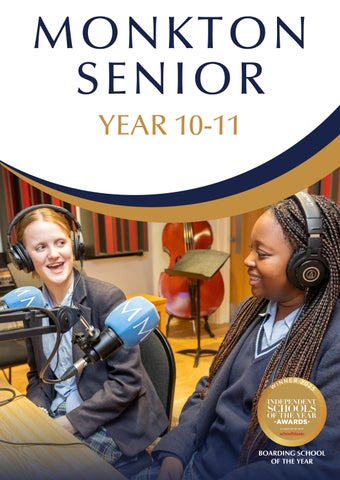
MONKTON SENIOR YEAR 10-11
BOARDING SCHOOL OF THE YEAR
2
WELCOME from the Principal
Years 10 and 11 are often dominated by the name of the examinations that take place in May and June at the end of the second year, GCSEs. For Monktonians, this is not all that these years are for. There is certainly a strong element that is focused on enabling each person to make a first inscription on their academic CVs. A series of marks that paint a positive picture about the level reached at this point in time. Monkton’s aim is to do all we can to enable this “front stage” to be both accurate and eye-catching for future recipients. This starts by helping pupils to make informed decisions about their subject choices and then continuing to raise the bar over the two years with that final destination in mind. Pupils will need to become adept at receiving constructive and critical feedback, understanding how they learn and what works well, celebrating the small wins, collaborating with others, and working hard. These two years are not just about the “front stage”, perhaps the greatest lifelong learning takes place
“
behind the scenes, on the “back stage”. This is where pupils form their character, moral code and self-awareness. This is a priority for Monkton as we recognise that a focus solely on short term exam success will likely only deliver just that, short term exam success. “Back stage” learning happens when pupils take a broad view of how they seek to be known, where they seek inspiration and the growth that comes from being ambitious for yourself and others. The “front stage” GCSE grades will help open doors whilst the quality of the “back stage” will lead to a full life. This booklet sets out the information you need to know about how the provision and choices for Year 10 and 11 pupils at Monkton. If you have any questions, please reach out to a member of staff at the school. We would love to have that conversation with you. Years 10 and 11 are dynamic and exciting years and key steps into the Sixth Form at Monkton. I hope that what has been provided for you here gives a taste of that. Bradley Salisbury
Perhaps the greatest life-long learning takes place behind the scenes.
Principal
3
CONTENTS 5. Why Monkton Senior? 6. MONKTON LIFE 8. Community 10. Boarding 12. Christian Ethos 14. CO-CURRICULAR 16. Enrichment 18. Sport 20. Performing Arts 22. Outdoors 24. ACADEMIC COURSES 26. Futures Programme 28. Destinations
4
30.
GCSE Curriculum & Academic Subjects
51. 52. 54.
Scholarships & Bursaries Academic Pathway Map Admissions
WHY MONKTON
SENIOR?
Monkton is a very special place, full of opportunity, challenge and stretch, underpinned by a deep community that builds confidence and academic ambition. A place where you will…
BE KNOWN Year 10 marks the beginning of a journey in more ways than one. GCSE work begins but this also marks a shift from exploring to honing, as you begin to focus on specific areas that you want to understand more profoundly. Your self-awareness grows and, with the help of the teachers, house team and tutor, who build deep relationships with you, you will start to see the path you want to pursue into Sixth Form, and indeed, beyond Monkton.
BE INSPIRED From the staggeringly beautiful surroundings of the Monkton Valley to the innovative, stretching academic curriculum, to the breadth and excellence of the co-curricular programme, to the deep communities in the houses - everything is here to inspire you to learn, to start to imagine what you want to do in the future, with so much to enjoy in the present.
BE AMBITIOUS Scan the QR above to learn more about why parents chose Monkton!
We want our pupils to be ambitious inside the classroom and beyond: to grow in becoming the best version of themselves, to learn new things, persist through obstacles, to find a future path that they believe in, and to have the confidence to pursue it. There are as many futures as there are Monktonians, but at Monkton you will find all you need to grow into a courageous, kind adult, able to make a positive difference to the world both now and in the future. Read on to find out more…
5
Be Known
Community Boarding Christian Ethos
6
MONKTO
ON LIFE
7
Be Known
YEAR 10
COMMUNITY The truly special community is one of the things that sets Monkton apart and is an aspect that is deeply valued by so many pupils, past and present. We have a distinctive, integrated approach to boarding, with all pupils, day and boarders being part of the Houses with the opportunity for day pupils to engage with the evening and weekend programme..This enables every pupil to be known by teachers in a deep and nuanced way, creating a place where it is safe to try, to step out of your comfort zone, and push yourself. And the community extends in both directions, in all sorts of ways. Across the co-curricular programme you will get to know a variety of people, from your year group and beyond. The boarding ethos enables you to forge connections, not only with your peers, but the older pupils as well. They become like older brothers and sisters, giving advice, support and care, and those friendships often outlast school. Kindness and care for others sits at the very heart of how we operate as a school and community, and it makes Monkton a very special place to live and study.
“
The supportive and accepting community at Monkton enables pupils to push boundaries and explore new skills. Hannah OM 2025
8
9
Be Known
SENIOR
BOARDING A key aspect of Monkton is our boarding ethos. The school day is built around this and allows time for pupils to build strong relationships and memories which in turn enhance their experience of school life. The boarding environment encourages students to learn more about others and, in doing so, about themselves. Living in a strong and caring community, where older pupils pride themselves on supporting younger ones, those starting their time at the Senior School quickly feel safe and at home. They are able to see in older peers some of what lies ahead for them, and aspirations and character are developed in a positive environment that encourages individual discovery. All students (both boarders and day) join one of the six boarding houses which are led by Houseparents and their teams. Houses are full of life and laughter throughout the year and the care and systems in place from both staff and students alike help to build independence within a loving big family. Day pupils access as much of the house activities as they want to, including a number of boarding nights at Monkton, included in the day fee, each academic year to help them in their ‘journey into boarding’ that ultimately all students are on as they move towards adulthood.
“
I found that the house community doesn’t change, whether you’re boarding or not. I often came in for breakfast and didn’t leave until just before bedtime. This was one of my favourite parts about Monktonwhich I’ve found to be quite unique after talking to my university friends. Izzy (Day Pupil) OM 2020
10
11
Be Known
OUR STRONG
CHRISTIAN ETHOS Monkton’s Christian ethos lies at the heart of the school in the values it helps nurture and the opportunity it provides to explore faith as well as the bigger questions of life. The School meets centrally for a short chapel service and ‘Thought for the Day ‘on Mondays and Wednesdays, led by the Chaplaincy team, members of staff, and pupils. On Fridays, each House holds its own House Prayers - a house-led, informal and interactive gathering. The School gathers for a longer chapel service on Saturdays after lessons, and before lunch and afternoon sports begin. Visiting speakers, a range of topics, and multimedia are all used. For boarders wishing to attend a church in Bath on Sundays, minibuses and taxis are provided. In addition, there are optional Bible study groups on Monday evenings, run by various members of staff, which are well attended. The highlight of the week
“
I was on the CU committee, which was so encouraging for me and was an opportunity to serve and help others. I was also mentored by Rev Hutch who read the Bible with me and helped me grow in my faith. Peter, - Class of 2023 Christian Bursary Recipient
12
is the Christian Union, meeting on Wednesdays and attended by around 80 pupils. The Christian Union is organised and run by a Year 13 committee, supported by the Chaplaincy, while a number of Sixth Formers also lead year-group or house prayer groups. Alongside this, there is a lively programme of activities throughout the year, including sports events, joint gatherings with other schools, and visits from comedians, sportspeople, and rappers. During their time at Monkton, pupils are given the opportunity to engage with the Christian faith, explore their questions in a safe space, and see how a Christian framework for life can be lived out practically as they prepare for life beyond school.
Scan the QR above to learn more about our amazing Chaplaincy
“
Monkton’s Christian ethos is such a core part of the school and totally shapes the foundations and attitudes. Compassion always comes first, creating a loving and safe community, without fear of judgement and with certainty Pippa of support. OM 2025
13
Be Inspired
Scan the QR above to learn more about our co-curricular provision
Enrichment Sport Performing Arts Outdoors
CO-CURR 14
RICULAR 15
Be Inspired
MONKTON
ENRICHMENT At Monkton, there are a wealth of opportunities on offer outside the classroom. But it’s not just about having lots on offer, it’s about how every pupil is individually supported to get involved, be inspired through trying new things, and to grow through those experiences. Co-curricular life isn’t a ‘bolt-on’ at Monkton - it is central to helping develop the whole student. So much growth happens outside the classroom as pupils learn how to lead, how to collaborate and how to bounce back when things go wrong, and these are all skills they will take with them after school. Clubs School clubs are wide and varied and students are often able to introduce their own, with staff support. They include product disassembly, retro games, gardening, beekeeping, airfix models, knitting, craft, chess, philosophy and walking. Enrichment In Year 10, you choose one strand of Combined Cadet Force: Army, REME, Navy or RAF and discover a wide range of experiences and skills. In Year 11, you can specialise in areas such as rowing, touring theatre, or sustainability, or enjoy the variety of a carousel, trying golf, culinary school, climbing and football.
“
I really valued how Monkton encouraged me to take part in every aspect of school life, from sports to drama to academics, helping us grow into well-rounded individuals. The community at Monkton is so unique and I am so grateful I was a part of it.
16
Tasha OM 2021
CULINARY SCHOOL MODEL UNITED NATIONS ROWING KNITTING CRAFTS CERAMICS CHESS PHILOSOPHY GOLF CCF BAKING SUSTAINABILITY DANCE CLIMBING FOOTBALL GIRLS’ RUGBY TENNIS BASKETBALL TOURING THEATRE AND MORE...
17
Be Inspired
MONKTON
SPORT
PARTICIPATION, BREADTH, EXCELLENCE There are so many sporting opportunities at Monkton, starting with 2 dedicated sports sessions during the week. These vary from term to term, but include rugby, hockey, netball, cricket, rowing, tennis and athletics. There are also Saturday afternoon fixtures most weekends, enabling everyone to translate the skills learned in training into a real match scenario. These sports are run by highly qualified Heads of Sport and coaches both from the staff body but also from local clubs such as Bath Rugby and Bath Buccaneers Hockey Club. Then there are an array of sports clubs to choose from. Ultimate frisbee, basketball, football, table tennis, stretch and tone, pickleball, running, touch rugby, Strength + Conditioning and more.
“
There are also extension sessions for the main sports for those wanting to develop and improve their skill levels further. Some pupils make the most of our links with Bath University which is five minutes away from school. There are regular minibuses from school so pupils can participate in the various clubs and regional development sides, including Bath Buccaneers hockey, Team Bath swimming, Team Bath netball, Bath Uni Tennis and Bath Athletics club. When pupils reach the highest level of sport such as international representation, they have bespoke arrangements to ensure they are able to balance the demands of their high performance sport and their academic studies.
“
The sports department has shown how much they are Monkton has supported committed to making sure me by providing me with opportunities to be coached each child can improve their physical health. Even when by highly skilled staff who you’re not in the top teams, constantly motivate me to you do feel like you’re improve. This has led me working towards your own to be able to compete in events such as Henley Royal goals. Manuella OM 2020 Regatta. Noah
18
OM 2025
• Elite Sporting Pathway • Professional & Olympic Coaching • Strong links with Bath Uni
Scan the QR above to learn more about Sport at Monkton 19
Be Inspired
MONKTON
PERFORMING ARTS Encompassing Drama, Music, Dance and Media, there’s a place at Monkton for everyone to experience the joy of the Performing Arts. Opportunity is central to the faculty, which provides a broad range of creative and Performing possibilities. Beyond curriculum Drama lessons, we offer everything from informal pupil-led solo and extravaganza productions from ‘Into the Woods’ and the pupil-written and directed Greek tragedy adaptation ‘Wild Myths’, to the ever popular Monkton Touring Theatre shows for primary and prep schools. We recognise that students at Monkton have varying degrees of experience and self confidence. Progress and success manifests in many forms, from that first step onto the stage to playing a leading part in a large-scale school play. Whether on-stage or as part of Monkton’s Stage Crew, there’s a place for all. We have links with higher education establishments including Bath Spa University and the Royal Welsh College of Music and Drama, and recent visits to professional venues have included the superb post-production Films@59 and a bespoke tour backstage at the Royal Opera House. In Music, there are numerous opportunities to get involved. Ensembles include Gospel Choir and Chapel Choir, orchestra, bands such as Wall of Sound and clubs like Music Tech. Making
“
music together brings both great joy and progress, and we expect those who learn to play and sing to participate in school ensembles. There is a host of performance opportunities; from the amazing annual Longmead Music Festival through to Studio 1@1 informal lunchtime concerts, from cathedral Evensongs and performances at venues such as Disneyland Paris and Real World Studios, to exciting concerts which have recently featured everything from live gaming to AI! The faculty’s media opportunities are also growing, offering weekly sessions in our superb studios, teaching audio recording for podcasts, and every faculty event is streamed, often in multi-camera format. In Dance, we have regular workshops from leading Professionals from the West End, and our Dance Troupe performs at all of our large scale concerts. As well as engendering a love of the arts and developing life skills such as creativity and self-confidence, Monkton’s most passionate performing artists have gone on to study at a wide range of leading institutions from The Royal Welsh College of Music and Drama and LAMDA to BIMM and universities such as Surrey and Durham. Monkton’s Faculty of Performing Arts lives by its motto - Opportunities for Possibilities.
As an actor, I’ve discovered that true growth arises from stepping out of your comfort zone. Monkton’s Performing Arts department encouraged me to rise to the challenge. Kambua
OM 2025
20
21
Be Inspired
MONKTON
OUTDOORS
Our unique Wild Monkton programme recognises the importance of being outdoors away from screens and close to nature in order to help support our students’ mental health.
The co-curricular programme inspires our pupils in so many ways, whether they are deepening an existing passion and learning to excel in it, or discovering a new skill and broadening their outlook as a result.
The Clubs programme also offers many opportunities to get outdoors with clubs such as gardening and walking. Monkton Mountain Challenge Along similar lines to the National Ten Tors Competition, our Year 10 students have the opportunity to complete our own Monkton Mountain Challenge. This is open to those students who really want to push themselves physically, mentally and emotionally in the outdoors as they tackle an increasingly demanding set of mountain peaks in the Brecon Beacons, Dartmoor National Park and Snowdonia, with wild camping and cooking along the way.
22
Scan the QR above to learn more about our Outdoor provision at Monkton
COMBINED CADET FORCE
Our Combined Cadet Force is compulsory for all Year 10 students. Students choose between 3 sections - Army, Navy and the RAF. Here they learn field craft, navigation, team work, personal challenge, selfdiscipline, first aid, code breaking, communication, as well as flying and sailing on occasion.
23
Be Ambitious
Scan the QR above to learn more about our academic provision
Futures Destinations Subject Curriculum Scholarships & Bursaries Academic Pathway Map Admissions
ACADEMIC 24
COURSES
C
S
25
Be Ambitious
FUTURES
PROGRAMME Monkton’s vision is to inspire young people to become courageous, kind and ambitious adults who live fulfilling lives. Hence, our Futures Programme in Year 10 and 11 continues to build on each pupil’s careers journey so far. There is individual advice through our 1:1 Tutor meetings and also by arranging meetings with any member of the Futures Team. In addition, there are opportunities for external advice, and discussions with the school’s senior leaders at key transitions. Our Futures programme is about helping each student to become future ready and aware of their options. Pupils will develop an understanding of the world of work and job market through careers specific lessons in their PSHE. Each student will continue to build on their personal online careers account as they progress through the school and this account acts as a central hub for the formalised careers testing in Years 9, 11 and 12. One of Monkton’s key educational strategic aims is that we are a community committed to working together, developing self knowledge, always asking
26
questions, evaluating progress, acknowledging failure, celebrating success, and making implicitly taught skills and characteristics explicit. Therefore, students use their careers account to gather evidence of skills development and to record their research and thinking. We use a variety of personality and strengths questionnaires in order to provide students with greater insight and understanding of themselves so they can become more self-aware. We also use the Skills Builder Universal Framework for Essential Skills to develop these core, transferable skills for employment through lessons and activities. We encourage students to produce their own digital portfolio to showcase their skills and characteristics and to continue to focus on developing these, which cover: •
Communication
•
Creative Problem-Solving
•
Self-Management
•
Interpersonal Skills
Monkton inspires young people to become courageous, kind and ambitious adults who live fulfilling lives. 27
Be Ambitious
A DIVERSE ARRAY OF UNIVERSITIES...
INTERNATIONAL DESTINATIONS
Bellmont Abbey, USA
Abertay Dundee HULT International
Edinburgh Durham
University of Washington
York Marian University
Leicester Sheffield
Manchester
Loughborough
Nottingham Birmingham
Middlesex
Swansea Central Saint Martins
Cardiff
King’s College London London School of Economics
Bristol Royal Welsh College Music & Drama Southampton Bath
Falmouth Exeter
28
Oxford
Norland
Reading
University College London London Academy of Music and Dramatic Art Cambridge
MONKTON
DESTINATIONS ALEX
SOPHIE
3RD YEAR MEDICINE - OXFORD
MPHYS FIRST CLASS - OXFORD
Alex Bichard, now thriving in his third year of Medicine at Merton College, Oxford, speaks with real gratitude for Monkton’s Medicine Programme. He recalls the Science Department’s “empathy and flexibility around workload,” and how teachers went the extra mile to adapt lessons to his interests. Alex also embraced wider opportunities from ophthalmology work experience to inspirational guest speakers. He was supported every step of the way by teachers who encouraged him, gave feedback, and opened doors through their medical networks.
“Monkton has supported me in exploring my wide-ranging academic interests. Throughout the earlier years I changed my mind multiple times about what I wanted to study at university before settling on Physics. I was never pigeonholed into one area but encouraged to pursue Maths and Science as well as Languages and Philosophy. My teachers were focused on developing a love of learning and a passion for their subjects, whilst also helping me achieve great exam results. They always gave me extra challenging material and never tired of answering my incessant questions which has laid an amazing foundation for my later studies.”
EVE
IZZY
FIRST CLASS BA(HONS) HISTORY - LOUGHBOROUGH
FIRST CLASS BA(HONS) FRENCH & CHINESE STUDIES - NOTTINGHAM
“Monkton’s engaging teachers and interesting History lessons first sparked my interest in learning about people and places. The trip we took to Berlin in Year 10 even inspired me to spend my university year abroad in the city – and to start learning German. Sport was also a huge part of my time at Monkton – playing in the first teams set me up well to contribute to life at sport-fuelled Loughborough.”
“I was really taken with the range of subjects available at Monkton, especially when it came to languages. I started learning French in the Prep School and took on Mandarin at GCSE level – both of which I carried through to my degree, which included stints in Martinique and China. This early exposure to languages, alongside truly lovely teachers and a fun syllabus, sparked a lasting interest in cross-cultural communication.”
29
YEAR 10
CURRICULUM
Year 10 is an exciting time at Monkton. It is the start of your GCSE courses and the first time pupils will have chosen the majority of their subjects. Monkton seeks to ensure pupils are given as much autonomy as possible, guided and supported by their tutor, houseparents and teachers, and we are unusual in that only English Language and Literature, or EAL, and Mathematics are compulsory, with all other subjects being placed into one of six blocks. Pupils typically study two or three Sciences within the blocks, which are designed to allow pupils as broad and varied a range of options as possible. Academic expectations deepen in Year 10, led by dynamic, innovative teaching and personal support from your teachers and it is crucial that pupils have a love of the subjects they choose to study.
Where pupils have specific learning needs, our outstanding Learning Support department work 1:1, enabling every pupil to reach their full potential. For international pupils, our EAL team offer excellent, tailored lessons to accelerate English acquisition and enable you to thrive in your academic lessons. The wide range of subjects available at GCSE and A level at Monkton create a platform for you to build the life you want beyond school.
“
I left Monkton with confidence, belief in myself and my abilities, We encourage every pupil to embrace academic challenge, to work diligently from the start of Year 10, building strong foundations for both GCSEs and A fantastic A Level results Levels. and friends for life. Departments offer workshops each week, in which you can receive additional support, or extra help with prep or classwork that you are finding difficult. Your tutor will meet regularly with you to discuss your academic progress.
Gemma, OM 2024
30
SUBJECTS 32.
Photography
Fine Art
33. 34.
Design (Three Dimensional Design) Mathematics
Business
36. 37.
Biology Physics
Chemistry
39.
Physical Education
Computer Science
40.
Dance, Drama
Music
41. 42.
English Literature
English as an Additional Language
43.
French
English Language
Mandarin Chinese
44.
Spanish
Latin
46.
Theology, Philosophy and Ethics (TPE)
History
47. 48.
Higher Project Qualification (HPQ)
Extra Support for English
49.
Learning Support and Study Skills
Extra Support for Maths
Geography
31
Be Ambitious Photography
Fine Art
Why study this subject?
Why study this subject?
Studying GCSE Photography helps you develop creativity, technical skills, and a critical eye for composition and lighting. It allows you to express ideas visually while learning camera techniques, editing, and visual storytelling. The course boosts problem-solving and analytical skills, and it’s a great foundation for careers in art, media, or design. We are surrounded by images, humans take billions of photos each year; this can help you make sense of the visual culture that we all live in.
Studying GCSE Fine Art fosters creativity, critical thinking, and self-expression. It enhances observational, technical, and problem-solving skills through drawing, painting, and mixed media. You learn to analyse artists’ work, developing cultural awareness and artistic appreciation. The course encourages independent thinking, resilience, and experimentation, valuable in any career. It builds a strong portfolio for further art studies or careers in design, media, or architecture. The qualification develops time management and presentation skills, preparing you for higher education. Overall, it nurtures both artistic talent and transferable skills for the future.
AQA
What will I learn at GCSE? In AQA GCSE Photography, you will learn essential technical and creative skills, including how to use a camera manually, control lighting, and compose striking images. You’ll explore different genres like portraiture, landscapes, film, experimental imagery, while experimenting with techniques such as digital editing, darkroom processes, and mixed media. The course emphasises developing a personal style, researching photographers, and analysing their work to inspire your own projects. You’ll also refine your ability to critique images and present your ideas effectively. Through practical assignments and coursework, you’ll build a personal portfolio, preparing you for further study or careers in photography, art, and media. How is the course structured? In Year 10, you’ll experiment with fundamental camera settings, composition, lighting, and digital editing techniques to build your creative confidence. Projects focus on visual exploration, developing ideas, and learning how to tell stories through images. Midway through Year 10, you begin your personal project which is 60% of the overall marks. The remaining 40%, which begins in January of Year 11, is a project set by the exam board, combining research, shoot planning, and image manipulation into a final body of work that culminates in a practical exam. How is the course examined? The AQA GCSE Photography course is assessed through 60% coursework (Portfolio) and 40% externally set assignment (ESA). For the Portfolio, you submit a body of work demonstrating your skills in research, experimentation, and final outcomes. Teachers assess it against four assessment objectives (AO1–AO4), then AQA moderates the marks. The ESA involves a 10-hour supervised practical exam (usually split over two days), where you create final pieces based on preparatory work. Your response to the ESA theme is marked by teachers and moderated by AQA. Both components are judged on: developing ideas, refining techniques, recording observations, and presenting a personal response.
32
AQA
What will I learn at GCSE? Studying GCSE Fine Art will teach you a range of practical skills including: drawing, painting, printmaking, sculpture, and digital art, while exploring creative techniques like composition, colour theory, and mixedmedia experimentation. You’ll learn to analyse artists’ work, understand different styles and cultural contexts, and develop your own ideas from initial sketches to final pieces, refining your personal style. The course also focuses on critical evaluation, helping you assess your own work and others’ to improve through feedback. Additionally, you’ll build a portfolio for further study or careers in art, design, or media, while developing independent thinking, problemsolving, and time management skills. The course balances technical ability with creative freedom, preparing you for A-Level Art or future creative professions. How is the course structured? In Year 10, you’ll experiment with a range of drawing, painting, printmaking, sculpture and mixed-media techniques to build your creative confidence and develop your own artistic style. Projects focus on visual exploration, experimentation, developing ideas and learning how to communicate meaning through art. Midway through Year 10, you begin your personal project, which makes up 60% of the overall marks. The remaining 40%, which begins in January of Year 11, is a project set by the exam board, combining research, experimentation, development and refinement into a final body of work that culminates in a practical exam. How is the course examined? The GCSE Fine Art course is assessed through 60% coursework (Portfolio) and 40% externally set assignment (ESA). For the Portfolio, you submit a body of work demonstrating your skills in research, experimentation, and final outcomes. Teachers assess it against four assessment objectives (AO1–AO4), then AQA moderates the marks. The ESA involves a 10-hour supervised practical exam (usually split over two days), where you create final pieces based on preparatory work. Your response to the ESA theme is marked by teachers and moderated by AQA. Both components are judged on: developing ideas, refining techniques, recording observations, and presenting a personal response.
Design (Three Dimensional Design) AQA
Why study this subject? 3D Design is perfect for creative problem-solvers who love bringing ideas to life. You’ll learn to design and make innovative products using a wide range of materials and techniques through the iterative design process. It’s great for future careers in architecture, product design, jewellery design, engineering and many more. Plus, you’ll develop skills like creative problem solving, critical thinking and project management that are useful in any job. What will I learn at GCSE? In GCSE 3D Design, you’ll explore product creation. You’ll learn to sketch and develop ideas, use computer-aided design (CAD) software, and create prototypes. You will also work with different materials like wood, metal, and plastics. You’ll discover the design process, from initial concepts to final products. You will study iconic designers and design movements for inspiration. You’ll learn about sustainability in design and how to consider user needs. By the end, you’ll be able to create exciting innovative solutions. How is the course structured? The course is split into two main parts: coursework and exam. In the beginning of Year 10, we focus on building skills through mini-projects. You’ll try out different materials and techniques, and learn to use design software. We also start the main coursework project, which continues into Year 11. This coursework project lets you choose a theme and create a product from start to finish. You’ll research, sketch ideas, develop designs, make prototypes, and produce a final piece. Then in January of Year 11 you will start the exam project which is a mini design and make project. How is the course examined? The course is assessed through both coursework and an exam project. Component 1: Non-Exam Assessment (60%). This includes a number of mini projects and then your own personal project which you will begin half way through Year 10 and finish in Year 11. Component 2: Externally Set Assignment (40%). Set in January and completed in a much shorter space of time, ending with a 10 hour exam in the beginning of the summer term in which you realise your final design.
33
Be Ambitious Mathematics
Business
Why study this subject?
Why study this subject?
Taking Maths iGCSE opens doors to many future careers, not just traditionally “mathsy” ones. It sharpens your problem-solving and logical thinking skills, and in addition, it’s a qualification that employers and universities really value highly – it shows you can handle a challenge!
The Business Studies GCSE exposes inspiring entrepreneurs to the world of commerce, sparking innovation in a commercial context. You will develop your transferable skills in finance, organisation, planning and risk taking, all needed to fulfil a small business start up. The course is extremely current, using real business case studies from the world around us, from small scale entrepreneurs to larger global enterprises.
Edexcel IGCSE
What will I learn at GCSE? You will build a solid foundation in essential topics like algebra, geometry, statistics, and probability. You’ll learn how to work with equations, understand shapes and space, analyse data, and figure out the chances of things happening. These skills aren’t just abstract ideas; they will help you make sense of the world around you, from budgeting to understanding scientific information. It’s about gaining tools for logical thinking and problem-solving in a mathematical context. How is the course structured? We study the IGCSE Edexcel course. This is split into four areas: number, algebra, geometry, statistics. We have constructed a spiral curriculum, so that topics are revisited regularly and in increasing depth. For gifted pupils extension takes the form of UKMT Maths Challenge competitions, enrichment and accelerated learning, and the completion of mentoring scheme problems. Provision for pupils requiring learning support takes the form of two timetabled extra Maths lessons a week, voluntary attendance of three afterschool workshops, plus access to a private tutor – at an additional cost. How is the course examined? Pupils sit two exams at the end of year 11, each a two-hour calculator paper. Some pupils may take the Foundation Tier entry in November of Year 11 with the expectation that they will then take the Higher Tier entry in June. The highest set also study the Further Maths GCSE (AQA), with an examination typically taken in June of Year 11. This prepares pupils well for A-level Maths and Further Maths by consolidating the harder topics from GCSE as well as exposing them to new exciting topics such as matrices and the binomial expansion.
EDEXCEL
What will I learn at GCSE? You will cover the internal and external operations of a business including the generation of innovative business ideas, how to compete in new and existing markets, and developing the correct strategic approaches to choose given the external environment in which businesses exist. Covering introductory level finance, people, operation, marketing and the environment, you will cover a range of business activities through diverse learning techniques including enterprise competitions and real life insights through our Business Studies trips. How is the course structured? The course begins by investigating small businesses including converting a business idea into reality and finding the financial resources to start up. The course then develops by investigating how to grow a business, the strategic choices made, sourcing and managing finance, planning and the external legal, competitive and economics environment in which they operate. How is the course examined? The course is examined through a mixture of multiple choice, short answer and extended answer questions ranging from 1-12 marks. Two papers, 50% each, are used to assess this course, each being 90 minute written papers responding to case study data. Extended writing skills are needed for the longer answer/short essay questions and numerical skills are essential throughout. You are advised to follow current business affairs and read the business news on a weekly basis, following key strategic choices, competitive activities and legislative pressures on business operations.
“
I think all pupils that leave Monkton are going to be ahead of their peers when they go to University. They don’t just learn skills as an academic exercise, they learn them as a life skill. Jonathan Belcher Head of Learning Support
34
35
Be Ambitious Biology AQA
Why study this subject? Biology GCSE provides students with an excellent understanding of the natural world while at the time providing those who wish to study science at A-level with an excellent science grounding. What will I learn at GCSE? You will discover the extraordinary sphere of Life on Earth from tiny bacteria to the complicated inner workings of our body. It is important for humans to appreciate that they are part of the world in which they exist and show an understanding of their place in it. By carrying out practical work and following scientific procedure during experiments you will learn to evaluate, assess and think critically, all vital skills in today’s world. How is the course structured? We start teaching the GCSE syllabus in Year 10, looking at how cells and the organ systems they are found in keep the body alive. The vital role plants play in ensuring life on Earth exists is also emphasised. The ability to think critically and being able to evaluate information and data is now a fundamental part of Biology at GCSE. In Year 11 the structure and function of DNA (which now forms a core part of the syllabus) is looked at in detail. Much practical work is undertaken to bring to life the academic content we study. How is the course examined? There are two exam papers: • Paper 1 (1h 45): Topics 1–4: cell biology, organisation infection and response and bioenergetics. • Paper 2 (1h 45): Topics 5–7: homeostasis and response, inheritance, variation and evolution and ecology.
“
We offer a large and diverse range of subjects and provide them with the guidance and skills to make informed decisions at each step of the academic journey. Victoria Armand-Smith Deputy Head Academic
36
Physics
Chemistry
Why study this subject?
Why study this subject?
You will learn to approach the real world with an analytical eye and logically apply the ideas and skills learnt in Physics to each situation. The course offers a chance to put practical skills and academic knowledge together, aiding you to develop through kinesthetic learning and more traditional learning styles. You will also further develop your analytical skills as data is collected and processed, helping you to reach valid and reliable conclusions. These skills will be vital in studying A-level and beyond, as well as being sought after by employers especially in Physics, Engineering, Computer Science and other related fields.
Chemistry helps us understand the materials and processes that shape our world. It develops analytical thinking, problem-solving, and practical skills, and is essential for careers in science, healthcare, and engineering. It also supports learning in Biology and Physics, and is essential for the study of both A Levels Chemistry and Biology.
AQA
What will I learn at GCSE? The course comprises eight topic areas covering Energy, Electricity, Model of Matter, Radioactivity, Forces, Waves, Magnetism & Electromagnetism, and Space. Throughout the course we aim to develop the knowledge and understanding in Physics through both working practically and through scientific thinking. Ideas of how the universe began to current day thinking on climate change are discussed, with each student considering their experiences and responsibilities in a rapidly changing world. You will also develop your mathematical skills, whilst molecular Chemistry and Human Biology lend themselves to the content of the Physics course. How is the course structured? Content is delivered one topic at a time through classroom teaching; debates and discussions; practical experiments and demonstrations; questions and assessments; online digital simulations. However, as you build your knowledge and understanding, links between the topic areas are built and explored. How is the course examined? The course has two exam papers in which knowledge, practical understanding, application and evaluation skills are assessed. There is no practical assessment involved, but questions within the exam papers will have practical elements. •
Paper 1 (1h 45 - 100 marks) assesses topics 1-4: Energy; Electricity; Model of Matter; Radioactivity
•
Paper 2 (1h 45 - 100 marks) assesses topics 5-8: Forces; Waves; Magnetism and Electromagnetism; Space
AQA
What will I learn at GCSE? You will study a wide range of topics that show how chemistry connects to the world around us. These include atomic structure, bonding, chemical reactions, energy changes, rates of reaction, organic chemistry, and chemical analysis. You’ll also explore the chemistry of the atmosphere, sustainable resource use, and environmental impact. Practical experiments throughout the course will strengthen your investigative and analytical skills, helping you interpret scientific data and understand real-life chemical processes. How is the course structured? You have four lessons a week, including a double lesson often focused on practical work to develop analytical skills and reinforce theory. You will build core knowledge of atomic structure, the Periodic table, chemical equations, resources, environmental impact and sustainability. Year 10 introduces bonding and structures, energy changes, quantative chemistry and analytical methods.The course is completed in Year 11 covering Group 7 chemistry, electrolysis, fuel cells, chemical equilibria, and more advanced organic chemistry concluding with applied chemistry and sustainability, revisiting and integrating previous learning. How is the course examined? Assessment is by two written exams, each 1 hour 45 minutes. •
Paper 1 covers topics 1-5: atomic structure, bonding, quantitative chemistry, chemical changes, and energy changes.
•
Paper 2 covers topics 6-10: rates of reaction, organic chemistry, chemical analysis, atmospheric chemistry, and using resources.
Both papers include multiple-choice, structured, and extended-response questions. There is no coursework, but practical skills are tested in the exams through questions based on required practical activities completed during the course. There are eight required practicals. Practicals 1-4 can be assessed in Paper 1 and Practicals 5-8 in Paper 2.
37
Be Ambitious
38
Physical Education
Computer Science
Why study this subject?
Why study this subject?
In GCSE PE we explore sports performance in depth, enabling you to understand how your body works when exercising and how to aid your performance, in addition to delving into the world of elite sport and training. Taking this GCSE will allow you to study Physical Education further and potentially pursue a career in sport related fields.
Computer Science GCSE gives you a strong understanding of the fundamental principles of the subject, providing a foundation for A Level and beyond while also developing knowledge useful across many areas of science and engineering.
What will I learn at GCSE?
What will I learn at GCSE?
AQA
You will cover topics on anatomy and physiology, movement analysis, health and fitness, sports psychology, ethical issues, commercialisation, sports technology and diet. You will also get the chance to improve and analyse your practical performance through practical and written aspects. How is the course structured? We teach four topics in Year 10 and a further two in Year 11. We will also start the coursework in Year 10 where you must complete an evaluation of their performance in one sport and provide a training programme for improvement. In addition to this, we conduct some practical lessons and mock moderation sessions that allow you to be assessed practically across three sports in both skills and competition. How is the course examined? Topics 1-3 are assessed through paper 1 and topics 4-6 are assessed through paper 2. Both exams are completed in the summer of Year 11 and each are worth 30% of the overall course grade, totalling 60%. The coursework piece is worth 10%, whilst the three sports are worth 10% each, totalling 40% non-exam assessment. The three sports chosen must be from the AQA specification and they must be a mixture of team and individual sports. You are advised to be playing at least two sports of school first team, or higher level, and must be willing to commit to filming their practical performances.
EDEXCEL
You will learn computational thinking, alongside programming by writing pseudocode. This will lead you onto high-level computer languages (Python) and develop your understanding of the main principles in problem-solving using computers. You will apply your understanding to develop computer based solutions to set problems. You will also develop a range of technical skills, including the ability to test effectively and to evaluate computing solutions. You will look at current computing technologies, considering the benefits of their use, as well as recognising the ethical issues and potential risks when using computers. You are taught the component parts of computer systems, including software, data, hardware and network communication, and how they all interrelate. How is the course structured? You will study hardware, software and network communications, in addition, there is consideration of the UK laws, ethical and cultural arguments needing to be considered when using computer systems and developing further technologies. Algorithms and problem solving skills are developed and tested, along with programming in Python via the Google IDE Colab. We also delve into some mathematical skills with boolean logic and truth tables. The content is taught simultaneously, building confidence and depth throughout the two years. How is the course examined? There are two externally examined papers: Paper 1 - Computational Systems 1 hour 30 minutes 50% This paper consists of multiple choice questions, short response questions and extended response questions. Paper 2 - Computational thinking, algorithms and programming 1 hour 30 minutes 50% This paper has two sections: Section A and Section B. You must answer both sections. In Section B, questions assessing your ability to write or refine algorithms must be answered using either the OCR Exam Reference Language or the high-level programming language with which they are familiar (generally Python).
39
Be Ambitious Dance
Drama
Why study this subject? If you are a passionate dancer, then the chance to study this at GCSE level is a great opportunity to get into the details of Dance. Like many artistic subjects, valuable life skills such as creativity, self-discipline and teamwork will be nurtured and developed whilst you follow the course. Dance also sharpens your real-time reactions, empathy and ability to adapt, preparing you to thrive in any environment.
Why study this subject?
AQA
What will I learn at GCSE? Discover the creativity, energy and excitement of dance as you develop your skills as a performer and choreographer. Through practical work, you will create your own choreography and explore a wide range of dance styles, genres and practitioners. You will experiment with movement, develop your own ideas and learn how to bring them to life through performance. Alongside developing your creative skills, you will learn to work collaboratively, gain analytical skills, produce high-quality performances, and demonstrate your knowledge and understanding through written assessment. How is the course structured? The course has two components. Component 1 (60%): Performance and Choreography Part 1 - You will perform a number of set dance phrases of around 1 minute, and a duet/trio performance of 3 minutes. Part 2 - You will choreograph your own solo or group dance Component 2 (40%): Dance Appreciation At the end of Year 11, you will be asked to show your knowledge and understanding of choreography and performing skills, you will analyse your own work during the course, and answer questions about the works in the GCSE Dance Anthology.
EDUQAS
Choosing GCSE Drama isn’t just about the stage – it’s about building life skills that will set you apart in the future, equipping you with the tools to succeed in any career. Employers highly value creativity, problem-solving, and teamwork – all of which are at the heart of what you’ll learn in Drama. Drama also sharpens your emotional intelligence, empathy, and ability to adapt, preparing you to thrive in any environment. What will I learn at GCSE? You will develop creative and analytical skills by exploring drama from acting and design perspectives. The course promotes enjoyment of drama through practical work, including creating original theatre and performing extracts from play texts. You will study theatre practitioners and genres, experiment with dramatic forms and techniques, and learn how to interpret texts for performance. Opportunities to attend live theatre will help you become an informed and thoughtful audience member. You will also develop skills in working collaboratively, producing high-quality theatre, and demonstrating your understanding in a written examination. How is the course structured? The course is structured into three components. Component 1: You will participate in the creation, development and performance of a piece of devised theatre in response to a stimulus. Component 2: You will study two extracts from the same play and then create a performance using sections of text from both extracts. Component 3: Exam at the end of year 11 that will test your knowledge of both a set text and live theatre. How is the course examined? The course has three examined components. As well as a final written exam, there are two performance exams. Component one is internally assessed (and externally moderated) in the Summer Term of Year 10. Component two is externally assessed by a visiting examiner in the Lent Term of Year 11.
“
I love the opportunities to get more comfortable on the stage and in front of people. Anouk
Current Performing Arts Scholar
40
Music
English Literature
Why study this subject?
Why study this subject?
GCSE music develops a vast array of skills: written, analytical, practical, social/personal symbiotic and performative. Above all, the course looks to develop your creativity and your self-expression through performing and composing and our department puts a particular emphasis on the development of these skills through our curriculum planning and teaching strategies.
English Literature brings stories, characters, and ideas to life. You’ll develop skills in critical thinking, empathy, and expression–key qualities for success in many subjects and careers. You’ll explore different global perspectives and learn to engage with big ideas by noticing the small details in texts that reveal deeper truths about people and societies.
What will I learn at GCSE?
What will I learn at GCSE?
You will develop your composition skills and your technology skills as you make use of Sibelius and Logic production software in order to produce your work. You will also develop your analytical skills when listening to and appraising different styles of music. Finally, you will develop as both a solo performer on your individual instrument and you will develop your ensemble skills through working with other musicians in small groups.
You will explore a range of powerful texts, including modern prose, poetry, drama, and a literary heritage text. Authors studied range from Shakespeare to Achebe, spanning modern and traditional works from both British and global traditions. You’ll be encouraged to read habitually beyond the course, comparing texts and appreciating nuanced differences in meaning. You’ll learn to analyse how writers use language and structure, reflect on social and historical contexts, and engage in critical debate. Alongside becoming a powerful, clear, and confident writer, you will develop discussion skills that enable you to express ideas with precision and insight.
EDUQAS
How is the course structured? The listening and analysis part of the course is based around four key areas of study: Area of study 1: Musical Forms and Devices Area of study 2: Music for Ensemble Area of study 3: Film Music Area of study 4: Popular Music We will cover all four areas over the course of the two years and your compositions and performances will be linked to these areas. How is the course examined? Composition forms 30% of the total mark. Throughout the course, you will create two compositions: one based on a specific brief, the other based on a brief of your own choice Performance forms another 30% of the total mark. Here, you will produce one solo and one ensemble performance over the course of two years. At the end of the second year, you will sit a 75 minute listening paper which constitutes 40% of the total marks. It includes in-depth questions related to set works studied during the course and a series of unfamiliar pieces that you will be required to appraise.
Edexcel IGCSE
How is the course structured? The course is made up of two papers. In Paper 1 (examined, 60% of the course), you’ll study poetry from an anthology, respond to unseen poetry, and explore a modern prose text, with the opportunity to demonstrate analytical, comparative, and critical skills. In Paper 3 (coursework, 40% of the course), you will complete two written assignments: one on Modern Drama–either Priestley’s An Inspector Calls or Miller’s A View from the Bridge–and one on a Literary Heritage text, Macbeth. This structure develops a wide range of reading, writing, and evaluative skills across varied literary forms and traditions. How is the course examined? Sixty percent of the course is assessed through a two-hour exam (Paper 1) at the end of Year 11. Section A focuses on unseen poetry, where analytical skills are key. Section B covers anthology poetry, requiring a detailed comparison of two studied poems, both reprinted in the paper. Section C is a more traditional essay on either Achebe’s Things Fall Apart or Ishiguro’s Klara and the Sun, asking you to consider how wider contexts might influence your interpretation. The remaining 40% is assessed through Paper 3 (coursework), with essays on character, theme, and writer’s craft written under controlled conditions.
41
Be Ambitious English Language
Edexcel IGCSE
English as an Additional Language CAMBRIDGE IGCSE
Why study this subject? English Language helps you become a confident communicator. You’ll appreciate how language can shape response and thought, as well as how to craft your own language for effect. The course develops adaptive communication skills and an attentiveness to the small details in texts, sharpening your thinking, strengthening your writing, and preparing you for every subject - and every future - where words matter. What will I learn at GCSE? You will develop your reading, writing, and analytical skills through the study of a wide range of texts, including nonfiction, poetry, and prose. You’ll learn how to structure your own writing for maximum impact and how to respond to structural features in texts. You’ll practise adjusting language to suit different contexts and audiences, both in imaginative and transactional writing. Alongside expressing yourself clearly and effectively, you will develop the ability to communicate about how language shapes the world around us, appreciating the power of words to influence thought, feeling, and perspective. How is the course structured? The course includes one examined component and one coursework component. For the exam, you study a selection of non-fiction texts and practise writing for different real-world purposes, learning to analyse language by imitating styles and techniques from accomplished writers. There is plenty of scope for imaginative and creative thinking, balanced with building a technical skill set to break down how writing works. For the coursework, you complete two assignments: one analytical essay comparing three literary texts from the anthology, and one piece of imaginative writing where you apply the techniques you have studied to craft your own original work. How is the course examined? Sixty percent of the course is assessed through a two-hour and fifteen-minute exam focusing on non-fiction reading and transactional writing. In the reading section, you will respond to an unseen text and compare it to an anthology text through a range of comprehension, analysis, and comparative tasks. Strong communication and careful reading are essential, with plenty of overlap in the skills required for the Literature course. The remaining 40% is assessed through coursework: two written assignments completed under controlled conditions and marked internally.
42
Why study this subject? All EAL lessons promote communicative English in order to build English confidence and competence across the curriculum and outside the classroom. As a specialist small group provision, the learning is tailored to the specific needs of the students to maximise engagement and accelerate progress. What will I learn at GCSE? The Year 10 programme of study covers the first half of the Cambridge ESL IGCSE syllabus. Through developing skills in English reading, writing, speaking and listening combined with strengthening your grammar and vocabulary range, you will learn how to understand and use English effectively in daily life, with an increasing focus on academic English use. How is the course structured? EAL students take five English as an Additional Language lessons a week during mainstream English lessons following the Cambridge IGCSE English as a Second Language examination course. Year 10 provides an IGCSE course foundation by developing English skills, grammar and vocabulary. You cover examination topics and are introduced to specific exam techniques. There is also an emphasis on academic English for use across the curriculum. Year 11 continues to develop English skills, vocabulary and grammar. It also focuses more specifically on IGCSE exam preparation. How is the course examined? The IGCSE is assessed in three examinations: a two-hour reading and writing paper, a fifty-minute listening paper and a fifteen-minute oral exam. Each language skill accounts for 25% of the overall grade. There is no coursework component. At Monkton, there are internal assessments at the start and midpoint of each year to track progress. Additionally, at the end of Year 10, you will have the valuable experience of taking past papers under exam conditions, and again in the mocks in Year 11, to help you gain familiarity with the exam requirements.
French
Mandarin Chinese
Why study this subject?
Why study this subject? Mandarin Chinese is spoken by nearly one third of the world’s population and has become increasingly important as a language of global diplomatic, political and business importance. A level of proficiency in this language could help you stand out in tomorrow’s jobs market, giving you that competitive edge.
AQA
By taking on French GCSE we hope to foster an interest in the language, always encouraging you to see that language learning is a stepping stone to different pathways. Language will give you a broader choice for your A Levels, courses at university, for travel or just communicating with people across the globe in the world’s fifth most spoken language. What will I learn at GCSE? You will be immersed into a French environment in the classroom, learning about France and French speaking cultures and societies. In the classroom you will be encouraged to take an active part in lessons and whether it be through authentic materials, conversations with peers, or even having visiting native speakers, you will have plenty of opportunities to practise your French. All GCSE French students have the extra opportunity for one-to-one, or paired speaking practice in our compulsory weekly speaking session as part of your language and exam learning. How is the course structured? Pupils are assessed in four different elements: Listening, Reading, Written and Spoken French. The course is divided into modules and topics: Identity and Culture, Local Area, Holiday and Travel, Education, Future Aspirations, Study and Work, International and global dimension. Each module is subdivided into different topics and grammar structures, relevant to each topic. How is the course examined? AQA Exam Board: At the end of Year 11 pupils will sit externally assessed exams depending on ability: Foundation or Higher Tier. Pupils are examined in all four aspects: Speaking is conducted internally by the subject teacher and assessed externally while the other three components, Listening, Reading and Writing are externally assessed.
AQA
What will I learn at GCSE? You will not only learn spoken Mandarin, but you will have the opportunity to look into China and Chinese speaking histories, cultures and societies. You will learn how to write those amazing characters and by the end of the year be able to read some Chinese! Through authentic materials, conversations with peers, or even having visiting native speakers, you will practise your Mandarin. All GCSE Mandarin students have the extra opportunity for one-toone, or paired speaking practice. How is the course structured? Pupils are assessed in four different elements: Listening, Reading, Written and Spoken Mandarin. The course is divided into modules and topics: Identity and Culture, Local Area, Holiday and Travel, Education, Future Aspirations, Study and Work, International and Global Dimension. Each module is subdivided into different topics and grammar structures, relevant to each topic. How is the course examined? AQA Exam Board: At the end of Year 11 pupils will sit externally assessed exams depending on ability: Foundation or Higher Tier. Pupils are examined in all four aspects: Speaking is conducted internally by the subject teacher and assessed externally while the other three components, Listening, Reading and Writing are externally assessed.
43
Be Ambitious Spanish
Latin
Why study this subject?
Why study this subject?
With over 400 million people speaking Spanish, studying Spanish at GCSE is a wonderful opportunity to expand your academic knowledge. Alongside gaining valuable transferable skills you develop deeper understanding of Hispanic cultures. The Russell Group of universities (top 24 universities) recommends the studying of a foreign language at GCSE.
The benefits of studying Latin extend far beyond the subject itself. Latin strengthens your understanding of the English language, enhancing reading, writing, and communication skills, while providing a strong foundation for the Romance languages. Its logical structure develops analytical thinking, attention to detail, and problem-solving skills that transfer across the curriculum. At the same time, Latin fosters an appreciation of Roman civilisation and its enduring influence on the Western world. Intellectually stimulating and highly relevant, GCSE Latin equips you with the critical thinking, adaptability, and mental agility needed for further study and success in an increasingly complex workspace.
AQA
What will I learn at GCSE? The course for Spanish GCSE is fun, fast-paced and highly rewarding. In the classroom you will learn not only the language but about Spain and Spanish speaking cultures and societies. You will be encouraged to be brave and take risks in lessons; whether it be learning the language through authentic material or conversations with peers you will have plenty of opportunities to practise your Spanish. All GCSE students have the extra opportunity for one-to-one, or paired speaking practice in our compulsory weekly speaking session as part of your language and exam learning. How is the course structured? Pupils are assessed in four different elements: Listening, Reading, Written and Spoken Spanish. The course is divided into modules and topics: Identity and Culture, Local Area, Holiday and Travel, Education, Future Aspirations, Study and Work, International and global dimension. Each module is subdivided into different topics and grammar structures, relevant to each topic. How is the course examined? AQA Exam Board: At the end of Year 11 pupils will sit externally assessed exams depending on ability: Foundation or Higher Tier. Pupils are examined in all four aspects: Speaking is conducted internally by the subject teacher and assessed externally while the other three components, Listening, Reading and Writing are externally assessed.
“
EDUCAS
What will I learn at GCSE? The course comprises three complementary elements. Latin Language develops grammar, vocabulary, and translation skills through the study of unseen passages with a prescribed vocabulary list. Latin Literature explores short prescribed extracts in the original Latin (currently Heroes and Villains), focusing on literary analysis, interpretation and comparisons. Roman Civilisation examines a prescribed topic (currently Slavery), using archaeological evidence, artefacts, and literary sources to deepen pupils’ understanding of life in the ancient Roman world. How is the course structured? In Year 10, you build on the language skills acquired in Year 9, developing your understanding of Latin grammar, vocabulary, and translation while studying the complementary Roman Civilisation component. In Year 11, you progress to the more advanced language requirements and the prescribed literature, analysing and translating themed selections of Latin texts in the original as a class. Prescribed vocabulary is learned and regularly assessed throughout both years, providing the secure linguistic foundation required for GCSE success. How is the course examined? GCSE Latin is assessed through three examination papers. The Language paper tests comprehension, translation, and grammatical understanding of unseen Latin passages, with an optional English-to-Latin question. The Latin Literature paper is an open-book examination and assesses comprehension, literary analysis, and comparison of the prescribed texts. The Roman Civilisation paper tests knowledge of the prescribed topic through the interpretation of artefacts, analysis of historical sources, and evaluation of supporting evidence.
Happy students, taught by talented and inspiring teachers, in a fantastic setting are some of the key ingredients needed for our children to thrive and flourish.
44
Victoria Armand-Smith Deputy Head Academic
45
Be Ambitious Theology, Philosophy & Ethics (TPE)
History EDEXCEL
AQA
Why study this subject? Why study this subject? The theories studied in Theology, Philosophy & Ethics (TPE) deal with questions that we all face at some point in our lives. Whether questioning the existence of God, or exploring attitudes towards a wide range of ethical issues, TPE GCSE will equip you with both knowledge and skills as you clarify your own views and understand the beliefs of others.
History nurtures essential academic and life skills; questioning, critical thinking, research and effective communication - that support success across a wide range of subjects and careers. GCSE History develops thoughtful, informed individuals, well-prepared for higher education and sought-after by employers in fields like law, journalism, business, education, public service, and politics. It is a strong foundation for ambitious futures.
What will I learn at GCSE?
What will I learn at GCSE?
You will gain a good understanding of the beliefs, teachings and practices set out in both Islam and Christianity, as well as exploring ethical and philosophical perspectives on topics such as war, the environment, social justice and human rights. You will learn to think critically, to listen well to the views of others, to disagree respectfully and to communicate effectively.
The IGCSE course concentrates on key events in the Twentieth Century that have helped to create our world today. Through a range of activities and an investigative approach to learning, you will be taught to analyse and interpret information, construct balanced arguments and arrive at informed judgements. In the Summer Term of Year 10, there is an opportunity to visit Berlin, a city that often found itself at the centre of many of the momentous events that we study in the course.
How is the course structured? The course is split into two sections over two years. It involves an in-depth study of two religions (in Monkton’s case Christianity and Islam), followed by an exploration of how religion, philosophy and ethics apply to a wide range of issues in the modern world. How is the course examined? You will sit two exams at the end of year 11. The first of these is on the beliefs, teachings and practices of Christians and Muslims. The second paper covers four key themes relating to religion, ethics and philosophy. The papers include multiple choice, short answer and essay questions. There is no coursework component.
“
How is the course structured? The syllabus itself is broken down into three parts: - Two depth studies: Development of Dictatorship in Germany, 1918-45 followed by Superpower Relations and the Cold War, 1943-72; - One investigation topic: East Germany, 1958-90, and; - One breadth study in change: The Middle East: conflict, crisis and change, 1917– 2012. How is the course examined? The Course is assessed by two examination papers, each lasting 1 hour 30 minutes. Paper 1 addresses both depth studies and Paper 2 includes the investigation topic and breadth study.
The most valuable thing about studying TPE for me is how it’s encouraged me to go out and understand different religious viewpoints. It’s made me feel way more passionate about my beliefs because I’ve actually critiqued them. Dami OM 2025
46
Geography EDEXCEL
Why study this subject? Do you ever ask questions about the world around you? Are you interested in finding solutions to rising global temperatures, extreme poverty, or food insecurity? Geography gives you the skills and understanding to explore answers to some of the world’s biggest challenges, blending ideas from both sciences and humanities. Many pupils choose Geography because of their interest in the content, others choose it to enhance their critical thinking and communication skills in other subjects. What will I learn at GCSE? We study a mix of human and physical geography topics - from tectonic hazards and coastal landscapes to urban growth, climate change, and deforestation. Geography brings breaking news into the classroom and takes you outside to see change in action. Along the way, you will master skills in map reading, data analysis, and fieldwork investigation, which can be used as a building block for further study in the subject and also give you skills needed for success in other academic subjects or as you explore the real-world for yourselves. How is the course structured? Year 10: Hazardous Environments (causes, characteristics and management of earthquakes, volcanoes, and tropical storms) Fragile Environments (causes, impacts, and responses to climate change, deforestation and desertification). Urban Environments (causes of urban change, challenges in urban areas and management of issues in developing cities) Year 11: Coastal Environments (processes, landforms, and ecosystems) Economic Activity and Energy (economic sectors, global inequality and sustainable management of resources) Throughout all topics, you develop cartographic, statistical, and analytical skills, transferable across and beyond the IGCSE Geography course. In addition, we complete two fieldwork projects: analysing city characteristics locally in Bath in Year 10 and exploring coastal landforms in Swanage in Year 11. How is the course examined? Assessment is through two examined papers: •
Paper 1: Physical Geography (including fieldwork), 1 hour 10 minutes, 40% of the final grade
•
Paper 2: Human Geography (including fieldwork), 1 hour 45 minutes, 60% of the final grade
In both papers you will answer a mix of multiple-choice, short-answer, and extended-response questions. Each topic includes an 8 mark question where students apply their knowledge to an unseen resource, in addition to one 12 mark question at the end of Paper 2 which fosters greater debate and evaluation.
47
Be Ambitious Higher Project Qualification (HPQ)
Learning Support and Study Skills
Why study this subject?
We focus on the skills required to record information in different ways and to produce written assignments across many of the subjects you have chosen for GCSE. These include: active reading skills, making effective notes, summarising, writing and sequencing structured paragraphs and planning essays. Some GCSE subjects also require significant independent work and organisation skills which we can help you develop as well.
This Level 2 Higher Projects Qualification offers you the chance to explore your passion for a subject of your choice and develop independent research and project management skills which are valuable for life and further study. What will I learn at GCSE? You will learn to manage a small project from start to finish - creating a title, setting aims, planning and managing your time, researching effectively, writing analytically and presenting your findings clearly. The HPQ develops academic confidence, extends your learning experience and prepares you for success in higher education. How is the course structured? HPQ is timetabled along with other subjects so you will have two guided learning lessons per week with your supervisor. These lessons focus on helping you acquire the skills needed to complete the project well. At key times during the course, you will have one-to-one meetings with your supervisor in order to help you progress. You can complete a 2,000 word report or produce an artefact supported by a short report. The course is completed in Year 10, allowing you more time in Year 11 to focus on your GCSE examinations. How is the course examined? The course is entirely coursework based (there is no written exam). It is assessed using four criteria: project management, effective use and selection of resources, project development/realisation and conclusions and reflection. These four criteria are aimed at evaluating your ability to conduct a research project independently and to reflect critically about the outcomes. The EPQ is assessed by your supervisor and internally standardised, then externally moderated by AQA.
48
As required, we will also show you how to use different strategies to help with understanding and learning of new concepts and information. As we approach the end of year exams, we will look at revision and exam techniques. You can also have help with Maths but at this stage it is important that you start to identify for yourself where you need the help so we will encourage you to bring work with you to the lesson. Lessons are either individual or in a small group and are scheduled either at 8am, period 9, extra English/Maths or during the study periods. There will be an additional charge for these lessons.
Extra Support for English
Extra Support for Maths
Why study this subject? Extra English offers small group, tailored support to build confidence, strengthen skills and raise attainment. It helps students get ahead and feel more in control of their English learning.
The Extra Maths lesson each week allows time for pupils to become more comfortable and confident with the skills they are learning in their normal class, typically Sets 3 or 4.
What will I learn at GCSE? You’ll focus on core reading and writing skills, including comprehension, vocabulary, grammar and essay structure. We’ll develop your ability to write clearly and analytically, exploring literary and non-fiction texts in more depth. You’ll also practise exam technique, gain support with coursework, and build the skills needed for confident, independent thinking in English.
These lessons provide an opportunity for pupils to seek clarification on a particular point or seek help with revision of a previous topic. Lessons are geared towards mastery of topics within the curriculum, however, at any point each pupil may be undertaking a different task to the other pupils, supported by their teacher. As the GCSE exam approaches pupils will spend more time in the Extra Maths class working through problems from past papers.
How is the course structured? Extra English is taught in small groups by an English specialist. Each week runs ‘one step ahead’ of your main English course, allowing you to preview key content, grow in confidence, and practise essential skills. Sessions focus on exam preparation, core writing development, and coursework support, tailored to meet your individual needs. How is the course examined? Extra English is not assessed as a separate qualification. Instead, it supports your progress in your main English GCSEs. Your development is measured through short written tasks, regular feedback and guided practice, helping you build stronger foundations and feel well-prepared for final assessments.
49
Be Ambitious
50
SCHOLARSHIPS & BURSARIES
Monkton is deeply committed to fostering a community where exceptional talent, ambition, and dedication are not just recognised, but are actively nurtured and celebrated. Our scholarship programme identifies and supports students who demonstrate outstanding potential in academics, arts, sports, and leadership. Scholars receive a discount on fees, but much more importantly access our Excellence Programme, offering mentorship, masterclasses and tailored trips to pursue their chosen discipline to the next level. Our scholars are encouraged to challenge themselves, to explore new horizons, but also to make a positive impact to the school community through their passion for learning and their character. We are proud of the achievements of our past scholars, who have gone on to excel in various fields, making significant contributions to society. Their success stories are a testament to the transformative power of education at our school. To find out more, please contact Admissions.
“
I have reached the point where telling stories through dramatic and creative arts is the BEST thing I can do at Monkton. It’s addictive in all the best ways because people from every background and age come together to create a team with one goal - to convey a message, to take them somewhere they don’t yet know they want to go to! Cassia
Scholars receive mentorship, masterclasses and tailored programmes
Drama Scholarship Recipient
We offer a number of means-tested bursaries each year to support students who would not otherwise be able to access Monkton, with particular priority given to the children of clergy and missionaries. We are also proud to support our military families with a substantial discount (CEA +10%) as we understand how vital a stable, caring boarding community is for our military families. Scholarship fee remission will be subsumed into any other financial award. Please see our website for more details and discuss with Admissions at the earliest opportunity if you require financial support.
51
ACADEMIC PATHWAY Attend the Success in Life Post Monkton Week
Become an Old Monktonian
Apply to five UK universities via UCAS or apply to international universities, guided by your tutor and the Futures Team at Monkton
Attend Monkton’s Gap Year Fair
YEAR
13
Complete Year 12 End of Year Exams to get A level ready
Begin your A level Programme
YEAR
12
Learn how to write an effective CV, prepare for interviews, financial literacy and professional conduct in the work place in PSHE
11 Start your GCSE courses
Sign up for an independant, external careers interview
Complete the Morrisby Career Profile, highlighting strengths and suggesting potential career pathways
Year 10 Mid Term Assessments
10 52
Monkton Sixth Form Lecture Series
Study Leave begins students are able in school or at home, attend school w and gain ongoing support from teach
GCSE Examinations
YEAR
Sit Unive Assessm etc.
Go to at least 3 University Open Days to Attend ‘w UCAS ap gain insight into university courses and Evening S university life
Ongoing support to develop excellent independant study skills through the effective use of study periods
Join the Pre A level programme to trial A level choices for a week
YEAR
A level Examina
Begin working with your 1-1 tutor on executive functioning skills
Attend Monkt and students about the ma
Develop employability skills via training in the Combined Cadet Force
Co GC hon
ations
Study Leave begins - students are able to study in school workshops and gain ongoing support from teachers
ersity Entrance ments - UCAT/MAT/PAT
writing your pplication’ Seminar
Use PSHE Association Thematic Model to develop financial awareness and careers development
Year 13 mock examinations and study lleave week in preparation for A level exams
Complete a careers questionarre and refine CV and interview preparation
Apply for Sixth Form student Year 12 students attend leadership team roles-prefect, the University fair conference in Bristol CU, head of house...
Become a Sixth Form Academic Mentor and subject ambassador, tutoring younger students and helping supervise the library
Careers and Networking Event
Attend Year 12 Futures Day
Consider A level preferences in discussion with parents, tutor, teachers & house parents
e to study workshops hers
Year 12 Mid Term Assessment Parent and pupils attend the ‘Introduction to Higher Education’ Evening
Year 11 Mid Term Assessments
Submit your informed A level choices
ton’s Sixth Form Open Evening - Parents attend seminars in which to learn more any A level courses on offer at Monkton
onsider the format of CSE examinations and ne revision techniques
Choose six subjects to trail during Monkton’s Sixth Form Taster Day
Begin exploring post 16 courses and pathways in PSHE lessons and tutor meetings
Attend an interview with a member of SLT to discuss preparation for GCSEs, A level choices, and future plans.
Learn study skills, finacial literacy and skills profile in PSHE lessons.
Attend one of the plethora of academic enrichment events offered at Monkton Senior School
53
ADMISSIONS PROSPECTIVE PUPILS
CURRENT PUPILS
1. Visit: if at all possible, join one of our open mornings (see our website for dates) or book an individual tour
1. Investigate: use the variety of lessons in Year 9 to explore your passions and preference for GCSEs
2. Register: fill in our online registration form
2. GCSE taster week: in November you will have GCSE taster lessons to give you a clearer understanding of how each subject will develop
3. References: we will request a reference from your child’s current setting and their most recent school report 4. Assessment: we use the internationally recognised online CAT4 test and each pupil will have either an online or in-person interview with one of our senior leadership team. Pupils for whom English is a second language will take our online EAL assessment to help us understand their English level
3. GCSE Open Evening: attend (with parents where possible) the GCSE Open Evening in January to find out more 4. Discuss with your teachers, tutor and parents, your aspirations and your progress in the relevant subjects 5. Submit GCSE choices by the end of the Lent term
5. Offer: sent as soon as possible after the assessment 6. Begin your Monkton journey: we look forward to welcoming your child to Monkton Senior School
GET IN TOUCH
Heathrow Airport under 2 hours away
Our amazing admissions team are delighted to help guide you through every step of the process.
Bristol Airport under 45 minutes
Please get in touch:
Email: admissions@monkton.org.uk Phone: 01225 721133
Bristol
Find out more
54
Heathrow
55
Prep School Combe Down, Bath BA2 7ET E: mpsoffice@monkton.org.uk Tel: 01225 831200 Senior School Monkton Combe, Bath BA2 7HG E: reception@monkton.org.uk Tel: 01225 721100
www.monktoncombeschool.com