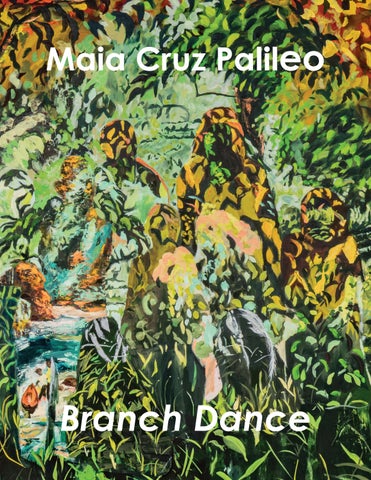
Maia Cruz Palileo
25!
25! 25! Branch Dance 1
2
3
4
5
Front cover: Maia Cruz Palileo, Three Generations (detail), 2025 Back cover: Maia Cruz Palileo, Waves (detail), 2025 6
Maia Cruz Palileo Branch Dance Monique Meloche Gallery November 14, 2025 - January 10, 2026
Introduction by Alyssa Brubaker Essay by Jose Mari Cuartero Edited by Staci Boris Photographed by Bob. Designed by Julia Marks
This catalogue was published on the occasion of Branch Dance, a solo exhibtion at Monique Meloche Gallery, Chicago
7
©2026
8
Table of Contents Introduction
14
Essay
18
Installation Views
28
Artworks
50
Biographies
98
Exhibition Checklist
102
9
10
Introduction
by Alyssa Brubaker
11
12
Introduction by Alyssa Brubaker by Alyssa Brubaker 13
moniquemeloche is pleased to present Maia Cruz Palileo: Branch Dance, the artist’s fourth solo exhibition with the gallery. Palileo’s practice encompasses painting, sculpture, installation, and drawing to question how belonging, assimilation, memory, and displacement intertwine. In their research-based practice, Palileo interrogates ethnographic images from Philippine archives alongside their family’s oral histories and photographs, producing lush landscapes where rivers morph, figures emerge from the trees, and boundaries blur, break, and mirror—obscuring the line between fact and fiction. Branch Dance presents a series of new paintings, works on paper, and ceramic sculptures that reconfigure imagery from colonial postcards, stereoscopic images, and studio portrait photography taken during the US occupation of the Philippines to examine how stories change over time, how memory is imperfect, and how imagination can fill the gaps in historical documentation to counteract Imperialism’s parasitical gaze. The title of the show, Branch Dance, evokes the movement of wind through trees, a forceful and knowing sway that hints at invisible presences. After the Philippine-American War (1899–1902), photography and printed imagery became inextricably linked to colonial conquest. American soldiers tucked photographs into letters sent home, and images were reproduced on postcards and stereographs for commercial distribution in America. Colonial photography was not neutral, it functioned as a tool of empire, carrying messages about civilization, progress, and otherness, often framing the land, people, and culture through an exoticized lens. During wartime, it sought to undermine the Filipino soldiers who used guerrilla tactics to blend into their surroundings, collaborating with the land to become visually elusive. Through photography, American forces produced fixed, legible images in an attempt to capture an enemy they couldn’t see as evidence of control. These images rendered the Philippine landscape—dense, unpredictable, and full of hidden resistance—into a flattened visual field, stripping it of vitality and danger.
14
This act of flattening is both visible and visceral when viewing postcards and archival photographs. Palileo’s ongoing engagement with archival materials utilizes collage as a tactile means of intervention. Collage allows experimentation with narrative and spatial possibilities, laying the groundwork for their expansive paintings—where flora, fauna, and landforms are imbued with agency. Formal strategies such as doubling and mirroring extract the stereoscope’s illusion of three-dimensional depth, disrupting linearity and visualizing the space between historical determination and present-day viewership. For the artist, the process of painting blurs boundaries, introducing breath, ambiguity, and slipperiness, providing a framework to rea rrange, reframe, and reinvigorate Filipino history, and shifting the dynamics of power embedded within the archival image.
13 15
16
Essay
by Jose Mari Cuartero 17
N
Branch Dance and the Art of Replenishment By Jose Mari Cuartero
The rivers have always sprawled into a network of water stories through folklore, earning a reputation for being dangerous, while luring the world into their depths for their enchantment and magic. In the folklore archive of Isabelo de los Reyes, a 19th-century anticolonial polymath in the Philippines, he documents the belief of the folk where, at times, some folkloric creatures appear in the river, abducting children, making them disappear, while surprising them with the presence of creatures like mermaids, spirits, deities, and ghosts who may be hiding behind the tall grasses, rocks and trees, mimicking the environment only to catch their new prey. While the river has nestled these intransigent figures of folklore, Maia Cruz Palileo’s exhibition Branch Dance, at Monique Meloche Gallery in Chicago, revivifies further such mystique and summons the folk as a figure whose inclusive collectivity embraces non-human kin, revitalizing the river as a fellow protagonist in the lives of the folk communities. The river, as a character, lives in the series of works titled Pagsanjan Falls, where it appears as an agent in terms of guiding the brushstrokes, making the entire riverscape dissolve the expected picturesque landscapes, washing out the touristic imagination shaped by postcards and imperial photography. By endowing the river with such capacities, Cruz Palileo awakens its inherent unrecognized care work, especially as it has, at one point in our Philippine history, provided a refuge for Salud Algabre, a female guerilla fighter and revolutionary during the American imperialist period, who emerges with a historical recognition after escaping the American forces, eluding them by jumping into the river, holding her breath under water, then rising for “fresh air.” By making the river a place of refuge for guerilla fighters like Salud, the river like the Pagsanjan falls can be also interpreted as a place of mimicry for the folk, such as in Our Vacation, culminating into a family portrait, gathered together through brushstrokes, with watercolor and gouache on paper, spreading like water marks, marking the ecology of family origins, yet whose traces are made temporal and liquid as well.
18
Maia Cruz Palileo, Our Vacation, 2025
Maia Cruz Palileo, Moaning Rock (Lolo Lolo), 2025
However, as the river historically served as the point of origins for villages, nations, states, and civilizations to emerge, it may also be recognized as the archival depositories of temporal histories. The river, after all, is the first habitat of our ancestors, and in such a location, rocks, boulders, pebbles, and the earth provide the bedrock for all such social formations to emerge. Such historicity is carved through the ceramic sculptures Rock Formations (Moaning Rock) and Rock Formations (Lolo Lolo), which both appear like busts and, at the same time, coarse stone carvings, looking darkened because of the water splashed by the river, while the mineral deposits appear like gestural marks of time. Thus, these sculptural pieces solidify and harden as traces of the images of those generations who walked before us. Through such gaunt faces, and their incandescent presence, these ceramic sculptures not only pay homage to our folk, but also chronicle the genesis of things, whether by laying out the evolution of the moist clay body into a hardened sculpture, situating us at a geologic period, or by historicizing the elementals’ struggle with one another, such as in between water, fire, wind and earth.
19
Maia Cruz Palileo, Three Generations, 2025
Having such a perspective, the sculptures like such ceramics are also considered artefacts of geologic time shifts, locating our ancestors in rock formations. In their indefatigable presence, they might have also lived as forces of animacies, to borrow from Mel Chen.. The works like Three Generations, I am Well, How are You? and Chances Are They Can Hear You share the technique of disfiguring and deconstructing the species divide, between human or non-human, while also challenging the corporeal existence of man’s anthropocentric privilege, specifically with the folk who appear as refractions of the images of the natural environment. These paintings turn their bodies into fragments of river streams, flora and fauna, and atmospheric shifts, while also showing the natural ecology as a collage of refracted images. Such works, in this way, shatter the divide between living and dead, human and non-human, foregrounding expressionist brushstrokes as contestations of constraints, logics of divide, and politics of control.
20
It is not surprising that Cruz Palileo’s world of animacies values and celebrates democratic interspecies relations. In works like Rustling Trees, the animal immersed in the water observes and seems to commune with a gorge of plants and trees, receiving a response from the leaves with their pigment as manifestations of their life. In the case of Sábong, a man bathes in the sun while touching the tail of a rooster—a watercolor and gouache snapshot of a sabongero, showing how one’s derby participation is also premised on relations of care and tenderness. While in the case of Right and Passing Clouds, the dog in the foreground becomes our companion specie, despite being used to racially profile the early Filipino migrants as dog eaters during the St. Louis World’s fair. Instead of treating the dogs as prey, these paintings animate their sense of belonging to their respective habitats, like how the former camouflages the dog with earthly tones, while the latter melds it into the river’s with an aquatic hue.
Maia Cruz Palileo, Rustling Trees (detail), 2025
Maia Cruz Palileo, Passing Clouds (detail), 2025
Maia Cruz Palileo, Sábong (detail), 2025
Maia Cruz Palileo, Right (detail), 2025
21
Such animal and plant iterations animate the liquid matter of watercolor and gouache as forces where aspirations of Darwinian survival of the fittest are made into a state of liquefaction. The imperial legacies of looking, such as how humans once reified the plants, animals, and the atmosphere, could be reversed and view the human as, to borrow from Jane Bennett, one of the material actants whose presence can be acknowledged as part of the power of things. The work, After the Cloudburst, for instance, interrupts the land enclosures of private property, foregrounding a lenticular image in its reverse order, revealing the weather’s cyclic process, and at the same time, illustrating the gradation of the atmospheric shifts. In such shifts, when the rainfall does not inundate the river, Waves depicts the intimacy of animals with water within an aqueous forest, while the First Light welcomes us into its channels through the rising sun, turning the stretch of the river into a mirage of its surroundings. Such reflection also appears in Basketbol, showing that the biological diversity of entities found in this exhibition are not segregated from one another. Instead, they are respective animate currents, dwelling spaces that provide life, things, energies, and forces the potentials, possibilities, and even Yvette Mayorga, La Usurpadora Not 4 Me (details), 2025 trajectories.
Maia Cruz Palileo, After the Cloudburst (detail), 2025
Maia Cruz Palileo, Basketbol (detail), 2025
22
Maia Cruz Palileo, Waves, 2025
Branch Dance, as it unfolds, is a conceptual and visual proposition insightfully conceived by Cruz Palileo to shore up the river as not only a liquifying force, but also a current in which actors and material actants are mapped, historicized, and visualized, redeeming the Philippine visual culture from being consumed, exhausted, drowned, and washed away by the visual culture of American imperial expansion. According to Cruz Palileo, the title of this exhibition is borrowed from a song titled Breaths by Sweet Honey in the Rock, whose lyrics can make one hear the ancestors’ breaths in the fire, water, woods, rocks, grass. Such musical insight turns the images of nature, from fire to grass, into a medium from which the message can be transmitted and imagined, leading us to assemblages of human and non-human, enabling a visual composition of vitality, showing that such an ecology is breathing and alive like the unforgotten beloved ancestors. Yvette Mayorga, She’s in the cake / Put out the fire after Nicolas Lancret (detail), 2025
Yvette Mayorga, W3 R TIR3D (detail), 2025
23
As a result, Cruz Palileo’s painting practice must be celebrated as a decolonial effort targeting a traditional art form that has been historically plagued by American coloniality, which turns the canvas into, for some, a life’s tombstone. Instead of exhausting and killing life, Branch Dance is also a recognition of the interspecies and non-human interception of the paintings within a continuum. Within such a spectrum, at the point of laying the last brushstroke, the artist surrenders to the autonomy of the canvas to create its own, gaining independence from the painter, allowing the work’s life to come full circle. Branch Dance, in its latitude, is a recognition of painting as a living being, endowed with its own ontology which, like the river of Pagsanjan, flows into the networks of viewers, art lovers, art historians, and other entities, animate and inanimate, human and non-human. With the sprawling network of relations, the river’s branch dance becomes analogous to the tree’s swaying branches, reaching up to the light of the sun and others, and at the same time, like the river, reaching ports, channels, and tributaries, as well as the folk, introducing us to an unacknowledged art of replenishment.
Maia Cruz Palileo, First Light, 2025
24
Maia Cruz Palileo, I Am Well, How Are You?, 2025
25
26
Installation Installation Views Views 27
28
29
30
31
32
33
34
35
36
37
38
39
40
41
42
43
44
45
46
47
48
Artworks
49
Pagsanjan Falls, P.I., 2025 oil on linen 10 x 8 in 25.4 x 20.3 cm
50
51
Detail
Rock Formations (Lolo Lolo), 2025 glazed stoneware, quartzite base, & light bulb 14 x 10 x 8 in (sculpture) 35.6 x 25.4 x 20.3 cm 18 x 11 1/2 x 10 in (base) 45.7 x 29.2 x 25.4 cm
52
53
Chances Are They Can Hear You, 2025 oil on linen 50 x 104 in 127 x 264.2 cm
54
55
Detail
56
Detail
57
Detail
I Am Well, How Are You?, 2025 oil on linen 72 x 68 in 182.9 x 172.7 cm
58
59
Detail
60
Detail
61
Detail
Basketbol, 2025 oil on linen 30 x 34 1/4 in 76.2 x 87 cm
62
63
Detail
64
Detail
65
Detail
After the Cloudburst, 2025 oil on linen 60 x 48 in 152.4 x 121.9 cm
66
67
Detail
68
Detail
69
Detail
Three Generations, 2025 oil on linen 72 x 128 in 182.9 x 325.1 cm
70
71
Detail
72
Detail
73
Detail
Waves, 2025 oil on linen 72 x 68 in 182.9 x 172.7 cm
74
75
Detail
76
Detail
77
Detail
Rock Formations (Moaning Rock), 2025 glazed porcelain & walnut base 7 1/4 x 5 1/4 x 3 in (artwork) 18.4 x 13.3 x 7.6 cm 8 x 8 x in (base) 20.32 x 20.32 x 2.54 cm
78
79
Pagsanjan Falls, P.I. I, 2025 watercolor and gouache on paper 11 x 7 1/2 in 27.9 x 19.1 cm
80
81
Detail
First Light, 2025 watercolor and gouache on paper 12 3/4 x 15 1/4 x 1 3/8 in 32.4 x 38.7 x 3.5 cm
82
83
Detail
Right, 2025 watercolor and gouache on paper 8 1/4 x 10 1/4 x 1 3/8 in 21 x 26 x 3.5 cm
84
85
Detail
Our Vacation, 2025 watercolor and gouache on paper 16 x 13 1/4 x 1 3/8 in 40.6 x 33.7 x 3.5 cm
86
87
Detail
Pagsanjan Falls, P.I. II, 2025 watercolor and gouache on paper 15 1/4 x 11 1/2 x 1 3/8 in 38.7 x 29.2 x 3.5 cm
88
89
Detail
Sábong, 2025 watercolor and gouache on paper 13 1/4 x 15 1/2 x 1 3/8 in 33.7 x 39.4 x 3.5 cm
90
91
Detail
Rustling Trees, 2025 watercolor and gouache on paper 15 1/4 x 12 3/4 x 1 3/8 in 38.7 x 32.4 x 3.5 cm
92
93
Detail
Passing Clouds, 2025 watercolor and gouache on paper 15 1/4 x 12 3/4 x 1 3/8 in 38.7 x 32.4 x 3.5 cm
94
95
Detail
96
Biographies Biographies 97
Photo by Mary Inhea Kang
Maia Cruz Palileo (they/them) is a multidisciplinary artist whose paintings, installations, sculptures, and drawings navigate themes of migration and the permeable concept of home. Influenced by the oral history of their family’s arrival in the United States from the Philippines, as well as the history between the two countries, Palileo infuses these narratives using both memory and imagination. They produce paintings of dream-like quality that hover between fact and fiction. Investigating the malleable language of the medium, Palileo’s works offer a panoramic lens through which to investigate the larger questions pertaining to forgotten histories and how best to honor these stories in perpetuity. Sourcing subject matter through various photographic archives, their paintings recontextualize the stories, portraits, and images to resuscitate these figures from the exploitative gaze of the ethnographic image.
Palileo (b.1979, Chicago, IL) received an MFA in sculpture from Brooklyn College, City University of New York, Brooklyn, NY (2008) and BA in Studio Art at Mount Holyoke ColYvY lege, South Hadley, MA (2001). Palileo has had solo exhibitions at moniquemeloche, Chicago, IL (2025, 2023, 2021, 2019); David Kordansky Gallery, Los Angeles, CA (2025); The Cummer Museum, Jacksonville, FL (2023); Kimball Arts Center, Park City, UT (2022); CCA Wattis Institute for Contemporary Arts, San Francisco, CA (2021); the Katzen Arts Center, Washington D.C. (2019); Pioneer Works, Brooklyn, NY (2018); Taymour Grahne Gallery, New York, NY (2018, 2017, 2015); and Cuchifritos Gallery + Project Space, curated by Jordan Buschur, New York, NY (2015). Recent group exhibitions include Spirit House, Cantor Arts Center at Stanford University, CA (2024); Seven Rooms and a Garden, Moderna Museet, Skeppsholmen, Stockholm (2023); Spirit in the Land, The Cummer Museum, Jacksonville, FL (2024-25), Pérez Art Museum Miami, FL (2024), and the Nasher Museum of Art at Duke University, Durham, NC (2023); The Outwin: American Portrait Today, Smithsonian National Portrait Gallery, Washington, D.C. (2022); A Point Stretched: Views on Time, San José Museum of Art, California (2022); and Our Blue Planet: Global Visions of Water, Seattle Art Museum (2022), among many others. Their work is in the collections of The Baltimore Museum of Art, Baltimore, MD; The San Jose Museum of Art, San Jose, CA; Cummer Museum of Art & Gardens. Jacksonville, FL; The Library of Congress, Washington, D.C; The Nasher Museum of Art at Duke University, Durham, NC; The Speed Museum, Louisville, KY; and The Fredriksen Collection at the National Museum of Oslo, Norway. Palileo is a recipient of the Sharpe-Walentas Studio Program Award, NY (2022); NYFA Painting Fellowship (2021); Jerome Foundation Travel and Study Program Grant (2017); Rema Hort Mann Foundation Emerging Artist Grant (2014); Astraea Visual Arts Fund Award (2009); Joan Mitchell Foundation Painters & Sculptors Grant (2008); and Joan Mitchell Foundation MFA Award (2018). Palileo has participated in residencies at Skowhegan School of Painting and Sculpture, Madison, ME; Lower East Side Print Shop, NY; Millay Colony, Austerlitz, New York; and the Joan Mitchell Center, New Orleans. They currently live and work in Brooklyn, NY.
98
Jose Mari Cuartero is an assistant professor in the Department of English and Comparative Literature at the University of the Philippines-Diliman. His research work focuses at large on the folklore archive of Isabelo de los Reyes, while simultaneously engaging in an interdisciplinary conversation through theorizing the archive’s contemporary cultural translation and permutation in the fields of comparative literature, anthropology, visual culture, and curatorial practice. Recently, he served as the research associate for the current Philippine Pavilion, Soil-beings / Lamánlupa, at the 19th International Architecture Exhibition of the Biennale Architettura 2025, under the curator, Renan Laru-an, and artist, Christian Tenefrancia Illi. Some of his writings have appeared in Suvannabhumi, Kritika Kultura, and Philippine Studies. He is also a contributing writer for an online newspaper, CoverStory, where he writes about contemporary art, visual culture and curatorial exhibitions.
99
Rock Formations (Moaning Rock), 2025 glazed porcelain 7 1/4 x 5 1/4 x 3 in 18.4 x 13.3 x 7.6 cm
100
101
Exhibition Checklist Pagsanjan Falls, P.I., 2025 oil on linen 10 x 8 in 25.4 x 20.3 cm
Waves, 2025 oil on linen 72 x 68 in 182.9 x 172.7 cm
Rock Formations (Lolo Lolo), 2025 glazed stoneware, quartzite base, & light bulb 14 x 10 x 8 in (sculpture) 35.6 x 25.4 x 20.3 cm
Rock Formations (Moaning Rock), 2025 glazed porcelain & walnut base 7 1/4 x 5 1/4 x 3 in (artwork) 18.4 x 13.3 x 7.6 cm
18 x 11 1/2 x 10 in (base) 45.7 x 29.2 x 25.4 cm
8 x 8 x in (base) 20.32 x 20.32 x 2.54 cm
Chances Are They Can Hear You, 2025 oil on linen 50 x 104 in 127 x 264.2 cm
Pagsanjan Falls, P.I. I, 2025 watercolor and gouache on paper 11 x 7 1/2 in 27.9 x 19.1 cm
I Am Well, How Are You?, 2025 oil on linen 72 x 68 in 182.9 x 172.7 cm
First Light, 2025 watercolor and gouache on paper 12 3/4 x 15 1/4 x 1 3/8 in 32.4 x 38.7 x 3.5 cm
Basketbol, 2025 oil on linen 30 x 34 1/4 in 76.2 x 87 cm
Right, 2025 watercolor and gouache on paper 8 1/4 x 10 1/4 x 1 3/8 in 21 x 26 x 3.5 cm
After the Cloudburst, 2025 oil on linen 60 x 48 in 152.4 x 121.9 cm
Our Vacation, 2025 watercolor and gouache on paper 16 x 13 1/4 x 1 3/8 in 40.6 x 33.7 x 3.5 cm
Three Generations, 2025 oil on linen 72 x 128 in 182.9 x 325.1 cm
102
Pagsnanjan Falls, P.I. II, 2025 watercolor and gouache on paper 15 1/4 x 11 1/2 x 1 3/8 in 38.7 x 29.2 x 3.5 cm Sábong, 2025 watercolor and goauche on paper 13 1/4 x 15 1/2 x 1 3/8 in 33.7 x 39.4 x 3.5 cm Rustling Trees, 2025 watercolor and gouache on paper 15 1/4 x 12 3/4 x 1 3/8 in 38.7 x 32.4 x 3.5 cm Passing Clouds, 2025 watercolor and gouache on paper 15 1/4 x 12 3/4 x 1 3/8 in 38.7 x 32.4 x 3.5 cm
103
104
105
Monique Meloche Gallery is located at 451 N Paulina Street, Chicago, IL 60622 For additional info, visit moniquemeloche.com or email info@moniquemeloche.com
106
107
108