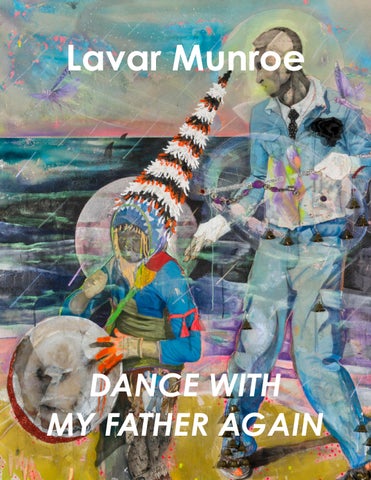
Lavar Munroe
DANCE WITH MY FATHER AGAIN 1
2
3
4
5
Front cover: Lavar Munroe, DANCE WITH MY FATHER AGAIN (detail), 2026 Back cover: Lavar Munroe, DANCE WITH MY FATHER AGAIN (detail), 2026
6
Lavar Munroe DANCE WITH MY FATHER AGAIN
Monique Meloche Gallery June 13 - August 1, 2026
Introduction by Alyssa Brubaker Essay by Xuxa Rodríguez Photographed by Bob. Detail images by Douglas Barkey Designed by Matthew Cortez Edited by Staci Boris
This catalogue was published on the occasion of DANCE WITH MY FATHER AGAIN, a solo exhibition at Monique Meloche Gallery, Chicago.
7
©2026
8
9
10
Table of Contents Introduction
12
Essay
16
Installation Views
22
Artworks
40
Biographies
62
Exhibition Checklist
66
11
12
Introduction
by Alyssa Brubaker
13
moniquemeloche is pleased to present Lavar Munroe: DANCE WITH MY FATHER AGAIN, the artist’s second solo exhibition with the gallery. Munroe is an interdisciplinary artist from Nassau, Bahamas whose work spans painting, drawing, sculpture, installation, collage, and assemblage. Working with an expansive range of materials including paint, cardboard, feathers, glass, found objects, textiles, newspaper, and discarded cultural artifacts, Munroe constructs richly layered worlds that merge folklore, spirituality, personal memory, and collective history. Munroe’s exhibition emerges from research developed for The Bahamas Pavilion at La Biennale di Venezia 2026, which centers on an intergenerational dialogue between Munroe and the late Bahamian artist John Beadle – who are both deeply shaped by Bahamian culture and particularly the traditions of Junkanoo, the national festival known for its processions, elaborate handmade costumes, music, improvisation, and collective production. Following Beadle's death in 2024, Munroe developed works that engage Beadle's legacy, incorporating aspects of his artistic philosophy, collected materials, sketches, and influence. DANCE WITH MY FATHER AGAIN extends Munroe’s ongoing exploration of posthumous collaboration while marking a deeply personal return to continue an unrealized project conceived with his late father. Before his father's passing, Munroe envisioned a collaboration centered on the parachutes his father—a Junkanooer, fisherman, and boatsman—washed, repaired, and braided by hand. Recognizing their sculptural beauty, Munroe hoped to present the parachutes as artworks and respond to them through his own visual language, creating a dialogue between two makers connected by a shared understanding of material transformation. Although his father's death interrupted the project, the collaboration sustained as Munroe incorporated these objects into subsequent installations, sculptures, and drawings, allowing his father's presence to remain an active force within the work. This exhibition marks a return to the origins of that conversation through a series of unstretched paintings on canvas. While earlier projects relied on inherited objects as collaborators, these paintings position memory itself as the medium of exchange for which the artist navigates loss, celebration, and lasting connection. Central to these works is the Bahamian tradition of shared mourning, where movement, coordinat-
12 14
ed dress, and united visual markers transform grief into a communal act. The figures depicted here are "rushing," a term associated with participation in Junkanoo processions moving through spaces that are at once celebratory and elegiac. Layers of Bahamian newspapers from 2024 to 2026 function as both historical record and a fragmented archive, preserving traces of specific moments that emerge and disappear beneath successive layers of paint, fringe, beads, sequins, and decorative elements derived from Junkanoo costume-making traditions. The surface feels simultaneously celebratory and weathered, echoing the handmade exuberance of Junkanoo while preserving the residue of lived experience and ritual. Taken together, the works in DANCE WITH MY FATHER AGAIN revisit the relationship that first inspired Munroe's notion of posthumous collaboration. Here, Munroe deftly showcases painting as a space in which communication, remembrance, and artistic partnership can be shaped by the enduring presence of ancestors, community, and shared history.
13 15
16
Essay
by Xuxa Rodríguez 17
A Wake Beyond Time: Lavar Munroe's Visual Processions for Future Generations By Xuxa Rodríguez Lavar Munroe’s DANCE WITH MY FATHER AGAIN presents an ongoing meditation by the artist on the spaces between life and death, as well as the transition of the spirit between these two planes of existence. The five works presented in the exhibition can be read together as a processional for the recently departed. The procession of figures with their gold and silver halos radiating from their heads recalls the processions depicted across Gentile da Fabriano’s Adoration of the Magi or the Lamentation in Giotto’s Scrovegni Chapel frescoes. However, while these images are deep cuts within the history of Late Gothic Italian art, Munroe’s references and visual vocabulary are both rootedly and staunchly Bahamian. Munroe and I spent a morning on zoom together talking about the new series and the cultural threads he is tying together across the works. He shared that his paintings are directly connected to Junkanoo practices on the islands. Junkanoo may immediately call to mind the celebrations in The Bahamas on Boxing Day (the day after Christmas) and New Year’s Day. The artist noted that these festivities are complete with parades where the themes are illustrated by the participants’ resplendent costumes made from fringed newspaper and cardboard bases layered with rhinestones, mirrors, bells, and other objects that add to the jubilee’s musical landscapes. The celebration planning season begins on Labor Day as Junkanoo groups (artist collectives) construct the costumes while keeping the year’s themes a secret until they announce them to the public in December. The parades are reported in the news for all to see. By contrast, Munroe shared that a Junkanoo wake is a relatively private affair. When a member of a Junkanoo group dies, their group members will gather at night to help the departed’s spirit pass on to the other side beyond death’s veil. The mourners will play Christian music as they march along in ceremony a week before the deceased’s funeral. The group members make a cardboard wreath in the same way that they would make a Junkanoo costume and then gift it to the deceased’s
16 18
Lavar Munroe, DANCE WITH MY FATHER AGAIN (detail), 2026
family, who can choose to keep the wreath in their home or bury it with their loved one. A Junkanoo wake begins the process of helping the departed pass by walking with the departed’s spirit to their next destination. The artist said that following the wake, the death cultural rituals of The Bahamas include a funeral and a final gathering at home to celebrate their loved one’s life together. While Junkanoo parades are public, and Junkanoo wakes are invite only, both are connected by the soundscapes across them. The parades are filled with the sounds of the fringed paper and bells nested in the costumes, while the wakes are soundtracked by Christian song and music as mourners walk the departed spirit to their next life. Animated in Munroe’s paintings, the mourners sing, dance, cry, and reflect on their loved one’s passing. Their eyes and breath glow with a bright yellow and green energetic life force that connects them to the nocturnal spiritual realm that they appear to move between along the scene’s shoreline. On the horizon, a cutter or skipjack sailboat filled with shadowy figures that have the same yellow-green glowing eyes
17 19
Lavar Munroe, ROLLIN' BY THE RIVER (detail), 2026
sails safely along a calm sea. A captained dinghy, flying fish, and the mainsail-like dorsal fins of sharks escort the vessel on its journey beyond where the sea and the sky meet. The wake plays out under the light of a bright and glittering red moon, referencing either the bloodlike color of a full lunar eclipse or the folkloric sailor’s adage, “red sky at night, sailor’s delight; red sky in morning, sailor’s warning.” Stars, comets, and rain fall across the sky in line with the mourner’s tears, cosmic and meteorological showers that both herald change across the heavens and earth as well as mark the wake’s importance as a historical event. Spangled across the paintings are layers of symbolic references to transformation and resurrection. Cicadas explode from the earth as they emerge from their subterranean slumber and stream across the panels, their wide-open wings cutting through the air as sharply as the viewer can imagine hearing their songs. Bird grasshoppers fly along with the processioners, moving between the worlds of earth and sky effortlessly and uncannily. A hummingbird flashes before a flower
18 20
wreath, its bright colors reflecting the light that has revealed its plumage as it appears to flicker between the world that we can see and the one we can’t. Flowers speckle the scene’s landscape, the mourners’ clothes, and their drums, holding space as a reminder of life’s brevity and as an encouragement to remain present in the awe and wonder of its brief beauty. Along with flora and fauna, water is a unifying element across the five panels. Munroe shared that the rain drops and water depicted within the works are important because many burials in The Bahamas happen by the water since it’s believed that spirits pass to the other side through water as a vessel. The artist shared that when it rains during a Junkanoo wake, it means that the spirit of the departed has acknowledged that the wake is taking place for them. He added that water in the paintings also references the Transatlantic Slave Trade. Metaphorically, I like to think that water is also important across the Caribbean archipelago not just as the oceanic highway that connects the islands to each other, but also as a record of family lineage both known and unknown to diasporic peoples whose ancestors either survived or were lost to the sea along their journeys to the region. This is seen in one of the panels where a child mourner walks ahead of an elder, almost spectral father figure. On the child’s pant leg is a photograph of a young Munroe seated on his own father’s lap. The artist’s father holds a small Junkanoo figure as he smiles lovingly at his son. The photograph sits on the level where the sea and sand meet, symbolizing that the picture’s figures belong to both the terrestrial and oceanic worlds. This existence between worlds is echoed by the child mourner as they walk away from the ocean and closer to the land that the viewer is positioned to be standing firmly on. The spectral father figure appears to have walked out of the ocean while seeming to still be of the sea as their body appears transparent against the tides and currents cutting through and across their pant legs and jacket. Raised in a Junkanoo shack, a hidden studio and workshop where Junkanoo groups build their costumes away from public sight, Munroe received his earliest art lessons from Junkanoo elders who taught the artist how to work the materials they use to make costumes, passed on the practice’s senses of color and composition, and showed him how to shape and create forms from scratch. Munroe’s formative art education from Junkanoo elders is a point of pride for the artist as he fringes the
19 21
newspaper that he uses by hand, pasting it and embedding objects in his paintings to the standards of craftsmanship and technique that he knows Junkanoo artists will be expecting of him. This reverence is present in Munroe’s work and he continues to showcase the talent and skill that Junkanoo artists passed onto him through his use of family artifacts in the paintings. Along with the family photo, Munroe has also applied his grandmother’s jewelry to the panels as a way of preserving them and her memory as a celebrated Bahamian educational leader in perpetuity. The photo and jewelry function as offerings to Munroe’s departed loved ones while the paintings themselves function as homage to the long lineage of Junkanoo artists who shaped the young artist. Munroe’s paintings of Junkanoo performers will live on beyond us and beyond our time, a stark contrast to the practice in Junkanoo parades where performers will leave their costumes on the streets because they’re no longer animated by the performance. The artist’s paintings are animated forever by being shown. The whispers of the paper fringes and light ringing of the applied bells as the artwork is walked by or handled activate the Junkanoo soundscapes embedded in the painting’s materials. This repeatedly brings the works to life in the same ways that both Junkanoo parades are heard before they begin and that Junkanoo wake music is heard by the gathered mourners and departed spirits. In these ways, the artist’s meditations become a message for future generations that memorializing and remembering our ancestors and forebearers is an ongoing action. To tell the stories of our loved ones, of those who taught us, and of the knowledge that has been passed down by hand is an act of affirming their impact and reviving their legacy. It’s also an act of remembering where we have come from, who and what has shaped us, and the responsibility we have to continue passing on what we carry within us to those who are coming after. In this recent period with the news reporting on information and data that has been lost, rewritten, revised, or even removed from access across U.S. government agencies and universities, Munroe’s call to remember and pass on knowledge directly to the next generation is a radical act of resistance and insistence that those who came before us and what they have taught us will be remembered regardless of any attempts to stop us.
18 22
Lavar Munroe, DANCE WITH MY FATHER AGAIN (detail), 2026
19 23
24
Installation Views 25
26
27
28
29
30
31
32
33
34
35
36
37
38
Artworks
39
ROLLIN' BY THE RIVER, 2026 acrylic, airbursh, spray paint, vintage Junkanoo t-shirt, Haitian sloop sail, found fabrics, red Sharpie marker, fringed newspaper (Thursday obituaries of the Nassau Guardian and Tribune), beads stripped from Junkanoo performed-costumes, hot glue, staples, synthetic flowers, plastic insects, tassels, glitter, chalk, woven polypropylene bag, and collaged image on canvas 92 x 98 in 238.66 x 248.92 cm 40
41
Detail
42
Detail
43
Detail
I KNEW YOU AS A FATHER, I KNOW YOU AS A FRIEND, 2026 acrylic, airbrush, red Sharpie marker, fringed newspaper, fringed fabrics, boat rope, beads stripped from Junkanoo-performed costumes, tassels, glitter, fabric, and collaged images on canvas 78 x 58 1/2 in 198.2 x 148.59 cm 44
45
Detail
46
Detail
47
Detail
DANCE WITH MY FATHER AGAIN, 2026 acrylic, airbrush, red Sharpie marker, fringed newspaper, beads stripped from Junkanoo-performed costumes, tassels, glitter, bells, synthetic flowers, toy soldiers, Air Jordan 1's, hair beads, white pencil, Sadie Curtis' jewelry, feathers, and collaged images on canvas 78 x 60 in 198.12 x 152.4 cm 48
49
Detail
50
Detail
51
Detail
QUEEN TO A KING, 2026 acrylic, airbrush, red Sharpie marker, glitter, synthetic flowers, fringed newspaper (Thursday obituaries of the Nassau Guarduian and Tribune), tassels, glitter, earring, and collaged images on canvas 78 x 74 in 198.12 x 187.96 cm 52
53
Detail
54
Detail
55
Detail
WHEN I GET TO THAT CITY OF GOLD, 2026 acrylic, airbrush, red Sharpie marker, fringed newspaper (Thursday obituaries of the Nassau Guarduian and Tribune), beads stripped from Junkanoo-performed costumes, tassels, glitter, chalk, lace fabric, and collaged images on canvas 78 x 54 in 198.12 x 137.16 cm 56
57
Detail
58
Detail
59
Detail
60
Biographies 61
Lavar Munroe (b.1982, Nassau, Bahamas) earned his BFA from Savannah College of Art and Design (2007) and MFA Studio Art at Washington University, St. Louis (2013). He also attended Skowhegan School of Painting and Sculpture (2013) and was awarded a postdoctoral research fellow at the University of North Carolina, Chapel Hill (2016), Benny Andrews Fellow from the MacDowell Colony (2016), and The Carolina Postdoctoral Program for Faculty Diversity-University of North Carolina, Chapel Hill NC (2014). Recent solo exhibitions include moniquemeloche, Chicago, IL (2026, 2023); Larkin Durey, London, UK (2024); Jack Bell Gallery, London, UK (2022, 2021, 2014); Walters Museum of Art, Baltimore, MD (2021); NOMAD, Brussels, Belgium (2017); Meadows Museum of Art, Shreveport, LA (2018); SCAD Museum of Art and Gutstein Gallery, Savannah, GA (2016); and The Central Bank, Nassau, Bahamas (2010). Photo by Roy Cox
Munroe’s work has been exhibited widely nationally and internationally at The Charles H. Wright Museum of African American History, Detroit, MI; Kunstmuseum Basel, St. Alban-Graben, CH; Zeitz MOCAA, Cape Town, SA; The National Art Gallery of The Bahamas; Centre Pompidou Metz, FR; Ichihara Lakeside Museum, Funyu, JP; Virginia Museum of Contemporary Art, Virginia Beach, VA; Perez Art Museum Miami, FL; and the Nasher Museum of Art at Duke University, Durham, NC, among others. Munroe co-represented The Bahamas in the exhibition In Another Man's Yard curated by Dr. Krista Thompson at the 61st International Art Exhibition of La Biennale di Venezia. Munroe’s work is held in the permanent collections of the Baltimore Museum of Art, MD; Fondation de France; Fondation Gandur pour l’Art, Genève, Switzerland; The Studio Museum of Harlem, New York, NY; The Central Bank of The Bahamas, Nassau, BA; The National Art Gallery of The Bahamas, Nassau, BA; and the MAXXI Museum, Rome, IT. He is the recipient of honors and awards including the Guggenheim Fellowship in Fine Arts in honor of Robert De Niro, Sr., (2023), the Sondheim Artscape Prize Finalist (2021), Distinguished Alums Award from Sam Fox School of Art and Design from Washington University of St. Louis (2018), Postdoctoral Award for Research Excellence from the University of North Carolina (2015), Joan Mitchell Foundation Painters and Sculptors Grant (2013), Joan Mitchell Foundation Scholarship (2012), The Kraus Family Foundation Award (2011), and The National Endowment for the Arts Grant (2011). Munroe lives and works between Baltimore, MD, and The Bahamas.
62
Photo by Kat Wilson
Xuxa Rodríguez, PhD, is the Patsy R. and Raymond D. Nasher Curator of Contemporary Art at the Nasher Museum of Art at Duke University. She earned her doctorate in art history from the University of Illinois Urbana-Champaign. Her expertise ranges across modern and contemporary Latinx and Latin American art, African diasporic art, feminist and queer art, transnational artists, and time-based media, with strengths in digital, performance, and video. Born in Miami, Florida, her heart is always in the Caribbean in her ancestral island home of Cuba.
63
64
65
Exhibition Checklist ROLLIN' BY THE RIVER, 2026 acrylic, airbrush, spray paint, vintage Junkanoo T-shirt, Haitian sloop sail, found fabrics, red Sharpie marker, fringed newspaper (Thursday obituaries of the Nassau Guardian and Tribune), beads stripped from Junkanoo performed-costumes, hot glue, staples, synthetic flowers, plastic insects, tassels, glitter, chalk, Woven Polypropylene Bag, and collaged images on canvas 92 x 98 in 238.66 x 248.92 cm
QUEEN TO A KING, 2026 acrylic, airbrush, red Sharpie marker, glitter, synthetic flowers, fringed newspaper (Thursday obituaries of the Nassau Guardian and Tribune), tassels, glitter, earring, and collaged images on canvas 78 x 74 in 198.12 x 187.96 cm WHEN I GET TO THAT CITY OF GOLD, 2026 acrylic, airbrush, red Sharpie marker, fringed newspaper, beads stripped from Junkanoo-performed costumes, tassels, glitter, chalk, lace fabric, and collaged images on canvas 78 x 54 in 198.12 x 137.16 cm
I KNEW YOU AS A FATHER, I KNOW YOU AS A FRIEND, 2026 acrylic, airbrush, red Sharpie marker, fringed newspaper, fringed fabrics, boat rope, beads stripped from Junkanoo-performed costumes, tassels, glitter, fabric, and collaged images on canvas 78 x 58 1/2 in 198.2 x 148.59 cm DANCE WITH MY FATHER AGAIN, 2026 acrylic, airbrush, red Sharpie marker, fringed newspaper, boat rope, beads stripped from Junkanoo-performed costumes, tassels, glitter, bells, synthetic flowers, toy soldiers, Air Jordan 1's, hair beads, white pencil, Sadie Curtis' jewelry, feathers, and collaged images on canvas 78 x 60 in 198.12 x 152.4 cm 66
67
68
69
Monique Meloche Gallery is located at 451 N Paulina Street, Chicago, IL 60622 For additional info, visit moniquemeloche.com or email info@moniquemeloche.com
70
71
$25.00 ISBN 979-8-9971157-0-8
52500>
72 9 798997 115708