
Professional AWS Certified Security Specialty Learning Guide for Global Engineers

Page 1


ProfessionalAWS Certified Security Specialty Learning Guide for Global Engineers
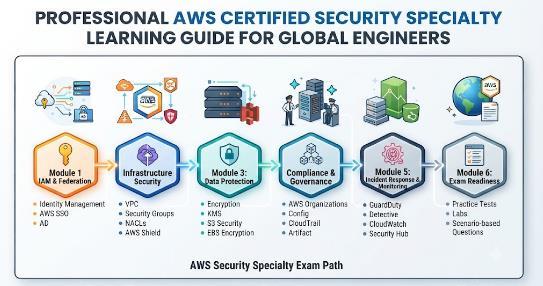
AWS environments often store business data, customer records, applications, credentials, and financial information. Protecting these resources requires more than basic cloud knowledge. Professionals must understand access control, monitoring, network security, encryption, incident handling, and governance.

AWS Certified Security Specialty helps experienced professionals develop these capabilities. It is suitable for engineers, architects, security teams, software developers, technical managers, and cloud professionals who want to strengthen their AWS security knowledge.

Certification Summary

Category Details

Certification

AWS Certified Security Specialty

Track Cloud and AWS Security

Level Specialty

Provider DevOpsSchool

Suitable For DevOps engineers, software engineers, security professionals, architects, SREs, and managers

Prerequisites AWS experience, IAM knowledge, networking basics, monitoring, and security concepts

Skills Covered

Access control, threat detection, incident response, data security, infrastructure protection, and governance

Category Details

Recommended Order AWS basics → Architecture and operations → Security practice → AWS Security Specialty

What Is AWS Certified Security Specialty?

AWS Certified Security Specialty is an advanced certification focused on securing cloud workloads running on AWS.

It measures whether a professional can protect AWS accounts, applications, networks, identities, data, and operational processes using suitable security controls.

The certification is useful because cloud security problems are rarely solved by one service. Professionals must understand how multiple AWS services and policies work together.

Why Professionals Choose This Certification

Many organisations now expect cloud engineers and software teams to take responsibility for security.

This certification can help professionals:

 Understand AWS security architecture

 Improve cloud access management

 Design stronger security controls

 Investigate suspicious activity

It also helps managers understand the technical risks behind AWS projects.

Who Should Take It?

This certification is useful for:

 AWS security engineers

 DevOps and DevSecOps professionals

 Cloud administrators

 Software engineers

 Solutions architects

 Platform engineers

It is not the best starting point for complete beginners. Candidates should first understand basic AWS services, cloud networking, IAM, monitoring, and encryption.

Recommended Prerequisites

There is no compulsory certification requirement. However, practical AWS experience is strongly recommended.

Before preparing, candidates should understand:

 AWS accounts and resources

 IAM users, roles, and permissions

 Virtual private cloud networking

 Security groups

 Logging and monitoring

A learner should also be comfortable reading architecture scenarios and identifying security weaknesses.

Skills You Will Gain

AWS Security Specialty preparation can help you build skills in:

 Creating secure AWS account structures

 Managing identity and access

 Applying least-privilege permissions

 Protecting cloud networks

 Monitoring user and resource activity

 Detecting unusual behaviour

 Handling security incidents

Real-World Projects You Should Be Able to Do

After proper learning and practice, you should be able to:

 Design a secure AWS account structure

 Create centralised security logging

 Build alerts for high-risk activities

 Write least-privilege IAM policies

 Configure cross-account access

 Secure a public-facing application

These projects are important because practical work improves both exam preparation and job readiness.

Preparation Plan

7–14-Day Plan

This plan is best for experienced AWS professionals.

 Review the complete certification syllabus

 Identify weak subjects

 Revise IAM and access control

 Study monitoring and incident response

This plan should be used for revision, not first-time learning.

30-Day Plan

This plan is suitable for professionals with general AWS experience.

Week 1

Study AWS security fundamentals, IAM, policies, account protection, and shared responsibility.

Week 2

Focus on network protection, infrastructure security, logging, and threat detection.

Week 3

Study data encryption, key management, secrets, and incident response.

Week 4

Complete hands-on projects, practise scenario-based questions, take mock tests, and revise weak topics.

60-Day Plan

This plan is suitable for software engineers and cloud professionals entering security.

Days 1–15

Learn AWS basics, IAM, networking, monitoring, and security fundamentals.

Days 16–30

Study the main security areas one by one and complete small labs.

Days 31–45

Build practical projects related to access, logging, encryption, and incident response.

Days 46–60

Attempt practice questions, review difficult topics, complete mock tests, and prepare for the exam.

Common Preparation Mistakes

Candidates should avoid these mistakes:

 Using outdated learning material

 Memorising AWS service names

 Ignoring practical labs

 Providing excessive permissions

 Weak understanding of IAM policies

 Focusing only on network security

 Ignoring incident response

 Treating encryption as a simple setting

The exam expects candidates to choose the most secure and practical solution, not only a technically possible answer.

Best Next Certification After This

The best next certification depends on your career goal.

AWS Certified DevOps Engineer Professional is a suitable next step for DevOps and DevSecOps professionals. It connects security with automation, deployment, monitoring, and cloud operations.

Other possible options include:

 AWS Solutions Architect Professional

 AWS Advanced Networking Specialty

 DevSecOps certification

Choose Your Learning Path

DevOps Path

Learn AWS fundamentals, Git, CI/CD, infrastructure as code, containers, monitoring, and cloud security.This path helps professionals build and operate secure delivery systems.

DevSecOps Path

Focus on secure coding, pipeline security, vulnerability testing, secret management, policy automation, and compliance.This path is ideal for professionals who want to include security throughout software development.

SRE Path

Study monitoring, reliability, incident response, automation, recovery, and operational security.AWS security knowledge helps SRE teams manage incidents without affecting service stability.

AIOps and MLOps Path

Learn cloud automation, machine-learning pipelines, model monitoring, data protection, and access management.This path helps protect AI models, data, endpoints, and automated operations.

DataOps Path

Focus on data pipelines, data governance, encryption, data access, backups, quality, and audit records.AWS Security Specialty helps DataOps professionals protect data throughout its lifecycle.

FinOps Path

Learn cloud billing, cost control, budgeting, governance, and risk management.Combining FinOps and security knowledge helps organisations create controls that are both secure and financially practical.

Institutions Supporting AWS Security Learning

DevOpsSchool

DevOpsSchool provides structured technical training, guided learning, practical sessions, and certification preparation. It can support working professionals who need an organised approach to AWS security.

Cotocus

Cotocus supports cloud consulting, automation, technical transformation, and professional learning. It can help learners connect AWS security concepts with business and implementation requirements.

Scmgalaxy

Scmgalaxy provides resources related to DevOps, cloud technologies, automation, and software configuration management. These areas support the technical foundation required for cloud security.

BestDevOps offers knowledge related to DevOps tools, cloud engineering, career roadmaps, and modern software practices. It can help learners strengthen supporting skills around AWS security.

DevSecOpsSchool

DevSecOpsSchool focuses on secure software delivery, security testing, pipeline protection, compliance, and automation. It is suitable for learners following a DevSecOps career path.

SRESchool

SRESchool supports learning in reliability engineering, monitoring, production operations, and incident management. These skills are closely connected with cloud threat detection and response.

AIOpsSchool

AIOpsSchool covers automation, intelligent monitoring, event analysis, and AI-assisted operations. These skills can support modern security monitoring environments.

DataOpsSchool

DataOpsSchool focuses on data automation, governance, quality, pipelines, and cloud data operations. It is useful for professionals responsible for securing business data.

FinOpsSchool

FinOpsSchool provides learning related to cloud costs, financial governance, budgeting, and optimisation. It helps professionals understand the financial impact of cloud-security decisions.

Conclusion

AWS Certified Security Specialty is suitable for professionals who want deeper knowledge of AWS cloud protection. It develops skills in access management, infrastructure security, monitoring, incident response, encryption, data protection, and governance. The certification is most useful when learning includes practical labs, real-world projects, and scenario-based study. By selecting the right preparation plan and career path, professionals can apply this knowledge across DevOps, DevSecOps, SRE, AIOps, MLOps, DataOps, FinOps, software engineering, and cloud-security roles.

Turn static files into dynamic content formats.

Create a flipbook
Professional AWS Certified Security Specialty Learning Guide for Global Engineers by MONIKA_96 - Issuu