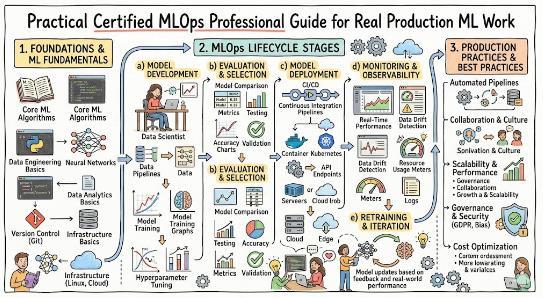
Practical Certified MLOps Professional Guide for Real Production ML Work
Practical Certified MLOps Professional Guide for
Real Production MLWork
Introduction
Machine Learning is now used in real business applications such as automation, fraud detection, recommendations, customer support, forecasting, and intelligent decision-making. But creating a model is not enough. The real challenge starts when that model has to run safely, accurately, and continuously in production.The Certified MLOps Professional certification is designed for engineers and managers who want to build strong skills in production-ready machine learning operations.
What Is Certified MLOps Professional?
The Certified MLOps Professional is an advanced certification for professionals who want to manage machine learning systems in real production environments.
It focuses on ML deployment, model monitoring, A/B testing, governance, compliance, performance optimization, multi-model serving, and continuous training pipelines.
Certification Overview
Track Level Who it’s for Prerequisites Skills covered Recommended order
Track Level Who it’s for Prerequisites Skills covered Recommended order DevOps engineers, ML engineers, SREs, data engineers, managers CI/CD, containers, or production experience governance, A/B testing, model serving, continuous training → Certified MLOps Professional
Who Should Take This Certification?
This certification is suitable for working professionals who want to grow in AI, ML, DevOps, cloud, and platform engineering roles.
It is useful for:
Software Engineers
DevOps Engineers
ML Engineers
Data Engineers
SRE Professionals
Cloud Engineers
Platform Engineers
Technical Managers
If you want to work on production machine learning systems, this certification can help you build the right direction.
Skills You’ll Gain
After preparing for this certification, you will understand:
ML model deployment
CI/CD for machine learning
Model monitoring
Data drift and model drift
Model versioning
A/B testing
Governance and compliance
Continuous training pipelines
Multi-model serving
Performance and cost optimization
These skills are important because companies need ML systems that are not only accurate but also reliable, secure, scalable, and easy to manage.
Real-World Projects You Can Handle
After this certification, you should be able to work on practical projects like:
Building an end-to-end MLOps pipeline
Deploying ML models using automation
Creating model monitoring dashboards
Setting drift detection alerts
Managing model versions
Running A/B testing between model versions
Creating continuous training workflows
Improving model performance in production
Preparation Plan
7–14 Days Plan
Best for experienced professionals. Revise MLOps concepts, model deployment, monitoring, governance, A/B testing, and continuous training. Practice scenario-based questions daily.
30 Days Plan
Best for most working engineers. Spend one week on MLOps basics, one week on deployment and CI/CD, one week on monitoring and governance, and one week on revision and practice.
60 Days Plan
Best for beginners. Start with ML lifecycle, Git, Docker, Kubernetes, cloud, and CI/CD. Then move to model registry, monitoring, governance, and continuous training.
Common Mistakes to Avoid
Avoid these mistakes while preparing:
Learning only theory
Ignoring hands-on practice
Thinking MLOps is only DevOps
Skipping model monitoring
Not understanding data drift
Ignoring governance and compliance
Focusing only on tools
Not practicing real production use cases
Choose Your Path
DevOps Path
DevOps professionals can move into MLOps by learning ML lifecycle, model deployment, model registry, and monitoring.
DevSecOps Path
DevSecOps professionals can focus on secure ML pipelines, compliance, governance, and auditready workflows.
SRE Path
SRE professionals can focus on reliability, observability, incident response, and production model health.
AIOps / MLOps Path
This is the direct path for professionals who want to build a career in AI operations and machine learning operations.
DataOps Path
DataOps professionals can focus on data quality, feature pipelines, validation, and continuous training.
FinOps Path
FinOps professionals can focus on ML infrastructure cost, GPU usage, inference cost, and cloud optimization.
Best Next Certification
After completing Certified MLOps Professional, the next best step can be:
Certified MLOps Architect
This is useful for professionals who want to design enterprise-level MLOps platforms and lead AI engineering teams.
Top Institutions for Training cum Certification Support
DevOpsSchool helps learners build DevOps, CI/CD, cloud, Kubernetes, and automation skills useful for MLOps.
Cotocus supports digital engineering and automation practices for business-level technology implementation.
Scmgalaxy helps with configuration management, release management, DevOps, and automation knowledge.
BestDevOps supports professionals in understanding DevOps-related certifications and career paths.
DevSecOpsSchool is useful for security, compliance, governance, and secure automation learning.
SRESchool helps learners understand reliability, monitoring, observability, and incident management.
AIOpsSchool is the official provider of the Certified MLOps Professional certification.
DataOpsSchool supports learning around data pipelines, data quality, validation, and automation.
FinOpsSchool helps professionals understand cloud cost management and resource optimization.
Conclusion
The Certified MLOps Professional certification is a strong choice for engineers and managers who want to work with real production machine learning systems.It helps you learn how to deploy, monitor, govern, optimize, and improve ML models in business environments.For software engineers, DevOps engineers, ML engineers, data engineers, SREs, and technical managers, this certification can be a valuable step toward modern AI and MLOps career growth.