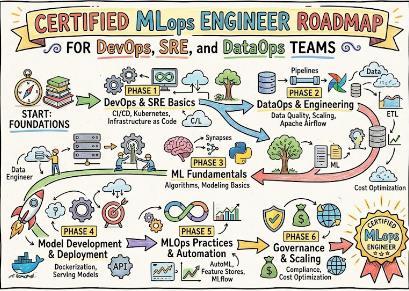
Certification Overview
Track Level Who it’s for Prerequisites Skills covered
AIOps / MLOps Intermediate Software Engineers, DevOps Engineers, Data Engineers, ML Engineers, SREs, Managers
Basic Linux, Git, Python, cloud, CI/CD, Docker, and ML basics
ML lifecycle, model deployment, monitoring, CI/CD for ML, automation, governance
Who Should Take This Certification?
Recommended order
Learn DevOps basics, then cloud and containers, then MLOps
This certification is useful for professionals who want to work with production-ready AI and ML systems.
It is best for:
Software Engineers
DevOps Engineers
Data Engineers
Cloud Engineers
SRE Engineers
ML Engineers
AI Platform Engineers
Technical Managers
Engineering Leaders
For software engineers, it opens a path toward AI engineering and ML platform roles. For DevOps engineers, it adds ML workflow knowledge to existing CI/CD and automation skills. For managers, it gives better understanding of how AI projects should be planned and controlled.
Skills You’ll Gain
After completing the Certified MLOps Engineer certification, you should understand how to manage the complete ML lifecycle.
You will learn:
Machine learning lifecycle management
Model deployment methods
CI/CD pipelines for ML systems
Model versioning
Data and model monitoring
Docker and container-based deployment
Basic Kubernetes usage for ML workloads
Model drift and data drift concepts
Automated retraining workflows
Model governance and documentation
Collaboration between DevOps and data science teams
These skills are important because companies need professionals who can make ML models stable, reliable, and useful in production.
Real-World Projects You Can Do After It
After learning MLOps, you should be able to build practical projects such as:
Deploying a machine learning model as an API
Creating an end-to-end ML pipeline
Building a CI/CD workflow for model deployment
Containerizing an ML application using Docker
Tracking model versions and experiments
Monitoring model performance in production
Detecting model drift
Creating a retraining pipeline
Designing a basic production MLOps architecture
These projects help you prove your practical skills during interviews and real workplace tasks.
Preparation Plan
7–14 Days Plan
This plan is good for experienced engineers. Revise ML lifecycle, Docker, Git, CI/CD, and cloud basics. Then study model deployment, monitoring, drift, and retraining. Build one small project where you deploy a model through an API.
30 Days Plan
This plan is ideal for working professionals. Spend the first week on Linux, Git, Python, and ML basics. Use the second week for Docker, CI/CD, and model versioning. In the third week, practice model deployment. In the fourth week, study monitoring, governance, and retraining.
60 Days Plan
This plan is best for beginners and managers. Start with software engineering basics, then learn cloud, containers, ML lifecycle, deployment, monitoring, and governance. Build at least one complete MLOps project by the end.
Common Mistakes to Avoid
Many learners focus only on tools and forget the process. MLOps is not just about installing tools. It is about creating reliable ML delivery systems.
Avoid these mistakes:
Learning tools without understanding concepts
Ignoring data quality
Not tracking model versions
Skipping model monitoring
Treating ML deployment like normal software deployment
Not planning rollback
Ignoring security and governance
Not building hands-on projects
A good MLOps engineer should always think about reliability, repeatability, automation, and business value.
Best Next Certification After This
After Certified MLOps Engineer, your next certification depends on your career goal.If you want to grow in AI operations, choose an AIOps path. If you want stronger production skills, choose SRE. If you work with pipelines and data quality, choose DataOps. If you manage cloud cost and budgets, choose FinOps. DevOps and DevSecOps are also strong next steps.
Choose
Your Path
Best for engineers who already work with CI/CD, automation, cloud, and deployment pipelines.
DevSecOps
Best for professionals who want to secure ML pipelines, data, models, and production systems.
SRE
Best for engineers focused on reliability, monitoring, incident response, and uptime.
AIOps/MLOps
Best for professionals who want a direct career in AI operations and ML platform engineering.
DataOps
Best for data engineers who want to manage clean, reliable, and automated data pipelines for ML.
FinOps
Best for managers and cloud professionals who want to control ML infrastructure cost.
Training cum Certification Support Institutions
DevOpsSchool
DevOpsSchool helps learners build DevOps, cloud, automation, and CI/CD skills. These foundations are useful for preparing for MLOps roles.
Cotocus
Cotocus supports enterprise technology, automation, cloud, and DevOps practices. It helps learners understand real-world implementation.
Scmgalaxy
Scmgalaxy focuses on configuration management, build, release, and DevOps practices. These skills support model versioning and release control.
BestDevOps
BestDevOps helps professionals understand DevOps-related career paths and certification planning. It is useful for learners moving toward MLOps.
devsecopsschool
devsecopsschool is useful for learning security practices in software and ML pipelines.
sreschool
sreschool helps learners understand monitoring, observability, reliability, and production stability.
aiopsschool
AIOpsSchool is the provider of the Certified MLOps Engineer certification and focuses on AIOps, MLOps, automation, and monitoring.
dataopsschool
dataopsschool helps learners understand data quality, data pipelines, and data governance for ML systems.
finopsschool
finopsschool focuses on cloud cost management and optimization, which is useful for managing ML infrastructure expenses.
Conclusion
The Certified MLOps Engineer certification is a useful choice for professionals who want to work with production machine learning systems. It helps you understand how ML models are deployed, monitored, automated, secured, and improved.For software engineers, DevOps engineers, data engineers, SREs, and managers, this certification can create a strong path toward AI-driven engineering careers.