
CertifiedAIOps Manager Certification Guide for
Professional CareerAdvancement
Introduction
IT operations are changing very fast. Earlier, teams mostly depended on manual monitoring, ticket-based support, dashboards, and reactive troubleshooting. But today, applications run across cloud, containers, microservices, APIs, databases, networks, and multiple third-party services. Because of this complexity, traditional IT operations teams often struggle to find the real cause of incidents quickly.
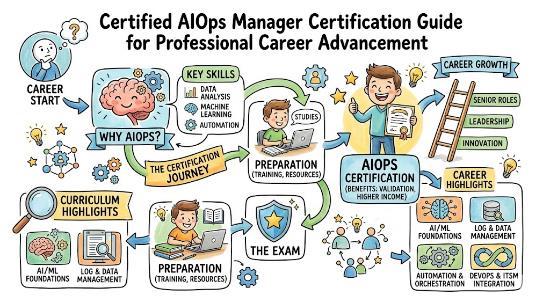
This is where AIOps becomes important.AIOps means using artificial intelligence, machine learning, automation, data analytics, and observability practices to improve IT operations. It helps teams reduce alert noise, detect unusual behavior, predict incidents, automate repetitive work, and make faster operational decisions.The Certified AIOps Manager certification is designed for professionals who want to understand how to manage AIOps adoption in a practical way. It is not only for technical engineers. It is also useful for managers, team leads, operations heads, DevOps professionals, SRE engineers, cloud teams, and software engineers who want to understand how intelligent IT operations work in real business environments.
Choose Your Path
1. DevOps Path
If your background is DevOps, Certified AIOps Manager can help you understand what happens after deployment. Many DevOps engineers focus on CI/CD, infrastructure as code, automation,
and release pipelines. AIOps adds another layer by helping teams monitor releases, detect issues, and improve operational feedback.
This path is useful if you want to grow from DevOps Engineer to DevOps Lead, Platform Engineer, Automation Architect, or Operations Strategy role.
Focus areas:
Deployment monitoring
Release health intelligence
CI/CD failure analysis
Infrastructure automation
Incident feedback into delivery pipelines
2. DevSecOps Path
For DevSecOps professionals, AIOps can help connect operational intelligence with security signals. Security teams often face too many alerts, false positives, and disconnected event data.
AIOps can support better prioritization, anomaly detection, and faster investigation of suspicious activity.
Focus areas:
Security event intelligence
Risk-based alerting
Threat signal correlation
Automated security workflows
Compliance and governance visibility
3. SRE Path
SRE and AIOps are strongly connected. SRE focuses on reliability, incident management, service-level objectives, error budgets, and reducing toil. AIOps supports these goals by giving better visibility, faster detection, and intelligent automation.
If you are working in SRE or want to move into SRE, Certified AIOps Manager can help you understand how intelligent operations improve reliability.
Focus areas:
SLO and SLA monitoring
Incident response improvement
Error budget visibility
Toil reduction
4. AIOps/MLOps Path
This path is suitable for professionals who want to work closer to AI, machine learning, operational analytics, and intelligent automation.
AIOps focuses on IT operations intelligence. MLOps focuses on managing machine learning models and pipelines. Professionals who understand both can work on advanced automation, prediction, and intelligent platform operations.
Focus areas:
Anomaly detection
Predictive operations
AI-based alerting
Model monitoring
Intelligent automation workflows
5. DataOps Path
AIOps needs data, and DataOps helps manage data quality, data flow, and data reliability. If operational data is poor, AIOps cannot produce useful results.
Professionals from a DataOps background can support AIOps by improving the quality of logs, metrics, event streams, and analytics pipelines.
Focus areas:
Operational data pipelines
Log and event quality
Data governance
Analytics readiness
Data reliability for AIOps
6. FinOps Path
FinOps focuses on cloud cost visibility, financial accountability, and resource optimization. AIOps can support FinOps by detecting cost anomalies, forecasting usage, and identifying inefficient resource consumption.
This path is useful for cloud managers, platform teams, and leaders who want to connect operations performance with cost control.
Focus areas:
Cloud cost anomaly detection
Resource usage intelligence
Capacity planning
Cost optimization alerts
Business-focused operations reporting
Top Institutions That Help in Training Cum Certifications for Certified AIOps Manager
DevOpsSchool
DevOpsSchool is known for training programs in DevOps, DevSecOps, SRE, Cloud, AIOps, and automation-related technologies. It helps learners understand both technical concepts and real implementation practices.
For Certified AIOps Manager preparation, DevOpsSchool can help professionals connect AIOps with DevOps pipelines, monitoring, operations workflows, and practical enterprise use cases.
Cotocus
Cotocus works around DevOps, cloud, automation, consulting, and enterprise technology transformation. It can help professionals understand how AIOps fits into larger IT modernization programs.
Learners can benefit from Cotocus when they want to understand AIOps from a business transformation and implementation planning perspective.
Scmgalaxy
Scmgalaxy has strong relevance in software configuration management, DevOps, automation, build-release practices, and IT process improvement. These foundations are useful for understanding AIOps adoption.
For Certified AIOps Manager learners, Scmgalaxy can help build clarity around structured workflows, automation discipline, and operational process maturity.
BestDevOps
BestDevOps is useful for professionals exploring DevOps-related certifications, career paths, and skill development options. It can help learners understand where Certified AIOps Manager fits in the larger DevOps and IT operations career roadmap.
It is especially useful for professionals comparing multiple certification paths before deciding their next career move.
devsecopsschool
devsecopsschool focuses on DevSecOps, security automation, secure delivery, and risk-aware engineering practices. AIOps and DevSecOps can work together when organizations want better security event intelligence and faster risk response.
This institution can be useful for learners who want to connect AIOps with security monitoring, compliance, and threat-related operational signals.
sreschool
sreschool is highly relevant for professionals interested in reliability engineering, incident management, service-level objectives, and operational excellence. Since AIOps supports reliability improvement, SRE knowledge is very helpful.
Certified AIOps Manager learners can use SRE concepts to understand how AIOps improves uptime, reduces toil, and supports better incident response.
aiopsschool
aiopsschool is directly focused on AIOps learning and certification. Since the Certified AIOps Manager certification is provided through aiopsschool, it is the most directly relevant institution for this certification.
Learners can use aiopsschool to understand AIOps concepts, certification expectations, rolebased learning, and practical adoption of intelligent operations.
dataopsschool
dataopsschool is useful for professionals who want to understand the data side of operations. AIOps needs good operational data from logs, metrics, events, and traces.
DataOps learning can help Certified AIOps Manager learners understand data quality, data pipelines, governance, and analytics readiness for AIOps success.
finopsschool
finopsschool focuses on cloud cost management, financial governance, and resource optimization. This connects well with AIOps when organizations want to detect cost anomalies and improve cloud efficiency.
For managers, FinOps knowledge adds a business layer to AIOps because it connects operational performance with cost control and financial accountability.
Conclusion
The Certified AIOps Manager certification is a strong learning choice for professionals who want to grow in modern IT operations, automation, observability, and intelligent service management. Today’s IT environments are too complex for only manual monitoring and reactive troubleshooting. Teams need better visibility, smarter alerts, faster incident response, and safe automation.