
Certified FinOpsArchitect Guide for Cloud Optimization and Cost
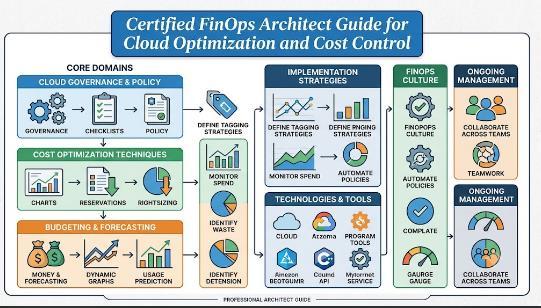
Introduction
Cloud cost is now a serious business topic for every company using AWS, Azure, Google Cloud, Kubernetes, SaaS tools, or multi-cloud platforms. Engineering teams want speed, finance teams want control, and business leaders want clear value from every cloud investment.This is where FinOps becomes important.The Certified FinOps Architect certification helps working engineers, managers, software engineers, cloud professionals, DevOps teams, SREs, finance teams, and IT leaders understand how to manage cloud cost in a structured and practical way.
What Is Certified FinOps Architect?
Certified FinOps Architect is a professional certification focused on cloud financial management, cost visibility, budgeting, forecasting, governance, reporting, and cloud cost optimization.
It teaches how engineering, finance, product, and leadership teams can work together to control cloud spending without slowing innovation.
Certification Overview
Track Level Who it’s for Prerequisites Skills covered Recommended order
FinOps / Cloud Financial Management Professional / Architect Engineers, managers, DevOps, SRE, cloud, finance, and platform teams Basic cloud and IT knowledge
Who Should Take It?
Cost allocation, governance, budgeting, forecasting, optimization, reporting, automation Cloud basics → Billing → FinOps lifecycle → Optimization → Certification
This certification is useful for professionals who work with cloud cost, cloud infrastructure, software delivery, IT operations, or business planning.
It is best for:
Software engineers
DevOps engineers
Cloud engineers
SREs
Platform engineers
Engineering managers
Finance and procurement teams
Product managers
Cloud consultants
IT leaders
If you want to move from only technical execution to cloud cost leadership, this certification is a strong choice.
Skills You’ll Gain
After preparing for Certified FinOps Architect, you should be able to:
Understand FinOps principles and lifecycle
Build cloud cost visibility
Create tagging and labeling strategies
Design cost allocation models
Prepare budgets and forecasts
Find unused and wasteful cloud resources
Optimize compute, storage, database, network, and Kubernetes cost
Create showback and chargeback reports
Build executive cloud cost dashboards
Design cloud cost governance policies
Work with engineering, finance, and leadership teams
Real-World Projects You Can Do After It
After this certification, you should be able to work on practical FinOps projects such as:
Creating a monthly cloud cost dashboard
Designing a tagging policy for cloud teams
Building showback reports for departments
Setting cloud budget alerts
Finding unused cloud resources
Preparing a 90-day cost optimization roadmap
Designing cost governance for multi-cloud environments
Creating reports for leadership and finance teams
Preparation Plan
7–14 Days Plan
This plan is suitable for experienced cloud, DevOps, SRE, or finance professionals.
Focus on:
FinOps basics
Cloud billing concepts
Cost allocation
Tagging and reporting
Optimization techniques
Governance models
Case study practice
30 Days Plan
This is the best plan for most working professionals.
Week 1: Learn FinOps foundations and cloud billing
Week 2: Study cost visibility, tagging, and governance
Week 3: Learn optimization, budgeting, and forecasting
Week 4: Practice dashboards, reports, and real-world case studies
60 Days Plan
This plan is useful for beginners.
First, learn cloud basics and billing. Then study FinOps lifecycle, cost allocation, budgeting, forecasting, optimization, and reporting. In the final stage, build a complete FinOps operating model with dashboards, policies, automation, and governance.
Common Mistakes
Many learners think FinOps only means cost cutting. This is not correct. FinOps is about getting better business value from cloud spending.
Common mistakes include:
Studying only theory
Ignoring real cloud bills
Not learning tagging properly
Thinking finance alone owns cloud cost
Ignoring shared cloud resources
Not understanding Kubernetes cost
Forgetting budgeting and forecasting
Not practicing dashboards and reports
Treating optimization as a one-time activity
Best Next Certification After This
After Certified FinOps Architect, learners can choose the next certification based on their career path.
Good next options include:
Certified FinOps Professional
Cloud Architect certification
DevOps certification
DevSecOps certification
SRE certification
AIOps / MLOps certification
DataOps certification
Choose Your Path
DevOps Path
DevOps engineers can use FinOps to manage cloud cost through automation, Infrastructure as Code, CI/CD pipelines, and environment cleanup.
DevSecOps Path
DevSecOps professionals can learn how to balance security, compliance, logging, governance, and cloud cost.
SRE Path
SRE teams can use FinOps for capacity planning, autoscaling, observability cost control, and reliability-cost balance.
AIOps / MLOps Path
AIOps and MLOps teams can manage the cost of AI workloads, GPUs, model training, automation, and monitoring.
DataOps Path
DataOps teams can control data storage, data pipelines, analytics queries, clusters, and data transfer cost.
FinOps Path
Professionals who want a direct FinOps career can focus on governance, cost allocation, budgeting, forecasting, optimization, and executive reporting.