Enterprise MLOps Career Guide with Certified MLOpsArchitect
Introduction
Machine learning is now used in real business systems, not only in labs or experiments. But taking an ML model from development to production is not easy. Teams need proper pipelines, automation, monitoring, security, cloud infrastructure, and governance.The Certified MLOps Architect certification helps professionals understand how to design and manage productionready machine learning platforms. It is useful for software engineers, DevOps engineers, managers, cloud architects, SREs, data engineers, and ML professionals.
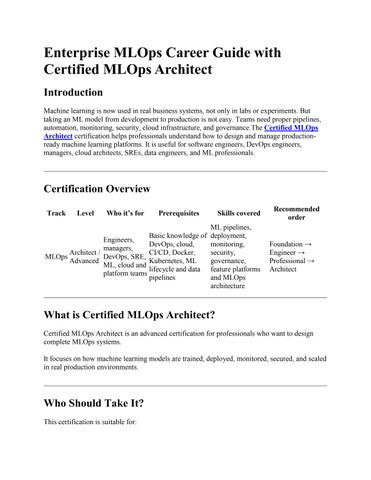
Certification Overview
Track Level Who it’s for Prerequisites
MLOps Architect / Advanced Engineers, managers, DevOps, SRE, ML, cloud and platform teams
Skills covered
Recommended order
Basic knowledge of DevOps, cloud, CI/CD, Docker, Kubernetes, ML lifecycle and data pipelines ML pipelines, deployment, monitoring, security, governance, feature platforms and MLOps architecture Foundation → Engineer → Professional → Architect
What is Certified MLOps Architect?
Certified MLOps Architect is an advanced certification for professionals who want to design complete MLOps systems.
It focuses on how machine learning models are trained, deployed, monitored, secured, and scaled in real production environments.
Who Should Take It?
This certification is suitable for:
Software engineers moving into AI and ML platforms
DevOps engineers learning MLOps
ML engineers handling production deployment
SREs managing reliability of ML systems
Data engineers working with ML pipelines
Cloud architects designing AI infrastructure
Managers leading AI and automation projects
Skills You’ll Gain
After preparing for this certification, you will understand:
How to design end-to-end MLOps platforms
How to create ML pipelines
How to deploy models using containers and Kubernetes
How to monitor model performance and drift
How to manage model registry and feature stores
How to apply security and governance
How to design multi-cloud ML systems
How to reduce cost in ML training and inference
Real-World Projects You Can Do
After this certification, you should be able to:
Design an enterprise MLOps platform
Build CI/CD pipelines for ML models
Create model deployment and rollback workflows
Set up model monitoring and drift detection
Plan secure access control for ML systems
Design reusable ML workflows for teams
Build cost-optimized ML infrastructure
Preparation Plan
7–14 Days
Best for experienced professionals.
Focus on MLOps lifecycle, ML pipelines, CI/CD, Kubernetes, model registry, monitoring, drift, security, and architecture practice.
30 Days
Best for working engineers.
Week 1: MLOps basics and ML lifecycle
Week 2: CI/CD, Docker, Kubernetes and pipelines
Week 3: Model registry, feature store and monitoring
Week 4: Security, governance, multi-cloud and architecture design
60 Days
Best for beginners.
Start with ML lifecycle and DevOps basics. Then move to pipelines, model deployment, feature stores, monitoring, governance, security, and real architecture examples.
Common Mistakes
Avoid these mistakes:
Learning only tools without architecture understanding
Ignoring data quality and pipelines
Treating ML deployment like normal software deployment
Skipping model monitoring and drift detection
Ignoring security and compliance
Not learning cloud cost optimization
Not practicing real-world design scenarios
Best Next Certification
After Certified MLOps Architect, you can move toward:
AIOps Architect
SRE certification
DevSecOps certification
DataOps certification
FinOps certification
Choose the next certification based on your career goal.
Choose Your Path
DevOps
Move from CI/CD, Docker, Kubernetes and automation into ML pipelines and MLOps platforms.
DevSecOps
Focus on secure ML pipelines, compliance, access control and model governance.
SRE
Learn model reliability, monitoring, observability and incident handling for ML systems.
AIOps/MLOps
Build deep skills in AI operations, ML lifecycle, automation and platform architecture.
DataOps
Focus on data quality, data pipelines, metadata, lineage and ML-ready data systems.
FinOps
Learn how to control cloud cost for ML workloads, GPU usage, training jobs and inference systems.
Top Institutions for Training cum Certification Support
DevOpsSchool
DevOpsSchool helps learners build skills in DevOps, CI/CD, cloud, automation and Kubernetes. These skills are useful before moving into MLOps architecture.
Cotocus
Cotocus supports enterprise technology, cloud, automation and DevOps transformation. It helps learners understand real-world platform implementation.
Scmgalaxy
Scmgalaxy is useful for learning SCM, build automation, release management and CI/CD practices, which are important for MLOps workflows.
BestDevOps
BestDevOps helps professionals understand DevOps certifications, career paths and skill growth. It is useful for connecting DevOps knowledge with MLOps.
devsecopsschool
devsecopsschool focuses on secure software delivery, DevSecOps and compliance. These topics are important for secure ML platforms.
sreschool
sreschool helps learners understand reliability, monitoring, observability and incident response for production systems.
aiopsschool
AIOps School is the official provider of the Certified MLOps Architect certification. It focuses on AIOps, MLOps and certification-based learning.
dataopsschool
dataopsschool helps learners understand data pipelines, data quality, metadata and governance, which are important for machine learning systems.
finopsschool
finopsschool focuses on cloud cost management and optimization. This is useful because ML workloads can become expensive without cost planning.
Conclusion
The Certified MLOps Architect certification is a good choice for professionals who want to design scalable, secure and reliable machine learning platforms.It helps engineers and managers understand ML pipelines, model deployment, monitoring, governance, cloud architecture and
team collaboration.For professionals in India and globally, this certification can support career growth in MLOps, DevOps, cloud, SRE, DataOps and AIOps.