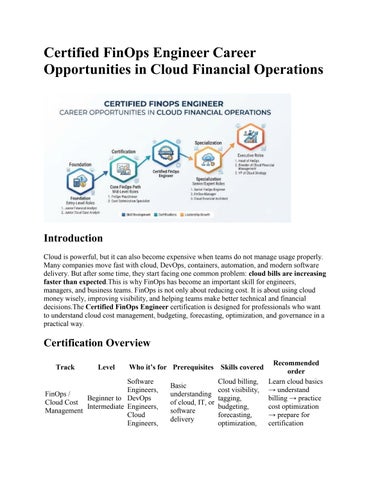
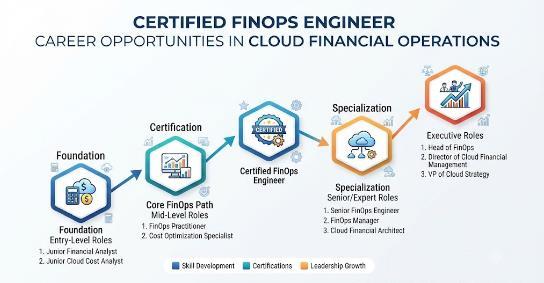
Certified FinOps Engineer Career Opportunities in Cloud Financial Operations
Introduction
Cloud is powerful, but it can also become expensive when teams do not manage usage properly. Many companies move fast with cloud, DevOps, containers, automation, and modern software delivery. But after some time, they start facing one common problem: cloud bills are increasing faster than expected.This is why FinOps has become an important skill for engineers, managers, and business teams. FinOps is not only about reducing cost. It is about using cloud money wisely, improving visibility, and helping teams make better technical and financial decisions.The Certified FinOps Engineer certification is designed for professionals who want to understand cloud cost management, budgeting, forecasting, optimization, and governance in a practical way.
Certification Overview
Track Level Who it’s for Prerequisites Skills covered Recommended order
FinOps / Cloud Cost Management Beginner to Intermediate Software Engineers, DevOps Engineers, Cloud Engineers, Basic understanding of cloud, IT, or software delivery
Cloud billing, cost visibility, tagging, budgeting, forecasting, optimization,
Learn cloud basics → understand billing → practice cost optimization → prepare for certification
Track Level Who it’s for Prerequisites Skills covered Recommended order SREs, Managers, Finance and IT teams reporting, governance
What It Is
Certified FinOps Engineer is a professional certification focused on cloud financial operations. It helps learners understand how cloud cost is generated, tracked, controlled, and optimized.
It is useful for people who want to connect engineering decisions with business cost and cloud value.
Who Should Take It
This certification is suitable for:
Software Engineers
DevOps Engineers
Cloud Engineers
SRE Professionals
IT Managers
Project Managers
Finance and billing teams
Cloud consultants
Platform engineers
Students planning a cloud career
Skills You’ll Gain
After completing Certified FinOps Engineer, you can build skills in:
Cloud billing concepts
Cost visibility and reporting
Tagging and resource ownership
Budget planning
Forecasting cloud spend
Identifying unused resources
Rightsizing cloud infrastructure
Cost optimization methods
Cloud governance
Showback and chargeback basics
Team-wise cost accountability
FinOps culture and collaboration
Real-World Projects You Can Do
After this certification, you should be able to work on projects such as:
Creating cloud cost dashboards
Setting budget alerts
Finding idle or unused cloud resources
Building tagging policies
Preparing cost reports for teams
Tracking project-wise cloud usage
Suggesting rightsizing options
Supporting monthly cloud cost reviews
Creating showback reports
Improving cloud cost governance
Preparation Plan
7–14 Days Plan
This plan is suitable for professionals who already understand cloud basics. Start with FinOps concepts, then study cloud billing, tagging, cost reports, budgeting, and optimization examples. Use the final days for revision and practical scenarios.
30 Days Plan
This plan is good for working engineers and managers. In the first week, learn cloud billing. In the second week, focus on cost visibility, tags, and reports. In the third week, study optimization and governance. In the final week, revise and practice use cases.
60 Days Plan
This plan is best for beginners. Spend the first two weeks on cloud fundamentals. Then study billing, FinOps principles, dashboards, forecasting, and cost control. Use the last two weeks for hands-on examples and certification preparation.
Common Mistakes
Many learners make these mistakes:
Thinking FinOps means only cutting cloud cost
Believing FinOps is only for finance teams
Ignoring tagging and ownership
Not understanding cloud billing deeply
Learning theory without practical examples
Forgetting budgeting and forecasting
Not connecting cost with business value
Ignoring team collaboration
Not practicing dashboards and reports
Best Next Certification After This
After Certified FinOps Engineer, learners can choose the next certification based on their career goal.
DevOps professionals can move toward DevOps or cloud automation certifications. SRE professionals can learn reliability engineering. Data professionals can choose DataOps. AI and automation professionals can move toward AIOps or MLOps. Those who want to grow deeper in cost management can continue with advanced FinOps learning.
Choose Your Path
1. DevOps Path
DevOps engineers create and manage cloud environments, CI/CD pipelines, containers, and infrastructure automation. FinOps helps them understand how these systems affect cloud cost.
With FinOps knowledge, DevOps teams can build cost-aware automation, apply tagging standards, control unused environments, and improve infrastructure efficiency.
2. DevSecOps Path
DevSecOps teams manage security, compliance, scanning, monitoring, and governance. These tools can also increase cloud cost if not managed properly.
Certified FinOps Engineer helps DevSecOps professionals balance security needs with cost control and better resource planning.
3. SRE Path
SRE teams focus on reliability, uptime, performance, and incident response. But high availability often needs more infrastructure.
FinOps helps SREs balance reliability and cost. It teaches how to avoid overprovisioning while still maintaining stable systems.
4. AIOps/MLOps Path
AIOps and MLOps platforms use compute, storage, monitoring, logs, data pipelines, and automation. These workloads can become expensive quickly.
FinOps helps professionals manage AI, ML, and operations cost with better planning, forecasting, and resource optimization.
5. DataOps Path
DataOps teams work with data pipelines, warehouses, lakes, ETL jobs, analytics, and storage systems. These platforms can create high cloud bills.
FinOps helps data teams control storage cost, query cost, pipeline cost, and analytics workload cost.
6. FinOps Path
This is the main path for professionals who want to specialize in cloud cost management.
It focuses on budgeting, forecasting, reporting, optimization, governance, and communication between engineering, finance, and business teams.
Top Institutions for Training and Certification Support
DevOpsSchool
DevOpsSchool supports learners with DevOps, cloud, automation, and engineering-focused training. It is useful for professionals who want to understand FinOps from a practical technology point of view.
Cotocus
Cotocus works around cloud, DevOps, automation, and enterprise transformation. It can help teams understand how FinOps fits into real organizational cloud governance.
Scmgalaxy
Scmgalaxy provides learning support around DevOps, SCM, cloud, and automation practices. It is helpful for learners who want to connect FinOps with engineering workflows.
BestDevOps
BestDevOps focuses on DevOps and cloud learning. It can help professionals understand how cost optimization connects with CI/CD, cloud infrastructure, and operations.
DevSecOpsSchool
DevSecOpsSchool is useful for learners who want to combine security, compliance, cloud governance, and cost management practices.
SRESchool
SRESchool helps learners connect reliability engineering with cost optimization. It is useful for SREs who want to manage performance and cloud spending together.
AIOpsSchool
AIOpsSchool supports learning in AI-driven operations, observability, monitoring, and automation. FinOps knowledge helps manage the cost of these intelligent platforms.
DataOpsSchool
DataOpsSchool is suitable for data engineers and data teams. It helps professionals understand the cost side of data pipelines, storage, analytics, and cloud data platforms.
FinOpsSchool
FinOpsSchool provides the Certified FinOps Engineer certification. It focuses on cloud cost management, reporting, governance, optimization, and financial accountability.
Conclusion
The Certified FinOps Engineer certification is a valuable choice for professionals who work with cloud, DevOps, software engineering, SRE, data platforms, AI operations, finance, or IT management.It teaches how to understand cloud bills, reduce waste, improve visibility, build accountability, and connect engineering work with business value.For India and global professionals, FinOps is becoming an important career skill because companies want cloud teams that can deliver speed, reliability, and cost efficiency together.If you want to grow in cloud, DevOps, SRE, DataOps, AIOps, MLOps, or FinOps, this certification can be a strong step forward.