
Services
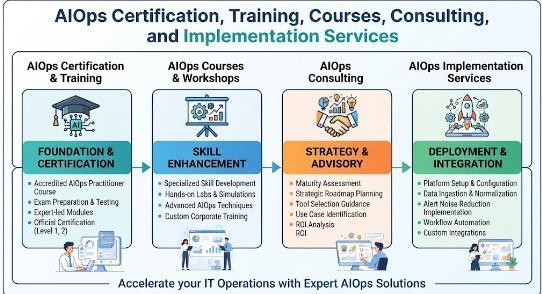
Modern IT operations are becoming more complex because businesses now use cloud platforms, Kubernetes, microservices, automation tools, and distributed applications. In such environments, traditional monitoring is not enough. Teams often receive hundreds or thousands of alerts, but finding the real root cause can take too much time.
This is where AIOps becomes important.
AIOps, or Artificial Intelligence for IT Operations, uses AI, machine learning, automation, and observability data to improve IT operations. It helps teams reduce alert noise, detect incidents faster, understand root causes, and improve system reliability.
For professionals and enterprises, AIOps Certification and AIOps Training are becoming valuable because modern operations teams need smarter skills for managing complex infrastructure.
What Is AIOps Certification?
AIOps Certification validates a professional’s knowledge of AI-powered IT operations. It shows that the learner understands observability, monitoring, event correlation, intelligent alerting, root cause analysis, incident automation, and modern operations practices.
This certification is useful for DevOps Engineers, SRE Engineers, Cloud Engineers, IT Operations Teams, Platform Engineers, Monitoring Specialists, and Technology Managers.
Why AIOps Training Is Important
A good AIOps Course helps learners understand how intelligent operations work in real production environments. It teaches how to collect and analyze logs, metrics, traces, events, and alerts.
AIOps Training usually covers:
Machine learning for IT operations
Event correlation
Intelligent alerting
Root cause analysis
Predictive analytics
Incident automation
Observability
OpenTelemetry
Monitoring automation
With AIOps Online Training, working professionals can learn these skills flexibly while continuing their jobs.
AIOps for DevOps and SRE Teams
AIOps is highly useful for DevOps and SRE teams because both teams focus on reliability, automation, speed, and system performance.
For example, if a new software release causes errors in production, AIOps can connect deployment events, application logs, latency metrics, and user impact. This helps teams identify the issue faster and take action before it becomes a major outage.
AIOps helps DevOps and SRE teams by:
Reducing alert fatigue
Improving incident response
Supporting faster root cause analysis
Improving service reliability
Helping with continuous delivery
AI Observability and Modern IT Operations
AI Observability is an important part of AIOps. Traditional monitoring tells teams when something is wrong. Observability helps teams understand why something is wrong.
Logs, metrics, traces, and events give a complete view of system behavior. When AI is applied to this data, teams can find patterns, detect anomalies, and predict possible failures.
This makes AI Observability Training important for anyone planning to become an AIOps Engineer.
AIOps Engineer Career Path
An AIOps Engineer should learn technical and operational skills step by step.
A simple roadmap includes:
1. Learn Linux and networking basics.
2. Understand cloud platforms.
3. Learn Kubernetes and containers.
4. Study monitoring and observability tools.
5. Understand logs, metrics, traces, and events.
6. Learn OpenTelemetry basics.
7. Practice automation and Python.
8. Study AIOps tools and workflows.
9. Learn incident management.
10. Prepare for AIOps Engineer Certification.
This path helps professionals grow from IT operations or DevOps roles into AIOps Engineer, SRE, Platform Engineer, or Observability Consultant roles.
AIOps Consulting and Implementation Services
Enterprises often need AIOps Consulting because AIOps adoption is not only about buying a tool. It requires planning, data quality, integration, automation strategy, and team readiness.
AIOps Consulting helps organizations assess their current operations maturity, choose the right tools, build a roadmap, and design better incident workflows.
AIOps Implementation Services usually include:
Assessment
Design
Tool selection
Data integration
Event correlation
Automation
Optimization
Continuous improvement
This helps enterprises move from reactive operations to intelligent and proactive operations.
Benefits of AIOps Adoption
AIOps can provide many operational benefits, such as:
Reduced downtime
Faster root cause analysis
Better user experience
Lower operational effort
Improved reliability
Smarter decision-making
Better incident management
For businesses, this means fewer outages, faster recovery, and more stable digital services.
Why Learn with AIOpsSchool
AIOpsSchool provides practical learning, certification programs, hands-on training, consulting knowledge, and enterprise-focused guidance for AIOps professionals and organizations.
Learners can explore AIOps Certification, AIOps Training, AIOps Course, AIOps Engineer Training, AIOps Online Training, AI Observability Training, AIOps Consulting, and AIOps Implementation Services through AIOpsSchool.
Conclusion
AIOps is becoming an important skill for modern IT operations. As cloud-native systems, Kubernetes, microservices, and distributed applications continue to grow, organizations need professionals who can use AI, automation, and observability to improve reliability.
AIOps Certification helps professionals prove their skills. AIOps Training helps them build practical knowledge. AIOps Consulting and Implementation Services help enterprises adopt intelligent operations in a structured way.
For DevOps Engineers, SRE Engineers, Cloud Engineers, and IT operations professionals, learning AIOps is a smart step toward future-ready IT careers.