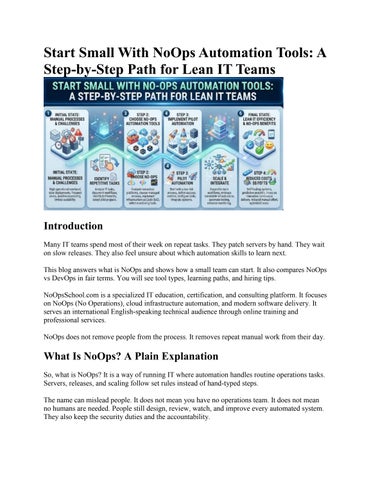
Start Small With NoOps Automation Tools: A Step-by-Step Path for Lean IT Teams
Introduction Many IT teams spend most of their week on repeat tasks. They patch servers by hand. They wait on slow releases. They also feel unsure about which automation skills to learn next. This blog answers what is NoOps and shows how a small team can start. It also compares NoOps vs DevOps in fair terms. You will see tool types, learning paths, and hiring tips. NoOpsSchool.com is a specialized IT education, certification, and consulting platform. It focuses on NoOps (No Operations), cloud infrastructure automation, and modern software delivery. It serves an international English-speaking technical audience through online training and professional services. NoOps does not remove people from the process. It removes repeat manual work from their day.
What Is NoOps? A Plain Explanation So, what is NoOps? It is a way of running IT where automation handles routine operations tasks. Servers, releases, and scaling follow set rules instead of hand-typed steps. The name can mislead people. It does not mean you have no operations team. It does not mean no humans are needed. People still design, review, watch, and improve every automated system. They also keep the security duties and the accountability.
Automation can also support self-healing. This means a system fixes a known problem by itself. For example, it restarts a failed service. This helps with common, well-understood faults. It does not solve every problem.
Why This Matters for IT Teams and Careers Manual work slows delivery. Each hand-run step adds waiting time and a chance of error. Automation makes releases more repeatable. As a result, teams can ship smaller changes more often. Reliability can improve too, because scripts do the same thing each time. Cost is more mixed. Automation takes effort to build, and cloud bills still need review. Savings depend on the organization. Skills matter most for careers. Teams need people who can write code for infrastructure and read monitoring data. Learning NoOps automation tools gives you a practical base. It does not guarantee a job or a raise.
NoOps vs DevOps: What Is the Difference? NoOps vs DevOps is not a fight. DevOps joins development and operations teams so they share goals. NoOps builds on that idea. It pushes automation further, so routine operations need less hand work. DevOps ideas still matter. Shared ownership, fast feedback, and teamwork stay important. In fact, good automation depends on them. A team with weak communication will only automate its confusion. Neither idea replaces the other. Think of DevOps as the working culture. Think of NoOps as a sharper focus on automating repeat tasks. Many teams use both at once.
NoOps Automation Tools: The Main Categories NoOps automation tools fall into a few groups. Begin with the group that matches your most urgent need. Infrastructure as code means you describe servers and networks in files. A tool then builds them for you. Terraform is one example. Containers package an app with everything it needs to run. Orchestration tools manage many containers at once. Docker and Kubernetes are common examples. CI/CD means continuous integration and continuous delivery. It tests and ships code through an automatic pipeline.
GitOps uses a Git repository as the single source of truth. The system then matches your live setup to those files. Observability means seeing what a system does through logs, metrics, and traces. Monitoring sends alerts when something looks wrong. AIOps means using machine learning on operations data to spot patterns and noise. A person still reviews what it finds. NoOpsSchool.com covers these topic areas in its learning programs, as the site advertises. Add one group at a time, and check each tool's current features yourself.
NoOps Certification: What to Look For A NoOps certification generally shows that you studied a defined set of skills. It may also show that you completed tasks or an exam. It does not replace real experience. Judge any NoOps certification with three checks. First, read the syllabus and see if it matches your work. Second, look for hands-on practice, because labs teach more than slides. Third, match it to your role, since engineers and managers need different things. Details vary by program. Check the provider's current details on its own site before you enrol. NoOpsSchool.com advertises certification tracks for NoOps Engineers, Architects, Managers, and other professionals.
NoOps Engineer Certification A NoOps engineer certification usually fits people who build and run automated cloud systems. The role is hands-on. Engineers write code that creates infrastructure, then keep it healthy. Common topics include infrastructure as code, CI/CD pipelines, and observability. Many paths also add containers and cloud basics. Engineers learn to test changes before users see them. Look for labs where you build something real. For example, you might deploy a small app through a pipeline. Then you add alerts and fix a planned fault. Practice like this builds skill that reading alone cannot.
NoOps Architect Training NoOps architect training suits people who design the bigger picture. Architects plan how cloud pieces fit together. They aim for systems that are automated, resilient, and easy to change. Good NoOps architect training covers design trade-offs. For example, it may show how to split a system into parts. It may also cover planning for failures and building security into the design.
Because automation can fail too, architects plan for human review. They decide where a person must approve a change. This keeps control in the right hands.
NoOps Manager Certification A NoOps manager certification targets people who lead teams and plan change. Managers do not need to write every script. They do need to know what automation can and cannot do. The role covers planning, people, process, risk, and measuring outcomes. A manager sets priorities and clears blockers. They also pick which tasks to automate first. Managers protect accountability too. Someone must own each automated system and each incident. Pick a NoOps manager certification that stresses risk and ownership, not just tool names.
NoOps Training Course A good NoOps training course teaches by doing. Look for hands-on labs, real scenarios, clear learning steps, and support when you get stuck. Lessons should build from simple to harder topics. NoOpsSchool.com advertises topics such as infrastructure as code, Kubernetes, and Docker. They also include Terraform, GitOps, and CI/CD automation. Other topics are cloud-native computing, serverless architecture, observability, and AI-powered operations. Cloud-native means built to run well in the cloud. Serverless means the cloud provider runs the servers for you. The site also mentions self-healing infrastructure and automated incident response. The second term means the system takes first steps when an alert fires.
NoOps Consulting Services NoOps consulting services help organizations plan and carry out automation. The site advertises services such as operational assessments, automation strategy, and cloud-native modernization. It also lists infrastructure provisioning, CI/CD implementation, AIOps integration, and security automation. An assessment looks at how work happens today. Strategy then sets the order of changes. Modernization moves older systems toward cloud-native design. Security automation builds safety checks into the pipeline. Results depend on each organization. A good consultant explains each step in plain terms. Ask what your own team will need to do.
How to Hire NoOps Freelancers
Before you hire NoOps freelancers, define the job. Write down the scope, the tools, and the finish line. A clear scope prevents surprises later. Then check four things. Look at relevant skills, past work, communication, and how they handle security. Ask for examples of similar projects. If you can, begin with one small paid task. NoOpsSchool.com offers access to freelancers with skills in Terraform, Kubernetes, cloud platforms, automated monitoring, and self-healing systems. Not every skill is available at all times. Review each profile yourself.
Common Mistakes Learners and Teams Make
Believing NoOps means no people. Skilled staff still own each system and answer for it. Automating without monitoring. You cannot fix what you cannot see. Skipping security automation. Add safety checks to the pipeline early. Learning tools without practice. Choose a NoOps training course that includes real labs. Treating NoOps vs DevOps as a contest. Keep the teamwork habits while you automate more. Adopting too many tools at once. A crowded toolset confuses a team and hides problems. Ignoring team skills. Check what your people know before you pick a plan. Chasing a certificate without a plan. Set a goal first, then choose a path. Automating a broken process. Fix the process first, then automate it.
A Simple Example This is a fictional example. A small software team runs one web app. Releases take a full day because people copy files by hand. First, the team asks what is NoOps and learns it means less hand work, not fewer people. Then they pick one pain point, which is releases. They store their setup in files and add a CI/CD pipeline. Next they add alerts. Later they let the system restart one failed service on its own. One member explores a NoOps engineer certification track on NoOpsSchool.com and practices in online labs. The team keeps a person on call and reviews every change. They learn from each incident and improve the rules.
How NoOpsSchool.com Can Help NoOpsSchool.com presents itself as one place to learn, certify, and find expert support. For learners, the site advertises a NoOps training course built around hands-on labs and real automation scenarios. It also mentions platform engineering ideas. These are about building internal tools that help developers ship safely.
For career tracks, the site lists NoOps certification options for several roles. These include NoOps engineer certification, NoOps architect training, and NoOps manager certification. For organizations, the site advertises NoOps consulting services. It also offers access to freelancers. Teams that want to hire NoOps freelancers can browse for the skills they need. Always confirm current details with the provider.
Frequently Asked Questions About Starting NoOps Automation in Small Teams 1. What is NoOps in simple words? NoOps is a way to run IT with as little manual work as possible. Automation handles routine jobs, such as building servers and shipping code. People still plan, watch, and fix systems. The goal is fewer repeat tasks, not fewer responsible humans. 2. Is NoOps vs DevOps a choice I must make? No. NoOps vs DevOps is better seen as a range, not a fork. DevOps brings the teamwork habits. NoOps pushes routine tasks further toward automation. Many teams use both ideas together. Pick the mix that fits your team size, your risks, and your skills. 3. Which NoOps automation tools suit a small team? Match the tool type to your biggest pain. Slow releases point to CI/CD. Hand-built servers point to infrastructure as code. Blind spots point to monitoring. Terraform, Docker, and Kubernetes are common examples. Check each tool's current features before you commit to it. 4. What does a NoOps certification usually show? It usually shows that you studied a defined skill list and met the provider's bar for it. That bar may be tasks, an exam, or both. It does not prove you can handle every system. Ask employers what they value, because views differ. 5. Who should consider NoOps engineer certification? People who build and run cloud systems may find it useful. That includes developers, system administrators, and DevOps engineers. Architects may prefer NoOps architect training instead. Choose one that matches your daily work. A certificate alone does not promise a job. 6. What does NoOps architect training cover? It generally covers the design of automated, resilient cloud platforms. Topics may include planning for failures, building security into designs, and fitting parts together. Details differ by provider, so read each syllabus closely. Strong courses add design exercises with realistic cases.
7. Who might take a NoOps manager certification? Team leads, IT managers, and delivery heads often look at it. They want to know what automation can and cannot do. A good syllabus teaches how to set priorities and judge risk. It should also show how to measure whether a change really helped. 8. What does NoOpsSchool.com offer for someone choosing a NoOps training course? NoOpsSchool.com advertises online lessons built around hands-on labs and real-world automation scenarios. Its topics include Kubernetes, Terraform, and GitOps. Read the current course pages for what is included. Confirm fees, length, and exam format with the provider directly before you enrol. 9. When do NoOps consulting services make sense? They make sense when your team lacks time or experience to start alone. The site advertises assessments, automation strategy, and CI/CD implementation, among other services. Results depend on each organization. Your own staff should stay involved and keep ownership of the outcome. 10. How can I hire NoOps freelancers with less risk? Treat it like any hiring decision. Ask for proof of similar work, and talk through your goals. Agree on access rules, since freelancers may touch live systems. Write down deliverables and review them yourself. The platform offers access to freelancers with skills in cloud platforms and self-healing systems. Confirm availability first.
Final Thoughts Starting small is the safest way into automation. When you understand what is NoOps, the path feels less scary. Pick one pain point, choose one of the NoOps automation tools, and build from there. Learning matters as much as tooling. A NoOps certification or a hands-on course can give you structure. Engineers, architects, and managers each need different skills. Outside help can fill gaps. That may mean NoOps consulting services or a decision to hire NoOps freelancers. Remember that NoOps reduces manual work. It still needs skilled people who watch, decide, and take responsibility. NoOpsSchool.com is one place to explore learning and services that match this goal.