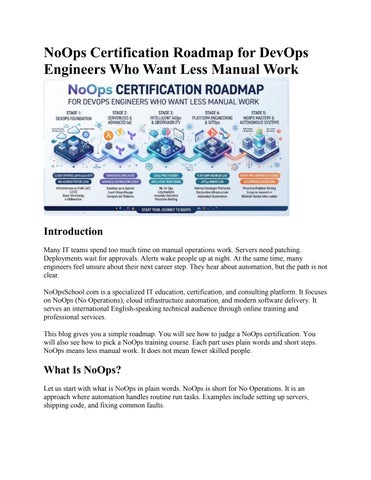
NoOps Certification Roadmap for DevOps Engineers Who Want Less Manual Work
Introduction Many IT teams spend too much time on manual operations work. Servers need patching. Deployments wait for approvals. Alerts wake people up at night. At the same time, many engineers feel unsure about their next career step. They hear about automation, but the path is not clear. NoOpsSchool.com is a specialized IT education, certification, and consulting platform. It focuses on NoOps (No Operations), cloud infrastructure automation, and modern software delivery. It serves an international English-speaking technical audience through online training and professional services. This blog gives you a simple roadmap. You will see how to judge a NoOps certification. You will also see how to pick a NoOps training course. Each part uses plain words and short steps. NoOps means less manual work. It does not mean fewer skilled people.
What Is NoOps? Let us start with what is NoOps in plain words. NoOps is short for No Operations. It is an approach where automation handles routine run tasks. Examples include setting up servers, shipping code, and fixing common faults.
The name can mislead. NoOps does not mean there is no operations team. It does not mean no humans are needed. People still design, review, monitor, and improve every automated system. They also keep security and accountability. Three ideas sit at the core. Infrastructure as code means you describe servers in text files instead of clicking in a console. Self-healing means a system fixes common, well-understood faults by itself. Observability means you can see what a system does through its logs, metrics, and traces.
Why This Matters for IT Teams and Careers Manual work slows delivery. Each hand-made change adds delay and risk. Automation makes releases more repeatable. As a result, teams ship with fewer surprises. Reliability can improve too. Automated checks catch many common errors early. Even so, automation cannot remove all incidents or all risk. Skilled people must still handle new and unusual problems. Cost and skills also change. Teams may spend less time on repeat tasks. But they need new skills in code, cloud, and monitoring. Engineers who learn these skills gain more options. No course can promise a job or a raise. Your results depend on your effort and your market.
NoOps vs DevOps: What Is the Difference? Talk about NoOps vs DevOps often sounds like a fight. It is not one. DevOps is a culture of teamwork between developers and operations. NoOps pushes that idea further with heavy automation. DevOps ideas still matter. Shared ownership, fast feedback, and small releases all remain useful. NoOps builds on them. It asks which routine tasks a machine can do safely. Neither idea replaces the other. A DevOps engineer already knows CI/CD, which means continuous integration and continuous delivery. That is a strong base for NoOps work. So the move is a step forward, not a restart. If you are new, revisit what is NoOps first. Think of the two as points on one road.
NoOps Automation Tools NoOps automation tools fall into a few groups. Each group handles one part of the work. Infrastructure as code tools create cloud resources from code. Terraform is one example. Container tools package apps so they run the same everywhere. Docker is one example. Orchestration tools run those containers at scale. Kubernetes is one example.
CI/CD tools build, test, and ship code on their own. GitOps keeps Git as the single source of truth. A change in Git then updates the live system. Monitoring and observability tools show system health. AIOps tools use machine learning to spot patterns in operations data. No single tool fits every team. Pick tools by need, not by hype. Learn the idea first. Then learn the product.
NoOps Certification: What to Look For A NoOps certification generally shows that you studied a set of skills. It may also show that you passed a test or a lab task. It is not a magic key. Employers weigh it in their own way. Check three things before you choose. First, read the syllabus. It should cover topics you will use at work. Second, look for hands-on practice. Labs teach more than slides. Third, check the fit for your role. An engineer, an architect, and a manager need different skills. Always read the details on the provider's site. Details vary by program. NoOpsSchool.com advertises learning programs and certification tracks. They are for NoOps Engineers, NoOps Architects, NoOps Managers, and NoOps Professionals. Treat any certificate as one part of your story, next to real projects.
NoOps Engineer Certification A NoOps engineer builds and runs automated cloud systems. The engineer writes code that creates servers, networks, and pipelines. The engineer also sets up alerts and dashboards. A NoOps engineer certification path should cover infrastructure as code, CI/CD, containers, and observability. It should also teach basic security habits. For example, secrets must stay out of code. Start with Linux and one cloud platform. Then add Terraform, Docker, and Kubernetes. Practice by building a small pipeline from start to finish. Study works best after you have built something real.
NoOps Architect Training A NoOps architect designs automated and resilient cloud systems. The architect plans how many pieces fit together. These include networks, data stores, pipelines, and monitoring. NoOps architect training should teach design trade-offs. For example, serverless means the cloud runs your code without you managing servers. It can cut upkeep, but it can also limit control. An architect weighs such choices with the team. Good architects also plan for failure. They ask what breaks first and how the system recovers. They write down decisions so others can follow them.
NoOps Manager Certification A NoOps manager guides the people and process behind automation. The role covers planning, risk, and measuring outcomes. A manager does not need to write every script. But a manager must understand how the system works. A useful NoOps manager certification covers roadmaps, team skills, and change management. It should also teach risk reviews and security duties. Managers track simple measures, such as how often releases succeed and how fast the team recovers. Good managers keep humans in the loop. They set rules for when a person must approve a change. They also make time for the team to learn.
NoOps Training Course Many people begin with a NoOps training course. Look for four things. First, hands-on labs. Second, real scenarios, such as a failed deploy. Third, clear learning steps from basic to advanced. Fourth, support when you get stuck. NoOpsSchool.com advertises course topics such as infrastructure as code, cloud-native computing, and GitOps. It also lists Kubernetes, Docker, Terraform, and CI/CD automation. More topics include serverless architecture, observability, and AI-powered operations. The site also advertises real-world automation scenarios, self-healing infrastructure, and automated incident response. Course length, fees, and exam format vary. Check the provider's current details. Choose a course that fits your schedule. Steady practice beats rushing.
NoOps Consulting Services Some teams need help, not just training. NoOps consulting services generally cover assessment, strategy, modernization, provisioning, CI/CD, AIOps, and security automation. An assessment reviews how work is done today. Strategy sets goals and the order of steps. Modernization moves older systems toward cloud-native designs. Provisioning sets up infrastructure by code. The rest builds pipelines, adds AIOps, and automates security checks. The site advertises these services. Results depend on each organization. Ask about scope, timelines, and how your team stays involved. Your people must own the outcome after the work ends.
How to Hire NoOps Freelancers
A short project sometimes needs an outside expert. If you hire NoOps freelancers, check four things. First, skills that match your stack. Second, past work you can review. Third, a clear scope with set deliverables. Fourth, good communication. The platform offers access to freelancers. Their skills include Terraform, Kubernetes, cloud platforms, automated monitoring, and self-healing systems. Availability varies. Not every skill is open at all times. Start with a small task and review the work. Then grow the scope. Plan access control and handover notes as well. Keep final ownership in your own team.
Common Mistakes Learners and Teams Make 1. Treating NoOps as "no people." Skilled people still design, review, and own every system. 2. Automating without monitoring. You cannot fix what you cannot see. 3. Skipping security automation. Fast changes spread fast mistakes. 4. Learning tools without hands-on practice. Reading alone does not build skill. 5. Ignoring team skills. A plan fails when nobody can run it. 6. Chasing a certificate without a plan. Set a goal before you pick a path. 7. Automating a broken process. Fix the process first, then write the code. 8. Collecting too many tools. Each extra tool adds upkeep. 9. Seeing NoOps vs DevOps as a contest. Both share the same goals. 10. Forgetting handover notes. Written notes keep knowledge in the team.
A Simple Example (Fictional) This is a made-up example. A small team runs a web app. Engineers deploy by hand each week. Releases feel slow and stressful. One engineer decides to study automation. The engineer joins a course on NoOpsSchool.com and practices in labs. Next, the engineer writes Terraform files for a test environment. Then the engineer adds a CI/CD pipeline and a simple alert. The team reviews every change together. Later, the team tries automated restarts for one common fault. A person still approves risky changes. The team grows its skills one step at a time. This example claims no numbers and no results.
How NoOpsSchool Can Help NoOpsSchool.com is built around one theme: less manual work through smart automation. The site advertises online learning programs. It also advertises certification tracks for Engineers, Architects, Managers, and Professionals. New readers can start with what is NoOps and build up from there.
For organizations, the site advertises consulting. Listed areas include operational assessments, automation strategy, and cloud-native modernization. Others include infrastructure provisioning, CI/CD implementation, AIOps integration, and security automation. Hiring help is also part of the picture. The platform offers access to freelancers in areas like Terraform and Kubernetes. Services and skills are not always available. Check the current details before you plan.
Frequently Asked Questions About the NoOps Career Roadmap 1. What is NoOps in simple words? NoOps is an approach that uses automation for routine operations tasks. It cuts manual work such as setup, deploys, and common fixes. It does not remove people. Humans still design, watch, secure, and improve the systems. Think of it as fewer repeat chores, not zero responsibility. 2. Do I have to choose between NoOps vs DevOps? No. NoOps vs DevOps is not a forced choice. DevOps gives you teamwork, fast feedback, and small releases. NoOps adds deeper automation on top. Most learners keep their DevOps habits and add new automation skills. Many teams blend both ideas in daily work. 3. How do I judge a NoOps certification before I enrol? Read the syllabus first. Look for hands-on labs and real scenarios. Check that the topics match your role. Then read the provider's current details on fees, format, and exam rules. A NoOps certification shows study and practice. It does not promise a job, a raise, or recognition. 4. Who should take a NoOps engineer certification? It suits DevOps engineers, system administrators, and developers who want to build automated cloud systems. You should know basic Linux and one cloud platform. A NoOps engineer certification track usually focuses on infrastructure as code, CI/CD, and observability. Check the provider's page for exact topics. 5. What does NoOps architect training usually include? It usually covers system design, resilience, and trade-offs. You may study cloud-native patterns, serverless designs, and failure planning. Good NoOps architect training also teaches how to record choices for others. Details vary by program, so compare syllabi before you pick one. 6. Is a NoOps manager certification only for technical leads?
No. A NoOps manager certification also suits IT managers with little coding time. It centers on planning, people, process, risk, and measuring outcomes. Managers learn to set review rules and keep humans in the loop. Basic technical knowledge helps, but writing code is not the main task. 7. What should a NoOps training course include? Look for hands-on labs, real scenarios, and clear learning steps. Support from instructors or a community also helps. Topics should match your goals, such as Terraform, Docker, Kubernetes, GitOps, and observability. A good NoOps training course lets you practice each skill, not just read about it. 8. Which NoOps automation tools should I learn first? Start with the idea, not the brand. Learn infrastructure as code, containers, CI/CD, and monitoring in that order. Then add GitOps and AIOps. Pick NoOps automation tools your own team already uses. That makes practice useful at work right away. Tools change, but core ideas stay steady. 9. When should I use NoOps consulting services or hire NoOps freelancers? Use NoOps consulting services when you need an assessment or a long-term plan. Hire NoOps freelancers when you have a small, well-defined task. In both cases, define the scope and keep ownership inside your team. Results depend on the organization. Availability varies by provider. 10. What does NoOpsSchool.com offer? NoOpsSchool.com is an online home for NoOps learning, certification tracks, consulting, and freelancer access. It speaks to English-speaking technical teams worldwide. Its focus is cloud automation and modern delivery. Check its site for current programs and details, since offerings can change.
Final Thoughts Moving from manual operations to automation takes steady steps. Begin with what is NoOps, then learn the ideas, then practice with real labs. Pick a NoOps certification or a NoOps training course that matches your role. Use NoOps automation tools with care, and keep people in charge. Remember that NoOps reduces manual work. It still needs skilled people who design, review, and secure each system. DevOps habits stay useful along the way. Engineers, architects, and managers each have a path. Organizations can also lean on outside help when a gap appears. NoOpsSchool.com offers a focused place to begin. Review its current programs. Then compare them with your goals and take the next step.