Career OpportunitiesAfter DevOps Certified Professional Certification
Introduction
DevOps has become an important part of modern software development. Companies now expect engineers to release applications faster, reduce errors, automate routine work and maintain reliable systems.The DevOps Certified Professional (DCP) certification helps professionals understand these responsibilities in a structured way. It is suitable for software engineers, DevOps professionals, cloud engineers, system administrators, technical leads and managers.The certification is provided by DevOpsSchool and focuses on practical DevOps knowledge rather than only theoretical concepts.
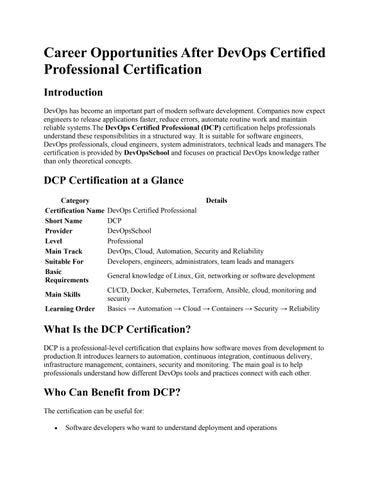
DCP Certification at a Glance
Category
Certification Name DevOps Certified Professional
Short Name DCP
Provider DevOpsSchool
Level Professional
Details
Main Track DevOps, Cloud, Automation, Security and Reliability
Suitable For Developers, engineers, administrators, team leads and managers
Basic
Requirements
Main Skills
General knowledge of Linux, Git, networking or software development
CI/CD, Docker, Kubernetes, Terraform, Ansible, cloud, monitoring and security
Learning Order Basics → Automation → Cloud → Containers → Security → Reliability
What Is the DCP Certification?
DCP is a professional-level certification that explains how software moves from development to production.It introduces learners to automation, continuous integration, continuous delivery, infrastructure management, containers, security and monitoring. The main goal is to help professionals understand how different DevOps tools and practices connect with each other.
Who Can Benefit from DCP?
The certification can be useful for:
Software developers who want to understand deployment and operations
DevOps engineers who want broader practical knowledge
System administrators moving toward automation
Cloud engineers working with modern infrastructure
Technical managers leading engineering teams
Security professionals interested in DevSecOps
Beginners planning a long-term DevOps career
Some basic technical knowledge is helpful, but regular practice is more important than previous certification experience.
Important Skills Covered
Through DCP preparation, learners can develop knowledge in:
Linux and command-line operations
Git and source-code management
CI/CD pipeline creation
Docker containers
Kubernetes orchestration
Cloud infrastructure
Terraform automation
Ansible configuration management
DevSecOps practices
Monitoring, logging and alerting
Site reliability engineering
Incident management
AIOps, MLOps, DataOps and FinOps fundamentals
Practical Work You Should Be Able to Perform
After completing the learning process, a candidate should be able to:
Build an automated CI/CD workflow
Package an application using Docker
Deploy applications on Kubernetes
Create infrastructure using Terraform
Automate server setup using Ansible
Add security checks inside a delivery pipeline
Create monitoring dashboards
Configure alerts and logging
Manage application deployment through GitOps
Prepare basic incident-response documentation
These practical tasks are important because DevOps roles require problem-solving ability, not only tool knowledge.
Preparation Options
7–14 Day Plan
This plan is suitable for experienced professionals.
Revise Linux, Git, CI/CD, Docker, Kubernetes, Terraform, cloud, monitoring and security. Spend most of the time on labs and complete one full project.
30 Day Plan
Use the first week for Linux, Git and DevOps concepts.
Spend the second week on cloud, Terraform and Ansible. Use the third week for Docker, Kubernetes and CI/CD. Complete security, monitoring and revision during the final week.
60 Day Plan
This plan is better for beginners.
Start with Linux, networking, scripting and Git. Then learn cloud infrastructure and automation. After that, study containers, Kubernetes, CI/CD, security and observability.
Reserve the final days for troubleshooting, revision and a complete practical project.
Choose Your Career Path
DevOps
Choose this path to work with CI/CD, automation, cloud, containers and infrastructure.
DevSecOps
This path is suitable for professionals interested in secure pipelines, vulnerability scanning, secrets protection and cloud security.
SRE
Select SRE when your main interest is system reliability, incident management, observability and performance.
AIOps/MLOps
This path connects operations with artificial intelligence and machine learning. It includes model deployment, intelligent monitoring and automated analysis.
DataOps
DataOps is useful for professionals working with data pipelines, data quality, automation and data platform reliability.
FinOps
FinOps focuses on cloud cost control, budgeting, resource optimisation and financial accountability.
Common Learning Mistakes
Many learners struggle because they:
Focus only on tools
Ignore Linux and networking
Watch lessons without practising
Memorise commands
Avoid troubleshooting failed deployments
Learn security at the end
Start too many tools together
Do not document their projects
A better approach is to learn one workflow at a time and connect every tool with a real use case.
What Should You Study Next?
After DCP, professionals can choose a certification based on their career goal.
DevOps engineers may continue with cloud, Kubernetes or platform-engineering certifications. Security professionals can move toward DevSecOps or cloud security.
SRE professionals can study observability and reliability engineering. Data and AI professionals can continue with DataOps, MLOps or AIOps. FinOps is suitable for those who want to specialise in cloud cost management.
Training and Certification Support
DevOpsSchool
DevOpsSchool provides the official DCP certification, structured training, labs and professional guidance.
Cotocus
Cotocus supports technical learning, consulting and engineering skill development.
SCMGalaxy
SCMGalaxy offers resources related to software configuration management, DevOps, automation and cloud technologies.
BestDevOps
BestDevOps provides DevOps learning content, certification information and career guidance.
DevSecOpsSchool
DevSecOpsSchool focuses on security automation, secure development and DevSecOps practices.
SRESchool
SRESchool supports learning in reliability engineering, observability and incident management.
AIOpsSchool
AIOpsSchool covers intelligent monitoring, event analysis and AI-based IT operations.
DataOpsSchool
DataOpsSchool provides learning resources for data pipelines, data automation and data reliability.
FinOpsSchool
FinOpsSchool focuses on cloud financial management, budgeting and cost optimisation.
Conclusion
The DevOps Certified Professional certification can help learners understand the complete software delivery process.Its real value comes from combining development, automation, cloud, containers, security and monitoring into one learning path. Professionals should not depend only on the certificate. They should also build projects, test failures, solve problems and document
their work.With regular hands-on practice, DCP can provide a strong foundation for DevOps, DevSecOps, SRE, AIOps, MLOps, DataOps or FinOps careers.