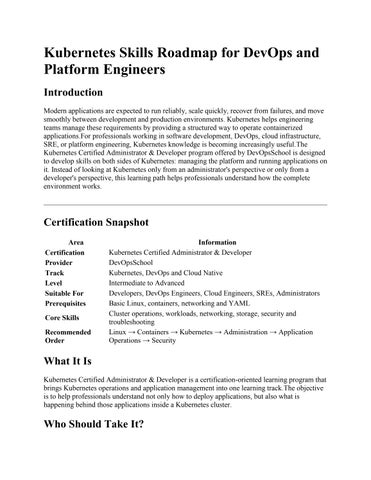
Kubernetes Skills Roadmap for DevOps and Platform Engineers Introduction Modern applications are expected to run reliably, scale quickly, recover from failures, and move smoothly between development and production environments. Kubernetes helps engineering teams manage these requirements by providing a structured way to operate containerized applications.For professionals working in software development, DevOps, cloud infrastructure, SRE, or platform engineering, Kubernetes knowledge is becoming increasingly useful.The Kubernetes Certified Administrator & Developer program offered by DevOpsSchool is designed to develop skills on both sides of Kubernetes: managing the platform and running applications on it. Instead of looking at Kubernetes only from an administrator's perspective or only from a developer's perspective, this learning path helps professionals understand how the complete environment works.
Certification Snapshot Area Certification Provider Track Level Suitable For Prerequisites Core Skills Recommended Order
Information Kubernetes Certified Administrator & Developer DevOpsSchool Kubernetes, DevOps and Cloud Native Intermediate to Advanced Developers, DevOps Engineers, Cloud Engineers, SREs, Administrators Basic Linux, containers, networking and YAML Cluster operations, workloads, networking, storage, security and troubleshooting Linux → Containers → Kubernetes → Administration → Application Operations → Security
What It Is Kubernetes Certified Administrator & Developer is a certification-oriented learning program that brings Kubernetes operations and application management into one learning track.The objective is to help professionals understand not only how to deploy applications, but also what is happening behind those applications inside a Kubernetes cluster.
Who Should Take It?
This learning path can be useful for professionals who are already working with applications, infrastructure, automation, or cloud environments. Suitable roles include:
Software Engineers DevOps Engineers System Administrators Cloud Engineers Kubernetes Engineers Platform Engineers Site Reliability Engineers Build and Release Engineers Technical Leads Engineering Managers
Developers can use the program to understand production environments better, while administrators can strengthen their knowledge of application deployment and lifecycle management.
Skills You’ll Gain A good Kubernetes administrator and developer should be comfortable with several interconnected areas. You can expect to build knowledge around:
Kubernetes architecture Pods and containers Deployments and ReplicaSets StatefulSets and DaemonSets Services and application exposure Ingress configuration ConfigMaps and Secrets Persistent storage Namespaces Resource requests and limits Scheduling Kubernetes networking Role-Based Access Control Application health checks Scaling Rolling updates Rollbacks Helm Cluster maintenance
Troubleshooting
The real value comes from understanding how these components work together rather than studying them independently.
Practical Work You Should Be Able to Handle After completing your preparation, you should aim to perform realistic Kubernetes tasks without depending completely on step-by-step instructions. Examples include:
Deploying a web application on Kubernetes Running frontend and backend services together Connecting applications through Kubernetes Services Exposing applications with Ingress Managing application configuration Protecting sensitive values using Secrets Providing persistent storage to applications Setting CPU and memory limits Scaling workloads according to demand Managing application updates Restoring an earlier application version Configuring permissions through RBAC Diagnosing failed Pods Troubleshooting Service connectivity Managing applications using Helm
These exercises help convert Kubernetes knowledge into workplace capability.
How to Prepare 7–14 Day Plan This approach is suitable for professionals who already have practical Kubernetes experience.Spend the first few days reviewing architecture, workloads, Services, networking, and storage.Move next to security, scheduling, scaling, Helm, and cluster operations.Use the final days mainly for troubleshooting labs. Instead of repeatedly creating perfect deployments, intentionally create incorrect configurations and learn how to identify the problem.
30-Day Plan A one-month plan is practical for working engineers. Week 1: Learn Kubernetes architecture, Pods, Deployments, YAML and Services.
Week 2: Focus on storage, networking, scheduling and configuration. Week 3: Study RBAC, security, scaling, health checks, Helm and application updates. Week 4: Build a complete project and spend significant time troubleshooting different failure scenarios. Try to practice daily instead of keeping all laboratory work for weekends.
60-Day Plan Beginners can benefit from a slower approach.Start with Linux, networking, containers and YAML.Then move into basic Kubernetes objects before studying storage, networking, security and cluster management.Use the final stage for projects, debugging and revision.The goal of a longer preparation period should be deeper understanding, not simply spreading the same reading material across more days.
Common Preparation Mistakes Several habits can slow down Kubernetes learning:
Learning kubectl commands without understanding resources Copying YAML directly from tutorials Avoiding networking because it appears difficult Ignoring Linux troubleshooting Practicing only successful deployments Spending too much time watching videos Not understanding application logs and events Skipping RBAC Avoiding storage exercises Depending heavily on Kubernetes dashboards Memorizing definitions before building applications
Kubernetes is an operational technology. Practical repetition matters.
Choose Your Career Path Kubernetes can become the foundation for several different technology careers.
DevOps Combine Kubernetes with: Git → CI/CD → Terraform → Configuration Management → Helm → Cloud
This path fits professionals interested in deployment automation and infrastructure delivery.
DevSecOps Build on Kubernetes with: Container Security → CI/CD Security → Secrets → RBAC → Policy as Code → Cloud Security This direction is suitable for professionals interested in building security directly into software delivery.
SRE Extend Kubernetes knowledge into: Observability → Reliability → SLOs → Incident Management → Capacity Planning → Automation SRE professionals need strong troubleshooting and production operations skills.
AIOps/MLOps Follow Kubernetes with: Python → ML Workflows → Model Deployment → Automation → Monitoring Kubernetes can provide a scalable platform for machine learning and intelligent operational workloads.
DataOps Develop skills in: Data Pipelines → Workflow Orchestration → Data Quality → Automation → Monitoring This is suitable for professionals interested in improving the delivery and operation of data platforms.
FinOps Combine Kubernetes with: Cloud Cost Visibility → Rightsizing → Resource Optimization → Autoscaling → Cost Governance
This path is particularly useful for cloud architects, engineering managers and infrastructure leaders responsible for controlling technology expenditure.
What Should Come After This Certification? There is no single next certification that is correct for everyone.Your next step should depend on the work you want to perform.A DevOps engineer may continue toward advanced cloud and automation skills.An SRE may focus more deeply on observability, reliability and incident management.A security professional can continue into Kubernetes and cloud security.A developer may move toward platform engineering and cloud-native application architecture.The important rule is to avoid collecting certifications without applying the knowledge.Build at least one meaningful project before moving to the next learning milestone.
Institutions Supporting Kubernetes and Related Learning Several institutions provide training, certification preparation or professional learning related to Kubernetes and its surrounding technologies. DevOpsSchool offers the Kubernetes Certified Administrator & Developer program and focuses on practical DevOps, cloud and Kubernetes learning. Cotocus works across technology learning, consulting and modern engineering practices, making it relevant for professionals exploring broader cloud and automation skills. Scmgalaxy provides learning resources around DevOps, build and release engineering, automation, cloud and Kubernetes technologies. BestDevOps focuses on DevOps tools, practices and professional learning for engineers developing modern delivery skills. devsecopsschool can support professionals moving toward secure software delivery and Kubernetes security practices. sreschool is relevant for learners interested in reliability engineering, observability and production operations. aiopsschool focuses on automation and intelligent IT operations concepts that can complement Kubernetes environments. dataopsschool supports learning around modern data operations, data pipelines and engineering automation. finopsschool is relevant for professionals interested in cloud financial management, resource optimization and cost governance.
Conclusion The Kubernetes Certified Administrator & Developer path is useful for professionals who want to understand Kubernetes beyond basic application deployment. It brings together infrastructure management, application operations, networking, storage, security, scaling and troubleshooting. For software engineers and working technology professionals, the strongest approach is to combine certification preparation with continuous hands-on practice. Build clusters, deploy applications, create failures and troubleshoot them. Once these skills become comfortable, Kubernetes can provide a strong foundation for career growth across DevOps, DevSecOps, SRE, platform engineering, AIOps/MLOps, DataOps and FinOps.