DataOps Professional Skills for Modern Data Platforms Introduction Modern companies generate huge amounts of data every day, but the real challenge is not collecting it. The bigger challenge is making sure that data is reliable, updated, secure, traceable, and available when teams need it.DataOps addresses this problem by bringing automation, testing, monitoring, collaboration, and governance into data engineering workflows.The DataOps Certified Professional certification from DevOpsSchool is designed for engineers and managers who want to understand how production-grade data systems should be designed, automated, monitored, and improved.
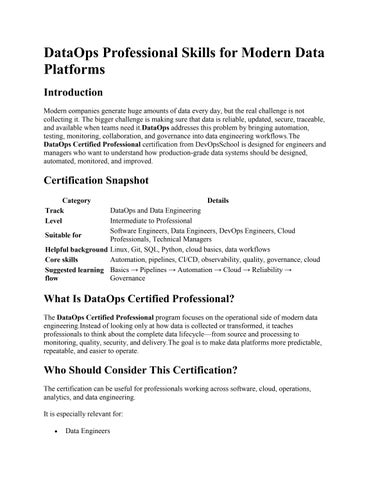
Certification Snapshot Category Track Level
Details
DataOps and Data Engineering Intermediate to Professional Software Engineers, Data Engineers, DevOps Engineers, Cloud Suitable for Professionals, Technical Managers Helpful background Linux, Git, SQL, Python, cloud basics, data workflows Automation, pipelines, CI/CD, observability, quality, governance, cloud Core skills Suggested learning Basics → Pipelines → Automation → Cloud → Reliability → Governance flow
What Is DataOps Certified Professional? The DataOps Certified Professional program focuses on the operational side of modern data engineering.Instead of looking only at how data is collected or transformed, it teaches professionals to think about the complete data lifecycle—from source and processing to monitoring, quality, security, and delivery.The goal is to make data platforms more predictable, repeatable, and easier to operate.
Who Should Consider This Certification? The certification can be useful for professionals working across software, cloud, operations, analytics, and data engineering. It is especially relevant for:
Data Engineers
Software Engineers DevOps Engineers Cloud Engineers Platform Engineers Analytics Engineers Site Reliability Engineers ETL Developers Technical Leads Engineering Managers Professionals preparing for MLOps or data-platform roles
For software engineers, DataOps can provide a strong understanding of how applicationgenerated data moves into analytics, reporting, and machine-learning environments.
Skills You Can Develop A good DataOps learning path should help you develop practical capabilities rather than only theoretical knowledge. Important skills include:
Understanding DataOps principles Designing reliable data workflows Automating repetitive data tasks Using Git for version-controlled data projects Working with Python and SQL Creating CI/CD pipelines for data changes Running workloads with Docker and Kubernetes Applying data-quality checks Monitoring pipeline health Managing cloud-based data infrastructure Using Infrastructure as Code Handling access, security, and secrets Understanding governance and lineage Troubleshooting failed or delayed pipelines
These skills help engineers move from simply creating pipelines to operating them with stronger engineering discipline.
Practical Projects You Should Build A certification becomes much more valuable when you can demonstrate what you learned. Useful hands-on projects include:
Build a small batch-processing data pipeline Automate ingestion from an API Create validation rules for incoming data Add CI/CD to a transformation project Containerize a data-processing application Build alerts for failed pipelines Monitor data freshness Create a simple observability dashboard Automate infrastructure using Terraform Add access controls to a cloud data platform Build an end-to-end pipeline from ingestion to reporting
A strong project should show not only that the pipeline works, but also that it can be tested, monitored, secured, and maintained.
Preparation Options 7–14 Day PlanThis path is suitable for experienced professionals.Focus on DataOps concepts, Git, Python, CI/CD, cloud data services, data quality, Docker, and observability.Try to complete at least one end-to-end project during this period.
30 Day Plan A 30-day schedule works well for most working engineers.Use the first week for fundamentals, the second for pipelines and automation, the third for cloud, containers, and monitoring, and the final week for governance, security, and project practice.
60 Day Plan The 60-day route is better for professionals who are new to data engineering.Start with Linux, Git, SQL, Python, and cloud fundamentals. Then move toward pipeline development, orchestration, CI/CD, containers, observability, security, and governance.Use the final part of your preparation to build and troubleshoot complete workflows.
Mistakes to Avoid Many learners focus too much on tools and not enough on the engineering problem being solved. Common mistakes include:
Studying commands without understanding architecture Ignoring data-quality problems Treating DataOps as only a collection of tools Building pipelines without monitoring Overlooking security and access management
Skipping governance and lineage Trying to learn too many technologies at once Preparing for the exam without doing practical work
The better approach is to understand why each tool is used and how it supports a reliable data lifecycle.
What Can You Learn Next? DataOps connects naturally with several modern engineering disciplines. After completing DataOps Certified Professional, you can choose your next direction based on your career goals.
DevOps Choose DevOps if you want deeper knowledge of CI/CD, automation, Kubernetes, cloud infrastructure, and platform engineering.
DevSecOps Choose DevSecOps if your interests include data security, policy enforcement, access management, and secure software delivery.
SRE SRE is a useful direction if you want to specialize in reliability, observability, incidents, SLOs, and production operations.
AIOps/MLOps This is a strong option for professionals planning to work with machine-learning platforms, model pipelines, AI systems, and intelligent operations.
DataOps Continue deeper into DataOps if your main goal is to specialize in data reliability, orchestration, quality, governance, and platform automation.
FinOps FinOps can complement DataOps for professionals responsible for controlling cloud costs across data lakes, warehouses, analytics systems, and large compute environments.
Institutions That Can Support DataOps Learning DevOpsSchool DevOpsSchool provides the DataOps Certified Professional certification and offers learning around automation, cloud technologies, data platforms, DevOps practices, and production engineering.
Cotocus Cotocus can support professionals who want to strengthen their knowledge of enterprise technology, cloud platforms, automation, and engineering transformation.
SCMGalaxy SCMGalaxy provides learning resources around DevOps, configuration management, automation, cloud technologies, and engineering tools that can support a DataOps career.
BestDevOps BestDevOps can help learners explore DevOps practices, cloud engineering, CI/CD, containers, automation, and related technical skills.
DevSecOpsSchool DevSecOpsSchool is useful for professionals who want to combine data-platform knowledge with security, governance, compliance, and secure engineering.
SRESchool SRESchool can help learners develop reliability skills around monitoring, observability, SLOs, troubleshooting, and incident management.
AIOpsSchool AIOpsSchool can support professionals interested in intelligent monitoring, automation, analytics-driven operations, and modern infrastructure management.
DataOpsSchool DataOpsSchool focuses more directly on areas such as pipeline automation, data quality, observability, governance, and modern data engineering practices.
FinOpsSchool
FinOpsSchool can be useful for managers and engineers who want to understand cloud budgeting, optimization, cost visibility, and financial accountability.
Conclusion The DataOps Certified Professional certification provides a practical path for professionals who want to understand how reliable data platforms are operated in real environments. It brings together data engineering, automation, cloud, CI/CD, monitoring, quality, security, and governance. For software engineers, it can open opportunities in data platforms and analytics engineering. For managers, it can improve understanding of how modern data teams work. The most effective preparation method is to combine study with hands-on practice. Build pipelines, automate deployment, add tests, monitor failures, control access, and learn how to recover when something breaks.