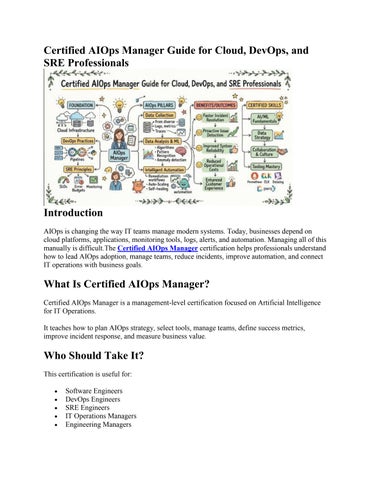
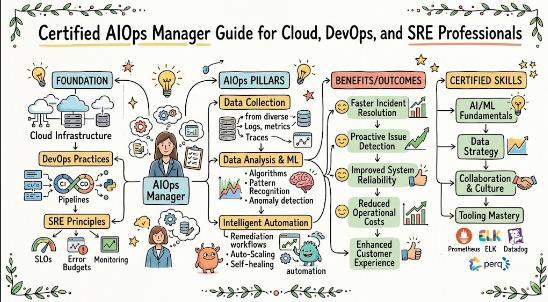
Certified AIOps Manager Guide for Cloud,
DevOps, and SRE Professionals
Introduction
AIOps is changing the way IT teams manage modern systems. Today, businesses depend on cloud platforms, applications, monitoring tools, logs, alerts, and automation. Managing all of this manually is difficult.The Certified AIOps Manager certification helps professionals understand how to lead AIOps adoption, manage teams, reduce incidents, improve automation, and connect IT operations with business goals.
What Is Certified AIOps Manager?
Certified AIOps Manager is a management-level certification focused on Artificial Intelligence for IT Operations.
It teaches how to plan AIOps strategy, select tools, manage teams, define success metrics, improve incident response, and measure business value.
Who Should Take It?
This certification is useful for:
Software Engineers
DevOps Engineers
SRE Engineers
IT Operations Managers
Engineering Managers
Cloud Managers
Platform Leads
Monitoring and Observability Professionals
Certification Overview
Track Level Who it’s for Prerequisites Skills covered
AIOps Manager Engineers, managers, DevOps, SRE, IT teams
Skills You’ll Gain
AIOps fundamentals
Basic knowledge of IT operations, DevOps, monitoring, and cloud AIOps strategy, automation, roadmap, vendor selection, ROI, team management
Incident and alert management
AIOps roadmap planning
Automation strategy
Tool and vendor evaluation
ROI measurement
Team planning
Leadership communication
Real-World Projects You Can Handle
Create an AIOps adoption roadmap
Build a business case for AIOps
Reduce alert noise
Plan incident response automation
Compare AIOps tools
Define success metrics
Prepare leadership reports
Preparation Plan
Recommended order
Learn AIOps basics first, then manager level
7–14 Days: Best for experienced professionals. Focus on AIOps basics, incident management, roadmap, vendor evaluation, ROI, and case studies.
30 Days: Best for working professionals. Study AIOps fundamentals, monitoring, observability, automation, strategy, and reporting.
60 Days: Best for beginners. Learn DevOps, SRE, cloud operations, monitoring, AIOps use cases, and management concepts step by step.
Common Mistakes
Learning only tools
Ignoring business value
Not understanding ROI
Skipping incident management basics
Ignoring team and process changes
Not preparing for case studies
Forgetting data quality and integration challenges
Choose Your Path
DevOps: CI/CD, automation, deployment reliability
DevSecOps: Security alerts, risk detection, compliance
SRE: Reliability, incident response, MTTR reduction
AIOps/MLOps: AI, ML, intelligent operations
DataOps: Logs, metrics, data quality, analytics
FinOps: Cloud cost optimization and anomaly detection
Best Next Certification
After Certified AIOps Manager, learners can move toward:
Certified AIOps Architect
Certified AIOps Professional
Certified SRE Manager
Certified DevOps Manager
Certified MLOps Manager
Certified FinOps Manager
Training cum Certification Support Institutions
DevOpsSchool: Helps learners build strong knowledge in DevOps, cloud, automation, and modern IT operations.
Cotocus: Supports enterprise technology consulting and practical implementation understanding.
Scmgalaxy: Useful for learning SCM, CI/CD, DevOps, and automation basics.
BestDevOps: Helps professionals explore DevOps certifications and career learning paths.
devsecopsschool: Useful for DevSecOps, security automation, and compliance learning.
sreschool: Helps professionals understand SRE, reliability, incident response, and automation.
aiopsschool: Official provider for Certified AIOps Manager and focused on AIOps learning.
dataopsschool: Useful for understanding data pipelines, data quality, and analytics.
finopsschool: Helpful for cloud cost management and FinOps-related learning.
Conclusion
The Certified AIOps Manager certification is useful for professionals who want to lead intelligent IT operations. It helps engineers and managers understand AIOps strategy, automation, incident reduction, tool evaluation, ROI, and team leadership.
For software engineers, DevOps professionals, SREs, and IT managers, this certification can be a strong step toward leadership roles in AIOps, cloud operations, platform engineering, and modern IT management.