Earth Observations and Neuromorphic Engineering: Monika Hofmann’s Vision for Sustainable Environmental Innovation
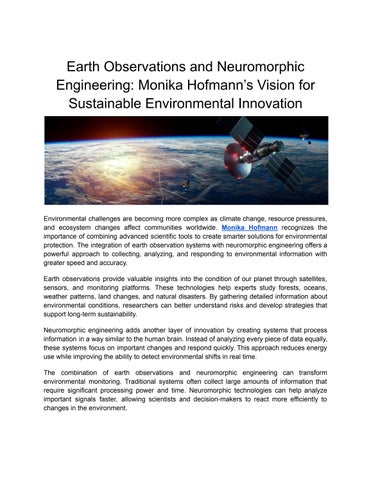
Environmental challenges are becoming more complex as climate change, resource pressures, and ecosystem changes affect communities worldwide. Monika Hofmann recognizes the importance of combining advanced scientific tools to create smarter solutions for environmental protection. The integration of earth observation systems with neuromorphic engineering offers a powerful approach to collecting, analyzing, and responding to environmental information with greater speed and accuracy. Earth observations provide valuable insights into the condition of our planet through satellites, sensors, and monitoring platforms. These technologies help experts study forests, oceans, weather patterns, land changes, and natural disasters. By gathering detailed information about environmental conditions, researchers can better understand risks and develop strategies that support long-term sustainability. Neuromorphic engineering adds another layer of innovation by creating systems that process information in a way similar to the human brain. Instead of analyzing every piece of data equally, these systems focus on important changes and respond quickly. This approach reduces energy use while improving the ability to detect environmental shifts in real time. The combination of earth observations and neuromorphic engineering can transform environmental monitoring. Traditional systems often collect large amounts of information that require significant processing power and time. Neuromorphic technologies can help analyze important signals faster, allowing scientists and decision-makers to react more efficiently to changes in the environment.
One major benefit of this combination is improved climate monitoring. Sensors powered by advanced computing methods can identify changes in temperature, vegetation health, water conditions, and air quality. When connected with earth observation data, these systems provide a clearer understanding of environmental trends and help create more effective sustainability plans. This technology also has strong potential in disaster prevention. Natural events such as wildfires, floods, and storms often develop quickly. Faster data processing allows monitoring systems to recognize warning signs earlier. This gives communities more time to prepare, reduce damage, and protect valuable natural resources. Beyond disaster response, the partnership between earth observations and neuromorphic engineering supports better resource management. Farmers, conservation groups, and governments can use accurate environmental data to make informed decisions. These solutions can improve water management, protect biodiversity, and support responsible land use. Energy efficiency is another important advantage of neuromorphic systems. Many environmental monitoring projects require sensors to operate in remote areas for long periods. Low-power technology allows these systems to continue collecting valuable information without frequent maintenance or high energy demands. As technology continues to advance, the connection between artificial intelligence, advanced sensors, and environmental science will become even stronger. These innovations can help create smarter systems that understand environmental changes and support more sustainable actions. The future of environmental protection depends on intelligent sustainability solutions that combine accurate data with efficient technology. Earth observations and neuromorphic engineering together provide a new way to monitor the planet, identify challenges, and develop responses that protect ecosystems. By bringing together advanced observation methods and brain-inspired computing, scientists can build more responsive environmental systems. This powerful combination supports a healthier planet by improving awareness, strengthening prevention efforts, and helping communities make better choices for the future.