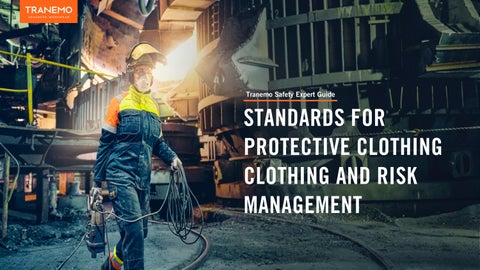
Tranemo Safety Expert Guide
STANDARDS FOR PROTECTIVE CLOTHING CLOTHING AND RISK MANAGEMENT
STANDARDS FOR PROTECTIVE CLOTHING AND RISK MANAGEMENT Standards for personal protective equipment are a key component of effective risk management. By combining a thorough risk analysis with the application of these standards, companies and organisations can identify potential risks in the workplace and design appropriate protective solutions. In this guide, we have summarised some of the most important standards for personal protective equipment.
© 2026 Tranemo Workwear | Standards for protective clothing and risk management
KEY STANDARDS FOR PROTECTIVE CLOTHING AND RISK MANAGEMENT 1. Heat and Flame
7. Weather Protection
EN ISO 11612 – Protective clothing against heat and flame EN ISO 14116 – Protective clothing with limited flame protection
EN 342 – Protective clothing against cold EN 343 – Protective clothing against rain EN 13758-2 – Protection against UV radiation
2. Arc Flash EN 61482-2:2020 - Protective clothing against thermal heat from
8. Protective Gloves
electric arcs
EN 407 – Protective gloves against thermal risks (and/or flame) EN 420 / EN ISO 21420 – Protective gloves – General requirements and test methods
3. Static Electricity EN 1149-5 - Protective clothing with electrostatic properties
9. Helmet
4. Welding EN ISO 11611 - Protective clothing for protection against welding or similar work
5. Chemicals EN 13034 Type PB [6] - Protective clothing for protection against liquid chemicals
6. HIgh-visibility EN ISO 20471 - Standard for high-visibility clothing
EN 397 - Standard for industrial helmets EN 50365 - Standard for electrically insulating helmets for use in low-voltage installations
10. Eye Protection EN 166 - Standard for eye protection
11. Knee Protection EN 14404 - Standard for knee protection © 2026 Tranemo Workwear | Standards for protective clothing and risk management
1. HEAT AND FLAME EN ISO 11612 - Protective clothing against heat and flame This standard specifies requirements for protective clothing used in work where there is a risk of the garments coming into contact with heat and EN ISO 11612 is categorised using six different code letters, where each letter describes the requirements the protective equipment must meet and what it protects against. Each code letter has different levels describing the level of protection – the higher the number, the better the protection. A garment certified to EN ISO 11612 must be certified to at least code letter A1 or A1+A2, plus one additional code letter from B, C, D, E or F.
© 2026 Tranemo Workwear | Standards for protective clothing and risk management
Code Letter
Description
A1, A2
Requirements for limited flame spread; A1: Surface ignition; A2: Edge ignition
B (1-3)
Protection against convective heat from an open flame
C (1-4)
Protection against radiant heat
D (1-3)
Protection against splashes of molten aluminium
E (1-3)
Protection against molten iron splashes
F (1-3)
Protection against contact heat
1. HEAT AND FLAME EN ISO 14116 - Protective clothing with limited flame resistance This is a standard used for protective clothing and accessories with a lower level of flame resistance, such as:
» Hi-Vis vests » Rainwear » Socks » Flame-resistant short-sleeved T-shirts
EN ISO 14116 is divided into indices 1–3, with 1 corresponding to the lowest level of protection. Index 1 garments must never be worn next to the skin, whilst index 3 garments must always be worn in combination with clothing certified to EN ISO 11612.
© 2026 Tranemo Workwear | Standards for protective clothing and risk management
2. ARC FLASH EN 61482-2:2020 – Protective clothing against thermal arc flash The standard specifies protective clothing to be used when working with electricity where there is a risk of an arc flash. This clothing is intended for use when working with exposed electrical equipment or when an electrical system needs to be opened.
Open Arc To certify an arc flash garment in accordance with EN 61482-2/IEC 61482-2, the protective clothing must undergo at least one of the two different test methods: Open Arc IEC 61482-11 and Box test EN 61482-1-2. The Open Arc test method uses an open arc that is directed partly towards the fabric and partly towards a test dummy wearing protective clothing (made from the fabric being tested). The test results in two different arc flash classifications: ELIM and ATPV or EBT. ELIM (Incident Energy Limit, cal/cm²) indicates the maximum energy level that the protective clothing can withstand without there being a risk of a second-degree burn. ATPV (Arc Thermal Performance Value, cal/cm²), or EBT (Energy Break Open Threshold, cal/ cm²), specifies the energy level that the protective clothing can withstand where the risk of a second-degree burn is 50%.
© 2026 Tranemo Workwear | Standards for protective clothing and risk management
Box test The Box test method uses a confined and directed arc created by a short circuit in an open cabinet. The tests are carried out on fabric and finished protective clothing in the same way as for the Open Arc test. The result is expressed in APC (Arc Protection Class) and is divided into two classes: APC 1 (formerly Class 1) – 168 kJ (4 kA, 400 V) and APC 2 (formerly Class 2) – 320 kJ (7 kA, 400 V). Clothing designed to protect against the risk of electric arcs is always classified under Category III (High risk of injury) in accordance with the PPE Regulation.
3. STATIC ELECTRICITY EN 1149-5 - Protective clothing with electrostatic properties This standard is designed for protective clothing used in potentially explosive atmospheres (ATEX environments). In such environments, it is important to minimise the risk of ignition or explosion caused by electrostatic phenomena. Garments certified to EN 1149-5 are intended for use in ATEX zones 1, 2, 20, 21 and 22 (see table).
ATEX zone classification for gas, mist and vapour Zone 0
An environment in which a mixture of air and flammable gas, mist or vapour frequently forms and persists for a long time.
Zone 1
An environment in which a mixture of air and flammable gas, mist or vapour is likely to occur under normal conditions.
Zone 2
An environment where a mixture of air and flammable gas, mist or vapour may be present under normal conditions but dissipates rapidly.
ATEX zone classification for dust Zone 20
An environment where explosive dust clouds occur frequently and over extended periods.
Zone 21
An environment where explosive dust clouds may occur under normal conditions.
Zone 22
An environment where explosive dust clouds are unlikely to occur, but if they do, they dissipate quickly.
© 2026 Tranemo Workwear | Standards for protective clothing and risk management
4. WELDING EN ISO 11611 – Protective clothing for use in welding and similar work This standard applies to protective clothing for welding or similar work where there is a risk of:
» Metal splashes » Brief contact with flames » Radiant heat from the welding arc » Electric shocks from brief contact with
live wires carrying voltages of up to approx. 100 V DC during normal welding.
Class
Description
Number of drops tested
*Radiant heat, RHTI24 (Response time, seconds)
Electrical resistance Ω
1
Provides protection in lowerrisk situations involving lower levels of splashes and radiant heat.
15
≥7
> 105
2
Provides protection in higherrisk situations that result in higher levels of splashes and radiant heat.
25
≥ 16
> 105
EN ISO 11611 is divided into Class 1 and Class 2, the latter offering a higher level of protection.
© 2026 Tranemo Workwear | Standards for protective clothing and risk management
4. WELDING
Welding technician:
EN ISO 11611 specifies which class applies to different welding techniques and environmental/working conditions.
1
Class description
2
Manual welding techniques with minimal spatter and spatter formation; Gas welding, Gas tungsten arc welding (TIG), Gas metal arc welding (MIG), Micro plasma welding, Brazing, Spot welding, Metal arc welding (MMA, using a rutile electrode). Manual welding techniques involving heavy spatter and slag formation; Manual metal arc welding (MMA) (using basic or cellulose electrodes), gas metal arc welding (MAG) (using carbon dioxide or a gas mixture), gas metal arc welding (MIG) (using high current), submerged arc welding, chiselling, plasma cutting, oxy-fuel cutting, thermal spraying.
Environment/working conditions: Class description 1
Machinery operation; Oxy-fuel cutting machines, Plasma cutting machines, Resistance welding, Thermal spraying, Bench welding.
2
Handling of machinery; in confined spaces. Welding or cutting above head height or in similar awkward positions.
© 2026 Tranemo Workwear | Standards for protective clothing and risk management
5. CHEMICALS EN 13034 Type PB [6] – Protective clothing offering protection against liquid chemicals The standard applies to protective clothing where there is a risk of small volumes of chemical splashes, but which does not require a complete barrier against liquid penetration. In accordance with the standard, various groups of chemicals are tested. Remember that it is particularly important to check which chemicals the garment has been tested for and what level of protection is required when purchasing garments certified to EN 13034. If working conditions only require protection against acids or alkalis, fabric with a PFAS-free finish (per- and polyfluoroalkyl substances) is a good choice. A PFAS-free finish does not contain the fluorine-carbon bond, making the protective garment a better and less environmentally harmful choice. If, on the other hand, the conditions require protection against o-xylene or butanol, a fabric with a PFAS finish is required. © 2026 Tranemo Workwear | Standards for protective clothing and risk management
EN 13034 can be tested for four groups of chemicals: Chemicals group
Chemical
Acid
H2SO4 30% (Sulphuric acid)
Bas
NaOH 10% (Sodium hydroxide is also known as lye or caustic soda)
Aromatic hydrocarbon O-xylene Alcohol
Butanol
6. HIGH-VISIBILITY EN ISO 20471 – Standard for high-visibility clothing The standard applies to protective clothing used in work environments involving moving vehicles – where visibility is required both day and night. EN ISO 20471 comprises three visibility classes, with Class 3 representing the highest level of visibility. The class to which the garment belongs is determined by the size of the garment’s reflective and fluorescent surface. A high-visibility garment that does not meet EN ISO 20471 Class 3 can be co-certified together with other certified high-visibility garments to achieve the highest high-visibility class. For example, a jacket that only meets Class 2 can be worn with Class 1 or 2 waist trousers or dungarees to achieve a Class 3 system, provided the total surface area is sufficiently large.
© 2026 Tranemo Workwear | Standards for protective clothing and risk management
Surface area of materials in m²
Class 1
Class 2
Class 3
Fluorescent
0,14
0,50
0,80
Reflective
0,10
0,13
0,20
7. WEATHER PROTECTION EN 342 – Protective clothing against the cold
EN 343 - Protective clothing against rain
The standard specifies protective clothing used when working in cold environments. EN 342 requires testing for effective thermal insulation (value in m²K/W), air permeability class 1–3 and water resistance class 1–2. For a garment to be certified to EN 342, it must meet the requirements for thermal insulation and air permeability. Water resistance, however, is not mandatory.
The standard specifies protective clothing used when working in rain, snow, fog or wet conditions. According to the latest version of standard EN 343:2019, garments and seams are tested for water penetration (water resistance) classes 1–4 and resistance to water vapour (breathability) classes 1–4, where class 4 is the highest class. For a garment to be certified to EN 343, both the garment and its seams must meet the requirements for both water penetration and water vapour.
A garment combination (e.g. a two-piece set or a coverall) must meet the thermal insulation and breathability requirements in order to be CE marked with the EN 342 symbol.
© 2026 Tranemo Workwear | Standards for protective clothing and risk management
EN 13758-2 – Protection against UV radiation The standard specifies the requirements for garments to be tested for UVA and UVB protection of over 40 UPF. The protection offered by textiles against UV radiation is primarily related to the thickness of the fabric.
Code: Explanation of symbols
8. PROTECTIVE GLOVES
Flame-retardant properties
How flammable is the glove? Do the materials melt? How quickly does it go out? Tests are carried out to determine the after-burn and after-glow times in an open flame after the flame has been removed; 1–4 (level 3 or 4 is classified as flame-resistant)
Contact heat
The glove must provide insulation against contact heat and must not melt. Tests involve exposure to a hot object for 15 seconds with limited heating of the hand, levels 1–4. (Level 1 = 100°C, Level 2 = 250°C, Level 3 = 350°C, Level 4 = 500°C)
Convective heat
The glove must provide insulation against convective heat transfer and prevent the penetration of hot air or steam. Tests the time until heat transfer to the hand becomes harmful, 1–4 (4 being the highest * level)
D
Radiant heat
The glove may reflect or absorb thermal radiation, and the skin must be protected from its effects. The test is conducted at 20 kW/m² and results in a rating of 1–4. (4 is the highest rating)*
E
Small splashes of molten metal
Test involving small splashes of molten metal, 1–4 (4 being the highest level)*
F
Large splashes of molten metal
Test involving large splashes of molten metal, 1–4 (4 being the highest level)*
A
EN 407 – Protective gloves for thermal risks (and/or flame) This standard applies to protective gloves designed to protect against heat and/or flame. EN 407 can be tested for flame resistance, contact heat, convective heat, radiant heat, and small and large splashes of molten metal. If the test is passed, the protective gloves may be marked with the respective code A–F.
B
C
*X indicates that the test has not been carried out. © 2026 Tranemo Workwear | Standards for protective clothing and risk management
8. PROTECTIVE GLOVES EN 420 / EN ISO 21420 – Protective gloves – General requirements and test methods The standard defines the general requirements for protective gloves with regard to:
» Design » Construction » The material’s water-repellent properties » Protection » Comfort » Labelling © 2026 Tranemo Workwear | Standards for protective clothing and risk management
9. HELMET
EN 50365 – Standard for electrically insulating helmets for use in
EN 397 – Standard for industrial helmets
This standard is optional and indicates that it provides protection against:
The standard defines the performance
» Elektric shocks and dangerous electric currents passing through
requirements, test methods and marking requirements for safety helmets. For the helmet to be certified to EN 397, it must meet the protection requirements for:
» FallING OBJECTS » Penetration of sharp objects » Flame protection » Release straps
low-voltage installations
the head
» Alternating voltage of up to 1000 V (AC) or voltage of up to 1500 V (DC)
In order for the helmet to be certified to EN 50365, it must not contain:
» Conductive parts if the helmet is insulating » Air valves that may come into contact with live parts » In addition to this, it must also comply with the requirements of EN 397
© 2026 Tranemo Workwear | Standards for protective clothing and risk management
10. EYE PROTECTION EN 166 - Standard for eye protection The standard applies to all types of eye protection and specifies the following:
For the helmet to be certified to EN 166, the eye protection must be tested in accordance with:
» Eye protection must be free from defects,
» EN 167 – Optical test for field of view,
» The protection must not contain materials
» EN 168 – Robustness and resistance to
» Headbands must be at least 10 mm wide
» EN 170 – Requirements for UV filters
parts and edges that could cause discomfort or injury during use
known to cause skin irritation
across all parts that come into contact with the wearer’s head, and must be adjustable or self-adjusting
transmission and diffusion, and refractive properties
heat, ignition and corrosion
© 2026 Tranemo Workwear | Standards for protective clothing and risk management
11. KNEE PROTECTION EN 14404 - Standard for knee protection The standard defines the requirements for knee protectors designed to protect the user when working in a kneeling position. The protectors are divided into four different types – 1 to 4 – based on their design; for example, type 1 specifies knee protectors that are fastened around the legs, whilst type 2 includes removable protectors that are placed in knee pockets on the trouser legs. Knee protectors are also classified into protection classes 0, 1 and 2 based on their intended use.
© 2026 Tranemo Workwear | Standards for protective clothing and risk management
Class description 0
Includes protection for use on flat surfaces.
1
Provides protection on flat and uneven surfaces.
2
Intended for use as knee protection when working on uneven and sharp surfaces in difficult conditions.
EVERYONE WHO GOES TO WORK HAS THE RIGHT TO COME HOME SAFE AND SOUND. STAY UP TO DATE WITH THE STANDARDS. UNDERSTAND THE CERTIFICATIONS. For more detailed information on risk assessments, standards, certifications and sustainability, please visit our website tranemo.com.
Book meeting