Tranemo Safety Expert Guide
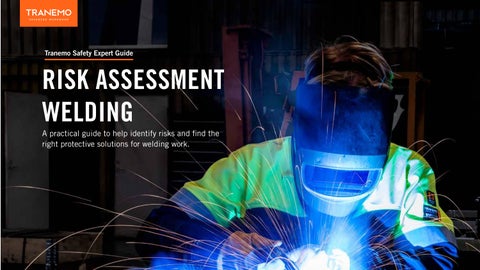
RISK ASSESSMENT WELDING A practical guide to help identify risks and find the right protective solutions for welding work.
RISK ASSESSMENT: WELDING Welding sparks, UV radiation, flames and heat stress are common and serious risks associated with welding work. If these are not managed correctly, they can have serious consequences for health and safety. To protect yourself against these potential risks, you need both knowledge of welding environments and a systematic approach to risk management. A thorough risk assessment will help you identify and manage these hazards correctly. In this guide, we go through the key steps for carrying out a risk assessment, and also provide recommendations for protective clothing specifically designed for welding work.
© 2026 Tranemo Workwear | Risk assessment Welding
1.
Keep an eye on the workplace environment – understand the risks
2.
Start with the right welding method
3.
Apply standard EN ISO 11611
4.
Test in a real-world environment
5.
Be aware of the design requirements
6.
Use welding accessories
7.
Choose the right solution
1. STAY INFORMED ABOUT THE WELDING ENVIRONMENT – UNDERSTAND THE RISKS The risks associated with welding vary depending on the welding environment, working position and welding method. An important part of the risk assessment is to identify which parameters may be present in the workplace.
» Welding sparks » Heat & flame » Heat stress » UV radiation Bear in mind that confined spaces present particular challenges for protective equipment. Do you weld in a flat position at a workbench, horizontally in confined spaces, vertically, or overhead? Each position can involve different levels of risk and requires the right type of protection. © 2026 Tranemo Workwear | Risk assessment Welding
2. START WITH THE RIGHT WELDING METHOD
TIG
MMA
MIG/MAG
This method involves relatively low risk and rarely produces spatter that exposes protective clothing to metal splashes. However, it emits UV radiation and some heat from the arc, which may pose a risk to the skin and eyes.
The process emits molten metal in larger or smaller droplets, as well as radiant heat and UV radiation, depending on the current and the thickness of the material being welded.
These methods often produce high levels of radiant heat and splashes of molten metal. These methods generate the highest levels of UV radiation.
Please be aware that different welding methods emit varying levels of visible light. This can make it more difficult to assess the risk accurately and choose the right protective equipment.
© 2026 Tranemo Workwear | Risk assessment Welding
UV radiation levels are primarily influenced by the welding method, the welding current and the distance from the welding spot. It is also important to bear in mind that people in the vicinity of the welding site who are not actually carrying out the welding may be exposed to high levels of radiation.
3. APPLY STANDARD EN ISO 11611 Protective clothing for welding and similar work This standard specifies protective clothing used during welding or similar work where there is a high risk of serious injury. The standard is divided into two classes, with different levels of protection: Class 1 and Class 2. The fabric’s welding protection is tested to withstand 15 drops of molten metal (Class 1) or 25 drops (Class 2). We always recommend Class 2 clothing when welding, as the protective requirements for Class 1 clothing are relatively low and do not provide sufficient protection in high-risk situations.
Number of drops tested
*Radiant heat, RHTI24 (Response time, seconds)
Electrical resistance Ω
Provides protection in less hazardous situations involving lower levels of splashes and radiant heat.
15
≥7
>105
Provides protection in higher-risk situations that result in higher levels of splashes and radiant heat.
25
≥16
>105
Class
Description
1
2
Choice of protective clothing depending on the process
Class 1
Manual welding techniques with minimal spatter and spatter formation; Gas welding, Gas tungsten arc welding (TIG), Gas metal arc welding (MIG), Micro plasma welding, Brazing, Spot welding, Metal arc welding (MMA, using a rutile electrode).
Class 2
Manual welding techniques involving heavy spatter and slag formation; Manual metal arc welding (MMA) (using basic or cellulose electrodes), gas metal arc welding (MAG) (using carbon dioxide or a gas mixture), gas metal arc welding (MIG) (using high current), submerged arc welding, chiselling, plasma cutting, oxy-fuel cutting, thermal spraying.
Choosing protective clothing depending on the environment Operation of machinery; Oxy-fuel cutting machines, plasma cutting machines, resistance welding,
Class 1 thermal spraying, bench welding
Operation of machinery; In confined spaces. Welding or cutting above head height or in similar awkward
Class 2 positions.
© 2026 Tranemo Workwear | Risk assessment Welding
4. TRY FABRICS AND GARMENTS IN A REAL-LIFE SETTING Actual working conditions often differ from laboratory environments, which means that you cannot be entirely certain that all Class 2 garments provide the protection required in your specific working environment.
We recommend that both fabric tests and wear tests are carried out in the environment in which the protective clothing will be used.
© 2026 Tranemo Workwear | Risk assessment Welding
CERTAIN TASKS PLACE GREATER STRAIN ON PROTECTIVE CLOTHING AND THEREFORE REQUIRE HARD-WEARING GARMENTS.
5. BE AWARE OF THE DESIGN REQUIREMENTS The design of protective clothing is a crucial factor in the development and certification of welding garments. The aim is to prevent welding spatter and grinding sparks from becoming trapped in the garments, ensuring instead that they run off as quickly as possible. This places significant demands on the construction and positioning of the pockets. When designing welding garments, UV and heat radiation must also be taken into account, as these can affect the user’s safety. Our welding garments are made from fabric with inherently flame-retardant fibres and feature extra ventilation openings for increased comfort. Although the fabric has a higher weight per square metre to meet Class 2 requirements, the garment remains soft and comfortable to wear throughout the working day. Inherent flame retardancy cannot be worn away or washed out of the garment.
© 2026 Tranemo Workwear | Risk assessment Welding
Our Class 2 garments are lighter than comparable cotton garments.
6. IMPROVE PROTECTION AND SERVICE LIFE USING VARIOUS WELDING ACCESSORIES An effective way to enhance protection in vulnerable areas of protective clothing is to use certified accessories, such as aprons, balaclavas and sleeve protectors. These accessories not only provide greater protection but also help to extend the lifespan of the protective clothing, which in turn reduces resource consumption and environmental impact.
With a few simple steps, you can extend the life of your protective clothing
© 2026 Tranemo Workwear | Risk assessment Welding
7. CHOOSE THE RIGHT PROTECTION SOLUTION
Cantex WS – Weld Stretch
Outback HW – Heavy Welding
Cantex 57
Edge
For foundries, heavy welding and smelting works.
For heavy-duty welding.
For smelting plants, foundries and light welding.
For heavy-duty welding in high-traffic environments.
Class 2
Class 2
Class 2
Class 1
© 2026 Tranemo Workwear | Risk assessment Welding
EVERYONE WHO GOES TO WORK HAS THE RIGHT TO COME HOME UNHARMED. UNDERSTAND THE RISKS OF WELDING. ENSURE YOU HAVE THE RIGHT PROTECTION. For more detailed information on risk analyses, standards, certifications and sustainability, please visit our website at tranemo.com.