Tranemo Safety Expert Guide
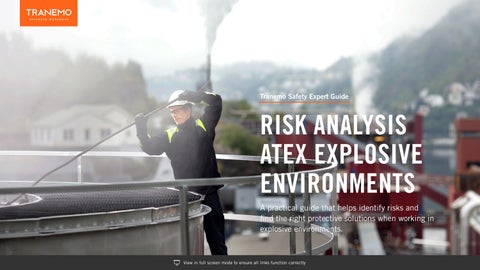
RISK ANALYSIS ATEX EXPLOSIVE ENVIRONMENTS A practical guide that helps identify risks and find the right protective solutions when working in explosive environments.
View in full screen mode to ensure all links function correctly
RISK ANALYSIS ATEX ATEX, which comes from the French term ATmosphères EXplosibles, refers to work environments where there is a risk of explosion. In these environments, there is a risk that explosive substances will ignite, which can lead to devastating consequences. To protect against these risks, it is essential to have a good understanding of how an explosion occurs and what factors increase the risk. It is also important to know in which environments explosion risks can occur and to have a functioning risk management method in place. In addition to this, specific expertise is required to know how to act safely in an ATEX environment. In this guide, we go through the most important steps for conducting a risk analysis in ATEX environments. We also provide recommendations on protective clothing that is specially adapted for working in explosive environments. See also AFS 2023:1 Work in potentially explosive atmospheres.
© 2026 Tranemo Workwear | Risk Analysis ATEX
1.
Causes of an explosion
2.
Understand the dangers
3.
Map explosive environments
4.
Identify the risks
5.
Apply standard EN 1149-5
6.
Act safely in an ATEX environment
7.
Choose the right protective solution
Fla mm abl e
tion gni of I rce Sou
Ma ter ial
1. CAUSES OF AN EXPLOSION
Oxygen
© 2026 Tranemo Workwear | Risk Analysis ATEX
NOTE! ATEX risks arise where combustible substances are present, and risk management focuses primarily on minimising the risk of ignition. By understanding these conditions, explosions can be effectively prevented.
2. UNDERSTAND THE DANGERS
Explosive Atmosphere/Flammable substance
Sources of Ignition
» Gases » Vapours » Mist » Dust
» Electrical and mechanical equipment » Hot surfaces » Sparks from tools » Static electricity
Non-certified equipment Equipment that lacks EX certification can pose a serious hazard in explosive environments. All electronic equipment used in ATEX areas must be EX-rated and hand tools must be spark-free to minimise the risk of ignition. In ATEX environments, antistatic clothing is required to avoid static electricity that can cause sparks.
© 2026 Tranemo Workwear | Risk Analysis ATEX
3. MAP EXPLOSIVE ENVIRONMENTS The risk of explosion exists in many work environments and is particularly relevant in the following areas and industries:
» Petrochemical industry » Gas industry » Explosives industry » Ammunition industry » Food industry (sugar, flour, spices) » Sawmills
© 2026 Tranemo Workwear | Risk Analysis ATEX
4. IDENTIFY THE RISKS When conducting risk analysis for work in ATEX environments, the following risk factors must be taken into account:
» Heat and flame » Shock wave » Splinters and flying objects » Loud noise » Molten metal
© 2026 Tranemo Workwear | Risk Analysis ATEX
5. APPLY STANDARD EN 1149-5 The EN 1149-5 standard is specifically designed for protective clothing intended for use in explosive work environments (ATEX). In these environments, it is crucial to minimise the risk of ignition or explosion due to electrostatic discharges. When working in ATEX environments, protective clothing certified according to EN 1149-5 (antistatic protection) is recommended, in combination with EN ISO 11612 (flame protection). It is extremely important that protective clothing is used correctly in these environments and that the entire outfit, including shoes and gloves, is antistatic.
Remember that clothing and all equipment, including tools and other work equipment, must be ATEX-approved or EXrated (spark-free).
© 2026 Tranemo Workwear | Risk Analysis ATEX
5. APPLY STANDARD EN 1149-5 Zone Classification Antistatic garments certified according to EN 1149-5 are intended for use in ATEX zones 0, 1, 2, 20, 21 and 22 (see tables for specific zones).
NOTE! In environments with elevated oxygen levels or in Zone 0, protective clothing should only be used after approval by the responsible safety engineer. This is because use and wear can affect the protective properties of the garment.
ATEX zone classification for gas, mist and vapour Zone 0 Environment where a mixture of air and flammable gas, mist or vapour frequently occurs and remains for a long time.
Zone 1 Environment where a mixture of air and flammable gas, mist or vapour is likely to occur under normal conditions.
Zone 2
Environment where a mixture of air and flammable gas, mist or vapour may occur under normal conditions but dissipates rapidly.
ATEX zone classification for dust Zone 20 Environment where explosive dust clouds occur frequently and for extended periods.
Zone 21 Environment where explosive dust clouds may occur under normal conditions. Zone 22 Environment where explosive dust clouds are unlikely to occur, but if they do, they dissipate quickly.
© 2026 Tranemo Workwear | Risk Analysis ATEX
6. ACT SAFELY IN AN ATEX ENVIRONMENT When working in an ATEX-classified environment, it is very important to follow certain guidelines to minimise the risk of explosion. Here are some key points to consider:
Remove Any Sources of Ignition
Ensure that Protective Clothing is Used Correctly
Clean and Check Regularly
Only Use EX-certified Equipment
Follow Local Safety Regulations
Ensure that there are no ignition sources within or near the explosive environment.
Protective clothing must be full-length and worn in accordance with regulations.
Protective clothing should be checked regularly and cleaned according to the manufacturer’s instructions.
All equipment and tools used in ATEX-classified areas must be EXcertified.
Ensure that local safety regulations for equipment are always followed and complied with.
Dirt, wear and damage to the garment can affect its protective properties and should be repaired immediately.
The certification ensures that the equipment is approved for use in explosive environments and meets safety requirements.
For example, a jacket should be worn with the zip fully fastened and buttoned to cover the zip to ensure complete protection.
© 2026 Tranemo Workwear | Risk Analysis ATEX
7. CHOOSE THE RIGHT PROTECTION SOLUTION
Apex
© 2026 Tranemo Workwear | Risk Analysis ATEX
Zenith
Tera TX
Merino/FR Underwear
EVERYONE WHO GOES TO WORK HAS THE RIGHT TO RETURN HOME UNHARMED. UNDERSTAND THE RISKS OF EXPLOSIVE ENVIRONMENTS. USE THE RIGHT PROTECTION. Book Meeting