THE GLOBAL LEADERS IN ENTERTAINMENT SOLUTIONS ITALY - FRANCE - GERMANY - USA - FINLAND - CHINA
“Over 45 years of solving what others couldn’t”
Audiovisual, lighting, stage and safety systems engineered for the most ambitious projects at sea and on land www.videlio-hms.com
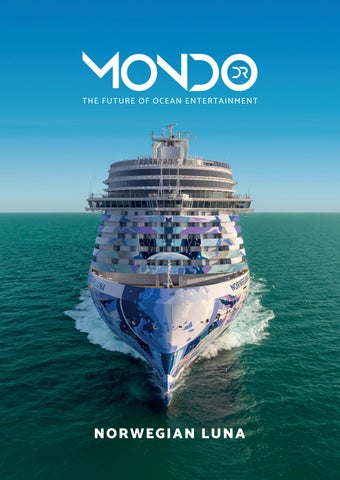
MONDO-DR NORWEGIAN LUNA
C O N TENT S
ON THE COVER Norwegian Luna All photographs courtesy of Norwegian Cruise Line. EDITOR Todd Staszko t.staszko@mondiale.co.uk
6
NORWEGIAN LUNA SETS SAIL
12
BEHIND THE SCENES WITH VIDELIO-HMS
16
SPOTLIGHT ON RACHAEL MCCUTCHEON
18
ALL HANDS ON DECK FROM EWP
20
CHAUVET LIGHTING
22
CITY THEATRICAL
25
CONDUCTR
28
ETC
31
HARMAN PROFESSIONAL
34
LEYARD
36
MARTIN AUDIO
40
ROBE
44
SHURE
48
TVONE
ASSISTANT EDITOR Daisy Thorogood d.thorogood@mondiale.co.uk ACCOUNT MANAGER Cameron Crawford c.crawford@mondiale.co.uk ACCOUNT MANAGER Bethany Price b.price@mondiale.co.uk MARKETING & EVENTS MANAGER Alice Clarke a.clarke@mondiale.co.uk MARKETING & EVENTS ASSISTANT Charlie Moore c.moore@mondiale.co.uk DESIGN & PRODUCTION Mel Capper, Jez Reid, Dan Seaton DIGITAL CONTENT MANAGER James Robertson j.robertson@mondiale.co.uk EDITORIAL DIRECTOR Peter Iantorno p.iantorno@mondiale.co.uk CEO Justin Gawne j.gawne@mondiale.co.uk FINANCE DIRECTOR Amanda Giles a.giles@mondiale.co.uk CREDIT CONTROL ar@mondiale.co.uk GROUP CHAIRMAN Damian Walsh MONDIALE PUBLISHING Strawberry Studios, Watson Square, Stockport SK1 3AZ , UK Tel: +44 161 476 8340 Fax: +44 161 429 7214 ANNUAL SUBSCRIPTION RATES (7 ISSUES) UK: £30.00 / Europe: £50.00 / Rest Of World: £65.00 Two year rates are available on request. Subscribe online at www.mondiale.co.uk or call +44 (0)161 476 5580 ISSN: 1476 4067 Mondo DR (ISSN 1476 4067) is published in January, March, May, July, September, November and December by Mondiale Publishing Ltd, Strawberry Studios, Watson Square, Stockport, SK1 3AZ, UK Subscription records are maintained at Mondiale Media Ltd, Strawberry Studios, Watson Square, Stockport, SK1 3AZ, UK
T O THE MOON AND BA CK ... Over the past couple of years, on behalf of MONDO-DR, I’ve been becoming more and more familiar with the niche yet mighty maritime audiovisual industry. Visiting trade shows and events across the globe has meant getting to know some wonderful people and teams within the cruise ship field, and it’s remarkable how much the sector seems to grow each time I visit. This special edition was born from one of those visits, after meeting the Norwegian Cruise Line team and discovering just how much state-ofthe-art sound, lighting, and visual equipment goes into the line’s newest ships. This marks the third instalment in MONDO-DR’s hat-trick of cruise ship special editions, and this time the spotlight falls on Norwegian Cruise Line’s latest addition to its Prima Plus fleet, Norwegian Luna. Inside, you’ll find a wealth of exclusive, new insight from the vessel’s designers, installers, and associated manufacturers, with the full story on how its many onboard entertainment venues were brought to life. A massive thank you to everyone who spoke with me while putting this issue together. I’m excited to keep working within, and writing about, the maritime industry, so as always, I welcome any feedback on this publication, and any outreach about entertainment at sea. Enjoy the issue!
mondo@mondiale.co.uk www.mondodr.com www.mondodrawards.com Printed by Buxton Press, Palace Road, Buxton, UK
DAISY THOROGOOD EDITOR
03
ROBE Maritime
Lighting onboard cruise ships.
Find Out More Maritime Website
N O RWEG IA N LUN A S E TS S A I L N or we g i a n C r u i s e L ine we lc ome s N. Luna to its f le e t.
“N O RW EG I A N L U N A I N T HR E E WORDS...IT’S VIBRANT, U N EXPECT E D, A N D E C L E C T IC . ”
Since 1966, Norwegian Cruise Line’s fleet has been sailing across the globe, with the company consistently working to bring upgraded technology and a high-quality guest experience to each of its vessels. Weighing anchor in 2022 was the company’s Norwegian Prima, which was the first ship in NCL’s Prima Class, delivered by Fincantieri. Since then, the fleet has expanded to include a Prima Plus Class, which includes Norwegian Aqua and, most relevantly to this supplement, Norwegian Luna, both from the same shipbuilder. This MONDO-DR special issue focuses on this second edition of Prima Plus, N. Luna, which is also, at the time of writing, the latest evolution in its class. At 1,056ft in length, N. Luna is undeniably huge; the ship spans 20 decks where up to 3,565 guests can explore 17 dining options as well as 18 bars and lounges. One of Norwegian Luna’s defining features is the breadth of its entertainment offering, with guests able to experience live music, theatrical productions, comedy, DJs, games, and interactive experiences throughout the day and into the evening. Uniquely, visitors can even find a hybrid rollercoaster-waterslide in the Aqua Slidecoaster, an attraction built by Wiegand.Waterrides. In creating a comprehensive entertainment and technology commentary on N. Luna, it seems only correct to begin with input from the global cruise company itself. To uncover the thinking, challenges, and creative decisions behind N. Luna’s many venues, MONDO-DR spoke with Caitlyn Luc, NCL’s Senior Manager in Newbuild Entertainment Architecture. Norwegian Luna’s entertainment personality Luc started by explaining how Norwegian Luna’s entertainment programme includes three key venues: Luna Theater & Club, Improv at Sea, and Syd Norman’s Pour House. Together, they cover a broad range of formats, from full-scale theatrical productions and interactive game shows to comedy, circus, children’s programming, and live music. The Luna Theater & Club houses some of the vessel’s most ambitious offerings. The initial line-up in the theatre consists of the popular tribute
A bove: C ait lyn Lu c , N CL’ s Sen i or Ma na g er i n Newbuild En terta i nm ent A rc h i tec tu re.
8
N C L LU N A | WWW.M O N D O D R.CO M
performance Rocketman: A Celebration of Elton John, NCL’s exclusive sci-fi-inspired HIKO: Innovation Meets Wonder, and “many other intimate and lively performances dotted around the ship, so every guest is covered,” as Luc detailed. These large venues complement the tens of other leisure, dining, bar, and attraction experiences on board. In designing and delivering N. Luna’s venues, Luc explains that it is all hands on deck from day one, with the technical, architectural, and programme production teams all inputting on the build. “We have always involved the entertainment teams as early as possible in the newbuild process. The earlier we collaborate on space requirements and operational needs, the easier it is to make meaningful improvements,” she said. From the initial blueprint stage through to installation and commissioning, Luc says the development of the entertainment venues and requisite systems takes approximately five years. That long lead time creates an unusual challenge: designing technology for spaces and experiences that are still being developed. “We have to ensure each venue can adapt to future programming, creative ideas, and evolving trends,” Luc explained. “That meant selecting the latest technology while also designing spaces that could accommodate new, additional productions, interactive experiences, and creative concepts that might not have even been fully established during the ship’s design phase.” She reaffirmed the importance of this when asked what the most important considerations were for her team whilst creating N. Luna’s venues: “Flexibility and anticipation!” Venue adaptability is a particularly relevant requirement for the Luna Theater & Club, which Luc described as “a flexible, multi-purpose space that seamlessly transitions between spectacular productions and vibrant nightlife.” For the teams responsible for its design, that versatility has to be reflected throughout the venue – from the architecture itself through to the technical infrastructure supporting each change of format. Norwegian Luna shares its core entertainment DNA with Norwegian
9
Next page, bel ow: N orweg i a n Lu na ’ s h y b ri d r oller coas t er-waters li de, th e A q u a Sli dec oa s t er , b uilt by Wie gand. Wa terri des .
Aqua. The two Prima Plus ships have the same fundamental venue layout and infrastructure, giving NCL a common starting point while allowing the entertainment systems to be developed further. However, Luc explained, “With each new ship, we enhance and update, with targeted improvements to the technology and entertainment systems throughout several venues. “These updates were driven by the needs of new productions, activities, game shows, and guest experiences. The goal is always to give our entertainment teams the tools they need to continue delivering exceptional guest experiences throughout the ship’s lifecycle.” It takes a village The development of N. Luna’s entertainment venues involved a network of specialist partners, all rallying together across different disciplines to furnish, build, and design each space. Playing a large role in bringing the technical infrastructure together, Videlio-HMS worked particularly closely alongside NCL to incorporate lighting, audio, video, and rigging requirements on board the ship, in a project that is further explored on page 12. This is a role that the integrator is well-versed in, having completed builds with NCL since the cruise line’s earliest ships. “Rather than simply executing specifications, they contribute creative solutions, recommend the latest technologies, and help ensure the venues remain flexible enough to support a wide range of entertainment experiences,” Luc said. Also to be credited in the creation of this vessel is Waagner-Biro Stage Systems, a company contracted to complete a large, complex rigging installation in the main theatre. Inside this venue is Waagner-Biro’s impressive three-tonne chandelier structure, which can be raised to transform the performance space into a disco. Further, the team crafted five stage platforms across N. Luna’s theatre areas, with two functioning as performer elevators. For N. Luna, UK-based installer EWP joined the audiovisual team, too. EWP is a newer partner for NCL and supplied additional show equipment for the theatrical productions, working alongside the audio and lighting designers. Its involvement also extended into preparation before the equipment reached the ship. “Before the equipment was shipped to the vessel, our lighting team travelled to the UK to prepare, configure, and address the lighting fixtures with EWP,” Luc explained. “That pre-commissioning work helped streamline the onboard installation and ensured the equipment was ready for programming and rehearsals as soon as it arrived.” Paul Byrne, Managing Director of EWP, proved to be an important member of the team, thanks to his extensive knowledge in the maritime integration industry. Turn to page 18 to hear all about his experience on board N. Luna and in the overall cruise ship world. These technical systems are only one part of the wider operation. As Luc put it, “Building a ship like Norwegian Luna truly takes a team the size of a small city.” Behind the finished venues is an extremely long list of departments, suppliers, and specialists, including Fincantieri, NCL’s Italy Team, NCL’s newbuild and entertainment operations teams, NCLH Creative Studios, production contractors, entertainment technicians, programmers, manufacturers, and a host of other organisations. “Every group played a critical role. While it’s impossible to name everyone involved, the project was the result of an extraordinary collaboration between countless teams and partners,” said Luc. The shipboard team then took over once N. Luna entered service, turning the completed infrastructure into a working entertainment
10
N C L LU N A | WWW.M O N D O D R.CO M
operation. For all the planning that goes into a newbuild, it is ultimately these teams who use the systems night after night, adapting them to the realities of live performance and guest interaction. Learning from N. Luna The experience of developing Norwegian Luna is already feeding into NCL’s next generation of ships. One of Luc’s key lessons is the importance of making decisions early enough for the entertainment team to have a genuine influence on the design. “Making changes during the design phase is far more effective than implementing them in the final six months before delivery,” she noted. There is also a balance to be struck between creating visually distinctive spaces and ensuring that the materials and technology can withstand life at sea. Luc points to Waagner-Biro’s chandeliers in N. Luna’s theatre as an example of the considerations involved in custom design. “While bespoke design features can create striking guest spaces – such as these chandeliers – they must also withstand the unique demands of a cruise ship, including constant movement and vibration.” She continued: “We invest significant time in validating custom products and materials. N. Luna reinforced the importance of balancing aesthetics with long-term durability and operational reliability, a lesson that will be especially valuable as we move forward with NCL Aura, the next Prima Plus vessel.” Reflecting on the completed project, Luc concluded the interview by sharing what she considers the greatest achievement of Norwegian Luna. “I’m proud of what the entertainment’s architecture represents - the sheer talent of thousands of people, collaborating to achieve remarkable spaces for our guests to connect, relax and enjoy NCL in a beautifully designed environment.” N. Luna is the result of years of planning, testing, refinement, and technical coordination, with its entertainment infrastructure designed to support both the current programme and whatever comes next. This MONDO-DR special takes a closer look at the people, technology, and specialist expertise behind that process, exploring the who, why, how, and when of Norwegian Norwegian Luna’s entertainment venues. www.ncl.com
11
BEH IND THE SC ENES W ITH VIDELIO HMS
12
N C L LU N A - V I D E LI O H M S | WWW.M O N D O D R.CO M
Norwegian Cruise Line (NCL) works to establish itself as a cruise provider that is suitable for a wide demographic – as Caitlyn Luc, Senior Manager of Newbuild Entertainment Architecture at NCL, said, “every guest is covered.” To ensure that a large audience consisting of all ages and group sizes could enjoy a trip on a Norwegian Luna voyage, many different entertainment venues needed to be built, from safe spaces suitable for the youngest passengers to more sophisticated bars for the adults on board. Behind the scenes of all of these areas are complex and carefully considered audiovisual systems. Working on behalf of shipbuilder Fincantieri, Videlio-HMS (V-HMS) was responsible for much of this AV infrastructure. The company’s scope covered the complete design, engineering, supply, integration, and commissioning of Luna’s Local Entertainment Systems (LES), RGB architectural lighting, and Public Address & General Alarm (PA/GA) systems. In practical terms, that meant Videlio-HMS was involved in virtually all of the audio and video systems installed throughout the ship, from the main theatre and entertainment venues through to restaurants and public spaces. Marco Baldin, CSO of Videlio-HMS, stepped in to explain how the installation team took on a project with such an immense scope. “We were involved from the very start,” he began. “Our work commenced during the concept development phase, supporting the evolution of the entertainment spaces together with NCL, Fincantieri, and the project partners.” He continued, identifying the brief that V-HMS was handed upon joining the shipbuilding effort: “The main idea was to have Norwegian Luna featuring a wide variety of themed entertainment venues, including lounges, clubs, and the pool deck, each providing further examples of the seamless integration of audio, video, lighting, and control technologies.” One of the less visible aspects of Videlio-HMS’s work was also one of its most significant. The CSO explained how the installer found an unobtrusive way to tackle different audio needs through a single speaker distribution network. “By using high-performance loudspeakers, we were
“ IN T HE E ND , THE T E CHN OLOG Y IS ONLY AS GOO D AS THE PEOPLE W HO D E S IG N, BU ILD, AND IN T E GRATE IT.”
L e f t : V i d e l i o - H M S w ork in g w it hin Nor w egia n L u n a’s t h e at r e s pa c e , in st a llin g a r obu st a u d i o v i s u al b a c kb on e .
able to deliver both life-safety announcements and premium-quality background music through the same infrastructure.” Taking centre stage Among Luna’s venues, the theatre provided Videlio-HMS with its most extensive technical challenge. Despite the complicated build, Baldin is enthused about the results. “When it comes to the ship’s most iconic areas, the theatre undoubtedly stands out. It is the place that best showcases Videlio-HMS expertise and represents the flagship of our work on board.” The venue combines large-scale audio, lighting, and video systems with a show control infrastructure, including a high-performance LED wall integrated into the theatre’s control systems. Videlio-HMS also delivered the RGB lighting implementation for the theatre chandelier structure. This multifaceted nature of the installation was what made the design challenging, the CSO commented. “It required extremely close coordination between multiple disciplines.” Every millimetre matters For Baldin, one of the biggest challenges of a cruise ship AV installation can be found in making the technology complement the ship’s design. “As a general point of view, it’s the most demanding period of the process – here, we’re working really closely with the ship’s interior design and furnishing contractors,” he said. “In this phase, every millimetre truly matters.” The CSO explained that coordination can account for dozens, and sometimes hundreds, of hours of engineering reviews. “The objective is not simply to conceal the technology, but to make it an integral part of the architectural design, preserving the aesthetic vision of each venue while delivering the intended guest experience.” RGB architectural lighting provides a particularly clear example of where this visual and technological balance is an absolute necessity. “When working with light, there is no room for compromise,” Baldin
noted. “Achieving a perfectly uniform lighting effect requires extremely precise engineering, based on detailed coordination with the interior outfitting contractors and meticulous analysis of the production drawings they provide.” In some cases, the team also uses advanced 3D modelling to verify installations and optimise the position of individual lighting elements before construction begins. “Every fixture has been carefully positioned to enhance the guest experience while remaining virtually invisible within the overall design,” Baldin reiterated. Engineering for a long life at sea Choosing the specific equipment to go into maritime spaces presents another challenge. Cruise ships are “environments that are inherently demanding for electronic equipment”, Baldin said, with continuous vibration, temperature changes, humidity, and near-constant operation. “On board, every system must combine functionality, reliability, and outstanding performance.” Videlio-HMS draws on its experience across the cruise sector when selecting manufacturers and products and makes sure it “strikes the right balance” between proven reliability, technical innovation, shipowner desires, and the latest market developments, as the CSO identified. Before they can even be considered to be used anywhere on board, this means that all equipment must be thoroughly assessed for durability and performance. Getting ahead of onboard obstacles A large part of an integrator’s role on a project of this scale is trying to prevent problems before they reach the installation stage. “We’re always minimising surprises by addressing any potential issues,” Baldin said. Detailed planning, coordination, and engineering reviews allow the team to anticipate potential problems during construction and resolve them before they affect the schedule. But a newbuild of Luna’s scale will inevitably involve changes, as Baldin shared. “Cruise ships are
13
designed to offer cutting-edge guest experiences, and this often requires the integration of new products or evolving design concepts as the project progresses.” The Aqua Slidecoaster is a prime example of this. Its RGB lighting installation had to be completed within a compressed construction schedule, with approximately 80% of the work carried out at height. Some areas could only be reached using industrial rope-access specialists. “Despite these challenges, we successfully completed the installation while maintaining both safety standards and the required quality,” said Baldin. Working as one team Luna involved Videlio-HMS in daily coordination with NCL’s entertainment and production teams, Fincantieri, and its manufacturing partners. “Projects of this complexity can only succeed through continuous collaboration,” Baldin remarked. That cooperation was particularly important as the build progressed and circumstances changed. “This level of cooperation allowed us to react quickly to changing circumstances while maintaining the project schedule.” Looking back at the completed project, Baldin says the achievement he values most is not a particular piece of equipment or individual venue. “What makes us most proud is not only the technical achievement, but the fact that such a complex project appeared effortless to everyone watching,” he mused. “Behind that apparent simplicity was an enormous amount of engineering, planning, teamwork, and commitment from everyone involved.” This is particularly evident when walking around Luna. Videlio-HMS technology is present in almost every public space, but much of it has been designed to sit quietly within the architecture rather than draw attention to itself. “Seeing so many different technologies come together to create a seamless guest experience is something the entire team can be proud of,” Baldin said. The CSO is also confident that the people behind the systems are as important as the technology itself. “Working alongside dozens of talented men and women, each bringing their own expertise, dedication, and passion to the project,” was a major part of the achievement, he said. “In the end, technology is only as good as the people who design, build, and integrate it.” Reflecting on Videlio-HMS’ years of experience in the cruise industry, Baldin expressed that the expectations placed on onboard entertainment continue to rise. With the company working across France, Italy, Germany, and Finland – four of Europe’s key shipbuilding countries – as well as with established subcontractors and manufacturers across Europe and the US, he has seen first-hand how the role of technology in creating the passenger experience has developed. “I recognise that today’s passengers expect unforgettable experiences. When they leave the ship, they should return home with memories and emotions they simply cannot experience anywhere else,” he concluded. www.videlio-hms.com
14
N C L LU N A - V I D E LI O H M S | WWW.M O ND O D R.CO M
A b o ve a nd belo w: The Vid elio- HMS t ea m i n s t al l in g t he a u d iovisu a l equ ipmen t t h a t b r i n g s Nor w egia n Lu n a ’s d yn a mic e n t e rt a in men t spa ces t o lif e.
CRUISE SHIP SOLUTIONS
BUILT FOR THE SEA. ILLUMINATING EVERY MOMENT.
Elation lighting fixtures are engineered to withstand the harshest marine environments. Built with corrosion-resistant materials and marine-grade construction, Elation’s OPS fixtures deliver the reliability you need.
Every Venue. Every Deck. One Elation. ElationLighting.com
LEARN MORE
Righ t: O f t h e man y s pa c es a b oa rd th e c ru i s e s h i p t hat McC ut cheon h elped s h a pe th rou g h li gh t i ng , t he main t heatre wa s one of th e m os t prom i nent .
SP OT LIG H T ON RACH AEL M CC UTCHEO N
Lighting a cruise ship is a different proposition from lighting a theatre, club, or concert venue on land. The rig has to support multiple, diverse productions daily and operate reliably while the ship is at sea, without the ability for an external engineering team to hop on board and fix or change any technology. On Norwegian Luna, Rachael McCutcheon sat across much of this difficult lighting process, moving between design, engineering, programming, and the practicalities of getting the systems installed and operational. “My role is hard to pigeonhole; however, I see it as a project manager/ designer/engineer/consultant, all rolled into one,” she began. McCutcheon has worked with Norwegian Cruise Line Holdings (NCLH) for 16 years in various capacities, including designing and engineering lighting systems for its vessels alongside AV partners. Her involvement with the Prima Class began when Richard Ambrose, then Senior VP of Entertainment, asked her to oversee production lighting across the Leonardo/Prima ships being constructed at Fincantieri. The brief covered more than the lighting fixtures themselves. McCutcheon was tasked with coordinating the technical requirements of the room across multiple integrators, while developing a lighting design that could accommodate the requirements of the different lighting designers who would ultimately work in each space. Across the four vessels, that remit expanded to include three additional secondary venues. On N. Luna, her primary rig design work centred on the main theatre, which changes function to become a nightclub. She was also directly involved with Syd Norman’s Pour House, Improv Comedy, and the main pool deck, all whilst designing and programming five shows across the ship. That combination of fixed infrastructure and quickly changing content is one of the things that distinguishes shipboard lighting from a conventional venue. “The ship needs to function operationally for a rotation of guest entertainers, presentations and game shows,” McCutcheon explained. “This involves a repertory lighting rig with a flexible range of parameters, which the vessel will utilise for years. So,
16
N C L LU N A - R A C H AE L M CCU TCH E O N | WWW.MO N D ODR.COM
the initial system needs to be able to support unknown productions in the future.” Reliability matters just as much, she detailed. “Given the transitory nature of the vessel’s location, it is very important that the fixtures are reliable and the warranties and manufacturer support are strong and efficient.” She added: “A rig needs to be dependable as help is often stretches of water away!” N. Luna’s lighting backbone These requirements completely informed the manufacturers selected for Norwegian Luna. Martin Lighting, Robe, ETC, and City Theatrical were among the brands most prominently used across the lighting package, with McCutcheon pointing to performance, service, and support as major factors. “Martin is a long-time partner of NCL,” she said. She pointed to work carried out on NCL’s Breakaway Class ships at Meyer Werft, where Martin operated alongside the shipbuilder to implement and improve the use of remote device management (RDM) on NCL vessels. “RDM is so important in a place where fixtures are often installed before power and data systems can be energised.” Robe, meanwhile, provided what McCutcheon describes as an industrystandard “workhorse”, with its RoboSpot followspot system becoming “an integral part” of the Prima Class theatre package. ETC occupied a similarly central position. “ETC is the workhorse of our power and programming systems. Their fixtures have superior colour mixing and reliability,” said McCutcheon. Five performances, one system Once the shipboard infrastructure was established, McCutcheon then had to turn it into a series of distinct production environments. She designed and programmed five shows on board N. Luna: two nightclub experiences in the theatre, Luna Eclipse and Planet Disco, plus two pool deck productions, Latin Live and Island Nights, and finally, the children’s theatre show Dive into Discovery, conceived and directed by Bart Doefler.
“There was a minimal support budget for the five productions, so a lot of creativity was required,” McCutcheon stated. “I relish this kind of challenge!” For Luna Eclipse, the EDM nightclub experience directed by Kevin Black with video by 5D Productions, she deployed eight Astera Titan tubes around the DJ booth to add visual impact, alongside eight lasers programmed by her associate, Paola Costantini, to complement the video content on the main screen. Planet Disco took a more overtly 1970s approach. Six Equinox Fusion Reflecta units were purchased specifically for the show. Each fixture combines a rotating half mirror ball with a mirrored surface surrounded by an individually controllable pixel ring, allowing McCutcheon to use them as both lighting and visual objects within different floor configurations. “I was very happy with the amount of interest I could create in both venues with very little additional equipment. The Equinox Fusion looked incredible in Planet Disco,” she commented. The same principle carried across to the pool deck, where the available system was considerably simpler. The space had a single pipe of fixtures at approximately two metres, aimed directly at the stage, along with a small line of Martin RGB linear fixtures behind the performers. Rather than treating that as a limitation, McCutcheon supplemented the rig with two ground-supported twometre vertical trusses. Each carried three MAC Ones and an Equinox Fusion Reflecta, with four Astera Helios tubes attached to the vertical chords. The configurations could then be changed between the two productions. She also made use of N. Luna’s architectural lighting infrastructure, bringing the pools, decks, slides, and ship funnel into the visual design of the shows. Custom gobos featuring the production logos were projected onto the satellite domes, extending the lighting design beyond the stage itself. It was a relatively small addition to the technical inventory, but one that helped create a much larger visual environment around the performance.
Deploying the design The design work was only one part of McCutcheon’s role. She was also responsible for coordinating the people responsible for installing and preparing the systems. Her early points of contact included Videlio-HMS, with Sergiu Postueca helping to resolve technical questions and facilitate issues during the project. EWP, led by Paul Byrne, was another important partner, providing a fully equipped technical space where fixtures could be prepared before being brought onboard. “They both work tirelessly to acquire the equipment we require in short time frames,” McCutcheon said. That was not always straightforward. “Purchasing approvals often go through multiple departments, so it can take time from the decisionmaking to the actual arrival of orders on vendors’ desks,” she stated, revealing that keeping track of requirements and delivery dates became part of the day-to-day job. “Luckily, the vendors for N. Luna were always on hand to answer questions and give updates.” McCutcheon also worked closely with the ship’s house lighting team and yard electricians, with NCL’s onsite Technical Manager, Nemo Tisma, acting as a central point of contact. “NCL’s onsite Technical Manager, Nemo, was an invaluable part of the process, directing questions and concerns in the relevant direction and always coming up with solutions.” The theatre itself involved additional lighting designers, Alex Taylor and Michael Powers, who programmed the lighting for the largest productions in the theatre “As well as my own work on other on board shows, I heavily supported Alex and Michael with their assignments.” McCutcheon credits her associate, Steve Cherry, with helping manage the overall workload, alongside the numerous meetings with Norwegian Creative Studios around the individual shows. “I was fortunate enough to have a great associate in Stephen. He was invaluable to the whole process.” Leading a team The physical installation was organised around a 10-person crew spread across four venue integrations. Before the wider shipboard work began, McCutcheon arranged a pre-hang in the Luna Theatre so the principal stage lighting bars could be loaded in and rigged ahead of the scenic installation. That preparation proved important because the installation window was tight. “We then had 2 weeks in January to fill in around the edges and get the ‘chandelier’ fixtures hung,” she explained. That meant coordinating with the chandelier installers, Videlio-HMS, the seating contractor, and the company responsible for the specialist dance floors, with each installation depending on the others progressing in the correct order. There were practical considerations, too. Rather than keeping the full team onboard for long periods, McCutcheon tried to schedule most crew members for two-week stays. “Venice in winter can be cold and damp. This, coupled with the onboard dirt and dust, can lead to sickness, so I tried to schedule to mitigate this.” Rest was also built into the planning. McCutcheon made a point of ensuring that the main console programmer, Evan Hermin-Chin, and the wider team had adequate downtime between periods of intensive work. Even with that structure in place, the installation took over several months, as is the common timescale in large cruise ship projects with many different integration angles. The final member of McCutcheon’s crew left the ship five months after the team had started. For Norwegian Luna, McCutcheon was working across those moving parts while also preparing the rigs for multiple productions and venues. When asked what part of the experience she was the proudest of, McCutcheon answered genuinely: “Out of everything, I’d have to say my Lighting team. They worked tirelessly with good humour and professionalism throughout.”
17
L ef t: The Nor w egia n Lu n a ’s c on s t r u c t ion pr oc ess a t t he s h ip ya rd . A b o v e: Pa u l B yr n e, Ma n a gin g D ir e c t or a t EWP.
AL L HANDS O N D E C K FR O M E WP After a ship’s audiovisual blueprints and requirements are initially laid out, the work is only just beginning. This is where teams like EWP step in. With its extensive experience in the marine world, both in newbuild and retrofit projects, EWP has been providing and installing systems across the maritime vertical for many years. In the case of Norwegian Luna, the company stepped in to supply AV equipment for the vessel’s entertainment areas, as well as operating closely alongside Norwegian Cruise Line to ensure all technology was dynamic and cutting-edge as the shipbuilders needed. Against the backdrop of InfoComm 2026 in Las Vegas, MONDO-DR speaks with Paul Byrne, Managing Director at EWP, about his experience on board N. Luna and the unique challenges of “designing and supplying for a floating city,” as he puts it. Could you start by outlining EWP’s overall scope on Norwegian Luna? Which venues or entertainment systems were you directly involved with? Byrne: EWP was invited to tender for the supply of entertainment lighting equipment for the cruise ship’s main theatre, the Luna Theater & Club, onboard Norwegian Luna. Following a successful bid, we were awarded the contract and supplied specified equipment, including Martin Professional and CHAUVET moving light fixtures, among others. A key part of our involvement was hosting the NCL technical team
18
N C L LU N A - E WP | WWW.M O N D O D R.CO M
at our warehouse in the UK, where all equipment was pre-prepared, tested, and configured before shipment. Once this work was complete, many of the same technicians who took part in the warehouse preparation travelled to the shipyard to oversee and assist with the installation onboard. At what stage did EWP come into the N. Luna project? We were invited to bid for the project in approximately October 2025 and were awarded the contract in early November 2025. Prior to Christmas 2025, the NCL technical team attended our warehouse to complete the pre-preparation and testing phase, ensuring everything was ready ahead of shipment and installation onboard. How did your team work alongside NCL, Videlio HMS, manufacturers, and other project partners during the build? Our primary collaboration was with the NCL technical team throughout the preparation phase. Once the equipment had been prepped and tested, EWP consolidated the shipment into clearly defined venuespecific allocations, following the logistics requirements provided by Rachel McCutcheon (page 16). This meant that when the equipment arrived on board, it could be efficiently distributed to the correct areas of the vessel, in this case the Luna Theater & Club, helping streamline the installation process and minimise delays.
What are the biggest differences between delivering AV systems for a cruise ship and delivering them for a land-based entertainment venue? Cruise ships present a unique set of challenges compared with traditional land-based venues. In many ways, you’re designing for a floating city where reliability is absolutely critical. Equipment must withstand constant vibration, movement, temperature variations, and the corrosive effects of the marine environment. Maintenance access can also be more challenging once a vessel enters service, so systems need to be robust, thoroughly tested, and designed with long-term reliability in mind. Unlike a fixed venue, where replacement parts and specialist support can often be sourced quickly, cruise operators depend on equipment performing consistently across global itineraries, making quality assurance and preparation even more important. What obstacles did you face in bringing N. Luna to life? Actually, there were no major obstacles during our scope of the project! One of the biggest advantages was having dedicated warehouse preparation time before equipment was shipped. This allowed the NCL team to fully bench test every fixture, verify correct operation, complete programming-related tasks such as gobo changes, and identify potential issues before the equipment ever reached the shipyard. That upfront preparation significantly reduced installation risk and helped contribute to a smooth delivery process once the equipment arrived onboard.
Looking back, what part of EWP’s contribution to N. Luna are you most proud of? I’m most proud of the seamless delivery process and the level of service we were able to provide throughout the project. From winning the contract through to equipment preparation, testing, logistics, and final delivery, our focus was on making the process as efficient as possible for the client. The positive collaboration between all parties and the smooth execution of our scope demonstrate the value of careful planning and truly strong customer support. From your perspective, what is the current state of the cruise ship entertainment industry? What do guests expect from their voyage? Guest expectations continue to rise as technology evolves. Today’s cruise passengers expect entertainment experiences that rival, and often exceed, what they’d find in major land-based venues. Highimpact lighting, immersive environments, dynamic video content, automation, and interactive experiences are increasingly becoming the norm. For suppliers and technical partners, this creates both opportunities and challenges. Technology develops extremely quickly, which means staying ahead of emerging products, understanding new capabilities, and helping clients make informed investment decisions has become a key part of the role. At the same time, cruise operators want systems that are not only innovative but also reliable, maintainable, and efficient to operate. Balancing innovation with long-term operational practicality is becoming increasingly important for everyone involved in the entertainment technology supply chain. ewpsl.com
The luxury of complete control.
ETC’s flagship line of lighting control consoles offers a sleek control interface engineered for your comfort and customization. With generous programming surfaces and the power to run complex rigs, Eos Apex is the ultimate hands-on, professional workspace – powered by the ultimate control platform.
etcconnect.com/Eos
CHAU VET P R O FES S IONA L CHAUVET Professional’s footprint on Norwegian Cruise Line’s fleet is spread across several ships and several very different kinds of space, as Shaun Robertshaw, Global Account Executive for Cruise & Theme Park (EMEA/N) at CHAUVET Professional, revealed. “CHAUVET Professional technology has been used across multiple vessels and applications within the NCL fleet over a number of years,” he stated. On Norwegian Luna specifically, that presence covers the ÉPIX pixel-mapping system and a wider mix of moving lights, wash fixtures, and architectural units, brought onto the ship through more than one design and install team. The ÉPIX system – 16 ÉPIX Strip Tour fixtures run from a ÉPIX Drive 900 controller, plus a set of heavy-duty extension cables for signal distribution – was designed and installed by Videlio HMS. Robertshaw described what the pixel-mapped strips are actually built to do rather than what’s inside them: “Designers get individual pixel control across the strip, so they can build clean geometric patterns or fluid motion effects that sit somewhere between scenic design and active lighting,” he said. “Their passive cooling also means they can go into tighter, more acoustically sensitive spaces without adding noise to the room.” A second, larger kit sits alongside it, added to the design in collaboration with Rachael McCutcheon and EWP: 15 STRIKE Saber 10 fixtures that are several-IP-rated for exterior use, and from CHAUVET DJ, a D-Fi Hub2, 12 Freedom Par Q9 units, a Freedom Charge 8P, and three Freedom Par Q/H9 Sleeve X4 accessories. Robertshaw noted that CHAUVET DJ is a select brand within the manufacturer’s One-Solution Approach. Following this, two COLORdash Accent 3 fixtures and six Ovation P-56WW units were integrated, built for dynamic and colourful performances on board the ship. This EWP and McCutcheon joint design targets multiple lighting needs for N. Luna, with the system having architectural accent capabilities, wash lighting, and creative pixel mapping. That all-important manufacturer and integrator teamwork Robertshaw explained that during the process of an installation this large, CHAUVET Professional’s role centres on support. “We work with the design teams during the planning and specification process, and for this fleet specifically, we were always ready to provide product and application support around the ÉPIX system in particular.” He added that the CHAUVET assistance focuses on advising teams on working through spatial limitations, thermal management, power budgets, and network architecture, all before a fixture ever ships. “Our job is to bring product and application expertise into that process early enough that integration ends up straightforward rather than something the install team has to solve on-site.” Robertshaw puts CHAUVET Professional’s maritime
20
N C L LU N A - C H A U VE T PRO F E SSI O NA L | WWW.MO N DODR.COM
market wins down to the breadth of the range more than any single fixture. He explained that cruise projects need “a specific balance of compact form factors, strong performance, and low power draw. Every fixture we specify onto a ship draws less load off the generators, which matters more at sea than almost anywhere else.” The global account executive added: “Having a wide enough portfolio means a shipyard or designer can source lighting for theatrical, hospitality, architectural, and exterior spaces from one manufacturer.” The nuances of an at-sea venue “A cruise ship runs continuously, and spare parts can’t be delivered overnight, so secure installation and dependable connections matter more than they might on land, especially with the ship in constant movement,” Robertshaw said. Remote diagnostics help, but he doesn’t oversell them: “It’s one useful tool among several. It gives technical teams visibility, but it doesn’t replace good design or a solid install.” The bigger factor, in his experience, is how much a single space has to change through the day. “The same space might need to feel relaxed in the afternoon and then shift into something high-energy after dinner,” he said. “That’s really what a flexible lighting system is for.”
P h ot os: CH A UV E T Pr o f e s s i o n al l i g h t s a r e i nteg ra ted th roug h out No r w e g i an L u n a ’s v i b r a n t perfo r m a n c e a n d c l u b s p ac e s .
“ O U R J OB I S TO B RING P RO D U C T AND APP LICATIO N E XP E RT I S E INTO TH AT P RO C E S S EARL Y ENO UGH T HAT I NT E G RA TIO N ENDS U P S T RA I G H TF O RW ARD RAT HE R T HAN S O METH ING T HE I NS T AL L TE AM H AS TO S O LV E O N-SITE. ”
CHAUVET Professional’s cruise ship industry growth Three shifts, in Robertshaw view, are shaping where the maritime vertical goes next: “A trio of major trends: the rise of truly multifunctional spaces, the blending of interior architecture with dynamic show lighting, and the demand for centralised, IP-based system monitoring for energy and operational efficiency.” As a manufacturer with a visible presence in the cruise ship industry, the brand is able to pick up on these shifts and tailor their lighting offerings to what the field truly wants and needs. The global account executive said that CHAUVET Professional makes sure to take into account the needs of the people bringing in the tech, and the teams subsequently using it. “Ultimately, the goal for manufacturers today isn’t simply to build brighter fixtures. The true value lies in creating technology that is easier to integrate, simpler to maintain, and flexible enough to evolve and keep working throughout the operational lifespan of the vessel.” The ÉPIX strips already running elsewhere in the NCL fleet are a concrete reaffirmation of the value of considering product longevity during the manufacturing stage. Robertshaw noted: “They’re still delivering vibrant, consistent pixel effects with no flicker, years into operation. That’s the clearest proof we have of how the line holds up long-term.” Having a years-old fixture still perform like that is exactly the kind of proof the brand wants, and CHAUVET Professional has built the ÉPIX family around feedback like this since. The range now includes an IP65 outdoorrated version, ÉPIX Strip IP, plus higher pixel densities, expanded control options, and accessories like diffusion domes. “Every addition to that range comes out of what we’ve learned watching the original fixtures perform in the field, giving designers even greater creative agility for modern builds,” Robertshaw said. www.chauvetprofessional.com
21
C I TY THE AT R I CA L
A bove: C it y Theatri c a l s y s tem s can be found in sev era l of L una’s p er fo rman c e s pa c es , as s is t ing with produc ti on needs .
22
N C L LU N A - C I T Y TH E ATRI CA L | WWW.M O N D O D R.C OM
Broadway-calibre productions, immersive sets, and an impressive lighting rig are the bar modern cruise entertainment sets for itself, and it’s a market City Theatrical has built a strong presence in. Founded in 1986, the company sees many verticals rely on its lighting accessories, wireless DMX technology, LED systems, and other custom-engineered solutions. Its name is most associated with theatre, film, television, and touring, but the same technology transfers cleanly to the demands of a cruise ship venue, something demonstrated throughout Norwegian Luna. On board entertainment venues at sea, space is tighter, the whole structure is in constant motion, and every cable and fixture must survive that movement while staying serviceable by the vessel’s crew. With productions often running multiple times a week and little room in the schedule for downtime, equipment either works reliably, or it becomes someone’s problem at 2 am mid-Atlantic. For N. Luna, City Theatrical’s Multiverse wireless DMX systems cut down on the amount of cabling a production needs, which makes installs more flexible and maintenance considerably less painful. Its LED product line, developed in collaboration with Environmental Lights, covers scenic installations that call for a broad, versatile lighting palette. DMXcat, meanwhile, is built for the times when something isn’t working: a handheld tool that lets technicians test and troubleshoot a lighting system fast, which
counts for more on a ship running daily productions than almost anywhere else. Environmental Lights, City Theatrical’s partner brand, has carved out its own reputation for professional-grade LED lighting, custom LED tape, architectural fixtures, power distribution, and bespoke lighting assemblies. On a ship like N. Luna, that range covers a lot of ground: bars, restaurants, atriums, staircases, suites, and retail spaces. From accent lighting that shapes a ship’s interior architecture to full LED systems built into an entertainment venue, Environmental Lights supplies equipment that makes cruise interiors feel considered. Custom manufacturing is where City Theatrical’s cruise work really sits.
24
Off-the-shelf equipment doesn’t always fit a cruise theatre’s specific constraints, and the company’s willingness to engineer bespoke solutions is what’s made it a go-to technical partner across sectors that run into the same problem. It’s the kind of work an audience watching the show never clocks, but it’s the reason the show runs at all. City Theatrical’s fixtures and systems are backing productions on Broadway, in concert arenas, and increasingly aboard the cruise industry’s biggest ships, playing the key role of making sure the lighting holds up, night after night. www.citytheatrical.com www.environmentallights.com
N C L LU N A - C I T Y TH E ATRI CA L | WWW.M O N D O D R.C OM
A b o v e: D yn a mic per f or ma n c es o n b oa rd Lu n a a r e su ppor t ed b y s ophist ica t ed syst ems t ha t r i va l t hose on la n d .
Righ t: T he on boa rd h i g h -tec h a rc a de, L una Midway, crea ted b y CO N DUCT R .
CONDUCTR
CONDUCTR’s relationship with Norwegian Cruise Line runs just over four years now, and it has continually evolved since the first day. “Our relationship has changed from a typical client-supplier one into really a key strategic partnership,” began Ben Dowson, the company’s Director of Creative. “We work very closely with NCL’s Innovation team. We’re a key consultant now on future ships, helping to push the boundaries of what’s possible at sea.” Where it started The catalyst, Dowson explained, was the brand’s proprietary Glow Court, the installation of which was CONDUCTR’s first project for NCL. The Glow Court is the world’s first weatherproof, interactive LED sports court, with an interactive LED floor and adjacent LED wall that delivers immersive experiences. The court offers a range of activities, from sports-themed skill games to immersive fitness challenges and original digital gameplay. Players are further immersed in the action through interactive elements including haptic feedback, dynamic lighting, and augmented reality media overlays, all without the use of wearables, as it’s driven completely by player tracking sensors. The Glow Court was an answer to a problem that NCL had been tackling for some time: what to do with a sports court after the sun goes down. “Traditional sports courts take up a large footprint. Great for a bit of basketball or tennis, but after five or six PM, they’re redundant and underused,” Dowson said. The fix was to turn an exposed, underused stretch of top deck into a multi-use interactive court, built around outdoor-rated LED tiles. “There was this spare bit of space right up at the top that no one knew what to do with, because it’s so exposed to the weather. We really took that challenge and seized upon it.” Building for two ships over five years By the time Norwegian Luna came around, CONDUCTR had already
won the Glow Court contract for both N. Luna and its earlier sister ship, Aqua, in one go, which meant designing a single system that had to hold up across two vessels for years at a stretch. Harrison Cooke, CONDUCTR’s Technical Director, added: “The client was expecting the system to work five years plus. So that was the first challenge: a robust, reliable system that could work on the top of the ship.” This meant over a year of R&D with manufacturing partners. Furthermore, there was some punishing environmental testing to be completed, with panels running from minus 20°C to plus 50°C, alongside extended IP-rating trials, before the system ever reached Aqua’s deck. Aqua’s real-world performance then fed straight into N. Luna’s build. “The environment was as challenging, if not more challenging, than we ever expected,” Cooke continued. Most of the core technology held up, with only a handful of details needing tightening. These additions were developed in coordination with NCL’s Alex Tavernini and Dominic Chancellor, both invaluable project contributors that the CONDUCTR team made sure to highlight during their interview with MONDO-DR. For Dowson, the brief for N. Luna was to keep the same functionality of Glow Court, given Norwegian Luna sits fourth in NCL’s six-ship Leonardo class and is positioned as Aqua’s “big sister.” What did shift was the audience and the content. “There was a real push to widen the demographic appeal with N. Luna,” he said. Player data from Aqua showed the arcade-style mini-games, rather than the more traditional digital-sports framing, were what guests actually gravitated toward, so CONDUCTR leaned further into that for N. Luna, building more family friendly content. How it works Strip Glow Court back to its components and it’s a fully custom build. “We worked with a really trusted manufacturer to build the bespoke LED screen that was rugged, robust, but also with the touch sensitivity we required,” Cooke said, noting that the surface has
25
A bove: Norwegian Lu na ’ s Glow C our t experi enc e from C O NDUC T R.
26
N C L LU N A - C O ND UCTR | WWW.M O N D O D R.C O M
to stay responsive for quality gameplay despite constant exposure to water. A ball-tracking system fast enough to register kicks against the LED wall was built entirely in-house, running on a high-availability server stack built on Unity. Lighting and audio, meanwhile, were taken care of by Videlio-HMS, under NCL and CONDUCTR’s creative direction but linked directly into CONDUCTR’s own system. The operational layer is just as built out, with a status screen for the onboard crew, remote access for CONDUCTR’s support team to troubleshoot alongside the ship’s own engineers, and a live update channel NCL can use to push new UI or games straight to the ship. Cooke remarked: “It’s not just about the function and the technology. There’s a lot of operational stuff going on behind the scenes to make it easy for the crew on board.” Two new attractions for Norwegian Luna Glow Court wasn’t the only build on N. Luna’s activity deck. Moon Climber and Luna Midway are both new to the ship, occupying a patch of space behind Glow Court that had gone unused on Aqua. Moon Climber, Dowson explains, grew out of the same multi-generational push – a high-ropes net course layered with RFID touch sensors and minigames (‘how quickly can you find all the red flags’ is one example) to gamify what would otherwise be a fairly standard structure. Luna Midway takes a different tack, fairground and carnival-style games updated with a technology layer. “We’re seeing a trend across the entertainment industry for competitive socialising,” Dowson said. Both were, in his words, “a toe in the water” to test appetite for the format, one that’s since fed directly into planning for CONDUCTR’s next project with NCL. What both these games share, Dowson argued, is a shift away from the traditional arcade reward structure. “Traditionally, with those kinds of games, you play to win a cuddly toy. But in this age of gamification, just bettering your score and getting to the top of the leaderboard is what we find satisfies user competitiveness!” The future of cruise ship entertainment CONDUCTR’s work outside cruise – across theme parks, competitive socialising venues, heritage sites, sport, and hospitality – also feeds directly back into what it builds for NCL, Dowson said, and the two companies’ priorities have started to converge. NCL’s push toward what Dowson calls a “multigenerational” guest experience lines up with CONDUCTR’s own reluctance to lean on technology like VR in favour of shared, connective experiences. The scale of that alignment shows in what comes next, as Cooke and Dowson hinted at an even larger CONDUCTR presence within future cruise ships. “We’re helping transform ship decks from just a collection of things to do into, instead, a proper, exciting mini-destination on board a vessel,” Dowson concluded. www.conductr.com
27
ETC
28
N C L LU N A - E T C | WWW.M O N D O D R.CO M
“IN TH IS BUSIN ESS, T HERE H AS TO B E A L OT OF T RUST . KEEP ING IT IS REL A T IV EL Y SIMPLE: DELIV ER WHA T Y OU PROMISED.”
L e f t : A y o u n g pe r s on ’s spa ce o n b o ar d L u n a , En t ou r a ge, e x c l u s i v e l y f o r 13 t o 17 yea r o l d s . Th e v e n u e is con t r olled b y E TC c o n s ol e s . F a r l e f t : A d u l t s ca n visit L u n a’s V i b e B e a ch Clu b, a n o u t d o o r ar e a s u ppor t ed by ETC consoles. N e x t p a g e : L a Te r ra z z a on L u n a’s p r e d e ce s s or, Nor w egia n A q u a . Th i s o u t d oor spa c e is a l s o c o n t r o l l e d b y ETC .
ETC’s presence on Norwegian Cruise Line’s second Prima Plus ship, Norwegian Luna, reaches across the full vessel. Its equipment is used in the large theatre, performance spaces, clubs, public areas, pool decks, and architectural environments, with control systems helping the ship move between production lighting, mood-setting interiors, and the day-to-day requirements of onboard operations. Daniele Peroni, Global Cruise Ship Sales for ETC, has worked closely with the cruise sector for years, and says the relationship between manufacturer, shipowner, designer, and integrator is established long before a vessel reaches the shipyard. “For this project, most of the liaising and specification of ETC products was handled by Fisher Dachs Associates, our trusted partner from New York. Then Videlio-HMS handled the design, integrating our technology into the venue plan, and then installing it.” For N. Luna, the process was built on work already undertaken on the Norwegian Cruise Line’s first Prima design. “When the original Prima was made, we gave some input into that process. N. Luna is the Prima Plus evolution of this design. It’s mostly the same infrastructure, just with improvements or updates where needed.” Peroni describes an ongoing dialogue with NCL and its technical teams, with customers able to visit ETC’s factories, discuss upcoming products, and provide feedback on what they need from future systems. “We really listen to the feedback we get,” he stated. That approach has also led ETC to develop products around cruise-specific requirements. Peroni pointed to the ArcSystem Navis, a now-popular ETC downlight that grew from a conversation involving a cruise customer, lighting designer, system integrator, shipyard, and the manufacturer. “We were discussing an idea for a light that would be perfect for their requirements. The next morning, one of our mechanical engineers came to us
with the idea for the Navis, and we were all like, ‘yes, let’s go for it!’” The product was developed without a finished prototype being available at the time the shipyard and the system integrator signed the purchase order. “This goes to show that in this business, there has to be a lot of trust. Keeping it is relatively simple: deliver what you promised,” Peroni said. “And that’s what we did – we delivered what we said we would, and we delivered it perfectly for their requirements.” A ship-wide ETC footprint On N. Luna, ETC equipment appears across a wide range of spaces. The Eos Apex range and Gio @5 consoles form the main control platforms, while ETC’s Mosaic architectural control system is also deployed across a selection of environments. Peroni commented: “The Eos/Apex range is the flagship of the ETC consoles on board. These have been installed in the cavern club, the comedy club, and various other entertainment areas on board the ship.” Mosaic is then used across pool areas, children’s spaces, the theatre, crew areas, exterior spaces, and Ocean Boulevard. “So basically, it’s easier to say that we are in every entertainment space on the ship!” he remarked. There is also a separate role for ETC’s Paradigm architectural lighting control. On N. Luna, it handles work lights and the blue safety lighting in the theatre, providing functions that sit outside the main showlighting operation. The company’s dimming technology is also part of the ship’s infrastructure. Peroni highlighted the use of ETC dimmers with relays and their suitability for shipyard electrical configuration. “ETC Sensor Racks are quite special, especially for the side of the shipyard behind N. Luna, Fincantieri, because they provide power in delta, which can be a more efficient way of connection.” He added that the infrastructure of the system allows for a high level of control within a compact footprint, giving
29
N. Luna “really detailed control of entertainment lighting.” The ETC package is not confined to control infrastructure. Profiles and spotlights are used in the theatre and other entertainment venues, with ColorSource fixtures appearing throughout the ship. “There’s also ETC downlights to provide mood lighting in areas like the Atrium where sophisticated music performances happen,” described Peroni. “There’s also our Source Four Mini LED fixtures that are scattered all over the place for lighting specific bits of furnishing and decor.” Built for operators at sea Peroni explained that dependability is one of the clearest reasons ETC products translate well to cruise projects. “ETC products are industry standard. Our products are really reliable, and if there are any issues, we can provide great support globally.” That global support network matters heavily when the venue itself is moving around the world. “Anywhere across the globe you can find someone to provide you with a solution for an ETC issue that you’re having. We have a support team over the phone also that can help 24/7, no matter where you’re at,” he continued. “The non-stand-still nature of cruise ships means they particularly need this support that can travel with them.” Peroni said N. Luna had experienced no issues with ETC equipment at the time of the interview. “Furthermore, its predecessor, Aqua, installed over 100 moving lights from ETC, and so far, there’s only been one tiny issue with one of them, which we were able to fix immediately. So, we feel really confident for N. Luna.” As for the people operating the equipment, he said that ETC brings the all-important usability they need. “As an operator, especially on our consoles or as a Mosaic programmer, we find that they find it to be a
30
N C L LU N A - E T C | WWW.M O N D O D R.CO M
friendly environment,” Peroni explained. “It’s something that we find technicians can easily work with.” The platforms are also continually developed, with new features added and bugs addressed as the technology evolves. Today on board Norwegian Luna Visiting the finished vessel provided Peroni the opportunity to see how the technology performs once the design drawings, installation, and programming all became a working entertainment operation. “I’ve been on N. Luna. It’s a wonderful ship. It seems to be very classy and luxurious.” ETC has a broad technical footprint across the ship, which Peroni identified as a reflection of where cruise entertainment is heading. Entertainment lighting is no longer confined to the stage; it is increasingly part of the identity of the entire vessel, with ships wanting dynamic lighting solutions everywhere on board, from the restaurants to the pool decks. “One thing that is becoming a standard on newer cruise ships is that I find them wanting colourful lighting or the ability to change the colour in areas to set different moods,” he said. “So instead of white lights, we’re finding more customers want RGB fixtures in lots of venues, not only in the theatres, to give even more creative potential.” Seeing all the ETC equipment in use on Norwegian Luna meant for a particularly rewarding visit for Peroni. “It’s so great to see our consoles and technology on board and see it all working. People are happily programming without any big issues, and that’s what we love to see,” he concluded. www.etcconnect.com
A b o ve a nd l e f t: Nor w egia n Lu n a ’s or igin a l p r o d u c t i o n , ‘HI KO: I n n ova t ion Meet s Won d er ’, a s h o w t h a t b l e n d s sci- f i a est het ic s w it h C i r q u e a r t i s t ry. The show ben ef it s f r om t he t h e a t r e ’s d y n amic light in g r ig, in c lu d in g M a r t i n Pr o f e s s ion a l f ixt u r es.
H ARMAN P R OFES S IONA L Through studying the various manufacturers and installers behind Norwegian Luna’s creation, it became clear that a newbuild cruise ship is, among other things, an exercise in trust. Over a long period of time, the shipyard, cruise line, manufacturers, and installers all have to work extremely collaboratively to make sure that the equipment that gets specified, often years ahead of time and in huge quantities, is able to be delivered. On Luna, a large share of this responsibility lies with HARMAN Professional, whose Martin Professional and, to a lesser extent but still significantly, JBL Professional brands sit behind the ship’s lighting rigs and distributed audio. For Morten Gjotz, Director of Global Lighting & Cruise at HARMAN Professional, Luna is the latest instalment in a relationship with Norwegian Cruise Line that predates the ship by decades. “HARMAN Professional’s partnership with Norwegian Cruise Line began more than 25 years ago through early newbuild projects at Meyer Werft in Papenburg, Germany. Since then, Martin Professional lighting has become a core part of NCL’s entertainment technology across multiple generations of ships in its global fleet,” he began. That history shows up in the numbers on Luna itself. In rigs designed and installed by Rachael McCutcheon and VidelioHMS, working closely with Norwegian Cruise Line, Martin Professional solutions can be found in almost all entertainment venues on board. “Martin [has] the biggest presence on the ship out of all AV manufacturers aboard, while JBL further expands HARMAN’s role in
supporting the vessel’s entertainment systems,” Gjotz said. What’s actually on board Luna’s show-lighting Martin Professional package for The Luna Theater & Club reads almost like a full Broadway or West End rig, including four MAC Ultra followspots, six MAC Viper XIP fixtures, 39 MAC ERA 600 Performance units, and 40 MAC ERA 600 Profile units, 35 MAC Encore Wash CLD fixtures, six MAC One fixtures, 34 MAC Aura XB, 12 MAC Aura PXL wash fixtures, and six Atomic LED units. Gjotz frames the wide, diverse breadth of this spec sheet as very deliberate. “The combination gives lighting designers a versatile toolkit for key lighting, beam control, movement, colour, and immersive atmospheric effects while supporting the world-class entertainment experiences guests expect onboard.” Audio follows the same intention of range and clarity. JBL Professional’s package runs to more than 80 Control 24CT in-ceiling speakers and 54 Control 25-1 loudspeakers. The director explained: “These compact installed loudspeakers anchor a distributed audio system throughout the vessel, providing consistent coverage in spaces where discreet integration and controlled sound distribution are required.” A continuous collaboration None of this gets specified cold. Gjotz described a working relationship with NCL’s entertainment and technical teams that runs continuously.
31
“CR UI SE SHI P S P R ES EN T O NE O F T HE M O S T D E MAND I NG EN V I R ONME NT S FO R EN TER T AINM E NT TECH N O L O G Y . ”
A bove: Norwegian Lu na ’ s h ea dli ne s h ow, ‘ R ocket Man : A Celeb ra ti on of Elton J ohn’, a high en erg y tri b u te to th e a rti s t. Mar t in Pr of es s ion a l fi x tures s u pport th i s p r oduct ion at The Lu na T h ea ter & Clu b .
32
N C L LU N A - H AR MA N PR O F E SSI O N A L | WWW.MO N DODR.COM
“The collaboration begins well before a ship enters service and extends beyond an individual project,” he detailed. “Throughout the year, Martin Professional regularly shares strategic and future product roadmaps, discusses upcoming technologies and works with major customers to understand their long-term goals for the fleet.” One of the more counterintuitive threads in that ongoing conversation is that newer isn’t automatically better. Fleet-wide consistency, Gjotz argued, often outweighs the appeal of the latest fixture generation. “Cruise operators often prefer to maintain the same product families across an entire class of ships, allowing productions, programming, training, and maintenance practices to remain consistent from vessel to vessel.” He added: “Rather than assuming every new ship should feature the latest generation of products, Martin Professional works with each customer to determine the right timing for technology transitions.” There’s also a feedback loop running in the other direction, with NCL’s ships doubling as an explorative space for HARMAN’s own R&D. “The cruise line provides real-world operating environments where Martin Professional can evaluate new solutions over extended periods before broader deployment.” A rig with no days off Asked about this R&D process in creating products for maritime use and
what Martin Professional observes in this manufacturing process, Gjotz said: “ Cruise ships present one of the most demanding environments for entertainment technology. Fixtures must continue performing through harsh conditions, like constant vibration and power fluctuations, without compromising the consistency or quality of the guest experience.” He continued: “Martin Professional systems are designed to deliver that consistency through reliable fixtures, long-term product support, preventive maintenance resources, readily available spare parts and technical training. “Combined with JBL Professional’s flexible distributed audio solutions, the result is a technology platform that helps operators deliver superior entertainment experiences while simplifying maintenance behind the scenes.” Why maritime is a flagship vertical Zooming out from any one ship, Gjotz places the cruise ship sector among HARMAN Professional’s most strategically important hospitality markets, thanks to its scale and density. A single vessel packs in nearly every venue type HARMAN’s portfolio is built for. “A modern cruise ship is more than a performance venue. It is a floating resort/city with theatres, lounges, restaurants, bars, pool decks, retail spaces, fitness centres, and public areas, each with unique audio and lighting requirements,” he said. That density is also what makes the sector
a showcase for HARMAN’s multi-brand approach. “By combining technologies from brands such as Martin Professional and JBL Professional, we can support everything from large-scale theatrical productions to distributed background audio, architectural lighting and venue control through a coordinated technology platform.” Where it’s all heading Thanks to recent projects like Luna, Gjotz has been given insight into the direction of maritime entertainment and the technology that underpins it. “Guest expectations for onboard entertainment continue to quickly rise, and cruise lines are constantly raising the bar to deliver five-star experiences,” he noted. “Cruise operators need systems that can keep pace with these evolving entertainment desires while providing consistency, reliability, and longterm support required for continuous operation at sea.” Gjotz then concluded: “I think that Norwegian Luna truly reflects this approach. Combining a versatile Martin Professional lighting system with JBL Professional audio solutions has played a big part in helping NCL deliver the memorable entertainment experiences its guests expect across a wide range of venues.” www.martin.com www.jblpro.com
33
L EY ARD EURO P E With so many venues on board Norwegian Luna, it was a necessity to make each one unique in its own right and visually engaging for guests. One way that Norwegian Cruise Line ensured the spaces on board were attractive and drew attention was through immersive LED displays. To help deliver this creative combination of architecture and entertainment, Videlio-HMS collaborated with Leyard Europe, bringing the manufacturer’s patented technologies to the ship. In conversation with MONDO-DR, Arturo De Leonardis, Territory Head Italy for Leyard Europe, explained this installation and design process. How did Leyard contribute to the visually exciting venues on board Norwegian Luna? Leyard is proud to have contributed to both Prima Plus ships, actually – both N. Aqua and N. Luna. For both projects, we supplied our CarbonLight CLI Flex LED display technology, working closely with the project partners to deliver a solution that met the creative and technical requirements of the entertainment spaces. Being selected for both vessels reflects the confidence that Norwegian Cruise Line and its partners have in the quality, reliability and flexibility of our display solutions.
34
N C L LU N A - LE YA RD E UR O PE | WWW.M O N D O D R.CO M
Where can Leyard’s technology be found on board N. Luna? On Norwegian Luna, our CarbonLight CLI Flex display is installed at the entrance to the arcade area, where it serves as a striking architectural feature. Rather than simply displaying content, it helps create an immersive and engaging arrival experience, drawing guests into the venue and enhancing the overall entertainment environment. It’s a great example of how LED technology can become an integral part of the guest experience. Unlike conventional rigid LED cabinets, CLI Flex can conform to curved and custom-shaped surfaces, allowing designers to create seamless architectural displays without compromising image quality. For Norwegian Luna, this provided the design team with greater creative freedom while delivering a high-quality visual experience, excellent colour consistency, lightweight construction and simplified maintenance – important advantages in a cruise ship environment. Can you tell me more about the capabilities of this CLI Flex technology? CarbonLight CLI Flex was developed to remove many of the design limitations associated with traditional LED displays. Its flexible LED modules can be shaped into concave, convex and other complex curves, enabling designers to create truly unique visual installations. Beyond its flexibility, CLI Flex delivers excellent image quality, high
brightness, colour uniformity and a lightweight modular design. The magnetic mounting system also simplifies installation and servicing, making it suitable for projects where both creativity and long-term reliability are essential. We believe our CLI Flex technology was selected for N. Luna because it combines creative freedom with proven performance and reliability. Modern cruise ships are increasingly focused on delivering immersive guest experiences, and that often requires display technology that can integrate seamlessly into complex architectural designs rather than being limited to flat video walls. For the maritime industry specifically, factors such as lightweight construction, reliability, ease of maintenance and long operational life are critical. CLI Flex addresses these requirements while giving designers the flexibility to create visually distinctive entertainment spaces. What are the technical challenges that Leyard’s technology has helped solve across its portfolio of cruise ship builds? One of the biggest challenges on cruise ships is integrating largeformat displays into spaces where architecture and guest experience are equally important. Traditional LED cabinets can limit design possibilities, particularly when curved surfaces are required. CLI Flex solves this by allowing seamless curved installations that follow the
architectural intent without sacrificing image quality. Its lightweight modular construction also makes installation and future maintenance more straightforward, which is especially valuable in the confined and highly engineered environment of a cruise ship. How does the cruise ship environment change the way your technology needs to perform compared with a land-based entertainment venue? Cruise ships present a unique set of engineering challenges. Display systems must operate reliably for extended periods while withstanding constant vibration, movement and the demanding conditions of a marine environment. At the same time, maintenance access is often more restricted than in traditional venues, so systems need to be designed with serviceability in mind. CLI Flex’s lightweight, modular design and robust construction make it well suited to these conditions, delivering reliable performance while allowing maintenance to be carried out as efficiently as possible. Ultimately, our goal is to provide technology that not only delivers exceptional visual performance but also meets the practical demands of operating at sea. www.leyardeurope.eu
Lef t: T he s hip’s G a m e Z one a rc a de, wh i c h c an b e v i s i t e d v i a a high-t ech ‘tunnel’ form ed b y Ley a rd Eu rop e s c r e e n s . Below: Vide lio-H MS i n s ta lli ng a n d tes ti ng t h e L e y ar d E u r o p e s cr eens t hat make up th e en tera n c e to N . Luna’s G am e Z o n e .
35
A bo ve: N. Lu n a ’s la r ge ou t d oor pool d ec k , spec if ied w it h r obu st , w ea t her a n d s a l t - pr oof a u d iovisu a l e q u ipmen t , in clu d in g Ma r t in Au d io pr od u c t s.
M AR TIN AU DI O
Norwegian Luna is the fourth of six ships in Norwegian Cruise Line’s Leonardo/Prima class. Prima, Viva, and Aqua came before N. Luna, and now a fifth vessel is already being built. Across all of them, Martin Audio’s UK Sales Manager Peter Codron has watched the company’s speakers spread into nearly every entertainment space on board, working through the same integrator relationship each time with Videlio-HMS. Videlio’s design team, who Codron says know Martin Audio’s range well, builds out a venue-by-venue kit list for Martin Audio’s own marine specialists to check over. He said: “They give me a kit list, and they say, look, we’ve come up with this design. Videlio really know what they’re doing.” From there, it becomes a quote, then a delivery schedule run against a shipyard timeline with no real slack in it. “I do ask them to give us at least nine months’ notice,” Codron noted. “They’re on quite a tight deadline to deliver, and it does put a lot of pressure on us, because it’s a lot of different products.” Specifications shift a little from ship to ship within the same class, too. Codron explained that the first vessel in a run tends to double as the test case, with whatever doesn’t quite work carried forward as an adjustment on the next one.
36
N C L LU N A - M AR TI N AU D I O | WWW.M O N D O D R.CO M
Collaboration over two decades Codron has only worked with Videlio for as long as he’s been at Martin Audio, seven years, but the relationship between the two companies runs much further back. “Martin Audio’s connection with Videlio, or the name they went by back then, goes back probably 20 years,” he stated. “It all started from their operation in Germany, which is called Funa,” originally Harbour Marine Systems, or HMS Funa. Martin Audio’s route into cruise in the first place goes back further still, to a supply opportunity through its former German distributor, Atlantic Audio, with engine maker Wärtsilä in the early 1990s. The sales manager explained: “We worked with them to deliver onboard systems including MLA Compact for the theatre and custom W8LC-Marine for outside. Following that, we connected directly with Wärtsilä for all future cruise business, which is still ongoing.” The two threads met when Videlio bought out Wärtsilä’s marine operation roughly five years ago, turning these decades of separate history into one relationship. On N. Luna, this history shows up as a footprint across nearly every entertainment space on board. Wavefront Precision and TORUS systems anchor the theatre alongside CDD point-source speakers and cardioid subs. This is a rig built, Codron stresses, for a genuine theatre
38
N C L LU N A - M AR TI N AU D I O | WWW.M O N D O D R.CO M
Lef t: T wo of L una’s bar ven ues complemented by cons is t ent , clear audio.
production rather than a scaled-down version of one. “It’s not a sized-down theatre for a ship, it’s a proper dedicated theatre in its own right,” he noted. The Martin Audio kit spreads into the nightclub, the atrium, the casino, the comedy club, the crew bar, and some of the ship’s restaurants. Outside, marine-grade CDD covers the Haven’s external deck and runs the length of Ocean Boulevard, the walkway connecting one end of the ship to the other, while marine-grade Wavefront Precision handles the main pool deck. Martin technology can also be found in the gym, the kids’ play area, and the piano bar – the list covers most of what a guest walks past in a day. “We’re supporting most of the main entertainment areas, really,” Codron emphasised. Marine-grade gear The difference between a standard CDD cabinet and its marine-grade counterpart is more than what’s holding the box together, Codron explained. “It isn’t a coating or a couple of stainless screws. The metalwork is 316L from the grille inwards, and the box is sealed and tested at the factory so there’s no connector for the salt to get into. A standard CDD on an open deck will be streaked with rust inside a couple of months.”Using the unsuitable products means the consequences show up fast.” Utilising the Martin Audio portfolio correctly, however, deploying CDD marine versions across their ships, NCL has had no problems for five plus years. Codron went on to identify why he believes Martin Audio products have been continually specified by Videlio-HMS. “Martin Audio products offer high quality and great value. It comes down to performance and, importantly, the relationship that we have with the installer.” He continued: “That relationship between the manufacturer and the integrator is really, really important, both ways. And there’s a lot of trust there.” Some of that trust shows up in how far Martin Audio will go on the aesthetic side, too. “It’s such a visually intriguing ship with lots of different areas with varied aesthetics, so we needed to manufacture some bespoke colourways. Custom colourways is something we do often for projects that need a more unique option,” Codron added. Seeing the scale firsthand Codron’s clearest sense of what that relationship is actually built on came from a visit to Viva, N. Luna’s older sister ship, while it was still under
construction at the Marghera shipyard in Venice. What stuck with him was watching Videlio work. “Videlio installs literally everything, not just our kit. They were installing all the AV, so much different tech, even the satellite systems on board the ship and the CCTV cameras,” he explained. “The sheer scale of the amount of work that goes into building one of these ships is probably the thing that really, really blew my mind.” He remembers being told the ship would be delivered in nine weeks and doubting it outright. “I walked on and said, you’re never going to get this finished. They said, no, don’t worry, we will get it delivered on time. They did actually get it delivered on time, and I really don’t know how.” This installation quality matters to Martin Audio directly, not just as a point of admiration, the sales manager said. “If an integrator deploys something incorrectly, it can make our technology look bad, it can upset the client, and it won’t sound right. This is why Martin Audio trains Videlio’s teams, who in turn train the crew running the systems on board, particularly in the theatre, where the demands change with every show on the itinerary. Keeping the clarity Codron sees the cruise sector as one of the staple parts of Martin Audio’s business right now, and Videlio’s continued orders as proof. “The cruise ship market is very important for us, and it’s growing in traction, and we’re still getting repeat orders from Videlio, so we must be doing something right.” His own measure of success for the work on board ships is that a guest shouldn’t be able to tell they’ve walked from an area controlled by one system into another. “Wherever you go on N. Luna, you’re hearing Martin Audio speakers, and there’s a consistency there. Whether you’re in the corridor, or you’re on the pool deck, or you’re in the theatre, you’re getting that consistent sound. It just blends the experience all together.” He concluded by detailing that on a ship built around moving guests from venue to venue rather than keeping them in one place, consistency is key. “If one venue sounds too quiet and the one next to it is too loud, you notice it even more. There needs to be clarity and quality of the speakers, so that every venue can be trusted to provide an excellent, onbrand experience. For Norwegian Luna, I think that Martin Audio provides this high-quality experience across all the spaces it’s in.” www.martin-audio.com
39
WALK THR O UGH N O R WE G I AN LU N A WI TH R O BE
Robe has long invested in the cruise ship industry, designing and manufacturing products especially targeted towards the demanding environment on board a vessel. This commitment was reinforced when, in 2024, lighting, entertainment, and cruise ship specialist Tony Perez was appointed Global Sales Director for Robe’s Maritime division.Since then, Perez has worked side by side with many cruise brands, Norwegian Cruise Line (NCL) being one of them. Since the early days of NCL’s Prima-class vessels, the Global Sales Director has helped NCL deliver ambitious lighting solutions across ships, and for the latest addition, Norwegian Luna, this was no different. Following N. Luna’s completion, Perez boarded the ship to see the entertainment solutions up and running in person. After touring the completed vessel, MONDO-DR caught up with him to hear his fresh, boots-on-the-ground impressions of N. Luna and its finished entertainment spaces.
40
N C L LU N A - R O B E | WWW.M O N D O D R.CO M
A b o ve : Th e c ompl et e , d iver se light in g set u p o n b o a r d Nor w egia n Lu n a empow er s c o l o u r f u l , NC L e xclu sive show s lik e ‘HI KO: I n nova t ion Meet s Won d er .’ L e f t : To n y Pe r ez , Globa l Sa les D ir ec t or , Robe Ma r it ime d ivision .
To start, can you tell me a bit about the Robe and Norwegian Cruise Line relationship? Robe began collaborating closely with NCL right after the COVID-19 pandemic, when they started using the RoboSpot systems (an industry standard for remote follow spotting) and were introduced to the TRANSFERABLE ENGINE technology in the FORTE and ESPRITE units. My relationship with NCL has a long history, and I feel privileged to have maintained both a professional and personal connection with the NCL teams over the years. What entertainment purposes do the Robe systems on board Norwegian Luna serve? Robe lighting technology has been integrated into the main Luna Theater & Club space.
This venue serves multiple purposes and accommodates a variety of activities during a typical cruise. Robe products are strategically placed throughout the main seating area and on the stage. Additionally, the RoboSpot system is stored in a remote location on board N. Luna, making it an ideal choice for the venue’s follow spot needs. Can you talk me through the Robe products or systems that are installed on board Norwegian Luna? The Luna Theater & Club features a wide array of Robe products designed for both the house and stage areas, catering to its multipurpose functionality. Custom-made, one-ofa-kind chandeliers incorporate Tarrantulas, while Spiider units hang over the stage, LED wash beam fixtures that provide uniform colour washes and flower effects throughout
the venue. ESPRITE units – powerful, highperformance LED profile moving lights – are configured into cluster pods, capable of projecting beams of light in any direction from the house lighting rig, suitable for theatrical, club, and multipurpose lighting applications. RoboSpots, paired with ESPRITE units, are utilised for key performances and everyday follow spots. Additionally, SilverScan mirrored fixtures are employed for their speed and exceptional effects, enhancing various aspects of the space. The venue also incorporates Tetra2 and TetraX multisource LED linear moving lights, together with SVB1 effect, beam and wash luminaires, which contribute to stunning wash and flower effects. Lastly, FOOTSIE2 Slim units on the stage floor illuminate the performers, making them a critical element of the lighting design. The NCL designers and team expertly select
41
T op lef t: So me of th e R ob e fi xt ures t hat illumi na te N . L una’s p er fo rman c e s pa c es . Bottom left : O n e of th e t heat re’s mos t u ni q ue li g h ti ng s t r uct ur es , cus tom -m a de chandelier s incorpora ti n g R ob e T arr ant ulas. Righ t: T he dynami c li g h ti n g s et up for N. Lun a’s th ea tre a llows for vibrant produc ti ons .
the necessary Robe tools to create the best possible impact in this unique venue! Can you tell me about Robe’s close collaboration with the NCL team and the other designers behind N. Luna? Robe was involved early on, having the privilege of inspiring the NCL team and the designers working on N. Luna with our technology. We collaborated closely with Rachael McCutcheon and her team, the installers and designers of the Robe solution on board N. Luna – it was an honour to support her incredible vision. With Rachael’s guidance and support, we were able to overcome any obstacles we faced, and we extend a big thank you to her! Additionally, we supported Videlio-HMS Italy through our distributor, RM Multimedia. Why do you think your technology works well in this project? A significant part of Robe’s success lies in having lighting tools that are both consistent
42
N C L LU N A - R O B E | WWW.M O ND O D R.CO M
and reliable, and come complete with an outstanding global support system. We collaborated closely with the N. Luna designers to create custom gobos that were installed at the factory, which saves time and resources for NCL. Additionally, we designed custom angled corners for the FOOTSIE lights to match the stage’s angle. We also provided direct RoboSpot training to Rachael and her team as needed, helping to create effective solutions that brought this incredible project to life. These are just some of the advantages of working with the Robe Group! Are there any particularly creative or problem-solving deployments of Robe on board N. Luna? I can confidently say that there were no critical issues during the N. Luna project. One interesting problem-solving step we took was 3D printing the corner angles for the FOOTSIE2 Slim units. The designers required custom angles to match the contour of the stage. Since
we couldn’t manufacture the angles due to their size, we decided to print them instead, and they turned out great – problem solved. How important is the cruise ship vertical to Robe? At Robe, we have a unique perspective on the cruise ship market. Our primary focus is on the people we work with, and the long-lasting relationships built on trust through trial and error. We don’t always get it right, and challenges can arise. What matters most is how we handle these challenges and the partnerships we have in place to resolve them together. Therefore, the cruise and maritime sector is a significant priority for the Robe Group and our cruise partners!
“ W E DO N ’T AL WA Y S GET IT RIGH T, A N D CH ALLEN GES CA N A RISE. W H AT MA T T ERS MOST IS H O W W E H A NDL E T HESE CH ALLEN GES A N D T HE PARTNER SH IPS WE HA V E IN PLACE T O RESOL V E TH EM TOGETHER.”
Finally, what has this project revealed to you about where maritime entertainment technology is heading? The cruise and maritime industry sets technological standards through leaders like Norwegian Cruise Line. Cruise ships provide a wealth of entertainment, exquisite dining, and world-class destinations. However, it’s crucial to ensure that the lighting equipment functions properly every day. When issues arise, the quality of support depends on trust, which is essential in this industry. Cruise stakeholders seek partners who genuinely care about their business and understand its operational needs, especially during active service. In summary, the cruise industry has vast opportunities, and cruise lines are at the forefront of enhancing guest experiences. We are grateful for our partnership with Norwegian! www.robemaritime.com
B e l o w : Th e o n e - of - a - kin d R o b e Ta r r a n t u l a cha n delier s.
43
SH URE
Guest-facing entertainment on Norwegian Luna doesn’t take days off, so neither does the wireless audio underneath it. That’s the reasoning behind the large Shure wireless system supporting Luna’s entertainment, as Steven Lupori “Kody”, Director of Technical Entertainment at Norwegian Cruise Line Holdings, sees it. He began: “Entertainment is really where Shure technology powers the guest experience onboard Norwegian Luna. We use a combination of Axient Digital and ULX-D systems across multiple venues throughout the ship.” Clinton Muntean, Founder and President of Mainline Connects, represented Shure on this Luna project and describes a working relationship with Norwegian Cruise Line that runs well beyond any single vessel. “Shure and Mainline have worked closely with Norwegian Cruise Line and its technology partners for years,” Muntean said. “The team regularly collaborates on new technologies, product evaluations, and future system design considerations. As new vessels are planned, Shure stays engaged with stakeholders to understand their needs and help identify solutions that fit evolving requirements.” On Luna specifically, this meant that Shure’s work needed to extend beyond handing over the solutions. Muntean explained: “Shure worked closely with the system integrator and Norwegian Cruise Line throughout the project lifecycle. The team supported design discussions, reviewed solution plans, provided product expertise, and helped ensure the technology met project requirements.” When asked what he thinks separates Shure from the rest of the field in this market, Muntean commented: “One of the biggest differentiators is support. Shure’s local presence, technical expertise, and commitment to helping customers throughout the lifecycle of their systems has made Shure a trusted technology partner across the cruise industry. Whether it’s RF coordination, system design, product demonstrations, or troubleshooting, customers know they have access to people who understand their environment and can provide hands-on assistance when needed.” Mapped across the ship Kody gave his account of the Shure deployment across the vessel, illustrating how large this wireless project was. Axient Digital runs the main theatre, the ship’s most demanding environment, while ULX-D covers a long list of everywhere else. “Outside the theatre, you’ll find Shure systems supporting venues like Syd Norman’s Pour House, our live music venue, the pool deck entertainment spaces, the comedy club, piano bar, and even critical operational applications such as emergency muster station systems,” he detailed. What makes that footprint genuinely difficult, he explained, is proximity rather than scale. “Many of these venues are operating simultaneously and often in very
44
N C L LU N A - S H U R E | WWW.M O N D O D R.CO M
S h u r e w ir eless syst ems s u p p o r t N. Lu n a ’s la r ge sc a le m u s i c al p e r f or ma nce, ‘Elt on : A C e l e b r a t ion of Elt on John ’.
45
close proximity to one another. We have entertainment spaces stacked above, below, and beside each other, all requiring dependable wireless performance. Shure’s ability to support high channel counts within a constrained RF environment has been a significant advantage for us.” The toughest nights on the ship Two shows in particular push that system hardest, and for opposite reasons. ‘Elton: A Celebration of Elton John’ and ‘HIKO: Innovation Meets Wonder’ both carry heavy wireless demands, Kody said, but the nature of the demand differs sharply between them. “Elton is a large-scale musical production with performers moving throughout the venue and a significant number of wireless channels operating simultaneously. HIKO presents an entirely different challenge because it incorporates acrobatic performers, aerialists, and highly physical movement. In those productions we’re relying on compact wireless transmitters that can be concealed within costumes while still delivering consistent performance throughout the show.” Syd Norman’s Pour House throws a different problem at the system entirely, as Kody informed. “It’s intentionally designed as an intimate, crowded live-music environment, which can be challenging from an RF perspective. Despite being packed
46
N C L LU N A - S H U R E | WWW.M O N D O D R.CO M
with guests and performers moving constantly through the crowd, we’ve seen consistently reliable wireless performance.” The difficulties with signal on board cruise ships None of the channel density of Shure’s systems means much if the signal can’t travel reliably through the vessel itself, and Muntean is blunt about what makes that hard. He identified: “Unlike traditional venues, cruise ships are constructed almost entirely of metal, which creates unique RF design challenges. Antenna placement and wireless system design require careful planning to ensure reliable performance throughout the vessel.” He added: “Further, cruise ships operate around the world and frequently travel between international destinations. Wideband wireless technology gives operators greater flexibility to adapt to varying spectrum environments as their vessels move between regions.” Kody’s version of that same problem plays out on the pool deck, where the interference doesn’t come from inside the ship at all. “Our ships regularly move between ports with very different wireless landscapes. Historically that created challenges because another ship could arrive in port after a frequency scan and suddenly introduce interference,” he said. “However, we’ve found that Shure’s spectrum
A w i d e v ar ie t y of p r o d u c t i o n s t ak e pl a c e w i t h i n t h e L u n a Th e a t e r & C l u b , al l e n ab l e d b y Shu r e.
efficiency and RF performance help us maintain reliable operation even in those changing conditions.” No dark days System dependability for Kody is the entire premise of the deployment. “On a cruise ship, there are no days off for the entertainment spaces, and there are no easy opportunities to pause operations if something goes wrong. The theatre alone hosts multiple productions every day, year-round. Because of that, reliability isn’t just a convenience. It’s a necessity. We need systems that allow our crews to focus on producing great guest experiences rather than troubleshooting RF challenges,” he said. Muntean names support as Shure’s core differentiator in installation, and Kody says the same thing has held up in daily operation. The director continued: “There are many companies that can sell a product, but we’ve found Shure’s long-term service, parts availability, and technical support to be exceptional. When you’re operating a global fleet, knowing you have that level of support behind the product is extremely valuable.” Standardising fleet-wide Shure’s track record is why the relationship stopped being ship-by-ship, Kody explained. “We standardised on Shure because we consistently found it delivered
better performance in our operating environment. As we evaluated our wireless deployments over time, Shure proved to be the most dependable solution in terms of RF performance, durability, and overall reliability. Just as importantly, Shure stands behind its products after the sale. The combination of product performance and ongoing support gave us the confidence to expand our deployment and make Shure our wireless platform of choice across the fleet.” For Kody, this decision reflects something specific about what a cruise ship actually is from an entertainmenttechnology standpoint. He concluded: “Cruise ships combine challenges from several different segments of the entertainment industry. We’re part theatre, part live music venue, part hospitality operation, and part touring production. The difference is that all of it happens simultaneously and continuously. What has impressed us most is how Shure helps simplify that complexity. Ultimately, that’s what matters most to us. Our technical teams can focus on delivering great experiences for guests because they’re confident the wireless infrastructure is going to perform when it matters.” www.shure.com www.mainlinereps.com www.nclhltd.com
47
TV O N E Norwegian Luna’s vast venues and their complex visual and audio systems don’t exist in a bubble; they’re brought to life by sophisticated distribution and processing infrastructure. Much of this behind-thescenes equipment on N. Luna comes from tvONE. Bob Bonniol, Chief Innovation Officer at tvONE’s parent company, ACT Entertainment, sat down with MONDO-DR to explain that whilst the technology is invisible, it is absolutely crucial to the operation of the vessel’s vibrant entertainment spaces. Can you tell me about this ongoing partnership between Norwegian Cruise Line and tvONE? Bonniol: tvONE has been quietly living in Norwegian’s racks for years now – signal distribution, video processing, the infrastructure nobody ever photographs. We’re aboard a lot of their fleet, and N. Luna is the newest chapter in a relationship that’s had enough time to earn trust in both directions. I’ll admit I like that our contribution is invisible when it’s going well. That’s the entire job. A guest standing in the Penrose Atrium should be thinking about the moment in front of them, not about the signal chain that delivered it. Where can tvONE be found on board N. Luna? Norwegian Luna is built on ONErack, which is easily the least glamorous product we make and quite possibly my favourite. ONErack is a universal powered mounting system. It takes all the small half-rack and quarter-rack devices that make up the AV critical path, mounts them properly, and powers them from one supply – optionally a redundant one – instead of a nest of wall warts fighting over a power strip. Seven selectable voltages per slot, up to 64 devices in six rack units, active cooling, and it happily powers other manufacturers’ boxes as well as ours. That matters more at sea than anywhere on land, and for a deeply unglamorous reason. Every wall wart is a single point of failure held in place by friction, inside a building that moves. ONErack removes several dozen of them from a rack and replaces them with one power architecture you can make redundant, plus a spares locker small enough to actually carry. We also have an entire signal distribution and processing backbone installed on N. Luna comprised from our industry mainstay, CORIOmaster2.
48
N C L LU N A - T VO NE | WWW.M O N D O D R.CO M
How early on and closely was tvONE involved with this project? Videlio are the integrators who look after Norwegian, and we treasure that relationship. They’re the people hanging steel and pulling cable in a shipyard, which is a species of difficulty I have enormous respect for. We work upstream with their team and, through them, with Norwegian’s production people, so that what arrives at the yard is configured for the way a ship genuinely behaves rather than the way a rack elevation looks on paper. Early involvement is the whole ballgame. It’s the difference between designing for the ship and apologising to it later. Why do you think your technology works well in this project, and in maritime projects in general? We have a name for this internally. We call it Tier ZERO. Tier ZERO is shorthand for the situations where failure isn’t a line item on a risk register — it’s the entire story. Space missions. Defence. Command and control. And, absolutely, entertainment, because a dark stage in front of two thousand people who bought a week of joy is its own species of emergency. A ship stacks the odds against you on purpose. It vibrates. It’s humid and salty. Power quality is an adventure sport. And you are, by definition, a long way from a replacement part. Equipment doesn’t survive that by having a ruggedised badge added late in the process. It survives because it was built for adverse conditions from the beginning — which happens to be the only way we’ve ever built.
How are you finding the maritime sector differs from other applications of tvONE products? We’ve been fortunate enough to work with nearly every major cruise line, along with several defence and other maritime programs. What surprised me over the years is how little of the difference is about the water. Three things change the moment your rack goes to sea. The environment stops being polite. The power stops being predictable. And the person servicing your gear at three in the morning, mid-ocean, is a talented generalist with forty other systems to worry about – not a specialist in your particular box. That last one reshapes design far more than the salt does. If your product needs its inventor in the room to be repaired, it doesn’t belong on a ship.
A bo ve: Nor w egia n Lu n a ’s B u l l s Eye B a r in t er a ct ive d a r t s lou n ge. T o p left: B ob B on n iol, C hief I n n ova t ion Of f ic er , AC T En t e rt a in men t . B o ttom left: Nor w egia n Lu n a’s Tee Time, a high t ec h min i-golf cou r se spa n n in g d e c ks 18 a n d 19 . Ma n y of t he e n t e rt a in men t ven u es on N. Lun a , lik e Tee Time, a r e pow er ed by t vONE.
Has any recent cruise ship project revealed anything interesting, or even concerning, about where maritime entertainment technology is heading? Honestly? The surprise is that it’s the reverse of concerning. There’s an assumption in our industry that ships are conservative – that anything floating must be five years behind the mainland. In our experience in the maritime sector, and the cruise lines in particular, sit right at the leading edge. They are relentlessly interested in the most efficient new devices, the newer workflows, the process that saves a rack unit or an hour of crew time. They have to be. A ship is a closed system with a hard ceiling on space, weight, power and people, and constraints like that make an organisation smart very quickly. So, if you
49
want to know where all production technology is heading, don’t look at the biggest venue on land. Look at what the cruise industry adopted eighteen months ago. It’s a rather good crystal ball. Finally, what should AV professionals know about delivering technology for cruise ship entertainment venues that might not be obvious from the outside? The first question is never “what can it do.” The first question is: does it fit through the door? Ships are unforgiving about space, and even more unforgiving about the path between where a thing enters the hull and where it eventually lives. You very often can’t build a system in a clean shop, roll it up on a cart and drop it into position. You bring it aboard in fragments and you integrate it in situ, in a corridor, at an angle, next to eleven other trades doing the same thing. Shipyards are layered and gloriously complicated environments, and the process of assembling a ship carries considerations that simply do not exist ashore. Then there’s the part that keeps
50
N C L LU N A - T VO NE | WWW.M O N D O D R.CO M
me honest. On land, if we come up short a bolt, a connector, an adaptor, someone takes the van to a supplier down the road and the day continues. At sea, between ports of call, you are at full stop. Not delayed. Stopped. Which means every spare part, every tool, and every device you might need to reconfigure a system to solve a problem you didn’t know you’d have – all of it had to be considered weeks ago, on a dock, by someone with a very good imagination. That’s why the unglamorous decisions matter so much out there. Standardise obsessively so the spares locker stays small. Label as though the next person is a stranger, because they will be. Assume the smartest thing you can carry aboard is optionality. And then accept that your work will ultimately be judged by a family in row eight who will never learn your name. Which is exactly right. That’s the job. We’re in the business of manufacturing joy at sea, and the equipment’s only real virtue is that it disappears. www.tvone.com
A b o v e: N. Lu n a ’s chic B e l ve d er e B a r , a c on t empor a r y c oc k t a il lou n ge.
MISSION-CRITICAL AV ENGINEERED FOR SMOOTH SAILING From racking to video processing solutions, tvONE technology powers the visual backbone of state-of-the-art cruise ships, delivering in the most unpredictable environments at sea.
tvone.com
an
brand