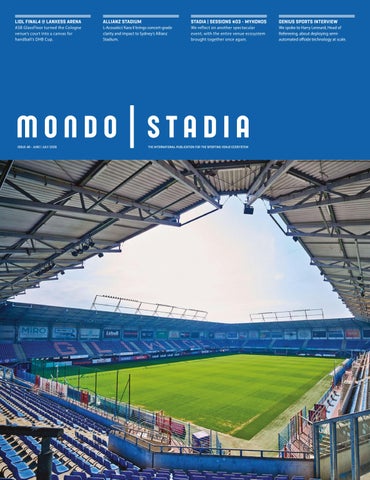
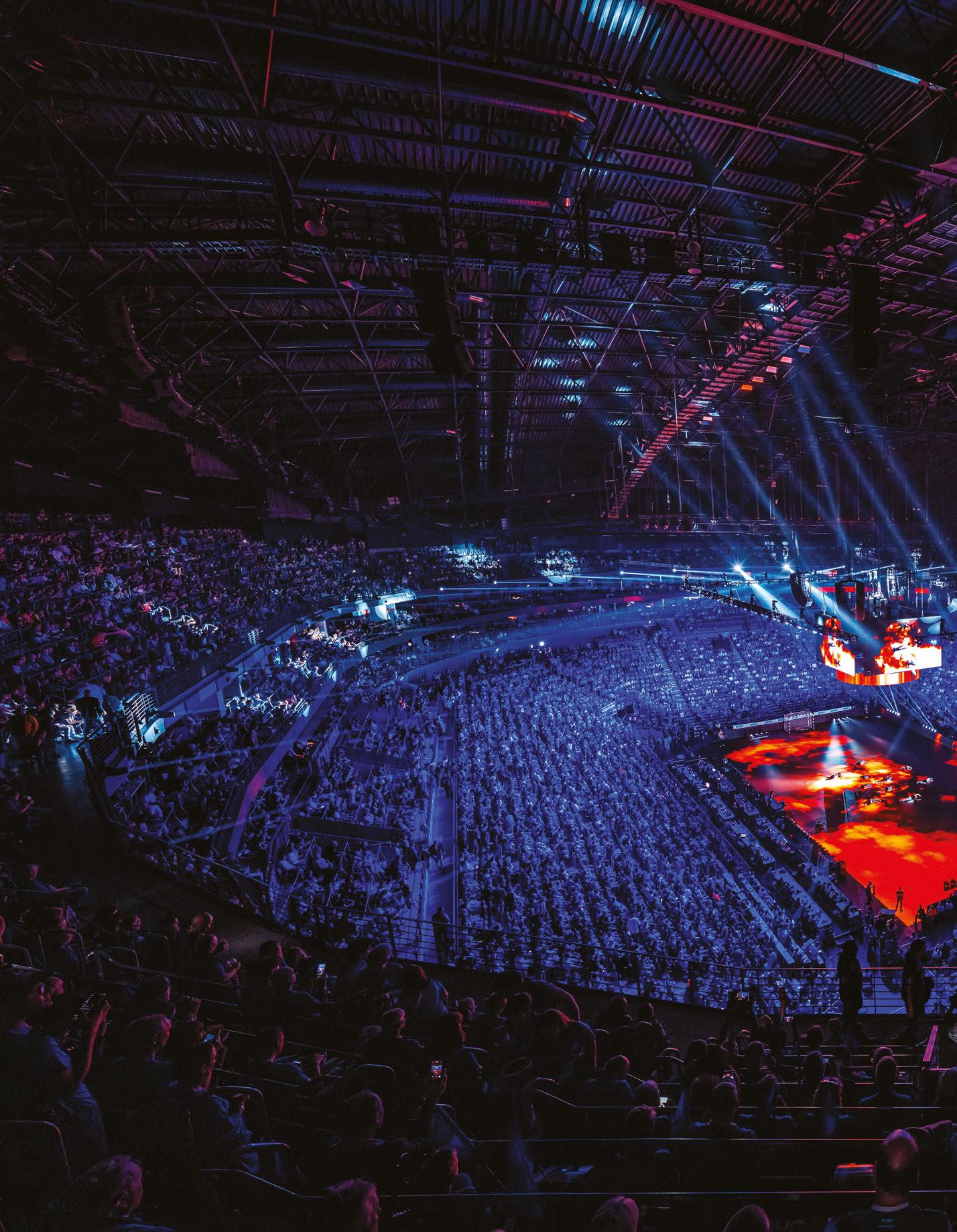
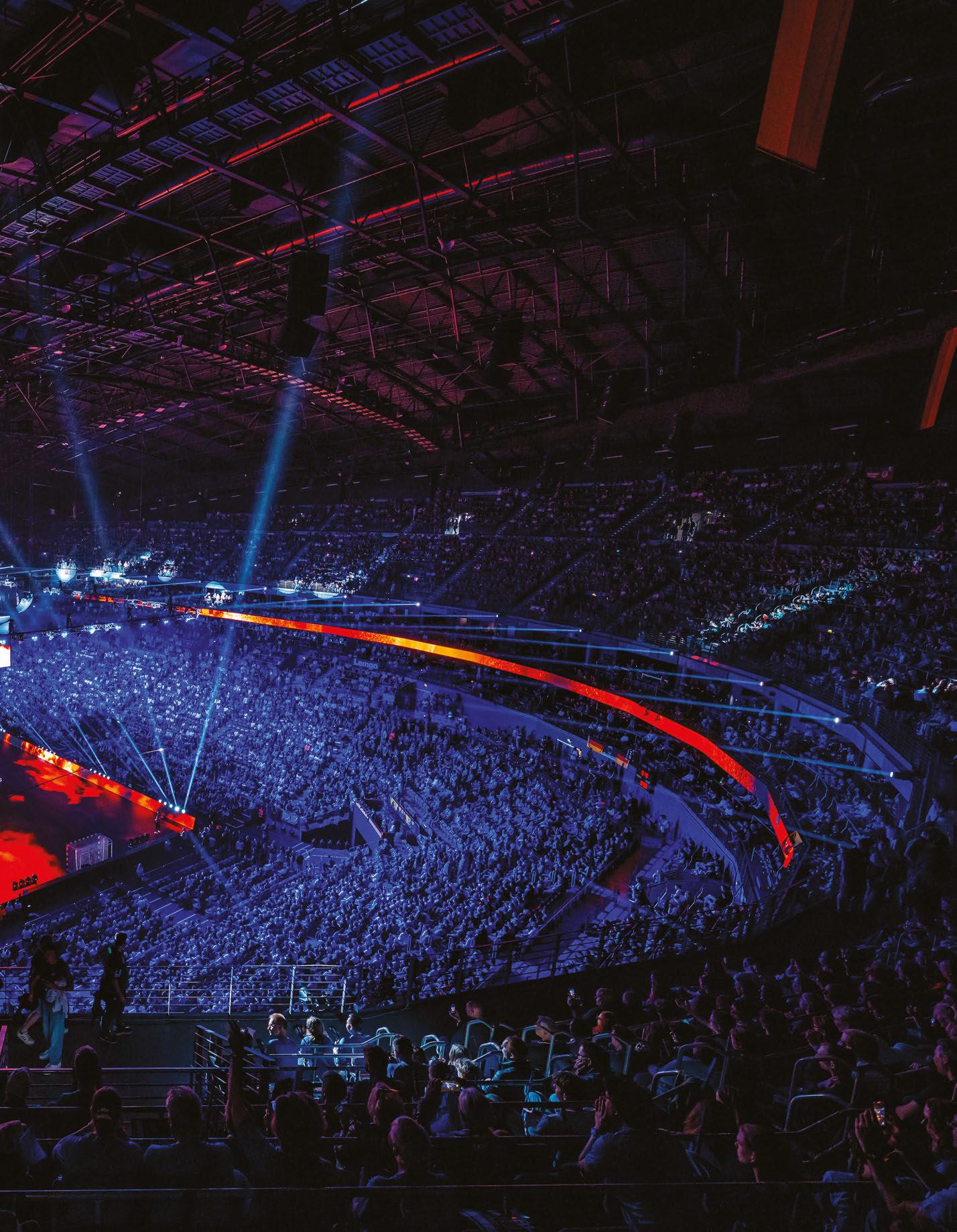
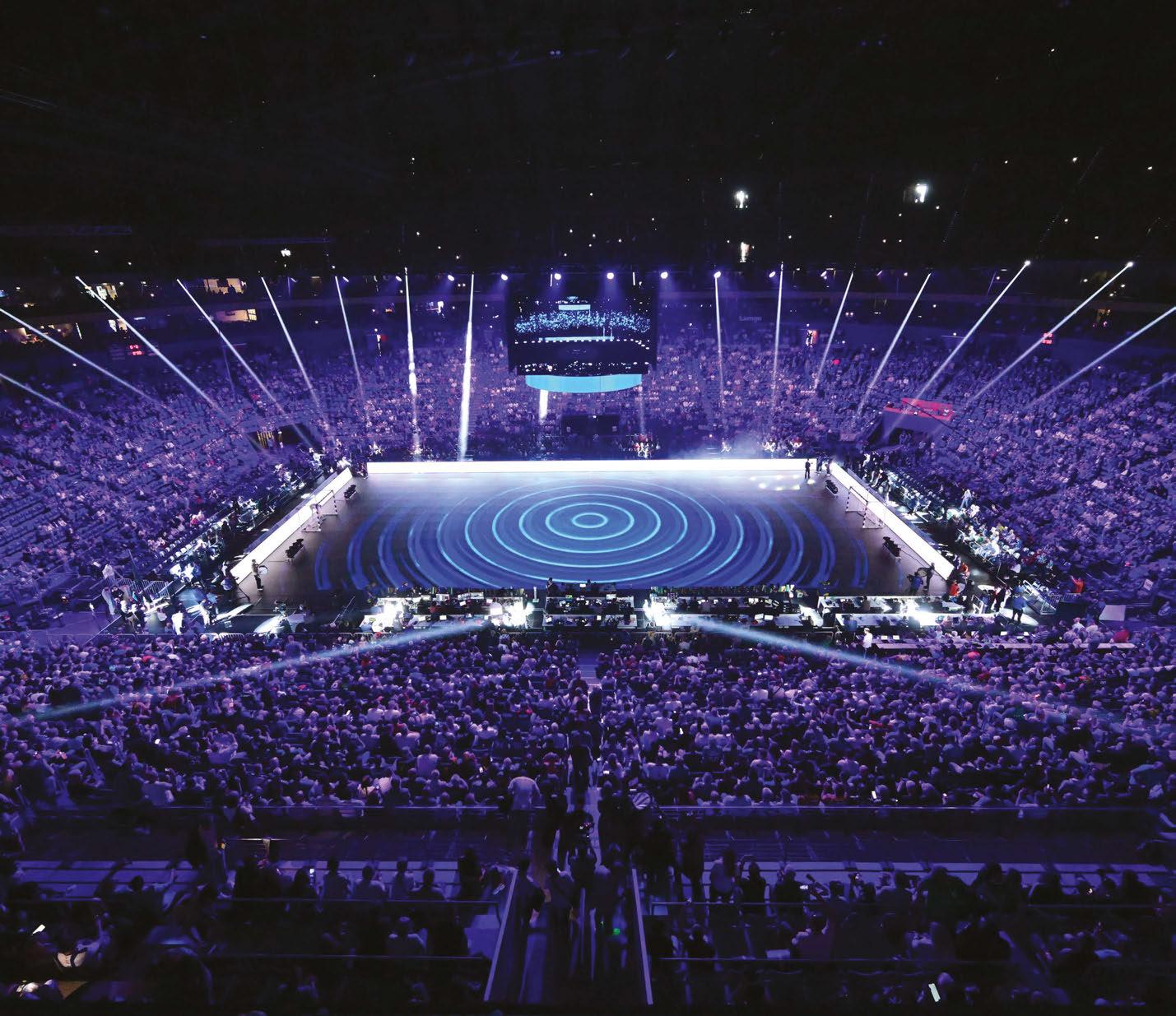
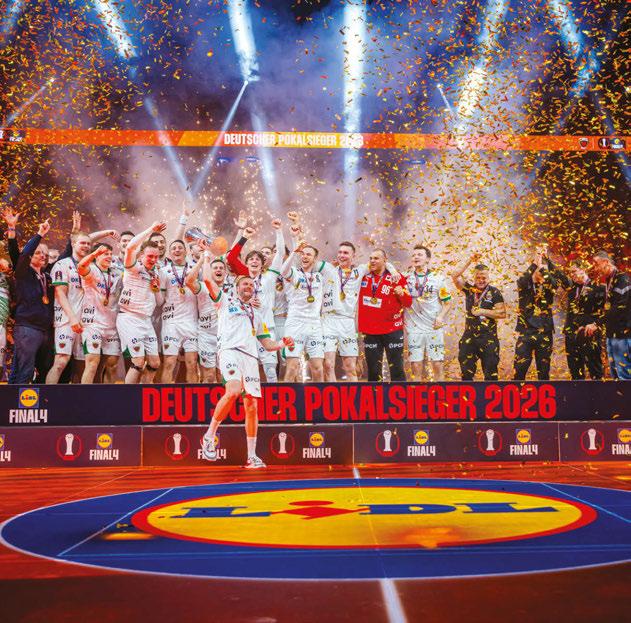
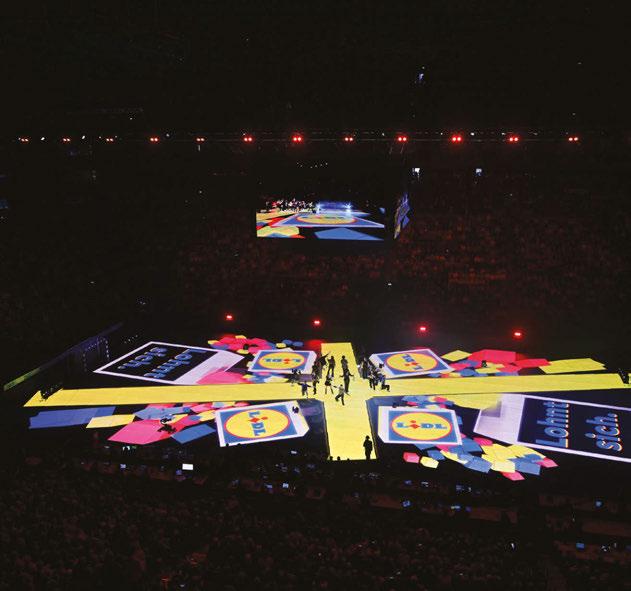
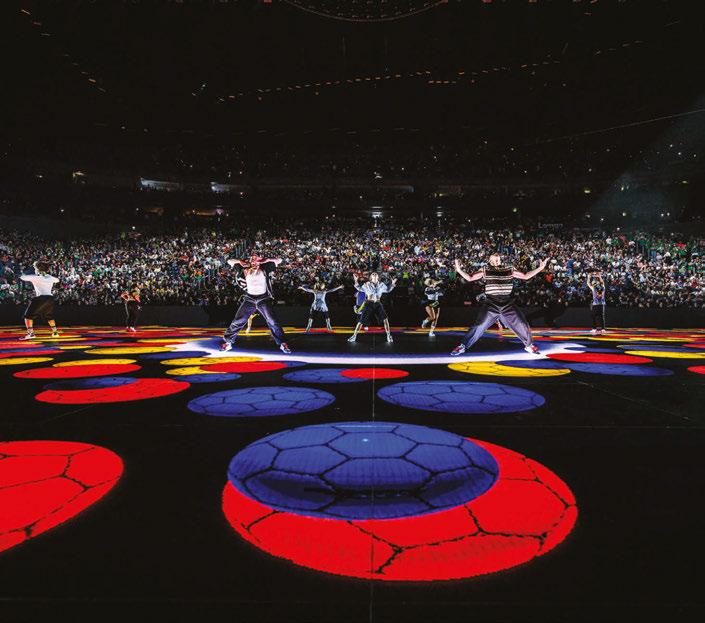
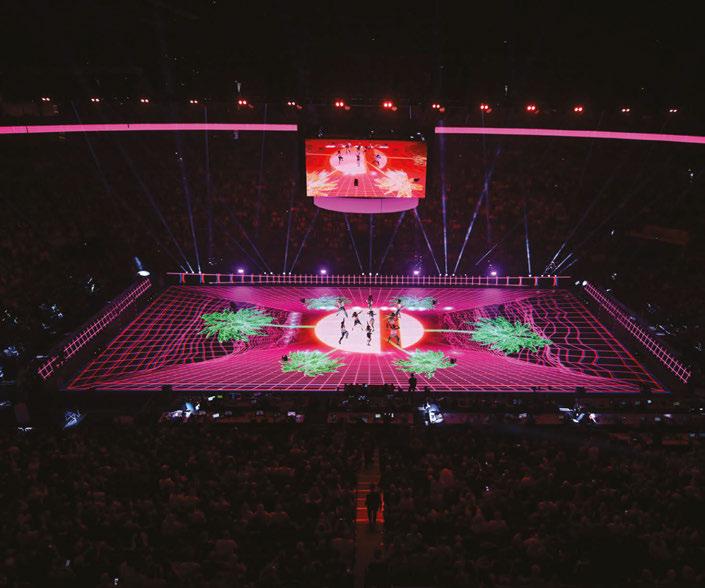
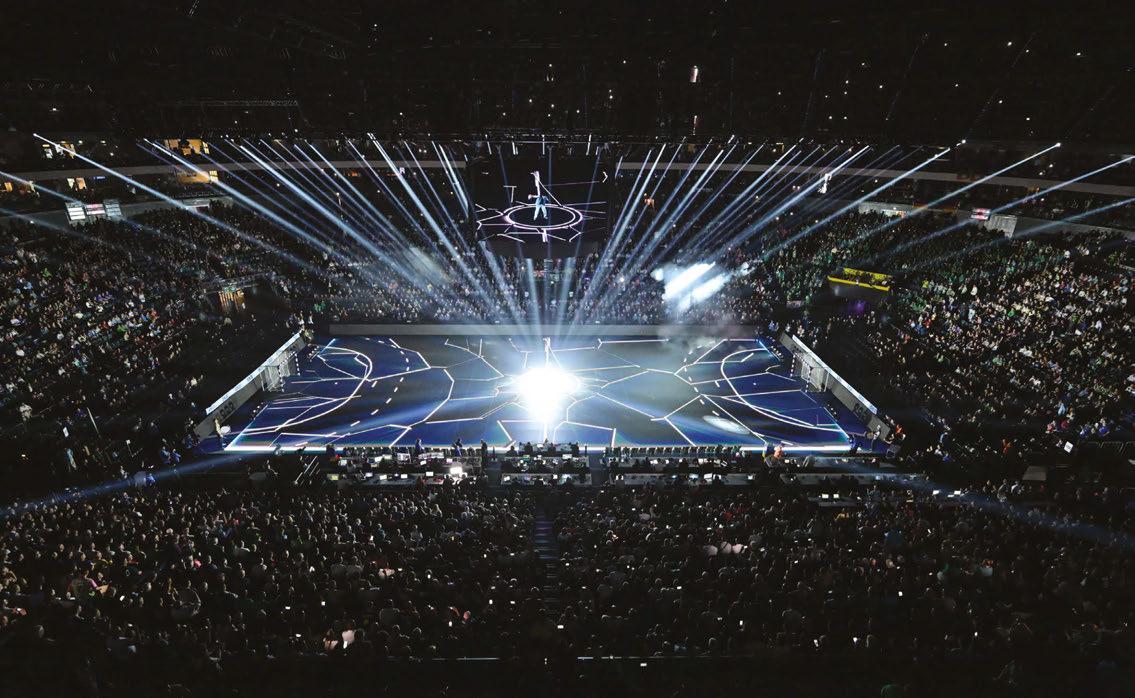
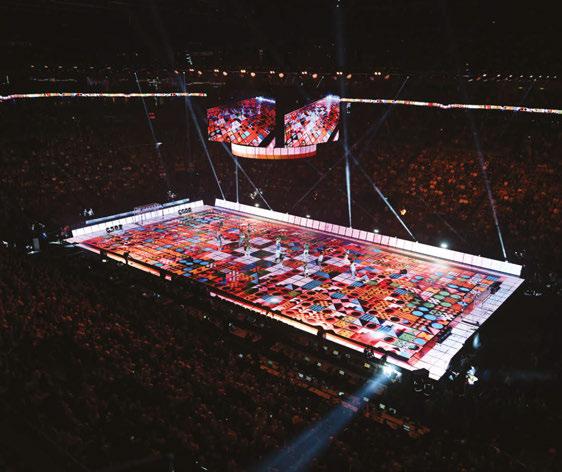
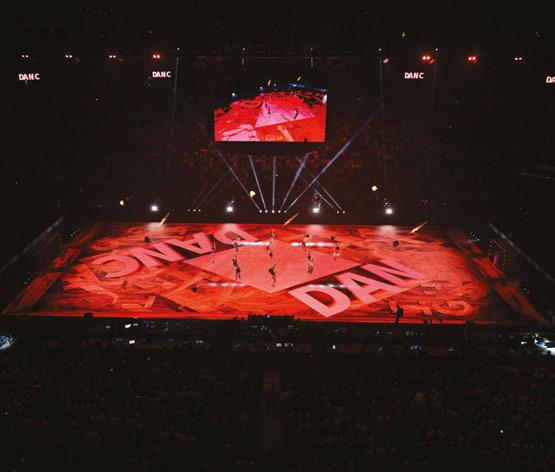
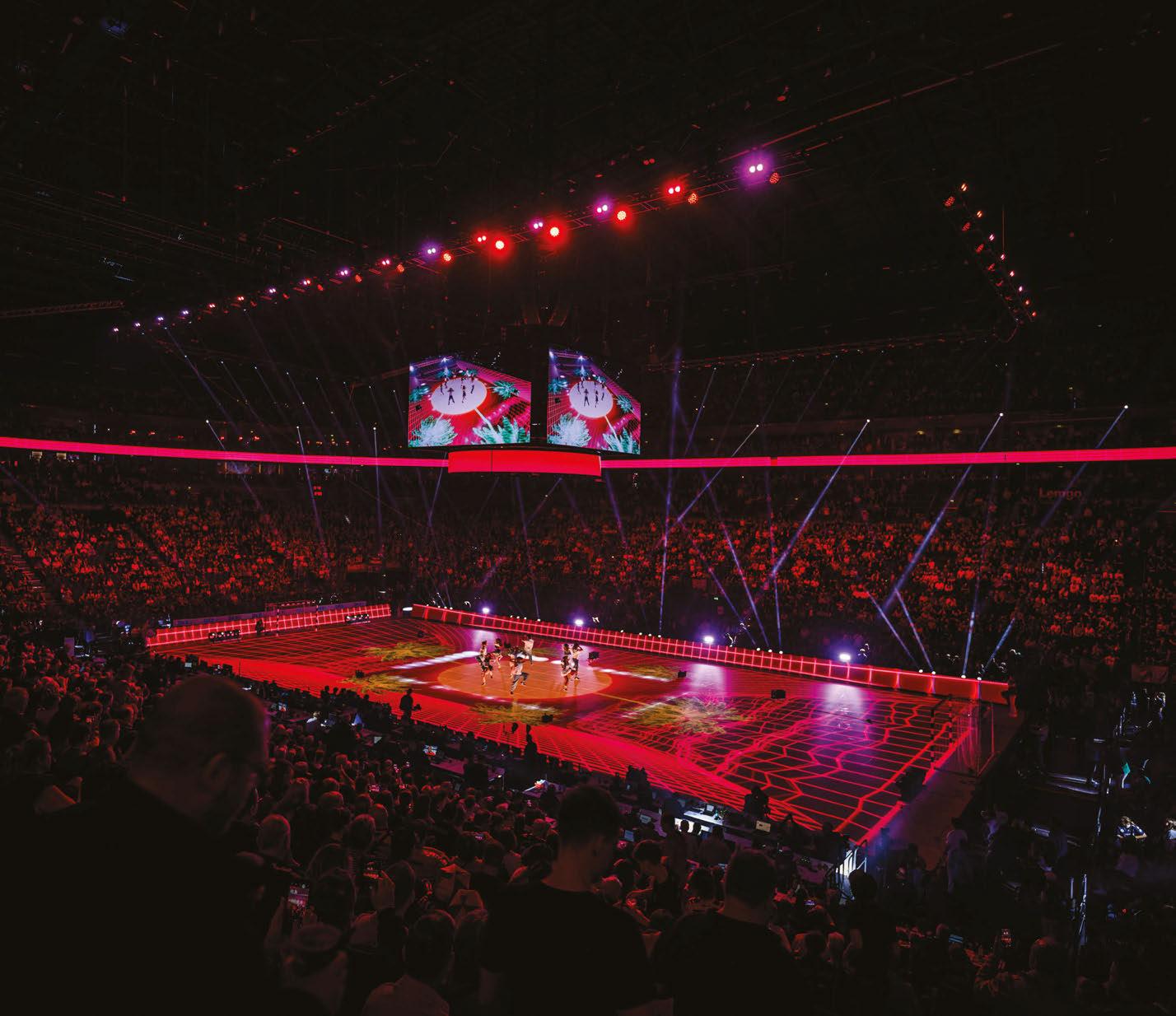
ASB GlassFloor turned the Cologne venue’s court into a canvas for handball’s DHB Cup.
ALLIANZ STADIUM
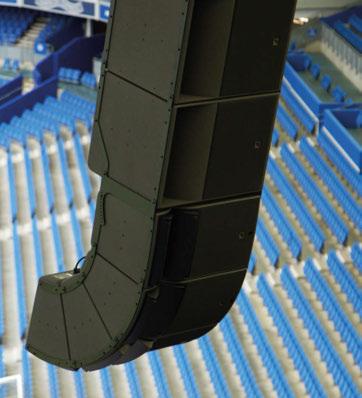
L-Acoustics’ Kara II brings concert-grade clarity and impact to Sydney’s Allianz Stadium.
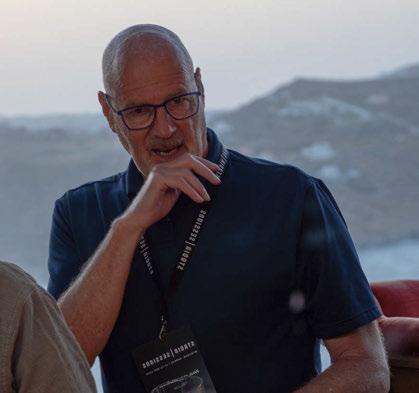
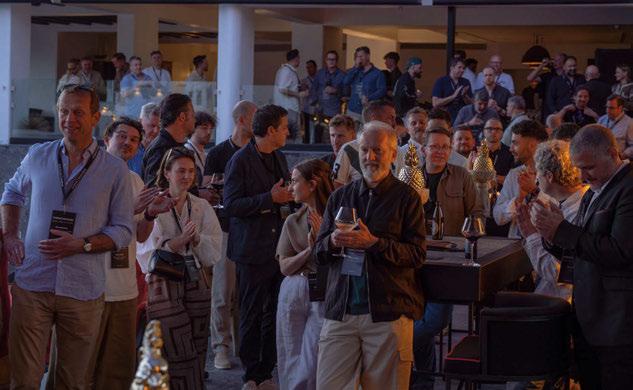
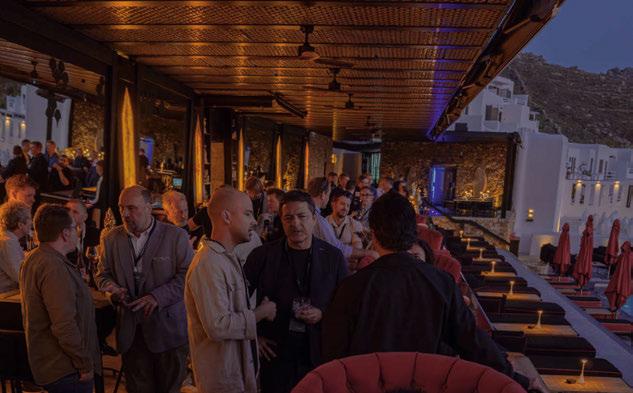
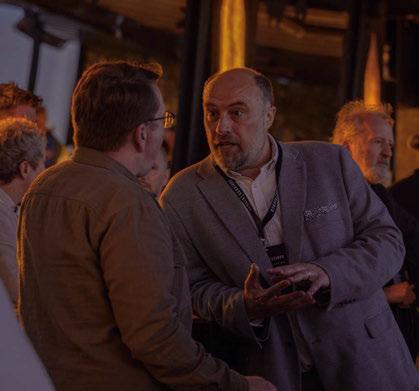
STADIA | SESSIONS #03 - MYKONOS
We reflect on another spectacular event, with the entire venue ecosystem brought together once again.
GENIUS SPORTS INTERVIEW
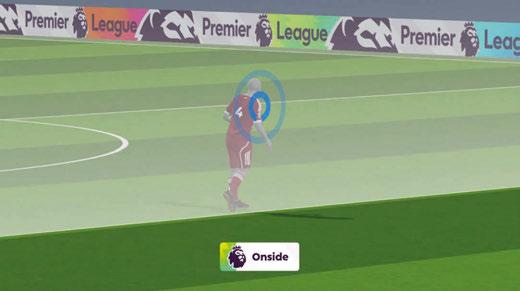
We spoke to Harry Lennard, Head of Refereeing, about deploying semiautomated offside technology at scale.
THE INTERNATIONAL PUBLICATION FOR THE SPORTING VENUE ECOSYSTEM
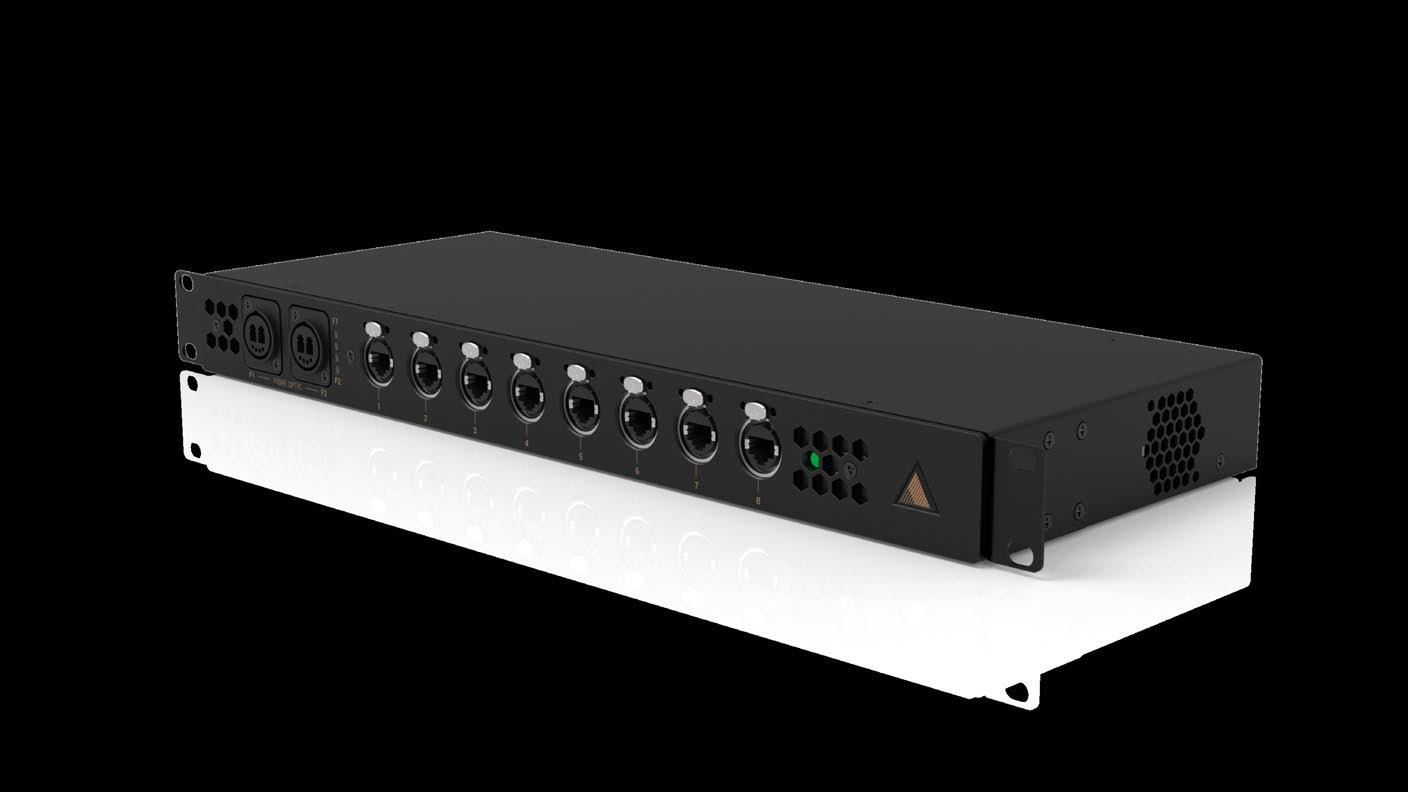
SCALABLE NETWORKING SIMPLIFIED.
Whether deploying a redundant or primary-only network topology, the MS8.2 Milan network switch is perfectly suited to simplify mobile, installed systems and spatial audio applications.
48
WELCOME
e open ISSUE 48 in Poland, where our cover story takes us to the Piotr Wieczorek Municipal Stadium — a venue that has undergone a remarkable audio transformation at the hands of Tommex, whose installation of a CODA Audio system sets a new benchmark for sound in Polish football. It’s the kind of project that reminds you how much the right audio infrastructure can change the character of a ground.
Staying with audio, we also report on L-Acoustics’ work at Allianz Stadium in Sydney, where one of Australia’s most celebrated sporting venues has invested in a system worthy of its ambitions.
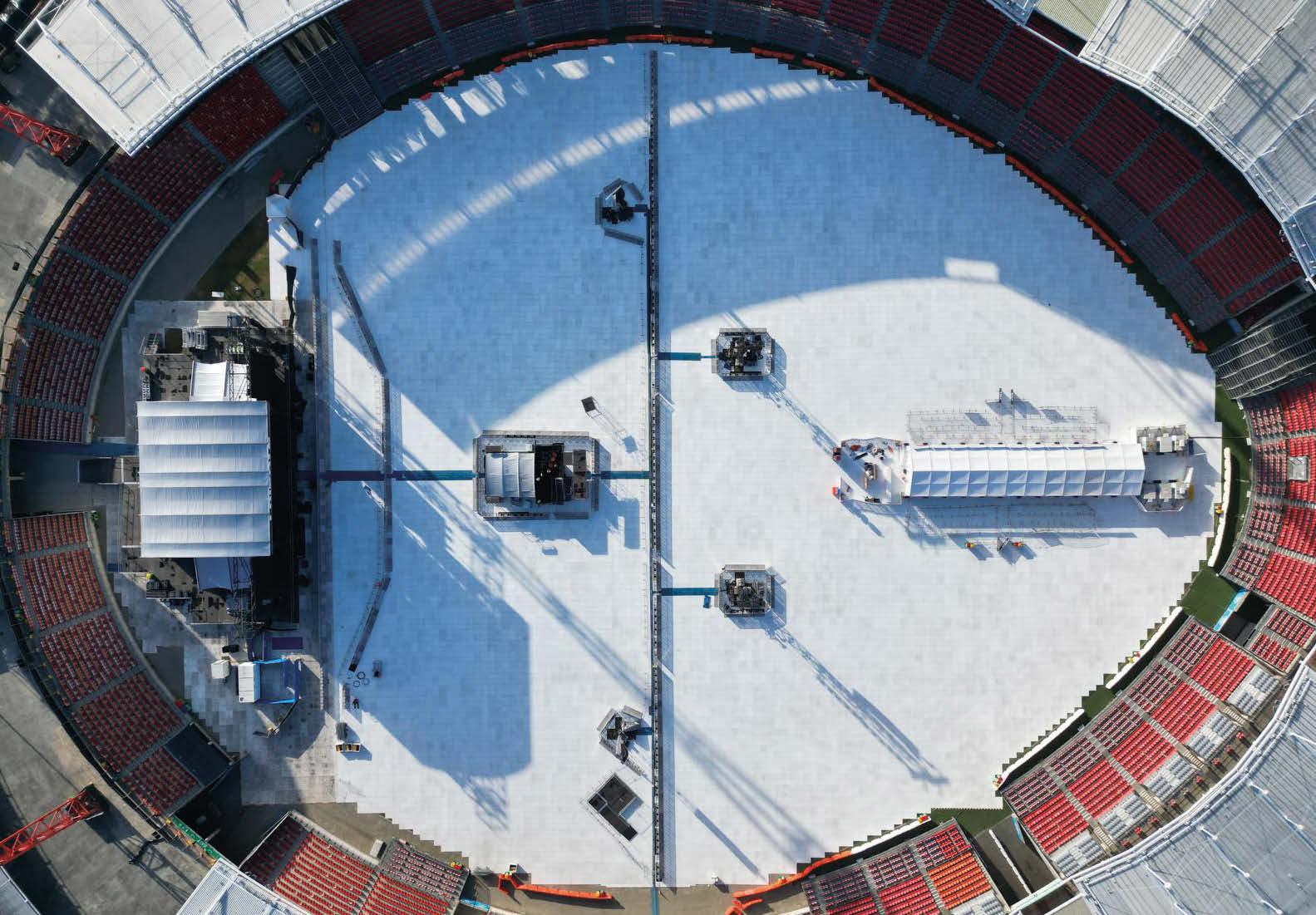
Elsewhere, ASB GlassFloor deployed its full-surface LED video sports floor at Cologne’s LANXESS Arena for the Lidl Final4 — a huge development in elite handball. Across more than 900 sq metres, the playing surface became a live media canvas, integrating sponsor content, animations, and broadcast-quality visuals directly into the floor. The logistics alone make for compelling reading.
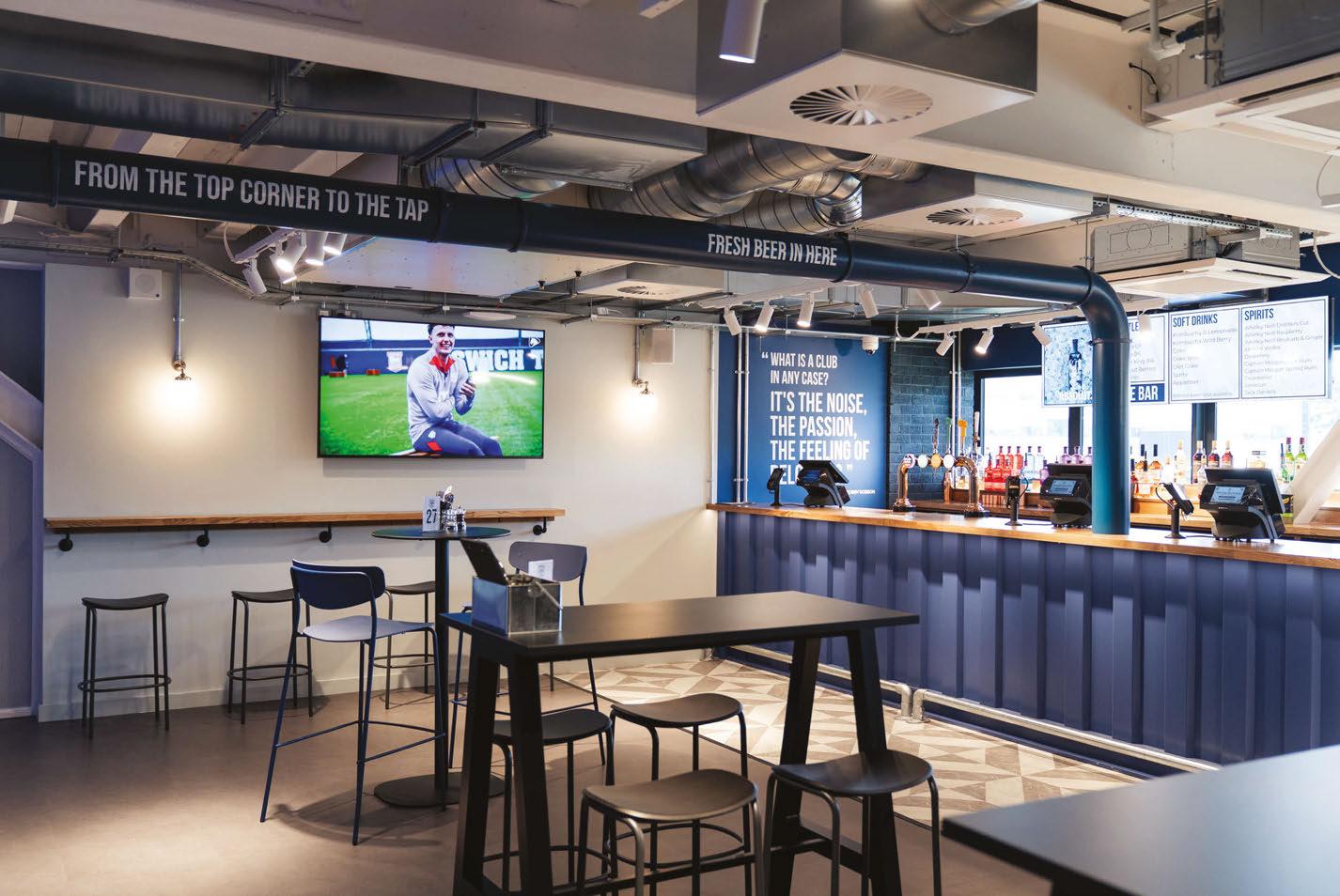
In our Team Talk section, Layrd Design turn their attention to stadium hospitality design — specifically, how considered spatial and experiential design translates directly into fan spend and loyalty. Definitely one to check out.
We also sit down with Victor Jimenez and Conn Dunning at Adder, whose work with venue operators and system integrators across North America offers a sharp perspective on the pressures facing modern venue technology teams — from live production demands to increasingly complex distributed infrastructures.
And, in a conversation that speaks directly to one of football’s most debated subjects, Harry Lennard, Head of Refereeing at Genius Sports, walks us through the operational realities of rolling out semi-automated offside technology across twenty architecturally distinct Premier League grounds.
We hope you enjoy ISSUE 48.
Sam Hughes Chief Creative Officer & Editor-in-Chief
From Venue to Destination
Our award-winning team provides solutions for the most complex, large-scale, and
Chief Creative Officer & Editor-in-Chief
Sam Hughes s.hughes@mondiale.co.uk
Editorial Assistant Matt Johnson m.johnson@mondiale.co.uk
072 From Concrete to Code: How Technology Is Changing The Modern Venue | George Vaughan, The Digital Line
Cover Image: Piotr Wieczorek Memorial Stadium
HOW SMART STADIUM HOSPITALITY DESIGN INCREASES FAN SPEND AND LOYALTY
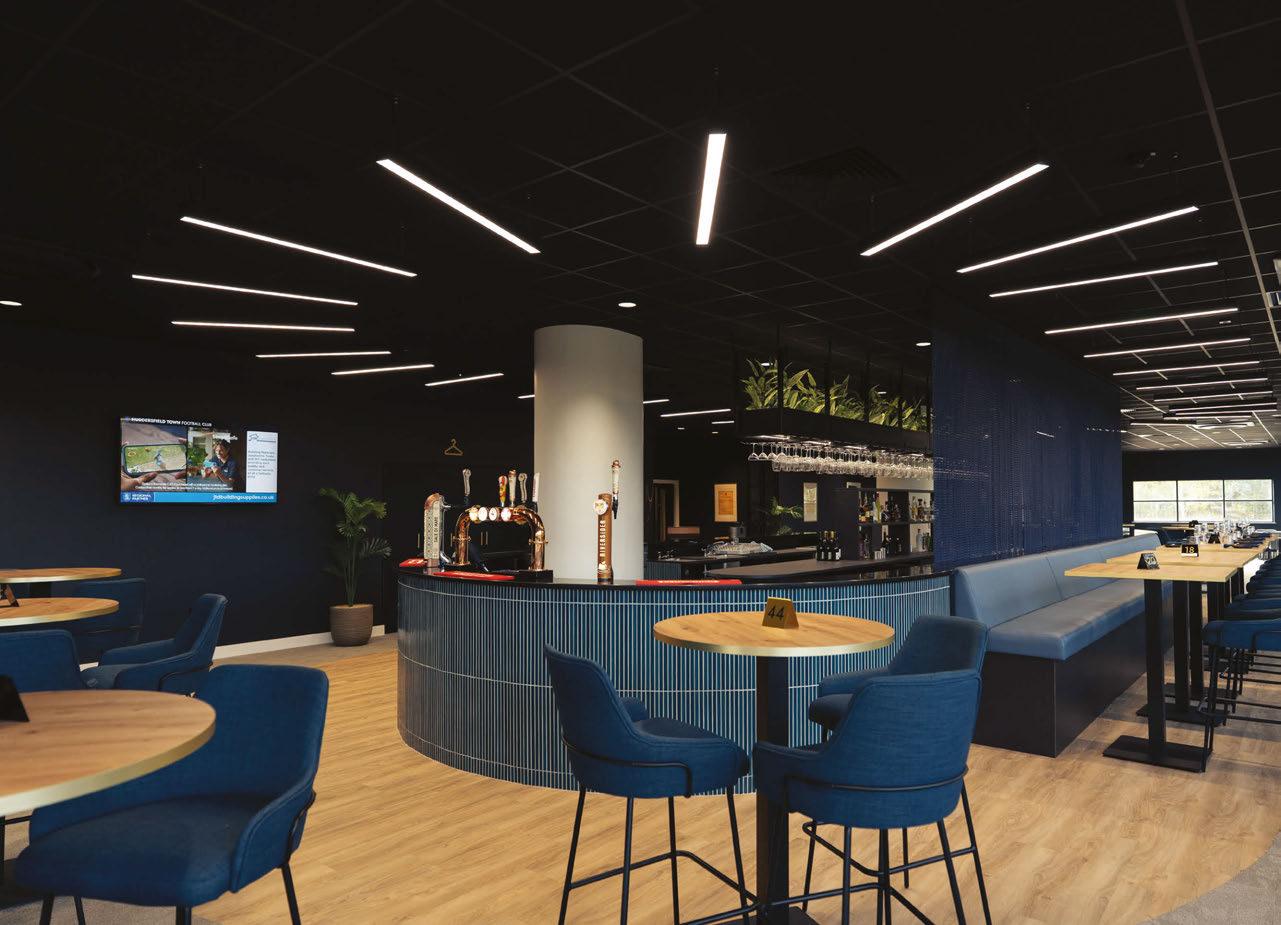
Great stadium experiences are no longer defined by the match alone; they are shaped by the spaces fans inhabit, the flow of movement through the venue, and the environments in which services are integrated. Modern stadium hospitality design moves beyond functionality to influence how fans interact, linger, and invest in the experience.
Redefining Stadium Hospitality Through Interior Design
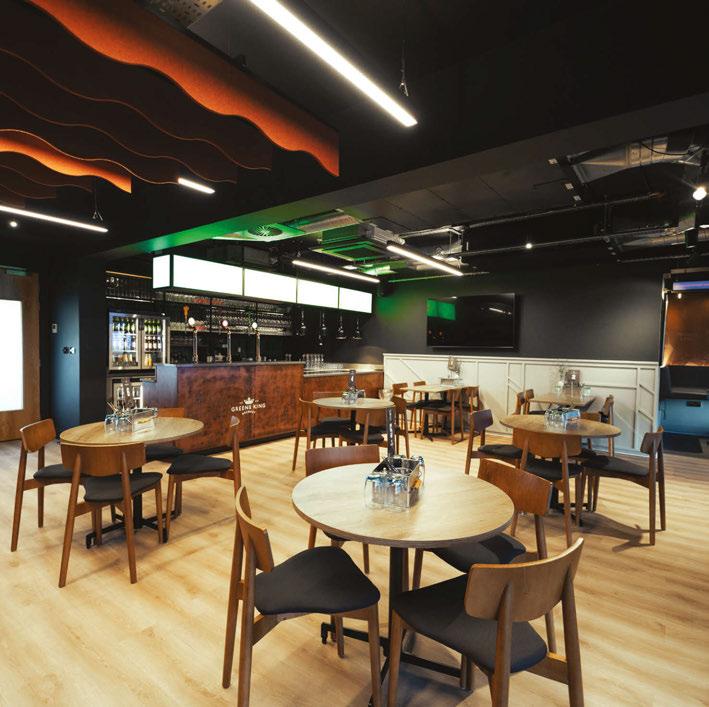
Stadium hospitality has evolved from a functional afterthought into a strategically designed component of the fan journey. Today’s fans expect more than amenities; they seek environments that anticipate their needs, facilitate social connection, and elevate the live experience. Each design decision, from layout to lighting, directly affects how fans engage, dwell, and spend. Thoughtful circulation and clear wayfinding reduce congestion, allowing fans to move effortlessly between concessions, seating, and hospitality areas. Comfort is equally essential. Ergonomically designed seating, textured finishes, and flexible lounge arrangements balance style, usability, and social interaction. Material choices, from tactile fabrics to warm timber finishes, communicate quality and sophistication, while lighting helps guide movement, highlight key experiences, and create spaces that feel both welcoming and exclusive.
Every element serves a purpose. Modular furniture adapts to varying group sizes, spatial zoning encourages guests to stay longer, and sensory-rich environments immerse fans in the excitement of the event. The result is hospitality that does more than enhance aesthetics; it extends dwell time, encourages higher spending, and strengthens the likelihood of repeat visits.
What Is Smart Stadium Hospitality Design?
In today’s stadiums, fans do not simply watch the game; they inhabit spaces designed to feel purposeful, social, and engaging. Interior design transforms hospitality areas from transitional waiting zones into immersive environments that encourage interaction and drive commercial performance.
Well-designed lounges and social seating areas are created with connection in mind. Carefully curated furniture selections, flexible seating clusters, and thoughtfully zoned layouts allow fans to gather, network, celebrate, or relax while remaining connected to the atmosphere of the event. These spaces balance intimacy with openness, supporting a range of social experiences.
Suites and premium hospitality areas extend beyond luxury aesthetics to deliver a heightened sense of value. Elevated materials, layered lighting schemes, and exclusive amenities create environments that encourage
guests to spend more time within the space. Through deliberate spatial hierarchy and carefully considered detailing, these areas communicate exclusivity while maintaining a welcoming and comfortable atmosphere. Flexibility is another defining characteristic of smart hospitality design. Modular layouts, adaptable furnishings, and dynamic lighting solutions enable spaces to transition seamlessly between family-friendly zones, corporate entertainment suites, fan club hubs, and event-specific functions. When these transformations are integrated into the design from the outset, they feel intentional rather than improvised.
Ultimately, every design choice influences behaviour. By creating environments that encourage comfort, connection, and engagement, stadiums can inspire fans to stay longer, interact more deeply with the venue, and invest more readily in premium experiences. Interior design is no longer a decorative consideration; it is a strategic tool for driving engagement, loyalty, and revenue.
The Psychology Behind Fan Spending in Stadiums: How Design Drives Behaviour
The environments in which fans spend their time have a direct impact on purchasing decisions and long-term loyalty. Design shapes how people feel, how they move
through a space, and how likely they are to engage with hospitality offerings.
Convenience plays a significant role in encouraging spending. Intuitive circulation routes, clear wayfinding, and easily accessible concessions reduce friction throughout the fan journey. When visitors can navigate the venue effortlessly, they are more inclined to make spontaneous purchases and explore additional hospitality offerings.
Comfort also has a measurable commercial impact. Inviting lounges, ergonomic seating, and thoughtfully designed social spaces encourage fans to remain within hospitality areas for longer periods. Increased dwell time naturally creates more opportunities for food, beverage, merchandise, and premium service purchases. Premium environments influence perceptions of value. High-quality finishes, carefully layered lighting, and sophisticated spatial composition signal exclusivity and elevate expectations. As a result, fans are often more willing to invest in premium tickets, hospitality packages, and suite experiences when the environment reinforces the value of the offering.
Perhaps most importantly, immersive and memorable
environments foster emotional connection. Sensoryrich spaces that create a strong sense of place enhance the overall event experience and strengthen fans’ relationships with the venue. These positive associations encourage repeat visits, increase loyalty, and turn visitors into advocates who actively promote the destination to others.
By grounding every hospitality decision in strong interior design principles, stadiums can create environments that are not only visually compelling but also commercially effective. Thoughtful material selection, spatial planning, lighting design, and circulation strategies work together to encourage fans to stay longer, spend more, and return again and again.
INTERVIEW
“Stadiums are no longer expected to support a single game-day production workflow. They’re hosting complete, high-demand entertainment experiences.”
“Our technology should support the strategy, not become the strategy.”
Victor Jiminez Eastern Region Sales Manager Adder Technology
Harry Lennard Head Of Refereeing Genius Sports
VICTOR JIMENEZ & CONN DUNNING: BUILDING CONNECTED STADIUM ECOSYSTEMS
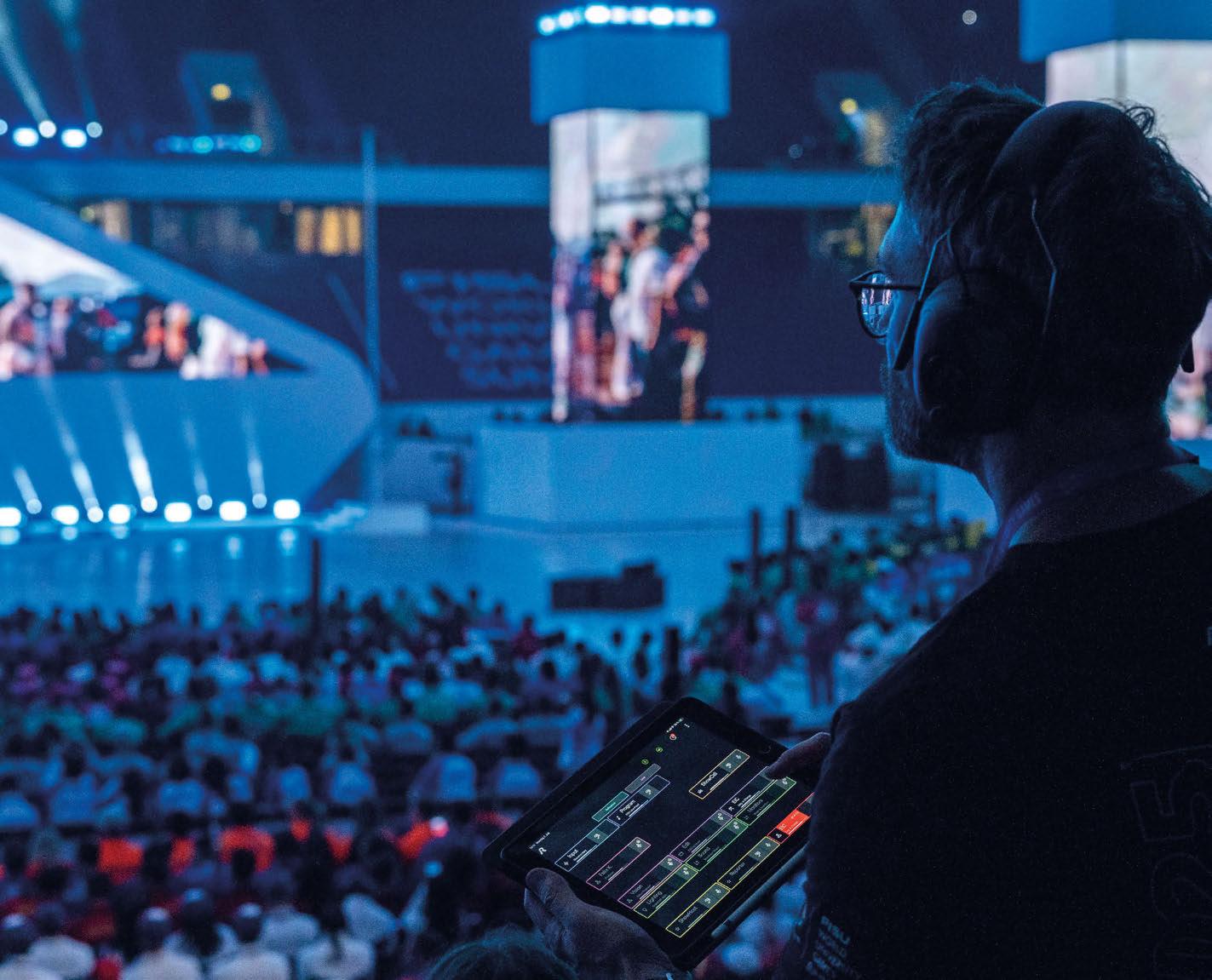
As stadiums continue to evolve into multi-purpose entertainment destinations, venue technology teams are under increasing pressure to deliver seamless live production, immersive fan experiences and broadcast-quality operations – all while managing increasingly complex and distributed infrastructures. From sporting events and concerts to premium hospitality experiences, today’s venues must support highly demanding operational workflows with little margin for error. MONDO | STADIA sat down with Victor Jimenez, Eastern Region Sales Manager, and Conn Dunning, West Region and LATAM Sales Manager at Adder to discuss the key challenges shaping modern venue operations after working closely with venue operators and system integrators across North America.
Images: @edunn_shot, Artur Didyk/Shutterstock.com, ShutterLibrary/Shutterstock.com
Modern stadiums are now expected to operate as multipurpose entertainment destinations as much as sporting venues. How has the operational landscape changed in recent years?
Jimenez: We’ve seen sporting events evolve into full-day experiences and, in many cases, family occasions where groups of people come together to celebrate. This shift is driving some of the biggest changes in the operational landscapes.
Stadiums are no longer expected to support a single gameday production workflow. They’re hosting complete, highdemand entertainment experiences that combine sports, concerts, hospitality and live broadcasting – often within extremely tight turnaround times.
Dunning: This evolution is placing far greater pressure on technology and production teams to deliver seamless, highquality experiences across the entire venue ecosystem while maintaining operational efficiency behind the scenes. At the same time, fan expectations have risen dramatically. Audiences expect real-time replays, immersive visuals and uninterrupted connectivity throughout the entire event experience.
What are some of the biggest operational and workflow challenges venue technology teams are managing behind the scenes today and particularly, during the biggest live events of the season?
Jimenez: One of the biggest challenges our clients face is managing increasingly complex environments that are often distributed across multiple locations. In these settings, downtime simply isn’t an option. Operators need systems they can completely rely on so they can stay focused on the live production itself.
Visibility and control across every technology platform is critical to ensure production runs smoothly and as planned.
Dunning: To help provide that certainty, we work closely with a range of technology partners to demonstrate how our solutions integrate seamlessly with the systems and workflows operators already rely on.
We showcase many of these collaborations through our global events program and within our state-of-the-art Customer Experience Center.
Are you seeing greater convergence between broadcast, AV and IT operations within stadium environments, and what impact is that having on infrastructure requirements?
Jimenez: Today, stadium projects require much closer collaborations between departments because systems are now deeply interconnected. Broadcast operations increasingly rely on IT infrastructure, AV systems are becoming more software-driven, and centralized management is expected across multiple teams, league sites and workflows.
IP based products that support APIs and Software Development Kits (SDKs) allow for the integration of these once separate ecosystems.
Dunning: This convergence is reshaping how venues approach infrastructure planning. Operators are actively looking for technologies that can bridge departments, simplify management and provide secure access to multiple workflows, while maintaining consistency and performance live broadcast environments demands.
As part of this transition, we’re seeing many legacy systems based on traditional technologies like Serial Digital Interface (SDI) being replaced by more flexible IP-based connectivity. IP infrastructure helps unify ecosystems and enables teams to
work more efficiently across distributed and interconnected environments.
Are you seeing venue operators place greater emphasis on flexibility and future-proofing when investing in infrastructure?
Jimenez: New technologies continue to emerge at a fast pace, and venue operators understand the importance of being ready for the next requirement. Stadiums are thinking about infrastructure requirements around SDR10, HDR10 and HLG even though they might not need them today.
Over the past few years, we’ve seen rapid technological development, particularly with technologies like Artificial Intelligence becoming more embedded within operational workflows.
Dunning: Scalability, interoperability and long-term reliability are now central to infrastructure decision-making. Operators and system integrators are paying much closer attention to how easily systems can integrate with existing environments, support future expansion and adapt to emerging technologies and workflows.
There’s also a much stronger focus on protecting long-term investment. Rather than replacing entire systems every few years, venues are prioritizing modular, flexible technologies that can evolve incrementally as operational requirements change over time.
Looking ahead, what do you think will define the next generation of stadium operations and live venue experiences?
Jimenez: I think the next generation of stadium operations will be defined by greater interconnectivity, centralized
management and increasingly immersive and interactive fan experiences.
We expect to see continued growth in IP-based workflows, remote production capabilities and centralized operational models that allow venues to manage increasingly complex environments more efficiently. Real-time data visualization will also play a much bigger role in helping operators proactively manage live productions and create an interactive fan experience via technology versus just the traditional live action.
Dunning: From the fan perspective, venues will continue investing in technologies that create more personalized experiences. We’re already seeing live content distributed through alternative digital platforms and streaming services in new ways, and that trend is only going to accelerate. Ultimately, venues will need to combine operational resilience with flexibility and adaptability to keep up with changing audience expectations and production demands. As stadium operations continue to evolve, venue operators are increasingly prioritizing technologies that enable secure, flexible and reliable workflows across highly demanding live environments. For technology providers like Adder, supporting that evolution with award-winning IP KVM solutions means supporting venues and system integrators to build infrastructures that are not only resilient today but adaptable for the future.
To learn more about our solutions in sports environments, contact our sales team or book a dedicated session in our CXC.
HLG Monitoring Where It Matters Most
In live sports, every second counts. Operators monitoring live feeds need instant access to systems so they can review and manage content before it goes on air.
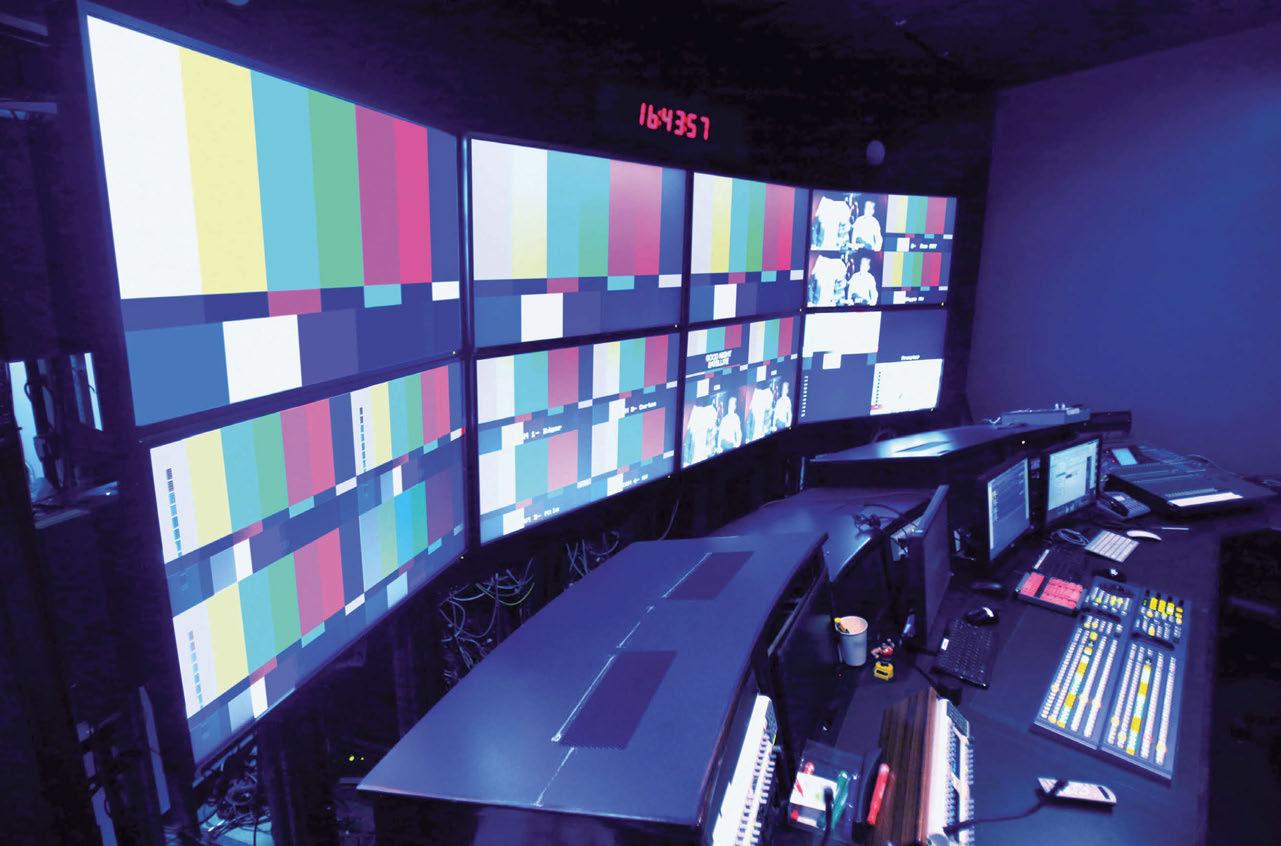
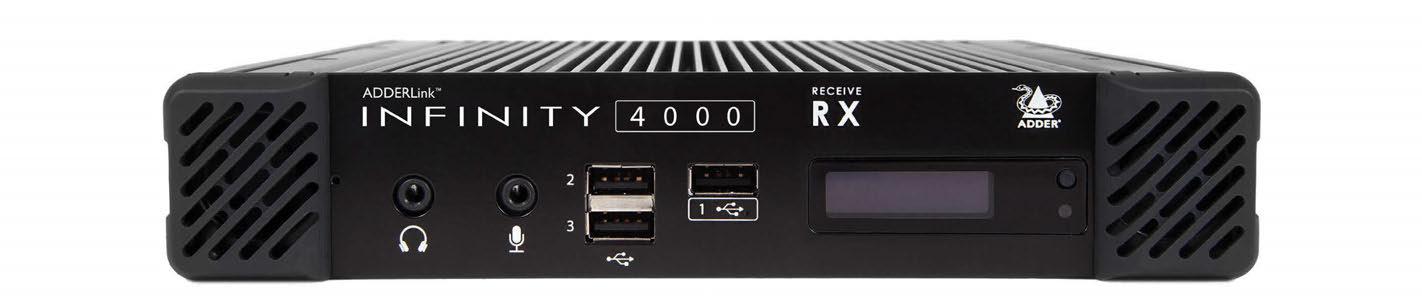
Now with HLG signal support, the ADDERLink® INFINITY 4000 series enables operators to manage HDR and SDR content directly from their workstations.
By removing the need for additional reference monitors, broadcast teams can streamline operations and stay focused on the moments in front of the camera.
Experience Adder IP KVM in action at our new state-of-the-art Customer Experience Center. Scan the QR code to discover more.
HARRY LENNARD DIRECTOR OF OFFICIATING OPERATIONS GENIUS SPORTS
MONDO | STADIA spoke with Harry to explore how semi-automated offside technology is being deployed across some of the world’s most demanding stadium environments. From the logistics of installing 30 cameras across 20 architecturally distinct Premier League grounds to the mesh tracking data that underpins every decision, Harry discusses the operational realities of rolling out SAOT at scale. He also addresses the fan experience question that has dogged VAR since its introduction — and makes the case for why speed, accuracy and in-ground clarity are no longer competing priorities.
SAOT needs 30 cameras installed in every stadium - how does the placement and calibration of those actually work on the ground, and who owns that process at each venue?
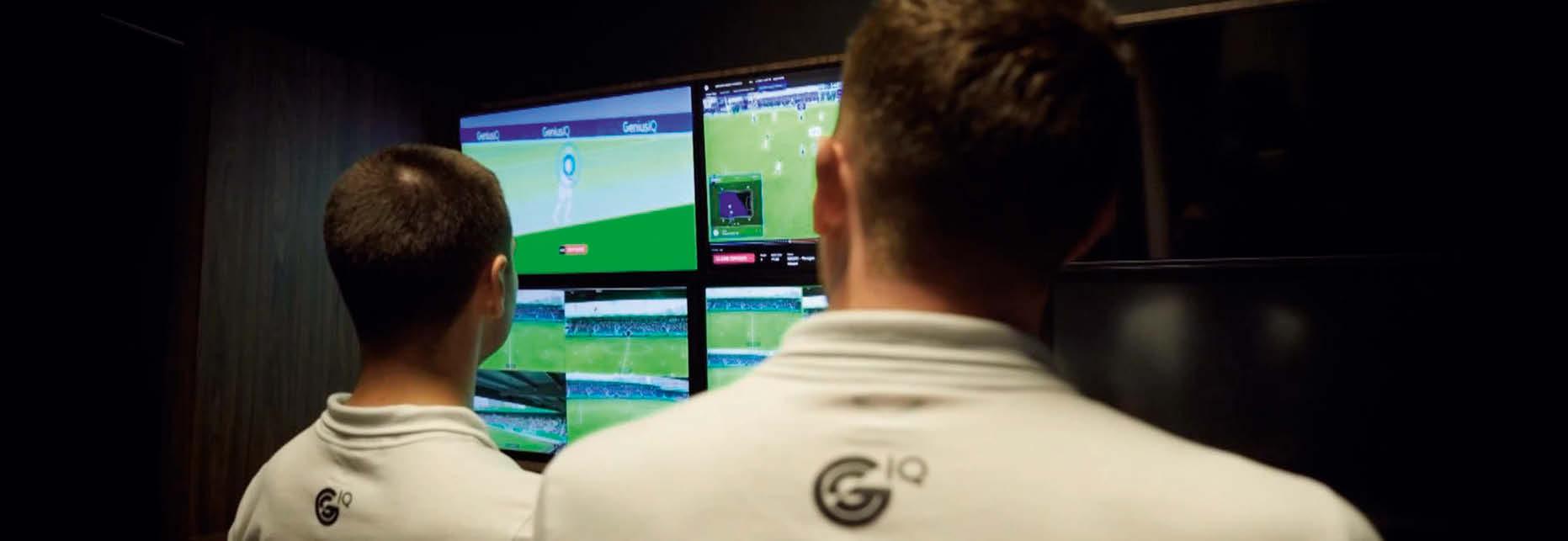
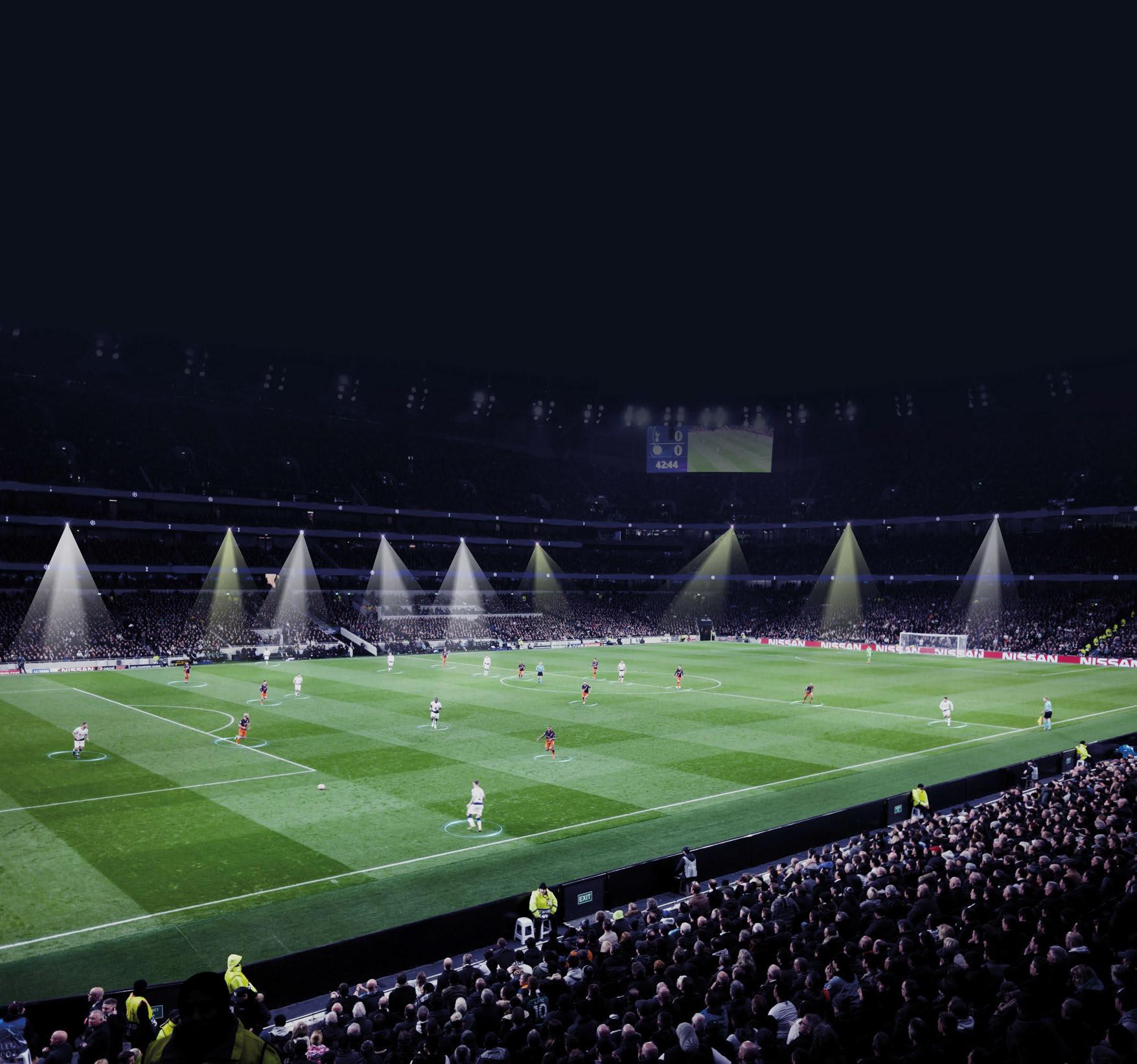
Semi-automated offside technology (SAOT) is one of many systems that runs off GeniusIQ, our data and AI platform. When we partner with a new league, we align closely with them and each of their teams to install our cameras in every stadium. These cameras capture a wealth of official tracking data from each game, which feed into GeniusIQ as a central system of intelligence.
Once GeniusIQ is deployed in a league, we can power everything from semi-automated offsides to data-driven coaching solutions and immersive fan experiences.
The system captures up to 10,000 surface data points per player, per second – for our readers, can you explain what “mesh tracking” actually means, and why does an offside call need that level of detail?
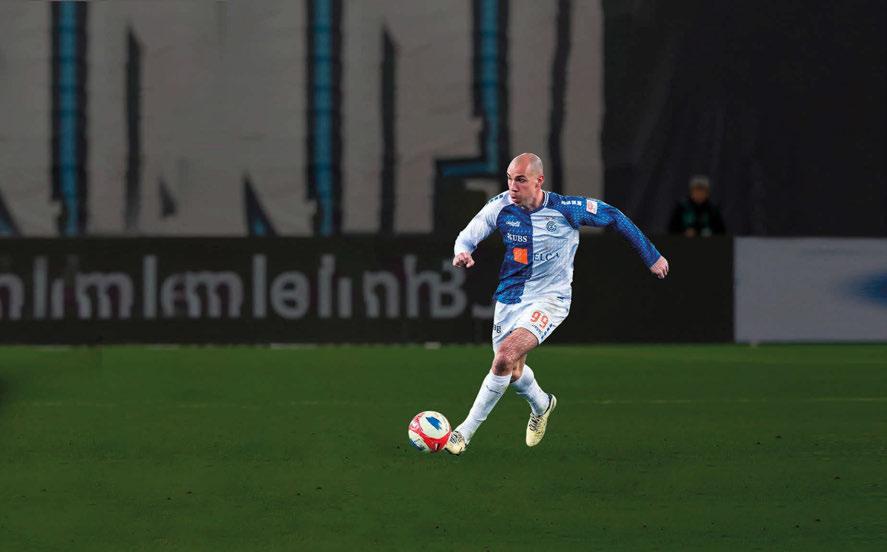
Mesh tracking is the most advanced dataset in world sport. It captures precise player body movements and angles in such rich detail that it enables the creation of a full 3D recreation of an entire game.
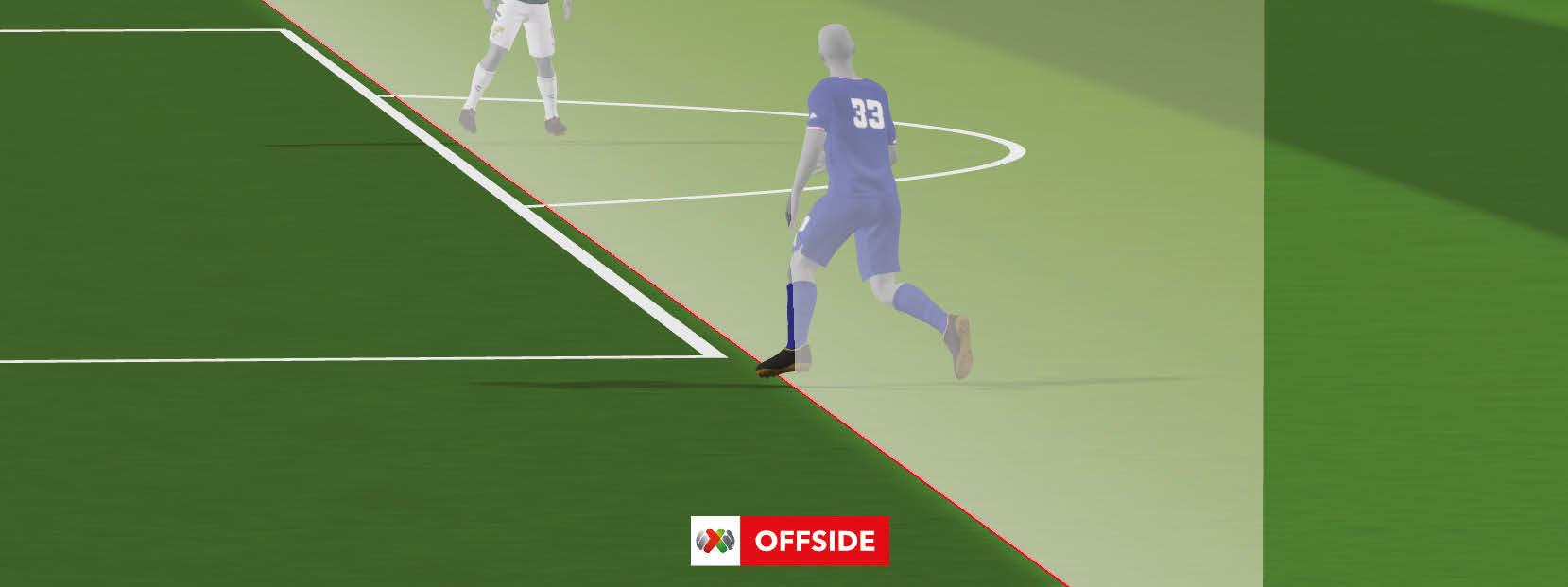
Offsides are one of the most complex and intricate decisions in football. To make precise and fast decisions, officials have to rely on a depth,quality and accuracy of data that can automatically create a 3D render of the exact offside incident.
How does GeniusIQ tell the difference between a genuine offside and a camera glitch or visual error, especially in a
stadium with tricky sightlines or older infrastructure?
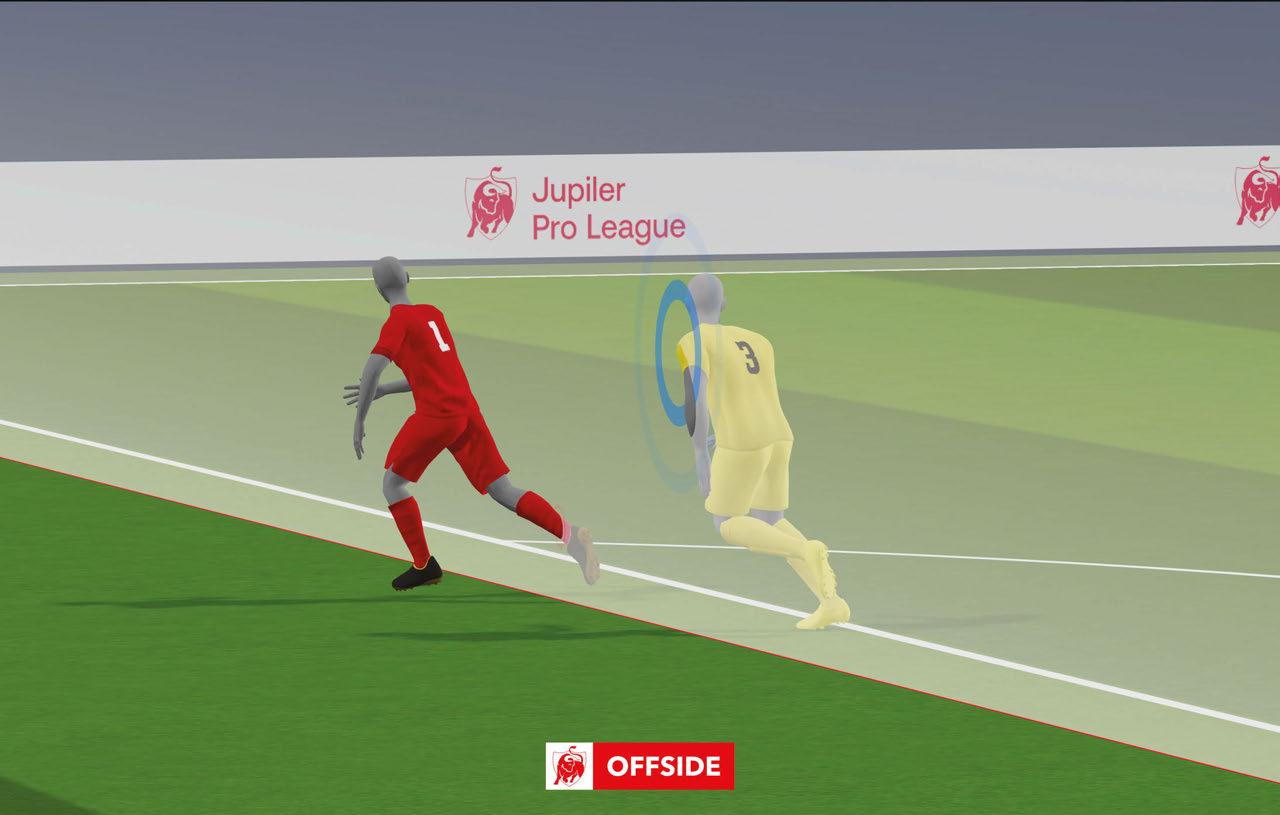
With dozens of cameras capturing up to 10,000 data points per player as well as their exact X, Y coordinates, GeniusIQ ingests and processes such a huge volume of data to recreate the live action. Our SAOT also removes the need for manually drawn lines with fully automated 3D recreations that clearly show which part of a player is offside.
You’re rolling this out across 20 very different Premier League grounds. How complicated is that, given every venue has its own architecture, lighting, and existing tech setup?
It’s certainly complex and the different layout of every stadium has caused a few headaches. But GeniusIQ is now deployed across hundreds of stadiums worldwide with our SAOT live in the Premier League, Belgian Pro League and Liga MX with the Brazilian Serie A to follow shortly after the World Cup. So far, we’ve not found a stadium we couldn’t manage and install in!
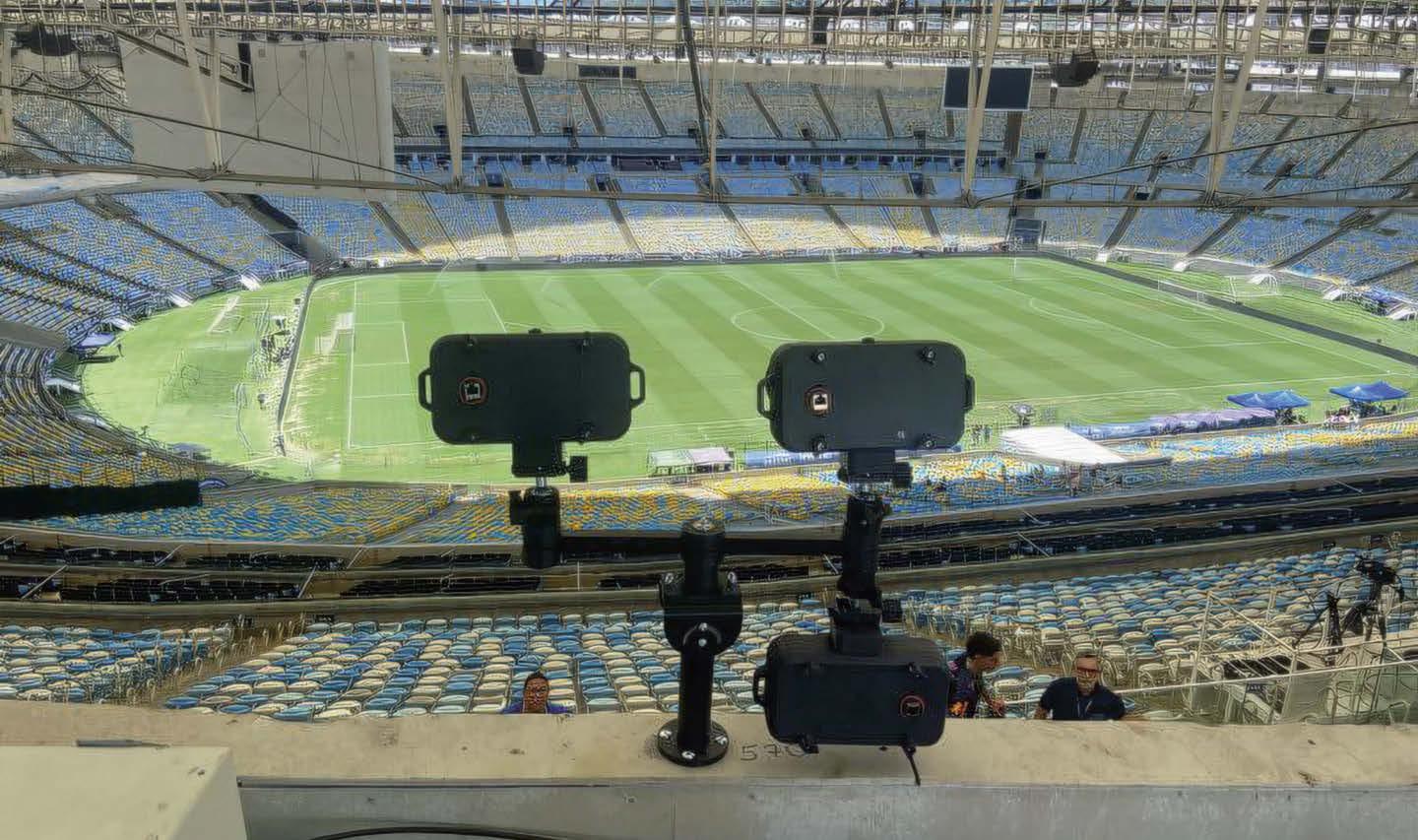
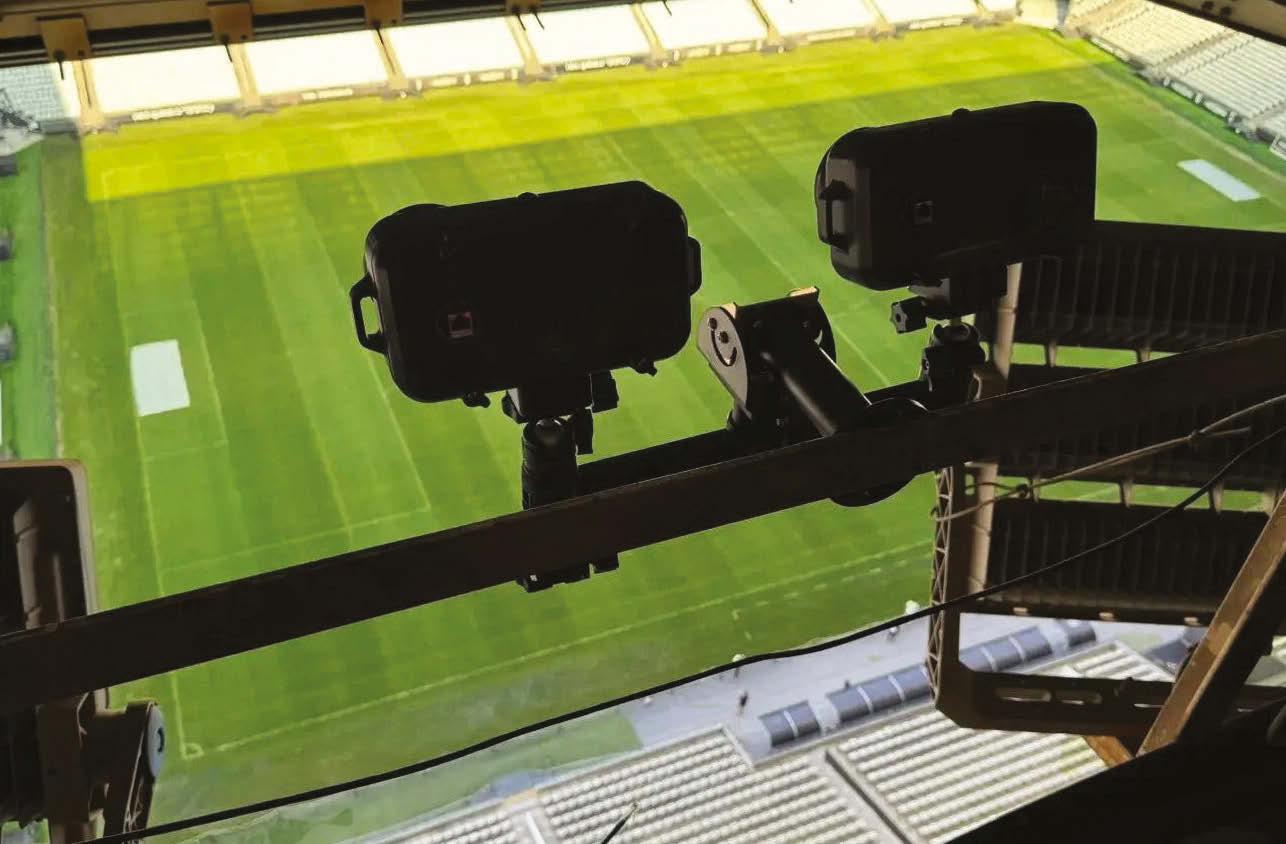
Whilst we have a standard layout for installations, there is enough flexibility to work around any challenges we come across. If a venue doesn’t have a stand behind the goal that we can install in, we can move these positions to the corners. We have automated tools that can then verify that our pitch coverage is comprehensive from multiple cameras and angles.
Are there certain stadium types that cause headaches - older grounds, unusual stand configurations, poor floodlighting - and how do you work around them?
There is flexibility to install the system as required, and our venue operations team are highly experienced after installing hundreds of stadiums globally already. As long as we can mount the cameras at least seven metres high and 10 metres back from the pitch lines, we can work around general venue infrastructure.
Where it’s not in place we can get creative with the venue to make something work, however this is fairly infrequent. Most stadium have enough basic infrastructure to work with, even if it is an older stadium.
From the venue operator’s side, what does installation actually look like? Is there meaningful disruption to the ground during fit-out?
Installing in every stadium on a league-wide basis takes time and we do need to scope different camera locations and other infrastructure requirements. But once we’re underway, it is quite straightforward and poses minimal disruption to the club.
Genius will work with the venue with an initial site-visit, agreeing positions with key venue stakeholders, who will ultimately approve and sign-off on any infrastructure work. We will then work to have this installed, working around any venue commitments, such as when they host concerts in the off-season, there can be multiple consecutive weeks we cannot get access to the venue.
Whilst we install up to 30 cameras, these are only located and mounted in 14 unique positions around the venue.
Once it’s in, who looks after it? Is ongoing calibration and maintenance handled by Genius Sports, or does that get handed over to the club?
Genius is ultimately responsible for ongoing maintenance and optimisation of the system, however, we work closely with clubs and their venue team as well.
Genius has automated monitoring and alerting in place for any issues such as power going out, camera(s) offline and internet not coming through as expected. We can then triage and action where necessary.
Genius will also work closely with the venue if they have any upcoming infrastructure work, such as work on the stands, thay may result in our equipment needing to be relocated.
Calibrations are confirmed for every match as part of our pre-game operations.
VAR has taken a lot of criticism for leaving fans inside the stadium completely in the dark - long waits, no context, no explanation. How does SAOT change that, and what does the actual in-ground experience of a decision look like?
In the new world of semi-automated officiating, the accuracy of decisions is almost taken as a given. Speed and efficiency of decisions is of the utmost importance, minimising disruptions to the natural flow of the game and allowing fans – both at home and in the stadiums – to celebrate goals.
A key differentiator of Genius Sports’ SAOT is the speed
with which we can deliver broadcast-ready offside graphics on TV and the big screens inside stadiums. In over 12 months of providing SAOT, we’ve consistently delivered live decision graphics to fans before the game has even restarted.
Can clubs put their own stamp on how the graphics are presented, or does every ground get the same output?
At this time, the decision visuals are standardised but there is scope for flexibility in the future. 3D offside renders also provide valuable new sponsorship inventory. For Liga MX, just before the World Cup, we started integrating Amazon as a sponsor of offside visuals, providing crucial brand visibility at at time when fans are highly focused on what’s happening on the pitch.
The Premier League is the flagship, but what does the wider picture look like? Which other leagues are already using SAOT, and where’s the momentum building?
Across world football, leagues are embracing technology to enhance the speed and efficiency of officiating. Our SAOT has been rolled out across Liga MX and the Belgian Pro League with the Brazilian Serie A to follow. In just over a year, we’ve delivered a proven, trusted offside system that can be rolled out across leagues and competitions on a truly global scale.
Does the technology have a life beyond offside decisions, and what do you think a fully tech-assisted officiating environment at a stadium level actually looks like in five or ten years?
Our technology starts with the deployment of our data and AI platform, GeniusIQ. For partners including the Premier League, GeniusIQ, powers much more than
automated offsides, with proven outputs including datadriven coaching and analytics tools as well as augmented broadcasts and fan insights.
In terms of automated officiating, goal line technology has already become a crucial component of top-level football.
Other decisions, such as possible fouls or cards, will likely always need a greater degree of human interpretation as they are less clear cut.
For a league or governing body thinking about adopting this, what’s the honest conversation about cost, lead time, and what needs to be in place at their venues?
Before we discuss cost or lead time with league partners, we start with a simple question: what core problem are you trying to solve?
Too often people start with the technology rather than the objective. AI has advanced so rapidly in recent years that sophisticated systems can now solve some of the most complex problems in football, including offsides.
But leagues must still ask themselves from the outset, are you trying to improve decision-making? Increase trust? Improve broadcast presentation? Modernise officiating processes?
Once you’re clear on that, then you can start looking at infrastructure, cost, operational models, governance and delivery.
But often SAOT discussions are part of a much broader overhaul for a league and our technology should support the strategy, not become the strategy.
THE FULL PITCH
022 Piotr Wieczorek Municipal Stadium | Gliwice, Poland
PIOTR WIECZOREK MUNICIPAL STADIUM
Gliwice, Poland
Images: TOMMEX
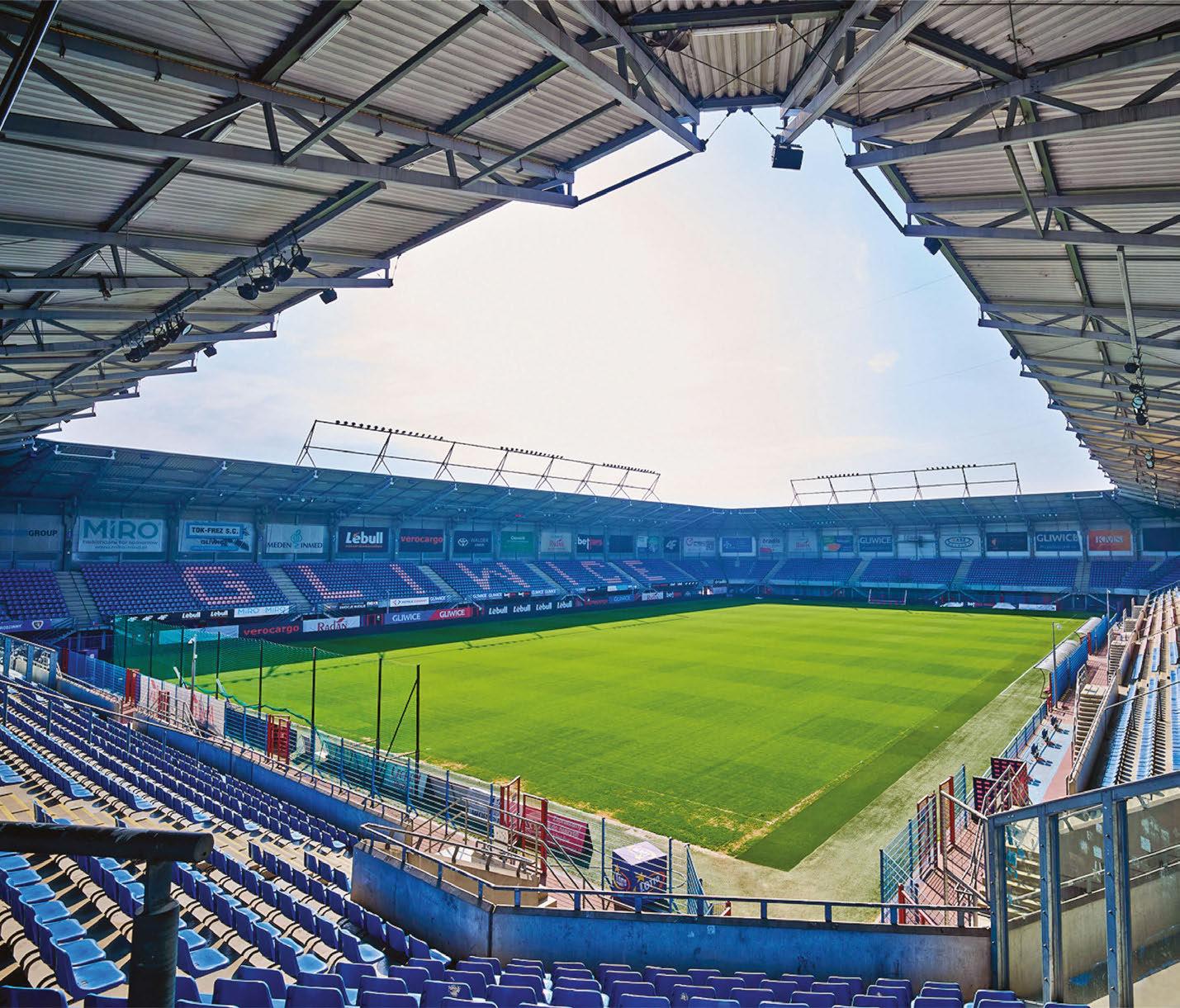
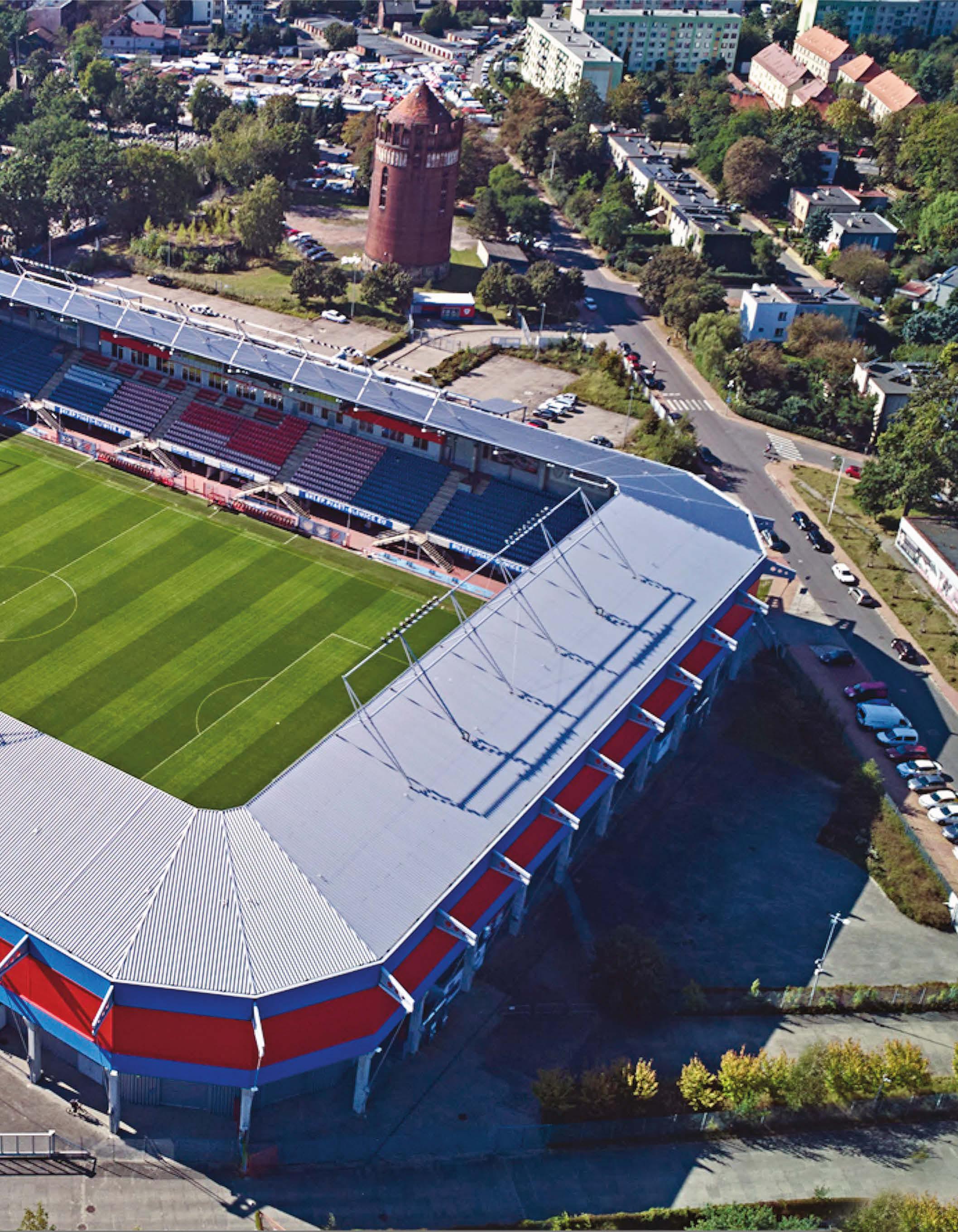
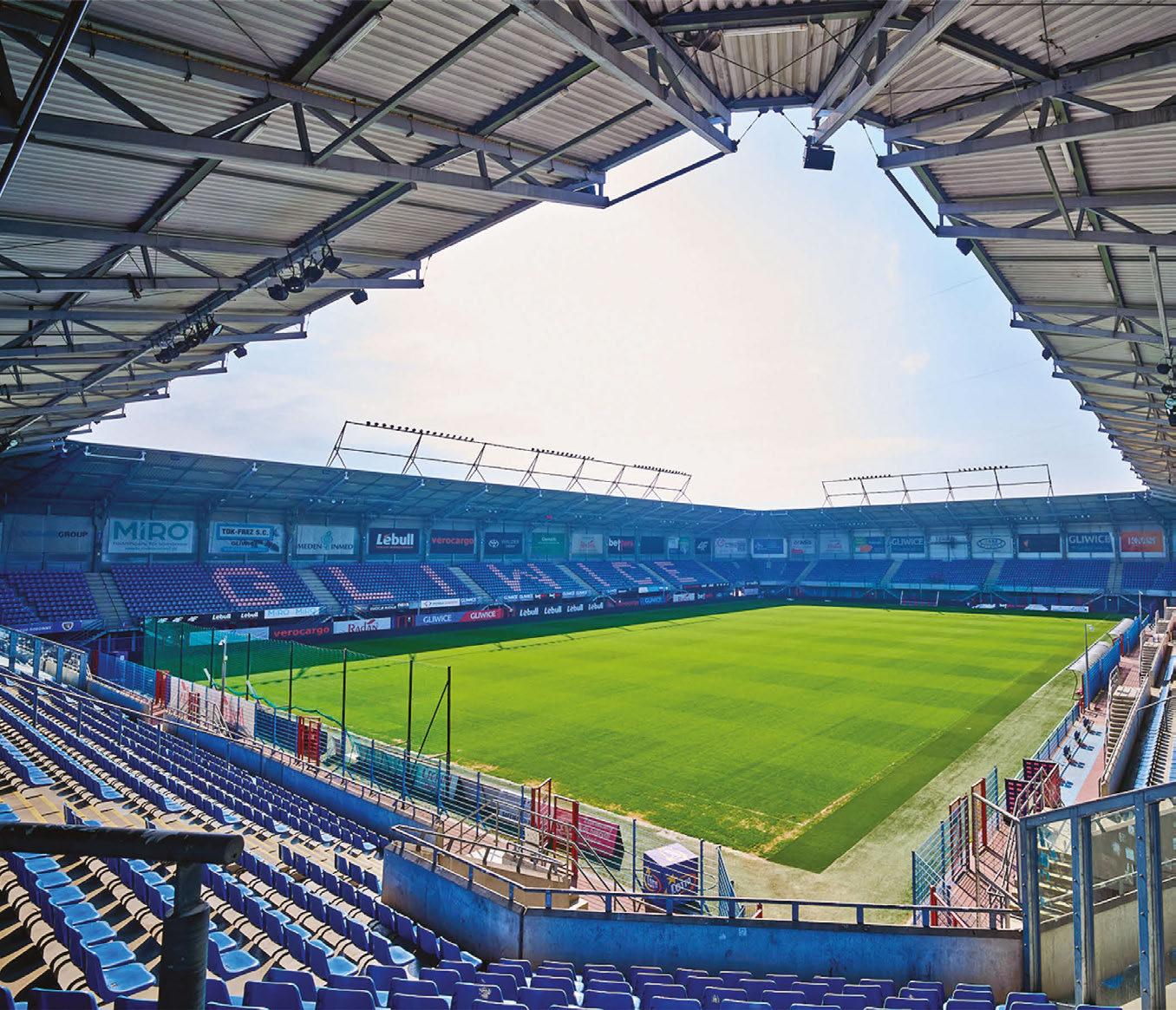
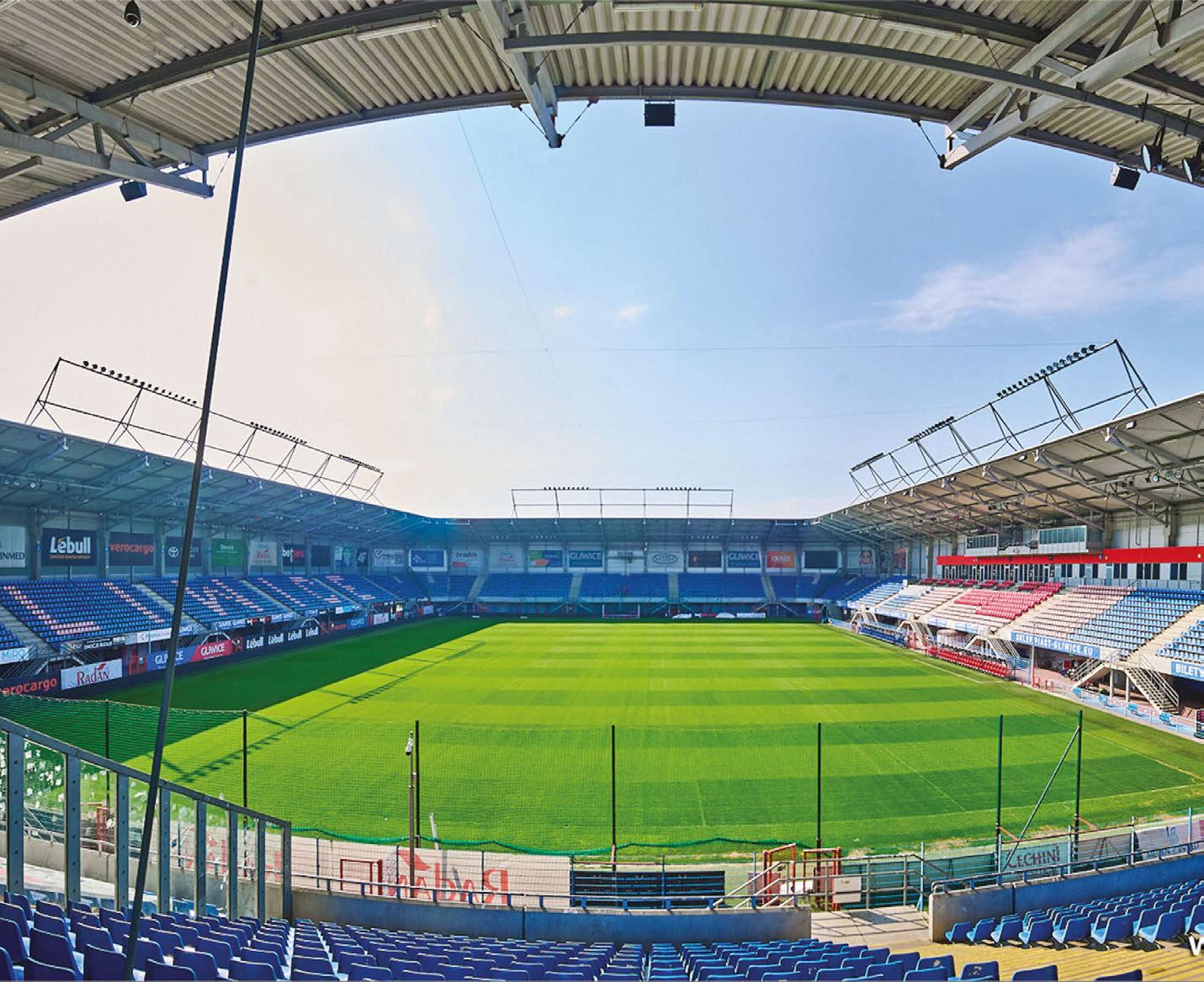
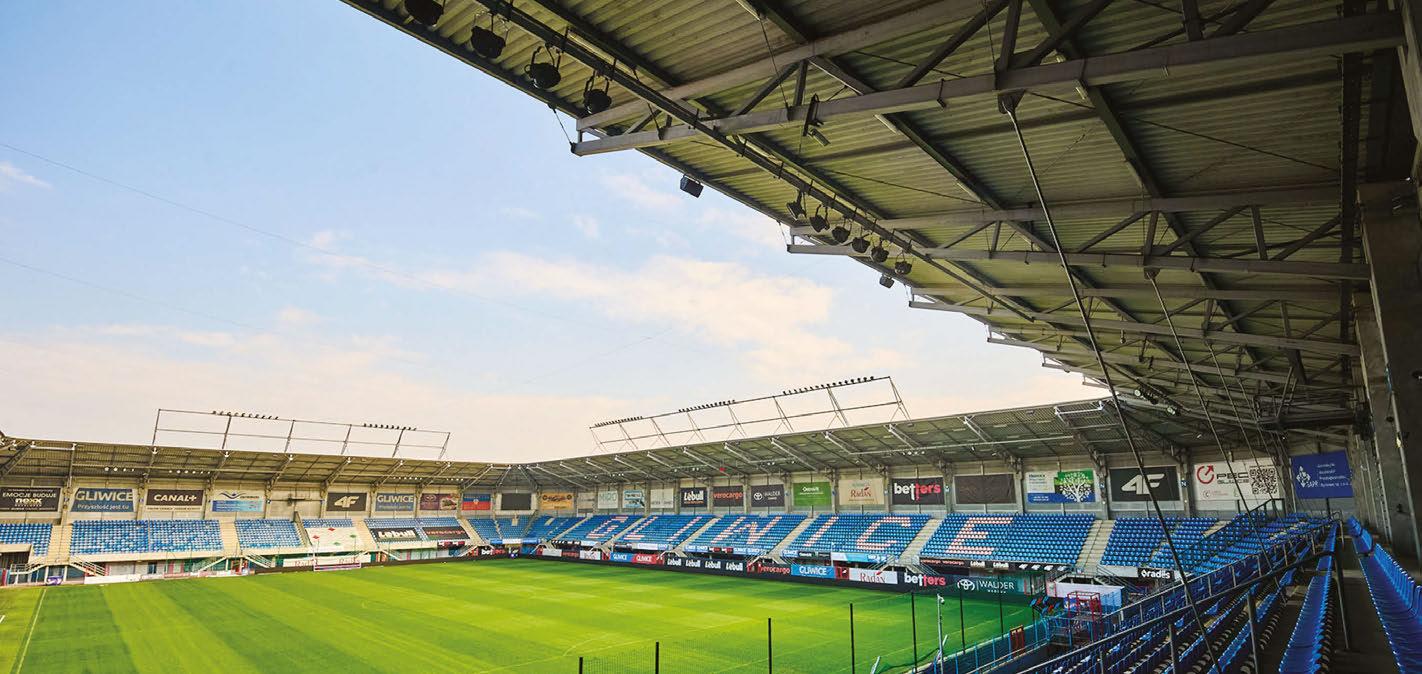
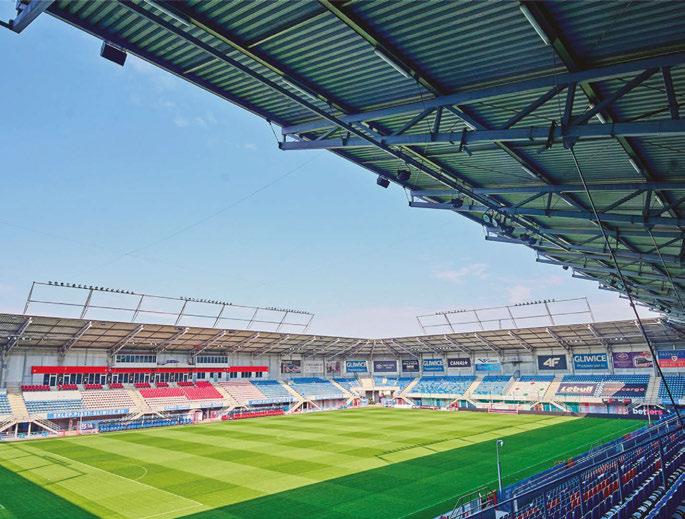
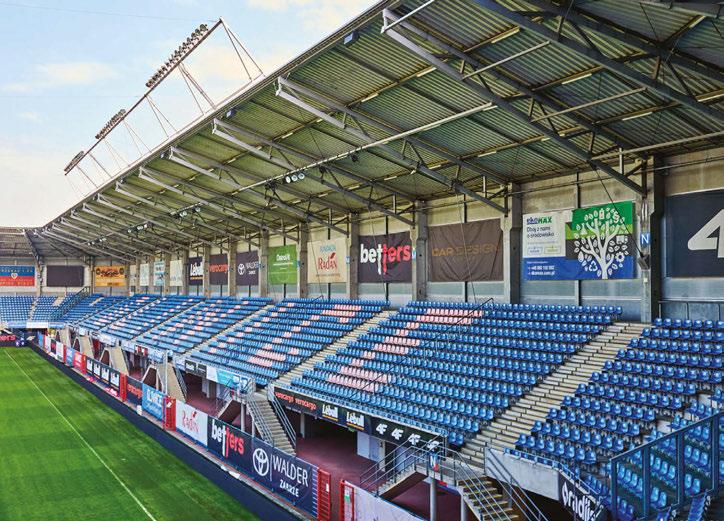
The Piotr Wieczorek Stadium has been the home of Piast Gliwice since its completion in 2011, when a completely rebuilt facility replaced its predecessor on the same site. Holding 9,736 spectators across four fully covered, all-seat stands, the ground meets UEFA standards and was designed from the outset with future development in mind. That forwardlooking ethos has continued to define how the club invests in its infrastructure — and at the turn of 2025 and 2026, it manifested in one of the most consequential upgrades the stadium has seen since opening: a complete overhaul of its public address and sound reinforcement system. The previous system had been in place for nearly 15 years. In that time, expectations of what a stadium sound system needs to deliver have shifted considerably. Match-day productions at Ekstraklasa level now routinely feature DJ sets, curated music programming, and high-energy prematch and half-time shows. Speech intelligibility — always the baseline requirement — is no longer sufficient on its own. Clubs need systems that can handle music with the
same authority they bring to announcements. At Gliwice, the old system was increasingly unable to meet that brief, with supporters feeding back that sound quality varied noticeably across different sections of the ground.
The club appointed leading Polish audio specialist TOMMEX to design and deliver the replacement. Working from detailed acoustic analyses and simulations, TOMMEX planned coverage, volume levels, and loudspeaker placement across the entire facility before a single unit was installed. At the heart of the solution they specified was CODA Audio.
CODA Audio’s G515-Pro, drawn from the manufacturer’s G500 series, was selected to provide full stadium coverage. It is a compact, two-way system with a power handling of 600W — engineered to produce the high sound pressure levels a football ground demands without sacrificing the frequency range or clarity that music reproduction requires. The cabinet combines a 15-inch neodymium woofer, specified for ultra-low distortion, with a one-inch neodymium compression driver coupled to a 90° x 60° rotatable elliptical waveguide. That rotatable waveguide is a practical asset
in a stadium context, where the geometry of stands, roof structures, and sightlines rarely makes for straightforward installation. Combined with the horizontal U-bracket mounting system (A15HG), the units were positioned beneath the roof structure of each stand to achieve even, consistent coverage across both the terraces and the pitch surface — a requirement that Piast Gliwice’s operational team was clear about from the outset.
Given that the system would be permanently exposed to the Polish climate — which brings significant cold, sustained rainfall, and summer heat within the same calendar year — TOMMEX specified the MG1 (Marine Grade 1) variant of the G515-Pro. Designed explicitly for demanding outdoor environments, the MG1 is rated for resistance to extreme temperatures, prolonged rain, snow, humidity, and airborne contamination. For a stadium operator, that means a system built to perform without degradation across many years of continuous outdoor use.
The G515-Pro units are driven by CODA Audio’s LINUS DSP amplifiers — specifically the LINUS12C and LINUS6.4i
— which provide both the power and the processing infrastructure needed to manage a system of this scale.
The onboard DSP gives operators full control over system performance and protection, and allows the sound to be precisely configured for different event types, whether a league fixture, a DJ-led pre-match show, or a large-scale public event.
Central signal processing is handled by a Yamaha MRX7-D, with capabilities spanning FIR filtering, feedback elimination, automatic mixing, and advanced dynamics control. The production environment is built around a Yamaha DM3 digital console paired with a Tio1608-D stagebox, with Sennheiser handling the microphone provision. VIP areas were addressed separately, with an Ashly FX125.8 amplifier driving existing loudspeaker cabinets — the focus there being electronics replacement rather than full hardware renewal.
Michał Kozioł, Commercial Representative at Piast Gliwice, is direct about what the investment has delivered: “Replacing the sound system was crucial for us and has significantly expanded our possibilities. Thanks to this system, we can
create sporting events with even more energy, music and sound quality — fans can truly feel like part of the action in every area of the stadium.
“At sporting events, good sound is crucial for the spectator experience. We had received feedback from fans indicating that the sound was not clear enough in certain areas of the stadium at certain times. Now we can shape the atmosphere of a game not only through visual elements, but also through first-class sound quality.”
For CODA Audio and TOMMEX, the Piast Gliwice installation is a demonstration of what the G500 series can deliver in a live sports environment — consistent coverage, high dynamic range, weather-resilient hardware, and the kind of sonic quality that has historically been associated with concert production rather than stadium infrastructure. Increasingly, the gap between those two worlds is closing.
Compact Long-throw Powerhouse
well equipped Your everyday go-to IP65 LED WashBeam, easy to handle and
VENUE FOCUS
LIDL FINAL4 @ LANXESS ARENA
Cologne, Germany
Images: HBL / @daikinhbl
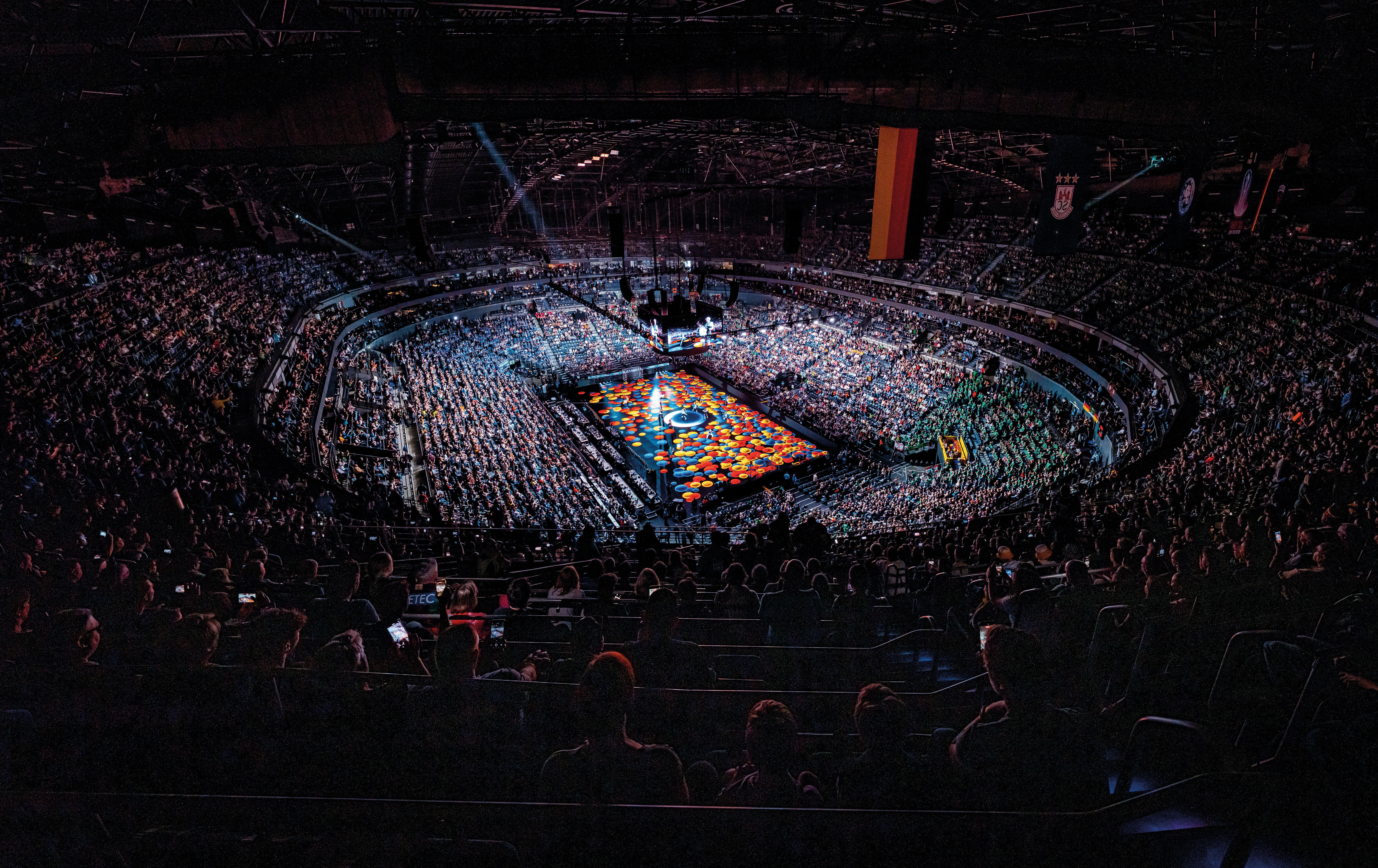
When the Lidl Final4 for the DHB Cup got underway at Cologne’s LANXESS Arena this April, the 19,750-capacity venue had something it had never had before: a floor that was part of the show. Large-scale animations covered all 900-plus sq metres of playing surface for the opening ceremony, player introductions were staged through the court, and sponsor content appeared directly beneath the players’ feet — visible in the arena and across broadcasts, reaching more than 80 countries. It was a world premiere for top-level handball, made possible by ASB GlassFloor’s portable, full-surface LED video sports floor.
ASB GlassFloor has been developing LED sports flooring for over a decade, and the Lidl Final4 represented its most visible stage yet. The floor is exactly what the name suggests: a toughened glass surface, embedded with LED panels, capable of displaying video content, animations, and live data across its full area. The latest generation of the product — the
ASB LumiFlex S — has been engineered specifically for the demands of high-rotation, multi-use venues, where rapid turnaround between events is as critical as performance on the night.
At LANXESS Arena, that turnaround was tested in the most direct terms. The Wednesday before the Final4 saw Game 4 of the DEL ice hockey playoff series between Kölner Haie and Eisbären Berlin played on the standard arena floor. On Thursday, ASB Arena and Event Services AG — the Swissheadquartered subsidiary of ASB GlassFloor responsible for planning and executing the installation — moved in. The entire floor was laid, cabled, and technically signed off within a single day. Training and rehearsals for the handball began on Friday. By the following Monday, ice hockey was back in the building for Game 6.
Multi-purpose arenas cannot afford technology that disrupts their calendars, and the LumiFlex S has been designed with that reality in mind: reduced setup and dismantling times,
and the operational reliability that top-level sport and live entertainment both demand.
The Handball Bundesliga has been building the Lidl Final4 into something larger than a domestic cup final for several years now. The “Super Bowl of handball” framing is not accidental: the HBL is explicitly pursuing younger audiences, broader broadcast reach, and a premium event experience that can compete with the production values of the most watched sports properties in Europe. The glass floor was central to that ambition this year.
In practical terms, the integration went beyond simply replacing printed floor stickers with a digital equivalent. Targeted animations were deployed at specific moments across all four matches — video reviews, two-minute suspensions, time-outs, and the “DAIKIN Minute” that runs immediately before the second-half kick-off of each game.
Sponsor content from title partner Lidl and others was woven directly into the surface rather than applied as physical
vinyl, removing a logistical step. The floor becomes part of the broadcast picture, too: what the camera picks up from the court now includes content designed for the television viewer, not just the person in row twelve.
Frank Bohmann, Managing Director of the Handball Bundesliga, was direct about the significance: the images from the event were capturing audiences worldwide precisely because world-class handball was being showcased in a visually spectacular way across the LED surface. He described the combined effort with ASB GlassFloor and media partner Dyn as having set new standards for the spectator experience — and pointed to the reach of the broadcast, live in Germany and across more than 80 other countries, as evidence of the scale of the platform.
For Lidl, the title sponsor and the largest sponsor of handball in Germany, the technology offered a specific opportunity: the ability to make brand presence immersive rather than static. Manuel Grund, Head of Brand Embassy at
Lidl Dienstleistung GmbH & Co. KG, described the floor as opening up entirely new possibilities for staging the game and connecting the playing field to the stands, with the goal of making handball more visible and emotionally engaging, particularly for younger audiences.
Benedikt von Dohnanyi, CEO of ASB Arena and Event Services AG, framed the deployment in terms of long-term development rather than a single-event statement. The Lidl Final4, in his view, is one of the most significant handball events in the world, and the ambition to continuously evolve it is what makes collaboration worthwhile. “Change takes time,” he said, “but it is an essential part of progress.”
Technology of this kind tends to generate two types of opinion among the athletes who actually perform on it: indifference once the adrenaline of competition takes over,
and genuine surprise at what they’d seen on the way in. The reactions gathered by handball-world at Cologne suggested both — often from the same person.
Mathias Gidsel of Füchse Berlin was enthusiastic. “It’s an incredible thing that we can offer this to spectators,” he told handball-world. “It’s incredible advertising for handball. The grip was very good on the playing surface. And we weren’t disturbed by the light show. That’s a very positive development for handball.” His assessment of the playing experience was equally measured: “You notice something is happening on the floor, but you don’t notice any difference, and it doesn’t bother you. No difference for the players — just a nice experience.”
Samuel Zehnder of TBV Lemgo Lippe captured what appears to have been the common experience: “You forget that it’s
a different floor. At first, I was a bit sceptical, because the whole floor is LED. But you forget it, because in the game there’s too much adrenaline. That’s no problem.” Niels Versteijnen, his Lemgo teammate, noted one practical improvement that will register with anyone who has watched floor-level cameras on televised handball: “You no longer slip on advertising stickers — that’s now impossible.”
Tobias Gröndahl, also of Füchse Berlin, looked beyond the playing experience to the broader effect: “I think the spectators enjoyed all those animations. I think it will help attract fans to the arena.” It was a sentiment that aligned closely with what the HBL and Lidl had set out to achieve, and one that suggests at least some of the players understood the commercial context as clearly as the organisers did.
The commercial logic of a fully digital floor is straightforward. Sponsor branding integrated into the surface cannot be blocked by camera angles, updates in real time, and disappears completely when the event ends. There’s no
vinyl to remove, no residue, no turnaround cost. For a venue like LANXESS Arena, cycling between handball, ice hockey, concerts, and arena shows throughout the year, that matters as much as anything that happens during the game itself.
The IHF has officially accredited ASB GlassFloor for international handball competition, and the profile of the Lidl Final4 — broadcast across more than 80 countries, with the HBL openly targeting further growth — gives the technology a platform that will be hard to ignore for other federations and venue operators considering their options.
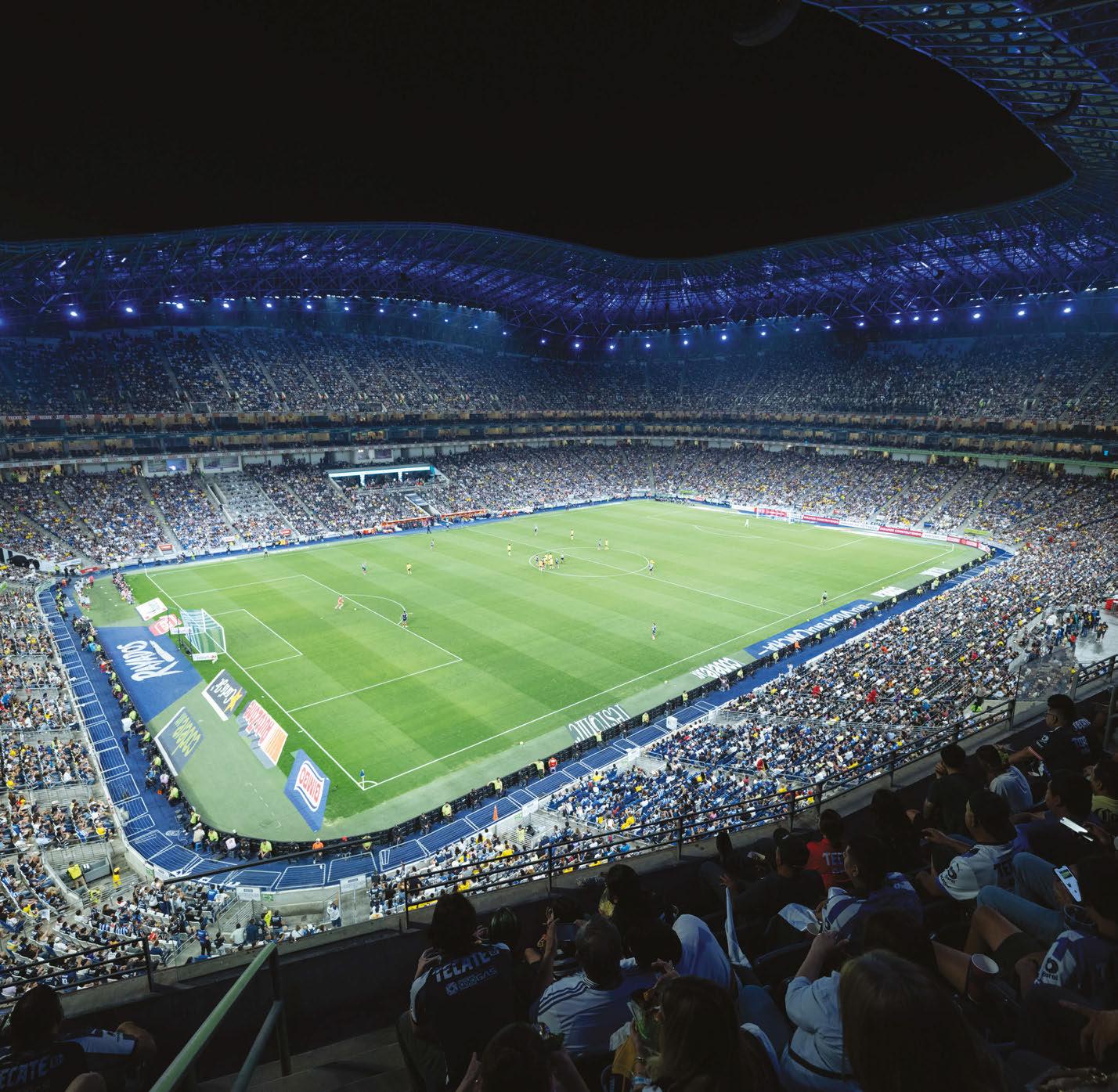
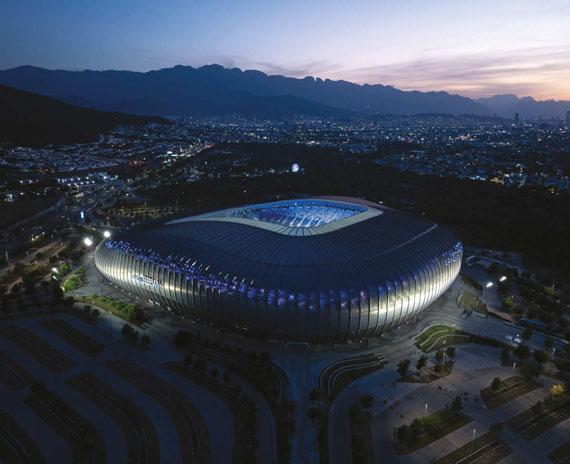
As Estadio BBVA in Monterrey, Mexico, prepares for the world’s most-watched sporting event, they chose Musco to light the moment. Drawing on more than 50 years of experience, we delivered elite field-of-play and entertainment lighting that elevates the experience for players, fans, and broadcast audiences.
SCAN HERE TO PUT OUR EXPERTISE TO WORK FOR YOU
Estadio BBVA Monterrey, Mexico
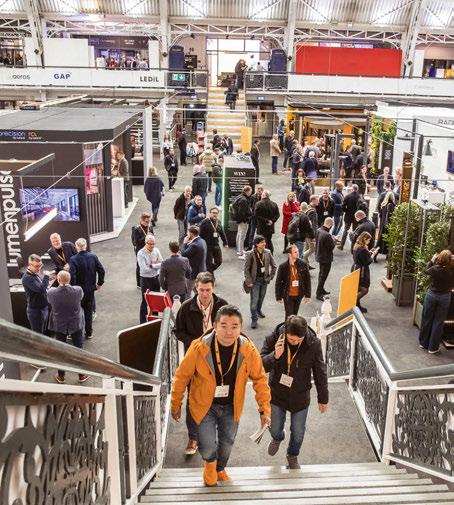
The room shaping the future of stadiums, arenas and sporting venues
For the first time, the global sporting venue ecosystem is being brought together under one roof.
stadia expo is the new home ground for the people designing, delivering and commercialising the next generation of stadiums, arenas and sporting destinations.
From infrastructure and technology to fan experience, hospitality and operations, this is where the industry comes to explore what’s next.
ALLIANZ STADIUM
Sydney, Australia
Images: JPJ Audio
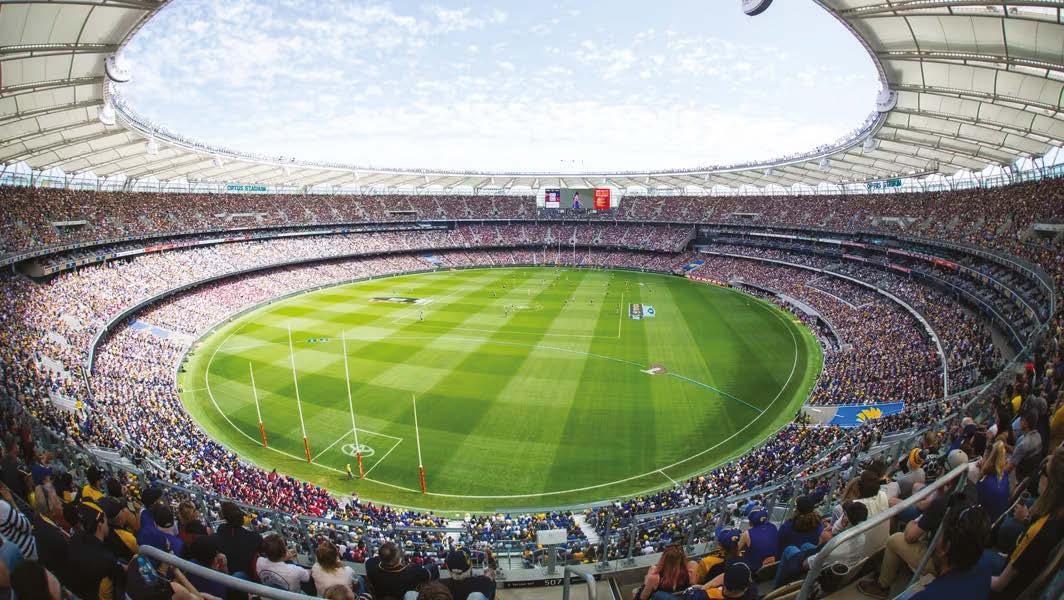
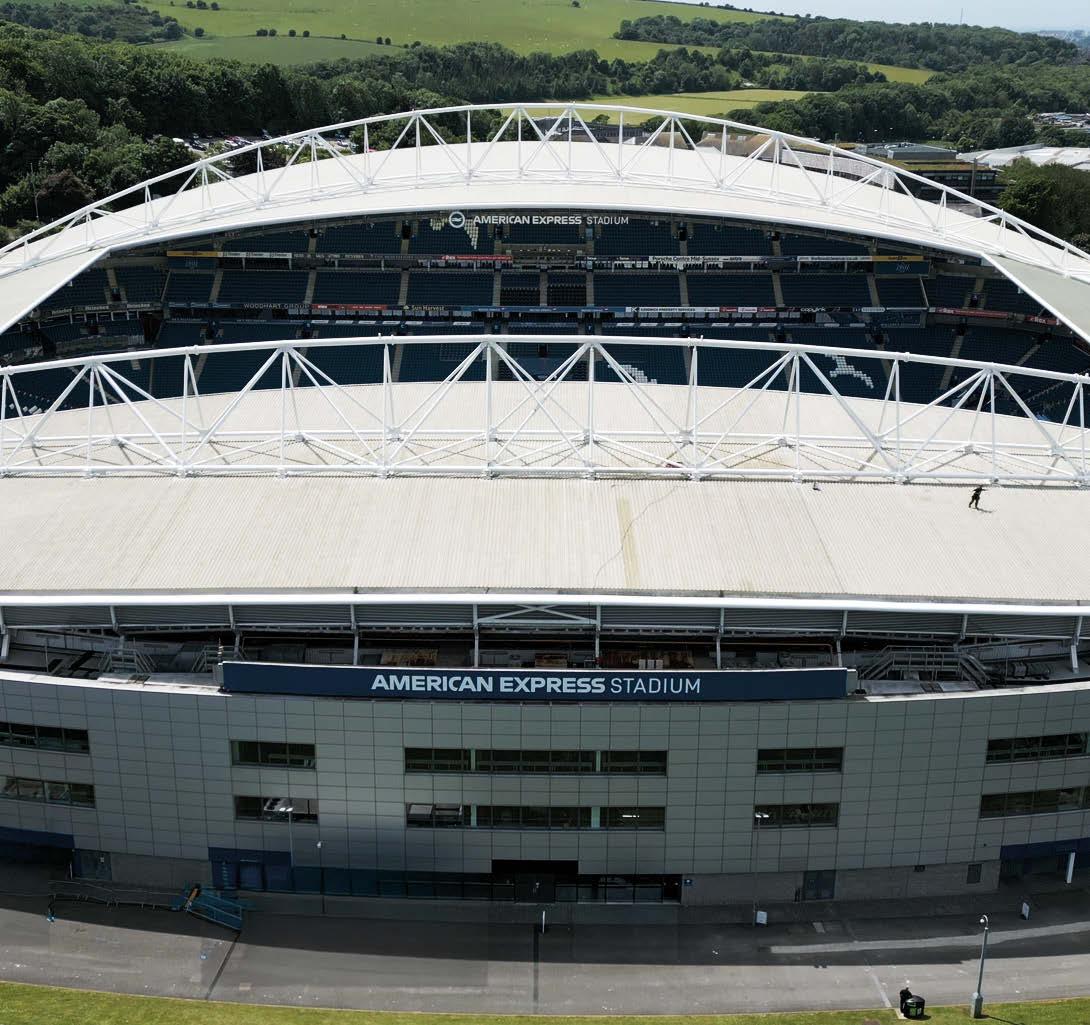
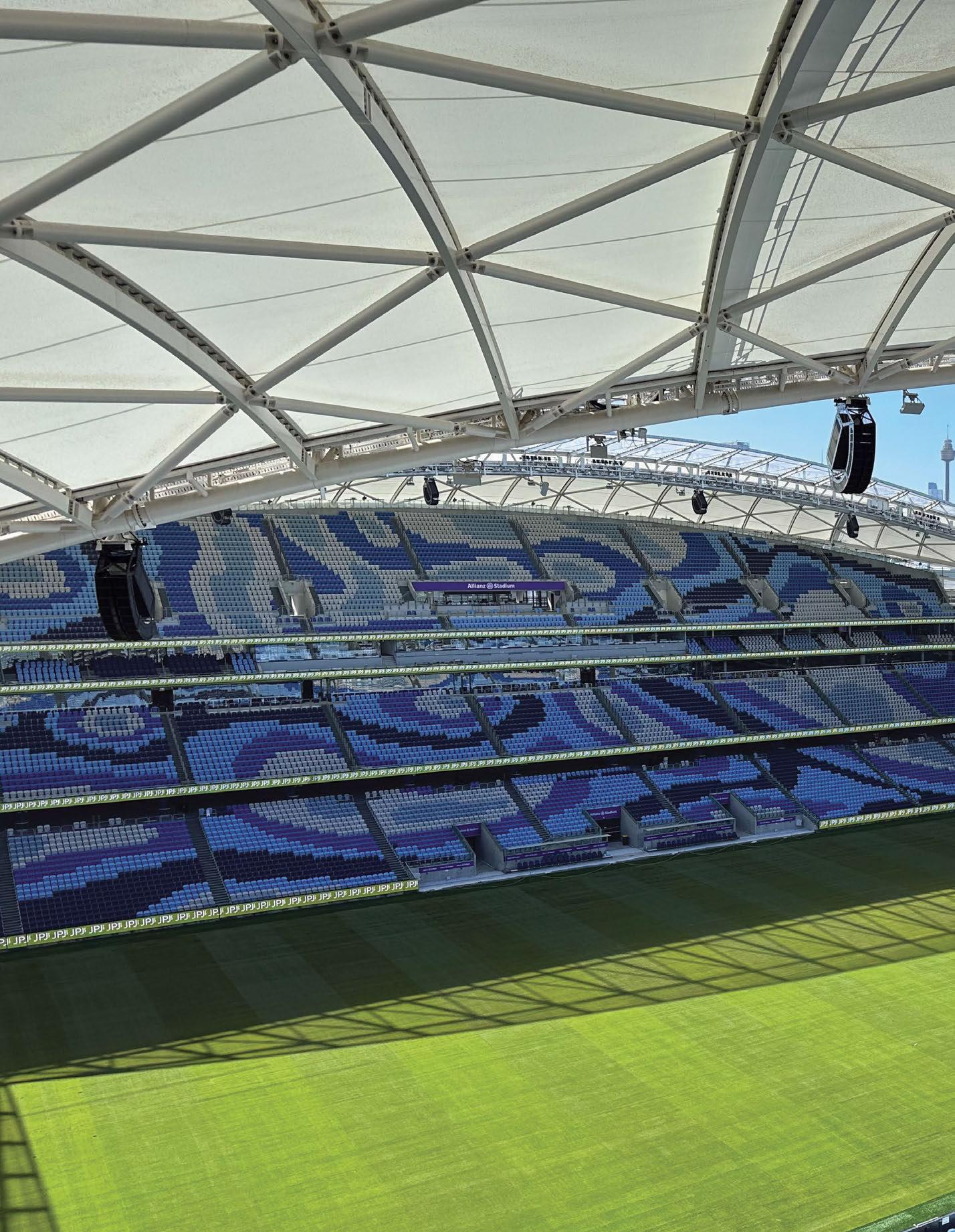
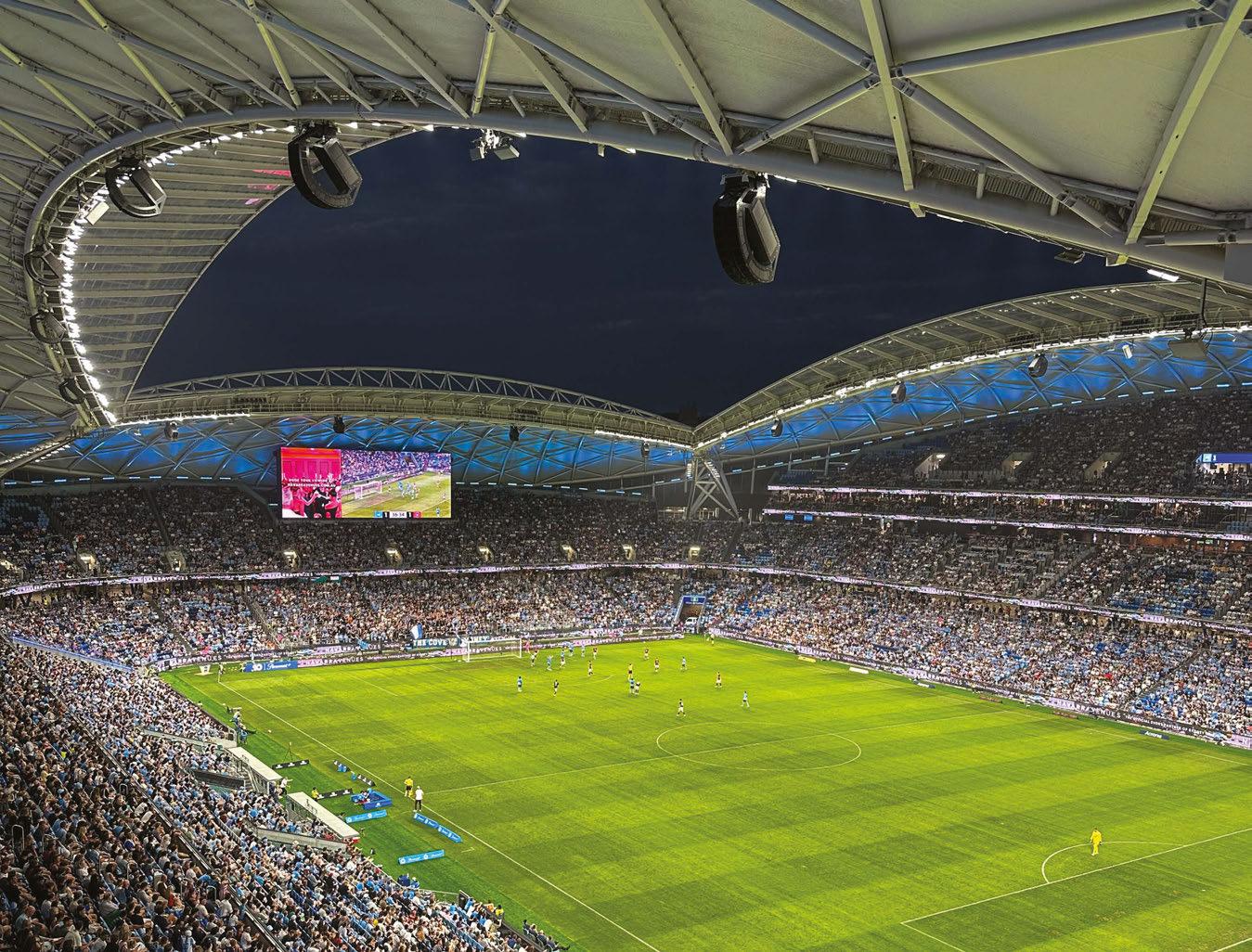
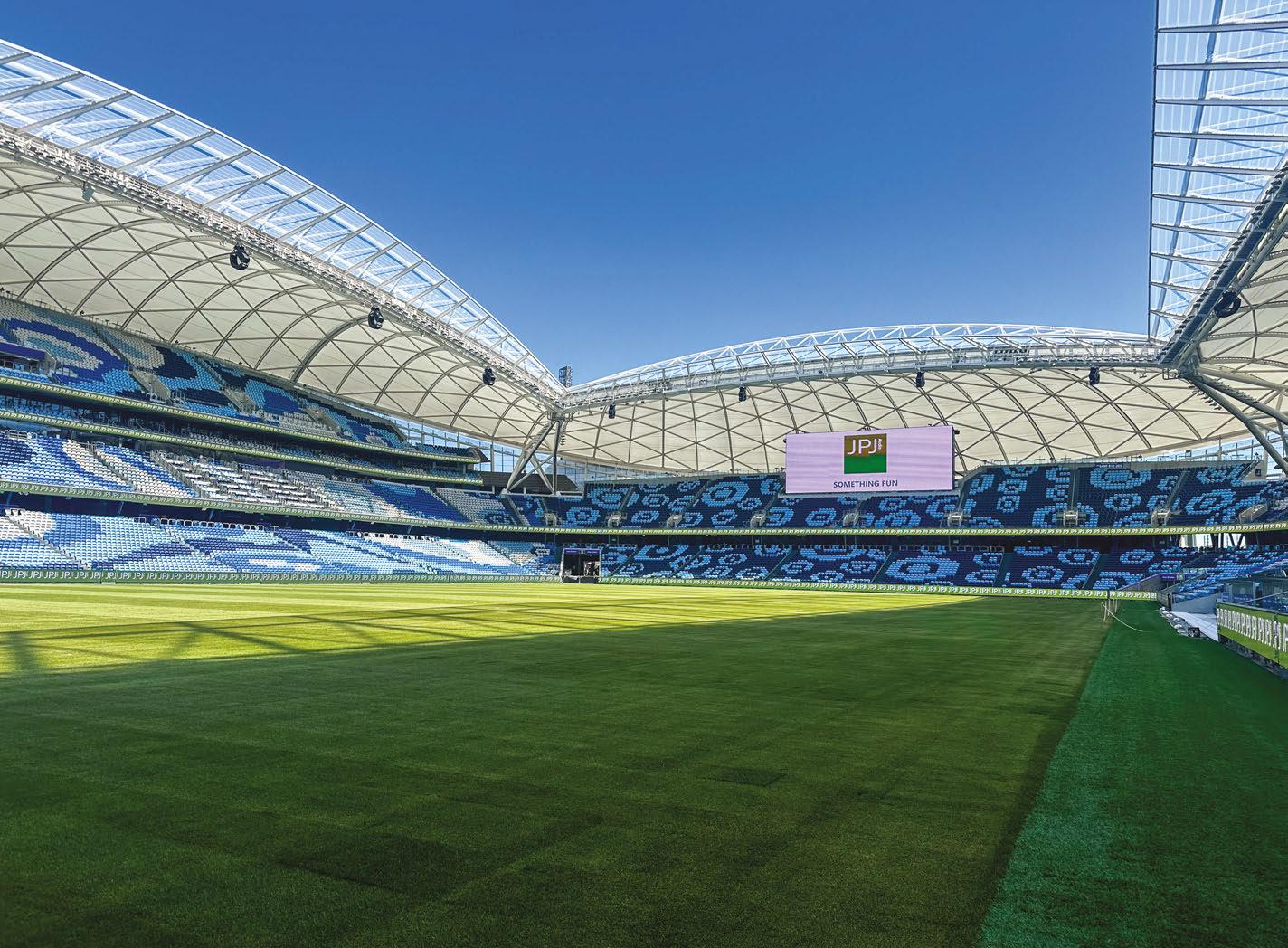
The 42,500-seat Allianz Stadium, one of Australia’s most significant sporting venues, is home to three elite teams across three codes: the Sydney Roosters (NRL), the NSW Waratahs (Super Rugby) and Sydney FC (A-League). Hosting more than 50 fixtures per year alongside international matches and major summer concerts, the venue demands a sound system that can perform across the full spectrum of gameday requirements: pin-sharp speech clarity for on-pitch announcements and post-match interviews, and raw, physical impact when pyrotechnics fire and thousands of fans are on their feet.
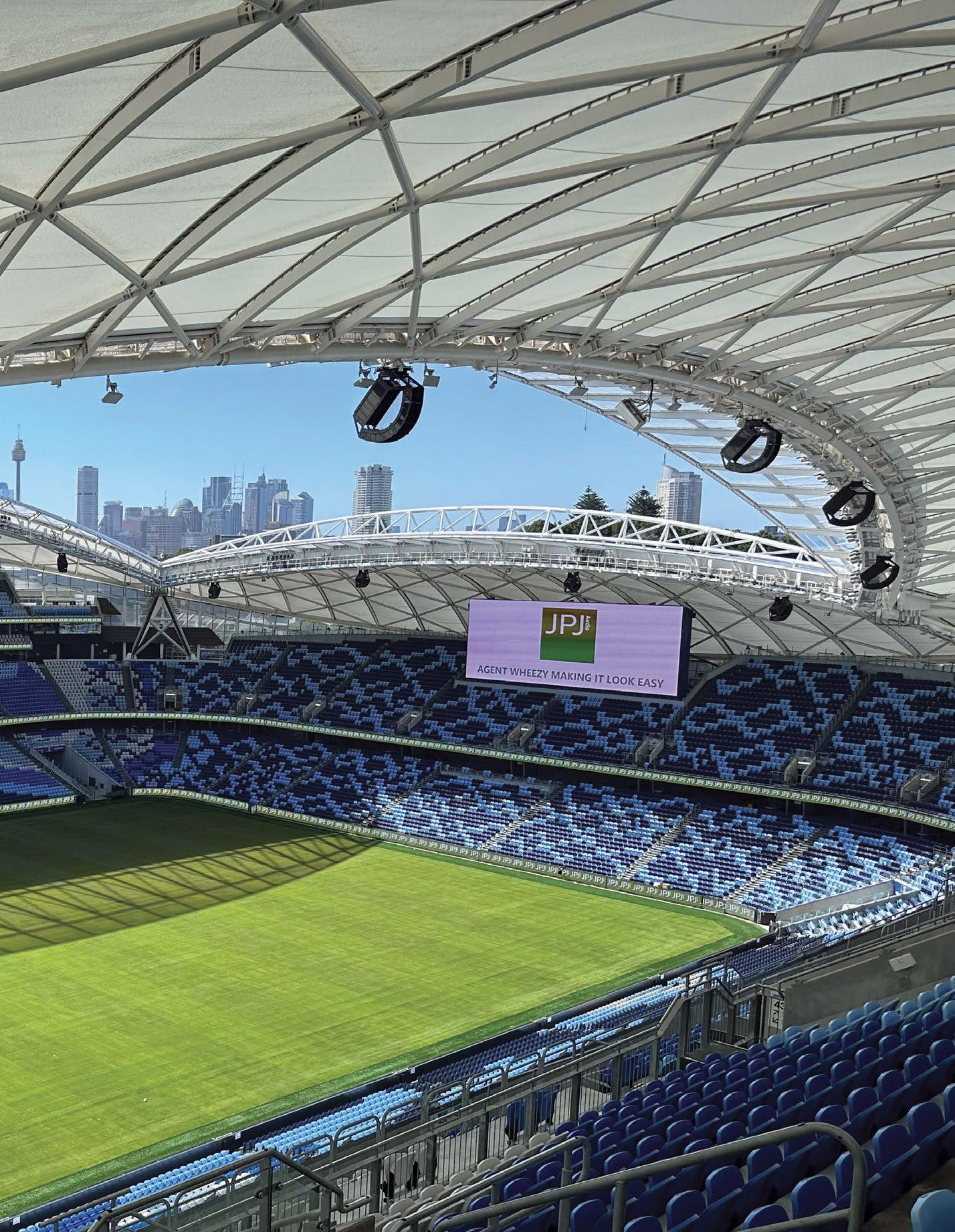
When Venues NSW wanted to supercharge the game day audio experience to match the world-class standard of the venue, they turned to JPJ Audio to design and install a fullbowl L-Acoustics Kara II system. The result is a step-change in sound clarity and impact, reinforcing its position as one of Australia’s premier live event destinations.
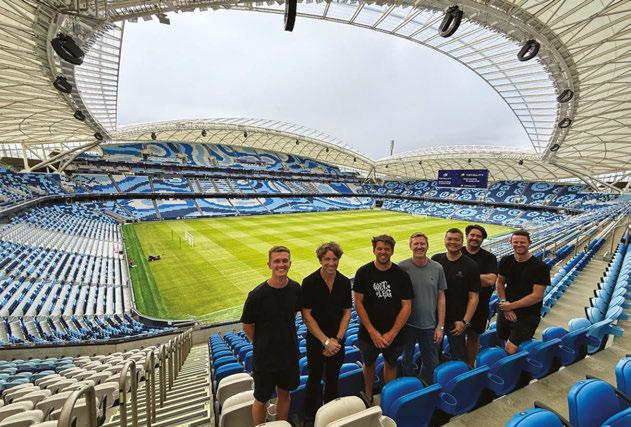
To deliver the upgrade, Venues NSW selected JPJ Audio following a successful tender process. Already responsible for operating audio systems across multiple NSW stadiums on game days, JPJ Audio brought both operational knowledge of Allianz Stadium and direct experience with L-Acoustics in the venue. The company had previously deployed temporary K2 and Kara systems inside the stadium in sporting configurations and K1 and K2 systems for concert
use, giving a first-hand reference for what the space could sound like.
“We had already shown them the benefits of a concert-grade sound system in the venue,” says Wayne Mulder, Project lead for this installation and who runs the sporting division for JPJ Audio.. “From the moment the temporary L-Acoustics system went in, they understood the difference straight away. The challenge was turning that into a permanent solution that worked every day.”
The project brief centred on two equally important objectives: intelligibility for live speech, and the kind of low-frequency impact and high-energy delivery that defines the atmosphere at elite sporting and entertainment events. Both had to be achieved across every seat in a stadium with a five-second RT60.
Kara IIi tames a five-second reverb tail to deliver clarity and impact across every seat
Allianz Stadium’s five-second reverberation time presented the central design challenge. Any system that excited the bowl indiscriminately would destroy intelligibility. The solution required extremely controlled, localised coverage with sound delivered precisely where it was needed, and nowhere else.
“It meant approaching the stadium almost in sections,” says Mulder. “You had to keep coverage very controlled and
localised so that you were only delivering sound where it was needed.”
To develop the system geometry, JPJ Audio worked closely with the L-Acoustics applications team using Soundvision, combining operational experience from concert deployments in the venue with predictive modelling tailored to Allianz Stadium’s seating geometry and roof structure. The design process was developed in collaboration with L-Acoustics application support and Tom Williams of Clair Global, allowing array angles, subwoofer positioning and coverage zones to be refined before a single speaker was hung.
“Soundvision was critical because if you put the speakers in the right place from the start, you don’t spend a week chasing problems afterwards,” says Mulder. “The design work gave us confidence that every section of the bowl would behave the way we expected.”
The modelling also informed placement of the subwoofer elements behind the main arrays, allowing JPJ Audio to use low-frequency steering to reduce unwanted energy build-up across the bowl.
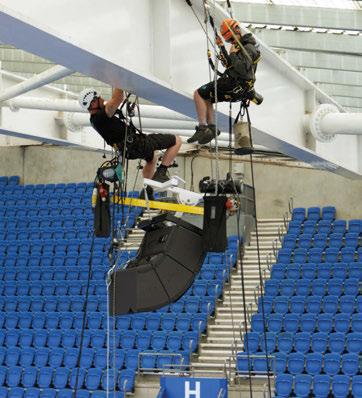
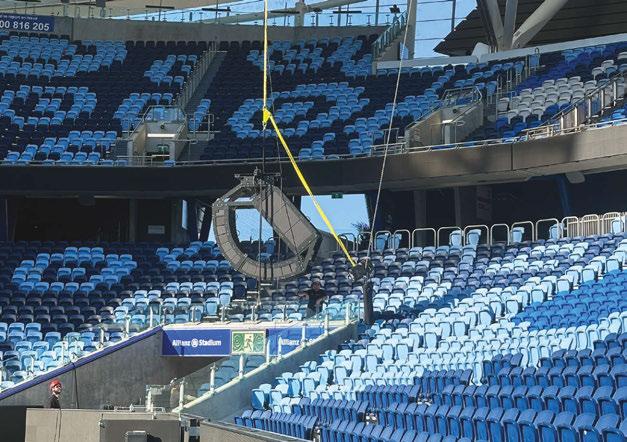
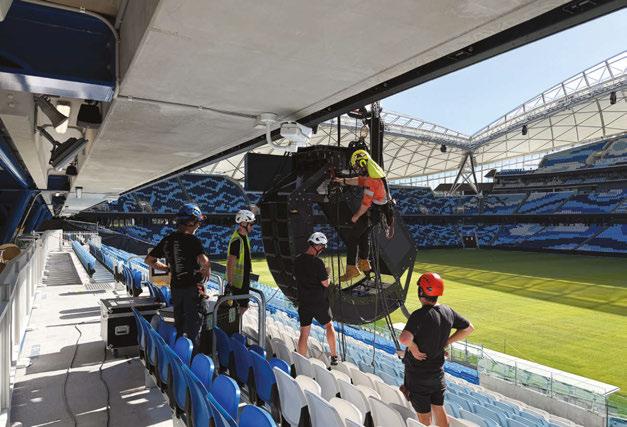
Installation logistics added another layer of complexity. With the venue remaining operational throughout and access restrictions prohibiting cranes, Boom Lifts or any contact with the playing surface, new speaker cable and cable paths into the gantry were required with ropes access being the only solution for installation. Every array had
to be installed using motors and rope access from the roof structure. This was executed using a load transfer technique across multiple motors, every array started its journey in one of the 4 vomitory before being lifted to its final position over the seating bowl. JPJ Audio adopted a touring-style workflow, assembling, wiring and phase-checking every array at its warehouse before transport to site. Final on-site loudspeaker deployment took just five days. “We treated it like a production build,” Mulder explains. “Every array was pre-built, phase-checked and ready to fly before we arrived. That meant once we were on site, everything moved quickly.”
232 Kara IIi and 52 SB18i: a system geometry engineered for the bowl
The stadium bowl was divided into four quadrants, each served by five array types matched to seating geometry and roof height. The largest array positions each use 14 Kara IIi with three SB18i; adjacent positions repeat the same loudspeaker count with revised angles to reflect changing stand height. Further positions use 12 Kara IIi with three SB18i, 10 Kara IIi with two SB18i, and eight Kara IIi with two SB18i.
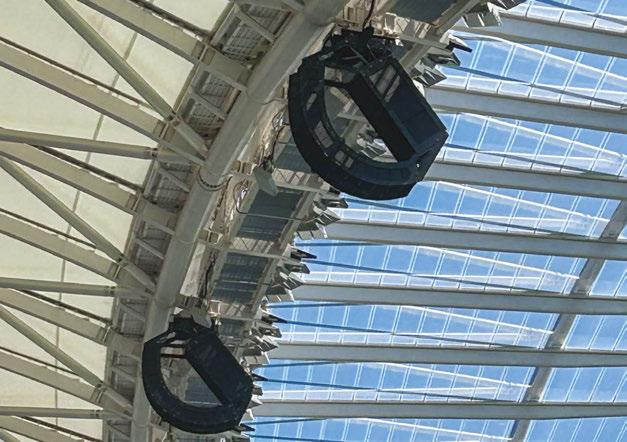
Across the full installation, the system totals 232 Kara IIi and 52 SB18i, all flown beneath the roof gantry on customdesigned metalwork developed specifically to retrofit the
stadium’s existing structure. A container-style docking mechanism makes lowering the arrays for servicing straightforward, with no tools required at height. A10i loudspeakers were added at each of the two large video screen positions to close residual coverage gaps.
LA4X amplification and Q-SYS integration built for daily game-day operation
Because JPJ Audio also operates match-day audio at Allianz Stadium, system usability was a design requirement from the outset. Amplification is provided by 78 LA4X, arranged across four amplifier room positions on level four with 19 amplifiers per rack including one hot spare. Signal distribution utilizes AES67 routed directly from Q-SYS, with six LC16D network audio converters interfacing with the LA4X amplified controllers via AES/EBU. The drive system utilises the venue’s ICN network of Cisco switches for control and audio distribution, with Q-SYS providing control and monitoring of the amplified controllers via a custom GUI. L-Acoustics Network Manager complements this setup by offering comprehensive system control and monitoring when required.
L-Acoustics live impedance monitoring routinely checks loudspeaker status every minute, enabling operators to verify system health continuously during events. “We
wanted something powerful, but also simple for daily use,” says Mulder. “Operators can walk in, power up the system, confirm everything is healthy and be ready immediately.”
The system was commissioned in time for the first A-League fixture on 18th January 2026, following an accelerated programme that took advantage of a short window for other works. Initial feedback from the home clubs has been strongly positive, with independent third-party review confirming delivery against project targets.
“A lot of game-day presentation now involves pyro, lighting and very high-impact moments,” Mulder says. “You need an audio system that delivers that energy, but just as importantly, when someone is speaking on the pitch, every word still has to land clearly. That was always the goal, and now we have a system that does both.”
BCF ARENA
Fribourg, Switzerland
Images: Uniguest
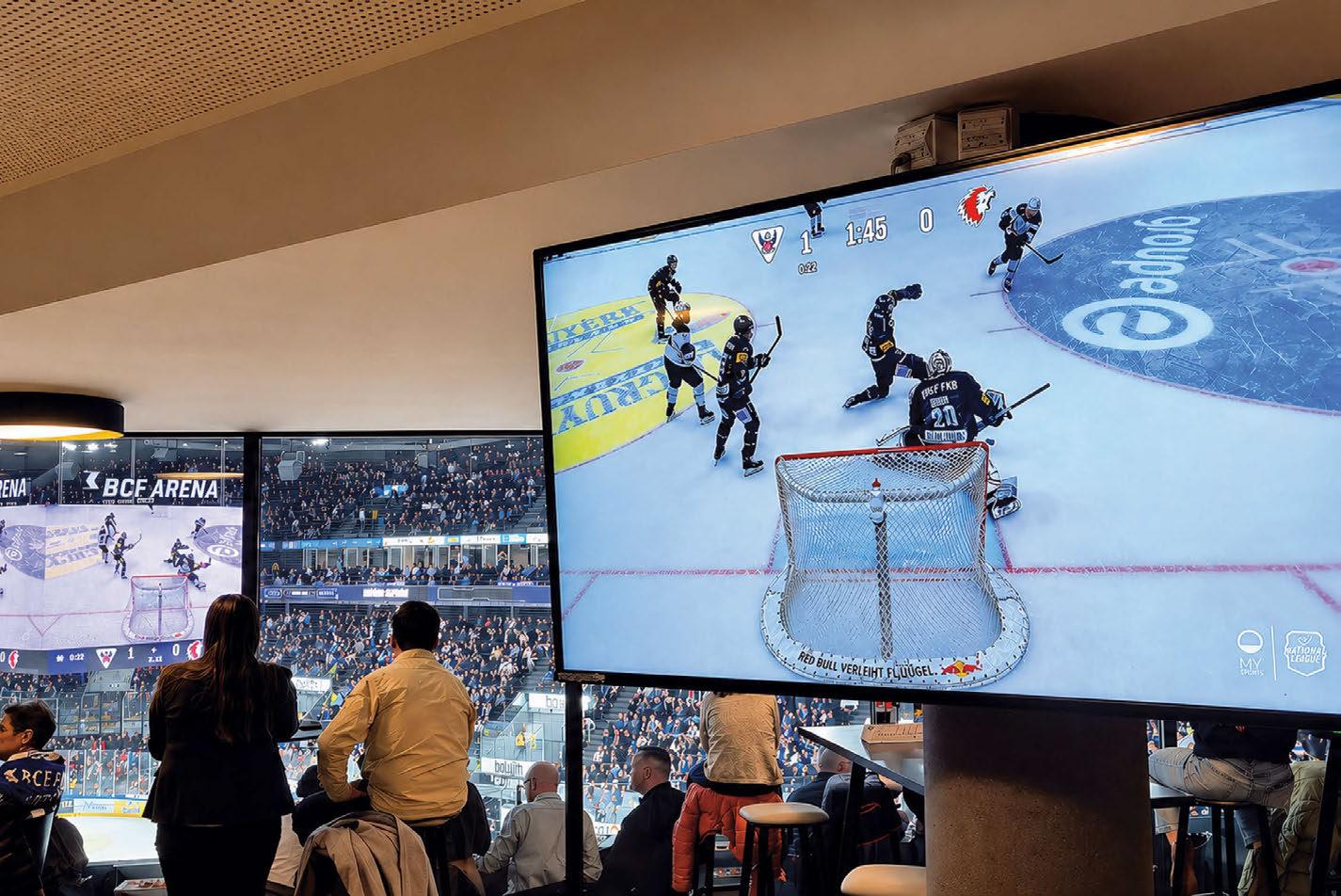
BCF Arena in Fribourg is strengthening its position as one of Switzerland’s leading sports and entertainment venues, with digital infrastructure playing a central role in enhancing both fan experience and commercial performance across a growing programme of sport and events.
Home to HC Fribourg-Gottéron, the arena has evolved into a modern, multi-purpose destination, welcoming more than 9,400 fans per game and hosting over 500 corporate events annually alongside concerts, cultural programming and major international tournaments.
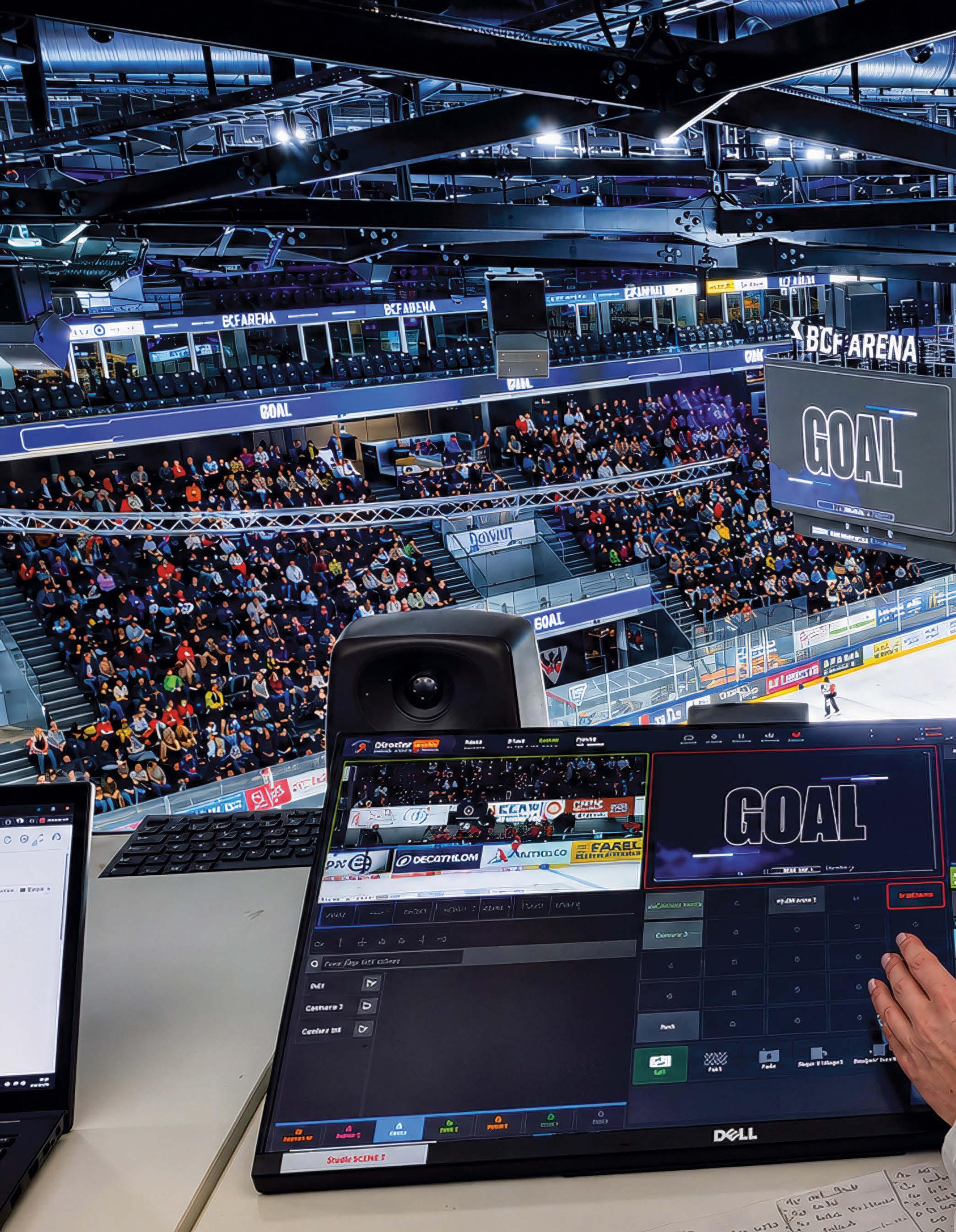
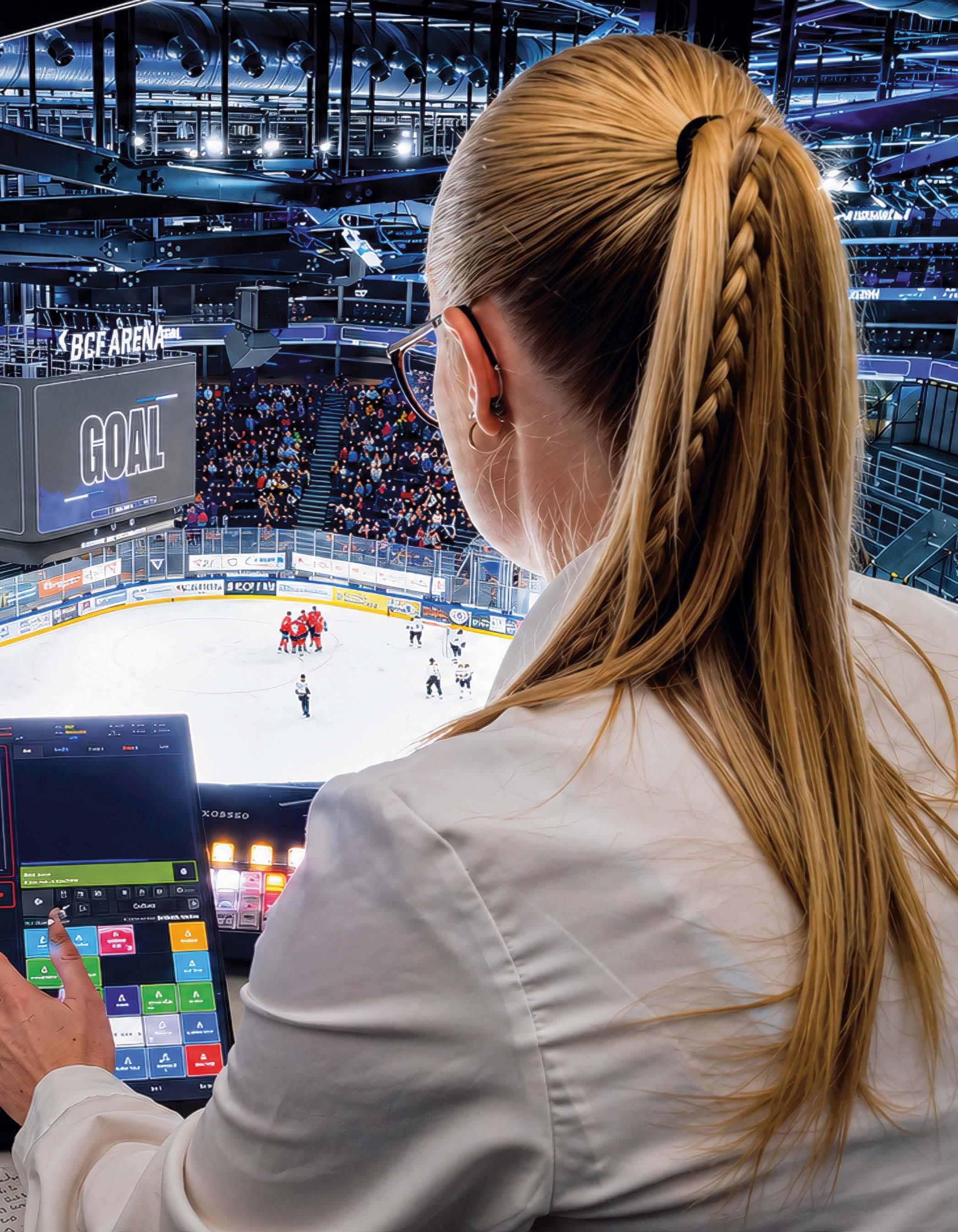
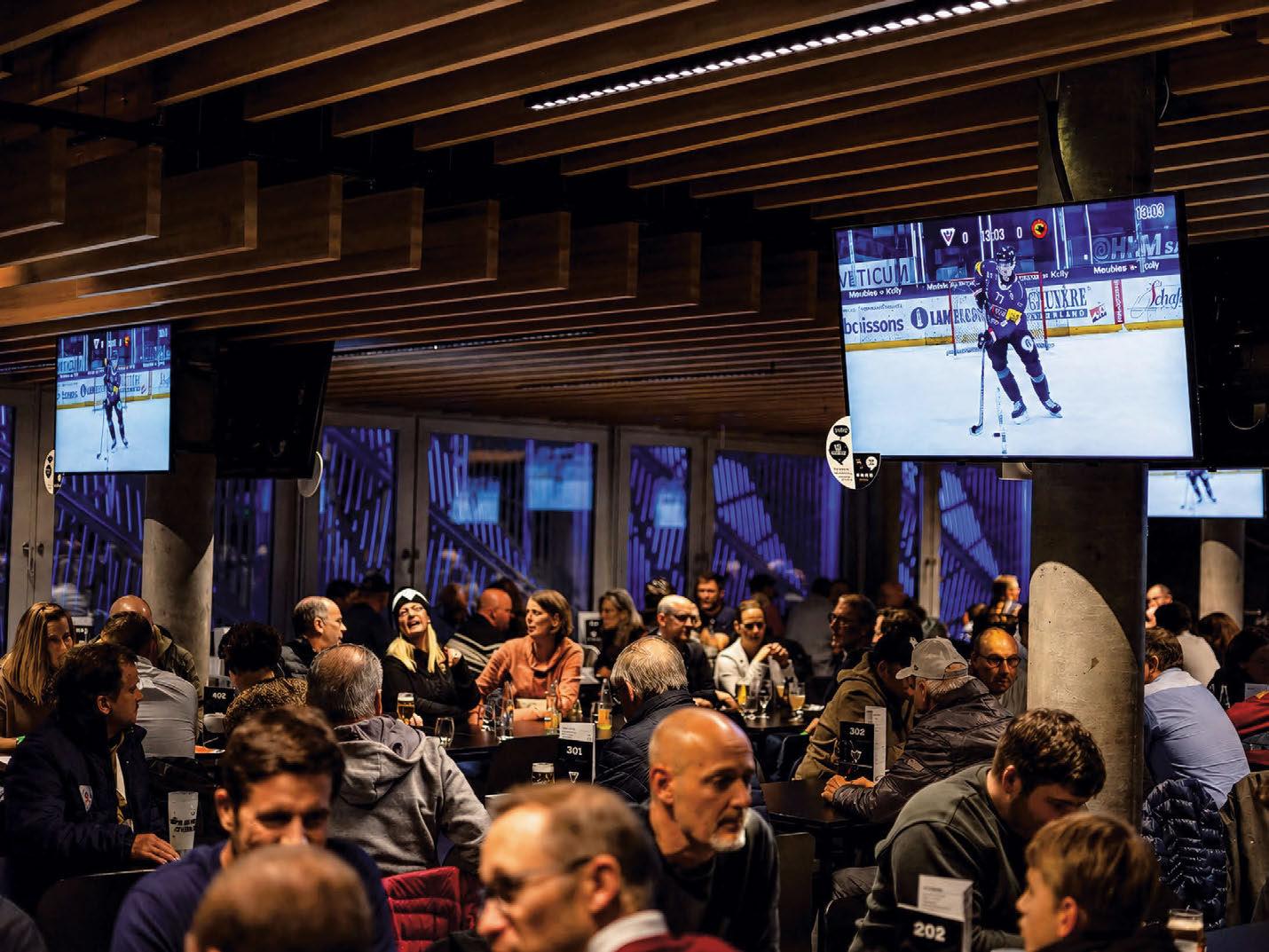
At the heart of this evolution is the deployment of Uniguest’s cloud-based Sports Hub platform, which unifies IPTV, digital signage and live streaming across approximately 180 screens throughout the venue. Spanning concourses, restaurants, lounges, restrooms and back-ofhouse areas, the platform enables the arena team to manage content centrally while maintaining flexibility across different spaces and event types.
Maintaining atmosphere beyond the arena bowl is a core objective. Live game feeds are distributed in real time across the venue, ensuring fans remain connected to the action
wherever they are, while synchronised content extends key moments such as goals and highlights into hospitality and circulation areas.
“We want people connected to the ice hockey game or other events,” said Eloi Coquoz, Digital & IT Manager at BCF Arena. “During the game, we are going to have the game on all the screens, and during the break we use it with partners. It’s part of creating a full experience.”
The platform also supports the venue’s growing demands as a multi-purpose destination. Screen environments can be adapted quickly between matchdays and events, allowing teams to tailor content, branding and layouts for corporate functions, concerts and private hire.
“We were looking for a system that was very flexible for match day and event day,” Coquoz added. “With Uniguest, we can adapt the content very easily depending on the event.”
Beyond enhancing the fan experience, the expanded digital estate has strengthened BCF Arena’s commercial offering. Sponsors benefit from dynamic, venue-wide visibility, with content delivered across multiple touchpoints throughout the customer journey, while hospitality spaces can be
personalised for different audiences and occasions.
“The screens are everywhere, and we need to communicate,” said John Gobbi, CEO of BCF Arena. “For a partner, it’s great visibility. When people share the emotion of the game together, it creates a much stronger connection.”
As expectations around live sport and entertainment continue to rise, BCF Arena sees technology as central to delivering a more immersive and commercially effective experience.
“We cannot sell just an ice hockey game. We need to have a big show, and all the technology is part of the show,” Coquoz said.
That approach is underpinned by close collaboration with technology partners, enabling the venue to continue evolving its offer across sport, hospitality and events.
“If you want to be the best, you have to have good players, good coaches, good facilities – and good partners,” Gobbi
added. “With Uniguest, we have a strong partner to help us continue to develop the arena and the experience.”
With plans to further expand capacity and enhance its digital infrastructure, BCF Arena is positioning itself not just as a host venue for world-class sport, but as a scalable platform for fan engagement, commercial activation and year-round event delivery.
We design, manufacture, and install for cities, sports halls, universities and theaters.
Design: Chybik + Kristof & studio mmcité obchod@kovostal.cz
EXTRA TIME
EXTRA TIME
054 STADIA | SESSIONS #03 | Mykonos, Greece
066 WORK PRO Audio | ARENA Series
068 CODA Audio | APSi-Pro Range
072 From Concrete to Code: How Technology Is Changing The Modern Venue | George Vaughan, The Digital Line
STADIA | SESSIONS #03
MYKONOS, GREECE
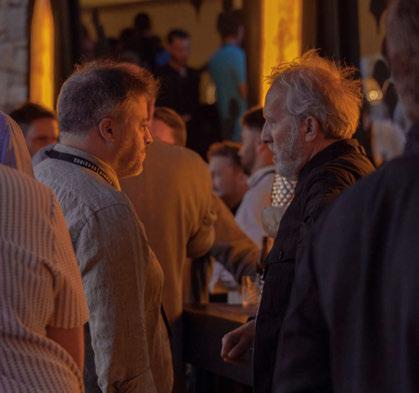
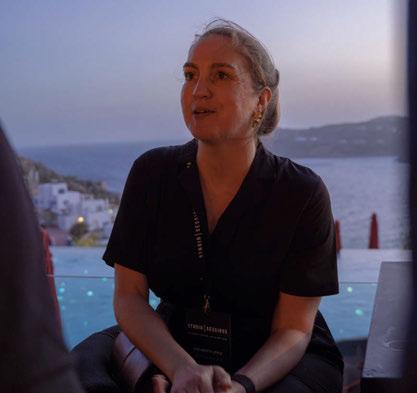
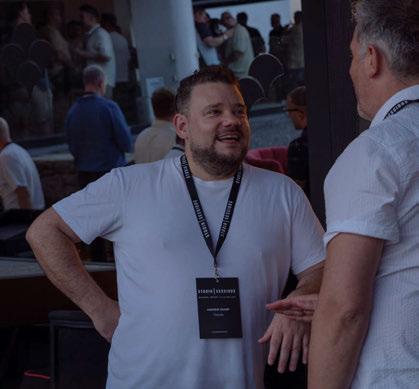
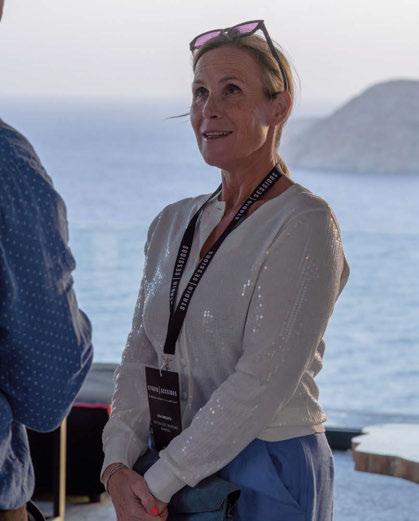
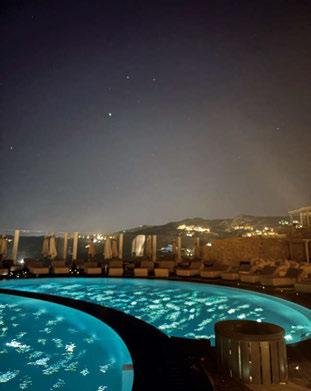
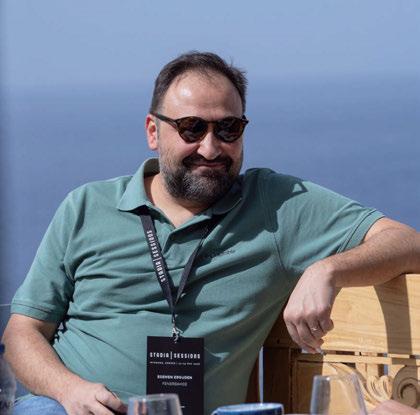
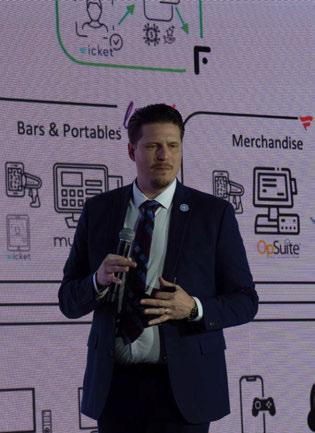
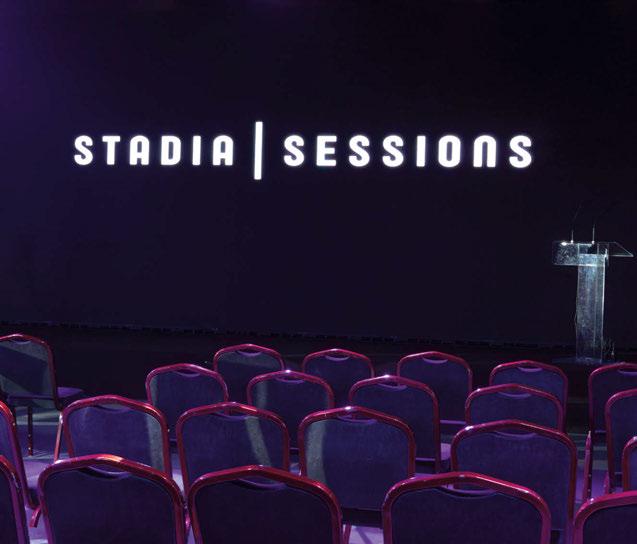
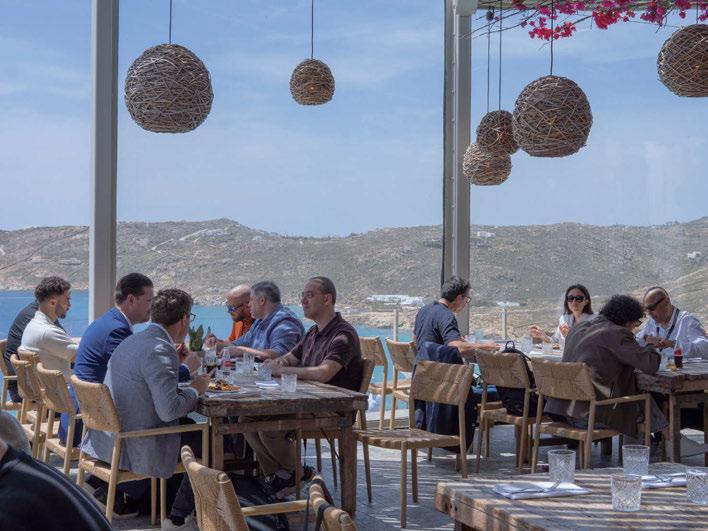
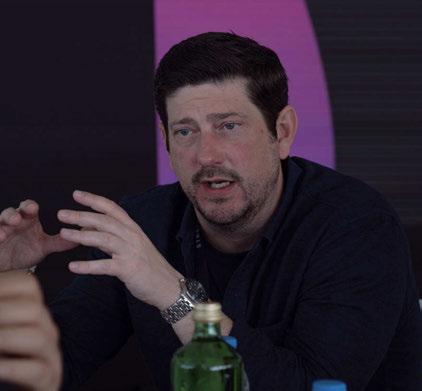
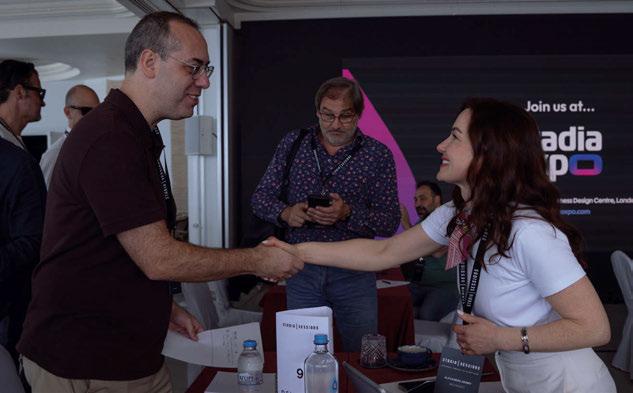
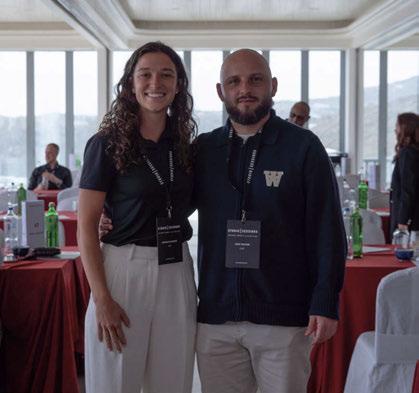
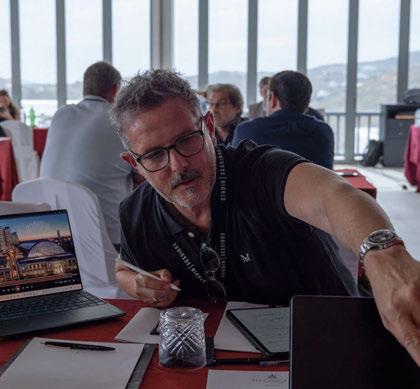
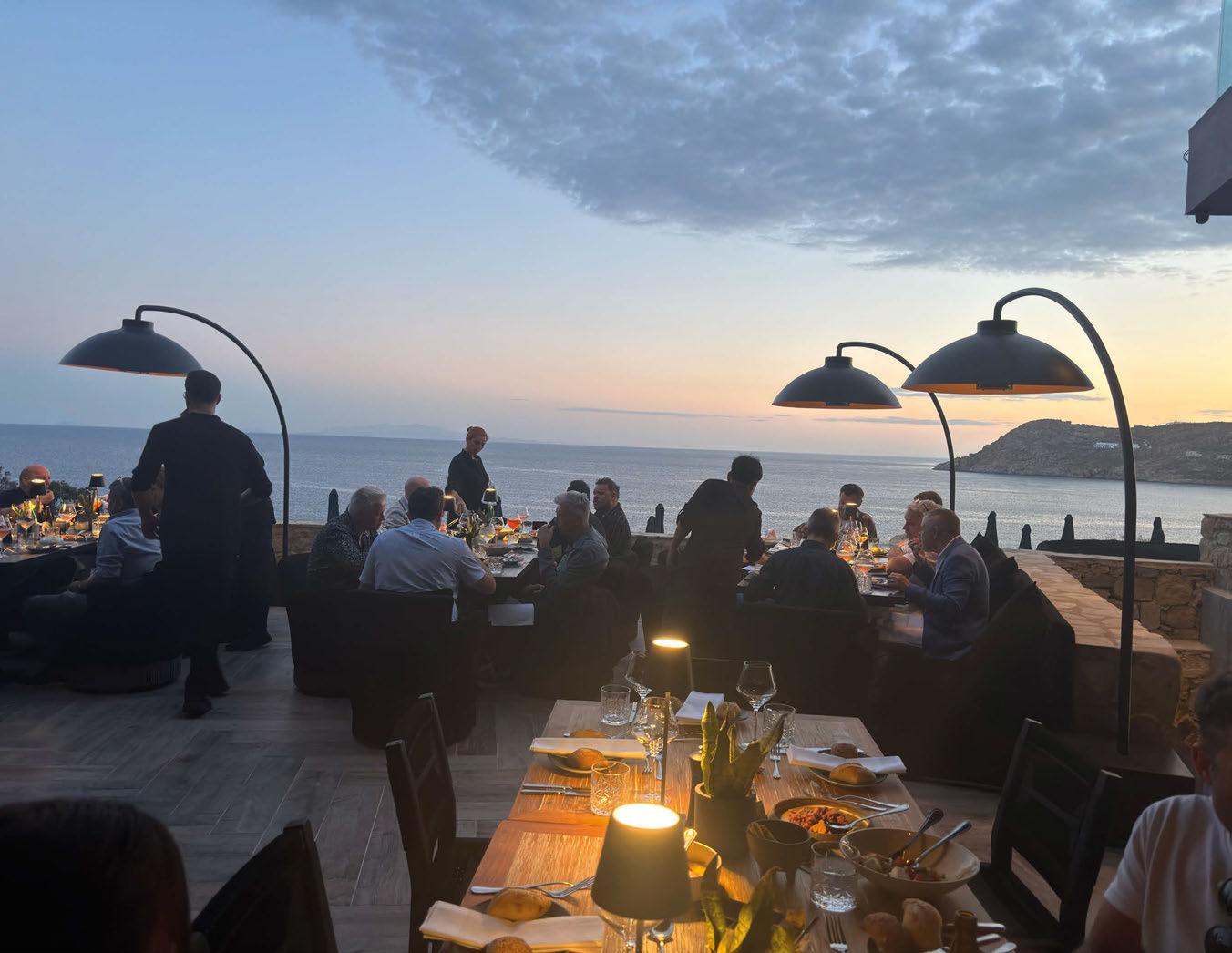
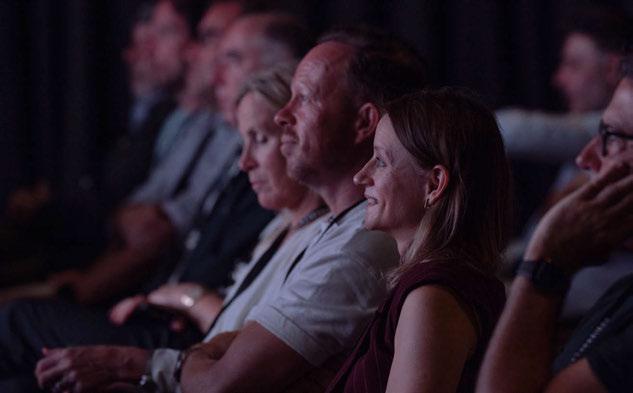
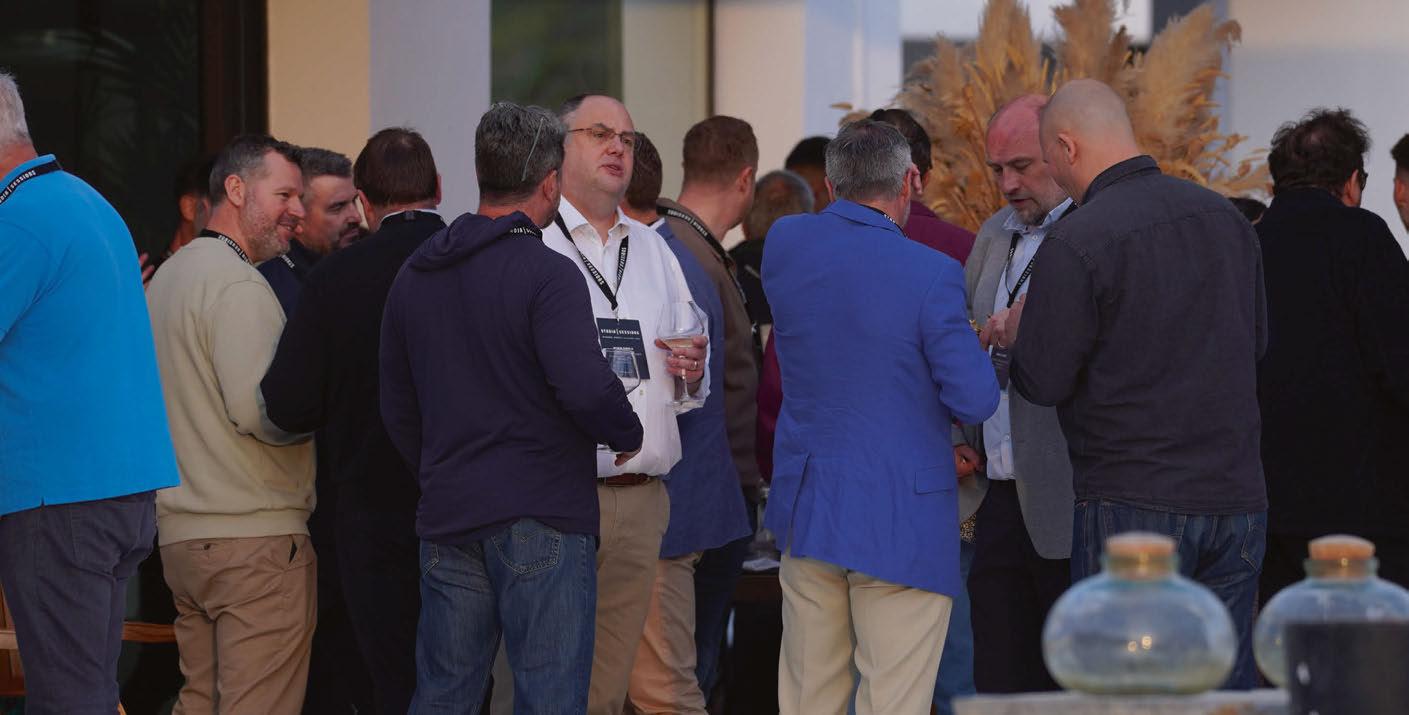
As we reflect on the third edition of STADIA | SESSIONS, first of all, we want to extend our sincere thanks to everyone who contributed to making the event such a resounding success. The energy, insight, and engagement from professionals across the sporting venue industry once again brought our vision to life, and we are truly grateful for the continued support from all those who came along and embraced the event.
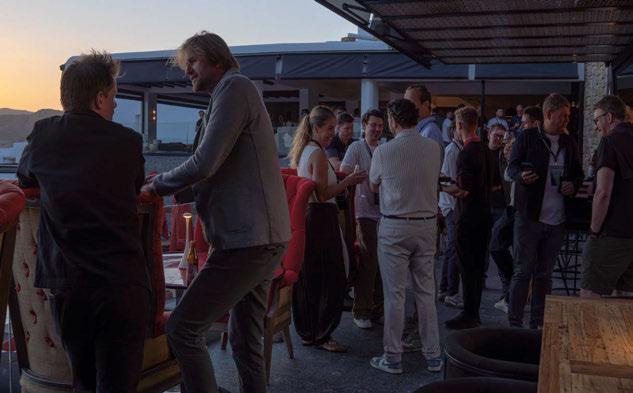
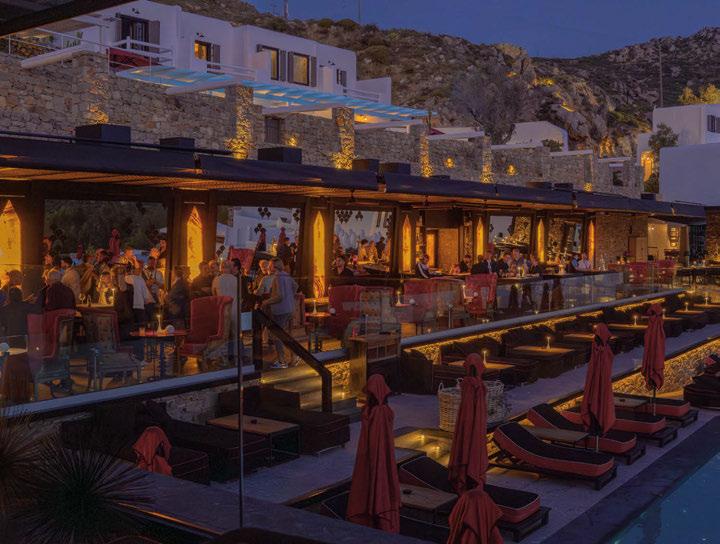
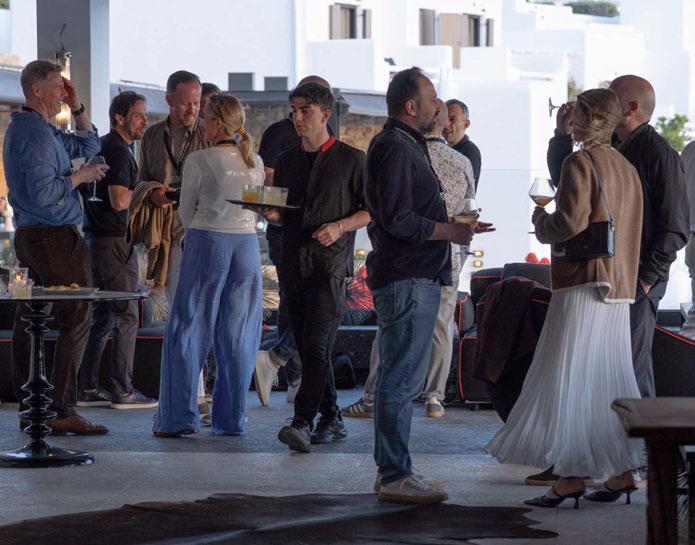
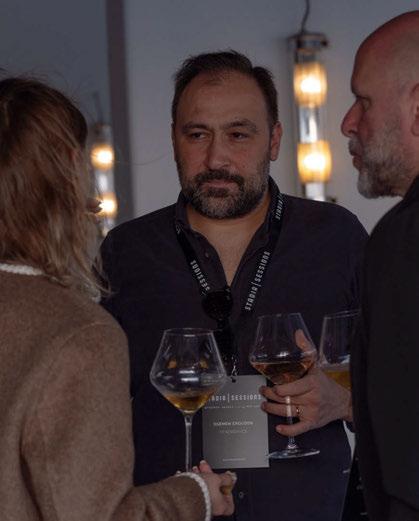
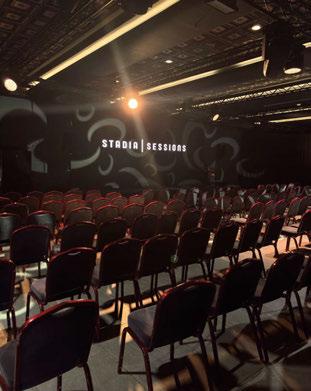
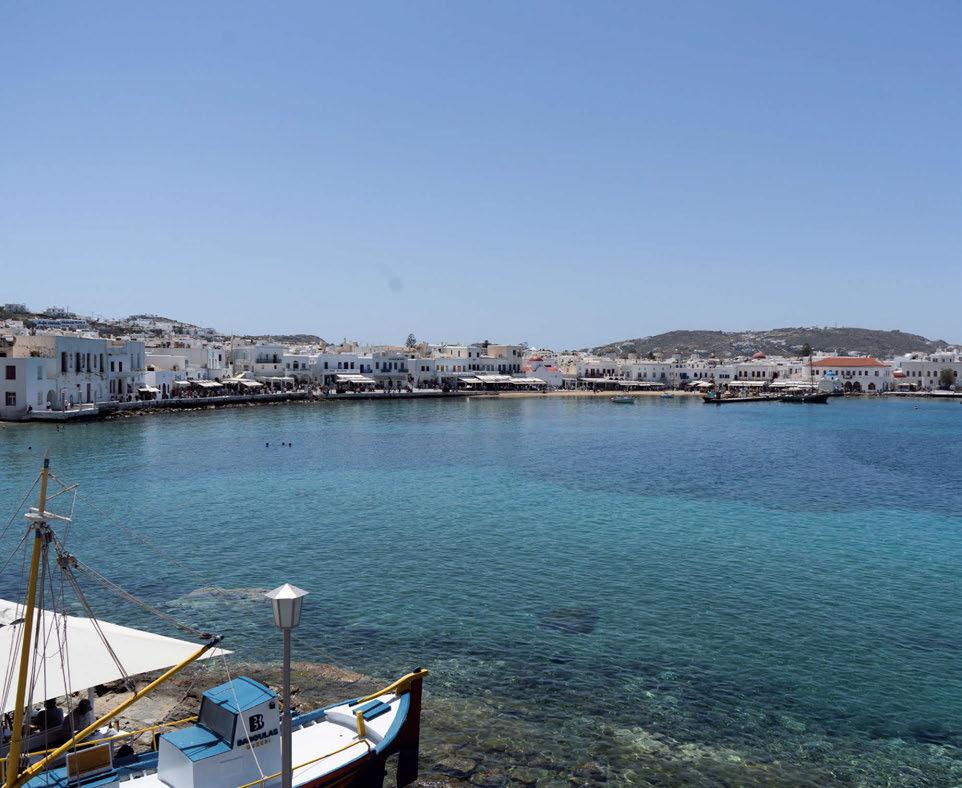
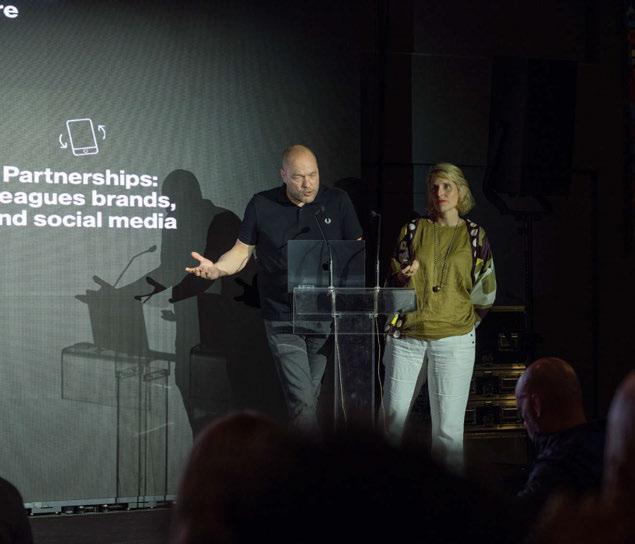
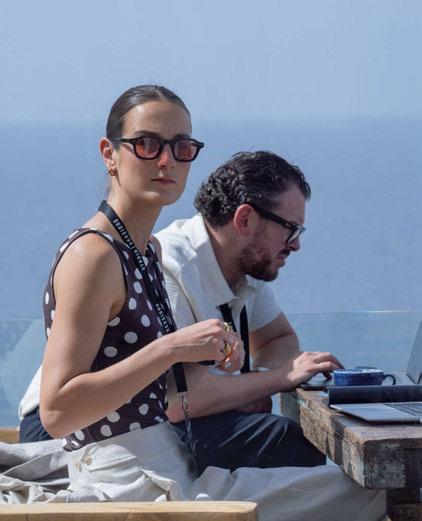
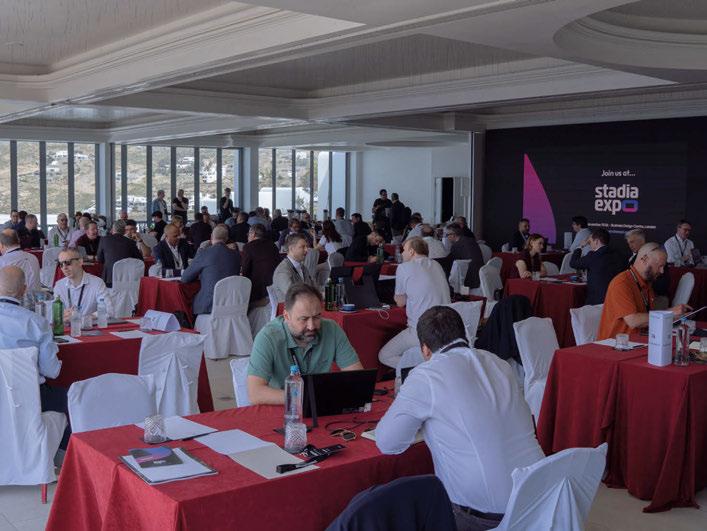
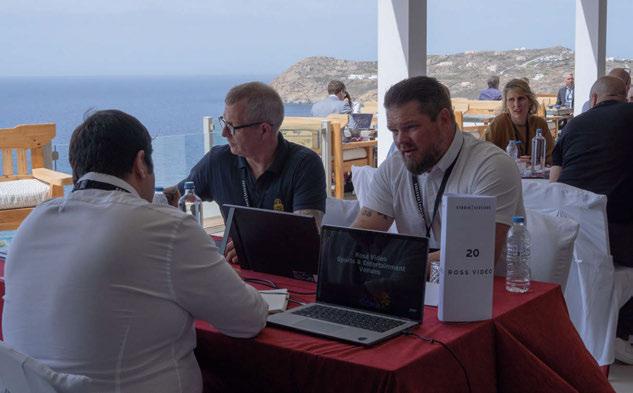
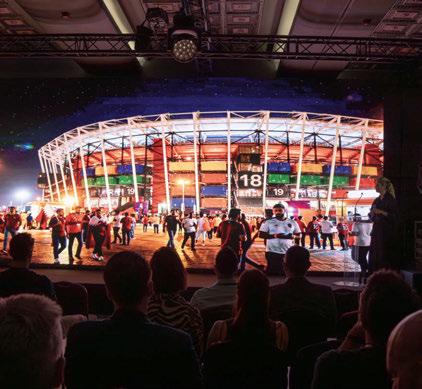
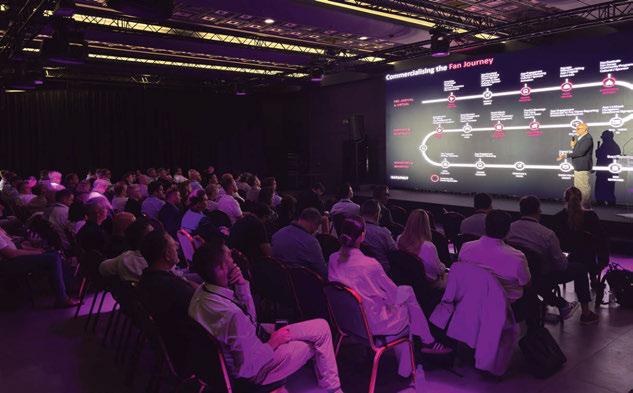
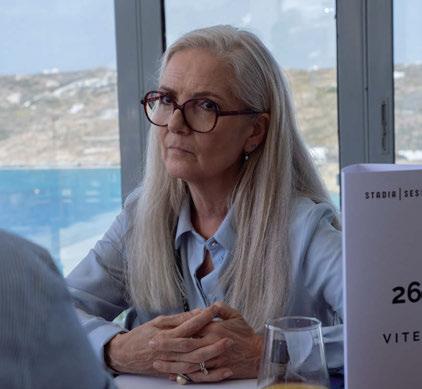
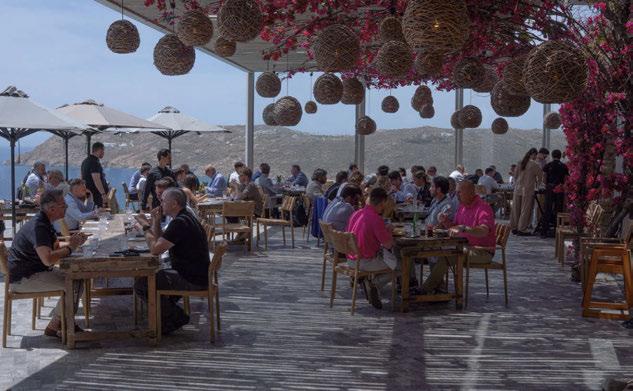
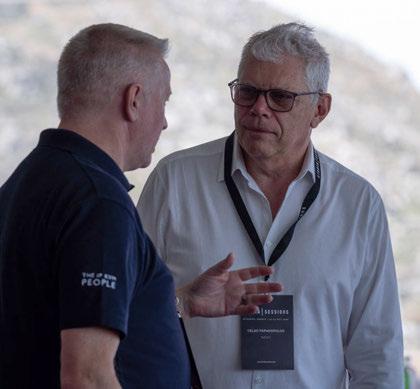
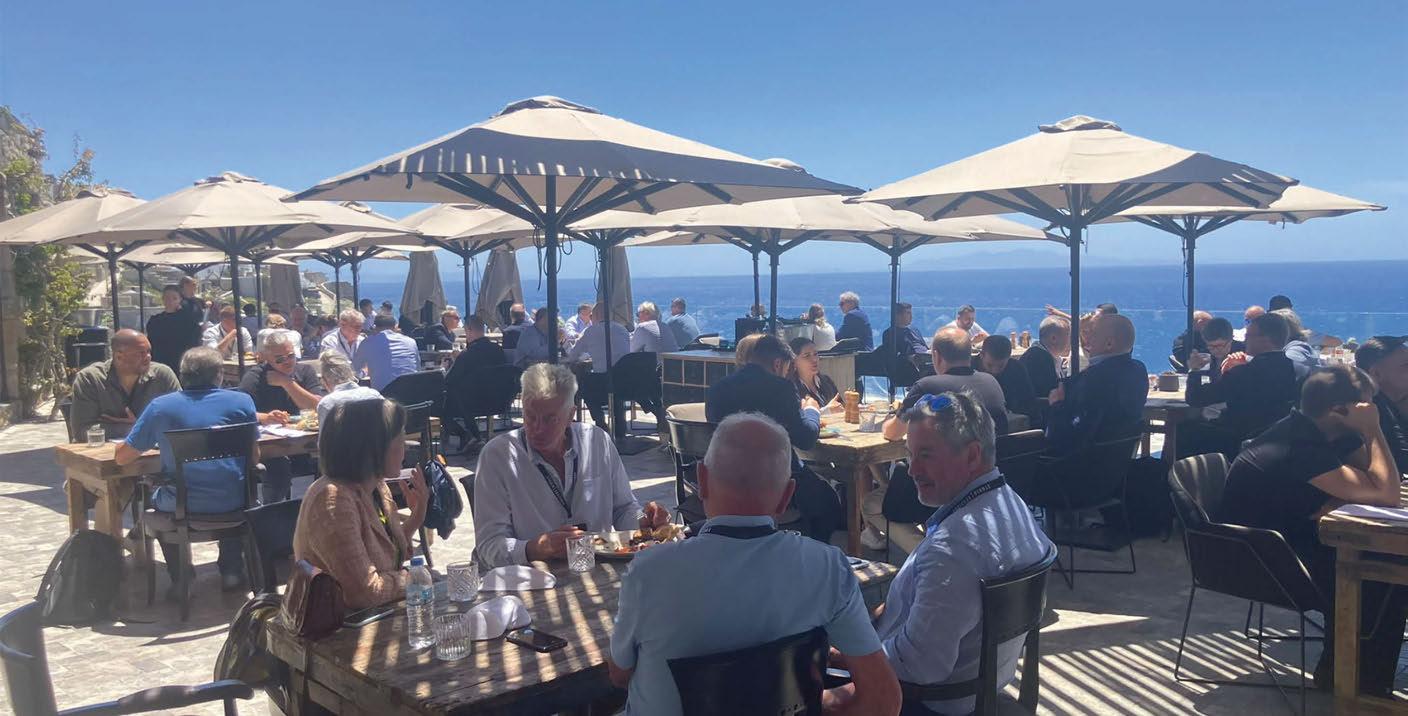
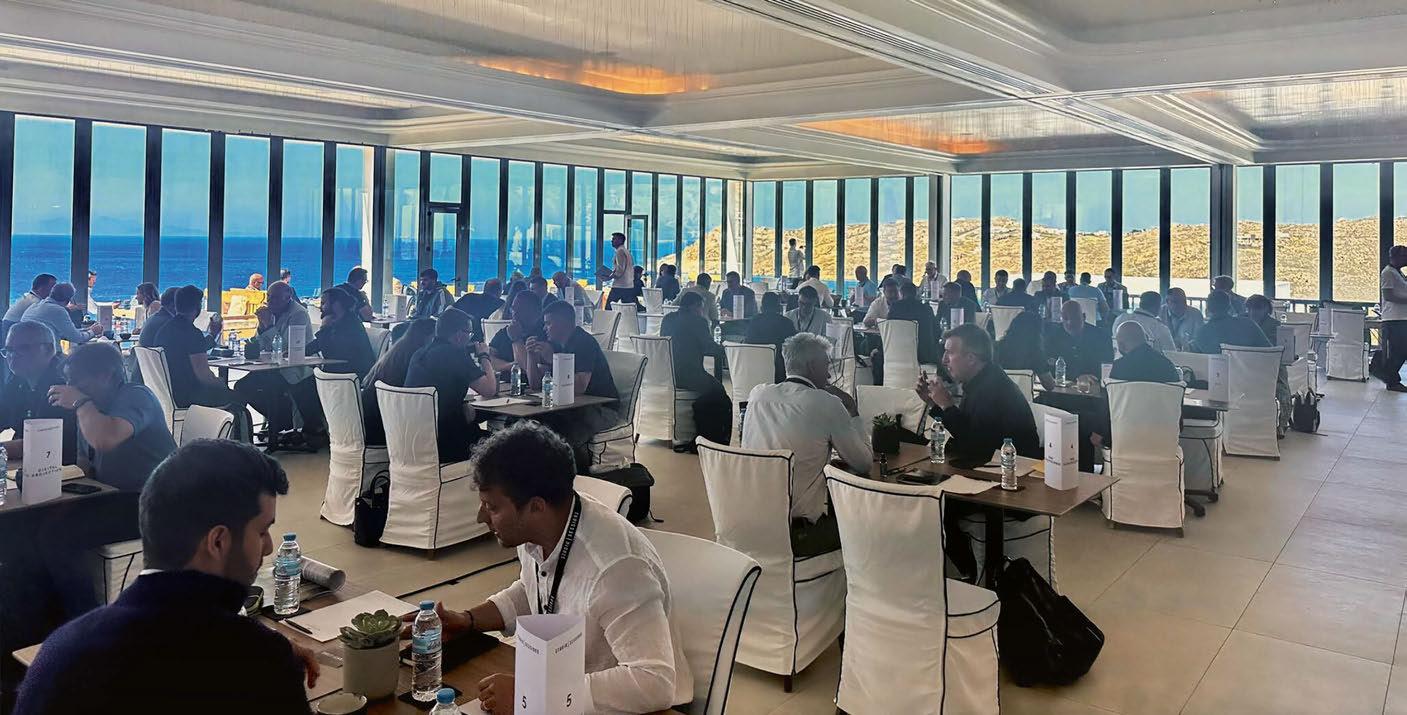
STADIA | SESSIONS #03 brought together key decision makers and innovators from across the global sporting venue ecosystem for three remarkable days of connection, collaboration, and insight. Held on the stunning island of Mykonos, the event provided a unique platform for clubs, stadiums, arenas, venue operators, architects, consultants, federations, government representatives, and leading suppliers to engage and explore new opportunities like never before.
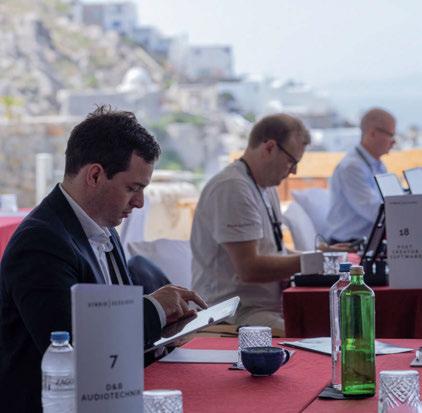
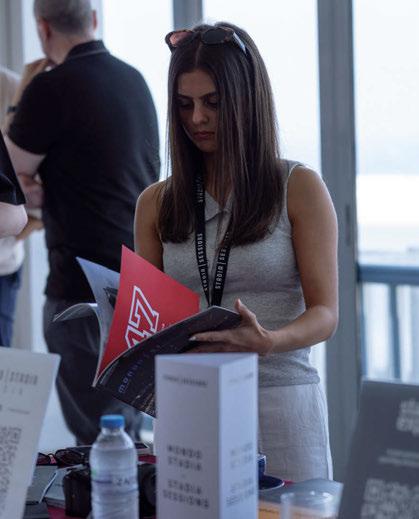
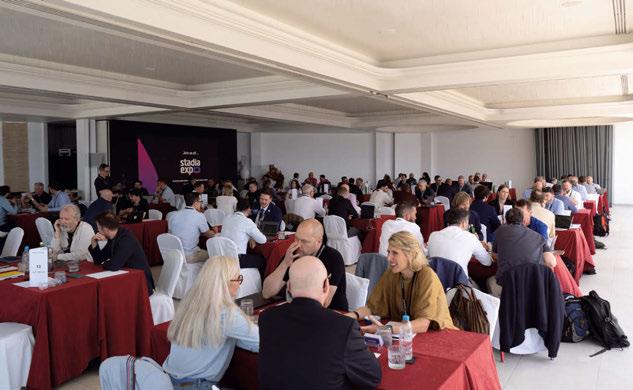
With over 520 one-to-one meetings taking place
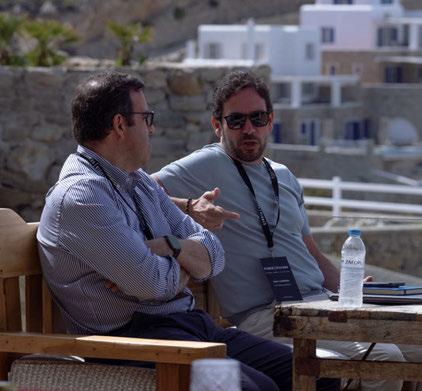
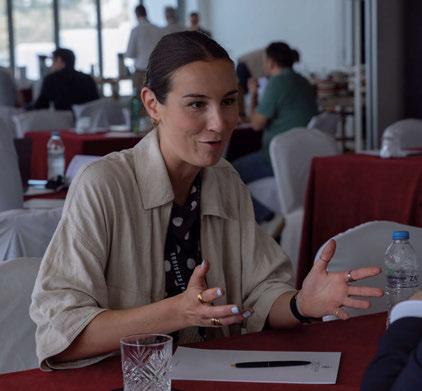
throughout the event, STADIA | SESSIONS #03 facilitated genuine, high-value conversations designed to spark long-term partnerships and strategic thinking. Delegates participated in a curated programme of one-to-one meetings, and concise, thought-provoking presentations - all within a relaxed, immersive setting that encouraged meaningful interaction away from the usual pressures of the work environment.
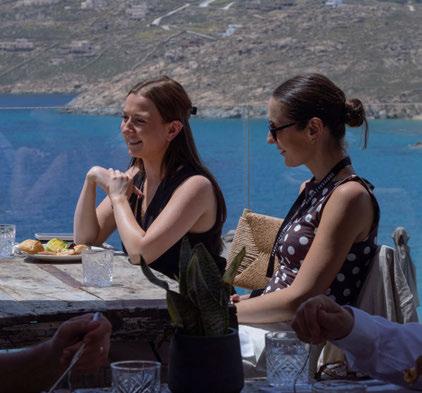
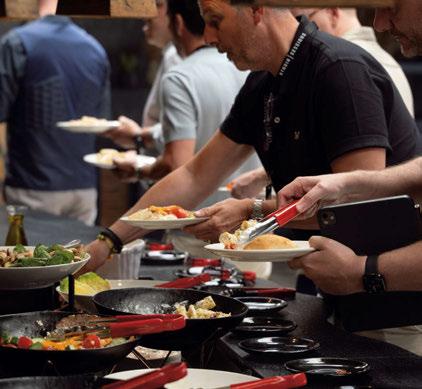
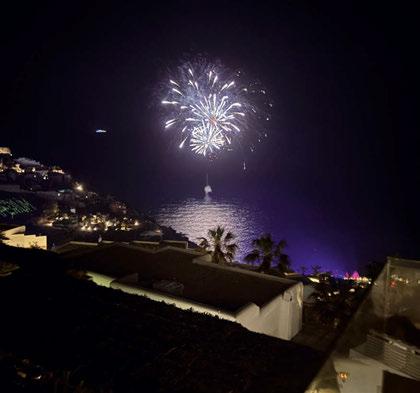
Complemented by a bespoke social schedule, framed by the idyllic backdrop of the Aegean, the atmosphere fostered informal networking and strengthened connections across every corner of the industry. The level of engagement and enthusiasm throughout the event was a clear reflection of the sector’s appetite for innovation, collaboration, and progress.
Conference Highlights
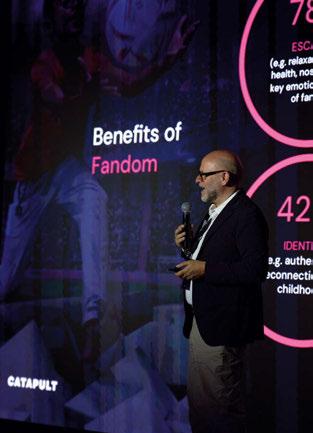
Our conference programme featured an impressive line-up of expert speakers, all of whom shared valuable insights
across various areas of the sporting venue industry. Highlights included:
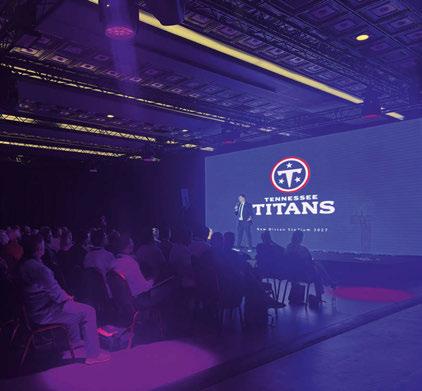
• Brian Myers from Tennessee Titans introduced us to the upcoming Nissan Stadium, delivering a fascinating keynote on the technology that will be bringing the venue to life from 2027.
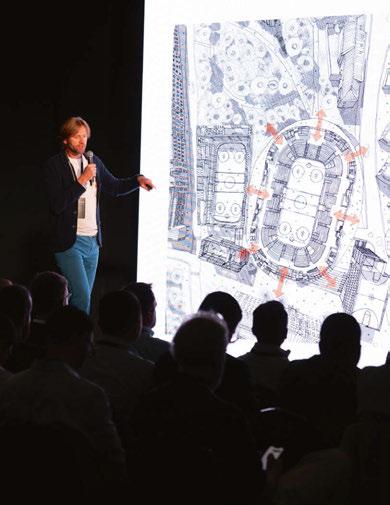
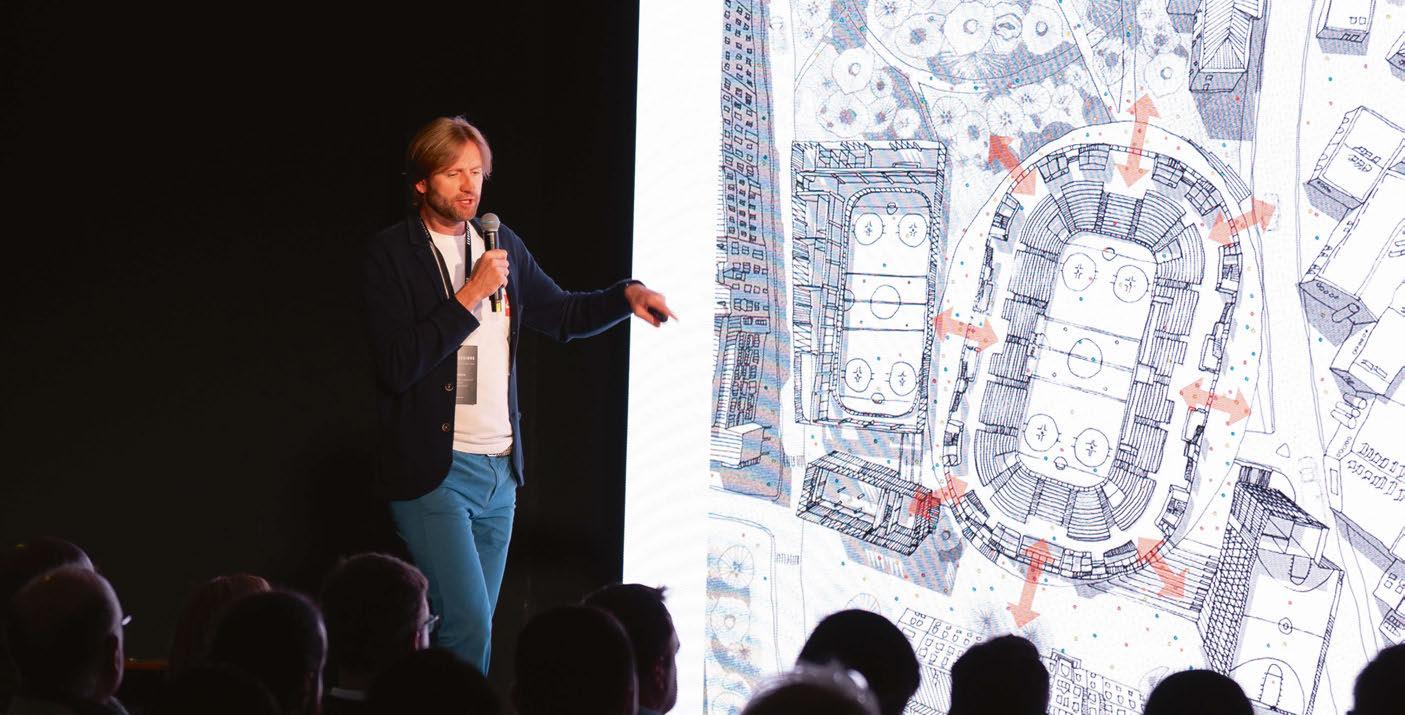
Tayomara Gama and David Mason from Gensler presented From Event to Ecosystem, highlighting the shift from venues designed for events to civic anchors.
• Nikolaos Barbas from IDEA Consulting discussed the future of fandom and how we should be designing the next generation of fan experience.
• Alejandra Fenwick, Fenwick Iribarren Architects presented The Living Stadium, highlighting how stadiums are evolving from stadiums to living ecosystems.
• Greg Turner from High Performance Venue Management delivered an insightful keynote on the reality of China’s stadium boom, and where the opportunities now lie.
• Vincenzo Barilari, Zaha Hadid Architects, delivered an impressive presentation of the company’s work across
stadiums and arenas, with an preview of some exciting projects on the horizon.
• Lisa Knights gave us an overview of Bristol Sport Group, which has overseen over a decade of facility investment, with much more to come.
• Rob May, Buro Happold, focussed on Al Ahly Stadium in Cairo and Everton’s Hill Dickinson Stadium, explaining how they unlock challenging sites for new venues.
Feedback
Alejandra Fenwick, Fenwick Iribarren Architects:
“This is my first time here and we’re definitely coming back. I’ve been really impressed by the way this kind of summit is organised — getting to know everybody, and not just through the working sessions but at the dinners and in the free time too. The place is wonderful, but the organisation has been perfect. Everything ran to time and the connections have been genuine.”
Brian Myers, Tennessee Titans
“To anyone considering coming to STADIA | SESSIONS
next year — it’s a must-attend event. It’s been absolutely incredible to be amongst counterparts and to learn how different North American and European sport can be. There are advantages on both sides of the Atlantic and a lot we can learn from each other.”
Lisa Knights, Bristol Sport Group:
“It’s been a fantastic event. When the invite came through, Mykonos isn’t a hard sell — but beyond the setting, it’s been really, really interesting. We’ve made some excellent connections. We’re at the point where we’re just starting to kick off our arena build, so meeting the people here has been really positive.”
Ben Veenbrink, The Stadium Consultancy:
“I’m glad I came this year. I like the concept — it adds value for both specifiers like me and for suppliers, because you get genuinely valuable time together. The conversations go in-depth on what both sides are doing and how you can help each other, rather than wandering around a conference
room listening to long presentations. It’s to the point. I’ve been really impressed.”
Harald Fux, RAUM + Architects:
“I would absolutely recommend STADIA | SESSIONS. The network is unique, the content is unique — but it’s about more than that. It’s about sitting together, focused on your appointments, and then having those natural breaks over lunch and dinner where the real conversations happen. That’s where trusted partnerships actually develop.”
Matthew Quade, TSL:
“The education I’ve got from other people in the sector has been a real benefit — as much as the curated one-toone conversations themselves. It’s not just about business opportunities but about genuinely understanding what the requirements are in this sector and how we can best support them. One of the brilliant things is how much everybody wants to help each other. It’s been a real eye-opener.”
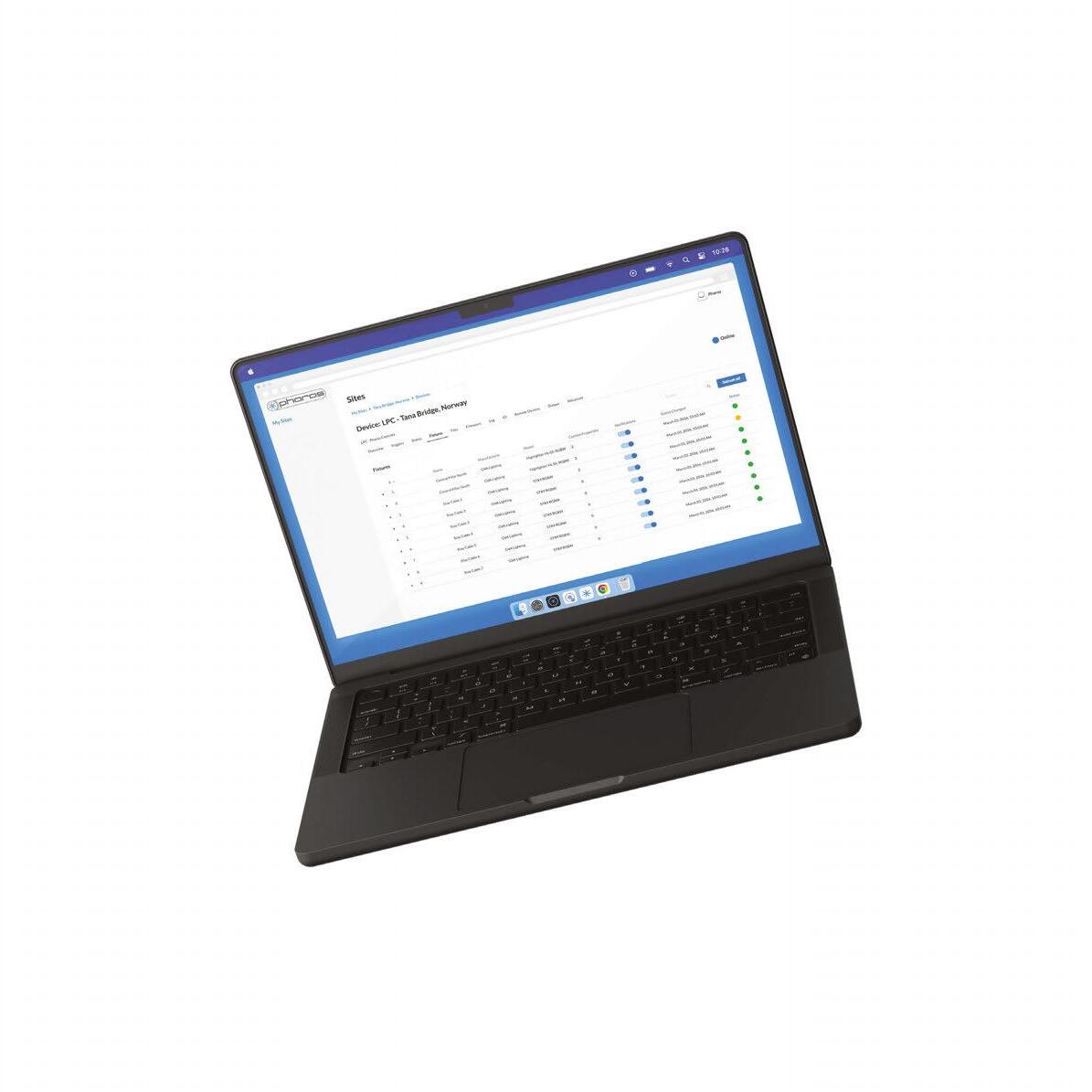
Comprehensive, secure remote lighting control and management, from any Internet-connected device, anytime, anywhere in the world, even in the Arctic Circle.
Coming soon:
Fixture Status Monitoring
Remotely monitor RDM fixture status and receive notifications when a fixture's status changes.
Project: Tana Bridge, Norway
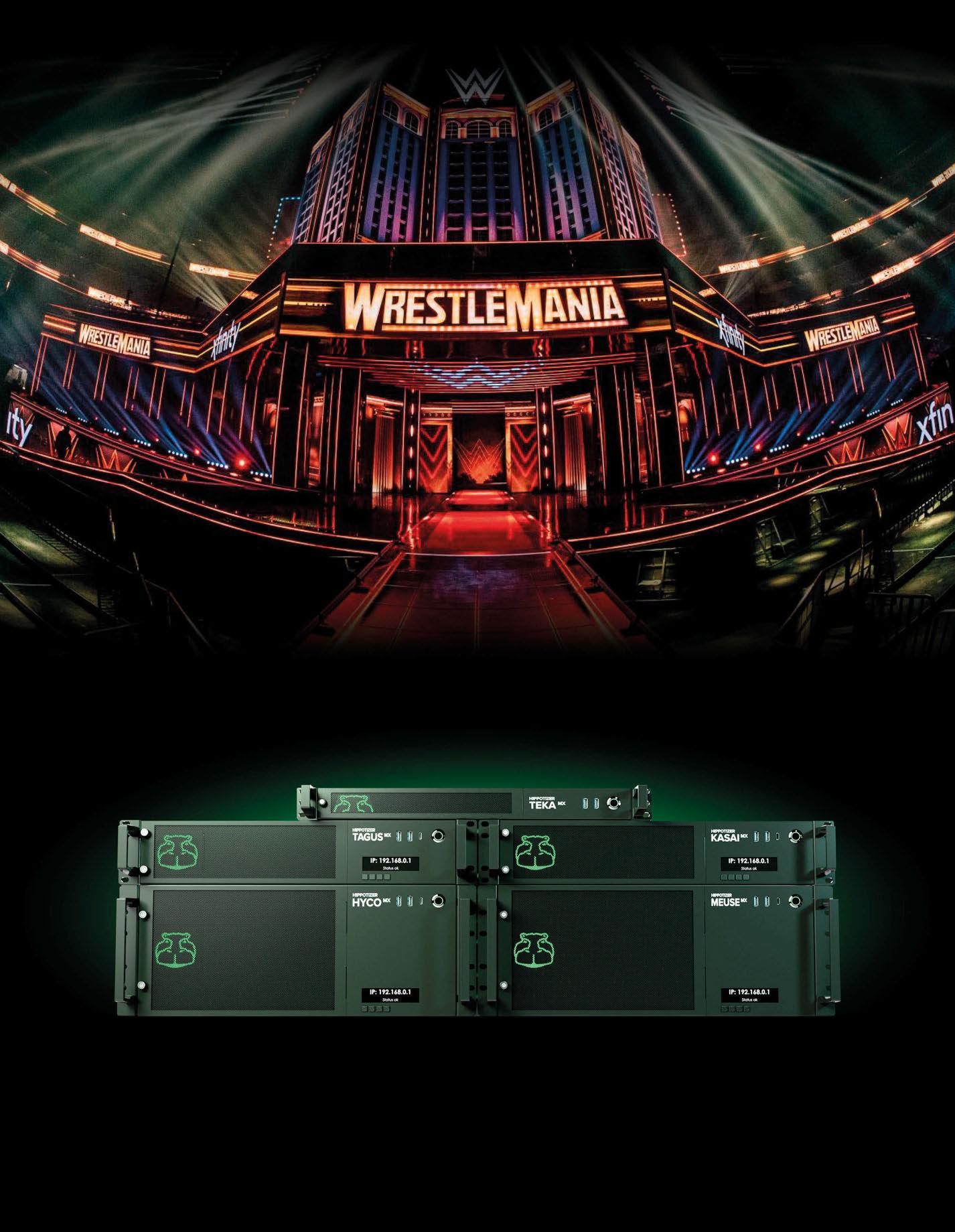
THE NEW HIPPOTIZER MX SERIES ENSURES SEAMLESS PERFORMANCE, MINIMIZES DOWNTIME, AND ENHANCES THE OVERALL QUALITY OF ANY PRODUCTION.
Rob May, Buro Happold:
“I’ve been to quite a few conferences with all different formats, but this one really works. The setting is obviously amazing, and because we’re all in one place it feels relaxed but focused at the same time. You can have really concentrated conversations. It’s been amazing.”
Vincenzo Barilari, Zaha Hadid Architects:
“I met a lot of interesting people, including people working in areas I wasn’t familiar with. I’ve learned a lot and it’s been an amazing experience overall. I’m going back to London with a lot to take away.”
Steffan Piolet, Daktronics:
“There are a lot of events in the calendar, but something as unique as this — the exposure you get to exactly the people you want to speak to, and the quality time you get with them — is really good for return on investment. Three quality evenings, insightful conversations, good speakers, well-structured networking. Really good experience.”
Chafik Ould Mhalla, Juventus FC:
“For anyone involved in this industry, it’s really valuable to be here — to understand what the market has to offer and to see the technology that is driving the football and stadium sector forward.”
STADIA | SESSIONS #04 | 2027
There’s been an unprecedented demand following the success of STADIA | SESSIONS #03, so we’re already hard at work planning for 2027. Spaces will be strictly limited for both specifiers and suppliers - if you’re thinking about being part of an event like no other, don’t wait.
Register your interest: tinyurl.com/stadiasessions
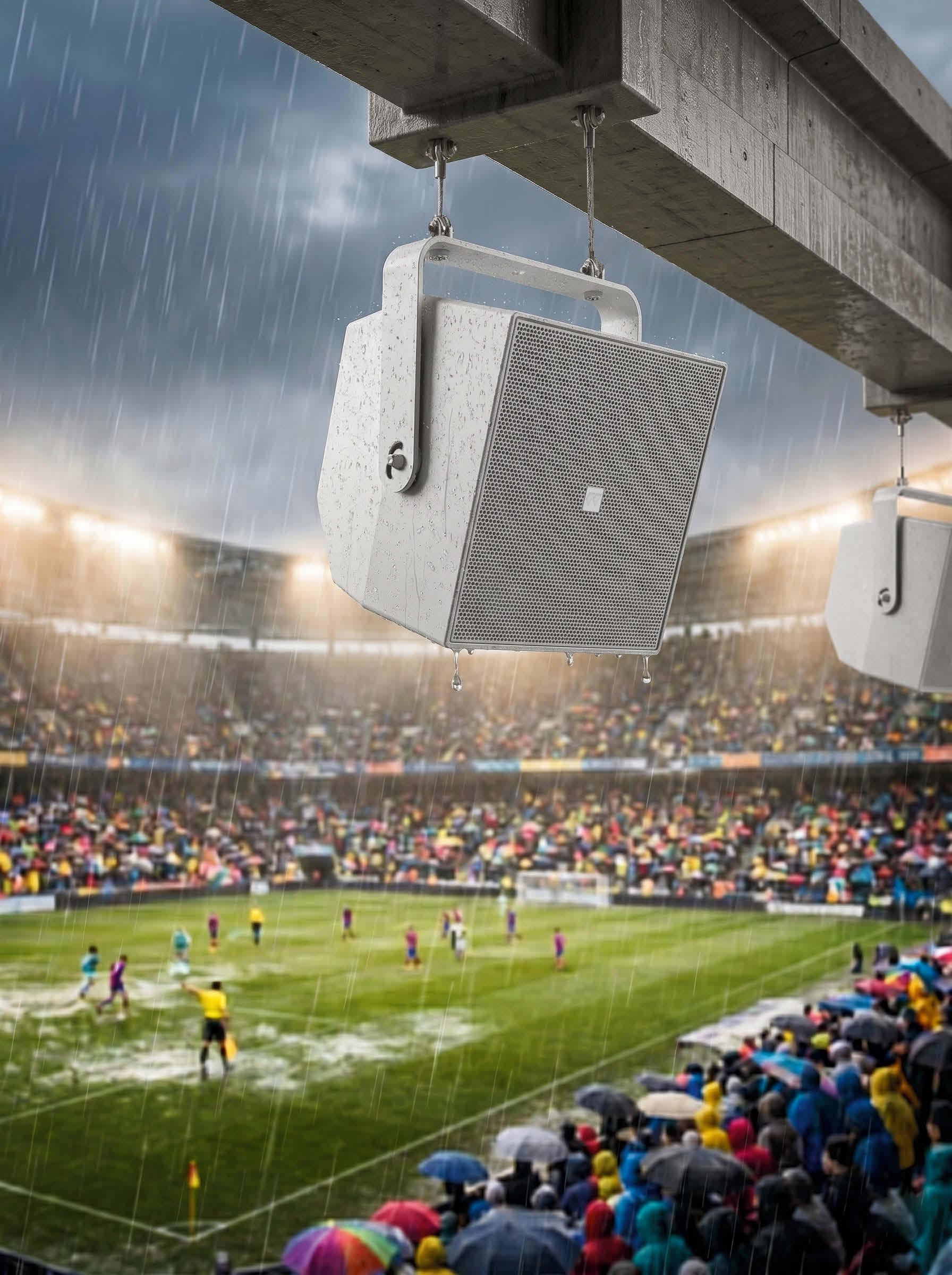
Designed for all-weather conditions, the ARENA Series transforms any outdoor space into a sonic experience.
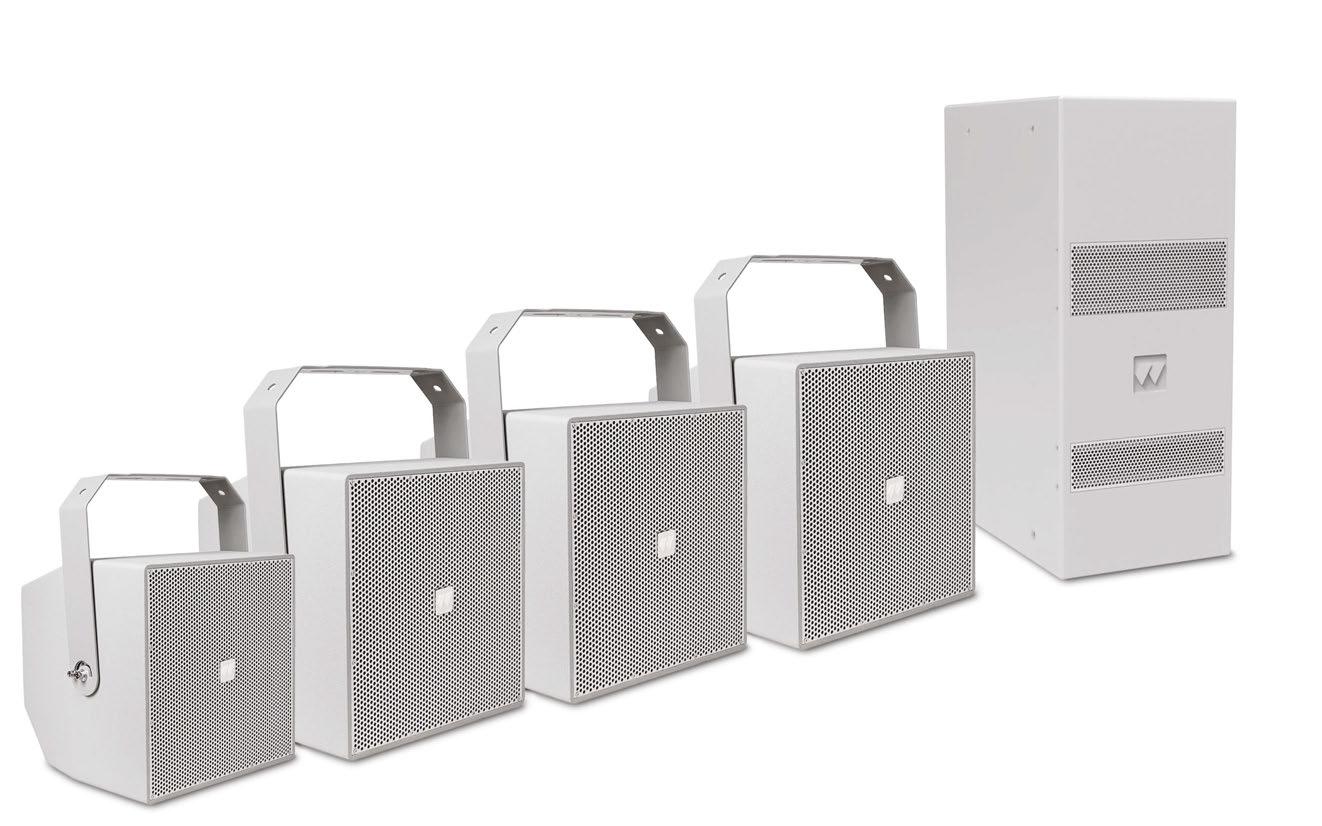
Equipson has expanded its WORK PRO range with a range of loudspeakers that deliver a reliable, outdoor sound solution, whatever the weather.
Available in a range of sizes to suit different applications, the ARENA Series is so durable and robust that it can defy the elements and transform any outdoor space into a high quality sonic experience. Every aspect of the Series’ engineering has been carefully designed to ensure that these loudspeakers can withstand the most testing weather conditions. From the hottest, driest day to the coldest, wettest night, these ARENA can handle everything that nature throws at it, without missing a beat.
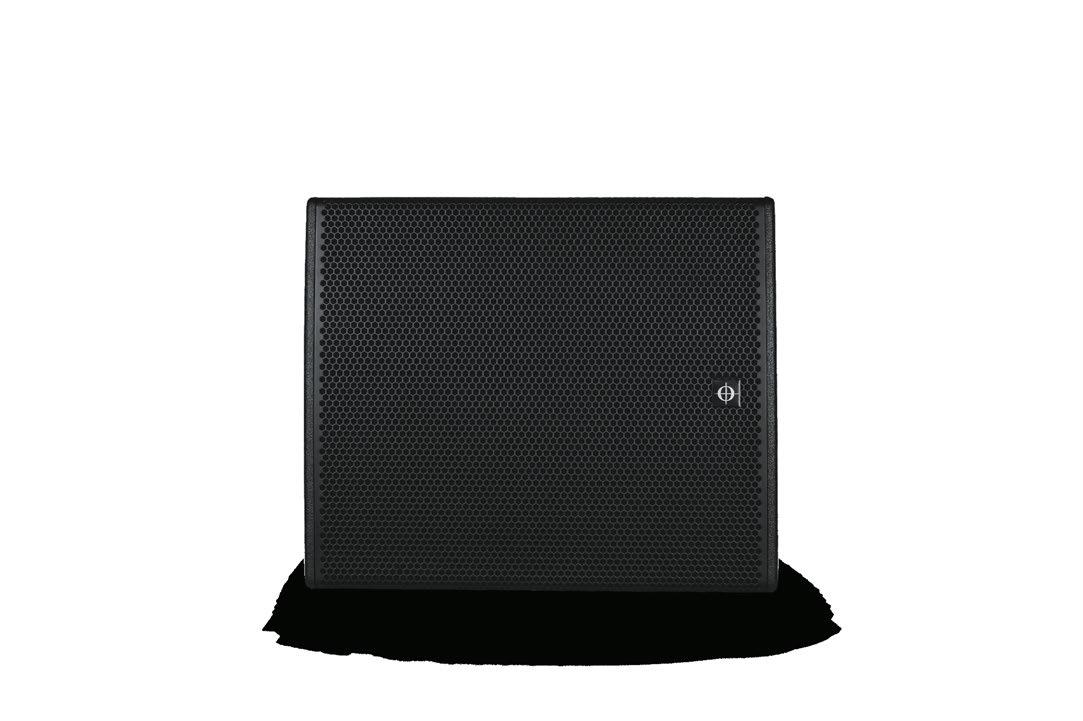
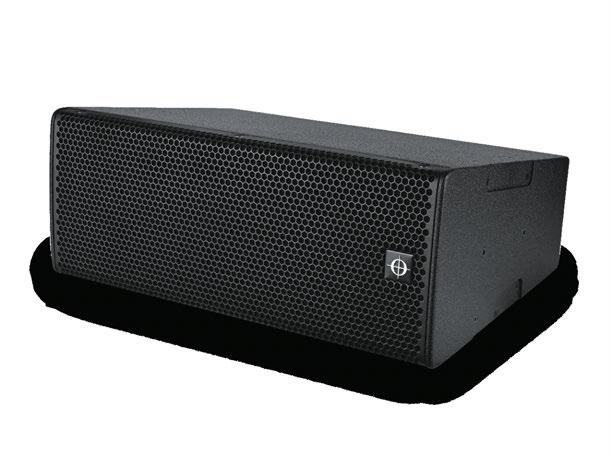
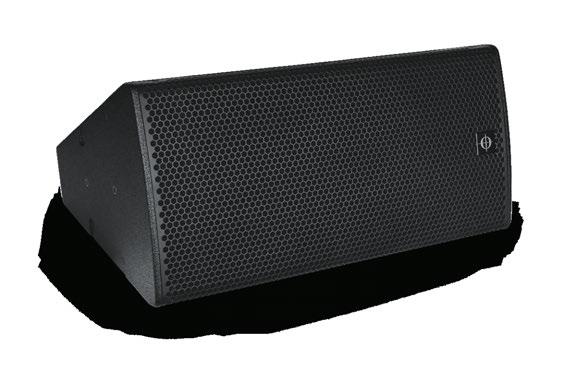
A key feature of the ARENA Series is its ability to deliver high power in a small format. These compact coaxial full-range speakers are available in four sizes (6”, 8”, 10”, and 12”) and deliver between 300W and 600W or pure power depending on the model size selected. In all cases clear highs, efficient low-frequency performance and minimized distortion ensure a balanced audio experience. In addition, the ARENA Series features a Dual 8” 800W band-pass waterproof subwoofer
that provides powerful low-frequency punch and audio enhancement for any ARENA Series installation.
“Primarily designed for Sports Arenas and Swimming Pools where a high quality sound system doesn’t just enhance the overall visitor experience but also provides a vital conduit for important safety announcements. They are also suitable for general outdoor applications such as fairs, theme parks and restaurant and club terraces and outdoor shopping malls,” says Juan Jose Vila, CEO of Equipson. “The versatility of this series is unparalleled as it is suited to any venue – indoor or outdoor, commercial or residential - that requires plenty of power from a small and totally weatherproof enclosure.”
Environmentally adaptive and with hydrophobically-treated grills, the ARENA Series has moisture-sealed crossovers to protect sound integrity. Polyvinyl enclosures that mimic wood finishes provide additional protection against the elements and ensure that these loudspeakers will continue to deliver great sound for many years to come.
More details about the ARENA Series can be found herehttps://www.workproav.com/arena
CODA Audio
CODA Audio Launches APSi-Pro Range
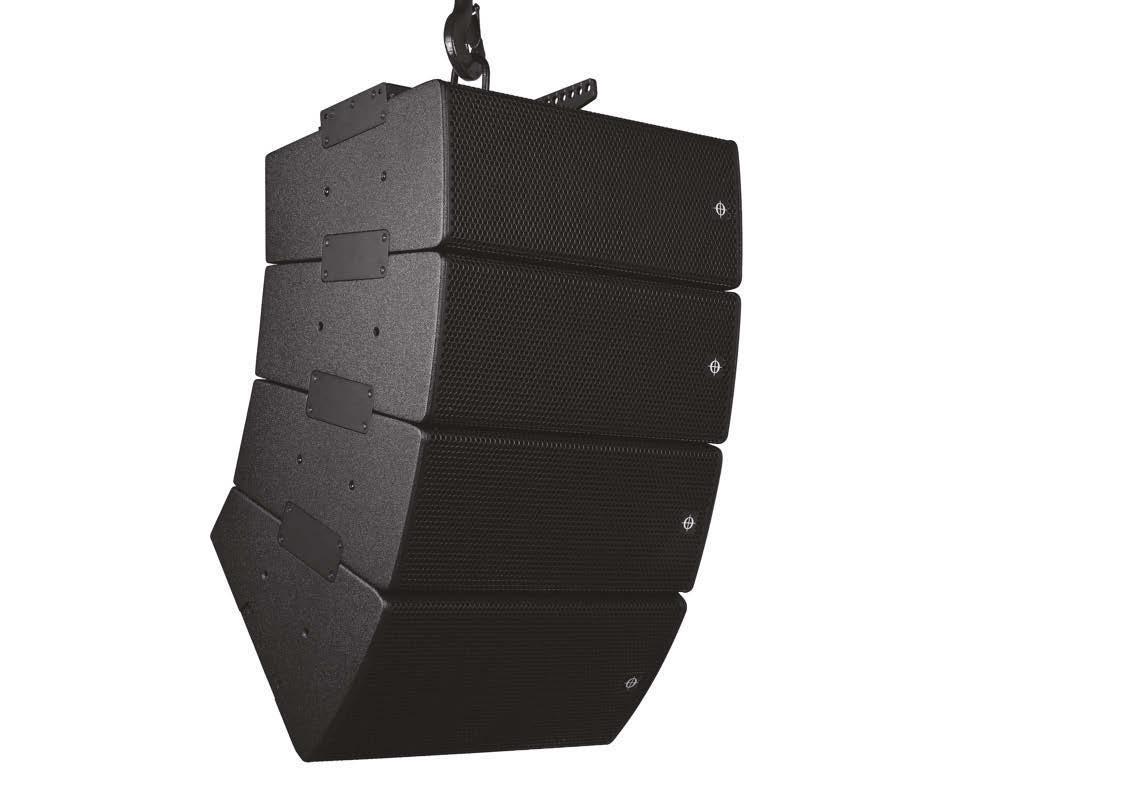
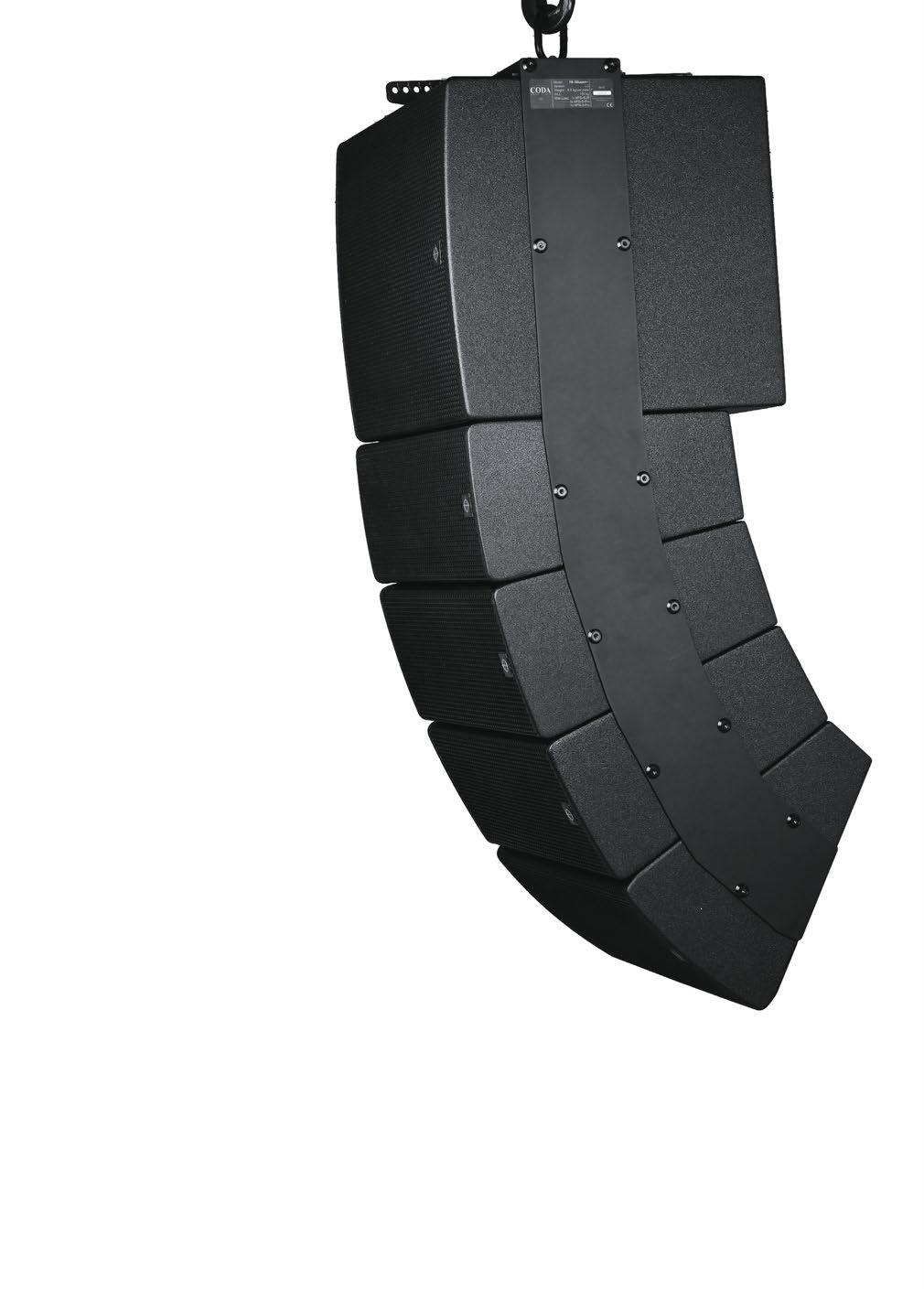
CODA Audio has announced the launch of APSiPro, a purpose-built high output progressive line source platform designed for fixed, permanent installation projects which need predictable coverage, high SPL, and cost efficiency. Stadiums, indoor sports arenas, nightclubs and many other permanent installation projects stand to benefit from this latest development from CODA Audio.
APSi-Pro evolved from the company’s existing APS-Pro Series in response to market demand. Although APS-Pro was originally conceived as a touring systems, it has consistently delivered outstanding results in fixed environments, leading many integrators to demand a version which contained the full acoustic performance of the touring system in a format purpose-built for installations. Lighter, cleaner, more costeffective, and free from unnecessary touring hardware, APSi meets those requirements with flexible weather-protection options, from durable outdoor finishes to full marine-grade treatment, along with custom colour choices to match architectural requirements.
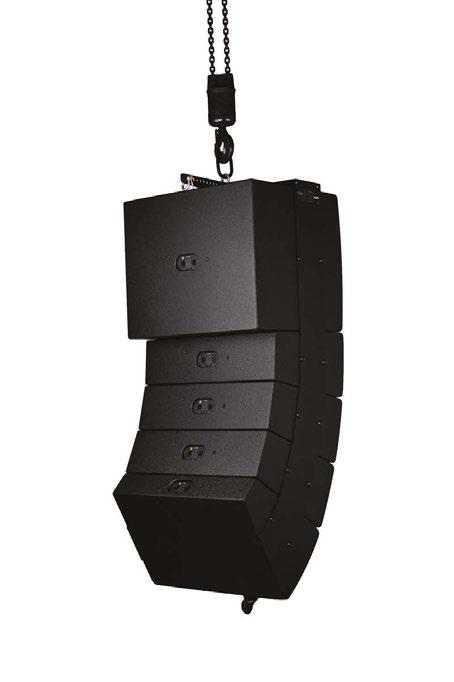
Rather than centring the design on one box, an APSi-Pro system is built from system blocks that combine to form tailored arrays for each venue. Each block, APSi-Pro-D or APSi-Pro-S, is a predictable building element - 10° and 30° vertical respectively. Installers choose the blocks that match the coverage requirement and assemble them into a coherent curved line-source array. The result is predictable sonic behaviour and coverage, delivered in a format that is easier to ship, rig, and budget for.
APSi-Pro can also be assembled into horizontal arrays, again exactly defining the coverage requirements by selecting from the two elements.
APSi-Pro’s output directivity is controlled by magnetic Instafit APS-Couplers which combine all the acoustic elements of the loudspeaker into a single, pattern-controlled
wavefront. Horizontal or vertical coverage, depending on the system’s deployment, can be changed between 60°, 90°, and 120°, and asymmetrical configurations of 75°, 90°, 100°, and 105° by using different Instafit coupler configurations.
Each array can include an APSi-SUB, the partner low frequency extension cabinet for the series.
Each APSi loudspeaker is supplied with a pair of universal fixing plates that form the core of the system’s modular installation concept. These plates allow any APSi product to be securely attached to another APSi element or directly to the flying frame, enabling a wide range of configurations without additional bespoke hardware. Whether the requirement is a compact two-box point-source cluster, a mixed-angle array, or a full system with an APSi-SUB, the same fixing plates provide a consistent, streamlined mounting method.
The Array Keeper (AK) is an alternative installation accessory for the APSi series. The AK is an overall metal frame, available in a variety of sizes, which fixes a number of APSi and subs into a single frame. This allows any single loudspeaker element in an installed APSi array to be removed for servicing without disturbing, disconnecting, or re-rigging the rest of the array. This solves one of the biggest practical challenges in fixed installations - maintaining a flown array without requiring a full system breakdown.
As with APS-Pro, the dual 10” low frequency drivers are mounted on an aluminium baffle – CODA’s Dynamic Airflow Cooling (DAC). DAC allows for higher power handling and more headroom at low frequencies, giving higher sound pressure levels for longer, without power compression. Each cabinet has an unprecedented AES power rating of 1400W and a peak SPL of 144dB (A weighted) per cabinet. Low frequency extends to 50Hz at -6dB - all from an enclosure that weighs an installation-friendly 27kg.
APSi Series
INSTALLATION EVOLUTION
APSi-Pro is a purpose built, high output progressive line source platform designed for installation projects that need predictable coverage, high SPL, and realworld cost efficiency.
It is a system - a modular frame of engineered blocks - not a single loudspeaker. APSi-Pro brings the performance philosophy of large modular linesource architectures into an installation friendly, budget sensitive format.
HEARING IS BELIEVING
APSi-SUB
APSi-Pro-D
Vertical Dispersion APSi-Pro D projects energy further with its narrower angle output resulting in higher SPL for the longer throw section of an array, when used with narrow angle couplers.
APSi-Pro S has wider coverage, so slightly less SPL, especially when wide angle couplers are used.
An array is naturally level shaded without having to use multiple amplifier channels.
APSi-Pro-S
InstaFit Magnetic Couplers
FROM CONCRETE TO CODE: HOW TECHNOLOGY IS TRANSFORMING THE MODERN VENUE
George Vaughan, The Digital Line
It is often said that time moves faster as we get older. From personal experience I can certainly attest to the fact and it is perhaps nowhere more evident than in the world of technology. Cast your mind back to 2008.
The smartphone revolution was only just beginning. The App Store was in its infancy. Most people still carried physical tickets, paid with cash, printed directions before travelling and relied on desktop computers for much of their digital activity. Social media was beginning to emerge as a cultural force but still had little influence on how we communicated, while concepts such as digital wallets, cloud computing and artificial intelligence remained largely the preserve of enthusiasts rather than everyday consumers.
At the time, many of us believed we were living through a period of remarkable technological change. Looking back now, we were certainly only witnessing the opening act.
In less than two decades, technology has transformed almost every aspect of our daily lives. The device in our pocket has become our primary interface to the world around us, understanding us in more intimate ways than we properly appreciate. It has become our camera, payment card, travel companion, entertainment platform and navigation system.
For those of us working within the venue industry, this shift is particularly significant because technology has not simply changed the buildings we operate. It has fundamentally changed the people who visit them as well.
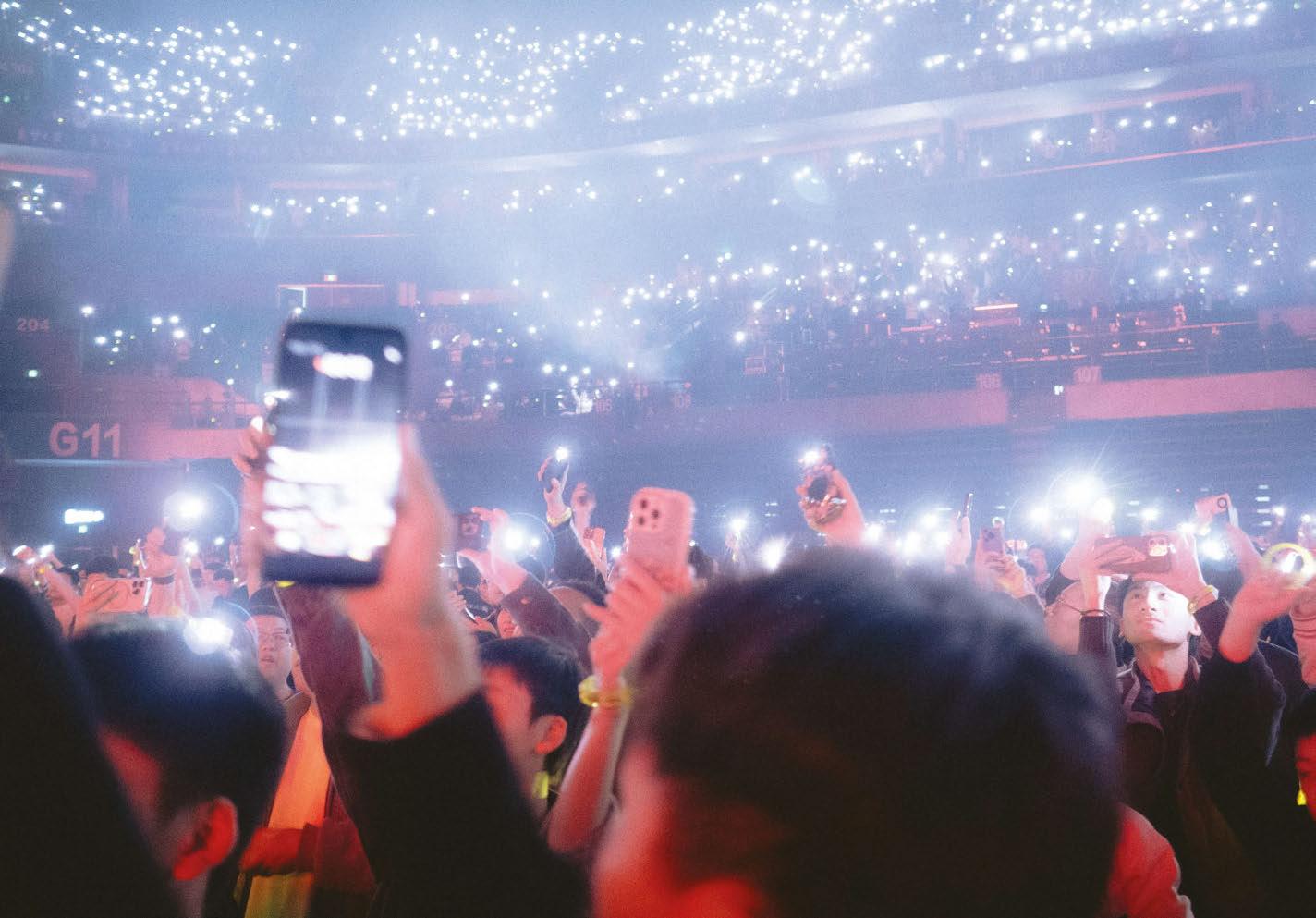
The guests attending our arenas, stadiums and entertainment destinations today arrive with very different expectations from those who attended events in 2008. They expect information instantly, transactions to be seamless and experiences to be personalised.
This raises an interesting question for venue owners, operators and designers. If so much has changed between 2008 and today, what changes are still ahead of us and will they happen much faster than before?
Many of the venues opening later this decade and into the 2030s are being designed and built right now but customer expectations will continue to evolve long before those venues open their doors. The challenge is no longer simply deciding which technologies to deploy. It is understanding how to create venues that remain relevant in a world where consumer behaviour can change dramatically within the lifespan of a single construction project.
Looking back at the last twenty years offers a useful reminder. The most significant technological changes are rarely the ones we predict with any certainty. They are often the ones that quietly reshape our habits until we can no longer contemplate life without them.
To understand just how much has changed, imagine taking the project team that built a major arena in 2008 and asking them to build the same venue again today.
The seating bowl would look familiar.
The stage would still sit at one end.
The crowd would still arrive to watch world-class sport and entertainment.
Yet almost everything else would be different.
The biggest changes are not visible in the architecture. They sit beneath the surface in the networks, data platforms, digital services and operational systems that now define the guest experience and determine commercial success.
Over the past twenty years, arenas have evolved from buildings that host events into intelligent platforms that orchestrate experiences.
The Guest Journey Has Moved Beyond the Venue
In 2008 the customer journey began when a fan arrived at the venue, meaning that most operators focused on ticket scanning, security checks, wayfinding and food and beverage.
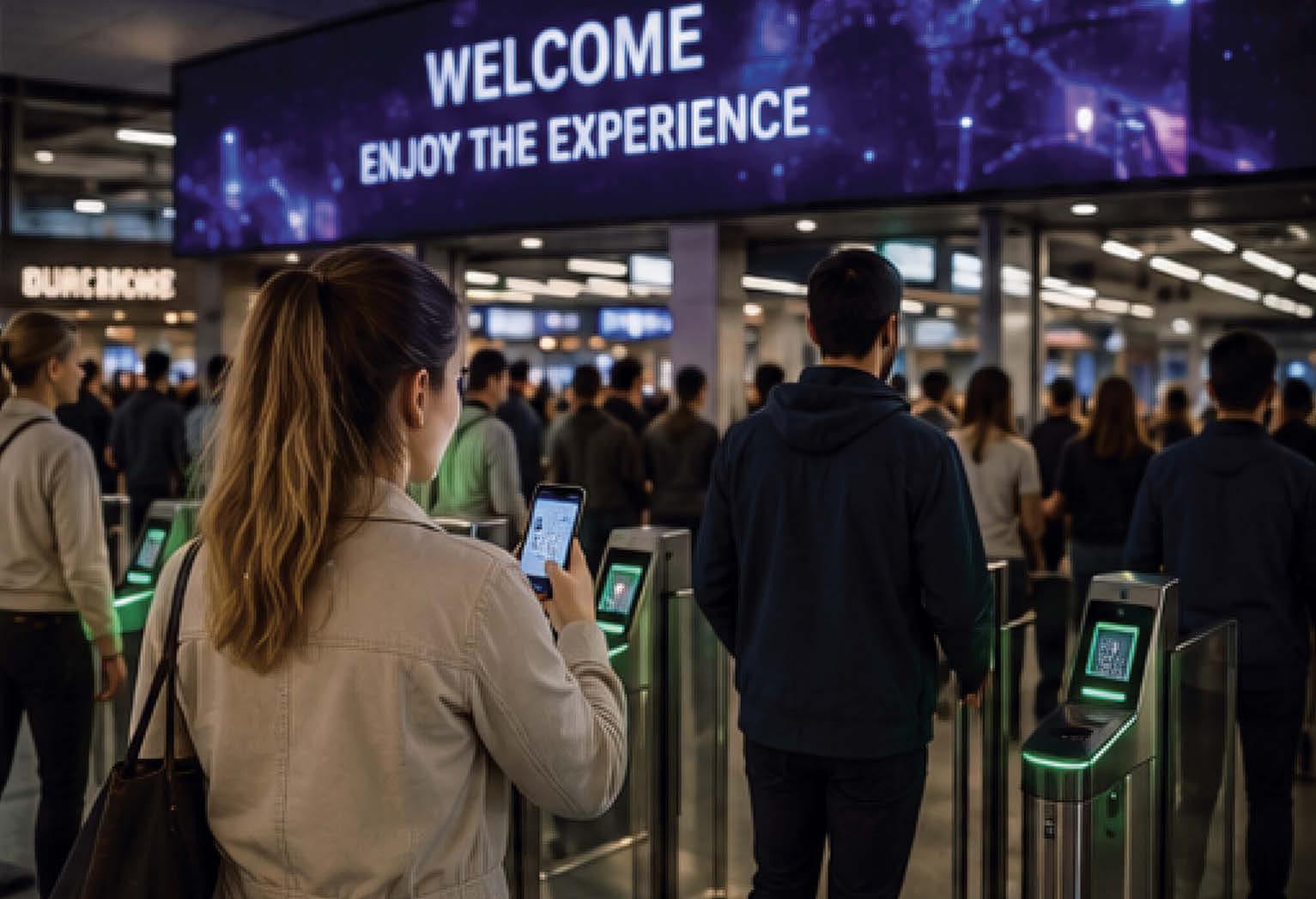
Today that same journey begins weeks before arrival and guests now expect mobile wallet delivery, digital wallets, travel recommendations, personalised hospitality offers, real-time event updates and frictionless entry.
The “everything now” mentality that social media and digital services like streaming and home delivery have fostered permeates every area of most consumer thinking. Why should I wait for anything? Why should I queue for anything? “Tomorrow” isn’t even a consideration for satisfaction.
The venue experience increasingly starts from that first point of engagement rather than at the front gate and this introduces another key difference. Back then, people adapted to the venue. Today the venue is expected to adapt to the individual.
The Rise of the Connected Venue
Twenty years ago, most venues were still heavily cash dependent and operators measured ticket sales, catering revenue and attendance.
Today, every transaction creates data, with venues analysing spend patterns, arrival behaviour, product preferences, queue times, dwell times and return visits. More and more the modern arena is becoming a real-time retail environment and the transaction itself is no longer seen as the end of the process but the start of a
comprehensive and long term data relationship.
Equally, technology used to operate as largely independent systems, which may have included ticketing, CCTV, access control, catering and signage.
In 2026, the most advanced venues are creating connected ecosystems where information sharing supports common operational objectives.
A sold-out concert might automatically influence staffing levels, security deployments, food preparation, digital signage content, HVAC settings and cleaning schedules. This leads to a venue operating as a single intelligent environment rather than a collection of disconnected systems.
Technology Has Become Revenue Generating
Perhaps the most significant shift over the past two decades has been the changing perception of technology within the venue industry. In 2008, it was largely viewed as an operational necessity – an essential collection of systems required to keep a venue functioning safely and efficiently. Investment decisions were often driven by reliability, compliance and cost control. The question being asked in boardrooms at that time was relatively straightforward: “How much will this system cost us to purchase, operate and maintain?” Technology was typically considered a support function rather than a strategic asset.
Now, that conversation has fundamentally changed. Modern venue operators increasingly view technology as a platform for growth rather than simply a cost of doing business. The focus has shifted from procurement to value creation, meaning it plays a direct role in driving revenue through premium guest experiences, dynamic pricing models, targeted retail offers, loyalty programmes and personalised engagement. Digital platforms provide new opportunities to increase spend per visitor, improve retention and create deeper relationships with customers long after an event has ended. The question is no longer solely about the cost of technology, but rather: “How much value can this platform generate?”
As a consequence, technology has become a commercial enabler in its own
right. Data-driven sponsorship opportunities, digital advertising inventory, mobile engagement platforms and strategic partnerships are creating entirely new revenue streams that simply did not exist twenty years ago. The most forward-thinking venues now recognise that every digital interaction has the potential to enhance both the customer experience and the commercial performance of the business.
Sustainability Has Become a Technology Challenge
Another area that has undergone a significant transformation is sustainability. Historically, environmental performance was rarely a primary driver of venue design or operational decision-making. While energy efficiency and utility costs were considered, they were often viewed through the lens of cost management rather than environmental responsibility. The success of a venue was typically measured by attendance, event revenue and operational performance, with relatively little attention given to carbon footprints, resource consumption or long-term sustainability objectives.
In 2026, sustainability has become a strategic priority for venue owners, operators, investors and local communities alike. Modern venues face growing pressure to reduce energy consumption, minimise carbon emissions, decrease waste production and use water more efficiently. These objectives are no longer driven solely by regulation or corporate responsibility programmes; they are increasingly influenced by customer expectations, investor requirements and broader organisational commitments to environmental stewardship. As a result, sustainability has become a core business challenge rather than a peripheral consideration.
Technology is playing an increasingly important role in helping venues meet these ambitions. Smart energy management systems can monitor and optimise consumption in real time, while predictive maintenance tools help reduce waste by extending the life of critical assets and identifying issues before they become failures. Occupancy monitoring allows operators to adjust heating, cooling and ventilation based on actual usage, while intelligent lighting and building automation systems ensure resources are used only when and where they are needed.
Building for the Audiences of Tomorrow
The arena industry has always been defined by spectacular architecture, iconic events and memorable experiences. Yet perhaps the greatest transformation of the past twenty years has happened behind the scenes. While guests continue to judge venues by the artists they host, the teams they support and the memories they create, an increasingly important part of that experience is now powered by technologies that most visitors will never see.
As we look towards the venues opening later this decade, success will depend on far more than physical infrastructure alone. The quality of their data, the intelligence of their systems and their ability to connect every stage of the customer journey into a seamless experience will become critical differentiators. From personalised engagement and frictionless transactions to operational efficiency and sustainability, technology is no longer simply supporting the venue; it is helping to define how it performs.
The emergence of artificial intelligence may further accelerate this pace of change. While much of today’s discussion focuses on operational efficiency and automation, AI has the potential to become one of the industry’s most valuable planning tools. By helping operators identify emerging behaviours, model future scenarios and better understand changing customer expectations, it may provide a glimpse into the needs of audiences that have yet to walk through the door.
Looking back to 2008 serves as a reminder of just how quickly expectations can change. Few could have predicted how smartphones, digital payments, cloud platforms and data-driven services would reshape our everyday lives.
The challenge facing today’s venue designers is remarkably similar. Many of the arenas opening later this decade are being built for audiences whose expectations have not yet fully formed.
If the past twenty years have taught us anything, it is that the most successful venues will not necessarily be those with the newest technology. They will be the ones with the flexibility to evolve alongside the people they serve.
WEEKLY GAMES TO THE WORLD STAGE
Daktronics LED displays and equipment are ready to elevate the experience from the moment fans arrive to pivotal points to post-game celebrations.