CARMAX PARK
LEANGEN ARENA
TEAM TALK - CRESTRON
D&B AUDIOTECHNIK INTERVIEW
Richmond Flying Squirrels has installed five Grass Valley LDX 110 cameras at its home stadium.
Full audio upgrade carried out at the Trondheim venue, featuring a wide array of KV2 Audio products.
What Espai Barça reveals about the changing role of technology in the era of the 365-day stadium.
We spoke to Dominika Obwarzanek, Senior Application Engineer, to discuss designing sound in modern stadiums.
ISSUE 49 - AUGUST | SEPTEMBER 2026
THE INTERNATIONAL PUBLICATION FOR THE SPORTING VENUE ECOSYSTEM
SCALABLE NETWORKING SIMPLIFIED.
Whether deploying a redundant or primary-only network topology, the MS8.2 Milan network switch is perfectly suited to simplify mobile, installed systems and spatial audio applications.
49 WELCOME
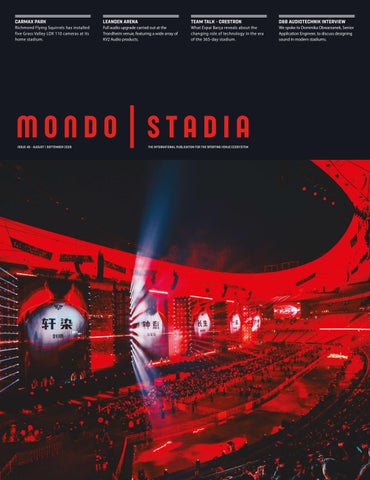
e open ISSUE 49 at Beijing’s National Stadium — the Bird’s Nest — where the Grand Finals of the King Pro League for Honor of the Kings set a Guinness World Record for the largest live esports audience ever assembled, with over 62,000 in attendance. Our cover story explores how MA Lighting’s grandMA3 system tied together a production of extraordinary complexity. We also spoke with Dominika Obwarzanek, Senior Application Engineer at d&b audiotechnik, whose nine years and dozens of stadium projects give her a cleareyed view of what it actually takes to design sound for venues where a Champions League final, a stadium concert, and a community event all share the same system. Her preference for the word “optimising” over “compromising” says a great deal about how she approaches the discipline. Fran Williams, Technical Commercial Director at Diversified, makes the case that AV and IT can no longer operate as separate departments, particularly as European stadiums push towards the 365-day, multi-use model that their US counterparts have long been building towards. Our Team Talk comes from Brad Hintze, EVP of Marketing & Customer Success at Crestron, who uses Espai Barça as the lens through which to examine whether the industry has truly adapted to the era of the 365-day stadium, or simply acknowledged it. We also carry a column from Stark Tech on the case for moving from individual building systems to a single, unified technology strategy: a shift that touches everything from energy management and security to AV and power visibility. Elsewhere, we visit CarMax Park, where Grass Valley have delivered a broadcast infrastructure project worth checking out, and Leagen Arena, where KV2 Audio have made their mark on the venue’s sound environment. We hope you enjoy the issue!
W
Sam Hughes Chief Creative Officer & Editor-in-Chief
L-Acoustics_Sound Forward_MondoStadia_245x318mm.indd 1
16/12/2024 11:44:47
49 INSIDE…
Cover Image: © Honor of Kings Chief Creative Officer & Editor-in-Chief Sam Hughes s.hughes@mondiale.co.uk
Editorial Assistant Matt Johnson m.johnson@mondiale.co.uk
Chief Commercial Officer Jamie Dixon j.dixon@mondiale.co.uk
Sales Executive Ruby Bemowski r.bemowski@mondiale.co.uk
Design & Production Dan Seaton d.seaton@mondiale.co.uk
Mel Capper m.capper@mondiale.co.uk
Finance Director Amanda Giles a.giles@mondiale.co.uk
Credit Control ar@mondiale.co.uk
Group Chairman Damian Walsh
TEAM TALK
EXTRA TIME
006 The 22 to 365 Shift: We’re Living It. But Have We Adapted
062 Tasker | Multipair Cables for Live Production
Enough? | Crestron
064 Sending Audiences Home Safely | Showstop
010 From Individual Systems To One Technology Strategy |
068 Beyond The Box: The Future of Premium in the Modern
Stark Tech
Arena | George Vaughan, The Digital Line 072 From Venue to Ecosystem: Why Europe’s Stadiums Need a
MONDO | STADIA is published by Mondiale Media Limited, Strawberry Studios, Watson Square, Stockport, SK1 3AZ, UK Tel: +44 161 476 8340
INTERVIEW
016 Dominika Obwarzanek | d&b audiotechnik 026 Fran Williams | Diversified
THE FULL PITCH 034 Beijing National Stadium | Beijing, China
Printed By Buxton Press
VENUE FOCUS WWW.MONDOSTADIA.COM
IPTV & DIGITAL SIGNAGE 042 ScottsMiracle-Gro Field | Columbus, USA BROADCAST 048 CarMax Park | Richmond, USA AUDIO 054 Leangen Arena | Trondheim, Norway
New Operating Model | Adder Technology
TEAM TALK
THE 22 TO 365 SHIFT: WE’RE LIVING IT. BUT HAVE WE ADAPTED ENOUGH? What Espai Barça reveals about the changing role of technology in the era of the 365-day stadium. By: Brad Hintze, EVP of Marketing and Customer Success, Crestron
he Shift Has Already Happened
At Crestron, we’re fortunate to be part of
requires us to rethink what it is we’re actually
It’s official – the 365-day stadium
one of the most ambitious examples of this
selling.
model has moved from an
transformation anywhere in the world.
For years, the AV industry sold technology.
emerging trend to the standard
As the Official Smart Hospitality Technology
Then we sold products. Then solutions. Then
business strategy.
Systems partner of Espai Barça, we’re helping
ecosystems. Then experiences.
Recent industry research describes the 365-
create the technology foundation that will
The next step may be even more powerful.
day stadium as a “commercial necessity,”
support the evolution of Spotify Camp Nou
Perhaps we need to stop thinking about
while more than 300 stadium construction
from a match-day venue for fans of FC
ourselves as suppliers of products and
and renovation projects began globally in 2025
Barcelona, into a year-round destination
experiences and start thinking of ourselves as
alone . The message is clear: venue operators
anyone can appreciate.
manufacturers of experiences. We manufacture
are being asked to create value far beyond
This project fills me with optimism about
the experiences; organizations sell them as
match day.
where our industry is headed.
products.
Even as I’ve read recent issues of MONDO
For years, AV professionals have worked
| STADIA, contributors have examined the
to justify technology investments through
AV Manufactures Experiences. Venues Sell
rise of the 365-day hospitality model, the
operational efficiency, reliability, or user
Products.
evolution of venue districts, and the shift from
experience improvements. Those benefits still
One of my favorite moments at Spotify Camp
physical infrastructure to digital platforms that
matter. But increasingly, technology is being
Nou had nothing to do with technology.
shape every aspect of the guest journey.
evaluated differently.
I was walking through the venue with a
One observation stood out to me:
It’s moving from operational expense to
member of the club’s leadership team,
“The modern stadium is no longer just defined
business enabler. From cost center to revenue
discussing some of the premium hospitality
by the 90 minutes of play at its centre but by
generator. From infrastructure to platform.
spaces being developed as part of the broader
how it performs when there is no event at all.”
In fact, one of the recurring themes in both
Espai Barça project.
That idea perfectly captures what’s happening
MONDO | STADIA’s recent venue coverage
One space stood out in my mind: the Pitch
across the industry.
and the latest stadium economics research is
Club.
The 22-match-day stadium is becoming a
that technology is no longer viewed solely as
It’s located right beside the pitch itself.
365-day business.
infrastructure. It’s increasingly being viewed
One moment you’re enjoying a drink or
The question is whether the AV industry has
as a commercial asset that helps operators
conversation inside the club. The next, you’re
fully adapted alongside it.
create value, generate revenue, and support
stepping onto the edge of one of the most
entirely new business models.
legendary football environments in the world.
That’s a profound shift. But I also think it
That alone is an unforgettable experience.
T
The Shift in Action at Spotify Camp Nou
006
WWW.MONDOSTADIA.COM
But then we walked over to a long glass wall.
Features:
audio
From the Pitch Club side, guests can see
•Pitch-side VIP match viewing with private bar
•Microphone for speeches and toasts
through the glass, into a tunnel where FC
and bathrooms
•Bluetooth connectivity for streaming personal
Barcelona players make their way toward the
•Live match broadcasting across multiple
playlists
pitch before kickoff. From the tunnel side, all
displays
•Native video calling for remote loved ones
the players see is their own reflection.
•Live music connectivity for room audio
•Simple user controls
Being that close to the athletes is a powerful
system
In every case, the physical space is simply the
moment for any fan.
•Player tunnel viewing
delivery mechanism. The actual product was
As we stood there discussing the concept,
the experience.
another detail emerged.
Product 2: The Pitch Club Corporate Event
And with several spaces around the stadium
There was similar one-way glass on the
(Non-match Day)
outfitted with the same core technology
opposite side of the tunnel. But instead of
Features:
framework, FC Barcelona is able to offer
guests watching from inside the Pitch Club,
•Pitch-side event space with private bar and
several of these products on the same day, at
these fans can watch the team while standing
bathrooms
the same time, across the stadium.
in the parking lot.
•Content sharing across displays and speakers
That’s the 365 unlock.
I was told they were exploring opportunities
•Wireless presentation
to create and sell this unique parking lot
•Microphone for presentations
The CIO Has Become a Product Manager
experience as well.
•Microsoft Teams connectivity for hybrid
Those conversations during my tour also
This idea of experience monetization became
meetings including speaker tracking camera
changed how I think about today’s venue
even more clear to me. The club wasn’t just
for far-side views of the room
technology buyer.
showing me rooms. They were showing me
•Simple user controls
Historically, CIOs were asked to keep systems
products ideas. And we were helping them
running. Today, many of them are helping
create these product packages.
Product 3: The Pitch Club Wedding Venue
drive business growth. They’re evaluating
And thanks to the flexibility and scalability of
(Non-match Day)
new revenue opportunities. They’re looking at
our systems, we were able to help them utilize
Features:
utilization rates. They’re assessing operational
the same space to create multiple products.
•Pitch-side wedding/reception venue with
efficiency. They’re accountable for ROI.
As an example, let’s look at a potential menu
private bar and bathrooms
Increasingly, they aren’t asking:
of products using The Pitch Club:
•Photo/slideshow sharing across venue
“What technology goes into this room?”
displays
They’re asking:
•Designated DJ connectivity for full venue
“What experiences can this venue create?”
Product 1: The Match-Day Pitch Club
WWW.MONDOSTADIA.COM
007
TEAM TALK
That’s an important distinction. Because
•Revenue enablement
truly brought that vision to life for me.
technology decisions are no longer being
•Hospitality
For technology providers, integrators,
evaluated solely through the lens of features
•Operational flexibility
consultants, and manufacturers, the takeaway
and functionality. They’re being evaluated
•Space utilization
is simple:
through the lens of outcomes and revenue.
•Premium experiences
The stadium is no longer the product. The
The AV industry needs to recognize that shift
•Business outcomes
experiences are.
so we can be better prepared to the have the
Because those are increasingly the
Our role is to build the technology foundation
right conversations with our buyers.
conversations venue leaders are having.
that makes those experiences possible. And
What This Means for the AV Industry
The technology hasn’t become less important.
when we do that successfully, we’re not
MONDO | STADIA recently described
In many ways it’s become more important.
just deploying technology. We’re helping
modern venues as intelligent platforms that
What’s changed is the role it plays.
manufacture the products that will define the
orchestrate experiences rather than simply
Technology is no longer just supporting the
next generation of venues.
host events.
business. Technology is helping create what
I think that’s exactly right.
the business sells.
The opportunity for the AV industry is to align
008
our language and positioning accordingly.
The Next Shift
We should absolutely continue talking about
The venue industry has already embraced the
innovation. We should continue talking
365-day model.
about the benefits of AV-over-IP and cloud
The industry’s leading stadium operators
management platforms.
understand that value is created not only on
But we should also become more comfortable
event days, but on every day in between.
discussing:
Being so close to the Espai Barça project has
WWW.MONDOSTADIA.COM
TEAM TALK
FROM INDIVIDUAL SYSTEMS TO ONE TECHNOLOGY STRATEGY I
n today’s increasingly connected built
systems separately. HVAC and controls are handled by
environment, owners and operators have access
one provider, security by another, audiovisual technology
to more sophisticated technology than ever
by another, and separate specifications for lighting and
before. Building controls can optimize energy
electrical infrastructure.
use. Security platforms can protect people and assets.
Each decision can make sense individually. Collectively,
Advanced audiovisual systems can transform the guest
however, this approach can introduce inefficiencies from
experience. Lighting can respond dynamically to occupancy
the start.
and events. Power systems can provide unprecedented
Different systems may use different protocols, produce
visibility into how a facility operates.
data in different formats or require separate interfaces.
Yet the value of these technologies is not determined solely
Operators can find themselves moving between platforms
by what each system can do on its own.
to understand what is happening across a facility. Data
The real measure of performance is how well they work
that could help one system make a better decision remains
together.
trapped in another. When something goes wrong, multiple
For complex facilities like stadiums and entertainment
vendors may need to determine where one system’s
venues, technology is no longer a collection of independent
responsibility ends and another begins.
systems. It is an ecosystem, and organizations that
The result can be a building filled with highly capable
approach it that way can create facilities that are more
technology that still does not operate as intelligently as it
efficient, resilient, secure and easier to operate throughout
could.
their lifecycle.
That is why the conversation needs to shift from selecting individual systems to designing an integrated operational
The Problem With Buying Technology in Silos Traditionally, many stadium owners purchase building
010
WWW.MONDOSTADIA.COM
environment.
The Best Facilities Operate as One Ecosystem
system. The right technology partner can work directly
High-performing facilities recognize that controls, security,
with owners and the design team to develop uses cases to
HVAC, audiovisual, lighting and power are interconnected
integrate the technologies for optimal performance.
parts of the same operational ecosystem. Consider a large venue preparing for an event. The building
Analytics Turns Data into Operational Intelligence
may need to transition from an unoccupied state to hosting
Modern facilities generate enormous amounts of data. The
tens of thousands of people within a relatively short period.
challenge is making that information useful.
HVAC demand changes. Lighting requirements shift.
An HVAC system may identify an unexpected change in
Access control points become active. Digital displays and
temperature. An access control platform may provide
audiovisual systems come online. Electrical loads increase.
occupancy information. Electrical infrastructure may
When technology is integrated effectively, information can
reveal an unusual increase in power consumption. Building
move across the environment in ways that help operators
controls may detect equipment operating outside its normal
see what is happening and respond more intelligently.
parameters.
Instead of managing a collection of technologies, the
Independently, each piece of information has value.
facility team can manage the building as a whole.
Integrated, they can provide much greater context.
A technology partner looks beyond the installation and
That context can help facility teams identify issues earlier,
performance of any single technology. The goal is to
understand why they are occurring and determine where
understand how systems interact, how information should
action is needed. Over time, integrated data analyzed with
move between them and how the overall environment can
analytics can also support better decisions around energy
support the owner’s operational and business objectives.
consumption, maintenance, capital planning and the overall
That requires more than connecting equipment. It requires
performance of the facility.
an understanding of the facility as an interconnected
The objective is not more technology. It is better outcomes
WWW.MONDOSTADIA.COM
011
TEAM TALK
from technology.
The Future Is Integrated As facilities become more connected, the distinction
From Project Delivery to Long-Term Partnership
between individual building systems will matter less.
One of Stark Tech’s key differentiators is its ability to serve
What will matter more is how effectively those systems
as a single-source partner across the technology ecosystem.
contribute to the performance of the entire environment.
That responsibility extends beyond bringing systems
Owners should therefore ask a different question when
together during design and implementation. The greater
evaluating technology.
opportunity is helping owners continue to improve how
Not simply: What is the best HVAC, security, controls, A/V,
their facilities perform after those systems are operational.
lighting or power system? Rather: How will all of these
Stark Tech brings that lifecycle approach to the
systems work together to make this facility perform better?
relationship, helping customers turn building and system
That shift is where the next generation of intelligent
data into actionable insight and identify opportunities to
facilities will be built. The future of building technology
improve performance over time through analytics.
will not be defined by how many sophisticated systems a
Instead of installing technology, completing a project and
facility contains. It will be defined by how intelligently they
walking away, the objective is to remain engaged with the
work together. For more information, visit starktech.com
customer, understanding how the facility is performing, identifying emerging needs and helping the technology environment evolve alongside the organization. That continuity matters because the most successful technology strategy is not static. Buildings change, technology changes and expectations change. Owners need a partner capable of changing with them.
012
WWW.MONDOSTADIA.COM
49 INTERVIEW
“Not a single stadium is copy and paste... All of them are difficult, and all of them are a real pleasure to work with once you understand what the room is going to do to the sound.”
“The AV and IT infrastructure behind a venue needs to be part of the conversation before a shovel so much as hits the ground.”
Dominika Obwarzanek Senior Application Engineer d&b audiotechnik
Fran Williams Technical Commercial Director Diversified
016
WWW.MONDOSTADIA.COM
INTERVIEW
DOMINIKA OBWARZANEK MONDO | STADIA spoke to Dominika Obwarzanek, Senior Application Engineer at d&b audiotechnik, to discuss the realities of designing sound for the modern stadium. Nine years and dozens of stadium projects on from her first, Puskás Aréna, Obwarzanek explores what it takes to build a single system that can serve a Champions League final, a stadium concert, and other events without compromise, and why she’d rather call the process “optimising” than compromising at all. From early manufacturer involvement in construction projects to retrofitting for community and fan expectation, she outlines the precision, and the pressure, behind acoustics in venues where there’s only one chance to get it right. Can you tell us about your background, and how you
easier to focus — that’s just the reality of a smaller
came to be at d&b audiotechnik?
pipeline. Now, the volume is at its peak. That’s an
I’m originally from Poland, and I hold a Master of
intense jump, but it’s also a great sign — it shows
Science in Technical Acoustics. Aeronautics was
momentum, and it shows trust in the brand as the
actually the other path I considered, but the choice
ones to bring the solution and the approach. What
became easier once I looked at it honestly. I spent
makes it more complex is that I’m working across
most of my life in ballet school, and that teaches you
very different streams at once. There’s enablement
early on that nothing lasts forever — at some point
and engagement with consultancies, which has one
you have to make a decision and commit to it. My
dynamic. Working with integrators is different again.
decision was to stay connected to sound, specifically
Then there’s getting early access to a project through
the opera house environment. I tried moving to front
construction companies and architects, which needs
of house, but I wasn’t particularly good at it, so my
a different narrative entirely, because the purpose
academic choices took me a different direction instead.
of that conversation is different. And then there are
My first job in audio was with Konsbud Audio as a
the end users — the technical staff who’ll actually
Project Engineer. I then had a stint with the Adamson
run these venues day to day. Those projects all sit at
distributor and got a broader perspective on the
different phases, too. This week, for example, I’ve got
industry, before joining d&b, where I’ve now been
projects with a four- to five-year horizon, and a few
for nine years. Funnily enough, I’d hoped to work on
others that are moving fast to support an integrator’s
opera projects worldwide. That never happened. My
submission over the coming weeks, and one that’s
very first project at d&b was Puskás Aréna in Hungary
approaching commissioning and final alignment —
— a huge one to start with, and it came with serious
which is a completely different scope of coordination
FIFA compliance requirements and advanced acoustic
compared to early design work. So, at any given time
investigations attached. Nine years ago, that kind of
it’s a mix of pre-design, design and embodiment,
project was still challenging ground for us. When I
formal tender and post-sale coordination heading
joined, d&b had great references, and we were paving
towards commissioning. I don’t often go on site for
the way towards these large-scale jobs. Benefiting
commissioning these days. I’m a mum — my son is
from my colleagues’ and mentors’ knowledge and
three — and I’ve deliberately chosen to protect that
experience, that project set the direction and quality
time at home for now. That will change soon; he’s
standard for the new ones to come, and I’ve stayed
getting older — he’s already starting to prefer his
in stadiums ever since, with the occasional detour
dad’s company! — so there’s room for me to accelerate
into smaller performing arts work. My current title
a bit on the career side again. But for Puskás Aréna,
is Senior Application Engineer, but I started out as a
and for FC Köln’s stadium — RheinEnergieSTADION
junior system designer and trainer, supporting sales
— in 2021, I was on site, and that was an incredibly
projects and running workshops on site. Today the role
valuable experience. Being there for commissioning
covers a lot of ground: I look after expert workflows
and tuning closes the loop: you see what actually
of software like EASE and Vectorworks, which relate to
happens after the design work, and it sharpens how
the electroacoustic data for our loudspeakers, and our
you anticipate problems on future projects. But I don’t
architectural and geometrical data repository. But the
see them as problems, really — just things to solve.
core of what I do is sales and project support for sports venues, including a lot of work with consultancy firms.
Stadiums host far more than just sport now — concerts and various events. How do you design a
What does a typical week look like for you at the
system that doesn’t compromise when the use case
moment?
changes?
It’s honestly getting harder to predict, though we
There’s another word for compromise: optimise. That’s
certainly have the agility to adapt. A few years ago,
the one I prefer, and it’s genuinely the d&b philosophy
when there was a handful of projects a year, it was
— I don’t want this to sound too philosophical,
WWW.MONDOSTADIA.COM
017
INTERVIEW
because at the end of the day it’s engineering, but that is
scratch. The quality of data d&b provides — electroacoustic
the approach. You optimise the system for its purpose, and
data, polar/balloon data and so on — means you can be fairly
you optimise against whatever compliance criteria are in
confident about system performance going in. But what
play. Alongside that comes educating the end customer, or
people often underestimate is that a stadium is a large-
whoever’s setting those criteria, so everyone understands
volume space, and that brings its own physical, acoustical
what’s achievable with technical integrity intact. We look at
challenges and phenomena. You could call it a split between
compliance against globally recognised standards — FIFA’s
system and room in shaping the listening experience, but in
specification, for example, is very precise, and precision is
my view, the room does more of the work than the system
something we enjoy working with. Sometimes it takes more
does. You could say a large-volume room is a large amplifier
effort to land on the one system configuration that satisfies
with embedded processing — but you don’t exactly know the
every requirement, because we only get one chance to deploy
processing algorithm until you experience it. Understanding
it. So, we have to run through every scenario using different
that, and designing the system to address it, is the
methods to cover all aspects. One is our ArrayCalc, which
application engineer’s real job.
gives us a strong starting point for the stages that follow.
018
From there it might move into EASE, occasionally other
Are there particular projects that were more difficult than
software, and ultimately into the real-world deployment
others in getting that balance right?
itself. The application engineer’s job is to cycle through
I’ll use this as a chance to share a quote from early in my
all of that repeatedly across the process — watching the
career. Someone once said to me, “Oh, stadia — that’s
dependencies, watching how different parameters interact
boring, isn’t it, just copy and paste every time.” It has never
and respond to different settings, and working out which
once been like that. Not a single stadium is copy and paste.
combination serves which purpose best. Where there’s a
Every case is individual, and you have to approach each one
sweet spot, we look at what we can settle on. One advantage
on its own terms. All of them are difficult, and all of them
with d&b is that a lot of that adjustment sits one click away
are a real pleasure to work with once you understand what
— Array Processing, configuration switches, all available
the room is going to do to the sound — from there, you can
and easily accessible within the workflow. Once we land on
work with it. The first project was definitely the hardest.
a sensible deployment in space — the X, Y, Z positioning
Puskás Aréna is my career highlight, I think. It ran on our
and source orientation that works for the project’s needs,
V-Series — a previous generation in the d&b portfolio, let’s
the customer’s needs, and fits our own technical standards
say “pre-broadband cardioid technology” but very capable —
— that’s the point we’ve arrived at after multiple rounds
combined with Array Processing, which made the whole thing
of testing and simulation, rarely a starting point. It’s never
feel iconic to me at the time. Hearing that system for the first
a case of setting the splay angles and seeing what happens
time in an empty room, in a building with that raw, brutalist
— it’s back and forth until, ideally, you can conclude with a
style of architecture, was something else. It was a new build,
result that performs well across every method and parameter
but they preserved the historical character of how the venue
you’ve tested against. On site, you’re not starting from
was originally constructed. Reaching compliance SPL for the
WWW.MONDOSTADIA.COM
From matchday to global touring productions and everything in between, we help you create unforgettable experiences with incredible sound for every listener. Accurately planned. Efficient. Reliable. Intelligible messaging one moment. Euphoric celebration the next. We understand the role sound plays.
INTERVIEW
first time — a genuinely loud signal test in an empty room,
sense, because your options are naturally more limited. New-
with all that concrete reinforcing every reflection — was an
build construction projects are different — there’s a higher
iconic moment for me. Getting that green tick for compliance
expectation from architects and construction companies that
is one of the best feelings in the world. The only thing that
we’ll follow their strategy. At some point you can either say,
beats it is when the FIFA consultant comes on site and signs
“This is what’s achievable, and that’s what we’re working
off with the same green tick. And that same venue went
with,” or you can open up the conversation: let’s explore a
on to host Euro 2020 matches, as well as this year’s UEFA
different system selection or configuration that might serve
Champions League final, with The Killers performing the
the purpose and meet your expectations more fully. With
kick-off show. The feedback was excellent, and there are
d&b, that’s easy because we have a broad portfolio to draw
reports confirming the venue is ready to serve multiple event
from. This is actually something I try to convince people of
types. That kind of satisfaction beats almost everything else.
constantly — don’t compare loudspeaker to loudspeaker, or
Especially when you share both the effort and the sense of
even series to series. Compare solution to solution. A variety
achievement with great specialists and friends — to this
of speakers arranged differently can hit compliance but with
project I was proud to contribute alongside Stefan Goertz
a different flavour. And if you get access to the full range of
(VP Global EAS) and Lukasz Tobola (Sales Manager) — not
stakeholders early — you can show them what the system
forgetting our partner, Interton Group.
will do in their venue — that’s a true win-win. Otherwise, selling a system is “just” a win for us. It must be a double
What’s the difference in how you work with architects on
win.
a new-build project versus a retrofit — and where does
020
bringing d&b in earlier actually change the outcome?
What’s changed in how construction and design briefs for
Great question. With audio systems, it’s easy to think we’re
stadiums are approached in recent years?
limited to purely audio expertise. But once you look beyond
I think the construction landscape right now is incredibly
that, there’s a lot more to consider. Take the project in
exciting. With the pipeline of tournaments ahead, FIFA/
Lisbon — Benfica’s Estádio da Luz. Audio criteria mattered
UEFA tournaments and other events, construction activity
a great deal there, but so did sightlines, and the system’s
around the world is beyond anyone’s expectations. And
position was essentially dictated by load allowances and
what’s interesting about these venues isn’t just the visual
similar constraints. Where d&b won was that our array is
side — it’s the functional side too. What’s actually inside,
extremely powerful and efficient at delivering sound pressure
and why. There’s a project in mind that illustrates this well,
level, but at the same time it’s also slim and low-profile —
though I won’t name it specifically — the design brief was
so you get the quality without the size. And various non-
so comprehensive and, most importantly, so intentional,
audio aspects are also what matters to the people making
in a way we simply didn’t see only a few years ago. I think
the buy or no-buy decision. That project was also a retrofit,
that’s because venue owners and operators now genuinely
and it’s a personal highlight of mine — I was pregnant
understand what “multi-purpose” needs to mean in practice.
while designing it. I joke that it’s my second baby, and that
It’s become a bit of a cliché as a phrase, but the intent
I worked especially efficiently because I had two brains on
behind it now has real depth and specificity. And when the
the job. Back to your question, though — the architectural
brief is that clear, it’s actually easier for vendors like us to
side can be very pragmatic, like load, or more subjective,
put forward the right solution — because ultimately, all of
like appearance and how the system blends into the space.
it comes down to bringing people into the building and its
Retrofit projects are actually more straightforward in that
surroundings.
WWW.MONDOSTADIA.COM
Extremely Compact Long-throw Powerhouse
Your Y our e everyday very yday yg go-to o-to IP65 5L LED ED WashBeam, easy to handle and well equipped
Discover More
INTERVIEW
facing the same criticism. Sound should be talked about, but When you’re working with an existing stadium, how do
not like that.
you factor in that venue’s relationship with its community? When you’re proposing changes to the sound system, how
Once a stadium is built, you don’t get a second chance to
do you account for what the stadium means to the wider
redo the acoustics. Does that level of consequence change
area?
how you approach the planning phase, or the accuracy
The first step is assessing how much of a role d&b should
required in it?
actually play in that evaluation — it’s important to stay
There’s a very good and precise FIFA guideline on how to
modest about our position in the project and understand who
approach room-acoustic related parameters like speech
your real client is. In some cases, that means handing the
intelligibility, and that’s the first thing we work to. As a
steering wheel to the integrator or the operator; in others,
loudspeaker manufacturer, though, we don’t have much
we might have a chance of becoming the leading voice on it.
influence over acoustic treatment or the spatial arrangement
Then you look at market and regional specifics. Stadiums in
of the building itself. But with experience, we’ve learned how
Germany, for example, tend to be very traditionally driven
to work within that. I can’t recall an occasion where we were
— you go to the match with your dad or your granddad,
able to directly influence that side of things, but I am starting
and maybe a third generation, too. The sound system aspect
to see architects factoring it in more proactively at the design
needs to be comfortable for all of them so they can stay and
stage. I think that’s because the industry as a whole has
enjoy the game. The sound also probably shouldn’t dominate
become more vocal about the issue and understands its origin
the experience or become the thing people talk about
better — which is a promising and good trend.
afterward — especially not in a negative way. “We went to
022
this event and the sound was terrible” is exactly what you
In terms of pressure-testing a plan before it becomes
don’t want to hear. The perception should be transparent,
irreversible — how do you know when you’re ready? Once
serve its purpose, and enhance the experience enough that
you’ve tested something out for a stadium, what’s the
people want to come back the following Saturday, and the
process that gets you to “we’re done”?
Saturday after that. In other parts of the world, the opposite
The design process starts with assessing the level of precision
can be true — the system needs to be prominent, built for
the project’s stage needs. Our proprietary software, ArrayCalc
exaggerated entertainment, for what happens at half-time
— like most manufacturers’ equivalent tools — works in the
or around the match itself. And that “around the match”
direct sound domain. Direct sound is something you never
could mean anything — a different kind of event entirely, a
actually encounter in real life unless you’re in an anechoic
community event, a school sports day. But even if different
chamber or similar environment. Once you factor in that
scenarios are considered, you only get to deploy one system.
it’s an enclosed space, even distribution becomes a different
So, our role is making sure the operator can support every
challenge. Direct SPL preparation is an integral part of the
scenario of content they have in mind — whether that’s
system design, and ArrayCalc lets us prepare the system as
building community feeling regionally, or serving fans flying
well as possible for the methods that follow. One of those is
in from the other side of the world for something like a FIFA
assessing in EASE, AFMG’s software, where we can model
tournament.
room acoustics and run ray tracing. That’s where we learn
A regular fan doesn’t know about the intricacies of a sound
about the real challenges in the space, and we go back into
system — but they sure notice the moment something
ArrayCalc and use our own technology to tweak the design
isn’t right. We perceive sound logarithmically, so there’s a
— Array Processing strategy, adjusting speaker positioning,
wide range in the middle that goes unnoticed — but once it
orientation, whatever’s needed to achieve the necessary
crosses into unacceptable, people notice immediately. There
improvements. Then we repeat that cycle, sometimes many,
are situations most people in the industry will recognise — a
many times, until what we get out is a spot-on distribution
venue where, every single time there’s a concert, the headline
of the required parameters and their values. We check how
the next day is “the sound was terrible,” whoever the artist
far we are from the compliance level — most often not far
was that weekend. That’s not what you want, because it not
at all, or even hitting it directly. Then we look more closely
only affects ticket sales, but maybe even how content gets
at that distribution, identify any problem zones, and work
brought into the region at all. And if you’re the only venue
out whether there’s something we can still do about them
that can realistically host events like that within a wide
or whether they’re simply inevitable. Either way, we make
radius, you don’t have the luxury of choice — you just keep
a mental note: these are the areas to focus on once we’re
WWW.MONDOSTADIA.COM
QUANTUM SERIES
The best way to sell out a place is by providing the best seating. That’s why Hussey has expanded its capabilities by adding Camatic. Our 190 years of problem-solving engineering combined with Camatic’s world-renowned design is about to take the seating game to a whole new level - whether that level’s the 100s or 400s. We can outfit your entire venue with an elevated seating experience and ensure effortless installation, unmatched durability and simple maintenance. Hussey Seating. Engineering elevated by design.
HSC_MONDO_Issue45.indd 1
12/15/25 10:18 AM
INTERVIEW
on site, to get as close to a perfect result as possible. All of
term, we’ll see, but the pipeline tied directly to FIFA and
that with the understanding that both ArrayCalc and EASE
UEFA tournaments is very strong. Venues in the Middle East,
modelling are simplified representations. It’s a bit like a 2D
for instance, will host events like the 2034 FIFA World Cup
sketch on paper versus the real room you can walk into and
while also reflecting local character. I think it will be a fairly
sit in. When compliance is proven in simulation — some
distinctive approach for a FIFA event, and we’ll see more of
people call it prediction, but I don’t like that word, because
that in other parts of the world. One trend I can see is fans
it’s calculation, it’s data, mathematics and physics, not a
wanting a consistent experience wherever they travel. If you
crystal ball — that’s when you know the design phase has
follow your favourite football club to a match somewhere
done its job. You bring your own experience and intuition
else in the world, there’s an appetite for that experience to
into it too, but everything has to be backed by data. Then you
feel familiar, set against the strong regionalisation we also
go on site, make sure the integration company is following
see in Europe or the Americas. I think we’ll end up with a
the design instructions, and you listen to the system. At that
mixture of both directions, and that will be really exciting
point, you have to slightly reset your expectations, because
to watch play out. For audio specifically, what that means
you’re likely listening in an empty room of extremely large
is that versatility remains the number one requirement —
volume, which is a very unnatural listening environment. You
really, I’d say it’s the only fundamental requirement that
make tuning choices on site, and they might not be exactly
has it all. That’s not new, though. Rotated arrays working as
the choices you made during design — but the design phase
ring delays for concerts, for example — that’s been a classic
will have prepared you well for what you’re doing in that
solution for a long time, not exactly a new development.
moment. It’s not that design and on-site tuning are two
But we will be seeking new ways and unexplored paths to
separate things; they’re the same process with two different
push boundaries and make venues benefit from unexpected
specifics. One happens on a screen, the other happens in your
solutions. We can watch the trends and stay responsive
ear. What matters most for a designer or engineer is realising
to them, but we also have to hold onto the fact that we’re
that the challenges on site vary, and you have to be extremely
a loudspeaker manufacturer. Let’s see how our portfolio
agile and sensitive to the acoustic phenomena that occur
evolves moving forward and how we’ll adapt that to the
in a large-volume space. And just as importantly, you have
macro trends shaping the industry. That dependency makes
to be agile to the client’s expectations — that’s equally a
it exciting for me as an engineer, who’s looking after applied
requirement. Globally recognised specifications, or any other
technologies.
formal tender specification, are important, yes. But the client has to be able to run their business in their own venue, with the sound system supporting that, or even enabling it. That’s really what it all comes down to for us as a manufacturer. Where do you think stadium audio is heading over the next five years, and what’s d&b’s role in getting there? Macroeconomics globally in the stadium business have been interesting lately, and that plays into this. What I can see as a trend from the past few years, and what I’d extrapolate forward, is that the volume of construction projects for sports venues is rising enormously. That’s not just about people wanting to invest in construction — there are genuine community needs, and other broader needs, that drive people to gather in these spaces. How that evolves long-
024
WWW.MONDOSTADIA.COM
TER339.047 – MONDO Adverts 245 x 318mm_AW.indd 1
24/04/2026 12:09
026
WWW.MONDOSTADIA.COM
INTERVIEW
FRAN WILLIAMS Stadiums built purely for ninety minutes of action are a thing of the past. Fans now arrive expecting a connected, hospitality-led experience that extends far beyond their seat, and venues that can’t deliver reliable Wi-Fi, fast-moving queues and engaging content throughout the concourse risk falling short of that expectation. As European stadiums look to compete with the scale and ambition of their US counterparts, and new developments in cities like Birmingham and Oxford push towards 365-day, multi-use destinations, the pressure on technical infrastructure has never been greater. To understand how operators are meeting that challenge, MONDO | STADIA spoke with Fran Williams, Technical Commercial Director at Diversified, about why AV and IT can no longer sit in separate departments, what it takes to design a venue for flexibility from the ground up, and how AI is starting to prove its worth behind the scenes rather than on the pitch.
The AV inside stadia and venues seems to just be
Fan expectation is one of the biggest challenges for
getting continually more advanced. What’s changed
venue operators because the baseline keeps moving.
for stadiums over the last few years that demands
People are paying significant amounts for tickets,
such huge AV outfits?
travel, food and drink, and naturally they expect to see
The expectations around the stadium experience have
value in return. It’s no longer enough for the action
changed dramatically. Ten years ago, the focus was
on the pitch to be great if the rest of the experience
largely on getting fans through the gates, watching
involves long queues, poor connectivity or friction
the game and getting them home. Today, the game
at every turn then the experience isn’t meeting
is just one part of a much bigger experience and
expectations.
fans increasingly expect venues to deliver something
What’s interesting is how quickly yesterday’s ‘nice
memorable from the moment they arrive to the
to have’ becomes today’s necessity. Wi-Fi is a
moment they leave.
perfect example. Reliable connectivity was once an
We’ve seen the US continually push the boundaries
added benefit; now it’s the starting point for almost
of what that can look like, and the World Cup has
everything that follows, from mobile ticketing
put many of those stadiums and experiences firmly
and ordering to digital content and interactive fan
in the global spotlight. Fans from the UK and Europe
experiences. The same expectation applies to faster
visiting these venues can see the difference first-hand.
queues, better hospitality and more personalised
That creates both an opportunity and a challenge for
experiences throughout the venue.
European stadiums. There’s pressure to invest and
That means operators have to think beyond the
keep pace at a time when many venues are also facing
stadium bowl. The venue is a hospitality destination,
significant financial constraints. Better experiences
media platform and digital environment all at once,
can also create new opportunities to generate revenue,
often hosting sport, concerts and other events
increase dwell time and give people more reasons to
throughout the year. The challenge is connecting
come back.
those experiences so the investment translates into
AV can be central to making that happen because the
something tangible for the fan. If people are being
experience can’t stop when somebody leaves their seat.
asked to spend more, they need to feel what they’re
Fans are moving around the venue, buying food and
getting in return is tangible.
drinks, meeting friends and exploring different spaces, but they still want to feel connected to the action.
If all these challenges need to be addressed, then
Displays, audio, content and interactive experiences
what’s going to happen to the stadium ecosystem?
can extend that connection across the entire stadium.
Is the design and building of new stadiums going to
The next step in Europe is understanding what’s
change?
possible and treating technology not simply as a cost,
You can already see a fundamental change in how new
but as part of creating an experience fans genuinely
stadiums are being conceived. In the UK and Europe,
value.
many traditional grounds were built within residential
This kind of demand must be a huge lift for venue
areas because fans were local and walked from their
operators. What challenges does this fan expectation
front door to watch their team. That history is part
pose for venues?
of what makes them special, but it can also restrict
WWW.MONDOSTADIA.COM
027
how much those venues can expand and what they can offer
the wider fan experience all need to work as part of the same
beyond matchday.
ecosystem. You can invest in brilliant individual technologies,
That’s why we’re seeing a different vision emerge around
but if they don’t communicate with each other, you’re
new developments. Projects in Birmingham and Oxford, for
limiting both the experience you can create and the return on
example, point towards stadiums becoming anchors for much
that investment.
wider sports and entertainment districts. Instead of designing
It requires a more holistic approach from the outset. In
a building that comes alive on matchday, the opportunity
Europe, we’re still relatively early in that journey and there’s
is to create a destination that can operate 365 days a year,
an opportunity to change the way we think about technology
incorporating concert venues, secondary spaces for grassroots
inside venues, moving from individual systems and projects
sport, hospitality, retail and leisure alongside the main
towards connected infrastructure that supports the entire
stadium.
operation.
That change in attitude opens up completely different
AI could accelerate that significantly, with venues under
commercial possibilities. More space and a broader mix of
financial pressure, its biggest opportunity may be behind
experiences can create new revenue streams while allowing
the scenes, helping operators bring systems, data and
operators to use their infrastructure more efficiently
workflows together. The power of making better use of the
throughout the year. We need to create destinations people
technology they already have shouldn’t be underestimated.
have a reason to visit whether there’s a game on or not.
When systems start working together, operators can improve efficiency, understand their audiences better and create more
028
How does technology bring all of this together?
consistent experiences. That’s also where the real ROI starts
Technology is the thread connecting all of this, but it can’t be
to become visible; not from any single piece of technology,
considered in silos. AV, IT, events, ticketing, hospitality and
but from what the whole ecosystem can achieve together.
WWW.MONDOSTADIA.COM
CLIENT: OPTUS STADIUM
Mondo Stadia Full Page_PRINT_JUNE.pdf 2 2/27/2025 4:15:22 PM
C
M
Y
CM
MY
CY
CMY
K
From Venue to Destination Our award-winning team provides solutions for the most complex, large-scale, and immersive installations. AV & Experiential Design
Broadcast Control Rooms
Digital Signage & IPTV
Large Venue Sound
onediversified.com
So, imagine we’re planning on building a new stadium; at
need an infrastructure designed from day one for flexibility,
what point do we need to consider the AV outfit and the
scalability and connectivity.
IT infrastructure that creates all these fan engagement
That means thinking about how content can be managed
opportunities?
across the entire venue, how IP-based workflows can
The impact technology can have on revenue generation,
make operations faster and more flexible, and how data
operational flexibility and long-term commercial growth
and analytics can help operators understand audiences and
is massive. So the AV and IT infrastructure behind a venue
personalise the fan experience and sponsorship opportunities.
needs to be part of the conversation before a shovel so much
Crucially, all of those capabilities need to work together, with
as hits the ground. It shouldn’t be something designed
room to accommodate technologies and experiences that may
around a stadium once the bigger decisions have already been
not even exist yet.
made.
It sounds like a lot… but so are the opportunities.
I think operators increasingly recognise that. The shift we’ve talked about means the days of isolated departments and disconnected systems are disappearing. If you’re designing a stadium to operate 365 days a year, create new revenue streams and continually evolve the fan experience, you
030
WWW.MONDOSTADIA.COM
THINK INSIDE THE BOX A FULLY REDESIGNED ACOUSTIC PLATFORM
JOIN THE NEXT GENERATION OF THE EVF & EVH SERIES
Redesigned from the ground up, the EVF and EVH Series feature newly developed Electro-Voice transducers at their core. These transducers deliver smoother coverage and greater consistency across all models, along with increased full-range output and more low-frequency headroom.
Trusted in thousands of venues across the globe, the front-loaded EVF Series and the horn-loaded EVH Series have become two of the most widely installed Electro-Voice point-source solutions for indoor and outdoor applications. Now the next generation, featuring four models, sets a new benchmark in premium performance and pattern control at a lower system cost.
EVF-12
EVF-15
EVH-15
EVF-215S
Learn more at electrovoice.com Product imagery renders are artistic digital representations for technical illustration purposes. ©2026 Electro-Voice Dynacord LLC
EV_EVFG2_EVHG2_PrintAd_245x335_March2026_v2.indd 1
05/08/2026 14:28:04
Award-Winning Interoperable Technology for Enhancing Experiences
Control & Monitoring, Power Distribution & Management
Innovative Audio Solutions
Interoperable Control Solutions
Efficient Power Management
Award-Winning Products
ISO Certified Solutions
Stadia & Arenas
AV & Broadcast Control Workflows and Automation
Soft & Hard Panel HMI
Audio Confidence & QC
Power Distribution and Management
Troubleshooting and Disaster Recovery
Discover more Visit www.tslproducts.com Call (UK) +44 1628 564 610 (USA) +1 818 898 3380
49 THE FULL PITCH
034 Beijing National Stadium | Beijing, China
THE FULL PITCH
HONOR OF KINGS @ BEIJING NATIONAL STADIUM Beijing, China Images: © Honor of Kings
034
WWW.MONDOSTADIA.COM
WWW.MONDOSTADIA.COM
035
THE FULL PITCH
T
036
he Honor of the Kings Grand Finale at Beijing’s
Lighting distributor, ACE, tying everything together with the
Bird’s Nest Stadium included a spectacular
grandMA3 lighting control system, proving the grandMA3’s
opening ceremony featuring 10 giant LED screens
unrivalled suitability for major stadiums events and systems
and over 5,000 luminaires, with integration of
integration.
the whole via the solid networked control of MA Lighting’s
The production included a central stage with an LED floor
industry-leading grandMA3 system.
spanning over 3,500sq.m. Above, 10 huge, dynamic, double-
A Stadium-Scale Spectacular
sided LED screens could move to switch between gameplay,
China - Esports’ popularity continues to accelerate
performance and ceremonial formats, while around the
worldwide, with the Asia-Pacific region as its undisputed
stadium were over 5,000 lighting fixtures, including more
powerhouse. No single event demonstrates its impact more
than 1,800 moving head luminaires, plus LED strips, lasers
than the Grand Finals of the King Pro League (KPL) for Honor
and foggers. grandMA3’s centralized show control integrated
of the Kings, the world’s most-played multiplayer online
with media servers and timecode to drive the synchronized
battle arena (MOBA) game, developed by TiMi Studio Group.
lighting, screens and effects across the stadium-scale canvas.
This was an event of incredible scale, a vibrant mix of live
A Record-Breaking Event
performance, choreography, lightshow, screen content
ACE is well used to dealing with big entertainment events,
and Augmented Reality (AR). Lighting design, supply and
but still, this was special. In fact, with over 62,000 attendees,
stadium-wide integration of all these elements was carried
the event set a Guinness World Record for the largest ever
out by leading entertainment technology specialist and MA
live esports audience.
WWW.MONDOSTADIA.COM
For this show, three experienced lighting design directors –
enrich our visuals capability. Having used grandMA2 for
Zheng Zhaoliang, Bei Wen and Liu Yanyang – were supported
many years, and with some of ACE’s shows already using
by a team of programmers and assistants. And, to ensure
grandMA3, this was an excellent opportunity for us to use it
reliable control over the production’s 180 000 parameters,
on a large-scale event – and we felt confident in mastering it
they used a grandMA3 system of six full-size consoles, with
after preliminary training.”
parameter expansion from six grandMA3 processing units XL
Also, grandMA3 would both enable reliable control of the
and 32 grandMA3 processing units M.
high parameter count and help to streamline the team’s
Lead designer Zheng Zhaoliang has been a user of MA
pre-programming work – a major plus with limited on-site
Lighting systems since 2010, starting on grandMA, before
programming time. “It helped us to avoid dividing effect
moving to grandMA2 in 2011. This show was his very first
programming among multiple designers and to present
use of grandMA3. Of the transition, he says: “I wasn’t
lighting visuals more efficiently and centrally within one
entirely familiar with the system, and that did affect my
system,” says Zheng Zhaoliang.
programming speed, but the access to new programming
At the same time, there was encouragement from peers and
features compensated for that initial unfamiliarity.”
mentors. He explains, “Early in my career, I worked as an
Enabled by grandMA3
assistant for many lighting designers, such as the renowned
“Lighting design is an innovation-driven profession,” says
Li Yangyang. Since 2024, they have been using grandMA3 for
Zheng Zhaoliang, explaining the choice of grandMA3, “and
Zhang Jie’s tour concerts. During preparation, he advised me
we need to use new control equipment to maximise and
that with such a large number of fixtures in a massive venue,
WWW.MONDOSTADIA.COM
037
THE FULL PITCH
it was essential to use a stable console capable of handling so
group, and control any part of a fixture matrix, which
many parameters.”
greatly improves pixel-mapping efficiency. Also, the
Saving Time & Labour
Generator function enriches effects for pixel fixtures through
The design was created in WYSIWYG, then imported into
algorithms, enhancing both variety and controllability.”
grandMA3 and visualization software via the MVR (My Virtual
As an example, this event saw the installation of 1028 pixel
Rig) file format. Zheng Zhaoliang says, “Support for MVR
strobe bars to create a controllable ring of light throughout
gives seamless data import, significantly reducing labour and
the stands, with unprecedented pixel effects created via the
allowing more focus on artistic creation.”
grandMA3.
Also useful was the grandMA3 viz-key allowing connection
Ambition Realised
to visualization software without additional hardware.
Overall, grandMA3 provided the tools the team needed to
“This enables programming and rehearsal in a virtual
successfully integrate all the elements of this ambitious
environment,” says Zheng Zhaoliang, “without relying on
show – on a stadium scale – into a stunning final result. Says
physical fixtures and stages. It saves significant hardware
Zheng Zhaoliang, “Despite the vast scale and complexity of
preparation time and costs in the early stages of the project.”
the show, our aim was to treat the stadium as an expanded
Other helpful features included the Phaser effect engine’s
version of a theatre – and the grandMA3 facilitated that
new ‘multi-dimensional effects’ concept. “Through the
integration for us.”
intuitive interface, we can finely adjust each characteristic of
He adds, “We received excellent support from the ACE team
an effect, like operating an audio equalizer,” Zheng Zhaoliang
throughout the entire process, from initial
explains. “The Phaser effect engine is more like an intelligent
preparation and pre-programming to on-site rehearsals and
effect factory, breaking down complex effects into intuitive
the live performance itself.”
parameter dimensions. It allows us to create more complex, organic dynamic effects with fewer steps.” He also cites the Selection Grid and Generator functions. “The Selection Grid helps with managing multi-instance fixtures – like pixel lights – allowing us to quickly select,
038
WWW.MONDOSTADIA.COM
Comprehensive, secure remote lighting control and management, from any Internet-connected device, anytime, anywhere in the world, even in the Arctic Circle.
Coming soon: Fixture Status Monitoring Remotely monitor RDM fixture status and receive notifications when a fixture's status changes.
Project: Tana Bridge, Norway
+44 (0)20 7471 9449
pharoscontrols.com
272 Gunnersbury Avenue London, W4 5QB
sales@pharoscontrols.com
@pharoscontrols
RETURNS 2027 V E N U E A N D DAT E CO M I N G S O O N . . .
49 VENUE FOCUS
IPTV & DIGITAL SIGNAGE 042 ScottsMiracle-Gro Field | Columbus, USA
BROADCAST 048 CarMax Park | Richmond, USA
AUDIO 054 Leangen Arena | Trondheim, Norway
IPTV & DIGITAL SIGNAGE
SCOTTSMIRACLE-GRO FIELD Columbus, USA Images: Uniguest
042
WWW.MONDOSTADIA.COM
WWW.MONDOSTADIA.COM
043
IPTV & DIGITAL SIGNAGE
A
044
s one of Major League Soccer’s founding
feel like a fortress.” The matchday experience extends
clubs, the Columbus Crew have long embraced
well beyond the action on the pitch. Sports Hub distributes
innovation. Since opening ScottsMiracle-
multiple content feeds across suites, clubs, concourses and
Gro Field in 2021, the club has continued
hospitality areas, combining live broadcast television with
that tradition by creating a venue designed to set a new
the club’s own match presentation, live statistics, player
benchmark for fan experience. Home to more than 20,000
profiles and fan engagement content. Sponsor L-Wraps
supporters, the stadium hosts MLS matches alongside
create additional commercial opportunities while ensuring
international soccer fixtures, concerts, corporate events and
supporters remain connected to the game wherever they are
community activities throughout the year.
in the venue.
To support that vision, the club deployed Uniguest Sports
“The matchday experience is really important for the club.
Hub across more than 550 endpoints throughout the venue,
It connects the city with the fans and the players on the
bringing IPTV, digital signage and centralized content
pitch,” said Ryan Gruebel, Manager of IT Support Services,
management together on a single platform. Today, Sports
at Columbus Crew. “The look that we have throughout our
Hub powers live IPTV, sponsor activation, hospitality
entire content is the same, from the uniforms to social
experiences, EPOS-integrated menu boards and operational
media to what’s on the LED boards and our TVs.” Beyond
communications across the stadium, helping deliver a
MLS matches, ScottsMiracle-Gro Field operates as a year-
connected experience wherever supporters are.
round destination, hosting conferences, private functions,
“When planning the new stadium, our biggest goals were
community events, stadium tours and international sporting
to create an environment that was unmatched in the entire
fixtures. Sports Hub’s Event Trigger functionality allows the
league in terms of fan experience, but also home-field
operations team to instantly deploy personalized welcome
advantage,” said Erik Shear, Senior Manager of Scoreboard
messages, customer branding and tailored content across
Operations at Columbus Crew. “We wanted to create an
selected displays before automatically returning every
atmosphere, both audibly and visually, that made our home
screen to its standard matchday configuration. Individual
WWW.MONDOSTADIA.COM
IPTV & DIGITAL SIGNAGE
clubs, suites and hospitality spaces can also be configured
engagement while supporting commercial growth.
independently, enabling bespoke experiences without
“The fan experience is night and day compared to the
disrupting the wider IPTV infrastructure.
old stadium,” said Gruebel. “We can do so much more
“Every event space and every experience varies slightly, and
with the Uniguest platform than we could before. Our Net
the Uniguest platform allows us to dictate what goes into that
Promoter Score is one of the top ones in MLS and that’s been
space and how the televisions are divided up,” added Shear.
consistent since we’ve opened the stadium. Fans love coming
Sports Hub also simplifies day-to-day operations behind the
here.”
scenes. EPOS integration enables concession menu boards
As ScottsMiracle-Gro Field continues to evolve as one of
to update instantly with pricing changes, promotions and
Major League Soccer’s premier venues, Sports Hub provides
product availability, while automated endpoint reporting
a scalable platform that grows alongside it, supporting
highlights displays requiring attention before supporters
matchdays, hospitality and year-round events while
arrive. Virtual Remote QR codes and integrated mapping
helping the Columbus Crew continue to raise the bar for fan
functionality further help improve both the guest experience
engagement.
and operational efficiency by making displays easier to manage across the stadium. Since moving from Historic Crew Stadium, the club has significantly enhanced both the supporter experience and its operational capabilities. With one of the highest Net Promoter Scores in MLS and continued demand for premium hospitality, ScottsMiracle-Gro Field demonstrates how a connected digital media platform can strengthen fan
046
WWW.MONDOSTADIA.COM
CONGRATULATIONS TO EUROPE’S FIRST DARKSKY APPROVED OUTDOOR SPORTS FACILITY Kall-Sötenich Sports Facility is located near the Eifel Dark Sky Park in western Germany.
Musco’s Total Light Control—TLC for LED™ technology minimises sky glow and light spill while meeting the needs of players and fans, helping the municipality to balance community recreation with ambitious regional sustainability goals. Backed by a 10-year parts and labour warranty.
SC AN HERE TO READ MORE ABOUT THIS DARK SKY PROJECT
w w w. musco. co m ©2026 Musco Sports Lighting, LLC · ADINT26-12
245x318_ADINT26-12_MondoStadia Aug-Sept 2026.indd 1
7/22/26 3:07 PM
BROADCAST
CARMAX PARK Richmond, USA Images: Grass Valley
S
ince their debut season in 2010, the Richmond Flying Squirrels, the Double-A Eastern League affiliate of the San Francisco Giants, have built a reputation as one of
Minor League Baseball’s most recognizable brands. The organisation has now installed five Grass Valley LDX 110 cameras at CarMax Park, a move that has noticeably improved the quality and consistency of its game broadcasts and livestreams while giving fans a more dynamic, engaging viewing experience. The new production setup centres on five LDX 110 camera systems, one of which operates in a wireless configuration, providing the image quality, operational flexibility and broadcast-grade performance required for comprehensive live coverage across the venue. The
048
WWW.MONDOSTADIA.COM
WWW.MONDOSTADIA.COM
049
BROADCAST
050
upgrades emphasise the organisation’s ongoing commitment
everything happening around the stadium with the same
to improving its live game coverage while also expanding
picture and colour quality we see on fixed cameras. Operators
CarMax Park’s capacity to host live sports and event
can move freely around the 360-degree concourse to
productions.
spend time with fans, react to big moments, and capture
Complementing the new camera systems is Grass Valley’s
entertainment that occurs on and off the field, all with the
Creative Grading technology, which lets operators preserve
consistent high-quality production standard. These shots are
a consistent, distinctive visual style throughout every game.
critical in telling the story of the fan experience at CarMax
Its intuitive graphical interface allows for quick adjustments
Park,” said David C. Ruckman, Vice President of Creative
without pulling operators’ attention away from the live
Services and Branding for the Richmond Flying Squirrels.
action, so they can stay locked in on the key moments.
Thanks to this upgrade, the Flying Squirrels now belong
Whether it’s a fast-paced play or an emotional reaction
to a select group of Minor League Baseball teams running
from the crowd or players, Creative Grading keeps image
broadcast infrastructure more commonly found in larger
quality optimised while protecting the production’s creative
sports markets. The enhanced on-screen presentation has
direction, resulting in a more immersive broadcast that draws
bolstered the club’s capacity to provide a visually consistent,
fans closer to the game.
engaging experience across streaming, broadcast and in-
“The LDX 110 gives us much more freedom to cover
venue coverage.
WWW.MONDOSTADIA.COM
“Fans expect a high-quality viewing experience regardless of market size,” said Greg Doggett, Vice President Sports, North America at Grass Valley. “The Richmond Flying Squirrels are demonstrating how regional sports organizations can adopt the same calibre of technology used across top-tier live sports to deliver stronger coverage, more engaging broadcasts and greater long-term operational value.” The project mirrors a wider trend across regional sports, as teams continue to invest in modern broadcast infrastructure to elevate live content and deepen audience engagement across both streaming and in-venue experiences.
WWW.MONDOSTADIA.COM
051
The room shaping the future of stadiums, arenas and sporting venues For the first time, the global sporting venue ecosystem is being brought together under one roof. stadia expo is the new home ground for the people designing, delivering and commercialising the next generation of stadiums, arenas and sporting destinations. From infrastructure and technology to fan experience, hospitality and operations, this is where the industry comes to explore what’s next.
25-26 November 2026 • Business Design Centre, London www.stadiaexpo.com
Here are some of MONDO | STADIA Media’s event partners
AUDIO
LEANGEN ARENA Trondheim, Norway Images: Endre Forbord
I
ndoor ice hockey arena, Leangen Ishall (Arena) opened in 1977 and is home to Nidaros, one of Norway’s Elite Hockey League teams. The 3,000-capacity venue
hosts competition matches, training sessions, and public skating events throughout the year, making it one of the region’s major destinations for winter sports. A recent renovation of the ice arena called for an audio upgrade, one that could deliver precise, intelligible sound across the venue. A new KV2 Audio system was selected to meet the challenge. Following a highly competitive public procurement process, AV integration specialist Avonlyd AS was awarded the responsibility of designing and commissioning an audio upgrade that would fulfil the requirements of the venue. Founded in 2007, Avonlyd has spent nearly two decades building a reputation as one of Norway’s specialist engineering-led integrators, combining system integration with distribution and technical support. “The arena demanded a sound system
054
WWW.MONDOSTADIA.COM
WWW.MONDOSTADIA.COM
055
AUDIO
056
capable of delivering exceptional speech intelligibility for
time arriving at a solution that did exactly that.”
announcements, high-quality music playback, and consistent
Built from large concrete walls, exposed steelwork, and
coverage across audience seating areas,” says Edgar Andraa
expansive reflective surfaces of glass and ice, Leangen
Lien, Partner, Founder and Sales Director at Avonlyd. “Due
Arena’s previous sound system struggled to overcome the
to the inherently reverberant nature of an ice hockey arena,
long reverberation lines. “The key to excellent engineering
there were several acoustic challenges that we needed to
begins with understanding the room,” continues Lien. “If
overcome.”
you understand the acoustics, you can design the system
The performance requirements were set by consulting
correctly, well in advance of even entering the venue.”
engineers COWI, whose tender specified two demanding —
Avonlyd had been in contact with KV2 Audio from the early
and potentially conflicting — targets: high sound pressure
stages of this project, during which a core solution was
level and a high Speech Transmission Index. “Meeting both
developed by the two companies well in advance of the
in a highly reverberant arena was never simply a question
installation. Lien worked closely with Leo Tanzil, KV2’s
of extreme output capability,” says Lien. “It depended on
Technical Support Director and Product Specialist for APAC,
maintaining precise directivity and a consistent frequency
throughout the design process, refining the EASE models and
response across all seating areas. We spent a great deal of
optimising the loudspeaker design. “Leo and I share the same
WWW.MONDOSTADIA.COM
engineering mindset,” says Lien. “We both enjoy working
in Barcelona. The consultants placed significant emphasis
in EASE and SketchUp, discussing drawings and solving
on simulation data, documentation and design methodology,
problems long before anyone arrives on site. Having accurate
and the meeting gave Avonlyd the opportunity to present its
acoustic data alongside professionally prepared SketchUp
EASE models, SketchUp drawings and the technical reasoning
models made the whole optimisation process efficient and
behind every major design decision.
genuinely enjoyable.”
“Meeting the consultants face to face at ISE was extremely
“Loudspeaker positioning, amplifier racks, cable routing,
valuable,” says Lien. “It allowed us to walk through
and mounting details were all digitally modelled to verify
the project together, explain our design philosophy and
coverage, delay values, and predicted intelligibility,” Lien
demonstrate how every engineering decision had been
explains. “KV2 Audio’s comprehensive SketchUp library
validated. Those discussions helped build confidence — not
proved invaluable as it allowed every loudspeaker to be
only in our approach, but in KV2 Audio as the right solution
precisely integrated into the digital venue, giving us detailed
for the venue.”
data for coverage and intelligibility.”
An eight-piece subwoofer array system from KV2’s VHD
Fredrik Haugdal and Øyvind Antonsen of COWI met with
Series and twenty-six ESD Series full-range loudspeakers
Avonlyd and KV2 Audio at Integrated Systems Europe (ISE)
were chosen to deliver power and clarity across the arena.
WWW.MONDOSTADIA.COM
057
AUDIO
“The original plan was to suspend the subwoofer cluster in
audiences hear all announcements and enjoy pristine
the centre of the ice rink for low-frequency reinforcement,
music playback during matches, intervals, and public
but a media cube was already suspended in this position
events. “Working with KV2 helped ensure that logistics and
to display scores and live match content to the audience,”
commissioning progressed efficiently, and delivered a robust,
he says. The digital EASE model had already allowed them
future-ready system that can be expanded and optimised for
to determine the optimum loudspeaker placement, leading
years to come,” Lien explains.
to the installation of a completely new steel suspension
“One of the most rewarding aspects of the project was
structure around the media cube from which eight VHD4.18
working with people who share the same engineering
subwoofers were deployed in an oval geometry that reflected
mindset,” concludes Lien. “KV2’s Leo Tanzil, Sascha Khelifa
the layout of the arena.
and Dominik Krampera were always available throughout the
Twenty-six ESD12 2-way, passive loudspeakers were flown
design and integration process, and this close collaboration
around the perimeter of the ice rink, with four positioned
ensured that every aspect of the system was carefully refined,
along each short side and nine along each long side. “The
from the earliest EASE model through to final optimisation.”
arena’s geometry proved to be a natural advantage for the sound design,” reveals Lien. “Every loudspeaker position
Project credits: Consulting engineers — COWI (Fredrik
was relatively close to the audience seating area, allowing
Haugdal, Øyvind Antonsen). System design, engineering and
the system to deliver high output with excellent tonal
integration — Avonlyd AS.
consistency so that direct sound remained dominant over the highly reflective acoustics. The arena’s short throw
KV2 Audio system used:
distance allowed us to keep audiences inside the direct field
26 × ESD12
of every loudspeaker, which meant we could fully exploit
8 × VHD4.18
KV2’s controlled directivity to achieve excellent intelligibility
8 × ESP2000D
without needing excessive sound pressure.”
2 × VHD3200D
Since the installation, Leangen Arena has seen significant audio improvement during ice hockey matches and public skating events. KV2’s VHD and ESD Series deliver smooth, even full-range coverage across the seating areas, ensuring
058
WWW.MONDOSTADIA.COM
Lighting that brings your stadium to life Elevate every moment with high-performance sports luminaires and connected systems, engineered for flexible, multi-purpose venues. Deliver broadcast-quality, uniform, shadow-free illumination with advanced light management, seamless scene transitions, and immersive, customizable light shows that captivate fans, broadcasters, and athletes. Smart controls optimize energy use, simplify operations, reduce maintenance, and support sustainability goals — all while creating unforgettable experiences and unlocking new revenue streams through sponsor branding and promotional opportunities.
Learn more about our sports lighting solutions www.signify.com/global/applications/sports
49 EXTRA TIME
EXTRA TIME 062 Tasker | Multipair Cables for Live Production 064 Sending Audiences Home Safely | Showstop 068 Beyond The Box: The Future of Premium in the Modern Arena | George Vaughan, The Digital Line 072 From Venue to Ecosystem: Why Europe’s Stadiums Need a New Operating Model | Adder Technology
EXTRA TIME
TASKER TASKER Multipair Cables for Live Production: Reliability, Flexibility, and the Value of Italian Manufacturing
I
n the fast-paced world of live production, where reliability
and larger 0.22 mm2 conductors. This is the new Tasker TSK702 series.
and speed are critical, multipair cables remain an essential
These designs combine improved electrical performance with enhanced
backbone for audio and lighting distribution. Whether in
mechanical robustness, while maintaining excellent flexibility thanks to
touring environments, fixed installations, or temporary
soft PVC outer jackets. Such solutions are particularly suited for pre-
stage setups, professional service companies rely on multipair solutions
made systems and touring applications, where repeated handling and
to ensure clean signal transmission, efficient deployment, and long-
coiling demand superior durability.
term durability.
Further up the range, high-performance digital multipair cables, the
Multipair cables are designed to carry multiple balanced signals within
Tasker C802 series, incorporate red copper spiral shielding on each pair,
a single jacket. This significantly reduces setup time and cable clutter
ensuring outstanding signal integrity without the need for an overall
on stage, making them indispensable for front-of-house connections,
shield. These cables are ideal for complex stage environments where
stage boxes, and control systems. Today’s market requires a wide range
multiple digital signals must coexist without interference.
of solutions, from analogue audio distribution to digital protocols such
For fixed installations, compliance with fire safety standards becomes a
as AES/EBU and DMX, each with specific construction and performance
critical requirement. The Tasker TSK902 series is CPR-rated, Cca class,
requirements.
and specifically engineered for permanent installation in public venues.
A key distinction in analogue multipair designs lies in shielding.
These designs typically feature solid conductors with larger cross-
For example, cables built with individually shielded pairs using red
sections, aluminium foil shielding on each pair, and an overall tinned
copper spiral shielding provide excellent protection against crosstalk
copper braid. Combined with LSZH (Low Smoke Zero Halogen) outer
and electromagnetic interference. These constructions are available
jackets, they provide enhanced fire performance, low smoke emission,
in configurations ranging from 2 to 52 channels, with a conductor
and suitability for both indoor and outdoor use.
cross-section of 0.22 mm2 offering a strong balance between flexibility
Behind these technical solutions lies a growing appreciation for
and signal integrity. Within this category, two approaches stand out:
manufacturing quality and origin. Made in Italy production continues to
the Tasker C402 series, without an overall shield, which maximizes
be recognized worldwide for its attention to detail, material selection,
flexibility and ease of handling for mobile applications, and the Tasker
and consistency. For professional users, this translates into cables that
C302 series, with an additional overall braided copper shield, designed
not only meet technical specifications but also withstand the rigors of
for enhanced noise immunity in more demanding environments.
real-world use.
As the industry increasingly adopts digital protocols, multipair designs
In an industry where failure is not an option, choosing the right
have evolved to meet higher performance standards. Entry-level
multipair cable is more than a technical decision—it is a strategic
digital multipair cables, like the Tasker TSK802 series, featuring 0.14
investment. From flexible analogue solutions to advanced digital and
mm2 conductors and aluminium foil shielding on each pair, provide
CPR-compliant designs, modern multipair families are engineered to
a lightweight and cost-effective solution for DMX and AES/EBU
meet the evolving demands of live production while maintaining the
applications, supporting up to 24 channels. However, more advanced
highest standards of performance and reliability.
solutions are now gaining attention. One of the latest developments in this field is the introduction of multipair cables featuring individually shielded pairs with copper foil
062
WWW.MONDOSTADIA.COM
SENDING AUDIENCES HOME SAFELY The Showstop Procedure training course launched in 2025 is the only proven, globally accredited emergency intervention measure, covering the important function of Showstop in the event of a lifethreatening incident at an event. MONDO | STADIA spoke to co-founder Steve Allen about the journey he and Dr Mark Hamilton are on with the Pink Bows Foundation to establish a standardised global Showstop Procedure.
he Highfield internationally accredited course came about after co-founders Steve Allen and Dr Mark Hamilton were approached by the Dubiski family. They had both been expert witnesses on the Astroworld, Travis Scott concert, where on Nov 5th 2021, 23-yearold Madison Dubiski’s life was cut tragically short, along with nine other young people in a crowd crush that saw hundred injured. Steve Allen explains: “Michele, Brian (parents) and Ty (brother) approached us, determined that no other families should have to go through pain they have endured. It is heartbreaking, but deeply motivating and an honour for us to be spearheading the campaign to establish Showstop® Procedure as a global standard, in memory of Madison.”
T
064
WWW.MONDOSTADIA.COM
Over ten million sports fans go through the turnstiles to watch sporting events every year, with broadcast audiences taking that number into the billions. Concerts and other entertainment genres have become an increasingly prevalent part of a stadium’s usage, adding millions more to the live experience within stadia. If a catastrophic incident occurs it will be under the eyes of all of those fans. Allen continues: “Stadium operators have a significant duty of care to protect everyone in their venues. History has shown us that undesirable occurrences can and do happen. What is important is how an organisation deals with such an occurrence and in the event something goes wrong, can they withstand the legal forensic scrutiny that will follow, The moral, legal, and financial
INTERVIEW
obligation to have competent personnel in safety critical roles is indisputable without it, it will be harder to defend.. “Initially there was a degree of scepticism around what we were doing, but as an increasing number of leading venues and event professionals have taken the course and incorporated it into their safety protocols. They’ve experienced the huge benefits and all reported significant improvements in their incident response time. The significance and effectiveness of Showstop® Procedure training has been recognised by multiple safety and crowd management organisations – and we’ve won awards already!” Professor Keith Still is one of the worlds most prolific expert witnesses in cases involving events, is one of the Pink Bows’ initiatives many supporters, who has
stated that it would now be ‘Indefensible to not have a competent Showstop Manager’. “Collaboration across the sector is fundamental for the greater good,” Allen continues. “We are working with a range of organisations, from independent providers to global corporations to help introduce this simple but effective procedure into their emergency response architecture. “It’s a one-day course, with an examination, for experienced event safety, crowd management professionals, law enforcement and venue & stadia operators. (An online Introduction to Showstop Procedure course, is available in nine languages.) Our conversations with the stadia sector began around the increasing number of concerts being hosted and how the communications chain with promotors, touring WWW.MONDOSTADIA.COM
065
INTERVIEW
parties etc are undertaken. Dr Steve Frosdick spoke on our behalf at the last European Stadium Safety Managers Association annual summit, and we will be returning to Nice, France in November, where we are offering ESSMA members the opportunity to take the APL (Accredited Prior Learning) Showstop procedure course, which is reduced to four hours, for those who have successfully completed the online course” Stuart Doyle, Wembley Stadium Safety Officer, is an ESSMA member who was ahead of the curve. He attended the course hosted at Wembley Stadium in December 2025, along with other members of his team and related stakeholders, ahead of Wembley’s record-breaking 34 concert summer in 2026. He stated: “We welcome this great initiative. Incorporating Showstop Procedure into Wembley’s safety protocols reflects our ongoing commitment to the highest standards of crowd safety and event management.” The Pink Bows Foundation is also the official charity partner for the Union Jack Classic, bringing American College Football to Wembley Stadium for the first time, on September 19th, 2026. Building on his role spanning both Pink Bows and Showstop® Procedure, 066
WWW.MONDOSTADIA.COM
it is unsurprising to know that Steve Allen has been integral in the planning between UJC and Wembley Stadium to ensure that the Showstop® Procedure is integrated across all elements of this multi-faceted event. Allen states: “This Showstop® Procedure applies to any event. We’ve seen Showstop Managers at festivals, stadium concerts, and World Title Boxing events over recent months and we’re proud to be part of the UJC American College Football game. No matter what genre of entertainment, the venues responsibility to be prepared with competent professionals and an effective emergency response procedure in place to keep audiences safe is indisputable.” www.showstopprocedure.com
ACCREDITED TRAINING. PROVEN PROCEDURE.
IN PERSON AND ON-LINE COURSES AVAILABLE TO BOOK
PROUD PARTNERS OF IFF
BEYOND THE BOX: THE FUTURE OF PREMIUM IN THE MODERN ARENA George Vaughan, The Digital Line or decades, premium hospitality in sports and entertainment venues was relatively easy to define. There were standard seats and there were boxes. One was for the fan. The other, more often than not, was for the corporate guest. Today, that distinction is becoming much less clear. Across new-build and redeveloped venues, premium is no longer confined to a ring of private suites overlooking the bowl. It is spreading through the building in different forms and at different price points: shared clubs, loges, courtside experiences, members’ lounges, all-inclusive seating, private spaces connected to seats within the crowd, priority access and experiential upgrades. The result means that premium is becoming less about where somebody sits and more about how somebody experiences the venue. And there is a strong commercial rationale behind that change. At the University of Kansas, the $450 million transformation of David Booth Kansas Memorial Stadium introduced 23 new premium seating products. Ahead of the 2025 football season, premium seating sales generated $187 million in capital commitments, around $60 million above initial projections. The really interesting point is more about the 23 products than the significant revenue figure because it demonstrates how far the industry has evolved from the simple hierarchy of general seat, club seat and private suite.
F
068
WWW.MONDOSTADIA.COM
Operators are increasingly building a premium ladder At one end might be a relatively modest upgrade giving a customer access to a lounge or inclusive food and beverage. At the other are highly personalised, ultra-premium products offering private hospitality, concierge service and some of the best positions in the building. Between them sits an increasingly sophisticated range of products designed for different group sizes, occasions and levels of willingness to pay. A good example of this can be seen at the Arthur Ashe Stadium in New York. As part of an $800 million USTA investment in the US Open and Billie Jean King National Tennis Centre, the stadium is being extensively reimagined. Its courtside bowl is expanding from 3,000 to 5,000 seats, while new club and restaurant areas and two dedicated luxury-suite levels are being introduced. In other words, premium inventory is not an afterthought being added to new venues. It is increasingly fundamental to their economics. But that doesn’t necessarily mean we have to build more traditional boxes. Privacy without losing the crowd One of the more interesting developments is the attempt to solve a longstanding hospitality contradiction. Premium customers want comfort and exclusivity, but they have still come to watch a live event. Remove them too far from the atmosphere and a venue risks improving the hospitality while diminishing the
COLUMN
reason they came. To illustrate this very point, PWC recently conducted some fascinating research among 1,000 high-income US sports fans. Sixty per cent said they would spend more than $250 to attend a special event such as a playoff game, while 20% would spend more than $1,000. Yet price alone does not define premium. In fact, 65% identified poor sightlines as the most detrimental factor that could spoil their experience. And when premium hospitality included experiences such as player meet-and-greets or autograph opportunities, nearly a quarter said they would spend more than $500. This provides compelling evidence that the currency of premium is not simply luxury. It is also proximity, access and experience. Intuit Dome provides an architectural expression of that idea. Its Backstage Bungalows combine prime seats on the main level with a private suite behind the bowl, while its Courtside Cabanas pair courtside seats with a subterranean private hospitality space. In both cases, guests can move between a private environment and seats that keep them close to the action. It is a subtle but important change. The premium room is no longer necessarily where the customer watches the game. It becomes one component in a wider premium journey. From transaction to membership There may, however, be an even bigger shift coming — and the clues are visible well beyond the stadium industry. Over the last two decades, consumers have grown accustomed to subscription models in almost every area of life. Software has increasingly shifted toward subscription and service models, while console gaming has followed suit with libraries of its own. Music collections have become Spotify subscriptions, while DVDs have given way to Netflix and similar streaming platforms.. Mobile phones are bundled into monthly contracts. Cars can be leased or subscribed to and a menu of technology extras activated through additional charges. Gyms, delivery services and countless consumer products operate through recurring membership.
The underlying behaviour is now familiar: rather than purchasing one thing each time we need it, we pay for continuing access to a service, ecosystem or set of privileges. Why should premium hospitality be immune from the same behavioural change? Co-op Live in Manchester already offers an interesting indication of where this could lead. Its annual premium membership provides year-round access to private suites and lounges, alongside priority ticket access to more than 120 shows with guaranteed premium seats. The package also includes personalised hospitality and dining experiences, invitations to member-only events and support from a dedicated relationship manager. The demand is certainly there. Co-op Live currently operates a waiting list for premium membership. The proposition is fundamentally different from asking someone whether they would like to add hospitality to a ticket for a particular concert. Instead it is asking: would you like to belong to this venue? And that could have profound implications for arenas in particular. A multipurpose arena possesses something that no individual sports team, artist or promoter can offer: the entire event calendar. The same customer relationship can potentially encompass basketball on Tuesday, a major concert on Friday and a family show on Sunday. Premium consequently begins to look less like an upgraded ticket and more like a private members’ club. For the operator, there is an obvious appeal. Membership can introduce more predictable, repeatable revenue and shift attention towards retention and lifetime customer value. In turn, this allows commercial teams to begin thinking like subscription businesses and focus on acquisition, renewal, tiering, upgrades and churn. For the customer, there is also less friction. Once somebody has made the larger decision to become a premium member, part of that purchasing decision has already been made. Instead of assessing the value of premium afresh at every event, the customer has made a broader commitment to the venue. Premium becomes part of their relationship with the building and sits alongside a suite of WWW.MONDOSTADIA.COM
069
lifestyle decisions that they decide to make. Premium membership therefore combines two apparently contradictory economic principles: the predictability of subscription with the value of scarcity. Managed correctly, that scarcity may make membership more desirable rather than less. Learning from outside the stadium This also points towards a broader lesson for venue operators. The future of hospitality will not necessarily be invented entirely within the sports and entertainment industry because customers do not experience arenas in isolation. They arrive carrying expectations developed elsewhere. Airlines have taught customers to understand status tiers, lounge access and priority boarding. Hotels have taught them to expect loyalty to be recognised. Credit cards bundle access and experiences into membership. Amazon has changed expectations around purchasing friction. Private members’ clubs have demonstrated that access itself can be a valuable product. Customers entering an arena increasingly bring expectations shaped by all of these things. Premium innovation therefore needs to be viewed through the lens of wider consumer behaviour, not simply by benchmarking the suite product at the venue down the road. How much premium is too much? There is, though, an uncomfortable counterpoint to all of this. As venues become increasingly skilled at identifying customers prepared to pay for differentiated experiences, they must avoid inadvertently turning the entire live event into a luxury product. Research published by YouGov in July 2026, based on a nationally representative survey of 1,000 US sports fans, found that 67% regarded attending a live professional sporting event as unaffordable to some degree. More strikingly, 86% agreed that live sport in the United States is becoming a luxury experience rather than something for everyday consumers. That creates one of the defining commercial tensions for the next generation of venues. The business case for premium has rarely been stronger. Yet the social and cultural 070
WWW.MONDOSTADIA.COM
value of sports and entertainment venues still depends heavily on thousands of people occupying ordinary seats, generating atmosphere and forming lifelong relationships with teams, artists and events. Premium cannot succeed in a vacuum. A courtside club overlooking thousands of empty or inaccessible seats would represent a fairly hollow victory. The challenge, therefore, is not simply to build more premium. It is to “premiumise” intelligently. That may mean allowing an ordinary ticket holder to purchase lounge access for one special occasion. It could mean temporary experiential upgrades, shared hospitality rather than private suites, or membership tiers offering convenience and priority without requiring ultra-premium spending. The most successful venues will ultimately be those that create numerous entry points onto the premium ladder while protecting a compelling experience for everybody else. Beyond the box Despite all of this, any suggestion that the private suite is disappearing would be wholly inaccurate. PwC notes that suites are overwhelmingly purchased by corporations rather than individuals, reflecting their continuing role in client engagement and relationshipbuilding. Among the high-income US sports fans surveyed, 81% said hospitality preferences were important when attending with clients or business partners. Among 25 to 44-year-olds, that figure rose to 90%. What is disappearing is the idea that the suite alone defines premium. The next generation of premium is likely to be more flexible, more experiential, more social and more personalised. As subscription behaviour becomes embedded across modern life, the relationship between customer and arena has the potential to change from a series of transactions into something continuous. The question may no longer be simply what is the best seat in the house? Increasingly, it might be what does being a member of the house get me? For the modern arena, this could represent the most significant premium opportunity of all.
#C4908
LIVE VIDEO PRODUCTION ALL-IN-ONE | REPLAY | CLOUD
VIDEO NETWORKS SDI | IP | HYBRID
INTERCOM
ALL STANDARDS | WIRELESS | IP VSP Virtual SmartPanel
SIMPLYLIVE
Live Video Production
MEDIORNET
Real-Time Media Network
ARTIST & BOLERO
Wired and Wireless Intercom
www.riedel.net
FROM VENUE TO ECOSYSTEM: WHY EUROPE’S STADIUMS NEED A NEW OPERATING MODEL Pierre Jalbert, Territory Sales Manager, Western and Southern Europe, Adder Technology Images: Gorodenkoff/Shutterstock.com, MichaelDechev/Shutterstock.com or decades, the success of sports
strategy – it demands a new approach
The question is no longer whether a system
venues has largely been measured
to technology, infrastructure and venue
still works, it’s whether it can support the
by what happens on gameday.
operations. The most successful stadiums of
workflows that venues and teams require over
From attendance statistics to fan
the future may not be those with the newest
the coming years.
satisfaction, the focus has traditionally been
technology, but those with the most connected
For operators relying on KVM systems that
on delivering a memorable event for spectators
infrastructure, systems and partners enabling
have been used for ten years or more, the
and broadcasters alike.
them to deliver value every day of the year.
challenge is becoming increasingly apparent.
However, as operational costs rise and fan
While becoming a year-round operating
Legacy platforms were designed for fixed
expectations continue to evolve, venue
model may feel like a significant leap, the
workflows and localized operations. Today’s
operators are increasingly looking beyond the
foundation for this transformation lies in
venues require infrastructure capable of
action on the pitch to unlock new sources of
the infrastructure that supports the venue.
supporting remote access, distributed
value.
Infrastructure changes can be expensive and
production teams and the integration of
In North America, many sports venues have
many locations operate with legacy systems
multiple operational systems. The longer
long embraced the concept of the stadium
and older KVM technology. Whilst these
teams take to upgrade their infrastructure, the
as an entertainment destination. Fans arrive
systems may continue to perform reliably and
greater the risk that existing systems become
hours before the game begins, remain on-site
meet the current working requirements of
barriers for future growth.
after the end of the action and engage in a
the teams running them, outdated technology
As this trend gathers pace across Europe,
range of hospitality, retail and entertainment
can also become a hinderance in progressing
success will depend on infrastructure that can
offerings throughout the day. This not only
and unifying venues into truly interconnected
evolve alongside operational requirements.
enhances the fan experience but also creates
ecosystems.
Becoming a connected ecosystem is not simply
lucrative commercial opportunities that extend
For many venues, the challenge is not that
about introducing new services or revenue
beyond ticket sales for venue operators.
existing infrastructure has stopped working.
streams – it requires a technology foundation
Across Europe, a different model has
Some KVM deployments have been supporting
capable of supporting ever more complex
historically been adopted. While many
broadcast and operational workflows reliably
workflows.
venues have invested heavily in improving
for more than a decade.
Modern venues rely on a growing number
the gameday experience, a growing number
The issue is that the demands placed
of interconnected systems, from production
of operators are now beginning to explore
on stadium infrastructure have changed
and broadcast operations to security, digital
how stadiums can generate greater value
dramatically. Remote production, distributed
signage, access control and hospitality
throughout the year and reduce their reliance
operational teams, centralized control rooms
services. As these systems become more
on seasonal sporting calendars. Many are faced
and multi-site content management were not
integrated, the underlying infrastructure
with a similar challenge – how can stadiums
primary considerations when many of these
becomes a top priority.
be transformed into connected ecosystems that
stadiums were first planned and deployed.
This interconnected approach extends
support a wider range of activities, audiences
As venues evolve and technical requirements
well beyond the stadium itself. During a
and revenue streams?
change, infrastructure that was once fit for
major tournament, operators may need to
This shift represents more than a commercial
purpose can quickly become a constraint.
coordinate broadcast, transport, security
F
072
WWW.MONDOSTADIA.COM
EXTRA TIME
WWW.MONDOSTADIA.COM
073
EXTRA TIME
074
and venue management teams across
equipment and personnel required on-site
workflows can work together to support more
multiple sites simultaneously. The stadium
while also enabling specialist teams to work
flexible, efficient and commercially sustainable
experience doesn’t begin at the turnstiles.
from centralized production hubs.
venues. North America’s mature stadium
Public transport, traffic management and
For stadium operators, this creates
ecosystem provides a proven model for how
wayfinding all contribute to the overall fan
opportunities to optimize space, improve
connected infrastructure can unlock year-
experience, making interoperability between
operational efficiency and support a greater
round operational and commercial value.
transport control rooms and venue operations
number of events throughout the year. These
Whether enabling remote production,
increasingly important.
workflows place new demands on network
supporting distributed operational teams or
Transport operators rely on real-time data,
connectivity and underlying infrastructure.
preparing for emerging broadcast standards,
live video feeds and public information
Access to systems, video feeds and production
infrastructure investments made today will
systems to anticipate crowd movements,
resources must remain seamless regardless of
determine how effectively stadiums can adapt
manage disruptions and guide visitors
the location of operators.
to the demands of tomorrow. The question for
safely to their destination. Access to timely,
Broadcast teams are rapidly adopting the latest
venue operators is no longer whether change
reliable information is essential to delivering
technology to help optimize their workflows
is coming, but whether their infrastructure is
a seamless experience, not only inside the
and future-proofing infrastructure also
ready for it.
stadium but across the entire fan journey.
means preparing for the next generation of
Today, Adder Technology supports operations
Adopting next-generation technology doesn’t
production standards.
in many of the world’s leading sporting
have to be complex. Upgrading technology
Vendors are also evolving IP KVM to support
venues, including stadiums selected to
is something that can happen progressively.
emerging production standards. For example,
host major international tournaments. As
Whether it’s swapping out an OB truck or
Hybrid Log-Gamma (HLG) compatibility in
operators continue their transition towards
considering remote production workflows,
the ADDERLink® INFINITY 4000 series allows
connected ecosystems, scalable IP KVM
investing in infrastructure enables modular,
operators to monitor HLG content directly
infrastructure will remain a critical foundation
incremental upgrades that can have a
from their workstations, reducing the need for
for future growth.
significant impact on connectivity.
dedicated reference monitors while integrating
The transition is already well underway.
seamlessly into existing IP workflows. The
Broadcasters and venue operators are
shift from venue to ecosystem is already well
increasingly exploring remote and distributed
underway. Across Europe, operators are re-
production models, reducing the amount of
evaluating how technology, infrastructure and
WWW.MONDOSTADIA.COM
THE FUTURE OF GAME-DAY PRODUCTION
“
WE WANTED TO MAKE OUR STATS AND THE WAY WE PRESENTED A LOT OF OUR CONTENT MORE DYNAMIC. WE SAID WE NEED TO HAVE CAMINO. WE CAN’T DISPLAY STATS AND INFORMATION WITHOUT DOING IT THIS WAY.” Abbey Thistle Director of Event Presentation & Fan Engagement The Kraft Group
LEARN MORE SEE THE FEATURES IN ACTION +
CAMINO