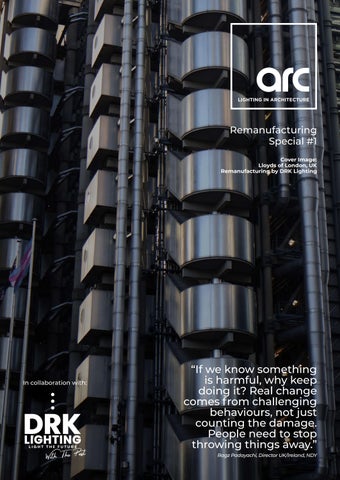
Remanufacturing Special #1 Cover Image: Lloyds of London, UK Remanufacturing by DRK Lighting
In collaboration with:
“If we know something is harmful, why keep doing it? Real change comes from challenging behaviours, not just counting the damage. People need to stop throwing things away.” Ragz Padayachi, Director UK/Ireland, NDY
TEL: 07786 805953 TEL: 07786 805953
Welcome
Matt Waring Editor, arc magazine
D’Arcy May Marketing Director, DRK Lighting
What you hold in your hands now is a piece of history, as we at [d]arc media are incredibly proud to present to you our first ever Remanufacturing supplement. Brought to you in close collaboration with the good people at DRK Lighting, this mini-magazine aims to demonstrate the huge benefits that a more sustainability-minded approach can bring. As an industry, the lighting world has garnered a lot of attention for its environmental impact, particularly when it comes to energy usage in the built environment. But, what is encouraging is the efforts that we have already seen take hold up and down the lighting sector. Regular readers of arc magazine will be familiar with our recurring comment pieces from the GreenLight Alliance, who have done great work in promoting more circular practices. I also don’t need to tell you about the introduction of CIBSE’s TM65.2 and TM66 documents, geared towards embodied carbon and circularity respectively, which have received widespread acclaim since their publication.
In amongst these efforts has been a growing push towards remanufacture and reuse of luminaires themselves, revitalising products and giving them a new lease of life elsewhere. This is an area where DRK Lighting is really excelling. Working with them on this supplement has been an inspiring journey of discovery for myself, as I have learned more about their sustainable approaches. Throughout this supplement, you will find a range of projects, stories, and comments citing real-world examples of remanufacturing in action, and of the positive benefits that this can bring in terms of energy cost savings, carbon emission reductions, and meeting safety standards. But also, beyond this, the knowledge that you are doing the right thing. As D’Arcy says below, there is a long way to go, but one of the best ways to make a difference is through sharing knowledge and expertise. That is what we hope to achieve in what is hopefully the first of many supplements on the subject. I hope you enjoy reading!
Sustainability is no longer a conversation happening at the edges of our industry. It’s something that increasingly shapes the decisions we make, the way we work and, ultimately, the future we’re building. That’s what inspired this special remanufacturing edition. As Marketing Director at DRK Lighting, I’ve had the privilege of working closely with arc and [d]arc media to bring this collaboration to life, from the initial idea through to the stories, case studies and conversations you’ll find across these pages. Our aim was to create something that goes beyond simply talking about sustainability. We wanted to highlight the progress already being made, share ideas that others can learn from and, importantly, encourage more of our industry to consider what we can each do differently. There is no single answer, and we still have a great deal of work ahead of us. But meaningful change
rarely happens all at once. It comes from better choices, shared knowledge and a willingness to keep pushing things forward. Writing this first remanufacturing edition of arc magazine has been an exciting opportunity for me both professionally and personally. As a vegan and someone who cares deeply about the environment, bringing attention to sustainable options in the lighting industry matters to me. A huge amount of thought has gone into what you’re holding, and I’m incredibly proud to see the collaboration come to life. I hope it leaves you not only feeling positive about where our industry is heading but inspired to be part of what comes next. This remanufacturing special edition supplement will hopefully evolve into a full edition with a wide range of contributors, of which DRK Lighting will be one of them.
Front Cover: Lloyds of London, UK
EDITORIAL Managing Editor Helen Ankers h.ankers@mondiale.co.uk Editor Matt Waring m.waring@mondiale.co.uk
Inside this issue
Guest Editor D’Arcy May darcy@drklighting.co.uk
Features 012
014
024
032
042
044
The White Cube Learn more about DRK’s purpose-built remanufacturing facility. The Black Box In-house photometric testing in its own “Black Box”, DRK is giving lighting designers greater confidence in remanufactured luminaires. In Focus Martin Nott details how and why remanufactured luminaires can still deliver the same quality as their original counterparts. Talking With Darren Roper-Knight makes the case for remanufacturing as the best option for truly sustainable practices. Inside DRK Lighting ‒ Upcycling as an art form DRK demonstrates its in-house commitment to circularity at its Shoreditch showroom. Investing in a Sustainable Future Through two charitable initiatives with DLAG and South Thames College Group, DRK Lighting is giving back to the community and investing in the next generation.
Comment 016
018
036
038
048
Online Editor Sarah Cullen s.cullen@mondiale.co.uk
From the Fringes to the Frontline Ray Molony believes remanufacturing will be a key asset in tackling the industry’s carbon emissions
Assistant Editor Ellie Walton e.walton@mondiale.co.uk
Remanufacture is the New Superpower Breaking down the “hierarchy of sustainable lighting, Greta Smetonuite examines why remanufacturing is the most effective approach towards a sustainable future.
COMMERCIAL Managing Director Paul James p.james@mondiale.co.uk Head of Business Development Jason Pennington j.pennington@mondiale.co.uk
The Big Question Will the UK soon have a “remanufacture first” principle for commercial lighting?
International Account Manager Andrew Bousfield a.bousfield@mondiale.co.uk Events & Marketing Manager Moses Naeem m.naeem@mondiale.co.uk
People We Love Working With D’Arcy May, Marketing Director at DRK Lighting, highlights several companies that match its circular mindset.
DESIGN
Hope Meadow: Putting Carbon in our own Hands After assessing its own carbon footprint, DRK has invested in its own orchard, as a means of addressing its impact.
Design Manager David Bell d.bell@mondiale.co.uk Design Jez Reid j.reid@mondiale.co.uk Production Mel Capper m.capper@mondiale.co.uk
Projects 006
8 Angel Court NDY
CORPORATE
008
Timber Square Hoare Lea
Chairman Damian Walsh d.walsh@mondiale.co.uk
022
Solaris dpa lighting consultants
026
BP ICBT DRK Lighting
028
Atelier Ten Headquarters Atelier Ten
030
Finance Director Amanda Giles a.giles@mondiale.co.uk Credit Control Lynette Levi l.levi@mondiale.co.uk [d]arc media ltd Strawberry Studios, Watson Square, Stockport SK1 3AZ, United Kingdom T: +44 (0)161 464 4750 www.arc-magazine.com ISSN 1753-5875
AELTC Centre Court DRK Lighting
arc (ISSN No: 1753-5875) is published bi-monthly by [d]arc media limited, UK and is distributed in the USA by ePost Global / Spatial, 1250 Valley Brook Ave, Lyndhurst NJ 07071. Periodicals postage paid at So Hackensack NJ. POSTMASTER: send address changes to arc, c/o ePost Global, 18 CENTRAL BLVD, S HACKENSACK NJ 07606. Mailed by Spatial Global · Printed by Buxton Press · To subscribe, visit www.arc-magazine.com or call +44 (0)161 464 4750.
CBP037567
DRK DRK LIGHTING LIGHTING
ith he ast
P With T he ast
LIGHT THE FUTURE
W
Download our eBook for FREE FOR MORE INSIGHTS ON S U S TA I N A B L E L I G H T I N G
d a o l n w o d o t Scan
DOWNLOAD YOUR FREE EBOOK
8 Angel Court London, UK During the refurbishment of 8 Angel Court, NDY turned to DRK Lighting to remanufacture the existing lighting stock. NDY Director UK/Ireland, Ragz Padayachi, explains the process.
At 8 Angel Court, Fairlift Estates wanted to refurbish its vacant office floors to become a new home for its occupier, Borchard Lines, while retaining the quality of the existing building fabric. The lighting strategy became a key part of that brief. Rather than replace the original Zumtobel fittings outright, the team explored whether they could be remanufactured and upgraded from compact fluorescent to LED. That approach preserved the look of the existing luminaires, reduced waste, and improved operational efficiency. It also supported the client’s wider aim of improving carbon performance across the building without compromising the occupant experience. The Challenge The existing lighting still suited the character of the office floors, but the compact fluorescent technology was no longer aligned with the building’s performance objectives. New fittings would have delivered an energy improvement, but they also would have meant discarding a large quantity of usable luminaire chassis. The project team needed a solution that balanced several priorities: • retain the established aesthetic of the office space • improve energy performance and operational carbon efficiency • reduce waste from unnecessary replacement • support the refurbishment budget • maintain a high-quality lighting outcome for future tenants For a building being repositioned for long-term occupation, the question was not just what to replace. It was what to preserve, upgrade and improve. The Approach NDY reviewed the available options with Fairlift Estates, James Greenways of Louis De Soisson Architects and Alex Growcott, QS consultant of CHPgrp. During this process, remanufacturing emerged as the most considered solution. The team had recently approved DRK Lighting as a luminaire manufacturer on NDY’s approved manufacturers list. DRK’s remanufacturing model offered a practical way to reuse the existing luminaire chassis while replacing the lamps and drivers with LED kit. This gave the project a clear benefit: the fittings could be modernised technically without losing the visual qualities that mattered to the client and architect. It also reduced embodied waste by
006 / 007
keeping the existing chassis in service for longer. The decision sat well with the project’s broader performance agenda. NDY focused on whole-oflife carbon efficiency, operational performance and NABERS UK targeting criteria, while keeping the lighting solution appropriate for a high-quality commercial office refurbishment. Key Outcomes The remanufacturing option delivered a balanced result across carbon, cost and quality: • lower operational energy use through LED conversion • reduced waste by retaining existing luminaire bodies • preservation of the established lighting aesthetic • improved alignment with the client’s carbon and refurbishment goals • a more considered use of budget than full replacement • a lighting strategy suited to long-term occupation The result was not driven by a single metric. It was the product of looking at the asset, the tenant brief and the building’s future together. Impact on People and Place For the people using the building, the outcome matters in practical ways. The refurbished office retains a familiar visual character while delivering better lighting performance and lower energy demand. That supports a more comfortable and responsible workspace for future tenants, including Borchard Lines. For Fairlift Estates, the strategy also shows how a thoughtful retrofit can improve an existing building without defaulting to wholesale replacement. In this case, collaboration between client, design team and manufacturer helped turn a straightforward lighting upgrade into a lower-waste, lower-carbon outcome. Sustainability Outcomes The project demonstrates how remanufacturing can play a meaningful role in refurbishment. By reusing the luminaire chassis and upgrading the light source and control gear, the team reduced material waste and improved operational efficiency at the same time. It is a practical reminder that better environmental outcomes are not always achieved through complete replacement. Sometimes the smarter answer is to keep what works, improve what doesn’t, and design around the long-term performance of the building. www.ndy.com
PROJECT 8 ANGEL COURT
PROJECT TIMBER SQUARE
Timber Square London, UK Hoare Lea and the Timber Square development team are demonstrating that reuse, lower-carbon materials and performanceled engineering can reshape commercial development.
008 / 009
The core principles behind remanufacturing are relatively simple: retain value, extend useful life, reduce waste and avoid consuming new resources unnecessarily. Applying those principles to buildings, however, presents a much bigger challenge. At Timber Square in Southwark, London, developer Landsec and a multidisciplinary team including engineering consultancy Hoare Lea took on precisely that challenge. Rather than treating sustainability as an addition to a conventional commercial development, the project considered carbon, materials, energy and existing assets as fundamental parts of the design. This project aimed to minimise its environmental impact by achieving net-zero carbon in both construction and operation. It significantly reduced embodied carbon, cutting construction emissions by around 50% compared with a typical office development. The project also prioritised reuse by retaining and refurbishing approximately 80-85% of the existing 1950s printworks, while targeting very low operational energy consumption. The result is an ambitious workplace development that provides a useful case study for anyone interested in remanufacturing, circularity and resource efficiency. Timber Square comprises of the Ink Building and Print Building, combining new construction with the partial refurbishment and extension of a pre-existing building, totalling approximately 35,600sqm.
For Hoare Lea, having provided building services engineering, sustainability, fire engineering, acoustics, daylighting and other specialist expertise, the central question was one familiar to the remanufacturing sector: how much value can we preserve? Keeping the value already in the building The Print Building incorporates part of the site’s existing structure rather than simply demolishing it and replacing everything with new construction. Hoare Lea states that approximately a quarter of the existing Print Building – including its basement and structural frame, and its luminaires – was retained. That matters because buildings represent enormous stores of materials, energy and embodied carbon. When an existing structural frame is demolished, the environmental impact extends beyond the waste leaving the site. Replacement concrete, steel and other materials must be extracted, manufactured and transported before the new structure can even begin. Retention therefore follows much the same hierarchy that drives effective remanufacturing: preserve the highest-value component wherever possible before considering replacement or recycling. At Timber Square, combining retained structure with new construction allowed the development to preserve some of the carbon and material
investment already made in the site while delivering the performance expected from a modern commercial workplace. Lighting remanufacture Lighting remanufacture formed an important part of Timber Square’s wider approach to circularity and carbon reduction. Rather than replacing serviceable lighting with new products, the project team worked with DRK Lighting to retain and upgrade existing pendant luminaires and high-bay style downlights. This complemented the development’s broader low-carbon strategy. The existing fittings were dismantled, cleaned and refurbished before being rebuilt with modern LED technology and upgraded electrical components. Original luminaire housings were retained and repainted, while the high-bay fittings also incorporated bespoke 3D-printed mounting clips and upgraded optical accessories. The work was undertaken using DRK Lighting’s BSI 8887220 accredited remanufacturing process, with each luminaire fully tested to ensure it met current performance and safety standards. The approach delivered savings in both embodied and operational carbon. Remanufacturing is reported to have saved 1,663kg of embodied CO₂, while retaining existing materials accounted for a further
0.70 tonnes of CO₂e. At the same time, upgrading the fittings reduced annual energy consumption from 19,525kWh to 4,943kWh (a reduction of approximately 75%), with operational carbon emissions reduced by an estimated 2,819.81kg CO₂e per year. The lighting programme illustrates how Timber Square’s sustainability strategy extends beyond the building fabric to its individual components. By treating existing luminaires as assets to be upgraded rather than waste to be replaced, the project demonstrated how circular-economy principles can reduce embodied carbon and material waste while still delivering the performance, efficiency and reliability expected of a modern lighting installation. Measuring embodied carbon from the start Material decisions at Timber Square have been informed by whole-life carbon assessment from the project’s inception, rather than assessing environmental performance only after the design has effectively been fixed. That distinction is crucial. By evaluating embodied carbon during design, engineers can compare structural options, retained elements, material quantities and building systems while there is still an opportunity to change them.
Landsec’s published sustainability data reported a forecast upfront embodied-carbon intensity for Timber Square of 535kgCO₂e/m² for RICS Modules A1-A5, representing a 47% reduction against the typical office benchmark used in that report. Landsec additionally reported a figure of 448kgCO₂e/m² when sequestration was taken into account, while noting that its baseline figure excludes sequestration in accordance with relevant industry guidance. Natural and recycled materials Landsec and Hoare Lea identify the use of natural and recycled materials as part of the development’s approach to reducing embodied carbon. This creates an important hierarchy within the project. First, retain useful existing construction and reduce the amount of new material required. Then, where new materials are necessary, select lower-carbon, natural or recycled alternatives where technically appropriate. And finally, understand those choices through whole-life carbon assessment. For the remanufacturing industry, this is very familiar. Recycling remains important, but preserving an existing high-value asset will often retain considerably more of the energy, labour and material invested in it than
PROJECT TIMBER SQUARE
“My vision for the future of the lighting design industry is one that wholly, gleefully embraces circular and low-carbon solutions. I would love to never hear the phrase ‘we’ll do it like we did last time’ ever again: the time for repeats is long gone, and we must all strive to be more agile, creative thinkers and do-ers. While this new era of design can feel complicated to learn, and many parts of the construction sector are slow to adapt, we must challenge ourselves to be lifelong students alongside our collaborators.” Kael Gillam, Senior Associate, Hoare Lea
breaking that asset back down into raw material. Timber Square applies that thinking at building scale. Engineering out the performance gap Circularity alone cannot make a building sustainable. A structure designed to last for decades must also consume dramatically less energy during those decades. Timber Square therefore combines embodiedcarbon reduction with an ambitious operationalenergy strategy. The project became the first in the UK to receive a NABERS UK 5-Star Design Reviewed Target Rating under the Design for Performance process. The significance is the emphasis on measured performance. Buildings have historically suffered from a gap between predicted energy use during design and actual consumption once occupied. Design for Performance attempts to tackle this by establishing measurable operational-energy targets and incorporating the engineering and metering needed to verify them. Hoare Lea worked with the wider team to optimise the building façade and developed an all-electric building-services solution, supported by detailed simulation. The project incorporates air-source heat pumps, renewable electricity and NABERScompliant metering so that actual consumption can be measured during operation. For manufacturers, there is a clear parallel. Designing a product that should consume fewer resources is only part of the task. Measuring what happens in service provides the evidence needed to demonstrate whether the design has been successful. Designing the façade around environmental conditions Energy efficiency also influenced Timber Square’s architecture. Hoare Lea worked with architect Bennetts Associates to analyse daylight, solar gain and overheating across different elevations of the development. Rather than applying an identical façade treatment everywhere, the design responds to orientation
010 / 011
and environmental conditions. Parametric analysis was used to optimise combinations of solid, translucent and clear façade elements, balancing cooling demand against access to useful daylight. This contributes both to lower energy demand and to occupant wellbeing. It demonstrates another useful resource-efficiency principle: optimise the requirement before designing the system that serves it. Reducing unwanted solar gains, for example, can reduce cooling demand before mechanical equipment is selected. The most sustainable unit of energy is ultimately the one the building never needs to consume. Designing for people as well as carbon Sustainability at Timber Square is not limited to carbon accounting. The development includes terraces and roof gardens, landscaped public areas and a new public realm between its buildings. Hoare Lea describes its approach as human-centric and health-focused, with occupational comfort, physical and mental wellbeing considered alongside environmental performance. Daylight was consequently treated as an integral part of the design. The project therefore illustrates a wider definition of sustainable value: one encompassing materials and carbon, but also health, accessibility, landscape and the relationship between a development and its surroundings. Creating social and economic value A genuinely circular economy ultimately needs to create more than environmental benefits. Hoare Lea reports that Timber Square has the potential to generate £205million in social and local economic value. That places the project’s environmental ambitions within a wider understanding of sustainability covering environmental, human, social and economic outcomes. This is increasingly relevant to remanufacturing businesses. Extending product life and retaining materials can reduce environmental impact, but
circular business models can also support skilled employment, local supply chains, repair capability and economic resilience. The strongest sustainability strategies recognise these outcomes as connected rather than competing priorities. Timber Square’s philosophy • Keep what still has value • Avoid unnecessary raw materials • Choose lower-carbon materials where replacement is required • Measure impacts across the whole lifecycle • Design systems for efficient operation and human wellbeing • Use evidence to demonstrate performance • And create assets capable of remaining useful for the long term
These principles are becoming increasingly important as construction confronts the carbon associated not only with operating buildings but with producing the buildings themselves. The thinking that went into the Timber Square development is perhaps the project’s most valuable lesson for the remanufacturing sector: circularity cannot simply be added at the end of a linear process; it has to influence the decisions made at the beginning. A building as a material bank Perhaps the most useful way to view Timber Square is not simply as two new office buildings, but as a long-term store of materials and carbon. Some of that value comes from the existing structure that has been retained. Some
comes from the timber’s sequestered CO2 incorporated into the new development. Some comes from remanufacturing. And some comes from engineering a workplace intended to consume less energy throughout its operational life. The challenge for the next generation of buildings will be to push this thinking further: designing structures and building systems so that components can eventually be maintained, removed, refurbished, remanufactured and reused rather than becoming demolition waste. Timber Square serves as proof that this is all possible. www.hoarelea.com
The White Cube: Designing a Future for the Lighting of the Past Furthering its commitment to remanufacturing, DRK Lighting tells us about The White Cube ‒ its purpose-built remanufacturing facility.
For lighting designers, sustainability is increasingly about more than specifying an efficient light source. It means thinking about the entire life of a luminaire: what happens when components fail, technology moves on, or a space is refurbished? Does the fitting have to be replaced, or can it be renewed? At DRK Lighting, we are adamant that the most sustainable lighting already exists. That dynamic thinking is behind The White Cube, our purpose-built remanufacturing facility: a controlled environment where existing luminaires can be assessed, disassembled, restored, upgraded, tested and returned to service. It is a space designed around a simple proposition: instead of starting again, what if we start with what we already have? From replacement to renewal Lighting technology has advanced rapidly, but the physical products that house it often have much longer potential lives. A luminaire may have been designed around an incandescent lamp or an earlier generation of LED technology, yet its body and other components can remain perfectly usable. In other cases, a fitting may have particular aesthetic, architectural or historical value that makes replacement undesirable. Remanufacturing provides a lifeline. Within The White Cube, luminaires move through a defined process of collection, assessment, disassembly, cleaning, reprocessing and reassembly, in full accordance with BS8887_220, before undergoing rigorous testing and recertification. Depending on the fitting and project, this can involve converting an incandescent luminaire to LED, replacing damaged parts or wiring, manufacturing replacement components, or integrating contemporary control technologies such as DALI or Bluetooth Controls. The objective is not simply to repair an old fitting. It is to create a product capable of performing for its next chapter and outperforming its last.
“For me and my Remanufacturing Division, the dedicated enhanced facility, along with our 3D printing farm and custom-made ultrasonic bath, makes the remanufacturing process a lot simpler.” Aaron Dever, Head of Remanufacturing, DRK Lighting
012 / 013
Inside The White Cube The facility itself has been organised into dedicated zones corresponding to different stages of the remanufacturing process. “For me and my Remanufacturing Division, the dedicated enhanced facility, along with our 3D printing farm and custom-made ultrasonic bath, makes the remanufacturing process a lot simpler.” says Aaron Dever, DRK’s Head of Remanufacturing. Fittings can be carefully disassembled before individual components are assessed and separated for cleaning, reuse, replacement or modification. An allocated materials recovery area allows components to be sorted and restored, with processes including ultrasonic cleaning in our custom-built bath, dust removal and polishing. Where replacement or modification is required, technologies including laser cutting, 3D printing and calibration equipment give us the ability to create custom components with precision while minimising unnecessary material use. This combination of traditional hands-on knowledge and contemporary manufacturing technology is important. Remanufacturing is rarely a one-size-fits-all exercise. Existing luminaires arrive with different histories, materials, construction methods, and technologies, so the ability to respond intelligently and flexibly to each product is fundamental. Understanding the product’s journey Traceability is another important part of this process. The White Cube operates within a controlled climate and has 24-hour monitoring capabilities, allowing the journey of a luminaire through the facility to be recorded and observed. Individual components are also tagged with their own passports, making them easier to identify and reorder when necessary. For designers, this points towards a different relationship with lighting products: one in which a luminaire is not treated as a sealed object with a fixed lifespan, but as an assembly of identifiable components that can potentially be maintained, replaced and upgraded over time. What does remanufacturing mean for lighting design? The conversation around sustainable specification has understandably focused on efficiency, embodied carbon, materials and new-product innovation. But remanufacturing introduces another question into the design process: Does this project actually need a new luminaire? In refurbishment projects, the answer is not always yes.
Existing fittings can form part of the project’s initial material resource. Their potential can be assessed alongside the other design considerations of the scheme: photometric performance, aesthetics, controls, energy consumption and compliance. That does not mean retaining products regardless of their condition or suitability. Remanufacturing must deliver performance, and understanding what is genuinely worth retaining needs to happen before design decisions are made. As part of the process, DRK can deploy a dedicated team to survey the existing installation on the designer’s behalf, assessing each fitting individually and identifying which luminaires are suitable for remanufacture. The findings are documented in a detailed report, giving the design team a clear picture of what can be retained, what may require intervention and what should be replaced. This allows remanufacture and replacement to be considered side by side at the outset of a project, rather than sustainability becoming a compromise later in the design process. Any fittings selected for remanufacture then move
through The White Cube’s controlled process, with rigorous testing and recertification forming an integral part of their return to service. The opportunity is therefore not about choosing between design quality and sustainability. It is about exploring whether existing products can be transformed to satisfy contemporary requirements. Designing with the next life in mind Perhaps the bigger opportunity is what remanufacturing can teach us about how lighting is designed and specified in the first place. If luminaires are expected to have multiple lives, considerations such as disassembly, component identification, replaceability and upgradeability become increasingly valuable. A fitting that can be opened, understood and adapted is fundamentally different from one whose useful life is dictated by its first failed or obsolete component. For lighting designers, that creates the possibility of thinking beyond the immediate installation. A specification can consider not
only how a product will perform on day one, but how it might be maintained, adapted and renewed years into the future. Light the future with the past The White Cube provides DRK Lighting with a dedicated environment to explore that future. It allows us to take luminaires approaching obsolescence and investigate what can be retained, what needs to change and how contemporary technology can extend their useful life. More importantly, it represents a shift in mindset. For decades, innovation has often been associated with making something new. Remanufacturing asks us to recognise another form of innovation: applying new thinking, technology and craftsmanship to the resources already around us. As the lighting industry continues to examine how it can reduce waste and extend product lifecycles, the question for designers may increasingly move from “What should we replace this with?” to “What could this become?” At DRK Lighting, we’ve titled that to Light the Future with the Past.
The Black Box: Putting remanufactured lighting to the test Through its own “Black Box”, DRK Lighting is using in-house photometric testing to give lighting designers greater confidence in remanufactured luminaires.
As the lighting industry moves towards a more circular future, remanufacturing presents a significant opportunity. Rather than discarding complete luminaires at the end of a conventional product cycle, existing products can be recovered, rebuilt and returned to service, retaining valuable materials while incorporating current lighting technology. For lighting designers, however, there is an important question behind any remanufactured product: how do you know exactly what you are specifying? A luminaire may have been carefully rebuilt and upgraded, but its value to a lighting designer ultimately depends on predictable, measurable performance. Photometric data needs to reflect the product being supplied, rather than assumptions based on what that luminaire once was. At DRK Lighting, this is where The Black Box, our purpose-built lighting testing and compliance laboratory, becomes an important part of the remanufacturing process. From remanufacturing to re-engineering Remanufacturing a luminaire is about more than replacing a failed component. Existing housings, reflectors and other valuable elements can potentially be retained while light sources, drivers and other components are assessed and upgraded. The result can extend the useful life of the original product while reducing the need to manufacture an entirely new luminaire. But changing the optical or electrical components of a fitting can also change the way it performs. For the lighting designer, that distinction matters. A remanufactured fitting needs to be treated as an engineered lighting product in its own right, with performance that can be measured, understood and incorporated confidently into a lighting scheme. That means testing becomes an integral part of remanufacturing rather than simply a final check. The Black Box DRK Lighting developed The Black Box as a controlled environment for photometric, electrical and compliance testing. 014 / 015
The dark laboratory environment is designed to minimise unwanted reflections and other variables that could affect measurements, allowing luminaires to be assessed under consistent conditions. At the centre of the facility is a LabSpion Goniophotometer, used to measure the luminous intensity distribution and output of a luminaire. Rather than relying on a theoretical performance, the luminaire can be measured to establish exactly how it distributes light through different angles. For designers, the result is practical information that can be used at specification stage. Photometric testing enables DRK to generate LDT and IES files for use within lighting design software, providing the data needed to model a remanufactured luminaire within a project. Why photometric testing matters in remanufacturing With a new luminaire, designers are accustomed to selecting a product and importing the manufacturer’s photometric file into their calculations. Remanufacturing introduces a different challenge. If an existing luminaire is fitted with a new LED solution, for example, its resulting output and distribution should not simply be assumed to match either the original fitting or another product using similar components. The interaction between the light source, optics, reflector, diffuser and physical construction of the luminaire determines its actual performance. Measuring the completed remanufactured fitting provides the missing link. It allows the designer to work with photometric information relating to the product that will actually be installed. That can be particularly valuable where existing luminaires form an important part of the architectural character of a building. Instead of automatically replacing them with new fittings, remanufacturing can potentially preserve that visual language while allowing their updated lighting performance to be incorporated into a contemporary scheme.
Data designers can work with The objective is to translate measured performance into information that is useful to those designing the space. Using data produced through our Goniophotometer, DRK can create photometric files for lighting calculations and provide performance information that can be incorporated into the designer’s normal workflow. This gives designers the opportunity to assess factors such as light distribution and output before installation and to evaluate how a remanufactured solution performs within the wider lighting design. It also creates a more informed conversation between designer and manufacturer, or remanufacturer. But how will the remanufactured luminaire actually perform? Testing beyond light output Optical performance is only one part of the process. The Black Box also incorporates electromagnetic compatibility testing, enabling DRK to carry out EMC verification during product development and remanufacturing. Bringing this capability in-house allows potential issues to be identified earlier and supports compliance with the relevant standards and regulations. For remanufactured lighting, this is particularly important. Retaining an existing luminaire body does not remove the need to consider the performance of the completed product after new electrical and electronic components have been introduced. Testing therefore provides a bridge between the circular ambition of retaining products and the technical responsibility of returning them to service. Making circularity easier to specify The environmental argument for keeping products and materials in use for longer is powerful, but circular lighting will only become a routine part of specification if designers can use it with confidence. To do so, designers need products that can be evaluated technically. They need reliable data for calculations. And they need confidence that a
remanufactured fitting has been considered as a complete luminaire rather than simply repaired or fitted with a replacement light source. This is the role DRK sees for The Black Box. By combining remanufacturing expertise with in-house photometric and compliance testing, DRK Lighting is working to make remanufactured luminaires easier to evaluate, easier to specify and easier to integrate into professional lighting designs. For lighting designers, the opportunity is significant: retain more of what already exists, while still designing with measured performance in mind. Remanufacturing does not have to mean compromising on lighting design. With the right engineering, testing and photometric data behind it, an existing luminaire can begin a new chapter, with its performance understood from the outset.
Ray Molony
From the Fringes to the Frontline With several lighting manufacturers turning their attentions towards remanufacturing, Ray Molony believes that the growth of this sector will be a key asset in tackling the industry’s carbon emissions.
The growth of the remanufacturing sector will be a key asset in tackling the lighting industry’s carbon. The publication you’re holding shows just how far remanufacturing has come in such a short time. Once a fringe activity, it’s increasingly moving to the frontline in the battle to tackle the industry’s carbon emissions. I’d like to congratulate DRK Lighting on the initiative for the supplement, because we need to put the refurbishment and reuse of luminaires up there as one of the first options to consider in a lighting upgrade. DRK is one of a growing number of Original Equipment Remanufacturers, or OERs, in the sector and it’s wonderful to see so many make a commercial success of the business model. That’s key to making this a sustainable and thriving sector. Remanufacturing is emerging as one of the most practical routes towards a genuinely circular lighting industry – and, as you’d expect it has a prominent place in the programme for this year’s Circular Lighting Live. DRK Lighting is backing the event as a gold sponsor, and a representative will discuss its growing capabilities under BS8887 and some of its remanufacturing case studies. Rather than accepting that a luminaire’s useful life ends when a project is refurbished, remanufacturing asks a more fundamental question: what can be retained, upgraded and put back into service? That question is also explored in ‘Engineering a second life’ where Thomas Bray will introduce a new remanufacturing service designed to keep luminaires in the ceiling, regardless of their original brand or format. Using BS8887 as its framework, the initiative aims to upgrade and re-warranty existing fittings, extending their service life while improving energy efficiency and reducing embodied carbon. The programme then moves from the concept to the reality of a heritage project. ‘Leadenhall Market: Remanufacturing with a Victorian soul’ looks at how Light Projects Evolve remanufactured and
016 / 017
upgraded the historic fittings at one of London’s best-known Victorian landmarks. A new LED light source was developed while retaining the character and aesthetic of the original fittings - demonstrating how remanufacturing can preserve both material value and architectural identity. But Circular Lighting Live will also confront the less comfortable side of reuse. In ‘This is going to hurt: six lessons from the reuse frontline’, lighting designer Paul Beale recounts the experience of redeploying 180 luminaires from a Cat A fit-out into a Cat B project at British Land’s London headquarters. The successful outcome came only after overcoming a series of practical obstacles, offering hard-won lessons for anyone attempting reuse at scale. And the challenge extends beyond individual projects. A dedicated Confronting Cat A session examines alternatives to the wasteful default of removing and discarding luminaires, including emerging models such as luminaire leasing and the real-world difficulties of finding new homes for barely-used fittings. Together, these sessions make a compelling case that circular lighting is not simply about designing better products. It is about finding ways to keep the products we already have in productive use for much longer. Circular Lighting Live 2026 takes place on Thursday 8 October at the Minster Building in the City of London and is free to specifiers. www.circularlighting.live
the gauntlet to the Lighting Industry. It will set the vision for the next decade and a half, showing how “business as usual” will be
2040
CIRCULAR LIGHTING LIVE 26 will throw down
VISION
BOOK YOUR PLACE AT
THE MINSTER BUILDING EC3R 7AG
BUILD BACK BETTER AWARDS 26 will take place at Circular Lighting Live, celebrating and rewarding creativity, innovation, social purpose and environmental leadership in lighting.
replaced with new business models and technologies, driven by new market and regulatory forces.
A
CONFERENCE
‘26 Attendees can choose from six specially curated sessions: A
B
D
C
E
F
Metrics Masterclass
Future Lights
Disruptive Design
Confronting Cat A
Projects Uncovered
Materials Masterclass
From EPDs to DPPs
Next-gen luminaires
The role of designers
Six ways to cut waste
Real World Lessons
Low carbon alternatives
circularlighting.live | Book Now! FREE for Lighting Specifiers - Independent fee-based lighting designers, architects, consulting engineers, wholesalers, and end-users.
HEADLINE SPONSOR
Remanufacture is the new superpower Greta Smetonuite of WSP breaks down the “hierarchy of sustainable lighting”, examining why remanufacturing is a process that, while overlooked by some, is a more effective approach towards a sustainable future. COMMENT GRETA SMETONUITE
The language around sustainability is often assumed to be new; in reality, the fact that Earth’s resources are finite has been discussed since the Eighteenth Century. Thomas Malthus, in An Essay on the Principle of Population (1798), warned that growth could outpace the means that sustain it. Rachel Carson, in Silent Spring (1962), exposed the violence of treating nature as an endless backdrop to progress. Donella Meadows and her co-authors, in The Limits to Growth (1972), made the point even harder to ignore: extraction, production, and expansion cannot continue forever without consequences. These early warnings are now visible signs of strain on the planet. The UN 2030 Agenda, the EU’s climate-neutral 2050 target, and the UK’s net zero commitment all point in the same direction: use less, waste less, and learn to value what is already here. In that context, remanufacture begins to feel less like a niche technical choice and more like part of a broader shift in collective perception. A circular consciousness that asks us to see existing materials, products and structures not as expired, but as still full of use, value and with a future. The real hierarchy of sustainable lighting For nearly two decades, the lighting industry has framed sustainability primarily in terms of energy efficiency and LED upgrades. While these advances have dramatically reduced operational electricity demand, the next stage of sustainable lighting is shifting away from efficiency alone and toward lifecycle thinking. The urgency of this shift becomes clearer when viewed against the scale of the built environment itself. Globally, buildings account for around 34% of energy demand and 37% of energy- and processrelated CO₂ emissions. Total global building floor area is projected to grow by roughly 230bn square metres by 2060, meaning the sector cannot rely on efficiency gains alone while continuing to expand materially at such scale.
018 / 019
Within Europe, and broadly likewise in the UK, most of the buildings that will exist in 2050 are already standing today. European policy sources estimate that 85-95% of today’s buildings will still be standing in 2050, while much of that stock remains energy inefficient. This means decarbonisation targets are unlikely to be met through new construction alone; they depend heavily on how effectively existing buildings are upgraded, renovated and maintained. Lighting remanufacturing paves the way. By preserving the luminaire structure and replacing only key components such as the LED engine, driver and controls, it follows the basic logic of circularity: keep products and materials at their highest utility for as long as possible. Advanced technology should not only be efficient; it should also be adaptable, repairable and built to last. Our Sun remains the most efficient light source available, yet it is still underused in practice. Despite being central to standards such as BREEAM, WELL, and LEED, daylight analysis is not consistently integrated into the early stages of lighting design. In practical terms, many lighting installations are still designed as if daylight were not present at all. Where daylight-responsive controls are implemented, studies show that lighting energy consumption can be reduced by 20-60%, particularly in perimeter office zones and educational buildings. However, these strategies should sit alongside a more fundamental question. Before designing a new luminaire scheme, the industry may need to ask a simpler one: What if “waste” is simply a resource that is currently in the wrong place? Are standards the reflection of this? If the hierarchy is to keep what already exists, make better use of daylight, and then apply controls and upgrades intelligently, the standards are emerging to support that logic. Across the UK, the most relevant lighting frameworks no longer judge a scheme purely by
installed efficiency. They increasingly view lighting as part of a broader environmental and human context: energy use, controllability, visual comfort, daylight response, and suitability for spaces with varied or prolonged occupancy. In regulatory terms, Approved Document L reinforces the need for lighting to be efficient in use, not only efficient as a product. Professional guidance such as the SLL Code for Lighting, LG7 and BS EN 12464-1 pushes designers toward more appropriate lighting for task, occupancy and comfort. Meanwhile, broader sustainability frameworks such as BREEAM and WELL extend the conversation further, connecting lighting to daylight, user control, wellbeing and long-term building performance. Taken together, these standards point toward a more layered understanding of lighting design. The question is no longer only how to install efficient luminaires, but how to create lighting systems that are adaptive, responsive and sustainable over time. That matters particularly in buildings with changing patterns of use. If occupation is partial, prolonged or unpredictable, then rigid replacement-led schemes can quickly become wasteful. A remanufactured luminaire, upgraded with modern optics and controls, can often meet contemporary design expectations while retaining the embodied carbon already invested in the original fitting. Within this framework, the standards are gradually moving closer to the hierarchy itself: first reduce need, then respond to people and daylight, and only then decide what genuinely needs to be replaced.
Could carbon counting be hypocritical? (And what players may have benefitted from this exercise?) As lifecycle carbon accounting becomes more widespread through methodologies such as TM65, life-cycle assessment (LCA) and environmental product declarations (EPD), the environmental advantage of remanufacturing is becoming increasingly clear. These tools matter because they help make impact visible. They allow designers, manufacturers and clients to quantify what has too often been hidden: the carbon tied up in materials, manufacturing, transport and replacement. In that sense, carbon counting has been an important step forward. It has given the industry a language, a set of metrics, and a way to compare decisions that were once judged largely on cost, compliance, or aesthetics alone. Those numbers are beginning to tell a consistent story. Avoiding new manufacturing often delivers greater carbon reductions than simply optimising the manufacturing of a brand-new product. Aluminium housings dominate the embodied footprint of many luminaires, so retaining the body preserves the most carbon-intensive part of the fitting. This is why remanufacturing can reduce product-stage emissions by around 70-85%, while LED upgrades can still reduce operational electricity use by roughly 40-70%. The numbers matter. They reveal that the most effective carbon saving may not always come from making a better new product, but from refusing to make one unnecessarily. And yet, metrics alone can sometimes obscure the broader question.
COMMENT REMANUFACTURE IS THE NEW SUPERPOWER
A newly manufactured luminaire with a low embodied-carbon rating still requires new materials, new manufacturing processes and global transport logistics. Remanufacturing avoids much of that process entirely. From this perspective, avoiding manufacturing may be more important than low-carbon manufacturing. Carbon counting is useful, but it can become strangely selfcongratulatory if it only serves to optimise replacement rather than challenge it. The conversation around sustainability in the UK may have been hijacked by foreign manufacturers with an agenda to keep their machines whirring. To decide that counting all the continual damage done is a perverse decision when ultimately it is not actually applying a handbrake to manufacturing lighting. It’s recording the damage versus stopping the damage. An uncomfortable truth is that “sustainability”, as it is often practised today, is not about making things better; it is about keeping things the same, but with less guilt. Real change requires a painful, fundamental restructuring of well-established systems. If the industry is serious about sustainability, then counting carbon cannot be the end of the conversation. It has to lead somewhere more difficult: toward manufacturing less, retaining more, and questioning whether replacement was necessary in the first place. Carbon counting is at its most useful when it stops being a performance of environmental virtue and starts becoming evidence for circular action.
“An uncomfortable truth is that ‘sustainability’ as it is often practised today, is not about making things better; it is about keeping things the same, but with less guilt. Real change requires a painful, fundamental restructuring of well-established systems. If the industry is serious about sustainability, then counting carbon cannot be the end of the conversation.”
020 / 021
A potential tipping point: perception of value and aesthetic Many industries have already begun shifting towards reuse. The fashion sector is one visible example, where second-hand and vintage platforms have helped reframe used products not as inferior, but as desirable, characterful and responsible. Lighting has long had its own version of this at the decorative end of the market. Antique and vintage luminaires have been repaired, restored and reinstalled for decades, often because their aesthetic, craft value, or material quality is considered worth preserving. The more interesting question is whether that mindset can now move from exceptional decorative pieces into mainstream commercial lighting. There are signs that it already is. In the wider UK fit-out sector, organisations such as FIS are actively promoting circularity, whole-life carbon thinking, and reuse across the construction supply chain, including growing interest in urban mining and project-based reuse. In lighting specifically, Recolight’s Reuse Hub has created a practical route for unwanted fittings removed from refurbishment projects to be identified, collected and redirected for reuse or remanufacture rather than sent straight to recycling. Most importantly, lighting design practices such as Hoare Lea, Speirs Major Light Architecture, and Max Fordham (to name a few) are happy to use remanufactured luminaires in their projects when given the chance. That distinction matters. Recycling is better than landfill, but it still accepts destruction as the default. Reuse and remanufacture begin from a different premise: that the fitting may still hold technical, material and aesthetic value. One point of contention is the idea that remanufactured luminaires can’t compete with new fittings in performance and endurance. DRK Lighting’s remanufactures, for example, are not only technically improved but also tested for full compliance, certified for UKCA and provided with a full seven-year warranty and 20 years of aftercare. As carbon-counting frameworks become more sophisticated and grid electricity becomes cleaner, the environmental argument for replacing functioning luminaires becomes harder to justify. The tipping point may come when the market stops seeing an existing fitting as old stock to be stripped out and starts seeing it as an asset: something that can be upgraded, re-valued and reused. At that point, remanufacture is no longer only a sustainability intervention. It marks a shift in perception from disposability to stewardship and from replacement culture to retained value.
The social and economic dimension of remanufacturing using a UK labour force While the environmental benefits of remanufacturing are increasingly recognised, its social and economic implications are often overlooked. Circular manufacturing models not only reduce carbon emissions; they also reshape how and where work is created. Traditional replacement-driven lighting supply chains tend to rely on globalised manufacturing networks. Raw materials are extracted, components are produced in large overseas factories, and finished luminaires are transported through complex logistics chains before arriving at a construction site. Much of the economic activity associated with these processes therefore occurs outside the UK. Remanufacturing reverses part of that model. Instead of replacing existing luminaires with newly manufactured products, it keeps much of the value chain local. Existing fittings are collected, inspected, upgraded and tested domestically, creating engineering, electrical and technical roles that remain embedded within the local economy. Research into circular economy employment suggests that remanufacturing and repairbased industries are significantly more labour-intensive than linear manufacturing systems. Studies conducted for the European Commission estimate that circular economy activities such as reuse, refurbishment and remanufacturing could generate substantial numbers of skilled jobs across Europe,
particularly in technical repair and engineering sectors. For the lighting sector, this creates opportunities not only for refurbishment work but also for innovation. Facilities dedicated to remanufacturing – such as DRK’s The White Cube laboratory – can act as small-scale research environments where engineers, designers and technicians develop new methods for upgrading existing lighting systems. These spaces enable experimentation with modular LED integration, adaptive optics, control technologies and even additive manufacturing techniques such as 3D-printed components for legacy fittings. Such environments play an important role in cultivating technical skills that might otherwise migrate to larger international manufacturing centres. By combining engineering, repair and product development, remanufacturing can help retain specialist knowledge within the UK while also creating opportunities for apprenticeships and early-career engineers. Viewed in this way, the sustainability benefits of remanufacturing extend beyond carbon counting. They also support a more resilient industrial ecosystem, one that values repair, longevity and innovation alongside efficiency. Circular design, therefore, becomes not only an environmental strategy but also a socioeconomic one: preserving materials already embedded in buildings while simultaneously supporting local skills, technological
experimentation and long-term employment. DRK’s own investment in working in accordance with BS 8887, expanding its remanufacturing capability through The White Cube, and supporting the lighting industry with remanufacture for over a decade reflects exactly that kind of deliberate choice. It is an example of a business investing not simply in compliance, but in a future model it believes is right; one in which circularity is not an add-on, but the basis of the business itself. DRK’s rally cry to ‘save the planet, one remanufacture at a time’ is now starting to be heard. That is also where the message to financial decision-makers becomes clearer. Circularity often asks for a different kind of confidence. It may require investment before the market fully catches up. It may be perceived as being slower than simple replacement. It may not flatter short-term procurement habits. But it is precisely this kind of conscious investment – in process, in local capability, in technical development and in long-life systems – that makes a circular business model possible later. Therefore, remanufacturing is not only an environmental strategy. It is also a financial and cultural choice about what kind of industry the UK wants to sustain: one built on repeated extraction and replacement, or one built on skill, adaptation, stewardship and long-term value. The answer, perhaps, is already apparent. Remanufacturing is the way forward for a more sustainable, planetconscious economy.
Solaris: When Remanufacturing Creates Art At this year’s [d]arc awards, dpa lighting consultants and DRK Lighting transformed discarded and existing materials into an immersive lighting installation, demonstrating that remanufacturing can be a creative tool as much as an environmental one.
What if the future of lighting design is not about continually making something new, but about seeing the potential in what already exists? That question sat at the heart of Solaris – an interactive installation created for the [d]arc awards through a collaboration between dpa lighting consultants and DRK Lighting. With Art being the theme of the awards, the project offered an opportunity to explore how lighting, engineering, creativity and circularity meet. DRK Lighting’s work is increasingly centred around remanufacturing and extending the useful life of existing lighting, Solaris was also an opportunity to make the principles of the circular economy tangible.
Images: Gavriil Papadiotis
022 / 023
From discarded materials to design Conceived and designed by dpa lighting consultants and brought to life through DRK Lighting’s engineering, remanufacturing and
fabrication expertise, Solaris took inspiration from the rising sun and the imaginative mechanical creations associated with illustrator and inventor William Heath Robinson. It also paid homage to Olafur Eliasson’s The Weather Project, the celebrated installation that transformed Tate Modern’s Turbine Hall through light, reflection, and an enormous artificial sun. The resulting installation combined light, movement and mirrored surfaces to create a kinetic experience that changed as visitors interacted with it. Approximately 85% of Solaris was constructed using recycled material. Scaffolding was recovered from a barn. Timber came from a skip. A micro-prismatic diffuser was reused. A steel cage began life as a fence. Cable offcuts found a new purpose, while 3D-printed components were produced using recycled PETG filament. The prism out of the core was made up of broken music CDs reconstructed into a mosaic that reflected light in all directions.
PROJECT SOLARIS
At the centre of it all were remanufactured lighting products. Materials that might otherwise have been regarded as waste became part of an installation designed to capture attention at one of the lighting industry’s major creative events. Remanufacturing as a creative process Remanufacturing is often discussed through the language of carbon, waste reduction and resource efficiency. These are important arguments, but Solaris highlighted another side of the process: its capacity to spark creativity and generate intrigue and conversation. Working with an existing product or material introduces constraints. Dimensions have already been determined. Components have a history. Materials may arrive with imperfections or characteristics that would not be specified when designing something entirely from scratch. But constraints generate innovation. As visitors moved around and activated the piece, coloured light interacted with mirrored surfaces and recycled materials, producing shifting reflections and patterns. The installation wasn’t intended to be left static; its appearance evolved through movement and participation. This design proved existing objects do not have to remain defined by their original function. With the right combination of design thinking, technical knowledge and engineering, it can begin another life. Collaboration between designer and remanufacturing Solaris also demonstrated the role collaboration can play in making circular design more ambitious. dpa lighting consultants developed the creative concept, with Ingo Kalecinski, Freddie Solum
Prentice and the dpa team working closely with DRK throughout its development. DRK then applied its knowledge of lighting engineering, remanufacturing and bespoke fabrication to translate that concept into a physical reality. It is an increasingly relevant relationship for an industry considering how to move towards more circular models. Remanufacturing cannot simply be treated as an intervention at the end of a product’s life. Its greatest potential emerges when designers, manufacturers, engineers and clients consider existing assets as part of the creative process from the outset. That shift changes the conversation around sustainability. Instead of circularity being a restriction placed upon design, it becomes another material to design with. Challenging the perception of ‘used’ One of the persistent barriers to wider adoption of remanufacturing is perception. New products arrive without history. Remanufactured products, by definition, have already had a life. For some, that can create an assumption that reuse requires a compromise in appearance, performance or quality. Projects such as Solaris offer a different narrative. The installation was intentionally expressive, playful and visually striking. Its use of reclaimed materials was not at odds with those qualities; it helped create them. Visitors encountered an artwork first. Behind that experience was a story about resources. The distinction matters because the transition towards a circular economy will require more than technically viable solutions. Designers and clients also need to see reused and remanufactured products as desirable choices with desirable outcomes. Solaris demonstrated that environmental responsibility and creative ambition can work in harmony in the design process.
Keeping value in circulation The lighting industry has a particular opportunity when it comes to remanufacturing. Existing luminaires contain housings, optical components and other materials into which energy, resources and manufacturing effort have already been invested. Removing an installation and automatically replacing every fitting with a newly manufactured equivalent can discard much of that embedded value. Remanufacturing asks whether that value can instead remain in circulation. A luminaire may be disassembled, assessed and upgraded with contemporary components while retaining suitable parts of the original product. The result can extend the useful life of existing assets while reducing demand for virgin materials and avoiding unnecessary waste. A different kind of showcase Solaris represented DRK Lighting’s first foray into the [d]arc awards, but the installation became more than an awards piece. It provided a physical demonstration of what remanufacturing can look like when sustainability is considered alongside creativity rather than after it. The response from designers, manufacturers and other lighting professionals was particularly significant. Interest centred not only on the visual experience, but on the materials and processes behind it, evidence of a wider shift taking place across the sector. As the lighting industry considers embodied carbon, material scarcity and the transition towards circular business models, the question is moving beyond whether existing products can be reused. The more interesting question is what designers can create when they begin with reuse in mind. Solaris was just one answer. www.dpalighting.com
Martin Nott
While some lighting specifiers may be sceptical of the quality and longevity of remanufactured lighting products, Martin Nott, Technical Director at DRK Lighting, allays those concerns, detailing how and why remaufactured luminaires can still deliver the same level of quality as their original counterparts.
What motivates you? A sense of injustice is one motivator; another is wanting to change attitudes and actions to create a better environment for my future grandchildren to live in. I have never been more disappointed than when I recently heard an old luminary of the UK lighting industry had rolled his eyes when he was being pitched UK remanufacturing because ‘’they could buy cheaper from foreign manufacturers’’. They were focusing purely on financial cost, not human cost. And the statement was largely incorrect anyway. Old values being expressed by long-toothed executives carry a lot of weight but need to be challenged by their younger subordinates who will be around in the next 30 years and will be experiencing global warming effects. Unless they take a stand now and practice truly sustainable circular-economy methods, rather than solely carbon-counting, our UN climate-limit trajectory remains unaltered. Hopefully, they will intrepidly break the shackles of these socalled titans of industry and bring about rapid change.
each type of fitting on its circularity merits. We have strong knowledge of all common fittings and know what can be easily upgraded and what must be swapped for new ones. Our bias is to renew, which is the only truly sustainable option in my opinion. Replacement is heavy on carbon when you consider mining raw materials, factory machinery, and transportation, which is energy intensive.
How long have you been working at DRK? A few years now; the time has flown. I have known the founders for decades and followed their company as they have grown. Once I realised they were serious about sustainability practices, it was only a matter of time until I joined the project. I had my own company, which focused on maintenance, upgrading, retrofitting and renewing. These are skills I had built up through experience over a long period of time. I found that my own greener interests aligned with DRK’s, and I could have a bigger impact on sustainable outcomes and reach a wider audience.
Do remanufactured fittings exhibit the quality and performance of new fittings? The simple answer is yes. At DRK, we have every conceivable testing machine to ensure the highest standards and performance. We stand by what we rebuild and supply a sevenyear warranty and 20-year duty care. DRK Lighting holds the BSI 8887-220 certification for remanufacturing, and we work to a methodical process that is transparent and well documented.
How do you decide what light fittings can be salvaged? We offer a free site survey so we can assess
024 / 025
Why do you think replacement light fittings still seem to be the preferred option? I’m not certain, but not enough has been done by the UK government to put pressure on stakeholders and specifiers to choose the sustainable option. I imagine there is a lot of outside pressures being exerted by European factories with their own agenda to keep the factories open and in profit. If the UK government decides it wants to re-skill and use its own labour force to extend the lifecycles of existing light fittings, a whole industry can quickly grow for the benefit of this country.
Are smart buildings conducive to remanufactured products? Yes, someone considering lighting controls, reducing energy consumption, and circadian rhythms is usually the same person considering remanufacturing. We regularly
receive requests to add these controls to our renewed and upgraded fittings. What documentation and data control is involved in remanufacturing light fittings? DRK document everything during the remanufacturing journey. We log all activity in detail, which is conducted in a fit-for-purpose ultra-clean environment. Traceability stickers are added so that each component can be easily identified and individually replaced if a malfunction or natural end of life occurs. Do you personally think things are now moving in the right direction? Right now, I would say maybe. The lighting industry’s ‘replace first’ attitude is being exposed more, and people can’t get away with being complicit as easily, but I feel our government needs to focus specifically on lighting and draft more legislation that should elicit good behaviours from stakeholders and influencers. But only the other year I heard that a government building in the centre of London asked for an assessment that proved that all the light fittings could be remanufactured to perform better than when they were new. The cost to replace was similar to the cost of remanufacturing. The supplier urged remanufacturing but would also supply new replacement fittings if that was the decision. The GPA decided to skip remanufacturing and replaced them all with new. For me, if governments are going to be the catalyst for change, they need to get their own house in order first. I do think change will happen soon and it will happen quickly, like turning on a light switch. I hope that we do something about the depletion of our planet’s natural resources due to industrialisation. If the government made me their Lighting Tsar tomorrow, I would be naming and shaming polluters and slapping heavy fines on those that fill skips with perfectly good light fittings.
DON’T KNOW WHERE TO START WITH REMANUFACTURE?
FREESITE SURVEY DRK have a team that will go to site on your behalf and do a report of each fitting that is salvageable for remanufacture, so you can decide whether to replace or Remanufacture based on detailed reports prior to doing the design. We also have an app, with the working title ‘Salvagable’, in development that will allow designers to do the assessment themselves to make this process as easy as possible.
026 / 027
PROJECT BP INTERNATIONAL CENTRE FOR BUSINESS AND TECHNOLOGY
BP International Centre for Business and Technology Sunbury-on-Thames, UK DRK Lighting remanufactured 8,500 light fittings across BP’s ICBT in Sudbury-on-Thames, offering benefits beyond energy efficiency.
At BP’s International Centre for Business and Technology (ICBT) in Sunbury-on-Thames, DRK Lighting was brought on for an ambitious remanufacturing project. Across 10 buildings, more than 8,500 existing fluorescent luminaires were remanufactured, retaining valuable existing materials while radically reducing the energy and cost required to light the campus. The 30-month programme is a powerful demonstration of what lighting remanufacturing can achieve at commercial scale. Rather than treating existing luminaires as waste, BP and DRK treated them as assets, extending their operational life while upgrading their performance, controls, and efficiency. The Sunbury site was vast and complex. Existing fluorescent fittings consumed 110W each, while the estate had accumulated four different wired lighting control systems across ten buildings. The result was limited dimming capability, compatibility problems, system failures and increasing maintenance requirements. With fluorescent lamps also being phased out, maintaining the existing installation in its original form was becoming increasingly difficult. BP wanted to retain the existing luminaires partly because of the construction of the ceilings. Removing thousands of fittings and replacing them with completely new luminaires would have introduced additional cost, disruption, waste and embodied carbon. Each fitting was converted from a 110W fluorescent system to a 21W high-efficiency LED solution while retaining its original housing. More than 8,500 luminaires received new LED boards, drivers and intelligent controls. Existing louvres were retained and ultrasonically cleaned in DRK’s custom-built ultrasonic bath, while new diffusers were introduced to improve light distribution and occupant comfort. Remanufacturing did not mean compromising on lighting performance. DRK designed bespoke LED boards in three lengths – 140mm, 280mm and 560mm – to work within BP’s existing luminaires. Where the original fluorescent fittings typically achieved around 81lm/W, the remanufactured LED solution achieved up to 190lm/W while maintaining like-for-like lighting output. The work was largely carried out using an in-situ remanufacturing process, helping minimise transport, disruption and waste. Installation was carefully zoned and undertaken out of hours by their own team where possible, enabling approximately 75% of the office estate to remain operational
during the programme. Components were also designed and assembled off-site where practical to reduce installation time at Sunbury. That ability to modernise a live corporate campus without the disruption associated with wholesale replacement is one of the less visible, but highly practical, advantages of remanufacturing. One particularly important area was the high-level lighting around the link and cafeteria – a central hub for the Sunbury site. Here, retrofit offered benefits extending beyond energy efficiency. High-level luminaires that were out, failing or flashing created an ongoing maintenance and healthand-safety challenge, simply because of the difficulty of accessing them. Extending luminaire life and reducing maintenance interventions therefore helped address both operating cost and the practical risks associated with maintaining lighting in difficult-to-reach areas. It illustrates why remanufacturing decisions should not be assessed purely through the purchase price of a fitting. Asset life, accessibility, maintenance, disruption, energy use and carbon all form part of the equation. The LED conversion was only one half of the transformation. BP’s buildings were also upgraded with HubSense Bluetooth mesh lighting controls. Smart drivers, wireless nodes, PIR occupancy sensors and daylight sensors allow lighting to respond to occupancy and available natural light rather than operating unnecessarily at full output. The scale is noteworthy. BP Sunbury was the largest single-site deployment of Bluetooth smart lighting controls in Europe at that time. The environmental argument for the project operates on two levels. First is embodied carbon: by retaining more than 8,500 existing luminaires, approximately 30 tonnes of lighting hardware was reused instead of being discarded and replaced. The project estimates that around 150 tonnes of manufacturing CO₂ were avoided as a consequence. Then comes the operational saving: converting the existing fluorescent luminaires from 110W to 21W produced more than 50% energy savings from the LED upgrade alone. Intelligent controls subsequently delivered an additional 60% reduction in lighting energy. Across the estate, annual lighting energy consumption is reported to have fallen from 6.83 million kWh to 1.46 million kWh, while annual operational carbon emissions have been
reduced by more than 1,036 tonnes of CO₂. That distinction matters for the remanufacturing sector. Decarbonising a building is not only about making the asset consume less energy once installed. It is also about asking how much existing material really needs to be replaced in order to achieve that improvement. At Sunbury, DRK demonstrated that the answer can be considerably less than first assumed. This project delivered environmental benefits, and the commercial case was equally significant. Avoiding complete luminaire replacement is calculated to have saved BP more than £600,000, while annual energy cost savings exceed £1.5million. The project achieved an estimated payback of approximately one year. Maintenance savings add another dimension. Emergency lighting testing had previously been costing approximately £125,000 annually; the new system has significantly reduced those ongoing testing and maintenance costs while improving compliance. For sustainability and energy teams, those numbers help challenge the assumption that circular solutions necessarily require a financial compromise. The significance of BP Sunbury extends beyond lighting. Commercial buildings across the UK contain enormous quantities of equipment that may be technologically outdated without being physically obsolete. The traditional response has often been replacement. At Sunbury, the housings and other serviceable components did not need to become waste simply because fluorescent technology had reached the end of its useful era. DRK retained that material, engineered new technology around it and effectively gave thousands of luminaires another life. The result is lighting consuming substantially less energy, incorporating intelligent Bluetooth controls, requiring less maintenance and providing improved lighting quality, all without the material footprint of manufacturing and installing thousands of completely new luminaires. For the remanufacturing, that may be the most important lesson from Sunbury. Net zero will require new technology. But it does not necessarily require new everything. BP and DRK Lighting demonstrated that some of the most significant carbon, cost and performance gains can come not from ripping out what already exists, but from recognising its residual value and engineering it for its next life.
Atelier Ten HQ London, UK Carrying its mantra of “shaping a more sustainable world” to its own workplace, Atelier Ten has implemented DRK’s remanufacturing processes to the lighting of its London headquarters.
Environmental design consultancy Atelier Ten has spent decades helping clients reduce energy, carbon and resource consumption. At its London headquarters, Atelier Ten has applied the same thinking to its own lighting, demonstrating how relatively modest interventions, such as remanufacturing, can deliver measurable results. For a consultancy whose mission is “shaping a more sustainable world”, decisions made within its own workplace inevitably carry a lot of weight. Atelier Ten has built its reputation around environmental design: analysing how buildings use energy and resources, how their systems perform over time, and increasingly, how embodied carbon can be designed out. Its London studio at Perseverance Works therefore provided an interesting testing ground for those principles, not as a showcase filled with experimental technology, but as a working office in which everyday procurement and maintenance decisions can reflect a broader environmental philosophy. Rather than remove the existing suspended linear luminaires and replace them with entirely new products, Atelier Ten chose to retain and remanufacture them, working with DRK Lighting to upgrade the fittings to LED. The intervention is comparatively small in the context of an entire building, but it represents something much bigger: a shift away from treating building-services products as disposable assets. And for Atelier Ten, that approach is very much in keeping with the direction of its wider sustainability work. Sustainability starts at home Atelier Ten’s commitment to reducing the environmental impact of its own operations is longstanding; the practice has previously described measures including natural ventilation, solar blinds and electricity monitoring. Its more recent Carbon Reduction Plan expands that approach beyond operational energy. Atelier Ten states that it has a policy of sourcing refurbished office furniture and IT equipment where available, avoids automatically upgrading IT equipment contracts, and instead aims to use and refurbish phones and laptops for as long as possible. In its UK offices, it separates key waste streams for recycling, while the London team uses Olio to redistribute surplus food and sends food residues for processing into biogas. These might appear to be disparate initiatives, but collectively they reveal an important principle: extract more value and life from the resources already in circulation before buying something new. That principle is particularly pertinent to building services. Atelier Ten has itself highlighted the embodiedcarbon implications of MEP systems, noting that their comparatively short service lives mean their embodied impact can become substantial over a building’s whole life. In light-touch refurbishment and fit-out projects, the consultancy says building services can account for as much as 75% of embodied carbon, depending on the scope. Lighting therefore presents a significant circulareconomy opportunity.
028 / 029
From replacement to remanufacture The existing lighting at Atelier Ten’s London office comprised 36 suspended linear fittings, each operating at 108W, giving a total connected load of 3,888W. DRK’s remanufacturing proposal retained the existing luminaires while replacing their light source with 54W LED units, halving the connected load to 1,944W. Crucially, however, the project was not simply an LED replacement. DRK’s assessment records 180kg of aluminium as being reused through the project. Using the report’s embodied-carbon assumptions, that retention produces an estimated 1.9 tonnes CO2e of material savings. That distinction matters. A conventional lighting upgrade might focus almost entirely on the efficiency of the replacement product. Remanufacturing asks another question first: how much of the product that is already here still has value? It is a question increasingly familiar to Atelier Ten. Discussing the next generation of lighting, the practice has previously observed that luminaires that would once have been stripped out and discarded can instead become part of a circular system, with individual components replaced rather than an entire fitting. Its own headquarters now provides a practical example of that philosophy. Cutting energy without throwing away the fitting Retaining material does not mean compromising operational performance. DRK’s assessment models the Atelier Ten lighting operating for 12 hours per day, seven days a week and 52 weeks per year. On that basis, annual lighting consumption falls from approximately 16,983kWh to 8,491kWh – a 50% reduction. At the electricity tariff used in the assessment, the annual cost consequently falls from £5,434.49 to £2,717.25, giving an estimated annual saving of £2,717.25. The report also estimates that the reduction in electricity demand avoids approximately 1,642kg of CO2 in use, reported as around 2 tonnes of annual greenhouse-gas savings. The numbers tell a useful story. Operational efficiency and circularity do not have to be competing strategies. Here, Atelier Ten has simultaneously reduced the energy required to illuminate its workplace and avoided the material consequences of replacing 36 complete luminaires. That combination is arguably more important than either saving in isolation. A workplace aligned with the work When it comes to sustainability, it is important for firms to practice what they preach. And to that end, this project aligns well with the advice Atelier Ten gives its clients. The consultancy’s Sustainability Implementation Plans, for example, are designed to embed environmental objectives into projects from the outset rather than treating sustainability as something added at the end. Metrics can encompass energy and carbon, water, recycled and low-embodied-energy materials, biodiversity and wider social considerations.
PROJECT ATELIER TEN HQ
“We are increasingly looking at how existing equipment can be retained, adapted and kept in use for longer, rather than automatically replaced. For our own London office, this was a great opportunity to put that thinking into practice, and working with DRK, who are based close to our office, also helped us take a more local approach to the refurbishment.” Johnathan Gittens, Director, Lighting, Atelier Ten
More recently, Duncan Campbell of Atelier Ten’s London office has described how the profession’s understanding of embodied carbon has advanced, arguing that environmental engineers now need to make managing carbon a primary design consideration alongside comfort, cost and design quality. Remanufacturing existing lighting is a tangible expression of that thinking. The environmental hierarchy is fundamentally different from simply specifying a more efficient new product. The existing aluminium bodies have already been manufactured, transported and installed. If they remain capable of performing their function, replacing them means introducing another cycle of extraction, manufacturing, transportation and waste. Keeping them in service preserves the value already embodied within them. The DRK project assessment makes that visible in carbon terms. It estimates the remanufactured installation at 1,944W compared with 3,888W before the intervention, while its headline project calculation identifies a 50% energy saving, 64% financial saving and 89% material carbon saving against the scenarios used in that assessment. For a practice concerned with whole-life performance, it is an appropriately whole-life way to think about a light fitting.
The bigger lesson: buildings are material banks The significance of the Atelier Ten project is not that 36 luminaires will transform the carbon footprint of London’s commercialproperty sector. It is that the thinking behind those 36 luminaires is highly repeatable. Across existing offices, enormous quantities of lighting equipment are removed during refurbishments because their light sources, drivers or controls have become obsolete, not necessarily because every component of the luminaire has reached the end of its useful life. Treat those products as waste and their remaining material value disappears. Treat them as assets, and refurbishment begins to look different. That approach also complements Atelier Ten’s broader move towards circularity. Its current practices already favour refurbished furniture and IT equipment, longer asset lives and suppliers with stronger environmental credentials. Its Carbon Reduction Plan additionally commits the business to continuing to assess energy renovations, including lighting, systems and building fabric, as part of improving the performance of its offices. The lighting project consequently feels less like an isolated specification decision and more like another step in an established trajectory.
Leading by doing There is often a gap between the sustainability ambitions associated with major construction projects and the decisions involved in running an office. Atelier Ten’s London project suggests that closing that gap does not always require dramatic interventions. Sometimes it means looking at an existing light fitting and deciding that it does not need to become waste. By choosing DRK Lighting to remanufacture rather than wholesale replace its suspended luminaires, Atelier Ten has retained existing material, halved the lighting load in the DRK assessment and extended the useful life of products already installed in its headquarters. The resulting savings are measurable, but perhaps the project’s most useful contribution is conceptual. For an industry trying to reconcile operational net zero with embodied carbon and finite resources, the most sustainable product may increasingly be the one already in the building. Atelier Ten has spent decades encouraging the construction industry to look at buildings as interconnected environmental systems rather than collections of isolated components. At Perseverance Works, DRK has applied that philosophy: the fittings remain, their performance changes. And that, ultimately, is what remanufacturing makes possible. www.atelierten.com
PROJECT CENTRE COURT
Centre Court Wimbledon, UK When the All England Lawn Tennis & Croquet Club needed to upgrade the lighting of Wimbledon’s iconic Centre Court, DRK Lighting provided a remanufactured solution.
030 / 031
Few sporting venues are as instantly recognisable as the Centre Court at Wimbledon. Steeped in history and watched by millions worldwide, it is a venue where tradition and modern performance coexist. So, when the All England Lawn Tennis & Croquet Club (AELTC) looked to upgrade Centre Court’s lighting, simply removing the existing luminaires and replacing them with new fittings was not the only option. Instead, DRK Lighting was tasked with giving the existing lighting assets a new lease of life through remanufacturing – retaining the original luminaires while upgrading their internal technology to deliver modern LED performance. The result is a compelling example of how remanufacturing can reduce energy consumption, carbon and waste while extending the useful life of existing equipment. The challenge was considerable. Centre Court required improved lighting performance without unnecessarily replacing usable assets. The upgraded lighting also needed to meet the demanding requirements of one of the world’s highest-profile sporting venues. That included
reliable, flicker-free operation suitable for international television broadcasting, as well as completion in time for The Championships. Working across two phases in January and June 2026, DRK Lighting remanufactured all 44 Centre Court floodlights, along with supplying more than 200 downlights. The existing luminaire housings were retained in full and taken to The White Cube, DRK Lighting’s dedicated remanufacturing facility. Each fitting was dismantled, cleaned and inspected before being rebuilt. New LED gear was installed, together with COB chips mounted onto bespoke heat sinks, upgraded electrical components and flickerfree drivers. The luminaires then underwent comprehensive testing before being returned to site and installed by FCL Building Services. Daniel Sharpe, Senior Project Manager at FCL Building Services, says: “Installing the upgraded lights at Wimbledon tennis was an honour and a privilege. The history of this annual event seeps into every part of these buildings. The decision to renew rather than replace their historic floodlights
“DRK Lighting delivered an exceptional end product, remanufacturing the Centre Court soffit lighting to the highest standard, enhancing spectator safety during the Championships, while providing reliable year-round lighting.” Billy Lewis, AELTC
keeps the traditions alive.” DRK also supplied bespoke LED downlights and used additive manufacturing to produce 3D-printed honeycomb diffusers. These were incorporated to improve visual comfort while maintaining light output. Crucially, the work was carried out under DRK Lighting’s BSI 8887-220 accredited remanufacturing process, providing a structured approach to ensuring the remanufactured fittings met modern performance and safety requirements. But the improvements were not just limited to energy performance. Before remanufacturing, the floodlight glass could reach approximately 152°C during operation. Following the LED upgrade, the front glass remains cool to the touch – a significant improvement in safety as well as a visible indication of the reduction in wasted energy. Lighting quality and uniformity were also improved, while flicker-free operation makes the upgraded luminaires suitable for broadcast environments.
The new components are expected to provide a longer service life and reduce ongoing maintenance requirements, while the environmental and operational figures are equally significant. The project achieved a 46% reduction in annual energy consumption, equivalent to 71,526 kWh of energy saved each year. That translates into an estimated £22,888 annual energy cost saving and a 46% reduction in operational carbon emissions. But one of the most important figures relates to something that can easily be overlooked when upgrading lighting: embodied carbon. By remanufacturing the existing luminaires rather than replacing them, the project avoided an estimated 10.42 tonnes of embodied CO₂. The Centre Court project illustrates an increasingly important question for the lighting industry: when an existing product can be upgraded successfully, why replace the entire asset? LED technology has transformed operational energy efficiency, but replacing complete
luminaires can mean discarding housings, materials and components that still have many years of serviceable life remaining. Remanufacturing takes a different approach. By retaining the existing housings and concentrating resources on the components responsible for performance, it is possible to combine the advantages of modern lighting technology with significantly lower material consumption and embodied carbon. For venues such as Wimbledon, there is an additional benefit. Existing assets can be preserved while their performance is brought up to contemporary standards. Billy Lewis of AELTC adds: “DRK Lighting delivered an exceptional end product, remanufacturing the Centre Court soffit lighting to the highest standard, enhancing spectator safety during The Championships while providing reliable year-round lighting.”
talking with…
032 / 033
“The continual heatwave summer we just experienced was a strong indication of how we are heating up our planet. A step-change in how we think about future lighting supply is something we should all be considering right now.” Darren Roper-Knight, Managing Director, DRK Lighting
With sustainability and circularity a hot topic and key consideration within many lighting design practices both in the UK and internationally, Darren Roper-Knight, Managing Director of DRK Lighting, makes the case for remanufacturing as the best option for truly sustainable practices.
W
hether it has been through the introduction of legislation and guidelines from industry associations, or a change in working practices and manufacturing processes from lighting design studios and manufacturers alike, sustainability and circularity have become vital components of many business models in the lighting design industry in recent years, and for good reason. Recent statistics from Dark Sky International have shown that lighting accounts for 13% of all electricity consumption globally, while in the UK, around 29 million lighting units are sent to landfill each year. One manufacturer keen to address this and make actionable change is DRK Lighting, which is championing the cause for remanufacturing as the “only true option for sustainable practice”. Darren Roper-Knight, Managing Director of DRK Lighting, tells us a bit more about the company’s practices, and why he feels remanufacture is the way forward. What five words would best describe DRK Lighting? I would say we are authentic, honest, dynamic, resourceful, and wildly quirky… it’s in our DNA. When you say it’s in your DNA, what does that mean? DRK is authentic because it is a family-run business. We treat our staff like we treat our clients, which means we cherish them. We run our business with a strong focus on support and friendship. As a team, we work at pace and extremely hard, but we always take the time to acknowledge the wins. Our staff socials are legendary. As for honesty, we keep things simple by always doing what we say we will do. Sticking to the deals we have agreed on and hitting deadlines is a powerful marketing tool. Our reputation has been built on integrity. It’s hard to gain and easy to lose, so we are rigid about delivering honest responses to our clients. Planning and preparation lay the groundwork for us to be dynamic. Once strategy is decided, we work at speed. We are exceptional when we work under pressure. Our decision-making is well thought through but delivered emphatically ‒ our underlying mantra at DRK is to be fearless. We empower and trust our team to make good decisions. As for being resourceful, we work smart and in a linear, logical fashion. We regard thinking smart as one of our super powers, and we will always find a way. We know what works, and we get stuff done. The quirkiness comes from our wild horse recruiting policy. We attract and are attracted to wildly quirky, creative people. They tend to have positive minds and are good to be around. Our DRK team has very strong personalities, and we celebrate that. They all have a passion for what holds their interest, both inside and outside of DRK. The DRK culture is to be curious; there are no bad questions here, and everyone has a voice. Another thing that binds this team is their personal ethics on sustainable practices; their morals align with DRK’s own.
034 / 035
Another quirk we love is ambition. Ambitious people are generally energy providers, and our energy feeds each other. Our ever-growing WhatsApp group is titled ‘DRK POSITIVITY’. What makes DRK stand out from the crowd? Our execution and delivery. Our communication is clear and constant. This leads to the service standards we want for DRK. We want to blow the client away with how intensely we want to do a good job for them. No compromise. Our other USP is our expertise and experience in lighting remanufacturing. I believe we are the best in the UK at providing sustainable lighting options that allow users to extend the life cycles of luminaires. We don’t want you to chuck it out when it can be repaired and upgraded. Why lighting remanufacture? We are in an industry that consumes a huge amount of energy, and the decision-makers at the top need to pass down and across the
TALKING WITH... DARREN ROPER-KNIGHT
Darren Roper-Knight discusses DRK Lighting’s approach with Shevokie Allen of Arup at [d]arc sessions Europe 2026 in Sicily, Italy (Image: Gavriil Papadiotis)
message that we cannot keep ordering shiny new things from a catalogue because it comes at a tremendous cost to the planet. Those conversations need to be had quickly if we are to alter the course we are currently on. We need to stop polluting by not specifying new fittings for old buildings. Use the existing fittings. Have them refurbished by a skilled local labour force. Greener working principles can make a difference. I really don’t want to sound preachy, but the evidence of global warming is now irrefutable. The continual heatwave summer we just experienced was a strong indication of how we are heating up our planet. A step-change in how we think about future lighting supply is something we should all be considering right now. I hope we soon reach a point where politicians, building owners, end users, and professional practitioners educate others to choose a sustainable route rather than continue a flagrantly disposable system that is grotesquely wasteful. www.drklighting.co.uk
“The decision-makers at the top need to pass down and across the message that we cannot keep ordering shiny new things from a catalogue because it comes at a tremendous cost to the planet. Those conversations need to be had quickly if we are to alter the course we are currently on. ”
The Big Question Will the UK soon have a “remanufacture first” principle for commercial lighting?
COMMENT ANONYMOUS
The UK Government’s intention is to work towards a greener, less wasteful lighting sector. When Mary Creagh was the Circular Economy and Nature Minister for DEFRA in 2024, she oversaw the creation of the UK Circular Economy Taskforce. The government established the Circular Economy Taskforce as an independent expert advisory group to help develop England’s circular economy strategy. Its stated objectives include increasing resource efficiency, retaining the value of resources within the economy, encouraging investment in technologies and infrastructure that keep resources circulating for longer, creating green jobs and reducing emissions. Unfortunately, there isn’t currently a single “Sustainable Lighting Act.” Instead, lighting sits under several different regulatory regimes. One of the most important is: Ecodesign for EnergyRelated Products and Energy Information (Lighting Products) Regulations 2021. These regulations establish ecodesign requirements for light sources and separate control gear. Importantly, the legislation recognises the concept of a “containing product” and whether that product can be taken apart to verify and access the light source and control gear. This is relevant to circular lighting because product architecture, replaceable components, controls, drivers, and light sources ultimately determine whether a fitting can be economically maintained, upgraded, or remanufactured rather than thrown away. The original government consultation explicitly identified resource efficiency and the circular economy, alongside energy efficiency and climate change, as relevant considerations. WEEE legislation is also extremely important to lighting. The UK’s Waste Electrical and Electronic Equipment (WEEE) regime specifically covers lighting equipment. Government guidance places lighting equipment in Category 5, including luminaires with integrated LEDs, decorative luminaires, emergency signs, 036 / 037
movement-sensor luminaires, and street lighting equipment. Producers of electrical equipment have obligations relating to the products they place on the UK market. Government guidance specifically says producers should seek to improve product design to facilitate recycling and reuse of components and materials. The logical next big question is:
If reuse is preferable, why are thousands of perfectly serviceable commercial luminaires being sent to landfill and replaced, simply because one or more components require upgrading? That’s exactly where lighting remanufacture becomes relevant. Environment Agency guidance explicitly recognises repair and refurbishment of electrical equipment. The T11 waste exemption, for example, allows certain WEEE to be repaired, refurbished or dismantled so that the whole product or components can be reused for their original purpose. Even more interestingly, Environment Agency guidance distinguishes between equipment that has become waste and equipment being sent away specifically for repair/refurbishment and returned to the same owner. It says that where Electrical and Electronic Equipment (EEE) is sent out for repair or refurbishment and subsequently returned to the same person for reuse, it continues to be EEE rather than becoming waste (WEEE).
There is now much greater regulatory focus on electrical waste The WEEE regime itself is continuing to evolve. The government’s producer-responsibility guidance was updated following the Waste Electrical and Electronic Equipment (Amendment, etc.) Regulations 2025, including changes concerning online marketplaces. In July 2026, the Environment Agency updated its WEEE evidence and national protocols guidance, including sections covering testing and repair for reuse. So, this isn’t a dormant area of regulation. Government is actively changing it. “Commercial luminaires should be assessed for remanufacture before replacement.” A “Remanufacture First” principle for commercial lighting. Before replacing existing commercial luminaires on major refurbishment projects, the project should demonstrate that it has considered: 1. Retention: Can the existing luminaire remain? 2. Upgrade: Can controls, drivers or light sources be upgraded? 3. Remanufacture: Can the luminaire be professionally remanufactured and returned to service? 4. Replacement: Only then should a new luminaire be specified. The government has committed to circularity in electrical equipment and the built environment. Commercial lighting is a major, largely overlooked opportunity to put that policy into practice. Remanufacturing lighting builds and promotes a UK workforce. Removing existing luminaires and having them enhanced here in the UK, sometimes in situ, and re-installed is a win for the UK labour force and our environment. When speaking to campaigner Lady Lucy French OBE, CEO of the Fleet Street Quarter Business Improvement District (BID), on this very subject, she said: “Remanufacturing, using a UK labour force, is a win-win for the local economy and the wider issues of our planet’s wellbeing’’. The final big question:
What is stopping specifiers and other stakeholders from firmly adopting a “remanufacture first” policy? The simple answer is they are not sure where to start. To that, there is a simple answer: Have an assessment done that reports on all the existing
Image: Declan Sun, via Unsplash
types of light fittings, which ones can be easily salvaged and made new, and which ones cannot have their lifecycle extended and will have to be skipped. If this assessment is completed before the lighting scheme is created, it becomes a question of what option they take, knowing exactly what can and can’t be reused. Maybe only one skip needs to be filled with waste and not a dozen. Eventually, the UK government will have legislation that enforces that end users ‘do the right thing’ or pay a heavy financial penalty. When the government figures out a way to monetise non-compliance, we will start to remedy a system that puts huge pressure on Earth’s resources. The clock is ticking. Postscript To highlight what those that are trying to do the right thing are currently up against, I heard very recently that a respected lighting designer had specified 1000s of fittings in a City of London office block to be remanufactured. They spent a year working on the carbon-emission savings, the performance detailing and working samples. At the 11th hour the main contractor went behind the lighting designer’s back to the end user to switch the remanufactured items for replacement ones, which were not tested nor sampled. The price was at parity for both the remanufactured and replacement products. It is a shocking and shameful exercise to rail against and throw off sustainable outcomes for planet harming ones. Why would anyone in good conscience do that?
People We Love Working With D’Arcy May, Marketing Director at DRK Lighting highlights three companies that the brand has regularly worked with that match its circular mindset.
COMMENT D’ARCY MAY
Companies are people at the end of the day, and it is people and their beliefs, morals, ethics and attitudes that change the zeitgeist for the better.
Helical London-focused property developer Helical has made sustainability a central part of its development strategy, with an emphasis on reducing both the carbon embodied in construction and the energy consumed once buildings are occupied. Its “Built for the Future” sustainability strategy commits the business to becoming net zero carbon by 2030. For new developments and major refurbishments, Helical has set an embodiedcarbon target of 600kgCO₂e/m² by 2030, alongside demanding standards for operational energy. The company also says residual embodied carbon from future new developments will be offset. Perhaps more significant are the standards being achieved across its current London pipeline. Helical’s developments target EPC A, NABERS 5-star or above, BREEAM Outstanding and WELL Shell & Core Platinum ratings. At its Delta Paddington development, the project achieved a BREEAM Design Stage score of 97.4% ‒ the second-highest score recorded for a new-build office development in the UK. Both 10 King William Street and the refurbishment of Brettenham House have also achieved BREEAM Outstanding at design stage, with 5-star NABERS targets secured for energy performance. The approach extends to existing buildings. At The Bower in Clerkenwell, for example, energyefficiency improvements have included LED lighting, upgrades to the building management system and the installation of solar panels, helping its Tower building retain an EPC B rating under more demanding regulations. There is measurable corporate progress too. Since launching “Built for the Future”, Helical reports that 038 / 039
its combined Scope 1 and 2 emissions have fallen by 42%. It holds an 88/100 GRESB rating, a CDP B rating and an EPRA Sustainability Best Practices Recommendations Gold certificate. For the construction and lighting industries, Helical is an interesting example because sustainability is increasingly being treated not as an addition to a building, but as a performance requirement embedded in its design, specification and operation. Nikki Dibley, Senior Development Executive at Helical, says: “Some of the barriers to remanufacture include humans being creatures of habit and client preference, but the main factor is that industry standards hadn’t applied to renewals and retrofitting until recently – getting a decent warranty on remanufactured products was nigh-on impossible, but that has changed now, and the landscape is more open to new methods and new outcomes.” www.helical.co.uk
WSP Global WSP is one of the world’s largest engineering and professional services consultancies, but its influence on sustainable construction is particularly visible in London. Rather than simply developing buildings itself, WSP sits behind many major projects, helping architects, developers and asset owners reduce embodied carbon, energy consumption and ultimately the environmental impact of buildings in use. Globally, the company has committed to achieving net zero emissions across its value chain by 2040. Its science-based targets include reducing Scope 1 and 2 emissions by 60% by 2030 against a 2018 baseline, cutting upstream Scope 3 emissions by 30%, and sourcing 100% renewable electricity by 2030. London provides some compelling examples of what this means in practice. At 40 Leadenhall Street, WSP’s engineering helped create a building targeting a five-star NABERS energy rating, with
“Some of the barriers to remanufacture include humans being creatures of habit and client preference, but the main factor is that industry standards hadn’t applied to renewals and retrofitting until recently – getting a decent warranty on remanufactured products was nigh-on impossible, but that has changed now, and the landscape is more open to new methods and new outcomes.”
“We have been really impressed with DRK since we first came across them when they supplied all the light fittings for our new London HQ on Chancery Lane. Across the five floors, the products were of a high quality and have certainly enhanced the look and feel of our offices. Since that time, we have always considered them for specification on many of our future projects. Recently, we have engaged them to discuss a vast remanufacturing project, which will take a few years to complete. Every step of the way we have found their services to be on point, and they are extremely responsive to our enquiries.”
Nikki Dibley, Senior Development Executive, Helical
Darren Connolly, Director of Building Services, WSP
carbon emissions designed to be 40% below the Building Regulations baseline. Passive measures reduce solar gain and cooling demand, while waste heat from the cooling system is recovered to provide much of the building’s heating and hot water. At 22 Bishopsgate, WSP’s engineering approach helped the tower achieve an embodied-carbon figure of 591kgCO₂e/m² 41% below LETI’s business-as-usual benchmark. The company has also put its thinking into practice at its own Chancery Lane offices, where an all-electric retrofit, incorporating free cooling, reduced energy consumption by more than 65%. Lighting forms part of this wider buildingperformance picture. WSP led delivery of the Mayor of London’s Business Climate Challenge, supporting more than 200 businesses with building decarbonisation measures. Recommendations included LED lighting upgrades alongside HVAC improvements, controls, sub-metering and solar PV, with estimated annual savings across the programme of more than 23,000MWh of energy and 5,700 tonnes of CO₂e. WSP earned a Gold sustainability rating from EcoVadis and a spot on the Corporate Knights’ 2026 Global 100 list. For the construction and lighting sectors, WSP demonstrates how sustainability increasingly depends on systems working together: structure, façades, lighting, controls, heating and cooling all contributing to buildings that consume less energy throughout their lives. Darren Connolly, Director of Building Services at WSP, says: “We have been really impressed
with DRK since we first came across them when they supplied all the light fittings for our new London HQ on Chancery Lane. Across the five floors, the products were of a high quality and have certainly enhanced the look and feel of our offices. Since that time, we have always considered them for specification on many of our future projects. Recently, we have engaged them to discuss a vast remanufacturing project, which will take a few years to complete. Every step of the way we have found their services to be on point, and they are extremely responsive to our enquiries.” www.wsp.com
McLaren Construction As one of the UK’s major Tier 1 contractors, McLaren Construction has the opportunity to influence sustainability not just through individual buildings, but through the materials, suppliers and construction methods used to deliver them. Increasingly, that means looking beyond conventional efficiency measures towards circularity, reuse and the carbon already embodied within existing products. McLaren is targeting net zero Scope 1 and 2 emissions, with Scope 3 compliance targeted by 2045. Its strategy includes establishing embodied-carbon baselines across key
construction packages, replacing diesel with HVO, using renewable electricity tariffs and working closely with its supply chain to identify lower-carbon materials and technologies. The company also delivers projects targeting standards including BREEAM, WELL, LEED, Passivhaus and NABERS UK. That ambition can be seen across its London portfolio. At 150 Holborn, McLaren delivered a highly adaptable headquarters building designed to target BREEAM Outstanding, LEED Platinum and SKA Gold, while at 10 King William Street in the City of London, it is delivering a major development targeting BREEAM Outstanding, NABERS 5 Star and WELL Platinum. McLaren is also demonstrating measurable progress at project level. At a logistics development in Leeds for Firethorn Trust, embodied carbon was reduced to 458.32kgCO₂e/m², surpassing the project’s carbon targets. Its broader environmental approach includes targeting Biodiversity Net Gain beyond the statutory 10% requirement, closely monitoring water and waste, and applying the waste hierarchy to prioritise prevention, reuse and recycling. Across its projects, the contractor is also exploring lower-carbon concrete, façade retention, the reuse of temporary steelwork and flywheel generator technology. Crucially, this thinking extends into procurement: platforms including EcoVadis and Constructionline are used to embed sustainability expectations within the supply chain, while all McLaren sites are registered with the Considerate Constructors Scheme.
COMMENT PEOPLE WE LOVE WORKING WITH
Together, these measures demonstrate an approach that considers carbon, resources and social value across the entire construction process, and creates a natural foundation for partnerships centred on reuse and remanufacturing. It is McLaren’s approach to the circular economy, however, that creates a particularly interesting connection with lighting. Rather than automatically treating existing equipment as waste, remanufacturing provides an opportunity to retain the materials and embodied carbon already invested in a luminaire while upgrading it for a new generation of use. That thinking is now reflected in McLaren’s relationship with DRK Lighting, with DRK selected as a Strategic Partner and its remanufacturing capabilities supporting the contractor’s wider ambitions around resource efficiency, waste reduction and embodied carbon. “At McLaren, we believe that maximising supply chain sustainability means challenging traditional ways of working and finding opportunities to extend the life of valuable resources. Remanufacturing plays a key role in this, reducing waste, conserving raw materials and lowering embodied carbon while delivering high-quality products that meet the demands of modern construction,” says Francesca Amato, Supply Chain Sustainability Lead at McLaren. “These principles are why we chose DRK as a Strategic Partner. Their commitment to the circular economy closely aligns with our own sustainability ambitions, helping us deliver practical solutions that reduce environmental impact without compromising on performance or quality. “During our visit to DRK’s factory, we saw firsthand the skill, care and craftsmanship that goes into every remanufactured lighting unit. Each fitting is carefully dismantled, assessed, refurbished and rebuilt by hand, giving existing products a new lease of life. Seeing the dedication of the team and the meticulous process behind every repurposed piece of lighting reinforced the value of remanufacturing and demonstrated how sustainable innovation can be delivered at scale.” For an industry accustomed to specifying new products, the partnership points towards an important shift in thinking: the most sustainable fitting may not always be the newest one, but the one that can be intelligently retained, remanufactured and put back to work. www.mclarengroup.com 040 / 041
“At McLaren, we believe that maximising supply chain sustainability means challenging traditional ways of working and finding opportunities to extend the life of valuable resources. Remanufacturing plays a key role in this, reducing waste, conserving raw materials and lowering embodied carbon while delivering highquality products that meet the demands of modern construction. “These principles are why we chose DRK as a Strategic Partner. Their commitment to the circular economy closely aligns with our own sustainability ambitions, helping us deliver practical solutions that reduce environmental impact without compromising on performance or quality. “During our visit to DRK’s factory, we saw first-hand the skill, care and craftsmanship that goes into every remanufactured lighting unit. Each fitting is carefully dismantled, assessed, refurbished and rebuilt by hand, giving existing products a new lease of life. Seeing the dedication of the team and the meticulous process behind every repurposed piece of lighting reinforced the value of remanufacturing and demonstrated how sustainable innovation can be delivered at scale.” Francesca Amato, Supply Chain Sustainability Lead, McLaren Construction
Doing The Right Thing Keen to shine a spotlight on other, likeminded manufacturers, DRK has highlighted two additional companies making strides in remanufacturing.
Egg Lighting Glasgow-based EGG Lighting is tackling waste through remanufacturing and circular design. Rather than assuming that an ageing or failed fitting needs to be replaced, EGG assesses whether existing luminaires can be disassembled, retained and rebuilt using upgraded components, keeping valuable materials in circulation while bringing the fitting back into service. It is an approach with increasingly robust credentials. EGG operates to BS 8887-221:2024, the UK standard specifically covering the remanufacture of luminaires and lighting equipment, and the company contributed to its development. Its work also incorporates CIBSE TM65 embodied-carbon calculations and TM66 circularity assessments, helping move the conversation around sustainable lighting from good intentions towards measurable outcomes. The potential savings are significant. Zero Waste Scotland reported that EGG’s reuse approach could deliver a 50% reduction in carbon, incorporate around 70% reused materials and cost 30-40% less than an equivalent new product. At the time of its 2024 case study, more than 1,000 products had already been reused, keeping 3.6 tonnes of material in circulation and avoiding the equivalent of 60 tonnes of CO₂. More recent projects demonstrate how the concept can scale. At a 200,000sqft corporate headquarters in Aberdeen, EGG reports remanufacturing 2,116 fittings, alongside connected emergency lighting, while achieving an estimated 44% reduction in energy consumption. At two Aberdeenshire Council care homes, remanufactured standard fittings were assessed at 31.1kgCO₂e embodied carbon, compared with 63.8kgCO₂e for a new equivalent. With thousands of luminaires already returned to service, EGG is providing practical evidence that retaining existing assets can deliver commercially viable projects without compromising performance. It is a strong example of a relatively small business having an influence beyond its own projects, helping turn remanufacturing from a sustainability concept into an established and increasingly credible option for major estates and organisations. www.egglighting.com
Stoane Lighting Edinburgh-based Stoane Lighting has been designing and manufacturing architectural lighting in Scotland since 1995, and has become a prominent advocate for applying circular-economy principles to lighting. Its approach starts with a relatively simple idea: luminaires should be built to last, and when technology moves on, the product around it shouldn’t automatically become waste. Stoane’s luminaires are designed to be disassembled using common tools, allowing components to be repaired, replaced or upgraded. The company backs this with a five-year warranty and a further 25-year Duty of Care, during which it pledges to support its products through repair and upgrade services. Its ReNew remanufacturing programme, formally established in 2020, takes this further by bringing existing equipment back into service rather than automatically manufacturing replacements. Remanufactured fittings receive a new five-year warranty. There is also a strong emphasis on measuring rather than simply claiming environmental performance. Stoane assesses its entire standard product range using CIBSE TM65.2 for embodied carbon and TM66 for circularity, with reports made available to specifiers. It also undertakes Life Cycle Assessments and produces Environmental Product Declarations, while offering environmental assessment as a service for individual projects. The company has been B Corp-certified since 2020 and was recertified in 2024. The results can be seen in existing installations. At Bath’s Holburne Museum, more than 300 Stoane spotlights originally using halogen technology were remanufactured on site and converted to LED. Power consumption per fitting fell from 45.7W to 15W while maintaining a comparable delivered light output. Stoane’s own analysis indicates that remanufacturing can potentially avoid more than 70% of an installation’s embodied carbon compared with replacement. Stoane also looks at the waste generated during manufacture itself, experimenting with products made from aluminium offcuts, acrylic waste and captured powder-coating overspray. Manufacturing is undertaken to order in Scotland, its electricity comes from 100% renewable sources, and plastic has been eliminated from its packaging. What stands out about Stoane is the completeness of the approach. Designing for disassembly, committing to decades of product support, publishing environmental assessments and providing a route to remanufacture all reinforce the same principle: a luminaire’s value shouldn’t end when its original components do. www.stoanelighting.com
Inside DRK Lighting ‒ Upcycling as an art form Demonstrating its in-house commitment to circularity, DRK Lighting gives arc a tour of its Shoreditch showroom.
In the creative heart of East London, DRK Lighting has created a space that challenges conventional ideas about what a showroom should be. Part exhibition space, part creative working hub and part hosting space, its Shoreditch home brings together innovation, personality and a distinctly rebellious approach to light. Shoreditch has long been a neighbourhood where design leads the way. Behind the brick façades and warehouse doors, architects, artists, creatives and independent brands have continually reshaped the visual language of London. It is therefore the appropriate setting for DRK Lighting’s flagship showroom. Located at 57 Charlotte Road, the showroom occupies a characterful old warehouse and has been conceived as much more than somewhere to display products. Instead, DRK has crafted an environment in which lighting designers, consultants and contractors can explore ideas, discuss projects and experience lighting as it is intended to be experienced: illuminated, installed and interacting with the space around it. As an entertainment space, it offers guests a fully stocked wine fridge, Birra Moretti on tap, retro arcade games, karaoke, and a projector for all sporting events. Welcome to Lumi-Punk The personality of the showroom is perhaps best captured by DRK’s own phrase for its aesthetic: Lumi-Punk. It is an idea that brings together the rebelliousness of punk with the rawness of industrial materials and the possibilities of contemporary lighting technology. Exposed brickwork, metal, unexpected textures, distressed finishes and unconventional forms create a space that feels deliberately removed from the pristine, predictable lighting showroom. There is warmth amongst the industrial character, chaotic playfulness amongst the technical detail and, importantly, a sense that experimentation is encouraged. It reflects DRK’s wider personality: a lighting company willing to question established approaches rather than simply follow them. Sustainability you can actually see Sustainability sits at the centre of DRK’s approach, particularly through remanufacturing and 042 / 043
repurposing. Rather than automatically replacing existing luminaires, DRK explores how fittings and materials can be retained, upgraded and given another useful life. It is circular thinking made tangible. Visitors to Shoreditch can see working examples of DRK’s repurposed lighting and explore how materials that might otherwise become waste can be transformed into distinctive, high-performance products. Here the idea of re-use reaches beyond lighting. In the showroom, the mammoth fridge – A.K.A. “Lady Trafalgar’’ due to the 4 lion statues sat on each corner – is a prime example of re-use and extending lifecycles. Moreover, the vast horseshoe shaped sofa, short-throw projector, retro games console, coffee table, and all office tables are, in fact, second-hand. The coffee table is made of a discarded industrial cable reel, the sofa is thrifted and reupholstered, and the upstairs table is topped with Smile Plastics, made from 100% recycled materials. For designers and clients facing increasingly demanding environmental objectives, the showroom therefore offers something particularly useful: the opportunity to move sustainability away from a presentation slide and experience what the circular economy can look and feel like in practice, and that extending lifecycles doesn’t mean compromising on aesthetics. A showroom designed for conversation Perhaps the most interesting thing about DRK’s Shoreditch space is that it doesn’t behave entirely like a showroom. It has increasingly become a meeting point for London’s lighting and design community. DRK has used the space for events, collaborations, and gatherings with designers, creating an informal environment where conversations can develop into ideas, and ideas into projects. Recent activity has included an event bringing together lighting designers from practices including Speirs Major Light Architecture, Michael Grubb Studio and Nulty. The showroom is also now home to Solaris, an interactive installation conceived by dpa lighting consultants, and brought to life in collaboration with DRK using recycled materials for the [d]arc awards. That sense of participation feels particularly
Image: Alex Bond
appropriate for Shoreditch. This isn’t simply a place to walk past rows of products and collect a catalogue. It is a place to chill-out and engage, a place to relax and chat about the possibilities of lighting with a chilled glass of Chablis in your hand. Light the future with the past The lighting industry faces an interesting contradiction. It must continue to innovate technologically while simultaneously finding ways to consume fewer resources. DRK’s answer is not to view those ambitions as mutually exclusive. Its philosophy combines new lighting technologies and controls with remanufacturing, restoration and creative reuse. Existing materials can become the starting point for something new; older fittings can be reconsidered rather than discarded; and good design can be measured
not only by appearance and performance, but by how intelligently resources have been used. It is an approach neatly summed up by DRK’s call to action: “light the future with the past.” And in a neighbourhood famous for reinventing old buildings, materials, and ideas, this philosophy is at home. Worth seeing in person Photography can communicate the character of a luminaire, but light remains an inherently experiential material. Colour temperature, reflection, shadow, texture and atmosphere are difficult to appreciate fully through a screen. That makes DRK’s Shoreditch showroom particularly valuable. Whether visiting with a live commercial project, exploring more sustainable approaches to specification, or simply looking for inspiration, the space lets designers see
the ideas behind DRK’s work brought together under one roof. It also showcases DRK’s Bluetooth lighting controls in action. Bold, unconventional and unmistakably DRK, it makes a persuasive case for a different kind of lighting showroom – one where experimentation, design and environmental responsibility can comfortably occupy the same space. Please get in touch at marketing@drklighting.co.uk if you wish to visit. DRK Lighting Showroom 57 Charlotte Road Shoreditch, London EC2A 3QT www.drklighting.co.uk
Investing in a Sustainable Future Through two charitable initatives with DLAG and South Thames College Group, DRK Lighting is making efforts to give back to the local community, and to invest in young, emerging talent.
DLAG - Dons Local Action Group In 2020, just as the Covid-19 pandemic began, Dons Local Action Group (DLAG) was founded by three AFC Wimbledon supporters: Xavier Wiggins, Craig Wellstead and Cormac van der Hoeven, who had all been part of the football campaign, led by the legendary Ivor Heller, to help AFC Wimbledon return home. When lockdown began, they used this existing network of supporters and volunteers to help vulnerable and self-isolating people, initially collecting food outside Morrisons in Wimbledon and distributing it within the local community. This quickly developed into a large volunteer organisation, helped run by Tim Marshall, tackling food, digital and furniture poverty across Merton, Wandsworth and Kingston. DLAG became part of the AFC Wimbledon Foundation in 2020, before becoming an independent charity in 2023, while retaining the community-focused values that grew from its AFC Wimbledon roots. Once DRK Lighting was introduced to DLAG, we knew we had to get involved. With our background as problem solvers, we quickly identified that a pain point for them was 044 / 045
not having a consistent driver available for the larger van deliveries to the community. Since then, we have provided and paid for a dedicated driver for DLAG. It truly is a worthy, one-of-a-kind charity that gets stuff done. If you’re ever feeling charitable, we highly recommend donating to DLAG to make a real difference. Craig Wellstead, Co-founder and Head of Operations, DLAG, says: “Not only do DRK light up and cheer up our warehouse every Christmas with the fantastically decorated Christmas tree that they provide for our volunteers, and they raise money for us, and supply us with a full-time driver for our food deliveries, but basically, they’re just good people. In life, you see a lot of people who do things for the sake of it, but I know the DRK team does it to make a change in people’s lives and improve things. We know we can always lean on them for assistance in helping the less well-off society in our community. They’re just normal people doing a great thing to support us, so we know we’re not alone.” www.donslocalaction.org
“In life, you see a lot of people who do things for the sake of it, but I know the DRK team does it to make a change in people’s lives and improve things. We know we can always lean on them for assistance.” Craig Wellstead, Co-founder and Head of Operations, DLAG
Join us for a night of celebration, entertainment and fundraising
One special night. Lasting local impact
6:30pm, Thursday 3rd December AFC Wimbledon Stadium £50 ticket includes welcome drink, food, comedy and live music 10% early bird discount available until 30th September Premium tables for
Get your ticket now!
PHOTOGRAPH/KAROLA-G
10 people available for £1,000
CHARITY NO. 1201803
Winter gala 333x236mm with QR code.indd 1
07/09/2026 14:26
“DRK provides a safe space for our students to learn and build confidence. The feedback we receive from those who have had work experience at DRK is heartening.” Jeanette Bryant, Employability Co-ordinator at Merton College
South Thames College Group At DRK Lighting, we believe that one of the most meaningful investments in a sustainable future is investing in the next generation of young people and our community. For more than three years, we’ve been proud to work alongside Merton College, part of South Thames Colleges Group, providing meaningful work experience opportunities for electrical and business students looking to take their first steps into the industry. Over that time, we’ve welcomed 16 students each year, giving them the opportunity to gain real-world experience, develop valuable workplace skills and build confidence in a professional environment. What began as a work experience programme has become a long-standing partnership. In recognition of this commitment, DRK Lighting was honoured to receive the South Thames College New Employer Engagement Award in the very first year of the partnership. It was a happy moment for our team and reinforced the importance of creating 046 / 047
opportunities for young people to succeed. Recently, we’ve celebrated another exciting milestone in our partnership with Merton College. We’ve officially welcomed three of the students as permanent members of the DRK Lighting team. Their journeys perfectly demonstrate what can happen when education and industry work together to support new generations. “DRK Lighting continue to surprise us with the number of places they make available to our students each year,” says Jeanette Bryant, Employability Co-ordinator at Merton College. “They provide a safe space for our students to learn and build confidence. The feedback we receive from those who have had work experience at DRK is heartening, and we would like to extend our sincere thanks to DRK Lighting for their continued support of Merton College. This is a fantastic example of how meaningful work experience can lead to successful career pathways.” www.stcg.ac.uk
Hope Meadow: Putting Carbon in Our Own Hands After assessing its own carbon footprint and researching offestting, DRK has invested in its own orchard as a means of addressing its impact. Here, we learn more about Hope Meadow. For DRK Lighting, sustainability has never been about ticking boxes. From remanufacturing luminaires and reusing packaging to generating solar power at its Chessington factory, the approach has always been practical: identify what can be improved, then get on and do it. Hope Meadow, its four-acre rewilding project on the England-Wales border, takes that philosophy beyond the factory walls. Carbon offsetting can be remarkably abstract: calculate a footprint, purchase credits and receive confirmation that somewhere, somebody has taken action to compensate for those emissions. There is an important role for credible, independently verified carbon projects. Across the UK, projects validated under the Woodland Carbon Code have already created 45,467 hectares of new woodland, with 15.7 million tonnes of planned CO₂ removal. The Code currently has 907 validated projects, demonstrating the scale at which woodland creation can contribute to long-term carbon sequestration. But when DRK Lighting began looking seriously at its own carbon footprint, it wanted to do something more tangible: it wanted to get its hands dirty. Understanding our footprint Measuring its emissions gave DRK a clear starting point. The brand’s assessed carbon footprint totalled approximately 334.6 tonnes of CO₂ equivalent (tCO₂e) across the three emissions scopes:
Emissions
tCO₂e
Share of footprint
Scope 1
100
30%
Scope 2
73.6
22%
Scope 3 (3.1-3.8)
161
48%
Almost half of the measured footprint therefore sat within Scope 3, while direct Scope 1 emissions accounted for 30% and Scope 2 for 22%. Those figures also reinforced an important point: offsetting cannot be a substitute for reducing emissions in the first place. Hope Meadow complements those activities. It doesn’t replace them.
048 / 049
Why do it ourselves? When DRK first explored offsetting, the simplest solution would have been to pay an external provider. There are numerous schemes through which a business can purchase carbon credits or fund environmental projects without ever seeing the land involved. Instead, in 2024 DRK purchased four acres of land in Powys, Wales, specifically to rewild it and contribute towards addressing the company’s carbon footprint. The reason was characteristically DRK. “We wanted to know exactly where the money was going, what was being planted and what difference our investment was making.” Owning the project also meant that carbon wasn’t the only consideration. The same land could be used to restore habitat, improve biodiversity and create something with ecological value extending far beyond a carbon calculation. It fits an ethos that runs throughout the business: rather than simply paying someone else to solve a problem, get involved and get stuff done. There was a practical local benefit too. The farmer who sold DRK the parcel of land had wanted those areas rewilded but didn’t want to commit the necessary resources and expenditure. An agreement set out DRK’s purpose and minimum planting targets, while advice from the Small Woodland Owners Group helped identify suitable indigenous species. The farmer could concentrate on the land better suited to crops while the less productive area began a new life as habitat. From carbon calculations to muddy boots In November 2024, the project stopped being an idea. Ten members of the DRK team travelled to Hope Meadow and planted the first 200 trees themselves. The species were deliberately varied. Oak, Beech and Maples were planted alongside Wild Cherry and Goat Willow, with traditional fruit trees including Cox’s Orange Pippin, Bramley’s and Cobra apples. Local conditions helped shape those choices. Wild Cherry is suited to the area’s damp climate, while Goat Willow thrives in the moist soils found around streams and wetlands – particularly appropriate because a stream runs along the bottom of Hope Meadow, forming the border between England and Wales. Planting a mixture rather than pursuing a singlespecies carbon plantation was important. Hope Meadow was conceived as a living ecosystem rather than simply a collection of carbon-capturing assets. And that means accepting that nature works on a different timescale from business.
Watching a habitat return When members of the DRK team returned in June 2025, the difference was already visible. Trees had begun establishing themselves, the first fruits were developing and more than eight native plant species had successfully established across the meadow. Hundreds of native trees were by then contributing to the gradual transformation of the landscape. That biodiversity matters. Trees provide food, shelter and nesting opportunities; vegetation creates habitat for insects and other species; roots interact with the soil; and allowing a wider ecosystem to develop can create a more resilient landscape. This biodiverse environment supports wildlife while simultaneously creating a natural system capable of drawing carbon from the atmosphere. It is why Hope Meadow is better understood as a rewilding project with carbon benefits than as a conventional offsetting transaction.
What does four acres actually achieve? Hope Meadow is estimated to sequester approximately 2.21 to 5.74 metric tonnes of CO₂ annually as the site establishes and matures. Against a measured company footprint of around 334.6 tCO₂e, that figure also puts the scale of the challenge into perspective. Four acres of new habitat cannot simply make hundreds of tonnes of annual emissions disappear. Nor should anyone pretend that it does. Carbon sequestration is gradual. Young trees store relatively modest quantities of carbon; their contribution develops as they grow, while carbon is also held within the wider woodland ecosystem and soils. Forest Research estimates that UK forests contained approximately 4.1 billion tonnes of CO₂ equivalent in carbon stocks in 2025, including around 2.8 billion tonnes in soils and 0.9 billion tonnes in living woody biomass. That long-term perspective is important
when discussing offsetting. Under the Woodland Carbon Code, woodland projects can be assessed over lifetimes of up to 100 years, with projected sequestration subsequently checked through verification. Hope Meadow therefore isn’t a quick route to a convenient “carbon neutral” claim. It is something much more grounded: a longterm contribution towards the emissions that remain while DRK continues working to reduce its footprint at source. More than tonnes of carbon Perhaps that is the biggest advantage of doing it themselves; a purchased carbon credit can be represented by a number on a certificate. At Hope Meadow, the results can be walked through. There are trees where previously there weren’t. There are apples beginning to grow. Native plants are returning. Habitat is developing. Wildlife has somewhere new to
HOPE MEADOW
feed, shelter and reproduce. And the DRK team can return year after year to see what survived, what flourished and what needs attention. A local steward now monitors the site, reducing the need for repeated journeys by the DRK team, while keeping the company connected to what is happening on the ground. That direct accountability was one of the reasons for choosing this route in the first place. Getting stuff done There is no single sustainability initiative capable of solving the climate challenge. For DRK, the response is therefore becoming a collection of practical actions: generate renewable energy where it can; keep existing lighting products in service for longer; remanufacture rather than replace; reuse before recycling; reduce waste; measure the carbon produced; and create new habitat capable of capturing some of what remains. Hope Meadow sits within that bigger picture. It began with four acres, a plan and a team willing
050 / 051
to spend a November day planting 200 trees. Since then, those saplings have started becoming part of something considerably larger: a developing ecosystem that will continue changing for decades. The numbers matter. 100 tCO₂e of Scope 1 emissions. 73.6 tCO₂e of Scope 2. 161 tCO₂e within measured Scope 3 categories. An estimated 2.21–5.74 tonnes of CO₂ sequestered by Hope Meadow each year. But sustainability cannot exist only in a spreadsheet. Sometimes it looks like an old luminaire being given another life. Sometimes it is a factory roof covered in solar panels. And sometimes it looks like four acres of Welsh countryside, a few hundred young trees and a group of people with muddy boots who decided that, rather than paying somebody else to make a difference somewhere else, they would start making one themselves.
What we do now determines the scarcity of resources for those that inhabit the earth in future generations.
The leading media company for the lighting design industry
Our Portfolio
www.darc-media.com