Monthly Grain Crop Review February 2018 Jefferson City, MO
Fri Mar 02, 2018
MO Dept of Ag/USDA Market News
Missouri is still several weeks away from the start of planting season, but traders and producers alike have turned their concerns from old crop to new crop. The last part of February cemented that thinking with the nice, warm weather. South American weather continued to be the focal point for traders throughout February. Any change in weather, good or bad, the market responded. Argentina’s weather continued to be a major market force. If there was a round of rain coming, the market backed off their higher bids, but for the most part, the dry weather worries and uncertain harvest in South America translated to higher grain trade in Chicago. Volatility in outside markets had their impact on some of the futures grain trade, as well. Stock indices, crude oil, and the US dollar kept traders uncertain on market direction. Some much needed precipitation was well received around most of Missouri the last couple of weeks. There have been a few transport issues due to the increased river levels, but the greener pastures were a welcomed sight. The latest drought monitor has taken severe and extreme drought out of the map completely. Where most of the state was in moderate or severe drought just a few weeks ago, “abnormally dry” is what describes the majority of the state now. The 2017 production and inventory report published by USDA was released this month. Missouri ranked 2nd in number of farm operations, 9th for corn, and 6th for soybeans.
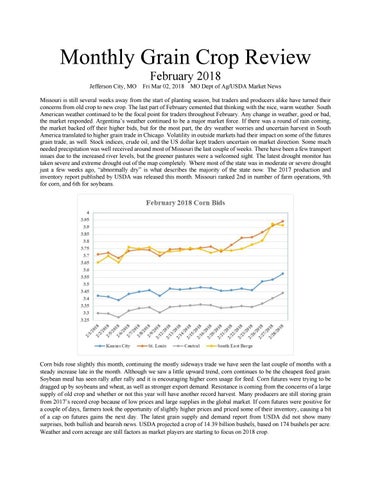
Corn bids rose slightly this month, continuing the mostly sideways trade we have seen the last couple of months with a steady increase late in the month. Although we saw a little upward trend, corn continues to be the cheapest feed grain. Soybean meal has seen rally after rally and it is encouraging higher corn usage for feed. Corn futures were trying to be dragged up by soybeans and wheat, as well as stronger export demand. Resistance is coming from the concerns of a large supply of old crop and whether or not this year will have another record harvest. Many producers are still storing grain from 2017’s record crop because of low prices and large supplies in the global market. If corn futures were positive for a couple of days, farmers took the opportunity of slightly higher prices and priced some of their inventory, causing a bit of a cap on futures gains the next day. The latest grain supply and demand report from USDA did not show many surprises, both bullish and bearish news. USDA projected a crop of 14.39 billion bushels, based on 174 bushels per acre. Weather and corn acreage are still factors as market players are starting to focus on 2018 crop.
As stated above, weather in Argentina has been one of the driving factors for the market this winter. That is quite apparent when looking at the graph above and the steady upward trend in soybeans. Production estimates in South America have been on the decline as crop stress has been increasing each week. According to Buenos Aires Grains Exchange, about 55 percent of the 2017-2018 soybean crop has been damaged due to the dry weather that started three months ago. USDA will be releasing their prospective plantings report at the end of March. Early industry expectations are about 90 million acres, although that number may change as producers take into account how cheap corn is. The higher profitability prospect in soybeans are making some producers take a second and third look at their potential soybean acres. The February WASDE showed another month of negative US soybean news. USDA estimate from 470 million bushels in January to 530 million bushels for February. The soybean meal market was pushed to new highs as soybean production estimates in South America have been on the decline.
*Missing data is due to elevators in that area not receiving wheat at that time. Some uneven trade, but an overall upward trend was received by the wheat markets in February. Precipitation reached parts of Oklahoma, Kansas, and Nebraska, where it was greatly needed. Wheat fields around Missouri were able to green up from the rain that was a welcomed sight. USDA projects 2018 wheat production at 1.84 billion bushels, but that is excluding any potential losses from dry conditions on the southern plains. Spillover from a strong soybean market has helped pull wheat bids upward.
*Sets of data for the graphs are from the Missouri Grain Cash Bids report that is published daily. Only dates in which markets are trading are represented. Source: MO Dept of Ag/USDA Market News Service, Jefferson City, MO Caroline Tyler-Carter, Market Reporter, (573)751-5618