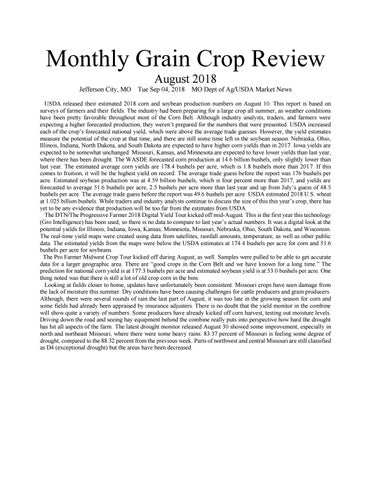
Monthly Grain Crop Review August 2018 Jefferson City, MO Tue Sep 04, 2018 MO Dept of Ag/USDA Market News USDA released their estimated 2018 corn and soybean production numbers on August 10. This report is based on surveys of farmers and their fields. The industry had been preparing for a large crop all summer, as weather conditions have been pretty favorable throughout most of the Corn Belt. Although industry analysts, traders, and farmers were expecting a higher forecasted production, they weren’t prepared for the numbers that were presented. USDA increased each of the crop’s forecasted national yield, which were above the average trade guesses. However, the yield estimates measure the potential of the crop at that time, and there are still some time left in the soybean season. Nebraska, Ohio, Illinois, Indiana, North Dakota, and South Dakota are expected to have higher corn yields than in 2017. Iowa yields are expected to be somewhat unchanged. Missouri, Kansas, and Minnesota are expected to have lower yields than last year, where there has been drought. The WASDE forecasted corn production at 14.6 billion bushels, only slightly lower than last year. The estimated average corn yields are 178.4 bushels per acre, which is 1.8 bushels more than 2017. If this comes to fruition, it will be the highest yield on record. The average trade guess before the report was 176 bushels per acre. Estimated soybean production was at 4.59 billion bushels, which is four percent more than 2017, and yields are forecasted to average 51.6 bushels per acre, 2.5 bushels per acre more than last year and up from July’s guess of 48.5 bushels per acre. The average trade guess before the report was 49.6 bushels per acre. USDA estimated 2018 U.S. wheat at 1.025 billion bushels. While traders and industry analysts continue to discuss the size of this this year’s crop, there has yet to be any evidence that production will be too far from the estimates from USDA. The DTN/The Progressive Farmer 2018 Digital Yield Tour kicked off mid-August. This is the first year this technology (Gro Intelligence) has been used, so there is no data to compare to last year’s actual numbers. It was a digital look at the potential yields for Illinois, Indiana, Iowa, Kansas, Minnesota, Missouri, Nebraska, Ohio, South Dakota, and Wisconsin. The real-time yield maps were created using data from satellites, rainfall amounts, temperature, as well as other public data. The estimated yields from the maps were below the USDA estimates at 174.4 bushels per acre for corn and 51.6 bushels per acre for soybeans. The Pro Farmer Midwest Crop Tour kicked off during August, as well. Samples were pulled to be able to get accurate data for a larger geographic area. There are “good crops in the Corn Belt and we have known for a long time.” The prediction for national corn yield is at 177.3 bushels per acre and estimated soybean yield is at 53.0 bushels per acre. One thing noted was that there is still a lot of old crop corn in the bins. Looking at fields closer to home, updates have unfortunately been consistent. Missouri crops have seen damage from the lack of moisture this summer. Dry conditions have been causing challenges for cattle producers and grain producers. Although, there were several rounds of rain the last part of August, it was too late in the growing season for corn and some fields had already been appraised by insurance adjusters. There is no doubt that the yield monitor in the combine will show quite a variety of numbers. Some producers have already kicked off corn harvest, testing out moisture levels. Driving down the road and seeing hay equipment behind the combine really puts into perspective how hard the drought has hit all aspects of the farm. The latest drought monitor released August 30 showed some improvement, especially in north and northeast Missouri, where there were some heavy rains. 83.37 percent of Missouri is feeling some degree of drought, compared to the 88.32 percent from the previous week. Parts of northwest and central Missouri are still classified as D4 (exceptional drought) but the areas have been decreased.
August 2018 Corn Bids 3.9 3.85 3.8 3.75 3.7 3.65 3.6 3.55 3.5 3.45 3.4 3.35 3.3 3.25 3.2 3.15 3.1
Kansas City
St. Louis
Central
South East Barge
The average corn price for August was 3.51, only a penny more than July’s average corn price in Missouri. There was not very much green on the board for corn throughout August, except for the spike the last day of the month and bids closed about a dime higher. This was strangely similar to last year’s ten to fifteen cent jump on the last day of August 2017. The slight increase at the beginning of the month was due to the increased export demand numbers, as well as the slight downgrade that USDA gave to crops on August 7 in the Crop Progress Report. The latest Crop Progress report shows Missouri’s corn condition is rated 29 percent good to excellent, compared to 67 percent at a national level. As explained above, corn bids fell after the WASDE report and kept feeling the pressure throughout the month. Some technical buying and selling caused a couple of bounces, but the overall trend was lower. Rain in the Midwest increased pressure on the markets, but at this point, moisture was not really a factor in helping out Missouri’s yields. Gro Intelligence maps (from the DTN/The Progressive Farmer 2018 Digital Yield Tour) of Missouri showed average corn yields ranging from 59 to 138 bushels per acre. Excessive heat and lack of rain caused pollination issues. In some areas, corn yields started from zero because the fields have already been cut for silage. Places that have gotten some moisture increased the corn yield estimate.
August 2018 Soybean Bids 9 8.9 8.8 8.7 8.6 8.5 8.4 8.3 8.2 8.1 8 7.9 7.8 7.7 7.6 7.5
Kansas City
St. Louis
Central
South East Barge
Soybean bids had quite a volatile month. The average Missouri soybean bid was 8.32. However, the vast majority of soybean bids were below the eight dollar mark as we closed out August. Grain markets usually decline as harvest approaches, but there were some other factors that also contributed. The big drop off on August 10 was from the estimated production numbers from USDA. There were a few jumps due to increased positive trade talks, especially after the bearish WASDE report on August 10. Markets got excited about potential trade talks then fell when there was a hint of negotiation taking too long. Traders were discussing the potential for increased non-Chinese demand, due to the cheap prices in the United States. A talking point that was confirmed the last part of August was the $1.65 per bushel on fifty percent of production to farmers to offset some of the negative effects of the Chinese sanctions against U.S. soybeans. However, the trade issues, favorable weather conditions at a national level, as well as the large potential crop have continued to pressure the market. The latest crop progress report rated 43 percent of Missouri soybeans good to excellent, compared to 66 percent at the national level.
August 2018 Wheat Bids 5.9 5.8 5.7 5.6 5.5 5.4 5.3 5.2 5.1 5 4.9 4.8 4.7 4.6 4.5
Kansas City
St. Louis
Central
South East Barge
Volatility from the soybean market spilled over into the wheat market throughout August. The average Missouri wheat bid was 5.30, slightly higher than July’s average of 5.27. Wheat bids spiked mid-month due to news about Russia considering decreasing exports. This caused notions of U.S. wheat gaining some demand due to the lower production overseas. The EU crop monitoring service decreased their yield forecasts by 1.7 bushels per acre to 84.8 bushels per acre. This was largely due to the hot, dry weather they have received the last several weeks.
*Sets of data for the graphs are from the Missouri Grain Cash Bids report that is published daily. Only dates in which markets are trading are represented. Source: MO Dept of Ag/USDA Market News Service, Jefferson City, MO Caroline Tyler-Carter, Market Reporter, (573)751-5618