The Hyperloop Project, Improved with Powerful and Reliable Electronics - Moises Seraphin
Download PDF Copy
View Supplier Profile
Request Quote
Sponsored by Moises Seraphin Feb 5 2019
The Hyperloop is a proposed form of transport infrastructure that would revolutionize travel. The Hyperloop would make the sci-fi vision of traveling in a tube a reality and is expected to be much faster and more efficient than any existing form of transport for journeys of around 2,000 km. Many futurologists are welcoming the advent of the Hyperloop, with Tesla’s Elon Musk being a key advocate for the technology.

Image Credits: g/petrmalinak/Shutterstock.com
For the Hyperloop project to work the pods used in the system must be able to rapidly and efficiently accelerate. Stäubli was present in this year’s Hyperloop Pod Competition, where their modular, high-current connectors were a key component in one team’s attempt to design and build the fastest Hyperloop capsule yet.
The Hyperloop as a concept was the brainchild of Elon Musk. The Hyperloop would be an entirely new form on transport infrastructure, based around the propulsion of a capsule within a vacuum-tight sealed tube. Whilst the idea sounds absurdly futuristic the principle is quite similar to that of an enclosed train, the only significant difference being the presence of a vacuum.
The vacuum means that the drag from air resistance is significantly reduced allowing extremely high speeds (of up to 1220 km/h) to be reached at good efficiencies.1
Elon Musk’s SpaceX company, which specializes in aeronautics, hosted the third Hyperloop Pod Competition in the Summer of 2018. The competition involves engaging international teams in the design and construction of the pod to be used in the Hyperloop.2
Only student teams can participate in the challenge and, as a new addition to this year’s challenge, the teams must also design a thrusting platform to propel the pod.3
The inclusion of a high-power thrusting platform into the design was a big challenge as it requires the construction of an entirely different, high-performance system to work alongside the pod. To generate the velocity required the thruster must be able to rapidly receive high volumes of electrical power, thankfully this is possible using connectors from Stäubli.
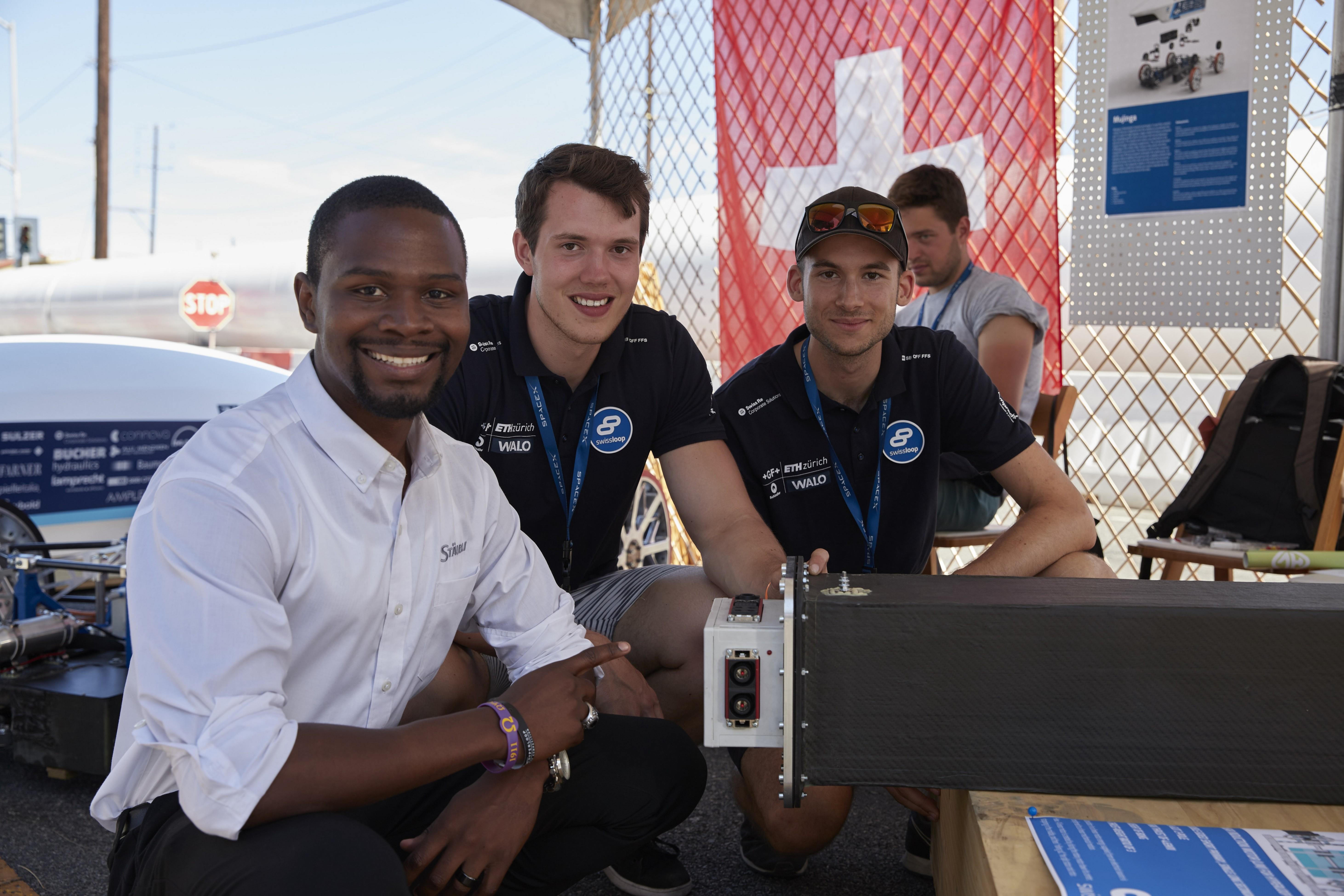
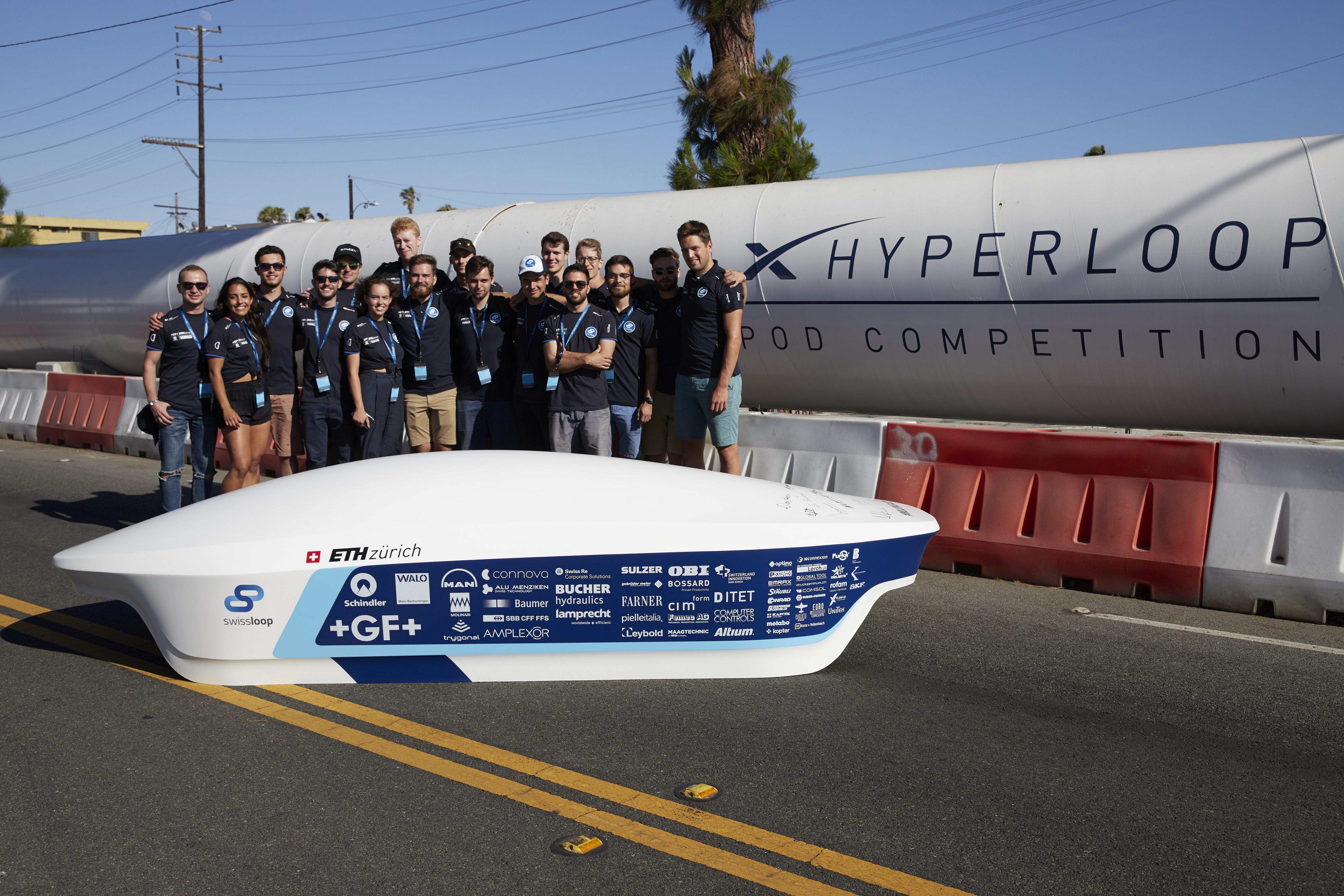
Swissloop; a Swiss team of 20 mechanical, electrical and civil engineering students; were competing in the challenge. Their 2018 capsule entry used Stäubli’s CombiTac to power their bespoke pod propulsion system.
Swissloop was not new to the competition. The year before they had entered the competitions 2017 round and won third place, in front of the other 1,200 competitors, and they had hoped to improve even further on this performance in the 2018 competition.
Their 2017 design, which they named Escher, used a cold-gas thruster to propel the 240 kg pod to the top speed. This thruster was the first ‘rocket style’ design approved by SpaceX in the competition.4 In the 2018 competition, the key to winning is being the fastest. To help achieve this Swissloop are going to use a high-power electrical thruster.
Swissloop’s new design will incorporate multiple different electrical systems for roles such as sensing and stabilization, and propulsion. For these systems to work as they are required to, they must have reliable and efficient power sources. Stäubli is a proud component supplier to Swissloop, providing the project with high-performance connectors for the rapid, powerful and efficient transfer of electricity to the pods.
High Performance Connectors for the Hyperloop
Swissloop needs connectors for a wide range of different functions within the pods including the transmission of data and signals, power transfer, and fluid transfer; and all as quickly and efficiently as possible. In addition, the design constraints placed on the pod mean that space is extremely limited, the connectors must be fire-safe and weight needs to be kept to a minimum.
The modular CombiTac connector, provided by Stäubli, could meet all of these needs, providing various connector options suitable for almost any application.5
As a huge volume of power needs to be supplied to the thruster to achieve the pod velocities required the connectors used by Swissloop must be extremely efficient. Stäubli’s novel MULTILAM technology can meet this challenge.
MULTILAM electrical connectors form an extremely tight seal with each other, using spring-loaded contacts to connect to one another.
Related Stories
Race to Zero Emissions in Mining
Stäubli and partners complete North America’s first mechanized large scale port EV charging program
What are Autonomous Mobile Robots and Guided Vehicles?
The total contact surface area is a key parameter when making electrical connections. A small contact area means that all of the current is being forced through a bottleneck, which results in an extremely high current density, which in turn means that the electrical resistance is also very high; resulting in a low electrical efficiency. This inefficient exchange is obvious to anyone who has ever jump-started a car battery using crocodile clips – where the small contact area can result in crackling noises and sparks flying out.
A high resistance is not only inefficient, it can also be dangerous as it can result in the components heating to extremely high levels.
The MULTILAM connectors produced by Stäubli have a large contact area and fit together tightly and uniformly to ensure that the connection produces an efficient flow of electricity at safe temperatures.
Swissloop and Stäubli worked together on a unique, all-in-one solution for the new pod which was safe for the application whilst also being small and light enough to fit within the competition’s design constraints.
Stäubli is proud that a novel version of their CombiTac system now connects the battery power and the thruster of the propulsion system in Swissloops system; where it plays the vital role of supplying the large power volumes required to propel the pod to high speeds.